




Abstract
This study aimed to investigate the effects of manipulating ball possession directionality (i.e., NO direction, MULTI direction or ONE direction) on the physical, tactical and technical performance of youth football players during small-sided games (SSGs). A total of 18 male youth football players (age: 13.6 ± 0.4 years) participated in four testing days, where they completed three random order experimental tasks based on a 4vs4 SSG: (i) NO direction, where players performed a ball possession task without a specific direction to progress; (ii) MULTI direction, where two neutral players were added to the top of each pitch and players could use them to maintain possession; and (iii) ONE direction, where each team defended and scored in two small goals placed at opposite ends of the pitch. In the positioning perspective, the NO condition showed a higher spatial exploration index than the other two conditions (p = .001), while higher distance to the nearest teammate was identified in the MULTI (p = .007) and to the nearest opponent in the ONE (p < .001). In the physical variables, higher game pace (p = .002), total distance covered (p < .001) and jogging distance (p < .001) were identified in the MULTI than the other conditions. Lastly, from the technical perspective, players revealed better passing decision-making (p = .004) in the ONE than NO or MULTI conditions. Based on these results, coaches may use NO condition to emphasize space exploration, MULTI to increase external load and game pace, while ONE to emphasize technical actions related to ball control and pass.
Introduction
The success of team performances in sports like association football relies heavily on both their defensive and offensive behaviours. Teams adopt a compact defensive structure when they do not have possession of the ball, often applying collective pressure on the opposition to decrease space and time. This collective approach has been shown to be effective in limiting the opposing team's ability to create scoring opportunities. 1 In contrast, when a team is in possession of the ball, the intention is to create space and progress on the field to create goal-scoring opportunities. The ability to create such opportunities is often related to the offensive method adopted by the team, which can be either counterattack or progressive possession.2,3 The counterattacks and the fast attack were used by many teams for decades. These offensive methods make use of the opposing team's defensive unbalance to create a fast progression on the pitch. This strategy often involves a few numbers of players and passes before a shot is made.4,5 The success of possession-based styles, such as those employed by Barcelona, Manchester City and the Spain national team, has led to a shift in offensive paradigms from the previously dominant counterattack approach. As a result, there has been a growing focus on researching ball possession strategies over the last decade.6–10 For example, Lago-Peñas et al. 11 discovered that ball possession was among the performance indicators associated with team success in Spanish La Liga during the 2008/09 season. Higher-ranked teams are able to maintain possession for longer periods, particularly in the opponent's offensive half, compared to their lower-ranked counterparts during the final phase of the UEFA Euro 2016 France. 7 Given the findings of such research, which suggest that a progressive possession style is linked to team success, 3 it is crucial to investigate which training tasks can enhance players’ ability to maintain possession.
Training sessions in association football have the goal of preparing players tactically, technically, physically and psychologically to compete while promoting collective movement coordination.12,13 This coordination is based on players’ ability to simultaneously perceive and act upon the same information. 14 The available information from the environment creates opportunities for action, known as affordances, 15 which are dynamically changing due to the movement of teammates, opponents and the ball. 16 From a practical point-of-view, during the development of an offensive sectorial task intended to promote the team's ability to build up using a progressive possession style of play, it is possible that a central defender receives the ball and has a potential penetrative pass to an offensive midfielder at first. However, this passing line may become covered by the opposition if the central defender holds the ball for too long, forcing them to explore alternative passing options. This example highlights how information and time can guide players’ decisions. Therefore, coaches must design training tasks that develop the team's tactical behaviour based on collective principles while also fostering players’ ability to adjust their positioning based on local information. This perspective is essential for coaches of not only elite players but also youth players to ensure proper development,17,18 and increase their chances of attaining a successful career.
The use of small-sided games (SSGs) has been proposed as an effective approach to enhance the performance and environmental attunement of young football players. 19 A recent study investigated the impact of task structure on subsequent game performance of youth football players, comparing a prescriptive passing task, ball possession in a square without opposition and a ball possession game (3 vs. 3 + 2 neutral players). 20 The study revealed that the ball possession task resulted in a higher transfer effect to the subsequent game, especially in the players’ ability to identify teammates in more advanced positions. Additionally, SSG allows coaches to simultaneously develop multiple training factors (i.e., tactical, technical, physical and psychological), with an emphasis that may vary depending on the task's boundary conditions.21,22 As players’ decision-making is often guided by local information, different rules can emphasize distinct information and direct players towards adaptive movement patterns.22–24 Thus, it is essential for coaches to understand how different rules impact the performance of young players during tasks aimed at improving their ability to maintain possession.
Frequently, coaches incorporate ball possession exercises into their training programs to enhance players’ ability to maintain ball control, as opposed to focusing solely on scoring goals. In this context, several studies have been conducted to investigate how varying rules affect young players’ performance during ball possession games. For instance, Nunes et al. 25 conducted a study to investigate how different playing area dimensions (i.e., 20 × 15 m, 25 × 20 m and 30 × 25 m) and player numbers (i.e., 4v3, 4v4 and 4v5) influenced the performance of under-11 (U11), under-15 (U15) and under-23 (U23) players during SSG. The researchers found that larger playing areas resulted in players covering greater distances at higher intensities, while the players’ technical actions decreased when playing in inferiority compared to balanced or superiority situations. In a similar vein, Evangelos et al. 26 found that under-17 players (U17) performed more passes when playing in superiority during 3vs3 and 4vs4 with a floater during ball possession games. Although these studies suggest that pitch size and player numbers are important factors to consider when designing ball possession tasks, it is also important to consider how directionality can impact player performance. While ball possession games can induce higher physical stimulus and promote more technical actions, such as passing, than SSG with goalkeepers,27,28 the lack of game directionality (i.e., providing a direction whether to attempt to conquer space as in regular competition) may limit the players’ tactical development. One study, for example, examined the impact of game directionality on physical performance in under-13 (U13) players. Accordingly, it was performed a game without direction (i.e., ball possession), a game with one direction (i.e., both teams scoring in one goal), a game with two goalkeepers and multi-direction (i.e., the team in possession could score in both goals) and a game with one direction per team (i.e., each team defended and scored in one goal). 29 The authors of the previous study found that the absence of direction contributed to higher physiological stimulus. However, it is important to consider how directionality may also affect players’ technical actions and positioning to gain a more comprehensive understanding of its effects. For example, developing players’ ability to stay on the ball without the risk of losing it and conceding a goal may compromise player’ development and affect the transfer of his skills towards competitive settings. That is, during ball possession tasks without direction or with multi-direction, losing the ball may have the only effect of changing from offense to defense, without any other effect. Consequently, it may not help the players to understand the risk and reward of each pass according to the pitch location (e.g., deciding whether to keep possession in zones further from the goal, where, when losing they have space and time to adjust; or attempting to stay on possession in defensive zones to attract the opposing team to then move forward, which may enhance chances of progression but also the risk of losing the ball). As a result, this study aimed to investigate the impact of manipulating ball possession directionality (i.e., NO direction, MULTI direction or ONE direction) on the physical, tactical and technical performance of youth players during SSG. It was hypothesized that: (i) SSG without any direction would lead to higher space exploration to increase distance to opponents’ and amplify opportunities to stay on the ball; (ii) SSG performed with multi-direction would increase the external load as result of attempting to move from one side of the pitch to the other; (iii) SSG performed with direction may emphasize technical actions and the distance between players from confronting teams as result of mission's definition (i.e., attacking and defensive teams).
Methods
Participants
Participated in this study a total of 18 youth football players (age = 13.6 ± 0.4 years; height = 168.1 ± 9.6 cm; weight = 52.3 ± 8.3 kg; football experience = 6.7 ± 1.8 years, belonging to a total of seven clubs most representative from the region) from a U14 regional selection team (i.e., local football association that select the best players from the local clubs according to their technical, tactical, physical, perceptual and social skills for a specific age group to participate in a national tournament). All players participated in a regular three training sessions per week in their clubs (90-min on average for each training session), while playing an official 11vs11 match in the weekend. Additionally, six extra players participated as neutral floaters during one condition of the experimental design; however, their data were excluded from the present analysis as result of not being involved in all game-based conditions. An informed and written consent were provided to all involved, namely: (i) the players and their legal tutors; (ii) the regional association; and (iii) the clubs and coaches representing the players, serving as gatekeepers for their participation. All players were informed that they could withdraw the study collection at any time without any negative consequence. The study protocol adhered to the guidelines of the ethics committee of the local university and the recommendations of the Declaration of Helsinki.
Study design
Two balanced teams of four players were created by the head coach on each testing session according their tactical, technical, physical and perceptual skills. 30 To explore the effects of varying the ball possession direction, players’ were exposed to three experimental conditions (see Figure 1): (i) no-direction (NO), consisting in a regular ball possession game of 4vs4, where the team in possession was awarded with one point when performing 10-passes31,32; (ii) Multi-direction (MULTI), where two neutral players’ were added outside the pitch in the longitudinal direction to provide support; however, it was included the rule that after the ball being played by one team to one neutral player, during that possession, it was only allowed to play with the same neutral player after the ball being passed to the other neutral player. In addition, the same 10-passes awarded was considered; (iii) One-direction (ONE), in which the teams played 4vs4 with the main aim to scoring in two small-goals placed on the longitudinal end line of each team, conferring a specific direction. In this condition, players were awarded with one point every time they performed 10-passes or scored a goal.
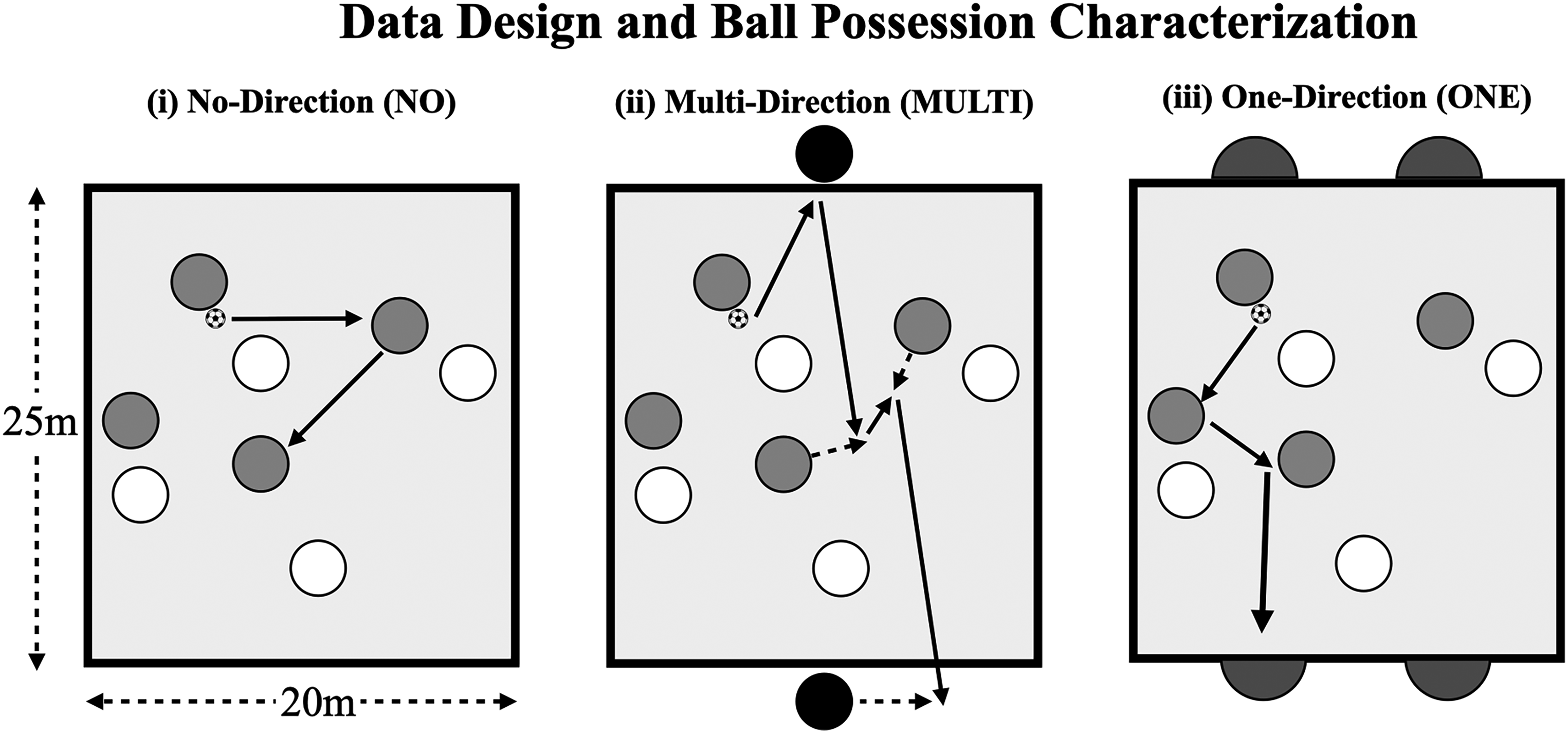
Representation of data design and acute training interventions.
Procedures
A total of four sessions were performed during non-consecutive weeks (i.e., one data collection performed on the same day every two weeks) during the competitive period (January–March from 2022–2023 season). No familiarization session was performed as players were often exposed to these types of tasks during both their club and local association training sessions. On each testing day (n = 4), the teams were kept constant and exposed to all conditions in a random order (i.e., on the first day, players’ may have performed the MULTI, followed by NO and ended with ONE, while on the second day, performing the ONE, followed by the NO and ending with the MULTI). However, to guarantee a higher data generalization, the teams were modified between testing sessions. This means that players were exposed to four testing days, and in each session performed one bout of each of the three conditions (i.e., NO, MULTI and ONE). Each session began with a standardized 15-min warm-up consisting of running and mobility-based movements and ending with a possession game (4-a-side without goals). Following the warm-up, players were exposed to the testing situations. Each SSG was performed on a 25 × 20 m pitch size artificial turf pitch (length × width ratio = 1.25). 25 Each bout consisted of a 5-min duration, interspersed by a 3-min passive rest period. 33 To decrease the time that the ball spent out of play, several balls were strategically placed near to the pitch external lines. In addition, and to avoid possible effects on the players’ behaviour, no coach feedback nor encouragement was allowed. The distinct nature of the ball possession in comparison to the official match forced to adapt some rules. For example, the game restarted with a pass from one player in the end line when the ball when out of play, while a regular throw-in was used when the ball went out of play by the sidelines.
Data collection
Physical and tactical performance
The players’ positioning data and physical performance during the conditions were collected using 10 Hz global positioning system (GPS) units (10 Hz, Accelerometer 1 kHz, FieldWiz, Paudex, Switzerland). These trackers have shown good level of accuracy for measuring movements and displacements in team sports. 34 The players’ latitude and longitude information captured with the GPS units were resampled to remove possible gaps within the data and to allow the synchronization of all individual data. After, the data were converted to meters using the Universal Transverse Mercator coordinate system.
The dynamic positional data from the players were used to calculate the distance between each player with the nearest teammate and nearest opponent21,24 taking into consideration the absolute values expressed in meters (m), the variability in those distances expressed by the coefficient of variation (CV) and the regularity of those distances expressed in arbitrary units (a.u.) using the approximate entropy approach (ApEn). The ApEn technique is often used to understand the structure of variability within a time series, and the values imputed to allow its calculation were 2 to vector length (m) and 0.2*std for the tolerance (r). 35 This technique returns values ranging from 0 to 2 a.u., in which, values close to 0 indicate a higher regularity (e.g., the two players’ from the same team maintain a regular distance across the time), whereas values close to 1 indicates a higher irregularity. 24 Additionally, the spatial exploration index (SEI) was calculated as it provides a perspective on the amount of space explored by each player during the tasks. 23
From the physical perspective, it was processed the total distance covered, and distance covered by the players at different speed zones were in accordance to the following thresholds adopted by previous studies analyzing SSG with youth players22,36: (i) total distance covered; (ii) distance covered while walking (0.0–3.5 km/h); (iii) jogging (3.6–14.3 km/h); (iv) running (14.4–19.8 km/h) and (v) sprinting (>19.9 km/h). In addition, also the players’ average speed (m/s) were considered to understand the game pace.
Ball control and passing execution and decision-making (GPET)
The game situations were recording using one digital video camera (Panasonic NV-GS230) aligned with the central section of the pitch at a height of 2-m, allowing to have a proper and wide view of the pitch. The Play (Metrica sports software, version 2.20.2) was used to tag the players’ ball control and passing actions according to a computerized notational analysis process.
The Game Performance Evaluation Tool GPET 37 was used to analyze the players’ ball control and passing execution and decision-making skills. This instrument allows to understand how players’ decision-making and execution varies according to training interventions and task manipulations in youth football players.20,37–40 As regards to decision-making, GPET considers the adequateness of the players’ selected response taking into consideration the local information, such as teammates and opponents’ positioning. 37 The analysis of execution is grounded on how successful or unsuccessful the action was performed. To measure these behaviours, players were coded as 0 when the decision-making or execution was not appropriate (e.g., not being able to receive the ball or failing to pass to a target teammate) or as 1 (e.g., receiving properly the ball that may allow to perform subsequent actions, while achieving the target teammate during a pass). 37
Complementarily, additional technical criteria were included for both the ball control and passing action for ref see. 20 Accordingly, the ball control was also coded as: (i) ball in the motor space, which analyses whether the player is able to receive the ball within a close motor space that allows to stay in possession; (ii) body orientation, which explores whether the player received the ball oriented to the space (e.g., space that allows to maintain possession); and (iii) appropriateness, which refers adjusting the way how the ball is received, and that focus if the player uses the appropriate surface to control the ball (e.g., using the furthest foot). For the passing behaviour, players’ actions were coded as: (i) free from opposition, that focus whether the player is able to identify teammates that are unmarked, contributing to increase their space and time for decision-making when receiving the ball; and, (ii) Rhythm and tempo, which analyses whether the pass is performed with the right direction and speed according to the target teammate movement. The GPET variables were expressed as the percentage of successful related decisions over the total number of actions performed (e.g., the motor execution for the pass was coded as: successful passes / [successful passes + unsuccessful passes]). 41
A total of 1334 actions were recorded (ball control motor execution n = 476; passing behaviour motor n = 858). The players’ decision-making and execution during SSG were coded the one expert analyst with more than 10 years of experience in training and match analysis. From the total sample, 10% was reanalyzed to analyze the intra-observer correlation,20,42 and the values ranged from 0.85 to 0.93 (Kappa values ranging from 0.64, substantial agreement for passing to free teammate, to 0.91, near perfect agreement for passing execution and ball control) in the different categories. Overall, these values are deemed as high and similar to the thresholds found in previous studies. 37
Statistical analysis
Descriptive data were presented as mean (M) and standard deviation for data revealing normal distribution, while median (Me) and interquartile range for data that revealed non-normal distribution. The data were also tested for outliers and the Shapiro–Wilk test was used to inspect the assumptions of normality. As result of existence of normal and non-normal data distribution, it was adopted parametric (Repeated measures analysis of variance [ANOVA]) and non-parametric tests (Friedman ANOVA) for each game comparison. Additionally, pairwise differences between the task conditions (NO vs MULTI; NO vs ONE; MULTI vs ONE) were assessed using the Bonferroni post hoc test for data revealing a normal distribution, while the Durbin-Conover for data that was non-parametric. Statistical significance was set at p < .05, and calculations were performed using the Jamovi Project (Computer Software Version 1.2. 2020). Furthermore, differences in means with 95% confidence limits (raw data) and Cohen's d as the effect size (ES) were applied to the pairwise comparison. The thresholds for ES statistics were as the follows: 0.0–0.19 (trivial); 0.20–0.49 (small); 0.6–1.19 (moderate); 1.2–1.9 (large); and ≥2.0 (very large). 43
Results
Descriptive and inferential statistics from the physical and positioning performance between experimental tasks
The aim of Table 1 and Figure 2 is to present the descriptive and inferential effects of the experimental conditions (NO, MULTI and ONE) on the physical and positioning-related variables. Statistically significant effects were observed in both the positional and physical variables. For the positional variables, a statistically significant effect was found for the SEI (F = 8.96, p = .001), where the NO condition showed moderate higher values than the MULTI (p = .012) and ONE (p = .01) conditions. Additionally, statistically significant effects were found in the distance to the nearest teammate absolute values (χ2 = 10.0, p = .007) and CV (F = 6.02, p = .008), as well as in the distance to the nearest opponent absolute values (χ2 = 15.2, p < .001) and CV (F = 3.3, p = .031). The NO condition presented small to moderate lower values in both the distance to the nearest teammate absolute values MULTI (p = .003) and ONE (p = .003), while in turn moderate lower in the CV of the distance to the nearest teammate than ONE (p = .05). Similarly, the NO condition also revealed small-to-moderate lower values in the distance to the nearest opponent absolute values when compared to MULTI (p = .002) and ONE (p < .001). Furthermore, the MULTI also showed small lower values than the ONE (p < .017), while the NO condition revealed small lower values than the MULTI condition (p = .05).
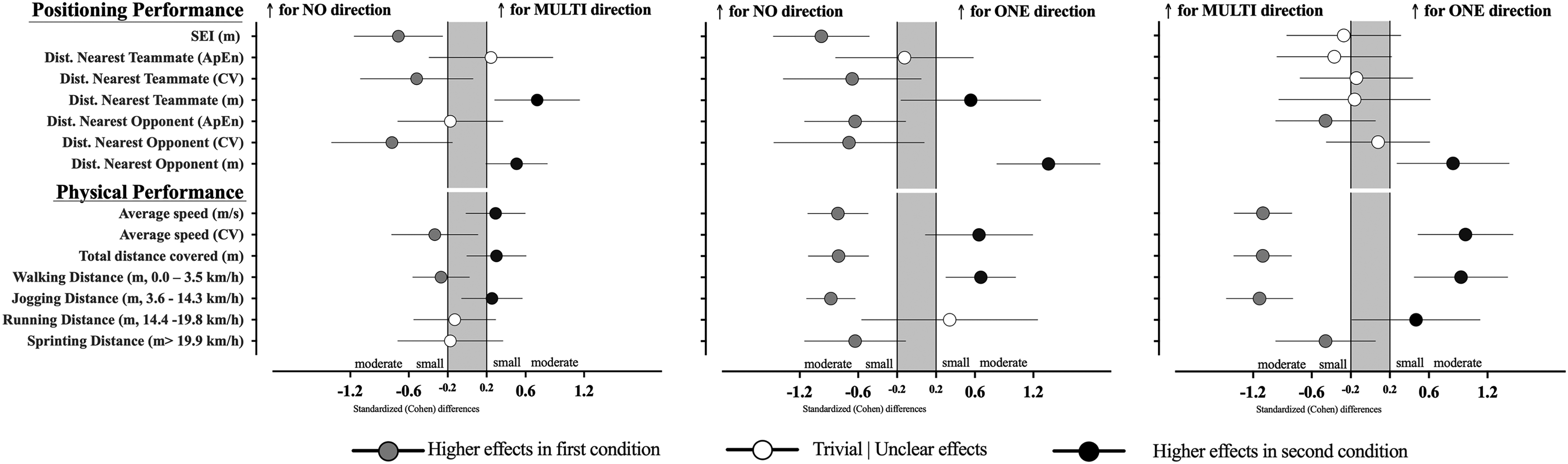
Standardized (Cohen's d) differences in positioning and physical performance related variables according to the different SSG conditions. Error bars indicate uncertainty in the true mean changes with 95% confidence intervals.
Descriptive (M ± DP) and inferential statistics from the experimental tasks according to the conditions (NO, MULTI and ONE) for the physical and positioning related variables.
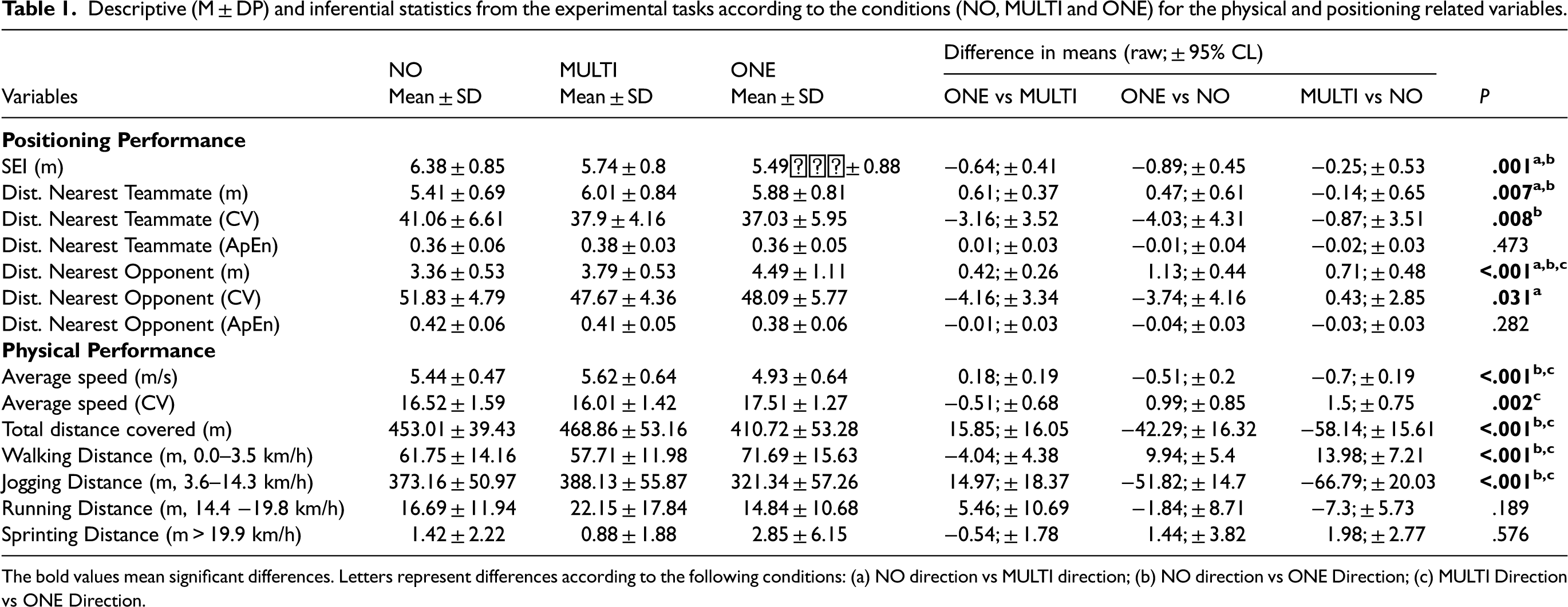
The bold values mean significant differences. Letters represent differences according to the following conditions: (a) NO direction vs MULTI direction; (b) NO direction vs ONE Direction; (c) MULTI Direction vs ONE Direction.
In terms of the physical variables, statistically significant effects were identified in all variables except running and sprinting distances (average speed, F = 26.4, p < .001; average speed CV, F = 7.81, p = .002; total distance covered, F = 26.5, p < .001; distance covered while walking, F = 12.3, p < .001; and distance covered while jogging, F = 35.1, p < .001). Players showed small-to-moderate higher average speed than the NO (p = .001) and ONE (p < .001) conditions. In turn, moderate higher values for the CV from the average speed were found in the ONE than in the MULTI condition (p = .004). Both the NO and the MULTI showed moderate higher values of total distance covered (p = .002 and p < .001 for the NO and ONE, respectively) and distance covered while jogging (p < .001 and p < .001 for the NO and ONE, respectively) than the ONE condition. The MULTI condition showed moderate lower values in the distance covered while walking than both the NO (p < .001) and ONE (p < .001) conditions.
Descriptive and inferential statistics of the ball control and passing decision-making and execution performance between experimental tasks
Table 2 and Figure 3 present the descriptive and inferential effects of the experimental conditions (NO direction, MULTI direction and ONE direction) on ball control and passing performance, as measured by the GPET tool. The results indicate that passing decision-making was the only outcome with statistically significant effects (χ2 = 11.1, p = .004). Specifically, passing decision-making was found to be small to moderately higher in the ONE condition than in the NO (p = .002) and MULTI (p = .004) conditions, respectively. Although there were no statistically significant effects for ball control performance, the ESs allowed for some important inferences. For example, small-to-moderate higher values were observed for passing to a free position in the ONE condition compared to both the NO (ES with 95% of confidence intervals: 0.32 [0.05; 0.59]) and MULTI (0.73 [0.17; 1.29]). The NO condition also showed small higher values than the MULTI condition (−0.33 [−0.76; 0.10]). Regarding ball control performance, there was a trend towards small higher values of appropriateness in the ONE condition compared to the NO (0.52 [0.01; 1.04]) and MULTI (0.25 [−0.14; 0.65]). Additionally, the MULTI condition showed small higher values of appropriateness (0.36 [−0.15; 0.88]) and receiving the ball in the motor space (0.33 [−0.19; 0.84]) than the NO condition.
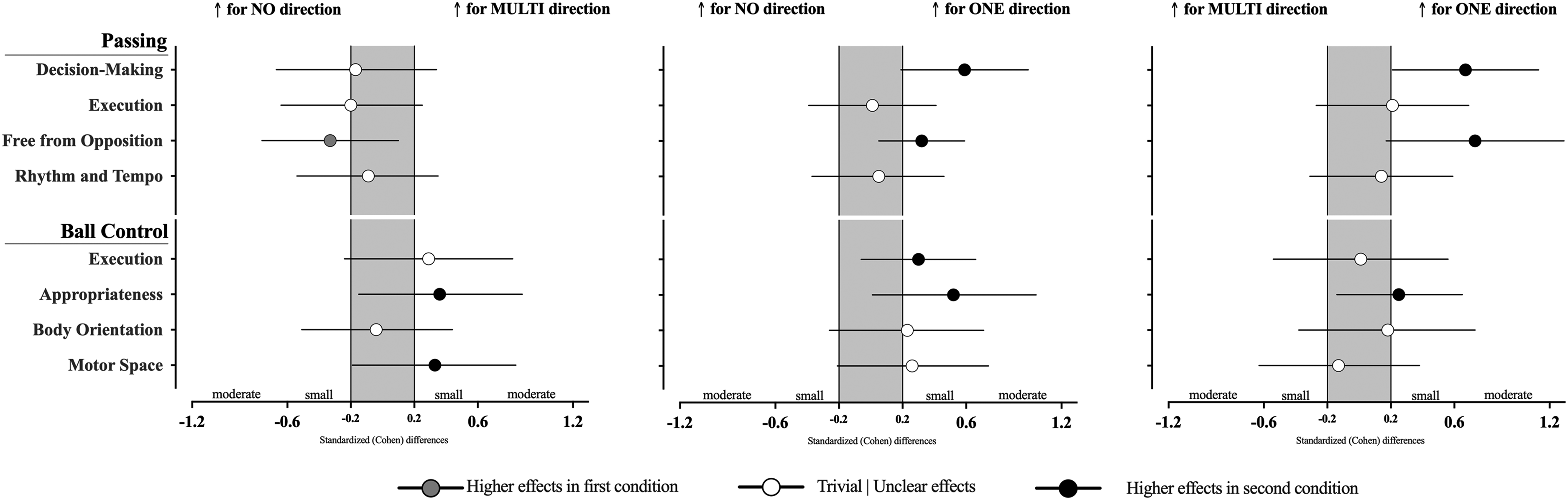
Standardized (Cohen's d) differences in GPET and technical criteria variables according to the different SSG conditions. Error bars indicate uncertainty in the true mean changes with 95% confidence intervals.
Descriptive (Me ± IQR) and inferential statistics from the experimental tasks according to the conditions (NO, MULTI and ONE) for the GPET-related variables.
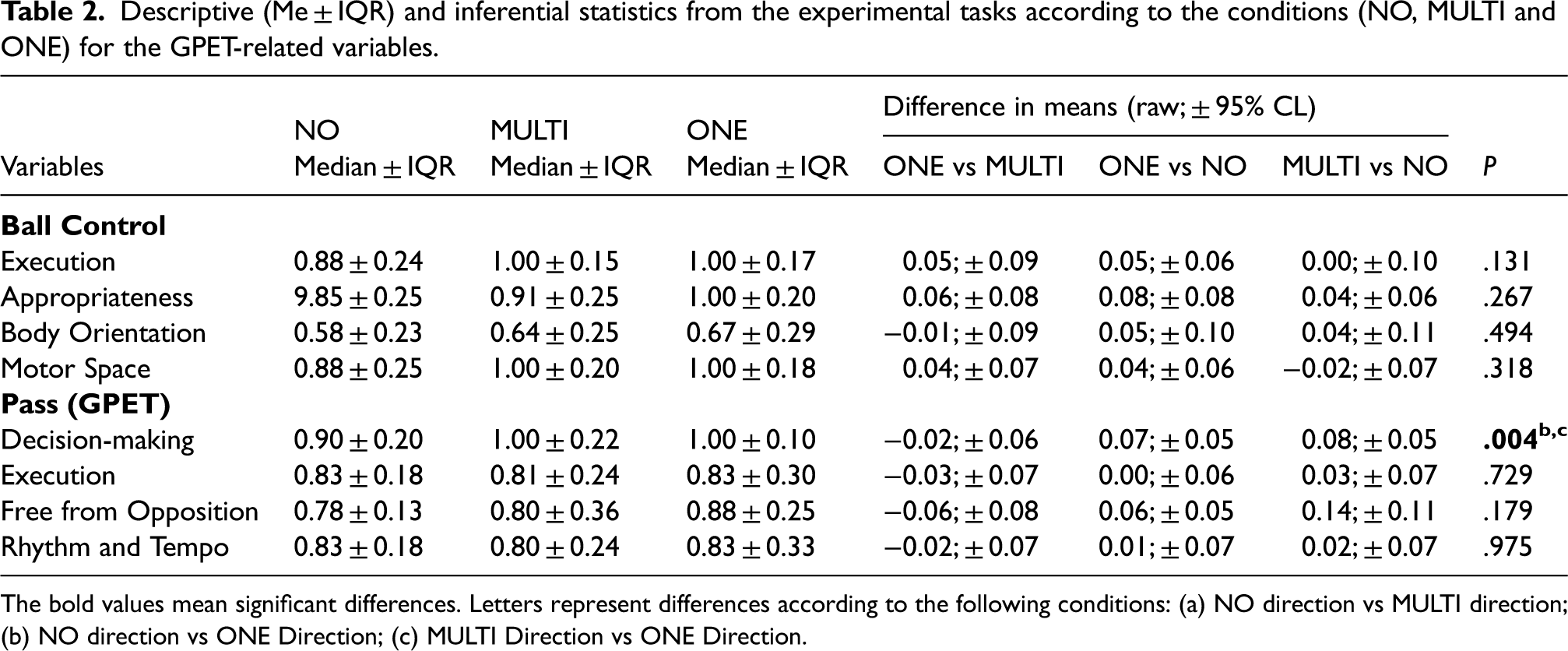
The bold values mean significant differences. Letters represent differences according to the following conditions: (a) NO direction vs MULTI direction; (b) NO direction vs ONE Direction; (c) MULTI Direction vs ONE Direction.
Discussion
This study aimed to investigate how manipulating ball possession directionality (NO direction, MULTI direction or ONE direction) affected the physical, tactical and technical performance of youth players during SSG. Overall, the directionality type had a distinct impact on the different variables studied. Playing without directionality (NO condition) emphasized individual space exploration and resulted in higher variability in the distance between each player and the nearest teammate/opponent. MULTI direction seemed to prioritize game pace, increase players’ external load and decrease the distance between teammates. On the other hand, playing with ONE direction emphasized ball control, passing decision-making and execution, increased the distance to the nearest opponents and decreased players’ external load.
In the design of football practice sessions, coaches typically start with fundamental drills that focus on improving players’ ball skills, spatial awareness and tactical principles,44,45 such as drawing pressure and quickly changing the direction of attack. These drills usually involve ball possession-related tasks and have become increasingly popular in training sessions due to the success of teams that employ a positional play and progressive possession strategy. 3 Studies have shown that these types of tasks increase players’ external load46–48 and lead to longer ball possession durations and more effective technical actions than traditional SSG drills with goalkeepers. 49 However, while there is a wealth of research comparing players’ performance in ball-possession tasks (e.g., maintaining possession, crossing the line, using small goals) versus traditional formats with goalkeepers, there is less knowledge about manipulations related to ball possession tasks. Playing in larger areas is known to contribute to higher distances covered at high intensity and more passing actions performed by players, especially in superiority situations such as 5vs4. 25 However, one important factor that is often overlooked in research is offensive directionality, which refers to the specific direction players are instructed to move in. Only one study has explored how ball possession directionality impacts players’ performance, by comparing four different conditions: (i) ball possession without direction, (ii) a game played with one goal and both teams scoring in that goal, (iii) two goals where each team can attack both goals and (iv) two goals where each team defends and attacks only one. 29 The authors found that ball possession promotes a higher physical stimulus, but allowing both teams to attack both goals (similar to MULTI direction) decreases game intensity and increases shooting efficiency. In the present study, the MULTI direction condition resulted in higher physical loads in terms of average speed, total distance covered and distance covered while jogging, compared to the other two conditions. The main difference between the study of Sánchez et al 29 and the present study is that, in this study, the MULTI direction condition included a neutral player on each end of the pitch to support play, instead of a regular goal with a goalkeeper. As a result, ball possession duration in games played with goalkeepers tends to be lower, as players can easily find scoring opportunities without having to move to support their teammates’ progress, 47 which may be exacerbated in games where teams can score in both directions, as explored by Sánchez et al. 29 In contrast, in this study, the MULTI direction condition corresponded to a situation where two neutral players were positioned at either end of the pitch, and after playing with one neutral player, the team could only play with the other neutral player before playing with the first one again. To this end, it appears that players had to constantly move from one end of the pitch to the other in order to improve their chances of maintaining possession of the ball, thereby increasing the game pace. Meanwhile, the opposing team had to cover greater distances to press the player in possession. The results regarding the distance between players seem to support this finding, suggesting that playing closer together improves the chances of maintaining possession while moving between the two ends. Additionally, defenders may struggle to intercept passes during shorter distance actions and at higher speeds, as noted in previous research. 50 Overall, coaches may consider using the MULTI direction condition during ball possession tasks as a way to encourage players to stay closer together, increase the pace of the game and enhance the external load.
To enhance players’ technical abilities, ball possession tasks are often used. In this study, it was observed that players had a higher proficiency in receiving the ball, making passing decisions and finding open teammates (i.e., those not closely marked by the opposition) during the ONE condition. This was the condition where each team had an additional option to score points besides just maintaining possession. Additionally, a specific direction towards which to progress was granted. The inclusion of goals in the game might have resulted in better team organization as players took on specific positions such as center back, winger or fullback. This led to less exploration of space, resulting in lower external load for the players.29,46,47 Indeed, the ONE condition resulted in lower space exploration, as indicated by the SEI variable, and players covered more distance while walking, leading to a slower game pace compared to the other two conditions. This finding supports the idea that adding goals may have encouraged players to assume specific positions and roles, leading to decreased exploration of space and a subsequent decrease in external load. Moreover, a previous study reported that increasing the number of goals from 1 to 3 per team encouraged the team without possession to defend closely around the target to protect the goal and prompted the use of wider channels to move the ball. 51 While the purpose of this study was not to compare the effects of the number of goals, it is possible that adding two small goals prompted the defensive team to adopt a more conservative position close to their targets in order to protect them. This positioning may have contributed to the greater distance found between each player and the nearest opponent in the ONE condition. From a defensive perspective, players must remain compact and close off the center channel to protect the goal. While speculative, it is likely that the offensive team occupied the wider channels in order to have more space to operate, 51 contributing to such increase in the distance between players of the confronting teams. However, as player performance was not measured with and without possession in this study, this remains untested. Furthermore, the increased distance between players and opponents in the ONE condition may have given players more time to make decisions and execute motor skills, which could explain the better ball control and passing performance. Another study that aimed to improve players’ ball control and passing performance by using different task structures found that players showed greater improvement when the tasks were more similar to the competitive dynamics of the game. 20 These results suggest that coaches can use the ONE condition to focus on players’ technical skills within a context of higher tactical organization.
Finally, in the NO condition, playing without any specific direction resulted in greater space exploration and higher variability in the distance to the nearest teammate and opponent. This type of ball possession task may encourage players to move freely to create goal-scoring opportunities without worrying about the possibility of losing possession, which could result in a conceded goal. Without possession, players may focus on following the ball rather than protecting a specific area. In contrast, defending with at least one goal to protect may force the defender to maintain a position between the attacker, the ball and the goal. As a result, in ball possession tasks, players may occupy zones that they typically would not cover in a more organized tactical structure, contributing to greater variability in the distance to both teammates and opponents. In other words, the absence of a specific aim in the NO condition may result in players exploring more space and having more freedom, leading to a greater range of distances to their opponents and teammates. Coaches may utilize this type of task to emphasize the exploration of space and center of play principles under less complex tactical structures.
This study provides valuable insights for coaches and sports scientists on the significance of directionality in ball possession tasks. Despite its innovative nature, some limitations need to be acknowledged. Firstly, the second task was performed with additional two floaters, and thus, players were exposed to the cumulative effects of changing direction and number of players. Thus, future studies may create two offensive scoring zones (i.e., substituting the floaters), in which players are awarded with one goal when consecutively moved within the same possession between the two zones. Secondly, while the participants represent a good sample from a regional perspective, it is important to note that youth players may behave differently from those at an elite level or in older age groups, and thus, readers must carefully consider the transfer of the present results to their specific contexts. Additionally, as mentioned earlier, future studies should consider players’ performance during both offensive and defensive phases to provide more specific information on their performance. Furthermore, future research could explore the effects of maintaining ball possession in training tasks grounded in more tactical and collective principles, such as 4 vs 4, 6 vs 6, 8 vs 8 and 10 vs 10 situations.
Practical applications
Distinct differences were found in terms of positioning, technical skills and physical performance as a result of varying ball possession directionality. Therefore, coaches may use the NO condition to emphasize space exploration under moderate external load demands. The MULTI condition can be used in training sessions with the goal to increase external load. By having two floaters providing depth, players tend to decrease the distance between them to amplify opportunities to stay with the ball. Thus, coaches may use it to develop the ability of changing the point-of-attack, while increasing external load. Lastly, having a direction assigned may enhance players’ understanding of spatial occupation according to offensive and defensive phases, leading to small higher decision-making and technical execution skills. This task should be used to refine players’ ball control and passing skills.
Conclusion
This study added important practical information regarding the effects of directionality during ball possession games. In line with our hypothesis, playing without direction (NO condition) promoted less positional rigour derived from the absence of targets and tend to encourage variability in the use of available space. Playing with multi-direction emphasize ball possession while moving from one section of the pitch to the other, resulting in higher running activities and physical demands. Simultaneously, the additional floaters on the top of the pitch may have encouraged players to decrease the distance to the nearest teammates, as floaters provided length. The inclusion of targets and direction to each team (ONE condition) tend to foster a higher positional role, decreasing external load and increasing players’ technical actions. Overall, the findings from this study may have important insights for coaches while designing training tasks to develop specific principles of play and technical actions related to keep possession. Therefore, depending on the task main objective (i.e., physical, technical or tactical / positioning), coaches must carefully consider the type of directionality included in the exercise.
Footnotes
Declaration of conflicting interests
The author(s) declared no potential conflicts of interest with respect to the research, authorship, and/or publication of this article.
Funding
The author(s) disclosed receipt of the following financial support for the research, authorship, and/or publication of this article: This work was funded by National Funds by FCT - Foundation for Science and Technology under the following project UIDB/04045/2020 (https://doi.org/10.54499/UIDB/04045/2020).
