




Abstract
This article presents the findings of a season-long investigation of video-based coaching (VBC) practices in an English youth soccer academy. During the period of fieldwork, the lead author immersed themselves within the academy setting, in which they observed 22 VBC sessions and also day-to-day interactions between coaching staff relating to these activities. In addition, 18 interviews were conducted with 5 coaching staff, totalling 8 h of in-depth interview data. The fieldnotes and interview transcripts were iteratively analysed, utilising Goffman's dramaturgical writings and Groom et al.'s grounded theory of VBC. Our analysis produced two overarching themes. These were (a) how the coaching staff concealed that VBC sessions were principally designed to develop ‘high priority’ players and (b) how the coaching staff purposefully withheld critical thoughts and feelings about their player's performances, preferring instead to strategically focus on the provision of positive messages during VBC sessions. These findings contribute to the limited investigation of this aspect of coaching and demonstrate the importance of educating coaches to acknowledge how VBC can be influenced by and used to respond to workplace demands and expectations.
Introduction
As technology and accessibility have developed, VBC is now a key feature of practice in high-performance and youth development contexts.1–3 Despite widespread applications of VBC there remains comparably limited research into its applied delivery in coaching environments. Some consideration has been given to the pedagogical practices of VBC and the potential to positively impact the learning, development and performances of athletes.4,5 However, little is known about the strategic delivery of video-based coaching (VBC), as well as how workplace pressures and demands influence delivery.1,3 Through the completion of a season-long investigation into the VBC delivered in an English youth soccer academy, the present study extends our understanding of these important but under-investigated features of VBC.
Previously, research has focused on athletes’ perceptions and experiences of VBC.6–10 For example, through their investigation of a case-study ice-hockey player, Nelson et al. 7 identified that the trust and respect athletes afford their coach impacted on the (non)learning from VBC sessions. Here, athletes were shown to be more open to learning from those coaches who delivered visually appealing and well-prepared sessions, shared their expert knowledge and encouraged group discussions. 7 In contrast, athletes were less likely to learn during poorly prepared and ill thought-out VBC sessions. Furthermore, Wright et al. 10 found that football player's level of debate and interaction with coaches differed greatly during VBC, but it was central to self-reflection and learning. Despite the positive outcomes, research also highlights the potentially harmful and controlling impacts of coaches’ applications of VBC.8,9 Indeed, Magill et al. 6 identified that football players felt culturally obligated to manage their public displays of emotion and associated thoughts during VBC sessions to appear professional, protect their working relationships and avoid sanctions associated with a lack of emotional control. This research shows that the actions of coaches can impact how athletes experience, engage with and (non)learn from their participation in VBC.
In addition to athlete-focused research of VBC, scholars have also begun to investigate the pedagogical practices of those coaches responsible for the delivery of video sessions.5,11–13 For example, Raya Castellano et al. 5 observed the coaches’ behaviour during VBC in junior-elite football and identified feedback as the most prevalent intervention. Groom et al.'s 11 grounded theory revealed that when designing their VBC activities, national team youth soccer coaches considered targeted outcomes, delivery designs, session designs and presentation formats. Importantly, these decisions were also framed by coaches’ perceptions about the qualities of their athletes, preferred coaching and delivery styles, as well as perceptions regarding the contextual expectations, demands and pressures experienced in their workplace environments. 11 Groom et al. 12 then analysed the coach-athlete ‘talk in action’ during VBC sessions, revealing that the dynamics of social interactions that occur during these sessions were significantly influenced by the actions of the coach, further emphasising the role and influence of the coach within the application and delivery of VBC sessions. This is demonstrated by Booroff et al. 13 who reported how an Academy soccer coach strategically used VBC to fulfil various objectives and outcomes expected of him at the club. This included (a) focusing on the ‘better’ players, (b) fostering respect, professionalism and discipline and (c) preparing players for being released from the academy. 13 This foundational research identifies the importance of developing an improved understanding of how pedagogical decisions and practices relating to VBC are influenced by coaches’ perceptions about role expectations, inclusive of pressures to fulfil performance targets which include player development objectives and outcomes. Simply put, VBC is a mechanism that coaches can and do increasingly utilise in response to how they are judged.
Considering the limited research addressing VBC applications, this study aimed to undertake a season-long investigation of VBC within a professional English youth soccer academy. More specifically, this investigation sought to develop rich insights into (a) how the coaching staff delivered VBC sessions, (b) why they delivered sessions in these ways and (c) how understandings about workplace expectations and pressures influenced the VBC decisions and actions of the coaching staff. In doing so, this article provides novel insights into the individual and collective strategic performances of coaching staff in response to their learning objectives and pedagogy. This contributes to limited scholarship addressing VBC and highlights the importance of educating coaches about this increasingly prevalent and unavoidable feature of contemporary coaching work.
Methodology
Dramaturgical approach
This study was conducted from a dramaturgical perspective. Our decision to adopt dramaturgical analysis as a guiding framework is founded on our belief that coaching (including VBC) can be a performative, social and relational activity. 14 Hence, it has been argued by coaching scholars that dramaturgy offers a particularly useful means of getting a greater purchase on the realities of this inherently social endeavour. 15 Here, emphasis was placed on investigating what Shulman 16 refers to as the constituent parts of the sociological analysis of nonfiction from a dramaturgical perspective, namely, the consideration of (a) places of performances (i.e. where VBC interactions are performed), (b) players in the performances (i.e. which stakeholders are involved in the provision of VBC), (c) presentation in the performances (i.e. actions and expressions of those involved in VBC sessions), (d) purpose of the performance (i.e. reasons for delivering VBC in desired ways) and (e) product of performances (i.e. intended and unintended consequences of VBC). This framework provided a coherent analytical approach to guide the investigation.
Context and participants
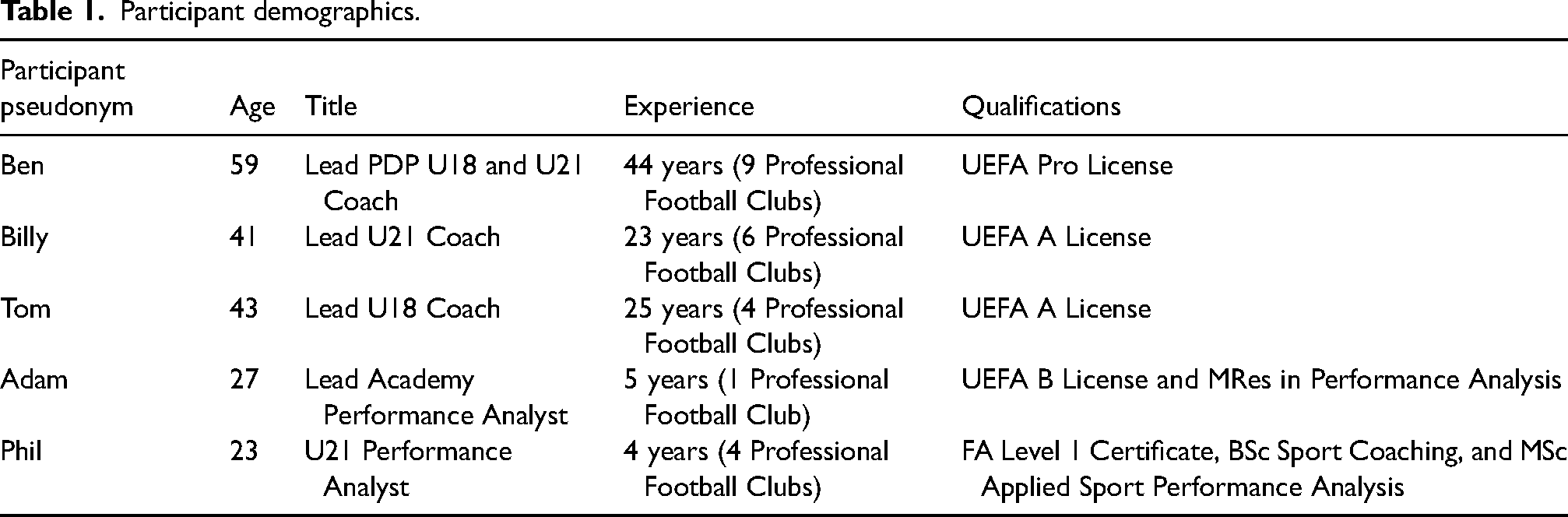
Using purposive sampling, three full-time head coaches and two full-time performance analysts in one English Category 2 Football Academy agreed to participate (Table 1). These five participants were male, and the only members of staff directly involved in delivering VBC to players in the professional development phase (PDP, i.e. U18 and U21 age groups) within the academy. A case study approach allowed rich insights into how the participants organised, delivered and interacted with each other and their players on VBC to be established. To ensure anonymity, all participants were given pseudonyms (Ben, Phil, Adam, Tom and Billy), and ethical approval was granted by a University Social Sciences Ethics Committee [ETH2122-0302].
Participant demographics.
Data collection
Participant observation
The lead author immersed themselves in the academy setting over a season-long period of fieldwork as a performance analyst within the club conducting the observations and interviews as a research project. Observations were employed to learn about how the participants performed their roles within the context of the investigation. 17 Fieldnotes were completed to provide insights into the day-to-day interactions of coaching staff and performance analysts regarding VBC, and to provide descriptions of specific events in chronological order. These fieldnotes were aligned with the dramaturgical categories (a) places of performances, (b) players in the performances, (c) presentation in the performances, (d) purpose of the performances and (e) products of performances to help inform, explain and understand the contextual demands of the Academy (working) environment. Throughout, all notes were made promptly in situ, to ensure the accuracy of observations and were later expanded on to provide greater detail and contextual description. 18 In total, 22 VBC sessions and numerous day-to-day interactions over 231 days, between coaching staff relating to these activities were observed. The field observation notes were then used to inform the interview questions as the study progressed.
Semi-structured interviews
Throughout the completed fieldwork, the lead author engaged in regular day-to-day discussions with the PDP staff. In addition to these informal discussions, 18 formal (semi-structured) interviews were conducted, totalling 8 h, lasting between 22 and 37 min. Interviews were informed by the collected fieldnotes and the broader aims of the study. Interviews permitted the development of richer insights into staff VBC decisions and actions. ‘How’ and ‘why’ questions were used as probes, with prompts for specific examples. 19 All formal interviews were conducted face-to-face in a classroom at the football Academy and recorded on a ‘voice memos’ device before being transcribed. As the research and data collection progressed, previous interview findings and fieldnotes iteratively informed subsequent data collection.
Phronetic iterative data analysis
A phronetic iterative approach was undertaken, which is defined as an abductive, problem-based approach that continuously switches between the emergent data findings, existing research questions, theories and the literature. 20 This process started with engaging in primary cycle coding (e.g. who, what, when, where), which included using first-level descriptive codes to capture the essence of the data. 21 During this stage, discussions between the authors offered initial codes that were descriptive and basic. Following this, secondary cycle coding (e.g. how, why, because) was undertaken, which involved the consideration of past theory and literature that best illuminated an understanding of the video-based decisions and actions of the observed coaching staff. 21 This principally involved the use of Goffman's 22 dramaturgical theorisation as outlined in The Presentation of Self in Everyday Life text and Groom et al.'s 11 grounded theory of VBC. The research team met on several occasions to cross-check and to give consideration as to which data was important, and how the codes were to be developed in ‘secondary cycling’ where our understanding of performative, social and relational activity proved useful for interpreting and building theoretical explanations. As such, additional questions emerged and new connections between theory, VBC and empirical data were developed progressively leading to refined focus and understanding. 23 It is important to acknowledge that this iterative process was far from simplistic and linear. Rather, cycles of etic and emic readings of the data occurred throughout as well as after the completed fieldwork. Data collection and data analysis informed each other, with the analysis of findings continuing into the writing-up of this manuscript. That is, the writing of this article included all the authors and was an analytical process in and of itself, whereby the meanings of our findings took form through an iterative process of thinking, writing, ongoing discussion and re-writing. 1
Results
Our iterative analysis of the interview and observation data resulted in two distinct but interrelated themes. The first explores the Academy's aims to progress players to the first team resulting in VBC sessions focusing on the development of the ‘high priority’ players. The second shows how the coaching staff focused on the delivery of positive VBC sessions to players, despite negative assessments of team and individual performances during private coaching meetings.
Strategic focus on ‘high priority’ players
Before observing VBC sessions, at the commencement of fieldwork, it was apparent that the academy was particularly proud of the successful outcomes it had achieved. Adorned on the walls of the main corridor of the Academy facility were framed pictures of those players who had graduated to the senior squad and made professional debuts for the first team, which was reinforced by Ben the Lead PDP coach: ‘The ultimate for every Academy coach or manager is obviously to get a player into the first team. So yeah, I would say the main goal and target is to get players into the first team’. The importance the Academy placed on achieving these ends was reinforced by the observation that certain U18 and U21 players were listed in black and others red, on a whiteboard located in the coaches’ private office. When questioned about this distinction, the coaching staff shared that those listed in black marker were ‘high priority’ players (sometimes also referred to as ‘grade A players’) who were recognised as club assets, whereas those listed in red were ‘the others’ (sometimes also referred to as ‘grade B players’). The significance of this distinction was articulated by Billy (Under 21's Lead Coach) who explained that the PDP coaching staff ‘prioritise the higher achievers’ and provides them with ‘special attention’ as ‘they could either play in our first team or be a potential sellable asset for the club’. When asked why these players receive special attention, Tom (Under 18's Lead Coach) went on to explain it was ‘to keep us all in jobs because it's the grade A players that are either going to be playing in your first team or the club will sell them on, which continues to fund the club and the academy as well’. In short, coaching staff focussed on developing the ‘high priority’ players as ‘the success of the PDP is how successful we are at readying the young footballers for first team football. The priority is to get players into the first team’ (Adam – Head of Performance Analysis).
This contextual information provided a useful lens for understanding the observed VBC sessions. During VBC sessions the ‘high priority’ players were more often involved in the video clips that were shown and reviewed, they also received regular individualised feedback as well as greater recognition and praise for their contributions, as shown in the below fieldnote: Today, I observed a post-match meeting that included all the U21 players, the U21's head coach, the PDP coach, the goalkeeper coach and the U21's analyst. The head coach continually highlighted the ‘high priority’ players for good practice in the post-match video. The head coach is standing at the front of the classroom next to a screen where video clips of the last game are played one by one. The other staff are sat at the side and back of the classroom. The players are all sitting around the screen carefully observing. ‘That's brilliant Anthony (pseudonym) keep doing that. Look how much space you’ve created for everyone by doing that’. Another video of a successful performance is played on the screen. ‘I love that Chris (pseudonym). That's really good play by you two. Once we lost the ball, the reactions top notch boys. Well done (Chris and Anthony)’. (Fieldnote) There are definitely weaker players who are not likely to progress into the first team but to play games you need a full squad of players that facilitates a games programme. Having a full squad allows your best players to experience all sorts of opportunities and games that will help with their development into the first team. So, if we give the weaker players help and guidance it can have a good impact on our better players.
Coaching staff were acutely aware that a full squad of players was needed to aid the development of the ‘high priority’ players and that instructing ‘the others’ was a necessary step in this process. Therefore, staff strategically utilised VBC to focus on the development of the ‘high priority’ players while progressing ‘the others’ in ways that would benefit the staff's ability to achieve organisational outcomes. When preparing VBC sessions the coaching staff considered how their design and delivery could facilitate these desired ends. However, it is important to note that neither the ‘high priority’ players or ‘the others’ were made aware of the categorisation system, nor how this impacted the VBC sessions they attended. Rather, the coaching staff purposely concealed this information from the players to maintain the engagement of all players. Coaching staff believed identifying ‘the others’ could negatively impact on the development of the ‘high priority’ players. Conversely, coaching staff believed identifying ‘high priority’ players could cause a level of complacency among these assets, again leading to a drop in engagement that could negatively impact their development: Mainly to keep the grade B players emotionally engaged […] If the grade B players thought they were less valuable, then their efforts and engagement levels would decrease. If this happened, it would have an effect on the grade A players. Not to mention the grade B players might perform really well and give themselves a chance of progressing and being valued as a grade A player so we can’t disregard them. (Adam – Head of Performance Analysis) Obviously being in academy football, all the players are fighting for the same thing, to be retained and get a contract. They’re all in the same position and they all have the same goal. You don’t want the grade B players to think, well I’m a grade B player so I won’t get a contract, but you also don’t want the grade A players thinking they have already got a contract. (Phil – Under 21's Performance Analyst)
Strategically positive approach
During the completed fieldwork, an important observation was that staff regularly held pre-video meetings away from the players. These meetings tended to occur in the coaching office at the academy facility. During these meetings staff candidly discussed the individual and collective performances of their players and made decisions about the content and delivery of VBC meetings. Observations of these meetings, as well as informal office conversations between coaching staff, revealed the frustrations that staff regularly experienced about the poor performances of their players and a lack of perceived development, as shown in the below fieldnote: Today I observed the coaches and analysts in the coach's office. The U18's coach and U18's analyst were openly sharing their frustrations about poor individual performances. I also noticed that the coaches and analysts were annoyed that basic mistakes were occurring regularly within games. The U18's coach expressed ‘We’ve worked on this training, how on earth can we still get it wrong?’ ‘Every week it's the same mistake, we are not learning from our mistakes’. (Fieldnote) Today I attended a video meeting that included all the U21 players, the U21's head coach, PDP coach, the goalkeeper coach and the U21's analyst. From watching the U21's game 2 days before, a CB was at fault for both the goals that they conceded. I waited to see how the coaches would highlight his mistakes in front of the group but there was nothing mentioned about either of the goals that they conceded. The negative conversations that had occurred in the coaches’ office, with the same members of staff, were not communicated to the players. ‘Well done though lads, were moving in the right direction. There’re positives we can take from that game, we move on to Tuesday now’. (Fieldnote)
When asked to comment on why the observed VBC sessions tended to present players with a more positive analysis of squad and individual performances, including overall progress, staff variously shared how they purposefully adopted this approach for a variety of pedagogical reasons. That is, they chose to strategically deliver positive VBC sessions to develop a constructive learning environment that aimed to enhance player and squad efficacy, motivation, learning and development. The coaching staff were mindful of the consequences that could result from the delivery of negative, critical and pointed VBC sessions. Namely, how negative feedback aimed at individual players within a group session could hinder their development and promote a toxic learning environment where players are fearful of the feedback they may receive from teammates as well as coaching staff. For example, Tom and Phil shared the following: I think we try and aim to work off positives, that's personally where I feel we can have the best impact. Another thing to consider is that we are working with U18 players so I believe that working off positives makes a bigger impact on them and then they can perform better […] You must be very careful what you present to the group of players in the meeting itself. The relationship between you and the players is really important. Each player learns in different ways and as a coach working with them daily, you should know how to deal with each individual. So, for the video-based meetings you need to be really careful what clips you show to some of the individuals because it could affect many different things like confidence, team morale and the team's image of an individual […] We always look for positives to try and produce confidence. Everyone performs better with confidence, so we try to keep the meetings positive to try and build everybody up so they have the confidence to go out and perform. (Tom – Under 18's Lead Coach) You’re always trying to encourage players, to try and boost their confidence because ultimately, we believe that's the best way to get a good performance out of the players. Having a positive environment with lots of encouragement will always push them and make them perform better than slating them for making a mistake […] The analysis needs to be used wisely because it can be detrimental to a player if you do it in the wrong situations at the wrong time. You don’t want to make it a toxic environment for players to go in to, if you constantly draw up on one mistake that a player keeps making then it will affect their performance when they play […] You always enhance the positives that they do. If you keep homing in on the poorer aspects it will create a toxic environment and players will fear coming into the meetings. If someone feels uncomfortable, stressed and not confident they won’t perform well. So, building up someone's confidence through the positive clips will only enhance their performance. (Phil – Under 21's Performance Analyst)
Discussion
The main findings of this study are that coaching staff strategically focused on the ‘high priority’ players as well as the provision of positive VBC sessions in response to the perceived workplace demands and expectations. Specifically, staff hoped that these strategies would facilitate the development of players who could progress to first-team football, either at the club or sold to another club for a profit. These findings can be understood in relation to Groom et al.'s 11 grounded theory of VBC, which shows that coaches’ pedagogical decisions are often framed by the demands of the social environment in which they conduct their coaching work. In this research, the coaching staff's targeted outcomes, priorities and positive approaches to VBC delivery were shaped by their understanding of the context. Like the coach in Booroff et al., 13 staff in the present investigation were acutely aware of how the performance of the Academy and their respective roles within it were judged by senior members of the football club. In the present study, focusing on the pedagogical provision of positive VBC sessions was principally aimed to focus on the development of ‘high priority’ players to try to fulfil these expectations.
A dramaturgical analysis of these strategic uses of VBC helps to gain further insight into how and why they were pedagogically implemented by the coaching staff. According to Goffman's 22 analysis, social interactions often comprise identifiable teams. The settings in which these team interactions occur are typically assembled and managed by one of the teams, known as the performers (i.e. staff). The performers put on a show for the other team, referred to as the audience or the observers (i.e. players). Indeed, mirroring Britton, 24 the present study identified that VBC is not always an individual coaching endeavour, rather VBC performances are collectively prepared and delivered by a team of coaching staff who conceal information from their player audience in response to organisational demands and expectations.
The coaching staff's decision to prioritise the content of their VBC sessions towards the development of the ‘high priority’ players is consistent with the findings presented in Booroff et al.'s 13 study of VBC in a football academy setting. Focusing on the provision of positively framed VBC is also consistent with the findings of Groom et al.'s 11 study, which found that elite soccer coaches often use VBC as a means of improving the efficacy and motivation of their athletes while also being mindful of the potentially damaging impacts negative feedback can have on these targeted outcomes. Here, coaches clearly considered not only the psychological impacts of VBC on their players but also how the broader contextual demands of their working environments shaped and influenced their delivery.
The coaching staff's implementation of these strategies can be explained by Goffman's 22 theorisation of how social performances occur on what he termed the frontstage and backstage regions. The frontstage regions, according to Goffman, 22 are those locations where performances are delivered before a scrutinising audience. In contrast, he identified the backstage region as those ‘place[s] where the performer can reliably expect that no member of the audience will intrude’ (Goffman, 1959: 113). In the present study, coaching staff devoted considerable time in the backstage region critically planning the content of their VBC and how the video clips were going to be delivered with a focus on the positive messages they wanted to convey. At no stage were athletes made aware that the coaches’ VBC sessions were strategically orientated towards the development and progression of the ‘high priority’ players. Neither were the players informed that the coaches strategically focused on delivering positive clips and associated feedback on the frontstage, despite being frustrated by individual and team performances when reviewing video and preparing VBC backstage.
Learning about these deceptions would likely have damaged the athletes’ perceptions of their coaching staff and potentially have resulted in the players withdrawing their best efforts. Coaching staff engaged in impression management to avoid these negative outcomes, which included concealing their pedagogical decision-making to avoid their athletes acquiring ‘destructive information about the situation that is being defined for them’ (141). Current findings provide important insights into the performative nature of VBC delivery and pedagogical implications, which require a more concerted empirical and theoretical investigation. Indeed, there is much to be learnt about how coaches perform as part of teams, as well as what information coaching staff conceal from whom, how and why. This includes the success of their performative efforts and attempts to retain information during staged performances. Future research should seek to explore these areas in greater detail, including how the performances of coaching teams are influenced by and enacted in response to perceived workplace demands and expectations.
Conclusion
This study contributes to foundational critical social and pedagogical scholarship that investigates how coaches’ understandings of workplace demands influence their VBC practices (i.e.11,13). It also adds to a growing dramaturgical analysis of sports coaching through its consideration of the performative features of coaching practice (e.g.25–27). The findings and analysis of this study also have important implications for the education and development of coaches. Coaches need to be taught how to become technically proficient with video analysis technology and software, as well as the analysis of performance. However, in line with this research, coaches also need to think about how they design and deliver their video sessions for strategic ends, being mindful of how players might respond to such delivery. In this regard, VBC is rarely recognised within coach education programmes. This is problematic as advancements in performance analysis technologies have resulted in VBC becoming an integral feature of coaching practice. As such, those responsible for the education of sports coaches have a responsibility to appropriately prepare coaches for this aspect of their work. This study seeks to prompt further scholarship into the investigation of VBC as well as the need to inform the professional preparation and development of sports coaches in this area of practice. Current findings could be used by coach educators to encourage coaches to think critically about ‘how’ and ‘why’ they wish to design and deliver VBC in preferred ways. Here, coaches should consider how the organisational demands and pressures they face might influence their VBC decisions. Coaches should also reflect on how their decisions and actions could respond to the learning needs of their players, the environment in which these sessions are delivered, as well as how players might respond to these pedagogical approaches that they utilise.
Footnotes
Declaration of conflicting interests
The authors declared no potential conflicts of interest with respect to the research, authorship, and/or publication of this article.
Funding
The authors received no financial support for the research, authorship, and/or publication of this article.
