




Abstract
Sporting success among nations provides a sense of value and national pride. This paper evaluated the perceptions and experiences of national coaches on the enablers and hindrances of international sporting success by elite athletes from historically disadvantaged areas (HDA) using the SPLISS framework. A qualitative research study design was employed for this study. Ten internationally recognised coaches (46.7 ± 12.9 years) volunteered for the study. Data was collected through semi-structured interviews. A thematic analysis was used to analyse data. Data was analysed using a computer software programme. Governance, organisation and sports policies, coach provision, local/international competition access, bursaries/scholarships and sport volunteerism were perceived as enablers, while lack of financial support, foundation level participation, school sport, athlete retention, sports facilities, reliable transport system and scientific support were perceived to be hindrances to sporting success. The findings highlight the need for policymakers to oversee and ensure a systemic governance approach with an integrated sports support system and effective policies, institutions and strategic planning, coupled with an adequate budget allocation in support of this system to facilitate elite sports success.
Introduction
Sporting success among nations provides a sense of value and national pride. Hence most governments aim to improve their sports systems in the interests that are beneficial to their communities. 1 This requires governments to play a significant role in elite sports through the development of sports policies, allocation of grants for sports infrastructure, talent identification, development, nurturing and overall development of sport. 2 Ford et al. 3 argues that government support may assist in the holistic development of talented athletes from novice to elite level through a multidisciplinary support system and progression opportunities. 3 The success of an athlete or team is highly dependent on the effectiveness of their country's allocation and usage of resources that are directed to benefit elite sports. Some nations that are successful in international sports tend to plough more investments towards their national sports systems, while others cannot invest due to other pressing priorities, including provision of essential services for their citizens. This creates a debate over whether socioeconomic determinants (i.e. wealth, population, politics) influence international sporting success among nations. 4 At the receiving end of the nation's support towards elite sports are the talented individual athletes who are supposed to harness these allocated resources and perform within their sporting codes.
The South African context
In South Africa, sport symbolises nation-building and reconciliation following historical discrimination policies during apartheid. 5 Apartheid in South Africa was a legally designed system for segregation based on race, including political and economic discrimination against Black-African, Coloured, as well as the Indian population groups. 6 The policy of apartheid was enforced between 1948 and 1994 by the previous government led by the National Party, leading to a systemic underdevelopment of infrastructure in predominantly non-white areas. Sport in the apartheid era was also divided across racial lines, whereby different races were not allowed to compete with one another. The skewed developmental progress during apartheid, for instance, saw 89% of White schools in 1981 having cricket pitches, with black schools having almost none, thereby limiting the development of black cricket players. 6 This was further burdened by non-white players not being allowed by the government to represent the country at local and international events. 6 The impact of this underdevelopment continues to be felt in the post-apartheid South Africa.
The post-apartheid government of South Africa established the new Department of Sport and Recreation, which formulated the transformation charter to allow for increased opportunities and access to sport by all South Africans, especially the previously marginalised racial groups, women, youth, the elderly, as well as persons living with disabilities. 6 However, the work of the government in levelling the playing field by providing equal opportunity for sports participation is yet to be reviewed. More specifically, there needs to be more literature on the current enablers and barriers to sports participation at an elite level for athletes from historically disadvantaged areas (HDA). HDA in the study are regarded as South African residential areas that were grossly underdeveloped in terms of infrastructure development as part of the apartheid policy pre-1994, whereby the legacy of underdevelopment continues to be felt post-apartheid. These areas in this context include townships, farmlands, villages and rural areas. 7 There is also a need for more literature on whether the transformation charter achieved its objectives of ensuring equal access to sports for all citizens across all levels of participation (foundation to elite level). Nolte et al. 8 conducted a comparative study on the perspectives of coaches on long-term athlete development in Judo across the British, Netherlands and South African Judo. The study found that coaches perceived financial resources, holistic sport policy development and alignment, professionalisation of sports organisations with full-time employees and coaches, quality training facilities, marketing and commercialisation of the sport as the most significant role player to long-term athlete success. Kubayi et al. 9 also evaluated the perceptions of South African coaches in bridging the gap between coaching philosophy and sports science in South Africa. They found that lack of resources directed at coaches limited them in attaining and integrating sport science support within their training programmes. These findings identify areas for attention concerning long-term elite athlete development and success as they directly affect pillars one, two and six of sport policy factors leading to international sporting success (SPLISS) by De Bosscher et al. 4
South African athletes face many challenges in access, participation and progression in sports, especially those from low-income communities. Noorbhai 10 investigated the extent to whether attending wealthy boys-only or co-ed (semi-private or private) schools had a significant impact on a cricket player representing the national cricket team and overall cricket success and found that attending such schools as a critical contributor (aside from race, class, cultural or socioeconomic factors) to representing the national team and cricket success. The work of Desai 11 showed that the challenges of sport support were worse in HDA as it indicated that historically, public spending on sport infrastructure was mainly concentrated towards predominantly White neighbourhoods, particularly in sports such as swimming. In the late 1970s, there was one swimming pool per over 569 000 black people, and the situation has not changed much post-1994. 11
Al-Ababneh 12 defines ontology as the nature of reality, and in a sporting context, major competitive international sporting events exist for the reality of athletes qualifying to represent their countries and competing with one another to win medals for their countries in order the accomplish prestige and national pride. Therefore, the ontology of the current study is defined as athletes attaining international sporting success by competing in major international sporting events and showing potential of winning medals. Al-Ababneh 12 further defines epistemology as a theoretical perspective of viewing the world and making sense of reality. Epistemology involves the nature of knowledge and its acceptance in the field of study. De Bosscher et al. 4 developed a conceptual framework that identified factors that determined top-level sporting success within nations into three levels of influence: (1) macro-level, which refers to the cultural and social context in which people live (i.e. geographic, economic welfare, degree of urbanisation, cultural and political system); the (2) meso-level referring to sports policies within the country that may influence long-term sports performance of athletes and the nation; and (3) micro-level which refers to individual factors including the athletes’ genetic endowment that enables them to perform in sport, their close supporting environment of coaches, parents, friends, as well as their training regimes. All these levels must interact to enable athletic support and success of athletes. 4 Within the conceptual framework, the international sporting success of nations was evaluated using the nine pillars of SPLISS, namely (1) financial resources, (2) governance, organisation and structure of sport policy, (3) foundation level participation, (4) talent identification and development, (5) post-sport career support, (6) provision for sports facilities, (7) provision for coaching and coach development (8) opportunities for international participation, (9) provision for scientific and research support. Adequate investment by nations in the nine pillars of SPLISS increases its likelihood of success in international sporting events (i.e. Olympic Games). 4 The micro-level of influence is where the closest support structures of athletes reside. One of the most influential individuals at this level is the athlete's coach, who provides a supportive role and enabling environment for athletes to succeed in their respective sports. In the conceptual framework of SPLISS by De Bosscher et al., 4 sporting success represents an increase in the production of athletes capable of winning medals at an international level of competition through their nations financial resource allocation (pillar 1) and the effective use of these financial resources in the remaining eight pillars (pillar 2–9) to produce the desired results. Using the nine pillar SPLISS model, De Bosscher 13 explored the relationship between SPLISS and success in international sport (i.e. medals won historically at Olympic games), whereby large data was also gathered among athletes, coaches and performance directors across 15 nations. The study found a correlation between the SPLISS pillars and the success of nations whereby countries that performed better internationally had higher scores on the nine pillars of SPLISS. Pillars one, two, seven, eight and nine correlated most significantly with sporting success. 13 These findings would significantly improve the reliance on the SPLISS framework to determine the probability of sporting success of a nation. However, this is not a silver bullet as it is highlighted that there are broader political, social and cultural aspects in different nations that impact elite sport and still need to be understood.
Several studies by Sotiriadou et al. 14 ; Liston et al. 15 ; and Lee 16 adopted the SPLISS framework in their research approach and have made important findings, which also informed the current study. Sotiriadou et al. 14 conducted in-depth interviews with coaches, athletes and high-performance managers to explore interrelationships between sports policies and their effect on sporting performance and their findings offered a contribution to existing elite sport policy and the role of sport culture in shaping interrelationships and policy linkages. Liston et al. 15 examined the perceptions of coaches in Northern Ireland on policy factors influencing international success through semi-structured interviews and coaches perceived that fractured elite sport policies constrained their attempts to deliver on their performance targets. Lee 16 applied the SPLISS framework in a qualitative study focusing on factors influencing the British Taekwondo notable performance in international competitions and found that United Kingdom (UK) Teakwondo entities had sustained financial support with well-defined roles, talent transfer strategy to increase the country's talent pool, and appointment of foreign coaches with expertise offering coaching services. This study was motivated by limited qualitative studies adopting the SPLISS framework in a South African context. Therefore, the SPLISS framework and its nine pillars inform the epistemology of this study as they define what is known in terms of international sporting success and how this knowledge can be defined in the context of South Africa considering the historical nature of racial and socioeconomic inequalities of the country.
South African sport is under the custodianship of the national Department of Sport, Arts, and Culture (DSAC) and its ministry which is responsible for policy formulation and grant allocation to sport entities and federations. The South African Sports Federation and Olympic Committee (SASCOC) serves as the mother body of the South African national sports federations (NSFs) and has a mandate to perform oversight as well as delivery of high-performance sport. University Sport South Africa (USSA), professional sports clubs, and academies are some of the structures that create a pathway for elite athletes to attain high-performance level. 17 Figure 1 shows a typical distribution mechanism for high-performance sport in South Africa. However, the school sport system which plays an important role for grass-roots sports development and a feeder system for elite sport in South Africa remains weak and dysfunctional as a very limited number of schools in HDA offer formalised sport programmes. This creates a problem in the long-term as this narrows the pool from which talented athletes can be selected. If more schools had to offer organised sport, this would increase the base where talented athletes can be selected and level the playing field in sport participation across the different socioeconomic classes. 18
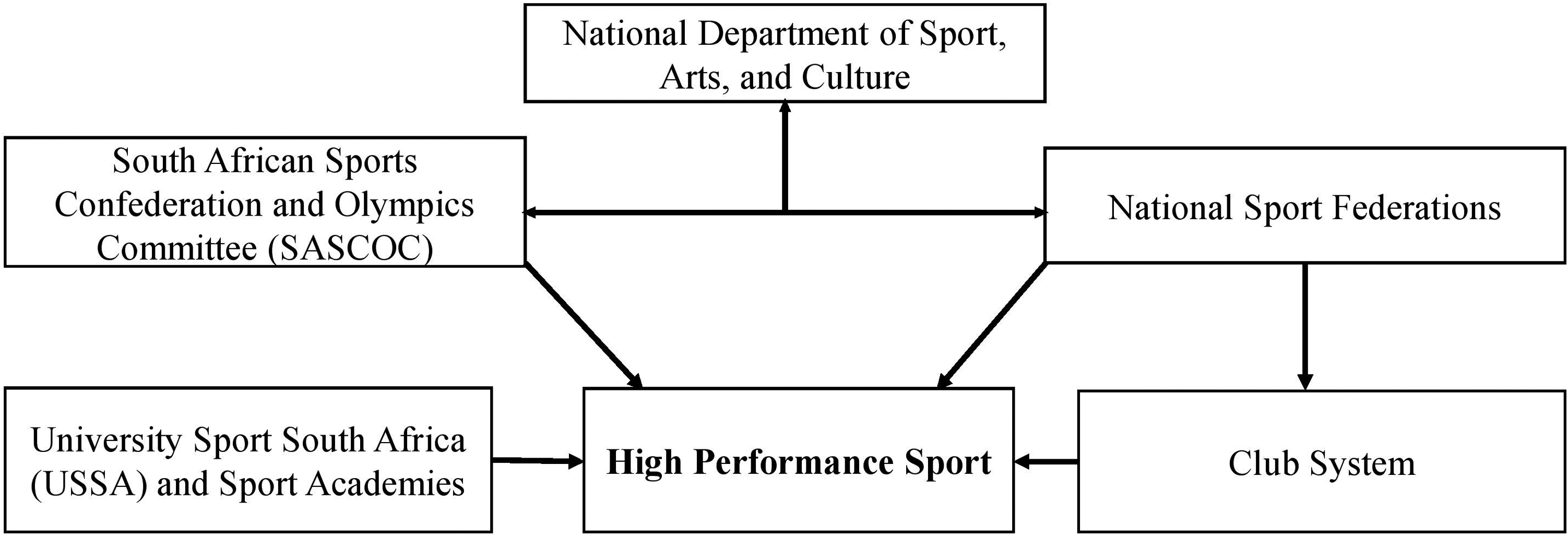
South African support mechanism for high-performance sport (adapted from Mthombeni et al. 17 ).
The role of a coach in athlete success
A fundamental role of a coach is to develop and improve an individual athlete or a team's sporting performance. A coach is central to the development of the physical, psychological, tactical and technical attributes of an athlete. 19 Coaches also take on a variety of roles that include being a mentor, teacher, friend, role model and a leader within the community. Such roles enable the coach to be able to instil life skills such as leadership, character building and teamwork in their athletes, all of which are important for their overall development and growth even outside of sports. 18 In addition to these aspects, a coach ensures that an athlete finds satisfaction, enjoyment and retention in the sport. 20 Trzaskoma-Bicsérdy et al. 21 examined the perspectives and experiences of Hungarian coaches and athletes to determine the coach-athlete relationship among successful sporting codes. The study found that social and psychological background, cooperation between coach and athlete, and family support were vital in strengthening the coach-athlete relationship and, subsequently, athlete success. When a coach creates an inspirational environment that emphasises constant instruction, motivation, feedback, encouragement, effort and improvement, the athlete will most likely cooperate positively and achieve sporting excellence. This is because coaches who hold their athletes’ skills and abilities in high regard, coupled with community and parental support as well as personal experiences, tend to be more competent and confident in motivating athletes, thus possessing better coaching skills. 21 Pill et al. 22 highlighted that understanding coaches’ perceptions provides insights into their coaching behaviours and their approach to performance outcomes and athlete satisfaction. The study sought to determine the perceived enablers and hindrances to sporting success, more especially for athletes from HDA, through the lens of a coach. There is a gap in this area of research within the South African context. Therefore, the important research questions are as follows; what instruments or factors do coaches perceive as enablers and hindrances of elite level sporting success in South Africa? Where are the gaps or weaknesses and potential areas for improvement from a coach's perspective? This study seeks to provide insight to address these important research questions.
Methods
Study objectives
This paper aimed to evaluate the perceptions and experiences of national coaches on the enablers and hindrances of international sporting success by elite athletes from HDA in line with the SPLISS framework by De Bosscher et al. 4
Study design
A qualitative study design was employed whereby a grounded theory approach was used to gain insight into the views and experiences of elite-level coaches who have trained athletes from HDA on factors that enable and hinder sporting success. A grounded theory approach would allow for the build-up of a theory directed towards elite sport development in HDA, through the data collected from participants. This would allow the researcher (interviewer) to generate narratives through one-on-one interviews using open-ended questionnaires with inductive probing. 23 The ontology (nature of reality) of the study was defined as the nature of international sporting success described as representing the country at major international events (i.e. the Olympic games). The epistemology (the nature of knowledge) of the study was on the opinions of Olympic coaches, based on their lived experiences, on the sport support systems that enable or hinder athletes from HDA to achieve sporting success within a South African context.
Participants
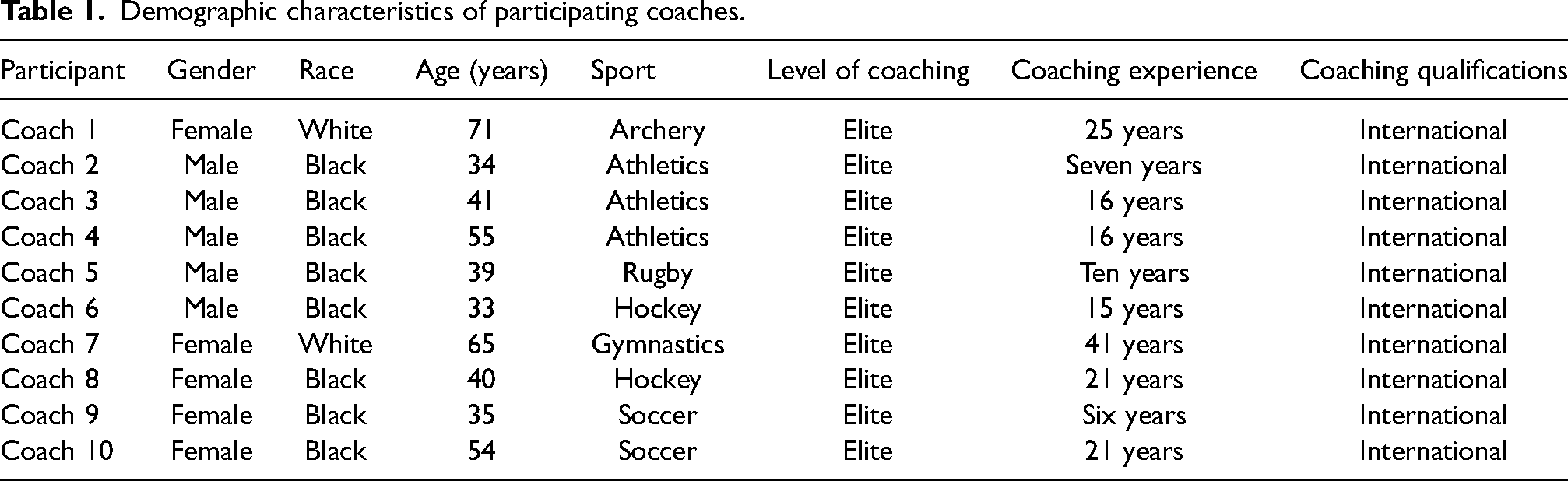
A snowball sampling method was used to recruit coaches whereby one coach recommends the next coach of a similar stature and high-level coaching experience. A total of 10 internationally recognised South African coaches (five males and five females) with an average age of 46.7 ± 12.9 years, ranging from 33 to 71, participated in the study. The national coaches had represented or had experience coaching South African Olympians, including athletes from HDA. The coaches had an average development and elite-level coaching experience of 17.8 ± 7.8 years, ranging from six to 25 years. All the participating coaches held international coaching qualifications. This level of coaching experience and qualifications would allow the study to gain rich information from the study cohort from diverse sporting codes. Most participating coaches were Black African (80%), and a minority were White (20%). The coaches represented a variety of Olympic sporting codes, as shown in Table 1. All the coaches were still actively coaching within their respective sporting codes.
Demographic characteristics of participating coaches.
Data collection
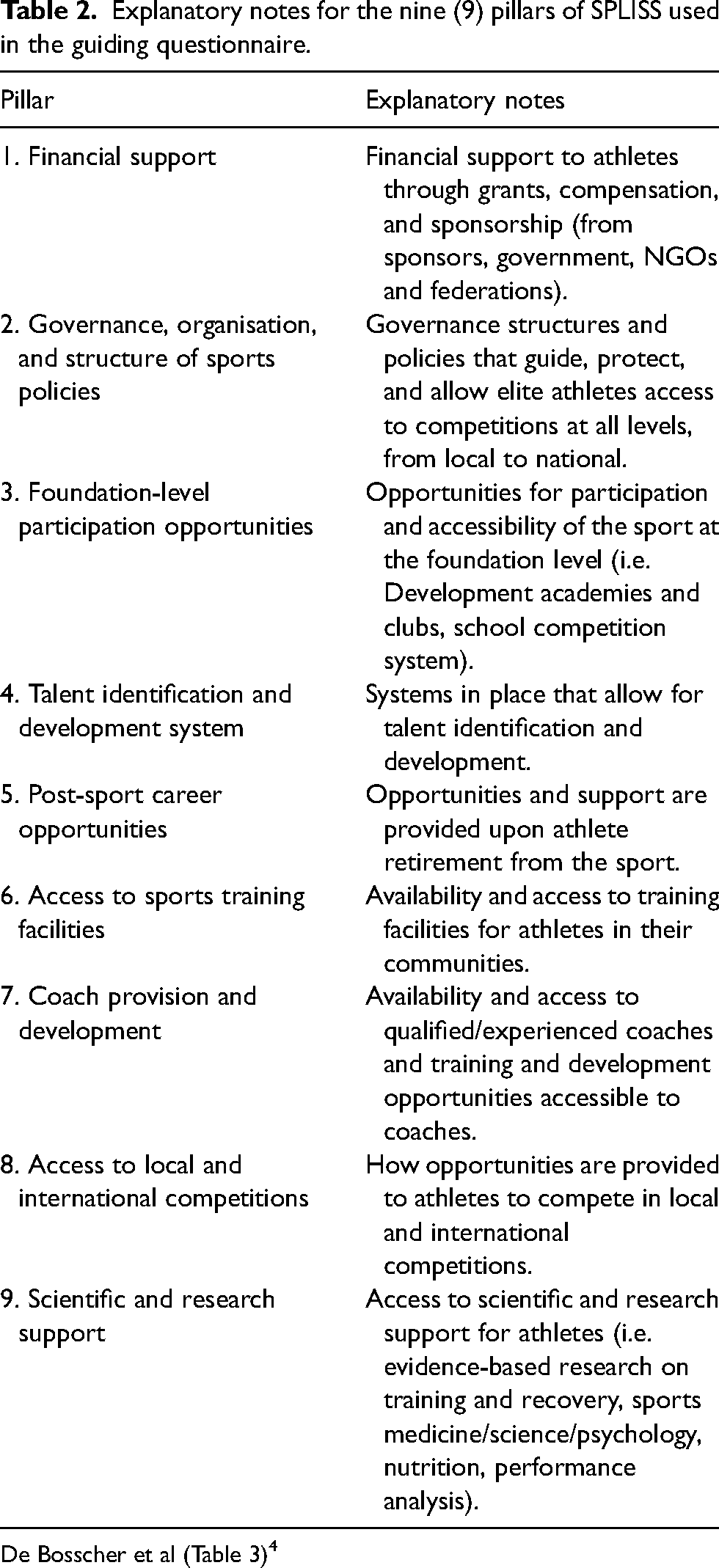
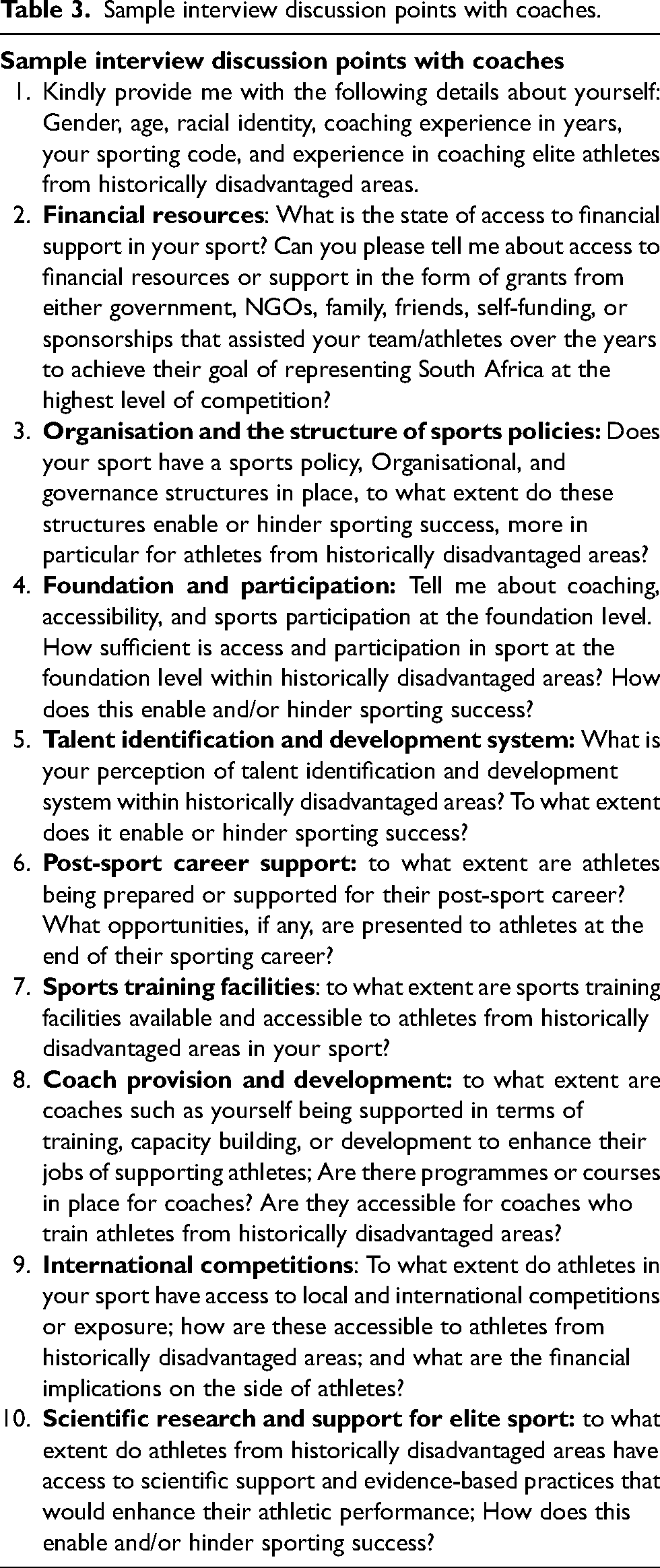
The recruited participants were provided with the information sheet about the study via email and had to complete and sign an informed consent form after agreeing to participate. Semi-structured interviews were conducted with participants. Semi-structured interviews were selected as discussion areas and aligned in accordance with the nine pillars of SPLISS by De Bosscher et al. 4 The advantage of semi-structured interviews was that they allow for further discoveries as the conversation unfolds and allow for the researcher to collect rich and meaningful data. 24 The interviews were conducted telephonically, and the conversation was recorded with a portable Tablet voice recorder (Lenovo Tab M10 HD, Slovakia). The reason for the telephonic interviews instead of face-to-face was that data collection occurred during the COVID-19 lockdown whereby physical contact with participants was prohibited. In the comparison between telephonic and in-person interviews, Rahman 25 found both methods of gathering data as equally effective in human qualitative research studies, with telephonic interviews being more cost-effective and displaying less interviewer bias during data collection. A total of nine open-ended interview discussion points with the coaches were structured according to the following themes: financial support; governance, organisation and sport policy that deals with the administrative aspects of the sport; access to sport at the foundation level; talent identification and development systems; post-sport career opportunities for athletes; access to training facilities; training and development of coaches to support athletes; opportunities for local and international competitions; as well as scientific and research support. The interviews lasted between 25 and 60 min. The participants were prompted to provide further insight in areas where broad responses were provided. Data collection was terminated once data saturation was reached. Data saturation was reached at a point where similar comments were heard and there was limited new information gained from the participants (Table 2).
Explanatory notes for the nine (9) pillars of SPLISS used in the guiding questionnaire.
Sample interview discussion points with coaches.
Data analysis
Upon capturing the interviews, audio recordings were subsequently transferred onto a Laptop for storage and analysis. The data was transcribed through a computer software programme, Otter.ai transcription software (Los Altos, California, U.S.), from audio to Word format. All the text in the native language was further translated into English for ease of analysis. Only one interviewee responded in their native language whereby the researcher translated the text into English. This protected the integrity of the data and ensured that nothing was lost in translation. The thematic analysis was conducted in-line with the steps of Braun and Clarke. 26 The first step was to conduct data familiarisation to understand the breadth and depth of captured data. The second step involved the development of initial codes providing interesting features to analyse and to organise data into meaningful groups. The third step involved sorting out different initial codes into themes and combining those that were similar into overarching themes. The fourth step was to review and refine the themes which entailed the creation of sub-themes and collapsing of themes not supported by data. Step five entailed naming and defining themes and identifying the storytelling of each theme. Step six involved reporting the final analysis and writing up of the findings. Data coding and analysis of themes was conducted through the assistance of a computer software programme, ATLAS.ti (version 22).
Ethical considerations
Ethical approval for the study was obtained from the faculty of Health Sciences Research Ethics Committee at the University of Johannesburg (REC-500-2020).
Results and Discussion
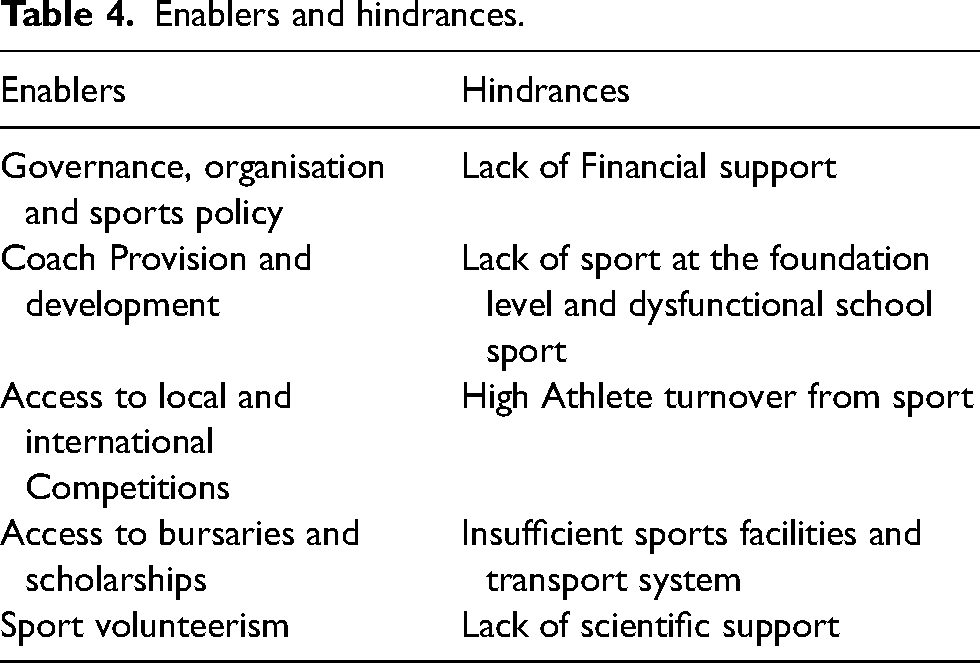
The purpose of the study was to understand the factors that enable and hinder sporting success among South African athletes from HDA through the lens of coaches. The results section presents coach perceptions on enablers and hindrances to sporting success among elite athletes from HDA, as seen in Table 4.
Enablers and hindrances.
Enablers
Governance, organisation and sports policy
The findings reveal that all participants reported availability and well-established sports policies, organisations (sports departments at national, provincial and local government) and governance structures in place within their sporting codes. These structures allow for effective governance and administration of sport and the creation of competition opportunities and safeguarding for athletes. We have a well-structured sports policy and league system which allows an athlete to go through different stages until reaching an elite level. They compete in local league competitions, then regional, provincial, and National with their different age categories from youth until they become senior athletes. (Coach 4)
However, few participants indicated that although policies allow for effective governance of their sport, there are instances where administrators with poor leadership skills are appointed within sports federations, which has led to poor governance within their sport. I was a team manager for Melbourne, for the Commonwealth Games, and experienced our sport confederations management first-hand and it's a horrible unit. They have this little mantra that the athlete comes first but it never happens. They did not put the athlete first but the officials. (Coach 7)
These findings are supported by Sotiriadou and Shilbury, 27 who reported on the importance of administration at all levels of elite athlete development in impacting the success of elite athletes after evaluating 35 Australian national sports organisations (NSO). It was found that the NSOs reported that elite athlete development and success in Australia were epitomised by policies overseen by government/federal departments, sports academies, coaches and administrators. It was also indicated that the NSOs, through funding and policy direction from national institutes of sport, were able to prepare teams for significant competitions as well as access world-class sports facilities and services. 27 Although South Africa has adequate policies and governance structures, the areas that need further improvement are human capital, leadership and funding for elite sports programmes. 28 Effective improvement of critical human skills, leadership and policies directed at improving opportunities for athletes from HDA may further enable better opportunities for athletes from HDA.
Coach provision and development
Most coaches reported that one of the enablers of sporting success among athletes was the availability of coaches. It was further indicated that national federations provided opportunities for the training and development of coaches. Some coaches further elaborated that although there is sufficient training and development of coaches, the coach needs to be self-driven, and disciplined and show interest in attending workshops and training as part of personal development. We do have regular courses in South Africa, but it's now up to you as a coach to apply and attend the courses. (Coach 2)
Two coaches, however, reported that training and development courses of coaches are expensive (i.e. learning materials, accommodation and traveling), which means that those coaches without the financial means to enrol in the courses are deprived of receiving the necessary training. For instance, a level two Hockey coaching course in South Africa is 2750 ZAR
29
which is an anomaly in a country where 55% of the population is, according to the World Bank, living under the poverty line of 992 ZAR monthly.
30
This also means that coaches from HDA have fewer opportunities for training and development compared to coaches from well-established clubs/schools that provide funds for the capacitation of their coaches. The only problem is that at some of these workshops, coaches must pay for themselves to attend, this includes registration fees for the workshops, transportation to the workshops, and accommodation if the workshops are more than one day. So, in most cases, coaches end up not attending the workshops because they cannot afford the expenses. (Coach 4)
This finding was supported by Brouwers et al., 31 who also found that coaching provision and education were among the most critical policy areas for athletes’ international sporting success in tennis. This meant that training and certification of coaches allowed for coaches to build strong core competencies, build a good reputation, and gain international recognition. 31 However, particular attention must be paid to the training and capacitation of coaches from HDA and those without financial means. Training and development should be prioritised and subsidised by federations for coaches and volunteers to be empowered with skills they will use to develop athletes.
Access to local and international competitions
Most coaches reported sufficient opportunities for athletes to compete locally and internationally. Some coaches indicated that South Africa has sound league/competition systems that allow their athletes to progress through the competitions and reach high performance gradually. The solid local competition system can be considered a strength compared to other countries with strong economies. If you are called up for the National junior teams, you’ll get opportunities to get international exposure. (Coach 9)
Mazzei et al.
32
found that some sporting codes in Brazil were reported to have a robust local competition system which positively affected their athletes’ preparation for international competitions. Therefore, Brazil's international competition success was determined by the excellent management and strength of their national competition in certain sports (i.e. Judo and Volleyball).
32
In a South African context, the nation's international success in rugby may be attributed to the strength of the national competitiveness and good rugby administration, as some of the coaches suggested. Some coaches, however, highlighted that access to international competitions was higher among athletes who had agents/managers, and belonged to professional clubs when compared to athletes who had neither. Some coaches also had concerns that although there are enough opportunities for athletes to compete internationally, their sporting codes require athletes to fund their international travel, making opportunities inaccessible to athletes from HDA. Few coaches reported continuously raising funds for their athletes to access international competitions. Athletes will be supported but they might have some costs to pay as they are partially funded. (Coach 7)
Brouwers et al. 31 also found that athletes’ access and opportunities for international competitions were among the essential contributors to athlete success in tennis. National federations in South Africa should partner with the government, sponsors and other sports stakeholders to strengthen local competition structures to better prepare athletes (support-wise) for international success.
Access to bursaries and scholarships
All the coaches highlighted the importance of sports scholarships and bursaries being enablers for athletes from HDA to achieve sporting success. It was indicated that access to scholarships to wealthy elite (semi-private to private) schools allow athletes to attend schools that offer academic excellence, diverse sporting codes, sporting facilities, hostel accommodation with good nutrition for athletes, as well as an organised and effective sports programme. This provides an enabling environment for an athlete to be nurtured and perform optimally. The coaches highlighted that sports bursaries in universities also assist in allowing the athlete access to training facilities, high-performance centres, stipends, academia and international exposure by competing at high-level university leagues and tournaments. On the study side, there are many opportunities; if you are talented enough and have proven yourself through sport and academics, the universities will approach you with bursaries. (Coach 2)
The findings were supported by Thompson et al. 33 who found that holistic athlete development was attributed to access to sport-centred schools. Sport-centred schools offered athletes opportunities to achieve a balance between sport and academia, opportunities for high-level training and competitions for student-athletes, paving the way for long-term athletic success. Nthangeni et al. 34 also found that university student-athletes enjoyed university sports because it allowed them access to additional support, including high-level competitions, media exposure, being scouted by professional teams, and performance awards and incentives. In South Africa, most of the schools that significantly invest in sports are the wealthy elite schools in high income communities which, in most cases, are unaffordable to learners from HDA. Therefore, the issuing of limited sport scholarships to young talented athletes from HDA by these elite schools provides them with the better opportunity to receive the much-needed support and potential to compete at the highest level.
Sport volunteerism
Most coaches indicated that athletes with potential are firstly identified by clubs within their communities run by volunteers who are passionate about the sport. These volunteers enable the athletes to showcase their talent by ensuring that the sport is accessible at the foundation level (exposure) within communities and by providing athletes with coaching despite having limited resources. If you look at most townships in the areas, people who coach soccer or rugby. it's people that are just passionate about the community and passionate about the game, but more often than not, they do not have the support of the government or the local community in providing resources and facilities, and it is people that are just passionate and wanting to make a difference. (Coach 5)
Surujlal and Dhurup 35 support that volunteerism plays an integral role in the financial and operational success of the sports industry and is highly dependent on the benevolent contribution of sports volunteers. The findings in this study are supported by Dhurup and Surujlal 36 who reported that the desire for sport volunteerism in South Africa is influenced by personal and organisational commitment variables including the volunteers need to contribute to their communities and sport, gain experience, and for goodwill. The organisational commitment variable where volunteers offer their services is influenced by beliefs, goals and values of that organisation hosting the sporting event. Therefore, it is important for sport organisations to acquaint themselves with potential motivational components and strategies that may attract volunteers to their organisations, as this may be beneficial for their sport. Recognition programmes, including the provision of awards/certificates and other non-financial benefits, may retain and motivate volunteers.
Hindrances
Lack of financial support
The government's lack of financial support for elite sports was listed as among the highest hindrances by the coaches. This was worse in townships and rural areas. The coaches reported occasional, insufficient and inconsistent funding from the government and the national lottery to support coaches and athletes. Athlete financial support in our country is insufficient because I work with a lot of athletes from rural areas from provinces like Limpopo and most of them migrate to Urban areas like Gauteng with no form of support, and the first thing you as a coach would need to provide is accommodation, food, transport, and other important items to support them in their sporting career. (Coach 2)
A few coaches also highlighted that some funding comes with a specific mandate from the funder, whereby the funds must be used in programmes that do not directly benefit the athletes (i.e. capacity building of administrators).
Most coaches indicated that a few athletes are fortunate enough to acquire sponsors but are in the minority as corporate sponsorship of sports is limited. In most cases, the more popular sporting codes like rugby, cricket and football are more likely to attract sponsorship than any other. Some coaches indicated that from time to time, they must fund underprivileged athletes from their own pockets because of the potential they see in these athletes. Most of the coaches commended the universities for investing financial resources towards university sports, as most funds adequately support athletes and coaches in their sporting and educational needs. However, it was highlighted that such support was limited to athletes and coaches fortunate enough to attend or work for the university rather than those from outside the system. Even at school level, access to financial and holistic support remains a challenge for athletes from HDA when compared to elite schools. Vosloo and Du Toit 18 found that schools in South African low-income communities (townships and rural areas), which constitute most South African schools, have little to no sporting facilities and activities. This is coupled with unqualified sports practitioners, no school sports policy, and opportunities for participation in sports. Therefore, talented athletes from HDA can only rely on limited scholarships issued by elite schools to access all support systems that enable holistic athletic development. However, without scholarships or financial support to attend such elite schools, athletes from HDA have a limited competitive advantage compared to their wealthy peers in well-resourced schools.
This finding is consistent with that of Mthombeni et al. 17 who found that most former Olympians from HDA reported a lack of financial support, especially at the development level, being among the major hindrances of sporting success in South Africa. The lack of financial support may stem from the poor budget allocation to sports by government annually. According to the South African National Treasury budget report, 37 government allocated only 1.4 billion ZAR sport specific programmes in the national DSAC in the 2022/2023 financial year. This is less than 0.7% of the government's annual total expenditure of approximately 2.1 trillion ZAR. 38 Škorić and Obadić 39 found a linear relationship between state funding and international sporting success in Croatia, but this also depends on the funds used. The study argues that increased funding alone does not guarantee success. However, countries would need to focus funding in areas with inefficiencies (i.e. administration, coaching support, human resources in sports federations), all of which may be critical contributors to sporting success. Mazzei et al. 32 also found that although Brazil has adequate financial resources for high-performance sports, the funding did not achieve international sporting success because of poor strategic planning and a lack of integration of the country's high-performance policies. This needs to be considered by countries that intend to invest in sports, and they ensure that effective high-performance policies are in place ahead of investing large amounts of funds in sports.
Lack of sport at the foundation level and dysfunctional school sport
Most coaches reported that although their sporting codes are accessible at the foundation level, they depend on volunteers introducing the sport within communities. They further highlight that most sporting codes are unavailable in low-income communities and HDA in general. Therefore, exposure to a particular sport at the foundation level depends on whether a club exists within that community. This is further exacerbated by a need for more developmental coaches who are supposed to expose and develop young athletes to the sport. In most cases, community volunteers and educators passionate about sports take on the responsibility of coaching development athletes. If you look at most townships in the areas, the people who coach soccer or rugby are people that are just passionate about the community and passionate about the game, but more often than not, they don't have the support of the government or the local community in providing resources and facilities, and it's people that are just passionate and wanting to make a difference. (Coach 5)
Most coaches also highlighted that coaches and volunteers at the foundation level do not last within the profession because of a lack of financial support. Most coaches opt to coach at a high-performance level as they can earn salaries working for professional clubs, federations or universities. Another mounting challenge reported by most coaches was the dysfunctionality or non-existence of sports within schools in HDA. This denies athletes within HDA to participate in sports or incur the expenses of traveling to areas outside of their residence to those where they can access opportunities to participate in sports. However, it was also reported by most coaches that access to sports at the foundation level is available to athletes who attend elite and former model C schools, as these schools have effective sports programmes, resources and infrastructure.
The finding was consistent with that of Vosloo and du Toit 18 who found that sports in Township and rural schools were primarily facilitated by unqualified, untrained and inexperienced educators who are keen to be involved in such a sport, and in most cases, the dominant sport offered in such schools being football. This is exacerbated by a need for more human (qualified coaches/trainers), financial, physical (sports facilities and equipment), safety (protection from crime and gangsterism) and information resources that would enable an environment for sports participation in Township schools. Vosloo and Du Toit 18 however, highlighted that wealthier and highly resourced (former Model C schools in South Africa) offered a wide range of organised sporting codes, qualified coaches, outsourced specialists, well-maintained sports facilities, sports policy and compulsory participation, all of which enabled a conducive environment for sporting excellence. Noorbhai 10 also showed a link between attending a wealthy elite school and career progression in cricket, with over 62% of national team players attending elite boys-only schools and 92% of national team captains produced by these schools Cricket. However, such private and wealthy (former Model C) government schools in South Africa have a learner population of only 17.5% nationwide. 40 It is therefore recommended that a synergy between the Department of Basic Education and the DSAC be established to ensure a meaningful understanding of diverse school contexts and a reviewing of policy. In partnership with sports federations, the government must provide adequate financial, physical, human and information resources and essential strategies to enhance school sports participation and appoint all stakeholders that facilitate sports in all South African Schools.
High athlete turnover from sport
Most coaches reported that South Africa needs an effective talent identification and development system within its sporting codes. This has a significant impact on a high number of athletes with sporting potential dropping out of sport during the development stages of their careers. Athletes from HDA drop out from sports because of a lack of support ranging from continuous funding, equipment, coaching, pressure to support their families as they grow older, poor job prospects upon sports retirement and lack of sponsorship. Most of the previously disadvantaged kids don't even get to a national competition level, we tend to lose them before that. (Coach 1)
This finding is consistent with Back et al. 41 who reported lower socioeconomic status, older age, female and less intrinsic motivation as factors associated with high drop-out from sport by developing athletes. Espedalen and Seippel 42 also argue that the more expensive participation in sports becomes as an athlete gets older. As the sport has become more professionalised, the competing demands of participation, such as joining professional clubs with high membership fees, participation fees, transportation to and from training/competitions, advanced sporting equipment and facilities, access to coaching and high-performance specialists, nutrition and supplements, all of which require large sums of financial investment in the athlete. Failure to secure sponsorship or any form of athlete funding may affect their access to services necessary for athlete support and performance enhancement, ultimately leading to low morale and eventual drop-out.
However, it was also reported that there are high drop-out levels among athletes from well-resourced families and schools because of parental pressure. Some coaches highlighted that the ‘win at all cost mentality’ placed by parents and schools on young athletes hampers their athletic development, leading to injuries, loss of enjoyment for the sport, and eventual drop-out. This also hurts the coach-parent relationship regarding talent identification and development. Coaches emphasise enjoyment, skill development, and retention of developing athletes, while parents focus on competitiveness and winning, sometimes leading to conflict between coaches and parents. Parents need to allow the kids to play and enjoy the game and if there's one that's remarkable then we will identify him or her. They are too ambitious to the point where they want to push a child to win at all costs and that is a wrong approach because you are depressing the child and putting them under so much pressure to the point where a child will eventually no longer be interested in the sport, and then we end up losing that talent as well. (Coach 9)
Ross et al. 43 reported similar findings by Australian coaches and administrators that parental pressure is detrimental to an athlete's sporting career. Among the most notable behaviours of parents were conditional support pending on the child's performance during sporting events, whereby if the child performs poorly or does not meet their parents’ expectation, parents tend to respond with anger, less affection and less attention. This behaviour often leads to feelings of guilt, shame, low self-esteem and growing resentment of athletes toward their parents. 41 The South African NSFs need to be proactive in ensuring that athlete retention programmes are established to reduce high athlete turnover from sports. High athlete turnover means the country loses its much-needed sporting talent and potential to be competitive on a global stage. Consistent funding by the government and the national lottery towards programmes on athlete retention programmes is paramount to ensure that funds are always available to assist athletes in need of support. Parental education programmes led by trained sports psychologists must be established or enhanced to ensure that parents understand the consequences of their behaviour on the athletes and how best to support their children-athletes on and off the field of play.
Insufficient sports facilities and transport system
There are clubs with Public facilities, and they are not sufficient, and there are safety issues. (Coach 1)
Most coaches reported a need for more access to sports training facilities as one of the hindrances to sporting success, forcing athletes to train under challenging circumstances. Another concern highlighted by coaches was around the safety of public sports facilities in townships. It was reported that most facilities were poorly maintained, vandalised, and serving as hot spots for criminality due to abandonment and poor security. This makes them inconducive to the safety of athletes, forcing them to seek alternative training avenues. The reason for poorly maintained facilities in HDA was attributed to the failure of the local municipal council to allocate resources (human and financial) to maintain the facilities. Of the few facilities in HDA that are well maintained, most of these facilities become overcrowded and overutilised by the growing population contesting for limited shared facilities.
The finding was supported by those of Vosloo and Du Toit 18 who reported that community sports complexes in low-income communities were supposed to facilitate school sports activities but are poorly maintained with overgrown grass, had poor ablution facilities and some were also rendered unsafe for use because of crime and gangsterism in the areas. Coaches highlighted a need for multipurpose-sport facilities in HDA to allow for a diverse range of sporting codes. This was also reported by Dove et al. 44 that one of the barriers to cricket success among Black African semi-elite cricket players was the absence of facilities in predominantly black neighbourhoods, in addition to poorly maintained facilities in those areas where facilities were built.
Coaches also reported that for most sports, there are good training facilities in cities, which presents a challenge in transporting athletes from townships to training and competitions. This is further exacerbated by unreliable public transport infrastructure for athletes who train or compete during off-peak hours (early mornings and late evenings) and do not own private transport. Some coaches reported that talented athletes from rural areas migrate to urban cities to access better sporting opportunities and facilities. Vosloo and Du Toit 18 indicated that wealthier elite schools, however, have the necessary sports facilities that accommodate a variety of sporting codes, in addition to organised sports programs and qualified sports specialists to support sporting excellence. There is continuous scrutiny of the municipal infrastructure grant (MIG) expenditure allocated annually by the government to build, renovate and maintain sports facilities in HDA. Lack of oversight over the MIG may lead to mismanagement of funds by municipalities, leading to funds not being used for their intended purpose. Schools in low-income communities may form partnerships with wealthy elite schools to assist with the occasional use and sharing of sporting facilities for training and competitions and donate sporting equipment they no longer use to low-income schools. These efforts may also foster social cohesion and shared spaces. Budgets allocated for community sports programmes within municipalities should also be used to invest in a reliable transport system that will be used by local athletes from HDA to areas where they will have access to sports training facilities and competitions.
Lack of scientific support
Most of the coaches reported another hindrance being poor scientific support, including multidisciplinary scientific and medical support teams (i.e. physicians, physiotherapy, nutritionists, psychologists) for athletes and most must rely on such professionals volunteering their services to assist clubs in need. Access to such services would more likely be accessible to athletes from high-income households and to those who belong to professional teams or individual sponsors. … there is not enough scientific programming and tracking of players within the sport, it is there at the elite school level and university level, but for those that fall outside that system, there is not any on that, and this makes it difficult for national teams in being able to track players throughout the season. (Coach 6)
This finding is consistent with that of Mthombeni et al. 45 who found that 52% of South African NSFs in their study reported they were unable to invest in scientific support programmes for their elite athletes because of insufficient funding from the national government. Kubayi et al. 9 found a dire need for scientific research and support by South African coaches in areas of technique efficiency, sports injury prevention, athlete peak performance and the mental preparation of athletes for competitions. Therefore, investments in scientific support and research should be prioritised in conjunction with the sport science departments of South African institutions of higher learning to ensure equitable access to evidence-based programming across the sporting fraternity. National federations are to ensure that coaches receive scientific support through capacity building, access to courses and workshops and access to high-performance centres nationwide for their athletes.
Strengths and limitations
The study's strength can be attributed to the diversity of the participants in terms of race, gender and coaching experience. Another strength of the study was that the coaches were from a diverse range of sporting codes, and the study was not limited to a particular sporting code. Although ten was deemed adequate due to data saturation, numerous attempts were made to recruit more than ten international coaches. However, the population group for working with athletes from HDA is minimal. As this study was focused on a qualitative approach, future studies could benefit from a mixed-methods approach, integrating both qualitative and quantitative data to build upon the foundation this study provides. Such endeavours would undoubtedly enrich the understanding of this topic by triangulating findings and offering a more comprehensive view of the subject matter.
Conclusion
The study identified the perceptions of national coaches on factors that promoted and hindered the sporting success of South African athletes from HDA. The coaches highlighted that governance, organisation and sports policies, provision of coaches, access to local and international competitions, bursaries and scholarships, and sport volunteerism as among the highest enablers. However, lack of financial support, foundation level and dysfunctional school sport, high athlete turnover, sports facilities, reliable transport system and poor scientific support were the main hindrances to sporting success in South Africa. There ought to be concerted efforts to ensure that all athletes can access various sporting codes irrespective of their socioeconomic status or geographic location. More financial investment in South African sports, from foundation to high-performance level, is necessary to ensure that athletes receive much-needed support. There ought to be concerted efforts to ensure that all athletes can access various sporting codes irrespective of their socioeconomic status or geographic location. The findings of the study highlight the need for policymakers to oversee and ensure a systemic governance approach with an integrated sports support system and effective policies, institutions and strategic planning, coupled with an adequate budget allocation in support of this system to facilitate elite sports success in South Africa. Further studies are necessary to investigate the high levels of athlete turnover from sports in South Africa and the impact of foundation-level participation and long-term sporting success.
Footnotes
Declaration of conflicting interests
The authors declared no potential conflicts of interest with respect to the research, authorship, and/or publication of this article.
Funding
The authors received no financial support for the research, authorship, and/or publication of this article.
