



Abstract
The governance of Indigenous people is in many contexts a combination of political ambitions to promote self-governance, and more traditional policies and governance practices. These combinations often carry unintended contradictions and exclusionary processes. In this article, we investigate the consequences of one such contradiction: the aspiration for self-determination and self-governance on the one hand and the aspiration for broader political influence in decisions about resources to Sámi sport on the other. Since legitimation of governance structures and practices is essential for their overall functionality, we constructed the research question: What strategies are used to legitimise the policy and governance practices of Sámi sport? To explore this research question, we employed Sámi sport in Finland as an empirical case. Results show that authorisation as a legitimation strategy is prominent and used at institutional and individual levels. Moral evaluation as strategy is based on authoritative actors’ personal choice. Inclusion and integration in mainstream policy is seen as a rational legitimation strategy, which is supported by narratives where smallness and uniqueness are dominant.
Introduction
Long before Grix (2010) provided a much-needed overview – or, rather, the status at the time – of governance studies in sport, particularly after the launch of the handbook on sport governance (Shilbury and Ferkins, 2019a; see especially Shilbury and Ferkins, 2019b, for an overview), the topic has been a recurring object of study in the broader field of social science research on sport and the specific field of sport policy and politics. Regarding governance as a concept, Grix (2010: 159) noted that the ‘governance debate’ is one of the most influential intellectual conceptualisations of recent changes in British politics and policy in the fields of public administration and political science. Building on that notion, in this article, we will argue that the debate – and not least the relevance of the concept – reaches far beyond that British context and mentioned policy fields.
The governance of sport in Nordic countries provides an apt opportunity to qualify such an argument. As this context has been characterised by traditional and habitual forms of steering and providing incentives in established networks, rather than through formal regulations and role descriptions along a chain of command as in government (Thing and Ottesen, 2010), the concept holds the promised ability to aid in the understanding of not only seemingly straightforward issues of legitimacy and mandate but also issues connected to self-determination, autonomy, and even human rights. These latter issues, as we show below, are particularly pressing in the specific part of the contemporary governance system that is charged with governing sport for Indigenous groups.
Indigenous groups worldwide struggle to be recognised in discussions about issues that affect their daily lives and future (Coates, 2004; Dahl, 2012). Such a power dimension has been adequately covered in the broader sociology literature (Gilroy, 2008; Go, 2013) and in the sociology of sport literature, when studying, for example, Māori in New Zealand (Collins and Jackson, 2007; Scherer and Jackson, 2013), Aboriginal people in Australia (Hallinan and Judd, 2014) and Indigenous people in Canada (Forsyth and Giles, 2013; Forsyth and Paraschak, 2013). Extant research has shown how such asymmetries not only have consequences for attention, priorities and resource allocation but also for Indigenous groups’ inclination to take part in such discussions (Coates, 2004; Dahl, 2012), including those of sport policies (Skille, 2012; Skille et al., 2021). This issue is further complicated by the fact that Indigenous groups are, to various degrees, recognised by the nation-states they live in. This is also acknowledged in international agreements, as exemplified by the International Labour Organization (ILO) Convention No. 169, which recognises Indigenous peoples’ aspirations to exercise control over their own institutions, ways of life and economic development, as well as to maintain and develop their identities, languages and religions, within the framework of the states in which they live (International Labour Organization [ILO], 1989).
In the context of Nordic sport, this complication comes to the fore as the Sámi (an Indigenous people inhabiting large northern parts of Norway, Sweden, Finland, and the Kola Peninsula of Russia) aspire to gain the autonomy and control the ILO convention formally attempts to guarantee. This has proved to be imperative for their possibilities to preserve their cultural expressions and secure the public support needed for organising sport activities. On this note, Fahlén and Skille (2016) demonstrated how the organisation of, and possibilities to, exercise Sámi sport are affected by broader political coalitions, social structures and institutions and that Sámi sport struggles to receive the same public funding as conventional sport does. Similarly, Skille et al. (2021) showed how close ties between national sports confederations and respective nation-states work to discriminate against Sámi sport.
With this article, we investigate the consequences of this contradiction: the aspiration for self-determination and self-governance on the one hand and the aspiration for broader political influence in decisions about resources to Sámi sport on the other. Although the legitimation of governance structures and practices is essential for their overall functionality, we pay specific attention to legitimation strategies, with the aim of extending the understanding of how certain governance practices, although launched with ambitions of inclusion, might instead drive exclusion. For this purpose, we have constructed the following research question: What kind of strategies are used to legitimise the policy and governance practices of Sámi sport?
Our results will not only be relevant to the Sámi but to all Indigenous groups caught in similar dilemmas. For research, our contribution is significant in its capacity to add to the broader understanding of governance practices and their consequences. To explore the research question, we employ Sámi sport in Finland as an empirical case. The article is structured as follows: firstly, we present a literature review and the broader context of the Sámi people and Sámi sport in Finland. After this we examine the theoretical framework, in which we go through the concepts of governance and legitimacy and their application in this research. In the methods and materials section, we present the mode of analysis after which we proceed through the results to the concluding discussion.
Literature review
Indigenous sport is a complex phenomenon worldwide that contains several aspects. For example, it includes sport disciplines that are both unique to an Indigenous people and ‘universal’, often brought into a country by a coloniser. An example of a unique sport is Gaelic football, which works as an identity marker for the population of Ireland (Holmes and Storey, 2004; Murray and Hassan, 2018). Gaelic football distinguishes itself from soccer and represents ‘an important link between the terminology of the game and native language’ (Beacom, 1998: 65). Another example is Chinlone in Burma/Myanmar (Aung-Thwin, 2012), which functions as an identity marker against the former coloniser. Although the British aimed at ‘civilising’ the Burmese, following the liberation in 1948, the development of native ‘national culture meant identifying elements that could be extended to all citizens of the nation’ (Aung-Thwin, 2012: 1347), including sport. Chinlone – a no-bounce football to be kept in the air – was developed as a modern sport, with rules and governing bodies, but ‘the game was Indigenous to ancient Burma and was played exclusively by the Burmans’ (Aung-Thwin, 2012: 1348).
In Taiwan, Indigenous groups are defined as subordinates in the relationship with the Chinese in Taiwanese baseball. Despite the opportunities provided for individuals to become (rich and famous) stars, the suppression of native players is exploitation because native Taiwanese are allocated roles along imperial stereotypes of Aboriginal people as physically strong but intellectually weak (Yu and Bairner, 2010; see also Chiu et al., 2014). Another example of a former coloniser's sport is rugby in New Zealand. The national team for men, the All Blacks, selects the best New Zealand players – independent of ethnicity. Moreover, the All Blacks performs a haka – a traditional Māori dance – before each match, which seemingly showcases a holistic country founded on Indigenous tradition (Jackson and Hokowhitu, 2002). Rugby in New Zealand is a noteworthy case when it comes to governance, especially regarding the combination of the All Blacks and Māori All Blacks (Mulholland, 2009; Scherer and Jackson, 2013). Although the All Blacks represents everyone, the Māori All Blacks is an Indigenous team, but both teams are affiliated with the same national sport governing body: New Zealand Rugby.
Canada, too, has a dual approach to Indigenous and ‘mainstream’ sport, as there is one overarching sport policy for both. In addition to the organisation created for giving voice to the Indigenous peoples in sport, the Aboriginal Sport Circle, the federal department Sport Canada ‘is responsible for overseeing the development of Aboriginal people's sport in Canada’ (Forsyth and Giles, 2013: 7). Thus, the Indigenous organisation of Indigenous sport and the mainstream Canadian sport system are intertwined but still distinguished from one another. However, the relationship is ambiguous: ‘Some view the Canadian and Aboriginal sport systems as working as a double helix’ (Forsyth and Giles, 2013: 8). The metaphor of the double helix inherits ‘parallel strands stabilised by cross-links. The parallel strands represent the mainstream and the Aboriginal people's sport system, each operating independently of each other’. It is characterised by ‘an effective way of communicating the existence of an alternative sport system, characterised by specific sites where Aboriginal people's sport connects to, and remains distinct from, the mainstream model’ (Forsyth and Paraschak, 2013: 269).
Within this complexity of Indigenous sports studies, our examination in this article focuses specifically on the intersections of governance and policy that maintain Indigenous sports and mainstream sports. It is thus a question of whether mainstream politics promote or hinder the opportunities of the Indigenous people – in this case the Sámi people – to participate in sports. In addition, it is also a question of whether the different dimensions of mainstream governance and the autonomous self-governance of Sámi people support or contradict each other.
Sámi and Sámi sport in Finland
Sámi sport, in contrast to the examples from Canada and New Zealand rugby, is completely separated from Finnish sport (and Swedish and Norwegian sport, respectively). The Sámi are an Indigenous people inhabiting the northern parts of Norway, Sweden, Finland, and the Kola Peninsula of Russia. Even though the culture and history of the Sámi people are prominent in these countries, political discussions seldom touch upon the Sámi people's sport and leisure-time activities. Even more rare are discussions on how such activities are affected by mainstream political and governmental mechanisms. This inattention is problematic because we know how mainstream policy may be conceived of as both a barrier and a facilitator for the Sámi to adapt to mainstream sport and keep their traditional cultural sporting activities alive (Fahlén and Skille, 2016, 2017; Lidström, 2019; Skille, 2022b; Skille et al., 2021). Moreover, the overall governance of the Sámi people is exercised at the interface between broader national politics and policy in the specific nation-state and their self-governmental practices realised through their own governmental body, the Sámi Parliament, installed in the three Nordic countries; however, there is no Sámi parliament in Russia. As a result, the Sámi people's sport and leisure-time activities are also affected by national minority policies and not least by the self-governance practices exercised by their own governing body (Berg-Nordlie, 2015).
The number of Sámi people in Finland is approximately 10,000, and over 60% of this group is living outside of Sápmi (the geographical area conceptualised as the Sámi homeland). The total Sámi population is estimated to be some 75,000 to 100,000, with the majority living in Norway (Sámi Parliament, 2023). As an Indigenous people, the Sámi have a constitutional right to maintain and develop their own language, culture and traditional livelihoods (hunting, fishing, gathering, handicrafts and reindeer herding). The self-governing body of the Sámi people in Finland – the Sámi Parliament (Sámediggi) – was established in 1996, with the main purpose of planning and implementing the cultural self-government guaranteed to the Sámi as an Indigenous people. The Sámi Parliament is under the authority of the Ministry of Justice as an advisory organisation to state authorities and a self-governing body for the Sámi people. The Sámi Parliament in Finland represents the Sámi people (of Finland) in national and international connections and considers the Sámi language, culture and their position as an Indigenous people. The Parliament consists of members who are elected from and by the Sámi population. Due to its representative character, the Sámi Parliament expresses the official view of the Sámi in Finland. The Plenum, a full-time chair, and an executive board are the main organs of the Sámi Parliament. However, this character of representation varies across the countries Finland, Sweden and Norway because the respective parliaments employ various criteria for enrolment in their election rolls (see Berg-Nordlie, 2015).
In the Finnish government, the Department of Youth and Sport Policy in the Ministry of Education and Culture is responsible for sport and physical activity, the development of sport policy, and the distribution of state subsidies for sport in Finland. The total sport budget in Finland is around €150 million, distributed to national governing bodies of sports, other national sport associations (ca. €42 million), municipalities (€19,5 million), sport institutes (€18 million), facilities (€28 million), elite sport (€12,5 million) and projects for increasing physical activity (€8 million) (Ministry of Education and Culture [OKM], 2021). The basic structure of the voluntary-based sport sector is similar to that found in other Nordic countries (Lehtonen and Mäkinen, 2020; Lehtonen et al., 2021). The sport clubs – around 10,000 with approximately 1.1 million members – form the backbone of organised grassroots-level sport, while simultaneously being members of national sport federations, which, in turn, are members of the National Olympic Committee.
In terms of sport activities, there are some 30 sport-specific clubs active in Northern Finland but only one specifically for Sámi sport. The club, Anára Sámisearvi, organises traditional Sámi activities as sport disciplines (e.g. lassoing and reindeer racing) but also modern sport disciplines, such as football and floorball. In addition, it arranges traditional Sámi culture activities for its approximately 100 members. Thus, most Sámi people interested in sport activities are members of conventional sport clubs. The main financial support for Sámi sport is distributed as project funding by the Sámi Parliament and is directed at participation in the Arctic Winter Games. In 2022, the total amount of financial support to cultural activities and organisations from the Ministry of Education and Culture to the Sámi Parliament was some €179 000. Of these, some €5 000 were directed to Anára Sámisearvi (Sámi Parliament, 2022).
In the region of the Sámi homeland, Sámi sports are organised both across the nation-states in the Sámi region and in each country independently. From a historical perspective, the skiing competitions between Swedish Sámi schools in 1948 marked the start of organised Sámi sports, and at the same time, the first named Sámi sports organisation (Swedish Sámi Sports Association) was founded (Kuorak, 2015). The common Sámi sports organisation Samiid Valáštallanlihttu (SVL) was founded in 1979 (Pedersen and Rafoss, 1989). In 1990, the structure of the union changed so that the regional organisations belonged to the respective nation-state (Lidström, 2019), Sweden, Norway and Finland (SVL-S, SVL-N, SVL-F). The reorganisation of the country-specific organisations of SVL's activities started a few years ago. However, even before this process, SVL-F was not active in Sámi sport policies, and the practices of Sámi sport were based on local activities in Finnish Sámi sport (Skille et al., 2021).
Theoretical framework: Governance and legitimation
Regarding our specific object of this research that includes notions of Indigenous autonomy, we wish to engage with a decolonial perspective that focuses on a critical analysis of power imbalances and how these might influence decision making and the experiences of the Sámi as Indigenous people. Therefore, we follow Henhawk (2018: 163) who emphasised the importance of an Indigenous view on sport participation and sport governance (or leisure governance more generally) and argues that it is imperative to understand how Indigenous peoples know the world and maintain their relationships to the world regarding ‘stories so as to not repeat the past and break the cycle of ongoing colonialism’. Although we are non-Sámi researchers and, as such, are not equipped to observe Indigenous sport from the inside, we wish to shed light on the issue of Sámi sport (cf. Skille, 2022a) and to discuss colonialism and reconciliation based on Indigenous voices (Henhawk et al., 2023).
Theoretically, government as a concept is thought of as describing the exercising of power and the distribution of resources by use of formal rules and structures. Governance as a concept instead suggests the exercise of power through wider and softer norms and habituations. According to Rhodes (1996), governance is a steering and coordination mechanism. Similarly, sport governance is conceptualised as the exercise of power, with consideration given to influence, authority and the nature of decision making (Hums and MacLean, 2018). Henry and Lee (2004) proposed three conceptualisations of sport governance: (a) systemic governance, which is concerned with the competition, cooperation and mutual adjustment between organisations; (b) organisational or ‘good’ governance, which is concerned with normative, ethically informed standards of managerial behaviour; and (c) political governance, which is concerned with how governments or governing bodies in sport ‘steer’, rather than directly control, the behaviour of organisations. In this article, we depart from a political governance position, in which sport governance is seen as a system by which organisations are directed and managed.
Political governance relates to the processes by which governments or governing bodies seek to steer sport systems to achieve desired outcomes using moral pressure, official or other incentives, or by licensing, regulating and controlling other parties to act in ways consistent with desired outcomes. The literature distinguishes between two principal types of questions concerning political governance in relation to the activities of governments: the question of the effectiveness of governmental activities and the question of their legitimacy (Henry and Lee, 2004). Our interest is directed at the contradiction between the self-determination and self-governance where the meaning of self-determination refers to the ability to independently decide on your lifestyle on an everyday basis. In Sámi history, it particularly refers to not being suppressed by assimilation that included being prohibited from using your mother tongue. Self-governance refers to more formal and political decision-making processes (see, e.g. Hibbard, 2022) in which legitimation often becomes crucial and the aspiration for broader political influence in decision-making matters for resources to Sámi sport. In our analysis, we place an emphasis on the latter.
In more colloquial terms, legitimation as a concept is often equated with justification. Sport as a social institution is laden with arguments that justify its existence and rules that guide the interaction between individuals within its structures (Hums and MacLean, 2018). Questions regard how justified the activities are and what the justification of an individual actor is for acting in a certain way. Legitimacy, on the other hand, answers the question of whether the activities of an organisation are acceptable within a socially constructed norm, value or belief system (Suchman, 1995). Achieving organisational legitimacy is essential for the existence of all organisations (Tilling, 2004). To achieve legitimacy, the social values and activities of an organisation must be consistent, both internally and in relation to the surrounding society (Suchman, 1995).
Often, legitimacy is achieved through various reference and interest groups (Hybels, 1995), but the consistency of activities and the value base of the organisation are equally important. Legitimacy is not a status quo; during its life cycle, an organisation must re-establish its legitimacy regularly whenever its environment or activities change. Consequently, an organisation may lose legitimacy if it is not able to justify (the value of) its activities (Tilling, 2004). Hence, we focus on the legitimation of governance mechanisms and their effects on the self-determination of an Indigenous people and on their ability to place Indigenous sport on the agenda. More specifically, we utilise Van Leeuwen's (2007) theoretical conceptualisations of legitimation strategies. Although these were developed specifically for discourse analysis, we also find his conceptualisations useful for our more rudimentary qualitative content analysis in which we employed the concepts of authorisation, moral evaluation, rationalisation and mythopoesis as an interpretative framework when approaching our interview and document material during the analysis. In Van Leeuwen's terms, authorisation draws legitimacy from authority, laws, tradition or habit. Moral evaluation focuses on values. In rationalisation, the focus is on proving social benefit or cognitive sense. Finally, narratives or mythopoesis refers to how ‘legitimation is conveyed through narratives whose outcomes reward legitimate actions and punish non-legitimate actions’ (Van Leeuwen, 2007: 92). We apply these strategies to structure the presentation of results.
Material and methods
We applied a case study approach as our overall research design (cf. Peters and Fontaine, 2020), aiming at providing as much information as possible about a specific phenomenon through analyses of interviews (n = 3) and policy documents (n = 4), combining notions from both the exploratory case study design (Yin, 2003) and the intrinsic case study design (Stake, 1995). Given the limited population of actors within Sámi sport in Finland, we employed a combination of purposive (Campbell et al., 2020) and strategic sampling (Flick, 2013) aiming at identifying key informants. Overall, we believe that the trustworthiness of the paper is increased by the population-wide sample, the transparent description of the analyses performed, and the complementary team of researchers.
In terms of sampling more specifically, the first author conducted interviews with a government official in the sport bureaucracy of the Finnish Ministry of Education and Culture, with an official within the culture section of the Sámi Parliament in Finland, and with a representative of Sámi sport in Finland. We selected the interviewees based on the notion of expert sources of information (Marshall, 1996) – that is, based on their formal role and position, as well as on their knowledge related to Sámi sport, sport policy and governance. We followed common ethical procedures (Israel and Hay, 2006), including paying attention to the fact that every interviewee participated voluntarily on an informed consent basis, with the possibility to withdraw at any time and with guaranteed anonymity, resulting in the masking of detailed working titles and affiliations. No ethical approval was needed for the research. We interviewed the informants via telephone, video application, or face to face, as preferred by the interviewee. The duration of the interviews was between 45 and 75 min. The interview guide consisted of the following main parts: (a) Finnish sport policy from the viewpoint of the respondent's organisation; (b) Sámi and Sámi sport in the Finnish sport policy agenda, including state subsidies and steering mechanisms and (c) Sámi politics, including Sámi sport.
Regarding policy documents, we purposively (Campbell et al., 2020) selected the most recent editions of policy documents governing the area in which our object of study is located: the intersection between sport policy and Sámi policy. This resulted in a selection of (a) the Government’s Sport Policy Report (Finnish Government, 2019); (b) funding criteria for national sport organisations (OKM, 2022); (c) the youth policy and development programme 2020 to 2023 (Sámi Parliament, 2020b) and (d) the cultural policy action and development programme for the Sámi people 2020 to 2023 (Sámi Parliament, 2020a). The Government's Sport Policy Report represents the Finnish mainstream sport policy agenda, whereas the funding criteria are relevant from the viewpoint of the question of how the state is guiding sport organisations and what kind of outcomes it might produce when looking at sport's organisational practices. We chose the Sámi policy documents due to their capacity to showcase the ambitions of the Sámi people (i.e. their democratic will as an Indigenous people).
The first author (of Finnish but not Sámi descent) conducted the interviews in Finnish and analysed the documents that were all written in Finnish. The transcribed interviews were translated into English, to be available for the remaining authors (one of Swedish but not Sámi descent and the other of Norwegian but not Sámi descent). The quotes used in the Results section were translated into English by the same author. Admittedly, and on the one hand, this involved a process in which some cultural nuances and specific terminology might have been lost in translation. On the other hand, it allowed us to draw on the outsider perspectives of the two remaining authors.
We analysed both datasets in two phases. Firstly, the original author applied a qualitative content analysis (Mayring, 2019), departing from an emic approach (Morris et al., 1999) and categorised the material into broad thematic areas. The formed thematic entities varied depending on whether the objects of analysis were interviews or documents. In the analysis of interviews, we paid attention to, for instance, what the interviewees said about the state's steering mechanisms and the organisational practices of Sámi sport, both from the viewpoint of mainstream sport and Indigenous sport. In addition, already at this stage, the material was themed from the perspective of legitimation strategies. In the analysis of documents, we focused for example on how funding criteria were constructed, how steering mechanisms were described, and how sport policy and Sámi policy documents overlap, intersect and/or contradict each other. Also, in the first stage of analysing the documents, the material was classified according to legitimation strategies.
Secondly, the research group together drew on the strengths of joint analysis to enhance trustworthiness (Phoenix et al., 2016) and categorised both datasets in the light of Van Leeuwen's (2007) legitimation strategies in an etic approach (Morris et al., 1999). Practically this meant that the broad thematic entities of the analysis of the first stage were structured more precisely according to the legitimation strategies. For example, legitimation through authorisation, such as the use of power, institutional position or ways to shape the laws related to administration, were compiled from both interviews and documents. Based on this analysis, the results were compiled, according to which, for example, authorisation has shaped Sámi sports both in the form of the use of power by the authorities and the funding criteria of the state administration.
Addressing the individual research group members’ potentially varying interpretative repertoires, we actively sought consensus (Graneheim et al., 2017) in the analytical co-creation by taking turns in presenting a first interpretation, aiming at an intersubjective understanding. Finally, by paying heed to Braun and Clarke's (2006) 15-point checklist of criteria for good-qualitative analysis, we aimed for overall quality in the process from sampling and transcription via analysis to the written report. In particular, we attempted to balance the fact that none of us are able to have an Indigenous perspective. Therefore, we made distinct efforts to accentuate the Indigenous voices in our data material.
Results
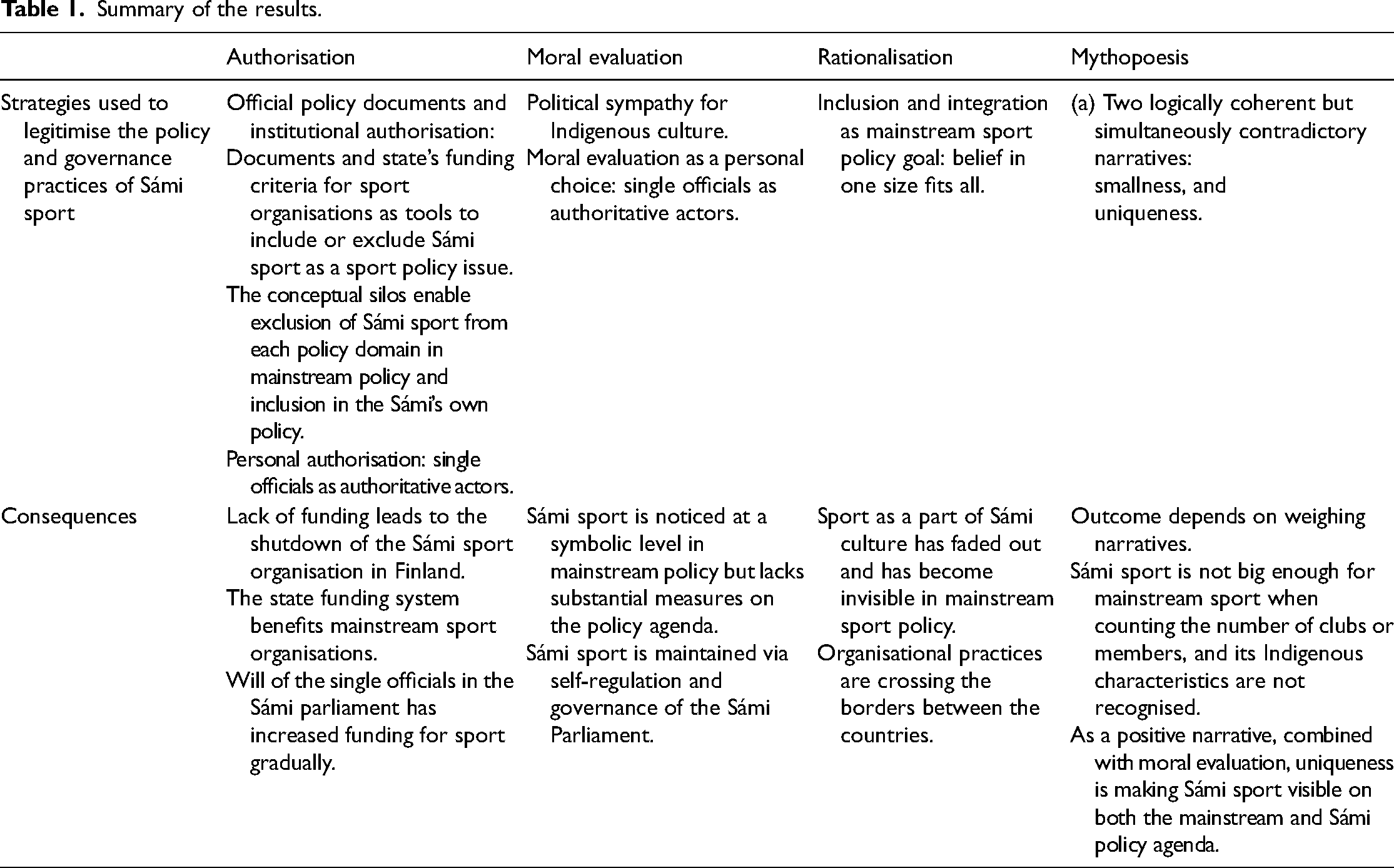
The results are structured according to Van Leeuwen's (2007) four legitimation strategies: authorisation, moral evaluation, rationalisation and narrative/mythopoesis. Table 1 provides an overview of the legitimation strategies, governance practices of Sámi sport, and consequences for Sámi sport policy and governance practices.
Summary of the results.
Authorisation
Authorisation as a legitimation strategy shows how institutions and their decisions as well as personal positions may influence policy and governance practices. Data illustrate how the state's funding criteria can be seen as an institutional authorisation where public sport policy shows its own will. As an example, funding criteria are underlining the number of participants or members by stating that ‘the Ministry is considering the quality, proportion and societal impact of organisational activities when distributing state subsidies’ (OKM, 2022). Such criteria are clearly not favouring smaller and autonomous sports with specific target groups, such as the Sámi. According to the representative of the Ministry, this led to a situation in the 1990s when SVL-F did not even bother to apply for funds: ‘There were quite many years during the 1990s when they [SVL-F] did not apply for subsidies at all. Therefore, SVL-F somehow faded out’. The representative of the Sámi sport club also pointed to the criteria: Looking at the Finnish sport policy overall, it is based on quantitative numbers in terms of memberships or participants. We have no numbers to show as we do not have enough organisations or individual members. Somehow, I feel that we are completely out of sport-related discussions overall here in Northern Finland.
From the viewpoint of administrative practices, Sámi sport is placed under the governance of several policy areas, such as sport policy, culture policy and youth work policy. Although such cross-affiliations would intuitively seem beneficial, they make it possible to exclude Sámi sport from the responsibility of one policy area and/or department by pointing to the responsibilities of other policy area and/or departments. The representative of the sport club explained the following: ‘Sport has not been part of culture before; now the situation is a little bit better. Ten years ago, there were no connections between culture and sport, but now things are better’.
Just like criteria for state subsidies mentioned above or administrative practices, the state's official sports policy documents can also be considered a way to legitimise Sámi sports. When scrutinising mainstream sport policy documents, it is difficult to find any recognition of an autonomous Sámi sport; it is absent in, for example, one of the most important documents, the Government's Sport Policy Report (Finnish Government, 2019). According to the report, Sámi sport does not seem part of the national sport policy goals, as there are no references made to Sámi sport or indigeneity more broadly. Comparably, the report contains descriptions and non-discriminations about immigrants as well as how the state's subsidies support inclusion and integration (Finnish Government, 2019: 27).
In its cultural policy action and development programme for the Sámi people 2020 to 2023, the Sámi Parliament (2020b: 8) provides a comment on that: There must be a separate earmarked appropriation to support the activities of Sámi sports and exercise organisations. Support for Sámi physical education, which in this context refers to the Sámi and Indigenous sports culture – for example, skiing, lassoing, and reindeer competitions – are of primary importance in strengthening the identity and sense of community of the Sámi youth. Supporting joint Nordic sports activities and increasing resources create opportunities to strengthen cooperation between actors in the Sámi homeland, not only in the field of sports activities.
This statement is also significant from the viewpoint of sport and its legitimate position in Sámi policy. In addition, the youth strategy 2020 to 2023 of the Sámi Parliament (2020a: 8) underlines that ‘sports events in the Sámi region should be kept alive together with different actors’.
Moral evaluation
Moral evaluation as a legitimation strategy provides a basis for the policy and governance practices. Interview data, in particular, show there is a lot of political sympathy for Sámi sport and good will that seems to stem from the Sámi people's Indigenous status. At the same time, it is unclear whether this ‘hope-based’ policy (with general but rather uninspired phrases like ‘we wish them the very best’) is leading to any concrete outcomes. In addition, the representative of the Ministry sees Sámi as one of many ‘minority’ groups that creates challenges for sport policymakers: In the sport policy domain, refugees are nowadays the new normal for us. Maybe it will be like that for Sámi sport in the future. This [Sámi discussion] has been a good wake-up call for us to understand the regional differences and especially what kind of minorities we have in different regions around Finland.
Equating the Sámi to other minorities, on the other hand, partially removes the legitimacy based on the ‘political sympathy’ mentioned at the beginning because the interview material does not show a distinction between the status of Indigenous people based on the constitution and belonging to minorities overall. In addition, the example highlights regional differences, which can be understood to refer to the Sámi homeland and thus strengthens the consideration of an autonomous Sámi sport in mainstream sports politics. Analysis of the interviews and documents also reveals another paradox. It seems important to provide a voice for the Sámi people in order to secure their representativeness and conditions for maintaining their own sport. However, concrete practices on how to do this are missing. Simultaneously, the Sámi Parliament, as an independent authority, is recognising sport as a part of their policy guidelines, whereas more general administrative practices are not.
As such, moral evaluation as a legitimation strategy provides a sort of baseline for other legitimation strategies because it shows what issues are important in the public (sport) policy. However, in our analysis, moral evaluation also appeared at an individual level, especially when it comes to decisions on whether to award Sámi Parliament subsides to Sámi sport. To legitimate such decisions, Sámi sport is connected to the Sámi language, which is a ‘cultural glue’ between the Sámi people, as the representative of the Sámi Parliament stated: To me, sport is not only about sweating, competitions, or physical activity but about community, and because of that, it maintains the Sámi language when Sámi people are doing sport together. This is why I think sport is a vital part of Sámi culture and worthy of funding.
Whether or not decisions are based on personal interests, it is evident that giving a new meaning to subsidising Indigenous sport as an autonomous organisation (for maintaining the Indigenous language) provides opportunities for maintaining Sámi sport and its organisational practices. Thus, decision making at a personal level can be seen as legitimation through a position of authority; authorisation and moral evaluation as legitimation strategies are thus supporting and reinforcing each other. In the next section, we show how rationalisation as a legitimation strategy is distinctly different in our empirical material, partly because ‘moralisation and rationalisation keep each other at an arm's length’ (Van Leeuwen, 2007: 113).
Rationalisation
When it comes to rationalisation, inclusion and integration are typical sport policy goals and objectives. The aim for independence and outspoken uniqueness work to make Sámi sport less rational in general sport policy terms. As previously described, the Sámi people are not recognised in the Finnish Government's Sport Policy Report. Despite the mentioned symbolic politics, it is evident that when combining Sámi and sport, the rational solution for policymakers seems to be to consider them as one of the minority groups, as stated in the state official’s argument: Sámi sport is a kind of minority politics, like it is with refugees or immigrants; it is limited here in Finland. Therefore, it's a question of integration: how to integrate minorities into society and how to treat them, for example, in traditional sports. We have done this with the sport federations.
From the government's viewpoint, this line of reasoning is rational and practical. In relation to the other three legitimisation strategies, rationalisation can gain a more significant position than others, especially if inclusion and integration are the basic starting points for dealing with minorities in mainstream politics. From this point of view, rationalisation as a legitimation strategy weakens the position of Sámi sports. A potential outcome of the practicality in mainstreaming Indigenous individuals into universal welfare state systems – such as monopolistic sport organisations in a corporatist relationship with the state – may be perceived as assimilation. In addition, it must be disheartening for the Sámi people to have its struggle for recognition as an autonomous people and being equated with that of immigrants, especially because it is not primarily a struggle to be included but a struggle for Sámi collective rights and features as an Indigenous people with their unique self-governed organisations.
Narratives, mythopoesis
Finally, regarding narratives or mythopoesis, ‘legitimation can also be achieved through storytelling’ (Van Leeuwen, 2007: 105). In our analysis, we identified two main narratives as legitimation strategies: smallness and uniqueness, which both – but especially the latter – indicate some sort of self-control and tie the previously described legitimation strategies together. When looking at the numbers and quantitative details, the Sámi sport membership base seems too small to be considered as worthy of being on the governance agendas for sport policy in Sámi or Sámi politics in Finland. However, the uniqueness and the status of the Sámi as an Indigenous people may also provide them with a position and put them on the policy agenda as the representative of the Ministry illustrated: ‘I think it is good to bring this Sámi case to the table, even though it is a kind of nuance to our sport policy’. However, as we have noted previously, although Finnish sport policymakers share the hope for a good future for the Sámi people in general, and for Sámi sport in particular, not much positive practice seems to be implemented in sport policy.
The narrative seems to depend on who you ask, though. For the Sámi people themselves, the uniqueness of their sport activities and organisation is evident and important. It seems that sport is a way to promote Sámi culture and identity, whereas undisputedly it is something unique. However, the uniqueness as a narrative is a way to legitimise not only sport but the whole culture, as the representative of Sámi sport club said: Most of the Sámi people are living outside the Sámi Homeland. They discovered Sámi culture when we invited them to join a traditional Sámi sport. The children in the South do not necessarily recognise or realise that he/she is a Sámi if Sámi culture is not visible at home. So, organising these competitions is part of keeping up the Sámi culture and keeping up Sámi identity.
Using this last quote as a starting point, in the following section, we will discuss the consequences of the aspiration for self-determination and self-governance on the one hand and the aspiration for broader political influence in matters deciding on resources to Sámi sport on the other hand.
Concluding discussion
In this study, we have empirically examined the strategies used to legitimise the governance and policy practices of Sámi sport. Out of Van Leeuwen's (2007) four legitimation strategies, authorisation seems to be the most important at all three levels: documents, institutions and personal. Central then is the power associated with status as an instrument of authorisation. From this point of view, authorisation as a legitimation strategy is about institutional power and its use on a personal level. It makes visible what Henry and Lee (2004) stated about the nature of political governance: it is a system by which sport organisations are directed and managed through the processes by which governments or governing bodies seek to steer the sports system to achieve desired outcomes. There is a lack of recognition of Sámi sport in this process, where the government aims at facilitating for organisations by means of economic incentives to gain desired outcomes.
Also, when considering governance as a ‘softer’ form of steering than government (cf. Grix, 2010; Rhodes, 1996), which is more habit based than formally regulated, one might suggest that this is the problem for Sámi sport. There is no custom for supporting unique organisations in the Nordic countries, where everything revolves around universal solutions (sport-for-all in one umbrella organisation). Even in Finland, where the overall sport system is characterised by more pluralism than its neighbours Sweden and Norway, the Nordic tradition of governance seems to cause Sámi sport to be caught in between traditional governance and self-governance.
Whereas mainstream sport policy does not recognise Sámi sport in any concrete practices, the Sámi Parliament indeed has sport-related statements in its own documents. In addition, the use of state subsidy criteria as a regulation has led to negative impacts in Sámi sport organisational practices. Considering these observations together and compared to other countries with Indigenous sport systems (i.e. Canada and New Zealand as per the introduction), Sámi sport in Finland does not seem to be of interest for the state’s policymakers. Sámi sport becomes somewhat of a specificity and not relevant to impact on ‘real’ policy issues. That makes Sámi sport unique but also ‘too small’. Hence, policies for Sámi sport are apparently only an issue of the Sámi people. By that, legitimation is authorised through self-governance and regulation. When it comes to fitting the Sámi sport into mainstream sport policy, a similar pattern is found in Sweden, where the state has never subsidised Sámi sport (Fahlén and Skille, 2016, 2017), and stands in some contrast to the case in Norway, where Sámi sport has received state subsidies since 2005 (Skille, 2012).
Together, the legitimation strategies of rationalisation and authorisation – even though they have kept Sámi sport out of the mainstream sport policy agenda – may have produced some positive outcomes for Sámi sport and the Sámi people: the Sámi people have been active in crossing the state borders to keep their specific sport alive, participating in the Indigenous sport disciplines, and finding other Sámi people with whom to speak their own language and maintain Sámi culture. Apparently, the organisational structures are not restricting them to only one club, and their method of participation may be richer and more creative, such as unofficial groups, networks and communities, than in people living in mainstream culture and away from the Sámi homeland.
Thus, in the discussion of how Sámi sport is balancing between autonomy and mainstream governance, it seems that the Finnish state blocks the possibility for influence by providing ‘full autonomy’ – that is, keeping them out of the overarching sport policy. In that respect, this study strengthens the findings in earlier studies of Sámi sport. Fahlén and Skille (2016) stated that the governance practices of Sámi sport vary in the Nordic countries, although their cultural bases are relatively similar. Therefore, it seems that people living across the territories of different countries without official state borders encounter the policy and governing practices of all four countries in the case of the Sámi and, in the case of sports, the structures and governing practices of each country's sports system.
However, these arguments could be interpreted as an under-evaluation, where the state documents and state interviewee equate the Sámi with immigrants and other minorities, thus devaluating their status as an Indigenous people. The view is significantly based on the idea of inclusion and the integration of minorities into the mainstream sport policy. As a point of view, the above represents rationalisation as a legitimation strategy. If this view is maintained, national sports policy will not recognise Sámi sport in the future either. The essential question is whether mainstream politics should support and recognise the meanings that Indigenous people attach to sport, such as maintaining the language and culture through sports.
In that respect, it is worth taking note of Van Leeuwen's (2007) theoretical distinction between various forms of rationalisation. Instrumental rationalisation refers to arguments that ‘explain why social practices exist and why they take the forms they do’ (Van Leeuwen, 2007: 101). In this regard, if sport is seen instrumentally (from the government's viewpoint), inclusion and integration are common sport policy goals in many policy documents across the globe (Green et al., 2019). The same is true for sport for all. In such a perspective, it is understandable that state authorities support the sport organisation(s) with the most members. When faced with Indigenous sport organisations with other goals (such as ethnic identity or nation building), it becomes more difficult to connect the organisation to the specific sport policy goals.
When traditional sport policy goals (such as public health and social integration) are used as rationales for legitimation, the Sámi sport organisation does not appear as a rationale to subsidise in the views of the state authorities because such goals are already being addressed by other organisations with far better reach. Regarding integration specifically, it could even be argued that Sámi sport works contradictory to the state policy goal: it is striving to be unique and is addressing an exclusive part of the population. In contrast, the Sámi people might see sport as preserving components of Indigenous people's culture, especially when people are using the Indigenous language in doing sport. From this point of view, the argument for supporting Sámi sport lies firstly in maintaining Sámi culture and secondly in possibilities to participate in sport.
In this study, it was possible to bring out new perspectives, which of course cannot be generalised as such but recontextualised to other Indigenous contexts. Examining Indigenous people and their self-governance highlights nuances and new angles to the study of governance in sports overall. Although we are non-Indigenous researchers, we seek to amplify the voices of those who experience marginalisation as per qualitative research ideology in general and Indigenous methodology in particular. Further research could focus on collaborative governing practices (see Meier and Garciá, 2021) of the Sámi Parliament, local municipalities, the state and neighbourhood states in the framework of systemic governance. It is assumed that Indigenous people's participation opportunities must be supported by the cooperation of various levels of governance. The governing practices of Sámi sports provide a good reference framework for this complex question.
Footnotes
Declaration of conflicting interests
The authors declared no potential conflicts of interest with respect to the research, authorship, and/or publication of this article.
Funding
The authors received no financial support for the research, authorship, and/or publication of this article.
