



Abstract
Coaches use of augmented verbal feedback (AVF), often measured through systematic observation, is acknowledged as having a vital role in athlete learning. The purpose of this review was to identify coaches’ use of AVF, through systematic observation, in developmental and performance contexts. A literature search was conducted using EBSCO HOST and SCOPUS databases. Studies were reviewed using the Preferred Reporting Items for Systematic Reviews and Meta-Analyses (PRISMA) guidelines. Data were extracted from 31 studies which met the inclusion criteria. Analysis revealed three themes: (a) variation in observation tool and feedback types observed; (b) evidence base surrounding feedback types observed; (c) quality of coach feedback. The multiple feedback types measured across the studies suggests there is limited agreement on the types of feedback most important to measure. For the impact of feedback to be better understood, feedback types captured via systematic observation need revising in line with research that has identified the important characteristics of feedback. A greater evidence-informed approach to the observation of feedback may help to develop a greater understanding of the feedback process in learning and performance. Where there were consistencies in feedback type, the quality of AVF delivered by coaches could be questioned.
Introduction
Feedback can be viewed as intrinsic, referring to the sensory information naturally available to the learner during the performance of a skill, 1 and extrinsic or augmented, conceptualised as ‘information provided by an agent regarding aspects of one's performance or understanding’ (p.81). 2 The effectiveness of feedback has been mostly understood from either its impact on motor learning, or a broader pedagogical strategy that supports learning.3,4 These corpuses of work have shown coach feedback to be effective in supporting athlete learning and performance.3,5 Augmented feedback has been split and researched in different ways. Andersen et al. 6 separated augmented verbal feedback (AVF) into what, when and how. ‘What’ variables include whether the feedback provided is based on knowledge of results or knowledge of performance and whether the feedback is descriptive or prescriptive. ‘When’ variables include whether feedback was used concurrently or terminally to performance and if terminally feedback was provided immediately or delayed. ‘How’ variables include the mode of delivery such as verbal, visual, auditory, vibro-tactile, haptic, and/or multimodal.6–8 AVF has been observed to be beneficial to learning and performance in skill acquisition when promoting an external focus of attention, 9 is autonomy supportive 10 and is based on positive performance. 5
The differentiation between learning and performance is a common oversight when discussing the use of feedback. 11 While learning refers to relatively permanent changes in underlying behaviour, in the heat of competition, immediate performance may be valued over learning outcomes.11,12 Mason et al. 12 discuss this in the context of coaches’ use of autonomy-supportive feedback in game, describing that while autonomy-supportive feedback may be seen as optimal for learning, controlling or prescriptive feedback may be of greater perceived importance for improving immediate performance. This short versus long term focus of feedback may be particularly important in elite environments when short-term results are more favourable. 12
From a pedagogical perspective, meta-analyses undertaken by Hattie and Timperley 2 and Wisniewski et al. 4 focused on the effects of multiple modes of teacher feedback and identified its positive impact on student's learning and achievement. Hattie and Timperley 2 clarify the characteristics of effective feedback, which is when learners are supported to better understand what they are doing well, together with what they need to do to improve. However, not all feedback is beneficial for learning. 3 Meta-analyses2,4 have highlighted how feedback linked to punishment, reward and/or praise had minimal, if any effect, on learning. These studies2,4 also highlighted how effective feedback focused on providing reinforcement, high levels of information and detail on what is deemed to be correct rather than incorrect performance. While the types of feedback used are important, the frequency of feedback is also particularly pertinent. Feedback can hinder learning when the learner develops a dependency on the provision of AVF which may occur when feedback is provided too frequently.1,3 An optimal frequency may be dependent on the stage of learning and the complexity of the task, with feedback given often enough to facilitate learning, while still ensuring the learner is adequately involved in the problem-solving process.13,14 The authors also suggest that as the skill develops frequency may reduce, along with a shift in qualitative focus moving from prescriptive to more descriptive feedback. Given feedback can positively and negatively impact learning, and is within the control of the educator, it is an important area to study in the context of sport coaching. 3
Feedback in sports coaching has been studied widely using a range of methods. For example, Mouchet et al. 15 used a combination of semi-structured interviews and in-game coach communication, of which feedback was a component, to identify and understand the subjectivity surrounding French National Rugby coaches’ in-competition communications. Ansell and Spencer 16 used interviews with athletes to explore their experiences of receiving and engaging with coach feedback. Questionnaires have also been employed to investigate coaches’ use of feedback as experienced by their athletes.17,18 However, the most common means of reporting coaches’ use of feedback has been through systematic observation, where coaches’ behaviours are directly observed and analysed, to illustrate what coaches do during practice or competition.15,16 While systematic observation is not without its limitations, it has been shown to accurately identify coaches’ ‘actual’ behaviours, demonstrated in their natural context 19 ; something which self-reported measures such as interviews and questionnaires may fail to do.20,21
When using systematic observation, coaches’ use of feedback is often identified as part of a coaches’ broader behavioural profile, such as questioning, modelling or demonstration and instruction. More recently, researchers have used systematic observation to focus specifically on feedback and its impact on athlete's learning and experiences, but this work is limited. In a study by Halperin et al., 22 the frequency and the type of feedback were observed and analysed for 12 amateur boxing coaches during competition. Findings indicated that feedback found to enhance motor performance such as being more autonomy supportive, more focused on positive actions and focused less on an internal focus of attention was used more often during winning rather than losing bouts. Mason et al. 12 used systematic observation to investigate the quantity and nature of feedback from coach to player during competition in Australian Rules Football. This study found feedback types more commonly associated with improved learning and performance appeared to be provided more frequently during winning quarters, these included the prevalence of more descriptive rather than prescriptive feedback, positive rather than negative feedback and process related rather than task related feedback.
An important feature of systematic observation research is the contexts in which these studies have been undertaken. A significant percentage of this research has been in participation/recreational contexts, 20 which Lyle 23 characterises as being short-term in nature, not always related to competition, and not necessarily associated with skill development and performance. Conversely, developmental (as characterised as a key stage for talent identification and young athletes accelerating their way through performance standards) and performance contexts (as characterised by relatively intensive preparation and involvement in competition sport) have received less attention. 20 Yet these are sites where skill development and performance are a priority. 23 Arguably, then, this is where coaches’ use of AVF is most important.
The purpose of this systematic review was to understand the use of AVF in sport. While researching coach behaviour is common, focusing on AVF alone is limited. Therefore, we aimed to understand AVF in team sport by evaluating the interactions between the coaches and players in developmental and performance contexts. Understanding how feedback is used in these contexts first is pivotal if future research is to build on how we measure and develop the use of optimal AVF provision. Evaluating AVF provision of coaches in team sports permits an assessment to be made on its efficacy and what methods may assist in players understanding and performance.
Materials and methods
Identification of studies
Studies were reviewed using the Preferred Reporting Items for Systematic Reviews and Meta-Analyses (PRISMA) guidelines. 24 The screening process utilised is outlined in Figure 1. The research question and inclusion/exclusion criteria were established prior to conducting the literature search and were consistent with the objectives of the review. The inclusion and exclusion criteria are outlined in Table 1. Initially, studies were identified through a comprehensive search of the EBSCO HOST and SCOPUS databases. Specific databases searched via EBSCO HOST were APA PsycInfo, APA PsycArticles, MEDLINE and SPORTdiscus with Full Text. The search strategy combined four groups of terms to ensure the retrieved studies involved reference to coaching (Group 1: coach*), involved coach to player interaction (Group 2: feedback, communication, coach behaviour*), involved the context (Group 3: sport*, team sport*) and the participation level (Group 4: professional, elite, development, academy). The final search string included a combination of the above terms combined with AND, OR, NOT or AND NOT.
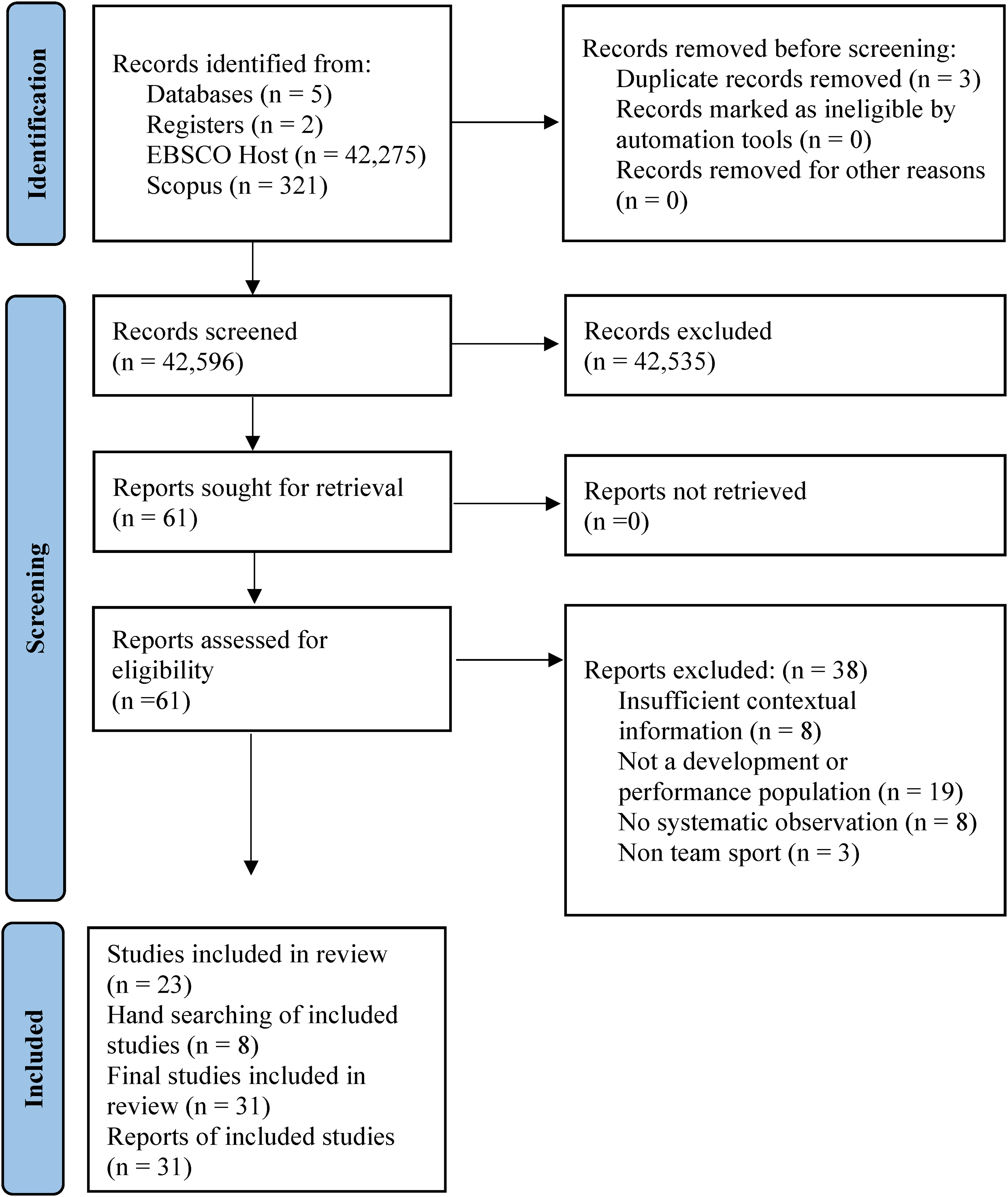
PRISMA flow diagram.
Outline of inclusion and exclusion criteria.
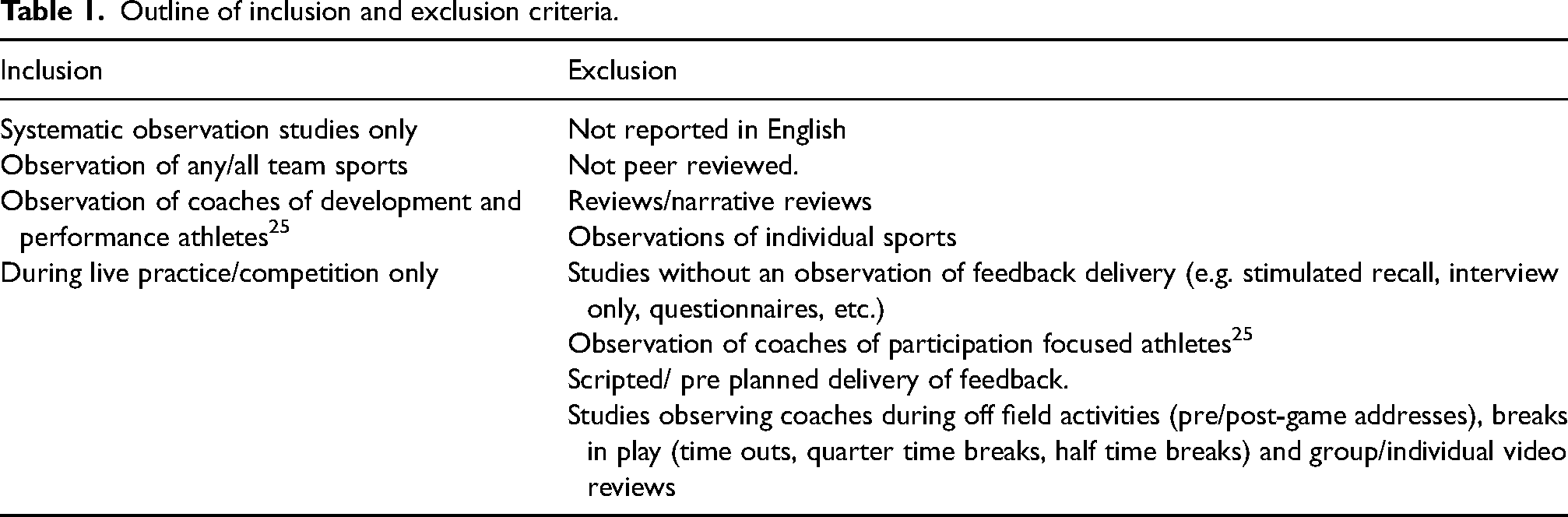
Screening and exclusion were carried out in three steps 26 as explained below and outlined in Figure 1. Once the initial literature search was complete, titles and abstracts of all articles retrieved from the literature search were screened for suitability, with only articles deemed suitable based on the information presented in the title and abstract progressing. The full text of each of these articles were then retrieved and checked against the inclusion/exclusion criteria by three reviewers, using Covidence systematic review software (Veritas Health Innovation. Melbourne, Australia). Additionally, a hand searching process of all bibliographies of the papers included after full text screening was carried out, to ensure no relevant articles were missed. The search and exclusion processes were conducted in February 2022.
Data extraction
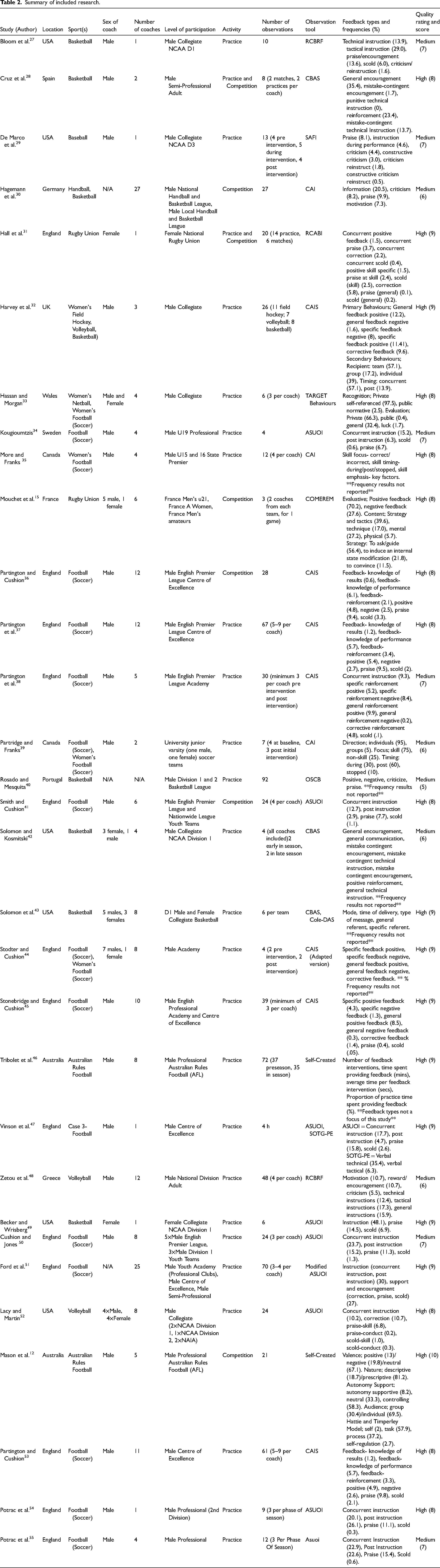
Data extraction was carried out by the first author (see Table 2) according to headings used in a systematic review of systematic observation in sport coaching. 16 These headings included location, sport, coach, sex, number of coaches observed, level of participation, coaching activity observed, number of observation and observation tool. Specific to this review, a heading reporting the frequency and type of feedback observed was also included. Extracted data under each individual heading was checked for accuracy by the authorship team upon initial completion of Table 2. Once extracted, data from each paper were coded deductively based on the characteristics of effective feedback highlighted in the previously discussed reviews by Hattie and Timperley 2 and Wisniewski Zierer and Hattie. 4
Summary of included research.
Quality assessment
The methodological quality of each of the included studies was assessed by the lead researcher (RC) using the Critical Appraisal Skills Programme (CASP) Qualitative Checklist. 56 This checklist was chosen as it most accurately questioned the relevant elements and risks of bias of the identified papers. Despite the checklists title, this checklist has also been used as a quality assessment tool in the analysis of quantitative as well as qualitative research. 57 This checklist assesses the quality of individual studies across 10 questions, where answers are given as ‘Yes’, ‘Can’t Tell’ or ‘No’ for each question, totalling to a score out of 10. Studies were rated ‘low’ if three or less questions were answered positively, medium if four to seven questions were answered positively, and high if eight or more answers were answered positively. 57 The results of the quality rating can be observed in Table 2.
Results
A summary of the search, selection and exclusion process of articles is provided in the PRISMA flow diagram (Figure 1). The initial search strategy identified 42,596 articles for screening. Following the multi-level screening process, 23 studies were eligible for inclusion. A further 8 articles were identified via hand searching resulting in 31 studies included for extraction. An outline of the final 31 identified articles is displayed in Table 2.
The analysis of these identified studies revealed three themes, which are (1) variation in observation tool and feedback types observed, (2) evidence base surrounding feedback types observed and (3) quality of coach feedback.
Research context
Of the identified 31 papers a variety of coaching demographics were observed. The majority of investigations identified were conducted in the UK (15 articles) and USA (6), with the remainder conducted in Canada (2), Australia (2), Spain, Germany, France, Portugal, Greece and Sweden (all 1 each). A variety of sports were also observed. Soccer/football (16) and basketball (8) were the most observed sports followed by volleyball (3), rugby union (2) and Australian rules football (AFL) (2). Baseball, netball, handball and field hockey were observed once in the identified studies. There was also a large variety of contexts observed across the identified studies. Youth academy or centre of excellence contexts were observed most frequently (12) followed by collegiate level athletes (9), professional athletes (6), semi-professionals (6) and amateurs (3). Five studies observed more than one context as part of their research. Twenty-six studies observed male athletes, three studies observed both male and female athletes, while two observed solely female athletes. Of these studies, 20 observed male coaches, 6 observed both male and female coaches, while 2 studies observed female coaches. The sex of the coach could not be identified from three of the identified studies. Twenty-four studies observed multiple coaches in their investigation, ranging from 2 up to 27, six studies were conducted on an individual coach. The number of coaches observed could not be identified from one study. Twenty-four studies observed practice only, five observed competition only and two observed both.
Variation in observation tool and feedback types observed
Thirteen different systematic observation tools were used in the 31 studies. Each tool has variations in the feedback types observed and the definitions associated with these. Examples of these variations are outlined in Table 3. Nine studies used the Arizona State University Observation Instrument (ASUOI) or a modified version of same. The original feedback types used in the ASUOI were consistent across six of the identified studies using this tool. However, the three remaining studies using the ASUOI, all used adapted feedback types.49,51,52 The coach analysis and intervention system (CAIS) or a version of same was used seven times. The same version of CAIS (which was already an adapted version of the original) was only used in three of the identified studies.36,37,53 The other four studies using CAIS all used different adaptations of the original tool. Other tools used in multiple studies included the coach analysis instrument (CAI) (3), coaching behaviour assessment system (CBAS) (2) and revised coaching behaviour recording form (RCBRF) (2). The Rugby Coaches Activities and Behaviours Instrument (RCABI), Self-Assessment Feedback Instrument (SAFI), Communications des Entraineurs de Rugby en Match (COMEREM), TARGET behaviours framework (task, authority, recognition, grouping, evaluation, and time structures), System of Observation of Coach's Behaviour (OSCB) and Cole Descriptive Analysis System (Cole-DAS) observation tools were each also used in one study. Mason et al. 12 used a self-created tool based on previous literature on feedback types observed during competition, while Tribolet et al. 46 also used a self-created tool based on previous research by Tribolet et al. 58 and Ford et al. 51
Examples of feedback type definitions used in systematic observation tools.
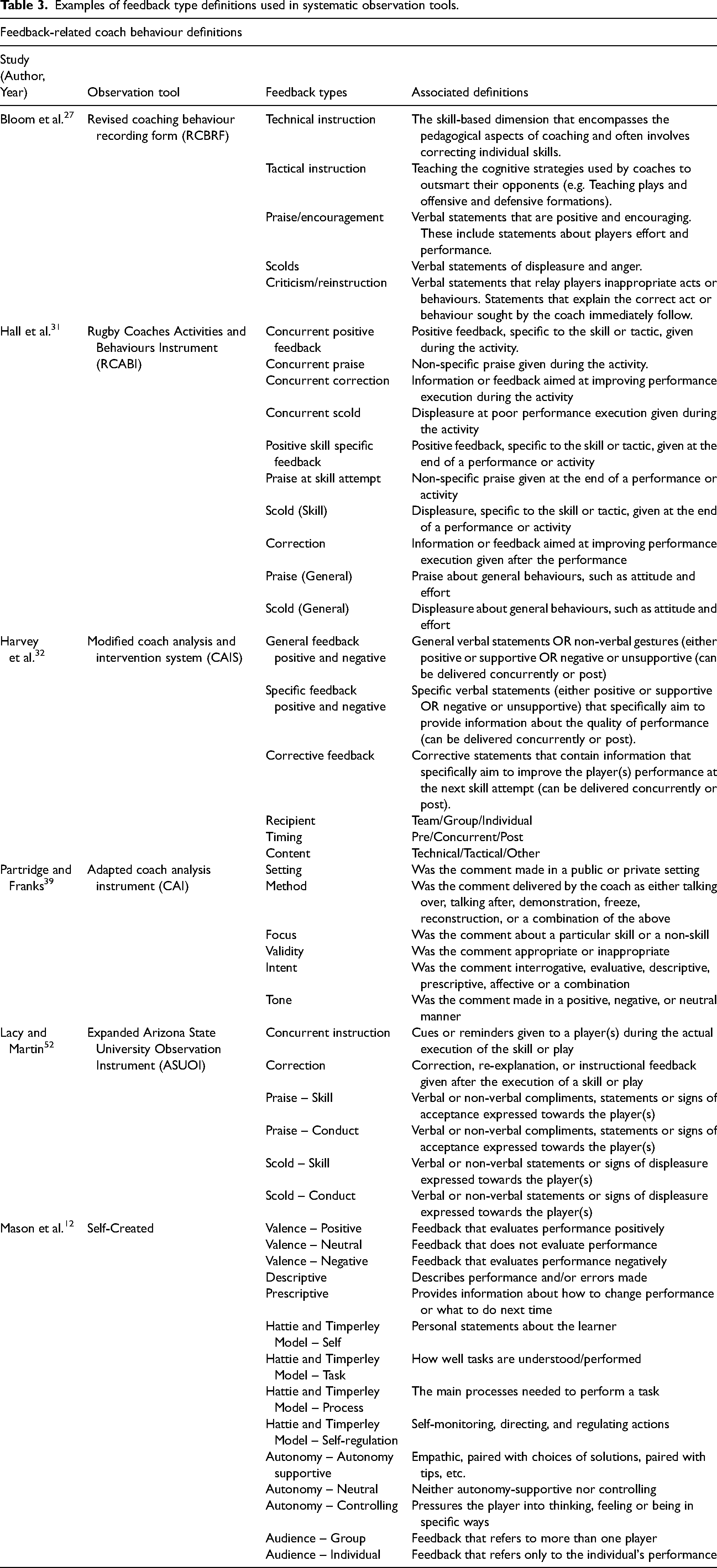
When trying to ascertain feedback types that have been observed across these studies a broad range exists, as outlined in Table 2. Some variations of the tools used appeared to observe only 3 feedback types,32,49 while others observed up to 14. 12 Some studies observed these feedback types in distinct categories, such as Hassan and Morgan 33 which looked at recognition and evaluation categories which included four feedback types. Mouchet et al. 15 used evaluative, strategy and content feedback categories which included nine feedback types. Partridge and Franks 39 also looked at direction, focus and timing categories which included seven feedback types. When looking solely at feedback as opposed to other coach behaviours Mason et al. 12 used five distinct categories; Hattie and Timperley model, audience, nature, valence and autonomy support which included fourteen feedback types.
It is important to note that of the literature identified, only two papers12,37 observed and classified solely feedback and characteristics of same in their research. Both studies were conducted in Australian rules football, in professional AFL clubs. Tribolet et al. 46 focused on rates of feedback provided and duration of these interventions, while Mason, Farrow and Hattie 12 observed the content of the feedback provided in greater detail (see Table 2). All other identified studies observed a variety of coach behaviours.
The most common feedback type observed was praise/encouragement, which was observed in nineteen of the identified studies. General feedback (or similar) was observed on thirteen occasions, while specific feedback was observed in fifteen of the identified studies. Positive/negative feedback (or valence) was observed in eleven of the identified studies. Timing was another common feedback type observed, with 14 studies using concurrent feedback as a feedback type observed, while 12 studies observed post feedback. Partridge and Franks 39 also used ‘stopped’ as well as concurrent and post in their analysis. Group/individual focus (or audience) was observed in four of the identified studies.
Evidence base surrounding feedback types observed
Along with the variety that existed in feedback types observed, the definitions associated with these also varied (as outlined in Table 3). For example, depending on the tool used, general feedback positive, 32 praise/encouragement 27 and valence-positive 12 may all be measuring the same comment in different categories. While being similar, the definitions associated with these feedback types varied. In other instances, the feedback types observed varied more broadly (as outlined in Table 3). Thus, what seems to be limited evidence surrounding which feedback types are most important to measure may call in to question where the feedback types observed have come from and what the rationale is for their inclusion.
Quality of coach feedback
In studies using the most frequently observed feedback types, feedback used by coaches appeared to be more general than specific in nature, particularly when considering the prevalence of praise in the identified studies. Concurrent feedback was more prevalent than post-activity, with Partridge and Franks 39 and Potrac et al. 54 the only identified studies to report a greater frequency of feedback post-activity. Feedback was also more directed at individuals as opposed to groups or whole teams in the identified studies. Of the four studies that observed this feedback type, Partridge and Franks, 39 Hassan and Morgan 33 and Mason et al. 12 all reported a higher prevalence of individually focused feedback, while Harvey et al. 32 reported feedback focused on the team (57.1%) and group (17.2%) more often than the individual (39%). Feedback also appears to be more positive than negative in nature, as will be discussed in more detail in following paragraphs.
Wisniewski et al. 4 found high information feedback (which contains information on task, process and (sometimes) self-regulation) to have a very large effect on learning. Of the identified studies only Mason et al. 12 observed these feedback types. Frequency of each type was reported as self (2.0%), task (57.9%), process (37.3%) and self-regulation (2.8%). Mouchet et al. 15 did report on what may be deemed similar feedback types termed ‘strategy’. The frequency of each strategy was reported as to ask or guide (56.4%), to induce an internal state modification (21.8%) and to convince (11.5%).
Reinforcement is another feedback type which has a large effect on learning, 2 which has been observed more extensively in the included studies.36,51,53,54 Cruz et al. 28 reported reinforcement as 23.4% of observed behaviours in male semi-professional basketball coaches. In a male English premier league centre of excellence, low levels of reinforcement 2.1%, 3.3% and 3.4% were reported by Partington and Cushion, 36 Partington and Cushion 53 and Partington et al., 37 respectively. Using an adapted version of CAIS in an English premier league academy, Partington et al. 38 observed reinforcement in sub types; specific reinforcement positive, specific reinforcement negative, general reinforcement positive, general reinforcement negative and corrective reinforcement. These sub types totalled to 28.6% of observed behaviours.
Wisniewski et al. 4 also found corrective feedback to have a moderate effect on learning. In the identified studies, observation of this feedback type was also rare. This may be due to the definition for corrective feedback 21 being very similar to the definition we commonly see for reinforcement, 36 which seems to result in these feedback types being observed somewhat interchangeably. Use of corrective feedback was identified by Hall et al., 31 Harvey et al. 32 and Stonebridge and Cushion 45 only. When observing a female international rugby union head coach in practice and competition, Hall et al. 31 found corrective feedback to constitute 5.8% of coach behaviours. Harvey et al. 32 observed corrective feedback to vary from 4.6% of total coach behaviours with a collegiate men's basketball coach, 7.5% with a collegiate women's field hockey coach and 16.5% in a collegiate men's volleyball coach. Stonebridge and Cushion 45 found corrective feedback to amount to only 1.5% of coach behaviours in 10 male English premier league football academy coaches.
Hattie and Timperley 2 also concluded that feedback is more effective when it provides information on correct rather than incorrect performances. In the identified studies the observation of feedback valence is common. Most studies observed valence as either positive or negative, while Mason et al. 12 also included a neutral sub type. Some variations of CAIS have also categorised valence in general and specific sub types,32,44,45 while Hall et al. 31 observed skill specific positive feedback in their research. Across most of these studies positive feedback was more prevalent than negative, in both general and specific sub types. Mason et al. 12 reported feedback to be 19.9% negative, 13.0% positive and 67.1% neutral in their observations of AFL coaches during competition.
Discussion
The purpose of this systematic review was to understand the use of AVF in sport. A key finding of this review highlights the variation in observation tool used and feedback types observed in the 31 studies reviewed. The evidence base surrounding the development of these tools and the types associated with these is questionable. Evaluating the types of AVF coaches provide in relation to the literature permits an understanding of their augmented feedback usage. Specifically, we aimed to understand AVF in team sport by evaluating the interactions between the coaches and players in developmental and performance contexts. Evaluating AVF provision by coaches in team sport permits an assessment to be made on its efficacy and what methods may influence athletes learning and performance.
Variation in observation tool and feedback types observed
The variation in systematic observation tool and feedback types observed in the identified research studies makes it difficult to accurately describe how coaches use feedback across different observation tools. For example, coaches use of either general or specific feedback was a dichotomy commonly observed in this review.32,38,42–45 General and specific feedback frequencies were quite similar; however, it must be noted that the variability in feedback types observed, and observation tools used may leave this finding open to interpretation. For example, specific feedback could be defined as ‘content’ as termed by Mouchet et al. 15 who coded technical, tactical, physical and mental focused content. Across other studies this type consisted of differentiations such as skill versus non-skill (e.g. Partridge and Franks 39 ) and technical versus tactical (e.g. Zetou et al. 48 ). While context will of course have an impact on coaches’ use of feedback, greater consistency of feedback types observed may help coaches to understand their use of feedback relative to the greater coaching community. An early aim of systematic observation was to help to portray what good coaches do. 21 The inconsistencies in feedback types observed arguably makes it challenging to identify what good coaches do. Greater consistency of feedback types observed, and definitions associated with each of these are necessary in supporting researchers and coaches in understanding the effectiveness of coaches’ feedback. Positive examples of this are evident in Halperin et al. 22 and Mason et al. 12 where evidence-informed feedback types are observed with detailed definitions and examples from the coaches observed.
Evidence base surrounding feedback types observed
The second theme from this review highlights there is limited agreement on the types of feedback most important to measure. Currently, the feedback types observed in systematic observation tools help code what practitioners see and hear. However, these tools do not help coaches gauge the appropriateness of feedback types for developing desired outcomes and specific behaviours. This approach makes us question where the feedback types observed have come from and what is the rationale for their inclusion. If using systematic observation as a pedagogical tool to improve coaches’ use of AVF, it may be argued that the observation of evidence-informed feedback types may be an important step to aid coaches to think more reflexively about and develop a rationale 59 of certain feedback types. If we look at the systematic observation tools used in the selected studies, the development of such rationale may be difficult because of the lack of evidence surrounding the feedback types observed. Reviews of feedback by Hattie and Timperley 2 and Wisniewski et al. 4 offer evidence regarding the types of feedback most effective in supporting learning. Yet, reference to these feedback types rarely underpin systematic observation instruments used in coaching. For example, using systematic observation tools, a coach reflecting on their practice would find it difficult to rationalise answers to questions such as why do I use this feedback type in this situation? Or could I use a feedback type more beneficial to learning in this situation.
Mason et al.'s 11 study is one of the exceptions as their conceptualisation of feedback is directly informed by research undertaken focussed on effective feedback (i.e. Refs.2,4,17,60–62). For example, Mason et al.'s 12 observation template included valence, 44 level of autonomy support, 13 descriptive or prescriptive feedback,48,59 and the intention of the feedback. 2 Underpinning coaches’ feedback types using this evidence base could support coaches in understanding the intentions of their feedback and its impact on athlete learning and performance.
It is the measuring of high impact feedback types which has been suggested to enable the quality of feedback to be evaluated 5 and therefore is a key consideration of any systematic observation tool. Focus on high impact feedback types such as valence (or focus on correct rather than incorrect performance), level of autonomy support, descriptive or prescriptive (or reinforcement/ corrective feedback) feedback, high levels of information and the intention of feedback, are key. This can be seen in Halperin et al.'s 22 study, where these feedback categories were used to determine coach feedback during breaks in rounds of boxing competition. Results showed that feedback, which was more autonomy supportive, focused on positive actions and promoted less of an internal focus of attention was used more often during winning rather than losing bouts. In Mason et al.'s 12 study, which observed the same feedback types as Halperin et al.'s, 22 results highlighted feedback variables more commonly associated with improved learning and performance appear to be provided more frequently during winning quarters. While we cannot claim there is a causal relationship between feedback type provided by coaches and the impact on result, these initial studies do provide a promising starting point from which future studies can build. To date, much of the research citing the benefits of certain feedback types is based on isolated tasks such as a golf swing 63 and drop jumps. 64 . Research focused on analysing the relationship between feedback types and learning and performance in team sports or group tasks may further aid our understanding of which feedback types are beneficial in developing learning and performance.
Considering the first two themes identified, we suggest that Mason et al. 12 observation tool is most suitable for enabling the quality of feedback to be evaluated. 5 Given the evidence surrounding the development of the tool and the feedback types included, this may help coaches to think more reflexively about and develop a rationale 59 regarding the feedback types they use. A consistent use of this tool in varying contexts and environments may also aid coaches in understanding how other coaches use feedback across these contexts and environments. It may be argued that this step is of vital importance if we are to reach a point where we can analyse the relationship between feedback types and learning and performance in team sports.
Quality of coach feedback
Theme three identified that where the same observation tool/feedback types were used, coaches have limited understanding of what types of feedback are most effective in supporting their athletes learning and performance. This assertion is supported by multiple studies identifying coaches’ difficulty in reporting and rationalising their own behaviour.25,38,53 Where there were consistencies in coach feedback type, the suggested quality of this feedback to support athlete learning and development could be questioned. For example, across studies, coaches’ use of praise was high, despite this being found to have minimal, if any impact on learning or performance.2,65 It is however important to note that specific feedback based on positive performance has been observed to enhance the perceived competence a learner feels 66 and may also positively impact future performance. 67 Wisniewski et al. 4 found that a main component of effective feedback is the information it contains, with simple forms of praise and punishment having low effects, while high-information feedback was most effective. Across the included studies the use of general feedback was prevalent, highlighting a low level of specific information used by coaches. For example, Cruz et al. 28 observed general encouragement to make up 35.4% of coach behaviours, while Harvey et al. 32 also found general feedback to make up 13.8% of all coach behaviours. Zetou et al. 48 also observed motivation (10.7%) and reward/ encouragement (10.7%) to make up over 21% of coach behaviours.
In terms of the current review, it may be recommended that coaches place a greater emphasis on providing specific feedback rich in information that supports athletes in understanding what they did well alongside what they need to do to get better.
Conclusion
Research offers clear evidence of the important role of feedback in athlete learning and performance.3,4 Literature suggests that AVF, which promotes an external focus of attention, 9 is autonomy supportive 10 and is based on positive performance, 5 is particularly effective. When using systematic observation to understand how coaches give feedback, a greater use of evidence-informed feedback types, are needed. This focus on evidence-informed feedback types can allow for greater influence of the chosen tool on coach feedback practices, providing objective information, as opposed to coaches’ perceived ideas about what they think happens when they coach. 59 This information may then also provide an evidence-informed basis for reflection and dialogic practice on how the coaches feedback practices can affect athlete learning and performance. It is also important that consistency of these feedback types is encouraged across studies as a means of understanding coaches’ feedback. As highlighted in this research, to date multiple tools observing a variety of feedback types have been used, making it difficult to determine the general landscape of how coaches working in developmental and performance contexts provide feedback. We encourage researchers to consider the tools they use to observe and measure coach feedback. We suggest that Mason et al. 12 tool be strongly considered, given the evidence-informed nature of this tool. While further research is needed on how coaches give feedback in sport, a common criticism is that research too often considers the provider of feedback, and too infrequently the feedback receiver. 68 Research with a focus on how athletes receive coach feedback is important 69 and is vital in understanding the impact of coach feedback.
Footnotes
Declaration of conflicting interests
The author(s) declared no potential conflicts of interest with respect to the research, authorship and/or publication of this article.
Funding
The author(s) received no financial support for the research, authorship and/or publication of this article.
