



Abstract
This study investigated the perceptions of players and football club staff regarding de-selection from the youth international football environment. Prior research into youth football de-selection focuses on players’ experiences of being released from their club environment; however, research is yet to understand the effect of de-selection from international football. The authors completed semi-structured interviews with 11 current youth international footballers and nine members of leadership staff from English Premier League youth academies, including academy directors, technical directors and heads of coaching. It was found that players had a strong identity as an international footballer and that once de-selected, it could be difficult to adapt to a change in status within their group at the club. The club staff also suggested that clubs do little to support the player once de-selected as although they perceive the player as being part of their development programme, they viewed international football as an area that was not their responsibility. Practical applications are discussed, including the need for clear justifications of de-selection and ‘after-care’ solutions.
Introduction
In 2022, the England U19 men's team won the UEFA European Championship for the second time in 5 years, leading to the England men's youth national teams being viewed by many as some of the most successful in the world. In response, research has sought to examine and explain this national success, in part by focusing on one of the most crucial areas: the transition process into the youth international environment.1,2 Despite this, one area that has yet to be explored is the de-selection out of international squads, and how this influences player development and national team representation as a whole. ‘De-selection’ here is understood as ‘the process of removing players from the development programme who no longer demonstrate the attributes to participate in, or to be selected for, future squads or teams’ 3 (p. 1200). From this definition, it can be suggested that de-selection from the youth international environment would inhibit the possible development opportunities that are afforded to the developing player. Across Europe, there is a high rate of de-selection in club academies,4,5 with players often de-selected for not reaching the expected level of performance: one study records a 25% turnover of players each season across a 13-club analysis, 4 while Ford et al.'s 5 study into 29 European football academies further locates that within the youth development phase (12–16 years old), there is up to a 29.5% turnover of players. While de-selection is indeed part of the game, research is yet to suggest the rate of de-selection from youth international football or the repercussions this has on youth players.
Given this, this paper makes an original and significant contribution to sports science and coaching practice by being the first to examine de-selection out of youth international squads. In doing so, we put forth new insights and recommendations concerning player de-selection and support. While the high turnover of players throughout the club development system suggests that de-selection is a commonplace within academy football, our logical starting point is to understand the international de-selection process from the viewpoint of the players and staff themselves. Consequently, this paper aimed to understand the effect of de-selection from the youth international football environment and the support offered to players upon de-selection through conducting interviews with players and staff from nine English Premier League youth academies.
The relationship between club academies and international teams can be described as complex. The national team constitutes players that are ‘borrowed from the professional clubs’ 6 (p. 2), and therefore it is integral that there is a positive relationship between clubs and governing bodies to ensure that players are supported. De-selection within youth international football can be problematic due to organisations attempting to find a balance between high potential and current levels of high performance, accentuated by the difficulty in comparing players from different parts of the country who are operating in different environments. 6 As discussed above, de-selection is an unavoidable element of youth academy football, largely due to the competitive nature and high financial rewards of reaching the professional level, and therefore we maintain that research needs to understand this area from various standpoints in order to better support those developing players.
Through de-selection from youth academy club football, sports psychology research has clearly shown that individuals often experience issues of identity crisis.7,8 In this context, athletic identity is defined as the constantly evolving sense of self, both as an individual and member of society, tied to the individuals athletic performance.7,9 When identity development is closely tied to athletic performance it has been shown that young athletes begin to develop an identity that is aligned to their level of performance. 10 This can have detrimental effects on the individual, including inhibiting the individual in developing wider educational, career or life-style options. 10 In England, football clubs have begun their attempt to counteract these issues through the development of player care departments. The discipline of player care is still a burgeoning area within youth football academies, with designated staff required to manage the ‘mental and emotional wellbeing of Academy players’. 11 (p. 40) However, there is limited guidance on the wider role of this individual within the system. Although there has been an increasing focus on areas such as identity development within youth club football, none of this research is situated within the youth international football domain, and therefore little is known as to how de-selection from this environment may influence the wider identity of the developing player or their sports performance.
Methods
Given the various gaps in the research, our guiding aims were to explore the following key questions:
What effect does de-selection from youth international football have upon players? What are the player's perceptions of international de-selection on talent development? What support is offered by clubs to players upon being de-selected from youth international football?
The lack of existing research and documentary coverage of this topic led us to the decision to seek to interview players and coaching staff directly. In doing so, we drew on the use of qualitative, semi-structured interviews.
Participants and procedure
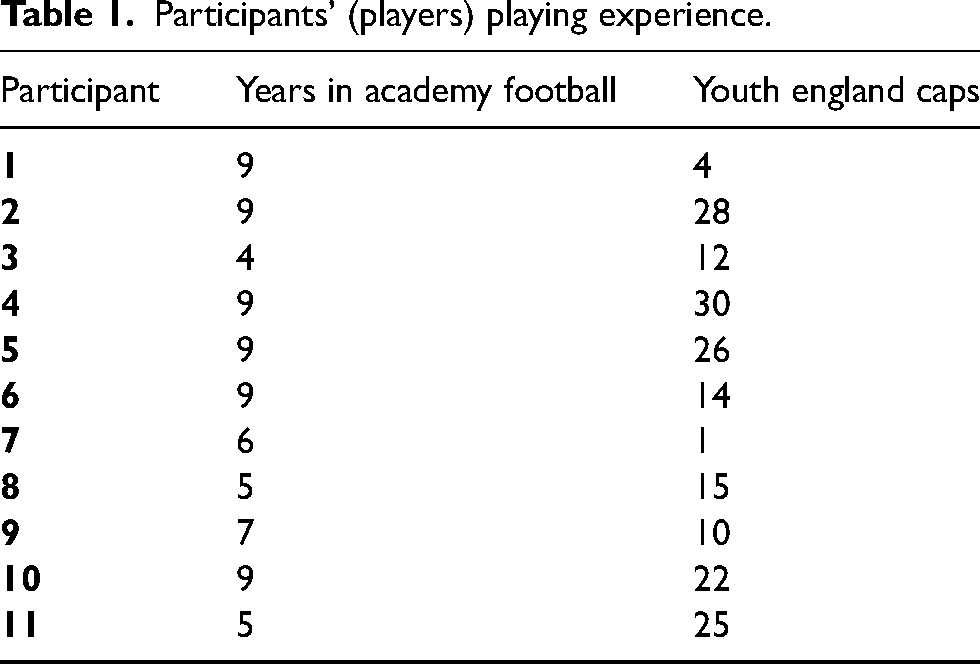
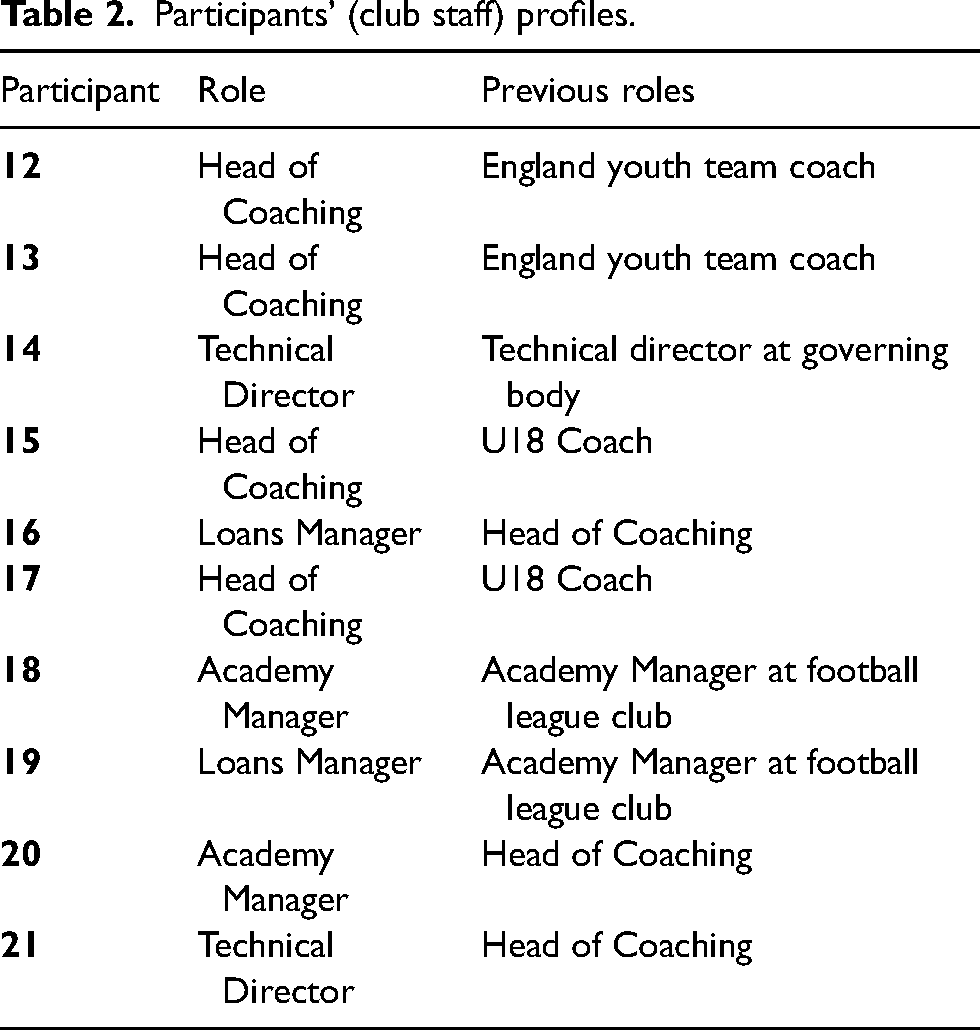
In total, we interviewed 11 professional youth footballers and 10 members of leadership staff from professional football clubs (see Tables 1 and 2). The players and staff came from nine different English Premier League clubs. The professional footballers in the study were all male, aged between 16 and 18 years of age (mean = 17.6 years old) and had each played a minimum of one youth fixture for the England national team in the under 15s to under 19s squads (mean = 17 youth England caps) and had experienced de-selection through non-selection at a minimum of one training camp throughout their career. The club staff each held a senior role at a youth academy as either a Technical Director, Academy Manager, Head of Coaching or Loans Manager and were responsible for the transition from club-to-country at their respective club. At the time of interview, each of our interviewees played for/worked at teams. Interviewing the club staff helps us to identify the clubs approach to youth international football, which is important as elite sport development pathways have a duty to understand welfare, education, and wider transition support. 12 A selective sampling method was used to identify participants where the principle researcher used their professional network to identify football clubs with youth international footballers. Discussions were then had with cub staff regarding those players who had previously been de-selected from the international environment.
Participants’ (players) playing experience.
Participants’ (club staff) profiles.
As part of a wider project, ethical approval was granted for this study by Manchester Metropolitan University in February 2020. Upon gaining approval, potential interviewees were approached by one of the investigators through the use of several gatekeepers. Each interviewee was provided a participation information sheet that detailed the aims and objectives of the project in full and was also required to complete an informed consent form before any interviews were conducted. Each interview with players and club staff lasted between 30 and 60 minutes. A copy of the semi-structured interview guide we used for each interview is shown in Appendix A. Each interview was audio-recorded and then transcribed in full. To ensure research quality, transcriptions were then sent back to each interviewee as part of a member checking process. To protect their identities, each interviewee was then provided with an assigned number.
Data analysis
Once our data had been transcribed, the specific analytic procedure we implemented was thematic analysis. In doing so, we followed the below five stage process for conducting thematic analysis, suggested by Braun and Clarke
13
:
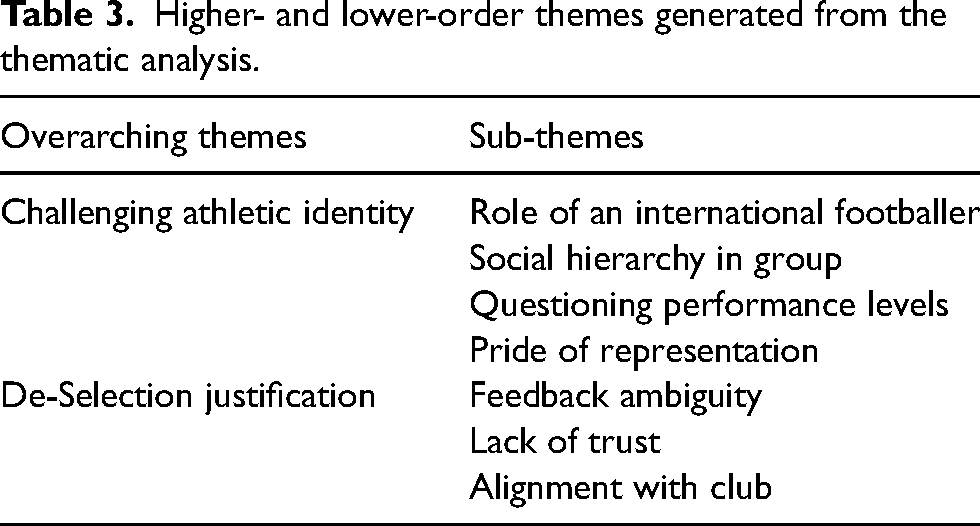
We read and re-read our data until we became familiar with the breadth and depth of the content we were dealing with. We then created initial codes. Working through our data, we pinpointed key points/aspects/issues – these were then colour-coded using highlighter pens, and each highlighted passage was allocated a few words of text. Once data had been coded, we progressed towards the identification of themes. Here, we sorted all codes into categories, providing consideration towards how various codes could be combined to form overarching- and sub-themes. We then ensured that each theme consisted of coherent data that came together meaningfully; we also ensured that each theme was significant and unique in its own right. We were then left with a list of overarching themes and their corresponding sub-themes. Once we were satisfied with our thematic map, we then went about defining and further refining our themes. Here we focused on defining and refining the essence of each theme. By the end of this stage, we were able to provide a concise account of the content and significance of each overarching and sub-theme (see Table 3).
Higher- and lower-order themes generated from the thematic analysis.
Results
The players and club staff perceptions’ of de-selection from the youth international football environment were gathered and discussed in accordance with the effect this may have on the developing footballer. The overarching themes generated from the thematic analysis are listed below.
‘Challenging athletic identity’
In acknowledging their desire to stay within the international setup, the first point to emerge from the analysis was the pride of representation and the influence this had on their athletic identity. Crucially, players not only saw this as an important opportunity to progress in their careers, but also as an opportunity to make their families proud, as Participant 8 explained: When you put on that shirt in the changing room I think you’re carrying your family's name, especially when you go out and play it was such an honour to play for England. Not a lot of people can do that and not a lot of people experience it in a footballing career, but I think getting that experience under your belt, especially as a young player is very good. (Participant 8, Premier League Academy Player)
Due to the pride in being selected for the squad, it was clear that the players felt it changed how they were perceived by the club staff: I think it gives you that level of respect to the coaches, it could open up their eyes and they could say ‘if this guy is an international player then maybe we should step him up’. I think it gives you a platform to live off, gives you a reputation. (Participant 1, Premier League Academy Player)
The players’ perception of feeling that their ‘call-up’ could alter how the club see them highlights the importance that players place on this opportunity, and hence the de-selection process is an integral part of talent development to support the individual's well-being. As well as perceived changes in coach perceptions, the players changed the way they viewed their own ability and opportunities to develop a career in the game: Honestly I never really saw myself being a footballer until I was about 14 or 15, until I more or less got called up to England and then I started realising that football is quite serious. (Participant 6, Premier League Academy Player) It's one of those where you think yeah you’re good, you might even make it to first team. You see loadsa players playing first-team that played international so you know it might not be everything, but it makes you feel like you’ve got a chance [in reaching senior football]. (Participant 8, Premier League Academy Player)
These players show the shift in their own perceptions of performance, which raises questions of how the process of de-selection from this environment influences their perception of self and their athletic identity. It is clear that there is a relationship between selection and perception of their own performance, with both selection and de-selection having an influence on athletic identity. This was also supported by the club staff: One of our goalkeepers had only been with [the club] since under 16 s so we hadn’t spent loads of time with him and the second he was in the England set up he loved it; it was just a big status thing for him. He loved being around it and he’d say things like this pitch ain’t good enough anymore. (Participant 18, Premier League Academy Manager) They can have the bravado that ‘yeah I’m gonna get a chance [in the first-team], I’m good enough’ but when they play international football at 18 onwards they get a better perspective because they realise just what their own peers are like and how you fit into that. You start to see a change in the way they carry themselves and what they think. (Participant 16, Premier League Loans Manager)
This shift in identity will affect the players’ perception of self but also the expectations placed upon them by peers, club coaches and family, as explained below: Players might come back and all of a sudden you’re an international and you can really change but at the same time you can come back in and there's a lot of expectation that goes with that. I’m sure that when you come back sometimes you’ve got to be careful that you don’t put players on a pedestal and that when they come back they become part of the club and [go] back to the values. (Participant 13, Premier League Head of Coaching)
Here, Participant 13 mentions the importance of clubs offering support to players on re-entering the club environment to re-introduce them to the values and expectations of the club.
‘De-selection justification’
The next theme centred upon players’ perceptions of the de-selection process and how this led to a possible lack of trust in the justifications for selection and de-selection. The players interviewed perceived that selection and de-selection for national team representation in football to be ambiguous and subjective: ‘they say you get picked based on your performance, you might get dropped but they won’t tell you you’ve been dropped, you just don’t get a call up and no one at the club says anything either’ (Participant 7). Players discussed their perceptions of the de-selection process: I think it would help to be told why you didn’t get called up for certain camps, because I think the last camp I went to…I think one of the goals came from my side and it wasn’t really great defending and I think they could’ve told me what I could’ve done with my defending and say why they didn’t call me to the February camp. I think that would really help. (Participant 4, Premier League Academy Player) Sometimes you see players get called up and you wonder why. I didn’t get asked to go to 3 camps in a row, but no one told me anything, the next camp I was in again but there wasn’t like a ‘oh this is why you weren’t here before’ kind of thing. It’d be good if they could even come to your club and speak to you, just show they care. (Participant 11, Premier League Academy Player)
This theme was prevalent amongst the players interviewed with it being suggested that ‘if you’re not told anything about your performance then it doesn’t make you feel good or want to be part of it again’ (Participant 6). This is supported by Participant 1 who stated that after being de-selected, they were ‘more worried about club football now than international’. As Participant 2 explains, although he had featured in the majority of tournaments and fixtures from U15 to U18, he was not selected for the UEFA European Championships: They said they want to see other players but yeah I don’t trust them, I’ve had a few, like when we were under 17s there were eight camps leading up to the Euros and I was the only defender that went every one, started every game which was like 16 games and it came to the Euros and he rang me and said I’m not going because ‘I’m not versatile enough’. I think that was just a little cheap excuse, I don’t know what his real opinion was. (Participant 2, Premier League Academy Player)
Questions around the quality of feedback were also raised by other youth international footballers who suggested that the club would not speak to them about what happens on international duty: Sometimes they’ll say something like they want to look at other players and give them a chance, and it makes you think, that's not really a fair comment cos what about my performances. When I spoke to my club about it they didn’t really know anything, they don’t ever speak to me about what happens with England (Participant 4, Premier League Academy Player) They [the club] might ask you randomly in the corridor and that but it's not like a sit down thing where they go through your feedback or talk to you about why you didn’t get selected. That’d be nice though cos then they could help you get back into it. (Participant 1, Premier League Academy Player)
Although a possible reason for de-selection in these instances may be the requirement for coaches to rotate their squads, the lack of critical feedback provided, in explaining de-selection, has brought the integrity of the coaching staff into question.
Participant 14, who had previously been involved in the England national youth teams as a coach, proposes some key points regarding the de-selection process of international sport: That de-selection process is massive, and we don’t always get that right, did we always consider the individual? Do we do it face-to-face? Do we go and meet them? Do we liaise with the club effectively? Do we speak to the parents? Do we follow it up a week or two weeks after to see how they’re doing? There is a lot of that stuff that clearly is important but unfortunately the coaches get caught up with camps and it doesn’t become a priority which is frustrating because once you’ve made that commitment I think it's important we follow that through. (Participant 14, Premier League Club Technical Director)
This admission from a former member of the national coaching staff explains that national governing bodies must have an awareness of the long-term development of the young footballer. This was also supported by Participant 20 who suggested that ‘sometimes boys don’t know if they’re coming or going and it's a real challenge; being given better feedback can really help them to understand decisions’. It was suggested by the club staff that more needs to be done to support players after de-selection, and this could be done whilst on camp: The back end of the camp it will be really good if the coach, the player and the national coach can have a proper in-depth conversation about the players experiences, you might say ‘we see some of those traits’, ‘oh no that's totally different to what we see he's actually really good at that’. Just have a conversation that can be used to give better feedback, especially if they end up not going to the next camp. (Participant 13, Premier League Club Head of Coaching)
These comments from both current youth international players and club staff are unique within the extant literature in highlighting the effect of de-selection on talent development.
Discussion
The purpose of this study was to explore the perceptions of both players’ and clubs of the de-selection process from youth international football in order to inform a possible club-to-international transition programme. The findings of this study are the first to provide an understanding of player and club experiences of de-selection from youth international football. The discussion section first focuses upon the players’ development of an ‘international athletic identity’, and the second centres on the justification players are given to explain why they had been de-selected from the youth international environment, and the effect this has on them when returning to the club.
First, it was found that becoming a youth international footballer could have an influence on the individuals ‘athletic identity’. Athletic identity is built through the athletes’ strong bond with their chosen sport, 14 emphasised in the international environment by the pride of representation, both individually and from stakeholders. Interactions with international sport can lead the player to believe that they have reached a higher level of performance, and as athletic identity is based on the current athletic circumstance, 15 this can lead to a shift in identity. This is important as despite the strides that youth academies have taken in recent years to professionalise the environment and create positive developmental opportunities, there are still concerns around the high rate of de-selection, 4 and the impact that has on players’ development (see 16 ) and identity (see 14 ). Due to de-selection being commonplace within international football, particularly in the younger age groups, if a player creates a strong athletic identity associated with their international representation, then they may experience a challenge to their identity when de-selected. As the club staff suggested, this is due to the reputation that being selected by the national team can bring. It is outside the scope of this paper to compare the impact of de-selection from the national team and de-selection from the club environment; however, it is clear that there can be a negative impact on the player if de-selection from the national team environment is not managed. However, more needs to be done to directly study the relationship between youth international football and athletic identity.
Both academia and policy documentation (see 11 ) suggest the importance of ‘educationally rounded people’,11,14 prioritising areas outside of athletic performance rather than holding an identity tied solely to their athletic performance. This is integral when considering international representation as their identity here is based upon the national governing bodies’ selection criteria as well as the players’ own standing within their current football club and therefore not controlled by the young person. Hence, this lends itself to an environment where if a young player wishes to remain involved in international sport, they must invest more time into the development of a performance-based identity in an attempt to be selected for future camps, which can cause a singular identity. Issues of athletic identity have been well documented in the extant literature when discussing de-selection from elite sport environments. However, this shift in athletic identity upon entering youth international sport is an original finding. It is possible that players can be de-selected based on factors that are less important at a later stage in their development 3 and therefore identification, selection and de-selection are difficult processes that, due to an ever-changing football environment leads to selection criteria that may become less important over time.
Identity development is an ongoing process and as such is shaped by social interactions and relationships as well as the environment that the individual is a part of. A narrow identity can lead players to neglect other identities, perceiving that this would negatively impact their athletic performance. 17 Through the research, it can be seen that players felt that they were seen as ‘an England player’ by the club staff and that international representation builds greater expectations on what they should be achieving at their club. Therefore, although it is not clear whether an ‘international identity’ was developed it was found that the opportunity began to alter the way that they perceived themselves. More needs to be done to identify the long-term development of an ‘international identity’ and whether this is apparent as there are potential consequences of developing a singular athletic identity. To avoid any potential negative consequences of an identity solely based on athlete performance, it is important that the environment help the players to develop multiple identities where the players’ self-worth is not based on becoming a successful athlete.
Upon entering this environment, the players will be motivated to spend more time on their personal development through experiencing an increase in the significance of the sport in their lives. 18 This leads to athletes who are more motivated to train and play, however, will often prioritise this over other parts of their lives such as schoolwork. A possible issue here is that the young person is likely to enter the international environment between the ages of 15 and 18 years old, a time where they will also be partaking in compulsory education. This would suggest that during this time, the player will be balancing the demands of education, club football, and international football amongst others, and therefore the support offered to the young person at this time is an important consideration.
Through an identity centred upon their role as an elite level athlete, there can be issues for those athletes during a transition – particularly the transition out of sport. 19 The club staff selected in this study each had a responsibility at their club to support the transition of their players into the international squads. Each youth academy has a different organisational structure with staff at one academy having different roles and responsibilities to staff with the same job title at another club. Although professional youth academies are required to provide full-time staff focused on player welfare, 11 the players suggested that they did not receive support from these staff members when de-selected from the international environment. Although there is not a policy document that governs youth international football, it would be beneficial for future youth development policy to recognise that a key part of the developmental process for young footballers may be their experiences with their national team. Hence, future policy should reflect the holistic nature of the talent development environment that players will move through, as there is a crucial relationship between player welfare and long-term team performance. 20
It was clear that through international representation, players developed a stronger self-belief that they may not have developed had they negatively transitioned into the environment.21,22 The increased desire and commitment to be successful as a footballer is in line with research into psychosocial competencies in elite adolescent footballers which suggested these characteristics as important for elite player development,23,24 highlighting the importance of international representation to development. Although there needs to be a greater focus on the study of athletic identity in youth international footballer, this potential shift in identity upon entering the national team shows the importance of understanding the required support during the de-selection process and the influence this can have on the developing athlete.
The second key theme revolved around a perceived lack of justification during de-selection. Players suggested that they did not feel they were told appropriate reasons for non-selection. This was supported by the club staff who had previously worked in international football environments through sharing that there were times that they did not ‘get it right’ regarding de-selection. Due to a possible lack of trust from players in the organisation this may provide a decrease in motivation to be involved in the environment in the future and also cause pedagogic issues where the player no longer applies the feedback from international camps to their performances and therefore fails to make improvements. Trust is an indicator for close relationships, 25 and therefore as athletes require effective and functioning support networks to help them achieve high levels of importance, it is integral that the athlete has trust in the coach's competence.
This adds further support to building strong coach-athlete relationships that are based on high-level communication in order to avoid missed opportunities for development.25–27 These findings are in line with current research into coach competency that suggests that if a coach is not seen as competent, then their trustworthiness will be questioned. 28 Although the lack of trust in the coach was suggested by certain individuals, it is highly influenced across groups,28,29 and therefore there may be other players who also do not trust the opinions or actions of national coaching staff.
Through a lack of feedback on de-selection, this not only reduces the perceptions of the coach's competence, an area which would lead players to question the coach's judgements, 30 but also can lead to a worse personal relationship. 31 Pedagogically, the element of trust in sports coaching is integral to coaching practice as the quality of the coach's delivery can be dictated by the trust that the athlete places in them. 32 Therefore, situations such as not providing actionable feedback, which may cause players to question coach competence should be avoided. This finding is in line with prior research into coach-athlete relationships that suggests that relationships that experience conflict, such as losing trust in the coaches’ methods, can incur a great deal of stress on the transitioning athlete. 33 Research suggests that through individualised meetings with players, this can help to build relationships between the player and the coach; 31 this was also an area called for by the participants in this study, and therefore the de-selection process for youth internationals would be more beneficial if bespoke meetings were offered, particularly when viewing this transition through the lens of ‘support-for-performance’.
De-selection can lead to doubt in one's own ability and even humiliation, compounded by the initial pride players felt in being selected this could result in a fear of failure. 7 This can be counterproductive to development as a fear of failure has a negative impact on long-term improvement. 34 The players comments are in line with a previous research that suggests that international selection can help put athletes’ long-term goals into perspective (see 35 ). It is important to suggest that the transition process occurs long before the moment of transition, 36 and critical moments that take place earlier in an athletic career can impact the success of future transitions. 37 Indeed, the transition into (and out of) the international environment is an important developmental period for youth footballers that may not only have an impact on their international career but the likelihood of successfully transitioning into senior sport. Due to the nature of this selection and de-selection, the players would benefit from being provided with structured feedback, which would result in players understanding how they can continue to improve their athletic performance and avoid situations of ambiguity.
Practical implications
The findings of this study should inform policy in the area of transitions and be used to inform transition programmes within academies. First, policy development should focus on providing greater detail to clubs on the importance of understanding de-selection from the youth international environment. This would help to bring the club-to-international transition to the forefront and re-position it as an important opportunity for player care and well-being support. Second, any club-led transition strategy should incorporate an awareness of the shift in athletic identity that comes with being selected or de-selected in international football. Good practice on behalf of the clubs would be to explain the ‘rotation management’ process that is prevalent in youth international football to better prepare players for the (inevitable) de-selection from this environment. National teams would benefit from managing player expectations during de-selection and use specific, actionable feedback to better prepare the player to re-enter the international environment in the future. This relies on both club and national team staff viewing the environment not as an extended games programme but as an opportunity to improve sport performance. And finally, dealing with de-selection from youth international football should be central to the roles of the club staff; however, this is something that our results suggest is currently not the case.
Limitations and future directions
There were certain limitations of the study that should be noted. Firstly, the participants selected had a greatly differing number of international appearances. Although the interviews did not specifically focus on their first transition into the environment, some participants may have been subject to recall bias61 due to being involved in the process for a longer period and therefore becoming indoctrinated into its customs. This could have resulted in participants recognising certain behaviours as norms and therefore failing to reflect upon this during the interview. Additionally, a longitudinal case study would have offered a better understanding of the effect of the level of coaching support provided to the players and whether this aided or inhibited the success of the player from club to international.
Future research should focus on developing a better understanding of the stakeholders involved in supporting the youth international football and how they collaborate to influence talent development. This is noteworthy as this research shows the wider influence of not only the national governing body but also the league and the club at which the player represents, and therefore there are a myriad of different relationships occurring, each with the player at the centre, of which we do not yet fully understand.
Conclusions
The aim of this paper was to explain the perceived effect of de-selection from youth international representation on talent development. From the analysis, it is clear that the opportunity to represent the national football team is of great pride to developing footballers and therefore will influence the players’ identity. The individual factors associated with the club-to-country transition, namely, sporting performance, self-esteem, and the athletic identity tied to performance, are in line with the individual factors associated with the junior-to-senior transition (see 38 ). These similarities show that the youth international environment acts as a similar opportunity for player development as the senior football environment, acting as a bridge between the environments of youth academy football and the perceived competitive environment of senior football. Not only does youth international football provide the player with the opportunity to test their ability against other talented players, but it also helps to develop the self-esteem, confidence and commitment required to be successful in the senior environment.
Players outlined the difficulties involved in being de-selected from the national age group squad that can lead to a lack of trust in the coaching staff and organisation due to not being provided with a sufficient justification of the de-selection. This lack of trust could occur due to the players’ athletic identity becoming entwined with their status as an international footballer, compounded by the great pride that players feel during representation. The practical implications here are for national staff to offer bespoke support to de-selected players, explaining the reasons for the lack of selection, as well having an awareness of the importance of international representation on the developing players’ identity.
Footnotes
Declaration of Conflicting Interests
The author(s) declared no potential conflicts of interest with respect to the research, authorship, and/or publication of this article.
Funding
The author(s) received no financial support for the research, authorship, and/or publication of this article.
