



Abstract
Despite interest in multi-sports training as a strategy to enhance long-term player development in soccer, current practice within English professional soccer academies is not well understood. This study explored the use of multi-sports training by English professional soccer academies (i.e., if multi-sports training was used, how often, session duration, activity type and age-group variations), and practitioners’ perspectives with respect to player development (i.e., perceived physical/sociological benefits of; and barriers to use) using an online survey. One practitioner per club, per age category (i.e., Foundation (<9 to <12 years), Youth (<13 to <16 years) and Professional (<18 to <23 years)) was permitted to respond. Sixty practitioners responded, of which, 48% worked with U18-U23 players; 42% with U13–14 and U15–16 players, respectively; 20% with U9–10 players and 33% with U11–12 players. Half (n = 30) of the respondents used multi-sports training for a total of 1 (IQR 1–2) session and 30 (13 to 60) minutes per week. Respondents ‘agreed’ or ‘strongly agreed’ that multi-sports training improved physical outcomes, reduced injury risk, helped to avoid early professionalism, and improved communication and problem-solving. Several barriers to inclusion were identified, such as limited training time, lack of equipment and attrition from other staff and players. In summary, although multi-sports training was used by only ∼50% of practitioners, indicating that many clubs specialise in deliberate soccer practice, most practitioners perceived multi-sports training to be beneficial to player development.
Keywords
Introduction
Sports specialisation was recently defined as ‘intentional and focused participation in a single sport for a majority of the year, which restricts opportunities for engagement in other sports and activities’. 1 It has been suggested that current youth sport practices promote ‘early specialisation’ within adolescent athlete populations, 2 aligning with four key parameters suggested previously by Baker et al. 3 i.e., an early start age; early involvement in one sport; early involvement in focused, high-intensity training; and early involvement in competitive sport. Potential benefits of early specialisation have been proposed to include the accumulation of deliberate practice hours. The deliberate practice framework has been positioned as an essential component of success in sports. 4 The basis for this framework is the belief that superior performance does not automatically develop from extensive experience or general education alone and that engagement in purposefully designed, repetitive training targeting specific weaknesses is necessary to obtain expertise. 4 Furthermore, the suggestion that engagement in deliberate practice during childhood was critical (due to this phase of life being viewed as a crucial period of physical and behavioural development) has prompted interest in those working with young athletes. 4 Consequently, concepts such as the 10,000-h rule were highlighted and promoted as necessary for performance expertise. 5 However, there is debate regarding the appropriate age and stage of athletic development for specialisation,6,7 and concerns around early specialisation leading to increased injury risk, burnout and longer-term athlete development.7–11
Sport specialisation during early adolescence may not be a prerequisite for the attainment of elite performance, and sport diversification has been promoted by some as a strategy to aid long-term athlete development. 12 Sport diversification during adolescence can increase the chances of adult sporting success.13–15 Specifically, in a recent meta-analysis, later milestone achievement, later starting age and more engagement in other sports were associated with higher senior performance across a variety of sports. 13 In this context, sport diversification (often referred to as deliberate play) may be defined as sampling or involvement in a variety of sports during adolescence/youth development. 16 The differentiating factors between early specialisation and diversification approaches are outlined in the developmental model of sport participation (DMSP), 16 which indicates that both may be successful in eliciting elite performance as an outcome. This directly contrasts the deliberate practice framework which suggests that general education (with respect to engaging in a variety of sports) may be ineffective. The proposed benefits of sports diversification include increased enjoyment and development of transferrable athletic skills (due to the wider variety of movement patterns experienced in different sporting activities) which contribute to enhanced skill acquisition and improved sociological development.17–19 Furthermore, increased training/competition availability due to reduced injury rates has been proposed as a major benefit, given the potential relationship between early sport specialisation and injury in adolescent athletes.8,9
In English professional soccer academies, players can be recruited from the age of 7 and integrated into a structured long-term player development programme through to the age of 21, which has typically been based on an early sport-specialisation model and focusses on deliberate practice. 20 It has been reported that participation in an elite training environment during adolescence substantially enhances a young soccer player’s chance of playing at an elite level, 21 which has been attributed to high-quality coaching and training. 22 Therefore, it seems clear that early engagement within a professional academy has major benefits for player progression. Yet, the Elite Player Performance Plan; introduced for English football academies in 2012 by the English premier league, highlights the importance of engaging in a variety of sporting activities, and appropriate strength and conditioning provision as a means of developing physical literacy and the fundamental movement skills of young players. Consequently, a shift towards the inclusion of a variety of sporting activities by many clubs has occurred to complement the physical development of young players, 23 with movement skills being highlighted as key development areas.20,24 The prevalence of athletic development activities within an English soccer academy was reported recently, with increasing engagement in these activities observed between the ages of 12 to 16. 25 These activities fit closely with the diversification strand of the DMSP, highlighted as being of value to the development of elite German soccer players.12,26 Accordingly, the integration of additional sporting activities within an academy training programme as a means of developing the physical, technical and/or psycho-social capacities of players, here is defined as ‘multi-sports training’. For example, this could be the addition (or in replacement of a soccer training session) of a martial arts or tag-variation game as a standalone session within a given academy’s delivery model.
Despite interest in multi-sports training as a strategy to enhance athletic development in soccer, the extent and nature of current practices within English professional soccer academies and perceptions of practitioners on multi-sports training are not well understood. Therefore, the aim of this study was to explore if/how multi-sports training is used (i.e., how often, session duration, activity type and age-group variations) by English professional soccer academies and investigate practitioners’ perspectives of multi-sports training with respect to player physical development.
Methods
A cross-sectional survey was used to establish the practices and perceptions of practitioners working in male English professional soccer academies between April and October 2022. Academy Staff from English Football League and Premier League clubs (Adhering to the Elite Player Performance Plan (EPPP)) were invited to respond. The survey was open to coaching, sports science, and medical staff from each club (i.e., those involved in the physical development of young players). Only one staff member per club, per age category was permitted to complete the survey to avoid response duplication. Respondents were, however, permitted to provide a response for multiple age groups – acknowledging that staff may be responsible for the development of several age groups. Ethical approval from Teesside University institutional ethics committee (Application number: 5394) was sought prior to study commencement, with data collected in accordance with the declaration of Helsinki. Respondents provided informed consent by completing the survey introduction page. All data were anonymous, with no personal details relating to the respondent or identifiable information on their club required.
Survey development and data collection
The survey was developed through an iterative process to ensure content validity in consultation with 10 practitioners with experience of working within academy football. 27 Practitioners provided feedback on the content and wording of questions. Following piloting, two questions were removed, with two alternative questions added, there were several amendments to the wording, and additional options were added to three questions. The final survey, distributed using Onlinesurveys.ac.uk, consisted of four sections and a total of 11 questions (with additional sub-sections) including seven multiple choice questions, three Likert scale questions, and one free text question. Likert scale questions used a 5-point bipolar scale as follows; 1, strongly disagree; 2, disagree; 3, neutral; 4, agree; 5, strongly agree. 28 The survey link was also distributed via email to club staff from 40 English football league clubs with responsibility for the academy programme, who acted as a gatekeeper to distribute the survey link to relevant staff. A web-link invitation to the survey was also distributed via personal networks and through social media, targeting those eligible to respond.
Respondents provided information on their job role, employment status (i.e., part-time or full-time), their club's academy category (according to the EPPP), the age group they were responding on behalf of (Pre-Academy [<7 to <8y], Foundation [<9 to <12 y], Youth Development [<13 to <16 y], and Professional Development [<18 to <23 y]), and their past experiences of working in other sports. Following this, data were sought around (1) current multi-sport training practices within their club (i.e., whether multi-sport training was used, how often, what type); (2) Perceptions of the delivery/outcomes of multi-sport training sessions (i.e., perceived benefits or concerns, players attitudes towards multisport sessions); and (3) Information around barriers to implementation. All completed surveys were retained for analysis.
Statistical analysis
The initial aim of the data analysis was to summarise the data collected and understand the uncertainty in our estimates given that we observed only a sample of the population of practitioners working in English football. Data were exported directly in Microsoft Excel (Microsoft, 2016), using the onlinesurveys.ac.uk ‘analyze’ function and dichotomous and multiple-choice questions converted into proportions with a 95% confidence interval calculated using, the Wilson procedure. 29 This enabled us to quantify the demographic information regarding our respondents, described above.
Practices
To quantify multi-sport training practices, we counted each unique activity that respondents listed and the number of different activities each respondent used, summarising using the mean and standard deviation. The proportion of respondents listing each of these multi-sport training activities was then calculated with 98% confidence intervals as described above.
Perceived benefits of multi-sport training activities
Likert scale questions asking respondents to what extent they ‘agreed’ or ‘disagreed’ that multi-sports training sessions could improve a variety of outcomes were split into two themes. The first rated respondents’ perceptions of the benefit of multi-sports training on physical outcomes and the second theme focused on the wider benefits of multi-sports training. Data were imported into R-Studio (version: 2022.07.2 + 576) and internal consistency was explored for each using Cronbach's alpha. This statistic is useful as it provides the reader with additional information regarding the reliability and dimensionality of questionnaire data and should be evaluated for each theme or focus. 30 Respondents’ perceptions of physical outcomes (Theme 1) had good internal consistency (0.83; 95% confidence intervals 0.74 to 0.89) but responses were less consistent for wider benefits (Theme 2; 0.68; 0.53 to 0.78) which likely reflects the broader scope of these questions. Likert scales were all fully labelled, and data were treated as numeric variables. 31 These data were visualised using flat violin, and raincloud plots to indicate the raw data and the probability density function of the observations. 32 Boxplots were then overlaid to indicate the median and interquartile range.
We found that 50% of our respondents used multi-sport training in their practice and 50% did not, thus, whilst not an a priori aim, we felt it was useful to explore if there were differences in perceptions between these two groups of respondents. Modified independent t-tests were used to compare the difference in Likert-scale responses between respondents who used (n = 30, 50; 37 to 63%) and those who did not use multi-sports training in their practice. Parametric statistics are robust for use with Likert-scale data with unequal variance, and when data are not normally distributed. 33 However, given these data are likely to violate the assumption of general linear models we used Yuen's modified t-test for independent trimmed means 34 via the ‘WRS2’ package. We compared 20% trimmed means 35 and derived percentile (95%) bootstrap confidence intervals from the default 599 bootstrap samples. 36 Here we defined the minimal important difference as 0.5 Likert scale points, as this presents the smallest difference guaranteed to change verbal anchors when rounded, for example, 3 (‘neutral’) compared to 3.5 (‘agree’). This approach has been used elsewhere for ratings of perceived exertion 37 and movement skill. 38
Perceived barriers to multi-sport training activities
Respondents were asked to identify whether any barriers to implementing multi-sport training were present within their academy. Upon selecting yes, respondents were then asked to identify barriers from a pre-determined list, whilst the option for ‘any other’ barriers was available as a free text answer. As part of the analysis, the frequency of each response was recorded and presented.
Results
Respondents
Sixty respondents completed the survey (Category 1 academy (Cat 1): n = 39; Category 2 academy (Cat 2): n = 8; Category 3 academy (Cat 3): n = 12; Category 4 academy (Cat 4): n = 1). Most respondents were from the Sport Science/Performance departments (n = 50) with the remaining respondents from coaching (n = 7) and medical (n = 3) departments. Most respondents were full-time members of staff (78%) and worked with Professional Development Phase players (U18-U23) (48%) followed by the Youth Development Phase (U13–14, 42%; U15–16, 42%) and the foundation phase (U9–10, 20%; U11–12, 33%). Practitioners who had experience of working in other sports (48%) (i.e., Tennis, Rugby, Netball, Swimming, Sailing) were more likely to use multi-sports training (68%).
Practices
Half (n = 30, 50%) of our respondents used multi-sports training in practice for a mean of 1.6 ± 1.5 sessions and 41.5 ± 27.8 min per week. Twenty-two different activities were used, with tag variations and handball being the most popular (Figure 1). Respondents identified a median of six activities (interquartile range 4 to 8) and unanimously ‘agreed’ (n = 16) or ‘strongly agreed’ (n = 14) that players enjoyed these sessions.
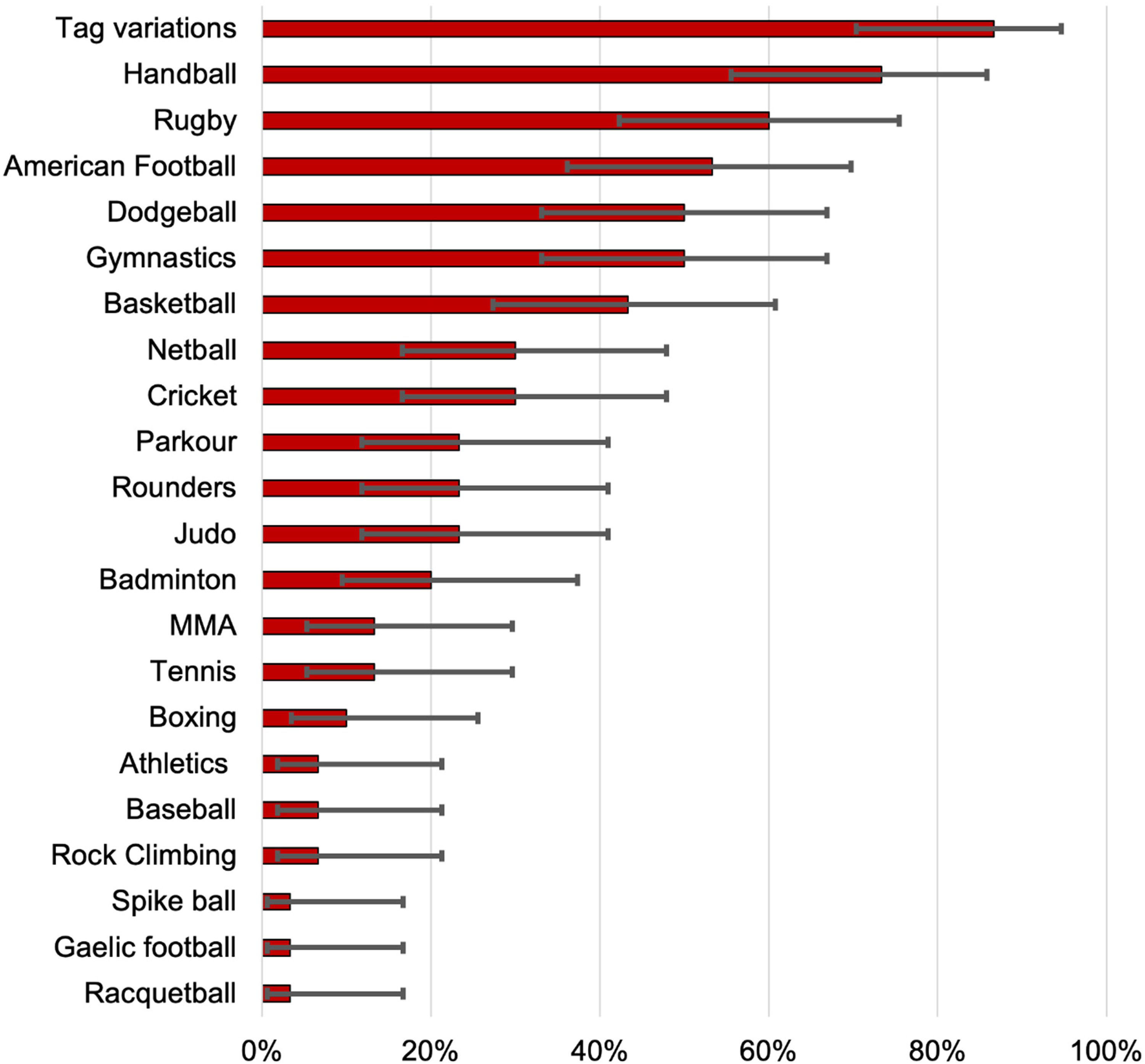
Variety of multi-sports activities that respondents included in their practice as a proportion (% of respondents). Error bars represent the 95% confidence interval for the proportion.
Perceived benefits of multi-sport training activities
Respondents generally ‘agreed’ or ‘strongly agreed’ that multi-sports training improved physical outcomes (mean 4.28 ± 0.84). For example, some respondents disagreed that multi-sports training could improve strength and power or speed whilst there appeared a consensus for fundamental movement skills, co-ordination, and agility (Figure 2). There was no clear trim-mean difference between the perceptions of those who did or did not use multi-sports (−0.28, −0.65 to 0.09 Likert scale points, Yt −1.58, p = .131). There were no substantial differences in individual Likert questions although a significant difference of less than our minimally important difference was observed for speed (−0.44, −0.84 to 0.05 Likert scale points, Yt 2.24 p = .033).
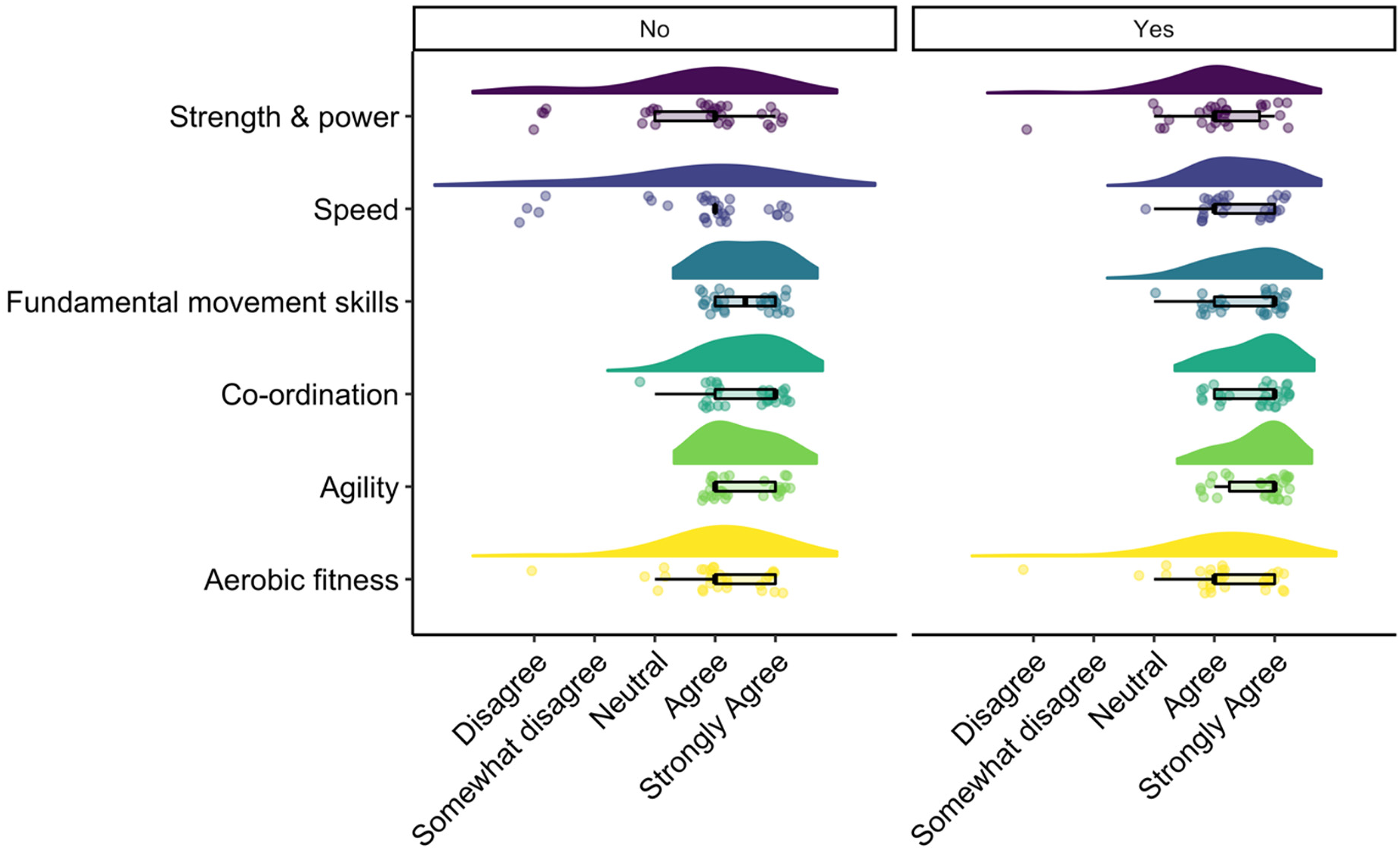
Rain cloud plot to visualise the respondents’ perceptions of the use of multi-sports activities to improve physical qualities. Respondents were asked to state to what extent they agreed or disagreed that multi-sport sessions could improve each physical outcome listed. Box plots represent the median and inter-quartile range. Data are faceted by respondents’ who stated ‘yes’ they currently use multi-sports or ‘no’ they do not currently use multi-sports.
Respondents’ perceptions of additional benefits of multi-sports training were generally in agreement that it could help to avoid early professionalism, and improve communication and problem-solving. Whilst median responses ranged from ‘agree’ to ‘strongly agree’ for the other questions, the individual responses were varied and spanned the full Likert scale range (Figure 3). There were no clear substantial differences between those respondents who used and those who did not use multi-sports training in their practice.
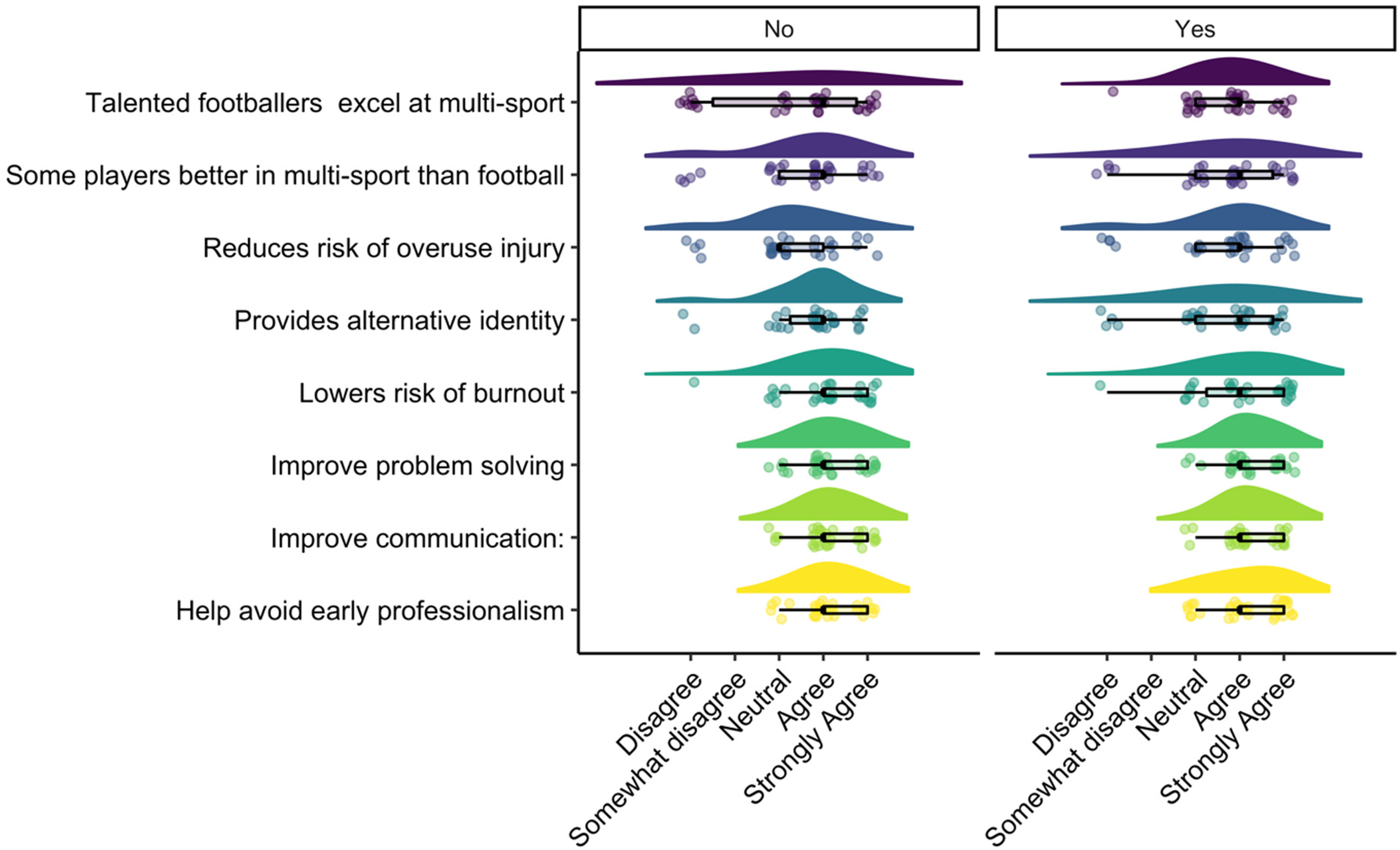
Rain cloud plot to visualise the respondents’ perceptions of the wider benefits of multi-sport activities. Respondents were asked to state to what extent they agreed or disagreed that multi-sports sessions could improve a variety of cognitive (decision-making; tactical) and injury prevention; and psychological benefits. Box plots represent the median and inter-quartile range. Data are faceted by respondents who stated ‘yes’ they currently use multi-sports or ‘no’ they do not currently use multi-sports.
Perceived barriers to multi-sport training activities
Of the 30 practitioners who did not use multi-sports training in their practice, 20 identified potential barriers to inclusion. A total of 12 practitioners within this group identified ‘training time’ as a barrier, 10 identified a ‘lack of willingness from within the club or their department’ and 9 identified ‘a lack of equipment’. Lack of staff expertise, 5 lack of perceived benefits 4 and limited engagement from players 2 were also identified.
Discussion
Summary of key findings
We explored the current practices of English soccer academies with respect to the inclusion of multi-sports training in academy player development programmes and practitioner perspectives on the potential benefits, contraindications, and barriers to use. Multi-sports training was frequently used in academy physical development programmes with ∼50% of responding practitioners indicating that they used this training method at least once per week. Practitioners perceived multi-sports training to be beneficial for player physical development, communication, and problem-solving skills, while reducing injury risk and burnout, regardless of whether they were included in development programmes. However, several barriers to inclusion were identified, which might be contingent on the wider perceptions of how valuable sports diversification is within respective clubs. Despite this, our findings indicate that while specialisation through deliberate practice is clearly a dominant feature of player development programmes in English soccer academies, the use of a sport diversification strategy via multi-sports training is evident.
Understanding practitioner use of multi-sports training
Engagement in other sports as a youth was shown to have a small beneficial effect (effect size d = 0.5) on attaining world and national class status in adulthood in a variety of sports, 13 and it was recently suggested that building diversity into elite athlete training environments may be best practice with respect to long-term athlete development. 5 Our findings that 50% of practitioners use multi-sports training as part of their development programmes, suggest that universal agreement does not exist on how/whether sport diversification should be used within the delivery model of English professional soccer academies. However, our observed prevalence is higher than previously reported (31%), 23 which may be explained by differences in the study protocols, i.e., a survey here, with a larger sample, whereas Smothers et al. 23 conducted interviews with a smaller sample, focusing on fundamental movement skill development. It is possible that those who do not include multi-sports training in their programmes may promote engagement in sports external to the academy training environment, as suggested previously. 23 This was reflected in the qualitative data we collected with several practitioners indicating a preference for players to engage in other sports externally to their academy. In this context, it was recently reported that Under-12 to 16 academy players complete a substantial amount of training load outside of their academy, including engagement in a variety of sports, aligning with the beliefs of these practitioners. 39
The proportion of practitioners using multi-sports training was consistent across age groups (i.e., ∼50% working in each age category). This somewhat contrasts the findings of Brownlee et al., 25 who reported increasing engagement in non-soccer athletic development activities between the ages of 12–16 years. The finding that practitioners believe multi-sports training to have further benefits than fundamental movement skills development (often associated with the development of younger athletes) may explain this. Our analysis revealed no clear differences in Likert-scale responses between those who used multi-sports training and those who did not. It would seem intuitive that those who chose not to use multi-sports training would subscribe to the ‘specialisation’ model evident within the DP framework, and those who did, the ‘diversification’ strand of the DMSP, 12 yet our findings contradict this. However, it has been suggested that practitioners may advocate for the use of multi-sports training, despite them not being used in their academy set-up. 23 This indicates that other contextual factors influence the decision on whether to include multi-sports training within the programme of academy soccer players. Several practitioners who did not use multi-sports training identified barriers to inclusion such as available training time, lack of equipment and attrition from within their club or department, some of which are consistent with that previously reported.23,40
Perceptions of multi-sports training and the role of fundamental movement skills
The perceived importance of fundamental movement skills in U.K. soccer academies and the perception that multi-sports training contributes to developing fundamental movements have been reported previously. 23 Developing fundamental movement skill competence is important for athlete development as children lacking fundamental movement skill competence are likely to have difficulty in learning and performing more complex skills relevant to sports such as soccer. 41 Our results support the findings of Smothers et al., 23 with the greatest levels of agreement we observed around the benefits of multi-sports training to fundamental movement skills and agility. Given that agility; defined as ‘a rapid a rapid whole-body movement with change of velocity or direction in response to a stimulus’, 42 and fundamental movements traditionally fall into three categories; locomotion, object control and stability skills 43 this likely explains the inclusion of multi-sports training such as ‘tag variations’ or handball by many practitioners (Figure 1) as these tasks challenge multiple categories of movement skill and require a stimulus-response. In contrast, it has been proposed that fundamental movement skills do not develop naturally (at least in early childhood) and require structured instructional feedback, 44 potentially explaining the high proportion of respondents who included gymnastics; a sport with a strong focus on teaching movement skills. Taken together this would suggest providing a breadth of exposure to different sports could be beneficial.
With regard to the wider benefits, practitioners perceived that multi-sports training was most beneficial to problem-solving and communication skills. The benefits of engaging in multiple sports on emotional and self-regulation skills have been highlighted previously45,46 and our findings are likely underpinned by this. Specifically, a key tenet of the DMSP diversification strand is that young athletes find engaging in a variety of sporting activities ‘fun’, which enhances motivation. 16 It has been postulated that sport diversification allows a broader spectrum of development experiences and facilitates positive peer relationships and enhanced leadership skills, 45 all of which have value for team sports such as soccer. Practitioners also perceived multi-sports training to be beneficial in reducing injury risk. This was in line with existing research reporting that early specialisation elicits an independent injury risk ratio of ∼1.3 in young athletes, in comparison to those not specialising when age and time spent in sports are accounted for. 9 Similarly, in youth soccer players, early specialisation has been reported to elicit a five-fold in increase the risk of overuse knee injuries. 8 A reduction in the occurrence and severity of injuries is of great importance in young soccer players, given the relationship with player progression. 47 This may explain the use of multi-sports training within practice by some and the beliefs of the majority. Similarly, practitioners also generally agreed that using multi-sports training could reduce the risk of player burnout. While research in this area has been equivocal, with it initially reported that specialising rather than sampling could lead to increased physical/emotional exhaustion,19,48 but more recently this claim was contested. 49 This may explain the greater spread of responses.
Implications for future research
While our study demonstrates that some practitioners use multi-sports training within their practice and perceive them to be beneficial to long-term player development, further evidence to support these beliefs is necessitated. As highlighted by Mosher et al. 5 practitioners are often warned to advise against early specialisation, yet understanding of the mechanisms underpinning many of the potentially negative effects of early specialisation are not well understood. Further empirical work investigating the impact of early specialisation, specifically comparisons between early sports diversification (i.e., multi-sports training) and specialisation in soccer players is needed to enhance understanding amongst researchers and practitioners. 23 More detailed information on the correct age and stage for specialisation, and best practice for the integration of multi-sports training also seems a key area for exploration. Furthermore, much of the existing work exploring sport diversification as part of elite athletes’ development history is based on athlete recall, 26 which presents issues around validity and reliability. With respect to engagement in multiple sports, therefore, recall bias might be problematic. 50
Limitations
Though our study provides novel information regarding the practices and perspectives of multi-sports training within English soccer academies, it is not without limitations. We acknowledge that our sample does not represent all practitioners. Our sample of 60 exceeds many similar soccer surveys,51–53 despite being smaller than others. 54 The relatively small sample size may be explained by the limited population targeted, i.e., those working in English soccer academies, and in this context provides adequate representation from which meaningful results can be drawn. We acknowledge that most of our sample were from Category 1 academies, this includes those with the greatest staff numbers and most financial investment. Therefore, our results may not entirely reflect academies and practitioners adhering to the EPPP guidelines from lower category academies (65% of respondents were from Category 1 academies), and there is potential for responder bias. Furthermore, given that the survey was anonymous it is not possible to report how many clubs our respondents represented. However, we felt that it was necessary to offer anonymity to respondents to provide more opportunities for greater honesty around their perceptions. Similarly, data pertaining to the experience level of the respondents may have added greater depth to our analysis, and future work could explore the relationship between practitioner experience and prescription/perception with regard to multi-sports training. While we did not explore the aims and purposes of including different multi-sports training activities within player programmes, or when practitioners use them within player training programmes/development cycles, this may represent the next phase of research in this area and could provide insight into best practice. Similarly, an in-depth investigation of the psychological and sociological benefits of multi-sports training seems necessary, given that we aimed only to establish practitioners’ perspectives on general benefits in this area.
Conclusion
Our findings demonstrate that multi-sports training is frequently used in English professional soccer academies, but has not been universally adopted by practitioners as part of player development programmes. Yet, our responses suggest that multi-sports training is perceived to be effective for the development of physical (particularly those related to fundamental movement skills) and psycho-social skills (i.e., communication and problem-solving skills), while also being perceived as a tool to reduce injury risk and burnout by most practitioners. Several barriers to the inclusion of multi-sports training, such as time, lack of equipment and attrition were cited by those who do not use multi-sports training. Therefore, while English professional soccer academies are encouraged to use multi-sports training by the EPPP as a means of developing player physical literacy through exposure to sport diversification, many clubs/practitioners still appear to specialise early with the delivery of deliberate soccer practice only.
Supplemental Material
sj-docx-1-spo-10.1177_17479541231210746 - Supplemental material for Multi-sports training in English soccer academies: A survey exploring practices, practitioner perspectives, and barriers to use
Supplemental material, sj-docx-1-spo-10.1177_17479541231210746 for Multi-sports training in English soccer academies: A survey exploring practices, practitioner perspectives, and barriers to use by Jonathan M Taylor, Charlie Quigley, Jonathan Madden and Matthew D Wright in International Journal of Sports Science & Coaching
Footnotes
Acknowledgements
Thank you to all respondents and to Matthew Portas from the English Football Association for his assistance in circulating the survey.
Declaration of conflicting interests
The author(s) declared no potential conflicts of interest with respect to the research, authorship, and/or publication of this article.
Funding
The author(s) received no financial support for the research, authorship, and/or publication of this article.

Supplemental material
Supplemental material for this article is available online.
References
Supplementary Material
Please find the following supplemental material available below.
For Open Access articles published under a Creative Commons License, all supplemental material carries the same license as the article it is associated with.
For non-Open Access articles published, all supplemental material carries a non-exclusive license, and permission requests for re-use of supplemental material or any part of supplemental material shall be sent directly to the copyright owner as specified in the copyright notice associated with the article.
