




Abstract
Background
Physical literacy-focused afterschool activity programs (ASAPs) can be an effective strategy to improve children’s health-related parameters. We sought to compare physical activity, body composition, aerobic capacity, and fundamental movement skills between physical literacy-focused ASAP and a standard recreational ASAP.
Method
A pre–post (6 months) comparison study was conducted in 5- to 12-year-old children in a physical literacy-focused ASAP (physical literacy group, n = 14) and children attending a standard recreational ASAP (comparison group, n = 15). Physical activity guideline adherence was assessed using accelerometry, body composition was analyzed using bioelectrical impedance, aerobic capacity was estimated using the Progressive Aerobic Cardiovascular Endurance Run test, and fundamental movement skills were evaluated using the Test of Gross Motor Development–2.
Results
There were no significant differences between groups at baseline. After 6 months, the physical literacy group exhibited a significant improvement in their total raw score for the Test of Gross Motor Development–2 (p = .016), which was likely due to improvements in object control skills (p = .024). The comparison group significantly increased body mass index (p = .001) and body fat (p = .009) over time. No significant between-group differences were found; however, there was a trend for improved aerobic capacity in the physical literacy group (d = 0.58).
Conclusions
Engagement in the physical literacy-focused ASAP contributed to an attenuated increase in adiposity and an improvement in object control skills.
Keywords
Regular participation in physical activity is an integral component of good health for all age groups, including children (Ekelund et al., 2016; Walsh et al., 2018). There is overwhelming evidence supporting the relationship between daily participation in physical activity and a plethora of health benefits for children, including improved cardiovascular and musculoskeletal health, body composition and adiposity, mental health, cognition, and the tracking of healthy behaviors into adulthood (Hills et al., 2011; Strong et al., 2005; Walsh et al., 2018). In contrast, the contributory role of physical inactivity and sedentary behavior on undesirable health outcomes including childhood obesity, and other weight-related comorbidities (e.g., impaired glucose metabolism and early onset of hypertensive disorders) has also been well-established (Böhm & Oberhoffer, 2019; Hills et al., 2011; Kallio et al., 2018; Strong et al., 2005).
Canadian 24-hour movement guidelines for children aged 5 to 17 years recommend at least 60 minutes of moderate to vigorous physical activity (MVPA) every day, and several hours of a variety of structured and unstructured light physical activity opportunities (Tremblay et al., 2016). These guidelines coincide with World Health Organization recommendations suggested an average of 60 minutes of MVPA per day for children (Bull et al., 2020). In addition, the guidelines advise that children and adolescents should minimize time spent being sedentary each day by limiting screen time (no more than 2 hours per day), sedentary transport, extended sitting periods, and time spent indoors (Tremblay et al., 2016). Despite these guidelines and the well-documented health-enhancing effects of physical activity, the prevalence of physical inactivity, and sedentary behavior among North American children remains high (Statistics Canada, 2015b; Troiano et al., 2008). Recent national report cards that evaluated physical activity among children suggest that only 1 in 5 Canadian children aged 5 to 17 years meet the recommended daily MVPA guidelines (Barnes et al., 2018).
To attenuate the adverse effects of the trifecta of inactivity, sedentary behavior, and adiposity, many researchers and stakeholders, have made a conscious effort to identify strategies to increase children’s daily physical activity, especially in education environments such as schools and daycares (Beets et al., 2009; Grao-Cruces et al., 2019; Kriemler et al., 2011; Mazzucca et al., 2018; Nagpal et al., 2020; Van Sluijs et al., 2007). Approximately half of Canadian children (47.5%) and nearly 20% of American children attend an afterschool program following each school day (Afterschool Alliance, 2014; Statistics Canada, 2015a) and a strategy that has gained traction within the research community is increasing children’s physical activity within the afterschool activity program (ASAP) setting (Beets et al., 2009; Beets et al., 2010; Gesell et al., 2013; Veldman et al., 2020). Modifying ASAPs to be oriented/focused around physical activity has been encouraged in place of the more traditional sedentary activities, including homework club, computer club, watching television, and doing seated arts and crafts (Beets et al., 2010).
Furthermore, it is also believed that ASAP that incorporate physical activity opportunities may help children increase their physical literacy by developing their fundamental movement skills (FMS; Comeau et al., 2017). According to Whitehead (2013), physical literacy can be described as “the motivation, confidence, physical competence, and knowledge and understanding to value and engage in physical activity for life.” FMS may be viewed as the building blocks which allow the development of complex, often sport specific movements, and include locomotor (e.g., running and jumping), object control (e.g., catching), and stability (e.g., balancing) skills (Gallahue et al., 2006). FMS proficiency has been associated with improved physical literacy and increased levels of total physical activity, light physical activity, MVPA, and participation in organized physical activity, as well as improved body composition and improved fitness among children (Barnett et al., 2009; Platvoet et al., 2020; Wrotniak et al., 2006). Moreover, FMS competence in early life is instrumental for increasing the likelihood of a physically active lifestyle across the life span (Barnett et al., 2008; Barnett et al., 2009).
Despite the hypothesized efficacy of ASAPs improving physical literacy and physical activity levels among children, there remains a paucity of research evaluating the outcomes of such programs. To address this gap and further explore the efficacy of ASAPs, we employed a pre–post comparison group design evaluating the 6-month change in health-related behaviors, physical health, and FMS of children who attend a physical literacy-focused ASAP versus a standard recreational ASAP. Our primary objective was to assess each type of program's effects on children’s daily physical activity engagement. Secondary aims were to examine how each program impacts children’s physical health, namely body composition and aerobic capacity, and FMS competence. We hypothesized that the children who attend the physical literacy-focused ASAP would display greater improvements in health behavior and physical health than those in the standard recreational ASAP.
Method
Participants
We included 35 participants aged 5 to 12 years enrolled in two ASAPs, SportsCan and the City of Ottawa’s HIGH FIVE program, offered in a community center setting; both afterschool programs agreed to participate in our study. Participants also had to be capable of performing physical testing, understanding English instructions, and responding to questions asked by staff. Given the lack of applicable/relevant data to support an a priori sample size calculation, we targeted all of the children in these programs and were able to recruit over 80% of those enrolled. We posit that findings from the present study can inform future sample size calculation for studies targeting implementation strategies for the physical literacy-focused ASAPs. For that reason, we included effect size calculations in our analysis.
SportsCan, offers a physical literacy-focused ASAP that encourages healthy active lifestyles to children via introducing and facilitating a wide range of sports and athletic opportunities. SportsCan programming was designed by certified coaches and delivered by trained undergraduate students from health sciences and kinesiology programs. The City of Ottawa’s HIGH FIVE program offers a standard recreational general activity program, which offers participants optional and less structured physical activity, fewer physical activity promoting games and sport-specific drills, and alternative more sedentary pursuits, and participants from this center represented the comparison group. Program instructors from the comparison group included university and high school students. In both programs, participants had access to a full gymnasium with sporting equipment, and in the case of HIGH FIVE, a classroom for other nonphysical activities (i.e., crafts, board games). Both programs were offered 5 days per week between the hours of 3 p.m. and 6 p.m. Parental consent (<16 years) and assent for children (<16 years) was obtained prior to the commencement of the baseline assessments. All procedures were reviewed and approved by the university institutional review board in September 2016.
Procedure
We employed a pre–post comparison group study design. Baseline assessments were conducted during early October 2016, and follow-up assessments were conducted approximately 6 months later during early March 2017. Baseline and follow-up assessments took place at the center where each respective ASAP was delivered. Trained research staff conducted all assessments.
Instrumentation and Measures
Anthropometrics
Height was assessed using a portable stadiometer (Seca GMBH & Co KG, Hamburg, Germany). Weight was assessed using a portable electronic scale (ProFit Precision Personal Health Scale, UC-321, A&D Medical, San Jose, California). Body mass index (BMI) was calculated from weight and height measurements (kg/m2), and body composition (lean body mass, fat mass, percentage of body fat [%]) was assessed using a Tanita bioelectrical impedance analyzer (Tanita 300-A, Tanita Corporation of America, Inc., Arlington Heights, IL, the United States). All anthropometric measures were done twice, and if there was a discrepancy between the first two measurements, a third measure was employed to ensure measurement accuracy to the nearest tenth. Weight and body composition were assessed at the same time of day in both measurement periods in an attempt to control for liquid and food intake.
Aerobic Capacity
Aerobic capacity was assessed using the Progressive Aerobic Cardiovascular Endurance Run (PACER), a widely used aerobic capacity test for children and adolescents (G. Tomkinson & Olds, 2008). The test has proven to be a reliable and valid field-based method for estimating aerobic capacity (VO2) in children and adolescents (G. R. Tomkinson & Olds, 2007). The PACER is an incremental multistage fitness assessment that involves running a 15-meter distance progressively faster every minute with a starting pace of 8.5 km/h. The progressive design of the assessment provides an imbedded warm-up whereby the children learn how to pace themselves from one level to the next (Léger et al., 1988). Participants’ PACER scores were recorded in number of laps completed.
Fundamental Movement Skills
FMS were assessed using the Test of Gross Motor Development–2 (TGMD-2), which has been validated and standardized as a measure of FMS for children (Ulrich, 2000). The TGMD-2 evaluates six locomotor skills (running, one-legged hopping, galloping, leaping, horizontal jumping, and sliding) and six object control (striking a stationary ball from a tee with a bat, stationary dribbling, catching, kicking, overhand throwing, and underhand rolling). During the evaluation, each skill is broken down into 3 to 5 components, and each component is scored as either a 1 (pass) or 0 (fail). Four scores were calculated based on the individual test score: (1) sum of raw scores for locomotor skills, (2) sum of raw scores for object control scores, (3) total sum of raw scores, and (4) an overall motor proficiency score, known as gross motor quotient (GMQ). Two experienced TGMD-2 examiners conducted each assessment.
Outside of Program Activity Involvement
Parents completed a self-made questionnaire, which asked them to describe the number and type(s) of sports and/or activities their child engages in outside of the ASAP. The number of programs a given child engages in outside of the ASAP was represented as a discrete variable (e.g., 1, 2, 3, or 4).
Physical Activity
Physical activity patterns were objectively assessed over a 7-day period (5 weekdays and 2 weekend days) using Actical accelerometers (mini Mitter Co., Inc., Bend, OR, USA) according to methods used for the Canadian Health Measures Survey (Colley, 2012). Acticals are small (28 × 27 × 10mm: 17g) omnidirectional sensors that measures the occurrence and intensity of motion and have been validated to measure physical activity and step counts in children (Evenson et al., 2008; Puyau et al., 2002). Accelerometers were worn over the participants left hip. Time spent at various intensities of movement (e.g., sedentary, light, and moderate to vigorous) were derived using a 15-second epoch and the validated cutoff points (Puyau et al., 2002). Only data from participants who wore the device for at least 10 hours per day for 3 out of 7 days a day at baseline and follow-up were included in the data analysis. For our study, we evaluated participants’ adherence to the Canadian physical activity guidelines for children aged 5 to 17 years (Tremblay et al., 2016), by assessing whether they engaged in 60 minutes of MVPA per day. If they achieved greater than 60 minutes of MVPA on a given day, they have met the guidelines; if they have less than 60 minutes of MVPA on a given day, they have failed to meet the guidelines. Data were processed with the use of standardized quality control and data reduction procedures in SAS version 9.3 (SAS Institute, Cary, North Carolina).
Statistical Analysis
Statistical analyses were conducted using SPSS version 24.0 (SPSS Inc., Chicago, IL, USA). Distributions of outcome variables were examined for normality using Shapiro–Wilk tests. Independent samples t tests were used to compare the following variables between groups at baseline: age (years), height (cm), weight (kg), BMI (kg/m2) body fat (%), and PACER score (laps). We employed a Mann–Whitney U test to assess for a between group difference in outside of program activity involvement. Finally, to compare physical activity adherence between the physical literacy and comparison groups at baseline and follow-up, data were analyzed as proportion of days when participants met physical activity guidelines. To make this approach comparable between baseline and follow-up, we matched the weekdays (e.g., Tuesday = Tuesday) and the number of days included (e.g., 3 = 3) for each time point within participants. For these analyses, each day with valid physical activity data was categorized based on the physical activity guideline adherence (0 = not meeting physical activity guidelines and 1 = meeting physical activity guidelines). We used Fisher–Pitman permutation test for independent samples with 20,000 runs to compare the proportion of days when physical activity guidelines were met between the groups. The 95% confidence intervals [CIs] were calculated based on the bootstrap method with 2,500 repetitions. Additionally, due to the low number of participants, changes were also reported in individual levels. Change scores were computed to evaluate the effects of each program type on body composition, aerobic capacity, and FMS of participants. Within-group change scores were assessed for significance using Wilcoxon signed-rank tests for nonparametric data, and paired samples t tests were used with parametric data. Provided that the between-group change scores for the aforementioned variables were all parametric, we applied independent samples t tests to analyze for potential differences, Effect sizes (Cohen’s d; small ≥ 0.2, moderate ≥ 0.5, and high ≥ 0.8) were calculated to further inspect between-group change scores. Data are presented as mean ± standard deviation. For all analyses, p < .05 was considered significant.
Results
Baseline Characteristics
Our study sample at baseline included 35 ASAP participants. Seventeen children (8 boys, 9 girls) aged 5 to 11 years enrolled in the physical literacy-focused ASAP (physical literacy group) and 18 children (7 boys, 11 girls) aged 5 to 12 years enrolled in the City of Ottawa’s HIGH FIVE program (comparison group) follow-up consisted of 29 participants: 14 participants (7 boys, 7 girls) from the physical literacy group and 15 participants (6 boys, 9 girls) from the comparison group. Only participants who attended baseline and follow-up assessments were included in our final analyses. Baseline characteristics of each group are shown in Table 1. There were no differences between groups at baseline.
Participant Characteristics at Baseline.
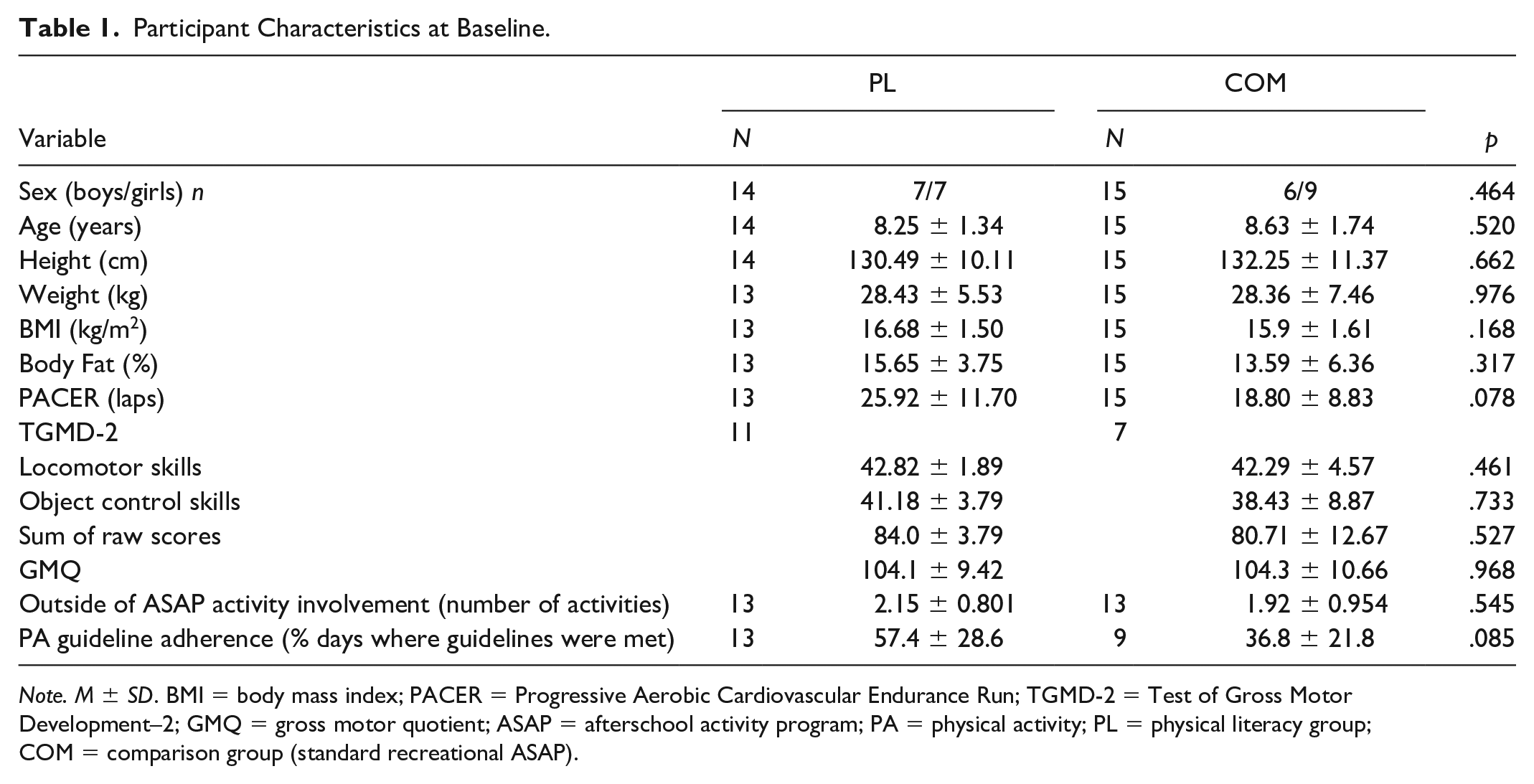
Note. M ± SD. BMI = body mass index; PACER = Progressive Aerobic Cardiovascular Endurance Run; TGMD-2 = Test of Gross Motor Development–2; GMQ = gross motor quotient; ASAP = afterschool activity program; PA = physical activity; PL = physical literacy group; COM = comparison group (standard recreational ASAP).
Physical Activity and Sedentary Behavior
During the follow-up the proportion of days when meeting guidelines decreased by 15.2% (95% CI [4.2, 26.2]) and 10.3% (95% CI [2.6, 23.2]) in the physical literacy group and comparison group, respectively (p = .59). Changes in the individual level can be seen in Figure 1.
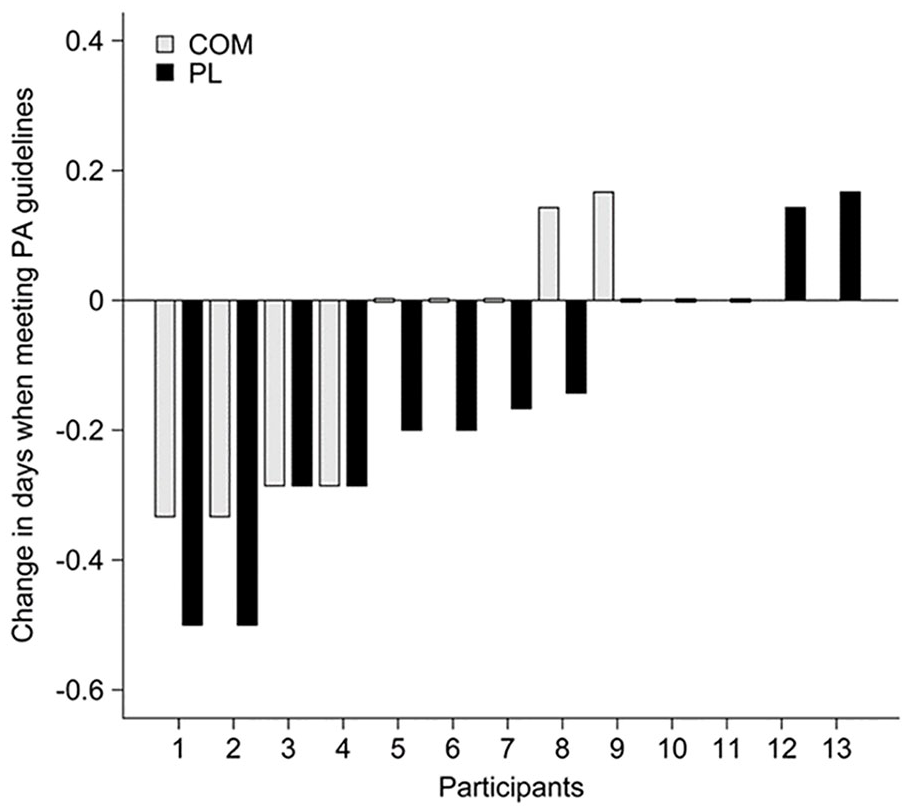
Change in proportion of days when meeting PA guidelines among individuals in the physical literacy group and comparison group.
Body Composition, Aerobic Capacity, and FMS
Changes in BMI, body fat percentage, aerobic capacity, and FMS are presented in Table 2. Both groups displayed increases in BMI and body fat percentage, with the comparison group increasing by significant increments (BMI: p = .001 and body fat percentage: p = .009). Between-group changes in the aforementioned variables were not significant (BMI: p = .127 and body fat percentage: p = .379). However, the effect size values suggested a moderate to high practical significance in between-group changes in BMI score (d = −0.62), and a low to moderate practical significance in between-group changes in body fat percentage (d = −0.35).
Within-Group and Between-Group Changes in BMI, Body Fat Percentage, PACER Score, and FMS From Baseline to 6-Month Follow-up.
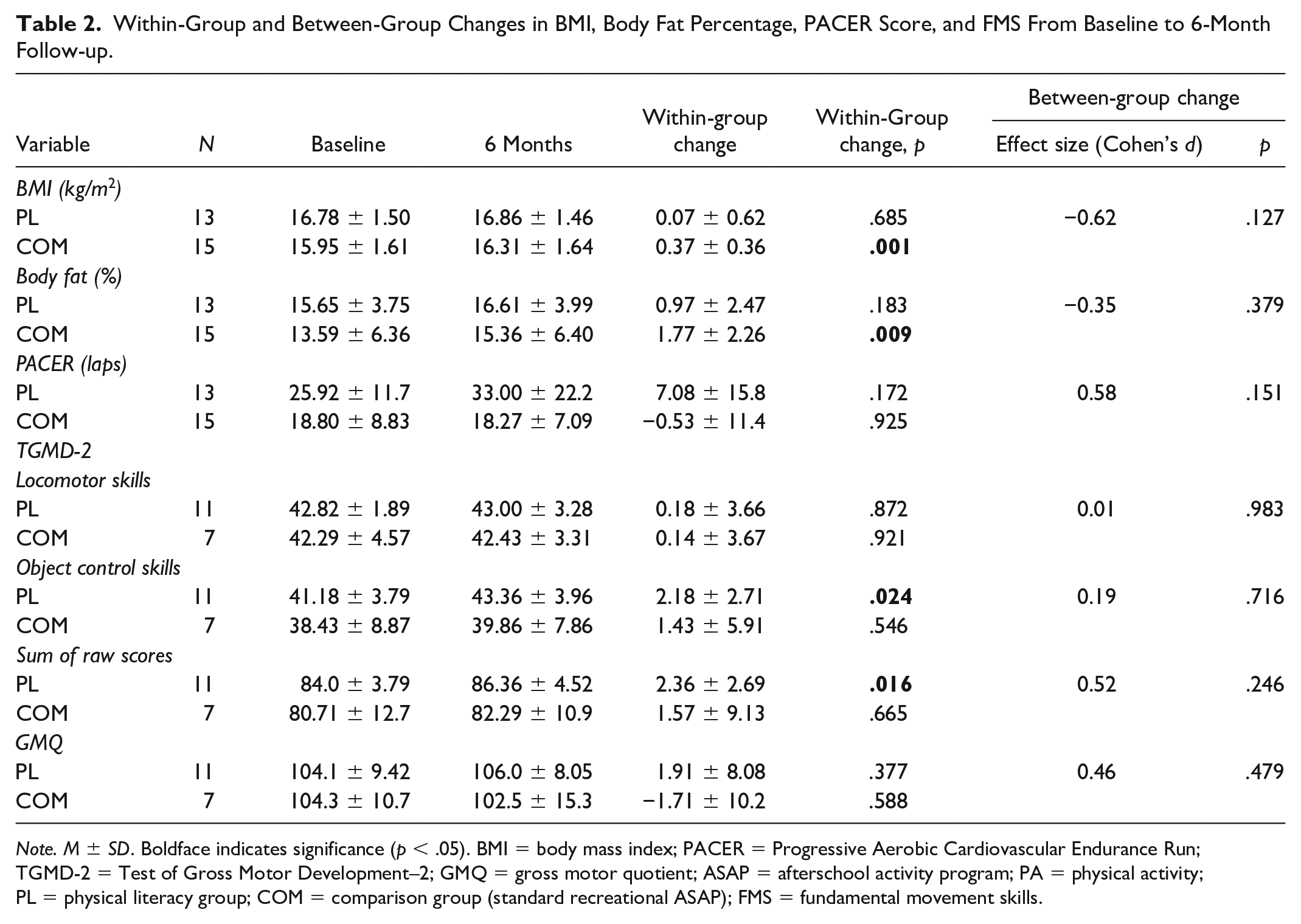
Note. M ± SD. Boldface indicates significance (p < .05). BMI = body mass index; PACER = Progressive Aerobic Cardiovascular Endurance Run; TGMD-2 = Test of Gross Motor Development–2; GMQ = gross motor quotient; ASAP = afterschool activity program; PA = physical activity; PL = physical literacy group; COM = comparison group (standard recreational ASAP); FMS = fundamental movement skills.
Although the physical literacy group’s PACER performance improved and the comparison group exhibited a decline in performance, the within and between-group changes in PACER scores were nonsignificant (within physical literacy group: p = .171, comparison group: p = .925; between p = .151). Cohen’s effect size value suggest a moderate practical significance in between-group changes in PACER performance (d = 0.58).
Only the physical literacy group displayed a significant improvement in TGMD-2 in object control skills (p = .024) over time. Between-group changes in object control skills were nonsignificant (p = .716, d = 0.19). Furthermore, there were no differences in within- or between-group changes in locomotor skills (within physical literacy group: p = .872, comparison group: p = .921; between p = .983, d = 0.01). The physical literacy group demonstrated a significant improvement in sum of raw scores (p = .016), while no difference was observed in the comparison group (p = .665). No differences were observed in both groups for overall motor proficiency. No significant differences were found for between-group changes in sum of raw scores (p = .246) or GMQ (p = .479); however, there was a moderate effect size value for sum of raw scores (d = 0.52) which indicates a practical significance in the respective between-group change scores.
Discussion
A physical literacy-focused ASAP demonstrated an attenuated increase in BMI and adiposity, and within-group improvements in FMS (specifically object motor control skills) after 6 months of participation. Although there were no differences in these variables in between-group comparisons, preliminary evidence suggests that physical literacy-focused ASAP may improve physical activity-related health markers in children. Further investigations are needed to develop effective strategies to increase children’s physical activity during and outside of ASAP, respectively.
Although previous studies have found that physical literacy-focused ASAP can increase adherence to physical activity guidelines (Beets et al., 2009), no significant differences were observed in our comparative analysis on the proportion of days the physical literacy group and comparison group were meeting physical activity guidelines. It should be noted that previous studies did not distinguish the intensity or type of physical activity the children were engaged in (Løndal et al., 2020), which may be factors that explain the contradictory findings of the present study. Moreover, a large randomized control trial conducted by Beets et al. (2016) assessed the 2-year impact of an intervention designed to increase MVPA in the ASAP setting by training ASAP instructors on how to develop programmatic capacity in the form of high-quality schedules that included physical activity. The researchers reported that the ASAPs that received the intervention successfully increased the percentage of boys (n = 677) and girls (n = 658; 6–12 years) achieving recommended amounts of MVPA by 11% and 6%, respectively. These findings suggest that perhaps a longer follow-up period is necessary to identify changes in physical activity adherence. Overall, our findings and previous studies that have investigated team sport-based (Veldman et al., 2020; Weintraub et al., 2008) and free or organized play (Trost et al., 2008) on objectively measured children’s physical activity, suggest that these programs can increase time spent in MVPA and thus contribute to improvements in physical health markers.
Based on previous literature, ASAPs can enhance physical activity engagement by (1) increasing the duration and frequency of free play and organized physical activity sessions (Trost et al., 2008); (2) enhancing program leaders’ awareness of the importance of physical activity and their ability to adequately encourage children to engage in physical activity, and developing their administrative and instructional skills related to physical activity programming (Elias et al., 2020; Henderson et al., 2015; Kelder et al., 2005; Trost et al., 2008); (3) selecting developmentally appropriate sports and activities (Kahn et al., 2002); and (4) structuring a physical environment that facilitates children’s physical activity, such as one that includes open areas for free play and sports/play equipment (Trost et al., 2008). As seen in our results, only structuring an ASAP curriculum around improving physical literacy and FMS or sport skills may not be enough to increase participating children’s physical activity. The potential limiting factors of this structuring method should be addressed in future studies and further strategies that facilitate increasing physical activity among children attending ASAPs should be explored.
As indicated earlier, we found that children in the physical literacy-focused ASAP experienced more favorable changes in body compositions compared to those in the standard recreational ASAP. Each group displayed increases in BMI, which is to be expected in growing children, yet only children attending the standard recreational ASAP displayed a significant increase in BMI and body fat percentage. Furthermore, there was a low to moderate effect size for between-group changes in body fat percentage (d = −0.35), and a moderate to high effect size for between-group changes in BMI (d = −0.62). These respective effect sizes indicate a practical significance in between-group changes in body composition and BMI. This finding suggests that engagement in the physical literacy-focused ASAP may have contributed to an attenuated increase in adiposity and subsequently, a maintained BMI among attending children. Although levels of physical activity did not improve in the physical literacy group, it might have been enough to maintain their body composition, since physical activity is directly correlated with improved body composition in children (Dencker et al., 2006; Hills et al., 2011). The influence that physical literacy-focused ASAPs have on children’s body composition has garnered research attention, and the beneficial association between the physical literacy-focused ASAP and the measures of adiposity found in our study, as well as others (Beets et al., 2009; Gutin et al., 2008; Slawta et al., 2008) indicate that these types of programs are indeed promising.
Our data found no significant between or within-group changes in aerobic capacity, as estimated using PACER scores. These findings are inconsistent with previous research that has found a positive association between ASAP participation and improved aerobic capacity in children (Gutin et al., 2008; Slawta et al., 2008) and may speak to the low statistical power limitation in our analysis due to the high degree of variability in change scores for PACER results. Even though the small sample size, we still observed a moderate effect size for the between-group change in PACER score (d = 0.580) was still observed. Thus, from a practical standpoint, the physical literacy-focused ASAP may have a meaningful effect on children’s aerobic capacity compared to the standard recreational ASAP. Further investigations with a larger sample size are required to confirm these findings.
Only the physical literacy-focused group demonstrated significant improvements in FMS, specifically their total raw score and object control skills over time. Furthermore, it is important to discuss the moderate effect sizes for between-group changes in sum of raw scores (d = 0.52) and GMQ (d = 0.46). In view of these effect sizes, it appears that the physical literacy-focused ASAP did promote greater overall FMS development compared with the standard recreational ASAP. Notably, the larger effect size favorable to the physical literacy group in the total raw score and GMQ is likely due to the significant improvement in their object control skills score. One existing study by Burrows et al. (2014) compared the effects of a “low-organized games” ASAP to a sports-based ASAP on children’s (n = 40, 6–10 years) FMS development over an 11-week period. Like our findings, they found that there were no significant between-group differences in changes in total GMQ and locomotor skills. Unlike our study, Burrows et al. (2014) did not find that children in the sports-based ASAP demonstrated a significant improvement in object control skills over the 11-week period. This discrepancy is likely because participants in the physical literacy-focused ASAP in our study engage in programming that aims to foster progressive object control skills development, rather than strictly engaging in less structured sports and games, which may not allow for children to adequately gain skill proficiency (Morgan et al., 2013; Platvoet et al., 2020). Future research using larger sample sizes and more prolonged follow-up measures to assess the impact of physical literacy-focused ASAPs on FMS proficiency is warranted. Given the promising findings in the present study, and previous research that has evaluated the impact of physical literacy-focused ASAPs on several biopsychological outcomes among children, the next steps should also include targeted implementation strategies. Specifically, ASAP curricula should integrate physical literacy components, as well as train staff to deliver the programs accordingly. Additionally, implementation activities should include ongoing evaluation and reform to ensure programs can be modified and geared toward the children participating in activities. Finally, longitudinal research is also necessary to evaluate the effectiveness of physical literacy-focused ASAPs and future physical activity levels among children as they exit programs. It may be postulated that developing critical physical literacy skills and understanding of the importance of physical activity at a young age through structured ASAP, children will continue to engage in an active lifestyle outside of ASAP settings as well and later in life.
Strengths and Limitations
Strengths of our study include the objective measurement of physical activity and sedentary behavior using Actical accelerometers and the measurement of body fat mass directly using bioelectrical impedance analysis instead of relying on BMI as an indicator of body composition. The physical literacy-focused ASAP was only offered in two sites resulting in a small sample and hence low statistical power (<80% based on post hoc power estimations for between-group differences). To minimize this limitation, we complemented our statistical analysis with effect size values. We believe these data can inform future implementation studies related to these physical literacy-focused ASAPs. Furthermore, with nonexperimental research one must consider that correlation does not necessitate causation, as we cannot account for all external variables affecting children within and outside of the ASAP setting. We attempted to address this limitation by also assessing outside of ASAP activities at baseline.
Conclusions
The physical literacy-focused ASAP appeared to contribute to more favorable body composition changes and an improvement in object control skills over time, although no changes were seen in the proportion of days when meeting physical activity guidelines. There were no significant within- or between-group changes in aerobic capacity, locomotor skills, or overall motor proficiency over time. Based on the moderate effect size for between group changes in aerobic capacity, it is possible that the physical literacy-focused ASAP elicited a practically meaningful effect on children’s aerobic capacity over time compared with the standard recreational ASAP.
Moving forward, additional research is required to evaluate the effects of ASAP on children’s physical health and health-related behaviors and factors that can explain the success of these interventions. By identifying salient ASAP features that promote healthy behaviors and induce physical health and FMS-related benefits, we can help devise strategies that ASAP instructors can implement to improve children and youth health.
Implications for Theory, Policy, and/or Practice
Our study helps inform the promotion of healthful behaviors for children. If designed and structured with a focus on physical activity and literacy, ASAPs provide a valuable opportunity to improve children’s fundamental movement skills, increase physical activity, and optimize body habitus. Recommending children to engage in a physical literacy-focused afterschool activity programs can be beneficial for fundamental movement skill development, specifically object control skills, and they can play a role in attenuating increases in BMI and adiposity in children. Instructors should consider incorporating physical literacy-focused activities and opportunities when designing and structuring their respective ASAP. A few examples by which ASAP could emphasize physical literacy promotion include:
Providing children with safe access to outdoor space or large indoor space, such as a gymnasium, with opportunities to engage in fun and active exercises.
Program instructors should serve as role models for children by participating in activities and being actively engaged with them. Instructors should foster a fun, safe, and educational learning environment for children to develop physical skills.
Ensure all participants have opportunities to engage in program activities and include a variety of traditional and nontraditional forms of physical activity to foster diverse forms of physical skill learning and application.
Optimally challenge participants so activities match their skill level and encourage them to overcome failed attempts, improve, and succeed. Instructors should provide encouraging and positive feedback?
Establish and follow an age-appropriate, sequential, and goal-oriented physical literacy program to help participants consolidate and build on gains in physical literacy skills.
Footnotes
Acknowledgements
We would like to thank the participants and leaders from Fielding Drive Public School (PS) SportCan program, Huntclub and Riverside Community Centre, and Bayview PS SportsCan program. Also, thank you to the dedicated research coordinators, students, and volunteers of the Adamo Lab ( ); without their help none of this would have been possible.
Declaration of Conflicting Interests
The author(s) declared no potential conflicts of interest with respect to the research, authorship, and/or publication of this article.
Funding
The author(s) received no financial support for the research, authorship, and/or publication of this article.