



Abstract
The term ‘priming exercise’ has recently been introduced to describe exercise stimuli prescribed to enhance performance within 1–48 hours of that stimulus. Despite evidence of these activities being utilised in competitive settings, the reasoning underpinning the application of priming exercise is not yet clear. Therefore, this study aimed to explore practitioners’ perceptions about using priming exercise as a pre-competition strategy to improve performance. Semi-structured interviews were conducted with 28 practitioners involved in prescribing training programs to elite Australian athletes. Reflexive thematic analysis revealed six organising themes (i.e. ‘limited and inapplicable research findings’, ‘consideration of athletes’ training age’, risk-return of priming session outcomes’, ‘logistical concerns’, ‘buy-in’ and ‘priming exercise prescription’) later grouped into a global theme, representing the ‘challenges of applying priming exercise’. The findings highlight contextual factors influencing practitioners’ use of priming exercise and, based on these considerations, draw attention to the apparent uncertainty about whether these stimuli can be prescribed effectively to improve competition performance in sports. In addition to gaining insight into applied priming strategies, the present findings may be used to inform externally valid and relevant study designs that subsequently guide practice.
Introduction
Planning during the competitive season generally considers shorter durations (i.e. microcycle), aiming to actualise skilled movement expression by balancing work and rest to heighten the possibility for successful performance outcomes.1,2 A primary challenge for practitioners designing the competitive microcycle is planning activities that can maximise sporting performance during the subsequent contest.2,3 Training bouts aiming to improve strength qualities are often scheduled at least two days before a competitive event to reduce residual fatigue that can attenuate performance.1,4 However, recent findings suggest that performance may be improved within 1–48 hours following these sessions providing the amount of work completed is relatively low.5–12 Termed ‘priming exercise’, studies have revealed improvements in different forms of strength expression (e.g. heavy maximal13–15 and fast5–7,9–12,16 dynamic strength) and maximal running ability13,17,18 within this time frame following low-volume exercise stimuli.
Anecdotal evidence suggests that priming exercise has previously been utilised in competitive settings.19,20 Yet, until recently, the prevalence with which practitioners implemented these strategies was unclear. A survey of individuals involved in prescribing training programs to elite athletes revealed that more than 80% of respondents had prescribed priming exercise to enhance subsequent competition performance. 4 However, whilst eight of 10 practitioners believed that exercise stimuli could produce a performance-enhancing effect, and nearly 100% of respondents considered these strategies beneficial to strength expression, almost half of the participants responded that they did not currently implement priming sessions. 4 More recently, Collins et al. found that only 20% of the 90 athletes who responded to an online survey used priming exercise despite the widespread belief that it could lead to a successful performance outcome. 21 Further examination of the results revealed that of the athletes who reportedly utilised priming exercise strategies, only ∼10% did so with the guidance of their coach, suggesting a lack of practitioner involvement in applying these methods. 21 Common reasons for practitioners not implementing priming exercise in athletes’ training plans have been reported. 4 Nevertheless, these responses were only considered among the respondents who had never prescribed priming exercise. 4 As such, the perceptions influencing the use of priming exercise among practitioners have largely not been explored.
Considering the limited number of studies investigating the effects of a relatively narrow selection of exercise stimuli on performance outcomes,8,20 practitioners may be wary about applying priming strategies until further evidence is available to support their use. 4 Although priming exercise has been shown to improve physical and perceptual responses, a number of studies have also found no change or significant decreases in these measures.5–7,12,14–16,22–24 Several factors may explain the lack of agreement in the literature. These include the training parameters used during a priming session, the duration separating the priming stimulus and subsequent performance, differences between exercise stimuli and testing measures researchers have utilised to assess performance and individual characteristics. 8 Additionally, most investigations have examined the effects of priming exercise stimuli on the ability to express strength in a single action (e.g. countermovement jump). In contrast, few studies have investigated priming responses involving specific measures of sporting performance13,20,25,26 and following activities other than resistance exercise.13,16,17,26 This may deter some practitioners from prescribing priming exercise until further applied research is conducted.4,20
There are considerable differences between the priming exercise stimuli shown to positively influence performance in research studies and the methods currently applied in practical environments. 4 This may be because the most appropriate training parameters have not been used to optimise priming responses.4,8,20,27 Accordingly, the variation in applied priming strategies 4 may reflect the conflicting results reported within5–7,11,12,15,22,24,28,29 and between5,7,14,15,17,22–24,28,29 studies, resulting in uncertainty about the best exercise prescription to elicit a beneficial effect. Furthermore, the complex nature of applied settings may preclude priming activities in the pre-competition period4,8 or require less researched methods (e.g. sprinting, plyometrics) to be utilised within this time frame. 20 As such, the wide range of exercise stimuli prescribed during priming sessions 4 may suggest that practitioners perceive particular strategies as more beneficial in having a performance-enhancing effect, despite the lack of supporting evidence. Nevertheless, because the reasoning underpinning the application of priming exercise is not yet clear, research exploring its use in competitive settings appears warranted. Knowledge of applied strategies, practitioners’ perspectives and considerations influencing its prescription would benefit researchers examining the performance effects of priming exercise. Information of this nature may be used to inform externally valid and relevant study designs that subsequently guide practice. Therefore, this study aimed to explore practitioners’ perceptions about using priming exercise as a pre-competition strategy to improve performance.
Method
Participants
Following approval from the Queensland University of Technology Ethics Committee, participants were recruited through criterion-based purposeful sampling strategies. 30 Selection criteria were adopted to confirm practitioners (i.e. high-performance managers, strength and conditioning coaches) had achieved a high level of expertise: (a) a degree(s) in a related field of study (e.g. sport and exercise science) from an accredited university; (b) a minimum of 10 years of coaching experience; (c) accreditation by Exercise and Sport Science Australia or certification by the Australian Strength and Conditioning Association; and (d) currently working with elite athletes (i.e. professional and national and international level 31 ). A total of 28 practitioners currently employed at state institutes of sport or professional sporting clubs and involved in prescribing training programs to athletes representing numerous sports (athletics, Australian rules football, baseball, basketball, bobsleigh, cycling [BMX, mountain bike racing, road bicycle racing, track cycling], diving, [field] hockey, golf, netball, para-athletics, para-rowing, para-swimming, rowing, rugby league, rugby sevens, sailing, shooting, skateboarding, skiing, soccer, softball, snowboarding, triathlon, water polo, weightlifting, wheelchair basketball), and all residing in Australia, were recruited.
Procedure
Practitioners were contacted by a gatekeeper at Sport Australia to invite them to participate in a face-to-face interview. Individuals interested in participating in the study were provided with an information sheet that detailed the interview topic and discussed the ethical implications of their involvement. The individuals were then invited to ask questions about the research project and, following initial contact, asked to arrange a suitable time and location for an interview. Before the start of the interview process, ethical considerations (i.e. the use of pseudonyms, data confidentiality for practitioners and organisations and participants’ right to withdraw) were provided to all participants. Participants were required to provide their written informed consent at this time. To establish rapport between the researcher and respondent, participants were then provided information about the interviewer's background and apprised of the research project. 32 As part of the interview process, a definition of priming exercise (i.e. a bout of exercise prescribed 1–48 hours before a competition with the aim of positively influencing athletes’ performance 27 ) was provided, and participants were subsequently invited to ask clarifying questions.
Semi-structured interview questions were used to explore practitioners’ perceptions about using priming exercise in competitive settings. Each respondent participated in a single interview conducted by the lead researcher. Interviews took an average of 26 minutes to complete (range 18–37 minutes). A set of preplanned questions designed around the study aim was utilised to shape each interview conversation whilst permitting the participants to express their opinions and experiences. 30 Questions initially focused on practitioners’ perceptions about using priming exercise in the sports they worked most closely (e.g. Is priming exercise used in your sport?; What is an example of how priming exercise has been used in your sport? If priming exercise has not been used, describe why you think it has not been used in your sport.). Specifically, questions attempted to capture if and to what extent priming exercise was utilised and how these sessions were prescribed (i.e. planning and programming considerations). Questions subsequently focused on exploring factors affecting the choice to implement priming exercise and how these considerations influence prescription within their practical environment (i.e. What are considerations for prescribing priming exercise?; Do you think all sports can include priming exercise? Why [i.e. what are the reasons for your viewpoint]?). Elaboration probes were frequently used as required to reveal deeper meanings surrounding the what, why and how of practitioners’ perception, experience and application of priming exercise. 33 Before concluding the interview, participants were offered the chance to provide further reflections related to their answers to the interview questions. All interviews were digitally recorded and professionally transcribed verbatim.
Data analysis
Transcripts were analysed through the lens of a reflexive thematic analysis, 34 taking an inductive approach. This method of data analysis was selected due to its philosophical alignment with the interpretivist paradigm adopted by the research team. In acknowledging the subjective nature of meaning-making, emphasising the role of social interactions in constructing reality and understanding that the researcher's biases and assumptions influence data interpretation, this approach manifested in how the lead researcher conducted interviews with the participants. For example, when a participant described the importance of athletes’ achieving a high training age before priming exercise was prescribed, the lead researcher, who had nearly 20 years of experience as a strength and conditioning coach in similar settings, implicitly understood the meaning they attempted to convey when making their point. As such, they were able to probe deeper into how participants constructed their meaning.
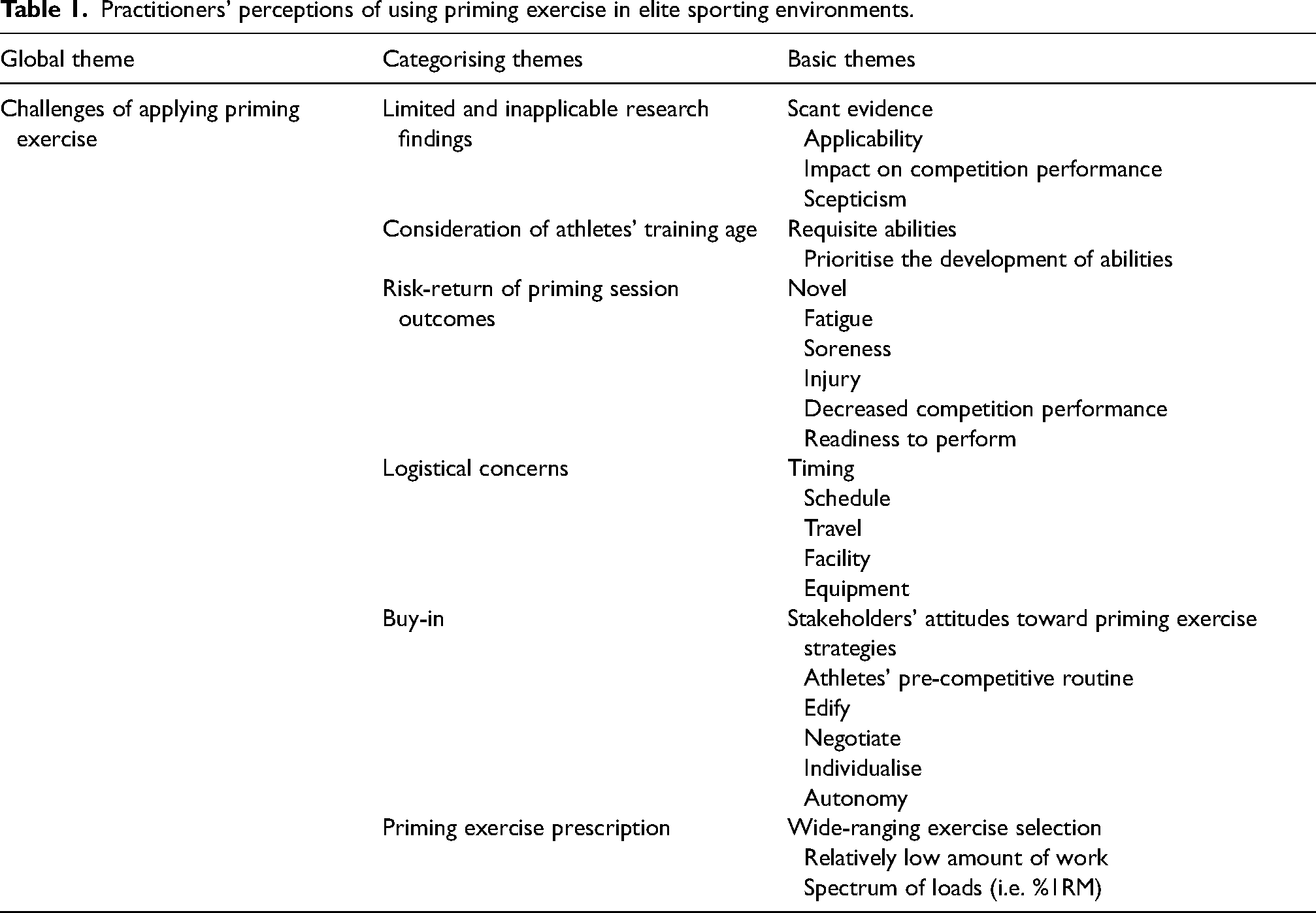
The data analysis process consisted of a six-phase procedure (i.e. data familiarisation, generation of initial codes, development of themes, theme refinement, naming and subsequent writing and reporting) outlined by Braun. 34 To aid in data familiarisation, the lead researcher kept copious notes (e.g. highlighting participants’ answers, which were subsequently used to formulate probing questions) during the data collection process. This step helped establish connections between interviews and recurrent discussion topics that were considered important for identifying phrases during the later development and refinement of themes. After interview transcription, the lead researcher further familiarised themself with the data by analytical reading. Initial codes were then generated by (a) categorising extracts according to the research aim and interview questions; (b) summarising extracts using word(s) that encapsulate their contents; and (c) utilising the participant's own words to summarise extracts into single words or phrases. The initial codes were collated into basic themes, representing primary discussion points about priming exercise, and all data relating to the basic themes were gathered. Next, the basic themes were reviewed using a critical friends approach.35,36 Basic themes were then combined and reviewed against the coded data and the entire data set and subsequently refined into categorising themes (i.e. clusters of signification summarising the assumptions of a group of basic themes) and, later, a global theme (i.e. summarising, condensing and making sense of lower-order thematic clusters), providing a comprehensive and holistic understanding of practitioners’ perceptions about using priming exercise as a pre-competition strategy to improve performance (Table 1). 37 Lastly, a written report of the results in which compelling quotes capturing the essence of categorising themes were coherently interwoven with commentary to provide an interesting account of the data and yield insights about the possible impact that applying priming exercise might have had on practitioners and their coaching practices.
Practitioners’ perceptions of using priming exercise in elite sporting environments.
Establishing rigour
Following an interpretivist paradigm grounded in ontological relativism and epistemological interpretivism to explore the lived experience of participants and uncover meaning held by those individuals, criteria were employed to establish rigour in the present study. In following a relativist orientation, the authors rejected a criteriology approach to developing rigour and thus chose to adopt criteria aligning with the aim of the present study to improve the quality of the research, as indicated by the sincerity, resonance, meaningful coherence and significant contribution of the findings.30,35,38 One criterion adopted was reflexivity, requiring the lead researcher to reflect on their subjectivity and how it may have influenced the data collection and analysis processes and subsequent findings.36,39,40 Reflexive writing was used throughout the research process to scrutinise emerging impressions of what the data mean and their relevance to each other.36,41 An example of a personal bias in the present analysis was when participants discussed their perceptions of how priming exercise was applied in the sports they worked. Given the lead researcher's understanding of the literature, practitioners’ responses were initially interpreted as lacking insight about applying priming exercise. As such, the categorising theme ‘limited knowledge’ was formulated initially. However, this theme was later framed as ‘limited and inapplicable research findings’ upon reflection, as participants did not necessarily convey unfamiliarity with study outcomes. Alternatively, the perceived lack of relevant yet scrutinised research findings was believed to influence their use of these methods.
A second criterion employed was transparency, reflecting the lead researchers’ aim to think critically about how data were interpreted. 36 Transparency was achieved using a critical friends approach whereby the coauthors challenged the first author's theme generation. 35 During the data analysis process, the first author regularly discussed the interviews with other research team members. These conversations often included discussions about how the lead researcher's experience and knowledge could influence the interpretation of findings. To further encourage transparency, the lead researcher, upon analysing the data, discussed the themes with the second author. This individual, who had no previous experience in strength and conditioning and had considerable knowledge of the research methodologies applied, provided alternative explanations of the data that challenged the lead researcher's initial interpretations. 34 This process was repeated several times until the authors agreed that the themes represented the data analysed. For example, the categorising theme, ‘priming outcomes’, was formulated initially, representing the possible outcomes practitioners perceived could occur with a priming bout. Discussion between the authors later framed these responses in a way that more appropriately represented participants’ viewpoints that, whilst priming stimuli could improve athletes’ perceptual state and thus their readiness to perform, practitioners were uncertain about including these sessions in the training plan (i.e. ‘risk-return of priming session outcomes’).
Third, participation in the study was limited to practitioners working with elite athletes representing numerous sports. A criterion-based purposeful sampling strategy was adopted to enhance the transferability and thus resonance, meaningful coherence and significant contribution of the findings. 36 As there are limited data suggesting the reasoning underpinning applied priming strategies 4 and considering the potential value that practitioners may perceive given the participants’ level of expertise, the results may encourage further reflection on behalf of professionals contemplating or currently prescribing these activities. As such, the readers can make choices about including priming exercise in athletes’ training plans based on their intuitive understanding. 36
Results and discussion
Figure 1 shows the six categorising themes (;limited and inapplicable research findings’, ‘consideration of athletes’ training age’, ‘risk-return of priming session outcomes’, ‘logistical concerns’, ‘buy-in’ and ‘priming exercise prescription’) later grouped into a global theme, representing the ‘challenges of applying priming exercise’. The findings highlight contextual factors influencing practitioners’ use of priming exercise and, based on these considerations, draw attention to the apparent uncertainty about whether these stimuli can be prescribed effectively to improve competition performance in sports.
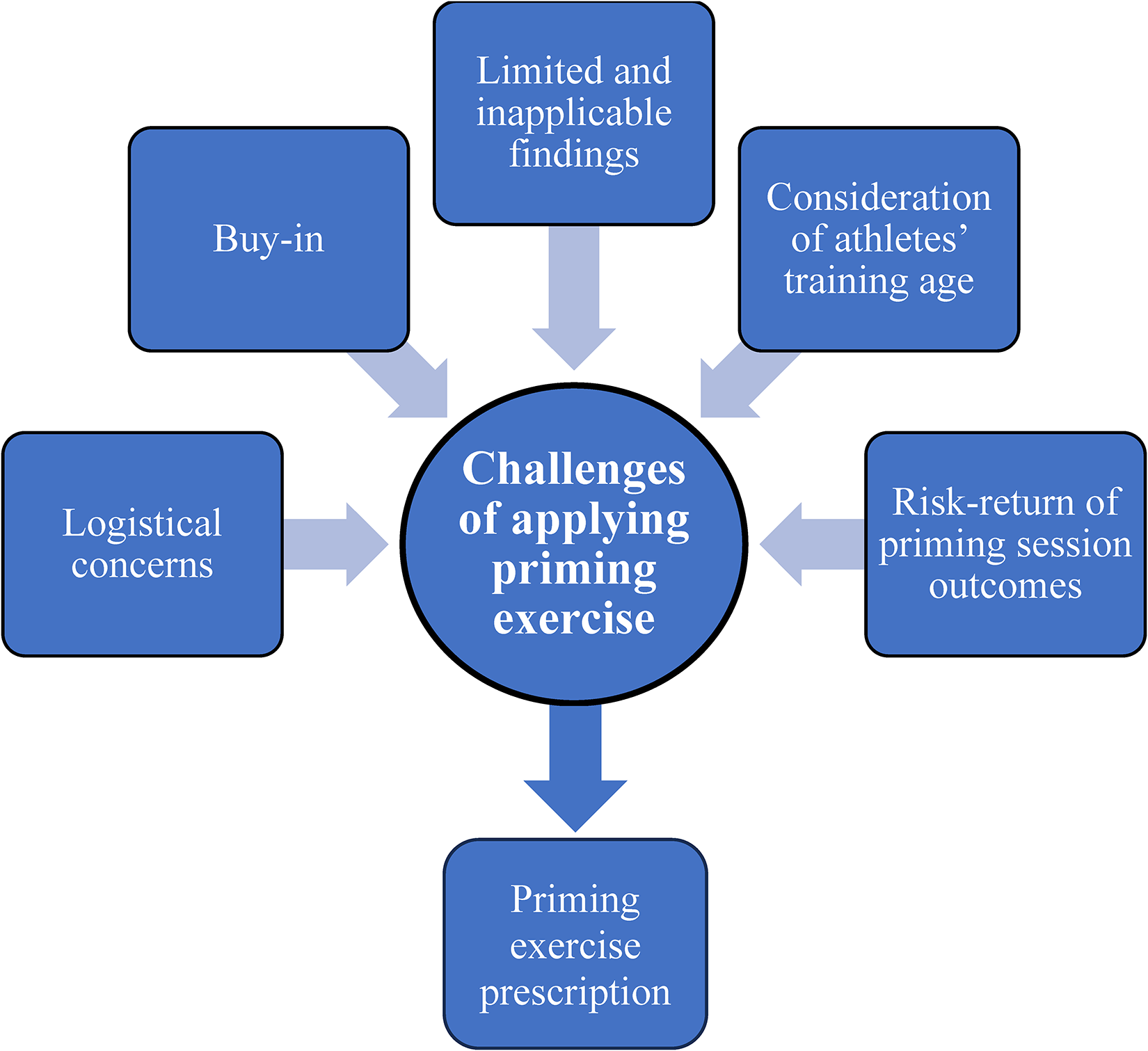
Six categorising themes grouped into a global theme, representing the perceived challenges of applying priming exercise in elite sporting environments.
Limited and inapplicable research findings
The perception that research findings to date are largely irrelevant contributed to the opinion that priming exercise may not improve specific measures of sporting performance. Without sufficient evidence supporting its benefit on competition-specific performance indicators, practitioners were generally cautious about implementing priming sessions in the training plan.
Practitioners commonly appealed for further investigations examining the performance effects of priming exercise. Expressing his frustration, Harry stated, ‘Amongst a lot of the S&C coaches I've worked with, it doesn't seem like there's a hell of a lot of research to back up how and why’. Kyle added, ‘There's not a lot of research, there's not a definitive answer’. Robert suggested that limited findings may be partly responsible for the apparent confusion about priming exercise, ‘I suspect a lot of coaches do it with the purpose of priming in mind, but they don't know what it's called. And there's no research to support it’. Anthony explained that this perception may lead to qualms about how priming exercise can be prescribed to positively influence performance, ‘This comes back to probably the research too of where I didn't, wasn't 100% sure whether the priming I was doing was actually going to be useful’.
Similarly limiting practitioners’ use of priming exercise is the opinion that current research findings are largely not applicable to most sporting demands and thus the belief that these strategies may not positively influence competition performance. Paul described the challenge of implementing priming exercise in his environment, given the perceived lack of relevant findings, ‘And, almost contextual too, that if you're saying the majority of the studies are done with countermovement jumps, the test for performance, if you will, that, to us, it's almost like a hesitancy’. Chris added: But if we look at that lower body power and vertical jump performance, I want to know that their priming can also transfer to other tasks as well. So, if we look, I think a lot of it's around countermovement jump performance improvement, which is obviously a lower limb force and power production. But does that mean it can be sustained over more than one sort of sequence?
As most priming studies have investigated the effects of resistance exercise stimuli on different forms of strength expression,12–14,16 there was the view that the measures researchers have used to assess priming outcomes have limited transfer to competition-specific performance indicators (e.g. sprint and repeat sprint ability). Speaking on this, Robert stated, ‘I can see it definitely being beneficial in probably more those power-based sports . . . But I want to know what does it mean for more endurance-based sports?’ Although findings have shown that priming exercise may positively influence outcomes involving maximal running speed,13,17,26 a paucity of research has examined performance measures relating to repeated bouts of high-intensity efforts characteristic of open-skilled sporting environments.
18
The lack of relevant findings may have implications for team sport athletes whose performance is largely underpinned by the ability to maintain a high running intensity with minimal recovery periods (e.g. football codes) and support Paul's belief that priming exercise may not have a beneficial effect on performance in these competitive settings: We don't know how that response may happen in elite [Australian Football League] players who are required to run 14 plus kilometres in a game. And repeat high speed and sprints are important, but because it's such a high volume of repeat efforts, is something like priming actually going to be truly beneficial over the length of a 120-to-140-min game?
However, as Marshall alluded, ‘It might become very difficult to define its influence on performance if it's a team-based sport or event. Did that actually make them better performers?’ Assessing the benefits of priming stimuli on subsequent performance in open-skilled competitive environments may be challenging, inferred by previous attempts to construct individual performance profiles in team sports such as rugby union, basketball, American football and soccer.42–45 Accordingly, practitioners such as Jeff have struggled to provide evidence for its prescription when assessing the influence of priming exercise on sport-specific performance parameters: Another challenge is that whenever we started to introduce the concept with the [team], I was encouraged to try and provide some kind of practical examples where we were actually achieving what we said we thought we would achieve. So, on one hand, I was able to go and say, “Here's a nice little paper by so-and-so”, or whoever it was. If you do this priming exercise, performance is improved. And they're like, “That's great, but has it happened with any of our guys?" . . . And that probably set us back as well because we didn't have the evidence to be able to present yet.
Practitioners similarly questioned whether sporting outcomes relying more heavily on skill expression rather than the expression of strength might be improved following priming exercise, as Danielle alluded: Then, there's probably sports that, bluntly, may not have any real physiological underpinning. Potentially, I can't really see if or how [priming exercise] would be useful in sports that have a lower reliance on physical capacities.
To date, no studies have investigated priming outcomes involving largely skill-based measures. As such, it is unknown whether these strategies can benefit sporting outcomes relying minimally on physical attributes.
Given the believed limitations of the research, most practitioners, including Craig, were hesitant about including priming exercise in the pre-competition period: It comes back to the research, which allows you, if there is any kickback, to reply, “Well, this is what the research is”, because I think from a practical standpoint, I have enough confidence in it that I could sell it. But, it's really having the research side of it to back it up, because, well, if someone is smart enough or knowledgeable enough to counterintuitively fight back, what have I got to back up what I'm saying?
Curtis further suggested that because few studies have clearly demonstrated the extent to which priming exercise can positively influence performance, practitioners may be reluctant to utilise these strategies: And again, from our perspective, the people who are trying to implement it, the main barrier would be, I guess, practical research to say, “You're going to improve by this much”, because in a way, if you put your backside on the line and you bring something into a new program, you'll want to have some pretty strong backing behind it.
Consideration of athletes’ training age
A common notion among practitioners was that athletes’ training age 46 should be considered before prescribing priming exercise. If a requisite training age, allowing for the sufficient development of strength qualities and technical proficiency has not been attained, practitioners believed that priming exercise would not elicit a beneficial effect and could decrease subsequent performance outcomes.
Commenting on the importance of previous training experience to elicit a priming effect, Eric offered, ‘Probably [athletes] that aren't very experienced or don't have a big training age I wouldn’t use priming’. Sean similarly conveyed: My athlete cohort that I have are generally of a younger age. So, most of my athletes are 16, 17, 18 year-olds. And so, I don't feel that the vast majority of them have really achieved a training history that I feel comfortable to be able to use [priming] adequately.
The belief that a requisite training age is needed to stimulate a beneficial response may be related to the perception that adequate strength qualities positively influence priming outcomes and reduce the possibility of residual fatigue that can decrease subsequent performance, as Ben asserted: In my eyes, there's no point having a 50-kilo squatter doing priming the day before, because they're only squatting 50 kilos. How much neuromuscular stimulus are you actually giving that athlete in that priming session? Probably more likely to fatigue them just because they don't have that strength base there.
Limited findings suggest that strength qualities are associated with a heightened priming response.6,10,22 These results support Eric's perception of the importance of strength qualities, ‘Basically, from my knowledge, it's the stronger they are the more effective these sort of programs are going to be . . . If they don't have that training base, it may not be effective anyway’, and the presupposition that priming strategies, whilst potentially effective in highly trained athletes, may not elicit a beneficial performance response in lesser-trained athletes, as Jeff alluded: I think you need a level of training and a certain level of strength to be able to elicit the effect. So, you can't just take brand new athletes and start priming them in the first month of training.
Practitioners commonly asserted that a lengthier training history may also allow for greater technical proficiency to demonstrate a high movement intent (i.e. a maximal effort to accelerate the load) when performing priming exercises, which Walter believed was necessary to stimulate a performance-enhancing effect: I think probably athlete intent might be another one . . . So, their willingness to put their maximum effort into the exercise. Like are they actually moving a maximum load? Are they actually moving as hard and as fast as they can?
Amber shared that because athletes with a lower training age are often still learning how to perform certain exercises, they may not demonstrate the intent for fast force production: If I look at my 17s national netball squad, we need to still build foundations for them, and I feel priming for them would kind of be wasted. I don't think there would be intent of movement because they're still building their base and understanding movement in general. But when I get to my 19s, I feel like there's a better understanding, there's better foundations built, and they understand what intent means. From there up, I feel it's definitely something we could use.
Amber added that emphasising high movement speeds with ‘young and developing athletes’ may ‘overload them or confuse them early on’. Anthony similarly expressed his hesitancy to include priming exercise in the training plan of less experienced athletes given their lack of technical proficiency, ‘There's probably some of them that realistically are probably not getting in here enough, so they're not movement competent enough to actually elicit what I want to elicit out of it’. This opinion is supported by previous research showing that the capacity of lesser-trained individuals to generate rapid force may be suppressed by inhibitory neural mechanisms 47 and further constrained by coordinative factors associated with the relative novelty of the exercise task 48 and recent findings suggesting that maximal intent is required to maximise priming effects.5,10
When deciding whether to implement priming sessions in athletes’ training plans, practitioners commonly asserted that particular attributes believed obligatory to maximise the priming response were required, as Tim emphasised: I would lean more towards the guys who know how to move a bar quick, they know how to push something with intent, they know how to handle that and they're strong enough and robust enough to handle that.
Risk-return of priming session outcomes
Practitioners often referenced the possible outcomes that could occur with a bout of priming exercise. There was widespread concern that priming stimuli may result in fatigue, soreness or injury and negatively influence subsequent performance. Nevertheless, practitioners commonly conveyed that priming exercise could positively influence athletes’ perceptual state, which may lead to successful performance outcomes.
Because practitioners, including Greg, considered these strategies novel – ‘I think probably because it's a new science, I probably haven't heard of it, or been exposed to it’ – there was the concern that priming exercise may negatively influence sporting performance. Paul elaborated: But I think also in your environment, you're always weighing out risk versus reward. So, if you bring something new into an environment that hasn't had it, you’re probably going to err on the side of what's going to cause less amount of harm.
Practitioners were commonly worried about fatigue, soreness, or injury during and following a priming session. Jacob stated, ‘Whenever you do look to introduce something new which potentially can fatigue or cause soreness, then it's probably a moral question that's raised amongst the high-performance unit’. The risk versus return relationship with priming exercise was alluded to by most practitioners. Greg exemplified this paradigm whilst discussing the decision to include a priming bout in the pre-competition period: And I'd say another one would be just fear of injury. So, that would be a big factor, like if your priming was a sprint or your priming was a heavy squat or clean or something, and there's a soft tissue injury, and they can't participate in the game. That has massive ramifications for the potential benefit.
As Marshall alluded, these outcomes can, ultimately, decrease athletes’ performance and negatively affect competition results, ‘Athletes’ great concern is that it's going to negatively impact their performance later, which is probably the primary barrier’.
Despite these concerns, Larry believed that priming exercise might improve athletes’ readiness to perform, ‘You tune in a bit. You're more cognisant, you're more aware, you're more switched-on, you're more alert’ which, as practitioners often asserted, can influence performance positively. Steven similarly suggested: If you are having an effect on the players where they're perceiving that it's having a positive effect, that's probably one of the more important things you can do, because you're already affecting psychology when they go out.
In discussing the potential psychological effects of priming stimuli on performance, Anthony commented, ‘Even if it is just this big placebo effect, so who cares if that helps them perform’. Larry added, ‘We know placebo works. It's worth a couple of percent. So, if you can knock off a couple of percent, that should get you a gold medal’. Findings from previous research have demonstrated that placebo effects have a biological basis and can strongly influence performance measures.
49
Considering the equivocal results of priming studies,5–7,10,11,15–17,22,24,28,29 it may be that an exercise stimulus produces a positive or negative performance outcome simply because the athlete believes one or the other to be true. Accordingly, practitioners seemed willing to utilise priming strategies so long as their athletes perceived it to influence performance positively, as Walter remarked: A lot of it from our perspective is probably more subjective. Like, “Yeah, I felt really good out there.” Whether it's a placebo or not, it still improves their performance or improves their subjective feeling of their performance.
Logistical concerns
Priming exercise was often considered, provided that operational procedures (i.e. competition schedule, travel, facility, equipment) could be coordinated to optimise the timing of sessions.
Practitioners generally previewed the competition schedule to determine whether a bout of priming exercise was feasible. In discussing a typical event schedule for sports such as swimming and diving, track and field, cycling and rowing, in which athletes often compete multiple times over a short period, Harry shared the pervasive view that priming exercise may not be beneficial, ‘They'll play multiple games across a week. So, how that timeline sits, is it better to just rest? They're the conversations we have’. The competition schedule was often not known beforehand, which compelled practitioners to exclude or modify priming sessions. However, if previously informed of a schedule that allowed for the favourable timing of a priming bout, practitioners generally believed the training plan should include these activities, as Amber stated: We went into our weekend tournament knowing exactly when we were playing. We'd already travelled the night before, so we knew exactly what was happening on that schedule. We could do a priming session in the morning, and they were playing in the afternoon. We found that worked out quite well with the scheduling.
Another consideration when travelling for a competition was the access to adequate facilities and equipment to complete a priming session. This concern was often mentioned by practitioners, including John: Now, on an away trip, it can be difficult. There are challenges around how far away the gym is from the hotel. If the hotel doesn't have a gym, the quality of equipment, the logistics of getting there.
Buy-in
When discussing the possible impact that the application of priming exercise might have had on them and their coaching practices, practitioners expressed that because stakeholders (i.e. sport coaches, athletes and medical staff) generally viewed these activities poorly, they often adopted approaches to influence the perception of these activities positively.
Speaking about the resistance toward priming exercise observed in some sporting environments, Robert commented: There's more of a history of them doing [priming] in those power-based sports like rugby league. You’re going to have a hard time getting through to soccer players, swimmers, hockey players, Australian footballers to say, “Okay, we want to lift heavy the day before.” They’re just going to go, “Ugh”.
Tim similarly acknowledged the challenge of implementing priming sessions in competitive settings, given the perceived attitude of most sport coaches that training before a contest can decrease performance: I think the challenge would be to convince the coach why a priming session would be of absolute benefit. Especially if athletes showed up sluggish the next day, he'd be like, “What have you done?” You'd be in strife and that would be the end of it.
Further limiting the use of priming exercise was the perceived opinion of stakeholders that altering an athlete's usual regimen before a competition can lead to performance decrements. Previous research has demonstrated that having a well-developed competitive routine is associated with increased performance in elite athletes.50,51 In contrast, departing from a normal competitive routine has been shown to influence Olympic athletes’ performance negatively. 50 Jacob reiterated these findings: ‘From a psychological perspective, you can potentially do more harm to a player's mindset and readiness to play if you start messing with his game day routine’.
Nevertheless, practitioners often discussed the importance of educating stakeholders about the potential benefits of priming exercise and involving them in its prescription. Accordingly, Marshall stated, ‘Basically, talking about the benefits, and then getting them to experience it, so it does become part of their preparation’. Eric and Jeff also emphasised that ‘players have to be really comfortable with doing [priming]’ and ‘given a little bit more autonomy of what it is that they choose to do for a priming-type exercise’. As such, practitioners often incorporated activities with which sport coaches and athletes were familiar to gain favour with priming exercise. Amber discussed the benefits of doing so: Then I said, “Look, and we're also throwing in the movement that you love,” and he has all his athletes do. “We've thrown these in as well just to make sure that we are covering all bases,” and the coach was like, “Let's give it a go!” Then he found that reports back from the athlete that he felt better and his scores improved.
Including stakeholders in programming decisions may improve their sense of autonomy and enhance their motivation to participate in priming sessions.
52
Recent findings suggest that supporting an athlete's need for autonomy by allowing them to choose training variables can be an effective coaching strategy to enhance performance.
53
However, limiting less experienced athletes’ role in decision-making until relevant training experience has been gained is also recommended.
54
Kyle communicated a similar approach: So, for junior cyclists, “This is what you're doing.” Two years in, maybe you go, “Okay, well, how's that feeling? Do you think you need a bigger gear or a slightly slower gear, or do you want a third effort?” So probably by that third, fourth, fifth year, it's probably more, “Here's the structure”, the athlete drives it, how heavy, how much. They've probably gone through two or three, four years of guidelines and slowly the athletes get more and more autonomy.
Findings from previous research support the importance of psychosocial behaviours (e.g. flexibility, adaptability, effective communication and evaluative skills55,56), enabling strength and conditioning practitioners to more closely understand the needs of athletes57,58 and how these interpersonal skills can improve communication between the two groups to encourage autonomy, 56 develop trust and rapport 59 and therefore also promote buy-in relating to coaching practices.59–61 As previously suggested, athletes’ buy-in to a training plan, ultimately influencing its efficacy in producing competitive success, may be intrinsically intertwined with their perceptions, expectations, concerns, confidences and belief in it.62,63 Thus, practitioners’ ability to effectively interact with athletes (and other stakeholders) about priming practices may determine whether these activities can elicit a performance-enhancing effect.
Priming exercise prescription
Findings revealed that because contextual factors largely determined applied priming strategies, exercise stimuli varied in prescription among competitive settings. Although common training parameters such as volume and load (%1RM) were similar across sporting environments, the variation in prescription, whilst reflecting practical considerations, may suggest practitioners’ uncertainty about how exercise stimuli can be prescribed to elicit a priming effect.
Practitioners discussed various priming stimuli, such as resistance exercise, sprinting, change of direction, plyometrics and task-specific activities. Recent findings have similarly revealed that a wide range of activities were utilised in elite sport and these stimuli varied considerably between practitioners.
4
Brian reiterated the many options whilst listing several resistance exercises, including ‘trap bar deadlifts, light clean pulls, loaded jumps, light squat jumps, power pushes or speed efforts on the powers’. When discussing the various choices, Adam added, ‘There's plenty of ways to go about things, but I know that different coaches will go, “Yeah, but I want to make sure we've got this in there”’. Per the previously discussed themes, exercise selection was often influenced by considerations such as coach and athlete comfortability, technical proficiency and current training emphasis. Walter included these considerations in describing how he determined the stimuli prescribed within a priming bout: Again, we kept familiarity with the exercises as well. So, depending on what part of the season they're into or what their previous program looks like, we'll adjust the priming sessions so that the movement isn't a novel movement to them and flows in with what they've been doing.
Additionally, practitioners discussed how priming sessions often involved task-specific activities, enabling the ‘rehearsal of movement’ before a competition. Discussing the importance of aligning priming exercise stimuli with subsequent competitive activities, Paul stated, ‘You got to align it to the sport . . . you need to make sure that it's coming back to the skilled performance’. Kyle discussed how cyclists utilised priming bouts to familiarise riders with the competitive environment and include practice repetitions before a race: Yeah, it's probably a fairly traditional thing that . . . Because the different tracks have different shapes in terms of banking angles, lengths as well. So, it probably more started from . . . Well, we're going to the track to do some track familiarisation . . . So, we may as well do a couple efforts there just to prime the system and get things up and going.
Limited evidence suggests that performance following priming stimuli may be improved in a movement-specific manner.12,13,16,17,26 As such, priming sessions enabling athletes to rehearse sporting actions may stimulate psychophysiological responses that subsequently enhance the expression of skilled movement and thus competition performance.51,64 Considering the perception that sport coaches commonly appealed for exercise stimuli involving task-specific activities and that practitioners often desired their support for the inclusion of priming strategies in the training plan, further research investigating competitive performance outcomes following methods that simulate sporting movements may be beneficial.
Similar to previous research, 4 practitioners, including Danielle, commonly prescribed multiple (3-4) upper- and lower-body movements involving externally loaded and unloaded exercises during priming sessions, ‘They'll go through more of a Smith machine, a squat jump, so lower body, unweighted work, a little upper body strength, and then some speed’. Whereas studies have found improvements in performance following priming bouts involving an isolated exercise,5,12,16 the effects of multiple exercises on priming outcomes are less researched. In addition to minimising the influence of confounding variables, this may be due to previous findings suggesting that, whilst the total stimulus of the priming session may be somewhat affected by the exercise task, the amount of work completed during a training bout will strongly influence the physiological demands imposed 65 and therefore also subsequent performance responses. Priming studies that have found positive outcomes following a priming session have generally involved a low volume of stimuli. 8 As such, the amount of work seemingly prescribed in competitive settings may lead to performance decrements, despite practitioners’ intentions to limit the volume of priming bouts, as Harry alluded, ‘And the session itself, once again, will be quite short’.
Practitioners generally utilised a spectrum of loads during priming bouts. However, lighter versus heavier loads were often prescribed, given that prescription was commonly based on sport coaches’ attitudes and athletes’ familiarity and preference relating to exercise stimuli. In discussing the load selected during a priming bout for track and field athletes, Sean stated, ‘They'll go more a light trap bar or light squat, and some kind of jump to express power’. Previous findings have similarly shown that practitioners generally favoured unloaded and lighter (≤30% 1RM) exercises during priming sessions.
4
Alternatively, only ∼20% of practitioners programmed heavier stimuli (≥85% 1RM), suggesting a reluctance to utilise higher loads before a competition.
4
The same study also found that most practitioners prescribed priming exercise within 8 hours of competition.
4
In contrast, the present findings suggest priming bouts are commonly scheduled the day before contests, as Paul alluded, ‘We do some light resistance training the day before a game, but nothing that is high-load or high-intensity’. Interestingly, practitioners often expressed their preference for using heavier stimuli to elicit a priming effect. However, they believed this practice would be discouraged by stakeholders, as Chris expressed: So, looking at less than, I think it was 35% or 40% off memory. Forty-five, yeah. I think there's probably a really good scope for buy-in for athletes in that because I think with that, you are getting less perception of fatigue . . . But, I actually like the idea of the heavier lifting, so greater than 80%. So that's probably the one I would really like to use. I just think it’d be tough.
Recent studies have indicated that heavier (4–8 hours) and lighter (24–48 hours) resistance priming may improve performance outcomes at different time points following these stimuli.5,7,10–12,22,29,66 As such, priming methods utilising a heavier or lighter resistance stimulus may be prescribed strategically based on practical considerations, including the competition schedule. Nevertheless, practitioners’ may not be aware of this nuance and thus somewhat irresolute about the most effective times to prescribe particular exercise stimuli, as Anthony alluded: I wasn't 100% sure whether the priming I was doing was actually going to be useful, or whether I was justifying it because primarily it was lighter, more explosive stuff, which my typical understanding was that priming is only really, and that's probably a little bit of, I guess a misinterpretation.
Summary discussion, future research and limitations
The findings from this study yielded insight into practitioners’ perceptions about using priming exercise as a pre-competition strategy to improve performance whilst providing direction for further investigation. The results highlight that contextual factors influence practitioners’ application of priming exercise and, based on these considerations, draw attention to the apparent uncertainty about whether these stimuli can be prescribed effectively to improve competition performance in sports. As participants perceived that study outcomes might not be relevant to practical settings, the challenge for researchers investigating priming exercise will be to design studies that measure specific outcomes believed to enhance competition-specific performance indicators. Findings also revealed that practitioners often considered athletes’ training age before implementing priming sessions in the training plan. These results, whilst considering the reported variation in performance responses within studies,5–7,10,11,15,22,24,28,29 may support research designs that assess changes in priming measures on an individual basis. This approach may provide important insight into applying priming exercise whilst considering contextual factors and thus will more closely reflect the type of data of interest to practitioners. 67
The results also highlight the perception that priming stimuli may elicit residual fatigue that could attenuate performance. Whereas research has indicated a different time course of responses following resistance exercise stimuli,5,7,10–12,22,29,66 few studies have examined performance effects subsequent to other activities (e.g. sprinting, 13 plyometrics 16 and task-specific activities17,25,26). As such, there is yet to be sufficient evidence of the most effective times to apply these strategies. Given that practitioners frequently mentioned the possible benefits of utilising these stimuli and considering these methods have the potential to circumvent logistical concerns associated with most practical environments,4,8 there appears to be much scope for applied research. Despite concerns that priming stimuli may diminish performance, practitioners generally believed these activities could positively influence athletes’ perceptual state, leading to improved sporting outcomes. Considering the support for performance-related outcomes associated with improved belief in novel training interventions, it has been suggested that placebo effects should be viewed as real effects that need to be applied. 49 As such, the ability to control for and separate belief effects from objective priming outcomes may allow practitioners to make more informed decisions about whether priming sessions should be included in the training plan. Accordingly, because stakeholders’ attitudes toward priming exercise often influenced whether and how it was implemented, it would be useful to investigate their perceptions of these activities. Furthermore, investigations examining how athletes’ perceptions of practitioners’ psychosocial competencies, which are intrinsically intertwined with their buy-in relating to coaching practices56,58–61 and thus its efficacy in producing successful performance outcomes,62,63 may influence priming outcomes would be beneficial.
The present study is not without limitations. Because practitioners’ familiarity and experience with, and therefore also the extent to which they were knowledgeable about, priming exercise varied, it may have influenced their perceptions of these activities and responses to the questions asked. Additionally, as strength and conditioning practitioners commonly prescribe training parameters relative to athletes’ physical profiles and sporting demands, more detailed responses about how priming strategies can be applied may have been imparted if specific scenarios were presented to participants.
Conclusion
The present study explored practitioners’ perceptions about using priming exercise as a pre-competition strategy to improve performance. Findings revealed that the decision to use priming methods and their subsequent application largely depended on contextual factors that, when considered, drew attention to the apparent uncertainty about whether exercise stimuli can be prescribed effectively to influence competition-specific performance indicators positively. Despite the perceived lack of supporting evidence, practitioners generally indicated an interest in priming exercise as a pre-competition strategy to enhance athletes’ performance. In addition to gaining insight into applied priming strategies, the present findings may be used to inform externally valid and relevant study designs that subsequently guide practice.
Footnotes
Acknowledgements
We would like to acknowledge the invaluable contribution of the participants in this study, including the state institutes of sport and professional sporting clubs in which they work.
Declaration of conflicting interests
The author(s) declared no potential conflicts of interest with respect to the research, authorship and/or publication of this article.
Ethical approval
This study received ethics approval (reference 5564).
Funding
The author(s) received no financial support for the research, authorship and/or publication of this article.
Informed consent
All participants provided consent prior to inclusion in this study. The study was performed in accordance with the standards of ethics outlined in the Declaration of Helsinki.

Supplementary information
The online version contains supplementary material available at https://doi.org/10.6084/m9.figshare.22229950.v1.