



Abstract
Optimal physical performance is a product of specific and tailored training. There are well-established sex differences in anatomical, physiological, and performance factors between biological males and females, which may have implications for physical preparation. A potential knowledge gap exists in relation to sex-specific differences in physical preparation because practitioners largely rely upon empirical evidence collected in male subjects for reference when devising interventions for female athletes. Therefore, this study explored the attitudes, beliefs and practices of strength and conditioning coaches (n = 8; M/F, 6/2) in elite level (international) women's rugby union using semi-structured interviews (mean ± standard deviation duration 59 ± 15 minutes). The interviews explored differences in coaching elite female rugby players compared to males, with specific focus on training methodologies and understanding of pertinent aspects of female physiology. Reflexive thematic analysis was utilised to generate a rich qualitative dataset. Analysis resulted in the identification of higher-order themes: developmental stage of women's rugby, physical preparation, and education. Additional subthemes were created to facilitate organisation and presentation of data. The majority of coaches consider sex-specificity when devising physical preparation interventions as a function of training experience, rather than physiological between-sex differences, yet there were conflicting, and often erroneous understanding of female-specific considerations. To the authors knowledge, this is the first study to investigate attitudes, beliefs, and practices in elite level strength and conditioning coaches regarding sex-specific differences, and as such, illustrates the current understanding and opinions of practitioners in international level women's rugby union.
Keywords
Introduction
Women's rugby union is one of the fastest growing demographics within rugby union, experiencing significant increases in participation numbers in recent years. 1 Despite the large growth observed in women's rugby and the professionalisation of the men's game almost three decades ago, the majority of ‘elite’ female rugby union players, that is internationals, participate as amateurs. 2 Total and relative running demands, that is distance covered and velocities achieved, differ between the men's and women's game. 3 Collision frequency has been reported as similar 3 or higher in the women's game. 4 Women's rugby union has also been observed to adopt more possession-driven attacking tactics compared to increased kicking frequency in the male game, resulting in a more open and continuous style of play. 5 These factors may warrant differing approaches to physical preparation between the male and female athletes in their respective codes.
Appropriate physical preparation and training is an integral element of long-term athletic development.6,7 There are well-established between-sex differences in anatomical, physiological and performance factors,8,9 which may have implications for physical preparation. Females also display differing hormonal profiles compared to males at rest and in response to exercise, which may also potentially influence performance.10–12
The cyclic fluctuations of endogenous sex hormones, namely oestrogen and progesterone, experienced by eumenorrheic females may theoretically influence acute performance and chronic adaptations to exercise training, yet the evidence for this is equivocal at present due to the lack of a sufficient number of high quality studies.13,14 Hormonal contraceptives alter the endogenous hormonal profile of females and this may also influence adaptive responses to exercise training,15–18 but the influence has not yet been fully elucidated again due to the paucity of high quality studies. 19 Qualitative and self-reported data suggest that a high prevalence of female athletes experience negative side-effects of the menstrual cycle (∼80%) and hormonal contraceptive use (∼24–40%), which may negatively influence performance in acute contexts.20–22 Lastly, between-sex differences in muscle fatigability 23 and injury rate profiles 24 have been observed.
These observations suggest a possible need for sex-specific physical preparation, but whether these between-sex differences do indeed necessitate differing methodological approaches to optimal physical preparation is yet to be fully explored. In response to matched resistance exercise training interventions, males and females respond similarly in terms of strength and hypertrophy outcomes, 25 but this response is largely observed from untrained and recreationally-active individuals, which limits the inferences for athletic populations.
Given the general lack of evidence-based guidelines in the domain of sex-specific requirements for physical preparation, the present study explored the attitudes, beliefs and practices of strength and conditioning coaches in elite level (international) women's rugby union, with specific focus on training methodologies and understanding of pertinent aspects of female physiology. Exploration of between-sex differences, if any, in their approach to the preparation of female athletes will enable the identification of unique challenges faced by elite level practitioners, while also identifying any pitfalls or gaps in their current knowledge, which will inform both research and practice in the future.
Research philosophy, design, and methods
Research philosophy and study design
As pracademics (practitioner-academics) concerned with the generation of practically-meaningful insight, this study was underpinned by a pragmatic research philosophy. 26 Pragmatists adopt a practical approach to investigation, rejecting both pure positivism (i.e. the existence of a single reality and universal truths that can be objectively measured) and pure constructivism (i.e. reality is constructed by individuals and groups with no research finding more ‘correct’ than another), while not committing to any specific ontological or epistemological view. The present study addressed a relevant applied issue and did not assume an unbiased interaction between authors and data. Rather, the lived experiences of the authors were acknowledged, and the authors were considered co-constructors of knowledge, aided by their own experience leading, assisting and performing in elite sport.
Participants
Following ethical approval from Dublin City University Research Ethics Committee (permit number: DCUREC2020/283), eight strength and conditioning coaches in elite level (international) women's rugby union were recruited utilising a purposive, criterion sampling approach. 27 Invitations were extended to the thirteen highest ranked international women's rugby union teams as per world rugby rankings on March 1st, 2021 28 via email to the respective rugby unions. Inclusion criteria stated that the participants had to be the current ‘lead’ strength and conditioning or athletic development coach for a senior international women's rugby union team, or have held that position within the previous 12 months. Participants’ characteristics have been summarised in Table 1, which has been presented to ensure anonymity of participants is maintained.
Descriptive characteristics of participants.
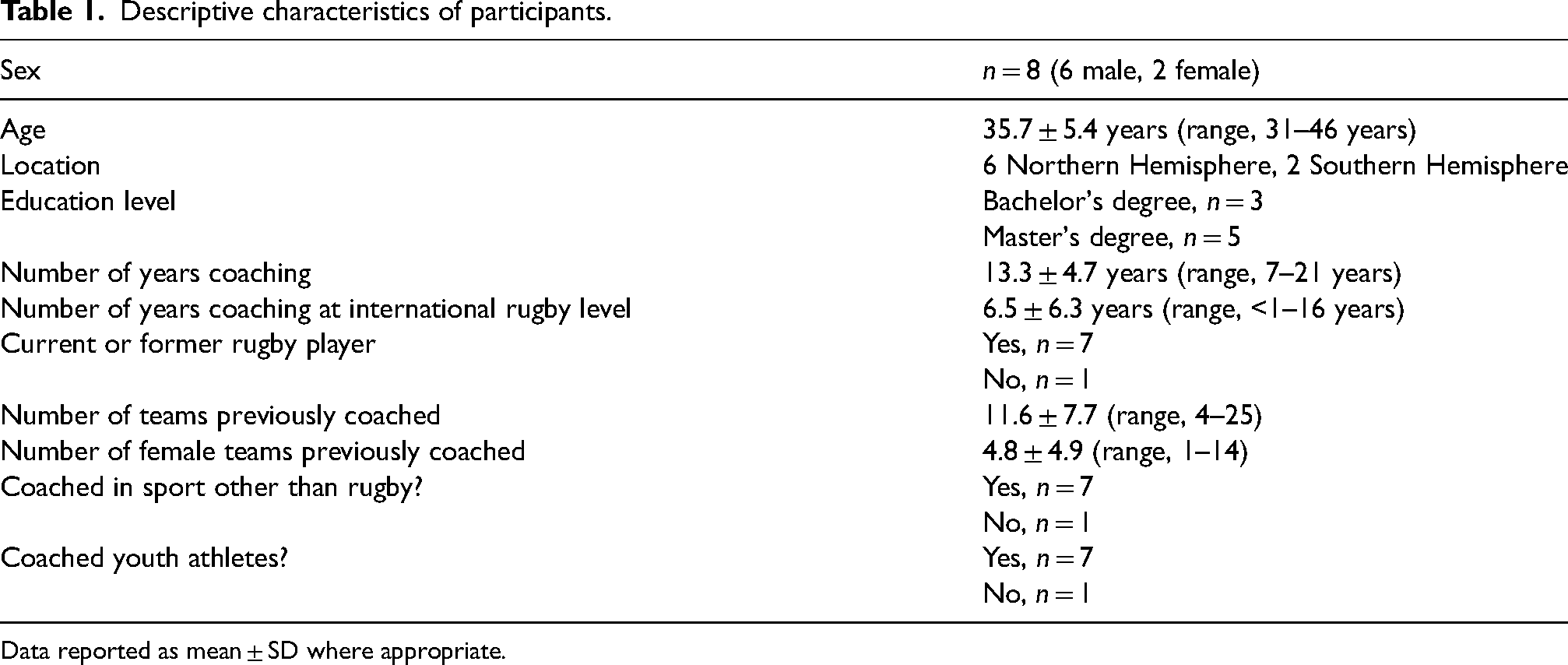
Data reported as mean ± SD where appropriate.
Procedures
Semi-structured interviews were utilised to allow for rich exploration of the key research questions, while also permitting flexibility to follow alternate lines of inquiry that emerged during the interviews. This process has been previously utilised to obtain qualitative data for the experiences of strength and conditioning coaches. 29 Prior to data gathering, a semi-structured interview guide was developed and informed by relevant literature and refined using pilot testing. Pilot interviews were conducted on two separate coaches (1 male, 1 female), which resulted in alterations to the interview guide to ensure alignment of questioning with study aims and objectives. These alterations consisted of modification of question structure and addition of probes to the interview guide. The interview guide consisted of introductory, central and closing questions, utilising a pliant approach to encourage meaningful discourse and ensure rich exploration of participant experiences. The interview guide addressed two distinct research questions; (i) Do coaches use differing physical preparation strategies between sexes, and what influences these differences, if any, and (ii) Do coaches have differing interpersonal interactions between male and female athletes? Due to the significant quantity of data gathered from these interviews, the themes relating to interpersonal interactions will be the subject of a separate report in order to enable appropriate depth of discussion for both research questions.
Detail-orientated probes were used to enhance the insights provided by the participants. 30 For example, these included ‘Can you explain exactly how you implemented that?’ or ‘Why did you do that?’. Clarification probes were used to further explore points that were unclear or vague. 31 These included using phrases such as ‘Just to be clear, can I confirm that when you say X you mean…?’. All interviews were conducted online via Zoom (Zoom, San Jose) by the lead author, with due consideration given to the methodological and epistemological issues that conducting interviews in this format presents. 32 Audio recordings were transcribed verbatim using Happyscribe transcription software (Happy Scribe, Dublin) and the transcripts were manually checked for accuracy by the lead author. Following transcription, all data were anonymised with a participant identification number assigned for the purpose of reporting. Interviews were conducted during the period April to October 2021 and lasted between 28:44 and 84:16 minutes (63:14 ± 17:59 minutes:seconds), resulting in 145 pages (72,294 words) of data (18.1 ± 4.3 pages per interview).
Data analysis
Data were analysed using reflexive thematic analysis utilising the framework provided by Braun and Clarke 33 to ensure appropriate application of thematic analysis. Thematic analysis is used to identify, organise, analyse and report qualitative data sets into concise patterns, offering insights into lived experiences, 34 and has been previously used to garner insights into experiences of strength and conditioning coaches.35,36
The first stage of analysis involved ensuring of accuracy of transcripts and immersion in the overall dataset, consisting of repeated listening to recordings and reading of transcripts, leading to the generation of ‘points of interest’ and potential codes and themes. Transcribed data were imported to NVivo Pro (QSR International, Doncaster) NVivo was used for the purpose of storing and organising the dataset, enabling the research process rather than being a key feature of the analysis per se. The NVivo software was not used to lead the analysis process, and consistent reading and re-reading of the original transcripts ensured the lead author did not become distant from the data or participants. 37 All data were again thoroughly examined, and codes assigned to lines and/or paragraphs relevant to the central research questions. All codes were then organised into themes and subthemes (as nodes). Reflexive thematic analysis was utilised to analyse the data and refine themes and subthemes. Following reflexive thematic analysis, and reflecting the sixth phase of the data analysis process, a consensus was agreed upon by the research team and a report of main findings was produced. This phase was recursive and given the reflexive nature of the process woven into the entire process of data analysis.
Trustworthiness
The application of thematic analysis in sport and exercises sciences has been previously criticised, 38 so it is imperative that best practices are observed to ensure high quality data are reported. Verification meetings of the research team resulted in the alteration, merging, and deletion of themes and subthemes. Verification methods are recommended to improve trustworthiness of data. 39 Authors listed at positions two (PH) and three (AMN) of the research team acted as ‘critical friends’ to the lead author and discussed similarities and differences in interpretation of the data, challenging the lead author until a consensus was agreed, with author four (BE) acting as a moderator where needed, leading to further refinement of themes and subthemes.
Reflexivity and positionality
The lead author utilised reflexivity throughout the research process which is described as ‘an act of self-reflection’ that considers how one's own opinions, values and actions shape how data is generated, analysed and interpreted.34,40 The following information provides context which may be used to assess credibility of this research and improve its transparency.
The primary research question was devised as part of a wider investigation by this research group into sex-related differences in athletic preparation. This area of applied research is largely understudied, particularly in the context of rugby union. The lead author has practical experience and interest in female-specific strength training, and understands the pertinent issues faced by practitioners in this domain. During the development of the interview guide, subsequent data collection and analysis, the lead author aimed to separate his own experience and beliefs from those held by the participants and to remain objective. The experience of the lead author allowed for a credibility with participants and facilitated the detection of lines of enquiry during the interview process that may otherwise be overlooked by an interviewer of differing background.
The positionality of the lead author may be viewed as a strength of this study. Positionality is aligned with reflexivity and understands that research is a process in which our own experiences shape and, dialectically, is shaped by the ongoing research process and its importance is increasingly recognised in research. 41 The background of the lead author offered him ‘insider’ status when speaking with participants and this is arguably invaluable to the conduct of the study.42,43 The participants recruited may be viewed as an unknown group, who are regarded as hard to reach. This status offered subcultural legitimacy and allowed for initial access as well as the development of trusting relationships between interviewer and interviewees.
Results and discussion
The aim of this study was to explore attitudes, beliefs and practices of strength and conditioning coaches in elite level (international) women's rugby union. The thematic analysis produced three higher-order themes under the central organising theme of “Differing Coaching Approaches to Male and Female Athletes” (Figure 1). These higher-order themes and subthemes are presented in detail with anonymised quotes included to support discussion points and explicate the participants’ experiences. Additional words are placed in parentheses to clarify intended meaning or provide further context where relevant. Punctuation was added to quotations to reduce ambiguity where required. Additional representative quotes for each subtheme are provided as Supplementary Information.
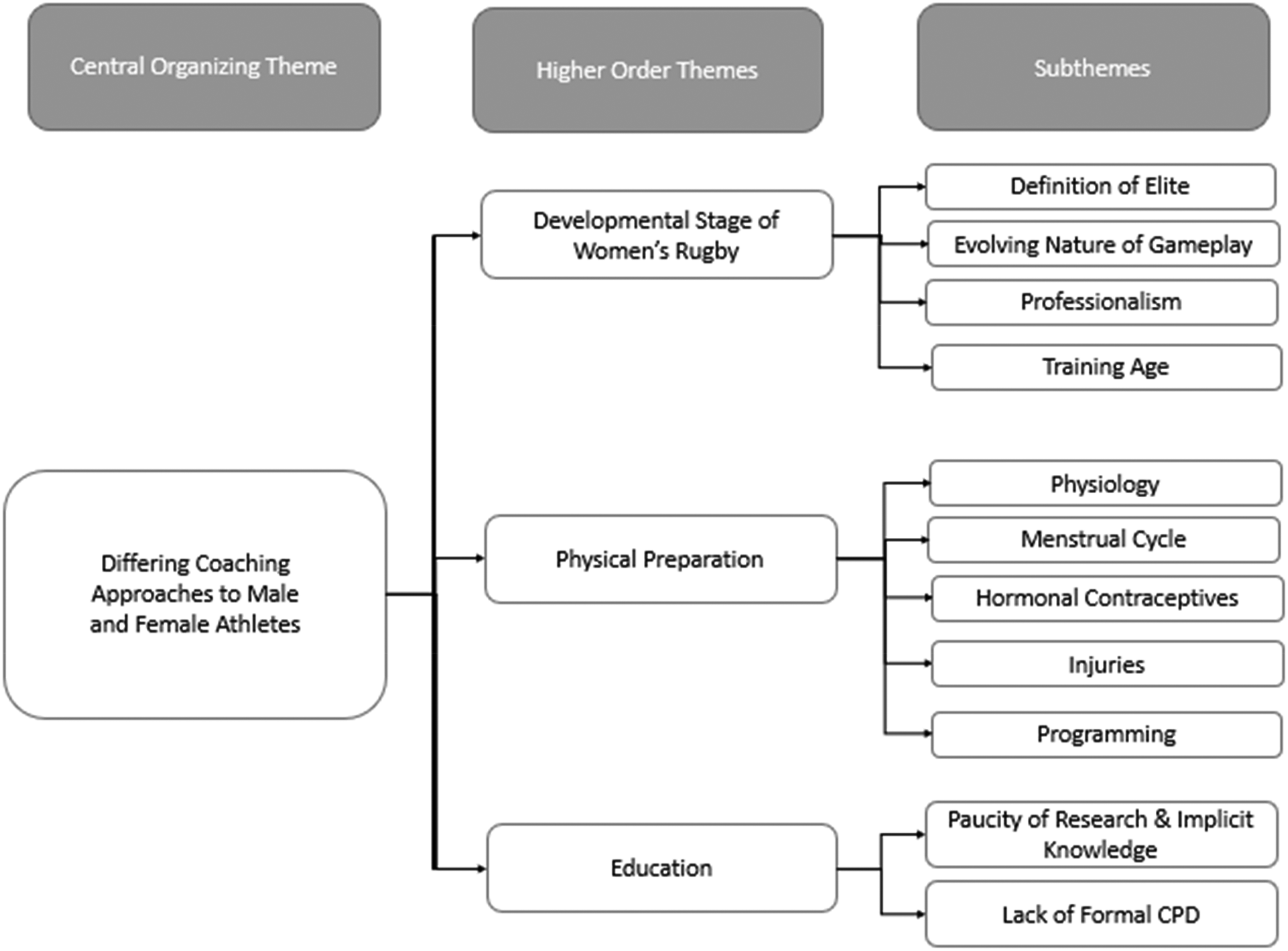
Schematic representation of central organising, higher order, and subthemes.
Developmental stage of women's rugby
Women's rugby is arguably in its infancy compared to the men's game (which turned professional in 1995), and is currently experiencing rapid growth in participation levels. 42 Although some nations have professionally contracted players, the majority of elite level female rugby players partake under amateur status. The data generated four distinct subthemes concerning the development stage of women's rugby; definition of elite, evolving nature of gameplay, professionalism, and training age.
Definition of elite
Overall, it was expressed that while the international arena represents the ‘elite’ of their sport, this definition holds differing connotations for males and females. So, elite in a male is very different to elite in a female in my world at the moment… this is an elite female team, but it’s an elite female team that’s amateur that’s only training twice a week. (Coach 2)
The coaches also reported females can rise to international level much quicker, with different training and developmental pathways compared to males: Whereas I found with senior females, just because they’ve probably got to that level without having had the years of experience in the gym or that big training age in resistance training. (Coach 2)
You might get a girl who’s playing at the top level who physically has no training age at all. (Coach 6)
The term ‘elite’ in a sporting context has been argued to often be applied erroneously, both across and within sports, and athletes should not be automatically be enthroned with elite status by merit of competing at an international level. 45 A more appropriate method of determining the status of an athlete should utilise objective markers of performance where possible compared to normative values, such as personal bests and physical performance characteristics. 46 However, this approach does not consider that elite athletes possess more than just higher than average physical attributes, with high levels of domain-specific skill execution also being imperative to performance. Physical testing batteries do not account for this. Taxonomies for classifying the status of athletes in sports science research have been posited for both physical 47 and skill-related attributes, 48 which may aid practitioners in conceptualising the current position their athletes reside upon the novice-elite spectrum, akin to employing a participant classification framework. 49
Evolving nature of gameplay
Four of the coaches (Coach 2, 3, 5, and 6) acknowledged the differing nature of gameplay between the sexes as a key difference which influenced their practices. The ongoing evolution of women's rugby was considered a key issue in the development of future physical preparation strategies. We’ve seen from 2014 to 2017 as there is only a three-year gap to [Women’s Rugby] World Cups, the game had changed dramatically and I would hazard a guess in 2022, we’re going to see that change again. We’re going to see a more evolved, more conditioned [female] athlete that will have a higher tolerance to training and just be more conditioned and stronger. (Coach 5)
There is a dearth of literature investigating the game demands of women's international rugby union. Because no study to date has directly compared international men's and women's teams using matched methodology, any interpretation of these data for between-sex differences is limited. Yet in other sports such as soccer where the women's game is more established, a divergence exists in which the men's game has higher running demands and intensities than their female counterparts.48,49 From the available evidence in rugby union, this divergence in the game demands between the men's and women's game also seems apparent, with the men's game having higher intensity running demands, with ‘worst case scenario’ total distances of approximately 154−184 m/min in men's international rugby compared to approximately 143−161 m/min in the women's game.52,53 The opinion that the women's game has intensified in recent years is also supported by empirical evidence showing an increase in sprinting and overall running demands in a five-year longitudinal study encompassing 2015−2019.3,54 Total average distance covered in a game ranged from 2410 m (front row) to 4605 m (outside back) in 2015 compared to 3240 m and 5283 m for front rows and outside backs, respectively in 2019.3,54
The growth of women's rugby was suggested to have led to changing physical characteristics of players and increased heterogeneity of physiques. You had quite a homogeneous body shape in women’s rugby… Now, I think there’s more girls playing rugby, which means you get more, you know, different shapes coming through, more suited. Plus the roles are more specialised. You know, the teams will go after teams at scrum time now. So, you know, you’ve got a big, particularly powerful pack where historically it would be like very homogenous body shape. (Coach 6)
Anthropometric profiles of international women's rugby players have significantly changed in recent years with athletes displaying lower levels of body fat, and greater levels of muscle mass. 54 Participation numbers in women's rugby are increasing year on year, so one would anticipate further diversification of anthropometric profiles with further increasing of muscle mass, which has been observed in other sports. 55
Professionalism
The paucity of professionalism in women's rugby was identified as a major confounding variable that influenced and constrained the practices of the coaches. But even if we were to look at the Six Nations and gather whatever data you want and you get an average of that. How true is that average when you’ve got a professional team, a semi-professional team and four amateurs? (Coach 2)
As previously noted, female rugby players are sometimes viewed as “not truly elite” compared to their male counterparts. The confounding variable of professionalism must be acknowledged in this respect. If coaches aim to strive towards parity between the relative athletic abilities of male and female athletes, this parity may not be achieved under amateur conditions where factors such as training opportunities, facilities, and multidisciplinary support teams are not equivalent to professional status. Reported differences in coaching practice undertaken with male and female rugby players could be argued to not be due to biological sex of the respective athletes and the associated differences in anatomy and physiology, but rather is a result of constraints and extraneous factors resultant from the absence of professionalism and resources for the women's game.
Five coaches (Coach 2, 3, 4, 7, and 8) viewed the lack of professional status and decentralisation of players as a significant barrier in their practice. We’re getting girls once a weekend every three weeks. There was only so much we can really tweak because I say back to it was a camp weekend, and it was probably just a state of where we were at really as well. So I wouldn’t say it gold standard practice. And that’s probably something that gets overlooked a little bit as well. You can’t do everything when you see them once a month. (Coach 8)
All coaches expressed the opinion that female rugby players generally have lower level of gym-based motor skill competence compared to their male counterparts, with Coach 8 stating ‘Some of our six nations camps were spent teaching some girls to lift… Some girls needed to come in and learn how to push, pull and squat’. The coaches’ opinion was also that, in general, male athletes are exposed to structured gym-based training earlier in their sporting careers through school- and academy-based programmes in adolescence, while female athletes generally do not get exposed to structured gym-based exercise until much later in their development, often not until adulthood.
Five coaches (Coach 3, 5, 6, 7, and 8) expressed views that female players have less training and athletic development opportunities available to them compared to their male counterparts due to differing structures and professionalism of the codes. The problem is I was getting some girls coming to me for [Country] International set up at 24/25 [years old], maybe even older, who had very little support or even the support they were getting at their clubs wasn't of a standard most 15 year old lads would have been getting just because of the support and the funding behind it. (Coach 8)
This lack of exposure may lead to weaknesses in fundamental athletic motor skill competencies that presents a barrier to long-term athletic development and success.6,7,56 Sex-based inequalities in sporting support structures has been posed as a significant barrier to both grassroot participation levels and progression of elite performers. 57 Improved support structures, aligned to those offered to male players may enhance the athletic abilities of female players, theoretically resulting in improved performances, self-efficacy and player retention.
Training age
While all coaches stated they do not differ their programming significantly due to sex-differences, it was universally acknowledged that any differences in their approach to physical preparation were generally due to a younger training age compared to males. It’s a massive difference [between males and females] in the sense of training age because they're not exposed to the level of training that you would need them to be. (Coach 3)
Notably, the coaches expressed the opinion that the majority of ‘elite’ female rugby players have a very low training age pertaining to specific aspects of athletic development (i.e. gym-based training) when entering the international set-up. This suggests that female rugby players are under-developed with respect to currently adopted long-term athlete development models, which advocate for structured strength and conditioning training during adolescence. 6
Lower technical ability due to lack of training age was expressed by six coaches (Coach 2, 3, 5, 6, 7, and 8) as a significant influence on their approach to physical preparation. They [have] got a very poor level, technically, especially in the gym, the level needed to be increased a lot to work safely also to perform and it’s a real problem for us. (Coach 7)
The technical and tactical characteristics and the physical characteristics are not quite as well emerged. You might get a girl who’s playing at the top level who physically has no training age at all’. (Coach 8)
These reported opinions again highlight the opinion that female athletes appear to not achieve sufficient stimulus from both their school-based physical education and club-based training to develop a high level of technical ability in the respective aspects of the athletic motor skills competency framework. 56
Physical preparation
Females may require a different approach to physical preparation due to anatomical and physiological differences compared to males. 54 Female athletes display differing injury risk profiles,59,60 and factors such as endocrinological differences due to the menstrual cycle and hormonal contraceptives may lead to augmented adaptive responses to training, presenting unique challenges and requirements when designing and implementing a physical preparation programme.14,61 Five subthemes are presented regarding physical preparation: physiology, menstrual cycle, hormonal contraceptives, injuries, and programming.
Physiology
Five coaches (Coach 3, 4, 5, 6, and 8) expressed the opinion that unique aspects of female physiology may lead to differences in adaptive responses to exercise training, and therefore influence the coaches’ practices. I guess if you look at physiology because of hormonal cycles, because of the nature of the muscle and everything else. Yes, women are going to respond differently…There may be some modalities of training that are more beneficial than others. (Coach 5).
The opinions highlighted potential inaccuracies in the coaches’ understanding of contemporary knowledge in female physiology as it pertains to neuromuscular adaptations to exercise training. Although it is theoretically possible that males and females respond differently to resistance exercise training due to divergent hormonal profiles, this is not yet supported by strong empirical evidence to date. When standardised for quantity of muscle mass at baseline before intervention, males and females do not display divergent outcomes for lower-body strength and hypertrophy in response to matched resistance exercise training interventions. 25 Augmenting programming based upon assumptions of divergent adaptive responses due to between-sex differences in anatomy and physiology is not presently evidence-based. Decisions regarding physical preparation should, therefore, be based on better established factors such as training status (age).
Menstrual cycle
The necessity to acknowledge the potential influence of the menstrual cycle was expressed by all coaches, with for example, Coach 5 stating; ‘Your gut says it does [menstrual cycle impact performance], your athlete’s gut says it does when you talk to them. They know their bodies themselves’, yet four coaches (Coach 1, 3, 5, and 8) noted that they do not actively monitor the phases of the menstrual cycle with their athletes. It’s hard to attribute anything to the menstrual cycle because I don’t know what their menstrual cycles are. (Coach 1)
Despite calls advocating for raised awareness and monitoring of menstrual dysfunction in athletes, 62 half of the coaches interviewed do not actively monitor menstrual function with their athletes. Monitoring of menstrual cycle status is a relatively cheap and efficient process that can identify individuals at risk of relative energy deficiency in sport (RED-S) and menstrual dysfunction, a pertinent risk factor for adverse health and performance outcomes in female athletes. 63 With the increasing availability of cost-free menstrual cycle tracking applications, menstrual cycle monitoring can arguably be seamlessly adopted in a performance environment.
While all coaches expressed the opinion that the menstrual cycle may impact performance, they varied in their views when describing the mechanism by which they believe this effect occurs, with Coach 2 stating ‘I definitely have some girls…when they’re in the follicular phase, they’re absolutely smashing it…when they’re coming close to their menstrual cycle [sic] they don’t feel as hot, they do take longer to recover… Half the time I don't know if it's a self-fulfilling prophecy of the fact that I've warned them on it [potential impact of menstrual cycle]’.
Again, these responses illustrate a potential lack of understanding of the current evidence regarding menstrual cycle phase and exercise performance. An apparent paradox is evident in the existing literature, wherein a consistent trend of qualitative and self-report data reports that female athletes experience a high prevalence of symptomology relating to the menstrual cycle and perceive it to negatively impact sporting performance,64,65 yet when examined objectively, menstrual cycle phase does not consistently affect acute performance indicators. 13 However, it must be noted that the majority of research conducted to date in this domain is of low quality, with small sample sizes and clear methodological flaws (i.e. lack of appropriate controls, and lack of blood sample confirmation of hormonal status) and thus limits firm conclusions.
All coaches reported that they have adjusted planned training or implemented coping strategies with an athlete due to menstrual cycle symptomology, but noted this is done on an individual basis reactively rather than proactively. We’ll just drop a little bit in terms of what you’re doing weights wise, or we’ll change the training session to allow you to complete it a bit more effectively, or we’d apply a bit more choice around what they're doing in certain elements of training… or we’d take away an appearance or something like that and allow them to sleep or do things like that. (Coach 6).
Based on current empirical evidence and best practice guidelines, adopting an individual approach to the development of menstrual cycle-related coping strategies is advisable. 12 There is large inter- and intra-individual variability observed in menstrual cycle-related symptomatology,20,65 therefore an individual, auto-regulated approach to symptom management is arguably superior to a generalised proactive strategy. A desire to implement so-called “phase-based training” was only expressed by Coach 1 who stated ‘I would love to do more phased based programming around each individual to maximize their maximize that training around the cycle… looking for ways to take advantage of the menstrual cycle and make it an ergogenic aid’.
As previously noted, there are currently no evidence-based guidelines or methods to prescribe training based on a specific phase of menstrual cycle. This coach displayed a belief that phase-based training would enable the coach to ‘take advantage’ of the menstrual cycle. Although this sentiment has a potential theoretical basis,
14
the empirical evidence for superior outcomes adopting such an approach is currently scant. Regardless, the reasons expressed for not using phase-based training were predominantly based upon logistical feasibility, with four coaches (Coach 2, 6, 7, and 8) believing that phase-based training to be unfeasible and impractical to implement in a team sport performance environment There’s a perfect way to do things and there’s a real way to do things…we can’t change the playing and training schedule based on someone’s cycle because you’ve got 40 girls, you’ve got 40 different cycles going on. You’ve got 40 different degrees of symptoms, you’ve got people on contraception, et cetera, things like that. (Coach 8)
Hormonal contraceptives
Two coaches (Coach 1 and 8) stated that hormonal contraceptive use may influence performance, but were ambivalent in their opinions, with Coach 1 stating ‘Whether or not they’re on contraceptives also like throws in a whole other mix’, whereas Coach 8 stated ‘From a theory standpoint, I'd say yes [hormonal contraceptive impact on performance], but I never got a chance to actually practically apply it and see’.
Hormonal contraceptive use does not appear to acutely affect athletic performance, 19 yet the majority of literature to date is again of low quality, with small sample sizes, lack of standardisation and inadequate familiarisation, among important issues that limit interpretation. There is equivocal evidence regarding the influence of hormonal contraceptive use on adaptive responses to resistance exercise training with the currently limited evidence base showing positive (molecular markers), 16 negative (hypertrophy, strength, inflammation)17,18,66 and neutral (hypertrophy, strength, power)15,57,67–71 outcomes relating to hormonal contraceptive users compared to non-users. Coaches should be aware that there are currently no evidence-based recommendations relating to adapting training approaches based on hormonal contraceptive use.
Six coaches (Coach 2, 3, 4, 5, 6, and 7) stated that they have never considered the potential effects of hormonal contraceptives on performance. I’ve got to hand up and say that is one of my blind spots [hormonal contraceptives]. (Coach 5)
I have no idea [regarding hormonal contraceptives]. (Coach 7)
Three coaches (Coach 1, 4, and 8) expressed opinions on potential health concerns relating to hormonal contraceptive use, with Coach 1 stating ‘from my understanding, from what I’ve read thus far is that using oral contraceptives create more harm than good’.
Given the high prevalence of hormonal contraceptive use in athletic populations and their sometimes associated negative side-effects,20–22,72,73 coaches or medical staff should monitor the prevalence of hormonal contraceptive use by their athletes and be cognisant of the potential influence of support staff, while also being aware of emerging evidence and best practice guidelines pertaining to hormonal contraceptive use within sport. The motivation for hormonal contraceptive use is personal and multi-faceted, and this must be considered when discussing hormonal contraceptive use with athletes. 72
Injuries
Six coaches (Coach 1, 2, 4, 6, 7, and 8) expressed the opinion that anatomical differences influence injury risk, with Coach 2 stating ‘The only difference [between males and females] is really that I have is, you know, there are certain parts of the female body, I think, that are more susceptible to injuries’, while Coach 6 specifically highlighted the quadriceps angle (Q-angle) as a significant risk factor, stating that ‘The large Q-angle and the wider pelvis in tall female athletes does represent a genuine ACL [anterior cruciate ligament] risk’.
The opinion expressed that females display differing injury profiles and are at higher risk of knee injuries, specifically anterior cruciate ligament injuries, is supported by the literature. 24 However, the attribution of increase knee injury risk to Q-angle by several coaches displays a potential lack of understanding of current evidence related to female sports injury risk. When standardised for baseline height, males and females display similar Q-angles 74 and static measures of Q-angle have questionable clinical significance. 75
Programming
Overall, the coaches interviewed in the present study do not approach physical preparation differently for female athletes compared to males. I wouldn’t do anything different. Again, it’s just more your expectations are different…we can still do the same program and still do the same running. (Coach 3)
Based on the current, albeit limited evidence base, there is not yet a strong rationale for sex-specific differences in programming. Females respond similarly to males in strength and hypertrophy adaptions following matched resistance training protocols. 25 A sexual dimorphism does appear to exist in acute fatigability during high intensity performance bouts, yet this has largely been observed in isometric based tasks rather than isotonic contractions. 23 Although this sexual dimorphism is observed in acute fatigue during isometric contractions, the same divergence is not observed in recoverability of neuromuscular function following dynamic and eccentric focused resistance exercise training sessions.76–78 Considering this, it would be ill-advised to train females differently to males based primarily on potential differences in fatiguability.
Regarding exercise selection, there is no strong evidence-based rationale for differing exercise selection for female athletes, and unsurprisingly all coaches stated that their exercise selections do not differ between players due to sex, with, for example, Coach 4 stating ‘there’s no difference in that [exercise selection]’.
Given the increased risk of anterior cruciate injury present in females, 58 it may be prudent to ensure female athletes are following an appropriate neuromuscular training programmes, incorporating lower body strengthening exercises with a specific focus landing stabilisation, which has been consistently shown to reduce anterior cruciate injury risk in female athletes. 79 However, the same advice would be pertinent for male athletes also.
Education
Given that sports science and elite sport is such a dynamic and evolving domain, it is imperative to understand what resources and strategies practitioners employ to ensure appropriate continued professional development (CPD). Two subthemes were identified, namely lack of formal CPD, and paucity of research and implicit knowledge.
Lack of formal CPD
Coaches noted there is a lack of formal educational programmes specifically regarding physical preparation of female athletes provided by their respective unions. Five coaches (Coach 1, 3, 4, 5, and 7) rely primarily on non-peer-review resources, with colleagues being used as the main source of education, as typified by Coach 5 stating ‘In short, no [education provided by union]. It’s been a reasonably steep learning curve, I would say, from some of our more qualified, more experienced male coaches’. Coach 4 displayed aversion towards academic research, stating ‘What you can’t quantify, can’t be published. And that’s a huge issue. And where my issue with academia is, it is now how many papers can I publish versus what problems am I trying to solve?… there’s not a lot of ground-breaking things have come out, so it’s like I think it needs to go…I then go into talking to coaches and then watching presentations…[the presenter] provides like real life practical [information]. It doesn’t matter about the study design. Hey, I did this, I did that. I don’t care if it’s statistically significant. My athletes got better. They improved on the field. I don’t I don’t need stats to tell me that’.
The coaches displayed a clear desire to further understand the requirements of the female athlete, but most noted a clear lack of opportunity for CPD on this specific topic within their union. Social media and podcasts were viewed as a key resource for on-going professional development. And then obviously in today’s world, like social media and podcasts, and getting information out that way, I think right now that’s kind of leading, leading the front on this topic anyways. (Coach 1)
Although podcasts can be a valuable source of information, podcasts are unregulated non-peer-reviewed platforms and the accuracy of information disseminated cannot be ensured. However, the use of peer-reviewed literature as a source of CPD was being utilised by four coaches (Coach 2, 3, 7, and 8), with Coach 2 stating ‘Google Scholar a lot [for CPD]’, and Coach 7 stating ‘I’m often going on PubMed [for CPD]’. The perceived lack of CPD offered, coupled with lack of utilising peer-reviewed sources suggests the respective unions engaging in formal educational opportunities, perhaps with innovative CPD offerings, for their practitioners would be advisable in this context.
Paucity of research and implicit knowledge
The majority of coaches in this study arguably present an androcentric view of beliefs and attitudes towards conditioning practices in women's rugby union. In other words, adopting practices from, and consistent with comparisons to, the men's game and male athletes. This perspective is most likely attributable to the viewpoint expressed by coaches relating to the lack of research in women's rugby. A prevailing opinion amongst the coaches was that a dearth of empirical evidence exists concerning the physical preparation of female rugby players, specifically concerning normative data regarding game demands and physical characteristics, with Coach 3 stating; ‘There’s not enough, evidence, or studies done on female sports’, and Coach 6 describing; ‘Relative difference between positional characteristics is also something we don’t understand’. All of the coaches expressed the opinion that there is little available research on females that can inform practitioners. This viewpoint does not accurately reflect the body of evidence. While females are underrepresented in sports science research, they still account for approximately one-third of sports science participants,80,81 but it must be noted that within studies relating to strength and hypertrophy outcomes or in highly-trained individuals, female representation is arguably lower. Research regarding best practices towards female athletes is constantly evolving and practitioners should be offered platforms to aid them in keeping up to date with, and correctly interpreting such information.
Study strengths and limitations
These coaches provided their insight and experience of sex-specific differences, albeit evidently few, in their approaches to physical preparation. The position held, and experience of the coaches is a clear strength of this study, although, of course, employment status is not necessarily a good indicator of expertise or knowledge. Nonetheless, to the authors’ knowledge, this is the first study to investigate attitudes, beliefs, and practices in elite-level strength coaches regarding sex-specific differences, and as such, illustrates the current understanding and opinions of practitioners in international level women’s rugby union. The qualitative methods employed in this study allowed for flexible analysis of rich information in a systematic and precise way.
Although the elite status of the coaches is considered as a strength of this study, it could also be viewed as a limitation. The homogeneity in status of the coaches should lead to caution of interpretation and application of results to practitioners in rugby as a whole. The viewpoints expressed may not be similar to those held by sub-elite coaches, or those working with amateur athletic populations or within other sports. The merit of occupying a senior position with an elite team should not be assumed de facto to reflect high levels of competency and knowledge. Also, three-quarters of coaches interviewed were male and while this is representative of the current landscape at the international level, it may be viewed as a potentially biased viewpoint given the topic under investigation.
Conclusions
This study provides important insights and contextual evidence to the understanding of sex-specific considerations in the physical preparation of female rugby players from the perspective of elite-level strength coaches, which to date has not been explored.
Women's rugby was reported by the coaches to be of a lower standard compared to the men's game in terms of ‘elite’ status and professionalism. Coaches highlighted that international female players often presented with low technical ability and training age in gym-based movements due to lack of systematic support within their performance environment and in developmental pathways. The improving standard of international women's rugby was acknowledged and with this in mind, coaches should be cognisant of current longitudinal trends suggesting increasing running demands and increasing heterogeneity of anthropometric characteristics. Women's rugby is currently experiencing significant growth and it is imperative that unions ensure appropriate support systems and infrastructures are available for their growing female demographic to capitalise on this rapid expansion.
Overall, while coaches expressed there are some female-specific considerations they are cognisant of regarding physical preparation, such as individual management of menstrual cycle symptoms, there was no meaningful difference in how they approached the physical preparation of females compared to males in terms of training methodologies. Differences in approaches to physical preparations are primarily driven by lower training age, and poorer technical ability of female athletes compared to males rather than distinct anatomical or physiological differences, a potential legacy of under-resourced developmental pathways, and support structures for female rugby players.
There were clear gaps in knowledge exhibited by the coaches regarding both the menstrual cycle and hormonal contraceptives. Coaches should be aware of the potential influences of the menstrual cycle and hormonal contraceptive use, and it would be advisable to implement appropriate monitoring systems pertaining to these aspects of female health and performance. Currently, there are no evidence-based guidelines which advocate for differing training methodology for female athletes, and it would be prudent for coaches to follow their current protocols but to be aware of the evolving research in this domain.
Coaches clearly strive to utilise an evidence-based approach where and when possible, but reported often lacking the necessary supports or information to do so. Informal resources (i.e. social media and podcasts) and colleagues were identified as the primary sources of education that the coaches utilised. There was a perception amongst the coaches that empirical data in elite female athletes is practically non-existent. This misconception should be addressed in this population with the coaches also being encouraged to draw inferences from data in other elite female sports and populations, where appropriate. Rugby unions would be prudent to audit their current support systems for practitioner CPD and implement resources to address identified gaps in coach knowledge, specifically regarding female-specific considerations, that is menstrual cycle and hormonal contraceptive use. A women's rugby specific online educational resource, for example, a podcast series delivering high-quality educational content, delivered from domain experts may be an efficient and cost-effective strategy which employs a platform that is already accepted and utilised by practitioners.
Supplemental Material
sj-pdf-1-spo-10.1177_17479541231169371 - Supplemental material for ‘There’s a perfect way to do things, and there’s a real way to do things’: Attitudes, beliefs and practices of strength and conditioning coaches in elite international women's rugby union
Supplemental material, sj-pdf-1-spo-10.1177_17479541231169371 for ‘There’s a perfect way to do things, and there’s a real way to do things’: Attitudes, beliefs and practices of strength and conditioning coaches in elite international women's rugby union by David Nolan, Peter Horgan, Aine MacNamara and Brendan Egan in International Journal of Sports Science & Coaching
Footnotes
Authors’ contributions
The study was conceived and designed by DN, PH, AMN, and BE. Data were collected by DN. Data were analysed by DN, PH, AMN, and BE. Data interpretation and manuscript preparation were undertaken by DN, PH, AMN, and BE. All authors approved the final written version.
Declaration of conflicting interests
The authors have no direct financial conflicts to declare. The lead author engages in extracurricular activities outside of his academic position that could be construed as a conflict of interest, namely hosting of a podcast and participation in delivery of educational courses.
Funding
The author(s) disclosed receipt of the following financial support for the research, authorship, and/or publication of this article: This work was funded through an Irish Research Council Employment-based Postgraduate Programme (Grant number EBPPG/2020/263) awarded to DN and BE. The Irish Research Council is an associated agency of the Department of Education and Skills and operates under the aegis of the Higher Education Authority of Ireland. The funders had no role in the design of the study; in the collection, analyses, or interpretation of data; in the writing of the manuscript, or in the decision to publish the results.

Supplemental material
Supplemental material for this article is available online.
References
Supplementary Material
Please find the following supplemental material available below.
For Open Access articles published under a Creative Commons License, all supplemental material carries the same license as the article it is associated with.
For non-Open Access articles published, all supplemental material carries a non-exclusive license, and permission requests for re-use of supplemental material or any part of supplemental material shall be sent directly to the copyright owner as specified in the copyright notice associated with the article.
