



Abstract
Objectives
The purpose of the present study was to examine the direct and indirect effects of coach transformational leadership (TL) on the current lives of socio-economically disadvantaged individuals within a sport-based education programme.
Design
Cross-sectional.
Methods
159 participants completed questionnaires on the perceptions of their lead coaches’ TL, perceived basic need satisfaction (autonomy, competence, relatedness) in relation to programme attendance, and feelings of resilience and life-satisfaction in their current life.
Results
PROCESS analysis revealed that all differentiated TL behaviours (but high-performance expectations) had a positive indirect effect on outcomes (resilience and life-satisfaction) via competence and a negative indirect effect on outcomes via relatedness. High-performance expectations demonstrated a direct effect on life satisfaction.
Conclusion
The results demonstrate how distinct coach transformational behaviours impact differently on the lives of disadvantaged individuals within a sports-based education programme. The differentiated conceptualisation of TL revealed nuanced results, furthering our understanding of how each TL interacts with the three basic psychological needs. Finally, our results demonstrate the significance competence may hold in transferring the effect of different transformational behaviours onto the everyday lives of disadvantaged individuals.
Introduction
Social and economic inequality continues to cause concern. 1 A growing number of individuals within Western societies, often referred to as socio-economically disadvantaged, face a multitude of issues such as lack of income, difficulties accessing education, poor health status and unemployment.2,3 Currently, the socio-economic inequalities derived from the COVID-19 4 pandemic and cost of living crisis 5 are causing disproportionate adversity among disadvantaged populations, whilst homelessness is on the rise in developed countries like the United States, and United Kingdom. 6 Moreover, socio-economically disadvantaged individuals often encounter challenging setbacks, find it difficult to extend friendship networks and suffer from a range of mental health issues. 7 Given these issues it is important to explore the potential contexts and mechanisms which may help disadvantaged individuals overcome adversities and flourish.
Confirmatory factor analysis (n = 159).

Sport is a context that is receiving increasing recognition for its role in facilitating developmental experiences for disadvantaged individuals.8,9 Indeed, several positive outcomes have been attributed to sports participation, including personal and social development, 10 motivation, 11 self-reliance and discipline, 12 and emotional control. 13 Given the potential and popularity of sport to promote positive developmental experiences, 14 a number of organised sports-based education programmes have been established. The result is a rapidly growing Sport for Development and Peace (SDP) programme movement within disadvantaged regions. 15 These programmes typically use the appeal of sport as an initial attraction, but also deliver educational support and provide a platform for skills to be transferred into other areas of participants’ lives. For example, Cowan and colleagues 16 explored one such programme in the United Kingdom for unemployed youth which aimed to build confidence and skills towards employment. The programme provided 13 weeks of practical soccer sessions which were focused on providing specific developmental opportunities (e.g., communication, teamwork) alongside additional employability support. The results from this study discuss how coach-created motivational climates may foster or hinder the development of life-skills among a disadvantaged population. 16
Despite the benefits of attending these programmes, mere participation is insufficient for the facilitation of positive outcomes. In most cases, it is the role of those within leadership positions (i.e., coaches, mentors) who help shape positive sport experiences and help ensure that positive outcomes materialise. 17 For instance, coaches who provide autonomy, develop supportive relationships and role model appropriate behaviour contribute to the personal development of disadvantaged individuals within their programme. 16 Yet, with the exception of a few researchers (see.11,18), these explorations of coaching behaviour have been qualitative, with limited understanding of the mechanisms which predict development in large samples. Additionally, studies have predominantly examined the role of the coach within various disadvantaged youth settings.16,19 To the authors’ knowledge, no study has attempted to examine the effects of coach leadership behaviours on the personal development of adult participants within a sports-based education programme. Arguably, these programmes pertain greater meaning to adult populations, as youth participants may still have the structure of education and the obligatory care of adult guardians whereas sport may provide the structure and escape from isolation that is not afforded to adults who experience hardship. The present study, therefore, aimed to examine specific coach behaviours and mechanisms which contribute towards the personal development of disadvantaged adults.
Conceptualising coach transformational leadership
Coach behaviours hold a critical role in shaping the sports participation experience. 20 Yet, there is limited understanding of which distinct behaviours lead to positive development with in sports-based programmes. Transformational Leadership (TL) is a useful theory to analyse coaching practice (e.g.,21–23). TL is often described as a behavioural approach to leadership (although this has recently been questioned in sport, see 23 ) whereby transformational leaders are proposed to inspire followers via personal and emotional appeals to motivate followers to surpass expectations. 24 TL is likely to be a relevant framework for coaching disadvantaged populations, given its emphasis on articulating positive and meaningful visions of the future, challenging old actions with new methods, while providing individual support.23,25
When conceptualising TL, researchers adopt a global model (all transformational behaviours combined to form a single construct 24 ) or a differentiated approach (each construct of TL examined as a distinct behaviour26, 27 ). The global approach has been criticised for oversimplifying TL's diverse range of behaviours, whereas a differentiated conceptualisation of TL enables a nuanced assessment of the distinct leadership behaviours. 23 Callow et al. 27 validated a differentiated index measuring TL in sport, outlining six transformational behaviours: Individual consideration, displaying respect for followers and showing concern for their personal feelings and needs; Inspirational motivation, inspiring others with their positive views of the future; Intellectual stimulation, influencing followers to challenge approaches they use and to re-think how they work or perform; Fostering acceptance of group goals promoting an environment where individuals work together towards the completion of a task or common goal; High performance expectations, conveying their expectations of excellence and performance on the behalf of their followers and Appropriate role modelling, showing an exemplary behaviour and setting an example with consistent values for others to follow. This index also contains one transactional behaviour, contingent reward, where leaders provide positive reinforcement in return for desired follower behaviour and performance.
Growing interest into TL may be due to its positive associations with well-being and performance outcomes previously found in education, 28 military, 29 and business contexts. 30 In sport, TL behaviours have been found to positively influence participant effort, 25 cohesion, 27 well-being and basic need satisfaction, 31 and athlete performance. 32 Albeit no research has examined TL within sports-based education programmes for disadvantaged individuals. This is somewhat surprising considering TL's focus on inspiring and empowering followers whilst fostering more optimistic views of the future. 23 In doing so, transformational leaders may inspire disadvantaged sport participants who often deal with adversity. 33 Indeed, within disadvantaged populations, suitable role models are scarcely found, 34 even though these individuals may seek leaders to aspire to and to help ease suffering attributed to their socio-economic status. 34 Transformational leaders may inspire personal development within disadvantaged populations to help these individuals endure the difficulties that they face via supporting their psychological needs. Indeed, in the current study, we propose that within a sport-based education programme, coach TL will indirectly affect disadvantaged individuals lives via the satisfaction of their basic needs.31,35
Transformational leadership, resilience and life satisfaction
Resilience is an outcome of significance within disadvantaged individuals, as it is defined as the ability to endure prolonged stressful situations, or to bounce back from adversity. 36 In this context, adversity may include drug issues, homelessness or mental health issues and there is strong evidence to suggest disadvantaged individuals’ resilience is predictive of their future life outcomes. For instance, enhanced resilience can have positive implications for disadvantaged individuals such as greater problem-solving skills, emotional regulation, stress management and coping with adverse events. 37 Bass 35 outlined that the central tenants of TL could augment greater resilience amongst subordinates. Given that TL has been shown to be predict resilience in other contexts (i.e., miliary, 29 employment, 38 university students 39 ), we believe that enhancements in resilience will be a consequence of following a transformational leader within disadvantaged populations. Recently, trauma survivors from disadvantaged populations have stated that their resilience has been enhanced through participating in SDP programmes.10,40 While coaches were identified as important components of the sport programming in both studies, the link between coach behaviour and enhancements in resilience was not investigated. It is therefore important to test the relationship between coach TL and resilience given the importance of enduring hardship within this context.23,29
Alongside resilience, it's important to consider the way individuals feel about their own lives and how satisfied they are with their current situation. Indeed, disadvantaged individuals are likely to experience low levels of life satisfaction and a sense of helplessness regarding their lives. 41 To combat this, the intervention of a transformational leader could make a positive impact in environments where role models and parents are often absent. Specifically, TL is centred around providing a positive vision of the future and given TL's capacity for facilitating positive psychological outcomes such as well-being, 31 satisfaction within the workplace, 42 and satisfaction in the home environment, 43 we would expect that transformational leaders would have a positive impact upon general life satisfaction. In support of this, transformational parents have been observed to increase life satisfaction and other positive health behaviours in adolescence. 43 For these reasons, the current investigation will seek to examine the relationship between TL and satisfaction with current life within a sport programme for disadvantaged individuals.
Transformational leadership and need satisfaction
In recent years, authors have called for greater explanation of the processes involved in TL. 23 As such, an exploration of mechanisms that cultivate a link between TL and the psychological development of disadvantaged populations is also needed. Basic need satisfaction, a sub-theory of self-determination theory (SDT 35 ), maintains that the nurturing of human consciousness, motivation and well-being is dependent on the satisfaction of three universal psychological needs; autonomy, competence, and relatedness. Autonomy relates to the need to make decisions and be the origin of one's own behaviour. Competence refers to one's sense of achievement, effectiveness, and purpose, while relatedness encompasses feelings of care and acceptance, whilst being securely attached to others. 35 Previous sports-based research has found that the satisfaction of the three basic needs is related to well-being, 31 prosocial behaviour, 44 mental toughness, 45 and resilience. 46
Basic need satisfaction is proposed to be a useful theoretical framework for understanding the influences of TL. 31 Indeed, research utilising global conceptualisations of TL within work-based environments have revealed that transformational behaviours satisfy followers’ needs for autonomy, competence, and relatedness which, in turn, were related to occupational self-efficacy, 47 and work engagement and performance. 48 In a sport context with a sample of floorball players the relationship between TL and well-being was mediated by need satisfaction. 31 These studies suggest that basic need satisfaction is a vehicle via which TL may have an impact on follower outcomes. Despite this, the mediating role of need satisfaction is still in its infancy within TL research thus warrants greater exploration. Stenling and Tavelin 31 used a global conceptualisation of TL behaviour which prevented the assessment of each TL behaviour and its relationship with needs satisfaction and well-being (see for example,23, 25 ). For instance, a participant's need for autonomy may be fulfilled by a coach's use of fostering acceptance of group goals and promoting an environment whereby individuals can make choices to achieve shared or common goals. Intellectual stimulation may also be positively associated with autonomy given the emphasis on encouraging followers to come up with their own solutions to problems. 31 The need for competence may be satisfied by a transformational coach's use high performance expectations,24,49 by not only conveying that success is expected and achievable but by augmenting Pygmalion effects to inspire greater self-confidence and competence. 29 Finally, coaches who adopt individual consideration and appropriate role modelling within their coaching style may satisfy an individual's need for relatedness, 31 while having a suitable role model to follow may be an effective tool to satisfy competence during vicarious experiences. 50 Clearly, it would not be expected that all TL behaviours would impact on need satisfaction in the same way, as such the utilisation of a differentiated analysis of TL will shed light upon the proposed distinct impacts of TL on basic psychological needs.
The present study
The present study aimed to examine the mechanisms which may lead to the personal development of disadvantaged adults attending a sport and education programme. Specifically, we aimed to examine the indirect effects of distinct transformational behaviours on resilience and life satisfaction via the satisfaction of the three basic psychological needs. Previous research indicates that coach TL may result in the satisfaction of all three basic psychological needs. 31 Yet, to our knowledge there is no research that examines the impact of coach TL on followers when they are not engaged with the transformational leader (i.e., the impact of a transformational coach on the everyday life of an athlete). In accordance with existing differentiated conceptualisations,21,23 we make several hypothesised arguments. Given intellectual stimulation is defined as encouraging followers to come up with their own solutions to problems,24,49 we hypothesised that intellectual stimulation would positively predict resilience via autonomy. This assumes that followers will independently address problems with heuristically acquired solutions, therefore becoming more independent to resolve issues and therefore resilient. 29 It is theorised that transformational leaders motivate individuals to persist when conditions are stressful and difficult. 49 To this end, we hypothesised that inspirational motivation would be positively related to resilience via competence, as leaders who motivate followers instil confidence and resilience as results have demonstrated in previous research. 29 As TL places a strong emphasis on cohesion and social interconnectedness, 27 it is hypothesised that the socio-emotional constructs of TL (appropriate role modelling, individual consideration, fostering acceptance of group goals) would positively predict life satisfaction via relatedness. This hypothesis is based upon an individual's need for positive social networks and role models, if they are secured then life satisfaction is expected to increase. 27 Finally, high-performance expectations were anticipated to positively predict life satisfaction via competence by augmenting Pygmalion effects (where higher expectation leads to greater effort and performance) increasing competence,51,52 and in turn, life satisfaction is argued to increase the more competent an individual perceives they may be. Therefore, the current study tested the hypothesised indirect effects of TL's distinct behaviours within a disadvantaged population.
Methods
Participants and context
The sample consisted of 159 adult participants (male = 151, female = 8) of a national sports-based education programme (Mage = 25.57, SD = 8.83, range 16–60). This programme engages with disadvantaged adults and aims to provide positive personal development via weekly drop-in sport sessions across four UK cities. Typical sessions involve round robin soccer tournaments whereby participants play competitive games with other attendees, while regular attendees have the opportunity to play in national soccer competitions. 7.3% of the sample stated that they were currently homeless, while 6.7% stated “other” as their current living situation. 18% of participants were in full-time employment with 13% in full-time education. 12% were in paid part-time employment while 35% of participants were unemployed, and a further 12.3% were not working due to sickness or a disability. The remaining 7% reported that they were currently in volunteer work.
Data was gathered from 7 session venues across the four cities and sessions were delivered by 11 coaches across these venues. The participants had been attending the programmes for at least one month prior to data collection. One month was deemed enough time for the participants to experience the programmes and provide informed perceptions of their coaches’ leadership (mean months attending = 25.5). Participants stated that they encountered the programmes through friends (42%) or referral by other charities (31%) and attribute their attendance to the enjoyment of soccer (40%), to improve fitness and well-being (17%) and to make friends (9%). Participants also reported overcoming mental health issues (6%) and drug addictions (3%) as reasons for regular attendance.
Measures
Transformational leadership behaviours
The differentiated transformational leadership inventory (DTLI 27 ) was used to assess participants’ perceptions of their coaches’ TL behaviours. The six transformational behaviours of the DTLI were used to create a 23-item differentiated index. These behaviours include; Individual consideration (e.g., my coach treats each team member as an individual). Inspirational Motivation (e.g., my coach talks in a way that makes me believe I can succeed); Intellectual Stimulation (e.g., my coach gets me to rethink how I do things); High Performance Expectations (e.g., my coach expects a lot from us); Fostering Acceptance of Group Goals (e.g., my coach encourages athletes to be team players); and Appropriate Role Model (e.g., my coach leads by example). Each item was measured by a five-point Likert scale anchored by 1 (not at all) and 5 (all the time). Previous research has provided evidence for the scales factorial and discriminant validity (e.g.,)23,27, while other studies have demonstrated strong internal consistency with Cronbach's alpha results surpassing criterion (α = .70) for use within the psychological domain (Smith et al., 2011). In the current study, a Confirmatory Factor Analysis (CFA) demonstrated the six-factor scales’ goodness of fit to the data, S-B χ2 (769) = 323, p < .01; RMSEA = .09; CFI = .93; TLI = .92; SRMR = .63.
Psychological need satisfaction
Six items of the previous 9-item basic need satisfaction in relationship scale (BNS-RS 53 ) were adapted for use within the sport programmes context. Participants were asked to rate the extent to which their needs were satisfied during the programme by responding 1 (no not at all) to 7 (very true). The scale measures autonomy; “when I attend the programme… I feel free to be who I am”, competence; “when I attend the programme… I feel like a competent person”, and relatedness; “When I attend the programme… I feel cared about”. Previous coaching research has reported the scales sound psychometric properties, with Cronbach's alpha scores ranging from 0.66–0.92. 54 After conducting a CFA, three poorly performing items were removed and after the removal of three poorly performing items, the 6 item BNS-RS demonstrated acceptable fit to our model, S-B χ2 (27.13) = 9, p < .001; RMSEA = .11; CFI = .93; TLI = .89; SRMR = .05.
Resilience
The brief resilience scale (BRS) is based on the dictionary definition of resilience, which is “to bounce or spring back.” 36 Items from this scale were measured between 1 (strongly disagree) to 5 (strongly agree) and was used to measure the programme participants’ feelings of resilience throughout their everyday life. The scale featured three positively worded items (e.g., “I tend to bounce back quickly after hard times”) and three negatively worded items which were reverse scored (e.g., “I have a hard time making it through stressful events”). A review of resilience measures supported the scale's construct validity, test reliability and interpretability 55 and it has also been a preferred measure of resilience within sport. 56 Reported Cronbach's alpha report to range between .80-.91, with support for the scales convergent and predictive validity. 36 Following a Confirmatory Factor Analysis (CFA), two poorly performing item were deleted. The scale then demonstrated goodness of fit to the data S-B χ2 (2.16) = 2, p < .05; RMSEA = .02; CFI = 1.00; TLI = .99; SRMR = .03.
Life satisfaction
Life satisfaction was measured using the five-item Satisfaction with Life Scale. 57 This scale is anchored between 1 (strongly disagree) and 5 (strongly agree) and was used to measure the participants’ perceptions of satisfaction in their recent life (e.g., “In most ways my life is close to my ideal”). Research has shown the scales acceptable internal consistency α = 0.82- 0.87. 57 Our CFA revealed a good fit to the data, S-B χ2 (4.68) = 5, p < .05; RMSEA = .00; CFI = 1.00; TLI = .1.00; SRMR = .01.
Procedure
Ethical approval was granted from the University's ethics committee and consent was obtained from the programme coordinators before recruiting and obtaining participant's informed consent. Consenting participants were then asked to answer each question as honestly as possible, and informed that all their responses would remain confidential and non-participation in the research would not impact upon their future involvement in the programme. All participants were verbally asked about their levels of literacy skills by the first author, and some were aided to complete the questionnaires. All data were collected either during session registration, intermission, at the end of a training session or at a national tournament that brought together teams from various session venues.
Data analysis
We examined the indirect effects of TL on our outcome variables via need satisfaction using PROCESS. 58 PROCESS provides the total indirect effect and the separate indirect effects through each mediator while controlling for effects of subsequent mediators via bootstrapping. PROCESS also allowed us to control for potential cluster effects (in our case multiple coaches) accounting for the nested nature of the data. 12 separate PROCESS models were run to examine the indirect effects of the six TL behaviours (independent variables) on resilience and life satisfaction (dependent variables) via the three basic needs (mediators) using multiple mediation analysis. This was to understand which basic psychological need played a more prevalent role in the relationship between TL and the psychological outcomes of the disadvantaged sport participants. The analysis was conducted with 10,000 bootstrap samples. Lower- and upper-bound 95% confidence intervals that do not involve zero demonstrate results of significance at the .05 level.
Results
Descriptives
Means, standard deviations, and intercorrelations among variables are displayed in Table 2. Results demonstrate that all coach TL behaviours apart from High Performance Expectations were significantly correlated to all three basic psychological needs; competence (r = .20 to .37, p < .01), relatedness (r = .23. to .32, p < .01) and autonomy (r = .27 to .41, p < .01). Competence was significantly correlated with resilience (r = .16 p < .05). High Performance Expectations was the only TL behaviour to significantly correlate with life satisfaction (r = .23, p < .01). Participant life satisfaction was significantly correlated to resilience (r = .45 p < .05).
Descriptive statistics and intercorrelations of model variables (N = 159).
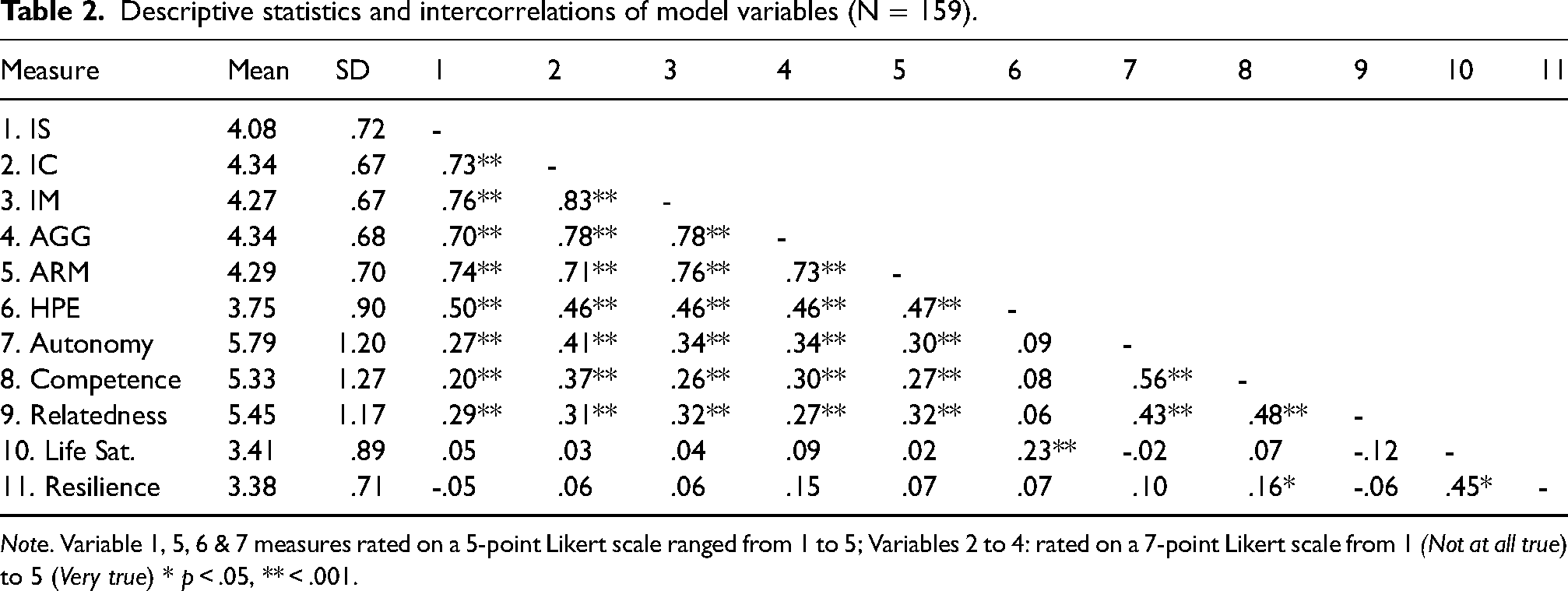
Note. Variable 1, 5, 6 & 7 measures rated on a 5-point Likert scale ranged from 1 to 5; Variables 2 to 4: rated on a 7-point Likert scale from 1 (Not at all true) to 5 (Very true) * p < .05, ** < .001.
Regression analysis
Table 3 displays results of the regression analysis conducted which includes unstandardised bootstrap estimates with 95% confidence intervals of both specific and total indirect effects of differentiated coach TL behaviours on life satisfaction and resilience.
Results of mediated regression analyses, the effects of Coach Transformational Leadership (X) on Life Satisfaction (Y1) and Resilience (Y2).
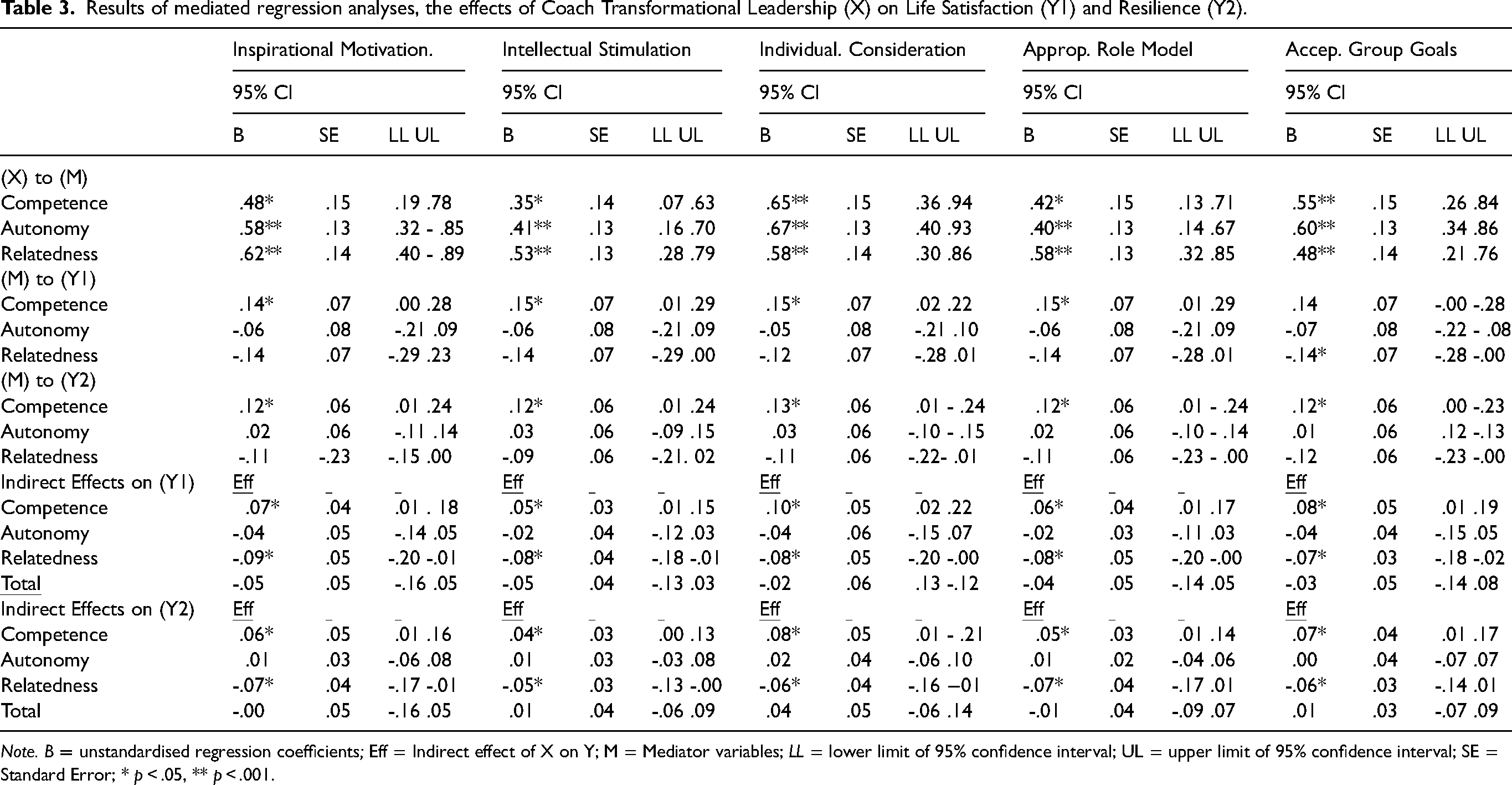
Note. B = unstandardised regression coefficients; Eff = Indirect effect of X on Y; M = Mediator variables; LL = lower limit of 95% confidence interval; UL = upper limit of 95% confidence interval; SE = Standard Error; * p < .05, ** p < .001.
Inspirational motivation had a significant positive indirect effect on life satisfaction (B = .07, SE = .04) and resilience (B = .06, SE.04) via competence, and a negative indirect effect on life satisfaction (B = -.09, SE = .05) and resilience (B = -.07, SE .04) via relatedness. Similarly, intellectual stimulation had significant positive indirect effect on life satisfaction (B = .05, SE = .03) and resilience (B = .04, SE .03) via competence and a significant negative indirect effect on life satisfaction (B = -.08, SE = .04) and resilience (B = -.05, SE .03) via relatedness. Individual consideration had a significant and positive indirect effect on life satisfaction (B = .10, SE = .05) and resilience (B = .08, SE .05) via competence and a negative indirect effect on life satisfaction (B = -.08, SE = .05) and resilience (B = -.06, SE .04) via relatedness. Appropriate role modelling had significant positive effect on life satisfaction (B = .06, SE = .04) and resilience (B = .05, SE .03) via competence and a negative indirect effect on life satisfaction (B = -.08, SE = .05) and resilience (B = -.07, SE .04) via relatedness. Finally, and consisting similarly to the previous TL behaviours, fostering acceptance of group goals had a significant effect on life satisfaction (B = .08, SE = .05) and resilience (B = .07, SE .04) via competence and a negative effect on life satisfaction (B = -.07, SE = .03) and resilience (B = -.06, SE .03) via relatedness.
High performance expectation did not have an indirect effect on any of the outcomes. However, high performance expectation did have a significant direct effect on life satisfaction (B = .19, SE = .08 p < .05), there were no other direct effects of TL behaviours on life satisfaction or resilience.
Discussion
The purpose of this study was to examine the differentiated effects of coach TL within a sports-based education programme for disadvantaged individuals and to explore the mechanisms that mediate these effects. The results revealed that five of the six TL behaviours indirectly predicted life satisfaction and resilience via satisfying the need for competence. Interestingly, relatedness negatively mediated the relationships between the same five behaviours and the outcomes of life satisfaction and resilience. Autonomy whilst attending the programme did not significantly mediate the relationships between any of the transformational behaviours and resilience or life satisfaction. High performance expectations directly predicted participants’ general life satisfaction.
As hypothesised, competence mediated the relationship between inspirational motivation and resilience. Competence also mediated the relationship between intellectual stimulation, fostering acceptance of group goals, individual consideration, appropriate role modelling and resilience. Our empirical data show how all differentiated TL behaviours (but high performance expectations) are positive predictors of resilience. 29 These results reinforce the existing theory that transformational leaders can inspire and motivate followers to become more competent to persist during difficult circumstances. 24 The mediating effect of competence could be further explained by previous research which revealed a positive link between TL and resilience, when transformational leaders instilled a sense of confidence and self-efficacy to persist during stressful circumstances or to endure setbacks.49,59 However, unlike Hardy and colleagues 27 research with military recruits, our research did not replicate the result of high-performance expectations as a significant predictor of resilience. Indeed, coaches who display high performance expectations could increase followers’ perceptions of challenge, 25 which may not be optimal in developing resilience or feelings of competence in populations who already battle significant challenges associated with their socio-economic status.
Similarly, competence positively and significantly mediated the relationship between the same five of six transformational behaviours (all but high-performance expectations) and life satisfaction. Existing empirical data shows that global conceptualisations of TL behaviours can significantly predict well-being in sport 31 and our results replicate previous findings that TL behaviours can positively impact psycho-social outcomes via the satisfaction of competence. 31 To further explain this relationship between competence and life satisfaction, it is well known that people respond positively when perceiving to be effective or achieving goals.50,60 Therefore, it is unsurprising that when a leader facilitates feelings of purposefulness and effectiveness via TL, that it has a positive impact on general well-being and life satisfaction. 57 However, unlike existing research, our results show the positive role in which competence and transformational behaviours play as they impact both life satisfaction and resilience outside of the programme context (i.e., in everyday life). This result highlights the significant need for role models, mentors, and leaders within disadvantaged populations, 34 with specific transformational behaviours potentially leading to greater general life satisfaction. For instance, the benefits of having multiple effective leaders in various contexts (i.e., family, rehabilitation, education) could have a substantial accumulative effect on the development of an individual who is facing multifaceted adversities. For example, many of our sample face substance problems and homelessness, with research demonstrating that engaging with professionals across multiple disciplines is most beneficial to effect change. 61 Consequently, a proposition could be made surrounding the accumulative effect of TL in these services for the reduction of problems and optimal development of disadvantaged populations.
Contrary to our hypotheses, there was a negative indirect effect between all differentiated TL behaviours (but high-performance expectations) and life satisfaction and resilience via relatedness. This means that as expected TL was positively related to feelings of relatedness which is likely to be due to the provision of positive messages and individualised support which develops strong relationships.21,27 However, the levels of relatedness experienced within the programme were negatively related to life satisfaction and resilience beyond the programme. Indeed, some individuals may rely heavily on their transformational leader to help create friendships 62 and positive relationships at the programme, which may make participants more aware of the lack of meaningful relationships and support they experience in the wider world. 7 Ultimately, decreasing their perceptions of their resilience and life satisfaction in everyday life.
In sport psychology research, autonomy has been positively associated with developmental experiences, motivation, and well-being.11,44,63 Stenling and Tafvelin 31 were able to establish autonomy as a positive mediator between TL and well-being in floorball players. Yet, like many other TL researchers, their examinations are context specific and explicitly focuses on the time spent engaged with the sport and the transformational leader. A possible contextual explanation for the lack of mediating impact of autonomy within our data is the chaotic lives led by our sample; one which involves homelessness, unemployment, deprivation, and drug use. An argument could be made that if an individual's life is controlled by disadvantaged circumstances, then it may be very difficult to seize opportunities for control and operate independently.10,16 Furthermore, our results suggest that an environment that inspires competence (feelings of effectiveness) and facilitates structure and organisation may be of greater benefit for individuals who are battling difficult adversities.
Finally, high performance expectations were a direct predictor of life satisfaction rather than impacting on life satisfaction via competence as predicted. Indeed, it seems that the positive expectations of a coach can augment Pygmalion effects which are likely to directly increase an individuals’ positive affect and therefore perceived life satisfaction regardless of how competent they feel regarding their own abilities. Bass 49 suggested that follower satisfaction is raised because of high-performance expectations.
Practical implications and future research
From an applied perspective, the results support the use of differentiated conceptualisation by demonstrating how different TL behaviours yield nuanced results. 23 Ultimately, this provides coach educators and practitioners with a theoretical rationale for each of the separate TL behaviours. 27 Our results imply that articulating positive and meaningful future visions, embodying role model qualities, adhering to the specific needs of individuals and challenging old methods creatively, coaches can positively shape the sports participation experience. Our data implies that as a result, TL may allow the individual to feel competent and thus positively develop in the wider world by enduring adversity and by feeling more satisfied with current life. Conversely, in the context of relatedness, coaches of disadvantaged groups would be wise to assist individuals to develop effective support networks outside the immediate programme to ensure that positive programme experiences are transferrable to their daily lives.
Additionally, our research provided further evidence of coaching contributions in the life skill development and transfer hypothesis. In short, coaches not only impact players when in the sporting environment, but positive implications can be transferred to other contexts (i.e., education, relationships, employment). 8 As such, we encourage SDP programmes to offer TL support and training to coaches or caring practitioners. Specifically, our research implies that programme coaches should be supported to reflect and develop their ability to provide inspirational motivation, role modelling, individual consideration, and intellectual stimulation to develop competence in the players which can then transfer positive personal development into the wider world. Consideration should also be afforded to high-performance expectations given its direct capacity to enhance life satisfaction. Our research implies that coaches (while also providing the necessary care) should seek to challenge and expect high standards from programme participants to directly predict development in the wider world. The effect of high-performance expectations could perhaps counter disadvantaged populations' experiences of being treated with apathy and lack of expectation in education or familial relationships.2,3 However, high-performance expectations should be administered with caution and with individual consideration in mind.
Future research should seek to further understand the antecedents to positive leadership behaviours, the personal characteristics that makes an individual transformational and the climates in which these traits are learnt. Providing the evidence to support the high trainability of TL, 27 other avenues for future research should include coach education interventions and field experiments; investigating how TL can shape the relationships between coaches and the psychological development of sports participants. Specifically, as our research demonstrates TL's effectiveness with disadvantaged sports participants, future research could examine variables exploring TL's developmental potentials amidst the growing SDP movement.13,15 Moreover, research into the explanatory mechanisms that mediate the relationship between transformational behaviours and follower outcomes is also warranted. Furthermore, additional quantitative examinations of the expanding SDP movement are necessary, particularly investigations of those occupying leader and mentoring positions who play an integral role in the developmental aspirations of these programmes. Finally, researchers could employ a qualitative perspective to explore the nuances of transformational coaching in sports development domains. Perhaps an ethnographic approach could provide researchers a unique insight into TL coaching and development strategies within this movement.
Conclusion
A strength of this study is the uncovered relationships between the three psychological needs and how they differently mediate the impacts of TL on life satisfaction and resilience. We extend the work of TL in sport by utilising a differentiated conceptualisation of TL with such nuanced results augmenting our understanding of both TL and need satisfaction within sport for disadvantaged populations. Moreover, our findings also add to the existing research by establishing relationships between TL behaviours and life outcomes rather than those restricted to sport experiences. Finally, a strength of the current study is the relatively large sample of “hard-to-reach” individuals who face extreme hardships, such as homelessness, mental health issues, drug use and unemployment.
This study is not without limitation. Consistent throughout existing TL in sport research are the limitations associated with cross-sectional research, which prohibits making inferences regarding cause and effect. Unfortunately, in the current context the sporadic nature of participant attendance prohibited a longitudinal examination of the mediating processes of TL behaviours in disadvantaged sport. Second, all variables used self-report measures which may influence a single method bias. Future research could use multiple methods (i.e., coach observations, questionnaires) from multiple perspectives (i.e., coach and athlete) to gain further insight into the effect of TL on follower outcomes. Finally, modifications had to be made to both the BNS-RS and BRS to attain the acceptable fit. Further investigations into the use of both scales within disadvantaged populations is therefore necessary.
In conclusion, this examination of a sports-based education programme is the first to suggest that TL can have a positive impact on the resilience and life satisfaction of disadvantaged individuals during their current everyday life. Moreover, indications from our analysis provide a further understanding of basic need satisfaction as an explanatory framework in the processes of TL. It appears that through satisfying the need for competence, TL behaviours may positively impact the everyday lives of disadvantaged individuals.
Supplemental Material
sj-docx-1-spo-10.1177_17479541231158693 - Supplemental material for The indirect effects of transformational leadership in soccer programmes for socio-economically disadvantaged individuals: Need satisfaction as a mechanism towards personal development
Supplemental material, sj-docx-1-spo-10.1177_17479541231158693 for The indirect effects of transformational leadership in soccer programmes for socio-economically disadvantaged individuals: Need satisfaction as a mechanism towards personal development by Jordan Donnelly, Rosie Arthur, Calum Arthur and Daryl Cowan in International Journal of Sports Science & Coaching
Footnotes
Declaration of conflicting interests
The author(s) declared no potential conflicts of interest with respect to the research, authorship, and/or publication of this article.
Funding
The author(s) received no financial support for the research, authorship, and/or publication of this article

Supplemental material
Supplemental material for this article is available online.
References
Supplementary Material
Please find the following supplemental material available below.
For Open Access articles published under a Creative Commons License, all supplemental material carries the same license as the article it is associated with.
For non-Open Access articles published, all supplemental material carries a non-exclusive license, and permission requests for re-use of supplemental material or any part of supplemental material shall be sent directly to the copyright owner as specified in the copyright notice associated with the article.
