



Abstract
Abstract
This study quantified and compared the weekly locomotor activity and subjective load between elite and development loan youth soccer players registered to a primary club. Development loan players were loaned to a lower-league club and trained part-time with their loan club whilst being available for development fixtures and training with the primary club. Data were collected in 16 squad players and 4 development loan players at loan clubs across a 41 week competitive phase of the 2018/2019 season. Analysis was completed on total distance (m), PlayerLoadTM (au), low intensity running (<14.4 km·h−1, m), running (19.8–24.98 km·h−1, m), sprinting (>24.98 km·h−1, m), accelerations (>2 m·s−2 count) and decelerations (<−2 m·s−2, count). Point estimates for the development loan players consistently showed lower weekly values than squad players for all variables ranging from 5.2% (weekly sRPE) to 16.8% (weekly sprint distance covered). Differences, however, were not found to be statistically significant (p ≥ 0.07). Variance ranged from 23.6% (weekly distance) to 37.7% (weekly high-intensity accelerations). Although the goals of a development loan are likely to be multifactorial, this is the first study to quantify and compare locomotor activities and subjective loading of players within the development loan environment.
Keywords
Introduction
A primary aim of soccer academies is through the processes of talent identification and development to create players that can progress to the first team. 1 Soccer academies generally adopt a holistic approach focusing on a range of factors (e.g. anthropometric, psychological, physiological and sociological) to supplement the development of soccer specific skills. 2 Strategies that address progression from academy to the first team have generally focused on psychological considerations.3–9 Differences in physical capabilities, however, are also routinely suggested to be of importance despite a lack of quantitative evidence to support this belief.5,6,9,10 Similarly, previous research has highlighted anecdotal claims of increased physical demands when transitioning to a first team environment. 11 Qualitative studies investigating players transitioning to the first team in elite English pathways have identified that coaches perceived first team play resulted in ‘increased intensity’ and was ‘physically tiring’. 3 Additionally, players perceived that the ‘speed of play is quicker’ and that first team players were ‘much stronger’.5–7 The perceptions of coaches and players suggest there are notable differences when progressing to first team environments, however, there is limited empirical evidence to support. 11
Only recently 12 differences in training and match locomotor activities between professional youth and first team players have been fully reported. Houtmeyers 12 compared first team congested (FTC; > one match) and first team non-congested (FTNC; ≤ 1 match) weekly locomotor activities with that of an U19 squad that played one match per week. Greater total distance (U19: 35265 ± 3863 m; FTNC 31084 ± 2808 m; FTC 30580 ± 2366 m; U19 vs FTNC 4180 ± 1508 m; U19 vs FTC 4684 ± 1320 m) and longer training durations (U19: 496 ± 60 min; FTNC 397 ± 32 min; FTC 365 ± 12 min; U19 vs FTNC 99 ± 21 min; U19 vs FTC 132 ± 18 min) were observed for U19's compared to first team players during non-congested weeks and congested first team training weeks, respectively. However, when distance covered was categorised within velocity thresholds, greater total distance for U19s only occurred during low intensity activity (<12 km·h−1) and with greater distances covered during high intensity (>25 km·h−1) activity (U19: 214 ± 111 m; FTNC 333 ± 128 m; FTC 294 ± 154 m; U19 vs FTNC −118 ± 56 m; U19 vs FTC −79 ± 62 m). The finding that U19s were exposed to greater training durations during congested training weeks where the first team played more than one match was due to a greater number of training sessions experienced by U19s (6.3 vs 5 sessions). The results of Houtmeyers and colleagues 12 indicate that first team players received far greater match exposures at advanced intensities compared to U19 academy players.
A commonly used approach of soccer clubs and academies to expose youth players to first team environments is to make use of loan systems. 13 Player loans can be considered as a means of cross-subsidisation where soccer clubs with greater resources loan players to less well-resourced clubs. 13 Loan systems can provide multiple benefits including flexibility to temporarily replace injured players and to create better development pathways for youth players. 13 Swainston 10 reported that senior academy players perceive loan periods as a key facilitator in their transition from academy to the first team. The considerations of players who experienced loan periods were psychological, technical, tactical and decision making, with very few comments relating to the physical exposure. 10 Given the accepted position that higher intensity exposures occur after transition to first team, 11 as competitive levels increase 14 and as the game has developed, 15 it is surprising that physical exposure was not a greater consideration for loaned players. This is possibly due to the lack of quantitative analysis available examining loan periods and thus the absence of a full understanding of the physical development impact of loan periods by players and coaches.
Strategies employed by soccer clubs to aid the development of players are likely to be influenced by cultures and procedures within individual national associations. For example, in Spain, the development system generally involves a number La Liga club's reserve (or B) squad playing adult football in the lower divisions,16,17 whereas in other UEFA governed countries the loan system generally involves between-club loans to allow adult and first team exposure.10,16–19 Spanish elite youth players who played for their primary club's B squad (Division 3) after academy graduation were more likely to eventually play professional soccer in Spain compared with players the club had signed directly to the reserve squad (43% vs 30%). 17
Strategies to enable players to transition successfully from soccer academies to the first team will likely be multifactorial in nature but use of B teams or loans to lower league clubs are common practice across European leagues. Given previously highlighted within-club differences between first team and U19 players and considering the use of the loan system as a method of exposing young professionals to first-team demands, investigations of the locomotor activities experienced by these players are warranted. Therefore, the aim of this study was to quantify and compare weekly training and match locomotor activities of professional youth football players that were either on loan or not.
Methods
Research design
This study employed a retrospective longitudinal design across a 41-week competitive phase with Scottish professional youth footballers that comprised regular team players and loan players. Subjective measures of training load were collected via ratings of perceived exertion (RPE), and objective measures of locomotor activities were collected via microelectromechanical (MEMS) devices worn during training and match play. Measures of players subjective load and external locomotor activities were analysed weekly across the competitive phase and then compared across the two groups of players.
Participants
Twenty male professional youth footballers (age 17.4 ± 1.3 years, height 178.0 ± 8.1 cm, mass 71.8 ± 7.2 kg) were recruited during the 2018/2019 season. The participants comprised multiple positions, with data collected from goalkeepers removed from the final analyses. Players were categorised as either development loan players (n = 4, age 19.1 ± 0.9 years, height 181.1 ± 10.7 cm, mass 74.7 ± 6.9 kg) or squad players (n = 16, age 17.0 ± 1.1 years, height 177.3 ± 7.6 cm, mass 71.1 ± 7.4 kg). Development loan players were those who were loaned to a lower-league club and trained part-time based with their loan club. Development loan players were therefore available for training and match play with both the development squad and their respective loan club. Within a representative training week, the loan club would have competitive Saturday match days, allowing for participants to complete training with the primary club on a Monday and Friday, access to both primary and loan clubs training on a Tuesday and Thursday, recovery sessions on a Wednesday and a day off on a Sunday. As per the development loan regulations, participants could also compete for the primary club within Tuesday evening development fixtures and weekly decisions were communicated between clubs. All pre-season data were excluded as all development loans commenced in the competitive phase of the season. Data collected from rehabilitation sessions, and non-pitch-based sessions such as gym-based recovery or resistance training sessions were excluded. This left a total of 2649 individual recordings, with 677 weekly recordings. This retrospective study was awarded institutional ethical approval by The Robert Gordon University (SHS20/30). Players were all professional and signed a contract allowing use of their data with third parties, which allows retrospective analysis of data in line with the clubs Data Protection Act processes.
Procedures
Each player's RPE was collected in isolation, approximately 30 min after each training session, to ensure light or challenging training intensities at the end of sessions would not dominate the participants rating, using a scale previously used with football players (Borg CR10).20,21 All players had previous experience using the scale as part of their training monitoring. Loan players used an online app to register their RPE and duration after training and match play. Each RPE score was multiplied by session duration to obtain subjective training load. 20 During both training and match play, all participants wore the primary club's commercially available MEMS devices (Optimeye X4, Catapult Sports, Melbourne, Australia, Firmware version 7.27) previously used in research conducted in team sports22–24 with loan players returning their units for download and analysis when in contact with the primary club. The units included a GPS receiver and a triaxial accelerometer collecting data at 10 and 100 Hz, with velocity and acceleration dwell times set at 0.6 and 0.4 s, respectively. After recording, data were downloaded and analysed via the software package Openfield (Software version 1.19, Catapult Sports, Melbourne, Australia). To minimise differences in data processing, the same software version was used to export training locomotor activities data. 25 The average satellite count for the retained dataset used for analyses was 10.6 ± 1.7, the average horizontal dilution of precision was 0.8 ± 0.2. The variables selected to quantify external locomotor activities were total distance (m); PlayerLoadTM (au); low intensity running (<14.4 km·h−1, m), running (19.8–24.98 km·h−1, m); sprinting (>24.98 km·h−1, m); accelerations (>2 m·s−2 count); and decelerations (<−2 m·s−2, count). Variables were included for analysis due to their wide-spread usage in both practice and research. 26 Data is available upon request.
Statistical analysis
Data were analysed in the statistical environment R (v4.0.3). Of the 2649 individual recordings, 2.7% were missing subjective data, and 13.0% were missing external locomotor activities data. Where data were missing, these were treated as missing at random (primarily due to technical errors such as battery failure, or participant adherence to recording subjective data remotely) and imputed using the MICE package.
27
Data were analysed using mixed linear modelling as a flexible approach to account primarily for the unbalanced repeated measures nature of the data. The fixed effects of the model were whether players were categorised as development loan players or squad players. Random effects were associated with individual players and weeks. Generalized likelihood ratio tests were conducted with models fit using the restricted maximum likelihood approach to test for statistical significance of each fixed effect. Due to the repeated measures design, effect sizes were obtained by calculating generalized eta squared values (
Results
Data collected from loan players comprised 490 (18.5%) individual recordings (Training = 373, Match-play = 117), while 2159 (81.5%) individual recordings were made up by squad players (Training = 1665, match play = 494). The distribution of weekly values for each group is described by the means and standard deviations presented in Table 1. Development loan players consistently reported lower weekly values than squad players ranging from 5.2% (weekly sRPE) to 16.8% (weekly sprint distance covered). Likelihood ratio tests indicated significant differences (p < 0.01) between groups for weekly measures of all dependent variables. Regression coefficients quantifying differences relative to squad status are presented in Table 2. The explained variance ranged from 23.6% (weekly distance covered) to 37.7% (weekly count of high-intensity accelerations). Analysis of individual regression coefficients showed that development loan players recorded consistently lower values than squad players for all dependent variables, however, these differences were not statistically significant (p ≥ 0.07) (Figure 1).
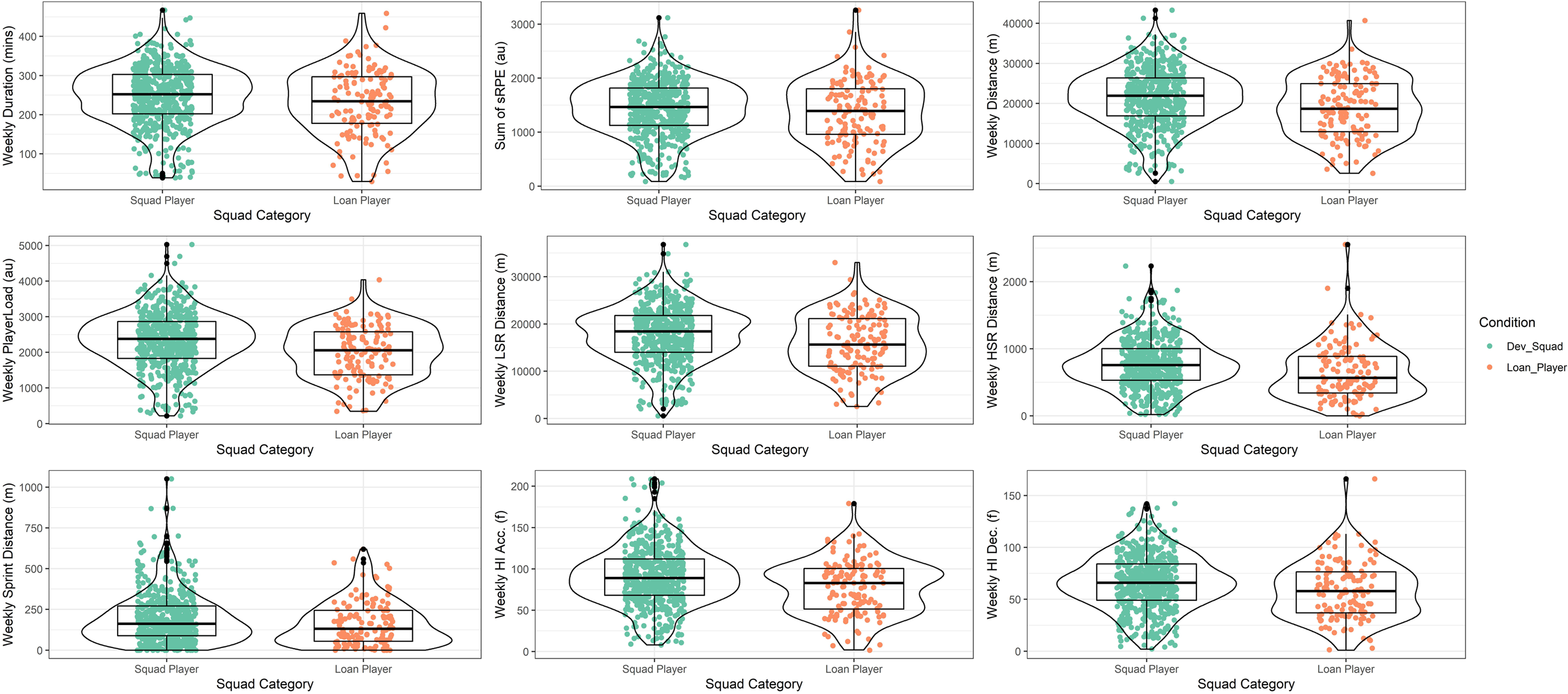
Weekly duration and locomotor activity values across competitive phases.
Distribution of weekly values for each group mean (±SD).
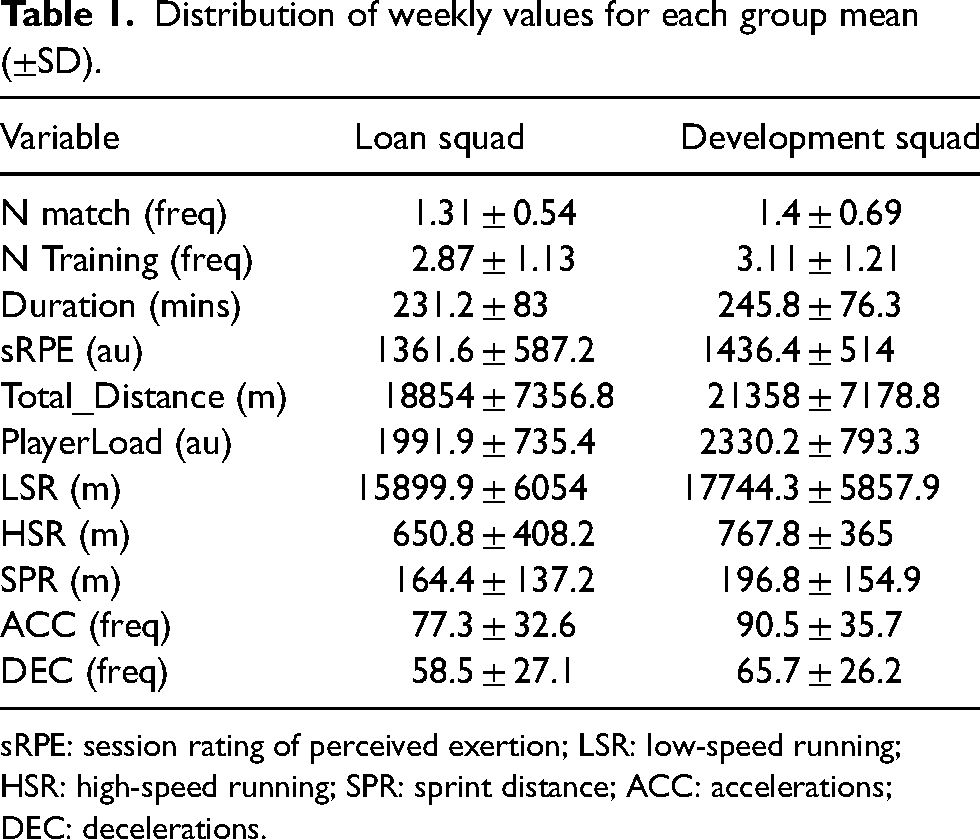
sRPE: session rating of perceived exertion; LSR: low-speed running; HSR: high-speed running; SPR: sprint distance; ACC: accelerations; DEC: decelerations.
Regression coefficients quantifying differences relative to squad status.
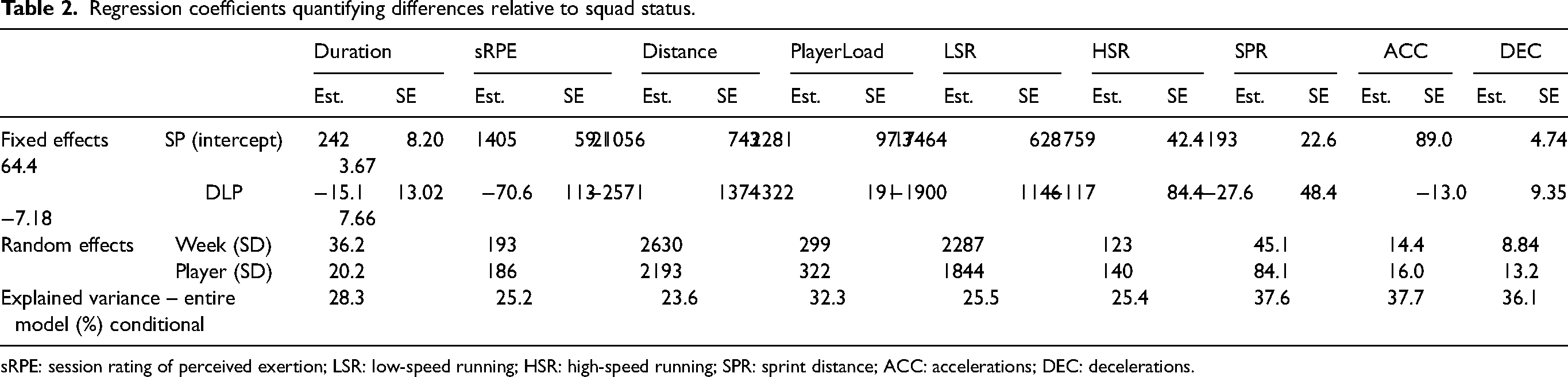
sRPE: session rating of perceived exertion; LSR: low-speed running; HSR: high-speed running; SPR: sprint distance; ACC: accelerations; DEC: decelerations.
Discussion
The aim of the current study was to quantify and compare training and match locomotor activities of professional youth football players, with specific consideration given to those undertaking development loans. The results of this study provided limited evidence that players undertaking development loans experienced and perceived lower physical load than that of squad players. Point estimates consistently showed lower values than squad players with differences ranging from 5% to 17%. None of the differences, however, reached statistical significance (p > x) and this is likely due to the low number of development loan players. The observation that development loan players may have experience and perceive lower physical load highlights a potential area of consideration and potentially consideration for improvement when planning loans for young professional footballers, if exposure to higher locomotor activity demands is an identified goal of the development loan.
The structure of development loans for the players within the current study allowed the participants to compete one time per week within their first team loan club and another within development squad matches. Therefore, results indicating that development squad players may exhibit higher values than loan players across locomotor parameters in the current study are surprising. Differences between current and previously observed data 12 may be due to differences in training approaches and are likely case specific. For example, total weekly distance was 18854 ± 7356 m and 21358 ± 7178.8 for development loan and squad players respectively in the current study compared with 35265 ± 3863 (U19) and 31084 ± 2808 (first team) in the Dutch team studied by Houtmeyers. 12 Differences between studies in the zones used to quantify locomotor activities are minimal (e.g. HSR 19.8–24.8 km·h−1 vs 20–25 km·h−1) and would not account for the differences between more intense high-speed running activities in the studies (current study: 650 ± 408 m development loan; 767 ± 365 squad players; Houtmeyers 12 : 1036 ± 271 m U19; 961 ± 261 m first team). The differences between studies highlight variability in locomotive weekly training demands between groups in the development phase regardless of loan status.
Point estimates from the results obtained here show that loan players consistently reported lower weekly locomotor activities values than squad players, ranging from 5% to 17%. One potential explanation for this observation is due to a loss of control by the primary club when players are training with their loan club. The hybrid development loan system used in Scotland is unique in that players can train part-time and complete in both a traditional loan setting and with their development squad whilst retaining full time status with their primary club. One potential challenge with any loan environment is the loss of control over training content and match systems with the key responsibility of a loan clubs to win games, not develop players. Generally, these development loan players are hosted by a part time club, where intensity and locomotor activities of training may be lower than full time clubs, with restricted time, space and resources. Where there is reduced locomotor activity exposure, coaches lose the ability to provide ‘top up’ sessions within this hybrid loan system due to competing priorities for the primary and the host club. 29
To overcome such limitations, clubs in Spain use ‘Colt’ Squads or B teams to further the development opportunities of their transitioning players who represent their home club whilst playing in a lower division. 30 When comparing the professional progression of the players involved in the B team, Los Acros 17 showed that the players who had been signed internally from the club progressed at a rate of 43% versus 30% of players who were signed directly into the B squad. With there being no physical performance differences in these groups, they attribute the difference in progression to ‘game intelligence’ and ‘personal qualities’ which have not been assessed in the current study. Further research may be warranted to understand whether the use of B squads allows parents clubs to maintain their training philosophy with development players, rather than loaning them to external clubs.
In theory, loans may serve as an opportunity to expose players to higher locomotive demands, thus supporting players progressing to first team level. 10 Houtmeyers 12 attributed higher weekly total distance and weekly total training volume in U19 players versus first team to a greater number of weekly sessions whilst only playing 1 match per week (versus 2 matches with the first team). Conversely first team players received greater match exposures at advanced intensities compared to U19 academy due to congested match weeks. The development loan system in the current study allows for players to compete and train for both the primary club and the loan club, playing once or twice per week. There was no difference in the number of weekly game exposures for development loan and squad players (1.3 ± 0.54 vs 1.4 ± 0.69) indicating that the opportunity to increase match exposures was not taken. Although not significant, development loan players experienced lower weekly training exposures (2.87 ± 1.13 vs 3.11 ± 1.21), training duration (231.2 ± 83 vs 245 ± 76.3 min) and PlayerLoadTM (1991.9 ± 735.4 vs 2330.2 ± 793.2 au) which may be indicative that scheduling considerations for training and match play do not take advantage of the hybrid nature of the development loan system.
Whilst our analysis has focussed on locomotive demands, there are many factors that have been suggested to influence first team transition success rates.5,17 In a recent analysis of English professional players who spent an entire season on loan, all participants highlighted an increased physical exposure. 11 The lack of quantitative value such as locomotor activity makes comparison with the current study difficult. It was acknowledged that the increase in physical challenge may indeed be associated with different training types such as a greater focus on large-sided games rather than technical development. With Abbott and Clifford's methodology 11 seeking to address physical differences specifically within part 1 of their interview structure, this could explain why more consideration is given to physical differences of the participants when compared with other investigations who have asked more generic questions.5–7 Although at times loan players felt more technically competent than existing players at the senior club, an ability to adapt technically and tactically was considered a key fundamental to be successful. 11 It appears critical that clubs match loan players with appropriate clubs to enhance player feedback, technical challenge, and social support. 11 This can be achieved by engagement in a wider club partnership agreement embedding aspects including coach education, equipment access for the part time club and a data sharing that would allowing the primary club to monitor and advise on the part time clubs overall activities. Although there are some legislative challenges to the inclusion of B squads in Scotland's lower leagues, B squads have been shown to make a positive contribution to development and first team progression in Spain16,17 and we would encourage a similar analysis to the current study with those clubs currently utilising B teams.
There are limitations to the current study which should be acknowledged. Firstly, only locomotor activities and subjective internal loading was assessed in the participants. The multifactorial demands of soccer require the development of psychological, physiological, sociological factors and technical/tactical skills. 2 Time motion analysis quantifies locomotor activity in a one-dimensional basis without considering the technical, tactical and psychological demands associated with training and match play. 31 Bradley and Ade 31 propose a semi or fully integrated approach across technical, tactical and physical demands which commonly utilised MEMS devices cannot accommodate. New technology to quantify technical data such as ball touches and releases may provide further insight into the demands of football training and match play and allow comparisons between different levels. As the game has progressed physically, these technical parameters have also progressed 32 and consideration towards these exposures in a loan setting is required. Marris 32 highlighted an impact of training day (e.g. MD-1, MD-5), playing position and training type (small sided game vs tactical drills) on the aforementioned technical parameters. Furthermore Lewis 29 observed MD + 1 having the highest absolute ball releases compared to all other training days, a decrease in frequency of ball releases as training becomes closer to match days, MD-1 and MD + 1 having the highest number of absolute and relative high-speed ball releases with variability being impacted by the type of drill or practice that the players were participating in. It thus is likely that different technical demands may be evident across different tiers of football and within different club settings. 29 Additionally, our analysis only assessed one loan structure, it is likely that the format of loan agreement will also impact the locomotive demands of the player. Factors such as the league which loan clubs compete in, and the playing style of loan clubs, are also likely to influence locomotive demands and warrant further investigation. 29 Additionally, the structure of the loan, whether it be a traditional full-time loan or part-time development loan, will likely highly influence the weekly locomotor activity structure of training and match-play. Finally, the current study only compared data from one club with no inclusion of first team data, with a relatively low number in the development loan group, a system specific to Scotland. Therefore, whilst this study raises noteworthy areas for consideration and further investigation, the findings may have limited generalisability to other scenarios.
Conclusion
This study quantified locomotor demands experienced within a loan environment compared with development squad players. The results show that there were no significant differences between groups, however, the mean group values were consistently lower for loan players compared with squad players. Previous internal research within the primary club has highlighted variability between locomotor activity demands of U19 and 1st team players, therefore this may suggest that there are opportunities to increase the specificity of weekly locomotor activities experienced by loan players to better replicate the demands of 1st team football. The goals of a development loan are likely to be multifactorial, with consideration given to the technical, tactical, physical, and psychological development of a player. Improved understanding of these areas may allow better player placement, and increase success rates in progression to 1st teams. Additionally, previous research has promoted strategic inclusion of ‘B Teams’ as a viable method of increasing player progression rates, and may increase host clubs ‘control’ of a players training regime.
Further investigation is required to establish interventions that work simultaneously with loans to enhance physical development and ensure a smoother transition to first team. Finally, recent developments in technology may increase the availability of technical data, allowing greater assessment of the multifactorial nature of soccer performance.
Footnotes
Acknowledgements
The authors would like to thank the primary club for the permission to conduct the retrospective analysis. There was no funding or grants provided within this study.
Data sharing
Data is available upon request.
Declaration of conflicting interests
The author(s) declared no potential conflicts of interest with respect to the research, authorship, and/or publication of this article.
Funding
The author(s) received no financial support for the research, authorship, and/or publication of this article.
