



Abstract
Motor performance is characterized by individual differences. Motive research posits that individual differences in motives (achievement, affiliation, power) predict what types of incentives individuals experience as motivating. It follows that in order to incentivize and optimize performance, models explaining determinants of such differences are integral to design appropriate interventions or training settings. Therefore, in the current study, we tested the utility of a motive-based approach in explaining motor performance differences in a competitive sports context. Specifically, we trained and assessed sport science students’ performance in a series of motor tasks (i.e., darts, beanbag throwing, golf putting) in small groups. Beforehand, students’ motives were assessed employing both projective and self-report measures. As hypothesized, students’ projectively measured power motive (and to a lesser extent achievement motive) showed a positive relationship to motor performance. In contrast, none of the self-reported motives were related to performance. These findings highlight the utility of the achievement and power motive in explaining individual differences in motor performance and suggest feasible intervention and training strategies.
“Talent sets the floor, character sets the ceiling.”
Motor performance in general as well as athletic performance in particular is characterized by individual differences. That is, even if characteristics of the task or environment are held constant, individuals differ in their performance.1–3 The relevance of such differences to coaches is at least twofold. First, knowledge of such differences (e.g., individuals’ strengths and weaknesses) may highlight boundary conditions for interventions. For instance, whereas soccer goalkeepers facing a penalty may have an advantage by reacting comparatively late, this is a viable strategy only for those keepers endowed with the movement capabilities to still intercept the ball under these tightened temporal constraints. 4 Second, being able to explain such differences (i.e., knowing about their determinants) is a prerequisite for developing new appropriate interventions leveraging those predictors. In the search for determinants of motor performance differences, research has broadened the scope beyond proximal determinants (e.g., reaction time, motor abilities) and increasingly highlighted the role of psychological constructs, such as the positive effect of coaches’ autonomy support on athletes motivation and persistence. 5–7
Motives as Predictors of Motivation and Performance
A theoretical approach that links differences in the psychological characteristics of the athletes themselves (vs. external influences such as coaches’ behavior) to differences in motivation and performance is Motive Disposition Theory. It is built on the central tenet that individuals exhibit intra-individually stable differences regarding which types of incentives or situations they experience as rewarding.8,9 Generally, three broad motives are distinguished: Individuals with a strong achievement motive derive satisfaction from the “autonomous mastery of challenging tasks”, individuals with a strong affiliation motive from “establishing, maintaining, and restoring positive relationships”, and individuals with a strong power motive from “having, physical, mental, or emotional impact on others” (p. 603–606). 10 Thus motive research goes beyond incentive theories of motivation (i.e., “law of effect” 11 ), by not only acknowledging that incentives (and disincentives) influence individuals’ behavior,12–14 but that individuals differ in what represents an incentive for them in the first place. For instance, individuals high in the achievement motive derive pleasure from mastering tasks, but substantially less so from impacting others or maintaining positive relationships (if their power and affiliation motives are comparatively weak). This idea has been supported by studies on evaluative responses to motive specific incentives15–19 as well as motives’ effects on behavioral outcomes10,20,21 (e.g., career success22,23, persuasion 24 ).
Motives’ relationship to motor performance was covered in a recent review encompassing a total of 42 published studies. 25 Among the aspects of this review that warrant further attention are: a) a pronounced focus on the achievement motive at the expense of the affiliation and power motive, b) employment of either projective or self-report measures of motives, but not both, and c) a dominance of laboratory studies in contrast to ecologically valid field studies. Of course controlled laboratory studies have unique methodological advantages, such as allowing to selectively manipulate specific aspects of the situation. 26 Nevertheless, researchers typically want to generalize effects obtained in laboratory paradigms to a wider array of real-life contexts such as those characterizing the coaching environment. Because findings may not naturally generalize to such contexts,27–30 this requires empirical evidence that more closely resembles such tasks and environments.
Evidence from Field Studies
Indeed, while 15 out of 42 reviewed articles addressed the relationship of motives and indicators of motor performance in a field setting, the overwhelming majority of this research focused on the achievement motive only. 25 Only few studies have targeted the affiliation31–33 or power motive. 32 In addition, studies indicate a pronounced bias for the use of explicit, self-report measures of individuals’ motives over indirect, projective techniques (which – to a lesser extent – is characteristic of the entire field of research on motives and motor performance). 25 However, previous findings highlight that the different modes of motive measurement may be sensitive to different constructs with unique behavioral correlates. 8 For example, projectively measured motives are aroused by task intrinsic incentives and predict “behavioral trends over time” (p. 691), 8 whereas self-reported motives are aroused by explicit, social incentives and predict deliberate choice responses (e.g., between behavioral alternatives). This distinction has recently been recast in terms of nonverbal vs. verbal incentives and non-declarative vs. declarative indicators of motivation,10,21 but the central tenet remains the same: Different types of motive measurement relate to different behavioral outcomes. In the realm of field studies, only one study has addressed this issue specifically by employing both projective and self-report techniques for motive measurement. 34 In line with previous theorizing, the projectively assessed achievement motive was positively related to participants’ actual performance in a tournament (basketball, handball, soccer, volleyball). In contrast, their self-reported achievement motive was related to the selection of task difficulty (i.e., choice of target distance for throwing task in basketball, handball, soccer, and volleyball setting).
The Current Study
Based on these findings, it was the goal of the current study to fill this gap in the literature by a) testing the role of all three motives, b) assessed by means of both projective and self-report measures in predicting differences in motor performance in a field setting. To this end, we took advantage of a curricular methods course on the assessment of motor performance. Students completed a sequence of motor tasks in small groups – thus offering the opportunity to assess actual motor performance in different tasks in an ecologically valid setting, representing a context where individuals’ motor performance is practiced as well as assessed.
Participants witnessed each others’ performances directly, thus offering a competitive stimulation, including the potential to ascend in a performance hierarchy and to achieve social visibility. Because such situations should be especially appealing to those with a strong power motive, 35 we expected individuals’ power motive to be positively related to motor performance. To a lesser extent, the setting may have also offered incentives for the achievement motive because participants received feedback about their performance progression throughout the tasks (even though no explicit feedback on changes in outcome performance was provided). Finally, even though performing the motor tasks in the course did not put an explicit focus (e.g., by establishing interpersonal dependency of group members) on the experience of positive social contact (i.e., incentive for the affiliation motive), it is nevertheless conceivable that participants experienced working in small groups as an opportunity for affiliative behavior.
Given that the observed motor performance represents an example of an operant or nonverbal measure 25 a relationship to the aforementioned motives should be especially pronounced for motives assessed with projective techniques. In contrast, self-reported motives should exhibit comparatively weak relationships to motor performance, because there is little room for individuals to engage in selection between alternative behavioral choices (i.e., all activities and their timing are prescribed fully by the experimental procedure).
Method
Sample
To arrive at an appropriate sample size to detect relationships of the power motive with motor performance with a power of at least .8 (
Design & Procedure
The study implemented a correlational design. Participants took part in a half-day practical on moderators of motor learning as part of their regular curriculum. In the days before the practical, participants completed both projective and self-report motive measures using an online questionnaire. In the practical, a theoretical introduction on theories of errorless learning38–40 (for an overview see Masters et al., 2020
41
, p. 83-85), was followed by a set of motor tasks designed to give participants first hand experience with different types of learning regimes (any reference to personality differences in general and motives specifically was avoided throughout the course). To this end, participants were divided into three groups (
Measures
Motive Assessment
Participants’ motives were assessed prior to the course via a custom built website. Here they completed a) the Multi-Motive-Grid as a semi-projective measure of motives and the b) Self-Image Questionnaire as a measure of self-reported motives.
The Multi-Motive-Grid42,43 (MMG) is a semi-projective measure of motives and is used widely in established research.44–51 For a total of 14 line drawings depicting various social situations (e.g., couples dancing, badminton match) participants are to indicate whether or not a set of statements apply to the depicted situation. The MMG yields two separate scores for each motive – a hope (approach) and a fear (avoidance) score (Range:
The Self-Image Questionnaire 52 is a short 12-item measure to assess participants’ motives in a self-report fashion. For each motive participants answer a total of four questions, with the first two of them addressing the approach dimension and the remaining two addressing the avoidance dimension of the respective motive. Following each short introduction of a motive dimension, the first question asks participants to indicate their ideal level of the respective motive (i.e., “How pronounced should this quality be for yourself?”) whereas the second question pertains to the actual level of the respective motive (i.e., “How pronounced is this quality actually?”). All items are answered on a 7-point rating scale (1 = “not at all”, 7 = “completely”). Because we were interested in actual levels of motives, only participants’ answers to the second questions were considered in the analyses.
Motor Performance
Participants completed four blocks of each motor task (i.e., golf putting, beanbag throwing, dart throwing). Whereas the first three blocks served as practice trials, a task’s final block constituted a transfer test. Depending on the respective difficulty condition, the first three blocks were completed in either ascending or descending difficulty, or – in the case of the constant difficulty condition – did not differ in difficulty.
In the golf task participants were to put a golf ball as close as possible to the center of a circular target area (diameter: 30 cm) marked in chalk on the classroom carpet. To manipulate difficulty, distance to target was either 180 cm, 250 cm, or 320 cm. Each practice block consisted of 10 puts. The transfer test consisted of 6 puts performed from a distance of 280 cm. In the beanbag task participants were to throw a beanbag as close as possible to the center of a circular target area (diameter: 30 cm) marked in chalk on the classroom carpet. To manipulate difficulty, distance to target was either 180 cm, 250 cm, or 320 cm. The transfer test was performed from a distance of 280 cm. All blocks consisted of 16 throws. Finally, in the dart task participants were to throw a dart as close as possible to the center of a circular target area marked on a board mounted on a wall (target center height: 173 cm, throwing distance: 237 cm). To manipulate difficulty, target diameter was either 16 cm, 10 cm, or 4.7 cm. The transfer test was performed using a target diameter of 13 cm. All blocks consisted of 16 throws.
In order to make the complexity of the design manageable for both participants and lecturers a number of precautions were taken. First, at the very beginning of the classroom session participants received a slip of paper containing a) their assigned temporal sequence of motor tasks and b) the corresponding learning regimes (i.e., ascending, descending, constant). Assignment of conditions to participants was random and counterbalanced. Second, at the beginning of each motor task participants were provided with a written description of the task requirements and how to complete both the task and the assessment of an individual’s motor performance in the given task. Typically, the majority of group members were actively involved in running the task. In addition to the person actively performing the motor task, a second person measured the achieved distance from the target using a tape measure (e.g., golfball to center of target area, dart to center of dartboard) and called out the result. A third person entered these scores in a form field on a purpose built website. To guard against errors in task sequencing and condition assignment, this form displayed the individual trial sequence of the selected participant (and visually indicated transitions between blocks and associated changes in distance or target size). Finally, the last group member was overseeing the accuracy of the procedure.
Demographics
After the class was over, participants completed a final online questionnaire asking them to indicate their age and gender.
Results
Data Preparation
As mentioned in the sample section, first, participants not providing data for all motor tasks and personality measures were excluded (final
Motives and Overall Motor Performance
In order to test the hypothesis that individuals’ motor performance in the presence of power motive incentives is positively related to their power motive participants’ mean motor performance was regressed on their motive scores – separately for projective and self-report motives.
Projective Motives and Performance
Predicting participants’ motor performance from their achievement, affiliation, and power motives as assessed with the MMG proved successful. The regression model was able to explain differences in motor performance,
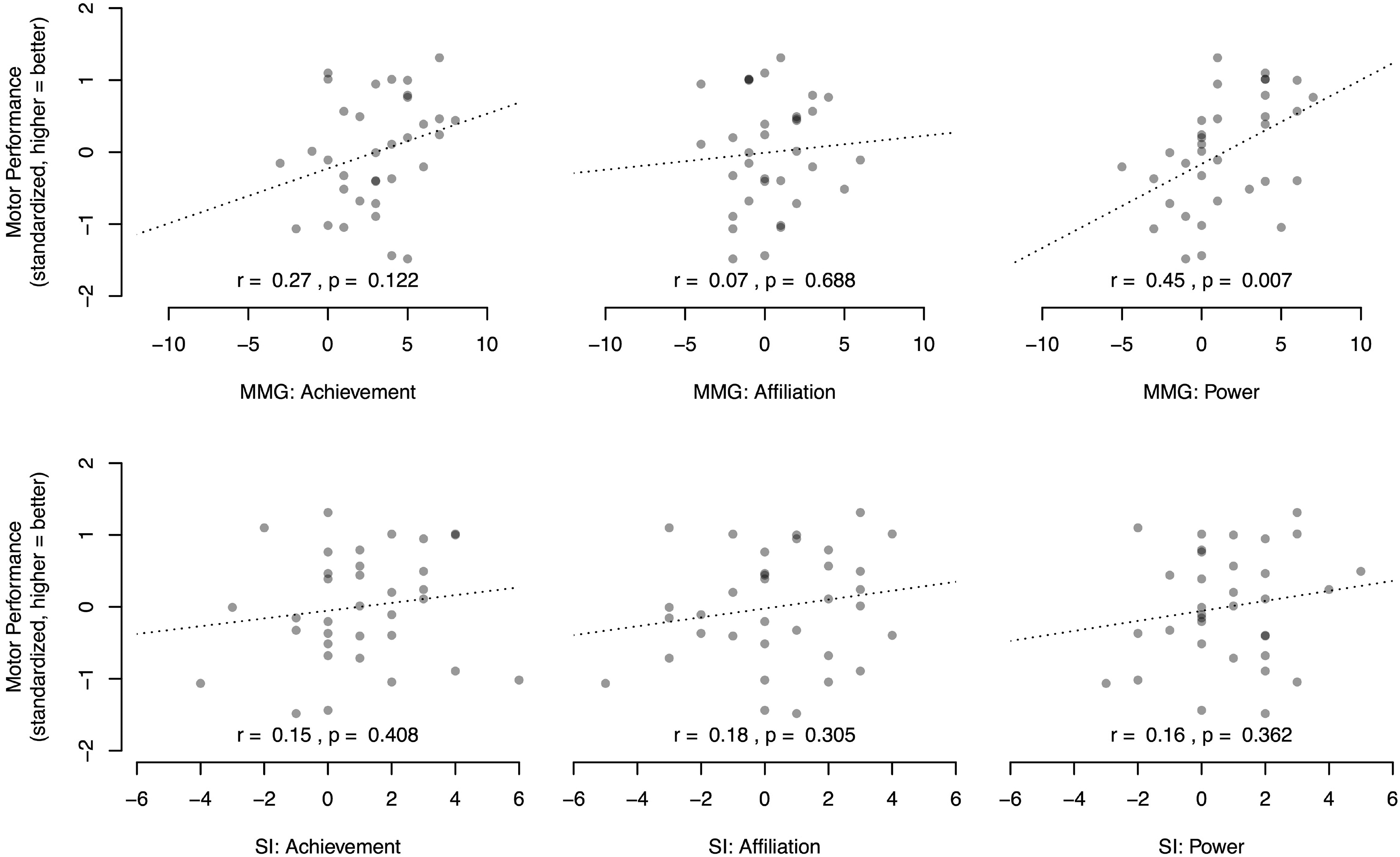
Simple regressions of motor performance on participants’ motives. Top row: projective motives (MMG), bottom row: self-report motives (Self-Image Questionnaire). All
Multiple regression statistics for participants’ motor performance on motives measured via the MMG (top) and via self-report SI (bottom).
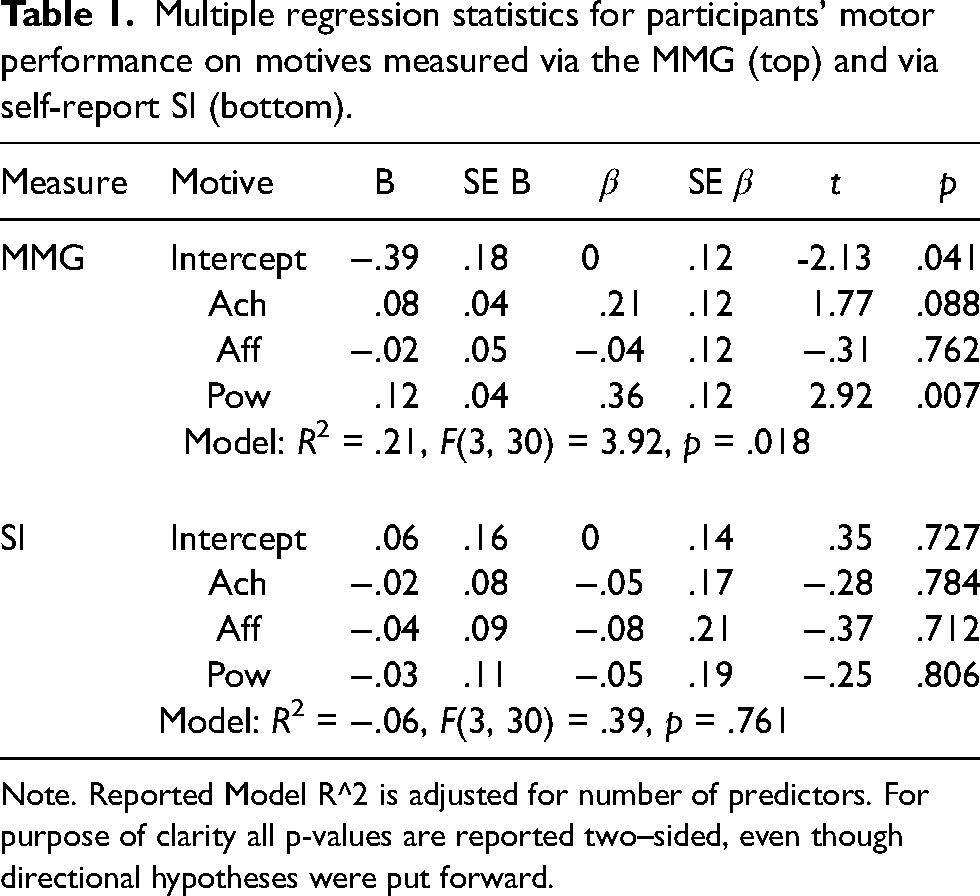
Note. Reported Model R^2 is adjusted for number of predictors. For purpose of clarity all p-values are reported two–sided, even though directional hypotheses were put forward.
Zero-order correlations of participants’ motor performance and motives measured via the MMG and SI.
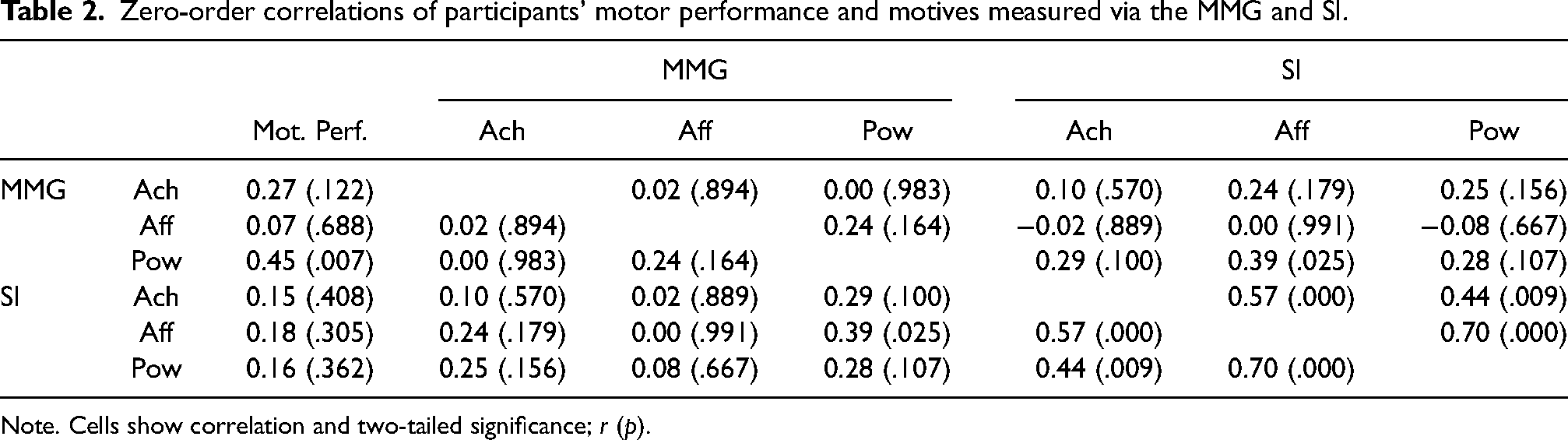
Note. Cells show correlation and two-tailed significance;
Self-Report Motives and Performance
The above analysis was repeated with participants’ self-reported motives as assessed via the Self-Image Questionnaire serving as predictors of motor performance. In contrast to the MMG-related findings, this model did not explain any variance in motor performance,
Motives and Motor Performance By Task
In order to follow up on the significant relationships of the power and achievement motives assessed with the MMG to participants’ overall motor performance, separate multiple regressions of motor performance on all three motives were conducted for each motor task. This revealed a stable, positive relationship of the power motive to motor performance (all
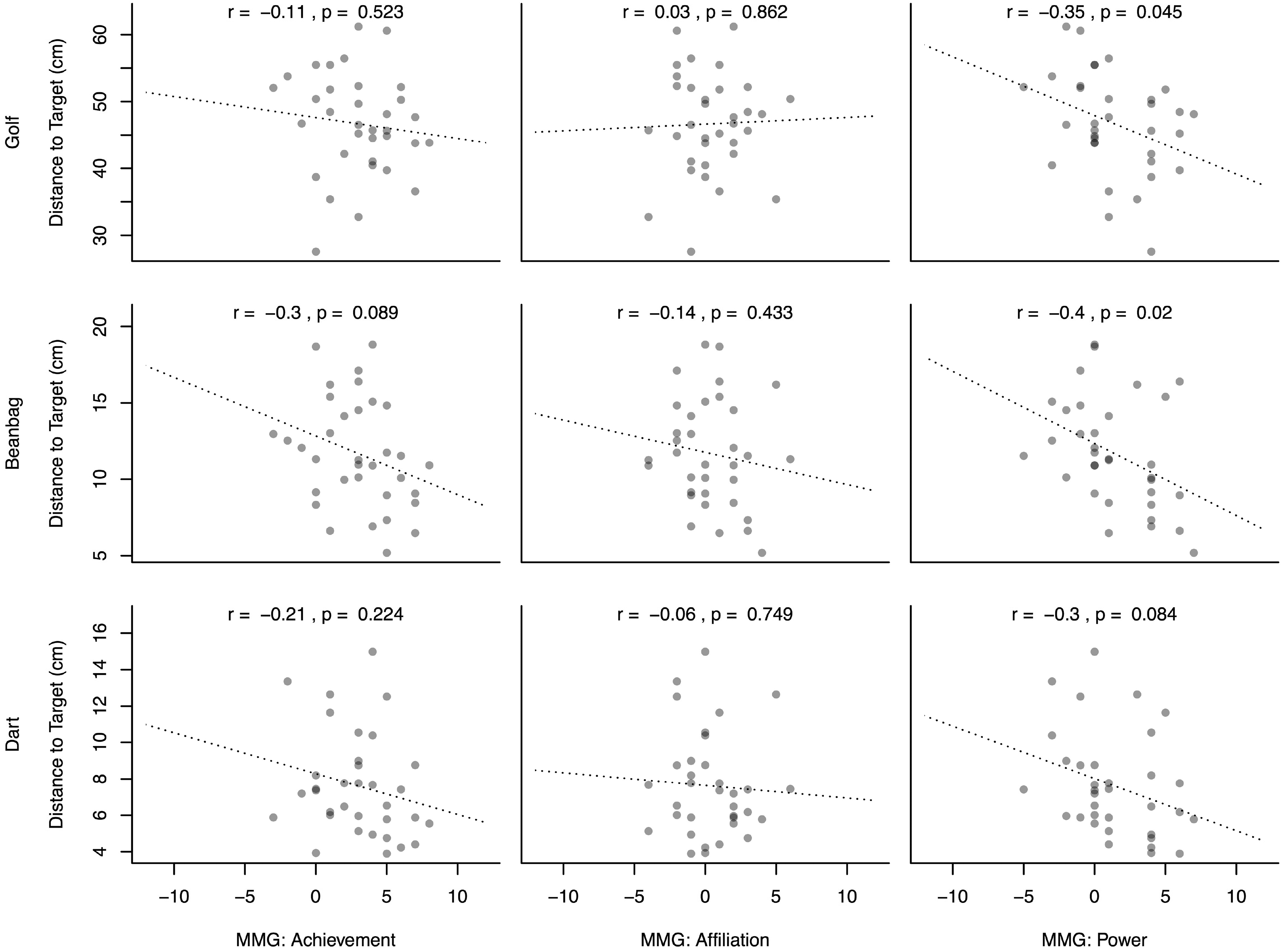
Simple regressions of motor performance on participants’ motives assessed with the MMG, separately for each task. All
The very same analyses were repeated for participants’ self-reported motives (i.e., Self-Image Questionnaire). In line with previous results on their relationship to overall motor performance, no significant findings emerged (all
Contrasting Motives’ Hope and Fear Components
Even though we employed a difference score of participants’ hope and fear components of each motive (see Motive Assessment in the Measures section), the previous analyses can also be run with taking the hope and fear components of each motive into account. Running multiple regressions of participants’ motor performance on the hope and fear components (separately for each motive) mirrored the previously reported findings. Effects emerged only for motives assessed with the MMG. For the achievement motive Hope for Success approached significance (
Effects of Learning Regime on Motor Performance
For the sake of completeness, we also analyzed data regarding the impact of the different learning regimes (i.e., ascending, descending, constant difficulty) on participants’ motor performance, even though this served merely as cover story. Subjecting participants’ z-standardized performance in the final transfer test (i.e., after the different learning regimes had taken place) to an ANOVA with the within subject factor Learning Type revealed a significant effect,
Discussion
The goal of the current study was to test the relationship of individuals’ motives to motor performance in an ecologically valid sports context, where motor performance is first practiced and subsequently assessed. We utilized a context offering incentives for the power motive (and to a lesser extent the achievement motive) to address the paucity of research assessing the impact of all three motives on motor performance in general and in applied field settings specifically. In keeping with recent recommendations, 25 we employed both projective and self-report measurements.
Concerning the projectively measured motives, results are in line with the predicted positive relationship of individuals’ power motive to their mean motor performance, which was observed across a variety of tasks (golf-putting, beanbag throwing, darts). Findings for individuals’ achievement motive were also significant, but follow-up task-specific analyses confirmed the relationship only for beanbag throwing. Finally, the affiliation motive was not related to motor performance. In contrast, participants self-reported motives were not related to motor performance – a finding that is in line with established research on the differential effects of projective in contrast to self-report measures.53,34
Relationship to Established Research
The current findings build upon and extend previous research on the role of motives in predicting interindividual differences in motor performance. First, comparatively few studies have addressed the relationship of motives other than the achievement motive to motor performance.31,54 In fact close to 80% of published studies focus on the role of the achievement motive only. 25 Among those studies incorporating effects of the power motive, Groepel et al. (2015) compared implicit motives between recreational / amateur and professional athletes. 55 At least for athletes in interactive sports, professionals were characterized by a stronger power motive (Study 2). In line with these findings, also Wegner et al. (2014) – using a similar paradigm – report the highest levels of power motives in professional athletes (vs. recreational athletes and sports science students). 32 Despite underpinning the role of the power motive in sports performance, these studies did not assess motor performance per se, but rather followed an indirect approach by relating the power motive measures to different levels of expertise.
Among the studies opting for a more direct assessment of motor performance, a set of three publications from Schultheiss and colleagues employed visuomotor sequence learning paradigms (i.e., completing series of keypresses, connecting ascending numbers in a scrambled matrix) as an indicator of motor learning in a laboratory setting.56–58 In a nutshell, those studies indicate increased motor learning if participants’ performance of motor sequences was reinforced by power motive incentives (i.e., low dominance faces, 56 winning vs. losing a staged contest58,57). In addition, a recent study from our own lab indicated that manipulating the presence of power incentives (i.e., one-on-one competition with an ostensible opponent) moderated the relationship of participants’ power motive to their performance in dart throwing: If power incentives were present, a stronger power motive was related to less variable errors in dart throws (i.e., better performance). 36
In a number of aspects, the current findings go above and beyond this established line of research. First, to the best of our knowledge, the present study represents the first instance documenting the impact of the power motive on motor performance in a field (i.e., classroom) setting, highlighting that findings previously established in the lab56–58,36 also translate to more applied, real world settings. This is especially noteworthy, as such settings lack the advantage of rigorously controlling sources of unwanted error variance that render relationships that emerge in controlled lab settings harder to detect. Second, we incorporated a) measurement of all three motives as well as b) both projective and self-report motive assessment, thus addressing issues critically highlighted and called for recently. 25 As such, the current work presents further evidence 34 that the previously hypothesized dissociation of behavioral correlates of projective and self-report motive measures8,25 may also hold for individuals motor performance: Only projectively assessed motives were related to performance – in contrast, participants’ self-reported motives did not show any relationship to motor performance. In addition, it also serves to demonstrate that the power motive – which has been largely neglected in previous studies – may constitute an important predictor of individuals’ motor performance.
Finally, one may ask why individuals’ motives show the documented relationships to motor performance. One pathway – as we have outlined in the introduction – is that motives endow the specific situation with incentive value. More specifically, for participants with a strong power motive a task offering the possibility to rank one’s own performance among others will trigger increased motivation (see e.g., person
Future Directions
The current research employed general (i.e., non context-specific) measures of motives that have been widely used in research on motives and motor performance. 25 However, also context-specific variants of these measures have been developed, such as the AMS-Sport as a sport specific self-report measure of achievement motivation,62,63 or the PSE using context-specific picture cues. 64 Whether aligning the content of motive measures to the specific performance domain further improves their predictive validity needs to be addressed in future research.
In a related vein, it is also conceivable that the lack of findings for the explicit motive assessment – though expected and documented in previous research 25 – may also be due to an insufficient reliability of the Self-Image Questionnaire. To rule out this possibility future research may seek to adopt alternative self-report motive measures, such as the UMS 65 or the AMS-Sport.62,63 It was a key finding of the current study that participants’ projectively assessed power motive was related to motor performance, whereas no such findings emerged for the other motives. To further bolster the claim, that only the power motive is related to motor performance in the current setting would require a statistical comparison of the size of a motive’s relationship to motor performance between the different motives. As this approach was not warranted by the current study’s sample size (see power analysis in Methods section), this is a topic for future research.
Finally, we want to highlight that the current design does not allow to identify the causal effects of motives on motor performance. As such, it is conceivable that other confounding variables (e.g., previous experience with the tasks or similar tasks) may instead drive the effects. To rule out this alternative, future research may employ two strategies. First, one could try to control for these potential confounds (i.e., by assessing previous experience in the motor task). Second, one could adopt an experimental approach that manipulates the presence of motive specific incentives, as has been employed in previous laboratory studies.66,36,67
Implications for Coaches
The current study built on an interactive model of individuals’ motives and situational incentives 25 and may thus inform systematic intervention strategies that go beyond the selection of suitable individuals. Specifically, coaches may introduce motive specific incentives in training sessions such that they are congruent with the motives of the individuals (a notion that has been previously proposed to boost self-regulation 68 ). That is, for individuals with a strong achievement motive situations that offer feedback about their own performance development might be most beneficial, whereas those with a strong power motive might excel in settings emphasizing inter-individual competition (examples for such manipulations targeting the fit of person and situation have already been reported in previous research31,67).
Furthermore, established research has suggested various interventions to systematically change individuals’ motives (for an overview, see Denzinger & Brandstätter, 69 ). For example, training programs emphasizing goal setting and functional attributions offer the opportunity to systematically affect the fear and hope facets of the achievement motive. 70 Consequently, coaches may also be well advised to employ such intervention strategies in order to foster specific motives.
Conclusion and Outlook
Taken together, the current study presents initial evidence for the impact of individuals’ power motive on motor performance in a field setting similar to a group training session. It thus serves to highlight that differences in motivation that have received comparatively little attention in the field of motor learning and performance 25 are in fact a powerful determinant of motor performance – recall that participants’ motives allowed to explain 21% of the variance in motor performance. Finally, it suggests that coaches may be able to improve athletes’ performance by providing training contexts that offer motive-specific incentives for each individual, thereby motivating each individual to give their personal best at each training session.
