




Abstract
Change of direction (CoD) ability is critical for the success of athletes in many sports. The purpose of this study was to perform a principal component analysis using 9 CoD tests in order to reveal possible subcomponents of CoD ability, which could aid practitioners in test selection. Male and female kinesiology students (n = 76) performed all CoD tests and a 30-m sprint test in a quasi-randomized, counterbalanced order. Three components for males and two components for females were extracted from principle component analysis (variance explained = 82.3 and 71.4%, respectively). It seems that the CoD test should be subdivided into at least two components: a) “pure CoD tests” (such as 505 test, T-test and 180° turn) and maneuverability tests (such as AFL run, Illinois test and Figure of Eight test). Considering that different factors seem to underlie CoD and maneuverability, our findings have important practical implications for training design. If hopping/jumping CoD is important for a given athlete, it should also be tested separately.
Introduction
Agility is unquestionably an important ability for athletes, as it underpins performance in many sports. 1 It has been defined in the past as an ability to rapidly change direction of movement. However, contemporary view outlines agility as a an ability of a rapid whole body movement with change of velocity or direction in response to a stimulus. 2 According to this view, perceptual and decision-making factors, such as anticipation, as well as visual scanning speed and visual scanning control, are underpinning agility in addition to change of direction (CoD) ability.2,3 Therefore, a high care is needed not to confuse agility tests, involving assessments of responses to stimulus 1 and CoD tests, involving pre-planned movements wherein no reaction to a stimulus is needed. Although the new definition of agility was introduced more than 15 years ago, some reports in the literature still refer to pure CoD tests as agility tests.4,5 In this study, we investigated testing procedures involving execution of pre-planned, strictly defined CoD maneuvers, which will therefore be referred as CoD tests.
While CoD testing cannot comprehensively assess agility, it is useful for its simplicity, ease of implementation and low cost Moreover, CoD ability is associated with speed, power, strength, and in turn, with sports performance.6–9 However, with an abundance of CoD test being available,2,10–13 practitioners may have difficulties deciding how many and which tests to use. One thing to consider during test selection is the reliability of individual tests, however, it seems that most of the common CoD tests are highly reliable,11–13 in some cases even when assessed with smartphone applications. 14 Previous studies have reported moderate to high associations among different CoD tests.11,12 This suggests that performing a multitude of different tests should not reveal new meaningful information in addition to a smaller number of carefully selected tests. In a practical setting, the possibility of fast evaluation is desired, whether to assess performance or inform exercise prescription.
Principal component analysis has been used in sport science to extract the most relevant variables for practitioners in terms of assessment,11,12,15 training design, 15 talent identification 15 and to classify the dependency on time history patterns of performance factors.16,17 Two recent studies have attempted to resolve the matter of multiple available CoD tests with principal component analysis approach.11,12 In both studies, the results reveal that all of the selected CoD tests loaded into one and only principal component, explaining 89.5% and 73.9% of the total variance of all tests, respectively. According to these studies, all CoD tests represented similar underlying ability. The limitation of these two studies was a selection of only 6 and 5 tests, respectively, as an inclusion of more tests could reveal different components of CoD ability. Indeed, an older study 18 used 32 CoD tests and revealed 5 components, although some of the tests they used can hardly be classified as CoD tests. Nevertheless, the authors suggested that CoD ability could be subdivided into components based on angle of CoD maneuvers, direction of movement (i.e frontal or lateral) or complexity (e.g. single CoD maneuvers or multiple successive CoDs). It has also been suggested that CoD ability should be distinguished from maneuverability, which is defined as the ability to maintain a high velocity of running through curvilinear movement patterns. 13 For instance, tasks such as Illinois test 19 and AFL run 20 primarily assess maneuverability, while being termed as agility tests. The performance of both CoD and maneuverability tests is underpinned by linear sprinting ability.3,13,21–24 In addition, the performance of CoDs with sharp turns, such as in 505 test or 180° cone turn, is positively related with concentric and eccentric strength.25,26 On the other hand, Illinois test performance does not appear to be related to strength. 21 Together with previous studies utilizing principal component analysis, the differences in determinants underlying the performance of CoD and maneuverability test indicate that these two abilities might need to be tested separately. This is an important and practically relevant aspect, since athletes in many sports are required to perform both sharp and quick CoDs, 27 or curvilinear running, resembling maneuverability tests. 28 As an example, soccer players may perform over 600 cuts of 0–90°, as well as over a 100 sharper (90–180°) turns during a match. 29 Similarly, CoDs of 45–180° are frequently performed in netball. 30 The ability of changing direction at sharp angles, as well as the ability to maneuver through space with shallower changes of direction, are considered to be crucial for the expression of agility during gameplay. 31
The purpose of this study was to to perform a principal component analysis to reveal possible subcomponents of CoD ability which could aid practitioners at test selection. We included CoD tests of varying complexity and direction of movement. Additionally, 30-m sprint test was added to the analysis because the linear speed ability has been shown to be strongly related to CoD ability.3,13,21–24 We hypothesized that at least two different components will be detected with principal component analysis. We expected that one component will reflect CoD ability (e.g. T-test, 505 test) and that the second component will reflect maneuverability (e.g. Illinois test, AFL Run). Possible further components could be based on test direction (e.g. Edgren's test for lateral CoD ability, T-test for multidirectional CoD ability) or complexity (e.g. T-test for complex CoD, 505 test for isolated CoD). We hypothesized that similar PCA compotents will be extracted for males and females.
Methods
Study design
A cross-sectional study design was used. The experiment was conducted within 2 sessions that were 1 week apart and conducted at the same time of day. In both sessions, the participants performed a warm-up, consisting of 10 min of light intensity running, 10 min of dynamic stretching exercises and 2 repetitions of 15 m linear sprinting and 2 repetitions of 15 m lateral shuffling. Then, the participants performed the selected tests in a quasi-randomized, counterbalanced order. The order for the 75 out of 76 participants was defined by generating 15 Latin (5 × 5) squares in R Statistical Software (version 4.0.3, R Core Team, R Foundation for Statistical Computing, Vienna, Austria) using latinsquare function. For the one extra participant, the order of the test was randomly determined. For each test, two familiarization trials were performed, with the instruction to complete the tests with almost maximal intent (the instruction was to complete the test with 90% of maximal perceived effort). Then, three repetitions of each test were performed (unless stated otherwise, see Testing procedures), with maximal effort. The first session included T-test, Illinois test, 505 test, Figure of eight test and 30-m sprint test. The second session included AFL Run, Hexagon test, Edgren's test, single 180° maneuver test (Turn180) and Shuttle run (Figure 1). Correlation analysis was conducted to reveal inter-associations among the tests, and principal component analysis was used to explore the factorial validity of the tests. Reliability across repetitions was also calculated.
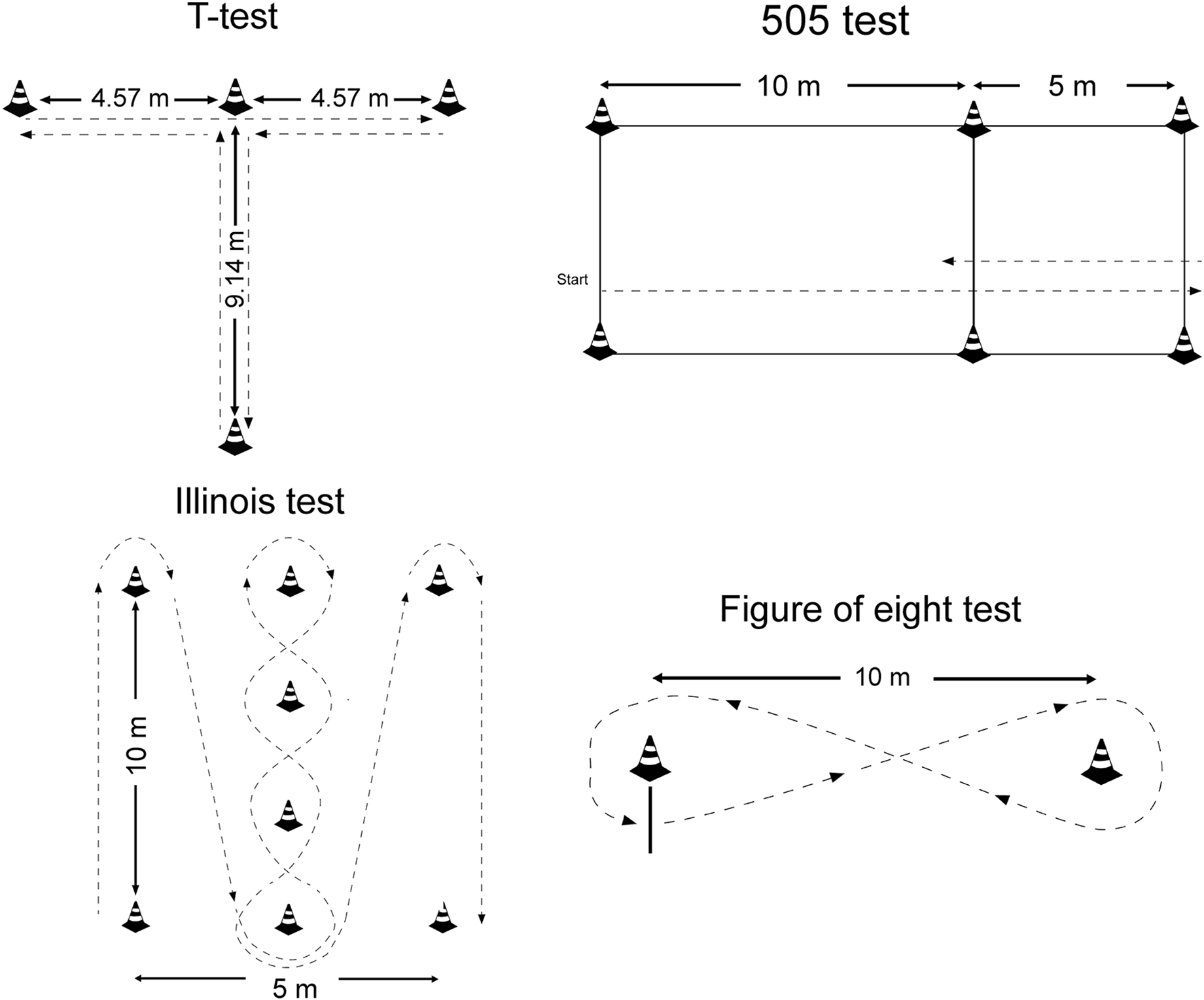
Graphical representation of illinois test, T-test, 505 test and figure of eight test (performed in the first session).
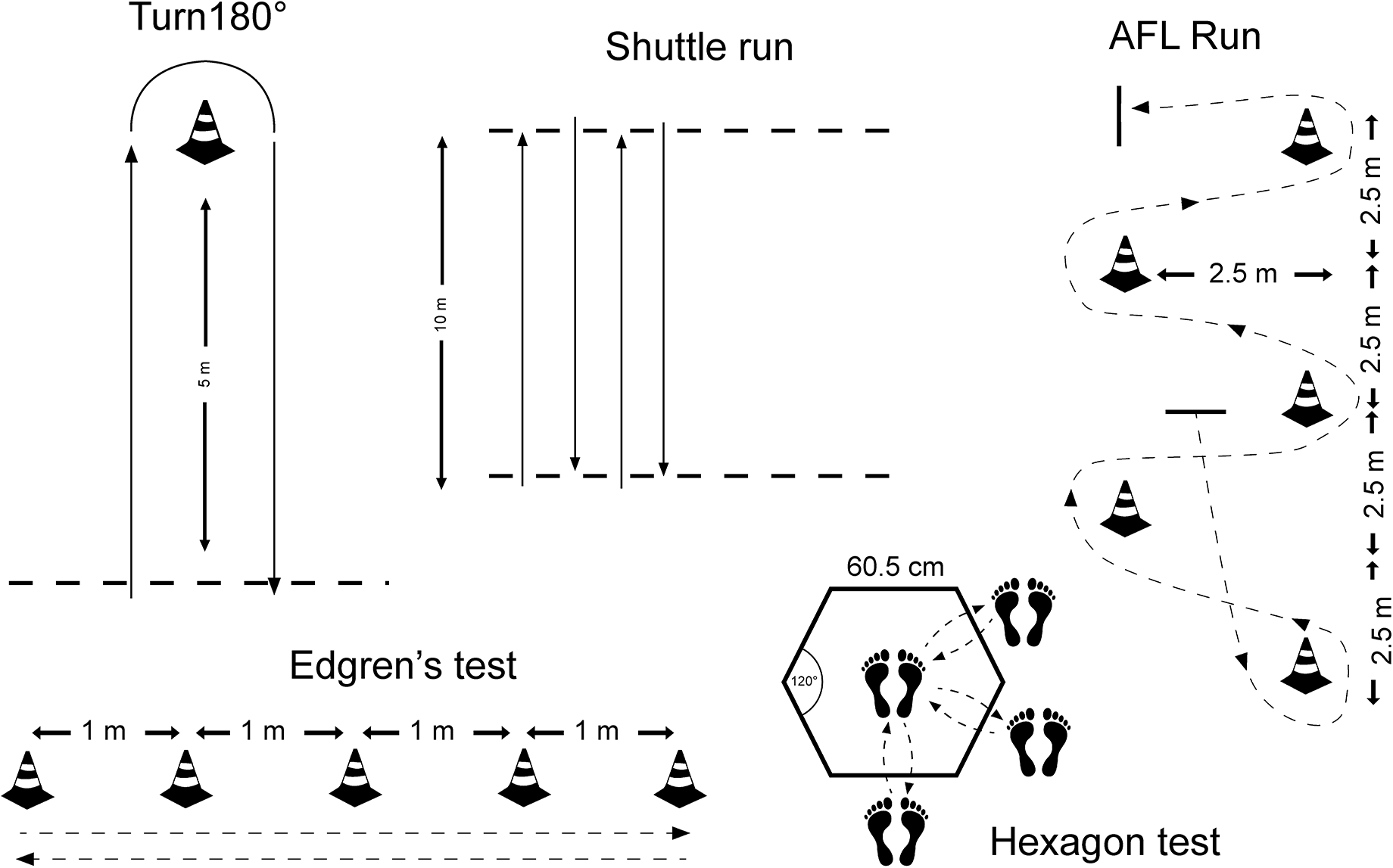
Graphical representation of Turn180 test, shuttle run, AFL Run, Edgren's test and hexagon test (performed in the second session).
Participants
The participants (n = 76; 50 females, 26 males) were 2nd and 3rd year undergraduate kinesiology students (age: 21.6 ± 1.5 years; body mass = 72.3 ± 13.1 kg; body height = 172.1 ± 12.0 cm). All participants reported to be physically active at least 3 times a week, with different preferred exercises of choice (e.g. resistance training, aerobic exercise). They also underwent several study courses that required them to exhibit decent levels of aerobic endurance, strength, flexibility and balance. The inclusion criteria were absence of injuries to musculoskeletal system three months prior to testing, no pain at the time of testing and absence of chronic non-communicable diseases. Participants were required to sing an informed consent prior to participation. The procedures were approved by National Medical Ethics Committee (approval n. 0120-690/2017/8).
Testing procedures
The testing was conducted in an indoor gym with a woodblock floor. For T-test, 505 test, Turn180 and 30-m sprint, laser timing gates (Brower Timing Systems, Draper, UT, USA), were used to maximize the precision of the measurements. For the remaining tests, stopwatches were used and the same examiner always performed the measurements for each individual test
T-test
The T-test (Figure 1) consists of forward run (9.14 m), lateral shuffling to the left (4.57 m), lateral shuffling to the right (9.14 m), lateral shuffling to the left (4.57 m) and running backwards to the starting line (9.14 m). The participants were required to touch the base of each cone to complete each portion of the test, otherwise the repetition was discarded and repeated. Between the repetitions, 2-min breaks were provided. T-test is one of the most widely used CoD tests and its reliability in college-aged population has been shown before.11,32
Illinois test
The participants started the test lying prone at the starting line. The test involves running forwards for 10 m and back to the starting line, then running though a slalom course (Figure 1) twice, followed by additional back and forth 10 m run. Between repetitions, 2-min breaks were provided. This test was previously reported to be in a weak correlation with the T-test, 19 but it might be less reliable in comparison to T-test. 33
The test involves running straight for 15 m, turning for 180°, and running for additional 5 m, with only the last 10 m (5 + 5 m) being recorded. Three repetitions were performed for each side (i.e. turning to left or right) in alternating order, and with breaks set at 1 min. The results were grouped according to the leg preference, with the preferred leg being self-reported by the participants as “the leg that you would use to kick a ball”. The reliability of 505 is well-established in different populations.11,12,34
Figure of eight test
The test involved running two “eight” shapes, for which two cones were placed 10 m apart (Figure 1). Although less common, this test has been used in sport science research before and has shown to be valuable in assessing dysfunction after anterior cruciate ligament injury 35 and to be sensitive to changes after plyometric training intervention. 36
30-m Sprint test
Participants were required to sprint as fast as possible for 30-m, with laser gates positioned at the start and finish lines. Standing start was used and 3 min breaks were provided between repetitions. Timing were placed at about hip height and the starting line was 0.5 m behind the first timing gate to prevent early triggering.
Hexagon test
A hexagon shape (sides length = 60.5 cm) was marked on the floor with white tape (Figure 2). The starting position was in the middle of the hexagon with feet together. On “go” command, participants jumped forwards across the line and back to the middle of the hexagon. Then, they continued to jump across sides (keeping their feet together and maintain forward orientation at all times), until three revolutions were completed. To limit fatigue, three repetitions of the test were performed only in one direction (clockwise or anti-clockwise), with the choice being left to the participants. The breaks between repetitions were set at 2 min. High reliability of hexagon test in college-aged men and women has been reported previously.32,37
AFL run
For the AFL run, the participants were required to complete a slalom course as outlined in Figure 2. The breaks between repetitions were set at 2 min. The test was suggested to have small predictive value for success in football. 20 However, research on its reliability and validity is lacking.
Edgren's test
For this test, the participants were required to cover as much distance as possible by back-and-forth lateral shuffling over the distance of 4 m in 10 s. Five cones were placed in a straight line, 1 m apart from each other (Figure 2). The participants started at the middle cone, shuffled laterally to the leftmost cone, then to the rightmost cone and so on. One examiner gave the “go” and “stop” commands and a second examiner counted the covered distance to the nearest 0.5 m. The breaks between repetitions were set at 2 min. Edgren's test was previously reported to have excellent inter-rater reliability. 33
Single 180° turn (Turn180)
The Turn180 involved running around a cone (placed 5 m from the starting line) and back to the starting line (Figure 2). Standing start was used and three repetitions were performed for each side (i.e. turning to left or right) in alternating order and with breaks set at 1 min. As with the 505 test, the results were grouped according to leg dominance. Being similar to more commonly used 505 test, Turn180 has been used before to assess single CoD ability and was reported to be highly reliable. 38
Shuttle run
This test involved running 4 × 10 m, with an additional task of transferring two objects (small, lightweight (∼0.5 kg) wooden blocks were used) to the start line (Figure 2). The participants run 10 m, picked up the first object, run back to the starting line and put the object down, run for 10 m again and picked up the second object, and the ran to the starting line for the final time. The time recording was stopped when the participants crossed the starting line with the second object (the second object did not need to be put down to the floor). The breaks between repetitions were set at 2 min. Although not commonly used, the test is purported to be an indicator of speed of movement, agility and coordination. 39
Statistical analysis
Statistical analyses were done with IBM SPSS Statistics (version 25.0, IBM Inc., Armonk, NY). For all analyses, the threshold for statistical significance was set at p < 0.05. Descriptive statistics are reported as mean ± standard deviation. The normality of the data distribution was checked with Shapiro-Wilk tests. Relative reliability was assessed by intra-class correlation coefficient (ICC), using two-way random effects model for absolute agreement and single measurement application. 40 The reliability, according to ICC, was interpreted as poor (<0.50), moderate (0.50–0.75), good (0.75–0.90) and excellent (>0.90). 40 Systematic error between trials was assessed with one-way analysis of variance for repeated measures. In case of significant difference among the trials, Bonferroni-corrected post hoc t-tests were also performed. Absolute reliability was assessed with typical error (TE), as outlined by Hopkins. 41 To compare the absolute reliability among the tests, the TEs were converted to coefficients of variations (CV), by dividing the TE by the mean value and multiplying it with 100%. CV < 10% was considered acceptable. Sex differences were assessed by independent sample two-tailed t–test, with Bonferroni-Holm corrections for multiple comparisons. 42 The effect sizes were expressed as Cohen's d, where <0.20 = trivial; 0.20–0.60 = small; 0.61–1.20 = moderate; 1.21–2.0 = large; 2.01–4.0 = very large. 43 Principal component analysis was conducted according to the guidelines set by Rojas-Valverde et al., 44 using the results of 9 CoD tests (i.e. 9 initial variables). First, the associations among the tests were assessed with Pearson's correlation coefficients and interpreted as negligible (<0.1), weak (0.1–0.4), moderate (0.4–0.7), strong (0.7–0.9) and very strong (>0.9). 45 The retention loading criterion was set at >0.5. For both analyses (i.e. males and females), 8 variables were considered after correlation matrix exploration. The variables were scaled with z-transformation before entering further analysis. Principal component analysis with varimax rotation method was used to extract principal components and factor loadings of individual tests. Bartlett's test of sphericity and Kaiser-Meyer-Olkin measure for sampling adequacy were performed to determine if the extraction of principal component was justified (>0.5). The extracted components were considered relevant if their eigenvalues were >1. The retention criterion for factor loadings was set at >0.6, and when cross-loading was found, the factor with the highest loading was kept.
Results
Reliability
Most of the tests exhibited good to excellent relative reliability (ICC > 0.75), with the exception of the Turn180 for the non-preferred side (ICC = 0.68). Systematic error across the trials was present only for the hexagon test (F = 5.94; p = 0.02), with the only statistically significant difference, indicated by post-hoc t-test, being present between the 1st and the 3rd trial (p = 0.04). Absolute reliability was acceptable for all tests (CV = 2.77–6.69%). There were no statistically significant differences between preferred and non-preferred side for 505 test (p = 0.18) and Turn180 (p = 0.15). Based on the reliability results, we considered only the preferred side for the tests that were done for both sides separately (Table 1).
Reliability of change of direction tests.
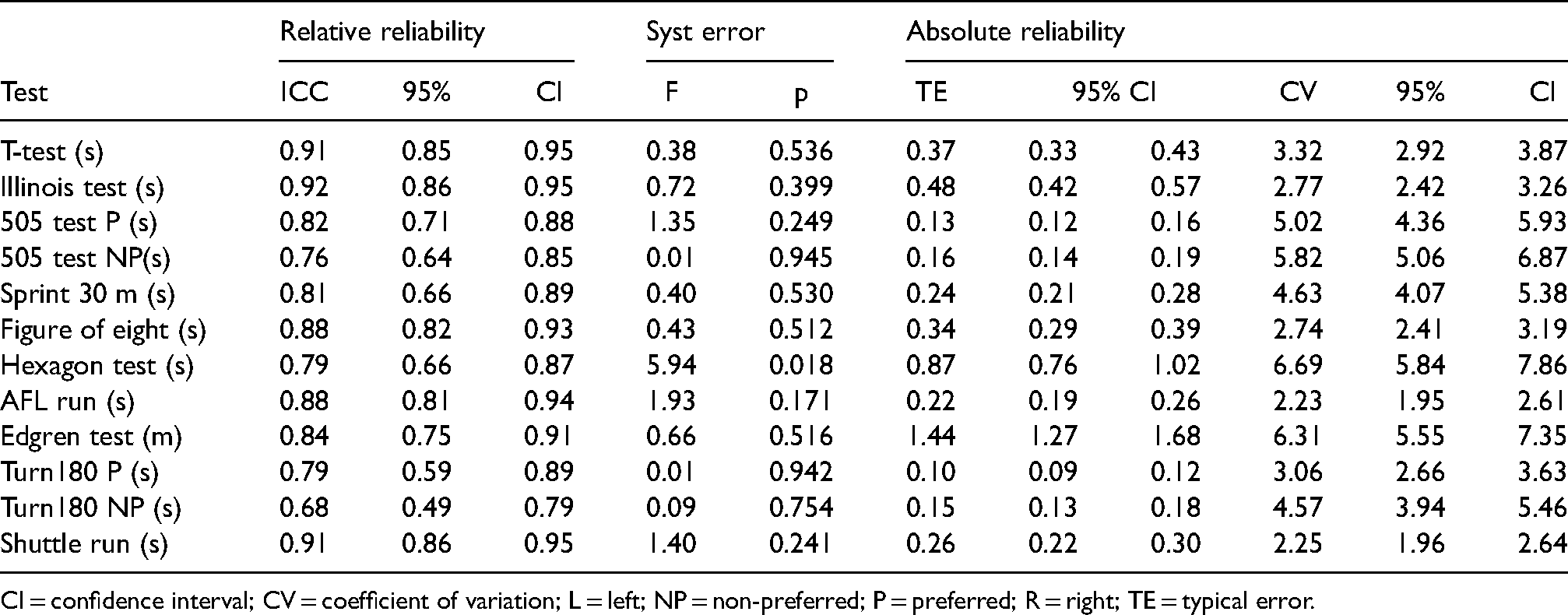
CI = confidence interval; CV = coefficient of variation; L = left; NP = non-preferred; P = preferred; R = right; TE = typical error.
Sex differences
Descriptive statistics with t-test statistics for sex differences are available in Table 2. Males showed better performance in most tests, with the exception of hexagon test (p = 0.59) and Turn180 test (p = 0.58). Effect sizes for statistically significant differences between males and females were moderate to very large (d = 0.83–2.33; see Table 2 for details).
Descriptive statistics and sex differences.
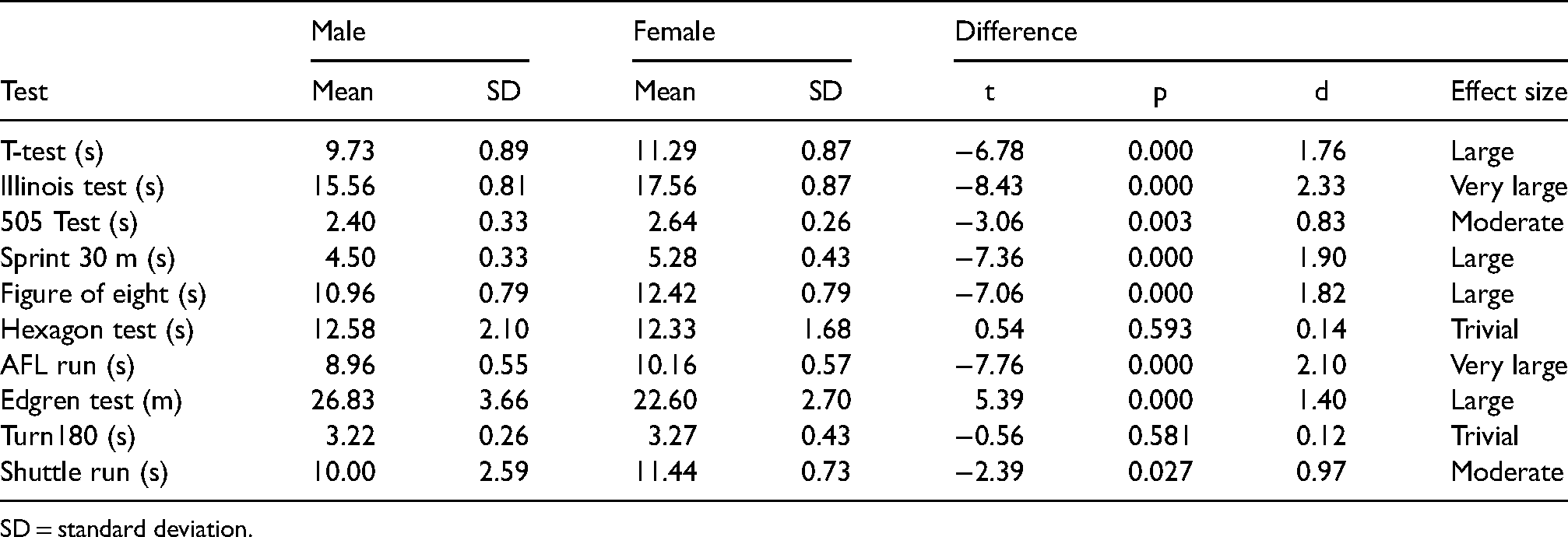
SD = standard deviation.
Correlation among tests
Correlations among the tests are displayed in Table 3. Generally, the outcomes of different CoD tests were in small to large correlation with each other. The hexagon test results were not associated with the results of any other tests in males except AFL run (r ≤ 0.49; p < 0.05) and were moderately correlated with Figure of Eight test (r = 0.44; p < 0.05) and Shuttle run (r = 0.49; p < 0.01) in females. Based on the retention loading criterion (factorability), the hexagon test was excluded prior to principal component analysis. In males, the 30 m sprint was in moderate correlation with Illinois test, 505 test and Hexagon test (r = 0.49–0.54; p < 0.01). In females, the 30 m sprint was in moderate correlation with T-test, Illinois test and Figure of Eight test (r = 0.42–0.51; p < 0.01) and in weak correlation with 505 test, AFL run, Turn180 and Shuttle run (r = 0.28–0.39; p = 0.01–0.04).
Correlation coefficients between the tests.
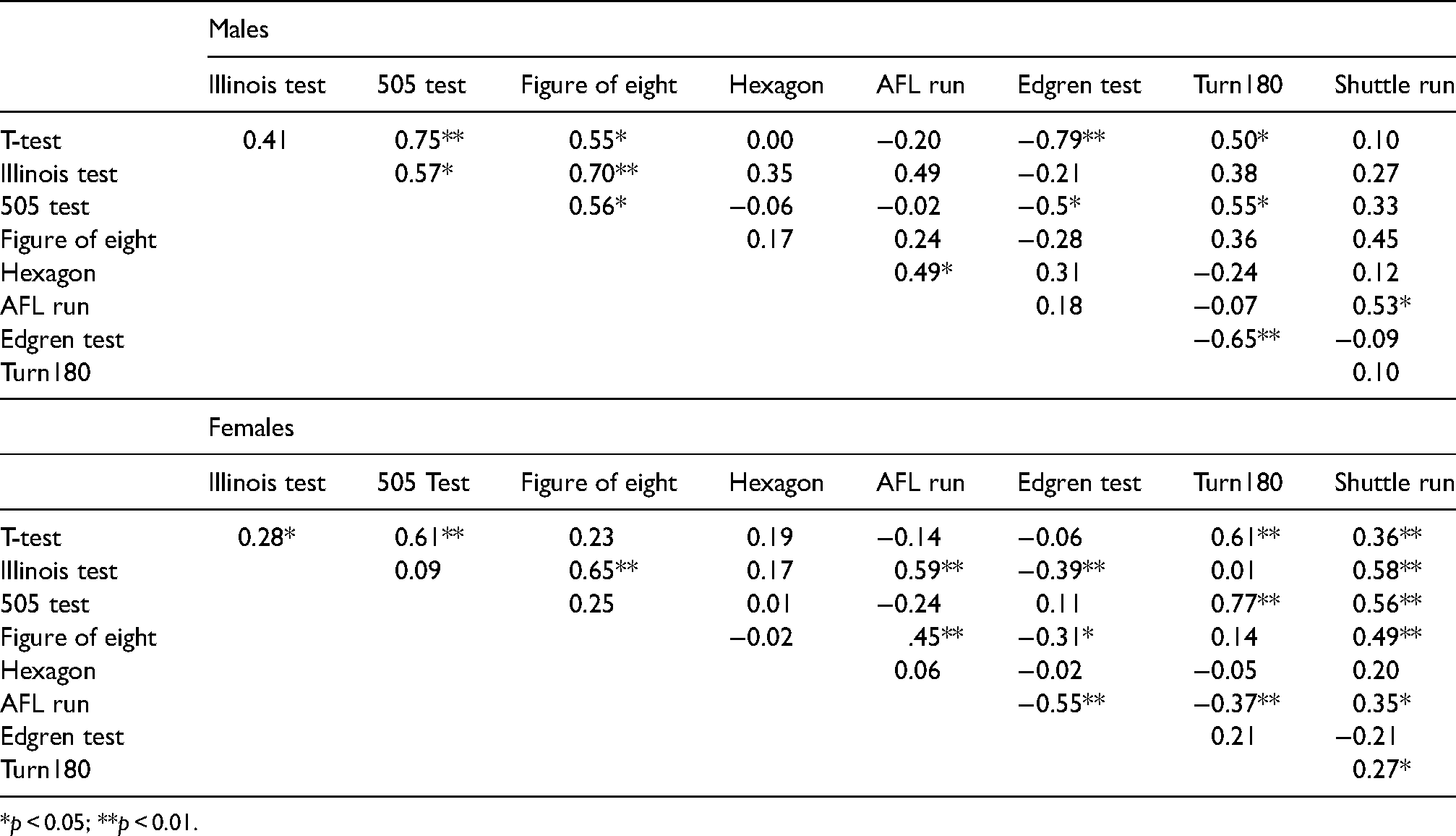
*p < 0.05; **p < 0.01.
Principal component analysis
The extraction of principal components was justified by statistically significant Bartlett's test of sphericity (χ2 = 52.1–216.1; p < 0.01) and Kaiser-Meyer-Olkin measure of sampling adequacy of 0.52 and 0.71 for males and females, respectively.
In males, three components were extracted, explaining the total of 82.3% of the total variance. The first component (eigenvalue = 2.8; 36.0% of the total variance) contained T-test, 505 test, Edgren test and Turn180 test. The second component (eigenvalue = 2.1; 27.3% of the total variance) contained Illinois test and Figure of Eight test. The third component (eigenvalue = 1.5; 19% of the total variance) contained AFL run and Shuttle run. In females, two components were extracted, explaining 71.4% of the total variance. The first component (eigenvalue = 3.1; 39.0% of the total variance) contained Illinois test, Figure of Eight test, AFL run, Edgren test and Shuttle run. The second component (eigenvalue = 2.5; 32.4% of the total variance) contained 505 test, T-test and Turn180 test. The factor loadings of individual tests for the three components are presented in Table 4.
Principal component analysis with factor loadings.
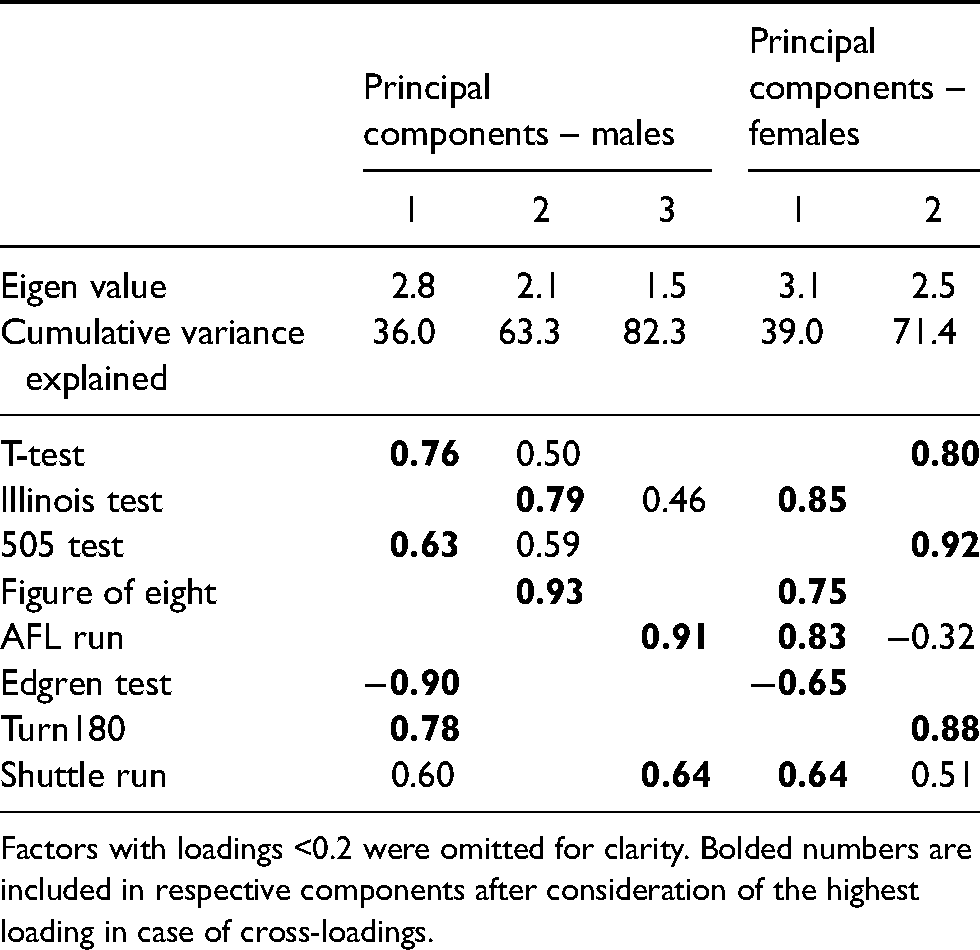
Factors with loadings <0.2 were omitted for clarity. Bolded numbers are included in respective components after consideration of the highest loading in case of cross-loadings.
Discussion
The purpose of this study was to explore if different CoD tests might be used to assess different aspects of CoD ability, by using principal component analysis. The results suggested that 3 and 2 different latent components of CoD ability were present in males and females, respectively.
In males, three components were extracted. The first component (T-test, 505 test, Turn180 and Edgren's test) could represent CoD ability, while the second component (Illinois test and Figure of Eight test) possibly represents maneuverability. The third component (AFL Run and Shuttle tun) could represent the combination of the two, as the tests involve both sharp turns, interspersed with sprinting. Supporting this, the Illinois test, which also involves two sharp turns, also had a small loading on the third component, while the Figure of Eight test, which involves only maneuvering, did not. In females, only two components were extracted, with the first component resembling maneuverability and the second resembling CoD ability. An important discrepancy between the sexes was noted, as the Edgren's test belonged to the CoD component in males, but to maneuverability component in females. On one hand, considerably less males (n = 26) compared to females (n = 50) were included in the study, which could be the reason for the differences observed in principal component analysis. Moreover, for males, the Kaiser-Meyer-Olkin measure was relatively low (0.52). Thus, it cannot be excluded that the observed differences between sexes were observed due to unequal sample sizes. On the other hand, it could also be that CoD performance is underpinned by slightly different determinants in males and females. Previous studies have noted that there are both biomechanical and perceptual-cognitive differences between sexes in agility tasks. 46 This would have important implications for sex-specific training, but it would need to be investigated further. Our results imply that shuttle run and AFL run tests offer additional information regarding CoD performance in males, but no in females. In shuttle test, a substantial between-participant variation was present in males (SD = 2.59 s) compared to females (SD = 0.73). It could be that the test also assesses motor coordination and proficiency of object manipulation. Indeed, there is some evidence for better motor coordination in females compared to males, 47 and it could be that separate component was extracted due to higher variability in underlying coordination in males. Moreover, both AFL test and shuttle test heavily rely on linear sprint speed. It could be speculated that males vary more in terms of their sprinting ability, which is why a separate component was extracted for CoD tests involving a lot of linear or near-linear sprinting. In any case, the practical application of these finding is that more CoD tests are needed in males for comprehensive assessment of CoD ability. Overall, all of the selected tests exhibited acceptable relative and absolute reliability, with the exception of Turn180 test for the right side, which showed unacceptable relative reliability (ICC = 0.68). This is consistent with the existing body of literature that shows mostly high or excellent reliability across CoD tests.11–13,32–34 Hexagon test was not related to any other test, suggesting that hopping/jumping CoD ability is a completely separate from running CoD ability or maneuverability.
Previous studies have demonstrated the need for specific and separate testing of individual physical abilities, such as jumping, sprinting and CoD ability. 48 In this study, the principal component analysis revealed three separate components for males and two components for females. Our results suggest that, at a minimum, practitioners should use separate tests to assess CoD ability and maneuverability. This has important implications for training design. Both maneuverability and CoD ability have been previously shown to be related to linear sprinting,3,13,21–24 which is also confirmed by statistically significant correlations between CoD tests and 30 m sprint. The performance of “pure” CoD tests (e.g. 505 test, Turn180) is also strongly related to muscle strength.25,26 Thus, if the assessment showed good maneuverability, but poor CoD, practitioners should emphasize strength development during training. In the opposite case, improving linear sprinting would be recommended as a primary goal. Previous reports by Stewart et al. 11 and Stojanović et al. 12 reported only one component, explaining 89.5% and 73.9% of the total variance of all tests, respectively. However, they included less tests (6 and 5, respectively), and only one test in both studies (505 test and modified 505 test, respectively) consisted of a single CoD maneuver. In the former study, 11 the 505 test correlated well with the remaining tests (r = 0.84–0.89 for total sample, r = 0.60–0.90 for male and female subgroups). Modified 505 test was also in moderate to high correlation (r = 0.56–0.77) with remaining tests in the second study. 12 In the present study, 505 test and Turn180 test were moderately to highly correlated with each other (r = 0.55–0.72) and several of the remaining tests (see Table 3 for details). It seems that the wider selection of tests enabled us to identify two separate components in contrast to previous studies.11,12 Metikos et al. 18 used an even larger test battery (32 tests) and reported that at least 5 separate components of CoD ability could exist Their findings suggest that CoD ability is far too complex to be assessed with one test. Our study corroborates this, suggesting that at very least, assessment of CoD ability should include a combination of maneuverability and CoD ability tests. On the other hand, the potential role of the hexagon test in CoD assessment is less clear. While commonly purported to be an agility test,32,37,49 the hexagon could be heavily influenced by jumping ability. Indeed, it has been reported to be correlated with both vertical (r = 0.60) and horizontal (r = 0.63–0.68) jumping ability, 50 although some studies showed much smaller correlations (r = 0.22–0.29) with vertical jumping ability. 32 In any case, if the athlete is required to perform hopping/jumping CoDs during training and gameplay, hexagon test or similar tools should be used in addition to other CoD tests.
Several small to large correlations between CoD tests and 30 m sprint time were observed. Previous reports on the strength of the relationship between CoD ability and speed are equivocal,3,21–24 however, linear speed ability unquestionably influences the results of CoD tests to some extent. It has been stressed that only approximately 31% of the time taken to complete the 505 test is spent changing the direction of movement. 51 In tests that take more time to complete, this percentage is possibly even lower. This fact has been recently acknowledged as somewhat problematic, and new testing approaches have been suggested to provide a more isolated measure of CoD ability and asymmetries in CoD.51,52 Briefly, this approach takes total CoD test time and subtracts linear sprint time for the same distance (e.g. 10 m for 505 test), which isolates extra time needed to complete the test to a CoD maneuver. Such approaches should be considered in the future to better isolate CoD ability from linear sprinting ability.
The extrapolation of our findings to practice is limited due to small number of tests. Future studies should consider exploring relationships among a higher number of more versatile tests of varying length and complexity, involving different angles of CoDs and different relative contributions of frontal, lateral and backward movements, as well as jumps and hops. 18 Furthermore, the extrapolation of our results to athlete populations is questionable, although the participants were decently trained. Previous reports by Stewart et al. 11 and Stojanović et al. 12 reached a similar conclusion after applying principal component analysis to CoD test in college-age population and basketball players, respectively. In the latter study, a somewhat lower percentage (73.9%) of variance in all the tests was explained by the one and only identified component, which could be due to different test selection and homogeneity of the sample. 12 According to the results of T-test, Illinois test and 505 tests, our sample was comparable or slightly better regarding CoD ability compared to physical education students assessed by Stewart et al. 11 Moreover, we used stopwatches instead of timing gates for some tests for logistical reasons. It must be taken into account that some error could have occurred and affected our results. Finally, considerably less males (n = 26) compared to females (n = 50) were included in the study, which could be the reason for the differences observed in principal component analysis. For males, the Kaiser-Meyer-Olkin measure was relatively low (0.52), which means that the results for the male group should be interpreted with caution.
Practical application
Contrary to previous evidence, this study suggests that CoD test should be subdivided at least into two components (i.e. pure CoD ability tests and maneuverability tests). Bearing in mind the underlying determinants of CoD ability and maneuverability (e.g. linear velocity, strength), practitioners can use this knowledge to optimize training design. Separate tests involving hopping/jumping CoD (such as hexagon test) should also be included if such ability is needed for a given athlete. In other words, it cannot be inferred that an athlete proficient in pure CoD ability tests and maneuverability tests will also exhibit good performance in CoD tasks that involve hopping/jumping movements. Our results also imply that CoD ability could consist of more independent components in males, compared to females. Although this could be simply due to higher variability in some test for males, including even more tests (such as tests involving higher demands for coordination (Shuttle test) or involving linear sprinting coupled with CoD actions) for males might be needed for comprehensive assessment of CoD ability. We recommend that coaches include, at a very minimum, two CoD tests for females (e.g. 505 test for pure CoD and Illinois test for maneuverability), and three test in males (e.g. 505 test, Illinois test, and Shuttle test or AFL run).
Footnotes
The study was supported by the Slovenian Research Agency through the project TELASI-PREVENT [L5-1845] (Body asymmetries as a risk factor in musculoskeletal injury development: studying aetiological mechanisms and designing corrective interventions for primary and tertiary preventive care).
Declaration of conflicting interests
The author(s) declared no potential conflicts of interest with respect to the research, authorship, and/or publication of this article.
Funding
The author(s) received no financial support for the research, authorship, and/or publication of this article.
