




Abstract
Skill assessments are essential to elite soccer coaches and clubs, to provide an evidence-based approach to player evaluation. Valid methods thereby support talent identification and development procedures (e.g. scouting and training strategies). However, it remains a complex challenge. Small-sided games have emerged as a promising tool, due to high ecological validity. Until now, no review has focused on their discriminative power. Therefore, we aimed to investigate whether technical–tactical skill assessments of small-sided games can discriminate between individual players and between teams of different skill levels (i.e. higher vs. lower playing levels and older vs. younger players) in soccer. A scoping review of PubMed, Web of Science, and MEDLINE databases was performed according to the Preferred Reporting Items for Systematic reviews and Meta-Analyses extension for Scoping Reviews guidelines. A total of 23 studies were included, all but one of which showed at least good methodological quality (i.e. > 50% score in quality assessment). For technical skills, small-sided games indicate discriminative power for passing skills, but only when comparing players of different playing levels, as supported by two of the included studies. Tactical categories, such as movement variability and decision-making, were more pronounced in higher level and more experienced players. However, the most conclusive finding among individual skill assessments was that the technical–tactical overall performance (a total score comprised of different subcategories) of individual players showed a positive relation to skill level in three studies. Team performance assessments in small-sided games showed that older and higher level teams mainly distinguish themselves from less-skilled peers by using the available space more efficiently. With the influence of different assessment instruments and several small-sided games modifications in mind, it may be concluded that technical–tactical skills in small-sided games can discriminate between players and teams of different skill levels. An interesting future avenue is to examine a more consistent approach to skill assessments in small-sided games, which can warrant their use for scouting and talent identification purposes.
Introduction
Assessing skills is fundamental for the identification of the most promising soccer players. These athletes cannot only generate millions in revenue for the clubs that they represent, 1 but also contribute to their team's overall success. This makes player evaluation an important task for soccer clubs and associations.2,3 Thus, conducting assessments successfully can help to improve talent identification and development processes, as well as strategies for training. 4 Yet, with the variety of influences on performance in soccer (i.e. physiological, psychological, cognitive, technical, and tactical abilities), skill evaluations still are complex avenues.5–7 Additionally, a lack of early indicators for future elite performance further adds to the challenge of successfully identifying the best talents.8–10 Nevertheless, a major aim of researchers and practitioners in soccer is to find and apply evaluation methods, that allow for reliable and valid assessments of players’ skills and potential. 5
Isolated skill tests, which aim to assess a single skill (e.g. Shuttle run test) have often been utilized by researchers and practitioners in the past.11, 12 However, due to their detachment (i.e. isolation) from the natural dynamics of a soccer game, they might reveal suboptimal predictions of in-game performance. 13 Hence, researchers have pointed to the importance of representative designs, where the context in which skills are assessed closely resembles that of the actual performance environment.14–16 More specifically, such designs keep the essential constraints (i.e. personal, task, and environmental) intact. 16 Accordingly, in soccer, representativeness can be achieved by including key performance components of a full-sized match, such as the rules of the game and the dynamic interactions with teammates and opponents. Therefore, 11-v-11 game observations may be considered an ideal assessment context, which in practice is often used for match analyses. 17 Both, traditional (i.e. observation-based data annotations) and modern (i.e. position data analyses) technologies can be used to gather objective and relevant information about players’ in-game performance. 18 The information also allows an insight into differences between more and less successful teams (e.g. Memmert et al. 18 and Filetti et al. 19 ). Yet, 11-a-side games are hard to control, may not always be feasible, and pose difficulties when trying to assess the performance of all players. Additionally, it is challenging to obtain enough data from individual players due to limited ball touches in a full-sized match.
A small-sided game (SSG) is a setting that provides more representativeness than isolated skill tests and is often a more feasible assessment context than a full-sized match. SSGs have gained popularity in recent years, as they allow the mimicking of game-like situations.20,21 They do so by keeping the most essential elements of the sports and reproducing them on a smaller scale, for example in a 3v3 or 7v7 set-up.15,22 Although SSGs are faster paced than full-sized matches, research suggests that especially when a match-derived relative pitch area per player is considered, they are in fact representative of 11-vs-11 games.15,23,24 Additionally, by reducing the number of players, SSGs also afford individual players to have more involvement in the game. Hence, extensive research has indicated their use for improvements of technical, tactical, and physical skills (for an umbrella review on SSGs see Clemente et al. 21 ). Furthermore, it has also been argued that SSGs can be a promising assessment instrument for player evaluations in soccer.5,22 However, for SSGs to be considered a valid assessment context they should also have enough power to discriminate between players of different skill levels. That is, players with higher playing levels, and who are older (thereby participating in stronger competitions), should demonstrate relatively better SSG performance.
While this can be investigated for various performance characteristics, research shows that players at an elite level separate themselves from less-skilled players, especially through their technical–tactical abilities.25–27 Accordingly, findings from recent studies suggest, just like in full-sized matches, that superior players show better technical–tactical skills in SSGs. For instance, when investigating the performance of 11- to 15-year-old players in a 4v4 SSG, Bennett et al. 28 showed that better players perform with higher proficiency in the categories of passing and ball control (i.e. touch). In contrast, assessing technical–tactical performance in an unbalanced 3v2 SSG, another study found that not the individual categories, such as passing and receiving skills, but rather the total performance (comprised of the subcategories) was able to discriminate between differently rated players. 29
Apart from the discrimination of individual players, another question is whether SSGs can distinguish between differently skilled teams. Although more complex, the inclusion of assessments on a collective (i.e. team) level in addition to individual (i.e. player) level is needed, as crucial performance characteristics in soccer rely on the interaction patterns between the players and should not simply be viewed as the sum of individual players’ performances. 30 The importance of team-level assessments is also suggested by research focusing on attacking patterns. For instance, Olthof et al. 20 found that older teams use more width of the field and therefore display a lower length-per-width-ratio (LPWratio) compared to their younger counterparts, indicating a more efficient use of space in a 4v4 game. Furthermore, Almeida et al. 31 showed that across other SSG formats (i.e. 3v3 and 6v6) more experienced players produce longer possessions, with greater ball circulation, during offensive sequences.
With studies using different SSG modifications, assessment instruments, and study designs, it seems difficult to determine a common ground among the research outcomes. Yet, the results could have meaningful implications for skill evaluations in research and practice. Therefore, in this scoping review, we aimed to investigate whether technical–tactical assessments of SSGs can discriminate between individual soccer players, and between teams of different age groups and playing levels. Hereby, we intend to investigate whether SSGs are a useful tool for skill and talent assessment, as well as highlight issues in current research that may guide future efforts.
Methods
Study design & search strategy
This scoping review was conducted following the guidelines of the Preferred Reporting Items for Systematic Reviews and Meta Analyses extension for Scoping Reviews (PRISMA-ScR) statement. 32 The protocol of this research project did not require Institutional Review Board approval.
The following key databases were searched in May 2020: PubMed (n = 346), Web of Science (n = 777), and MEDLINE (n = 392), focusing on SSGs in team sports. The search strategy implemented in this scoping review combined the following keywords: [“small-sided-games” OR “small sided games” OR “small-sided” OR “small sided” OR “conditioned games”] AND [tactical OR tactical performance OR technical OR technical performance OR talent OR match OR match performance OR scouting OR skill OR skill level OR ability OR ability level OR discriminat* OR game performance]
In addition to the search of key databases, a secondary literature scan was performed after completing the screening process for all studies that were identified through databases. The citation screening focused on all studies, which were already included in the review as well as all known systematic reviews published before June 2020.
The inclusion criteria for these articles were: (a) written in English; (b) subjects were competitive players with experience in organized/systematic training; (c) focus of studies on SSGs in soccer; and (d) SSGs used to assess at least on technical–tactical variable on individual or team level. Studies were excluded if they (a) were not available in English; (b) focused solely on physiological performance; (c) did not include systematically trained players; (d) had no group comparison; (e) were intervention studies; (f) only assessed skills on full-sized field; and (g) assessed tactical skills based on self-reports by the players.
Data extraction
Study selection and the extraction of relevant data were completed in four phases. First, database searches were exported to the Covidence online software to automatically remove all duplicates. The following step included a screening of all titles and abstracts using the inclusion criteria as a guideline. During the full-text assessment, all relevant data was extracted into a data-charting form, which was developed and discussed by two of the authors. The information on the remaining studies was then used to determine the final in- or exclusion of an article. All included studies were divided into individual and collective skill assessments. Relevant data such as the characteristics of the participants (e.g. age and playing level), used assessment instruments and SSG formats; and the various outcome measures, including their definition, were grouped and abstracted (see Tables 1 and 2, as well as Tables S3 and S4 in the supplementary file).
Overview of included studies focusing on individual players’ technical–tactical skills assessment.
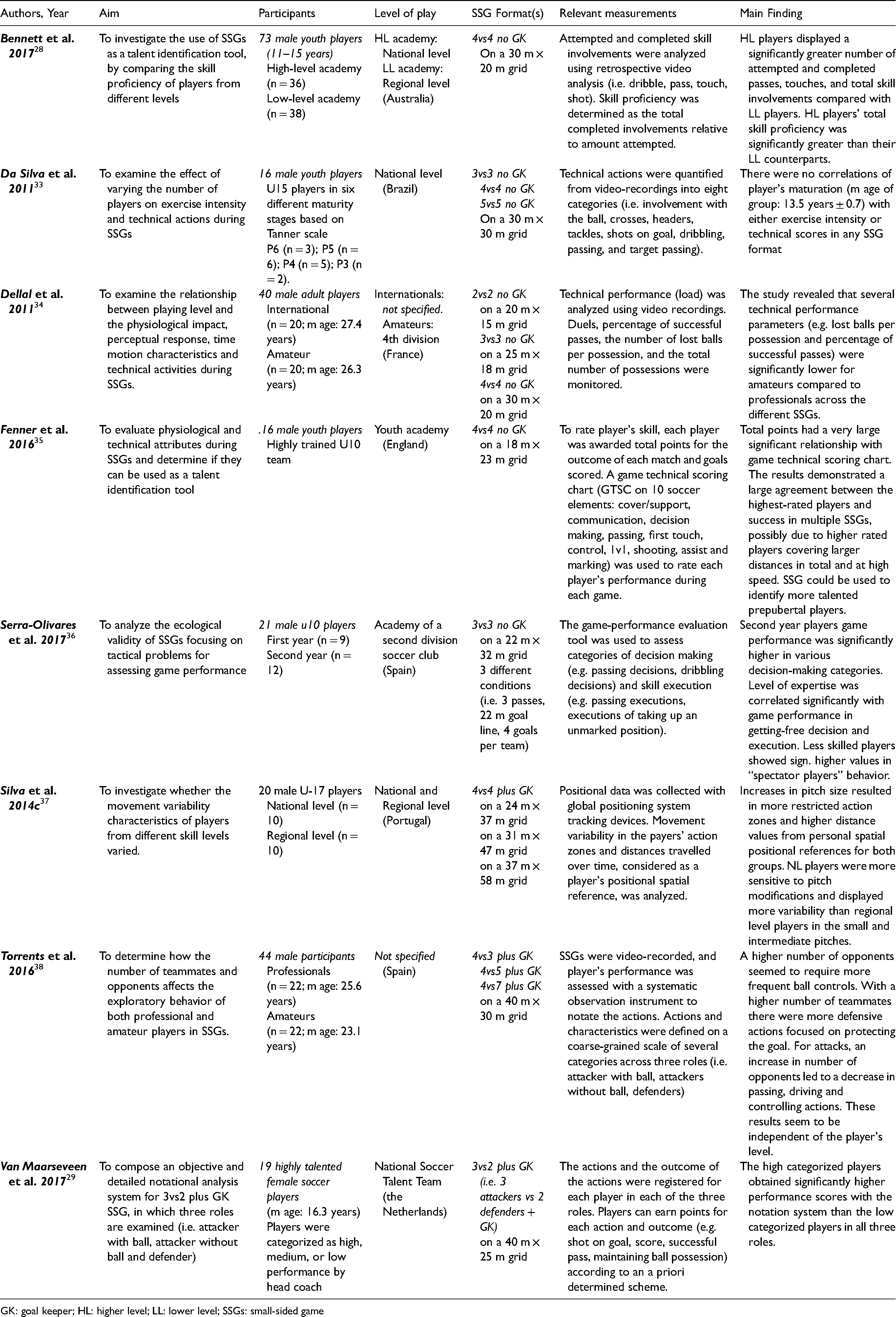
GK: goal keeper; HL: higher level; LL: lower level; SSGs: small-sided game
Overview of included studies focusing on collective technical-tactical skills assessment.
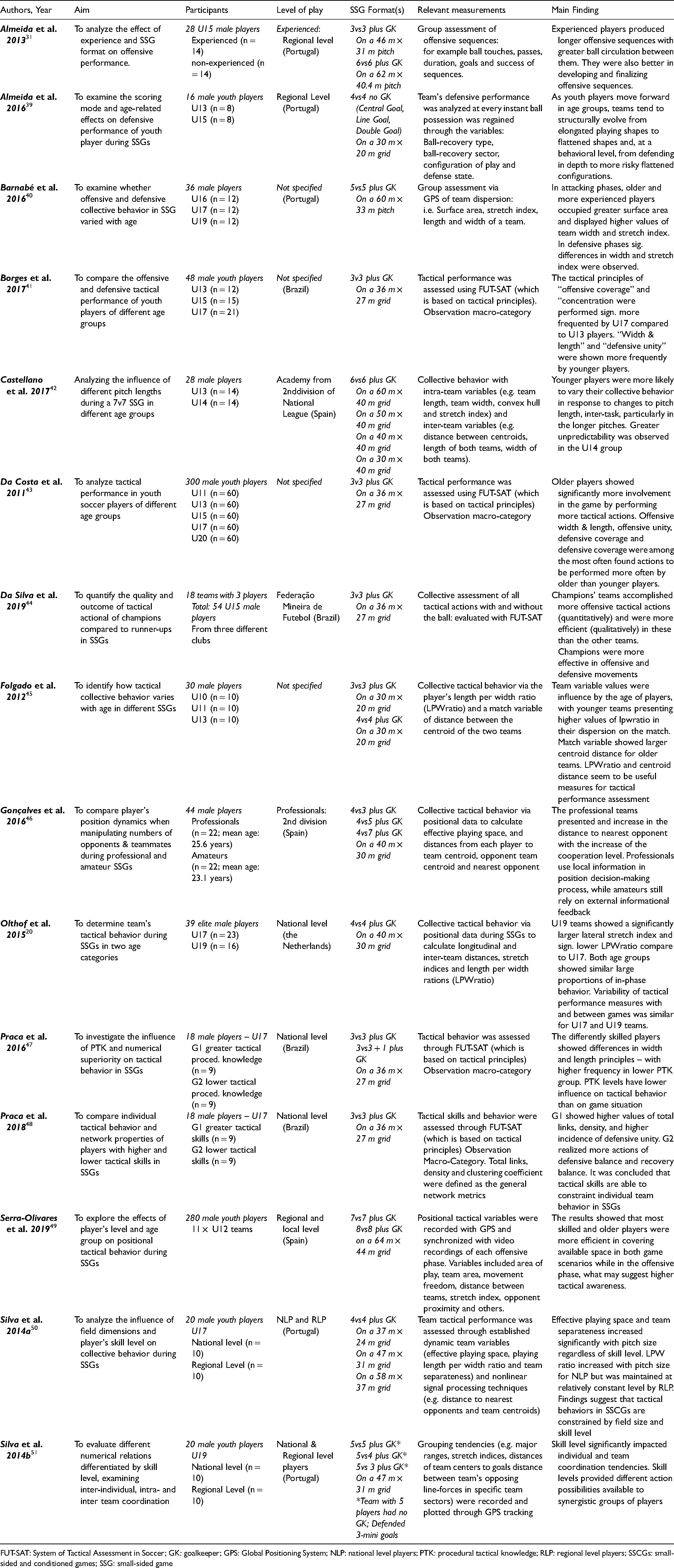
FUT-SAT: System of Tactical Assessment in Soccer; GK: goalkeeper; GPS: Global Positioning System; NLP: national level players; PTK: procedural tactical knowledge; RLP: regional level players; SSCGs: small-sided and conditioned games; SSG: small-sided game
Quality check
All included studies were assessed for their overall methodological quality by three authors independently, based on the “Guidelines for critical – review form - Quantitative Studies”. 52 In case of disagreements (which occurred in 11 of 322 total assessments), an independent rater assessed and discussed the studies with all authors until an agreement was reached. The guidelines include 16 items that aim to assess various components of a scientific research article in an objective manner. Besides items 9 and 12 which have a specific focus on intervention studies, all items of the chosen quality check were found to be relevant for this review (see Table S5 in supplementary file). As done in similar reviews,53,54 a total score (%) was calculated based on the relevant number of items, which allows for a more objective comparison of studies with different designs. Total scores <50% were considered to be of low methodological quality. Studies with a total score of 51% to 75% reached good methodological quality, and the rating of excellent quality was achieved with a total score of above 75% (based on categorization in Faber et al. 53 ).
Results
Study selection
A total of 1515 titles and abstracts were reviewed. After removal of duplicates, as well as abstract and title screening a total of 41 studies remained for the full-text review. Three additional studies were included from the secondary search. After applying the described in- and exclusion criteria, 23 studies remained for the data analysis. No further papers were excluded during the analysis process (see Figure 1).
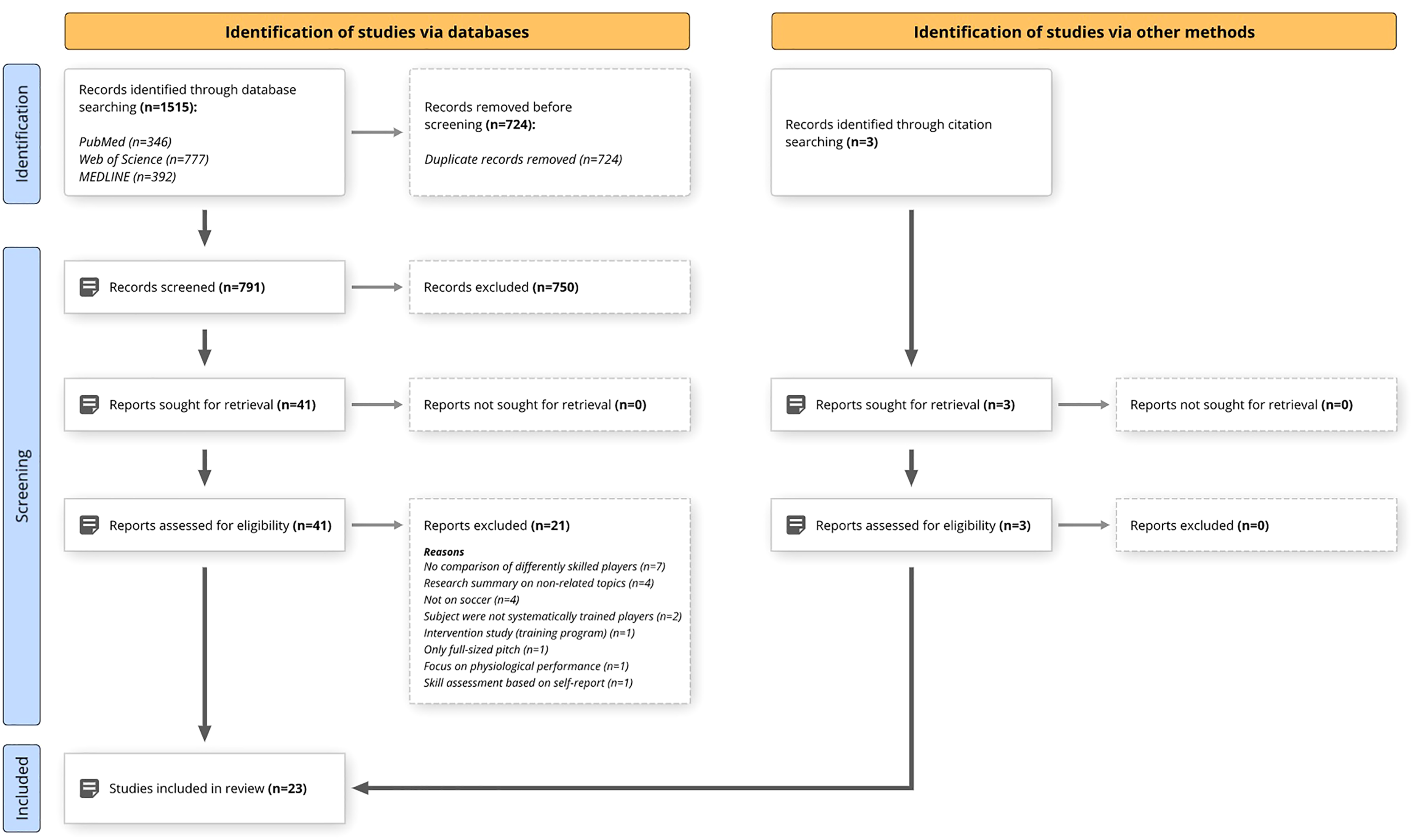
Process of study selection.
Quality check
The methodological quality among all but one of the 23 studies reached a rating of >50%. Eight studies were found to be of good methodological quality (between 51% and 75%), while 14 reached an excellent quality rating (>75%). Although all studies were consistent across most categories, some differences were found in reporting the validity of outcome measures (item 8), and the relevance for clinical practice (item 15). Some studies also lacked an acknowledgement of limitations (item 16). Almost none of the studies justified their sample size or reported whether any participants dropped out of the study (see Table S5 in supplementary file for details of assessment).
General study characteristics
Across the included 23 articles, a total of 1192 soccer players participated, of which only 19 were female. A total of 13 studies included players of the age range from U15 to U19, while seven studies were conducted with players from U10 to U14 and three with adult players (see Tables 1 and 2 for detailed overview of studies). The top players in three papers played at an international/professional level, whereas in 12 studies they competed at a national level of their respective age range. Regional players were the highest-level players in four articles, while in four further studies the level of play was not specified but it was made clear that players came from a systematically trained background. Figure 2 shows an overview of the used instruments across all included studies.
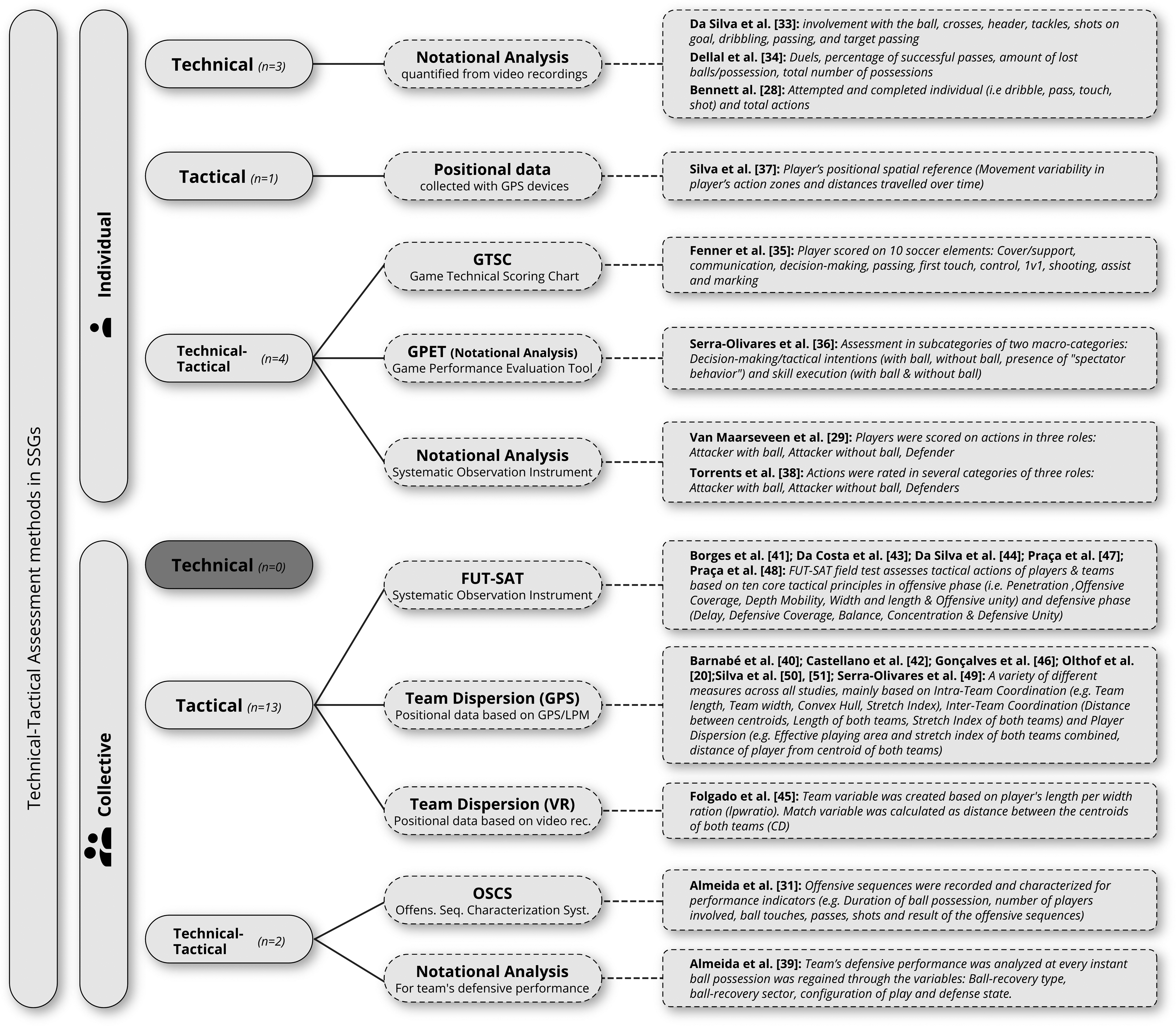
Instruments for technical–tactical skill assessments in small-sided games across included studies.
Regarding the specific modes of SSGs (see Table S3 in supplementary file), a 3vs3 with or without goalkeepers was found to be the most common SSG mode across the studies (n = 10). Almost equally as many studies included 4 versus 4 SSGs with or without goalkeepers (n = 8). In general, the mode of SSGs varied considerably. Other common modifications were 5vs5 and 6vs6 with goalkeepers, as well as conditioned SSGs, such as majority and outnumbered situations (e.g. 4vs3 or 5vs3).
Findings – individual skill assessments
A total of eight studies (i.e. 8/23 = 34.8%) focused on the assessment of individual players (see Table 1 for overview of studies). In those studies, a combined total of 249 players (female players: n = 19) participated in 12 different SSG modifications. To assess individual skills, six studies made use of individual notational analysis that were quantified from video recordings. One study had two experts assess players on a technical scoring chart during the game, 35 whereas another study analyzed the positional data of individual players. 37 All eight studies used unique definitions as well as combinations of assessment categories, indicating a large variability in the used instruments (see Figure 2).
When looking at technical skill assessments in SSGs, higher level players appear to distinguish themselves from lower level players by their passing skills. Bennett et al., 28 for example, found a significant effect for playing level for attempted (η2 = .09) as well as for completed (η2 = .17) passes, when comparing U14 players. Similar results were found for professionals compared to amateurs. 34 However, in articles with more homogeneous performance groups, passing does not seem to discriminate between players anymore. One study did not find differences in passing between differently rated players of the same team, 29 while another study found no differences for passing executions in U15 players with different levels of maturity. 33 Other technical categories, such as shots on goal, dribbling or duels found no significant differences between differently skilled players across most of the studies (see Table S1 in supplementary file).
Focusing on tactical variables, Silva et al. 37 found that in small and intermediated sized SSG configurations national-level players showed significantly higher Shannon entropy values, which indicate highly variable and unpredictable positioning when compared to regional players (see supplementary file Table S4 for more information on complex tactical variables). Individual movement variability is interpreted as a sign of superior tactical ability and perceptiveness when needing to adapt to the constraints of SSGs, where the available space is restricted. 37
Studies looking at combined technical–tactical variables also found significant differences between differently skilled players. Serra-Olivares et al. 36 showed that players with more experience (i.e. second year compared to first year U10 players) perform significantly better in making passing decisions and taking up an unmarked position. First-year players also demonstrated significantly higher values in “spectator player” behavior (i.e. player shows no active participation). Similarly, the results of Torrents et al. 38 suggest that in unbalanced SSGs professional players anticipate the need to optimize collective decision-making skills better than the amateur players. Most interestingly, and despite using different assessment subcategories, three studies consistently found significant relations between the player's skill level and their total performance score in SSGs.28,29,35 For example, Van Maarseveen et al. 29 found that the higher rated players within one team performed significantly better in all three defined roles of their notational analysis (i.e. attacking with ball, attacking without ball, and being a defender). However, except for defensive pressure, none of the individual categories that were used as performance measures for the total performance score (e.g. shooting, passing, and positioning) were able to differentiate between the differently rated players in this study. Another article, which was based their total score on points for match results and goals scored, also showed a significant relationship with the respective players’ technical–tactical skill assessments. 35
Findings – collective skill assessments
A total of 15 studies (i.e. 15/23 = 65.2%) focused on collective skill assessments involving 943 participants (all male players) in 14 different SSG formats (see Table 2 for overview of studies). A total of eight studies analyzed collective performance based on team dispersion that was derived from player position data, either based on Global Positioning System (GPS) or video recordings. Five studies used the System of Tactical Assessment in Soccer (FUT-SAT) instrument to assess the collective technical–tactical performance of teams. Two further studies recorded SSG performance through notational analysis (see Figure 2).
The most coherent finding across the included studies is that SSGs can discriminate differently skilled teams based on team dispersion. More specifically, several studies suggest that older20,39,40 and higher level49,51 players show higher width or lateral stretch index in their offensive sequences. Accordingly, studies also reported significantly lower LPWratios, which indicates a collective use of width over length during attacks, for older,20,40,45 as well as for superior players. 49 Interestingly, Silva et al. 51 reported no differences between national level and regional level U17 players in small (37 m × 24 m) and intermediate (47 m × 31 m) SSG configurations, and even a lower LPWratio for the lesser skilled players on a large pitch. In contrast to LPWratio, other categories of team dispersion, such as the effective area of team play (i.e. based on convex hull) were not consistently able to discriminate for playing level or age (see Table S2 in supplementary file).
Across the five studies using the FUT-SAT assessment instruments, only few of the 10 categories showed the ability to discriminate between players of different age or skill level. Penetration (i.e. movement of player with the ball toward the goal line) and offensive coverage (i.e. offensive support to the player with the ball) are two variables that show promising results, with more successful teams showing higher values for quantity and quality of this action. 44 Additionally, older players also score higher in this category.41,43 On the defensive side, the variables of concentration (i.e. off-ball defenders occupying vital spaces and protecting scoring area) and defensive unity (i.e. off-ball defenders reducing opponent's effective play space) discriminate in some instances for age groups, as well as for skill level.41,44,48 Interestingly, a total score of all defensive categories was partially able to distinguish between differently skilled players based on their performance in SSGs.41,44
Discussion
The present review aimed to investigate whether technical–tactical skills assessments in SSGs can discriminate between individual soccer players, and between teams of different skill levels (i.e. different age groups and playing levels). Across all included 23 studies a few technical–tactical categories indicate discriminative power. For studies focusing on individual skill assessments (i.e. 8 out of 23 included studies = 34.8%) passing skill was a discriminating factor, but only when players of different playing levels were compared. Movement variability and decision-making were other categories distinguishing differently skilled players. Additionally, technical–tactical overall performance (i.e. a total score that was calculated with subcategories) appears to show sensitivity to skill level. Collective skill assessments, which were conducted by 15 studies (i.e. 15 out of 23 included studies = 65.2%), indicate that more skilled players use available space more efficiently. However, the large variety of different assessment instruments warrants caution when attempting to generalize these results (see Figure 2). A detailed discussion of the results will be conducted separately for individual and collective skill assessments.
Individual skill assessments
Overall, the included studies suggest that SSGs cannot consistently distinguish differently skilled individual players based on single skill categories. Among the assessed technical skills, passing performance might still be the most promising variable, showing discriminative power between soccer players of different playing levels.28,34 Dellal et al. 34 suggest that specifically the passing percentage could be a good indicator of technical skills in soccer players. These results are in line with observations of full-sized matches where players in the top European leagues can be distinguished by their passing skills and pass-related variables.55,56 Considering the constraints of SSGs, where spaces are restricted, it would be logical that passing performance could differentiate between skill levels. However, the presented results cannot prove it to be a reliable discriminator, especially when playing levels are less differentiated. 29 Furthermore, it needs to be stated that the included studies might have used suboptimal operationalizations of this outcome measure (e.g. attempted passes or passing percentage). Only one out of the five studies that investigated individual passing performance, considered the nature of it (i.e. to a player in a promising position vs. a simple forward, sidewards, or backwards pass) in their assessments. 29 Recent research suggests that the quality of a pass, for example whether it sets up a chance 57 or disrupts the defense, 58 needs to be considered when evaluating passing performance.
The inconsistency in results might also be related to variables being sensitive to the selected formats. In the comparison by Dellal et al. 34 of international and amateur senior players, the most significant differences in the category of passing efficiency were found in 2vs2 and 3vs3, but not in a 4vs4 (each without goalkeepers). Additionally, Mallo and Navarro 59 also report that a 3vs3 SSG configuration with no goalkeepers tends to afford more passes and ball contacts for each player than the modification with goalkeepers. Here, it should be noted that two of the included studies that did not find significant results for passing skills used modifications that included goalkeepers. Thus, the number of field players and the format could have affected the emergence of passing across the different SSGs. These results underline the importance of selecting an appropriate SSG format depending on which skill is to be accentuated during the assessment (for reviews on the effects of SSG modifications see. Clemente et al.,21, Aguiar et al., 60 Sarmento et al. 61 )
Consistent differences did emerge in more complex categories such as decision-making skills.36,38 The need for these and other sophisticated variables, such as effectiveness of a pass57,58 and tactical action value, 62 has been discussed in the literature recently, with promising results for player evaluations. 57 Most strikingly, in two of the included studies a total performance score (based on subcategories that were different in each study), led to consistent discriminative results between differently skilled players in SSGs, although most subcategories separately (e.g. shooting and dribbling) did not.28,29 Such a combined total score may reflect the complexity of soccer particularly well. Furthermore, even a method as simple as rewarding players with points for scored goals and match outcome in SSGs shows discriminative power. 35 Although current findings are limited by the low number of studies and the differences in applied instruments, such results are a first indication that SSGs show sensitivity to the overall performance of players rather than to individual skill categories. The idea that an overall performance metric, which is based on relevant skills (e.g. passing skill, use of space, and decision-making) could be highly relevant for skill assessments and talent selection, is in line with recent literature. 22
Collective skill assessments
Studies focusing on collective technical–tactical performance in SSGs provide first evidence that SSGs could be an appropriate assessment tool for some categories on a team level. The results by Almeida et al. 31 suggest that SSGs can distinguish different skill levels, with more experienced teams recording more ball touches, longer durations of ball possessions, and more players involved in an attack than their less-experienced peers. By doing so the superior teams seem to be better at “reading the game”63–65 and finally exploiting mistakes in the defensive schemes. This way of controlled attacking seems to be assessable in SSGs, since it does not only stem from greater ball control and passing skills but also from skilled players successfully supporting the ball carrier through their positional play. 44
Additionally, attacking patterns also tend to change with the players’ age, experience, and skill. Several studies have reported that more skilled and especially older teams show higher width and lateral stretch index, as well as a significantly lower length per width ratio in their offensive build up when compared to less skilled or younger peers.20,28, 46 This means that better players tend to use the width of the field more efficiently, thereby making it possible to create separation from, and gaps between defenders. Different studies have interpreted this type of team dispersion as an individual indicator of greater tactical awareness.44,49, 51 SSGs seem to be sensitive enough to allow these differences in skill level to emerge.
However, as with individual passing skills, the results discussed above could be sensitive to SSG format and size of the pitch.42,50 When the relative pitch area per player becomes larger than in a full-sized match, and thereby becomes less representative, it might be that more advanced players adapt their strategies. Instead of using the width of the field, they may attack along the length of the field, showing a more efficient use of space. 50 It is therefore suggested to be cautious when assessing this type of tactical behavior in a skills assessment in SSG formats with a high relative pitch size. Still, spatial awareness and use of the field's width is found to be an important indicator of superior tactical skills in soccer players. It is important to note that tactical abilities seem to develop with age and experience, in that older players show better use of space20, 46 and more experienced ones less “spectator player” behavior. 36 This aspect of player development must be taken into consideration, especially when assessing young talents in SSGs.
Limitations of studies and review
The current article presents the first review on SSGs as possible assessment contexts for individual soccer players and soccer teams. Although the quality check revealed good to excellent quality among 22 of the 23 included studies, the results of this review should be interpreted with a few limitations in mind. These concern the included studies as well as the review's methodology. First and foremost, the included studies provided a high number of different assessment instruments, which make it difficult to truly generalize findings from the various skill categories. For example, eight different instruments were used across the eight studies that focused on individual skill assessments. Hence, a total performance score that was able to discriminate between differently skilled players in three studies was based on different subcategories in each of them. For the 15 studies investigating collective skills evaluations, five different instruments were used, with a variety of different outcome measures in the six studies focusing on team dispersion (see Figure 2). Another limitation results from the high variety in SSG formats (i.e. n = 22, see Table S3 in supplementary file), which can have a considerable impact on the discriminative power of outcome measures. As outlined in a previous review by Sarmento et al., 61 SSGs with lower relative pitch area emphasize key technical abilities. In contrast, larger and unbalanced SSGs enhance the use of tactical skills, such as positioning and use of space.
Furthermore, almost none of the included studies considered contextual factors, such as the players’ motivation, match status, or positional demands. All of these have been shown to influence performance.66–68 Likewise, the players’ tactical background (i.e. coaching and experience with certain formations) were also disregarded by studies and could have considerable implications for the results of technical–tactical skill assessments. Some included studies are also subject to limitations that concern group comparisons. As pointed out by Bergkamp et al. 5 categories of players’ playing levels might be a suboptimal criterion measure to distinguish players, among other reasons because it provides limited information on the individual differences between players. Lastly, some limitations are a consequence of the chosen methodology in this review. For one, the categories of the chosen quality check did not account for shortcoming in the studies, such as how variables were defined, and whether sample size was appropriate. Additionally, our search strategy focused solely on research published in English, thereby potentially ignoring important publications in other languages.
Future directions
A secondary intention of this first scoping review into SSGs as a skill evaluation tool was to identify issues in current research. By doing so, our results could guide and improve future study designs, which may ultimately enable systematic reviews and meta-analyses to investigate more specific research questions. 69 For instance, the discriminative power of technical–tactical assessments in SSGs might be investigated using more homogeneous groups. Different studies compared performance of players that differed substantially in skill and playing level. However, during skill evaluation procedures practitioners must rely on outcome measures to distinguish the best players in a group of similar skill level. As a next step, future studies may focus on the effects of skill assessments in SSGs across sexes, age groups, and various playing levels. Such results may help in establishing performance benchmarks. Another main challenge for future research is finding a precise and valid approach to quantify overall soccer performance on an individual and team level. Bergkamp et al. 15 recently showed an advanced approach of how individual categories within a notational analysis can be weighted to assign them more importance in the overall assessment of individual players. Based on recent studies,57,58 a more complex evaluation of passing performance could for example receive a higher weight than other categories, and therefore contribute to a more refined quantification of overall performance during SSGs. In practice, such assessments might support the process of finding an optimal standard for talent identification procedures. It should be noted, that when overall performance is quantified for player evaluation purposes, variables concerning the defensive performance ought to be included. Insights into the defensive actions may provide a more nuanced assessment of technical–tactical skills, but few studies have explicitly included such actions. Additionally, study designs should include SSG formats with match-derived relative pitch areas per player as this increases the representativeness of assessments.23,24 Future research may also provide more information on inter- and intra-individual variability during assessments in SSGs, for example by conducting more measurements (see Clemente et al. 21 for more information on this issue).
Practical implications
The discussed results also have relevance for practitioners in the field of player evaluation, scouting, and even talent identification in soccer. However, these practical implications should be considered with the limitations of the findings in mind (i.e. variability in study designs and used instruments, disregard for contextual factors and tactical background). When assessing the technical–tactical skills of individual players our findings suggest that a notational analysis or a similar scoring system, that combines individual skills (e.g. passing, shooting, and defending) into a total performance score might be feasible and most appropriate. On a collective level, reliable instruments such as using GPS to extract data on tactical behavior (e.g. efficient use of space indicated through stretch index and LPWratio) are also recommended for skill assessment purposes in elite soccer. Easy-to-interpret dashboards and applications are increasingly available to coaches, which facilitates the use of such data. Alternatively, notational analyses can also be used to evaluate a team's tactical performance.31,39 Hence, total (combined) performance scores on the individual level and the use of space on the collective level provide relevant skill assessments in soccer, regardless of the SSG format. However, as indicated, the choice of SSG formats may have a considerable influence on other outcome measures, which should be taken into account. For example, when the primary assessment is focused on passing skills, a modification with a low number of players and no goalkeepers could be useful. However, an unbalanced modification (e.g. more attackers than defenders) might afford players to showcase their tactical skills, such as spacing when attacking or defending. Lastly, a larger variation could also be used, as research found SSGs with six to eight players per team to be most representative of a full-sized match, if the relative pitch area per player is similar to an 11v11 (i.e. 80 m × 56 m for a 7v7, which results in a relative pitch area of 320 m2).15,70
Conclusion
The present review aimed to investigate whether technical–tactical assessments in SSGs can discriminate between individual soccer players, and between teams of different skill levels. Results from 23 included studies suggest that SSGs are sensitive to performance level across some technical–tactical categories. Specifically, complex variables such as a total performance score and decision-making skills were able to distinguish players of different skill levels, whereas such distinctions could not consistently be made based on simple quantifications of technical skills. Assessments of collective tactical behavior (i.e. attacking patterns and LPWratio) also showed discriminative power between differently skilled teams. Yet, due to the lack of consistency in study designs and assessments instruments these findings are limited. Future research may establish more consistent approaches to investigate the use of SSGs for talent identification and scouting purposes.
Supplemental Material
sj-docx-1-spo-10.1177_17479541211049532 - Supplemental material for Technical–tactical skill assessments in small-sided soccer games: A scoping review
Supplemental material, sj-docx-1-spo-10.1177_17479541211049532 for Technical–tactical skill assessments in small-sided soccer games: A scoping review by Fabian C Klingner, Barbara CH Huijgen and Ruud JR Den Hartigh, Matthias Kempe in International Journal of Sports Science & Coaching
Footnotes
Declaration of conflicting interests
The author(s) declared no potential conflicts of interest with respect to the research, authorship, and/or publication of this article.
Funding
The author(s) received no financial support for the research, authorship, and/or publication of this article.

Supplemental material
Supplemental material for this article is available online.
References
Supplementary Material
Please find the following supplemental material available below.
For Open Access articles published under a Creative Commons License, all supplemental material carries the same license as the article it is associated with.
For non-Open Access articles published, all supplemental material carries a non-exclusive license, and permission requests for re-use of supplemental material or any part of supplemental material shall be sent directly to the copyright owner as specified in the copyright notice associated with the article.
