




Abstract
Professionals involved in training programs for judokas should have access to evidence-based data on various characteristics of these athletes. In the current study, anthropometric (e.g., body height, body mass), physiological (e.g., power based on vertical jump height, maximal handgrip strength), and psychological (e.g., athletic coping skills) characteristics of judokas were examined. The judokas, aged 16-21, were classified into two groups: 30 light weight (males = 19, females = 11) and 27 heavy weight (males = 13, females = 14). Four MANCOVAs separated by sex were performed on the anthropometric, physiological, and psychological data. A discriminant analysis was also carried out. Results showed that heavy-weight males outscored their lighter peers on body height (d = 1.88), arm span (d = 1.88), and maximal handgrip strength. In the females, light-weight judokas outscored their heavier peers on jumping ability (d = 1.02) and peak power bench press (d = 1.20). Female heavy-weight judokas had greater body height (d = 1.46), a longer arm span (d = 1.35), and higher scores on maximal handgrip strength than light-weight judokas. The discriminant analysis revealed that 87.5% and 84.0% of the original grouped male and female judokas, respectively, were correctly classified. No differences in coping skills or self-regulation of learning between categories were observed. It is recommended that professionals involved in training programs may consider these differences in data when developing training programs for young judokas.
Introduction
Dutch judokas are quite successful in the international sporting arena. Currently, the Netherlands holds the seventh place of the World Nations Ranking List of the International Judo Federation (IJF) in seniors 1 and the eighth place in juniors. 2 The transition from the junior level to an elite senior athlete level in sport is a long, multidimensional, and complex process.3, 4 Inspired by Newell's constraints-led approach, 5 researchers developed a model of talent identification and talent development in sport (Groningen Sports Talent Model), 6 explaining the development of talented athletes’ sport performances over time with the hypothetical contribution of person-related, task-related, and environmental characteristics. 7 Depending on the task, the athlete (e.g. a judoka) needs certain person-related and environmental characteristics to perform well. As explored by Jonker and colleagues, 7 person-related characteristics are the multidimensional performance characteristics and can be divided into anthropometric, physiological, technical, tactical, and psychological characteristics. Environmental characteristics, for example, entail the competition structure, trainers, parents, and school. The interaction between personal and environmental characteristics leads to completing the task, which result in sport performance.
Completing the task of the Groningen Sports Talent Model, 6 may be seen as a world-class sport performance. This performance is the result of multiple factors, 8 it is important to understand which performance characteristics differentiate between athletes (e.g. judokas) at different levels, classes, ages, etc. This information provides guidance for talent development and performance optimization.
The anthropometrical and physiological performance characteristics of senior judokas have been studied extensively worldwide.9, 10 Previous research shows that elite judokas have a lower percentage of body fat and a larger arm span than their non-elite peers. 9 In addition, power based on vertical jump height and maximal- and endurance handgrip strength are discriminating physiological performance characteristics on which elite judokas outscore their non-elite peers.11–14
However, while anthropometric and physiological characteristics of judo athletes have been comprehensively addressed by the literature, psychological features received less attention. 15 In one study, elite and sub-elite judokas were found to be associated with a more problem-focussed coping style than an emotion-focused coping style. 16 Coping is defined as “constantly changing cognitive and behavioural efforts to manage specific internal and/or external demands that are appraised as exceeding the resources of the person”. 17 This involves the reaction of the individual to a stimulus of the environment in order to complete the task, for example still focussing on the task to win the tournament when the time schedule changes. With a more problem-focussed coping style, judokas attempt to accept this change, instead of emotionally thinking about the problem.
While coping is a psychological characteristic that is needed in the heat of the moment, self-regulation is an important characteristic in the development of youth athletes. 18 Self-regulation has been shown to be positively related to performance and skills in different domains, including sport. 19 Self-regulation is the extent to which learners exert control over their own learning to master a specific task and to improve.20, 21 In another study, self-regulation in 222 talented athletes, aged 12–16 years, 18 of which were judokas, was examined. 22 Higher scores on all subscales in international athletes relative to national athletes, especially on the subscale distinguishing between performance levels, were reported in this study. However, only 18 judokas participated in this study and their specific mean scores were not mentioned, therefore little was discovered on the psychological performance characteristics of the judokas.
As mentioned previously, depending on the task 6 (a world-class sport performance), the judoka needs certain anthropometrical and physiological performance characteristics to perform at a high level of proficiency.3, 4 When watching two judo matches, one in the lighter-weight and one in the heavier-weight categories, differences in pace, and explosivity are observed, suggesting differences in the tasks (a world-class sport performance in light- or heavy weight category) between the different weight categories. However, studies examining differences in judo style and performance characteristics in different weight categories are scarce. To the best of our knowledge, there is one study which reported that light and heavy U18 adolescent judokas do not score the same on various physiological measurements. 13 Light-weight male and female judokas outscored their heavier peers in muscular endurance, jumping ability, and balance ability. The heavy-weight judokas performed better on maximum strength and specific judo endurance. These findings are plausible when two judo matches are observed in light and heavy weight categories. Another study compared the maximal isometric handgrip strength of light- and heavy weight senior judokas. 23 This study found a large effect of weight category in absolute handgrip strength, for both hands, with lower values for the lighter weight categories.
These two studies are the first which consider differences in the task (a world-class sport performance in light- or heavy-weight category) and therefore differences in talent development between light- and heavy weight categories are expected. Such information is potentially useful for those professionals involved in talent development and training programs aimed at improving the ability of judokas in different weight categories – coaches, strength and conditioning coaches, physiotherapists, athletic trainers, sport physicians, and sport psychology consultants. That is, light- and heavy-weight judokas can be selected and trained in different ways, more specific to their weight category. In the long term, this study aims to contribute to the improvement of judokas' overall performance.
We attempt in the current observational study to provide an answer to the following question – What are the differences in performance characteristics between light- and heavy-weight categories in top-level youth male and female judokas? Our assumption is that light-weight judokas will score higher on short high-intensity movements, and the heavy-weight judokas will have absolute higher scores on maximal strength.13, 23 No differences in psychological performance characteristics are expected. If there are clear differences between light- and heavy-weight judokas, the training of judokas can be adapted to these specific performance characteristics in order to increase performance development towards the elite level.
Method
Subjects
Fifty-seven top-level youth judokas in the U18 and U21 age categories participated in the study (32 males, mean age = 17.83 years, SD = 1.26 and 25 females, mean age = 17.66 years, SD = 1.19). The judokas were participants in the talent development program of one of the four Regional Training Centres (RTC) or from the National Training Centre (NTC) of the National Judo Association (Judo Bond Nederland, JBN). They all competed at the highest level of their age category. The judo experience, training status, and body mass 24 of the judokas are presented in Table 1.
Participant characteristics of judo experience and training status divided by sex and weight category (n = 57).
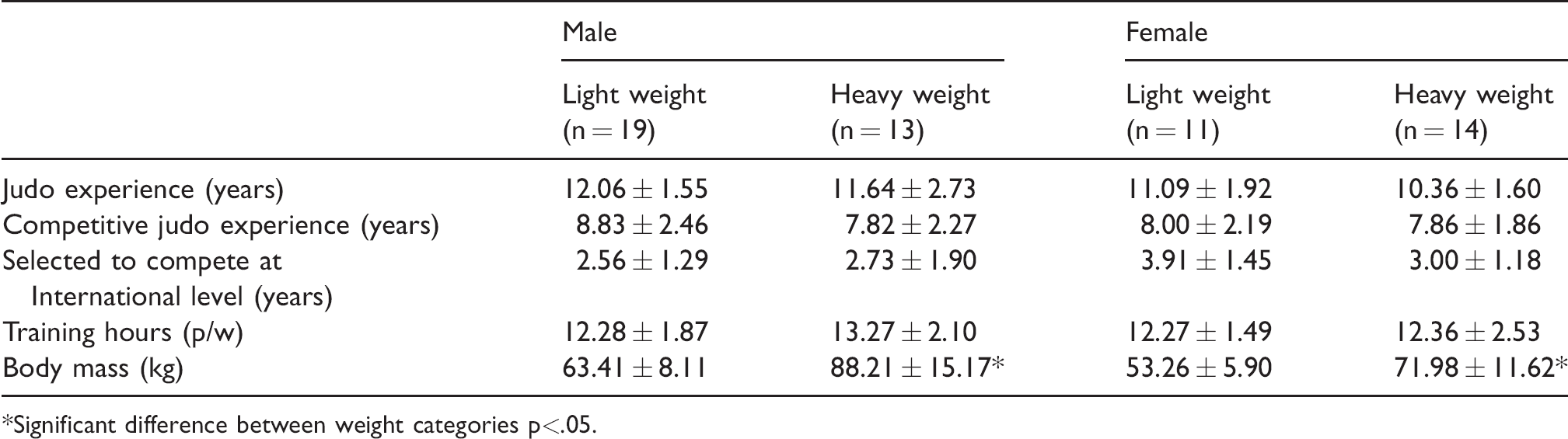
*Significant difference between weight categories p<.05.
The study was approved by the University Local Ethical Committee (201800779). All participants who were tested by the JBN received an information letter and informed consent about the aim of the study, and provided written consent for the use of their test scores. When a participant was younger than 16, both of his or her parents also received this information and had to sign the informed consent as well before the test scores of their child could be used. In the Netherlands, it is not required for participants from the age of 16 to have the informed consent forms completed by their parents or legal representatives.
Procedure
An observational design was used to determine the differences in performance characteristics between light- and heavy-weight judokas. The categorization of U18 and U21 male and female judokas in the different categories is presented in Table 2. The categorization used in this study is based on the procedure described by Kuvačić et al. 13 Due to a relative small sample size because of injuries or upcoming tournaments, two groups are made instead of three (light, mid- and heavy weights). The anthropometric, physiological, and psychological tests were administered in the first phase of the competition season.
Categorization of U18 and U21 male and female judokas in light- and heavy weight categories.

All judokas were tested under similar conditions at the national training centre, Papendal, during a weekly training session on the anthropometric and physiological characteristics. Before the tests, they performed a short warm-up session. The standardization of tests was facilitated by protocols, including detailed information about materials, set-up, and registering test scores. All tests were conducted by one graduate sport science student, who was trained and familiarized with the tests' protocols. The psychological characteristics were completed on two questionnaires by the judokas on their own time.
Anthropometric characteristics
Anthropometry included the measurement of body height, body mass and arm span. Body weight was measured with a Seca 216 Mechanical Stadiometer (Medical Measuring Systems & Scales, Hamburg, Germany), body mass was measured with Seca 877 Flat Scale (Medical Measuring Systems & Scales, Hamburg, Germany), and arm span was measured with Seca 201 Measuring tape (Medical Measuring Systems & Scales, Hamburg, Germany). Outcome measures were body height and arm span in centimetres and body mass in kilograms.
Physiological characteristics
All judokas performed three tests to determine five physiological performance characteristics: estimation of power based on vertical jump height, maximal and endurance handgrip strength, and power of the lower and upper extremities. An estimation of power was made using the Counter Movement Jump (CMJ). The judoka starts from a standing position, with the hands in his or her sides, and initiated a downward movement. 25 This act was immediately followed by an upward movement leading to a jump. CMJ was performed without arm swing so only the lower extremities were tested.26, 27 The jump technique was controlled by the test leader, first the judokas did a practice jump, if adjustment of the jump was needed, vocal advice was given. Data were collected using the Opto-Jump system (Microgate, Bolzano, Italy). The Opto-Jump has been reported as a valid and reliable measurement instrument to record vertical jump height. 28 The variables were calculated from interferences in the optical sensors in the transmitting and receiving bars. Outcome measure of the CMJ was jump height in centimetres.
Maximal and endurance handgrip strength were measured using a JAMAR handgrip dynamometer (Sammons Preston, Bolingbrook, Illinois). We applied a similar protocol to the one used in previous studies.11,12, 29 The judoka sat at a table with the dynamometer resting on the table. The maximal handgrip strength was measured with the judoka squeezing as hard as possible and holding this position for 3 sec. This procedure was repeated three times, with a 30-sec rest in-between. The highest value, for both left as right hands, was considered to be the maximal handgrip strength and was used for data analysis. The outcome measure was the handgrip strength in kilograms. The JAMAR handgrip dynamometer has been reported to be reliable and valid to measure maximal handgrip strength. 30
The handgrip strength endurance was measured in a cycle of four times. The judoka squeezed as hard as possible and held this for 10 sec, with 10 sec of rest in-between. The decline in handgrip strength for both the left and right hands was calculated between the first and last attempt and converted to a percentage value. This value was used for data analysis.
Power of the upper and lower extremities was measured with a 15-repetition maximal power bench press and a 10-repetition maximal power squat. The mean velocity, peak velocity, mean power, and peak power were the outcome measures. Data were converted to peak power corrected for body mass (watt/kg). These data were used for analysis. Data were collected using GYMAWARE (Kinetic Performance Technology, Canberra, Australia). GYMAWARE is a linear positional transducer with angle measurement that is used to measure barbell performance, velocity, and power. GYMAWARE has been reported to be a valid and reliable measurement for testing mean and peak velocity of 40-90% of 1RM in a bench press and squat movement. 31 The 1RM of the judokas was estimated from their age- and weight category and in consultation with their coach, considering the wide test range (40–90% of 1RM) this appeared to be the best choice in the available time.
Psychological characteristics
All judokas completed two questionnaires to determine athletic coping skills and self-regulation of learning. The questionnaires were executed by Qualtrics. Qualtrics is a website where advanced data are collected in a secured environment. Each judoka received a personal link to his or her own questionnaires. He or she completed the questionnaires in their own time.
Coping was measured with the Dutch version of the Athletic Coping Skills Inventory (ACSI-28).32, 33 A 4-point Likert-scale (1 – almost never to 4 – almost always) was used to score coping with adversity (4 items), peaking under pressure (4 items), goal setting (4 items), concentration (4 items), freedom from worry (4 items), confidence and achievement motivation (4 items), and coachability (4 items). Reliability and validity of the ACSI-28 was confirmed in a previous study. 34
Self-regulation of learning was measured with the Dutch version of the self-report scale self-regulation of learning (SRS-SRL), 18 based on Zimmerman's self-regulated learning theory. 35 A 4-point Likert-scale (1 – almost never to 4 – almost always) was used to score planning (8 items), self-monitoring (6 items), effort (9 items), and self-efficacy (10 items). The subscales evaluation (6 items) and reflection (9 items) were scored on a 5-point Likert-scale. Reliability and validity of the Dutch version of the SRS-SRL was confirmed in a previous study. 18
Data analysis
Analyses were performed in SPSS (IBM SPSS Statistics version 24). Mean scores and standard deviations of the anthropometric, physiological, and psychological performance characteristics were calculated separately by sex and light- or heavy-weight category. Distribution of all variables of the male and female judokas were evaluated with kurtosis and skewness, when these variables were within -2 and 2 these were considered as normally distributed. 36 In addition, effect sizes were calculated: <0.30 was considered small, ∼0.50 medium, and >0.80 large. 36
Multiple multivariate analyses of covariance (MANCOVA) were used for analysis of the data. The distribution of light- and heavy-weight categories was considered to be the independent variable. The scores on the anthropometric, physiological, and psychological performance characteristics served as the dependent variables. As these skills may vary by age, age was included as a covariate. Four MANCOVAs were performed: two for the male judokas (one for the anthropometrics and physiological performance and one for the psychological performance characteristics) and two for the female judokas (one for the for the anthropometrics and physiological performance and one for the psychological performance characteristics). For all tests of significance, an alpha level of 0.05 was considered as significant. All variables which were statistically different between the weight categories were analysed together to determine which combination of measures best discriminates between light- and heavy-weight judokas. Two discriminant analyses were performed to determine which weight category the judoka belonged to – one for male and one for female judokas.
Results
Mean scores, standard deviations, and effect sizes of the performance characteristics, divided by light- and heavy-weight categories, respectively, for male and female judokas, are presented in Tables 3 and 4. All variables of the male and female judokas were evaluated as normally distributed. There were no dropouts in the measures for anthropometrics. Two judokas did not perform all physiological tests due to injuries (missing data were 3.5%). In the psychological measures, six judokas did not complete all questionnaires (missing data were 10.5%).
Anthropometric, physiological and psychological performance characteristics in male top-level U18 and U21judokas, divided by light and heavy weight categories (n = 30).
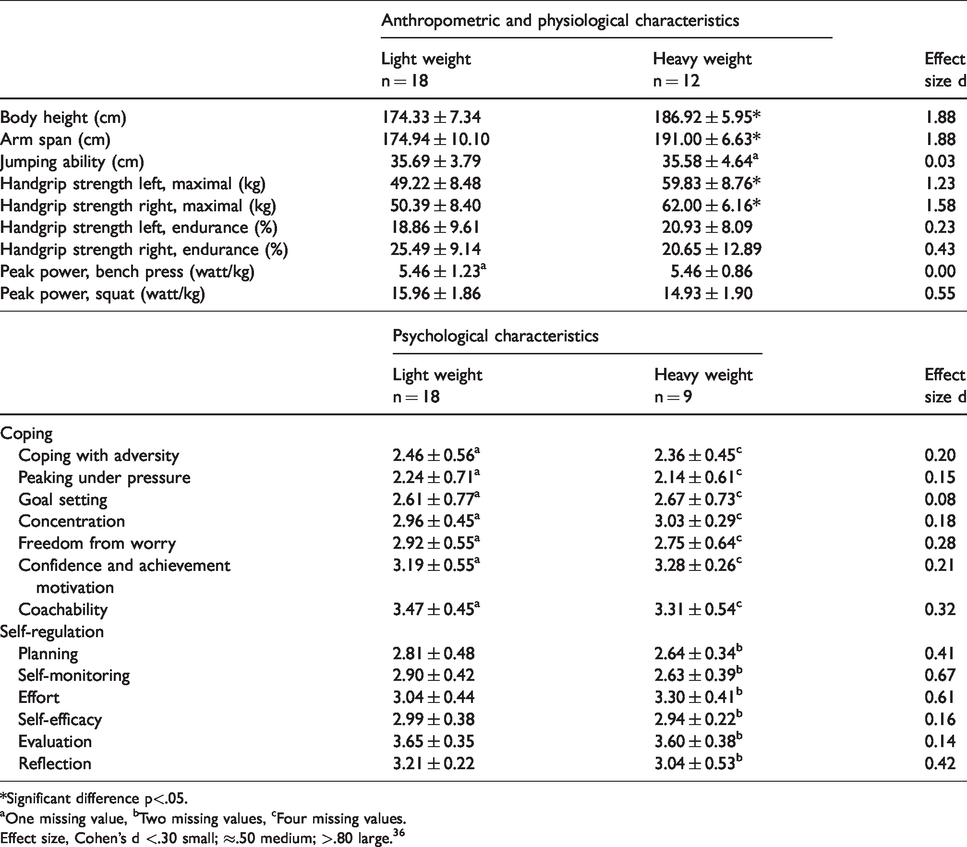
*Significant difference p<.05.
aOne missing value, bTwo missing values, cFour missing values.
Effect size, Cohen’s d <.30 small; ≈.50 medium; >.80 large. 36
Anthropometric, physiological and psychological performance characteristics in female top-level U18 and U21 judokas, divided by light and heavy weight categories (n = 25).
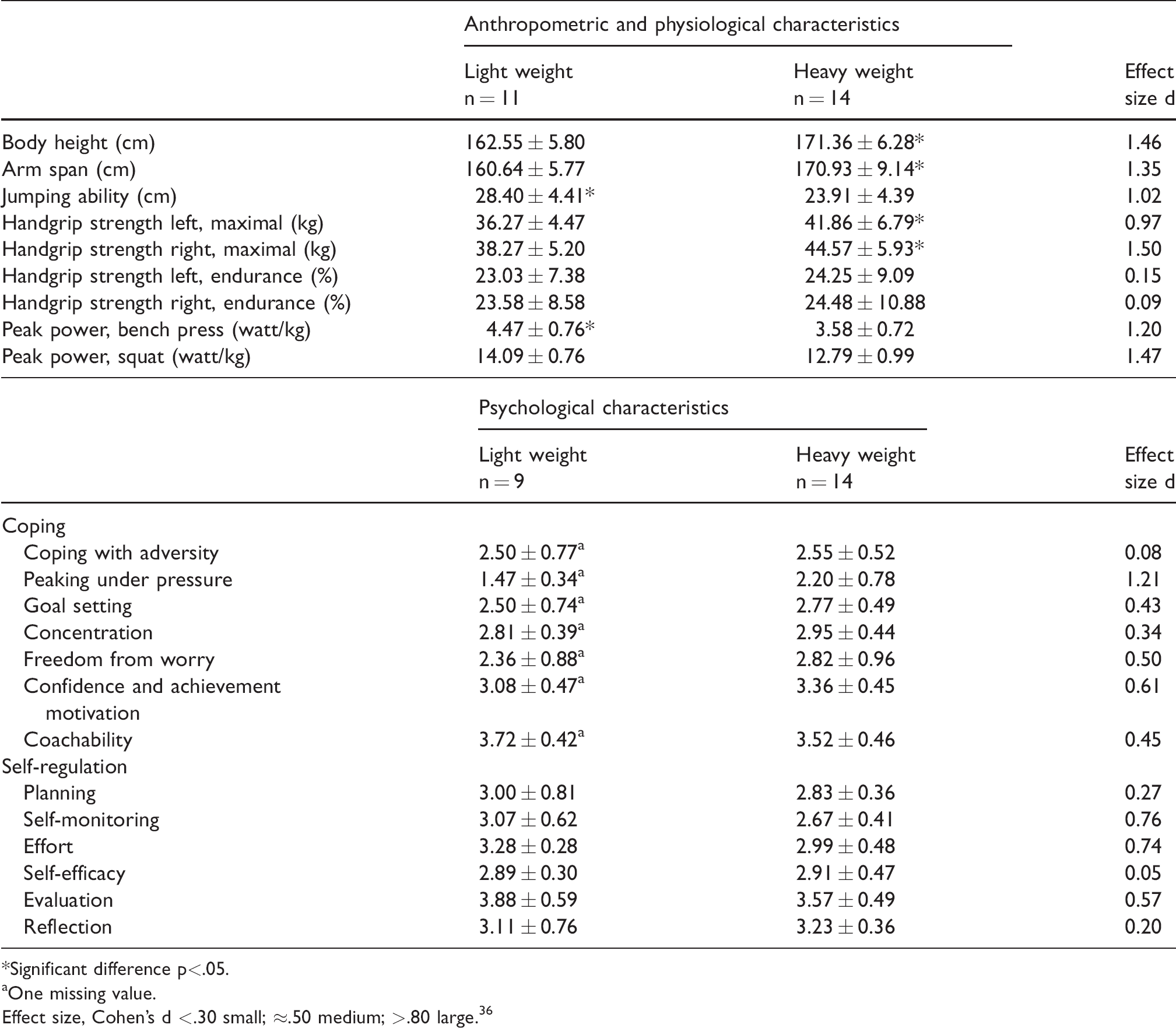
*Significant difference p<.05.
aOne missing value.
Effect size, Cohen’s d <.30 small; ≈.50 medium; >.80 large. 36
The first MANCOVA performed on the male group revealed significant differences in anthropometric and physiological performance characteristics. Male heavy-weight judokas had greater body height (F(1, 27) = 23.35; p < 0.01), a larger arm span (F(1, 27) = 22.82; p < 0.01), and higher scores on maximal handgrip strength, both left and right (F(1, 27) = 10.29; p < 0.01 and F(1, 27) = 17.66; p < 0.01) than male light-weight judokas. There were no significant differences in jumping ability, handgrip strength endurance – either left or right, peak power bench press, or squat (p > 0.05). The second MANCOVA performed on the male group revealed no significant differences between light- and heavy-weight judokas in terms of their psychological performance characteristics (p > 0.05).
The first MANCOVA performed on the female group revealed significant differences in anthropometric and physiological performance characteristics. Female light-weight judokas outscored their heavier peers in jumping ability (F(1, 22) = 6.52; p < 0.05) and peak power bench press (F(1, 22) = 9.70; p < 0.01). Female heavy-weight judokas had greater body height (F(1, 22) = 12.49; p < 0.01), a larger arm span (F(1, 22) = 10.16; p < 0.01), and higher scores on maximal handgrip strength – both left and right (F(1, 22) = 5,29; p < 0.05 and F(1, 22) = 7.94; p < 0.05) than light-weight judokas. There were no significant differences in handgrip strength endurance – either left or right, or in peak power squat (p > 0.05). The second MANCOVA conducted on the female group revealed no significant differences between-light and heavy-weight judokas in terms of their psychological performance characteristics (p > 0.05).
The discriminant analysis for the male judokas revealed that 87.5% of the original grouped judokas were correctly classified. The model predicts that a combination of four variables will successfully discriminate between light- and heavy-weight judokas. These variables were arm span (0.87), body height (0.84), maximal handgrip strength – right (0.77), and maximal handgrip strength – left (0.62). Four male judokas were placed in the incorrect group according to the discriminant analysis.
The discriminant analysis for the female judokas revealed that 84.0% of the original grouped judokas were correctly classified. The model predicts that a combination of six variables would successfully discriminate between light- and heavy-weight judokas. These variables were body height (0.64), arm span (0.58), peak power, bench press (−0.53), maximal handgrip strength – right (0.49), jumping ability (−0.45), and maximal handgrip strength – left (0.42). Four female judokas were placed in the incorrect group according to the discriminant analysis.
Discussion
The findings of this study suggest differences in anthropometric and physiological performance characteristics in light- and heavy-weight male and female judokas. Heavier male and female judokas outscored their lighter peers on body height and arm span. Light weight males did not outscore their heavier peers on anthropometric and physiological performance characteristics. On the other hand, light-weight females did outscore their heavier peers on explosivity, jumping power, and peak power bench press. These findings are partly in line with an earlier study, which showed that lighter judokas, both male and female, performed better on jumping ability. 13
According to an earlier study, the CMJ is a valid and reliable measurement for assessing short high-intensity movements of the lower limbs. 25 In the CMJ, these movements are the peak of the highest moment of force. 37 In this study, 25 light-weight females outscored their heavier peers on peak power bench press and they had better jumping ability. While their score on peak power squat was not significant different from their heavier peers, they did outscore them with a large effect size. These differences were not observed in the male judokas. Only in the peak power squat were differences indicated, where the light-weight judokas outscored their heavier peers (a medium effect size was calculated). We assume that the negligible differences in jumping ability and peak power bench press in male judokas are due to higher rates of short high-intensity movements compared to those of the female judokas. In addition, the heavier males and females outscored their lighter peers on maximal handgrip strength. These findings are in line with those of a previous study on youth and senior judokas, where it was found that heavier judokas perform better on maximum strength tests.13, 23
In the present study, over 80% of the original grouped judokas were correctly classified by the discriminant analyses. This means that less than 20% of the judokas were misclassified, showing that there are some missing variables in our study. However, to the best of our knowledge, this is the first study that attempted to differentiate between light-and heavy-weight judokas based on performance characteristics. With a score of over 80%, this is a valuable beginning, wherein meaningful variables are used to discriminate between weight categories in male and female judokas.
In total, eight judokas were misclassified; seven of these were judokas at the borderlines of the weight categories. The borderline weight categories are formed by splitting the weight categories into two groups. The judokas who fit into these borderline weights are judokas participating in the following weight categories: male and female U18 -66, -73; -52, -57 and U21 -73, -81; -57, -63. One-third of the male (n = 11) and almost half of the female (n = 11) judokas were classified into these borderline weights. Knowledge about the differences in anthropometrical and physiological profiles is especially important for these judokas, in order to inform them about transferring to another weight category.
When judokas transfer to another weight category, body mass is the variable that must be adapted (since other anthropometrics cannot be adapted); however, physiological characteristics can be adapted by training. Suppose a light-weight judoka who aims to shift to a higher weight category. Considering the findings of this study, the anthropometrics of this judoka is an important variable to take into account, as well as the need for more maximal strength. Adding weight and becoming stronger can be achieved by individualized strength training and good nutrition.
The opposite case is a heavy-weight judoka who aims to transfer to a lighter weight category. Before this can occur, he or she needs to lose weight, assuming that the physique of this judoka permits doing this. Considering the findings of this study, the training program must consist of more explosive power exercises in the strength training instead of maximising the power. Although it is very common to cut the last kilograms prior the competitive event using dehydration techniques, 38 it is not save 15 and some researchers claim that it must be included in the World Anti-Doping Agency prohibited listed and banned from combat sports. 39 Therefore, in this study the advice for both transferring ways – either a weight category up or a weight category down, is to do this between competition periods and under professional supervision.
For the psychological characteristics measured by the ACSI-28 and SRS-SRL, no differences were observed between weight categories, either in the male or female judokas. This finding provides support for our hypothesis that judokas of both weight categories do not differ in their psychological profiles. As mentioned before, elite judokas have a more problem-focussed coping style than the emotion-focussed coping of their sub-elite peers. 16 The psychological findings that emerged from our study showed a score of above 2.5 on each subscale of the ACSI-28, except for peaking under pressure for males and females and freedom from worry in females. Where the subscales are scored between 1 (almost never) and 4 (almost always), mean scores of 2.5 do not indicate an obviously more problem-focussed coping style. Higher scores on all subscales of the ACSI-28 correlate with a more problem-focussed coping style. 34
The youth judokas who participated in our study did not score high on the SRS-SRL compared to the scores achieved by other talented youth athletes. For example, in a previous study, high scores on the subscale distinguishes between youth athletes competing at an international level and a national level. 22 Reflection and learning to reflect on yourself as an athlete is something athletes learn at a very early stage of their development. These reflection skills contribute to the development of sport-specific skills, which in turn contribute to maximising the potential of the athlete. 22 The mean scores of the individual international and national youth athletes in this study were 4.14 ± 0.54 and 3.84 ± 0.86, while the judokas in the present study had a mean score of 3.16 ± 0.44 on the subscale reflection. 22 Although the judokas who participated in our study competed at the highest level of their age category, and had more than 10 years of judo experience, it is speculated that their psychological skills are still underdeveloped compared to other talented youth athletes. With psychological performance characteristics having a primary influence on sport performances, 40 improvement of these skills may contribute to higher performances.
There are two limitations in our study. First, to confirm the observed performance characteristics in the current study, a comparison with youth judokas of a lower performance level is required. Second, we used an observational cross-sectional design in our study. To increase our understanding of the long-term development of the observed performance characteristics, from youth to senior judokas, it would be useful to also conduct a longitudinal study.
For additional studies, we recommend using a multidimensional approach, namely also including an assessment of core technical and tactical performance characteristics in judo.3, 4 A number of researchers have attempted to measure technical and/or tactical performance characteristics in judokas. However, these characteristics are difficult to measure and even harder to compare between studies.41–46 It would be interesting to develop a judo-specific technical-tactical test, and not only a test assessing solely technical characteristics, 47 since in judo the technical aspects are strongly associated with the tactical aspects, and both are partly determined by the strengths/weaknesses of the opponent. In order to overcome reliability and validity issues in tests aimed at assessing technical and tactical aspects of judokas, knowledge from different domains should be synthesized – among them judo, measurement and evaluation in sport, and theory of training.
Conclusion
The current observational study provides information about differences in anthropometrics and physiological performance characteristics in light- and heavy-weight male and female judokas. The abovementioned findings can be used by professionals involved in training programs for young judokas, where a distinction is made in physiological characteristics in specific judo, strength, conditioning, or other parts of the training programs for light- and heavy-weight judokas. In addition, anthropometrics must be taken into account when judokas transfer to another weight category. However, to increase our understanding of the long-term development of the observed performance characteristics, from youth to senior judokas, it would be useful to conduct a longitudinal study.
Footnotes
Acknowledgements
The authors thank the judokas and their coaches and trainers for their participation in this study. Furthermore, we thank the National Judo Association (Judo Bond Nederland, JBN) for the realisation of this project.
Declaration of conflicting interests
The author(s) declared no potential conflicts of interest with respect to the research, authorship, and/or publication of this article.
Funding
The author(s) received no financial support for the research, authorship, and/or publication of this article.
