




Abstract
A large body of research has shown that self-regulation is an important aspect underlying athletes’ well-being and performance. However, self-regulation skills are equally important for post-performance situations, particularly with regard to the recovery process. This review highlights relevant self-regulation skills and provides a brief overview of theories, research findings, and practical recommendations regarding self-regulation and recovery in sport and exercise. Recovery self-regulation is defined as the act of identifying one's current state, one's desired future state and undertaking actions to minimize the discrepancy between both states during the recovery phase (e.g., between training sessions or competitions). Several self-regulation skills relevant to this process are discussed in the current review. First, self-monitoring is a central self-regulatory skill for successfully regulating post-performance states. Second, there is an important role for the regulation of cognition and emotion as complete recovery is only accomplished when both physical and mental resources are replenished. Specifically, detachment and mental rest (i.e., ceasing cognitive effort) enable athletes to restore depleted resources. Finally, self-control is often required to initiate appropriate, and sometimes effortful, recovery activities. That is, athletes may have to exert self-control to undertake activities, particularly when they are tired, stressed, or in a negative mood. Developing recovery self-regulation skills will likely benefit athletes’ physical and mental recovery from training and competition, which can have positive effects on long-term health, well-being, and performance.
Keywords
Many athletes dream of winning Olympic gold, becoming World Champion, or completing a marathon. In order to achieve such goals, athletes’ self-regulation skills play an important role. 1 Zimmerman 2 defined self-regulation as ‘self-generated thoughts, feelings, and actions that are planned and cyclically adapted to the attainment of personal goals’ (p.14). Not surprisingly, a large body of research has provided empirical evidence for the important role that self-regulation skills play before and during performance (for an overview, see Englert 3 ). However, the regulation of thoughts, feelings, and actions after performance is unmistakably important too (e.g., Balk et al., 4 Beckmann and Kellmann 5 ). For instance, imagine an Olympic athlete who has just underperformed, but who has to perform again two days later. The time between competitions will allow her to recover physically, but will she be able to regulate the negative thoughts and emotions related to her previous performance? Moreover, can she initiate the appropriate behaviors (i.e., actions) in order to adequately recover from the disappointing and frustrating race? If not, the recovery process is likely to be compromised, thereby also limiting optimal preparation for the forthcoming race. The aim of this review is to provide a brief overview of theories, research findings and gaps, as well as practical recommendations regarding self-regulation and recovery in sport and exercise. First, we will elaborate on why recovery can be considered a self-regulation process.
Recovery self-regulation
Abundant research has shown that self-regulation is an important aspect underlying athletes’ well-being and performance. Self regulation has been linked to lower somatic and cognitive anxiety, 6 as well as better competition preparation, 7 endurance performance,8,9 decision making, 10 and motor learning. 11 However, we still know little about post-performance self-regulation, that is, when athletes enter the recovery phase.
Before and during performances, athletes oftentimes devote a significant amount of physical and mental effort, resulting in physical as well as mental fatigue (e.g., Nédélec et al. 12 ). If athletes are unable to balance the demands of their sport with adequate rest and recovery, negative consequences may arise, such as athlete burnout, 13 decreased performance, 14 and even injury. 15 Consequently, recovery is considered an integral part of athletic training and vital for preserving athletes’ health and well-being.16–18 In fact, athletes spend more time in recovery than in active training. 19 Moreover, Bishop et al. 19 differentiate between immediate recovery (i.e., between rapid, finite efforts), short-term recovery (i.e., between training sets), and training or competition recovery (i.e., between training sessions or competitions), of which the latter is the focus of the current review.
Training or competition recovery usually takes place away from the actual sport environment and from the demands of training and competition. This form of recovery is generally defined as an inter- and intra-individual multilevel process in time to re-establish physiological as well as psychological resources. 20 Moreover, recovery is mainly an active or proactive process, meaning that athletes have an active role when selecting and engaging in recovery activities. 17 Hence, according to Beckmann and Kellmann 5 “finding the best recovery for one's self and actually implementing it is a task that requires self-regulation” (p.1135). Specifically, recovery can be considered a process in which an individual attempts to move from an actual state (e.g., high fatigue or high stress) to a preferred or required state of physical and mental activation.21,22 Building further on these definitions, recovery self-regulation can be defined as the act of identifying one's current state, one's desired future state and undertaking actions to minimize the discrepancy between both states during the recovery phase (e.g., between training sessions or competitions). Different recovery theories have—indirectly—emphasized the importance of self-regulation for recovery. For instance, according to the conceptual model of overtraining and recovery by Kenttä and Hassmén 18 and the Demand-Induced Strain Compensation Recovery Model, 23 recovery strategies should be matched with the main source of stress. Specifically, if an athlete is experiencing mental strain, this should be balanced with matching recovery activities such as mental relaxation exercises (e.g., meditation, imagery 24 ). So, a specific recovery activity should ideally match the area that is in the greatest need. 18 Hence, it is important to be aware of the main source of stress, as well as being able to identify available recovery strategies, given potential contextual constrains. In the following sections we will discuss three specific self-regulatory skills that we consider particularly relevant for identifying one’s current state, selecting strategies that help minimize a discrepancy between one’s current state and the desired future state, as well as initiating these strategies: self-monitoring, regulation of cognition and emotion, and self-control. For instance, the underperforming Olympic athlete mentioned earlier first needs to have awareness of any negative thoughts and emotions that she is experiencing in order to try to regulate them. Next, since optimal recovery also hinges on mental processes, she may need to regulate her thoughts and emotions. This might be difficult, particularly when fatigued or in a negative mood state,25–27 so she may need to override her impulse to eat comfort food or go to bed too late and instead initiate appropriate recovery activities. Finally, she needs to monitor again what the effect of a specific recovery activity is. Figure 1 illustrates this process of recovery self-regulation.
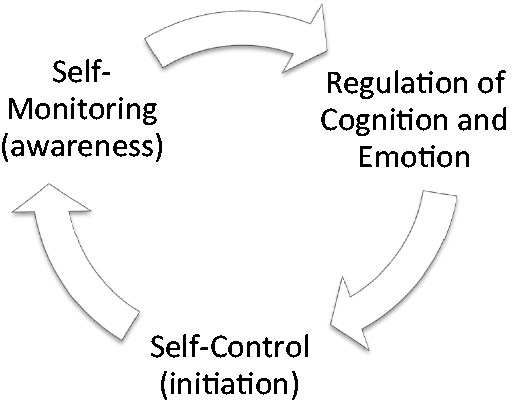
Process model of recovery self-regulation.
Self-monitoring
One needs to be capable of identifying one's current state in order for thoughts, feelings, and behavior to be successfully regulated (i.e., in line with a desired future state). A pivotal self-regulatory process is therefore the process of comparison and discrepancy detection through self-monitoring. 28 Self-monitoring takes place when a desired physiological and psychological state (i.e., a given standard) is compared against the knowledge of one’s current state. Hence, achieving adequate recovery requires awareness of both internal cues (e.g., thoughts, feelings, sensations) and external cues (e.g., rewards, opportunities). This process is driven by the individual’s skill to self-monitor effectively. Since recovery is considered a multidimensional concept, adequate recovery is only accomplished when physical, cognitive, and emotional resources have been replenished.4,17 The use of self-monitoring skills is therefore vital to develop awareness of the state of physical capacities, reflected in muscle pain, fatigue, stiffness, as well as cognitive and emotional capacities, such as vigilance and positive affect. The Conservation of Resources Theory29,30 proposes that individuals strive to obtain, retain, and protect their resources. According to Hobfoll, recovery is inadequate—and induces stress—when resources are not regained after resource investment. In sport and exercise contexts, athletes utilize significant physical and mental (i.e., cognitive and emotional) resources during the training process and in competition. Subsequently, athletes will strive to restore these resources. This implies that while high physical fatigue may require an athlete to remain idle, high mental fatigue may necessitate a change of scenery or actively seeking distraction.4,31 Awareness of the area that is in greatest need of recovery 18 is therefore an important self-regulatory skill underlying adequate recovery from the demands of training and competition. This can benefit athletes’ recovery and well-being both in the short-term as well as the long-term. For example, a recent study underscored the importance of self-monitoring for athletes’ long-term well-being by showing that talented tennis players high in self-monitoring reported less overuse injuries. 32 Taken together, self-awareness and self-monitoring are important self-regulatory skills for successfully regulating post-performance states. Moreover, they are a prerequisite for cognitive and emotional control. 33
Regulation of cognition and emotion
Adequate recovery depends on getting a break from sport-related demands.17,34 Therefore, it is recommended that athletes ‘switch-off’ physically and mentally from sport-related demands during the recovery phase.16,18 A central strategy as far as getting a break from sport-related demands is concerned is detachment. 35 According to the Stressor-Detachment Model of Sonnentag and Fritz, 36 the recovery experience of detachment can attenuate the adverse effects of high demands on health and well-being. Research in both work and elite sport has provided empirical evidence for the stress-buffering role of detachment.4,36 Like recovery, detachment can also be divided into cognitive, emotional, and physical components.4,23 Physical detachment refers to shaking off the physical exertion from training or competition. To achieve this, the majority of elite-level performers engage in passive activities during recovery. For instance, a study among English professional soccer players showed that they spent 79% of their waking hours (excluding training/matches) in sedentary fashion, with an average of 500 min per day. 37 These levels of inactivity are far greater than comparable non-athlete samples.
While physical rest, or inactivity, can be considered the primary way of achieving a physical break, its effectiveness for regulating thoughts and feelings can be questioned. 38 Hence, cognitive detachment means putting all thoughts about one's sport aside. According to the Cognitive Activation Theory of Stress, 39 cognitive processes may extend the duration of physiological stress responses. Thus, when an athlete is unable to regulate negative thoughts about a prior stressful situation (e.g., high pressure to perform, a disappointing performance, or a conflict), the stress response is not ‘switched off’ and psychophysiological activation remains high. Along similar lines, the Prolonged Activation Model postulates that physiological activity will be extended after a stressful or demanding situation due to “repeated or chronic activation of the cognitive representation of one or more psychological stressors” (p.114). 40 This phenomenon, termed perseverative cognition, refers to relatively uncontrollable and unpleasant repetitive thoughts. Perseverative cognition can manifest itself in two ways with regard to the recovery process. 41 The first way is rumination, which is defined as repetitively and passively rethinking negative internal or external events that have occurred in the past. 42 Rumination occurs when athletes keep thinking back to a specific competition and wonder what they could have done differently or why they felt tired so quickly. The second way is worrying, which involves negative future-oriented thoughts about an upcoming event or situation in light of previous experiences (see also, Grossbard et al. 43 ). For instance, after a disappointing performance an athlete might continuously worry about whether he is in good shape for the next competition and whether he is going to disappoint again.
Cognitive detachment allows an individual to recover as there are no intrusive thoughts related to the past or future.44,45 A study among recreational athletes 46 found support for the benefits of cognitive detachment for mental well-being (i.e., mental energy) as well as physical health (i.e. injury). Comparably, a recent qualitative study among high-level hockey players and staff members identified a reduction in thinking about one’s sport as a central psychological recovery experience. 35 This resembles the concept of cognitive detachment. Next to the deactivation of thoughts related to sport and experiencing a reduction in physical and cognitive activity in general, it is important for athletes to regulate post-performance emotions for optimal recovery. Specifically, it is important to distance oneself from negative sport-related emotions, which is achieved through emotional detachment. It is believed that negative emotions such as anger or disappointment interfere with complete recovery, as they actually increase arousal, which, over time, can lead to energy depletion.47,48 In contrast, positive emotions are associated with the production of certain hormones (e.g., serotonin, dopamine) that may lower the stress response, thereby promoting recovery. 49 Fredrickson’s 50 Broaden-and-Build Theory posits that experiences of positive emotions broaden individual's momentary thought-action repertoires and serves to build physical as well as psychological resources. In contrast, negative emotions narrow the momentary thought–action repertoire, which may lead athletes to be less receptive to recovery opportunities.
Supporting the view that regulating post-performance (negative) emotions is important, a recent diary study among Dutch elite athletes found positive associations between daily emotional detachment, but not cognitive detachment, in the prediction of elite athletes’ daily cognitive and emotional recovery. 4 Moreover, this study provided empirical evidence for the importance of matching recovery strategies with respective demands, 18 which is driven by self-regulatory processes.4,23 Another diary study showed that daily physical and emotional detachment from work benefited elite coaches’ health, well-being, and work engagement the next day. 51
Mental rest, or a reduction in effortful thinking in general, has also been identified as an important recovery experience for athletes. 35 As permanently thinking about sport-related issues is mentally fatiguing, athletes also require a break from continuous effortful thinking generally. Therefore, another key psychological resting experience seems to involve experiencing reduced cognitive demands, or mental rest, which can be obtained through engagement in low mentally demanding activities (e.g., listening to music). It is important to note that detachment and mental rest do not necessarily resemble the same recovery experiences, as detachment—from sport-related issues—can be obtained through engagement in mentally demanding activities (e.g., studying, talking with friends). In sum, deactivating cognitions and emotions related to the past activity is important for the recovery process. By allowing a physical, cognitive, and/or emotional break from sport-related demands, detachment enables athletes to restore depleted physical and mental resources. Moreover, mental rest in general (i.e., ceasing cognitive effort) appears to be important in promoting recovery from mental fatigue.
Self-control
Frequently, regulating thoughts and emotions requires the initiation of specific behavior. Moreover, appropriate regulation of cognitions and emotions not only ceases psychophysiological activation, it also increases the likelihood of the initiation of adaptive behaviors. 52 This brings us to the importance of self-control for recovery. Self-control involves the ability to override and alter a person’s predominant, or automatic, attentional focus or other automatic tendencies (e.g., Baumeister et al. 25 ). Athletes differ in terms of their self-control abilities on a dispositional level, meaning that some are simply better at regulating their impulses than others. 53 Self-control plays an important role in sport and exercise, 3 since the ability to resist immediate urges or to not give in to automatic impulses in specific situations enables one to attain preferable long-term goals instead of settling on short-term achievements. 54 Imagine, for example, a boxer who has to keep his weight in check: he has to resist the immediate temptation of consuming high-caloric food in order to achieve his more desirable long-term goal.
It is important to note that in order to restore resources, athletes occasionally must invest additional resources. Thus, self-control is often needed to initiate appropriate, and sometimes effortful, recovery activities (cf. Baumeister and Vohs 55 ). Specifically, athletes may need to exert self-control to undertake activities when they are tired, stressed, or in a negative mood state. High stress, fatigue, and negative mood states may influence behavior as they shift priority from the self-regulation of long-term goals to the regulation of the experienced emotion and feeling better in the short term. 25 For example, feeling frustrated or disappointed can lead to behaviors that hinder athletes’ recovery such as ruminating, withdrawing, arguing, eating poorly, having trouble falling asleep, or going to bed too late.26,27 This effect has also been termed the ‘recovery paradox’. 56 In line with the recovery paradox, recent studies in sport indicate that when the need for recovery is high, recovery experiences such as detachment tend to be impaired. In a study by Balk et al., 4 physical sport demands correlated negatively with elite athletes’ physical detachment after training, and emotional sport demands correlated negatively with emotional detachment after training. Another diary study among elite athletes showed that higher daily sport-related demands were related to lower daily physical and cognitive detachment, which was mediated by physical fatigue. 57 The authors speak of an ‘underrecovery trap’, in which high fatigue resulting from previous demands interferes with subsequent detachment, which may eventually negatively affect athletes’ long-term health and well-being.
When fatigued or stressed, athletes might also choose to spend time alone, which supposedly drains fewer resources, rather than spending time with others. However, research shows that social activities can elevate one’s mood 58 and provide a source of social support. 59 Social support and social interaction also stimulate the production of oxytocin, which is related to a reduction in blood pressure and cortisol levels. 60 Yet, undertaking social activities might be a challenge for tired or stressed athletes. 61 For instance, rugby league players reported a decrease in the frequency of partaking in social activities during a period of overload training. 62 This implies that tired athletes might withdraw from social activities while they could be effective in promoting recovery.
Another important recovery strategy for athletes is sleep, which is considered one of the best available recovery strategies for athletes. 63 However, while athletes may require more sleep compared to non-athletes to recover from the demands of training and competition, sleep deprivation is common among athletes. 63 Sleep deprivation has been linked with training demands. For example, a study among male cyclists showed that total sleep time decreased from 7.3 to 6.9 h and sleep efficiency decreased from 86.3% to 84.3% during a high training block of increased load. 64 Self-control needs to be exerted in order to be able to engage in sleep-promoting behaviors such as going to bed in time. 65 In support of this, a study among a sample of 2431 adults found that higher self-control was associated with less insufficient sleep and less bedtime discrepancy (i.e., difference between what time people wanted to go to bed, and at what time they actually went to bed), as well as more sleeping hours. 66 Interestingly, these relations were mediated by bedtime procrastination (i.e., going to bed later than intended). A study among professional football players reported a positive association between restraint self-control and sleep duration. 67 So, while sometimes it might be more tempting to stay up and watch a movie when being sad or tired, it would be in the athlete’s best interest to go to bed at an appropriate time. These studies underscore the importance of self-regulation, and self-control in particular, for athletes’ sleep experiences. However, what the exact role of self-control is in promoting adequate sleep deserves attention from future research.
Why is it so difficult to detach from sport, undertake social activities, and manage sleep when the need for recovery is actually high? Several theoretical explanations have been put forward to explain these lapses in self-regulation. First, a core assumption of the strength model by Baumeister et al. 68 is that individuals only possess a limited self-control energy pool, which can become temporarily depleted after having performed primary acts of self-control. These acts, such as regulating thoughts and emotions (e.g., Wagstaff 9 ), managing anxiety or stress (e.g., Englert and Bertrams 69 ), controlling the speed and execution of a motor task, 70 and playing through pain, may lead to a temporary exhaustion of available self-control resources. 71 Second, according to the process model, performing a tiring self-control demanding task (i.e., a ‘have-to’ task) leads to shifts in motivation, emotion, and attention. 72 When confronted with a subsequent ‘have-to’ task, an individual is less motivated in working on this task, assigns this task a rather negative valence, and instead shifts his/her attentional focus on more pleasant ‘want-to’ tasks. These shifts are associated with impaired performance in the respective secondary ‘have-to’ task. The process model seems convincing on a theoretical level, although it has not been formally investigated in sport, which is something that needs to be addressed in future studies 71 (for a notable exception, see Stocker et al. 73 ). In line with the idea of self-control as a limited energetic resource, it appears that in order to sustain self-control, one needs to have sufficient energetic resources left ‘in the tank’. 51 However, future studies need to address the question whether the recovery paradox can be explained by a lack of motivation as well (Sonnentag, 2018).
Practical implications
The recovery process as discussed in this review may inform practice as well. Optimal recovery self-regulation starts with fostering awareness of physiological and psychological sensations. Keeping track of physical and psychological states by keeping a journal or logbook has been advised to increase awareness. 26 Hence, coaches or sport psychologists should encourage athletes to reflect on their training and competition experiences to initiate the recovery process.
Strategies to regulate cognitions and emotions include expressive writing 74 and the use of relaxation techniques (e.g., progressive muscle relaxation, biofeedback, systematic breathing, imagery). According to Kellmann et al., 24 relaxation techniques can improve the ability to self-regulate one’s own physical and psychological state. More importantly, achieving a state of relaxation could lead to a stop of rumination and/or worry, and may aid regulation of cognitions and emotions. 24 One way in which relaxation techniques might benefit self-regulation is by increasing heart rate variability (HRV). Research has indicated that HRV is associated with behaviors that require executive functioning, such as self-monitoring and behavior Initiation. 75 Both deep breathing and HRV biofeedback training have been linked with increased HRV.76,77 Moreover, a study by Dupee et al. 78 found that after a one-year biofeedback and neurofeedback training intervention, Olympic-level athletes reported increased self-awareness and improved ability to self-regulate both their physiological and psychological states.
Replacing negative emotions with positive emotions appears to be a good strategy to enhance recovery as well. Fredrickson 50 argues that positive emotions can function as antidotes for the effects of negative emotions. According to this ‘undoing hypothesis’, individuals who experience positive emotions after a high-activation negative emotion (e.g., stress, fatigue) will show faster cardiovascular recovery. So far, however, studies on positive emotions and recovery in sport have been rather scarce. 79 One study by Crewther and Cook 80 showed that athletes who received positive feedback and focused on what they did well following a competition showed a better hormonal response than those who received and focused on negative feedback.
With regard to the initiation process, both the strength model and the process model of self-control agree that automatic behavior requires less effort and, therefore, is more likely to be successfully initiated (e.g., Webb and Sheeran 81 ). While the strength model would assume that automatized behavior does not require any conscious control and therefore no self-control, the process model would argue that automatized behavior does not possess a ‘have-to’ character meaning that no self-control would need to be invested in order to display the respective behavior. 71 Creating behavioral habits to increase the likelihood of performing intended behaviors can be done by forming implementation intentions, or ‘if–then’ plans. 82 An if-then plan has the structure of, ‘If situation X arises, then I will perform the goal-directed response Y!’. 70 For instance, an athlete could form the implementation intention: ‘If I feel sad at home, I will go for a walk outside’. Linking a specific situation with a desirable behavior, automatically triggers the respective behavior if the situation occurs. Forming implementation intentions may increase the likelihood of performing intended behaviors and, therefore, could serve as an effective strategy in preventing paradoxical recovery effects, such as going to bed late when one is actually tired.
By defining recovery as a self-regulation process, we argue that specific self-regulation skills that drive the recovery process can be learned and improved over time. In support of this assumption, a qualitative study by McNeill et al. 83 reported that a self-regulation intervention for sport coaches who experienced moderate to high levels of burnout enabled them to self-regulate more effectively by developing various competencies (e.g., strategic planning for their well-being, self-monitoring) and strategies (e.g., task delegation, facilitative self-talk). Future research should therefore concentrate on the investigation of whether such interventions can also improve athletes’ recovery self-regulation, particularly when stressed or fatigued. Promisingly, an intervention study focused on reducing stress and burnout among eight university-level athletes found that self-regulation capacity significantly increased as the intervention progressed throughout a competitive season, whereas stress and burnout levels significantly decreased. 84
Conclusion
Expert athletes exhibit better self-regulatory skills than their non-expert counterparts. 85 Often, these skills have been related to pre-performance and performance situations. In agreement with a recent consensus statement on recovery and performance in sport, 34 we argue that self-regulation skills are equally important for post-performance situations (e.g., recovery) and that these skills should be developed to enhance recovery. In this review, we intended to make a case for considering recovery a dynamic self-regulation process, consisting of self-monitoring (i.e., awareness), regulation of cognition and emotion, and self-control (i.e., behavior initiation). This will hopefully drive future research on recovery (e.g., using diary studies) as well as guide practitioners in developing athletes’ recovery skills. More self-regulation skills exist which can positively affect the recovery process (cf. Beckmann and Kellmann 5 ). However, we consider the aforementioned self-regulation skills as central to the recovery process, particularly with regard to the process of identifying one's current state, one's desired future state and undertaking action to minimize the discrepancy between both states. Ultimately, developing self-regulation skills can benefit athletes’ physical and mental recovery from training and competition, and ultimately, can have positive effects on long-term health, well-being, and performance.
Footnotes
Declaration of conflicting interests
The author(s) declared no potential conflicts of interest with respect to the research, authorship, and/or publication of this article.
Funding
The author(s) received no financial support for the research, authorship, and/or publication of this article.
