




Abstract
1,1′-Bichrysene-2,2′-diol and its thiophene analogs, 6,6′-biphenanthro-[1,2-b]thiophene-7,7′-diols, as a series of novel π-expanded chrysene-/phenanthro[1,2-b]thiophene-based axially chiral molecules are synthesized from 1,1′-bi-2-naphthols with key steps including a Suzuki coupling, a Wittig reaction, and acid-mediated cyclization.
(ChemBioDraw version 13.0)
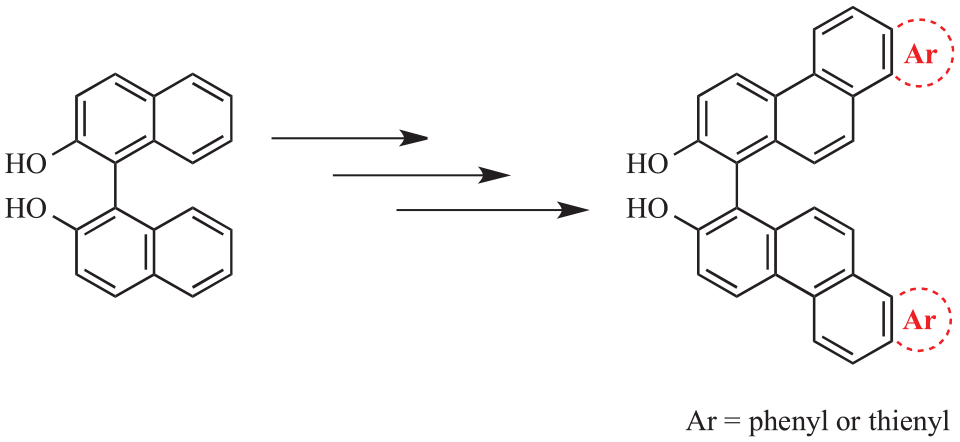
Introduction
Due to the superior electronic and optical properties, 1,1′-bi-2-naphthol (BINOL) and other axially binaphthol-related chiral molecules have recently been widely studied.1–3 The functionalities of BINOL and their derivatives can be tuned through the expansion of their π-system and by chemical modifications at specific sites. Among them, the expansion of the π-system is the most common method to date. 4 Large π-extended polycyclic aromatic hydrocarbons (PAHs) such as anthracene, 5 phenanthrene, 6 pyrene, 7 and naphtho[2,3-b]furans, 8 as replacements of the naphthalene rings of BINOL, could increase the rotational isomeric space through larger dihedral angles (Figure 1). Other advantages of such replacements to be addressed are reduced molecular energy and stable molecular structure, higher luminescence efficiency and extended fluorescence lifetime, and so on. 9 These advantages lead to numerous applications of PAH-type BINOLs in the areas of circularly polarized luminescence (CPL) spectroscopy and as starting materials for the preparation of graphene nanoribbons 10 and complex polyarene architectures. 11

Thiophene and its analogs are often regarded as electron-donating moieties in materials chemistry. 12 It was found that the electron transfer among molecules and the antioxidative capacity of compounds could both be improved by fusing thiophene onto PAHs. 13
Results and discussion
As a part of our ongoing research on heterocycle-fused binaphthalenes and binaphthols (BINOLs), we have extended our interest on BINOL analogs using chrysene and phenanthro[1,2-b]thiophene as replacements for the naphthalene motifs. It was reported that pyrene-based BINOLs can lead to a broader application of π-expanded axially chiral molecules.
7
Generally, racemic BINOLs and their chiral analogs can be synthesized by the oxidation of β-naphthol with often-used catalysts such as FeCl3 or Cu(OH)Cl·TMEDA.
14
In our case, 2-chrysenol and related analogs were very difficult to prepare through simple synthetic strategies, and therefore we thought that it would be possible to use commercial BINOLs as starting materials through well-defined and facile synthetic protocols in order to prepare the target molecules (Scheme 1). BINOL was functionalized as the dibromide in order to avoid any uncertainty in subsequent steps. 6,6′-Dibromo-2,2′-dimethoxy-1,1′-binaphthalenes [(S)-/(R)-/(
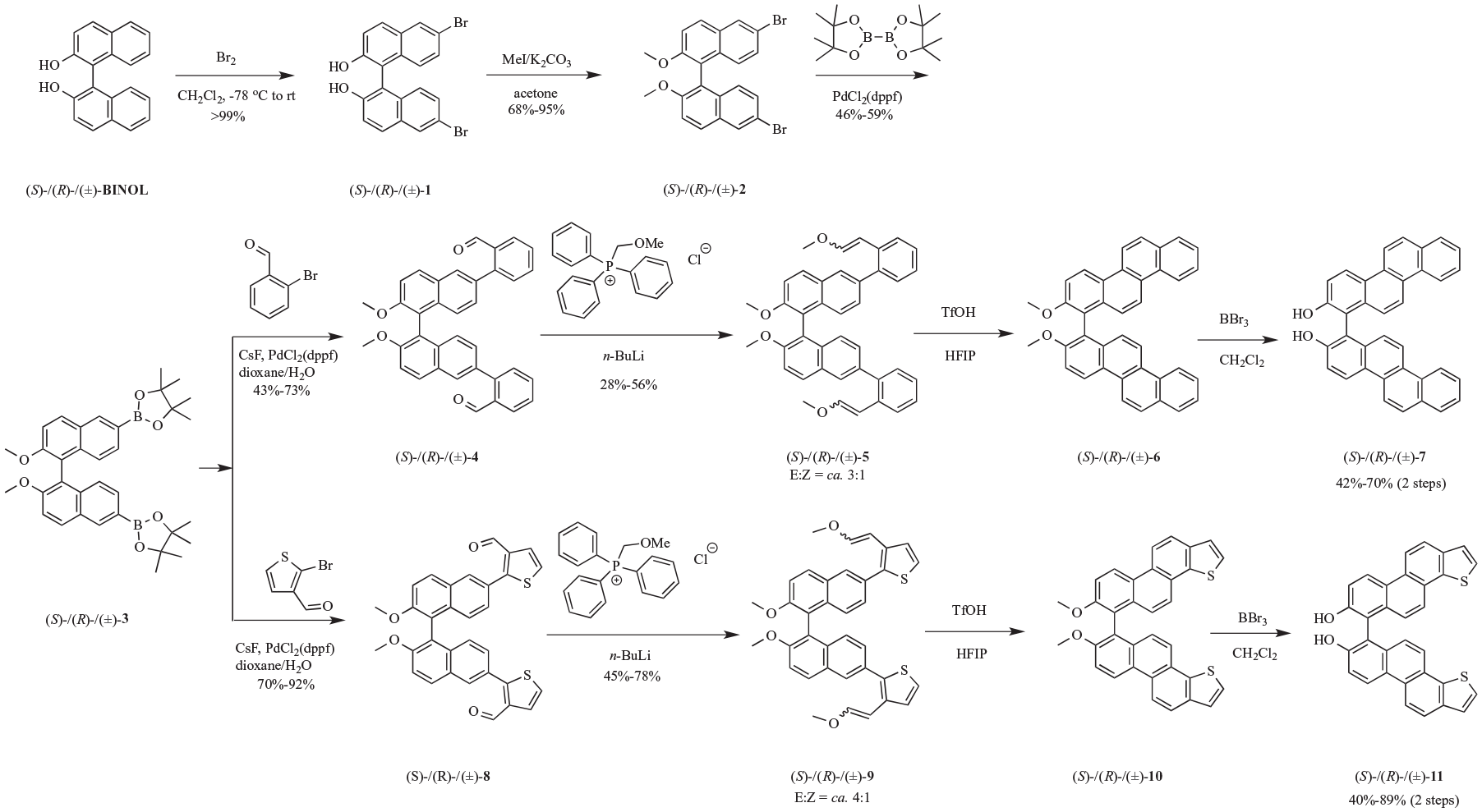
Synthetic approach toward the target molecules.
With (S)-/(R)-/(
Next, the Wittig olefinations were applied to (S)-/(R)-/(
Conclusion
In conclusion, a facile and atom-economic method for the synthesis of 1,1′-bichrysene-2,2′-diol and 6,6′-biphenanthro-[1,2-b]-thiophene-7,7′-diols has been presented. This method should also be applicable for the syntheses of different polycyclic aromatics such as polyarenes and nanographenes. Furthermore, the target molecules could contribute to molecular recognition and the further exploration of new π-expanded axially chiral molecules. Further studies on applications of the described molecules are now in progress in our laboratory.
Experimental
All chemicals were commercially available as analytical or chemical grade. Solvents were purified via standard methods before use. All reactions sensitive to air or water were conducted under an Ar or N2 atmosphere. Reactions were monitored by thin-layer chromatography (TLC). Silica gel (Anhui Liangchen GF254) for column chromatography was 200–300 mesh. 1H nuclear magnetic resonance (NMR) and 13C NMR spectra were measured on a Bruker DRx500 NMR spectrometer ( 1 H NMR: 500 MHz, 13C NMR: 125 MHz). Low-resolution mass spectra were recorded on an Agilent 5973N or a Waters GCT Premier spectrometer (mass spectrometry electron ionization (MS EI)). High-resolution mass spectra were obtained using a Bruker MicroTof II mass spectrometer (high-resolution mass spectrometry electrospray ionization (HRMS ESI)). Melting points were measured on an X-4 micrographic melting point apparatus.
Starting materials
(S)-/(R)-/(
(S)-/(R)-/(± )-2,2′-(2,2′-dimethoxy-[1,1′-binaphthalene]-6,6′-diyl)dibenzaldehyde [(S)-
4 /(R)-
4 /(± )-
4 ]
A 250-mL three-neck bottom flask was charged with (S)-
(S)-
(R)-
(
(S)-/(R)-/(± )-2,2′-dimethoxy-[6,6′-bis(2-methoxyethenyl)phenyl]-1,1′-binaphthalene [(S)-
5 /(R)-
5 /(± )-
5 ]
A mixture of Ph3P(CH2OMe)·Cl (3.61 g, 10.52 mmol, 5.0 equiv.) and n-BuLi (674.14 mg, 10.52 mmol, 5.0 equiv.) was dissolved in anhydrous tetrahydrofuran (THF; 15 mL) at 0 °C. After stirring at 0 °C for 30 min, a THF (10 mL) solution of (S)-
(S)-
(R)-
(
(S)-/(R)-/(± )-2,2′-dimethoxy-1,1′-bichrysene [(S)-
6 /(R)-
6 /(± )-
6 ]
Trifluoromethane sulfonic acid (31 μL, 0.35 mmol, 0.6 equiv.) was added to a hexafluoroisopropanol (HFIP; 30 mL) solution of the crude mixture of (S)-
(S)-/(R)-/(± )-[1,1′-bichrysene]-2,2′-diol [(S)-
7 /(R)-
7 /(± )-
7 ]
The crude product of (S)-
(S)-
(R)-
(
(S)-/(R)-/(± )-2,2′-(2,2′-dimethoxy-[1,1′-binaphthalene]-6,6′-diyl)bis(thiophene-3-carbaldehyde) [(S)-
8 /(R)-
8 /(± )-
8 ]
A 250-mL three-neck round-bottom flask was charged with (S)-
(S)-
(R)-
(
(S)-/(R)-/(± )-2,2′-dimethoxy-[6,6′-bis(2-methoxyethenyl)thiophene]-1,1′-binaphthalene [(S)-
9
/(R)-
9
/(± )-
9
]
A mixture of Ph3P(CH2OMe)·Cl (1.64 g, 4.78 mmol, 5.0 equiv.) and n-BuLi (306.43 mg, 4.78 mmol, 5.0 equiv.) was dissolved in anhydrous THF (10 mL) at 0 °C. After stirring at 0 °C for 30 min, a THF (5 mL) solution of (S)-
(S)-
(R)-
(
(S)-/(R)-/(± )-7,7′-dimethoxy-6,6′-biphenanthro[1,2-b]thiophene [(S)-
10 /(R)-
10 /(± )-
10 ]
Trifluoromethane sulfonic acid (14.52 μL, 0.16 mmol, 0.6 equiv.) was added to an HFIP (20 mL) solution of the crude mixture of (S)-
(S)-/(R)-/(± )-[6,6′-biphenanthro[1,2-b]thiophene]-7,7′-diol [(S)-
11 /(R)-
11 /(± )-
11 ]
The crude product (S)-
(S)-
(R)-
(
Supplemental Material
3.SI-Proof-An_SJ – Supplemental material for Novel π-expanded chrysene-based axially chiral molecules: 1,1′-bichrysene-2,2′-diols and thiophene analogs
Supplemental material, 3.SI-Proof-An_SJ for Novel π-expanded chrysene-based axially chiral molecules: 1,1′-bichrysene-2,2′-diols and thiophene analogs by Shujie An, Guofeng Tang, Yaling Zhong, Li Ma and Qiancai Liu in Journal of Chemical Research
Footnotes
Declaration of conflicting interests
The author(s) declared no potential conflicts of interest with respect to the research, authorship, and/or publication of this article.
Funding
The author(s) disclosed receipt of the following financial support for the research, authorship, and/or publication of this article: This study was supported by industrial funding from Jiangsu Visio Biotechnology Co., Ltd. China, which is acknowledged.

Supplemental material
Supplemental material for this article is available online.
References
Supplementary Material
Please find the following supplemental material available below.
For Open Access articles published under a Creative Commons License, all supplemental material carries the same license as the article it is associated with.
For non-Open Access articles published, all supplemental material carries a non-exclusive license, and permission requests for re-use of supplemental material or any part of supplemental material shall be sent directly to the copyright owner as specified in the copyright notice associated with the article.
