A novel coumarin-derived dithioacetal chemosensor, 8-(1,3-dithian-2-yl)-7-hydroxy-4-methylcoumarin (LS), has been designed and synthesized. The sensor LS showed highly selective fluorescent sensing for Hg2+ with a low detection limit of 0.81 nM in the pH range from 6.15 to 9.96 in ethanol/water (1:1, v/v) solution. The sensing mechanism of LS toward Hg2+ was proposed and verified by 1H nuclear magnetic resonance spectroscopy studies. Under an ultraviolet lamp, the fluorescence color changes could be easily detected by the naked eye. In addition, the sensor LS has been applied in the trace detection of Hg2+ in real water samples.
Mercury is a natural component of our environment; it constitutes 0.5 parts per million of the Earth’s crust and is one of the most toxic metals.1 Mercury species are broadly classified into three different chemical categories (elemental forms, divalent inorganic forms, and organic mercury), which have different toxic-kinetic properties.2 Hg2+ (inorganic form) is highly soluble, is the most stable form of inorganic mercury in the aquatic environment; it is carcinogenic and displays high cellular toxicity.3 The WTO explicitly defined that the concentration of Hg2+ in drinking water must be less than 6 µg L−1 (30 nM).4 Mercury can be absorbed by microorganisms and converted into methylmercury, which can enter into the food chain and cause various grave disorders and illness. Long-lasting uptake of high levels of mercury can lead to serious health problems, such as neurological damage, effects on the immune system, Minamata disease, muscle weakness, motion disorders, and chronic diseases.5–7 Therefore, the development of methods for efficiently detecting Hg2+ is of great significance.
In the last few decades, significant efforts have been made to quantify mercury species, and many methods have been reported, such as atomic absorption-emission spectroscopy,8 polarography,9 reversed-phase high-performance liquid chromatography,10 and infrared spectroscopy.11,12 Unfortunately, most of these methods are not appropriate for real-time and on-site assays and require expensive devices and complicated sample preparation. In recent years, chemosensors for detecting mercury ions have attracted great attention due to their high selectivity and excellent sensitivity. In addition, fluorescent chemosensors which can directly measure mercury ions in water samples are advantageous in terms of time savings, lower costs, and simplicity.13
There are two types of fluorescent chemosensors for Hg2+ detection that have been reported: coordination-based chemosensors14–16 and reaction-based chemosensors.17–26 For reaction-based sensors, the determination of Hg2+ is achieved by specific chemical reactions between receptors and Hg2+. This type of chemosensor usually exhibits excellent selectivity and high sensitivity toward Hg2+ due to their specific selective reactivity to Hg2+.13 Therefore, research of reaction-based chemosensors has gained more attention in recent years.
With large molar extinction coefficients, relatively long excitation and emission wavelengths and high quantum efficiencies, coumarin derivatives have been widely used as fluorescent chemosensors.27 It has been reported that the thioacetal group can be selectively desulfurized by Hg2+, resulting in the formation of the corresponding aldehyde and changes of the fluorescent intensity. However, most of these chemosensors have drawbacks of relatively high fluorescent background signals, limits of detection,28 and poor solubility in aqueous solution.29 Herein, we have designed and synthesized a novel “on-off” fluorescent chemosensor, 8-(1,3-dithian-2-yl)-7-hydroxy-4-methylcoumarin (LS) (Scheme 1), in which a thioacetal group has been added to a coumarin derivative. The sensor LS showed highly selective fluorescent sensing for Hg2+ with a low detection limit of 0.81 nM in the pH range from 6.15 to 9.96 in ethanol/water (1:1, v/v) solution. The recognition mechanism of sensor LS toward Hg2+ is proposed and confirmed by 1H nuclear magnetic resonance spectroscopy (NMR) studies.
Synthetic protocol for sensor LS.
Results and discussion
The ultraviolet–visible (UV–Vis) titration spectra of sensor LS upon addition of various concentrations of Hg2+ were carried out in ethanol and water (1:1, v/v) at room temperature. As shown in Figure 1, the absorption band of receptor LS in the UV–Vis spectrum appears at 272 nm. Upon addition of increasing concentrations of Hg2+ (0–0.75 equiv.) to the solution of sensor LS (100 μM), the absorption band at 272 nm was enhanced gradually, which clearly suggests that LS participates in a reaction with Hg2+.
Absorption spectra of sensor LS (100 μM) in ethanol and water (1:1, v/v) solution obtained by adding aliquots of [Hg2+] (0, 0.05, 0.10, 0.15, 0.20, 0.25, 0.30, 0.35, 0.40, 0.45, 0.50, 0.55, 0.60, 0.65, 0.70, and 0.75 equiv.).
The fluorescence emissions of sensor LS (2 μM) on adding different metal ions (1.0 equiv. of LS) including Ag+, Al3+, Ba2+, Ca2+, Cd2+, Co2+, Cu2+, Cr3+, Fe3+, Hg2+, Mg2+, Mn2+, Ni2+, Pb2+, and Zn2+ were determined in ethanol/water (1:1, v/v). After excitation at 369 nm, the sensor LS exhibited very strong fluorescence emission at 451 nm. Upon the addition of Hg2+ (2 μM), the fluorescence intensity was quenched immediately (Figure 2). In contrast, no significant fluorescence change was detected after addition of other metal ions under the same conditions, except for with Cu2+, Fe3+, and Cr3+. These common fluorescence-quenching ions (Cu2+, Fe3+, and Cr3+) quenched about 23%–36% of the fluorescence compared with LS alone. Under the 365-nm UV lamp, the remarkable light-blue fluorescence emission of sensor LS disappeared after adding Hg2+, but no significant fluorescence change was detected for LS solution with other metal ions. These results indicate that sensor LS exhibited high selectivity for Hg2+ over other metal ions.
Fluorescent spectra of sensor LS (2 μM) with 1.0 equiv. of various metal ions in ethanol and water (1:1, v/v). Inset: The colors of sensor LS upon addition of various metal ions as viewed by the naked eye under a 365-nm UV lamp.
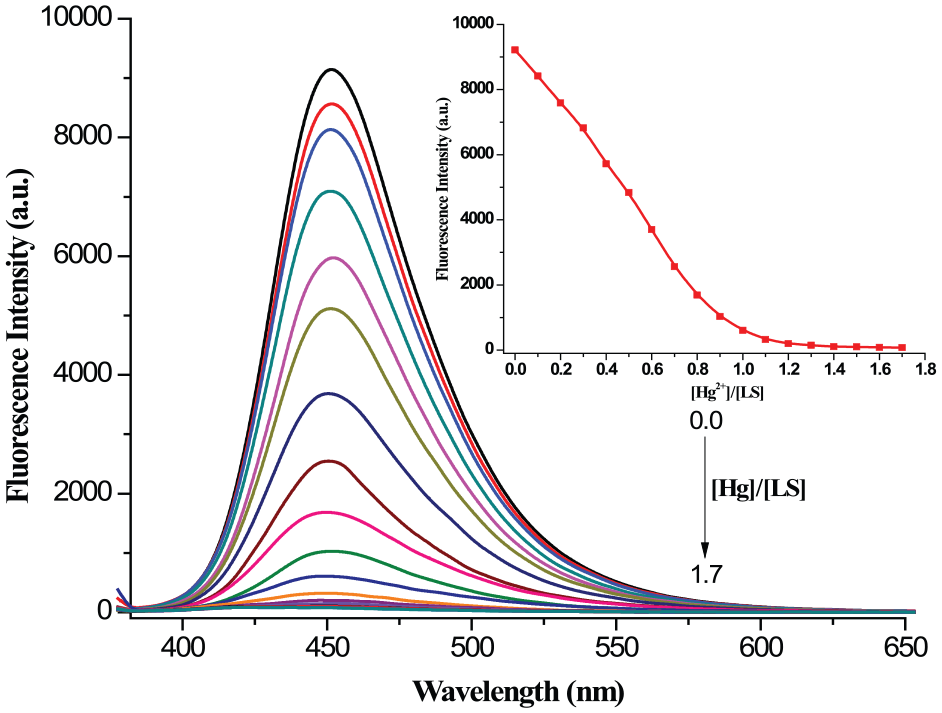
The quantitative sensing abilities of sensor LS (2 μM) toward Hg2+ were studied and a working curve was obtained (Figure 3). With addition of increasing concentrations of Hg2+ ions (0.2, 0.4, 0.6, 0.8, 1.0, 1.2, 1.4, 1.6, 1.8, 2.0, 2.2, 2.4, 2.6, 2.8, 3.0, 3.2, and 3.4 μM), the fluorescence intensity of LS at 451 nm decreased significantly. Besides, a good linear correlation (R2 = 0.9937) between the emission intensity of LS and the concentration of Hg2+ was observed on addition of 0–1.0 equiv. of Hg2+ ions.
Fluorescence titrations of 2 μM LS (λex = 369 nm) in ethanol and water (1:1, v/v) in the presence of different equivalents of Hg2+ ions (0, 0.1, 0.2, 0.3, 0.4, 0.5, 0.6, 0.7, 0.8, 0.9, 1.0, 1.1, 1.2, 1.3, 1.4, 1.5, 1.6, and 1.7 equiv.). Inset: Graph of the fluorescence intensity at 451 nm as a function of the concentration ratio of Hg2+ and LS.
According to the 3σ method (limit of detection (LOD) = 3σ/K, σ represents the standard deviation of a blank solution and K represents the slope of the calibration curve in Supplemental Figure S1), the LOD of chemosensor LS for Hg2+ reached 0.81 nM, which is much lower for the detection of Hg2+ than other published Hg2+ chemosensors (Table 1).30–37 These results demonstrate that sensor LS could be potentially used for selective detection of trace amounts of Hg2+ in analytical chemistry.
Comparison of LS-Hg2+ sensing with other dithioacetal-based Hg2+ fluorescent sensors.
To determine the utility of sensor LS (2 μM) as a Hg2+-selective receptor in the complex background of competing species, the fluorescence emissions of LS-M solutions (M represents different metal ions, 1 equiv. of LS) were examined in the presence of Hg2+ (Figure 4). LS-M solutions exhibited strong fluorescence emissions, even with common fluorescence-quenching ions (such as Cu2+, Cr3+, and Fe3+). Upon addition of Hg2+ (1 μM), the fluorescence emissions of the LS-M solutions were quenched almost immediately. This result demonstrated that sensor LS has the potential to efficiently detect Hg2+ in complex environments and is not interfered with other competing species.
Fluorescence intensities of LS-M (2 μM) solutions in the absence and presence of Hg2+ (1 μM). (λex = 369 nm, λem = 451 nm).
The fluorescence emission time-course of sensor LS with Hg2+ in ethanol/water (1:1, v/v) was studied (see Supplemental Figure S2). After adding Hg2+ to the LS solution, the fluorescence emission of LS-Hg2+ was significantly decreased in 2 min. The minimum of fluorescence intensity of LS-Hg2+ was reached after 6 min and then remained stable. This result demonstrated that the reaction between LS and Hg2+ proceeded quickly, and sensor LS could be practically used for the practical and rapid detection of Hg2+.
To investigate the applicability of sensor LS for detecting Hg2+ in different environments, the pH effects were studied (see Supplemental Figure S3). The fluorescence emissions of LS (2 μM) in the absence and presence of Hg2+(2 μM) were detected in various buffer solutions (see Supplemental Table S1). The free sensor LS exhibited relatively strong fluorescence emissions in the pH range of 6.15–9.96. Upon addition of Hg2+, the fluorescence emissions of the resulting solutions were quenched efficiently. These results demonstrated that sensor LS was highly sensitive toward Hg2+ in a relatively wide pH range (6.15–9.96). Considering that major biological imaging experiments are performed in neutral environments, sensor LS could be suitable for measuring Hg2+ in biological samples.
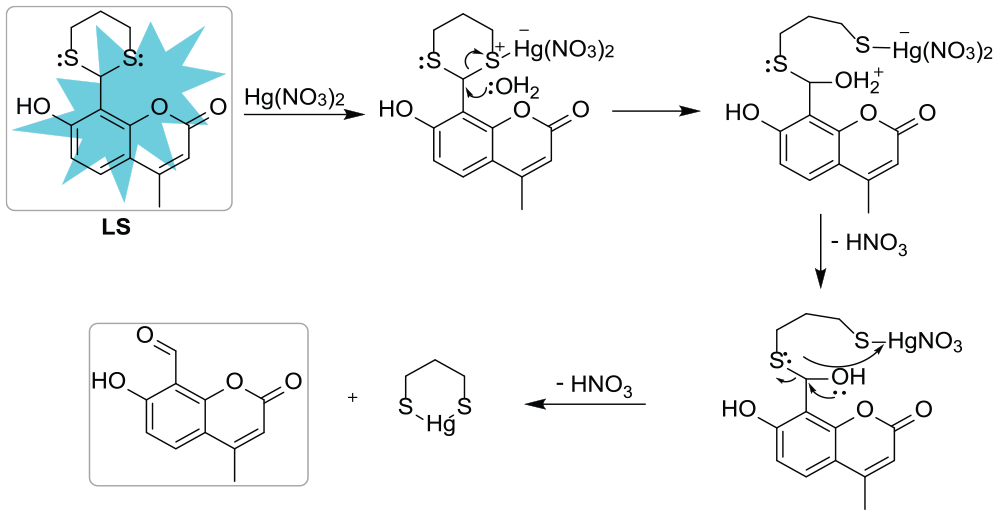
Based on the above results, a proposed Hg2+-promoted hydrolysis desulfurization mechanism for the fluorescence response of LS toward Hg2+ is proposed. As shown in Scheme 2, sensor LS emits strong light-blue fluorescent emission. Upon addition of Hg2+ to the solution of LS, the coordination between Hg(NO3)2 and the sulfur atom of LS caused activation of the carbon atom on thioacetal. The resulting activated carbon atom is then attacked by a water molecule to afford the corresponding aldehyde.
Proposed sensing mechanism between sensor LS and Hg2+.
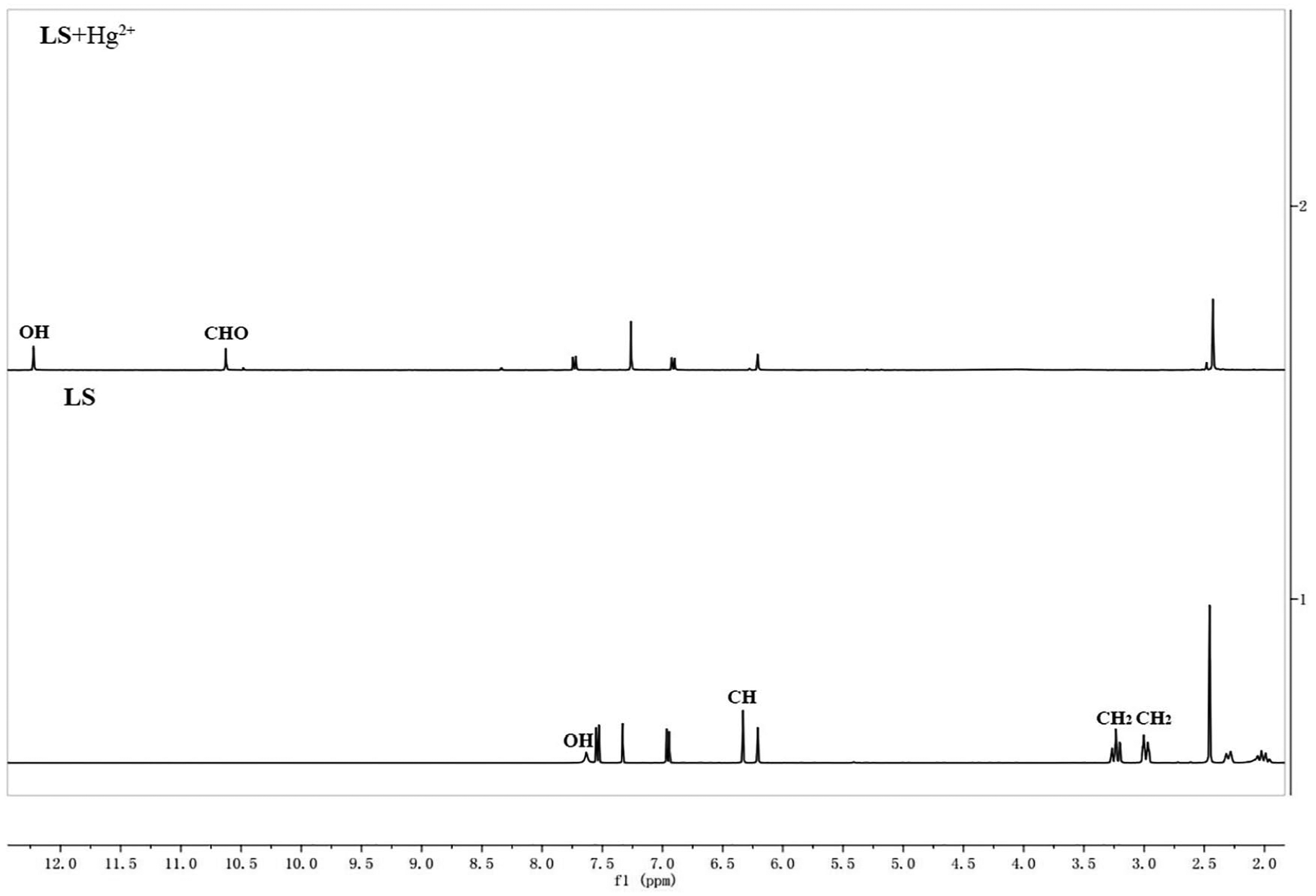
Additional evidence was given by NMR studies of the LS and LS-Hg2+ mixture. The 1H NMR spectra of LS in the absence and presence of Hg2+ were recorded in CDCl3. Significant spectral changes were observed (Figure 5). Signals for the protons of the methylene (3.16, 2.91, 2.23, and 1.93 ppm) and methine groups (6.26 ppm) disappeared in the presence of Hg2+, and a new resonance at 10.62 ppm formed being characteristic of an aldehyde proton. These phenomena indicated that the reaction between Hg2+ and LS causes desulfurization and formation of the corresponding aldehyde.
By utilizing a previously reported method,38,39 sensor LS was used to measure the Hg2+ content in actual water samples, including tap water (from our laboratory), domestic sewage (from student residences at our university), and industrial sewage (from industrial areas in Hangzhou City). All the water samples were filtered through a 0.2-mm filter membrane to remove large particular impurities, followed by the removal of remaining organics by extraction processes. The resulting samples were diluted with ethanol and water (1:1, v/v) in a 10.0-mL volumetric flask. Table 2 shows the results acquired using sensor LS with the appropriate concentration gradient of Hg2+ added. The results indicate that sensor LS had good recovery and demonstrated high accuracy in the analysis of Hg2+. Therefore, sensor LS can measure the concentration of Hg2+ in real water samples and has practical value in the environmental analysis.
Determination of Hg2+ in real water samples with sensor LS.
Determined with a pH meter before treating with Hg2+.
Results are based on three measurements.
Conclusion
In summary, a highly selective and sensitive coumarin-derived dithioacetal chemosensor, 8-(1,3-dithian-2-yl)-7-hydroxy-4-methylcoumarin (LS), has been designed and synthesized. LS shows significant “on-off” fluorescence behavior with Hg2+ in ethanol/water (1:1, v/v) solution, with strong light-blue fluorescent emission quenching. The detection limit was calculated to be 8.1 × 10⁻¹⁰ mol L−1 and remained stable, detecting Hg2+ in the pH range of 6.15–9.96. In addition, the sensor LS exhibits satisfactory results for Hg2+ detection in the analysis of real water samples and can be further used in potential applications for the detection of nanomolar concentrations of Hg2+ in chemical and environmental systems.
Experimental
All chemicals and solvents were obtained from commercial sources and used without further purification, except when specified. Solvents used in fluorescent experiments were of spectroscopic grade. The 1H NMR and 13C NMR spectra of the ligand were recorded on an Agilent 400-MR DDR2 spectrometer. The chemical shifts (δ) are recorded in ppm, relative to tetramethylsilane (SiMe4). The Fourier transform infrared spectrum was recorded on a Thermo-Nocilet IR200 spectrophotometer. Mass spectra were obtained using a Shimadzu LCMS-2020 spectrometer. A.Mapada UV-6100 UV–Vis spectrophotometer was used for recording the UV–Vis spectra. Fluorescence emission spectra were recorded on a Dual-FL fluorescence spectrophotometer. Elemental analysis (C, H, and N) was performed with an Elementar Vario MICRO cube and the results are within ±0.4% of the calculated values. All the solvents were purified before use. Compounds 1 and 2 (Scheme 1) were prepared starting from resorcinol according to a literature procedure.40
Preparation of 8-(1,3-dithian-2-yl)-7-hydroxy-4-methylcoumarin (sensor LS)
To a solution of compound 2 (204 mg, 1 mmol) in dichloromethane (10 mL) was added 1,3-dimercaptopropane (108 mg, 1 mmol), followed by five drops of boron trifluoride-diethyl etherate. The mixture was then stirred at room temperature (25 °C) for 12 h. After completion of that reaction, the resulting mixture was made alkaline with saturated sodium bicarbonate to pH 8–9 and then extracted with dichloromethane (50 mL). The organic layer was separated, dried over anhydrous sodium sulfate, and then concentrated in vacuo. The crude product was purified by flash chromatography (petroleum/ethyl acetate = 2:1, v/v) to afford the desired product (179 mg) as white solid. Yield 61%. M.p. 203–204 °C. IR (KBr, cm−1): 3310, 2919, 2891, 1712, 1607, 1572, 1392, 1362, 1317, 1064, 855, 809, 675. 1H NMR (400 MHz, CDCl3): δ = 7.56 (s, 1H), 7.47 (d, J = 8.8 Hz, 1H), 6.88 (d, J = 8.8 Hz, 1H), 6.26 (s, 1H), 6.14 (s, 1H), 3.13-3.20 (m, 2H), 2.89-2.94 (m, 2H), 2.39 (s, 3H), 2.20–2.26 (m, 1H), 1.92–1.99 (m, 1H). 13C NMR (100 MHz, CDCl3): δ = 160.74, 159.86, 153.10, 151.07, 125.88, 114.45, 113.21, 111.56, 110.96, 39.23, 31.20, 24.58, 18.85. MS (m/z): 316.95 [M+23]+. Anal. calcd for C14H14O3S2: C, 57.12; H, 4.79; S, 21.78; found: C, 57.15; H, 4.79; S, 21.79%.
Supplemental Material
Supplementary_material – Supplemental material for A novel coumarin-derived dithioacetal chemosensor for trace detection of Hg2+ in real water samples
Supplemental material, Supplementary_material for A novel coumarin-derived dithioacetal chemosensor for trace detection of Hg2+ in real water samples by Xing Ke, Yilei Fan, Jing Zhou and Zhongping Huang in Journal of Chemical Research
Footnotes
Declaration of conflicting interests
The author(s) declared no potential conflicts of interest with respect to the research, authorship, and/or publication of this article.
Funding
The author(s) disclosed receipt of the following financial support for the research, authorship, and/or publication of this article: This work was supported by the National Key Research and Development Program of China (No. 2018YFC0807400) and the Analysis and Measurement Foundation of Zhejiang Province (No. LGC19B050003).
ORCID iD
Yilei Fan
Supplementary material
Supplementary material is available online for this article.
References
1.
SelinNE.J Environ Monit2011; 13: 2389.
2.
HenriquesMCLoureiroSFardilhaM, et al. Reprod Toxicol2019; 85: 93.
3.
FaghiriFGhorbaniF.J Hazard Mater2019; 374: 329.
4.
WHO. The international programme on chemical safety. Environmental health criteria I. Mercury. Geneva: World Health Organization, 1976.
5.
ParkHNaveenMAnKL, et al. J Nanosci Nanotechnol2019; 19: 6893.
6.
SharmaBMSankaOKalinaJ, et al. Environ Int2019; 125: 300.
7.
KimKHKabirEJahanSA.J Hazard Mater2016; 306: 376.
8.
FongBMeiWSiuTS, et al. J Anal Toxicol2007; 31: 281.
TangLDingSZhangX, et al. J Photochem Photobiol A2017; 340: 15.
35.
XuQWWangCSunZB, et al. Org Biomol Chem2015; 13: 3032.
36.
SongCYangWZhouN, et al. Chem Commun2015; 51: 4443.
37.
ChangIJHwangKSChangSK.Dyes Pigments2017; 137: 69.
38.
QuSZZhengCHLiaoGM, et al. RSC Adv2017; 7: 9833.
39.
WuXChenJZhaoJX.Analyst2013; 138: 5281.
40.
HuangDDChenYHZhaoJZ.Dyes Pigments2012; 95: 732.
Supplementary Material
Please find the following supplemental material available below.
For Open Access articles published under a Creative Commons License, all supplemental material carries the same license as the article it is associated with.
For non-Open Access articles published, all supplemental material carries a non-exclusive license, and permission requests for re-use of supplemental material or any part of supplemental material shall be sent directly to the copyright owner as specified in the copyright notice associated with the article.