




Abstract
Background:
Recurrent ischemic stroke (IS) disproportionately affects individuals in their most productive years, contributing to significant morbidity and mortality. Despite its growing importance, data on this critical population remain limited.
Aim:
The aim of the study is to characterize rates and factors associated with recurrent IS in young adults.
Methods:
We performed a retrospective multicentre cohort study of consecutive acute IS patients aged 18–50 years from three tertiary hospitals in Singapore and Christchurch, New Zealand. We characterized rates and prognostic factors associated with recurrent IS over 1-year follow-up using univariate and multivariable Cox Proportional Hazards models. We then performed a systematic review and meta-analysis of PubMed, Embase, Scopus and Cochrane databases for all studies from January 2000 to July 2024 evaluating recurrent stroke or transient ischemic attack (TIA) following an index IS or TIA. We meta-analyzed rates and factors associated with recurrent cerebrovascular events based on aggregate count, aggregate survival, and individual patient-level survival data reconstructed from Kaplan–Meier curves.
Results:
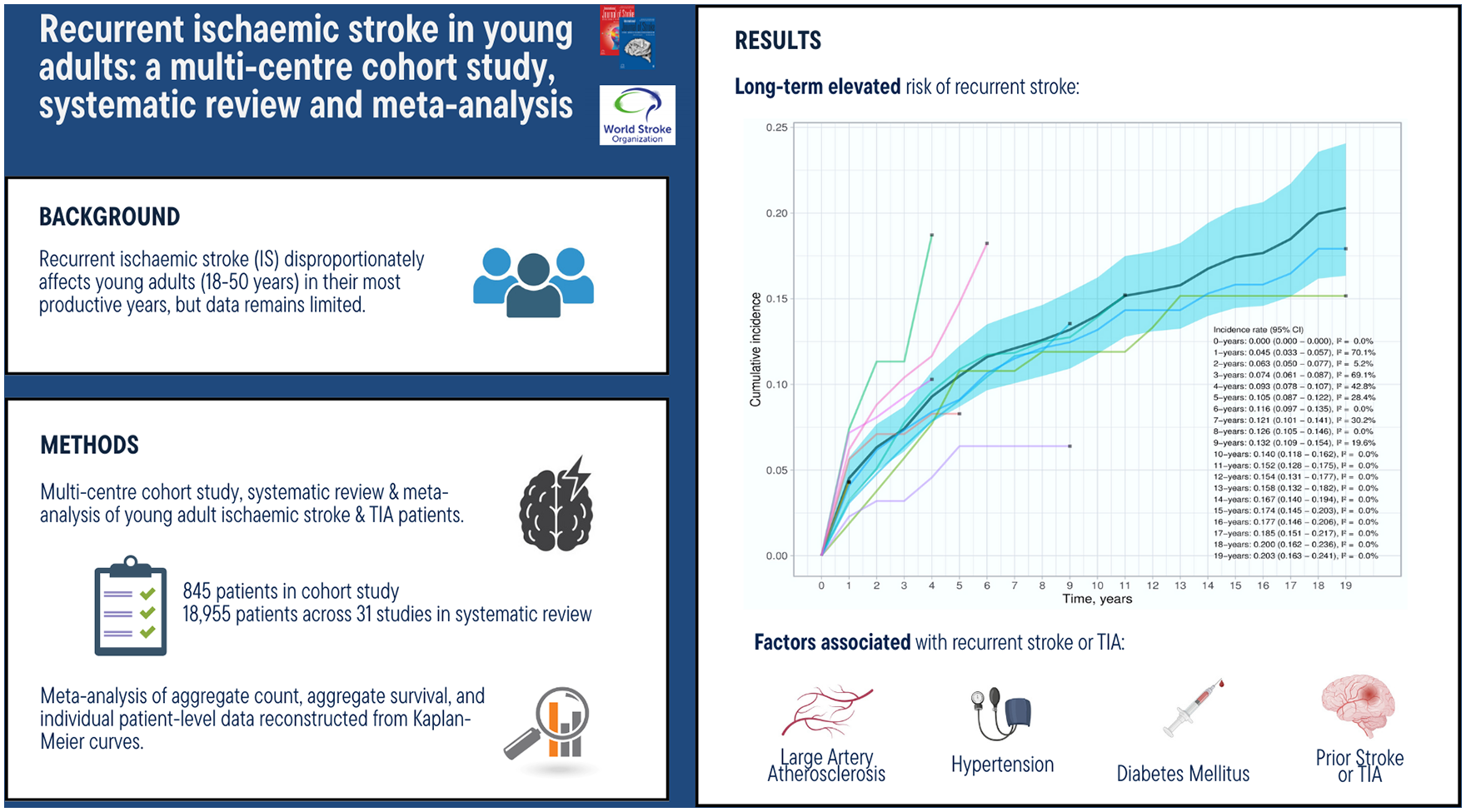
The cohort study of 845 patients showed a 3.41% (95% confidence interval (CI) = 2.16–4.64) recurrence rate over 1-year follow-up. Patients with diabetes mellitus and prior stroke/TIA had significantly higher rates of recurrent IS. The systematic review and meta-analysis of 18,955 patients across 31 studies yielded a recurrence rate of 4.5–7.3% at 1 year, 10.5–12.8% at 5 years, and 14.0–20.3% at >10 years. Large artery atherosclerosis (LAA) etiology, hypertension, diabetes mellitus, and prior stroke/TIA were significantly associated with recurrent stroke or TIA.
Conclusions:
Young adults with IS face a long-term risk of recurrent cerebrovascular events. More prospective studies are warranted to better characterize long-term prognosis for these patients.
Get full access to this article
View all access options for this article.
References
Supplementary Material
Please find the following supplemental material available below.
For Open Access articles published under a Creative Commons License, all supplemental material carries the same license as the article it is associated with.
For non-Open Access articles published, all supplemental material carries a non-exclusive license, and permission requests for re-use of supplemental material or any part of supplemental material shall be sent directly to the copyright owner as specified in the copyright notice associated with the article.
