




Abstract
Student researchers encounter ethical issues daily, but little is known about their unique perspectives. This article presents the results of 30 qualitative semi-structured interviews exploring students’ views and experiences around ethical issues in research groups. During the interviews, students were asked to describe challenges and successes they have encountered in their lab, their conception of what counts as an “ethical issue in research,” and how they handle these issues when they arise. Against this background, the article discusses students’ conceptions of ethical issues in research environments, the types of issues students reported facing, how these issues were ultimately resolved, and finally, the factors, internal qualities, and lessons learned that help students thrive in research environments, as well as some of the challenges students face – especially international students. Many of the ethical challenges interviewees discussed focused on interpersonal issues, highlighting the intense collaboration most graduate students have with their colleagues and supervisors. Findings from this study point to the need for targeted training programs for students and faculty supervisors focusing on building mentoring relationships and finding space in the lab where open communication can occur around ethical research practices.
Introduction
The integrity of scientific knowledge is paramount to our society. As citizens and researchers, we need the scientific research – and future researchers – emerging from our academic research labs to be committed to the core values of objectivity, openness, fairness, accountability, and transparency (National Academies of Sciences, Engineering, and Medicine, 2017). We have made strides in requiring the teaching of research ethics in U.S. colleges and universities (U.S. National Institutes of Health, 2022, U.S. National Science Foundation, 2022), but more is needed. When teaching research ethics, the focus is often on responsible research conduct (RCR) and rules for acceptable research behavior. While these are essential, recent studies highlight factors such as communication and good lab leadership as crucial in the ethical conduct of research (Antes et al., 2019a; Muthanna and Alduais, 2021). Students model themselves as future scientists on their senior colleagues and supervisors, and the interactions in this space are formative (Mejlgaard et al., 2020; Resnik, 2012). It is in the lab environment, perhaps even more so than the classroom, where students observe how responsible science is practiced, how questions and disagreements about research results are resolved, and how the final products of research are disseminated (Fisher et al., 2009; Weil, 2001).
Open communication, a culture that supports asking questions, regular lab meetings, and an equitable work environment are equally important, as they help build supportive lab environments and, directly and indirectly, foster ethical science, technology, engineering, and mathematics (STEM) research and research integrity (Dubois and Antes, 2018). These structures allow students to ask questions, seek help, and grow as individuals and academic researchers. Studies have examined research supervisors’ and mentors’ roles in enhancing the research integrity climate and engaging students in decisions about research integrity and responsible conduct of research issues by engaging students in meaningful discussions about research integrity, modeling fundamental attitudes toward responsible research practices, building collaborations and relationships, and serving as exemplars (Antes et al. 2019b; Pizzolato and Dierickx, 2023). Still, more research needs to be done from the student’s perspective. In their 2009 quantitative study of psychology students, Fisher et al. found that research experience, mentor RCR instruction, department policies, and faculty modeling of good research practices were essential factors. Other studies have found that professional and organizational socialization plays a vital role in shaping these perspectives and that the kind and quality of supervision graduate students receive play a significant role in the type of ethical issues they experience and value (Löfström, 2012; Löfström and Pyhältö, 2020). But what more can we find out by delving into the individual experiences of students?
This qualitative study is part of a research project that investigated ethical issues in STEM research and the culture of research labs and aimed to contribute to building a culture of responsible research and practice by situating research ethics education within the research environment (Hildt et al., 2019, 2022; Laas et al., 2021, 2022). Drawing from studies similar to our topic, by “ethical issue,” we mean “. . .any situation that may compromise, in whole or in part, the respect of at least one moral value that is considered socially legitimate and should thus be respected” (Drolet et al., 2023: 270). We have refrained from using the term “ethical dilemma” as students did not often avail themselves of describing the situations they experienced as situations where two or more ethical principles or standards were in substantial conflict with one another.
This article uses the same interview data analyzed in our previous publication that explored the culture of research groups (Laas et al., 2022). Findings from that study focused on the lab environment more generally, highlighting the critical role of open communication, community structures, governance, and collaboration in shaping lab culture. In this analysis, we explored the ethical issues students have experienced in their research groups, how these questions came about, and methods used to address these issues. This analysis aims to shed light on what students consider critical ethical issues in their work, the specific experiences of students when encountering ethical issues, and what factors helped or hindered resolving these issues satisfactorily. These issues are significant insofar as they point to differences between faculty and students in their perception, experience, and resolution of ethical issues. They also highlight key points in the student experience where levels of supervision, support, or interventions could be improved to help students flourish in the research environment and gain a more robust understanding of responsible research practices.
Our primary research questions were:
• What do students consider ethical issues in STEM research and lab practice?
• What ethical issues do students report experiencing in their research group?
• What factors or internal qualities help students thrive in research groups (and prevent ethical issues)?
• What methods have they used to address these ethical issues?
• What lessons did the students report learning about encountering ethical issues?
Method
This qualitative study emerged from a National Science Foundation grant 1 and was preceded by an extensive survey of over 200 students (undergraduate and graduate) and faculty that asked participants to identify the most critical ethical issues in STEM fields, how often these ethical issues are discussed in research groups, and how often these issues come up in the regular practice of research (Laas et al., 2021).
Sampling and recruitment of participants
With this background knowledge and after receiving approval from the university’s Institutional Review Board, the research team conducted 30 interviews with students working in university laboratories. We use the term “student researcher” in the article to mean students have at least 6 months of experience working in an academic research lab outside the classroom. The project team recruited 28 graduate students and two undergraduate students from STEM laboratories at the same university to participate in the studies. To participate, interviewees needed at least one semester of non-classroom lab work. Students were recruited via an email sent by participating department coordinators and flyers posted around campus. Students were emailed a copy of the consent form before the in-person interview and were asked to sign a print copy of the informed consent form after having the chance to ask any questions they might have about the research study.
Data collection
The 30 students participated in an hour-long semi-structured interview of 20 questions (Appendix I). The interviews were conducted in person by two research team members and were audio-recorded. These questions focused on the working situation of their lab, communication, and challenges, asking the students to describe their lab's culture and their suggestions for improving this culture. The audio recordings of the interviews were transcribed and pseudo-anonymized by the research team members and checked by the research team leader for accuracy.
For this study, the project team looked at interviewee responses to questions a-g and i-k of the interview. These questions focused on ethical issues students encountered in their research experiences (see Appendix I). Some example questions relevant to this analysis are: “Can you tell me about a specific experience in your lab or research group with an issue that you think had ethical implications?”; or “What are the most important lessons you learned from working in a research lab/group and encountering ethical issues or questions?” An analysis of the other questions is described in a previously published article (Hildt et al., 2022).
Data analysis and methodology
Thirty interviews were conducted for this study by a team of three collaborators: a librarian with 16 years of experience in research ethics, an ethnographer, and a master’s student in psychology. Two interviewers conducted each interview, which was recorded and transcribed. The interview transcripts were then loaded into MaxQDA for coding and analysis. Using the grounded theory methodology (Strauss and Corbin, 1994), team members coded one interview independently and then developed a shared coding system. The team chose the emergent fit grounded theory approach to avoid confirming pre-conceived notions and avoid any biases team members might bring to the data from past work. Categories developed in this coding system emerged through successive levels of analysis and discussion among the team members. Following this, two team members coded each interview transcript separately and then discussed it until a final coded version was agreed upon. Sentences from the interviews could be coded multiple times using different codes. Overall, 120 codes were used in analyzing the transcripts (Appendix II).
For this publication, the research group examined the 120 codes and decided to exclude terms that: (a) were not mentioned in the answers to questions a-g and i-k of the interview, and b) any codes that appeared in less than five interviews, and therefore did not allow us to compare interviewees’ perspectives effectively. Some minor changes to the original coding system were made to combine codes that were similar in content. 2 This left 63 codes (Appendix III).
After pulling the coded sections of the transcripts corresponding to participants’ answers to these questions, the project team grouped the codes into twelve subgroups (Table 1, subgroup category). Analyzing the subgroups, we built three overarching areas: ethical issues in STEM, communication/relationships/feelings, and lab situations.
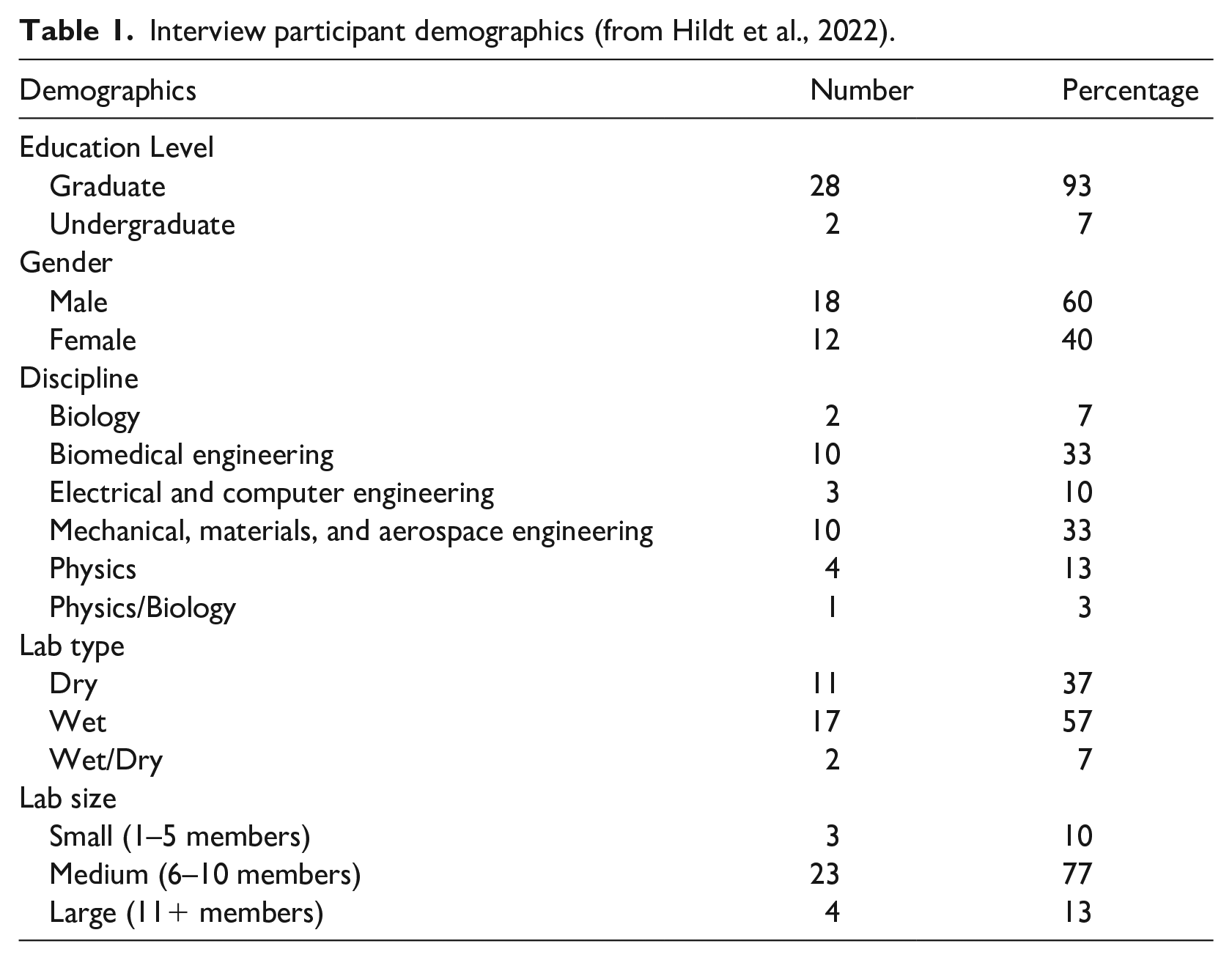
Interview participant demographics (from Hildt et al., 2022).
In the final analysis, two project team members looked at quotes in these sub-groups and analyzed the interview data. While a prolonged process, this approach gave the team an in-depth understanding of how the students described the ethical issues in their labs and how they were handled.
Results
Demographics
The detailed demographics of the interviewees and the table depicted below have already been published in Hildt et al. (2022). Of the students interviewed, 28 were graduate students, and two were undergraduates. Nineteen students were international, and eleven were domestic. This reflects the majority international graduate student population at the university, around 65%. The study population reflected the university population at the time (42% female, 58% male), with 12 female and 18 male students participating in the interviews. For details on the discipline, lab type, and size, see Table 1. The term “dry labs” is used to characterize labs where most experimentation is conducted via computers or computer-generated models. In contrast, “wet labs” are labs with hands-on research and experimentation, and wet/dry labs combine both characteristics.
The university attended by the students interviewed for this study is located in a large metropolitan area in the United States. Research groups in this university tend to be small, especially compared to larger, state research universities. Faculty usually work closely with their graduate students; sharing lab space and equipment is standard.
Topics addressed – areas and subgroups
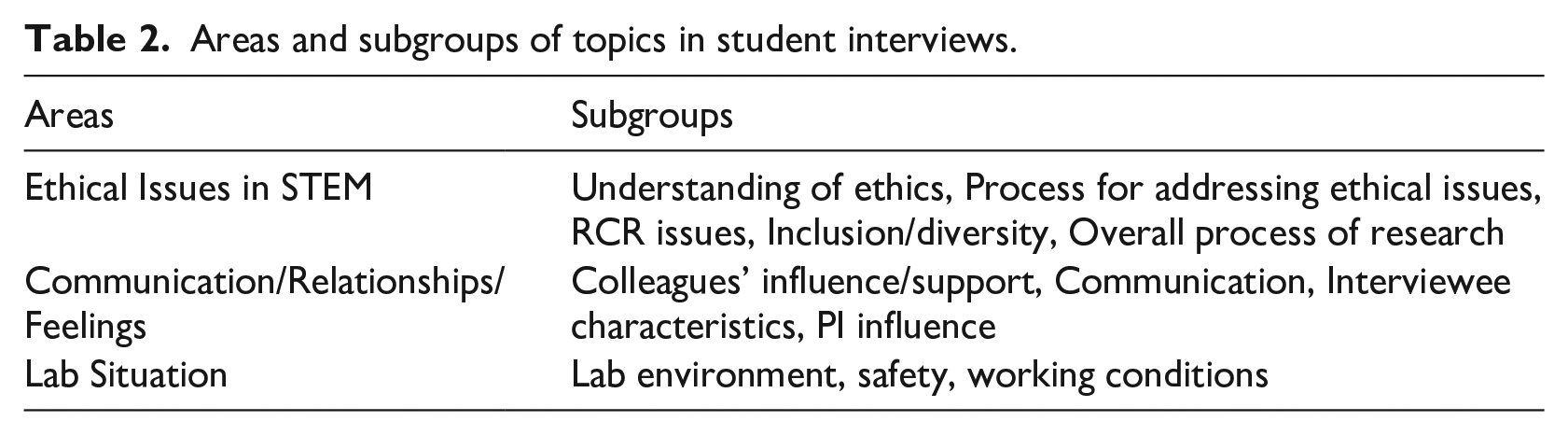
In what follows, we present the results combined in three areas: “Ethical Issues in STEM,” “Communication/Relationships/Feelings,” and “Lab Situation” (see Table 2). We chose these areas to help define the different areas that affect a student’s research experience. The first group, “Ethical Issues in STEM,” explores students’ understanding of ethics, how ethical issues are addressed in the lab, and specific mentions of RCR issues and issues of diversity and inclusion. The second area focuses on the levels of communication and relationships among lab members, as well as the personal traits and feelings of the students. The third and final group focuses on the overall situation of the lab, including students’ characterization of the lab environment, its safety culture, and overall working conditions.
Areas and subgroups of topics in student interviews.
Ethical issues in STEM
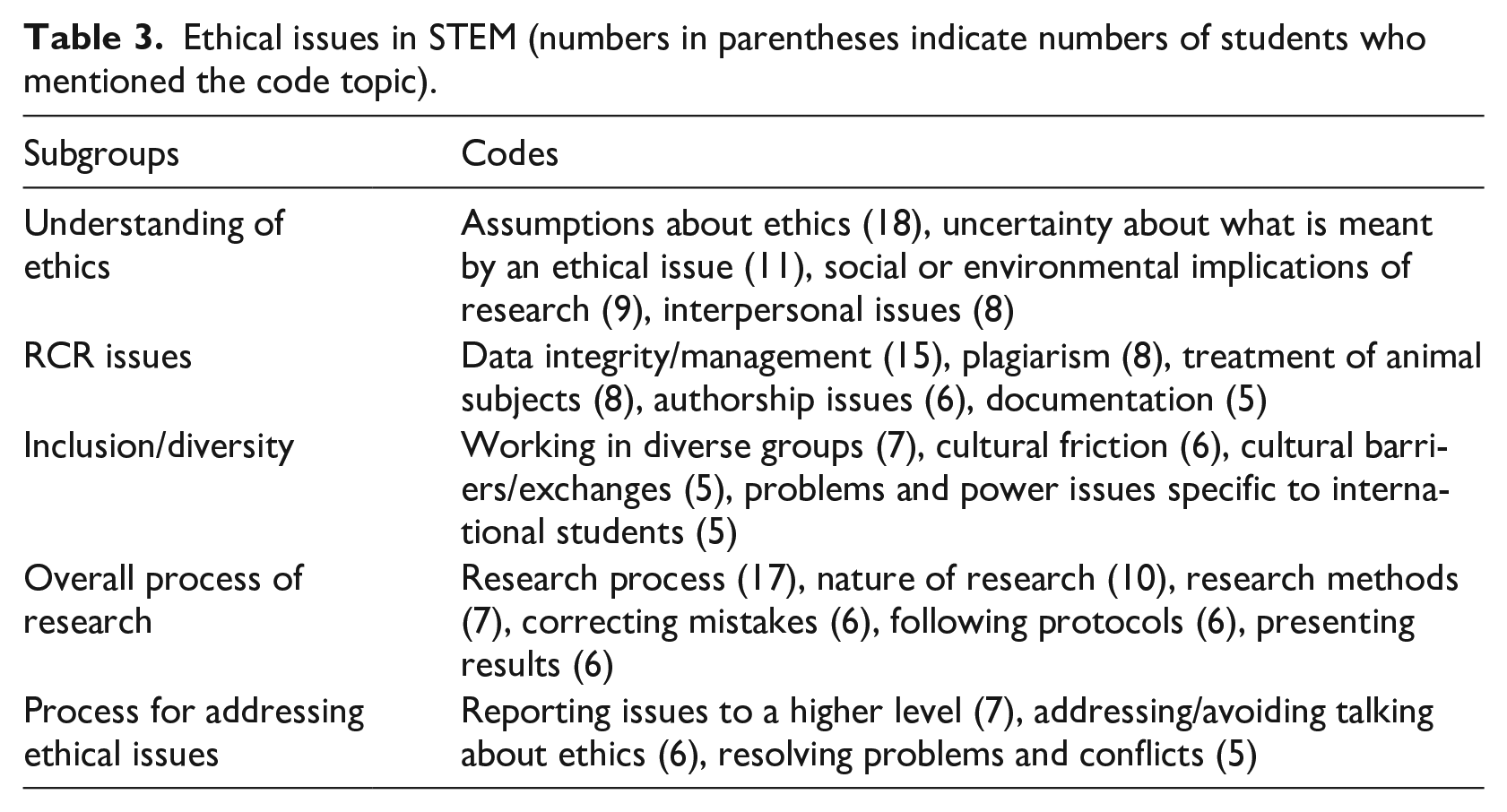
This section presents the results of “Ethical issues in STEM,” including ethical issues in STEM/Understanding of Ethics, Inclusion/diversity, the process for addressing ethical issues, RCR issues, and the research process. This grouping captures students’ discussion of “ethics” topics, traditional issues usually included under research integrity, and inclusion and diversity. We also included student discussions of the research process, which is integral to how ethical issues arose in the lab environment (see Table 3).
Ethical issues in STEM (numbers in parentheses indicate numbers of students who mentioned the code topic).
Understanding of ethics
Our first question asked students, “What do you consider ethical issues in STEM research and practice?”
Strikingly, 11 interviews included statements about
Those who did talk about their
RCR Issues
In response to the question, “Can you tell me about a specific experience in your lab or research group with an issue that you think had ethical implications?”, most students spoke about specific RCR topics, including
Inclusion/Diversity
Four codes were categorized under the subject of inclusion/diversity:
Several students spoke about differences between lab members, different cultural backgrounds, stereotypes, language problems, and the need to understand each other and overcome barriers. One student said: “I mean, this is probably representative of [the university] itself, but I was born in the States, the other three Ph.D. candidates, one is from Kenya, one’s from Spain, and the other one’s from China, but then it’s fun..now that we got to know each other..you know it’s okay, and it hasn’t led any issues if I don’t understand something I speak up, I can ask, ‘can you say that differently?’, it doesn’t hurt me to ask that” (Interview 22).
Several students mentioned cultural barriers related to language, as they tended to associate more with individuals who speak the same language or come from their country of origin. Sharing food from one’s culture and being open to discussing cultural differences helped some students build stronger relationships.
International students also spoke about specific power issues they encountered. “As international students, we feel like our life depends too much on our advisor because he has power to basically over us in this country. We can only stay here because we have student visas” (Interview 16). Interviewees also spoke about feeling powerless. “I feel so insecure. . .I think it’s kind of a strategy because when a person feels insecure, other people can manipulate him or make him uncomfortable” (Interview 6). This same student discussed his approach to mitigate feeling powerless.
Overall process of research
Six different codes fell under the overall process of research category: research process, nature of research, research methods, correcting mistakes, following protocols, and presenting results. Quotes in this section arose when students were asked to describe ethical issues they had encountered in their lab or when they were asked to talk about what it is like to work in their lab and to describe challenges and successes experienced.
Seventeen students spoke in depth about the
Students mentioned many specific experiences in research as formative, including the importance of learning correct
Students also discussed the
Process for addressing ethical issues
When discussing processes for addressing issues, students discussed
Six students spoke about
Five students spoke about how they
Relationships/Communication/Feelings
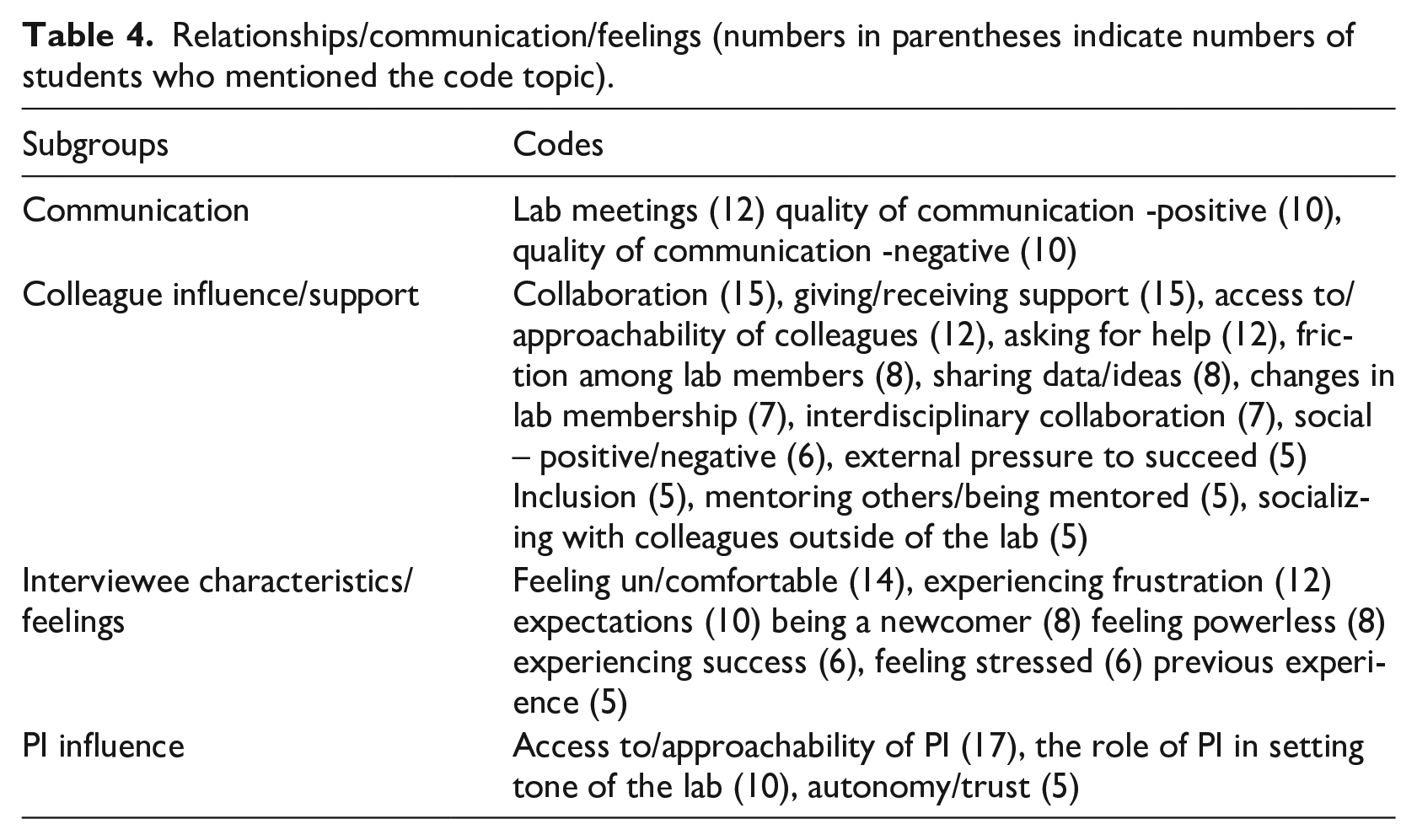
This section presents interview results on how the interviewees’ communication, relationships, and individual characteristics impacted students’ lab experience. It focuses on the internal relationships between lab members, how they interact with one another, the presence or lack of support from supervisors and colleagues, and characteristics that interviewees bestowed on themselves through their descriptions of events. In comparison with the first area, “Ethical issues in STEM,” this section helps put these issues in context. It shows how the process of identifying and effectively addressing ethical issues in the lab environment can be either helped or hindered by factors such as communication, relationships, or the characteristics and feelings of an individual student (see Table 4).
Relationships/communication/feelings (numbers in parentheses indicate numbers of students who mentioned the code topic).
Communication
More than a third of students discussed
Ten students discussed the
A third of the students spoke about the
Colleague influence/support
Fifteen students spoke about
Students also spoke about
Twelve students discussed the
Several students discussed
A number of students discussed
A handful of students spoke about issues of
Students also spoke about
Interviewee characteristics
Under the subgroup interviewee characteristics, 13 codes were categorized: feeling un/comfortable, experiencing frustration, expectations, being a newcomer, feeling powerless, experiencing success, feeling stressed, previous experience, expectations met/unmet, being senior in a research group, conflicting obligations, empathy for others, and work/life balance issues.
Fourteen students discussed feeling
Students also described instances where they
A third of the interviewees spoke about
Several students spoke about
On the positive side, students spoke about
Finally, students spoke about
PI influence
In this subgroup, three different codes were categorized: access to/approachability of PI, the role of the PI in setting the tone of the lab, and autonomy/trust.
Seventeen students spoke about the
A handful of interviewees spoke of PIs who could have been more approachable. They described their PIs as extremely busy or rarely in the lab. One of the students mentioned this as one of the reasons he left: “The reason why I left that first lab was even before my first day in the lab, the teacher said that ‘I am very busy and most of the time everybody in this lab. . .you guys need to do more self-studying or cooperation between you guys. . .but the real thing is this Professor will go to this lab once per week, and I mean only the last two hours, I think that’s. . . the teacher got paid right; he should pay some attention to his work” (Interview 6).
Ten students discussed the
Issues of
Lab situation
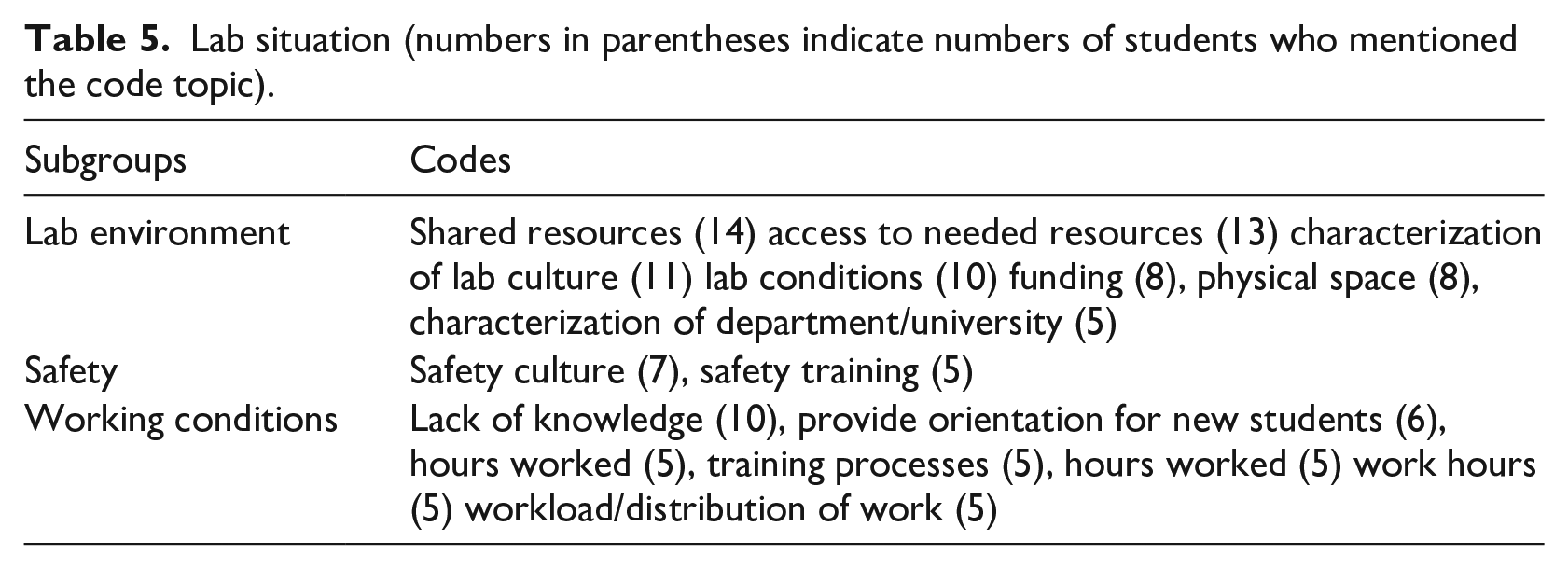
This section presents the “Lab Situation” area, that is, results that relate to how the overall lab environment impacted the students’ experiences. This section explores the physical space the students work in, the interviewees’ characterizations of their lab and department culture, and the safety and work culture of their respective labs. It reflects how students characterized different facets of their work environment and characteristics that could help or hinder research progress and resolve ethical issues more specifically (see Table 5).
Lab situation (numbers in parentheses indicate numbers of students who mentioned the code topic).
Lab environment
Almost half of all students interviewed spoke about successful practices for
Students also encountered problems sharing resources, including poor communication about purchasing new supplies, unfair time on expensive equipment, and contamination of other lab members’ cell cultures. “We all share a space for our cells. Everybody is growing cell cultures and using them for different purposes. If one person makes a mistake, it will ruin everybody else’s experiment. . .if someone screws up, everybody loses weeks, months of research” (Interview 15).
Eleven students provided a
A third of the students spoke about the
The
Several students spoke about
Safety
Safety in the lab was a daily concern for many students, and many spoke about the
In a handful of interviews,
Working conditions
Ten students spoke about needing
Several students spoke about the importance of
The
Some interviewees spoke about the
Discussion
The student interviews provided detailed insights into their experiences as researchers and how external factors such as funding, international status, outside obligations, and internal factors such as colleagues, supervisors, and the nature of their research impacted this experience. Overall, there seemed to be significant variance in what students thought counted as “ethical issues,” though most students could retrospectively articulate how ethical issues arose in their research. The overall lab situation, while important to the progress of research, was less important than the relationships between lab members, the personal feelings of the students, and the overall level of communication in the lab. Students who felt isolated, underappreciated, or powerless were likelier to “keep their head down” and “not rock the boat” (Interviews 4 and 17). In labs where communication levels were high and open, questions were answered promptly, and there was a high level of collaboration among lab members, students felt far more comfortable raising ethical questions, seeking allies, and learning from their peers.
What do students consider ethical issues in STEM?
When asked to simply name what they thought were ethical issues in STEM research and practice, students’ answers ranged from traits such as honesty and respect to extremely practical issues such as not wearing jeans or not eating in the lab. Half the students mentioned traditional RCR issues, like managing data and avoiding plagiarism. This reflects similar findings from a university-wide survey completed by the authors in 2016 (Laas et al., 2022). In contrast, around one-fourth of the students focused on interpersonal issues such as power dynamics and social and cultural attitudes that can arise when working in diverse groups. This diversity of opinions reflects findings of a 2018 study of medical students, faculty, and practitioners who also listed key values (such as honesty, truth, and objectivity), following rules, and avoiding research misconduct when asked to define research integrity (Shaw and Satalkar, 2018).
When first asked, more than one-third of students expressed some hesitancy in what was meant by ethical issues in STEM research and practice. Several students gave an initial "no" response to whether they had encountered ethical issues or challenges in their lab. This raises some interesting questions. Do some students only identify ethical issues when they are “impressive,” or was this a reaction to only wishing to share more dramatic stories with interviewers? Do the students assume that an ethical issue is outright wrong? Something that has to be condemned? Something that, in principle, should not happen at all?
However, many came up with examples after receiving a further explanation of what was meant by “Ethical issues in STEM.” These students appeared not to have a clear idea of what might be considered an ethical issue in research, or they had difficulties understanding the term “ethics.”
This speaks to the need to use more nuanced cases in teaching RCR and research ethics, and stressing reflection on personal experiences with research as well to help students see ethics as something integral to research rather than only as pertaining to research misconduct or other significant dilemmas (Inguaggiato et al., 2023; Kalichman, 2014).
Other students were extremely prompt in their answers and provided an incredibly nuanced answer, dividing ethics into multiple facets. In many cases, students naturally named the ethical issue uppermost in their minds and then described their personal experiences handling these issues in the lab.
Some of the comments made by the students who felt they had a good grasp of ethical issues in research reflect what Dubois and Anderson (2018) mention as the five dimensions of research ethics. Students spoke about normative ethics (values), compliance with rules and regulations, best practices leading to the rigor and reproducibility of science, and the importance of workplace relationships.
One may interpret the interview results as a need for more clarity among students on ethical research issues or a lack of research ethics education. Alternatively, it may hint at a potential need for instructors, mentors, and PIs to better specify what they understand ethics and ethical issues to be, make the role of ethics in research more explicit, and define ethics as being much more than just avoiding misconduct (Shaw and Satalkar, 2018: 92). On the other hand, students may connote "ethics" with rules, regulations, and policies they need to follow. Some ethical aspects students talk about are not traditional RCR issues. Instead, they are about communication, interpersonal relationships, and issues of equity and discrimination. Recent work on developing stronger research integrity training that includes focus in these areas offers a promising push to enlarge the circle of what is included as “ethical issues under the umbrella of research integrity” (Rasmussen, 2023).
What ethical issues have the students experienced in their research group?
Students’ responses focused on RCR issues and interpersonal matters. When breaking down RCR issues, most students talked about traditional ethical topics such as data management, plagiarism, animals in research, authorship conflicts, and documentation of results. Few students referred to learning about these issues in an ethics class or module; instead, the students who spoke about positively dealing with these issues cited the guidance of their supervisors and more experienced colleagues as being fundamental to recognizing when a problem was important and seeking solutions to ethical questions that came up. Students shared familiar stories about topics integral to the research process and challenges in presenting and publishing results.
A subset of the students, most of whom were international students, also spoke about interpersonal ethics issues. This points to the unique position students who come to study from other countries face in U.S. institutions. Two-thirds of the international students interviewed reported generally being comfortable in their lab. Students encountered challenges, such as fellow students needing to share lab equipment, learning to ask for help and communication challenges. Still, most were highly enthusiastic about their lab colleagues and PI's support. Other students spoke about having a positive and supportive lab environment but being aware of the particular issues international students face.
The comments shared by the international students who reported having negative experiences in their labs shared several factors. This included several students discussing significant power imbalances, feeling extremely vulnerable due to their immigration status, and promises of potential funding being used to make students stay working in a particular lab. These students spoke of "protecting themselves” or actively avoiding situations that might cause conflict. The research site's competition for teaching and research assistantships is relatively high, especially among international students who are ineligible to receive federal work-study funds. This pressure likely contributed to these negative feelings and worries over funding availability.
Almost all of the students interviewed reported experiencing negative feelings in their research environment at one point. Most of this stemmed from everyday frustrations and new experiences, such as being stressed due to problems with the research process. A much smaller number of students expressed experiencing negative feelings that raised more concern. This is the case for two students who felt uncomfortable with their lab mates or PI, a student who thought he could not speak freely for fear of getting into a political argument with his colleagues, and a student who felt his PI did not want him there.
Several students, most of them international, spoke about feeling powerless. They talked about feeling an overall lack of control or autonomy due to being undergraduate or international students. Students discussed working in isolation, staying silent, and fending for themselves.
The challenges described by students reflect some of the barriers identified in a 2020 study published by Haven et al. Though this study focuses explicitly on researchers’ perceptions of what makes a responsible research climate, interviewees identified themes of lack of support, unfair evaluation, and insufficient supervision as significant barriers to establishing a positive research climate (Haven et al., 2020). The unique experiences of international students are of particular concern, especially in light of studies highlighting the acculturation stress, loneliness, and social isolation that many international graduate students have reported as part of their experience studying in the U.S. (Burt et al., 2017; Girmay and Singh, 2019; Laufer and Gorup, 2018; Li et al., 2019.)
What factors or internal qualities help students thrive in research groups (and prevent ethical issues)?
Students discussed several internal qualities necessary to help them thrive in their research group. Students spoke about seeking out knowledge through research or asking questions, becoming less shy and reaching out to colleagues, learning how to ask for help, or being mentally prepared for working with animals.
They also identified several learned skills that helped them thrive in the lab environment, including having the confidence to ask questions and ask for help, learning to stand up for themselves, and talking to individuals in positions of power when they see an issue that needs to be resolved. Though some students who spoke of advocating for help were disappointed by the lack of response, none of these self-motivated students expressed regret for taking this step.
Students discussed the importance of keeping good documentation to share results and progress with their collaborators and the methods they used to share time on expensive research equipment equitably. Students spoke of the PI as helping them learn the standards for performing good research, but they worked with peers to allocate time, resources, and storage space. The importance of robust research mentoring and supervision has been documented in many studies (Antes et al. 2019a; Muthanna and Alduais, 2021; Resnik et al., 2021), and students provided examples of solid mentoring and supervisory practices in their interviews.
As discussed in our previous publication (Hildt et al., 2022), students thrived in a “culture of helping” that prioritized open communication, the ability to ask questions and make mistakes, and providing scheduled, regular times for communication. More experienced students seemed to internalize this culture in stellar labs, acting as mentors to their less experienced peers. In some cases, safety advocates brought up issues to their supervisors and, in some cases, took matters into their own hands. A positive, open, and supportive organizational climate has been repeatedly linked to helping students excel and fostering good research practices (Vidak et al., 2023).
In a small number of cases, students spoke about the need to “get used to it,” “keep one’s head down,” and “keep silent.” Students in these cases described their labs as having poor communication and PIs that were often not present in the lab or were not overly transparent about expectations and funding available. These experiences severely impacted students’ well-being in the research environment, though some students discussed tactics to mitigate these effects. Several studies have shown the impact of poor supervision on graduate students’ mental health and success and described similar detrimental behaviors (Meng et al., 2017; Scheuer et al., 2016).
What methods have students used to address these ethical issues?
While all students ultimately discussed what they considered ethical issues in STEM and discussed the ethical challenges and questions they encountered in the lab, a smaller number spoke about how these ethical issues were addressed. The PI often played the main role in resolving these issues. Students talked about their appreciation of their PI’s adherence to good research practices and prioritizing two-way communication. This echoes the vital role of good supervisory and mentoring skills in helping resolve ethical and other student issues (Antes et al., 2019b).
When speaking about authorship, PIs made final authorship decisions, and students generally brought these issues to the PI for resolution. While one student spoke about PI authorship decisions as “about hierarchy,” other students were willing to accept these decisions as long as the decision was explained clearly. Authorship often leads to tense discussions among collaborators – regardless of their seniority – and can highlight power imbalances in the lab (Smith et al., 2020).
A handful of students spoke about reporting ethical challenges to a higher level, with mixed results. All of these students expressed the need to protect themselves and others from either safety issues or, in one instance, harassment. Though none of the situations described in the interviews rose to the level of actual research misconduct, the students who reported acting on these issues were all domestic students who had a level of tenure in their lab. This correlates with other studies looking at the backgrounds of individuals willing to report questionable behaviors to higher levels of authority. (Horbach et al., 2020).
A handful of interviewees spoke about internal methods for solving conflicts among their peers. In each of these instances, students took the initiative by anticipating problems before they arose, training new lab members, or bridging the issue to their PI when no internal solution could be found. All of these students who took leadership roles came from labs that had been described as open and friendly and where they felt they had the trust and the seniority in the lab to raise questions and provide training to fellow students.
Students described practical and ingenious ways of solving potential problems, especially around sharing lab equipment. Sometimes, solutions were as simple as using Google Drive to share data or online tools to assign tasks to team members. In other cases, students negotiated with colleagues when they needed to use large amounts of computer processing power or storage. Traits such as problem-solving, good communication, negotiation skills, and building relationships helped students resolve ethical issues in day-to-day research.
What lessons did the students report as having learned?
Concerning lessons learned from working in a research lab and encountering ethical issues, students learned about the overall research process and the importance of following best practices. This included keeping a good lab notebook and being precise about data collection, being scrupulous in citing others, and learning what it means to be an author on a research paper.
Interviewees also discussed the importance of learning how to work in diverse groups. They spoke about diversity being part of “the nature of science and education worldwide” and how working in these groups helped them better negotiate language and cultural differences. Students also talked about how working in these groups helped them appreciate different viewpoints and approaches to research. Two international students spoke about being braver in bringing up issues of fairness with their supervisors. In contrast, other international students said they learned to keep their heads down and avoid getting into controversial discussions with their peers. This again points to the precarious position many international students may feel they inhabit. These comments again highlight the need to help students develop the skills needed to thrive in a global research environment and develop their autonomy as researchers.
Students also spoke about learning to become independent researchers, and while some wished for more written rules and guidance, others talked about how the realization that the PI would not be around all the time meant that they had to learn to troubleshoot and provide assistance to their peers when needed. Sharing resources also came up in several interviews as a major lesson learned. Students discussed developing systems, peer networks, and timetables to help more extensive labs share expensive equipment.
Overall, students were pleased with their research experience. The overall physical situation of the lab mattered less to students than the psychosocial situation in the lab. Namely, did their research group provide the emotional, intellectual, and peer networks needed to learn best research practices, or were students working in more isolated environments with limited communication or contact with their peers and professors? Further research is required in order to better map relationships between student researchers in the lab environment and identify key supports, training, or other interventions needed to help students identify, discuss, and actively seek solutions to ethical issues that come up as part of the research process. Namely, how do existing power differentials between supervisors and other lab members shape a student researcher’s perception, recognition, and ultimate handling of ethical issues in academic research environments?
Limitations
Results shared in this study come from interviews with 30 students engaged in research at one Midwestern U.S. university and are limited to one qualitative study. We hope that future studies of this kind look at larger, more diverse student populations, allowing for comparison between different institutions. Further studies focusing more specifically on the experiences of international students would also be highly illuminating (Antes and Dubois, 2018).
The participants included students willing and able to talk about their research experiences freely. Students experiencing significant problems with their current lab group may have decided not to participate in the project. Participants were not asked to validate the analysis of the interview results, which is another limitation of this study.
Due to the relatively homogeneous study population (e.g. graduate students in a mid-sized research university), we stopped interviewing new students when we reached 30 interviews, and no new insights emerged from these discussions. However, conducting a similar study at different universities would likely reveal a more nuanced understanding of, say, the specific ethical issues faced by minority students and how they address these issues. Students’ experiences at large state research institutions, where large lab groups dominate, would be another interesting comparison to this study’s results.
Conclusion
A 2019 Nature survey found students worldwide expressed frustration about training, work-life balance, and harassment and discrimination. However, most students surveyed (75%) were glad they had decided to pursue a higher degree in their chosen field (Woolston, 2019). Our study explores graduate students’ experiences with ethical issues in research labs and the students’ challenges, successes, and coping strategies. It points to the need for strong peer networks, well-trained supervisors, and a shared understanding of the responsibilities of both students and faculty supervisors.
Our study underlines the need for supervisor and graduate student training that addresses power dynamics and inequality among lab members (Bettencourt et al., 2021). This should include supervisors and students asking questions and reflecting on current lab practices, their assumptions about their colleagues, and engaging in two-way discussions about how these practices could be improved. Plemmons and Kalichman’s 2018) “Instructor’s Guide to Prepare Research Group Leaders as RCR Mentors” (developed an example of similar exercises, and there are other examples of recently developed programs that fulfill this need (Haven et al., 2023).
This study highlights the unique challenges international students face. They often grapple with social isolation and limited avenues for addressing ethical or other problems. While PIs can serve as advocates, the hierarchical model predominant in the U.S. education system also means that PIs can be sources of stress and inequality (Gardiner, 2008). In addition to this, there is the need to keep one’s visa status and the overall cost of studying in the United States, and it is easy to understand why some international graduate students decide to “keep silent.” U.S. universities need to provide coordinated services for international students and vital orientation programs that include discussions of mentoring, research ethics, and power dynamics in lab situations. Standardizing methods for all students to report potential research problems at the department, school, and university level is essential.
Another important theme is the need to empower graduate students, especially international students when facing difficult ethical questions in the lab (see Hildt et al., 2019). Strategies for this include scheduling regular meetings where two-way communication can occur and providing leadership opportunities for students, potentially on research ethics committees, appointing student liaisons who can participate in department meetings, and opening up opportunities for students to voice concerns and have some say on developing policies. Having defined places for students to go with questions and concerns, such as a faculty/student culture committee, could be another resource for building student autonomy. These practices can help students develop the skills and professional networks needed to prosper in today’s scientific community.
Footnotes
Appendix I: Interview questions
Appendix II: Original codes list

| Code | Number of Interviews |
|---|---|
| Knowing\Characterization of lab culture | 27 |
| Knowing\Definition of culture | 27 |
| Communicating\Lab Meetings | 27 |
| Communicating\Access to\Approachability of PI | 26 |
| Learning\Lessons learned | 24 |
| Communicating\Quality of Communication (Positive) | 24 |
| Communicating\Access to/approachability of colleagues | 22 |
| Communicating\Asking for help | 22 |
| Working\collaboration (lack of) | 21 |
| Experience\Role of PI in setting tone of lab | 21 |
| Working\Research – Process (General) | 19 |
| Experience\Giving/receiving help/support | 19 |
| Knowing\Assumptions about ethics | 18 |
| Experience\No problems reported | 18 |
| Working\Shared resources (equipment) | 17 |
| Working\Shared resources (equipment)\Access to needed resources | 17 |
| Working\Sharing data/ideas (in research group) | 17 |
| Improving\Copy current lab culture | 16 |
| Experience\Experiencing Frustration | 16 |
| Lab Composition\Tenure/time in lab | 16 |
| Communicating\Presentations/ Presenting results | 15 |
| Communicating\Documentation (including record keeping) | 15 |
| Experience\Data Integrity | 15 |
| Experience\Feeling un/comfortable/making others uncomfortable | 15 |
| Experience\Socializing outside of lab with members – Affirmative/Negative | 15 |
| Lab Composition\Department | 14 |
| Learning\Working in diverse groups | 13 |
| Learning\Future career plans | 13 |
| Learning\Provide orientation for new students (or lack of) | 13 |
| Communicating\Communication not strictly associated with work | 13 |
| Communicating\Meetings with PI | 13 |
| Experience\Being a newcomer | 13 |
| Experience\Giving/receiving help/advice/support | 13 |
| Knowing\Expectations | 12 |
| Knowing\Previous Experience | 12 |
| Working\Interdisciplinary collaboration | 12 |
| Working\Tenure - time in lab | 12 |
| Working\Nature of Research | 12 |
| Communicating\Amount of communication within the lab | 12 |
| Communicating\Modes of Communication | 12 |
| Communicating\Communicating Progress/Feedback | 12 |
| Knowing\Societal or environmental Implications of Research | 11 |
| Knowing\Un/certainty about what is meant by an "ethical issue" | 11 |
| Working\Working alone\Conditions in the lab | 11 |
| Experience\Changes in lab membership | 11 |
| Working\Hours worked (coming in on weekends, 40 hours a week) | 10 |
| Working\Overall “tone” of lab\ informal/formal | 10 |
| Communicating\Question/concern about interviews | 10 |
| Communicating\Cultural barriers/exchanges | 10 |
| Communicating\Quality of Communication | 10 |
| Improving\Suggestions to improve University/Department/Lab | 10 |
| Lab Composition\Number of members in lab | 10 |
| Lab Composition\PhD | 10 |
| Knowing\Plagiarism\avoiding plagiarism | 9 |
| Knowing\Knowledge transfer from/to colleagues | 9 |
| Learning\Training – Processes | 9 |
| Working\Funding | 9 |
| Working\Commitment to, work ethic | 9 |
| Working\Physical Space | 9 |
| Communicating\Language barriers | 9 |
| Communicating\Quality of Communication (Negative) | 9 |
| Experience\Funding | 9 |
| Experience\Feeling stressed | 9 |
| Experience\Experiencing success | 9 |
| Experience\Attending conferences, poster presentations | 9 |
| Experience\Friction among lab members | 9 |
| Experience\Social - Positive | 9 |
| Experience\Work Hours | 9 |
| Knowing\Lack of knowledge | 8 |
| Learning\Training – Self Taught | 8 |
| Working\Working alone | 8 |
| Working\Following protocols | 8 |
| Working\Shared understanding, approach, culture | 8 |
| Working\Treatment of animals | 8 |
| Communicating\Quality of Communication (Negative or difficult) | 8 |
| Experience\Autonomy/Trust(or lack of) | 8 |
| Experience\Friendship | 8 |
| Experience\Data Management | 8 |
| Experience\Feeling powerless | 8 |
| Experience\Inclusion | 8 |
| Experience\Mentoring others/Being Mentored | 8 |
| Knowing\Assumptions about ethics in another field/other lab | 7 |
| Knowing\Research methods | 7 |
| Knowing\Un/certainty about what is meant by "lab culture" | 7 |
| Learning\Addressing/Avoiding talk about ethics or uncomfortable topics | 7 |
| Learning\Correcting mistakes; finding or identifying mistakes | 7 |
| Learning\Reporting issue to higher level (not PI) | 7 |
| Working\SafetyCulture | 7 |
| Communicating\Reporting system | 7 |
| Improving\Empathy for others, why people do what they do. | 7 |
| Improving\External pressure to succeed | 7 |
| Experience\Feeling un/comfortable/making others. . . | 7 |
| Experience\Authorship Issues | 7 |
| Experience\Time pressure | 7 |
| Learning\Getting over shyness | 6 |
| Working\Workload/Distribution of work | 6 |
| Working\Performance (including efficiency, effectiveness) | 6 |
| Communicating\Modes of Communication | 6 |
| Communicating\Resolving problems and conflicts | 6 |
| Improving\Choosing new members of lab | 6 |
| Improving\Work Progress | 6 |
| Experience\Conflicting obligations (school work, family, etc.) | 6 |
| Experience\Autonomy/ Trust | 6 |
| Experience\Encountering\Freedom to Explore New Ideas | 6 |
| Experience\Publishing articles, etc. | 6 |
| Experience\Non-work activities within lab – Affirmative/Negative | 6 |
| Experience\Work/Life balance issues | 6 |
| Lab Composition\Country of origin | 6 |
| Knowing\Importance of "scientific method, scientific outlook in group | 5 |
| Knowing\Lack of knowledge or information | 5 |
| Learning\Safety Training | 5 |
| Learning\Succession Planning (including knowledge transfer; gaps) | 5 |
| Working\(Access to/use of) appropriate safety equipment | 5 |
| Working\Waste in research (disposable devices, etc.) | 5 |
| Communicating | 5 |
| Communicating\Going outside the lab for help | 5 |
| Improving | 5 |
| Experience\Cultural Differences | 5 |
| Experience\Expectations Met/Unmet | 5 |
| Experience\Working to become part of a team | 5 |
Appendix III: Grouping of codes
First, we combined the codes “expectations” and “expectations met and unmet” into the code “expectations. Second, we folded “contracts” and “contracts - psychological” into the code “contracts.” Third, we combined the code “problems specific to international students” and “power issues specific to international students,” and renamed it “problems and power issues specific to international students”. Finally, we combined the codes “social-positive and “social-negative” to “social-positive and negative.”
Declaration of conflicting interests
The author(s) declared no potential conflicts of interest with respect to the research, authorship, and/or publication of this article.
Funding
All articles in Research Ethics are published as open access. There are no submission charges and no Article Processing Charges as these are fully funded by institutions through Knowledge Unlatched, resulting in no direct charge to authors. For more information about Knowledge Unlatched please see here:  .The research was conducted within the project “A Bottom-Up Approach to Building a Culture of Responsible Research and Practice in STEM,” supported by National Science Foundation Award #1635661.
Ethical approval
This research project was approved by the Illinois Institute of Technology’s Institutional Review Board on July 22, 2016. The proposal number is 2016-61.