




Abstract
This paper presents a participant-centred virtue ethics approach, the Ọmọlúàbí moral-ethical framework, which moves beyond researcher-centred reflexivity to incorporate participants’ moral virtues within a broader research ethics framework. It demonstrates a methodical application of the framework during research with rural Yorùbá communities in Northcentral Nigeria through the principles of continuity; adherence to local and national processes; adaptation to local ways of being and doing; and provision of tangible benefit. After proposing a conceptual approach for participant-centred ethics, the paper explores the tensions and complexities that may occur when attempting to reconcile diverse ethical traditions and provides practical suggestions for researchers who wish to conduct moral and ethical fieldwork in similar contexts. Ultimately, the paper argues for an integration of participants’ values and virtues within research ethics in order to affirm diverse ethical and intellectual traditions.
Keywords
Introduction
In this paper, I present an application of a participant-centred virtue ethics approach, the Ọmọlúàbí moral-ethical framework, which contributes to existing scholarship around ethics and reflexivity (e.g. Gewirtz and Cribb, 2006; Stutchbury and Fox, 2009), particularly in relation to the relationship between the researcher and their participants. It was developed during ethnographic research with two rural Yorùbá communities in Northcentral Nigeria. The communities are predominantly Muslim and polygynous, with men primarily engaged in commercial driving (commA) and farming (commB); and women across both communities in farming and small-scale, off-farm micro-enterprises, including the sale of farm produce and provisions. The research aimed to explore parents’ understandings of, and practices in relation to, schooling and relationships with their children’s public primary schools. Early during data generation (henceforth ‘fieldwork’ 1 ), it became apparent that the British institutional and disciplinary ethics frameworks with which I was equipped, though important, were neither sufficient to guide my presence within communities nor always appropriate to help respond to the various situations I encountered.
It was evident that certain unspoken rules governed interactions among the rural Yorùbás with whom I sought to engage. Further exploration unearthed the Yorùbá moral philosophical concept of Ọmọlúàbí which I thenceforth adopted as the overarching moral basis for my research ethics and the underlying concept beneath the ‘Ọmọlúàbí moral-ethical framework’. The framework presents a situated moral and ethical approach to research (Oliver, 2003; Simons and Usher, 2000) realised through a participant-centred framework which extends existing notions of reflexivity by moral virtues grounded in the settings in which fieldwork occurs. While doing so, the framework makes explicit the tensions between my prior engagement with ethics codes, guidance and the formal ethics review process, and the moral virtues of the researched within their own settings.
I begin the paper with a brief review of reflexivity. I then explain my positionality, including the circumstances which led me to aspire to a form of telos, the commitment to think and research differently (Cannella and Lincoln, 2011). I move on to elaborate the concept of Ọmọlúàbí and discuss how, through a few key principles which incorporate some of its virtues, I went about ‘doing’ it. Encapsulating this discussion, I present a new conceptual approach to participant-centred ethics and examine how I managed the tensions that arose between our diverse values in context, before drawing some conclusions.
Reflexivity
Reflexivity within social, and particularly, qualitative research is often conceptualised as a critical reflection on the researcher ‘self’ (Lincoln et al., 2017: 143), the result of the recognition that one (and therefore, one’s research) is shaped by one’s ‘socio-historically conferred’ values and interests (Atkinson and Hammersley, 2007: 15). These include the ‘personal standpoints and positionality through which one perceives gendered, classed, age-graded, and raced/ethnicised ways of seeing and feeling in the world’ (Erikson, 2017: 46). In ethnography, the researcher reflects continuously from such personal standpoints and positionality upon their role in the co-construction and re-presentation of participants’ narratives and lived experiences (O’Reilly, 2012). This reflective depth and introspection as well as re-presentation of research distinguishes reflexive from reflective research, the latter commonly focused upon the interpretation of empirical data (Alvesson and Sköldberg 2009).
For a number of scholars (e.g. Fox and Allan, 2014; Pillow, 2003), reflexivity’s introspection or centring of the researcher ‘self’ risks being self-indulgent rather than disruptive and (potentially) transformative. However, an epistemically strong reflexivity employs researchers’ subjective ‘sympathies, prejudices, fears, emotional, mental, and physical reactions. . .as a valuable epistemic resource’ (Kuehner et al., 2016: 700). This enables movement beyond the researcher self towards participants as it seeks to facilitate an authentic re-presentation of their narratives and lived experiences through a critical alertness (Müller, 2016) to the unwritten rules governing their interactions. Doing this requires an interrogation of the values and virtues (moral character or traits) (Hursthouse and Pettigrove, 2018) or lived values (Krupansky, 2018) underpinning research ethics from the perspectives of researchers, on one hand, and researched participants, on the other.
The centrality of morality to ethics is traceable to the moral considerations of early anthropologists who required moral astuteness to navigate new contexts and cultural systems (Robinson-Pant and Singal, 2013). More recently, critical ethicists have suggested the need for a ‘continued moral dialogue’ towards a ‘critical consciousness’ capable of contesting neoliberal ethics regimes (Cannella and Lincoln, 2011: 81). Accordingly, Gewirtz and Cribb (2006) advocate an ethical reflexivity imbued with a moral consciousness which makes explicit a researcher’s values and the tensions between them. Macfarlane (2009) suggests what such values may be, proposing six moral virtues: reflexivity and five Aristotelian virtues (courage, respectfulness, resoluteness, sincerity and humility). Together they offer a moral basis for ethical action by encouraging researchers to first, be good persons and thereafter, become good researchers. Becoming a good researcher, moreover, is inextricably linked to researching with integrity, a notion which incorporates ‘good’ moral and intellectual practices. Research integrity, for Stutchbury and Fox (2009) is inherently ethical, and the scholars argue that ethical actions are preceded by moral thought and should therefore have a ‘defensible moral basis’ (p. 489). They produce an ethics framework which combines deontological (doing one’s duty, or what’s ‘right’, without concern for consequences) and consequentialist (judging what’s ‘right’ by its ability to produce the greatest advantages for the greatest number of people) moral philosophies with ecological (codes of practice, legal issues, resource use, etc.) and relational considerations (trust, respect and confirmation of findings).
These contributions underscore the need to embed moralistic thinking into ethics, alongside the ethics codes and principles of the specific disciplines within which research is located. However, moral philosophies are indissoluble from their contexts and, as Macfarlane (2009) concedes, virtues are socio-historical and temporal. Thus, the principles underpinning institutional and disciplinary ethics guidance documents, while important, may not be sufficient to respond to the practical ethical issues (Guillemin and Gillam, 2004) which arise in the sometimes vastly different contexts in which data is generated. While reflexivity has often been positioned as a tool to respond, it is less clear how this may actually be done.
Doing research in international development
In my previous professional life as a Research Manager for large donor-funded, international education programmes (primarily in Africa), I was dissatisfied with the way we conducted research within the economically disadvantaged contexts in which we worked. The process, I thought, was often extractive, 2 sometimes exploitative, 3 and almost always underpinned by positivist research designs which often eschewed contextual considerations. Moreover, the roles I occupied were not senior enough to effect the change I knew was possible.
A few details here on the perspectives I bring to bear in my research. I am a non-Muslim Yorùbá who emigrated to Canada as a child from an urban Nigerian metropolis. Post primary schooling, I was (re)educated in Canada and Western Europe, two contexts whose similar intellectual traditions now comprise my primary epistemological reference. My return to Nigeria occurred 16 years after my departure as a specialist on a donor-funded education programme. Given the educational value of Ọmọlúàbí for Yorùbá childrearing, it is a term I was familiar with as a child, but which lost prominence once I emigrated from the context of its collective use. Family linguistic practices preserved my Yorùbá competence which I was able to deploy in my interactions in the rural research communities.
Against this backdrop, I was committed to exploring a different way of doing research with rural, economically-disadvantaged participants which encompassed the values I needed to adopt to ensure participants felt valued, honoured and respected before, during and after fieldwork. Given the specificity of the fieldwork context, I was convinced such values went beyond what was laid out in my institutional and disciplinary (British Educational Research Association [BERA], 2018) ethics guidance documents whose generality and applicability to everyone everywhere often translated into a lack of specificity to anyone anywhere. Such documents posed an incongruity: to what extent do their principles, with their Euro-Western moral underpinnings, resonate with the generally accepted moral virtues in context and how might one reconcile tensions that arise? BERA also identifies these tensions when it acknowledges that its guidelines may not be ‘appropriate to all circumstances’ and recommends that researchers draw on multiple philosophical orientations to devise specific ‘ethical courses of action’ (BERA, 2018: 2). 4
Fundamentally, it was less a matter of cultural incompatibility (Holliday, 2013) as the values embedded within these documents (among which are respect, minimising harm, acting with integrity, etc.) are those to which all responsible researchers should aspire. Rather, it was an issue of cultural insufficiency; the principles in the documents needed to be complemented with considerations tailored to the specific needs of the fieldwork settings. Doing fieldwork in these unfamiliar communities was, for me, nearly as frightful as jumping out of an airplane. Like a parachute, my institutional and disciplinary ethics guidance documents helped me ‘land’ safely on the ground. However, once on the ground, the parachute was no longer comfortable to walk around in and I needed to learn how to ‘be’ in my new setting.
Having realised this aforehand, I was ready upon arrival to be critically alert and to analyse all that was occurring around me, redeploying what I had learned. In this way, the framework was ‘discovered’ throughout data generation as I interacted with participants within their own contexts (Holliday, 2013). Such ethics-in-process captures the reality of field research as the researcher is required to continuously develop ways to adapt to the situations which arise during fieldwork and other periods of engagement with participants. Adapting to these situations required me to strive to become an Ọmọlúàbí, a concept to which I now turn.
Who is an Ọmọlúàbí?
A core element of Yorùbá culture is ethics and for the Yorùbás, ethics is principally about character (Badru, 2020). A central concept within this virtue ethics is Ọmọlúàbí, an ideal being or the ‘epitome of morality and good character’ (Oyebade and Azenabor, 2018: 42). An Ọmọlúàbí is a good, virtuous, or morally upright person (Oyeshile, 2001–2002) in whom is found all the ‘excellencies of character’ required for goodliness in a person (see Figure 1). Such excellencies of character are not only an end in themselves but are also instrumental for the harmonious functioning of society (Oyeshile, 2001–2002). In other words, the virtues of Ọmọlúàbí are expected to be demonstrated not only for the benefit of the individual but also for the benefit of their family and society (Olanipekun, 2017).

An illustration of Ọmọlúàbí.
The term Ọmọlúàbí is made up of the constituents ọmọ (meaning child), olu-ìwà (or oluwà meaning chief of character) and bí (meaning give birth to) and thus, directly translates to the child whom the chief of character begets (Fayemi, 2009). As such, ìwà or character holds a central position within the concept of Ọmọlúàbí and is so highly regarded among Yorùbás, that it is ‘one of the aims of human existence’ (Oyeshile, 2001–2002: 93). In addition to being an all-encompassing term which epitomises character, ìwà is also often used as a qualifier to denote a type of character. For instance, a core type of ìwà is ìwà pẹ̀lẹ́ (gentle/mild character) and it is related to ìwà jẹ́jẹ́ and ìwà tútù (where jẹ́jẹ́ means gentle and tútù literally means cold but is translated as temperate) (Oyebade and Azenabor, 2018). There are also ìwà ìrẹ̀lẹ̀ (humble character or humility), ìwà ìtẹríba (respectful character), ìwà tòótọ́ (right character) and ìwà rere (good character/behaviour) (Fayemi, 2009; Olanipekun, 2017; Owoseni, 2016). Though ìwà ìtẹríba (respect) qualifies ìwà, it is also viewed as important enough to merit its own position alongside ìwà as one of the virtues of Ọmọlúàbí (Oyebade and Azenabor, 2018). These correlates and derivatives of ìwà, along with other virtues such as ọ̀rọ̀ sísọ̀ (intelligent spoken word), inú rere (good will, good mind or generosity towards others), òtítọ́ (truth), akínkanjú (bravery/courage), ọpọlọ pípé (intelligence) and isẹ́ (hard work) constitute the main elements of Ọmọlúàbí (Abimbola, 1975, cited in Ayodele, 2016). Oyebade and Azenabor (2018) include two additional elements – sùúrù (patience) and ìwọ̀n-tún-wòn-sì (moderation) – which they suggest, along with the other virtues, comprise a non-exhaustive list of broadly accepted virtues of Ọmọlúàbí.
Notably, there are similarities between the moral virtues of Ọmọlúàbí and some Euro-Western ones. For instance, of Macfarlane’s primarily Aristotelian virtues, only resoluteness and reflexivity are not part of Ọmọlúàbí and this is not surprising as Macfarlane’s are research-specific. Though beyond the scope of the current paper to comparatively analyse Ọmọlúàbí and Euro-Western moral philosophies, 5 it is useful to re-emphasise that certain virtues are common across cultures though their interpretations and applications may vary. For example, Macfarlane’s notion of respect includes broad aims like treating the research subject as a person rather than as a resource; and specific ones like respecting the right to life, consent and privacy; the latter, he acknowledges, differs in more collectivist contexts. But interpreting and showing respect for the subject as person requires understanding the person’s conception of respect, including the verbal and non-verbal cues this inheres which may differ significantly from the researcher’s. While Yorùbá (African) and Aristotelian/European-derived understandings of respect may be broadly consistent, the practice of showing respect requires greater knowledge of the nuances of day to day relational existence. Specific examples of this among the Yorùbá are discussed under one of principles of the Ọmọlúàbí framework: adaptation to local ways of being and doing. The same requirement of contextual specificity applies to the other three shared virtues. The following illustrates Ọmọlúàbí using the various virtues described above.
Ọmọlúàbí in practice
As a core aim, Ọmọlúàbí is a goal Yorùbás are expected to strive for and act towards consistently. It is, thus, a recommended moral code for human existence (Lawuyi, 2018) which affirms the individual’s ability to act virtuously under any circumstance. Ọmọlúàbí begins in childhood: it holds educational value and is inherent within Yorùbá traditional education whose primary goal is to produce an Ọmọlúàbí adult (Akinyemi, 2003; Dada, 2018). Positioning Ọmọlúàbí as a recommendation rather than a decree also acknowledges the inherent difficulty in becoming Ọmọlúàbí as one contends with variant experiences in everyday existence. Moreover, in spoken Yorùbá, Ọmọlúàbí is often used situationally, that is, it is used to describe someone who has acted like one or to urge individuals to act like one, given a particular situation or occurrence. These useful points underpinned my application of Ọmọlúàbí where I (a) applied Ọmọlúàbí as a guiding concept or set of moral virtues for the research’s overarching ethics approach; and (b) employed virtues relevant to my interactions with participants to develop a set of principles for the research. These principles are continuity; adherence to local and national processes; adaptation to local ways of being and doing; and provision of tangible benefit. Each is hereby discussed.
Continuity
Continuity refers to continuous engagement with research communities during and after data has been generated, whether it be to (again) express gratitude, reaffirm consent, or share findings/ideas in order to check for accurate re-presentation and interpretation of data. It involves at least one physical return to the research setting, in contrast to extractive research practices whereby data is collected from participants and ‘collectors’ are never seen again in participants’ communities. Although I had consciously planned continuity into the research, the consequences of extractive research came to the fore during initial interactions in commB. During a second interaction with a female participant during fieldwork, she mentioned previous government officials who had come to the community, detailing the types of personal, invasive questions they asked:
They even did it to the point where they asked, ‘how many animals do you have, how many goats’. . .
Was it the government who was asking that one or. . .
Yes. . .that’s how they brought, brought thing that day is it, even, we took photographs, all of it. We didn’t see anything (i.e. afterwards). They came to ask, ‘do you have jobs? Do you have jobs, or do you not have jobs? How many children are you sending to school, how many children are you raising’? Once they finish asking, they go!
And you don’t see them again?
Ahh! We don’t see them again!
You won’t see them again! Since that day! . . .We told them the names of our mothers, that we ought not to tell people, we told them the names of our fathers. . .
[2018-12-19]
This telling exchange confirmed that embedding continuity was the ìwà tòótọ́, the right thing to do and continuity was embedded in two ways. First, during the data generation process through multiple visits to research communities over the intensive fieldwork period. Due to the research’s ethnographic approach, and as is the norm for such approaches, I interacted with and observed participants in their naturalistic settings over a prolonged period (Atkinson and Hammersley, 2007). Thus, they gradually became accustomed to my presence. Second, through a multi-stage fieldwork approach (Table 1).
Stages of continuous engagement with research communities.

commA’s tangible benefit was provided in December 2020, as will be shortly discussed.
Evidently, the above entails significant resources. I was fortunate to have received a fieldwork grant from the British Association for International and Comparative Education (BAICE) and this, in combination with an institutional grant, enabled much of stages one to three. However, given my commitment to this approach, I was prepared to contribute personal financial resources and in fact, I had already begun fieldwork before the fieldwork grant was awarded. Given this framework, it was necessary to connect with key persons in the research communities (typically the School Heads) to inform them of upcoming visits so they could inform their schools (teachers) and communities (parents). This in-between stage engagement, even during my physical absence from communities, deepened continuity in two ways. First, it reaffirmed that schools and communities were still happy to be involved with the research thus providing a form of continuous consent (Helgesson and Eriksson, 2011). Second, it enabled a revisiting of conversations around confidentiality and representation, that is, how participants wished to be represented in the final research report and any dissemination efforts (e.g. government briefs, public presentations, etc.). Though these were discussed during initial informed consent and at various points during stage two, the multi-staged, iterative and reflexive nature of the research ensured participants’ views about representation developed from a thorough knowledge of the research process. These issues were revisited between stages three and four and the agreements are reflected in the extent of identification of participants and communities in the research outputs.
Adherence to local and national processes
The second principle of adherence to local and national processes was hinted at within the first. The core ‘ethic of respect’ for persons, knowledge and democratic values, among others, laid out in the disciplinary (BERA, 2018: 5) and institutional ethics guidance documents is similarly presented as a core virtue of Ọmọlúàbí: [ìwà] ìtẹríba. In my research, I extended the application of respect towards the institutional knowledge production processes in Nigeria. As there is no research ethics committee in the Nigerian Federal Ministry of Education, the ethics committee of the Federal Ministry of Health (FMH) proved a suitable alternative: it provides ethics guidance for human research while underscoring the need to engage with communities and respect the attitudes and ‘socio-cultural values of the community and its institutions’ (National Health Research Ethics Committee of Nigeria [NHREC], 2007: 44). Ethics approval was obtained from the FMH (NHREC/01/01/2007-23/09/2018) prior to stage two. Given the inclusion of children in the research, two additional guides were drawn upon: the FMH’s Policy Statement Regarding Enrollment of Children in Research in Nigeria (PS2.1016) (National Health Research Ethics Committee of Nigeria [NHREC], 2016) and my institution’s International Development Office’s safeguarding policy.
The application of the ethic or virtue of ìtẹríba extended beyond national procedural ethics. One of the aims of stage one was to obtain approval from the local governmental education agency to conduct research in its schools. An initial visit to the agency to discuss our intentions was followed by a visit to prospective schools to explore their interest. Once they agreed to participate and affirmed their communities’ interest, we returned to the agency who issued the approval letters we were to take back to schools. Though the letters did not grant automatic access to individual participants (these were continually negotiated during stage three), it was necessary for entry to schools and communities.
Adaptation to local ways of being and doing
The third principle is also related to the second in that it extends ìtẹríba. That is, ìtẹríba is inherent in adapting to participants’ ways of being and doing which comprise the broadly accepted virtues of Ọmọlúàbí. However, not every person I encountered in the research communities was an Ọmọlúàbí. Indeed, far from it; some participants lied (see endnote 10) and others were simply not ‘good’ (e.g. the school head who lied and repeatedly gave me a false phone number). Neither do I claim to have been the complete personification of Ọmọlúàbí. It is, nevertheless, relevant to identify the ways in which I strove to become an Ọmọlúàbí through an enactment of some of its virtues. The first, ìtẹríba, was demonstrated through my adaptation to communities’ modes of dressing. Upon arrival at the beginning of stage two, when it became apparent that that communities were almost entirely Muslim, I set about to dress modestly (Al-Makhamreh and Lewando-Hundt, 2008; Siwale, 2015). But my own definition of modesty, inherited from my primary epistemological reference, required adjustment. Sitting beside a male participant in commA during my third week in fieldwork, dressed in long, fitted black trousers, a loose long-sleeved shirt and a thick multicoloured pashmina scarf draped over my head and shoulders to mimic a hijab, I was waiting for the best moment to begin to tell him who I was and why I had come. He looked at me and began, ‘In Islam, it is not good not to cover your head because of what men see. Even in Christianity, it is not good’. He continued for a few more minutes about the importance of a woman’s head covering and delinked his strong suggestion from religiosity by pointing out, rightfully, that Yorùbá women, be they Christian or Muslim, cover their heads and that I ought to do the same as a Yorùbá woman. Having been thus advised (cautioned), I set about not to repeat the same mistake. My main fieldwork uniform thenceforth consisted of wide leg trousers paired with a variety of loose tee-shirts; a head wrap, long dress and skirt cut from colourful cotton fabric called ankara; as well as my pashmina (which I occasionally used as a head wrap).
In the schools and communities, I called people by their common names as others did and perfected my greeting of everyone, everywhere and every time. As there was always someone seated outside their home along the various paths I walked from school to home in each community, there was always someone to greet. I must have blended in convincingly with my dispositions and physical appearance as most teachers thought I was Muslim and others marvelled that I could be mistaken for a native of the main town given I spoke the language, dressed locally, knew how to greet properly 6 and was very familiar with community members. Unsurprisingly, these specific forms of doing respect differed in detail from those I brought with me from my primary epistemological context.
Adapting to local ways of being and doing also requires a sensible use of spoken word, or ọ̀rọ̀ sísọ̀ and being able to speak Yorùbá was a particular boon. For instance, the aforementioned greeting was meaningless without the accompanying ‘good morning’ or ‘good afternoon’ and eye contact directed at the person being greeted. It was common for me to mouth multiple greetings and perform individual curtsies to groups of women or men seated together as each one required their own greeting. Similarly, accurate usage of pronouns is critical for the requisite ìtẹríba to senior or elderly persons. To be safe, I used the senior pronoun to address everyone except children and teenagers.
In striving to be truthful (òtítọ́), I disclosed personal details about myself, some which I knew would expose me to scrutiny and unsolicited counsel. Of great interest, particularly to commA participants, was the state of my uterus, that is, whether it had produced children. The participant who advised I cover my head, took it upon himself during another interaction to counsel me about my ticking biological clock. With the most serious of looks, he urged me to plan to have children immediately because, although it was not yet late, it was ‘getting late’ since I was already beyond the age of 30 (as I had informed him). His concerns were echoed by another male participant and a co-wife of one of the female participants, also in commA. Though these scenarios were not the most comfortable, I took them in my stride because I knew that participants’ intentions were not malicious: it was their way of treating me as ‘one of them’ 7 and building trust. In commA, such trust-building was essential. The participant who repeatedly counselled me was a highly respected member and his granting me audience indicated visible, tacit approval of my presence (and thereby, of my research) which indicated to others that I was a trusted person with whom they could also engage: a sort of subtle consent. The trust I had built in commA was signalled early during fieldwork by another participant who, when I asked if she had any questions, asked what my research meant ‘because if we don’t trust you, that there’s no trouble, we won’t be saying all the things we’re saying, not that we won’t be saying it, we won’t be saying all of it. . .[participant’s emphasis]’. Evidently, the above modes of adaptation (i.e. dress, speech and corporeal interaction) shifted the researcher-researched power dynamic (Sultana, 2007) towards the researched, a consequence which proved necessary for building authentic trust with participants.
Isé (hard work), ìwọ̀n-tún-wòn-sì (moderation) and sùúrù (patience) are also inherent in adapting locally to the concept of Ọmọlúàbí, with the latter two going hand in hand. Hard work was evident in the physicality of fieldwork. I regularly walked around both communities under intense sunshine in high 30s and low 40s Celsius draped with a thick scarf in search of available participants. This often involved returning to a specific person’s home three or four times to check if s/he had returned from wherever s/he had gone. CommB was particularly challenging as it was more geographically spread out and walking to each home in the heat was physically demanding. But my physical and other efforts had not gone unnoticed. Late during fieldwork, as I walked around commA to locate participants, one participant saw me and shouted, ‘for me, you have already passed!’ to acknowledge my visible physical effort. Similarly, towards the end of fieldwork when my main contact called one of the school heads to thank her for hosting me, I felt a sense of pride when he later reported she had told him, ‘she’s a good girl and she’s not lazy’. Moderation and patience were inherent in the slow and steady ethnographic fieldwork approach where I interviewed participants, sometimes only for a few minutes, and often waited patiently while they finished what they were busy doing. Other times, I simply ‘hung out’ with, and observed participants if I sensed that an interview (often perceived as an interrogation, even when it lasted a few minutes) was not ambient. Moderation, thus, became the outcome of patience.
The last virtue within the principle of adaptation I highlight is courage (akínkanjú), exemplified in my anxiety-ridden decision to conduct research in two rural, Muslim communities with whom I had no prior relationship as an unmarried, childless, and lone female researcher given local negative perceptions about such categories of women (see Al-Makhamreh and Lewando-Hundt, 2008; Kloß, 2017). I was ‘lone’, not only because I was physically alone, but also because I was ‘unattached’ to an NGO or international development project which could have provided some logistical or other support, as is often the practice with international education research. Such attachments often make data generation ‘easier’ as these researchers are perceived as opportunities for further benefits (Siwale, 2015) or accorded audience for fear of negative consequences. Thus, I required courage to enter the field, despite my dreadful anticipation; to remain in it for as long as I did amidst the physical, emotional and psychological challenges often common in extended fieldwork in international contexts (Naveed et al., 2017); and to return to it over different stages.
Provision of tangible benefit
The final principle, provision of tangible benefit, aligns with the Ọmọlúàbí virtue of inú rere or good will, good mind or generosity towards others and is inextricably linked with the ìwà tòótọ́ (right character) of continuity. Each stage of continuous engagement, as outlined earlier, required more of participants’ time and contribution. An Ọmọlúàbí who strives for inú rere will not take something significant from others without giving something commensurate in return. Certainly, they will not do so repeatedly. This link is again illustrated by the commB participant who was rightfully annoyed that nothing had been given in return for their responses to personal, invasive questions. The following exchange occurred at the beginning of our initial interaction:
They have come like this once before as well, that they said they would do something for us and they didn’t!
…We’re fed up!
Participant: They have asked questions. . .!
Who were those?
That they said. . .they were like an association like this. . .they were like this. . .they were many that day!
They were many?
Yes. . .they said. . .they went to [the neighbouring] village as well. . .they asked, ‘what work do you do’? How many animals do you have’? We told them everything. . .They asked, ‘where do you dry it’? We said on the road. . .they said they’ll do cement, they’ll do…. we didn’t see anyone!
And they said we should bring money 8 !
Those are the ‘bring money’ ones!
[2018-12-05]
Though I was being excoriated for the sins of my predecessors (see Morrow, 2009), the exchange had a profound effect on me and raised, yet again, the unresolved issue of compensation which I had noted in my institutional ethics application would be addressed by providing ‘in-kind materials for appreciation of participants’ time. . .only at the completion of fieldwork’. Throughout fieldwork, I was not at ease, not only because of the methodological challenges a lack of pre-appreciation created, 9 but also because of my moral unease at the thought of stealing participants’ stories (Pittaway et al., 2010) given I had (institutionally) ethically bound myself to only provide inexpensive in-kind materials at the end of the follow-up stage. Furthermore, as an ‘unattached’ researcher, I could not hide under the assumption that my partner development project would already be providing benefits such that I could get away without doing so or with doing very little. The moral unease arose from my recognition that it was not ìwà tòótọ́ to depart research communities at the end of fieldwork having given nothing of value in exchange for stories that would be re-presented in academic publications which will generate intangible benefits (e.g. recognition, prestige, etc.) that may be converted into tangible ones (e.g. income earned through positions, consultancies, etc.). Moreover, future researchers in the communities would be excoriated for my sins. My non-giving was not lost on participants who came to accept that I had nothing to give, even if they might have initially hoped otherwise. As casually remarked during the follow-up stage by a participant in commA to a neighbour who asked what I was again doing there (she had seen me multiple times during fieldwork), ‘she is not giving us anything, she is just collecting words out of our mouths’.
The notion of exchange is central to the idea of reciprocity, the ‘respectful nature of good research relationships and exchanges that are essential in. . . research’ (Maiter et al., 2008: 307). Extending this, Pittaway et al. (2010: 234) suggest that reciprocity seeks to provide ‘direct, tangible benefit’ as a tradeoff for the ‘risks and costs’ of research participation, enabling the research to produce tangible, valuable outcomes for participants as well as the researcher. Such a tangible benefit, they note, should be something of real value determined by communities themselves. Seeking to meaningfully reciprocate participants’ contributions, I orchestrated a campaign after fieldwork to raise funds for boreholes at both schools: water was unanimously identified by both communities as a critical need in their schools. Unfortunately, donations raised at the time were insufficient to fund two boreholes at the end of the follow-up stage and my key contacts and I decided to proceed with commB then and later continue to raise funds to do that of commA (this was constructed in November 2020). On one hand, the decision to reciprocate at the community/school level mitigated real ethical concerns about the potentially negative effects of individual inducements on relational dynamics in the community. On the other, constructing the borehole at the end of the follow-up, that is, at the end of data generation, mitigated institutional ethics concerns around inducement although as has been noted, non-compensation also adversely affected participation.
Moving towards the researched: A conceptual approach to a participant-centred ethics
The above discussion has detailed a specific framework in a specific context, demonstrating a deepening of, and to some extent, a departure from conventional ethics approaches which move from a pre-field exploration of disciplinary and institutional standards towards their in-field application to practical ethical dilemmas. The above conceptual map illustrates this new approach (Figure 2).
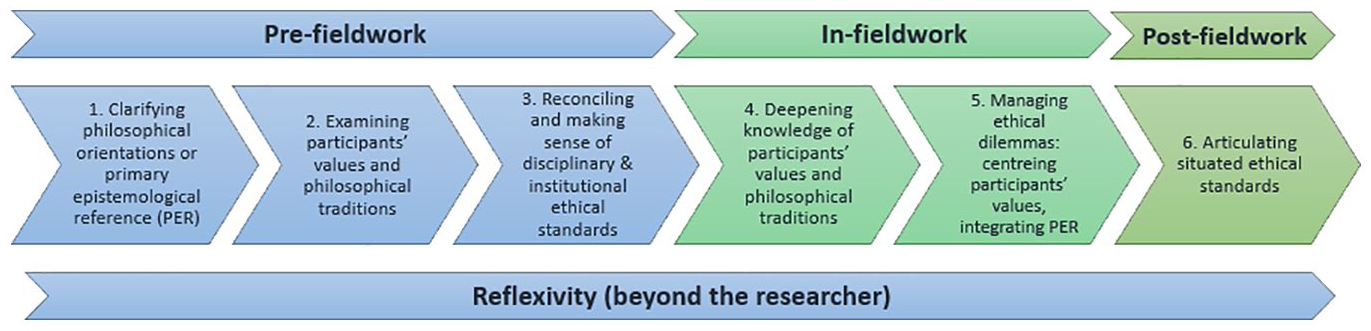
Participant-centred ethics: A conceptual approach.
Undoubtedly, many conventional attempts to resolve practical ethical dilemmas consider, and are sensitive to, participants. However, this often begins too late (i.e. in-field) and is done in an ad hoc manner with no clear epistemological basis. This approach proposes a structure which places participants at the centre much earlier in the ethics thought process. Necessarily, the approach is underpinned by continuous reflexivity. While phase three does not preclude institutional ethics application procedures, it recommends in-depth engagement with their guidance which goes beyond a box ticking exercise. Though illustrated linearly for simplicity, the approach is more cyclical in practice and does not negate a reordering (e.g. phases two and three), blending, or juxtaposing of phases to better fit the needs of particular projects.
This paper partly originates from substantive reflection on my fieldwork and the ways in which I could have been better prepared. For those conducting research in similar environments, the above offers an alternative approach to ethics, particularly, in-fieldwork reflexive practice. Moreover, inherent in phase five are tensions which researchers must prudently navigate in the field. For example, heeding the advice to cover my head was, in some ways, a patriarchal bargain (Sultana, 2007): a compromise between achieving my research aims (i.e. through generating data) as a woman and not offending a male participant who has positioned me within a specific understanding of what a woman should be or do. In other ways, it also represented a contextual bargain: the compromise between achieving my research aims and not offending or criticising participants’ socio-cultural values and norms, wherever it is possible to do so. Being of Yorùbá descent myself, it may be presumed that it was easy for me to make contextual bargains. However, my cultural origin, language proficiency and participants’ knowledge of these only meant that more was expected of me in certain situations (see, e.g. Siwale, 2015; Sultana, 2007 on the challenges of researching ‘back home’). For instance, it is unlikely that the participant would have expressed his concerns about my uncovered head, along with other non-complimentary remarks about ‘white people’, had I been a woman of white European descent.
Moreover, having departed Nigeria as a child, my cultural Yorùbá-status was sometimes ceremonial in the research communities. During other situations of discomfort, when I observed actions that contested my primary epistemological reference (such as corporal punishment in schools), contextual bargains were necessary. I observed but did not ‘correct’ the teachers and school heads, some of whom privately confessed to me that they did not actually like beating children but felt it was the best way to effect discipline in the ‘extremely stubborn’ children. Parents themselves approved, encouraged and carried out corporal punishment when they felt it was deserved (e.g. for lateness, classroom misbehaviour, etc.) and rejected it when they felt it was not (i.e. for what children do not know). Corporal punishment, for Yorùbás, is a form of discipline, where discipline holds pedagogic value for instilling Ọmọlúàbí virtues. Not disciplining a child as deserved constitutes parental neglect and poses a threat to the communal fabric. As evidence from the broader research shows, parents believe an undisciplined child is highly likely to grow up to become wayward and engage in mischief, bringing shame to her family and community.
My contextual bargain in this instance reflected my view that my primary epistemological reference was secondary to participants’ epistemologies within their own context. What might constitute physical abuse from a BERA guidelines or safeguarding point of view, represents a shared conception of social justice among Yorùbás. An unattuned application of external codes and guidelines, that is, explicitly challenging such ‘harmful practices’ would have been ethnocentric, closed-minded, 10 and boastful, the deficit vice of the virtue of humility in Ọmọlúàbí. It would have also eroded the trust I was beginning to build. Evidently, performing contextual bargains sometimes requires trade-offs between researchers’ own moral, critical consciousness and those of the participants with whom they engage. However, as various scholars argue, researchers should resist the temptation to ‘intervene into’ or ‘know and save’ but seek to ‘learn from’ even if they perceive their values are ‘more right’ (Cannella and Lincoln, 2011: 82, 83; see also Holmes and Crossley, 2004).
Luckily, and as may be argued for many other relational, indigenous moral codes or ways of being, the virtues in Ọmọlúàbí are non-controversial and therefore, not difficult to endorse. Even more fortunately, I was not confronted with issues of violent criminal behaviour; sexual or physical discrimination, harassment and violence. Such issues would have required deeper consultations in context, and in the case of physical or mental harm, a possible exit from context. Where such challenging issues occur regularly, in-depth, pre-fieldwork training is vital. This must include an exploration of the values and virtues operational within our desired fieldwork contexts, the extent to which they are compatible with our own (institutional, disciplinary and personal), and the extent to which we believe we might fulfil our research aims even in the face of significant incompatibility (hint: we probably cannot). Such training may include delving into fictional, non-fictional and academic literature; exploring localised social and other media as well as news outlets; reaching out to local contacts and other researchers who have written or researched similar settings (and for the latter, paying attention to ‘unpublished’ field experiences or challenges); and forming groups with colleagues (Kloß, 2017) and supervisors to discuss and devise potential strategies. Although ‘unanticipated events’ are inevitable in qualitative fieldwork, such training facilitates interrogation of naivety such that we may foreshadow dilemmas and develop relevant responses that may help mitigate our fears.
Conclusion
This paper has presented an application of a unique ethics framework for conducting research with disadvantaged populations, particularly in rural African settings. Representing a form of strong reflexivity (Kuehner et al., 2016), the Ọmọlúàbí moral-ethical framework is a virtue-based ethics approach which methodically ‘does’ reflexivity through principles of continuity; adherence to local and national processes; adaptation to local ways of being and doing; and provision of tangible benefit. Recognising that there are diverse ways in which Ọmọlúàbí virtues may be applied or combined to build principles, the framework is amenable to adaptation. Nevertheless, researchers must be explicit about the virtues they adopt and how they apply them.
The paper has also presented an overarching conceptual approach for participant-centred ethics codes such as the Ọmọlúàbí moral-ethical framework. This is particularly relevant for researchers from Euro-American institutions whose pre-fieldwork training fails to interrogate the values and virtues operational in international fieldwork contexts and whose ethics guidance documents, underpinned by philosophical principles from (dominant) Euro-American traditions, are often applied to (less dominant) ‘other’ traditions without ‘revision, modification or analysis of their relevance’ (Cortina et al., 2019: 490). By providing an appropriate alternative to ‘dominant notions of objective and universalistic morality’ (Simons and Usher, 2000: 3), the Ọmọlúàbí moral-ethical framework offers an example for researchers who wish to methodically incorporate local, indigenous knowledge into their work. The framework is not cheap, and neither should research which truly seeks to be affirmative. As such, greater effort should be made to link or provide researchers with more enabling sources of funding.
In part, this paper has responded to the morality question by centring the generally approved (and applied) moral foundations of research participants as an epistemological basis from which to design an ethical, morally underpinned, methodical application of reflexivity which not only incorporates, but also moves beyond the researcher ‘self’ towards participants. But no moral (or even ethical) project exists without tensions, complexities, and ambiguities. Pre-fieldwork examination of participants’ religious, political, socio-cultural, and other values, together with in-fieldwork striking of contextual bargains, may help manage the inevitable tensions that arise during field research, particularly in international contexts.
Nevertheless, these may not provide a smooth and easy pathway through the research. Tensions may be so great that they render the research (or part of it) altogether untenable. Conceptualisation of research aims and questions with participants, as often occurs in participatory research, might further reveal deep-rooted tensions. Such revelations facilitate important decisions about how or indeed, whether, the research should proceed. The combination of such a participatory approach and the type of morally underpinned, participant-centred ethics framework presented in this paper, would be worthy of further investigation. Ultimately, research is enriched by a priori, in-situ and post-fieldwork analysis of, and explicitness about, the myriad values which underpin our work (Gewirtz and Cribb, 2006). These values must include those of research participants. It is hoped that this paper contributes to the conversation about how this may be achieved.
Footnotes
Acknowledgements
I am grateful to Professor John Oates, Dr Deborah Drake and Dr Alison Buckler who provided critical feedback on earlier drafts of this paper. I would also like to thank the reviewers and Dr Kate Chatfield for their constructive feedback.
Funding
All articles in Research Ethics are published as open access. There are no submission charges and no Article Processing Charges as these are fully funded by institutions through Knowledge Unlatched, resulting in no direct charge to authors. For more information about Knowledge Unlatched please see here: 