




Abstract
The need for research to advance scientific understanding must be balanced with ensuring the rights and wellbeing of participants are safeguarded, with some research topics posing more ethical quandaries for researchers than others. Moral injury is one such topic. Exposure to potentially morally injurious experiences can lead to significant distress, including post-traumatic stress disorder (PTSD), depression, and selfinjury. In this article, we discuss how the rapid expansion of research in the field of moral injury could threaten the wellbeing, dignity and integrity of participants. We also examine key guidance for carrying out ethically responsible research with participants’ rights to self-determination, confidentiality, non-maleficence and beneficence discussed in relation to the study of moral injury. We describe how investigations of moral injury are likely to pose several challenges for researchers including managing disclosures of potentially illegal acts, the risk of harm that repeated questioning about guilt and shame may pose to participant wellbeing in longitudinal studies, as well as the possible negative impact of exposure to vicarious trauma on researchers themselves. Finally, we offer several practical recommendations that researchers, research ethics committees and other regulatory bodies can take to protect participant rights, maximise the potential benefits of research outputs and ensure the field continues to expand in an ethically responsible way.
In order to progress understanding in the psychosocial sciences, more often than not, research involving human participants is required. However, such research inherently comes with some elements of risk, and researchers must balance the need for more research with the rights and wellbeing of participants. The Helsinki guidance (World Medical Association, 1964) provides clear principles for carrying out ethical research studies which ensure that the health, dignity and integrity of participants are safeguarded. Critically, studies must take steps to protect participant rights to self-determination (e.g. informed consent) and confidentiality, non-maleficence (minimise harm) and beneficence (maximising benefit) (Council for International Organizations of Medical Sciences, 2002). Nonetheless, the investigation of some research topics pose more ethical quandaries to researchers than others. Moral injury is one such topic.
Research in the field of moral injury has rapidly expanded since the work of Litz et al. (2009) and Shay (2014). The definition of moral injury detailed by Litz et al. (2009) is one of the most widely used in which moral injury is defined as ‘perpetrating, failing to prevent, bearing witness to, or learning about acts that transgress deeply held moral beliefs and expectations’. Our team carried out a meta-analysis and systematic review of moral injury in 2018, which included 11 papers (Williamson et al., 2018); however, since then, more than 190 relevant scientific publications on the subject have been published (Allen et al., in preparation). Exposure to potentially morally injurious events (PMIEs) has been found to be significantly associated with depression, PTSD and suicidal ideation (Griffin et al., 2019; Williamson et al., 2018). We postulate that the scientific community can no longer claim that moral injury research is entirely in its ‘infancy’ (Frankfurt and Frazier, 2016); yet there remains poor consensus on the definition of moral injury and the impact of morally injurious events on wellbeing as compared to posttraumatic stress disorder (PTSD). Moreover, how moral injury relates to the concept of ‘moral distress’ – which has been explored primarily in healthcare contexts – is not well understood. Many of the studies carried out thus far reflect efforts to advance the scientific community’s understanding of the theoretical conceptualisations of moral injury and the pernicious impact exposure can have on the mental health of a wide range of professionals, from journalists to military personnel. Undeniably, there is a pressing need for continued research into moral injury to better understand the lived experiences of individuals, the preventative steps that can be taken to avoid long-term mental ill health and deliver the support that is needed by those adversely affected by PMIEs.
Safeguarding participant rights to self-determination and confidentiality
There can be little doubt that carrying out research in the field of moral injury can be highly challenging. Practically, intense feelings of shame, guilt and self-condemnation may mean participants are reluctant to disclose the event or their responses to it. There are also a number of methodological problems with existing measures of moral injury (Frankfurt and Frazier, 2016) and, while international efforts are underway to develop a new measure, it is likely to be several years until this is finalised (Yeterian et al.,2019).
Carrying out moral injury research can also pose legal quandaries for researchers. Asking about potentially illegal acts – or those perceived to be illegal – can put researchers in a difficult position. Breaches of confidentiality may be required in certain, albeit exceptional, circumstances, such as when a participant discloses that they have committed a serious crime (e.g. murder, manslaughter, abuse) (General Medical Council, 2018). Most of the existing moral injury research has also been carried out in military personnel/veterans (Griffin et al., 2019) and differences in rules of engagement and international agreements between nations impact upon whether an event (e.g. potential war crimes, genocide) is seen as a crime or not, adding a further layer of complexity. As moral injury research continues to expand into other occupations, such as in healthcare and judicial contexts, how PMIEs disclosures are managed by researchers warrants considerable thought. Studies of domestic violence face similar dilemmas and it is typically recommended that principles of participant autonomy and confidentiality prevail over disclosure by researchers to authorities (e.g. researchers should endeavour to avoid usurping a participant’s right to make autonomous decisions about their life (Ellsberg et al., 2001)). Taking a similar approach in moral injury studies is one possibility. Carrying out studies where participation is truly anonymous (e.g. use of firewalls to protect patient identities in online studies) and/or there is complete transparency about the limits of confidentiality as part of the informed consent process is another. Such efforts may vary between nations; for example, in the U.S. it is possible to obtain federally recognised certificates of confidentiality where investigators are protected from having to disclose participant identifying information (Wolf et al., 2015). Whether this offers protection from international lawsuits is unclear (Beskow et al., 2012). Research in other topics, such as child abuse, human trafficking or deradicalization programmes, also pose challenges relating to data protection and confidentiality, and local research ethics committees should be prepared to draw on existing trauma-informed protocols to guide future moral injury investigations. Future research efforts may be irreparably damaged if participants are concerned that coming forwards may lead to their prosecution.
Publishing research findings relating to moral injury can also be problematic. For example, small qualitative studies which focus on particular events (e.g. Grenfell Tower fire; 2011 Norway attacks) may run the risk of inadvertently identifying participants or participants identifying themselves. Moreover, the way in which moral injury is discussed and framed in the literature is important for the academic community to consider. The tone that is taken, if researchers suggest a ‘lack of moral fibre’ or weakness – rather than highlighting that everyone has the capacity to make decisions that they regret – has the potential to cause harm. We recommend that this is an aspect Editors highlight to peer reviewers when they are asked to review studies of moral injury for publication in scientific journals.
Non-maleficence and beneficence
The tenant of non-maleficence is also key in moral injury research given the potential for research data collection to cause harm or distress. Researchers should consider how and why they are asking about morally injurious events, whether this could be done briefly without detailed descriptions, or if secondary data could be used to answer research questions. Previous studies attest that high-quality, meaningful moral injury research can be carried out without asking about the specific details of the event (Frederickson, 2019). Notably, longitudinal studies which repeatedly question participants about PMIEs and their psychological responses using non-validated (or problematic) measures have the potential – similar to treatment approaches such as prolonged exposure (Maguen and Burkman, 2013) – to exacerbate distress and re-shame. We recommend that principal investigators (PIs), who are considering using longitudinal designs, balance the need to examine the progression of moral injury over time and the potential impact it may have on participant wellbeing. Assessments should perhaps focus more on the symptoms associated with moral injury rather than repeatedly asking about the PMIE itself which may cause unnecessary distress. Best practice used in previous longitudinal studies of PTSD (e.g. Steenkamp et al., 2017; Stevelink et al., 2018) may be a useful guide to moral injury researchers. As with any research, clear clinical risk protocols must be in place, and there must be a concrete plan for how participant distress following disclosure of PMIEs is managed. Moral injury researchers, who recruit participants anonymously, should consider how they will ensure that participants who need immediate support from a clinician can be identified and supported in a way that is not linked to their assessment data. For example, offering an anonymous online chat service to participants who exceed a certain score on psychological assessment measures could be beneficial. In cases where participants are still potentially at risk of ongoing exposure to PMIEs, there is a pressing need to develop clear protocols to manage this.
Many moral injury studies are now carried out online with signposting booklets made available in case of participant distress. While PMIEs may not be ‘classically’ threatening or life-threatening, they are often horrific and can affect daily functioning profoundly. As a minimum standard, the WHO guidelines (World Health Organisation, 1999) advise researchers to provide information or services that can respond to participant circumstances. While promising early evidence has been found for some treatment approaches such as adaptive disclosure in US military samples (Litz et al., 2017), there is currently no manualised treatment for moral injury-related mental disorders, posing the question of how research teams can ensure participants in need receive adequate support. It is important that research teams are prepared with well thought out, realistic procedures about the steps they will take to manage risk and to refer on when clinical issues arise during moral injury research studies.
To our knowledge, no studies have been carried out that examine the frequency of negative consequences of taking part in studies of moral injury. For example, no systematic studies have explored the increased risk of suicidal ideation or self-harm after taking part. Reporting of adverse events in studies of moral injury is also rare. It is unclear, therefore, whether there might be adverse consequences associated with participation. Whilst it is encouraging that studies of PTSD have found that disclosure can be cathartic for participants (White, 2007), further investigation is needed to determine whether this is also the case in moral injury as research.
When training a research team to carry out assessments with trauma-exposed samples, researchers will concurrently require clear support and supervision from study leads and clinical oversight. Data for large research studies are often collected by (less experienced) research assistants and repeated exposure to PMIEs and participant expressions of shame, guilt and post-trauma distress can be very challenging for researchers, particularly those with the least experience. Anonymous assessments carried out by telephone, versus face-to-face, may mean that researchers are more likely to create a ‘mental picture’ of the PMIE disclosed by participants which could be more harmful to their wellbeing. Researchers may also have to contend with the unavoidable (indeed, moral) dilemma their careers are being advanced by investigating another individual’s suffering. We therefore recommend regular supervision, including access to clinicians, and team meetings at which these topics are discussed openly to help prevent researcher burn out and compassion fatigue.
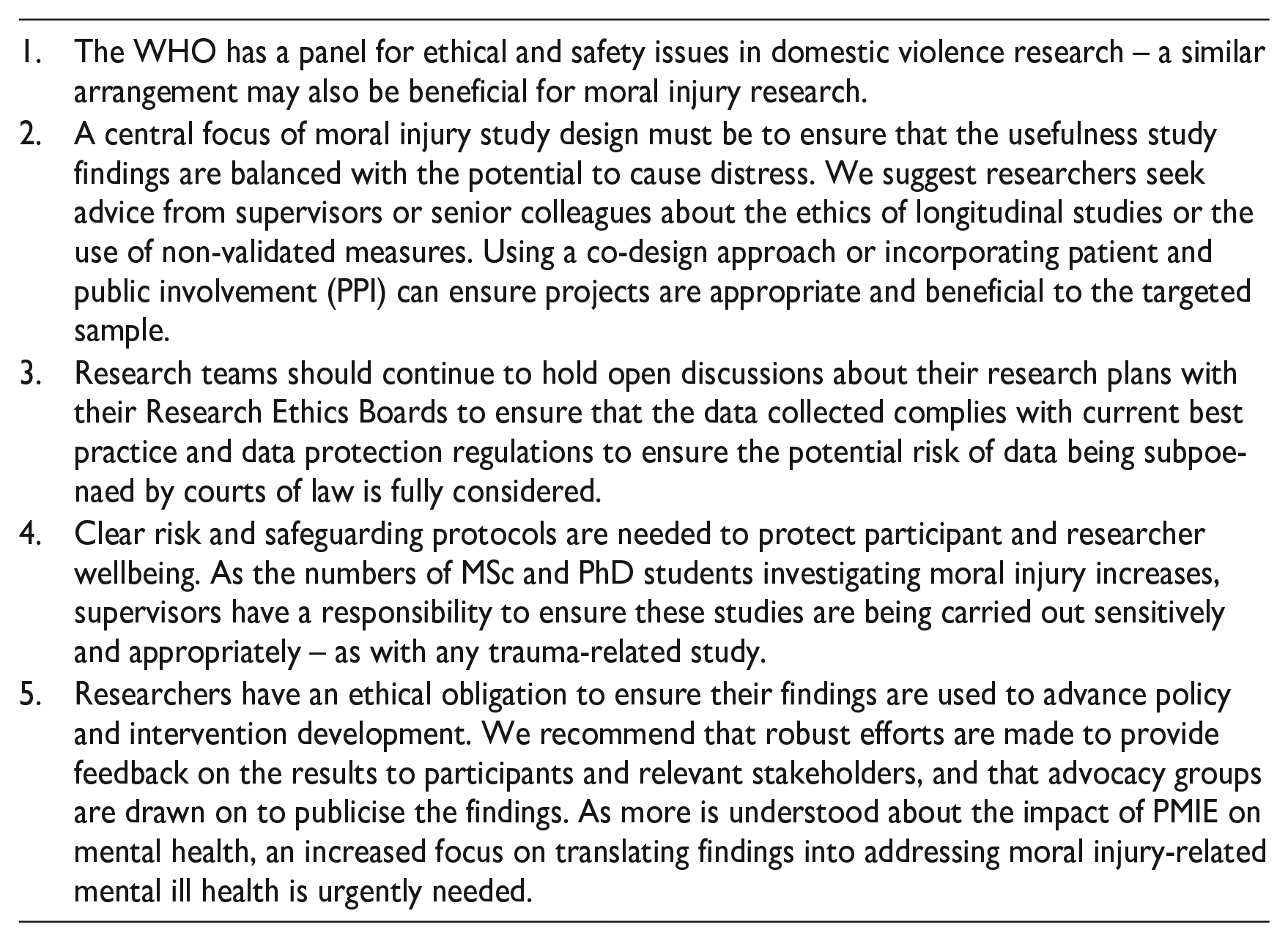
Suggestions for best practice in moral injury research
Several gaps in our understanding of moral injury remain and there is an undeniable need for future research studies which examine the prevalence of moral injury, the impact of moral injury on wellbeing, and the development of effective treatments to care for those who are suffering following a morally injurious experience. That said, there are ethical quandaries to be considered when carrying out this work and the issues we highlight in carrying out moral injury research are by no means an exhaustive list. Nonetheless, the following suggestions for best practice may help to ensure that the field continues to grow in an ethically responsible way.
Footnotes
Declaration of conflicting interests
The author(s) declared the following potential conflicts of interest with respect to the research, authorship and/or publication of this article: Authors had financial support from a Forces in Mind Trust grant (FiMT17/0920E) for the submitted work; no financial relationships with any organisations that might have an interest in the submitted work in the previous 3 years; no other relationships or activities that could appear to have influenced the submitted work.
Funding
All articles in Research Ethics are published as open access. There are no submission charges and no Article Processing Charges as these are fully funded by institutions through Knowledge Unlatched, resulting in no direct charge to authors. For more information about Knowledge Unlatched please see here:  .
.
The author(s) disclosed receipt of the following financial support for the research, authorship and/or publication of this article: This research was funded by the Forces in Mind Trust (FiMT17/0920E; VW). The funder did not have a role in the writing of the manuscript or submission of this article.