




Abstract
The development of novel neurotechnologies, such as brain-computer interface (BCI) and deep-brain stimulation (DBS), are very promising in improving the welfare and life prospects many people. These include life-changing therapies for medical conditions and enhancements of cognitive, emotional, and moral capacities. Yet there are also numerous moral risks and uncertainties involved in developing novel neurotechnologies. For this reason, the progress of novel neurotechnology research requires that diverse publics place trust in researchers to develop neural interfaces in ways that are overall beneficial to society and responsive to ethical values and concerns. In this article, we argue that researchers and research institutions have a moral responsibility to foster and demonstrate trustworthiness with respect to broader publics whose lives will be affected by their research. Using Annette Baier’s conceptual analysis of trust, which takes competence and good will to be its central components, we propose that practices of ethical reflexivity could play a valuable role in fostering the trustworthiness of individual researchers and research institutions through building and exhibiting their moral competence and good will. By ethical reflexivity, we mean the reflective and discursive activity of articulating, analyzing, and assessing the assumptions and values that might be underlying their ethical actions and projects. Here, we share an ethics dialog tool—called the Scientific Perspectives and Ethics Commitments Survey (or SPECS)—developed by the University of Washington’s Center of Neurotechnology (CNT) Neuroethics Thrust. Ultimately, the aim is to show the promise of ethical reflexivity practices, like SPECS, as a method of enhancing trustworthiness in researchers and their institutions that seek to develop novel neurotechnologies for the overall benefit of society.
Introduction
The development of novel neurotechnologies opens a horizon of possibilities of changing individual lives and broader society in ways that are both exciting and unsettling. By novel neurotechnology, we refer to the varieties of electronic devices that interact with an individual’s brain or other components of their nervous system to record or stimulate neural activity. This includes neuromodulators, like deep brain stimulation (DBS), that alter brain states to produce desired effects on a user’s motor control, cognition, or mood, as well as neuroprosthetics, like brain-computer interfaces (BCIs), that enable people to control external devices by reading their brain signals.
The positive value of novel neurotechnologies lies in their potential to improve dramatically the life prospects of many people. These include life-changing therapies for conditions like Parkinson’s disease, essential tremor, stroke, paralysis, Alzheimer’s disease and treatment-resistant depression (Budman et al., 2018; Lozano and Lipsman, 2013). People with paralysis or limb loss could use brain-controlled prosthetics to transcend their bodily limitations (Wood, 2017). Also, neural interfaces could be used non-therapeutically to enhance our abilities in desirable ways, like improving cognition (Cinel et al., 2019), emotion regulation (Steinert and Friedrich, 2020), or perhaps even moral character (Hughes, 2013), sending text messages by thinking alone (Zetlin, 2017), or creating new forms of communication and gaming (Jiang et al., 2019).
At the same time, developing novel neurotechnologies poses serious potential risks, some unique to the nature of brain-implant technology that seek to record or modify neural states and processes. Research participants face unknown long-term effects on their physical and mental wellbeing (Glannon, 2009; Hendriks et al., 2019). There are also broader ethical and societal concerns, such as the ways in which novel neurotechnologies could exacerbate social inequalities, intrude on mental privacy, create new forms of exploitation, and compromise some important elements of being human (Yuste et al., 2017).
The advancement of novel neurotechnology research requires that people put trust in researchers to exercise their discretion in ways that recognize and address these aforementioned risks and uncertainties. This professional discretion includes how researchers design, conduct and implement their research. Because their research aims and conduct impact the interests of many people, not only research participants but also broader constituencies, public trust is crucial to the continuation of novel neurotechnology research. Public trust is used here to encompass both social trust with diverse publics and interpersonal trust with individual research volunteers; clearly the former will greatly facilitate the latter. 1 Various publics are needed to supplement the research enterprise, whether as sources of research participants or boosters for the existence and integration of neurotechnology into social life. Since the pursuit of novel neurotechnologies is complicated by accompanying ethical concerns, achieving broad support from diverse publics depends largely on the optimistic belief that researchers and their institutions will act in ways that are sensitive to these concerns, minimize risks, and regard the wellbeing of vulnerable others as a major priority of the research enterprise. For this reason, it is important for researchers and research institutions to foster public trust as a practical and ethical requirement of novel neurotechnology research. 2
The focus of this paper is on fostering the trustworthiness of researchers and research institutions as an important way to cultivate public trust in novel neurotechnology research. Using Annette Baier’s conceptual analysis of trust, which takes competence and goodwill to be its central components, we propose that practices of ethical reflexivity could play an important role in fostering the trustworthiness of individual researchers and research institutions through building and exhibiting their moral competence and goodwill. By ethical reflexivity, we mean the reflective and discursive activity of articulating, analyzing, and assessing the assumptions and values that might be underlying their ethical actions and projects. Here, we share an ethics dialog tool we have developed to promote ethical reflexivity practices in novel neurotechnology research.
Our ethics dialog tool – The Scientific Perspectives and Ethics Commitments Survey (or SPECS) – was developed by the University of Washington’s Center of Neurotechnology (CNT) Neuroethics Thrust. SPECS involves an individual survey of ethics topics and a facilitated group discussion. Researchers who participate in SPECS sessions explore their own value assumptions and then work together to consider alternative views, explore possible justifications, and develop a shared awareness of the ethical complexities of their research enterprise and the various ways of responding to them. We argue that one of the important benefits of ethical reflexivity practices, like SPECS, is that they promote researchers and research institutions’ trustworthiness.
This paper will begin by elaborating the value of trust and the varied risks and uncertainties that animate the issue of trust in novel neurotechnology research. Second, we will elaborate the meaning of trustworthiness, what it means for researchers to be trustworthy, and some background conditions that impede researchers’ trustworthiness. Third, we will propose ethical reflexivity as a practice that promotes researchers’ trustworthiness and how our SPECS tool as a specific ethical reflexivity practice could further build trustworthiness. In the last section, we will point out some of its challenges and suggest future work to address them. Ultimately, the aim of this article is to show the promise of ethical reflexivity practices, like SPECS, as a method of enhancing trustworthiness in researchers and their institutions that seek to develop novel technologies for the overall benefit of society.
The value of trust and its burdens in novel neurotechnology research
Public trust in novel neurotechnology research plays a critical role in sustaining the research enterprise. The instrumental value of public trust in scientific research is well documented (Kass et al., 1996). When public trust is diminished, people are less willing to put themselves in a position of vulnerability for the sake of producing the goods of research. Volunteers will be less willing to enroll in research trials and broader publics will be less willing to fund or support the research (Mastroianni, 2008; Resnik, 2011). But beyond its prudential value, fostering public trust has intrinsic value as an expression of respect toward vulnerable others. Even if it is possible to advance novel neurotechnology research without the support of general publics, especially those who will be most affected by its manifestations, achieving public trust makes the endeavor non-patronizing and considerate to the needs and interests of people as ends in themselves.
In figuring how public trust in novel neurotechnology research could be fostered, it is important to acknowledge the burdens of trust attached to the research enterprise. By burdens of trust, we mean the vulnerabilities that must be assumed in placing trust in others, whether it is in an individual person or institution. A growing neuroethics literature has raised attention to the varieties of risks with novel neurotechnologies, pointing out the potential adverse effects to important aspects of individual and social life. These risks may also vary by publics due to their different social locations and identities, including their relations and histories to scientific research (Gamble, 1993; Scharff et al., 2010).
On the level of clinical research and application, novel neurotechnologies pose various risks to research participants. Implantable neural interfaces, for example, involve inserting electrodes into the brain, which raises concerns of long-term physical harms, such as hemorrhaging or infections on the implanted parts of the brain (Weaver et al., 2009). Volunteers also face psychological or identity harms that are distinctively pronounced in neurotechnologies. Clinical studies have reported dramatic changes in DBS-users’ personalities, internal desires, and personal identities (Baylis, 2013; Glannon, 2009; Schechtman, 2010). There are also reports of patients experiencing feelings of estrangement and alienation (Gilbert, 2018; Gilbert et al., 2017; Kraemer, 2013a). Since the brain is widely regarded as the principle seat of the self, novel neurotechnologies understandably raise heightened concerns about their effects on volunteers’ health and core aspects of their identities.
Other concerns include questions of whether neural interfaces will be designed in ways that appropriately take into account the needs of the intended users. This issue is especially pronounced with disabled people who may have different priorities than what researchers assume (Anderson 2004), have vulnerable identities given disability stigma (Aas and Wasserman, 2016), or have particular comorbidities that complicate use (Goering and Klein, 2019). Also, there is the question of whether vulnerable groups, like disabled people, may bear the burdens of novel neurotechnology research without eventually having access to its benefits or future medical care after the research trial has ended (Goering and Klein, 2019).
Beyond the clinic and laboratory, the development of novel neurotechnologies, with their ability to record brain activity and modify cognition, moods, sensory experiences, and forms of agency, could have implications that affect all of us. Technical methods that record and identify neural patterns raise suspicions that users’ inner thoughts will now be accessible to outside parties and subject to infringements of mental privacy (Ryberg, 2017; Wolpe, 2009). Neurotechnologies that seek to enhance people could produce inequalities between people who can afford the devices and those who cannot. Furthermore, integrating neurotechnologies into human beings to enhance valued abilities or introduce new ones challenges fundamental understandings of what grounds human dignity, such as autonomy or agency (Gilbert, 2015; Goering et al., 2017; Gurney, 2018), authenticity (Kraemer, 2013b; Mackenzie and Walker, 2015), and virtue (Jotterand, 2011).
In summary, novel neurotechnology research potentially affects many people, not only research participants in experimental trials but also broader publics. Due to the vulnerabilities generated from developing novel neurotechnologies, it raises the question of public trust in the research enterprise. In the next section, we will discuss what it means to trust researchers and what makes researchers trustworthy.
Trusting researchers
Extending trust to researchers can be precarious given the uncertainties involved in novel neurotechnology research. In the face of uncertainty, trust building, in large part, involves fostering the optimistic belief that researchers will exercise their discretion in careful, competent, and considerate ways that do not unduly endanger their lives and the things that matter to them. In other words, facilitating public trust depends significantly on fostering the justified belief that researchers and research institutions are themselves worthy of trust.
What are the qualities of trustworthiness? We turn to Annette Baier’s conceptual analysis of trust. According to Baier, trusting another involves having the belief that the recipient of trust possesses the characteristics of competence and goodwill, which grounds the truster’s willingness to be vulnerable to the discretions of the trusted (Baier, 1994b). Competence refers to having the requisite skills and knowledge to accomplish the tasks that are expected of them. Goodwill represents a particular kind of moral attitude and motivation, where an agent’s commitment and conduct are shaped by a genuine concern for the vulnerabilities of those conferring trust. Thus, it is not enough to hold simply the expectation that someone will act in a particular way. Rather, the reasons that motivate someone’s conduct are also relevant. For Baier, this is a crucial feature of trust since it makes trust distinguishable from mere reliance (Baier, 1994a: 98–99). Agents with goodwill are invested in exercising their discretion in ways that are properly responsive to the vulnerabilities and particularities of those dependent on them for the sake of respecting them as ends in themselves.
Trustworthiness, in its general form, then refers to the set of exhibited characteristics (on Baier’s account, competence and goodwill) that facilitates trust from others. Yet the details of these characteristics may vary according to roles and contexts. The normative expectations attached to a trustworthy researcher will differ in numerous ways from the normative expectations of, say, a trustworthy physician due to their professional roles (de Melo-Martin and Ho, 2008: 203). What makes a researcher of novel neurotechnology trustworthy?
Trusting researchers seems to hinge on the belief that the various needs and dependencies of diverse people are at the forefront of researchers’ concerns when designing, conducting, and implementing their research. We expect experimental trials to be designed in ways that minimize risks to research participants. Also, we expect that neural devices will be built in ways that are compatible or sensitive to the particularities of diverse, vulnerable bodies, such as disabled people who are often the participants of such studies. Because novel neurotechnologies have far-reaching moral and social implications, researchers’ trustworthiness would be bolstered by the belief that they will direct the research in ways that are properly responsive to the needs and moral interests of all people. Diverse publics will want to know that researchers are suitably attuned to and concerned about how neural devices could be vehicles for widening social inequalities, undermining autonomy and valued forms of humanness, eroding mental privacy and integrity, and commodifying valued abilities. Although many ethical questions surrounding novel neurotechnologies are still open, it is expected, at least, that researchers understand the moral disquietude of novel neurotechnologies, and strive to create neural devices that are overall beneficial to society and will not simply reinforce or exacerbate existing injustices.
In meeting the normative expectations described above, which would reasonably make researchers trustworthy, researchers are required to have a level of moral competence: they need to be cognizant of the particular needs, values, moral interests and identities of diverse people for whom researchers assume responsibility in developing technologies that will affect them. Also, it requires a level of goodwill, where researchers are positively motivated to attend to the needs, values, moral interests and identities of these same people. Without meeting these two conditions, it will be difficult to foster the confidence that researchers develop their technologies responsibly.
Background conditions as impediments of trustworthiness
In fostering trustworthiness, researchers must also contend with the various background conditions of their enterprise that discourage public trust. Even though many researchers are not necessarily responsible for these background conditions, these settings can diminish their trustworthiness. Several of these conditions are common to other research enterprises, while other conditions are unique to novel neurotechnology research. Here, we will go through these background conditions.
First, researchers operate from a setting of unequal relations of power with research participants and other publics. As a social position, researchers carry a notable degree of power that is backed by medical, scientific, academic, and state authority. Unequal balances of social power may make trust breaking less costly to researchers, which makes trusters more vulnerable to exploitation and neglect. Thus, fostering trust relations between researchers and prospective research volunteers and vulnerable publics may be complicated by inequalities in power and precarity.
Second, research is generally bound up with commercial interests. Companies invest financially in novel neurotechnology research for ends that may be driven by profit. As industry giants like Facebook, Neuralink, and Microsoft enter the neural device space (Jones, 2017; Samuel, 2019), worries about profit-driven motives controlling the direction of novel neurotechnology research grow. John Besley and colleagues have shown that industry contributions diminish the trustworthiness of scientific research (Besley et al., 2017). Thus, the expanding role of industry may hinder confidence in researchers that they will be properly responsive to the moral interests of people when they are in tension with the commercial interests of companies.
A third concern is that novel neurotechnology research operates from a complicated setting of multiple inequalities and biases that may significantly shape research practices and aims. Suspect norms and presuppositions may be reified in how neural devices are designed and for what purpose, and how research trials are done, which may unduly privilege certain people and discriminate against or seriously harm others. Disabled people, for example, are often the subject population of such research, both as research participants and justification for developing neurotechnologies as beneficial to them (Goering and Klein, 2019). Yet being situated in a context in which ableist assumptions are still prevalent, there is reason to be worried that the particularities and perspectives of disabled people will not be reflected in how devices are developed and how experimental trials are run. The worry is that troubling biases of researchers may produce inordinate vulnerabilities to people, especially the historically marginalized, in the practices and end-products of novel neurotechnology research.
Fourth, novel neurotechnology research is linked to the troubling legacy of psychosurgery. Past forms of direct neural intervention, like lobotomy, were offered as panaceas to confounding psychiatric disorders, only to be discredited much later after thousands of people were subjected to such methods, leading to their death or permanent injury (Presidential Commission for the Study of Bioethical Issues, 2015). Vulnerable individuals and desperate families permitted surgeries that appeared to be promising, and only later recognized the full risks of the intervention. The emergence of novel neurotechnologies conjures up this history, raising potential worries of therapeutic hubris and tempering optimism regarding its benefits to society.
Given these background circumstances that generate mistrust, it is crucial for researchers to attend to their trustworthiness. It is a mistake to assume that public trust will be readily available. The point of highlighting the background conditions of novel neurotechnology research—the unbalanced relations of power, the interplay of economic considerations, the effects of inequalities and biases, and the complicated legacy of psychosurgery—is to stress the challenging and active work that will likely be needed for researchers to meet their responsibility to be trustworthy.
Ethical reflexivity as promoting trustworthiness
What practices can contribute to the trustworthiness of researchers? Many ethicists have defended existing practices, like requiring informed consent, as ways of building and maintaining trust (Kass et al., 1996; Mastroianni, 2008). Other practices that claim to promote public trust include creating oversight groups, like research ethics committees (RECs), to monitor research programs, and ethical guidelines for researchers to follow (Hardin 1996; Pettit, 1992; Yarborough and Sharp, 2002). 3
These practices are unquestionably important. They are means of helping researchers navigate the tricky ethical terrain that comes with developing novel neurotechnologies, ensuring that research is conducted in morally acceptable ways, and holding researchers accountable for any ethical mishaps they may have directly caused. But some ethicists have raised suspicions that these means are not sufficient or appropriate for fostering trustworthiness. For instance, Angeliki Kerasidou argues that disciplinary approaches that involve rule following, oversight and accountability may increase compliance and reliance, but do not necessarily increase trust (Kerasidou, 2017: 46–47). For Kerasidou, such formal rules do not promote or express researchers’ goodwill, which is an essential component of trust. Linus Johnsson and colleagues argue that RECs and formalized ethics guidelines are premised on the idea that researchers are untrustworthy and in need of regulation and oversight (Johnsson et al., 2014). Thus, they do not improve researchers’ trustworthiness but may in fact diminish it. Like Kerasidou, Johnsson and colleagues argue that RECs and rigid ethical guidelines do not foster or demonstrate moral competence and goodwill in researchers, but mere conformance to rules, which can evoke feelings of alienation and heteronomy in researchers (Johnsson et al., 2014: 39–40). For this reason, Johnsson and colleagues have suggested that promoting trustworthiness in researchers requires decreasing the level of oversight, rules and regulations. At the very least, it is appropriate to consider other practices that may be incorporated into the research enterprise to supplement other practices to improve both reliability and trustworthiness of researchers.
We suggest practices of ethical reflexivity as a means to promote researchers’ trustworthiness. By ethical reflexivity, we mean the activity of ethical reflection through discourse, where discussants articulate and critically examine the values and beliefs that may be governing their group activities and the discretion of its members. Ethical reflexivity, when done as a reflective and discursive process, has the potential to foster and demonstrate moral competence and goodwill. By centering discourse on the moral concerns that impinge on the moral interests of vulnerable others, ethical reflexivity can be an appropriate way of confronting, acknowledging and attending carefully to the multiple vulnerabilities that arise from novel neurotechnology research. Johnsson and colleagues suggest practices that recognize and engage researchers’ moral capacities and epistemic advantages in appropriately shaping the ethical conduct of research (Johnsson et al., 2014: 40–43). They note, “Ethics must, if it is to remain a practice of its own rather than developing into a branch of jurisprudence, be practiced through discourse. For this reason, we need ethics review to be an arena for researchers to discuss their research, receive advice, and practice their ethics skills, and guidelines to be generally applicable, value-based and inspirational rather than specific, rule-based and regulative” (Johnsson et al., 2014: 43). We propose that ethical reflexivity practices take seriously this insight.
So far, the practice of ethical reflexivity is presented broadly, articulating its potential to foster trustworthiness but with no specific details on how such discursive interactions can be concretized in research contexts to foster researchers’ trustworthiness, specifically supporting and expressing researchers’ moral competence and goodwill. The dialogical approach to ethics has been done in other neuroscience research programs (Stahl et al., 2019). In the next section, we will discuss briefly an ethical reflexivity practice developed by the Neuroethics Thrust with the Center for Neurotechnology as a promising method to foster researchers’ trustworthiness.
The story of SPECS
The Scientific Perspectives and Ethics Commitments Survey (SPECS) is a dialogical ethics tool developed by the Neuroethics Thrust with the Center for Neurotechnology (CNT) at the University of Washington, Seattle. It was initially developed as a response to the Gray Matters report released by the President’s Commission for the Study of Bioethical Issues in 2014 (Presidential Commission for the Study of Bioethical Issues, 2014). The report called for greater integration of ethics into neuroscience research in hopes that the science progressed in ways that took seriously its ethical and social implications. The aim of SPECS is to help researchers identify and consider the multiple ethical implications of their work. The basic idea is that after due reflection of their values and beliefs that bear on their research aims and practices, researchers will be able to reaffirm or reform some of the norms, aims, and practices of their research so that they align with their considered judgments. As such, SPECS regards individual researchers as uniquely situated to initiate change where needed.
SPECS takes seriously two premises. First, it leverages the expressed interest and motivation of individual researchers to understand and engage with the ethical components of their work. This is the common experience of ethicists who are embedded in CNT and who have visited other neurotechnology centers. In our experience, researchers generally care about the ethics of novel neurotechnology research and welcome opportunities to participate in moral discussions.
Second, it appreciates the discursive nature of ethics and the transformative potential of discourse. Discourse is an interactive process of bringing together and presenting diverse perspectives. Its function is to spur shared understanding and appreciation of multiple considerations, confront criticisms, and reconsider currently held beliefs. The ideal of discourse is for discussants to reach normatively robust but still provisional conclusions resulting from deliberations in which diverse perspectives are represented, exchanged, and weighed.
SPECS is a specially tailored practice of ethical reflexivity intended for researchers of novel neurotechnologies. It calls for researchers to gather in a meeting space and take part in three activities. Participation is voluntary but strongly encouraged as an opportunity to engage with pressing ethical issues related to novel neurotechnology research. First, researchers are asked to complete an ethical survey, which is comprised of a number of prompts (see Table 1 for examples). The prompts represent prominent issues brought up in contemporary neuroethics literature and end-user roundtables, including concerns from marginalized publics. Responding to the prompts involves circling a number between 1 and 5 on a Likert scale, which indicate their strengths of agreement or disagreement to the prompt. The purpose of the ethical survey is to present to researchers some of the prominent ethical issues raised about novel neurotechnology research and assist researchers in identifying and articulating their tentative positions.
Sample prompts from the Scientific Perspectives and Ethics Commitments Survey.
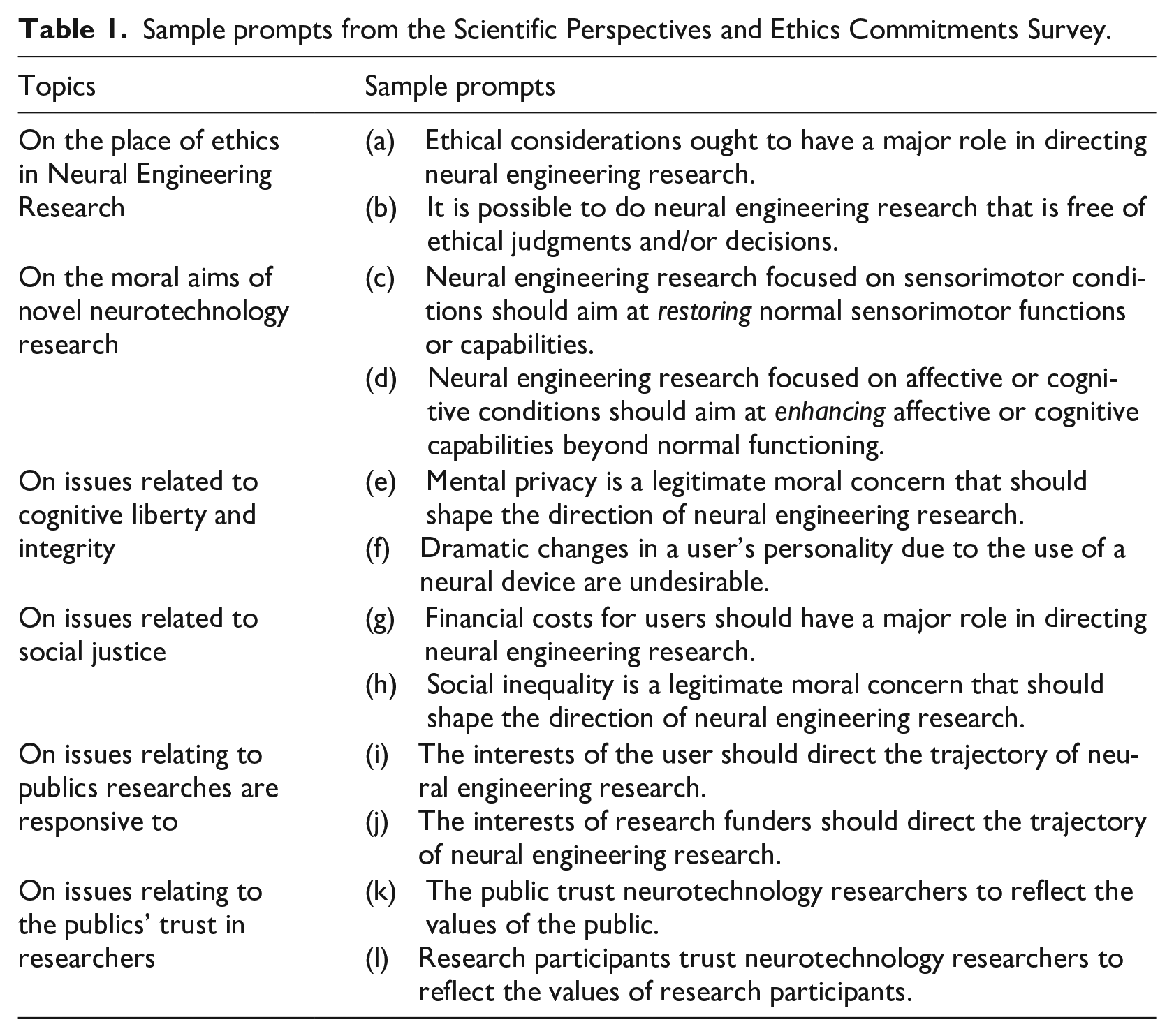
Second, after all participants complete the survey, a facilitated dialog takes place, centering on how participants answered the survey questions and some of their motivating reasons. An ethicist with a proficiency of creating open, critical spaces for challenging, cross-cultural negotiations facilitates the discourse to ensure that discursive interactions remain constructive. Operating from norms of non-directiveness and neutrality, the facilitator begins the dialogs by asking participants to share their responses and some of their reasons. During this stage, points of agreement and disagreement are expected to be raised, which opens up discursive spaces to consider, attend to, and assess multiple reasons and perspectives. The facilitator may ask clarifying questions to participants of their understandings of ethically salient but contested terms in the survey. For example, the notion of normality is raised concerning the permissibility of neuroenhancement. Respecting normality may ground researchers’ judgments on the ethics of neuroenhancement but disagree after due reflection on what ‘normal’ means in this context. The purpose of holding this dialogical activity is to stimulate ethical reflection among its participants by means of exposing their ethical beliefs to alternative perspectives as well as potential criticisms. By going through this reflective and discursive process, the desideratum is to increase awareness and appreciation of the ethical complexities of their research enterprise and the various ways of responding to them including their normative motivations.
Third, participants are asked to revisit the survey prompts and examine whether they would change any of their initial responses after the discussion period. The purpose is to prompt researchers to take stock of the various considerations encountered in the previous deliberative dialog and reconsider their beliefs and values assumptions. This may lead them to reaffirm or reform their ethical beliefs. We expect that whatever beliefs are drawn from the discussion will be more conscientious and considerate of the varied reasons that motivate researchers’ thinking on the considered issues.
SPECS is described as a neuroethical tool in that it offers a specific method to researchers to carry out an ethical discourse as a means to promote ethical sensitivity and reflection in a scientific research context. It highlights the importance of providing a venue and time for researchers to pay careful attention to the norms and beliefs underlying their research aims and practices. SPECS is intended to be useful at any point in the research process but would be especially valuable at the outset of a research project, in which early decisions about how to conceptualize the project often have profound implications on how it evolves.
SPECS is intended to be one sort of practice in a set of practices that seeks to support the moral integrity of novel neurotechnology research. Other practices include holding end-user focus groups, which are critical in gaining knowledge of the interests and lived experiences of current and prospective end-users, developing general ethical guidelines for researchers (Pham et al., 2018), and integrating ethicists into research teams (Goering and Klein, 2020). Other ethical engagement methods, like Responsible Research and Innovation (RRI) and Patient and Public involvement (PPI), are worthwhile ways to introduce and integrate the perspectives and concerns of potential end users and representative stakeholders from diverse publics in the process of shaping research agenda and protocols (Fleurence et al., 2013; Jakobson et al., 2019). SPECS serves a different function in that it enables researchers to partake in critical self-reflection by means of discourse. The panoply of neuroethical tools is to help novel neurotechnology research progress in ways that properly acknowledge and attend to the moral complexities and varied forms of vulnerability that are provoked by such research.
Although SPECS was designed for novel neurotechnology researchers to consider the ethical aspects of their research, it is a practice that, in principle, could be transportable to other research fields. SPECS is not limited to a specific area of research. Rather, it is a methodology to stimulate critical thinking through inquiry and discussion on the conceptual apparatus of a research program. As such, SPECS could easily be translated to other research domains, with survey prompts tailored to reflect the pressing ethical questions of a specific research context. Thus, it is possible, and even desirable, for SPECS to expand to other domains with ethicists and researchers collaborating to develop iterations of the practice that fit with their research program. Other emerging technologies undoubtedly push against conventional ethical boundaries and have the potential to alter individual lives and broader society in dramatic ways. For these reasons, there is an imperative to create critical spaces of self-examination in research environments beyond the limited research space of novel neurotechnologies.
SPECS as promoting trustworthiness
Ethical reflexivity practices, like SPECS, can help to foster the trustworthiness of neurotechnology research. First, using SPECS helps to develop and demonstrate moral competence in researchers, given that the practice promotes ethical understanding and sensitivity to the potential risks and harms to individuals and broader society. This is achieved through the activities of engagement with the ethical survey and the ensuing discussion. Addressing the prompts is a way for researchers to confront and pay attention to a range of prominent ethical concerns related to novel neurotechnology research, which, in effect, fosters moral competence on the ethical risks and uncertainties of their research that bear on aspects of human and social life that are valuable to many people.
Second, using SPECS is a way of indicating goodwill in researchers. Because the central focus of SPECS is on the moral salience of acknowledging and attending to the ethical concerns of novel neurotechnology research, the incorporation of SPECS into the research enterprise demonstrates the institution’s commitment to do ethically responsible research, including helping individual researchers to recognize and take seriously the need to be properly responsive to the concerns of vulnerable others. Researchers may already have the requisite goodwill but committing to exploring the values assumptions and ethical ramifications of their work together can help to refresh and demonstrate that goodwill and ensure a shared recognition of the relevant risks of their work. Implementing practices like SPECS in research centers could help to communicate to potential and current participants and broader publics that ethics is a core commitment within their research enterprise and professional roles as researchers of novel neurotechnologies.
Challenges to ethical reflexivity practices and future work
The central claim of this paper is that ethical reflexivity practices, like SPECS, can contribute substantively to novel neurotechnology research by fostering the trustworthiness of researchers and research institutions, which, in effect, promotes the climate of public trust. But the practical significance of such practices seems to depend on two questions. The first question is how significant the issue of public trust is in this arena. This question prompts the need for more empirical studies on public trust in novel neurotechnology research, including the general perceptions of researchers from relevant publics. A recent Pew Research Center survey found that a majority of U.S. citizens largely have confidence in scientific experts, though it is worth noting that U.S. citizens are less trusting of researchers than scientific practitioners who provide treatment and recommendations to the public. (Funk et al., 2019). Yet given the novelty, various uncertainties, and background conditions of novel neurotechnology research, it is reasonable to be concerned about public trust and invest in resources and practices that address it. Furthermore, even if public trust is readily given, it is still important to foster interpersonal and social trust that are morally grounded or justified. Since trusting researchers involves putting trusters in a position of vulnerability, it is important for trust to be extended to researchers on the basis that they exhibit qualities that make them worthy of trust from vulnerable others, and not out of, say, desperation or uncritical deference. Novel neurotechnology research should not operate under conditions of misplaced trust, even when trust is readily and voluntarily given. As Kass and colleagues argue, public trust in research is important but likely fragile, and there is a moral responsibility on researchers to live up to the trust placed upon them (Kass et al., 1996: 28).
The second question is concerned with the efficaciousness of ethical reflexivity practices. If it is accepted that there is a legitimate public trust issue in novel neurotechnology research, there is still the question of whether ethical reflexivity practices, like SPECS, are an effective means of improving and demonstrating researchers’ trustworthiness. There may be other positive reasons for incorporating ethical reflexivity practices into the research enterprise and we believe that there are such reasons, such as promoting the moral integrity of the research and building mutual understandings of the moral aims of novel neurotechnologies. Yet if ethical reflexivity practices do not produce any positive effects on researchers’ trustworthiness, then incorporating such practices cannot be based on the importance of promoting public trust. This question also calls for more empirical work, specifically whether ethical reflexivity practices have a substantial impact on the trustworthiness of researchers. It is an open question of whether researchers will treat ethical reflexivity practices as just another “box-ticking” exercise to manage perceptions rather than a transformative activity of engaging their moral competence and character. 4 Even absent such evidence, if the analysis of this paper is warranted, then we have good reason to believe in the potential of ethical reflexivity practices in enhancing researchers’ trustworthiness. Since trustworthiness is a public or relational property, there will be a practical issue of how publics can come to know that researchers are engaging in ethical reflexivity practices so that their trustworthiness is promoted. This is why it is also important for research institutions to communicate to various publics of their ethical activities and practices that are part of their research program, which would promote their professional integrity and consequently, public trust.
Conclusion
Public trust is an important and relevant consideration for the flourishing of novel neurotechnology research. Its promise to dramatically improve the life prospects of many people largely motivates the research enterprise. At the same time, novel neurotechnology research poses various risks to individuals and communities, which evokes the question of trusting researchers and their institutions. If researchers want various publics to extend their trust in their research endeavors, then researchers and institutions should focus on promoting their trustworthiness. The aim of this article is to consider a practice that could be integrated in the novel neurotechnology research enterprise to foster the trustworthiness of researchers. We argue that fostering trustworthiness involves research practices that go beyond mere compliance of regulations. It also includes practices that develop and demonstrate researchers’ competence and goodwill, which are essential characteristics of trustworthiness. We propose that ethical reflexivity practices, like SPECS, support this mandate. Although we do not claim that ethical reflexivity practices alone are sufficient for promoting ethically responsible research and, in effect, its trustworthiness, they can contribute valuably to researchers’ trustworthiness.
Footnotes
Funding
All articles in Research Ethics are published as open access. There are no submission charges and no Article Processing Charges as these are fully funded by institutions through Knowledge Unlatched, resulting in no direct charge to authors. For more information about Knowledge Unlatched please see here: 