




Abstract
How does discomfort affect research interviewing? Recent contributions suggest that researchers do not always experience discomfort as problematic but also as productive. We explore our experiences of, and strategies for, uncomfortable interviews. Based on experiences of interviewing right-wing populist Twitter activists in the United States and Sweden, we make four claims. First, discomfort may arise throughout the research process with multiple origins, e.g. the content of the interviews, emotions expressed or held back, security concerns, and tensions between professional, social, and ethical norms. Second, we show that most of these concerns are not necessarily obstacles to overcome, but might contribute to more reflexive and insightful conversations depending on how and when they arise. Third, discomfort pinpoints tensions and dilemmas within our research projects, which may not always be resolvable. Fourth, discomfort can thus be productive as we learn, adapt, reconsider and articulate our research choices in the wake of discomfort.
Introduction
Traditionally, scholars have stressed trust and comfort when we do interviews; assuming that this makes for better interviews and better data. However, recently, more work has stressed that discomfort (as in experiencing unease and agony, or even shame) may have its advantages and that overemphasizing comfort may lead to other problems (e.g. Brinkmann, 2007; Eriksson Baaz and Stern, 2016; Fraser and Taylor, 2022; Pillow, 2003; Thuesen, 2011). Building on this trend, this article offers a way of thinking about how discomfort in interviewing can be beneficial, and for what, as well as how it complicates the research endeavor. Interviewing those involved in societal conflict, whether former protagonists in war, or actors involved in violence, controversy, polarization, and dispute, is key if we are to understand both the causes and solutions to such conflicts. That means that we as researchers sometimes need to be in interview situations that we for political, personal, or ethical reasons feel uncomfortable with, talking to individuals with whom we do not identify or agree (see also Barrett, 2011; Gallaher, 2009; Parkinson, 2018: 41; Ramalingam, 2020). The question then, is how such discomfort influences our interview research methods through both practical and ethical concerns.
Paying attention to discomfort is about deconstructing the interview process from a relational perspective. Fujii's take on relational interviewing, which stresses interviewing as a dialogical learning process and a humanist ethos, encourages us to look beyond the idea of good rapport and think more deeply about how the relationship between interviewer and research participants unfolds (Fujii, 2018: 1, 3, 8–9; see also Turner, 2018: 49). This reminds us that discomfort can arise from both the interviewer and the interviewee, as interviews are dialogical. The interview is not an isolated event but embedded in additional relations, with friends, family and the research community, which may also create discomfort. In contrast to arguments for seeing such social aspects as distortions or as invalidating scientific research (see e.g. Diefenbach, 2009), we embrace them as being necessary and valuable parts of exchanges in which knowledge is produced. How we feel about an interview situation and the interaction with another person says much about the person interviewing and the person being interviewed. This article offers a close account of how discomfort positively and negatively affected our research, from the researcher's and, where possible, the research participants’ perspectives. The discomfort experienced varied significantly in type and intensity, from annoyance to frustration to more serious distress. It is important to illuminate the full range of these experiences and how they influence the research process. Furthermore, we also want to problematize what is understood as uncomfortable, and how expectations of, and naming, discomfort can create polarization; polarization which much of the research engaging in uncomfortable interviewing set out to overcome.
This article builds on research experiences within a project comparing Twitter (now known as X) activists in the United States and Sweden. Our definition of an activist is someone actively engaging in any type of political participation, based on a broad definition of political participation, which includes online participation (Theocharis et al., 2021; van Deth, 2014). In varying ways, these Twitter activists have questioned the legitimacy of the political system they operate in, and while many can be described as belonging to far-right communities, not all of them do. However, they all adopted a populist rhetoric or worldview. We collected life history interviews with these activists, and the analysis in this article is based on the three authors’ individual and shared experiences, reflections, and emotions from working with this project, in part developed through rather lengthy post-interview reflections written by all authors. In this article, we share our research journey, how we navigated discomfort, and how it influenced our research process, thus contributing to a more transparent, critical, and systematic debate about the role of discomfort in interview research. However, we recognize that this is challenging, partly because ‘it is very difficult to write academically and emotionally about emotions’ (Holmes, 2010: 139; see also Meth and Malaza, 2003: 155). But, like many others (Brounéus et al., 2022; Harrowell et al., 2018; Meth and Malaza, 2003; Widdowfield, 2000), we believe it is important to be open about the inner (emotional) workings of the research process.
We first turn to research on the role of emotions and trust in interviews and the more recent calls for recognizing discomfort in interviews, before detailing the material and interviews we have worked with. Our analysis tries to depict how discomfort entered our research process, before, during and after data collection. Overall, we show that discomfort highlights conflicts between various ideals and aims we may have when we engage in research. Ultimately, we argue that allowing discomfort into our interviews is crucial. Indeed, discomfort can produce meaningful encounters and be productive for the research process, as we learn, adapt, reconsider and articulate our research choices further in the wake of discomfort.
Debating uncomfortable interviews
In much research we are confronted with interview situations that we for political, personal, or ethical reasons feel uncomfortable with. The source of the discomfort may vary, but in many fields, and to varying degrees, we need to conduct research with groups with which we strongly disagree and whose worldviews we find deeply disturbing. The methodological discussion around conducting such interviews is growing. For example, peace research, which deals with the lingering consequences of trauma and violence, as well as the polarized reality of many post-war societies, emphasizes the role of affect and emotion in interviews (see e.g. Åhäll, 2018; Costalli and Ruggeri, 2017; Söderström and Olivius, 2022: 413). Feminist scholars have explored how to navigate emotion and power in interviews about sensitive topics such as sex and sexuality (see e.g. Gailey and Prohaska, 2011). In far-right studies, the methodological role of emotions and appropriateness of specific ethical guidelines when studying hateful or violent movements and ideas have been explored (see e.g. Back, 2007; Blee, 1998; de Coning, 2023; Fielding, 2007; Gallaher, 2009; Kulnik et al., 2020; Teitelbaum, 2019). Studying pluralist societies, these are methodological debates we need to engage more in, but to our knowledge there is not enough research that helps us systematize, when, how, and why discomfort enters the interview research process and what strategies can be employed in response.
An interview encounter is relational as the two parties make each other known through their interactions, including emotional exchanges (e.g. Ezzy, 2010; Fujii, 2018; Gubrium and Holstein, 2002; Holmes, 2010: 147; Parashar, 2019: 255). Emotions shape how we conduct interviews in many different ways (see among others Bergman Blix and Wettergren, 2015; Collins and Cooper, 2014; Dickson-Swift et al., 2007; Hubbard et al., 2001; McClelland, 2017; Pearlman, 2023). These relations are, however, not only infused with positive valence. The relational perspective also stresses that power enters into the interview, effectively making the interview a ‘battleground’ according to Thuesen (2011: 613; see also Fujii, 2018: 16–17; Gailey and Prohaska, 2011; Tanggaard, 2008: 25; Turner, 2018: 49). Emotions connected to interviews are also central to reflexivity, and not an obstacle to a distanced and objective approach (Burkitt, 2012: 458; Holmes, 2010: 139). Burkitt stresses how embedded emotions are in our social interactions, and therefore to disassociate emotions from reflexivity is bound to fail (2012: 459, 469; Holmes, 2010: 145). Moreover, Burkitt argues that ‘emotion is the source of all our thinking as it is integral to the relations we have with our world and the people within it’ (2012: 461). This dialogue happens not only between the interviewer and the interviewee, but also through the researcher's engagement with the research community, as well as family and friends.
A relational perspective has seemingly also underlined the importance of comfort and the need for trust in the interaction between research participant and interviewer. Trust has long been seen as an overriding principle for how we should interview: there is no good interview without trust (see e.g. Fujii, 2010; Harvey, 2011; Ingelaere, 2015). And, indeed, there are many good reasons for why trust, rapport and comfort help generate good data. We need trust to gain access to potential participants (e.g. Lyon, 2015; Miller, 2004; Söderström, 2022: 199); to get participants to say yes to participating in our study (e.g. Barata et al., 2006; Emmel et al., 2007); and for research participants to feel at ease sharing sensitive, private and controversial ideas, experiences and practices (e.g. Corbin and Morse, 2003; Dickson-Swift et al., 2007; Fraser and Taylor, 2022). We need to maintain trust after our interview, to ensure the wellbeing of our research participants (e.g. Mitchell and Irvine, 2008), to enable our research return and minimize research fatigue and animosity (e.g. Pascoe Leahy, 2022). Thus, much of the method literature discusses how to create trust, and how to keep it, throughout the research process; some advice is specific to certain interview populations, like elites (Harvey, 2011) or vulnerable populations (e.g. Bashir, 2018; Bosworth et al., 2005; Söderström, 2011: 148), some is specific to certain contexts, like war and post-war (e.g. Brounéus, 2011: 139; Höglund, 2011; Vela Castañeda, 2020: 279, 283).
Comfort and trust fulfill important functions in research, but perhaps we have stressed these principles too much (see also Fujii, 2018: 12–15). There may be good reasons for why, at least some, discomfort is needed in our interviewing as well. As Thuesen notes, ‘whether openly recognized or not, conflicts between interviewer and respondent often exist’ (2011: 613). Bringing out these conflicts, and sometimes confronting the interviewee with these tensions may be valuable. Discomfort can be useful as it allows us to identify when we need to probe further in the interview, to more fully understand the perspective of the interviewee (Thuesen, 2011: 618–619). Allowing discomfort to arise may be part of a more confrontational approach to interviewing, according to Thuesen, which is fruitful when those interviewed are in positions of power and there are critical questions of public concern to ask (2011: 620).
Others argue for a form of interviewing that questions and asks interviewees to justify their stances, in order to stress their role as ‘accountable, responsible citizens,’ often referred to as epistemic interviewing (Brinkmann, 2007: 1117). This kind of interviewing allows more distance between the interviewer and the interview participant, as interviews which stress comfort and too much rapport or empathy makes it ‘difficult to interview people with whom one disagrees and does not want to help (e.g. neo-Nazis)’ (Brinkmann, 2007: 1121; see also Berner-Rodoreda et al., 2020; Curato, 2012). While many types of interviews that are deemed to fall within epistemic interviewing (active interviews, elite interviews, confrontational interviews, and deliberative interviews) make room for challenging, debating and asking the interview participant to justify their stance, and rely less on rapport, the discomfort that may result (for both the participant and the interviewer) is not discussed or problematized at length. Berner-Rodoreda et al. simply note that ‘some working relationship’ needs to be established, where agreeing to disagree is accepted by both parties (2020: 300).
A more active interviewer, who acknowledges knowledge as co-constructed, was a response to critique against simulating friendship and closeness to extract information (Berner-Rodoreda et al., 2020: 292; Duncombe and Jessop, 2002; cf. Gailey and Prohaska, 2011: 378–379). Thus, another crucial advantage of allowing discomfort during the interview, is that displaying our emotions as interviewers may help avoid manipulating or deceiving the research participant. The research participant can be directly confronted with questions, and critique, during the interview, and not only in the print version of the research where they have less ability and opportunity to respond. Making room for discomfort can thereby even out the power differential between the researcher and the researched (Thuesen, 2011: 620).
Others have also made the argument that discomfort is productive for reflexivity. Pillow has argued that practicing reflexivities of discomfort is beneficial, not because it improves the data generation, but because it allows for more responsible research, that recognizes the complexity of knowing, and of representing, and that this kind of knowing is both tenuous and uncomfortable. Reflexivities of discomfort, then, highlights tensions and contradictions, and the continual engagement with such contradictions make for more engaged research (Pillow, 2003). Similarly, Eriksson Baaz and Stern have argued for a methodology of unease, as a way to deal with the experience of dissonance during data collection, also recognizing that it can be a very productive experience. And that, indeed, the solution is not necessarily to rid ourselves of discomfort, but to allow it to linger, and through that experience of dissonance we are likely to be able to both ask more interesting and important research questions, as well as write more responsibly about our research results (2016; see also Fielding, 2007).
Ultimately, perhaps it is a question of finding a balance, allowing enough and the right kind of discomfort into the interview, but not to the point where people shut down, either the interviewer or the interviewee. The stress on trust has perhaps meant that comfort, and avoiding discomfort, have become overriding principles in interviews. We want to problematize this, and suggest that perhaps discomfort and trust can coexist. The right balance between discomfort and trust is not easily located, nor has it been adequately addressed in previous work. For instance, our display of discomfort cannot undermine the interviewee's trust in our professionalism. Thuesen calls this a phronetic approach to interviewing where discomfort, or in his words, confrontation, is allowed to exist and even seen as crucial, but coupled with dialogue (2011). Fraser and Taylor's study is a good example of how discomfort came into play in their research with hard-to-reach participants on sensitive topics, for instance detailing whether it helped them produce ‘good data’ and how lingering tensions inherent in their research projects became more visible (2022). Tanggaard discusses how making room for the discomfort of the interviewee, allowing them to object to the line of questioning pursued by the interviewer can help make the interview more fruitful, but notes that this presumes a solid trust relationship between the two first (2008). Scheibelhofer problematizes and describes why they refrained from a more confrontational interviewing style, citing both methodological and ethical problems (2008: 406, 409). Gallaher's work problematizes what good ethical advice should look like when we are researching what she terms ‘repellant groups’ (Gallaher, 2009). Despite these accounts, there is not enough research that confronts these questions, helping us systematize, when, how, and why discomfort enters the research process surrounding interviews and if it is productive for the research endeavor.
Our research project and data collection
Our original research project focused on comparing Twitter activists, who using three hashtags in two different – but, in some ways, similar – contexts (USA and Sweden), have questioned the legitimacy of the current political system. Overall, these activists can, to varying degrees, be considered part of right-wing populist movements, thus speaking to dynamics surrounding increased polarization. We argue that this work speaks to how we do research in contexts of political conflict more broadly.
Interviewees were recruited via their Twitter accounts, using a dataset of about 35,000 tweets questioning the legitimacy of the current political system. The Swedish hashtags included #Swexit (4975) and #Yttrandefrihet (freedom of speech) (2000), whereas the English tweets only covered #Stopthesteal (27,982). The hashtags are not identical, but have similarities. We collected tweets from the first days after the presidential election, before the events of 6 January 2021 when rioters attacked the US Capitol Building. These tweets were thus written when nothing had been settled in terms of voter fraud, and before the election was called in favor of Biden (3–5 November 2020). There is no similar event in Sweden, necessitating longer time frames to collect sufficient data. Instead, we collected two sets of tweets between 1 March 2020 and 31 March 2021: #Swexit, which is the Swedish equivalent of Brexit, and #Yttrandefrihet, which is a hashtag used by those who claim that freedom of speech in Sweden is under threat.
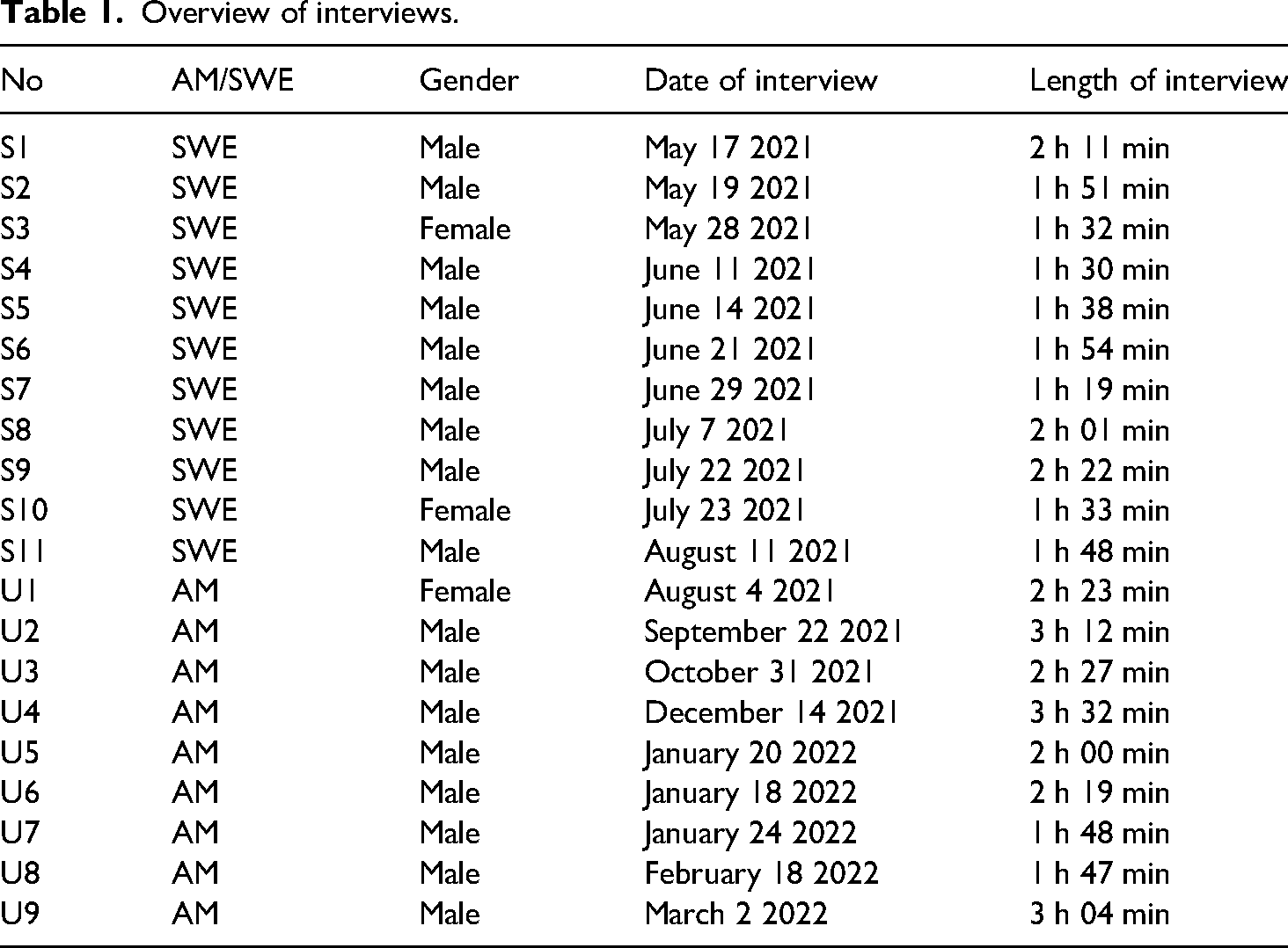
Based on these tweets, we prioritized Twitter accounts that were actively tweeting politics, well-connected (following, and followed by, many), not run by professional politicians, and who had been actively participating in these discussions for a relatively long time. Over a one-year period the accounts we prioritized (496 in total) were contacted and asked if they wanted to participate in life history interviews (Söderström, 2020). Out of these, 91 responded and 20 individuals finally participated in an online (often with video) interview (a response rate of 4.03%). The final sample consisted of eleven Swedish and nine American Twitter activists. The life history interviews were on average 2 h and 36 min long (sound only recorded). See Table 1 for an overview of the interviews. The importance of emotional reciprocity has been stressed particularly in conducting life history interviews, as they ask the research participant to share their life, including loss and failure. Emotional openness by the interviewer is key for building mutual trust and improving the interview, and does not exclude conflict or require concealment of ‘one's political antipathy […] if asked’ (Söderström, 2022: 204). As we conducted life history interviews, we expected comfort and trust to be necessary in our research endeavor.
This article is based on our engagement with, and reflection over, four different types of material and observations: 1) the original tweets; 2) the interview data; 3) interactions with participants prior to the interview, including those who refused to participate, and interactions with participants after the interview; and 4) post-interview reflections from the interviewers. These post-interview reflections were part of an attempt to recognize our own emotional experiences as useful data (see also Blee, 1998: 382, 396; Meth and Malaza, 2003; Widdowfield, 2000). We systematized this part of the research process through writing exercises, where the three authors wrote lengthy reflections based on collectively decided themes and questions that had been triggered during data collection. After individual reflection through writing (all author quotes from these reflections), followed by written reactions to each other's accounts and further refinement of our own accounts, the team had an oral workshop where we discussed our experiences. Writing this piece, these discussions and reflections continued.
The three interviewers are two females and one male, and were in their mid-20s, late 30s and early 40s when the interviews were conducted. While all of us identify as white, cis-gender, and Swedish, our experiences of interviewing the far-right differ in part because of different gender identities, social background, role in the project, age, and academic position. Junman, who is the youngest and most junior researcher, conducted the major part of the interviews as a research assistant in the project. She felt that both age and gender shaped her interaction with the interviewees, who sometimes made comments about her being too young to know a particular reference, or adopted an over-explanatory approach. Söderström, who is the project leader and most established researcher, who has conducted much research in post-war settings, with users of violence, felt surprised at how much more uncomfortable this setting proved to be. Holdo is male and grew up in a rural, white working-class town. For him, both the interviews and the conversations with colleagues afterward triggered complicated feelings.
Handling discomfort throughout the research process
Before interviewing
One of the first questions we were confronted with that raised the issue of discomfort was our contextual placement. It was clear that reaching out to potential participants in the country where we ourselves are based was a greater source of discomfort. Junman, who was reaching out to potential interview participants, experienced this most intensely: Junman: I felt this was hard at times, like when people wrote public tweets about me and the project, saying things like ‘This [Junman], does anyone know who she is?’ When this happened, I checked my university website and deleted my profile pictures – I felt very uncomfortable that they would see who I was beyond my name. I don’t know if I was afraid of something specific really, but it didn’t feel good. I locked all my accounts […] so that they couldn’t find anything controversial I might have written or that I would be ‘revealed’ as a leftist or feminist or antiracist. I became very conscious about my digital presence.
Experiencing less anonymity in the Swedish context, our practices of how we reached out were reconsidered more than once, and we had to confront questions of how to be both open and approachable toward our potential research participants, while still staying safe. Engaging with the tweets themselves, and vetting which profiles to contact, meant we became more familiar with some of the hostile communication in these communities. Junman, and Söderström, felt more affected by being exposed to this activist community than Holdo. As a white, straight man, it can be easier to not feel personally targeted by the far-right. Still, Junman and Söderström experienced this very differently. While the online interviews were carried out from the comfort of our own homes, knowledge of other colleagues’ experiences of coordinated attacks from similar online communities, weighed heavily on Söderström, who worried that they could be sought out in their own homes or on private social media accounts. Junman's role as a research assistant also raised questions for Söderström and Holdo about their responsibility for Junman's sense of safety and ensuring that she was not exposed to any risks. As a result, we also discussed these questions on a regular basis, and revisited our choices and practices so as to minimize risk and maximize safety. To date, we have not experienced any of the things we worried about at the outset – however, the anticipation of discomfort may productively shape how we do our research as much as experienced discomfort, both in terms of how we design the project, and with what degree of openness versus protective distance we manage to approach the interview situation.
For Söderström, another concern also made the Swedish interviews potentially more uncomfortable at the outset, as Söderström's dual citizenship and identity should have made her feel as much of an insider or outsider in both contexts, but: Söderström: I guess I am more used to disparate and diverging political views in the US context than in my native Sweden, and a higher degree of polarization feels more normal in the US context to me. What I have normalized and come to expect in these two political communities are therefore very different.
For Söderström, this meant that it felt easier to interview American than Swedish participants, as the anticipation of differences of opinion was easier to deal with and prepare for. These experiences point to how intimacy, often strived for in interviews, and perceived distance to the interviewees and their contexts, can highlight discomfort.
We also experienced discomfort during recruitment. The interactions with potential participants were often uncomfortable because many were highly skeptical of our project, as could be expected when recruiting from a group brought together by their political antagonism towards the government, academia, and other elite institutions. Their concerns about participating were also heightened by being contacted online, through a tweet or in a private direct message. People were more or less hostile in their responses to us, referring to the university as untrustworthy or politicized (for more on researching hostile environments see Fielding, 2007). Others were more suspicious of the particular study and the phrasing of the research purpose, or felt that we were targeting people with opinions they did not identify with. People also made references to safety concerns or fear of repercussions from their employer or community if their political orientation would leak because of participation in our study. For example, one person, while expressing trust in us, argued that if their data was hacked, they would be exposed to violent repercussions. On some occasions, we were able to convey a sense of security and people agreed to participate, particularly when we were able to discuss the project and interview format in more detail, potential risks of participating, and how data would be stored and used, either over the phone before the interview or before starting the interview. However, in many cases, the distrust and discomfort they felt hindered participation and made recruitment difficult.
These difficulties may have led to a biased sample, with more radical people not agreeing to participate. However, they were also productive in the sense that we learned about their political worldviews through how they motivated not participating and their questions asked about the project. It increased our reflexivity about how we interact with potential participants, and made discussions about informed consent more engaged than experienced in other projects without such participant discomfort. Such gray data were methodologically and analytically important to the project (for more on gray data, see Rambukkana, 2019). If we are to understand the role of discomfort in interviews, we also need to consider the meta-data around the interviews (see also Fujii, 2010: 232; Fujii, 2018: 50–51; Turner, 2018: 48). For these reasons, we discuss the interactions with people who did not want to participate. We use no direct quotes, and reveal no information about them, making the ethical challenges less serious. The participants’ discomfort surrounding recruitment did create some lasting problems for us, but overall, this discomfort was productive in many ways for our research project.
During interviewing
As the project focused on how political concerns and unease are expressed on Twitter, being exposed to opinions and worldviews we did not sympathize with was inevitable. For example, one interviewee angrily proclaimed that the US government should ‘wipe out’ all members of the Mexican cartel to stop fentanyl import into the country (U8);
1
another claimed that the government wanted to push an ‘LGBTQ lifestyle’ on people as a form of birth control (U1); a third claimed racism and hate crimes against black people are non-existent in the US (U6). It was uncomfortable and upsetting hearing these comments, despite us having prepared for offensive, racist statements and having been exposed to worse while monitoring their Twitter feeds. These thought patterns were what we wanted to understand and study: we wanted to listen to those whose views we find uncomfortable, who are often dismissed as unreasonable in their behavior or positions. We were genuinely curious as to how they had ended up in these positions. We recognize that dealing with such expressions in interview contexts where it is not expected, can be more unsettling and complicated (see e.g. Kulnik et al., 2020). There is also variation in discomfort depending on the degree to which you identify with the groups singled out and talked about in denigrating terms. While discriminatory remarks can be uncomfortable irrespective of if it is targeted at you, being the direct object of such comments changes its magnitude (see e.g. Ramalingam, 2020: 266). As not all identity categories are equally visible, the degree to which the interviewees were aware of causing direct offense also varied. There were also occasions when sexist comments were made by the participants, and when we simply tried to move on: U4: probably if there’d been a rally close enough to go to … that I thought my truck would make it that far [laughs]. So … um, my truck is probably as old as you are! [laughs] Junman: Maybe [laughs] U4: Just, so … and trucks don’t, they don’t age as well. [laughs] Junman: Well … ok [laughs]. But if you could [changes topic]
However, there were other aspects that caused discomfort during the interviews.
Our research participants’ socioeconomic conditions varied, but some were clearly living privileged lives; some held PhDs, others described themselves as high-income earners, most belonged to ethnically privileged groups. When such participants compared their and other conservative Americans’ lives to that of Jews during the Holocaust, it was a form of self-victimization that was difficult to deal with. These statements felt true to the person expressing them, and questioning these accounts when the person claiming victimhood expressed vulnerability, for instance through crying, was difficult. Additionally, when participants displayed a lack of logic, and did not recognize their own biases in the accounts offered to us, this also created discomfort. This ranged from research participants who themselves had an immigrant background but who were incapable of identifying with other immigrants, despite shared experiences, to others who were fully convinced of the political bias of certain news media, but who trusted other outlets (which are known to be more biased) to be completely unbiased. Hearing these inconsistencies or logical fallacies during the interview was frustrating, because we were not always sure how to handle them, ultimately making us feel as bad interviewers. How, and when should we point out these blind spots and call them out during the interviews? When we tried to challenge some of them, for instance, through epistemic interviewing strategies, such as asking for clarifications and justifications for their claims (see e.g. Berner-Rodoreda et al., 2020; Brinkmann, 2007; Curato, 2012), for example by asking ‘I’m not sure I understand, how can both A and B be true?’ it rarely helped the conversation along, and more often than not resulted in more incoherent arguments and further frustration. These strategies were not particularly productive in terms of generating more data to inform the research questions; however, they relieved us of feeling that we had deceived our participants by not voicing our disagreements, a feeling that arose in some interviews.
Our different experiences with the two communities also carried through in the interview phase. For varying reasons, we found it easier to connect and be comfortable with the American interviewees; in part this was because the political issues they discussed were more removed from our own context. It was also easier to use our outsider-ness to ask critical questions, this cloak allowed us to do so in a friendly yet direct manner, allowing us to probe our interviewees further. When interviewing the Swedish participants, this strategy was not as available to us.
Another component of the interviews that caused discomfort, was not connected to what was said, but how it was said. Some research participants were very emotional, and others were not, both causing different kinds of discomfort. Other times, our own emotional connection and empathy were also the source of discomfort. Below, we develop these three experiences. First, during the interviews, we sometimes had to deal with participants’ emotions such as anger, frustration, and grief. Usually, these emotions were described rather than ‘acted out’, but on some occasions, participants cried and expressed their frustration and grief. If unprepared, such strong emotional reactions can startle you, and they are a reminder to rethink how to proceed the interview. Do you need to take a break, should the interview be terminated, should the topic be pursued further or abandoned? Knowing when to do what, in order to safeguard the research participant and to conduct a successful interview, is not easy. Locating the balance is a cause for discomfort even for the most seasoned interviewer, and for Junman experiencing discomfort with unexpected intimacy and emotions from interview participants, gratefulness for being trusted, while also trying to be both a critical researcher and a fellow human being, was emotionally draining.
Second, at other times the dispassionate way that some research participants voiced their opinions was the cause of discomfort. Many of our research participants had a self-image of being ‘the rational one,’ whereas their opponents are the emotional and illogical ones (for more on this, see Söderström et al., unpublished). When this mode of reflection was combined with topics that spoke to exclusion, violence or discriminatory practices, this detachment and dehumanization was difficult to deal with. While we were not able to develop consistent strategies to engage with our research participants when this happened, this emotive paradox spurred our interest in how these populist Twitter communities relate to emotion overall, and the above noted research paper was developed. This discomfort led us to pursue a topic because it triggered a research sensitivity in us.
Third, another source of discomfort in the wake of strong emotions, was the cognitive dissonance sometimes experienced during these interviews, when we quickly moved between being confronted with our research participants’ humanity and our own feelings of empathy for them (and indeed enjoying the interview) and our aversion for opinions voiced. We could feel empathetic towards the experiences and emotions our participants expressed, but critical or even hostile toward their conclusions, which were often linked to ‘mass-immigration’ or an ‘elite conspiracy’. Such moments caused us to reconsider ourselves, what does this empathy say about us? Does it impact our political identity? This recognition of the complexity of being human that became visible through these emotional encounters was ultimately productive as our research project became more reflective, and hopefully also contribute to a richer and more engaged public debate (see also Back, 2007; Parkinson, 2018).
Finally, another source of discomfort during the interviews was the clash between different ideals, as also noted by previous research. The three of us approached this possibility differently. Söderström and Junman felt they needed to confront the balance between speaking up (staying true to our political ideals), building rapport (as a professional interviewer), and a professional ethos of not deceiving (as an ethical researcher). How visible should our own selves be during the interview, given that the interview is not about ourselves but is a means to understand the person being interviewed? Söderström's strategy was often to let her own identity take the back seat: Söderström: I felt in some way that I was living up to my own professional ethos, of this is how one should behave in an interview as the interviewer. If faced with a direction question, I would have told them how I felt, but professionally it did not seem appropriate to volunteer this at the cost of reducing the rapport in the interview.
By contrast, Holdo, who felt more comfortable about exposing himself to interview participants, felt that their interest in his political views was not only unavoidable but also something valuable that could be drawn upon in the interviews. In two interviews, he even mutually agreed with the interview participants that he was ‘on the enemy side’ and that it was a good thing that ‘politically correct, leftist academics’ talk to people on the other side. Answering questions honestly about your own views and political engagement made it possible to feel a sense of mutual agreement and shared backdrop for the interview. We do not believe there is an easy solution to these clashes, rather it is good that that discomfort is there and we need to continue interviewing with such discomfort intact to keep engaging in these questions throughout any research project.
After interviewing
Questions around discomfort continued also after interviewing, when we needed to process various difficult questions related to our own politics, sense of ethics, and ideas of what a good interview is. Our interviews took place in a time of political debates over whether talking to the far-right, especially discussing their views, implied contributing to their legitimization and normalization. Had we done this by giving them space to share their experiences, feelings, and thoughts? Had we been too nice to them? Had we, in the name of ‘good research practice’ failed to be anti-racist by not confronting their views enough? On the other hand, did these feelings of wanting to distance ourselves not in fact represent an impulse for othering, present in political as well as academic discourse, that we had set out to challenge in this research project? If so, did our efforts at distancing ourselves contribute to further polarization? While all of us felt emotionally affected by this experience, we had different emotions to process and we approached this from different positions.
Junman, in particular, felt uncomfortable with having let racism pass unconfronted during interviews. These worries were particularly present immediately after the interview, and during transcribing when she was reminded of the friendly tone and lack of critical questions. Söderström experienced something similar. Two examples of occasions when too much agreement may have been voiced are: U4: Because you ‘ve got so many hundreds of thousands of immigrants now, you have to sort it out somehow – not my job to sort it out for you! [laughs] Junman: [laughs] No, of course. U4: And that's a big problem. – – – – – U5: It's not about saving the environment, you’re an idiot for believing it, excuse me – I don’t mean YOU personally, I- Söderström: No, I know. I don’t even have a driving license so I don’t, I’m not offended! [laughs]
Both felt shame, as if they had become complicit in normalizing discriminatory ideas. These feelings were present despite their understanding of the interviews as research interactions, not political debates. Part of it may be attributed to the above-mentioned political climate, where political opponents must be condemned and othered, but part of it may also relate to the struggles we had recruiting participants. Given the doubts many had expressed upon being invited to participate in these interviews, for fear of being demonized and mocked, ensuring a safe and open interview environment was important for them. Yet, had they been too focused on making the interview situation feel safe and open, to decrease the risk of our participants using their Twitter profiles to publicly discredit our study and discourage participation? The question that arose for them was whether we had found the right balance, a question that remains unanswered.
Holdo approached this question differently. As his interviews often began with the interviewees asking him about his political views, he did not feel he needed to find a balance between being nice and being open about where he stood on these issues. While he did not actively seek to confront them on issues where his views, or even worldview, differed significantly, he felt that this was established from the outset. Nor did he experience these differences as an obstacle to making the interview situation feel safe and open – on the contrary it felt that his own openness made the interviewees relax. We recognize, however, that research participants who directly ask about the political views of the interviewer may react differently from participants that do not; and it is likely to vary how often such direct questions are asked (for an example, see Gallaher, 2009: 142). In Junman's case, few participants asked about her views: instead, some of them ended the interviews asking if she had learned something from them, which may relate to the way gender (and age) influences interview situations (Gailey and Prohaska, 2011: 372; Pini, 2005: 203, 209–213; Schwalbe and Wolkomir, 2002). The importance of being non-threatening in an interview situation may also be gendered, where the costs of volunteering your own political position may have been higher for Söderström and Junman (Arendell, 1997: 349–351).
This question of honesty and outspokenness was also connected to research ethics in a broader sense. Given our power advantage over how these interviewees are represented in publications, not deceiving them about our perspective, and lulling them into thinking our account of their arguments and perspectives would be devoid of critical interrogation, was also a principle we wanted to cherish (for a discussion of similar ethical dilemmas see Duncombe and Jessop, 2002; Thuesen, 2011). For all three, the continuous movements between building rapport in the interviews to asking critical questions raised concerns about whether the interviewees were being misled to feel more comfortable than they might have been if they had been more confronted with our critique. Had we compromised our commitments to research ethics by not being sufficiently upfront with our own political views during these interviews? After some interviews, especially going over the transcripts when alternative paths in an interview can sometimes become clearer, Söderström and Junman experienced a professional discomfort, when they felt they had, for example, laughed too much, suggesting too much agreement with our interviewees, knowing that issues in the interviews were things they were likely to question or problematize in future publications. Confronting the transcripts, they also had to contemplate whether there were missed opportunities to ask difficult questions during these interviews, which in addition to being ethically important might also have produced more useful data.
Another source of discomfort relates to sharing our research experiences with others. The varied emotions and experiences we had during this process also meant that we had difficulties at times to speak about our research with friends and colleagues. The interviews could be friendly, funny and considerate, with shared passions and concerns, and in the next moment confront us with opinions, political choices and even worldviews, we did not share or accept. We were confronted with the complexity of being human (Fujii, 2018: 9; Parkinson, 2018). Our experiences were more interesting, complex and unexpected than we could easily articulate in response to the simple question we often got from people around us: do you not feel scared/upset/disgusted/outraged with these people? What was at times uncomfortable about this question is that it seemed based on assumptions that did not fit with our experiences. First, it assumes that we are not normally exposed to racism; yet our workplaces are extremely white and culturally homogenous, and internal discussions about equal opportunities are both met with resistance and point to ongoing problems within academia. Second, it assumes that we are not able to relate to these people, when all three of us are in fact from white working-class backgrounds where far-right sympathies are very common. While it is socially easier for us to agree that they are, as Hillary Clinton put it, ‘a basket of deplorables,’ 2 this is not how we always feel about our interviewees.
Holdo began to feel uncomfortable when colleagues expressed condescending views about people supporting the populist far-right. Holdo: Politically, yes, I could not be further away from them, but I do not dislike them as people any more than I dislike academic elites who are unable to see how their white elite privileges shape their views of the world. I hate how they take so much for granted, but I like many of my privileged colleagues anyways, and try to forgive myself for becoming more and more like them.
Söderström shared some of these feelings, too. Talking to colleagues, she sometimes felt expected to only feel uncomfortable with these interviewees. Both Söderström and Holdo felt they were met with skepticism when failing to deliver the expected discomfort and even dehumanization of those we had interviewed, in a sense it felt as if we were asked to contribute to continued polarization. These expectations also created discomfort, and have been part of the motivation for this article, as we felt a need to share how this research endeavor has been complex and far from straightforward.
As we move closer to publishing within this project, the question of how our interview participants will react to how we have presented them become another concern, and a source of discomfort. Here, our own sense of safety again became an issue; will our depiction cause an outrage and ensuing reactions from our research participants? But also, are we staying true to our research ideal, publishing that which may be uncomfortable without our analyses being shaped by our fear? Dealing with this tension has been productive as it forces us to thoroughly think through our research account, helping us produce a more reflexive and truthful account.
Finally, we also experienced discomfort after the interviews, that was the result of seeing the totality of the minor frustrations experienced during the interviews. A deep concern for the possibility of a democratic conversation has been part of the motivation behind this project. The confrontations discussed in this paper have made us doubt this possibility. The racist worldviews and inconsistencies in the accounts given to us felt disturbing especially when taken altogether. We felt like we had tapped into a conversation where misinformation, conspiracy theories and racist views are allowed to pass, where participants are not held accountable for what they say, and where problematic perspectives endure. But this also underscores the importance of continuing research on these topics.
Conclusion
This article began with a reflection on the role of, problem of, and advantage of discomfort in interviews, as well as how to systematically think about these issues. We argue that discomfort in interviews is essential and that discomfort can be a productive experience (see also the discussion about failure as a productive experience in Harrowell et al., 2018: 232–233; or anxiety as productive for formulating research problems in Gustafsson and Hagström, 2023; or the long terms gains for the research community with increased transparency around fieldwork difficulties in Brounéus et al., 2022: 955). Discomfort makes us actively balance different research ideals and strategies, which comfort and complacency might not push the researcher to do. Pinpointing the discomfort allows us to understand the interview process better, ask better questions, follow up on issues that give rise to such discomfort, and ultimately engage in research that deals with our pluralist society. Discomfort was also productive as we learned more about our prospective participants’ worldview, discussions about informed consent were more engaged, and it gave us impetus for specific articles as discomfort had highlighted interesting contradictions. We wanted to add nuances to assumptions about the role of comfort and discomfort in interviews, and undercut the notion that discomfort is always a problem, as well as increase the transparency around how we as researchers tackle uncomfortable interviewing. Trust may not always suffer when discomfort enters the interview. We also wanted to show the range of discomfort experienced, from slight annoyance to more serious distress, as well as the variation in intensity.
Yet, discomfort can lead to multiple problems. Discomfort may cause researchers to avoid interviews completely, and potential participants to say no to participating. Hiding discomfort when felt, may lead to both ethical questions, but also compromise the data, as the interviewee may not be given the opportunity to fully explain their position and respond to such discomfort. Exposing discomfort during the interview may also lead to participants shutting down, refusing to continue and endanger future recruitment. These obstacles should not be taken lightly either.
To systematize the discomfort experienced through and in interviews, we started with a chronological account, showing how discomfort entered into the research process before, during and after the interviews. Some of this discomfort was clearly productive for the research, and other forms of discomfort were not. What is clear from this exercise is that multiple goals or ideals are in conflict with each other throughout this process in relation to discomfort. Throughout, we had to balance and handle conflicts between our ideals, as they related to our professionalism as researchers, our own political identity, how to conduct ethical research, as well as ensuring the success of the research project, our identity within the research community, as well as the societal consequences of our project. Paying attention to discomfort highlights how carefully we have to tread, to both deliver truthful accounts without resorting to increased polarization, and at the same time bridge the gap between academia and different communities we want to research. Avoiding discomfort can help signal our professionalism as interviewers, build trust and make research participants more willing to participate and share their opinions and life with us. Seeking out discomfort, on the other hand can also create useful data where participants have space to develop their views, it may strengthen the researcher's identity, and it protects the research participants from manipulation. These conflicting goals cannot be easily reconciled, but by bringing them to the surface, we can be transparent about how they have shaped our research choices. Thoughts around these conflicting goals have lingered, and linger still, as we write up this article; thereby contributing to reflexivities of discomfort. We argue that it is important for the research community as a whole to confront and sometimes invite such discomfort, but that does not mean that every researcher is mandated to do so. But if they choose to, we hope this article can be of support in facing different kinds of discomfort throughout the research process.
We should also acknowledge that writing this piece is itself a moment of discomfort for us. How do we write a reflexive academic account of this research process, and how do we balance and represent our different experiences without presenting a fragmented analysis in this article? This account is deeply personal, and propelled by our emotional responses. And while many of our colleagues are driven by care and feelings, academic outputs are usually framed in a language empty of such signifiers. We want this to be taken seriously, but how will this text be received?
Our experiences of discomfort varied across the three interviewers; these variations result not only from previous experiences of interviews, but also our own social background, gender, varying abilities to identify with aspects of those we interviewed, and each of the specific interview encounters we had. Our discomfort varied with each interview, topic and issues raised in this article. It also suggests that other research projects, with other interviewers and participants, may experience other kinds of discomforts. Recognizing this variability in discomfort is key, and requires openness and sensitivity in any collaborative research project. While we have been able to reflect some of the discomfort experienced by our research participants, the account offered here is dominated by our experiences as researchers.
Finally, we want to stress that we were not categorically uncomfortable with the people we interviewed, even if we frequently felt very uncomfortable with the worldviews many of them seemed to express, or the violence espoused by some. We hope that our research account helps add complexity to what this kind of research entails. Interviewing, talking to each other, is a crucial step in how we can engage with one another, how we can see others, as well as ourselves, and perhaps come closer and accept our flawed humanity. In allowing discomfort into the interview, we take our research participants serious as accountable and active agents, and hope to enrich our understanding of political issues and conflicts affecting our society.
Overview of interviews.
Footnotes
Acknowledgments
We are very grateful for feedback we received on earlier drafts of this article from Elisabeth Olivius, Anders Sjögren, Luise Bendfeldt, Maria Eriksson Baaz, Per Adman, and from the anonymous reviewers.
Data accessibility statement
The participants of this study did not give written consent for their data to be shared publicly, so due to the sensitive nature of the research supporting data is not available.
Declaration of conflicting interests
The authors declared no potential conflicts of interest with respect to the research, authorship, and/or publication of this article.
Funding
The author(s) disclosed receipt of the following financial support for the research, authorship, and/or publication of this article: The project was generously supported by FORTE, project number 2018-00583. Ethics approval: the Swedish Ethical Review Authority reviewed the project, Dnr: 2019-03899.

Notes
Author biographies
Johanna Söderström is a Senior Lecturer at the Department of Government, Uppsala University, Sweden. Her research concerns democratization, peacebuilding, state building, and interview methodology. She has published extensively on the use of life history interviews. Her most recent book Living Politics After War (Manchester University Press) is concerned with the political mobilization of veterans in the US, Namibia and Colombia.
Markus Holdo teaches and does research on contentious politics and ideas about democracy at the Department of Political Science, Lund University, Sweden. He is currently exploring care as a practice of democratic inclusion. His first book, Participatory Spaces Under Urban Capitalism was published by Routledge.
Alice Junman is a PhD Candidate at the Department of Sociology, Uppsala University, Sweden. Her dissertation project focuses on Swedish online political influencers, with a particular interest in the intersection between microcelebrity culture, social media, and politics. More broadly, her research interests include online political participation, visual representations of politics, legitimacy and influence, and the role of platforms in contemporary culture and politics.