




Abstract
This paper reports on the experiences of creative practice graduate researchers and academic staff as they seek to comply with the requirements of the Australian National Statement on the Ethical Conduct of Research Involving Humans. The research was conducted over a two-year period (2015 to 2017) as part of a wider project ‘iDARE – Developing New Approaches to Ethics and Research Integrity Training through Challenges Presented by Creative Practice Research’. The research identified the appreciation of ethics that the participants acquired through their experience of institutional research ethics procedures at their university. It also revealed a disjunction between the concepts of ethics acquired through meeting institutional research ethics requirements, the notion of ethics that many researchers adopt in their own professional creative practice and the contents of professional codes of conduct. A key finding of the research was that to prepare creative practice graduates for ethical decision-making in their professional lives, research ethics training in universities should be broadened to encompass a variety of contexts and enable researchers to develop skills in ethical know-how.
Since the 1990s, Australian post-secondary training in the creative arts has been provided within the university sector. One consequence has been an expectation of research output on the part of artists as academics and, in turn, that the creative arts would develop a tradition of research and research training. Creative practice as research meant that, like all research in the academy, it became subject to the university ethics processes. As a result, creative practice doctoral candidates are now negotiating an ethics process that is unfamiliar to many of their supervisors. Furthermore, academic staff in the creative arts are likely to maintain a practice outside of academic research imperatives, and, as a result, be more familiar with professional codes of conduct and long-standing ethical practices in an industry context. This produces confusion on the part of graduate researchers and potential conflict on the part of academics.
The research project ‘iDARE – Developing New Approaches to Ethics and Research Integrity Training through Challenges Presented by Creative Practice Research’ (iDARE) was conceived as a way of understanding the attitudes towards, and the experience of, ethics training and procedures on the part of creative practice researchers. Conducted over a two-year period (2015 to 2017) and funded through an Australian Government Office of Learning and Teaching grant, the project examined issues facing graduate researchers in the creative arts and design as they navigated their institution’s ethics approval framework while seeking ethics approval for their research projects. Although creative practice research is a relatively new field in the Australian university context, in 2017 there were 3235 enrolments in a doctorate by research across the creative arts, architecture and building (Australian Government, 2018). In creative arts itself, doctoral student numbers increased from 102 in 1989 to 1230 in 2007 and 2332 in 2017 (Australian Government, 2018; Baker et al., 2009).
iDARE set out to enhance the ways in which doctoral candidates negotiated the compliance requirements of the National Statement on the Ethical Conduct of Research Involving Humans (NH&MRC, 2007) (the National Statement) and to shed light on the degree to which research ethics approval requirements developed the candidates’ knowledge and awareness of ethical issues that may arise beyond the institutional setting. As universities respond to the need to prepare graduate researchers for careers outside academia, it was timely to consider the impact that institutional research ethics approval processes have on enabling ethical decision-making in other contexts. Hence the research team sought to broaden both our own thinking about ethics and that of our research participants. We drew on notions of ethical ‘know-how’ (Varela, 1999) and extended the field of contextual ethics into creative arts research. Contextual ethics proposes that ethical decision-making is about ‘determining what is ethically appropriate and justifiable’ in each circumstance (Field, 2017: 305–306, italics in original), and Varela’s ethical ‘know-how’ allows for a spontaneity in ethical decision-making. We considered what might be required so as to ensure that processes designed to meet compliance requirements of graduate research might encourage a critical awareness of ethics as a practice in itself, one that could be applied beyond an institutional setting.
The paper is organised in four parts. The first part provides the background to the iDARE project and the specific research undertaken as part of that project. In the second part, we report on the findings that relate to graduate researchers’ experiences of procedural ethics requirements in Australian university settings. The third part explores the views of graduate researcher and academic researcher participants on questions of ethics as these might arise in their research and/or practice. The fourth part of the paper examines the degree to which the internal university ethics compliance procedures enable graduate researchers to negotiate an ethical professional practice outside of the university context. In this part we introduce the Creative Research Ethics Workshop (CREW), which formed as a consequence of the iDARE project and investigated relationships between ethics and creative practice research in an emergent manner. In concluding, we argue for a more generative approach to ethics training within graduate research, one that would better prepare doctoral graduates to negotiate ethical issues beyond the academy, whether they arise as part of research or, more likely, in the course of an independent creative practice.
iDARE
Doctoral candidates in the fields of creative arts and design must attend to requirements of the National Statement as implemented in their particular institution. However, some graduate researchers, particularly those who draw from the avant-garde tradition, consider a provocation of the dominant ethos as central to their vocation, and so are resistant to institutional research ethics oversight. Artists and, hence, artist researchers see their role as contesting accepted notions, provoking and questioning ethical boundaries in order to create uneasiness and discomfort. A highly public case of ethical questioning involved the photographs of prominent Australian artist Bill Henson, whose 2008 exhibition at the high-profile Roslyn Oxley9 Gallery in Sydney was cancelled due to claims that it contained sexualised images of children. Henson himself acknowledges the discomfort that his works produce and claims ‘an artist’s right to make his audience uncomfortable’ (Marr, 2008: 32). The artist received significant support from leading members of the creative community, many of whom signed a public letter which argued that art ‘is valuable because it gives rise to such debate and difference, because it raises difficult, sometimes unanswerable, questions about who we are, as individuals and as members of society’ (Croggon et al., 2008).
The notion that one of art’s key roles is to act as a conscience for society, to provoke, to test boundaries and bring its audience into crisis, remains strong in the arts community and among creative practice researchers and doctoral candidates (Bolt and Kett, 2010; College Art Association, 1977). Translated into an institutional research ethics approval context, boundary testing on the part of creative practice graduate researchers can be challenging for supervising academics and ethics committees. Previous research suggested that where there is a perceived conflict between the institution’s ethics protocols and the work of creative practice researchers, researchers may either ignore their ethical obligations or reframe their project to avoid procedural ethics (Bolt et al., 2009).
iDARE aimed to develop a robust, innovative and ethically informed research ethics culture in the creative arts and design discipline, by equipping graduates with the ethical know-how for their real-world professions as artists and designers. A combination of quantitative and qualitative creative art and design methods informed the strategies and outcomes. Data collection took place across Australian universities through surveys seeking the views of both graduate researchers and academic researchers. An online survey attracted respondents across all fields of creative practice: art, design, object and interior design, sound, video, interactive media, architecture, music and music composition, journalism, creative writing, dance and theatre and performance, and from interdisciplinary approaches to creative arts practice. Building on specific responses to the survey, the project team conducted interviews with 29 respondents who indicated a willingness to expand on their experiences. These interviews gathered the narratives of the supervisory and candidature ethics process experience and provided the material on which to base a set of case studies.
The project team also facilitated workshops at a range of locations in Victoria and New South Wales, which were designed as experiential and active learning events. A key output of the project is the design of an ethics toolkit, which will bring together information and resources collected during the project, and the set of case studies, to be made available to creative practice graduate researchers in Australian universities. The toolkit will also contain a handbook, resources and outlines of pedagogical workshops that can be conducted with both graduate and academic creative practice researchers.
The online survey documented current attitudes and approaches to ethical oversight on the part of academics, graduate researchers and ethics administrators and identified those who might wish to participate in a more detailed interview. The 116 respondents comprised 62 academics/supervisors (33 female, 28 male and 1 who did not identify) and 54 graduate researchers (37 female and 17 male) from 19 tertiary institutions. The survey included the following questions:
What do you understand by the term “ethics”?
Were the institutional research ethical guidelines an important consideration when framing a research question or devising the methodology for a project?
Did institutional research ethics guidelines inhibit or enhance your research?
Were there any evident benefits to the research from engaging in the ethics process?
What principles do you look to or use in dealing with ethical issues in your independent creative practice?
Attitudes to institutional research ethics approval frameworks
Creative practice academic researchers and graduate researchers were asked about the impact of the university’s human and animal ethics guidelines on their creative practice research. The responses from those that answered this question appear in Table 1 below. The abbreviations AR for academic researchers and GR for graduate researchers, are used to denote the source of quotations in the following discussion of the interview data.
Impact of ethics process.
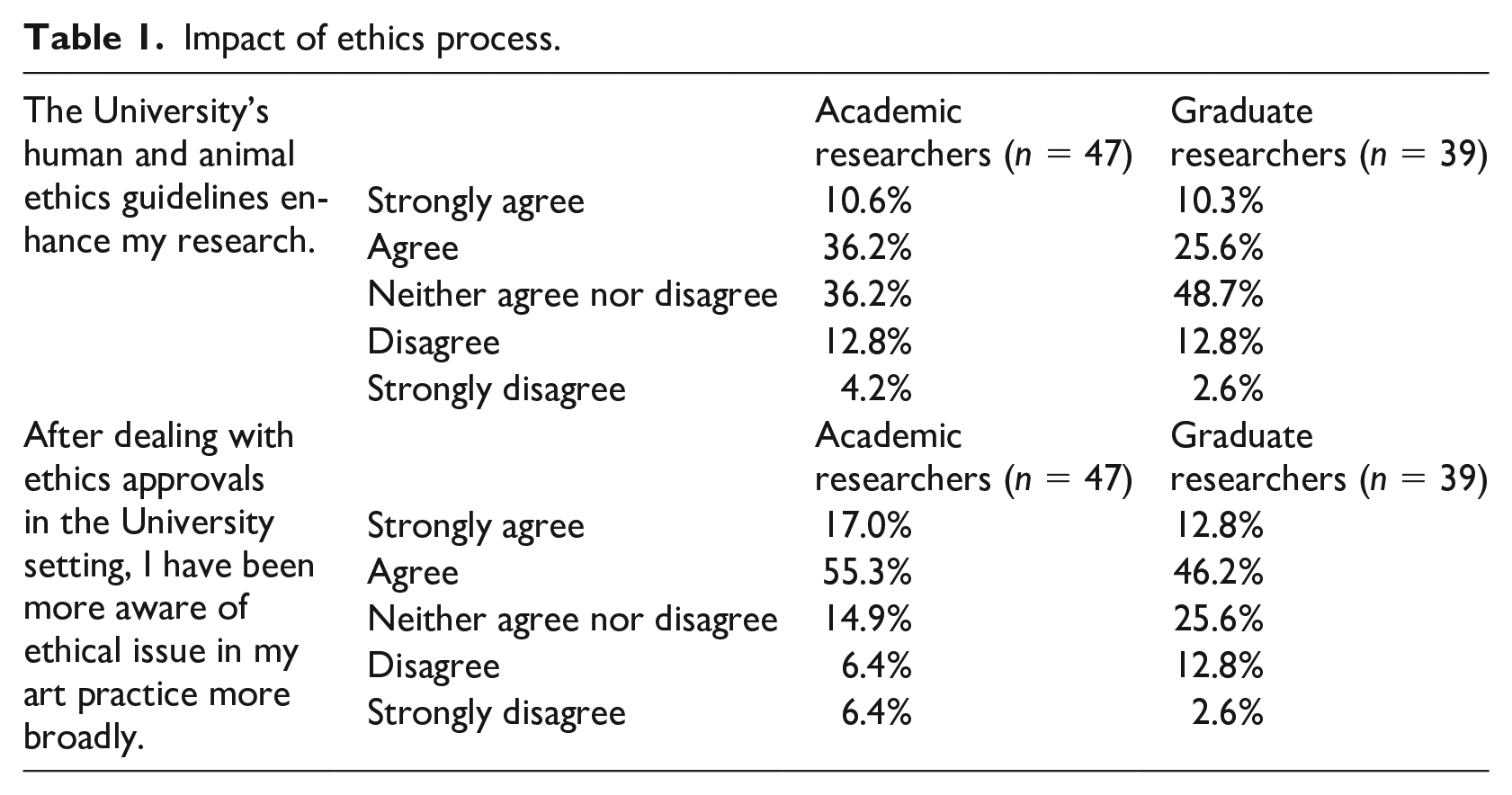
From these results we see that less than half of the creative practice graduate and academic researchers considered that the ethics process had enhanced their research. Just 47% of academic researchers and only 36% of graduate researchers agreed with the statement ‘The University’s human and animal ethics guidelines enhance my research’. On the other hand, only 17% of academic researchers and 15% of graduate researchers disagreed with the statement, while 36% and 49%, respectively, neither agreed nor disagreed. In contrast, a substantial majority within both categories agreed with the statement ‘After dealing with ethics approvals in the University setting, I have been more aware of ethical issues in my art practice more broadly’, with a greater number of academic researchers (72%) than of graduate researchers (59%) agreeing with the statement.
An analysis of the responses to the open-ended question of what particular aspects of the ethics process were useful suggests that the ethics processes serves at least two purposes: not only does it seek to identify potential ethical issues, but it also demands that the candidates set out their projects in a concise way. This second purpose was appreciated by many candidates who reflected that the most useful aspect of the ethics process was that it assisted them in clarifying the nature of their project: ‘[ethics] . . . made me consider my project in more detail at an early stage of my research. It also helped me to be more concise with my language so far as communicating my ideas with others in the community’ (GR 23) and ‘it made me think about and plan my research in a more considered way. I had to imagine potential problems and solutions, and this helped my field research’ (GR 39). For one respondent, the ethics processes and procedures assisted researchers in being clear about their dealings with participants: ‘I have clearer boundaries with my participants and I frequently fend off requests by them and frame it as an ethical boundary that I can’t cross’ (GR 49).
Academic researchers affirmed the positive role of the ethics process in providing candidates with a process through which to clarify research design and methodology: ‘[ethics] assists in refining the methodology of their research project and prompts them to think in detail, about . . . what they are researching and how’ (AR 60); that it encourages an awareness of their responsibilities to research participants: ‘students have the opportunity to reflect on their project, particularly the way that research affects others. It’s been useful, too, . . . to understand that research involves respect, consent and clarity of communication’ (AR 32); and enables candidates to develop a more reflective academic practice: ‘an improved understanding of the implications of the research and greater insight into the value and consequences of the research’ (AR 19).
It is heartening to see that after dealing with the ethics approval process, both academic researchers and graduate researchers considered themselves more aware of ethical issues in their practices more generally. It is also instructive that the ethics process is seen as being useful, as it assists graduate researchers in clarifying the scope of a research project and developing a methodology. However, while this may be useful for both graduate researchers and their supervisors, it is not the primary goal of an ethics process. Equally, before we can conclude that learnings from the ethics process might be transferable to the world beyond the academy and academic research, we need to explore what graduate and academic researchers understand to be encompassed by the concept of ethics in their creative practice research. This is taken up in the next section.
Ethical practices
We would hope that graduate research training, and in particular the requirements of the ethics process, would provide doctoral candidates and practitioners with knowledge, skills and frameworks sufficient to enable a sophisticated consideration of what might constitute an ethical practice and to be able to translate this to their creative practice beyond the academy. In order to explore what graduate researchers and academics took from their exposure to the ethics processes of universities, all participants were asked an open-ended question that explored their understanding of ethics in relation to a creative practice: ‘What do you consider to be meant by the term “ethics” in relation to a creative practice?’ Two themes emerged from the responses. The first group of responses reflected an understanding of ethics as procedural and characterised the ethics process as a way of protecting participants and institutions, whereas the second suggested an enhanced sense of ethical ‘being and doing’ on the part of the graduate or academic researcher.
Responses from graduate researchers that were limited to an understanding of procedural ethics consisted of very generic framings of ethics principles, such as ‘the use of other peoples’ involvement in your work. If they are involved they should be consenting to how and why they are involved’ (GR 1), and ‘being respectful and knowledgeable of the legalities involved in conducting research that involves people’ (GR 4). Others combined their response with academic misconduct aspects of research: ‘ensuring that my research minimises the amount of potential harm and distress to subjects. Also ensuring that collaborators are sufficiently credited for their contribution to a project’ (GR 48), and ‘acting in a way which respects and acknowledges all parties in the research process. Putting in place frameworks to support the ethical handling of information and sources’ (GR 25).
A similar range of responses came from academic researchers. One responded: ‘[ethics in creative practice means] . . . Minimal harm to participants (human and non-human). [W]ays to make decisions with how they participate, and what they participate in, and how they determine what is generated (as “data”)’ (AR 25); others defined ethics as ‘rules that seek to eliminate harm to participants in creative practice projects’ (AR 41) and as ‘ensuring no risk or discomfort, present or in the future, will result for the participant. Ensuring that the institution is not at risk of litigation’ (AR 67).
Researchers who appeared to have integrated ethics more fully into their practice alluded to a form of relational ethics. One graduate researcher who felt that the ethics approval process had little understanding of arts-based research, nonetheless described the experience of the ethics process as ‘useful, but still painful’ and expressed the researchers’ sense of ethics as ‘ethics in relation to the creative practice means the dynamics and nature of the artist’s relation to the community. It questions the role of the artist in the community’ (GR 21). Another spoke of the ethics process highlighting ‘elements of care and empathy’ and described ethics as having ‘an awareness of how the researcher influences the environment (even by their passive presence alone), as well as a responsibility for events resulting from that influence’ (GR 35). A third considered that researchers might be working with vulnerable communities in their research and stated that for them ‘ethics includes the range of my behaviour and conduct towards people I work around in general and subjects in particular. It includes my thinking about the impact and implications of my practice socially and environmentally’ (GR 39). These responses all came from graduate researchers whose practice was deeply engaged with a specific community or aimed at achieving social change.
Academic researchers who embraced a relational approach to ethics came from a broader range of practices and had a more diverse vocabulary for their framework. One characterised ethics as ‘awareness and sensitivity, integrity, socially and culturally responsible and considered practice’ (AR 46); another as ‘the manner in which one practices where there is a regard/care to its affect/effect on self and others (people, animals, plants etc) – not as a moral question so much as a relational, ecological one’ (AR 18). The theme of sustainability ran through a number of responses: ‘the environmental impacts of practices (research or otherwise) are inherently within the domain of ethics’ (AR 19); ‘undertaking practice in an environmentally appropriate and humanely appropriate way’ (AR 48).
The majority of respondents, be they graduate researchers or academic researchers, would have come to a consideration of ethics solely through the National Statement principles as instrumentalised within their institution. Without additional pedagogical interventions, graduate researchers may complete their doctoral or masters research with only a procedural ethics framework through which to consider ethical issues in their future practice. Furthermore, if this framework fails to resonate with researchers, it may produce perverse outcomes.
Some respondents reported that they had modified their research to avoid the requirement to prepare an ethics application: ‘I devised my project so that it would have minimal ethical hurdles’ (GR 51), and one respondent was under the impression that the university did not require an ethics approval: ‘doesn’t happen at [xxx]’, ‘I don’t know any creative arts HDRs who had to apply’ (GR 25). Academic researchers also reported curtailing their research so as to ‘make ethics approval easier to obtain’. This involved ‘avoiding or leaving out Indigenous persons, limiting the range of activities used to investigate creative processes’ (AR 9), and in another instance ‘removed children from my research proposal’ (AR 12). The blurred area between research and creative practice is highlighted by one respondent: ‘some projects I dump or push outside of the university to avoid the process’ (AR 38).
For a number of respondents, the institutional research ethics approval frameworks did not accord with their own sense of ethical concerns, one example being ‘I am familiar with the term ethics being used within a legal framework, primarily concerned with human research in universities and exposure to risk’ before stating that their own ethical framework is grounded in ecological concerns (AR 17). Others expressed an affinity with an ethical art practice, as distinct from ethical research: ‘often artists explore ethical issues in a way that may simplistically appear as immoral but are actually, by doing so, raising the issue into the public realm and raise debate and discussion’ (GR 12); and ‘I like to think that artists have a moral obligation to humanity. Ethics as a moral principle should be a guidance and reminder to all artists never to break away from that rule of conduct’ (GR 19). One graduate researcher who asserted that ethics meant ‘permission’ reported that in the creative practice beyond the university, ‘if art doesn’t feel uncomfortable in some way, it can’t be interesting. I talk things through before doing them on a case-by-case basis. Then I wait until the city shuts the show down’ (GR 42).
The fact that there is no consensus as to what ethics means in creative practice research is hardly surprising. What is of concern is the possibility that graduate researchers might not feel empowered by the institutional research ethics approval processes in a way that assists them to negotiate their way through ethical concerns in their practice beyond the academy. Indeed, some graduates may have come to the view that ethics was not of concern to them once their work is no longer regarded as research but rather a professional practice.
Creative practice beyond the academy
Practicing artists, designers and creative producers working in the community are not constrained by the National Statement; once creative practice graduate researchers leave the university, they are no longer required to gain ethics clearance for their work. Their professional practice is unlikely to be considered research and if they are constrained in any way, it is more likely to be through codes of conduct or industry norms. At this time they need to call on and use their own developed sense of ethics to make ‘judgment calls’ when issues of an ethical nature arise. Healthcare and ethics researchers Marilys Guillemin and Lynn Gillam refer to the ‘unanticipated and contingent ethical issues that arise in the process of conducting research in real-world settings’ (2004). Moreover, ethical issues will arise for creative practitioners who may no longer be conducting research but are undertaking a creative practice in a ‘real-world setting’. This will be the situation with artists, designers, film makers and journalists, all of which are career destinations likely to be embarked upon by participants in our research.
In an industry, commercial or community setting, creative practitioners need to be cognisant of professional and governmental codes of conduct or ethics, which may or may not align with the institutional research ethics requirements in university settings. Equally, professionals may be aware of codes of conduct in their field, but this does not guarantee a change in behaviour. In their detailed review of the literature on the impact of codes of conduct, Statler and Oliver noted that while codes may increase moral awareness, they do not necessarily increase moral judgement (2016: 89–90). Two examples come to mind that are relevant for the practice areas encompassed by our research: the code of ethics framed by the Australian Media, Entertainment and Arts Alliance (MEAA), to which practising journalists are expected to conform, and the ethos of a visual arts practice founded in notions of artistic freedom. In the case of visual artists, a code of ethics is to some extent anathema, and when the U.S. College Art Association adopted a set of professional practices for artists in 1977, they explicitly rejected enshrining expectations of ethical conduct on the part of artists in a code of ethics.
The College Art Association practices state: While art may support or affirm conventional behaviours and community standards, artists highly value their ability to challenge, criticise, and transgress those standards. . . . While applicable in many contexts, these elements potentially limit legitimate artistic expression and therefore should not be enshrined in a universally applicable, CAA-sanctioned Artist Code of Ethics. (College Art Association, 1977)
The statement continues: ‘Artists must be mindful of, and disclose to their viewers, any physical danger associated with the work. Artists must be ethically free to ignore limits established by legal authorities but should not expect immunity from sanctions resulting from their choices. The MEAA Journalist Code of Ethics (2018) similarly asserts that ‘journalists describe society to itself. . . . They give a practical form to freedom of expression’. Neither of these statements encourages practitioners to act unethically, rather they empower practitioners to push boundaries and make personal judgements. As the MEAA Journalist Code of Ethics states, ‘Basic values often need interpretation and sometimes come into conflict. Ethical journalism requires conscientious decision-making in context’ (MEAA, 2018). These codes invite us to consider whether university research ethics process can empower graduates as practitioners to navigate their way through ethical conundrums.
Throughout the iDARE project, we maintained parallel threads of enquiry. The survey provided us with a snapshot of the current engagement by doctoral candidates and academics in creative arts with the National Statement. It also provided case studies for pedagogical tools to better convey the ethical principles contained within the National Statement which are not always evident in institutional research ethics requirements. Ultimately, the project’s impetus was to demystify the ethics process for creative practice higher degree candidates and academics, so they could approach the task of obtaining ethics approval without trepidation and hopefully without compromising their creative project.
However, our research could not be contained within this institutional framing of ethics, as inevitably the ethics procedure itself became the object of inquiry and criticism. A continual refrain was that, to many of the project participants, the institutional research ethics process itself appeared unethical. The question was posed: what would constitute an ethical ethics procedure in creative practice? This was one impetus for the CREW being formed, which involved creative practice researchers from multiple universities coming together in the lead up to the iDARE project conference. Through a call for expressions of interest, a group formed to explore relationships between ethics and creative practice research. The exploration began with questions such as the following: what if the development of ethical expertise was approached as an integral part of creative practice research? How best might we tailor a process of creative, ethical deliberation? And, could this help leverage an enduring cultivation of ethical know-how?
Through a series of workshops and conversations, practitioners opened up their practices for discussion and explicated their approaches to a range of challenging, delicate and thought-provoking issues. This led to a series of contributions at the iDARE conference, including an exhibition, workshop/performative events and a conference bag/kit. Beyond these tangible outcomes, the CREW developed a set of shared understandings about:
the intrinsic collectivity of ethics;
the importance of slow negotiations of difference and situated particularities;
the value of face-to-face dialogue as part of ethical deliberation; and
how an ethical disposition might evolve through cultivations of enchantment.
The workshop explored what it might entail to practise a form of ethical know-how. ‘Ethical know-how’ is a term coined by Francisco Varela to indicate a capacity to make situationally informed, on-the-fly ethical decisions and which he distinguishes from ‘know-what’, a more arms-length deliberative process of reasoned judgements one might associate with institutionalised ethics compliance processes (Varela, 1999). The CREW was empowered to collectively explore ethical questions, to engage in open-ended creative activities and to reflect and deliberate, as one might through a long period of creative practice. It emulated Varela’s call: after acting spontaneously in a creative practice context, one reconstructs the intelligent awareness that justifies (and better comprehends) the action. In this sense, ethical know-how is situated, improvisational and spontaneous; it is grounded in immediacy, the circumstances in the moment and the particularities of the situation (Ednie-Brown, 2012).
The key thread through these industry examples and that of the CREW is that ethics is contextual. The ethics that we impart to our doctoral candidates is itself contextual: it is a process designed to minimise risk within the field of academic research within large publicly accountable institutions. As such the National Statement serves a number of ends, but not necessarily that of imparting an ethical framework that would equip doctoral candidates to negotiate their creative practices as individuals outside the academy or as members of a profession, such as journalism, with its own particular ethical positions placing much greater discretion in the hands of the individual.
This is not to say that creative practice research doctoral candidates did not comprehend a broader ethical framework; one creative practice research doctoral candidate spoke of the need to ‘trust my feelings and my intentions’ (GR 21), while another socially engaged practitioner expressed the aim to work in a transparent manner and develop strong trustful relationships based around reciprocity and a shared commitment to the creative work. Constant and honest dialogue with community partner and participants ensures ethical issues are considered and addressed throughout the project. (GR 23)
Other respondents spoke of the question of ‘discomfort’, with one filmmaker discussing giving the subjects of the film a veto on whether an image would be included in the work: ‘if there is a real discomfort, I don’t use the images’ (GR 36). This discomfort is one that recognises a relational ethics, an ethics that extends beyond any prior signed document. In another context, discomfort was central to the power of an artwork, with one commenting that in situations where ‘the point of the work can be to provoke, I do not feel this is unethical. Context is everything and permission cannot always be sought’ (GR 26). These examples demonstrate that particular projects can give rise to candidates contemplating broader ethical concerns and making sensitive and deliberative choices. It also highlights the need for doctoral candidates to be exposed to ethical considerations that arise in many different scenarios, not just those raised within their own specific project.
Conclusion
Drawing on data collected during the research phase of a pedagogically driven project, this paper has identified areas in which university ethics training can better prepare graduates for the ethical challenges they will face beyond the academic research setting. In particular, the research highlights the need for doctoral candidates to be exposed to ethical considerations that arise in many different scenarios, not just those raised within their own specific project. The toolkit developed during the iDARE project will go some way in addressing the pedagogical resources required for this activity within the academy, and future research should evaluate its effectiveness.
Both graduate researchers and their supervisors are likely to be able to express their commitment to ethical conduct, but the framing of ethics exclusively within the paradigm of procedural ethics may in fact detract from empowering researchers to formulate an ethical practice grounded in ethical know-how. We conclude that a robust and nuanced ethics pedagogy can produce doctoral graduates more aware of the values they hold, of the relevance of ethics to their research and of how ethics is relevant to their practices outside of the academy. This needs to engage with the widest possible range of scenarios and recognise that ethics is an ongoing practice, not merely a hurdle stage of a research project. Moreover, it also raises the need for more work to be done in finding effective ways to address the degree to which both ethical imperatives and methods may be clarified in an iterative process of refinement – often done with others through ongoing negotiation – as project conditions develop. This is the hard work of ethical know-how, reinforcing ethics as integral to how one approaches creative practice as a research vehicle. Without this integration it will be harder to cultivate confident ethical practitioner-researchers in contexts outside the university.
Footnotes
Funding
All articles in Research Ethics are published as open access. There are no submission charges and no Article Processing Charges as these are fully funded by institutions through Knowledge Unlatched, resulting in no direct charge to authors. For more information about Knowledge Unlatched please see here:  .
.