




Abstract
Equity, diversity, and inclusion are key concepts in European ethical research standards, especially in qualitative migration and refugee studies (QMRS). The European Code of Conduct for Research Integrity (ALLEA, 2012, 2023) provides a framework for the European research community that is grounded in the principles of doing no harm, reliability, honesty, respect, and accountability. The 2023 revision of this Code also emphasizes the importance of diversity, equity, and inclusion. However, these principles are not yet adequately integrated and operationalized in European universities’ ethics standards. Moreover, ethical guidelines often fail to prioritize reciprocal benefit, as suggested in migration scholarship. This article aims to address these gaps by presenting experience-based strategies that meet research needs, and, importantly, research population needs, on the premise that reciprocity is the basis of equity. Between March and November 2023, the Centre for the Social Study of Migration and Refugees (CESSMIR) at Ghent University organized five structured workshops to explore ethics in QMRS. Researchers focused on identifying inspiring practices that are relevant to both the “do no harm” and “reciprocal benefit” principles across all stages of research: design, recruitment, data collection, analysis, and dissemination. The inspiring practices that were identified include: reflecting on researcher positionality (invisibility, reasonable availability, advocacy), non-intrusive recruitment, iterative informed consent, ethnographic observation as a falsifying method, checking construct validity and data collection site considerations, linguistic reflexivity, analyzing interaction, back-translation and dissemination in collaboration with and adapted to the concerned communities, and, finally, co-creation throughout all research phases. This article proposes the use of its “Guiding questions for equity and reciprocal benefit in qualitative migration and refugee studies (QMRS Guide 1.0)” to support ethical reflection throughout the research process from an ethics-by-design perspective. It advances the discussion on the incorporation of diversity, equity, and inclusion into university ethics codes, linking migration governance, research, and knowledge politics.
Keywords
Introduction
The rapid increase in European qualitative migration and refugee studies (QMRS) in the past decade mirrors migration’s increasingly central position in Europe’s public and political debates since 2015 (Bozorgmehr et al., 2020). As in any research domain, adhering to high ethical standards is key. Forcibly displaced populations, for instance, were and are, by definition, confronted with violence, persecution, and inequity. This inevitably raises ethical questions in research, many of which can be traced back to the role of the researcher in both observation and analysis, and in dealing with inequity. These issues are also central to critical theory, which questions, for instance, how (symbolic) violence (Bourdieu & Passeron, 1970) is dealt with throughout the research process.
The European Code of Conduct for Research Integrity (ALLEA, 2012, 2023) offers the European research community a framework for self-regulation based on the principles of doing no harm, reliability, honesty, respect, and accountability. The revised version (2023) emphasizes the recognition of mechanisms of discrimination and exclusion, and the responsibility of all actors to promote diversity, equity, and inclusion.
In addition, the European Commission guidance note “Research on refugees, asylum seekers and migrants” (2021) specifies the importance of research relevance for the communities being researched in order to minimize any harmful consequences of research and to protect participants’ best interest. It emphasizes that special attention must be paid to recruitment, informed consent, the protection of personal data, and data misuse.
Doing no harm – the key principle of ethics in research – may indeed prove particularly challenging in QMRS. The consequences of the stress of relocation, family separation, violence or torture, uncertainty, trauma, the lack of full citizenship, and loss of assets (Seagle et al., 2020; Zapata-Barrero & Yalaz, 2020), amongst other factors experienced by study participants, are often not accounted for in the mainstream ethical frameworks applied in universities. This article therefore aims to move beyond the principle of “doing no harm” by aiming to facilitate reciprocal benefits, a principle posited by Mackenzie, McDowell, and Pittaway in 2007. Reciprocity is understood as a context-based process of (re)defining the relationship between participants and the researcher to understand how research projects can benefit participants in ways that they desire (Powell & Takayoshi, 2003). Reciprocity, we posit, thus precedes and is a prerequisite of equity in research.
The revision to the European Code of Conduct for Research Integrity (2023) to include diversity, equity, and inclusion clearly hints at reciprocity as outlined above. It opens the way to translate critical theory’s action orientation and its focus on recognizing structurally embedded inequities into ethical frameworks. It is crucial to clearly articulate these principles within European university ethics standards in order to uphold rigorous research ethics and safeguard the human rights of participants, particularly where government actions may put those rights at risk. President Trump’s January 2025 ban (Executive Order 14,151) on using diversity, equity, and inclusion related vocabulary in grant proposals in the USA can be considered such a threat, which can have far-reaching negative consequences for research participants and whole populations.
Although European researchers do adhere to an equity-oriented code subscribed to by most prominent EU universities (including Ghent University), it is still insufficiently operationalized in European university or policy research ethical standards. Indeed, they often adhere to what De Smet (2013) described as a static understanding of the research partnership, drawing a clear boundary between researcher and participant, and requiring, for instance, “impartiality”. Moreover, boards that are responsible for ethical reviews do not always have the requisite knowledge and experience to advise and support ethical conduct in QMRS.
There is, therefore, a need amongst European QMRS researchers for knowledge transfer and recognition of good practice. As QMRS is a relatively new research domain that focuses on populations in difficult research settings who are rarely reached by mainstream studies, qualitative designs are often the most appropriate research approach. This article therefore explores the ethical challenges created by the above research gaps by documenting inspiring practices and challenges in QMRS based on a collaborative process among researchers from the CESSMIR. We then translate the identified practices into actionable guiding questions per research phase (design, recruitment, data collection, data analysis, and dissemination).
This article leverages the implementation gap of the European Code of Conduct for Research Integrity—particularly its equity dimensions—as a lens to propose new ethical questions in QMRS, centering reciprocal benefit between researchers and communities, while embedding critical theory principles to redress structural inequities.
Method
Between March and November 2023, CESSMIR hosted five structured workshops on ethical challenges 1 at different research stages, that is, research design, participant recruitment, data collection, data analysis, and dissemination. The main goal of these workshops was to identify, disseminate, and discuss inspiring ethics practices and ethical challenges in moving beyond “doing no harm” to achieve reciprocal benefit. To this end, junior and senior researchers were invited to present their work and challenges, and to join the discussion.
Inspiring practices were included in workshops if they met the following criteria: (1) an innovative research practice that (2) specifically aimed to adhere to one or several ethical standards, in (3) a qualitative research design, with (4) study participants with a migrant and/or (internally displaced) refugee background, applied (5) during the past decade (2013–23) (6) by a researcher associated with CESSMIR at the time of the workshop.
Thirteen CESSMIR researchers (co-authors) made presentations at the workshop series. A total of 57 CESSMIR researchers attended the workshops and participated in the discussions.
Inspiring Practices in Five Research Phases
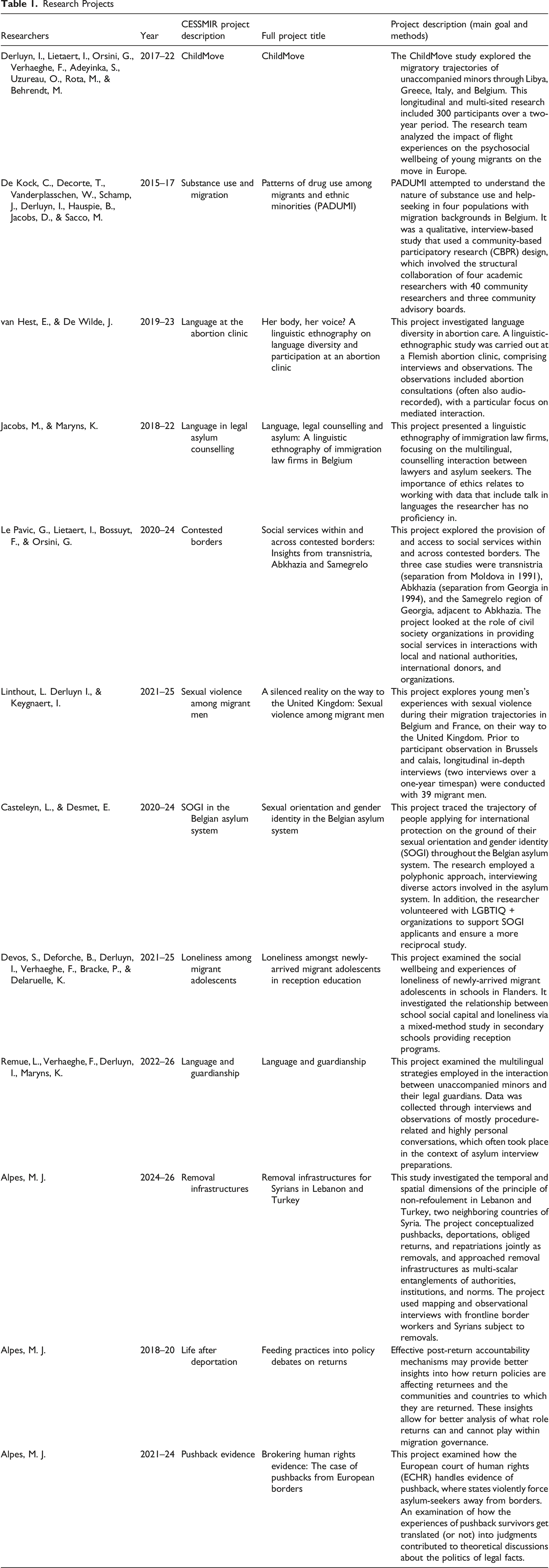
Research Projects
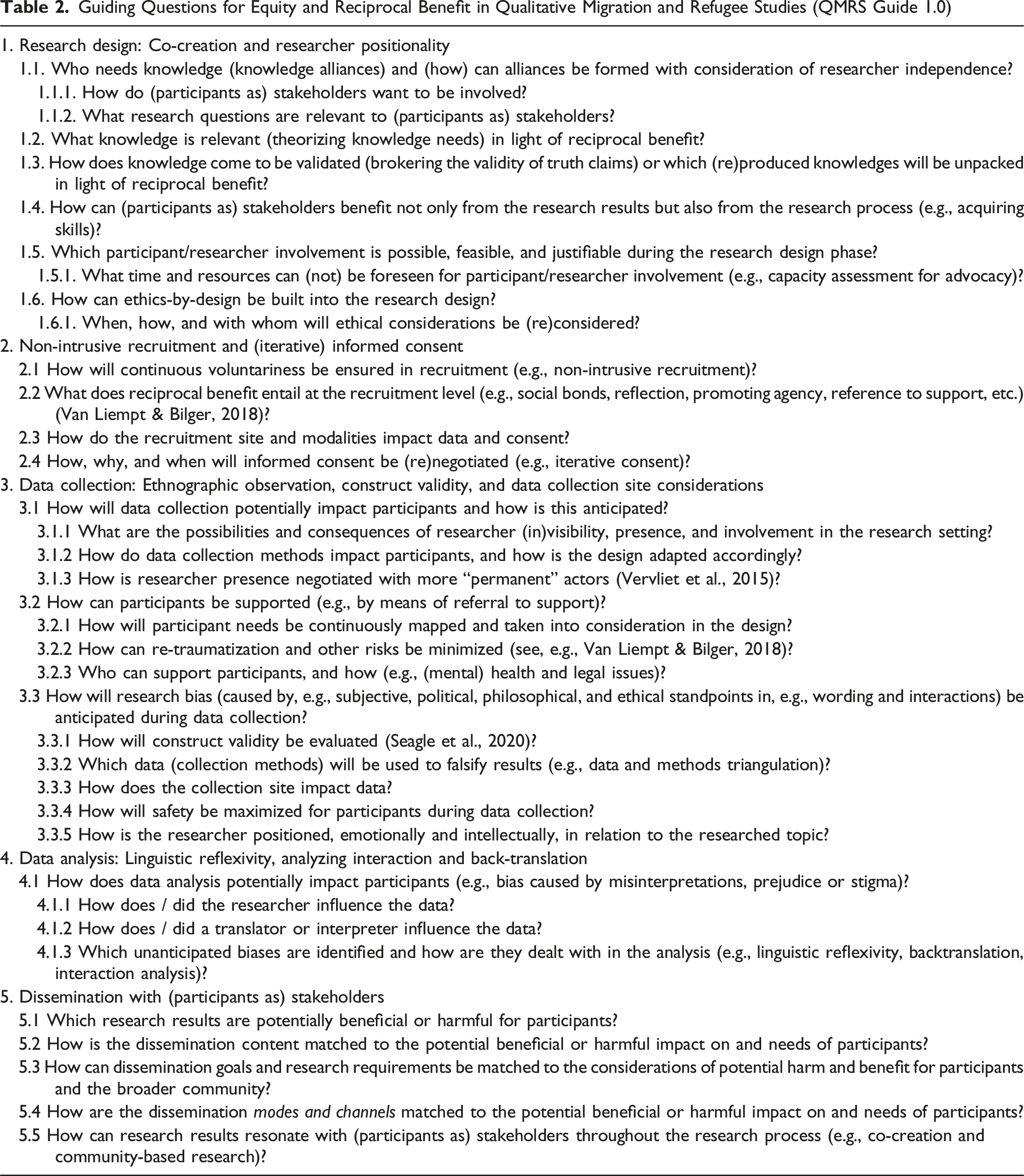
Guiding Questions for Equity and Reciprocal Benefit in Qualitative Migration and Refugee Studies (QMRS Guide 1.0)
Research Design: Co-Creation and Researcher Positionality
During the CESSMIR workshops, we identified two types of inspiring practices targeting reciprocal benefit in the design phase: the development of research processes based on co-creation and community-based participatory research (CBPR); and anticipating researcher positionality when entering and exiting the research setting by preparing for researcher invisibility, reasonable availability, or advocacy.
Co-Creation and Community-Based Participatory Research
As a researcher, former policy officer at Amnesty and human rights consultant, Alpes (2025) argues that “impact” is not something to be done after the research has been completed. Instead, academics who wish to engage in critical and actionable migration research should design transformative knowledge encounters between themselves and strategically situated practitioners. She therefore proposes three principles in the research design phase that put ethics center stage: (1) building knowledge alliances (with justice actors); (2) theorizing knowledge needs (in justice claims); and (3) brokering the validity of truth claims.
These research design principles informed the design of the project “Removal infrastructures,” thereby facilitating transformative knowledge encounters. Indeed, from an ethical stance, both co-creation and community-based research designs can support the expansion of notions of what and who is a researcher. Designing research in this way can be supported through methods from the arts, psychology, or the foresight domain. Together with her colleagues, for example, Alpes implemented so-called “futures literacy labs,” where Syrian families in Lebanon became the researchers of their own lives (Alpes et al., 2023).
Co-designing research with community members, whether lawyers, refugees (as in Alpes’ research), or other stakeholders, requires the knowledge practices of non-academics, as well as the practical role that academic knowledge can play in benefiting research participants, such as in migrants’ justice claims, to be taken seriously. The proposed three research design principles seek to transform legal and political processes in the short or medium term, and can be of relevance outside the legal realm too. A precondition is to take seriously the knowledge practices and needs of non-academics, as well as migrants and refugees themselves. Consequently, seeking reciprocal benefits can be facilitated by asking these three questions in the design phase: (1) Who needs knowledge (knowledge alliances) and (how) can alliances be formed with consideration to researcher independence? (2) What knowledge is relevant (theorizing knowledge needs) in light of reciprocal benefit? (3) How does knowledge come to be validated (brokering the validity of truth claims) or which (re)produced knowledge will be unpacked in light of reciprocal benefit?
Although these questions and principles originate in legal anthropology, they potentially deepen classic research design practices (e.g., identifying research relevance, embeddedness, and impact), and can also be applied in other QMRS study designs and ethics preparation, when considering going beyond “doing no harm” to facilitate reciprocal benefit.
A second inspiring practice arose from the CESSMIR “Substance use and migration” project (De Kock, Schamp, et al., 2017; De Kock, Decorte, et al., 2017), in which a community-based participatory research (CBPR) design was applied. CBPR enables reciprocal benefit in several ways. Building on previous UK research in this domain (Fountain et al., 2007), the design envisaged the participation of community members and organizations in refining the research questions, data collection (co-ethnic community researchers), analysis, and dissemination, in order to ensure equitable research relations, formulate relevant recommendations, and achieve change in the communities. Academic researchers recruited and trained co-ethnic community researchers to collect data on substance use and related needs among respondents with varying migration backgrounds in four case studies.
The CBPR design created reciprocal benefit by enhancing participants’ skills (interviewing, research, and others) as well as knowledge and awareness (about substance use). CBPR also facilitated making the research results relevant to participants and their (perceived) communities. As illustrated in this quote from a community researcher, their participation in the research process increased their awareness of substance use in the community: “I really changed my ideas about drugs. After hearing from all these different people [interview participants], I realize that it could have been me [using substances] if something had gone wrong in my life.” (Community researcher 11)
In addition, stakeholders were involved in a community advisory board, which made both the research questions and the resulting research and recommendations more relevant to substance use treatment services. This was exemplified in the creation of new permanent working groups in these services and the provision of new staff training based on the research results.
Indeed, from an ethical stance, both co-creation and community-based research designs can support the expansion of notions of what and who is a researcher. The three co-creation inspired design questions listed above can strengthen the epistemological stances in a research project. CBPR-based practice, in turn, facilitates reciprocal benefit on a more practical level, by identifying what research questions are relevant to (participants as) stakeholders, how stakeholders can (and want to) be involved, how the research subjects, participants, or community members can be involved, and how they can benefit not only from the research results but also from the research process (e.g., acquiring skills).
Researcher Positionality
During the CESSMIR workshops, making researcher positionality explicit from an ethical point of view was identified as key to both doing no harm and reciprocal benefit. It means that researchers reflect continuously on how they position themseves physically, emotionally, and intellectually in relation to the individuals being researched. This reflection and awareness entails continuously asking oneself what is harmful or beneficial in a specific researched situation, and what role the researcher plays and can potentially play to influence it. The central question here is: To what degree are you and can you get involved as a researcher (e.g., in the provision of advice and/or support to participants)?
On the one hand, researcher “invisibility” can minimize problems related to researcher involvement in the research site as well as in participants’ lives. Considering that it is often simply impossible to be “invisible” as researcher, a key question is: How does researcher visibility and presence impact the site and the participant? In the CESSMIR “Language and guardianship” project (Remue et al., 2024, 2025), the researcher initially chose to take up a mainly silent and observational role during the observations of child–guardian communication. This was done to safeguard the authenticity of the observed situation by minimizing the influence of the researcher’s presence on both the flow of the conversation and the relationship between the guardian and the unaccompanied minor.
By limiting participation, the researcher’s exit from the field would also be less disruptive than more active participation (Vervliet et al., 2015) where researchers take up additional roles (e.g., as an advocate). Nevertheless, even when “invisible,” a researcher may choose to intervene when they believe the alternative of non-intervention (Mackenzie et al., 2007) could cause harm to the participant. For example, when the researcher in this project noticed misunderstandings that might be detrimental to the minor’s situation, they remedied this confusion by speaking up, thereby becoming clearly “visible.”
Another stance may be to ensure the researcher is reasonably available to participants, and to prepare for this in the design phase. When sensitive topics such as violence, trauma, or other harmful experiences are being addressed, the risk of re-traumatization and how to avoid it should be particularly considered. It is vital to answer the question of who can support participants, and how, in dealing with mental health and other issues, such as legal aspects.
For example, in the CESSMIR “Sexual violence among migrant men” project, the researcher set up a comprehensive local referral network prior to data collection, from a “duty of care” perspective (Pittaway et al., 2010). Prior to setting up the network, the researcher mapped out the potential impact of the study on participants (e.g., emotional distress, information needs, judicial support). Locally available resources and services were evaluated (on their adequacy, affordability, accessibility), and selected services were comprehensively listed. Visiting these services and informing them about the study and their inclusion in the referral network guide was an integral part of the fieldwork, contributing to thick description. The referral network was continuously assessed and updated throughout the research process. Actors in the network were consulted by both the researcher and study participants throughout the data collection phase.
In the CESSMIR “ChildMove” project, six researchers engaged with over 300 separated minors going through migration processes in Libya, Italy, Greece, and Belgium across three different measurement moments over a two-year period. Between the measurement moments, participants and researchers were in contact via social media, thereby ensuring reasonable availability. This project also built solid referral networks in each study site. Before data collection, each field study drew up a list of contacts for participants, including local associations and organizations (e.g., NGOs, volunteering organizations) and official reception structures. In the design phase of this study, researchers decided to only collect data cross-sectionally in the Libyan case study, while the other case studies (Italy, Belgium, Greece) included three measurement points in a longitudinal design. This approach was chosen to attempt to minimize the risk of doing harm: the research team intended to avoid supporting or creating any incentive for research participants to (try to) cross the Mediterranean (i.e. for the follow-up interview in Italy/Europe).
As participants’ needs may be numerous, and researchers’ (financial) resources limited, a rule of thumb is to refer participants to relevant services if they request help, and to maintain a strong awareness of participants’ needs. However, this is not always possible or advisable, particularly in studies where participants are “illegalized” due to migration processes and policies. The CESSMIR “Contested borders” project (Le Pavic et al., 2024) documents a third way (in addition to [in]visibility and availability) in which reciprocal benefit can be achieved in this case, namely by means of advocacy. Throughout the research process, the researcher considered how research results could resonate with stakeholders.
In this project on the impact of contested borders on social services, which included case studies in Transnistria, Abkhazia, and the Samegrelo region of Georgia, the researcher actively supported the participants’ claim to access methadone substitution treatment, which was inhibited by contested border issues. The researcher endeavored to raise awareness and advocate for these rights in academic texts and during dissemination events (Le Pavic et al., 2024). Nevertheless, the researcher, at that time a PhD student, did not have the capacity to be involved in the creation of a working group with international stakeholders, nor to actively contest Georgian authority decisions that were detrimental to participants’ claims. Indeed, when considering the stances of (in)visibility, reasonable availability, and especially advocacy, it is important to delimit what is possible and feasible during the research design phase (e.g., by means of capacity assessment).
The variety of ways to move beyond doing no harm and towards reciprocal benefit exemplify how these issues and responses cannot all be anticipated in the research design. Indeed, ethical requirements can vary depending on the context, situation, and unforeseen changes. Therefore, anticipation is key, and a “one-size-fits-all” approach is insufficient. In QMRS, ethical questions should be asked not only in the design phase but also at set times (and other times) throughout the research process, from an ethics-by-design perspective. This proactive and intentional approach places ethical considerations at the core of the research process, and requires that researchers plan ethical reflections throughout the study.
Non-Intrusive Recruitment and Iterative Informed Consent
During the CESSMIR workshops, informed consent practices as well as recruitment modalities were discussed as key considerations when aiming to move beyond doing no harm and reciprocal benefit in the recruitment phase.
In the CESSMIR “ChildMove” project, researchers did not actively persuade minors (>14 years old) to participate in the project. Instead, they used a “passive/non-intrusive” recruitment strategy, waiting for participants to come over and ask the researcher about their presence in the field, as they “hung around” in reception facilities and other places where minors stayed. For instance, this was the case in informal camps in so-called “transit” and border locations within Europe – for example, Calais, Ventimiglia, Rome, etc. Researchers spent their days in these spaces, for instance helping with day-to-day tasks and giving support when and where needed. While they always made clear their research function to whoever approached them, they did not ask potential research participants for an interview but instead waited for them to ask to participate to the study. In this way, researchers avoided “forcing” minors to share their stories and experiences (Adeyinka et al., 2023; Derluyn et al., 2023; Orsini et al., 2022, 2023; Uzureau et al., 2022).
In contrast, the Libyan ChildMove case study took place in detention centers, where minors might have felt less able to refuse to participate, or hoped to obtain benefits (e.g., release from detention) if they participated. Moreover, it is likely that authorities in the detention centers might have prepared the scene before the researchers’ arrival, obscuring certain issues from the researchers’ attention. This demonstrates the importance of questioning how both the recruitment site and modalities impact data and consent.
Applying a non-intrusive recruitment strategy in the ChildMove study allowed the researchers to explain the project sufficiently to achieve fully informed consent from those who decided to participate. Yet, as the longitudinal data collection lasted two years, informed consent was collected at all the measurement moments, as well as during intervening interactions between the researchers and the participants. To remain in touch with these mobile participants, researchers frequently communicated with them via social media. During these virtual communication exchanges, informed consent processes were often rediscussed, leading to iterative informed consent procedures.
During the CESSMIR “Contested borders” project, the researcher was confronted with new informed consent issues that had not been accounted for during the institutional ethical review. New challenges arose from the use of social media platforms such as Facebook because it enabled participants to share information in ways that were not covered by the initial informed consent. For instance, after two of the four focus groups the researcher conducted, some participants posted identifiable pictures of themselves and other focus group participants on Facebook. Since all participants had orally agreed to these pictures being posted (although not specified in the written consent form, which emphasized anonymity), the researcher considered this to be part of the participants’ agency and appropriation of the research process. As such, the researcher shared these posts on her own social media channel because she argues that it contributed to going beyond a “do no harm” approach, by raising awareness about the issue being studied, which was quintessential to the research participants, some of whom were involved in NGO advocacy.
As the situation of a participant may change, and as the research can take unexpected or unforeseen turns, it is important to (re)negotiate informed consent in QMRS.
Data Collection: Ethnographic Observation, Construct Validity, and Data Collection Site Considerations
Three ways to move beyond doing no harm and achieving reciprocal benefits during the data collection phase were identified during the CESSMIR workshops. These included ethnographic observation, checking construct validity, and data site considerations.
In the CESSMIR “Language and guardianship” project (Remue et al., 2024), ethnographic observations of (interpreter-mediated) guardian–minor encounters enabled the researchers to identify contradicting discourse and beliefs about these encounters in semi-structured interviews with guardians through both method and data triangulation (Denzin, 1989). The researcher-observer gained an additional understanding of the nature of these interactions by comparing interview transcripts to ethnographic data.
Recording the encounters thus allowed the researcher-observer to identify contradictions between statements during individual interviews on the one hand, and what happened during actual interactions on the other hand. In this way, both method and data triangulation (i.e., combining and contrasting multiple methods and sources of data) revealed a number of communicative issues that guardians were unaware of. This exemplifies how data and method triangulation are instrumental for falsification and in-depth analysis in (multilingual) QMRS.
During the CESSMIR “Contested borders” project, the researcher observed how talking about a de facto border, state, or “occupied territory” influenced participants’ discourse during the interviews. For instance, Georgian local authorities refer to the contested border as a “dividing line” (გამყოფი ხაზი – gamkophi khazi). The river named Enguri in Georgian is mentioned as a “border point” or “bordering point” and implies a “crossing point” (სასაზღვრო პუნქტი - sasazghvro punkti), a meaning which is hard to convey in English. When talking about the geographical location of the Samegrelo region, and in particular Zugdidi, one local official framed it as “border adjacent” or “on the brink of the border” (საზღვრისპირა - Sazghvrispira). 2 This dynamic was also influenced by the translator’s wording during the interviews (see infra: Data analysis).
Indeed, no terminology is “neutral,” and wording implies choices informed by power relations, sometimes colored by coloniality (Meghji, 2021). From a social interactionist research perspective, being cognizant of these tensions is key to going beyond a “do no harm” approach. Indeed, researchers’ word framing directly influences what is silenced and what is said during an interview. It is therefore important to anticipate how subjective, political, philosophical, and ethical standpoints can influence wording and interactions throughout the research process (Chase et al., 2021).
In the CESSMIR “ChildMove” project, ethical issues during data collection also related to the influence of the data collection site, as, in some case studies, data was collected at government-run reception and detention facilities. For instance, in Libya, access was granted by the Libyan Government of National Accord (GNA), then governing the Tripoli area, and thanks to the support of the European Union delegation in Libya. Since both institutional actors were considered responsible for many of the atrocities suffered by the research participants, their role as gatekeepers in the recruitment of participants, as well as research in the detention centers, created a number of concerns (Cusumano & Riddervold, 2023) related to both data collection and recruitment bias (see above). Researchers visited and collected data (via interviews) at de facto crime scenes from minors who had been detained and were undergoing a traumatic experience. Participants were potentially surrounded by their abusers, which might have impacted their feeling of safety and their willingness to share their (true) stories. In QMRS, it is therefore vital to consider how data collection sites impact data, and how participants’ safety can be maximized during data collection.
To address the often one-sided and extractivist nature of data collection, the CESSMIR project “SOGI in the Belgian asylum system” (Casteleyn, 2024) engaged research participants through the researcher’s volunteer work with an LGBTIQ + partner organization. The researcher supported all applicants frequenting the organization, and not solely those agreeing to participate in the project. While this approach aimed to foster reciprocal benefit, it also introduced new ethical dilemmas. The fieldwork conflated with volunteer work enabling support to participants while harm was perpetuated in the reception system.
In this context, Hemelsoet (2014, p. 223) posited the ethical question: “Does the desirability of an emancipatory approach seeking structural ameliorations exonerate us from the duty to help those in need?” This question should be made explicit in the data collection and analysis phase, for instance via an autoethnographic analysis that fleshes out the role of the researcher, its conflation with offering support, and changing stances on bringing about change throughout the research phases. Such autoethnographic analyses were included in the “SOGI in the Belgian asylum system” (Casteleyn, 2024) and in the “Substance use and migration” project (De Kock, 2017).
Data Analysis: Linguistic Reflexivity, Analyzing Interaction, and Back-Translation
In relation to data analysis, linguistic reflexivity, critically analyzing interactions, and back-translation were all identified during the CESSMIR workshop as key principles in QMRS data analysis when the intention was to move beyond “doing no harm” and achieve reciprocal benefits. Subsequently, the meaning of reciprocal benefit was broadened by implying that it also requires a reduction in bias in the analysis. Indeed, bias reduction needs special attention in QMRS, both because the nature of biases is particularly complex in the domain (e.g., setting, researcher, and participant characteristics) and because the consequences of such bias (e.g., stigma) can be especially detrimental for participants in QMRS.
In the CESSMIR “Substance use and migration” project, the preliminary analysis of interview transcripts revealed that the religious background of some community researchers had influenced participants’ answers about their personal substance use. Participants framed their substance use in a religious prohibitionist perspective (interviewer bias). The researcher decided to analyze how these and other religious aspects were constructed during the interviews in the interaction between community researchers and study participants which in turn enabled the identification of influences of triple stigma and boundary making dynamics on substance use among people who use substances and who have a Turkish migration background (De Kock, 2020; De Kock & Decorte, 2017).
This analysis of the interview interaction allowed researchers to understand the influence of community-related stigma and feelings of inclusion and exclusion in substance use trajectories from an ethnic boundary-making perspective (Wimmer, 2013). Although this approach was not initially included in the research design, it was necessary to question how researchers had influenced the data and what could be learned from that.
In the CESSMIR “Language at the abortion clinic” and “Language in legal asylum counselling” projects (van Hest & Jacobs, 2022) the multilingual nature of service provision encounters was analyzed from a sociolinguistic point of view. In both these research projects, the clients’ voices and their access to information was mediated by (non-)professional interpreters, which became a crucial topic in their studies. Because the researchers were not proficient in the participants’ languages, they compared their observational data (field notes) to their back-translated “interactional” data (audio-recordings of service provision interactions translated by independent multilingual support). This process showed that transcribers sometimes opted for translations that did not fully reflect the original discussion (e.g., by omitting particular words), which potentially impacted analytical statements.
The researchers theorized this process as encountering “spaces of linguistic-non understanding” (van Hest & Jacobs, 2022). By analyzing these spaces of linguistic non-understanding, the researchers were able to identify mismatches between what they perceived to be occurring during fieldwork and what had actually happened. The researchers subsequently proposed the adoption of a stance of linguistic reflexivity during data analysis, understood as “a researcher’s reflexivity towards the language(s) used (or not used) by all those present in the research process” (Rolland et al., 2023, p. 645). QMRS requires transparency, and reflection on and analysis of how translation practices leave a mark on the data and how this relates to researcher perceptions in the field. In doing so, more justice is done to participants’ utterances and realities.
Translation always affects data collection. Its influence is, among other factors, dependent on the level of professionalization of the translator and familiarity with the research topic (Almalik et al., 2010). During the “Contested borders” project, for instance, the interview transcripts revealed that the translator had systematically translated border-related terms as “administrative boundary line” (ABL). This is the term used by the international organization where the translator had worked. The different terms that were actually used by participants during the interviews (see supra: Data collection) were not translated during the interview. In the interview and in the transcripts they were lost in translation, flattened by the administrative term “ABL”. Nevertheless, the analysis enabled the researcher to document and nuance perceptions of this specific contested border. This example shows how working across languages opens space for linguistic non-understanding (LNU) between the researcher and interviewees, in some cases amplified by the mediation of a translator (van Hest & Jacobs, 2022). Back-translating the interviews based on the original recordings is required in order to study these issues in terminology.
Dissemination via Policy Briefs, a Graphic Narrative, or Civil Society Partners
In this section we describe four inspiring dissemination practices that were identified by researchers during the CESSMIR workshops: the use of dissemination briefs, publishing a graphic narrative, and co-designing dissemination outputs with a civil society partner, and with a community advisory board.
In the CESSMIR “Contested borders” project, the researcher disseminated policy briefs in English and Russian for the first study and in English and Georgian for the second and third studies. Before dissemination, participants were asked for feedback on a draft brief. These policy briefs contributed to raising awareness about gender-based and domestic violence in Samegrelo and about the situation of methadone users crossing the border daily from Abkhazia to get access to methadone (Le Pavic, 2024).
In the CESSMIR “Loneliness among migrant adolescents” project (Devos et al., 2024), the researchers disseminated their findings among migrant adolescents and those working with them by publishing a graphic narrative depicting the experiences of loneliness based on in-depth interviews with the target group. Through visual storytelling, this initiative sought to raise awareness, foster empathy, and reduce the stigma surrounding loneliness amongst various target groups, including staff in secondary (reception) education, organizations interacting with migrant youth, and newly-arrived adolescent migrants. An implementation guide facilitated the integration of the graphic narrative into a classroom discussion on loneliness.
In the CESSMIR “Life after deportation” project (Alpes & Sylla, 2024), dissemination outputs were co-designed with a civil society partner (PICUM, 2020). The objective of civil society partner PICUM was to advocate for changes in the then-pending European return directive, and more specifically on detention-related clauses in the directive. For this, they needed a communication tool that would inform parliamentarians and civil servants in the European Commission about the human consequences of these clauses. The civil society partner was in charge of reworking the material provided by the researcher for their audience. Because this partner actively shaped the dissemination output, it also responded to their needs, meaning that it remains a useful tool to this day.
In the CESSMIR “Substance use and migration” project, dissemination was based on the input of a community advisory board (CAB) in the framework of this study’s community-based participatory research design (De Kock, Schamp, et al., 2017). The CAB consisted of local policy and practice stakeholders, as well as study participants. In addition to advising on venues for sharing the results and recommendations, CAB members actively helped to disseminate the study results in their own networks. The researcher organized several in-depth presentations of the research results upon invitation from substance use treatment services. This dissemination method moved the topic up both the research and policy agendas at regional, and national levels.
These inspiring practices illustrate that achieving reciprocal benefit through dissemination should be preceded by a consideration of which research results participants will benefit from, what type of dissemination is required to reach the envisaged public, and who should be involved to maximize impact in a perspective of impacting equity.
Discussion
This article has identified inspiring practices in each research phase (design, recruitment, data collection, analysis, dissemination) in qualitative migrant and refugee studies (QMRS) across twelve CESSMIR research projects. Table 2 summarizes the questions (italicized in the results section) that can guide the preparation of these research phases for reciprocal benefit (and thus equity), based on the inspiring practices identified in this study, as well as additional literature (indicated by references).
From an ethics-by-design perspective, in Table 2 we have moved the identified ethical questions to the corresponding research phase. Nevertheless, these questions should also be considered in the design and ethical approval phase, and (re)considered at set times and whenever necessary throughout the research process.
Research Design
In the research design phase, we highlighted the value of co-creation and community-based participatory research (CBPR), alongside anticipating researcher positionality (visibility, reasonable availability, and advocacy). Mackenzie and colleagues (2007) posit that adhering to beneficence, integrity, respect for persons, autonomy, and justice in QMRS implies that the researcher negotiates a research relationship with participants that not only respects but also promotes agency and helps (re)build capacity. Seagle and colleagues (2020) also stress that community engagement is key in achieving transparency and research relevance, and thus reciprocal benefit. They emphasize the importance of considering the need for and utility of the research project in the research design phase. We translated this in the first three questions in the research design phase (see Table 2).
Based on our work, and building on Pittaway and colleagues’ “co-design” (2010) we propose that community engagement should be expanded to co-creation, as the latter concept more explicitly bears witness to equitable relations from a critical theory perspective. Effective co-creation and CBPR in QMRS require the establishing of equitable partnerships across all research phases. This entails planning for time and resources, assessing equitable relationships and agency-building (Cargo & Mercer, 2008), ensuring that research questions align with community needs, and preempting participant overburdening by coordinating with related projects.
It requires participants and communities to be collaborators, not just subjects of study. This means we need to understand what ethics standards and needs are important to participants or communities, and then figure out how these fit with the standards set by research institutions or universities. Sometimes, it can also mean using a community’s standards to challenge or rethink the rules set by researchers or universities.
When deciding on researcher visibility and engagement levels, it is important to consider epistemological stances and the value of distance and separation versus intersubjectivity and interaction. Depending on the context, either a visible or more “invisible” researcher presence can be beneficial, provided these choices align with the research goals and objectives, and consideration of equity and reciprocity.
As mentioned in the EC guidance note on MRS (2021), working with researchers with refugee or migrant backgrounds can mitigate, although not eliminate, potential risks of coercion or power differentials between researchers and participants. Moreover, researchers with migration backgrounds are underrepresented in European universities and attention should be paid to the true equitable employment of staff with migration backgrounds.
Lastly, anticipating potential ethical issues when exiting the physical or symbolic research site is key in QMRS research (Seagle et al., 2020). Vervliet and colleagues (2015), for instance, exemplify in their research how leaving the field can be experienced by participants as “abandoning” participants. Researchers taking up roles in the field as a result of their research involvement can also engender a form of dependence among participants. The level of involvement, therefore, should be clearly reflected upon and negotiated with “permanent” actors in the field, to avoid creating any tensions or unrealistic expectations (Vervliet et al., 2015), or in anticipation of follow-up by other actors when the researcher exits the field. Although the ethical challenges related to researcher involvement are bound to vary depending on the research method and context, this type of reflexivity is crucial, regardless of the researcher’s degree of presence.
Recruitment and Consent
As pointed out by Chase and colleagues (2021), participant recruitment decisions fundamentally shape the research process and outcomes. CESSMIR researchers highlighted the importance of a non-intrusive strategy for safeguarding voluntary participation and iterative informed consent. Voluntariness of participation is especially crucial for individuals in detention. Researchers should consider the impact of having state actors or guards serve as literal gatekeepers to detained participants, and should question to what extent true voluntariness is possible in such settings, and how this affects research. Additionally, researchers should consider participants’ needs and well-being during the selection process, as participation in interviews can offer both negative and positive outcomes like forming social bonds, reflecting on experiences, and promoting agency (Van Liempt & Bilger, 2018).
Lastly, iterative and recurrent informed consent are vital, as both participant characteristics and project goals may shift, requiring consent to be renegotiated. In QMRS, oral consent may be preferable to written consent, as participants may distrust written documents (Düvell et al., 2010).
Data Collection
In data collection, the main inspiring practice was the use of ethnographic observation in addition to other qualitative methods such as interviews. Ethnographic observation and the related comprehensive note-taking not only allow thick description of the observed phenomena but also facilitate falsification and triangulation (Denzin, 1989). Indeed, what is said during qualitative interviews can blatantly contradict what is observed in the field. Moreover, understanding the data collection site by undertaking structured observation and systematic reporting will enable researchers to better understand how the site inevitably delimits, biases, or otherwise influences what is shared during an interview.
Whichever data collection method is chosen will obviously impact the type of data that is obtained. Ethnographic observation, as compared to qualitative interviews, may create a better (or additional) understanding and a thick description of the complexities of participants’ situations, and may be better for creating trust (De Graeve et al., 2017). The majority of the CESSMIR research projects in this study therefore combine qualitative interviews with ethnographic observation and document analysis to conduct data triangulation.
Additionally, it is important to ensure construct validity (Seagle et al., 2020). Will the research instruments enable the research team to answer the envisaged questions? Are elements of the instruments perceived differently by different research participants, or as compared to the researchers’ intent? There can, for instance, be a need to overcome a predominant focus on migratory experiences because it may risk downplaying other dimensions (Chase et al., 2021). It is therefore necessary to pilot instruments and constructs among participants before implementing them, especially among populations who may have different understandings of certain topics. This is extremely important if the intention is to capture and represent both vulnerability and agency (Chase et al., 2021; Mackenzie et al., 2007) while remaining open to new insights that arise from the data. Concepts and constructs that come up only during data analysis should of course be studied with the same rigor.
Data Analysis
The literature on ethical standards specific to data analysis in QMRS appears to be sparse compared to other research phases (see, e.g., Smith et al., 2023; Taquette & Borges da Matta Souza, 2022). Analysis is obviously central and should have equally high ethical standards. As stated by Van Liempt and Bilger (2018, p. 281), “key to the analysis is to understand that information is actually provided under certain circumstances and, supposedly, with particular intentions or expectations.” For the data analysis phase, CESSMIR researchers identified that making these circumstances, intentions, expectations—or what might be described as “bias” in classic research methods jargon—explicit is integral to targeting reciprocal benefit. With this in mind, we identified three such methods: analyzing linguistic non-understanding, back-translation, and interviewer–interviewee interactions.
Linguistic non-understanding (LNU) (Jacobs & van Hest, 2024; van Hest & Jacobs, 2022), for instance, can be anticipated by taking a stance of linguistic reflexivity during data analysis and by using back-translation. Analyzing interviewer–interviewee interactions may additionally allow researchers to identify and understand researcher bias in the data (De Kock, 2020). In addition to anticipating this type of “bias,” these practices tackle the question of the degree to which micro discursive claims about data can be made by a researcher who is not proficient in the language(s) of participants, by vocalizing circumstances, intentions, and expectations.
As pointed out by Mackenzie and colleagues (2007), involving research participants in the analysis process can be yet another way to achieve more equitable relations in a research project. However, involving participants in this process may prove challenging. The short duration of a project, restricted funds for community researchers, and limited training of participants can, for instance, favor the involvement of community researchers or participants in the dissemination rather than in the analysis phase (De Kock, Decorte, et al., 2017). Indeed, agency and equity need not be blindly attempted but can instead be aimed for strategically in certain research phases (e.g., by means of co-creation), thereby increasing the likeliness of effectively reaching these equity-related outcomes.
Although we emphasized the added value of co-creation (as a means to promote agency and equity) throughout the research process, one should equally weigh the benefits and costs during ethical reflections: Is co-analysis more ethical by definition? Does it truly add to reciprocal benefit, and if so, how? Can time and proper remuneration be foreseen? What is the added value or estimated hierarchy between academically trained researchers and community members or research participants? And, finally, how are agency and equity defined and evaluated in the research project? It could be useful to take into account critical concerns that have been raised in the literature on participatory research (e.g., Cargo & Mercer, 2008) when answering these questions and making ethical choices that really target reciprocal benefit and equity in QMRS.
Dissemination
Seagle and colleagues (2020) reported in their review of migrant and refugee health studies that the presentation of research results to participants or communities is rare (<9%). Supporting participants or a community by means of training or education was also rare, but more prevalent (13%). Indeed, research dissemination is the preeminent research phase where reciprocal benefit, described as an obligation in QMRS by Mackenzie and colleagues (2007), can be achieved. Whereas research participants might not benefit directly, their motivation for collaborating in the first place is often that research results will benefit the studied population or situation more broadly.
Pittaway and colleagues (2010) describe a research process where refugees are actively involved in both interpreting data and translating them in recommendations. This can indeed be a means of co-creation when attempting to achieve reciprocal benefit (by means of equitable researcher–participant relations). However, when this is not possible because it requires substantial time and resources (see supra), reciprocal benefit remains a minimum standard during the dissemination phase.
CESSMIR researchers identified four inspiring practices to amplify the impact of research and subsequently create reciprocal benefit: dissemination by means of dissemination briefs, developing a graphic narrative, and creating (recommendation) outputs in close collaboration with participants/civil society partners, or with a community advisory board. What these inspiring practices have in common is that the format is adapted to (and created in conversation/collaboration with) the target audience (e.g., participants as/and stakeholders) to create a win–win situation (reciprocal benefit) and maximize impact (e.g., equity) based on participation and co-creation.
Limitations
While this contribution provides inspiring practices and guidelines for moving beyond “doing no harm” and fostering reciprocal benefit and equity in ethical research practices in QMRS, it has some limitations.
First, the practices identified here are not exhaustive, as the conveners relied on the voluntary participation of CESSMIR colleagues in our five workshops. Second, labeling practices as “inspiring” was a pragmatic choice; we did not apply specific standards to classify them as “good” or “promising” practices. Future research could, for instance, evaluate the degree to which reciprocity and equity are reached per research phase and beyond. Third, although the focus is on qualitative migration and refugee studies (QMRS), some practices may be relevant to quantitative migration research or broader social science studies aiming to move beyond “doing no harm” and towards reciprocal benefit with other populations. Fourth, while the practices are organized by research phase, many, such as community-based participatory research and co-creation, apply across phases due to the inherently iterative nature of an ethics-by-design approach.
Fifth, whereas this contribution is a first step in supporting specific ethical guidelines in QMRS, it does not give guidance on research in specific populations. It is indeed imperative that each researcher critically anticipates ethical challenges dependent on the research context, envisaged design, resources, and study populations. For instance, certain ethical considerations will apply when studying populations with specific characteristics or experiences such as smuggled (see, e.g., Van Liempt & Bilger, 2018 for “triggering memories” ethically), war-affected (Makhoul et al., 2018), and under-age populations (Vervliet et al., 2015), or those residing in fragile political contexts (Müller-Funk, 2021), among others.
Irregular migration in particular, as pointed out by Düvell and colleagues (2010), is by definition “an elusive phenomenon” because it takes place in violation of the law. The nature of the phenomenon thus raises additional ethical questions concerning the sensitivity and vulnerability of research subjects. For ethical guidelines on data protection and safeguards for data misuse we refer to the European Commission guidance note “Research on refugees, asylum seekers and migrants” (2021).
Sixth and last, ethics and reciprocal benefits manifest beyond the duration of project cycles. Co-design with communities is only possible, for example, if trust has been established beforehand. Also, impact activities mostly do not occur at the end of a research project, but when windows for the mobilization of knowledge occur in the world’s own processes and timelines. Consequently, this article’s mobilization of insights for creating reciprocal benefits organized in relation to specific research projects was a pragmatic choice.
Conclusion
Populations researched in qualitative migration and refugee studies (QMRS) may be particularly vulnerable to harm, burden, and undue influence caused by research (Seagle et al., 2020). In this contribution we therefore identified CESSMIR practices in QMRS that both consider and move beyond the “do no harm” principle by focusing on reciprocal benefit and equity.
We deepened the European Commission guidance note “Research on refugees, asylum seekers and migrants” (2021) by giving concrete examples in a humble attempt to operationalize the “equity, diversity, and inclusion” referred to in the revised version of the European Code of Research Integrity (2023). We posit that the Code’s equity dimension should minimally be translated into prioritizing reciprocal benefit, and that it is important to make this explicit in university ethics standards, to safeguard participants’ rights. This article gives impetus to how reciprocity can be leveraged as a transformative social practice in identifying and redressing inequities in European QMRS.
This contribution serves to inspire institutional ethical boards to strengthen and refine their guidelines in ethical procedures for QMRS by posing specific questions per research phase that adhere to the principles of equity and reciprocal benefit. These questions are rarely discussed in methods sections, courses on methodology and ethical guidelines, as if they were only “nice to know,” while we suggest that these considerations and an ongoing dialogue about them are vital to ethical QMRS that go beyond “doing no harm.”
This collaborative effort adds three insights to the literature on ethics in QMRS. First, we posit that focusing primarily on “doing no harm” may in itself embody bias by favoring the image of a detached, objective researcher who minimizes engagement. In a domain where research subjects frequently face systemic human rights violations, we question whether this approach truly fulfills ethical obligations. The identified practices and guiding questions offer a framework for research that not only avoids harmful practices but aims for equity and reciprocity as a transformative social practice in identifying and redressing inequities. Moreover, we identified anticipating bias, more than in other research domains, as essential to avoiding harm and pursuing reciprocal benefit and equity.
Second, while some scholars argue that research in this field should aim to influence migration policies, thereby creating a dual and seemingly contradictory imperative in research (research vs. impact), we perceive rigorous research as central to any attempt to achieve reciprocal benefits. This stance is in line with taking the responsibility as scholars to mobilize epistemic resources to move beyond “doing no harm” (Alpes, 2025). Rather than suggesting that QMRS must per definition engage in policy advocacy, we argue that taking a human rights and equity perspective at face value in research ethics is inevitably intertwined with reciprocal benefit. It might also imply policy advocacy, but does not necessarily do so.
Finally, we advocate that both procedural and relational ethics should be taken seriously (Clark-Kazak, 2021) in what is more commonly known as an “ethics-by-design” approach, where ethics are revisited and adapted throughout research processes rather than treated as a single administrative hurdle at the outset. This means going beyond participant engagement in research, by taking a fundamental co-creative and thus reciprocal stance in ethical research considerations. This stance requires researchers not only to engage with participants, but also to (re)creating the research questions, goals, methods, outcomes, recommendations and impact together, if the aim is to create reciprocal benefit within an equity perspective. This ensures that research remains responsive to participant needs and aligns with new research needs.
We argue that reciprocal ethics function as a critical instrument for operationalizing the equity principle enshrined in the European Code of Conduct for Research Integrity and the human rights imperatives central to qualitative migration and refugees studies (QMRS). This study establishes reciprocal ethics as pivotal for reconciling methodological and ethical rigor in QMRS, ensuring its outcomes advance equitable social impact. While future research must delineate the spectrum of reciprocity as a transformative social practice and evaluate equity inputs and outputs, the current context – where equity, diversity, and inclusion face direct attacks in some academic spheres – makes it imperative for European QMRS scholars and university ethics boards to operationalize and advocate for reciprocal ethics.
Footnotes

Ethical Approval
Informed consent for publication was provided by all participants or a legally authorized representative of participants. The ‘Substance use and migration’ project received ethical approval from the Ethics Board of the Faculty of Law and Criminology, Ghent University on July 28, 2015. The ‘Language and guardianship’ project received ethical approval from the Ethics Board of the Faculty of Arts and Philosophy, Ghent University on July 25, 2022. The ‘Contested borders’ project received ethical approval from the Ethics Board of the Faculty of Psychology and Educational Sciences [2021/122], Ghent University on November 22, 2021. The ‘Language at the abortion clinic’ project was approved by the ethics committee of the Faculty of Arts and Philosophy, Ghent University on April 14, 2020. The ‘Language in legal asylum counselling’ project was approved by the ethics committee of the Faculty of Arts and Philosophy, Ghent University on October 3, 2017. The ‘Loneliness among migrant adolescents’ project was approved by the Ethics Committee of the Political and Social Sciences Faculty of Ghent University on September 10, 2021. The ‘Pushback evidence’ project received ethical approval from the Ethics Board of the Faculty of Law and Criminology, Ghent University on January 31, 2022. The ‘Gender identity in the reception setting’ project received ethical approval from the Ethics Board of the Faculty of Law and Criminology, Ghent University on May 10, 2021. The ChildMove project received approval from the Hellenic Data Protection Authority on August 29, 2017, from the Italian National Research Council’s Committee on Research Ethics and Bioethics on November 10, 2017, and from the Ethics Committee of the Faculty of Psychology and Educational Sciences, Ghent University on July 7, 2017. Full project titles can be found in Figure 1.
Funding
The authors disclosed receipt of the following financial support for the research, authorship, and/or publication of this article: The publication of this article was funded by the Centre for the Social Study of Migration and Refugees (CESSMIR) at Ghent University and by the Research Foundation Flanders (FWO) under a Junior Postdoctoral Research Grant [12AFB24N]. The ‘Substance use and migration’ project was funded by the Belgian Science Policy Office grant number [DR/69]. The ‘Contested borders’ project’ was funded by the Special Research Fund of Ghent University (BOF) grant number [2021/122]. The 'Removel Infrastructures' project was funded by the Gerda Henkel Foundation. The ‘Language and guardianship’ project was funded by FWO (Research Foundation Flanders) grant number [GO76622N]. The ‘Language in legal asylum counselling’ project was funded by the Special Research Fund (BOF) of Ghent University grant number [BOF.STG.2018.0037.01]. The ‘Language at the abortion clinic’ project was funded by the Special Research Fund (BOF) of Ghent University grant number [BOF.STG.2019.0033.01]. The ‘Loneliness among migrant adolescents’ project was funded by FWO (Research Foundation Flanders) grant number [G0C1421N]. The ‘Pushback evidence’ project was conducted within the context of the Horizon 2020 research project ‘Human Rights Adjudication’, funded by the European Research Council through an Advanced Grant [Grant ERC-AdvG-2018-834044]. The ‘Gender identity in the reception setting’ project was funded by the FWO [grant number 11I9321N]. The ChildMove project was funded by the European Research Council through a Starting Grant project number: [ERC-StaG-2017-714222]. Full project titles can be found in Figure 1. This article is published with the financial support of the Belgian University Foundation [WA-0567].
Declaration of Conflicting Interests
The authors declared no potential conflicts of interest with respect to the research, authorship, and/or publication of this article.
Data Availability Statement
Data is not publicly available because of the sensitive nature of personal data. Specified requests to make data available can be sent to the authors. Data will only be made available for the specified goals and only if this new goal specification as well as secondary use are in line with the informed consent provided by participants. In such a case only fully anonymized data will be made available.