




Abstract
The complexity of supporting teachers for Global Citizenship Education (GCE) in formal education contexts is widely recognised. Informed by classroom practice, this article documents a case study of three teachers to interrogate GCE pedagogy, and to contribute new insights to inform support for teachers. Previous research identifies factors that influence GCE teaching and learning, specifically teacher values, GCE orientations, and cultural and structural tensions. However, further insights drawn directly from teacher practice are required to understand more fully these complex and dynamic processes. Based on a qualitative study of upper secondary classroom practice, we analyse distinctive aspects of GCE and illustrate how and why GCE manifests differently across various classroom settings. Specifically, we consider the role of teacher’s ideological stances regarding the participatory nature of GCE and, consider how teachers can move from traditional, teacher-led approaches to more empowering experiences for students.
Introduction
Global Citizenship Education is complex, at times controversial, and frequently an innovative counterpoint to dominant traditional and teacher-led classroom practices (Bryan and Bracken, 2011; Elkorghli, 2021; Leviste, 2021; Pace, 2021; Tarozzi, 2023; Yemini et al., 2019). Increasingly, teachers are asked to address climate change in their classrooms, to support their students in understanding unfolding contemporary crises, such as the wars in Gaza and Ukraine, and to facilitate discussions on inclusion, cultural diversity and sustainability (Ahmed and Mohammed, 2022; Organisation for Economic Cooperation and Development [OECD], 2018). In this context, it is unsurprising that many GCE initiatives and research projects focus attention on teachers, their practice, and professional development. Previous studies highlight a range of contextual factors that result in a wide variety of GCE practices whereby teachers adapt to their local environments and oftentimes to their students’ interests (Chiba et al., 2021). Yet, a matter of ongoing debate is how best to guide teachers in this important and challenging area (Almonte-Acosta, 2011; Bentall, 2020; Bourn, 2020; Grossman, 2017).
Existing research suggests that many teachers are open to carving out spaces for students to engage with and discuss global justice issues across the curriculum (Almonte-Acosta, 2011; Bentall, 2020; Bryan and Bracken, 2011; Hahn, 2020; Rapoport, 2010; Saperstein, 2020; Sund and Pashby, 2020). There also exists examples of pioneering teacher education programmes (Tarozzi and Mallon, 2019) and promising, yet varying practice (Hahn, 2020). More specifically, some studies have identified the importance of reflective practice for teachers (Martinelle et al., 2024) and opportunities to engage with critical and postcolonial narratives (Andreotti, 2006; Sund and Pashby, 2020). However, we also know that even committed teachers can struggle to translate their professional development into practice (Bentall, 2020; Martinelle et al., 2024). For example, Martinelle et al.’s (2024) study of pre-service teachers found that teachers need more frames to help them assess and reflect on their practice, and on the methods they are using in the classroom. Several studies also indicate that further insights directly from teachers’ practice are required to understand more fully teachers’ experiences as they navigate GCE in formal education (Goren and Yemini, 2017; Sant et al., 2018; Sund and Pashby, 2020).
This paper builds on these conversations by evidencing new insights drawn from three teachers’ experiences and practices in Ireland. The case study and three teacher profiles presented provide unique insights to critically examine and classify GCE classroom practice, and to extend our understanding of how and why it shows differently in different contexts and with different teachers. It is developed from an analysis of 20 hours of classroom observations, in addition to teacher interviews and student focus groups. It is also informed by the study’s conceptual framework and literature related to critical pedagogy and teacher education, specifically on active learning, power in the classroom and student-teacher relationships (Bizzell, 1991; Freire and Ramos, 1996; hooks, 1994; Korthagen, 2012). In particular, this article considers how GCE pedagogy can move towards empowering classroom experiences and signposts specific aspects of practice that diffuse or enable more critical forms of GCE. The examination of teacher practice presented can be drawn on by others, to reflect on and interrogate their own approaches, and to consider more deeply the ideological intentions of GCE and its pedagogies. This, in turn, can support teachers to consciously shift their practice.
Global citizenship education: Lineage and associations
Global Citizenship Education is a dynamic and contested field, replete with tensions and paradoxes (Rapoport, 2010; Sant at al.,2020; Yemini et al., 2019). It is increasingly viewed as an educational response to complex global trends and challenges such as climate change, migration and cultural diversity (Estellés and Fischman, 2020; Gaudelli, 2016; Goren and Yemini, 2017; Sant et al., 2018). Whilst GCE nomenclature is a growing feature of 21st-century education policy, it draws on and is preceded by movements and traditions that include global education (Grossman, 2017) and several associated adjectival educations such as peace education, development education, human rights education, intercultural education and environmental education (Barton and Ho, 2021). It also has close ties with citizenship education and education for democracy (Camicia and Franklin, 2011; Sant et al., 2020). These educations are largely multi-disciplinary in nature and informed by different traditions and lineages (Gaudelli, 2016; Grossman, 2017; Mannion et al., 2011; Pashby et al., 2020).
Although each adjectival education is distinct and subject to its own internal debates, there are underlying principles and pillars that are common to most. For example, each carries a pro-social view of education and understands it as a potentially powerful force for democratic practice and social change. Consequently, these educations are frequently values-based and conceive of citizens in active terms (Mannion et al., 2011; Tarozzi and Mallon, 2019). There is also a strong emphasis on dialogic, democratic, participatory and active pedagogies that include student-centred approaches and empowerment (Bourn, 2020; Chiba et al., 2021; Gaudelli, 2016). Since the early 2000s in Ireland, GCE has become a dominant term in policy to describe a range of educations, with significant State support now invested in GCE partnerships across teacher education and school programmes. This article is situated within that broad field of GCE.
Factors that shape GCE practice
GCE has been recognised as subject to a range of approaches or ‘types’, each of which can generate different practices. Pashby et al. (2020) identify three overarching orientations amongst a myriad of different approaches to GCE: neoliberal, liberal and critical. Neoliberal GCE is characterised by a nation-state and economic focus, in addition to curricula that are standardised and competency based. Liberal GCE is generally rooted in principles of democracy and a shared humanity, in addition to promoting openness and dialogue. Pashby et al. (2020) highlight that this type of GCE is often critiqued for a failure to engage substantially with structural injustice. In contrast, critical GCE includes a post-colonial lens and social justice focus that challenges Eurocentric notions of equality and development. In their mapping of several GCE typologies, Pashby et al. (2020) also illustrate how these orientations can interface in several ways. They contend that a liberal-critical interface is the most common with many variants within this range.
Several studies illustrate the role of contextual factors that influence or shape GCE classroom practice. Specifically with regards to citizenship education pedagogy, Hahn (2020) notes in her study of teachers across a range of European contexts that although common pedagogies and dilemmas do exist, students and teachers do not experience ‘civic learning’ similarly, and that ‘pedagogical cultures influence the content and processes of social studies/civic education’ (p. 279). Across the broad areas of global education and GCE, this observation is supported by others, who call for further interrogation of teacher contexts and classroom realities (Goren and Yemini, 2017; Merryfield, 1998; Sund and Pashby, 2020). Specifically, Sund and Pashby (2020) highlight three contextual factors; institutional, personal and cultural, that may constrain GCE and that merit further investigation. They include within these three broad areas, pedagogical traditions and school and classroom-based culture.
An examination of context also reveals tensions between the nature of more critical forms of GCE and formal education. Oftentimes, formal education GCE is found to be at an impasse, caught in hierarchical and neo-liberal systems that continue to bear down on its transformative and emancipatory ideals (Elkorghli, 2021; Pashby et al., 2020). Estellés and Fischman (2020) argue that there is a dominant tendency to place undue responsibility on schools and teachers to tackle and indeed, solve, global issues, without due regard for the neoliberal context of formal education, especially when compared to the pedagogical and political complexities GCE assumes. Furthermore, GCE practices are often associated with pedagogical innovation and risk-taking (Pace, 2021; Waldron et al., 2020; Yemini et al., 2019). Rooted in participatory and emancipatory pedagogy, GCE encourages teachers to experiment with teaching strategies centred on active learning and discussion-based approaches that oftentimes run contrary to dominant instructive practices that persist in education systems. In Ireland, this is evident from studies that highlight the persistence of instructive and teacher-led learning (Gleeson, 2012). Moreover, it has been established that very limited control or power is afforded to students in school settings, and they are predominantly assigned passive roles that leave little space for participation, choice or empowerment (Cook-Sather, 2006; Devine and McGillicuddy, 2016). Devine and McGillicuddy (2016) refer to a type of ‘dysconsciousness’, a term originally associated with critical multicultural education theory (King, 1991). They borrow the term to define an uncritical habit of mind that is an outcome of prevailing cultural practices within education, which fails to position pedagogy as an emancipatory process for students (Devine and McGillicuddy, 2016). This constrained and controlled environment is at odds with the highly assumed, participatory role for students within GCE. These concerns are important to note as they highlight potential contextual challenges for integrating GCE into formal education contexts, particularly in relation to participatory pedagogies.
Merryfield’s (1998) seminal study of teacher practice and global perspectives in education found that teacher beliefs and values were amongst the most important factors that influenced teacher decision-making regarding instruction and curriculum choice. More recently, teacher confidence and capacity to integrate GCE into their practice is recognised as a cornerstone to the successful mainstreaming of GCE within formal education (Ahmed and Mohammed, 2022; Grossman, 2017; Rapoport, 2010). Furthermore, individual teachers’ enthusiasm for and commitment to GCE is widely recognised as a key factor that determines GCE practice, despite the structural and professional barriers they face (Bentall, 2020; Sant et al., 2018; Sund and Pashby, 2020). Indeed, it is acknowledged that the translation of policy opportunities into classroom practice is heavily dependent on teacher interest and that oftentimes, they can operate in isolation to their wider school context. This has led to increased calls for more active and central roles for school leadership (Doggett et al., 2016; McSharry and Cusack, 2016). Beyond GCE, broader educational research on teacher practice also highlights the significant role teacher beliefs, values and principles play in shaping teaching and learning (Korthagen, 2012). Indeed, the importance of connecting teaching to a strong sense of purpose and passion has been highlighted as critical to teacher education and to supporting the authentic implementation of democratic practices in classrooms and schools (Fielding, 2012; Waldron, 2012).
In response to these challenges, there have been calls for more extensive and holistic support for GCE teachers (Bamber, 2020). Indeed, broader research dedicated to teacher professional development warns against an overly technical approach to teacher education as it is limited and, at times, problematic (Cochran-Smith, 2012; Korthagen, 2012; Waldron, 2012). In particular, this approach removes pedagogy from its context and is driven by policy, rather than teachers or local considerations (Cochran-Smith, 2012; Korthagen, 2012; Lingard and Mills, 2007). It also results in few opportunities for teachers to reflect on or question previously taken-for-granted beliefs about practice, a process that has been identified as a necessary condition for change (Andreotti, 2014; Sund and Pashby, 2020). This is important for GCE as its policy and practice are oftentimes apolitical, neutral and underpinned by hierarchical and habitual ways of thinking (Curley et al., 2018).
Some studies have focused on the pedagogical challenges that GCE poses (Bentall, 2020; Sund and Pashby, 2020). These are important as they highlight issues that arise for teachers who seek to integrate GCE into their practices. For example, a recent study based on a professional development initiative for experienced teachers found that whilst participating teachers were open to adopting new pedagogical approaches, this marks a significant transition for them and they require ongoing support throughout and after the changes had been implemented (Bentall, 2020). Sund and Pashby’s (2020) study confirms the need for increased support, particularly if critical approaches to GCE are to be realised. These studies are important as they demonstrate that teachers do seek to make changes to their practice to implement GCE, yet they face challenges that are not easily overcome.
Methodology
This article draws on a qualitative case study that explored GCE teaching and learning within the context of upper secondary classrooms in Ireland. The study’s conceptual framework is underpinned by two theories: critical pedagogy and social constructivism, that offer discrete and shared elements. Both challenge traditional approaches to education and conceive of knowledge as constructed through dialogue, reflection and action (Fosnot, 1996; Freire and Ramos, 1996; hooks, 1994; McPhail, 2016). Moreover, the two theories imply that power and responsibility rest with both teacher and student. Given this study’s focus on both citizenship education and, participatory practices and processes within the classroom, power must be considered. Explorations of power relevant to this study describe it as a deeply relational force that is and can be constructed, deconstructed and reconstructed (Cook-Sather, 2006; Foucault, 1991; Freire and Ramos, 1996; Manke, 1997). The implication for the classroom therefore is that both teachers and students, through their interactions, can shift and disrupt normative behaviours of passive student and authoritarian teacher. Respect and trust emerge as important factors here in creating more empowering and open spaces in which all actors can participate (Cook-Sather, 2006; Freire and Ramos, 1996). Student presence and experiences are recognised, and their contributions are valued in a dialogical construction of knowledge.
Our researcher positionality also informs the study, which is shaped by our values, diverse professional experiences and shifting identities (Berger, 2015; Kacen and Chaitin, 2006). Particular values we draw on that inform this study are those related to participation and reciprocity in education. In addition, we have wide-ranging experiences in GCE across different contexts that include classroom teaching, NGO-practitioner-based GCE and teacher education at both pre- and in-service levels. These shared experiences afford us with a degree of understanding of the complexities of GCE practice, whilst challenging us as researchers to apply a theoretical and rigorous frame to our methodology. Each of us has worked with teachers and schools around GCE, however, none of this study’s participating teachers or students were known to any of us.
Research methods included participant observation, student focus groups and teacher interviews to reveal and interrogate the case in-depth, and from multiple perspectives (Stake, 2006). In particular, participant observation addressed specific gaps previously identified in relation to evidence from classroom practice (Bamber, 2020; Sant et al., 2018). Interview and focus group schedules were informed by the study’s literature review and conceptual framework. Teacher interviews included questions relating to teachers’ biographies, the origins of their courses, planning processes, choice of approaches and materials, desired learning outcomes, relationships with students and the challenges and successes of classroom implementation. Student focus groups included questions relating to student learning, their experiences of the approaches used, their relationship with their GCE teacher and their wider school and classroom-based experiences.
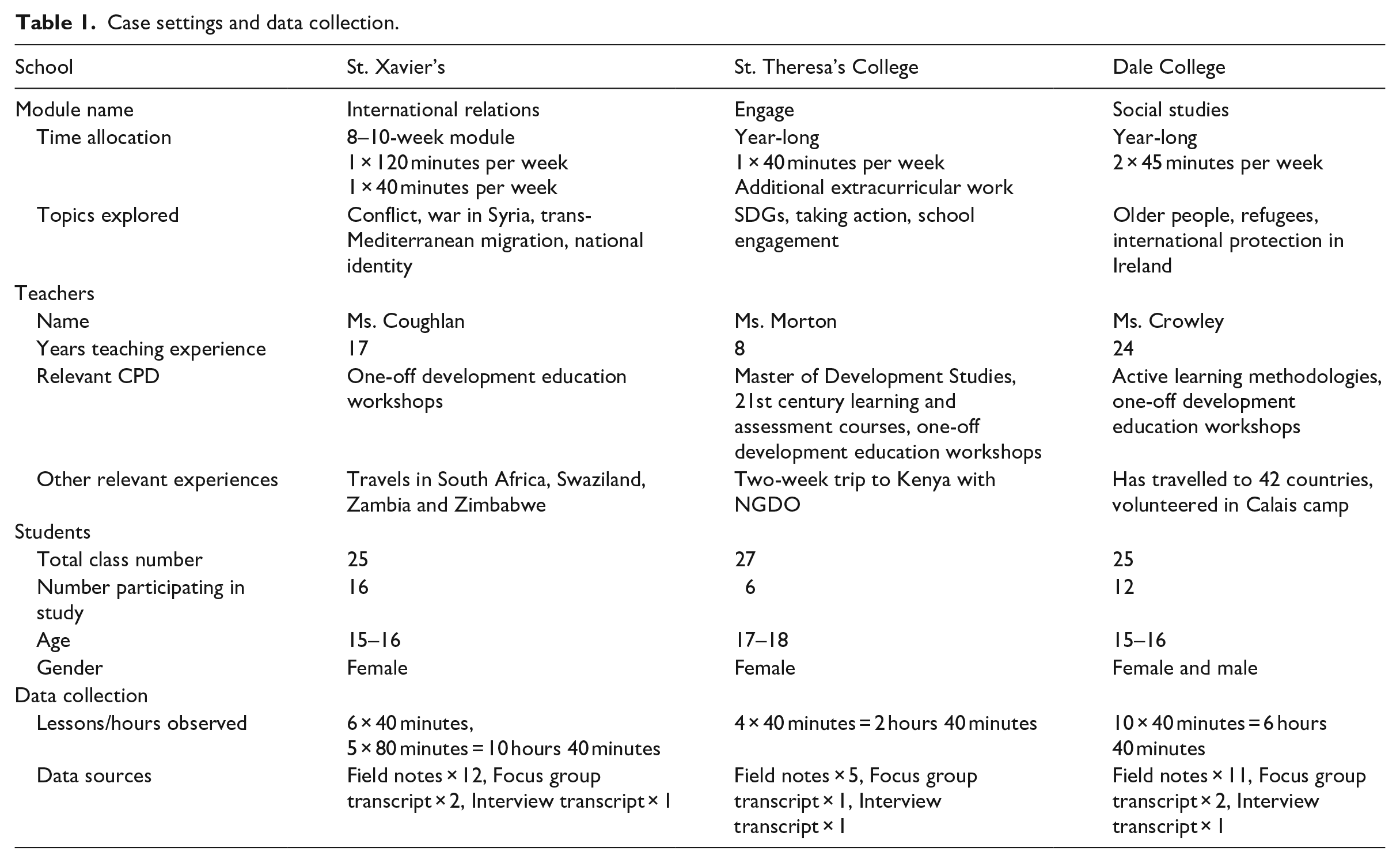
Twenty hours of classroom observations were completed across 3 different settings, over the course of 25 lessons and 1 academic year (Table 1). The observation phase was followed by teacher interviews and student focus groups. Data analysis followed an exploratory, iterative process (Charmez, 2006; Emerson et al.,1995; Glaser and Strauss, 1967) that was completed in four phases, using Nvivo software and several processes to ensure a rigorous and systematic approach (Emerson et al., 1995; Miles and Huberman, 1994). The four analytical phases consisted of line-by-line, open-coding of all data from the first setting. This was followed by a focused-coding phase of all data from all three settings to establish a series of focused codes that were more attentive to the central research questions and the study’s conceptual framework. Next, the data assigned to each focused code was read closely and an analytical memo for each focused code was written up, to support the development of themes. This process supported the assessment of themes’ uniqueness in relation to other potential themes, further cross-checking of themes against the data and consideration of outliers (Bazeley, 2009; Braun and Clarke, 2012; Saldana, 2013). The triangulation of classroom observations with teacher interviews and student focus groups provided multiple slices of reality (Cohen et al., 2000). It allowed the classroom observations to be described and interpreted by both teachers and students and to extend the study to also include both teachers’ and students’ wider teaching and learning experiences.
Case settings and data collection.
Participants and settings
Three teachers (Ms. Coughlan, Ms. Crowley and Ms. Morton) and 34 students, from 3 school settings (St. Xavier’s, Dale College and St. Theresa’s College) participated in the study (Table 1). All three schools are non-fee paying and managed by patrons who operate the schools on the State’s behalf, as is practice in Ireland. St Xavier’s is situated in an affluent Dublin suburb. It is all-female, and the ethos expressed is Catholic. Central Statistics Office (CSO, 2024) figures indicate that over 85% of the population from the surrounding area identify as White Irish. St. Theresa’s is also a suburban, all-female, Catholic ethos school. It has a designation for socio-economic disadvantage and the school handbook lists over 32 languages spoken in the school and 21 nationalities. Dale College is in a small town and 76% of the town’s population identifies as White Irish (CSO, 2024). The school is mixed gender and inter-denominational.
Purposive sampling identified suitable participants and settings, and ensured each setting could fulfil the case criteria. This prioritised opportunities for learning, as opposed to representativeness (Hyett et al., 2014; Stake, 2006). Nevertheless, it is important to recognise that the schools are in urban, as opposed to rural areas, and the participant profile is predominantly female. Whilst there is limited research relating to gender and GCE, one study from Ireland indicates that GCE is gendered in schools and that girls’ only schools are more likely than other types of schools to emphasise and practice aspects of GCE (Tormey and Gleeson, 2012). Of the 34 students that participated in the observation phase, 25 were selected to participate in focus groups. To satisfy the integrity of the observation phase, the case settings also needed to fulfil certain criteria: at least one timetabled GCE class period each week; the possibility of a 6-week observation phase and a reachable geographic location.
In Ireland, GCE has evolved under the guises of many adjectival educations that includes development education, intercultural education and education for sustainable development (Flaherty and Liddy, 2017). More broadly, Ireland’s 1998 Education Act sets out the role of education in promoting active citizenship, in addition to the role of schools to provide experiences that support social and civic learning opportunities (Cosgrove and Gilleece, 2012; Niens and McIlrath, 2010). This echoes a similar pattern internationally as the broad areas of civics, citizenship or social studies can be studied as discrete subjects or, integrated into subjects such as History and Geography (Barton and Ho, 2021; Hahn, 2020).
At a curricular level, GCE as a standalone subject does not have a discrete statutory status within Irish secondary education. Rather, key elements are integrated across the system in several ways. These include extracurricular activities, the integration of global themes into established subject areas and, in some instances, discrete modules with dedicated time allocations (Bryan and Bracken, 2011; McCarthy and Gannon, 2016). While opportunities for GCE have been identified across several subject areas (National Council for Curriculum and Assessment [NCCA], 2018), to date, certain subjects are more closely associated with the field. These include Civic, Social and Political Education (CSPE), Geography, Home Economics and Religious Education (Bryan and Bracken, 2011; NCCA, 2018). Recent curricular reform has also made strides in integrating further opportunities for GCE-related learning in Business Studies and Science (NCCA, 2018). However, explicit GCE practice in schools remains optional and fragmented (Bryan and Bracken, 2011). For example, motivated teachers can integrate GCE into established curriculum areas, or oftentimes, teachers voluntarily develop and teach curriculum-related modules that include a more explicit focus on GCE.
This latter approach, that is, discrete GCE modules, was identified as the case for this study and it was examined across three different settings (Table 1), some criteria were set to bind the case by unique and discrete characteristics. These criteria included: discrete and dedicated time allocations to the modules on school timetables; content related to global justice and citizenship issues, such as development, human rights, action or power and a designated teacher and group of students. Before data collection began, a process of informed consent was completed with the teachers, the students and their parents, and the schools’ Boards of Management. All identifying features including school names, teacher and student names have been pseudonymised.
Table 1 identifies key features of the case settings and participants. It indicates the different titles assigned to the GCE modules across the three settings and the topics explored. It is important to note that two of the modules were compulsory for students (St Xavier’s and Dale College), whilst one was optional (St. Theresa’s). All three teachers had designed these modules themselves and had been teaching GCE in various forms for between 8 and 17 years. Across the settings, students were aged between 15 and 18 years and all students had previously studied CSPE in their lower secondary studies for one class period a week, over 3 years. Typically, CSPE studies include the exploration of concepts such as human rights, democracy and development. However, enactment varies significantly and CSPE has been referred to as the Cinderella of curricular subjects in Ireland (Bryan, 2020). Class time allocations ranged from 40 to 120 minutes and topics explored included conflict, migration, trans-Mediterranean migration, national identity, older people, Ireland’s international protection system and the Sustainable Development Goals (SDGs). Content for each lesson was presented through several different resources and sources that included teacher-selected photographs, maps, videos, podcasts, news articles and activities drawn from resources, such as public broadcaster podcasts and Palestine and Israel – How Will There Be a Just Peace (Gannon and Murtagh, 2012). Both Ms. Morton’s and Ms. Crowley’s GCE classes had begun as extra-curricular activities, while Ms. Coughlan’s was part of the school’s Transition Year programme. Transition Year (TY) is a full-time, optional year within post-primary education in Ireland that occurs between the completion of lower secondary and the commencement of upper secondary studies.
Findings
The wider study from which this article is based contributes significant empirical insights into GCE classroom practices. In general, it demonstrates that important spaces for GCE exist within formal education, where students can engage in conversations and discussions to explore global justice issues that, according to participating students, are otherwise missing from their formal education. For example, students referred to their GCE modules as being a welcome counterpoint to the norm, which Tess describes as: . . . we’re normally sitting down listening to them[teachers] . . . they have interactive whiteboards, so the teacher types up notes and we just write them down and we read. That’s normal class to me. (St. Theresa’s College, focus group (FG) 1)
Others spoke about the nature of the subject content and the lack of opportunities to engage with such content, outside of their GCE module.
Peter: It feels like the only class we had where like we talk about controversial topics and stuff like that. (Dale College, FG 1) Tess: I like that we learn stuff that we don’t learn in other subjects. You hear of them on social media, but you don’t know much about them and in this class, we get to know more. (Dale College, FG 2)
This is significant given that omissions from the curriculum can serve to perpetuate dominant narratives (Mallon, 2018). The study also establishes teachers as vanguards of GCE practice, acting as both curriculum developers for the field and pioneering practitioners of participatory pedagogies and discussion-based teaching strategies. The study demonstrates that, at its most critical, GCE in formal education can create opportunities for students to experience democracy in action, to encounter the idea of engaging critically with knowledge and, to participate in meaningful discussions with their teachers and peers.
In addition, the study reveals factors that contribute to the shape of GCE classroom practice and that have the potential to bolster or dilute its criticality and participatory intent. The following sections present a profile of each participating teacher and their GCE practice, followed by a discussion of cross-cutting themes. This provides a critical consideration of the variety of manifestations of GCE observed and helps to demarcate and amplify tacit and distinctive aspects of GCE practice. This offers richer and more nuanced accounts of GCE teaching and learning and a greater understanding of the factors at play.
Ms. Coughlan
Ms. Coughlan taught GCE to 15–16 year-old female students in St. Xavier’s secondary school. Topics they explored included, war in Syria, trans-Mediterranean migration and national identity. Ms. Coughlan had over 17 years of teaching experience, and created and designed the module she was delivering. Her pedagogy was largely traditional in style, it was teacher-led, with a strong focus on content, as opposed to process. In addition, discussions and student participation most frequently occurred at a whole class level and were directed and controlled by Ms. Coughlan. The excerpt below provides an example of one such interaction that arose during a lesson, focused on identity: Ms. Coughlan moves on to ask, ‘What makes the Irish, Irish?’ . . . There is a mixture of a chorus of responses along with a few hands going up. Ms. Coughlan asks Ava, then Ruth . . . Zoe offers a response about drinking. Ms. Coughlan asks, ‘Is that absolutely true’? There is an animated chorus of responses for this, but I can’t decipher any of them . . . Ms. Coughlan begins to talk about stereotypes (St. Xavier’s, field notes, Week 4).
In interview, Ms. Coughlan described her approach as ‘old-fashioned’ and indicated that she did not focus on active learning or ‘skills’ (Ms Coughlan, interview).
Occasionally, Ms. Coughlan created potential for more student-centred approaches by including in-class, online research carried out independently by students and followed by a discussion of what students had discovered (St Xavier’s, field notes, Weeks 2 and 3). However, these were few in number and Ms. Coughlan herself identified a largely practical motivation for their use, as opposed to any ideological connection with principles related to student empowerment or participation (Cook-Sather, 2006; Lingard and Mills, 2007). She stated: I’ve started doing that, bringing them up to the computer room . . . That is a feature of this year only because the double class was too hard going for everyone concerned and they weren’t listening. (Ms. Coughlan, interview)
Ultimately, Ms. Coughlan’s approach to student participation was underpinned by a pragmatic intention that sought student contributions to break up the perception of a long class period, rather than by a more ideological stance that sought to create spaces for authentic student presence and contributions (Cook-Sather, 2006).
Another significant feature of Ms. Coughlan’s practice was her clear passion for the topics she explored with students and the political and provocative nature of some of her contributions in class. Indeed, Ms. Coughlan acknowledged this passion as a strong motivation for her work, stating: . . . a little bit of my role is to kind of make a change. It’s definitely there, there’s no question of it and it is sometimes the more reason for getting up in the morning, you know? (Ms. Coughlan, interview)
Ms. Coughlan described herself as honest, direct and humorous. In class, she frequently offered her own personal experiences or opinions on a topic, often in strong terms. For example, on one occasion, she offered her own views on a photograph she was using as a stimulus, that depicted a scene at a border checkpoint. Ms. Coughlan described it as ‘evocative . . . and extremely powerful and distressing’ before inviting students to share their responses (St. Xavier’s, field notes, Week 3). On another occasion, during a walking debate on Ireland’s international protection system she said, ‘me, I would change it completely’ (St. Xavier’s, field notes, Week 3). 1 These examples from Ms. Coughlan’s practice help to highlight that GCE teaching and learning is not exclusively tied to techniques or stances but can also be shaped through disposition.
Ms. Crowley
In Dale College, Ms. Crowley taught GCE to 15–16-year-old female and male students. They explored topics such as migration, refugees, Ireland’s international protection system and older people. Ms. Crowley had over 24 years of teaching experience, had travelled to over 42 countries and had also volunteered at a migrant camp in Calais. In the classroom, Ms. Crowley’s pedagogical approach included several features associated with active learning. Firstly, she used a significant number of participatory methodologies, resulting in a strong process-led approach (Dale College, field notes, Weeks 2, 3, 5 and 6). Typically, each lesson included two types of activity such as brainstorms, spider diagrams, think-pair-share, group discussions and walking debates. To follow, Ms. Crowley commonly facilitated some whole class discussion or at times, a brief individual reflection that required students to record some notes.
Ms. Crowley’s approach to group work was structured and planned. She used a variety of techniques to form pairs and groups and gave students clear and timed tasks. Oftentimes, she provided them with a prompt sheet that included different discussion points or questions. Ms. Crowley was explicit with students about the purpose of group work and frequently encouraged them to focus on the task-at-hand. Before one activity, it was noted: Ms. Crowley asks the students to discuss the photos, using the prompts provided and adds that she wants students to ‘tease out good quality answers’ and ‘stay focussed on the task’. (Dale College, field notes, Week 6)
She also instructed students on how to form their groups, encouraging them not to sit in lines but in a square so that they could see each other and reminding students that she would be ‘listening actively’ (Dale College, field notes, Week 6) and circulating to groups as they carried out their task.
An analysis of Ms. Crowley’s practice and contributions in interview indicate an intention or stance related to active learning and student participation that was technical in focus. It also illustrates a series of tensions that can arise because of the technisation of pedagogy which is driven by policy, rather than teachers, and can remove teaching and teachers from their contexts (Cochran-Smith, 2012; Korthagen, 2012). At the time of the study, Ms. Crowley had recently participated in professional development workshops that focused on active learning strategies. She was particularly contemplative about these experiences. The excerpt below illustrates Ms. Crowley’s commitment to professional development and a genuine attempt on her part to engage with new ideas to inform her teaching. She stated: I’m always trying to get to in-services and I leave the in-service thinking ‘oh my God, these are great ideas’ and then I go home and I put them into practice and it just doesn’t work as well as it did in the in-service and what I saw in the video and the brilliant teacher in the classroom. (Ms. Crowley, interview)
Yet, her reflection also points to a disconnection between how she experienced professional development and how those largely positive experiences did not replicate in her classroom. For Ms. Crowley, it resulted in a worrying sense of failure in her own practice and confirms Bentall’s (2020) finding that adopting GCE practices can present a complex transition for teachers requiring ongoing support. This tension Ms. Crowley raises also speaks to a critique of GCE and citizenship education and the challenges teachers face when attempting to implement complex processes within formal education settings (Estellés and Fischman, 2020; Sund and Pashby, 2020).
Ms. Crowley was clearly struggling with narrow interpretations of teacher as facilitator. In the excerpt below, she describes her struggle as twofold: she acknowledged that student-led learning was a complex process to support, and it was one that unsettled her sense of self in the classroom. Her description also reveals an interpretation of these methodologies as having a silencing effect on teachers and of classroom power dynamics as a zero-sum game.
I was using quite a lot of them [active learning methodologies] but it seems to me that it’s almost like the teacher . . . the more silent the teacher is in the room, the better. While I’m not all ‘chalk and talk’ I think, I think it’s very hard to sometimes just be the facilitator . . . I find that . . . I don’t know what to do with that. (Ms. Crowley, interview)
In this instance, Ms. Crowley appeared genuinely concerned by the version of active learning, as promoted through professional development. It was a narrow interpretation that focused on student-led learning, as opposed to forms of participation that include more reciprocal student-teacher relationships and empowering aspects of participatory pedagogy. Such an approach is concerned not only with learning but also with student voice, presence and democratic education (Cook-Sather, 2006; Devine and McGillicuddy, 2016).
These concerns that Ms. Crowley voiced may have also restricted her persona in the classroom. Despite a firm and strong personal commitment to GCE and human rights, as stated in her interview, Ms. Crowley appeared less inclined to portray this in the classroom. She rarely chose to participate in discussions or debates with students, or to offer a personal view. Notwithstanding this, a notable feature of Ms. Crowley’s practice was her attitude towards students’ contributions during whole class feedback. We observed a clear intention by Ms. Crowley to represent exactly what students stated, repeating what they said as she wrote their contribution on the board, whilst also clarifying and qualifying what they meant (Dale College, field notes, Weeks 1 and 2). These were not big gestures but did demonstrate a collaborative and respectful disposition on her part. These aspects of Ms. Crowley’s practice afforded legitimacy and audience to student contributions which were sought and valued, and did not go unrecognised (Cook-Sather, 2006). Students commented on Ms. Crowley’s willingness to listen and understood that she was both open to and genuinely interested in what they had to say, stating that Ms. Crowley ‘really values your opinion’ (Dale College, focus group 1) and ‘everyone can have their own opinion, own idea . . . She doesn’t turn it down’ (Dale College, FG1). Miriam and Peter state below:
She really values your opinion.
How do you know she values your opinion, Miriam?
Just sort of says ‘that’s really interesting to hear your point of view’.
It’s to let us use our own voices and have our own opinions rather than just hearing somebody else for the entire day. (Dale College, FG1)
This points to the potentially empowering nature of GCE practices if teachers are perceived as authentic in approach. Previous studies have found students to place significant value on being listened to and a corresponding sense of being respected (Cook-Sather, 2006).
Ms. Morton
In St. Theresa’s College, Ms. Morton taught GCE as an optional class to 17–18 year-old female students. The focus of these lessons was on taking action within their school and wider community in relation to the Sustainable Development Goals (SDGs). Ms. Morton had 8 years teaching experience and had completed a Master’s in Development Studies and a certificate in 21st Century Learning. Striking features of Ms. Morton’s pedagogical practice were the active nature of the lessons and the dominance of group work and student participation, even within the context of a 40-minute timetabled slot. The practice stood apart because it was premised on student self-selection, student-led action and a project-oriented approach. The self-selection aspect of the module was facilitated by school management who allocated the module as an optional choice for students on the timetable. It is one example of the important role school leadership can play in supporting GCE practice in schools. During observations, the busy and planning-oriented nature of the lessons was noted frequently (St. Theresa’s College, field notes, Weeks 2, 3 and 4).
One of the strongest aspects of Ms. Morton’s practice was her focus on student participation. Specifically, it was underpinned by a very conscious, ideological intention to position students to the fore and to foster their engagement and empowerment. Ms. Morton seemed keenly aware of this in the classroom. On a few occasions, she referred to the optional nature of the module for students and, below, she indicates how this then prompted her to think differently about her engagement with them.
I suppose I’m more a facilitator in those classes I think than a teacher per se . . . Yeah, it is a lot less formal than any of my other classes . . . It is more of us working together I suppose and me facilitating them. (Ms. Morton, interview)
Within her GCE practice, Ms. Morton strongly identified her role as a facilitator which she reported, was somewhat different to the approach she might normally take with students in a classroom. She associated the role of teacher as formal and distant, compared to a more collaborative and reciprocal role for a facilitator. Within her classroom practice, Ms. Morton displayed small but significant signs of this pedagogical stance. She was rarely observed teaching or talking from the top of the classroom, and she was more inclined to position herself to the side. In addition, her body language was noted, where at times, she sat at a table with a group of students and on one occasion ‘leaned over, arms straight, hands on desk, between two students . . . listening as they talked’ (St. Theresa’s College, field notes, Week 3).
Whole class moments and discussions led by Ms. Morton were rare. Most frequently, they served to recap what had been discussed or planned, to identify tasks that needed to be completed or, to look for volunteers. At all times, Ms. Morton remained attentive and responsive, prompting and motivating students whilst also keeping an eye on practical matters. This was evidenced by the extent to which she was observed moving around the room, checking in with various groups, listening to students’ ideas and plans and prompting further development by asking ‘how can you do that’, ‘what do you need to do next’ and frequently speaking in the ‘we’ (St. Theresa’s College, field notes, Weeks 2, 3 and 4).
Students in Ms. Morton’s GCE classroom were positioned as active participants who took responsibility to plan and execute the ideas and activities agreed upon. This was evident from how Ms. Morton chose to interact with students, in addition to the extent to which their deliberations, plans and activities became the focal point for the module. This is one of the distinctive characteristics of her approach across the settings. The active and participatory nature of the classroom was also noted by students, as reflected in the excerpt below. Sonya described the experience in a relational sense that is connected to the principle of reciprocity within participatory pedagogies (Devine and McGillicuddy, 2016; Freire and Ramos, 1996): I think in a class like sometimes it’s like teacher/student, like there’s a big gap between us but in ENGAGE it’s like the teacher is there to help and guide us but like we’re all running it together. (St. Theresa’s College, FG 1)
Sonya understands Ms. Morton’s role as collaborative and supportive, indicating a sense of empowerment, responsibility and autonomy over her own learning.
Ms. Morton did however present a slightly more distant persona in the classroom. She adopted a serious and professional tone, yet remained courteous and respectful of students. She was rarely observed expressing personal opinions, though she consistently displayed an interest in students’ contributions through how she responded verbally and in how she circulated during group tasks. One aspect of Ms. Morton’s disposition that was noteworthy, related to her autonomous and reflexive persona (Andreotti, 2014) that filtered through into her practice and further bolstered her focus on the students.
Whilst Ms. Morton’s practice was action-focused and described and understood by students in participatory terms, during observations, she used the least amount of active learning methodologies associated with GCE. Group work was oriented towards planning a project, public speaking, organising school events and raising awareness. As such, it could be argued that the participatory nature of Ms. Morton’s pedagogical practice arose more so because of the project nature of the module, rather than a deliberate intent on the part of Ms. Morton (Devine and McGillicuddy, 2016). Without doubt, the reorientation of purpose from the outset, in addition to wider structural support from school management, did affect what happened in the classroom. Nonetheless, Ms. Morton consciously considered the experience of students throughout this module. She intentionally shaped and delivered her practice so that students could experience an empowering form of participation.
Discussion
At its most ambitious, GCE strives to support students to critically engage with complex global justice issues through participatory pedagogy. The teacher profiles presented confirm that practising GCE is a highly malleable and dynamic process. In this section, we explore key factors that contribute to that dynamism. First, we consider teacher’s underlying motivations and ideological intentions, or lack thereof, that infuse and shape practice, particularly as it relates to participatory pedagogy. In addition, we explore how this study extends our understanding of the role of GCE orientations and context in shaping GCE in the classroom.
The determining role of teacher intentions for realising participatory pedagogy
An analysis of the empirical data presented reveals that teacher intentions or ideological stances, as they relate to student participation, play a determining role in the realisation of empowering GCE pedagogy in the classroom. In teacher education broadly, the influence of teacher motivations and intentions, in other words, pedagogical purpose, on the enactment of pedagogy is widely recognised (Devine and McGillicuddy, 2016; Korthagen, 2012; Waldron, 2012). This study establishes pedagogical purpose as playing a determining role in realising the empowering intent of GCE’s participatory pedagogy. Examining all three teachers’ practices through the lens of intention, illustrates a range of stances that infuse teaching strategies that include ideological, technical and practical elements. A focus on these intentions reveals interpretations of participatory pedagogies that range from a practical or technical tool to vary practice, through to more ideological perspectives related to student empowerment. For example, Ms. Coughlan’s use of active learning methodologies was underpinned by a very pragmatic purpose, rather than an ideological attachment to participatory or empowering pedagogies. As a result, whilst she did employ some pedagogical strategies that had the potential to disrupt and reconstruct power dynamics in her classroom (Manke, 1997), the opportunity to do so was diluted due to a stance that filtered purpose through a practical lens.
Ms Crowley’s practice establishes the presence of experimentation with active learning methodologies and the use of many approaches promoted in GCE literature and resources (Bourn, 2020; United Nations Educational, Scientific and Cultural Organisation [UNESCO], 2015). However, at the time, her practice was infused by a largely technical approach to student participation that limited more authentic engagement. An analysis of her practice and dilemmas also illustrates that the use of active learning methodologies alone does not automatically position students in more empowering ways in the classroom. Rather, the methodologies raise several complex questions for teachers in relation to power and authority in the classroom (Bizzell, 1991). Furthermore, Ms. Crowley’s experiences confirm a lacuna in professional development for teachers who want to be responsive to ‘great ideas’, yet need more holistic and ongoing support to move beyond technical aspects of teaching, and ultimately change their practice (Bamber, 2020; Bentall, 2020; Martinelle et al., 2024). Her genuine struggles confirm the essential nature of ongoing and reflective professional development for teachers beyond ad hoc or once-off support (Bentall, 2020).
Ms. Morton’s student-centred and action-focused GCE practice confirms the role and importance of wider contextual factors and school leadership support (Doggett et al., 2016; McSharry and Cusack, 2016). The opt-in nature of this module positions students as active and autonomous participants, thereby disrupting dominant school structures that control students’ time and space (Cook-Sather, 2006; Manke, 1997). Evidence from St Theresa’s demonstrates how a shift in approach at whole school level, can subsequently influence classroom dynamics. This contextual support facilitated Ms. Morton to position students as active participants in the classroom (Cook-Sather, 2006; Devine and McGillicuddy, 2016) and to adopt an explicit pedagogical stance that empowered students, rather than imposing or dictating what they did.
Interfacing GCE ‘types’ in the classroom
Findings from this study clearly illustrate what Pashby et al. (2020) describe as the interfacing of different types, or orientations, of GCE, as opposed to any one operating discretely. This is perhaps most strongly articulated through Ms. Coughlan’s practice. Her teacher-led practice is characteristic of neoliberal tendencies, however, her provocative and political contributions in class were striking and align her practice more closely, albeit sporadically, with a critical GCE orientation. She spoke clearly with students about what was wrong with Ireland’s international protection system and suggested another way was both necessary and possible. This relates to critical GCE as it connects the topic explored to more systemic issues and questions solutions in place (Pashby et al., 2020). Ms. Morton’s practice was characterised by elements of a liberal-critical interface, albeit in different ways to Ms. Coughlan. The SDGs served as content for the module, with no time in class dedicated to a critical analysis of the goals. Rather, adhering to liberal types of GCE, the end remained unquestioned, whereas as the means, in this case, the actions to be taken, were the focal point. Yet, her practice also veered towards a more critical orientation, this time through her focus on student empowerment. Finally, despite the most frequent use of active learning methodologies, Ms. Crowley’s practice risked being caught in a more neoliberal orientation. This came to the fore particularly with regards to the technical application of active learning observed in her practice that Pashby et al. (2020) associate with a neo-liberal and standardised type of GCE.
School and classroom cultures and structures
These findings further demonstrate how cultural and structural factors can impede GCE teaching and present teachers with dilemmas as they seek to navigate the transition from hierarchical teacher-student relationships to more reciprocal ones. For example, aspects of Ms. Coughlan’s practice confirm Curley et al.’s (2018) observation on the presence of uncritical habits of mind that suggest that ingrained and traditional teaching practices have the potential to diminish the participatory intent of GCE, even in circumstances where teachers’ political intent or desire to disrupt student thinking is present. It also provides empirical evidence to support Estellés and Fischman’s (2020) argument that GCE policy places undue responsibility on teachers within the context of persisting neo-liberal traditions in schools and demonstrates the impact of culture on teaching and learning (Hahn, 2020). This study reasserts the need to engage teachers in matters of pedagogy, not only technically, but also holistically and intellectually, to make connections with the underlying purposes of participatory approaches (Bamber, 2020; Korthagen, 2012).
It is Ms. Crowley’s classroom experiences that most clearly illustrate and confirm that cultural factors, in the form of pedagogical traditions, can constrain GCE teacher practice (Sund and Pashby, 2020). Her contributions distinctly capture those dilemmas faced by teachers who feel caught but unsure how to move beyond traditional classroom culture. Indeed, a critical exploration of Ms. Crowley’s practice reveals struggles that teachers face when seeking to adopt more participatory practices in formal education classrooms. Such practices require a significant shift and re-balancing of power dynamics that exist between students and teachers and a re-negotiation of the hierarchical structures ingrained in formal education. These struggles relate directly to explorations in literature that seek to balance freedom and agency for students, whilst also affording authority to the teacher to teach (Bizzell, 1991; Freire, 1994; hooks, 1994). In this study, they were encountered by experienced teachers who have the capacity to identify these tensions, yet struggle to resolve them alone. The isolated nature of GCE in schools, coupled with a paucity of ongoing professional support, affords little space for reflection or development. Yet, findings from this study support Bentall’s (2020) assertion that GCE practices necessitate significant transitions for teachers that require sustained support. Otherwise, technical approaches to teacher development risk stifling practices and diminishing the role of teachers.
The study also confirms that teaching and learning is more than an implementation of established pedagogy and highlights the importance of relational aspects (Cook-Sather, 2006; Devine and McGillicuddy, 2016; Freire and Ramos, 1996). Examining GCE classroom practice clearly demonstrates the significance of human relations in creating conducive environments that can be inspiring, open, political and supportive. It highlights the role of teacher dispositions and personal and professional identities and backgrounds. This study extends this insight by highlighting the importance of what Korthagen (2012) refers to as a ‘person-oriented view’ (p. 124) of teachers which seeks to extend teaching beyond the mere adoption of certain competencies, or indeed pedagogies (Korthagen, 2012; Lingard and Mills, 2007). Findings from this study suggest that for some teachers, it is through person, in addition to, or despite, their pedagogical intentions, that they infuse a more critical approach to GCE. This points to the potentially empowering nature of GCE practices if teachers are perceived as authentic in approach. Crucially, students across the three settings recognised and described similar dispositions in their GCE teachers, to those observed. They identified the relationship they held with their GCE teachers in particular terms that supported their participation in classroom discussions and helped create more trusting and at times, reciprocal and empowering relationships.
Conclusion
This article sets out a case study of GCE practices to interrogate a range of factors that can shape GCE teaching and learning. These insights from three teachers’ classrooms reveal that GCE practice is a multifaceted and complex endeavour (Bryan and Bracken, 2011; Sant et al., 2020; Yemini et al., 2019), infused by key elements that intersect in multiple ways, resulting in significantly different and unique experiences for students. The three teacher profiles presented provide one tool to examine and understand both tacit and conventional aspects of GCE teaching and learning. In doing this, it confirms the need to recognise the cultural and structural constraints within which teachers operate and the transitions they must undertake to enact more empowering forms of GCE. In preparing and supporting teachers for the classroom, professional development must explicitly reflect this. Equally, the study indicates the need to further explore the theoretical underpinnings of participatory pedagogies with teachers and the democratic practices and traditions that inform GCE pedagogy. Together, these approaches can provide teachers with useful frames that enable them to analyse and reflect on their own practices and contexts.
Footnotes
Declaration of conflicting interests
The author(s) declared no potential conflicts of interest with respect to the research, authorship, and/or publication of this article.
Funding
The author(s) disclosed receipt of the following financial support for the research, authorship, and/or publication of this article: The lead author received a PhD scholarship from DCU’s Centre for Human Rights & Citizenship Education to carry out some of this work.
