




Abstract
This paper presents a remarkable conversation with Carlos Alberto Torres about Global Citizenship Education (GCE) in relation to research, teaching, and learning in the USA. Torres is a Distinguished Professor of Education, UNESCO UCLA Chair on Global Learning and Global Citizenship Education, UCLA and Founding Director of the Paulo Freire Institute (São Paulo; Buenos Aires; UCLA). In this dialogue, he artfully blends together theoretical and practical perspectives on global citizenship focused on the connection between culture and power, the interrelationships of economic, political and cultural spheres in the modern educational institutions in the context of growing internationalization and globalization of education offering an exclusive portrait of GCE as a site of permanent pursuit for social justice. Our tête-à-tête is presented as a pedagogical tool for discussion that invites educators to reflect critically on the possible origins and implications of GCE discourses they are exposed to. It is designed with the intent to contribute toward the possibility of imagining a “yet-to-come” post-colonial, critical-transformative, and value-creating GCE-curriculum beyond a Westernized, market-oriented and apolitical practices toward a more sustainable paradigm based on principles of mutuality and reciprocity, or as Torres calls it in this discussion “el buen vivir”—a concept that portrays a way of acting in society that is community-centric, ecologically balanced, and culturally sensitive, in the ongoing construction of a more just and peaceful world.
Keywords
Introduction
Over the past three decades, internationalization and globalization have shaped educators’ pedagogical trajectories and educational institutions at different levels (Bosio, 2017a, 2017b; Knight, 2007; Torres, 2017; Yemini, 2016; Yemini at al., 2018, 2019). The discourse on internationalization is one of the most complex and multifaceted discourses within contemporary education and it relates to globalization through its economic, political, and social means (Beck, 2000; Knight, 2015). Twenty years ago, Wiseman, writing in the context of Australia and Politics of Globalization (Wiseman, 1998: 1), stated that “globalization is the most slippery, dangerous and important buzzword of the late twentieth century. It is slippery because it has many meanings and can be used in many ways. It is dangerous because too often it is used as a powerful and simplistic justification for the endless expansion of unregulated capitalist relations in whatever part of life and in every corner of the globe.” Globalization in general and internationalization in particular have become buzzwords for many discussions around the changing nature of education policy and programming (Bosio et al., 2018; Bourn, 2018). This includes the increasing influence of international comparisons which influences the content of national public debates on education. This discourse involves among others the Programme for International Student Assessment (PISA) standards for school performance and rankings published by the Organization for Economic Co-operation and Development (OECD), which are similar to rankings published by the Times Higher Education Supplement (THES) and others for universities (Billing, 2004; Verger and Hermo, 2010; Yemini, 2016); lastly, as Yemini (2016: 7) explains, internationalization connects with “basic problems and definitions within society (e.g. multiculturalism, ‘brain drain’ or ‘brain circulation’, religion and state power relations and, again, globalization).” The intricacy of internationalization is due to the volume of connotations and interpretations of related terms, which are largely based on a mix of ideological and academic stances of those involved in such discourse.
In this context, approaches for interpreting internationalization of the modern education system—from its beginnings in primary schools all the way to higher education— may be loosely divided into two types: a values-based one and a pragmatically based one (Jones and Killick, 2007). The latter mainly emphasizes the skills and qualities that students need for working in a globalizing world—in this view, knowledge and knowing may be reduced to the logics of the market and deferring to wider anxieties about global economic competitiveness and positioning in the context of world rankings (Giroux, 2007; Mignolo, 2011, 2012; Nixon, 2013) situating education “as an industry trapped within the networking logic of contemporary capitalism, subject to the same economic cycles, market upswings and downturnsand segmented global competition” (Rizvi et al., 2005, p. 11). The former draws attention to issues of social responsibility, ethics and justice, and emphasizes the need to fight poverty, promote human rights and/or work for a sustainable future—this approach calls for an ethical-critical global pedagogy that aims to foster and promote not only skills but, most importantly, also values and actions, engaging, rather than evading, problematic questions about global disparities (Andreotti, 2006, 2010; Bosio, 2017a; Peck and Pashby, 2018; Rizvi and Beech, 2017; Torres and Dorio, 2015 ; Clifford and Montgomery, 2017; Sherman, 2016; Guajardo and Reiser, 2016; Stein, 2018; Dorio, 2017). This is a type of approach that is multicultural, rights-based, universal, dialogistic collaborative and value-creating (Siegel and Gaudelli, 2018; Goulah, 2018; Sharma, 2018; Bosio, 2017a; Gaudelli, 2016; Tarozzi and Torres, 2016; UNESCO, 2014).
While internationalization may mean different things to different scholars and educational institutions, this paper offers a conversation concerning the values-based approach. It explores it from the lens of global citizenship education (GCE) as one of the possible value-creating outcomes of internationalization—in this perspective, we concur with Yemini’s (2016: 184) recent posit that “internationalization be defined as the process of encouraging integration of multicultural, multilingual and global dimensions within the education system, with the aim of instilling in learners a sense of global citizenship.” Yet, in many contexts, it is also a ruse to promote neoliberalism and entrepreneurship in the educational institution. Here, we invite you into a dialogue exploring, analyzing, and celebrating ideas and concepts on global citizenship. We touch upon issues of power and politics in education in the context of globalization/internationalization and hopefully provide a “roadmap” to relevant teaching experiences on GCE. This conversation intends to be a valuable resource for three groups of audience across the education system:
Educators who are seeking to develop their theoretical understanding of GCE into teaching practice. Researchers who are new to GCE and who seek dynamic starting points for their research. General audience who are interested in learning more about the history, philosophy, and practice of GCE.
Global citizenship education: a form of intervention in searching for a theory
Global citizenship as we conceptualize it herewith is based on values of mutuality and reciprocity, or as Torres calls it in our discussion “el buen vivir”—this concept frames GCE within a looking forward educational theory which, despite its intrinsic but resolvable contradictions, encourages a way of acting in society that is community-centric, ecologically balanced, and culturally sensitive, in the ongoing construction of a more just and peaceful world. While GCE for some represents an educational theory of the “common good” (Bosio, 2017a; Bourn, 2018; Gaudelli, 2016; Torres, 2017), we are also conscious that it demands moral obligation and responsiveness beyond the individual and his/her own interests (Dill, 2012). As Dill (2012: 541) points out, “whether real or aspired to, welcomed or opposed, GCE is commonly held to be a far-reaching paradigm shift” in our educational practices. Thus, it is absolutely critical to expand research on the practice of GCE. In order to do this, we ask a fundamental question which underpins our contribution: is GCE an educational theory of the common good? We believe this query is one of fundamental importance given that GCE is a form of intervention in searching for a theory and an agency of implementation because the world is becoming increasingly interdependent and diverse, and its borders more porous. There is a de-territorializing of citizenship practices and identities, and of discourses about loyalty and allegiance (Torres, 2017).
Concurrently, at the level of the classroom and curriculum setting, excellent educators are engaged in GCE; for instance, by refusing to give up on a single student. Carlos Alberto Torres is one of them. In our conversation, first, he stresses his strong interest in “wondering how to address the quest for knowledge of the post-colonial epistemologies of the Global South.” Second, he argues that global citizenship should add value to national citizenship and strive to defend the global commons which, according to him, are defined by three principles: (1) our planet is our home, (2) global peace is an intangible cultural good and a treasure of humanity with immaterial value, and (3) the need to find ways for people to live with a strong spirit of solidarity. Finally, in regards to curriculum approaches he suggests that because “there is a cosmopolitan imperative of economic equality, welfare and cultural diversity,” a GCE-curriculum may aim at fostering respect for diversity. Among other topics, Torres describes autobiographical events; for instance, how the September 11, 2001 attacks re-shaped his “journey of life” as a scholar in the quest for a new ethics.
A quest for a new ethics in the context of internationalization of education and GCE, however, poses new set of conditions for educational institutions and those actors who populate them (Banks at al., 2016; Bosio, 2017a; Rhoads and Szelényi, 2011; Schattle, 2008; Shultz, 2007; Suárez-Orozco and Boalian Qin-Hilliard, 2004; Torres, 2008). These new dynamics are not limited to any exclusive location or stage of education; similar processes take place in developed and developing nations, in schools and universities, and in central and peripheral settings (Yemini, 2016). To more fully grasp the challenges as well as the potential of the modern educational institutions, one needs to comprehend the ways in which its key players interact with a variety of forces and events linked to internationalization and globalization (Bosio, 2017b; Dill, 2012; Tarozzi and Torres, 2016; Yemini et al., 2019). As Rhoads and Szelényi (2009) points out, since educators represent a group in particular that is regularly faced with a variety of global powers interacting with educational institutions’ life, there is a tremendous need to better understand the complexity of their academic lives relative to how they conceptualize GCE in the context of increasing internationalization and globalization in both theoretical and practical ways.
With the preceding in mind, the following section introduces the rationale for the interview to Torres while the subsequent segment goes straight into our dialogue with the purpose of inviting the reader to consider the profoundness of Torres’ responses. We conclude with a commentary to our dialogue exploring links between internationalization and GCE in order to understand the inherent convergences and divergences. Our conversation is presented as a didactic instrument for discussion that invites teachers, researchers and learners to critically analyze the possible origins and implications of GCE discourses they are involved with. It intends to contribute toward the possibility of conceiving a pioneer vision for GCE beyond neoliberal, market-driven, and apolitical educational practices toward a more sustainable paradigm based on principles of mutuality and reciprocity in the ongoing construction of a more just and peaceful world. We are also hopeful that our conversation will provide critical input to educators at all levels because the existing separation between the school level and the higher education system in addressing the internationalization of education becomes narrower by the day within the reality of the second decade of the 21st century (Yemini, 2016). Thanks to the generosity of Carlos Alberto Torres, who shared his perspectives with me during the interviews for this study, we begin to have an original portrait of educational practices of global citizenship in the present day (see also Bosio and Gaudelli, 2018; Bosio and Torres, 2018; Bosio and Schattle, 2017).
Global citizenship education interview series—genesis
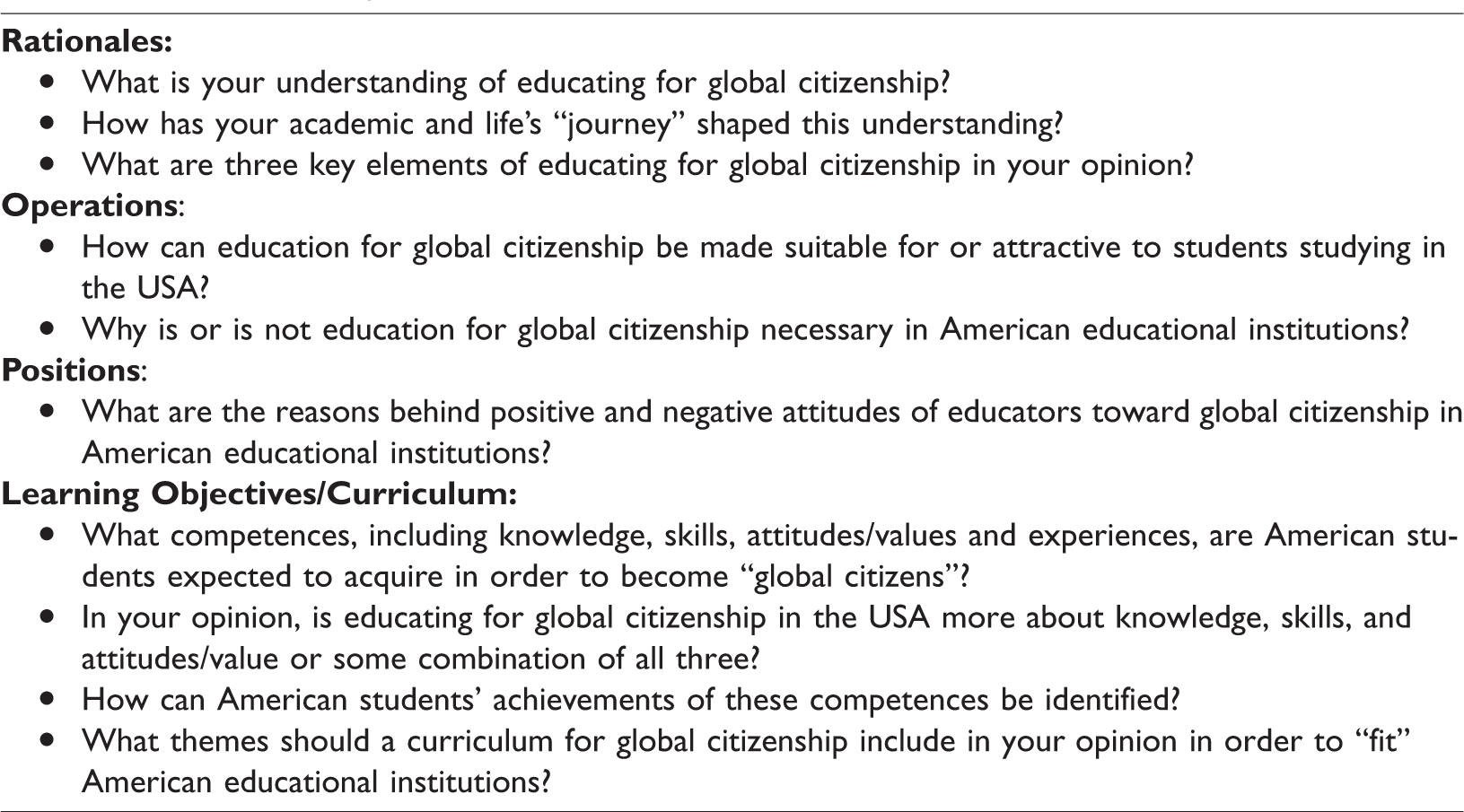
The rationale for the conversation was to clarify what Torres had been thinking when he made his respective choices regarding how to approach global citizenship in his courses and programs in the USA, specifically California. I did not impose any particular view of global citizenship on him. Instead, I made every effort during conversations to focus on what he had been thinking anyway—independently of being approached for this interview—and to give the respondent the time to elaborate freely on his views. Several questions related to the broader research agenda were discussed repeatedly, as appropriate (Table 1). Torres was selected because:
Main interview questions.
he is an outstanding example of the ways in which global citizenship might be implemented in a specific program-curriculum;
he offers distinctive and thought-provoking challenges to how we might conceptualize global citizenship in an age framed by the increasing influence of global capitalism.
Rationales
First, a set of questions about rationales for Torres’ understanding of GCE was prepared to examine how he conceptualizes global citizenship from various perspectives based on his academic and “journey of life.” Through these questions, the internal factors, including philosophical visions and educational ideologies, and the external factors, such as social demand, government policies, and the context-specific environment, were examined, and how his ways of conceptualizing global citizenship might be shaped by these factors.
Operations
The second set of questions was prepared in order to discover how GCE can be operationalized in order to be suitable for or attractive to students studying in the USA and what the reasons are behind positive and negative attitudes of American educators toward GCE, taking into consideration that the notion of global citizenship is highly debated if not rarely implemented transdisciplinary into an educational institutions’ ethos, besides rare exceptions —we shall return to this in future publications.
Positions
The third series of questions was set to enquire about how GCE is developed across US educational institutions according to Torres. These questions were aimed at identifying various interpretations and implementations and levels of enthusiasm for the institutional ideas and objectives among American educators.
Learning objectives/curriculum
The fourth set of questions was prepared in order to investigate the graduate attributes to be gained through GCE set. These questions were asked with the intention of investigating how the learning objectives, such as global competences—or disposition as I prefer to say (Bosio, 2017b), including knowledge, skills, attitudes/values—and citizenship, are recognized at the levels of the institution and faculties, and how the cognitive and affective goals shall be set in a curriculum for GCE according to Torres.
Dialogue with Carlos Alberto Torres
Among my next work, I will focus on one question that is always part of the subtext of any scientific analysis: “el buen vivir,” a beautiful analytical and yet normative concept in the Spanish language. A concept that should be traced back to Indigenous ancestors in Latin America. It is a term that requires a most complex translation and even more difficult implementation of living el buen vivir. In previous work, I have addressed el buen vivir as the good society, but this normative term is still insufficient to capture the richness of el buen vivir. There are analyses that speak of the sociology of the “good life” but I am more interested at this point wondering how to address the quest for knowledge of the post-colonial epistemologies of the Global South.
One of the papers that I am writing will address the following: How the sociology of the good life and the ecology of el buen vivir may help understand better the theory of global citizenship education that I have been building in my last book, but it is still underdeveloped, and the overall question of GCE as a new ethics in the world system remains to be addressed in depth.
As a cathartic way of attempting to grasp the events that transpired, I wrote a letter to my loved ones expressing that I have been thinking and seeking in my own heart the answers to the existential dilemmas that we face. Telling them what I was prepared to do, I say that I was prepared to bet on life, love, and peace. I have decided to continue, with renewed energy, enthusiasm, and effort my academic work. In these exceptional times, like all times, we need to remember the Latin adage, ad fontes. We need to go back to the sources of our own principles and desires. I concluded this letter saying: “I have decided to live close to the Earth, seeking peace and happiness, and to build things with my bare hands, instead of only with my mind.”
Not only did I increase my commitment to promoting sustainability and GCE, but I also wanted to be an example by living closer to nature and celebrating life. I wanted to find ways to defend the planet, peace, and people. I moved to a rural property in the mountains of Topanga, where I built a cabin with my own hands which in turn awaken in me a passion that I didn’t know I had for working with wood, and designing and building things. I studied fine woodworking at a community college and built furniture; planted olive trees and grapevines to make oil and wine; planted organic gardens for fresh vegetables, and even most recently kept honey bees to harvest honey.
This commitment to planetarian citizenship, which may bring us closer to revere Mother Earth, enjoy nature, and respect and defend a natural world in the age of the Anthropocene. A world that we found and we shall leave better when we are not here anymore. My commitment to GCE dovetails nicely with my principles and practices since I was a university student. Since my formative years in my native country Argentina, which I was forced to exile to Mexico in the mid-1970s because of a dictatorship that obliterated civil and human rights, until now, as a UCLA professor, I have always struggled to build new innovations of theory, policy, and practice in social justice education which is the utmost manifestation of democratic education; but a social justice education that promotes social justice for the planet. The implementation of the Global Education First Initiative (GEFI, opened in 2012 by the UN Secretary Ban-Ki Moon) was a new chapter in my own struggle for a better world, a world, in the words of Freire, in which it will be easier to love. The GEFI program identifies GCE as a central component of social transformation nowadays. GCE is predicated as a resource to enhance educational access for all, quality of education, global peace, sustainability of the planet, and the defense of the global commons. 1 I am convinced that GCE as a pillar of sustainable development is one of the answers to the challenges affecting global peace, such as growing inequality; global poverty; neoliberal globalization; authoritarian education; and predatory cultures destroying the environment and the planet.
In an era of global interconnectedness, the world faces immense challenges, as well as opportunities that demand new models of education which are not made in the image of instrumental rationality. Do current educational experiences provide the knowledge, skills, and values necessary for students to fundamentally understand what is happening in the world? Are education practices and curricula teaching us how global problems impact our lives, the lives of communities, of nations, and the planet?
September 11, 2001 forced me to seek an innovation grounded in a new ethics. This is the background of being awarded the UNESCO Chair on Global Learning and Global Citizenship Education, that I have the honor to occupy at UCLA; the first ever UNESCO Chair in the University of California system. This decision dovetails nicely with my academic career where I have endeavored to innovate education toward sustainability, GCE, and my extensive work on multiculturalism. 2 In addition to creating forms of education indispensable to foster mindsets and skills prepared to respond to the world’s problems, I have been inspired by the United Nations Sustainable Development Goals. The work of the UNESCO-UCLA Chair is predicated upon nurturing teaching practices, research, theories, and policies that support humanity’s struggle for the global commons, human rights, and democracy. I have argued that global citizenship should add value to national citizenship and strive to defend the global commons.
Teaching and learning GCE may help our planet, global peace, and people through its contribution to civic engagement, in its classical dimensions of knowledge, skills, and values. There is a cosmopolitan imperative of economic equality, welfare, and cultural diversity that may produce an individual who may admire others more for their differences than for their similarities.
Bringing the conversation about intersections helps bridge dividers but it doesn’t end up solving the focus of analysis. That is the analytical need to study the dynamics of the local and the global as intimately linked. Beyond this tension, which reveals ideological commitments as much as technical expertise (and its limitations), I am not sure there is yet a very large negative attitude toward global citizenship in educational institutions, with exception of the nativist and conservative positions (neo-Nazis included) reaffirming the defense of the blood and the land from the globalists.
What exists in educational institutions is, however, a lack of interest, a lack of understanding of the concept beyond the idea of GCE and internationalization. Albeit, encountering Trumpist students in our classes, should not surprise us that the adage Making America Great Again, may lead these students to question some of the pillars of GCE as “globalizing” and hence consider the project as antipatriotic. In this context, I prefer to revert the use of patriotism to Habermas suggestion of Constitutional Patriotism.
Yet in American educational institutions money talks. If there is money available for teaching and research on GCE, the concept will raise to the top of the agendas. Moreover, after the Trumpian deluge, if there is a serious vision of how to repair the damage made by the Trump administration, a new rationality should be in place. This new politics of culture should pursue a serious conversation about GCE, politics of sustainability and implications of global climate change.
I could not agree more with the normative principles of the Enlightenment. Yet the transition to what is normative to what is analytical, and from there to the scientific framework is a difficult one, occasionally it is impossible task that demands an ethical and moral transition. Not surprisingly, some of the best minds of the Nazi regime in Italy and Germany were highly educated individuals. The educational minister of Mussolini, Giovanni Gentile, was a neo-Hegelian idealist philosopher and a fascist inspired by Marx, Fichte, and Hegel. It should not also be a surprise that to develop his political project, Gramsci had access to some of the neo-Hegelian writers of the time while in prison, helping his model of alternative Marxist cultural rationality as presented in the Quaderni dal Carcere.
The same can be said about some of the “butchers” charged for genocide in the former Yugoslavia’s wars. Some of them were educated as social scientists, humanists, photographers, movie directors, and actors—that is, people concerned with educated knowledge about feelings, aesthetics, legal studies, beauty, and love. Radovan Karadžiæ, now a convicted war criminal, was educated as a psychiatrist and even worked while a fugitive with an assumed name in alternative medicine in Belgrade.
An example from the Southern Cone offers identical proof, as I detailed in my book The Church, Society and Hegemony. A Critical Sociology of Religion in Latin America (Torres, 1992). Many of the military and police chaplain’s priests helped to ease the consciousness of the Catholic Argentine Military that kidnapped, tortured, and killed, and even consoled the prisoners, or even perhaps in their sacerdotal role gave them Extrema Unction, before they died. Many were using biblical readings from the Book of Exodus to justify what they called the cross of the Red Sea to prevent Marxist and Communist taking over the country. As Emilio Mignone and many other distinguished representatives of the fight for human rights had said, if the Hierarchy of the Catholic Church in Argentina would have condemned the actions of the Armed Forces, most likely the genocide would have been prevented.
Legacies reside in the darkest side of our souls. When you see the present experience of using race to divide, separate and conquest by the Trump administration, you realize no matter how much education is available to people, often is not going to alter the ideology and principled commitments that we may find horrendous. Rather, they in fact exist in cohabitation with apparent rational norms and practices. Like an infection nativist ideologies may flourish when the moral fiber of the country and the law is under attack by those who should set the example and defend the Constitution. Consider Ayman Mohammed Rabie al-Zawahiri, previously second in command after Bin Laden and now the leader of Al-Qaida. He came from a large family of doctors and scholars. He himself was a learned man, being a doctor and obtaining a Master’s degree in surgery. He speaks Arabic, English, and French. There are many examples of people who have performed jihad and blow up themselves, though they had studied in some of the best Western universities.
In the other end of the spectrum, many, if not most of the so-called Evangelical Christians in the USA have accepted and are strong supporters of the divisive, racist, and white supremacy model that Trump represents. With the help of pastors who make a biblical reading of Trump as someone—who despite his moral and ethical failures—may be the representative, architect, or instrument of God, they give him a pass no matter what Trump does. It is in the nature of Populism (though Trump is only populist in name, not in agenda) to overlook the failures of the leader to defend the agenda. Why should these “devoted” Christians be different? Most of them are, after all, religious absolutists and they are warring their own jihad in their cultural war in the USA.
In short, while the ideals of education for democracy comes from the principles of the Age of Enlightenment, principles that may be seen very precious in the Western world, their practical implementation may also be completely filtered through ethics of prejudice, supremacy, hate, and ideology to name a few. This situation prevails in many parts of the world, and there is little reason to believe that it does not exist in US educational institutions. The question is can GCE be made suitable for or attractive to students studying in the USA? The answer depends on the social context, family experience, learning experience, and ideology.
Yet if you are never interested in the rest of the world, you are not concerned about the common good, you appreciate the neoliberal model of possessive individualism, and, on top of that, you become an uninformed local individual without any interest in fomenting solidarity across the social spectrum, hardly such an individual would endorse and practice an ethics of global citizenship democratic education. Keep in mind that the definition of what kind of global citizenship one may strive for matters. ISIS for years predicated a world Caliphate, which was restricted only to the believers and the infidels should have been eliminated or slaved, but in the end, was a model of global citizenship of sorts; not certainly a democratic one.
Conclusion
While globalization is a process that concentrates on the worldwide circulation of economy, services, technology, goods, resources, ideas, people, values, culture, and knowledge, (Beck, 2018; Knight, 2003; Bourn, 2018; Burbules and Torres, 2013; Torres, 2017), internationalization of education is characterized by some as the process of incorporating or “infusing” an international, intercultural, multicultural and global dimension into the ethos, objects, teaching/learning, research, and service functions of a school or university system (Altbach, Reisberg & Rumbley, 2010; Knight, 2005). Internationalization prioritizes the connection between and among nations, people, cultures, institutions, systems while globalization emphasizes the concept of worldwide circulation of the economy, ideas, and culture (Bedenlier et al., 2018; Knight, 2004; Spring, 2008). Thus, not surprisingly, GCE is understood in some contexts as global education or global civics education. The difference between the concept of “worldwide circulation” and the notion of “connection between/among nations” is both marked and complex (De Wit, 2002). Consequently, these two conceptions are very much linked to each other but concurrently diverse (Knight, 2007). Debate remains whether internationalization of education and GCE are driving forces, antagonists, or surrogates of globalization (Knight, 2015). In this context, our discussion has framed the notion of GCE as a possible value-creating outcome of internationalization and democratic cosmopolitanism not as a concept that “often has been appropriated by neoliberal sentiments to convey global market competence or even employment that involves numerous international flights” (Garson, 2016, p. 29). In this view, we believe that GCE may help our planet, global peace, and people through its contribution to civic engagement, in its classical dimensions of knowledge, skills, and values. Moreover, global citizenship should add value to national citizenship and to the global commons. We shall strive to develop science as a public good; with all its limitations, and considering the need to contextualize research and knowledge, science could be seen a good proxy for rationality which is so important in the age of xenophobic and exclusionary nationalism. There is a cosmopolitan imperative of economic equality, welfare, and cultural diversity that may encourage the creation of a curriculum which aims at fostering an individual who may admire others more for their differences than for their similarities. 3
Footnotes
Declaration of conflicting interests
The author(s) declared no potential conflicts of interest with respect to the research, authorship, and/or publication of this article.
Funding
The author(s) received no financial support for the research, authorship, and/or publication of this article.