




Abstract
In this study, we investigate secondary students’ experiences with school community service. Our aim is to explore the influence of school community service on attitudes towards volunteering. We examine whether community service motivates students to participate in volunteering in the future. We also explore the types of motivation which can be observed among secondary students in school community service. Our findings reveal that as of now, community service has only a short-term positive effect on volunteering. After completing community service, the importance of helping others, that is, the altruistic attitude strengthens. Furthermore, we find that community service increases the perceived importance of helping others among religious people. Our research contributes to improving the effectiveness of school-community service programmes by exploring the characteristics of groups that are less motivated to volunteer. This recognition can help programme coordinators to organise programmes in a more targeted way and to involve target groups more effectively.
Introduction
The goal of this study is to explore secondary students’ experiences and attitudes with respect to community service. The subject is especially relevant because Hungary introduced school community service in 2011, which has not been studied in Hungary extensively. International research findings reveal (Baltes and Seifert, 2010; Bekkers, 2009; Zentner, 2011 etc.) that service-learning is an effective paedagogical programme within and outside Europe. In Hungary, secondary students must spend 50 hours in community service at a public, municipal, non-governmental or non-profit organisation which has signed an agreement of cooperation with the school. As of 1 January 2016, students can only be awarded the secondary school leaving certificate if they have documentation on 50 hours of community service. Consequently, since 2016, the criteria for graduating from secondary school include a non-academic element. The measure was implemented to raise awareness of the fact that social skills and social sensitivity are as crucial to become mature, in other words, to graduate from secondary school as academic knowledge.
The introduction of school community service was also supported by Hungarian and international practices in reform paedagogy. In 19th century Hungary, it was the task of educational institutions, most of them religious, to enhance social responsibility among students. The goals of education included altruism, helping those in need, as well as religious and spiritual development. Internationally, the introduction of community service has been primarily aided by social pressure, a strengthening non-governmental sector, and reform paedagogy movements, rather than religious considerations. In the beginning of the 20th century, it was the United States where ‘service-learning’ activities first appeared, which were enlightening examples in the adaptation of the programme in Hungary. The aims of the Hungarian school community service are to increase social participation (civil behaviour, willingness to volunteer and social sensitivity) and help career socialisation (the realisation of career orientation, getting work experiences and increase of the network of connections).
Types and motives of volunteering
For the occasion of the International Year of Volunteers in 2001, the United Nations issued a report which described the characteristics and criteria of volunteering (Declaration of 2001 as International Year of Volunteers (1997): Report of the Economic and Social Council, 2001). In Hungary, lawmakers defined volunteers in the Act LXXXVIII. of 2005 as those who perform public service activities at a recipient institution without remuneration. According to the international literature, volunteering has the following four major characteristics (Cnaan and Amrofell, 1994; Handy et al., 2010; Inglehart, 2003; Wilson, 2000):
People do voluntary activity if they do so of their free will, driven by internal motivation. However, the definition does not include ‘social work’ or other compulsory community work.
No remuneration is offered for the individual’s activity (although organisations which provide volunteering opportunities can be supported financially, and costs which incur during volunteering can be accounted for), which also excludes paid work (contract work), voluntary cooperation based on reciprocity, and rewarded ‘civic work’ (Beck, 2000).
Even though volunteers may benefit from their activity themselves, volunteering is primarily aimed at the benefit of other people, other groups, or society; in other words, the public interest. As a consequence, individually motivated, self-centred activities which focus on one’s own interests and are non-compulsory (hobbies, amateur activities, sport or games) are also excluded.
Volunteering may have intrinsic (subjective, value-oriented) and/or extrinsic (instrumental, but not directly financial) motives.
Stefanescu and Claudia (2011) distinguish two major groups in young peoples’ motivations towards volunteering (although mixed motivations may appear besides the two major groups).
Altruistic motivations: benefit for society, acting to help others, protection of individual and collective rights and interests.
Self-centred, professional experience acquiring motivations: expanding one’s social network, meeting people who share similar interests, spending leisure time in a useful way, learning and doing activities in the fields of sport and culture, obtaining information, developing skills, better employment opportunities.
Old-type (traditional or community) volunteering is characterised by strong religious background, idealistic-altruistic attitudes, value-orientation, social motives, solidarity and the intention to help others. New-type volunteering features variety and shorter commitment, which is why the so-called ‘revolving-door volunteering’ (Hustinx, 2001) is attractive to young people of the ‘experience society’ (Schulze, 2000, 2003). This type of (modern or reflexive) volunteering is more individualised, egoistic and experience-driven than traditional volunteering. During the ‘revolving-door’ socialisation, young people may challenge themselves in various settings, while their work is motivated by interest and experience. During the activity, reciprocity and the intrinsic value of volunteering also come to light (Jacqueline, 2003).
According to Handy et al. (2010), career-building motivations behind modern volunteering are not necessarily egoistic, as voluntary activity may prove career-consciousness and aptitude for the task and, consequently, also offer an important signal to employers.
Recently, young people tend to take part in modern volunteering. WolleBæk and Selle (2003) argue that changes in volunteering motives are caused by the shift in individual values. According to Inglehart (1977, 1990), materialistic values have been replaced by post-materialistic values, which include democracy, human rights, gender equality, self-fulfilment, environmental protection and the importance of leisure time. In contrast to this, Putnam (1995, 2000) states that political apathy is increasing, grassroots organisations are on the decline, while materialistic and individualistic values become more pronounced. In his analysis of Putnam (1995) statements, Inglehart (2003) finds that volunteering is not on the decline among younger generations; on the contrary, a new, more flexible form of volunteering is common, which is not exclusively pursued in an organisational structure, unlike previously.
Data from the Flash Eurobarometer 455 (2017) reveal significant variation in young people’s voluntary activity across countries. More than a third of young people between the ages of 15 and 30 have taken part in volunteering in the past year in Ireland, Denmark and the Netherlands, whereas volunteering is the least frequent in Bulgaria, Greece and Sweden. In Hungary, 19% of respondents have done voluntary activity, which is lower than the EU-average (31%). However, it is important to note that the proportion of volunteers is higher in Western countries with a stable democracy than in Eastern countries (Stanislovas and Savicka, 2003).
Some researches (Oesterle et al., 2004) find that traditional background variables such as gender (Oesterle et al., 2004) or type of settlement (Flash Eurobarometer, 2019; Stanislovas and Savicka, 2003) affect volunteering only slightly. According to the evidence relatively more women are involved in voluntary activities than men, and urban residents are more willing to participate in voluntary activities than rural residents. The occurrence of volunteering is increased by the mother’s level of education as cultural capital (Wilson, 2000), students’ favourable financial background (Hustinx, 2001), and their strong religious beliefs (Becker and Dhingra, 2001; Wilson and Janoski, 1995; Wilson and Musick, 1997). As for genders, females are more likely to exhibit traditional motives (helping others, charitable work, organisational membership), while males prefer activities in connection with sport, culture, non-governmental organisations, environmental protection and political organisations.
Service-learning and volunteering
International research findings reveal that service-learning and community service are effective paedagogical programme (Baltes and Seifert, 2010; Bekkers, 2009; Birdwell et al., 2013; Zentner, 2011) and it can improve skills and competences (Amerson, 2010; Folgueiras et al., 2020; Sautú, 2013). According to findings by Handy et al. (2010), voluntary activity in secondary education has a positive impact on volunteering in higher education. However, they also emphasise that more young people take part in volunteering in countries where it is regarded as a strong and positive signal by employers.
In their analysis of commitment to volunteering, Marzana et al. (2012) provide a definition for volunteering with four main criteria: (1) planned and conscious activity; (2) long-term behaviour; (3) non-compulsory act without remuneration; (4) activity in an organisational framework. The authors test the Penner Model, which suggests that volunteering is directly influenced by four factors: demographic factors; personal attitudes; social/family pressure and various activators. Based on these four factors, they distinguish committed and uncommitted students. They find that extracurricular experiences (from childhood and adolescence) are more common among volunteers than in the control group, while politically active young people are likelier to show independence and commitment than those in the control group. Volunteers tend to be more religious and socially trusting, whereas the politically dedicated are usually more committed and independent, and active civic engagement is also more frequent among them.
The evolution in the propensity for and commitment to volunteering during adolescence is examined by van Goethem et al. (2012) and Crocetti et al. (2012). Both studies conclude that the older individuals are, the likelier it is that they participate in voluntary tasks, the more efficient they are in these tasks, and, finally, the stronger their drive to contribute to societal development. The study by Crocetti et al. has the additional advantage that it quantifies the probability of volunteering, elaborates on volunteers’ ‘involvement in the voluntary activity, and explores their understanding about the social purpose of their work.
Volunteering in adulthood is strongly influenced by participation in voluntary activity or membership in a voluntary organisation during secondary education. Astin and Sax (1998) find that service-learning causes students to become more committed in helping others and serving the community, and to join voluntary or non-governmental organisations with a higher probability. By analysing the effect of service-learning on volunteering among members of Generation Y, Burns (2011) corroborates the hypothesis that participation in service-learning increases the motivation for subsequent volunteering. Most young people believe that service-learning is useful in the future and is able to prepare them for subsequent volunteering.
It is apparent that service-learning has a positive effect on volunteering. It would also be important to examine whether school community service in Hungary is able to induce subsequent voluntary activity. Previous findings reveal that young people in Hungary can be characterised mostly by mixed motivations (Fényes, 2015). Therefore, it is crucial to investigate the type of volunteering which is increased by school community service; that is to say, it is traditional, altruistic motivations which are reinforced or rather individualistic, modern motivations for volunteering.
Methods
We explored the experiences associated with school community service through quantitative methods. To measure the effect of community service accurately, we conducted a longitudinal study of participants’ attitudes towards volunteering before (in the 2015/16 academic year) and after their service (in the 2018/19 academic year). Our sample selection was based on the Public Education Information System of the Office for Education. From this database, we selected all institutions in a smaller town in Hungary (in Nyíregyháza) which offered a secondary school leaving certificate in the academic year 2015/16. In this county the volunteering rate is higher (42.8%) than the Hungarian average (34.3%) (Hungarian Central Statistics Office, 2014). Of 23 eligible institutions, 12 allowed the survey to be carried out. Using purposive sampling, we selected a class in Grade 9 from each school. All students from the class responded. If possible, the largest class in the cohort was elected. Our sample includes six classes from secondary grammar schools and six from secondary vocational schools. In total, 324 students (from either a secondary grammar school or a secondary vocational school) responded. A few years later in the first half of the academic year 2018/19 (when the students finished the school community service) the same classes were surveyed. Due to attrition and school changes, only 265 students responded in the academic year 2018/19.
The decrease in the number of respondents may also be accompanied by a transformation of sociodemographic characteristics. In our study, no significant difference can be detected between the two surveys in terms of students’ social, economic and cultural backgrounds. An exception is the study average, which increased significantly from Grade 9 (3.83) to Grade 12 (4.41) (p = 0.021), which may be due to conscious preparation for higher education.
Our study seeks answer to the question whether motivation for volunteering increases, and which type of motivation can be observed among students after community service.
Based on findings by Astin and Sax (1998), we hypothesise that subsequent to community service, students become more motivated towards volunteering, and motivations for volunteering shift in the direction of altruism.
To investigate present and subsequent volunteering, we created a composite variable. 1 This allowed us to explore the evolution of students’ attitudes towards volunteering (dependent variable) between Grades 9 and 12 as a function of background variables. Our linear regression model included gender, students’ place of permanent residence, school type (secondary grammar school or secondary vocational school), (objective and subjective) financial situation, religiosity (individual, social, membership in a small community) and average grades.
Findings
The data reveal that in the academic year 2015/16, 50.7% of students did voluntary work besides school community service, but by 2018, the proportion of volunteers dropped to 35.5% (p = 0.000). The question to students in Grade 12 as to whether they would continue as a volunteer at their current organisation was answered affirmatively by 22%, while 18.7% reported the intention to take part in community service if it were not compulsory.
We asked another question with respect to subsequent, that is, long-term volunteering: whether students would like to participate in volunteering after graduating from secondary school. As an answer to this, 9.7% of students in Grade 9 responded that they intended to do voluntary work after graduating, and 9% of students Grade 12 did so, as well. Apparently, there is little change in the motivation for volunteering. The proportion of those who only wish to take part in volunteering occasionally decreased from 62.5% to 32.8%, while the proportion of those who want to refrain from volunteering increased from 27.8% to 58.2% (p = 0.000).
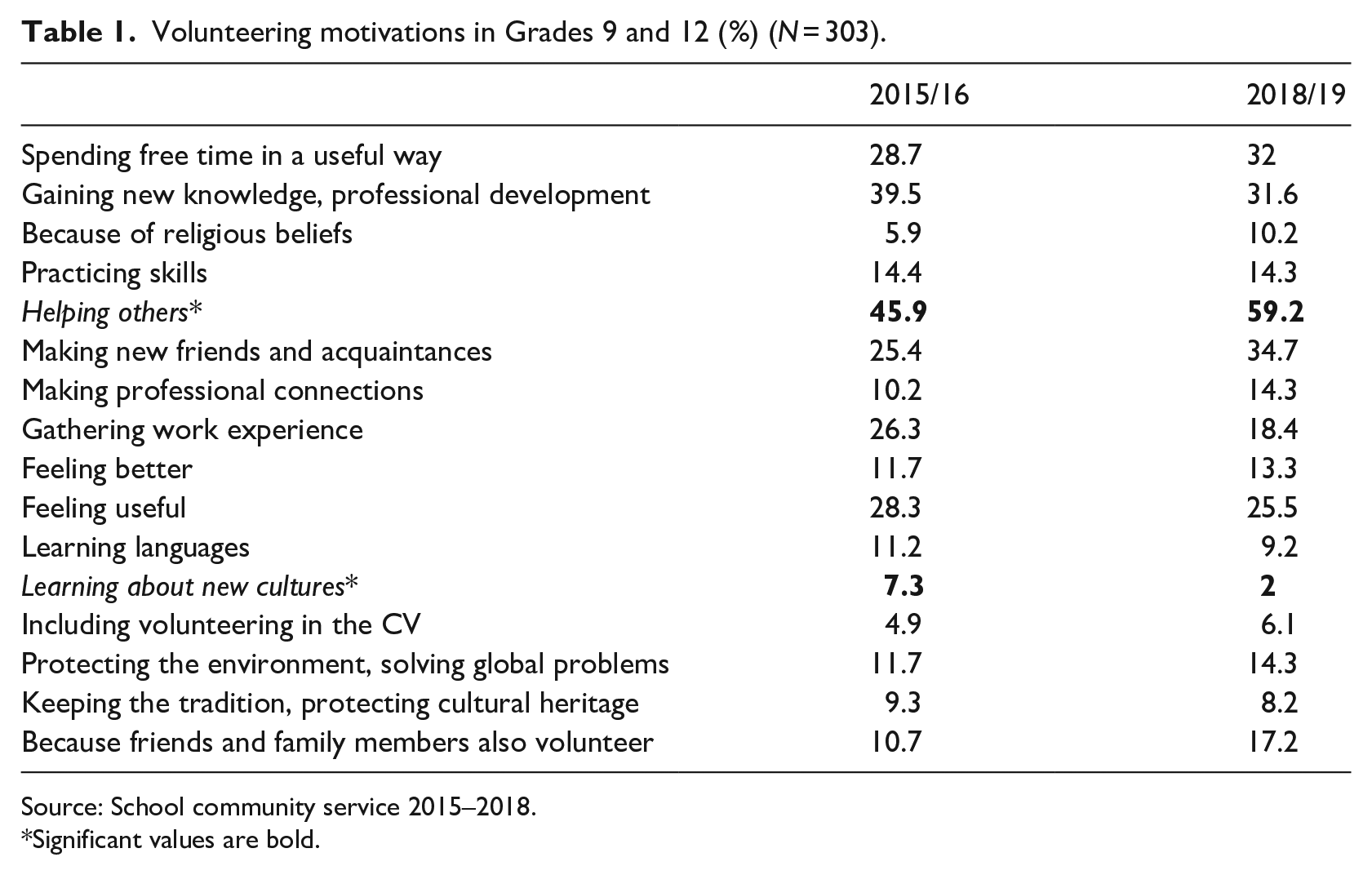
Besides volunteering intentions, we also explored the motivations to do voluntary work among those who had done so (Table 1). In accordance with expectations, the largest increase in volunteering motivations could be observed with respect to helping others. While 45.4% of volunteers in Grade 9 were motivated by helping others, by 2018, 59.2% of volunteers had such motivations. The motivation to learn about new cultures exhibited a change in the opposite direction. In 2016, 7.3% of volunteers had this motivation, in 2018, only 2%.
Volunteering motivations in Grades 9 and 12 (%) (N = 303).
Source: School community service 2015–2018.
Significant values are bold.
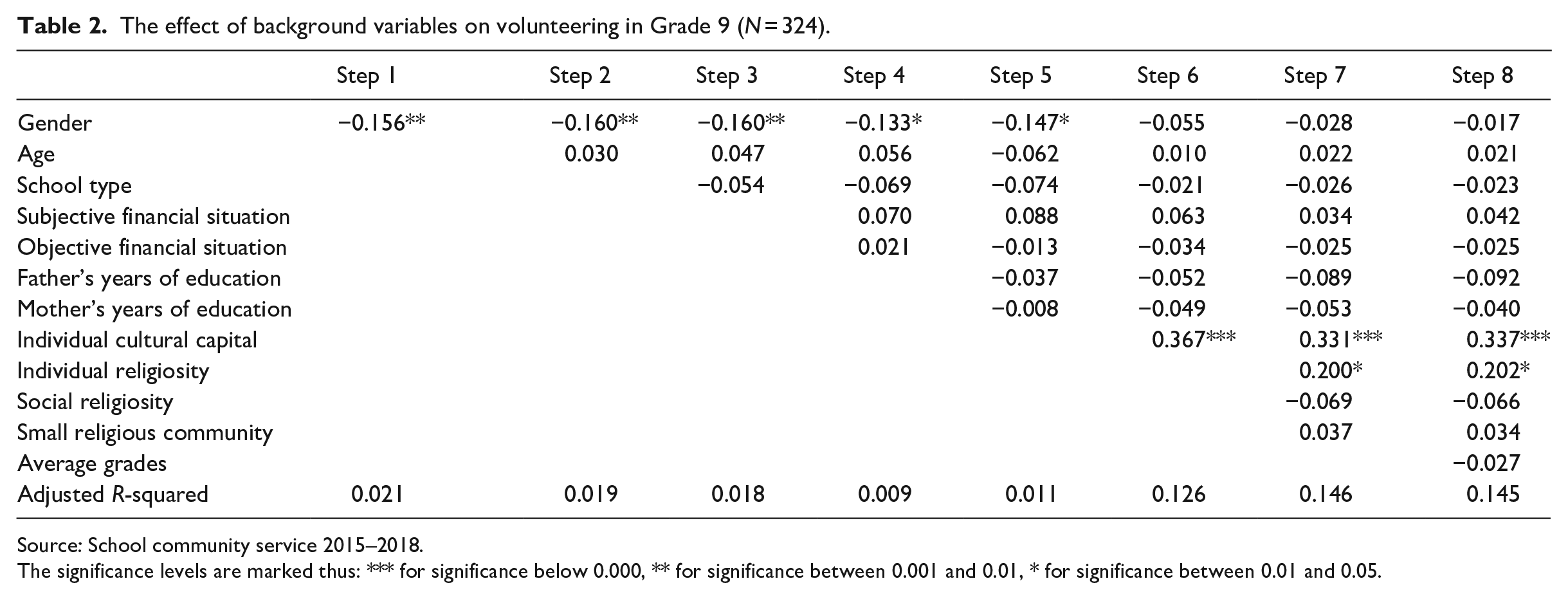
In the following, we analyse the effect of certain background variables on volunteering through the method of linear regression. Table 2 shows that gender, included in the first step, has a positive effect on volunteering, that is to say, voluntary work is more common among females. The place of residence, school type and financial situation have no apparent impact. As regards cultural capital, the mother’s level of education does not affect volunteering, but the individual cultural capital index has a positive influence. As for religiosity, it is individual (personal) religious practice which has a positive effect on volunteering. Average grades, included in the last step, exert no effect on volunteering intentions.
The effect of background variables on volunteering in Grade 9 (N = 324).
Source: School community service 2015–2018.
The significance levels are marked thus: *** for significance below 0.000, ** for significance between 0.001 and 0.01, * for significance between 0.01 and 0.05.
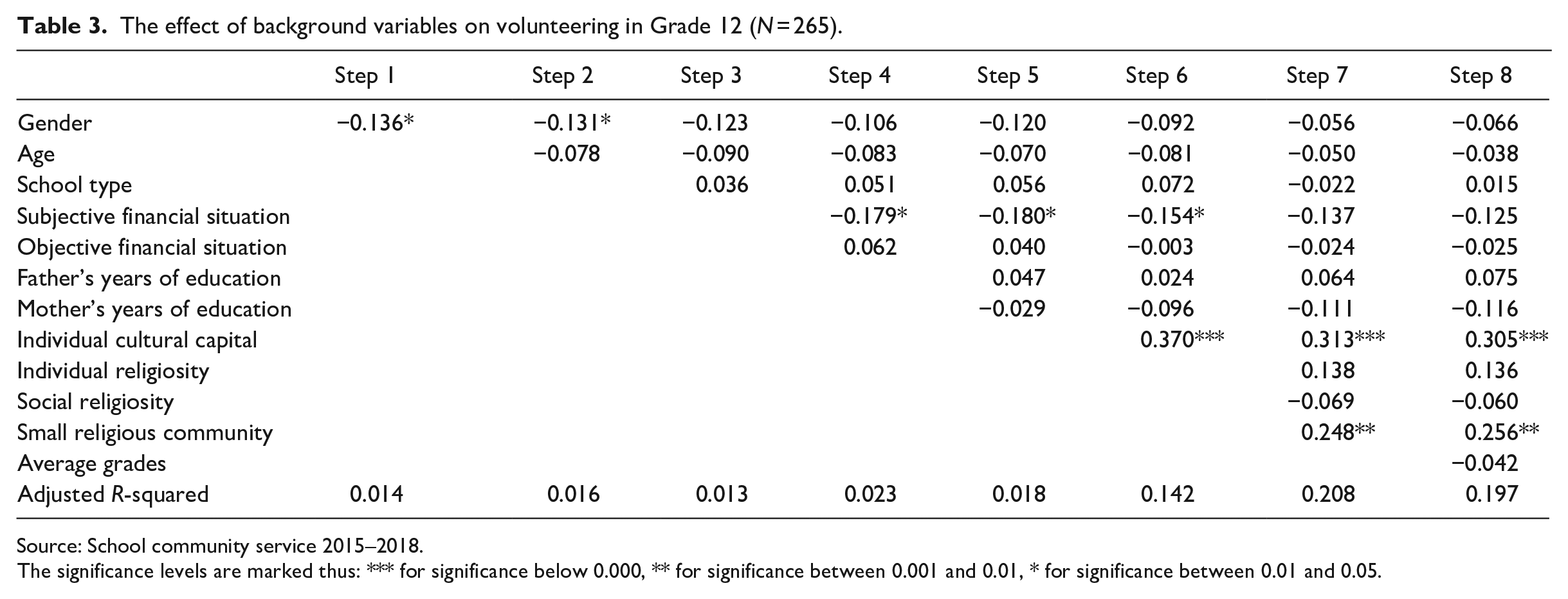
We also examine the effect of background variables on volunteering in Grade 12 (Table 3). As in Grade 9, the effect of gender is also significant among 12th graders, with more females involved in volunteering. The place of residence and school type have no discernible impact; however, the effect of gender disappears when school type is included because females are overrepresented in secondary grammar schools. Attitudes towards volunteering are significantly and negatively influenced by the subjective financial situation: present and future volunteers are more common among students who are worse off according to their subjective evaluation. The parents’ cultural capital does not exert an effect, although students’ individual cultural capital, similarly to findings for Grade 9, has a positive impact. The cultural capital index does not eliminate the effect of subjective financial situation, which implies that volunteering attitudes among 12th graders are influenced both by students’ unfavourable financial situation and higher individual cultural capital. Including variables with respect to religiosity removes the effect of students’ financial situation; the only significant coefficients remain those of individual cultural capital and membership in a small community, which are positive in Grade 12. Average grades, included in the last step, do not have an impact on attitudes towards volunteering.
The effect of background variables on volunteering in Grade 12 (N = 265).
Source: School community service 2015–2018.
The significance levels are marked thus: *** for significance below 0.000, ** for significance between 0.001 and 0.01, * for significance between 0.01 and 0.05.
Discussion
The data reveal that a greater proportion of students did voluntary work before school community service than after it. Presumably, students in Grade 12 had less time for additional volunteering besides school community service. In our previous study on future plans and prospects among young people from the investigated city, we arrived at a similar finding with respect to volunteering. Among the secondary grammar school and secondary vocational school students in Grade 11 who were surveyed in 2015, 35% did voluntary work (Engler et al., 2016).
As regards volunteering in the future, the motivation to do voluntary work did not really change. School community service did not increase the intention for volunteering among those who had not done voluntary work. It seems that school community service in Hungary has a short-term effect: young people are willing to do voluntary work at the recipient organisation for a while, but they do not have long-term volunteering goals after graduation. The effect of school community service on volunteering can be fully explored after multiple years, or among students in higher education, where voluntary activity is indeed voluntary and the pressure of obligation is not present. In our qualitative study on the topic, coordinators of recipient organisations explained that only a small fraction of students remained at the organisation as volunteers (Markos, 2018).
In connection with the motivations for volunteering (Table 1), we observed that the importance of helping others rose significantly from Grade 9 to 12, which is in accordance with our expectations, and that the importance of learning about new cultures diminished. Some researchers (Gonsalkorale et al., 2009; Wilson, 1996) argues that biases towards ethnic, national, and deviant minorities increases with age. The motivation to learn about new cultures may have declined due to other factors besides the biases which increase with age, namely the Hungarian and international consequences of recent global migration processes. Evidently, our hypothesis about the decline in individualistic, egocentric motives (learning about new cultures) and the rise in altruistic motivations (helping others) is corroborated.
The regression analysis (Table 2) revealed that participation in volunteering was more common among females. Findings by Bartal (2009) and the Hungarian Central Statistical Office (2016) also show that the proportion of volunteers in Hungary is higher among women.
The table also highlights that students with considerable cultural capital are likelier to do voluntary work in the present and future. The finding about volunteering chances being elevated by cultural capital is in accordance with the literature (Harflett, 2015). However, the effect of gender seems to disappear when individual cultural capital is included. The literature (DiMaggio, 1982) suggests that female advantage disappears if we control for the fact that females engage in more cultural activity than males (they accumulate more individual cultural capital over the years), which is why they are likelier to do or plan voluntary work.
Individual religious practice had a positive effect on volunteering. This implies that volunteering is increased by altruism, the intrinsic values of moral duty, and the importance of helping others (Fényes, 2015). Paxton et al. (2014) find that private religiosity (e.g. regular praying) has a positive effect on volunteering, and Prouteau and Sardinha (2015) show that those who pray actively do voluntary work in a religious setting more often than in a secular environment. Nevertheless, other researchers argue that it is social religiosity which elevates the propensity for volunteering (Becker and Dhingra, 2001; Ruiter and De Graaf, 2006; van Tienen et al., 2011; Voicu and Voicu, 2003; Wilson and Musick, 1997).
Regression results among 12th graders (Table 3) underscore that gender remains an influential factor in volunteering, which is more common among females. Although the effect that the place of residence and school type have on volunteering is not discernible, the impact of gender disappears when school type is included because the female proportion is higher in secondary grammar schools. According to Hungarian statistical data, the proportion of female students is higher in secondary grammar school, while in secondary vocational schools, males are in the majority (Hungarian Central Statistical Office, 2016).
Our data show that financial situation negatively affects volunteering, that is to say, those who are in an unfavourable financial position, at least according to their subjective assessment, are likelier to do voluntary work in the present and future. This is a finding which is of particular interest because the relationship between individuals’ favourable economic situation and volunteering is unambiguous in the literature (Youssim et al., 2015). Wilson and Music (1998) argue that people who earn a high income have an extensive social network, which allows them to participate in volunteering to a larger extent. In contrast, those in an unfavourable economic position regard volunteering as a luxury, for which they have neither the time nor the opportunity (Plagnol and Huppert, 2010). However, we presume that people from disadvantaged backgrounds may show more solidarity towards those who belong to their own social group or even a more disadvantaged one, which is why they are more willing to do voluntary work. Furthermore, segregation caused people in need to be concentrated in disadvantaged regions, such as such as our investigated counties, thus leaving ample opportunity for helping the less fortunate.
The fifth step of Table 3 highlights that 12th graders’ volunteering attitudes are determined by both their less favourable financial situation and higher individual cultural capital. Wilson and Musick (1997) suggest that volunteering requires social, human, and cultural capital at the same time, although they associate cultural capital with helping others, religious beliefs, and prayer, which could contribute to increasing cultural capital. Bennett and Parameshwaran (2013) find that participation in cultural activities (visiting a theatre, concert, museum or gallery) is an important predictor of young people’s volunteering, while it also has a large influence on civic activity. The authors argue that the relationship between volunteering and cultural activity exists because young people use volunteering as a ‘social advantage’ to distinguish themselves and their favourable social and cultural position in Western European society. According to Harflett (2015), volunteering is a form of cultural participation, since voluntary work requires cultural capital regardless of the field in which it is carried out, including sport and leisure. The importance of motivating those who have lower cultural capital to do voluntary work is also highlighted in the literature as it could contribute to elevating cultural capital (Bennett and Parameshwaran, 2013).
It is an interesting finding that the inclusion of variables for religiosity eliminates the effect of financial situation, and results in two factors which increase volunteering in Grade 12: individual cultural capital and membership in a small religious community. It seems that students who are members of small religious communities in the area are worse off than non-members. The relationship between religiosity and volunteering may be explained by better opportunities for voluntary activities in religious communities, which is why religious people are more involved in helping activities, which they feel obliged to do due to religious teachings. (Fényes and Pusztai, 2012; Storm, 2015). Based on the World Value Survey, Ruiter and De Graaf (2006) conclude that 46% of voluntary work between 1981 and 2001 was carried out at religious organisations.
By comparing volunteering attitudes in Grades 9 and 12, it is evident that the effect of gender (i.e. females are more willing to volunteer) applies only before the inclusion of school type and cultural capital. This is because the proportion of females is higher in secondary grammar schools (where, presumably, more students wish to do voluntary work, although the effect was not significant), and females have higher cultural capital (DiMaggio, 1982). Our data also reveal that individual, that is, acquired cultural capital significantly increases volunteering in both grades. Besides that of cultural capital, the determinative influence of financial situation can also be observed in Grade 12, but only before the inclusion of membership in a small religious community, which has a positive effect. This suggests that small community members are in a worse financial situation, but their membership elevates and motivates them to do voluntary work.
In sum, cultural capital had a discernible effect on volunteering attitudes in Grades 9 and 12. While it was private religiosity which affected volunteering in Grade 9, in Grade 12, it was membership in a small religious community. Presumably, school community service had an impact on members of small religious communities by making them aware of and more determined in the importance of volunteering.
Conclusion
In this study, we investigated whether school community service in Hungary caused students to become more committed to help others, and whether their subsequent volunteering increased. Although studies carried out in higher education show that young people today are characterised by volunteering of modern and mixed motivations, we hypothesised that school community service could shift motivations in the direction of altruism.
Findings from the longitudinal study show that somewhat less than a quarter of students did voluntary work besides school community service, and a similar fraction planned to participate in subsequent voluntary activity. Although we found no evidence for increased propensity for volunteering as a result of school community service, it can be concluded that students were not discouraged from volunteering despite the compulsory nature of the service. In our future research, we intend to follow the willingness to participate in volunteering among students in higher education, where the long-term effect of school community service can be examined more precisely, as it proceeds the completion of the compulsory programme.
We also observed that motivations with respect to volunteering shifted towards altruism, since the motivation to help others rose from Grade 9 to 12. At the same time, the individualistic motive of learning about new cultures significantly diminished. Furthermore, we found that volunteering attitudes are positively affected by high individual cultural capital and religiosity. The positive relationship between religiosity and volunteering is well-documented in the literature; our contribution is the novel finding that community service further elevates the importance of helping others among religious people.
In the future, religious institutions should be encouraged to take a more significant role in the supply side of volunteering as recipient organisations. This would allow students to experience volunteering and the act of helping others, while religious pluralism could also broaden their worldview at the same time. The required 50 hours of community service could be an excellent opportunity for students to familiarise themselves with different recipient organisations and target groups as well as various denominations, which might lend support in achieving the initial goals of school community service.
Footnotes
Declaration of conflicting interests
The author declared no potential conflicts of interest with respect to the research, authorship and/or publication of this article.
Funding
The author received no financial support for the research, authorship and/or publication of this article.
