




Abstract
With climate change and its consequences believed to be among the most vital challenges for humanity and the Earth’s ecosystem, it is important to understand why individuals do or do not adopt proenvironmental attitudes and behaviors. Personality traits are well suited for this purpose. Because no recent work has systematically combined the accumulating evidence on this topic, we aimed to meta-analyze the associations of the Big Five and HEXACO personality domains with proenvironmental attitudes and behaviors. A meta-analysis of 38 sources (N = 44,993) implicated openness and honesty-humility as the strongest correlates of proenvironmental attitudes (r = .22 and .20) and behaviors (r = .21 and .25). Agreeableness, conscientiousness, and, to a lesser extent, extraversion were also associated with proenvironmental attitudes (r = .15, .12, and .09) and behaviors (r = .10, .11, and .10). Heterogeneity among effect sizes was partly explained by samples’ gender ratio, age, and country of origin and by the personality model. P-curve analyses, funnel plots, and Egger’s tests indicated significant but sporadic and small publication bias. As a validity test, the meta-analytic associations collectively provided substantial predictive accuracy for proenvironmental attitudes (r = .44–.45) and behaviors (r = .28–.43) in independent holdout samples.
Climate change is increasingly accepted as one of the most—if not the most—important global challenge (Hilbig, Zettler, Moshagen, & Heydasch, 2013; Nisbet, Zelenski, & Murphy, 2009; Otto, Kaiser, & Arnold, 2014; Poškus & Žukauskienė, 2017). Consensus reports suggest drastic changes to Earth’s ecosystems (e.g., Intergovernmental Panel on Climate Change, 2018; Klein, Hilbig, & Heck, 2017; United Nations Environment Programme, 2019), such as large (0.7–1.2 m) rises in sea levels by the end of the 21st century (Horton, Rahmstorf, Engelhart, & Kemp, 2014). Although climate change is a universal problem, attitudes and behaviors linked to it and its avoidance differ widely among people and groups (e.g., Crippa et al., 2019; Schmidt, Krauth, & Wagner, 2017). Nonpsychological factors such as wealth, urbanization, household size, and age can explain some of the differences (e.g., Cole & Neumayer, 2004; Dietz & Rosa, 1997; Shi, 2003); for example, wealthier people can consume more and thereby have a larger environmental footprint. However, there may also be psychological reasons for why we, as a species, have pursued and continue to pursue behaviors that contribute to climate change.
Psychological Correlates of Proenvironmental Attitudes and Behavior
Proenvironmental attitudes can be defined as one’s tendency to exhibit a degree of favor toward the natural environment (e.g., one’s connection to nature, defining one’s self as an environmentalist, environmental awareness, intention to recycle). Proenvironmental behaviors can be described as concrete actions (including the behavior of not taking an action), whether deliberate or not, that positively affect the natural environment (e.g., recycling, purchasing organic products, water or energy reduction; Lange & Dewitte, 2019). There is a robust empirical link between such attitudes and behaviors (Bamberg & Möser, 2007; Klöckner, 2013), with a typical correlation just under .40 (Hines, Hungerford, & Tomera, 1987). An association of proenvironmental attitudes with proenvironmental behaviors is in accordance with multiple psychological models that postulate a link between attitudes and behaviors (e.g., Theory of Planned Behavior; de Leeuw, Valois, Ajzen, & Schmidt, 2015; Value-Belief-Norm model; Kaiser, Hübner, & Bogner, 2005). Attitudes, however, are not the only psychological antecedents of proenvironmental behaviors.
A wealth of research has examined social and psychological factors that could influence proenvironmental behaviors, either via attitudes or directly (Hilbig et al., 2013; Hirsh, 2010). In the first meta-analysis on this topic (Hines et al., 1987), a number of psychosocial variables were associated with proenvironmental behaviors, including not only proenvironmental attitudes (r = .35) but also locus of control (r = .37), personal responsibility (r = .33), economic orientation (r = .16), and verbal commitment (r = .49), all values corrected for sampling and instrument variability. A second meta-analysis, undertaken 20 years later (Bamberg & Möser, 2007), replicated the association of proenvironmental behaviors with proenvironmental attitudes (r = .42) and reported associations with perceived behavioral control (r = .30), internal attribution (r = .24), and intention to act (r = .52). Other factors associated with proenvironmental behaviors included problem awareness (r = .19), adherence to social (r = .31) and moral norms (r = .39), and generalized feelings of guilt (r = .30).
Personality Traits and Proenvironmental Attitudes and Behaviors
That psychological characteristics, such as feeling in control, internal attribution, adherence to social norms, and feeling guilty, are associated with proenvironmental behaviors suggests potential links between personality and proenvironmental attitudes and behaviors. Personality, defined as “the characteristic pattern of thoughts, feelings, and behaviors exhibited by individuals” (American Psychological Association, 2019), forms a core part of one’s motivations, beliefs, values, and attitudes and is therefore likely to be a powerful and ubiquitous antecedent for differences in individuals’ proenvironmental attitudes and behaviors (Karbalaei, Abdollahi, Momtaz, & Talib, 2014). For example, an individual’s impact on the environment typically involves a variety of behaviors enacted across a wide range of situations and repeated over extended periods of time (Markowitz, Goldberg, Ashton, & Lee, 2012); this patterning of behavior is what personality research examines. Less commonly but perhaps of equal importance, the personality traits and associated attitudes of a few powerful individuals may have substantial and lasting effects on climate policies.
In addition to the few personality characteristics considered in these earlier meta-analyses, researchers have started to link proenvironmental attitudes and behaviors with a wider range of personality traits (Hirsh, 2010, 2014; Klein, Heck, Reese, & Hilbig, 2019; Markowitz et al., 2012; Milfont & Sibley, 2012), often assessed using the five-factor model (McCrae & John, 1992), or the Big Five (Goldberg, 1990), which use five broad domains: emotional stability (neuroticism), extraversion, openness, agreeableness, and conscientiousness. We refer to these domains as the Big Five throughout. The six-factor HEXACO personality-trait model (Ashton & Lee, 2007) is also increasingly being used; this model adds the honesty-humility domain to the Big Five (which is related to agreeableness and conscientiousness in the Big Five; Lee, Ashton, Choi, & Zachariassen, 2015). HEXACO extraversion, conscientiousness, and openness are very similar to their equivalents in the Big Five (Lee et al., 2015), whereas agreeableness and emotionality slightly differ from their Big Five counterparts (Ashton, Lee, & de Vries, 2014; Lee et al., 2015).
Among the Big Five and HEXACO domains, openness has been reported to have the most systematic correlation with proenvironmental attitudes and behaviors (Brick & Lewis, 2016; Hirsh & Dolderman, 2007; Markowitz et al., 2012; Nisbet et al., 2009; Soliño & Farizo, 2014). Results for the other personality domains have been less consistent (Brick & Lewis, 2016; Hirsh, 2014; Kvasova, 2015; Lee et al., 2015; Markowitz et al., 2012; Milfont & Sibley, 2012). So far, however, no comprehensive meta-analysis has been conducted on these associations despite the fact that the meta-analysis is one of the best tools psychologists can use to synthesize and present research findings (Maki, Cohen, & Vandenbergh, 2018). The earlier meta-analyses (Bamberg & Möser, 2007; Hines et al., 1987) focused only on selected specific personality traits such as locus of control, personal responsibility, feelings of guilt, and economic orientation. They did not address traits commonly used in current personality research such as the domains of the Big Five and HEXACO.
Possible Implications of Personality Traits
A global issue such as climate change, for which policymakers may propose large-scale interventions such as rewarding proenvironmental behaviors, requires a strong evidence base. Policymakers are therefore increasingly looking toward the social sciences for strategies to combat environmental issues (Maki et al., 2018). An understanding of the psychological factors related to proenvironmental attitudes and, ultimately, behaviors, may allow policymakers to design more effective policy and interventions that target specific barriers to desired outcomes. Among other applications, such knowledge can help to target more specific population subgroups or frame proenvironmental interventions in ways that accommodate the domains of those who are otherwise the least likely to behave in desired ways.
For example, low openness is reflective of a relatively smaller and less flexible repertoire of cognitive and behavioral strategies. Therefore, if low openness is a barrier to proenvironmental behavior, effective interventions may focus on facilitating the adoption of new, more environmentally friendly cognitive and behavioral strategies and lowering the barrier to modifying people’s behavioral repertoires rather than trying to frame the desired behavior as a moral imperative. If domains such as low agreeableness and honesty-humility are involved, interventions framing desired behaviors as being morally and socially justified may not be effective because individuals with low scores on measurements of these domains may be less likely to care about these attributes. Instead, strategies highlighting ways in which it is personally profitable to change behavior, at least in the long run, may be more effective. If low conscientiousness appears to be a barrier to proenvironmental behavior, interventions may focus on making desired behaviors easier to enact; again, tapping into people’s sense of duty, characteristic of high conscientiousness, may prove less effective.
The associations of personality traits with proenvironmental attitudes and behaviors are also theoretically important. For example, they can hint at the degree to which these outcomes are tied to more temperamental characteristics of individuals as opposed to extrinsic factors. Of course, even if these attitudes and behaviors can, to a substantial degree, be explained by personality traits, this does not mean that they are immutable. Rather, these associations with personality traits may point to underlying motives that support and sustain existing attitudes and behaviors, as well as suggest ways to improve the effectiveness of communication of intended messages, thereby using people’s personality traits to help guide their behavior rather than changing the traits. More abstractly, knowing the domains of life in which personality plays out helps us to better understand the consequences of personality.
Current Study
Given the value of knowing how basic personality traits are linked with proenvironmental attitudes, and ultimately behavior, combined with the current paucity of integrative research efforts to this effect, we carried out a comprehensive meta-analysis on this topic. Routinely relying on meta-analytic databases and dynamically updating them can help social scientists to best summarize and communicate the state of research to policymakers (Maki et al., 2018). In collating available findings on the associations between the Big Five and HEXACO personality domains with proenvironmental attitudes and behaviors, we expected the strongest associations for openness; somewhat weaker associations for agreeableness, honesty-humility, and conscientiousness; and no consistent associations for extraversion or neuroticism. Because associations of personality traits with proenvironmental behaviors are at least partly mediated by proenvironmental attitudes, we expected the personality correlates of the latter to be similar to the former in configuration but stronger in magnitude. This is because attitudes are more proximal to personality traits than behaviors in the case of such mediation.
Method
Literature search
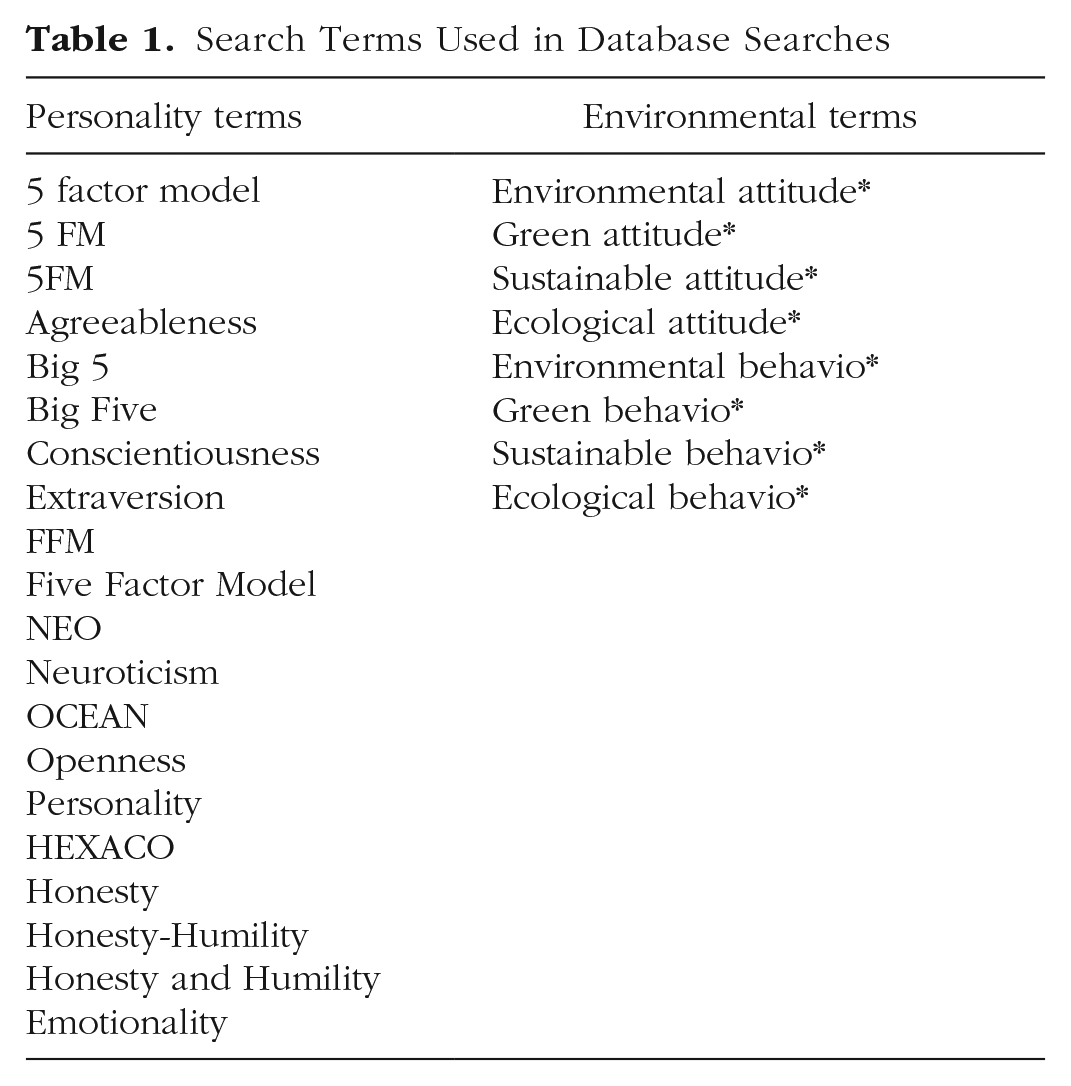
A literature search of quantitative associations of personality domains with proenvironmental attitudes and behaviors was conducted. Studies were located using the electronic databases PsycINFO, PsycARTICLES, and Web of Science Core Collection. The search terms are shown in Table 1. All personality terms were entered with the Boolean operator OR. The terms pertaining to proenvironmental attitudes and behaviors were also combined with OR. The personality terms were combined with the environmental terms with the Boolean operator AND. For PsycINFO the options of “English language” and “all articles” were selected. Likewise, the options of “articles” and “English” were selected for the Web of Science Core Collection. Furthermore, the environmental terms were enclosed in quotes to keep the term as one. PsycARTICLES does not provide options for language or type of resource. The search consisted of all articles indexed during a search conducted on May 31, 2019.
Search Terms Used in Database Searches
This database search was supplemented by a search using Google Scholar. A reduced number of terms were used for this search because Google Scholar does not have the advanced search functionality that other databases do in relation to combining multiple search terms. We used the search phrase “personality AND environmental behaviour OR environmental behavior OR environmental attitude.” The Google Scholar search was also conducted on May 31, 2019. Only the first 20 pages were used as part of this literature search, as subsequent results were not deemed relevant. Last, any references to other potentially relevant sources in the articles included by the previously described methods were examined, and this was repeated for any other articles that were discovered in this manner. Finally, data from A. R. B. Soutter’s Master’s degree research were incorporated (Soutter, 2015).
Inclusion and exclusion criteria and coding rules
Several inclusion criteria were applied when reading the abstract, method, and results sections of the articles identified in the literature search. First, only journal articles or unpublished manuscripts were retained, which excluded books. This was done to ensure sources were predominantly peer-reviewed and because books are often not available online. Second, all sources must have been empirical studies; theoretical or review articles were not included. This was done because the quantitative data that are required for a meta-analysis cannot be extracted from these latter types of articles. Third, all studies needed to measure at least one personality domain from the Big Five or the HEXACO model and at least one measure of proenvironmental attitude or proenvironmental behavior. This inclusion criterion meant that we excluded articles using traits named similarly to the Big Five or HEXACO domains (e.g., extraversion) that were not measured using a Big Five or HEXACO instrument per se. For example, Wiseman and Bogner (2003) examined extraversion and neuroticism using the Eysenck personality model. Similar examples include Borden and Francis (1978) and Ray (1980).
Furthermore, dietary habits (i.e., veganism and vegetarianism) alone were not included as a proenvironmental attitude or behavior because of their potential ambiguity with respect to environmentalism. Although dietary habits were a part of several scales of proenvironmental behavior (e.g., Brick & Lewis, 2016), these habits were included only if they were part of a greater set of proenvironmental constructs. A proenvironmental attitude was operationalized as any measure that examined valuations of, or intentions to act on, any explicitly environmental issue (excluding veganism/vegetarianism not otherwise elaborated). A proenvironmental behavior was operationalized as any measure that examined actual actions (not intention), whether self-reported or observed independently. A full list of the attitude and behavior measures can be found on the Open Science Framework at https://osf.io/jky45. Fourth, the analyses had to be conducted at the individual level and not community or national level. Finally, studies were included only if they reported correlation coefficients for associations between personality and environmental attitudes and/or behaviors. For those articles that did not include correlation coefficients (k = 37), the first/corresponding author was contacted to request the correlations. Ten of these authors provided useable correlations.
Effect sizes
Pearson product-moment correlations were used as the effect sizes but were transformed via Fisher’s r-to-Z transformation for analysis (Hedges & Olkin, 1985).
Coding
A Pearson product-moment correlation coefficient was extracted (or requested from authors) from each source as well as the sample size on which the correlation was based; standard errors for the correlations were calculated according to the standard formula based on effect and sample sizes. The personality model (Big Five or HEXACO) used to assess personality and the measure used to assess attitudes or behaviors were recorded. Where possible, the mean age and its standard deviation, percentage of women, country of origin, and educational level (coding copied from respective studies and thus no consistent coding) of participants were recorded. Country of origin was grouped into Northern America, Asia, Europe, Australia and New Zealand, and “mixed” on the basis of geographic region. Russia and Turkey were ambiguous, existing territorially on both the Asian and European continents. For this study both were coded as European countries. All coding was conducted by A. R. B. Soutter.
Statistical analyses
Initial coding was completed in Microsoft Excel, and the data were imported into RStudio (Version 3.5.0; RStudio Team, 2015). Calculations of standard error and Fisher’s r-to-Z transformations were conducted first. Meta-analyses were conducted using the metafor package (Viechtbauer, 2019). Meta-analyses were conducted to examine the association between each of the Big Five and HEXACO’s domains and proenvironmental attitudes and behaviors separately using the rma.uni() function of metafor. Put simply, a meta-analysis combines the results of multiple studies to create a pooled effect. This involves weighting individual effect sizes by their precision (i.e., standard error), which in turn reflects factors such as measurement precision and sample size. The nonindependence of multiple indicators from the same study can also be taken into account. For a more thorough understanding see Borenstein, Hedges, Higgins, and Rothstein (2011). Forest plots were used to depict effect sizes of individual studies (see the Supplemental Material available online). Evidence of publication bias was examined using multiple indicators: funnel plots in the first instance, Egger’s test for asymmetry, and p-curve analyses using p-curve function (Version 4.06; Simonsohn, Nelson, & Simmons, 2017). Further exploratory analysis testing for potential moderation was conducted using the rma.uni() function of the metafor package, with bootstrapped confidence intervals using 10,000 iterations.
The ultimate indication of the predictive power of personality traits is their usefulness in predicting yet unmade observations about the outcome of interest. We tested this using ideas from machine learning. Briefly, Yarkoni and Westfall (2017) argue that, to date, psychological models have been valued more by their ability to explain the same data in which the models are fitted rather than their ability to predict beyond these data. But because any data set and models fitted therein contain a combination of true associations, sampling error, and idiosyncrasies related to researchers’ methodological and analytical choices (researcher degrees of freedom), psychological models tend to be overfit to particular sets of data. Because these models can mistakenly interpret sample-specific and methodology-specific idiosyncrasies as true associations, these models may perform poorly in new data with different idiosyncrasies. To mitigate this possibility, Yarkoni and Westfall suggest using elements from machine learning. This can be done by performing an initial analysis to “train” a model in one data set and subsequently testing the performance of this model to predict associations in another holdout data set.
In the current study, this approach was implemented by first performing the meta-analysis, as described above, and subsequently using the meta-analytically derived associations of personality traits to predict proenvironmental attitudes and behaviors in holdout data sets not included in the meta-analysis. This was done by multiplying standardized personality scores in the holdout data sets by meta-analytic regression coefficients to create predicted (from personality traits) attitude and behavior scores. In the holdout data sets the proenvironmental attitude scales were standardized and averaged to create an overall proenvironmental attitude score; this was similarly done for proenvironmental behaviors. The predicted attitude and behavior scores were then correlated with measured attitude and behavior scores in these holdout data sets, quantifying how well personality traits predicted attitudes and behavior, free of possibly distorting effects of sampling bias and methodological quirks of particular studies (the meta-analysis relied on a diverse set of measures for each construct and the holdout sample used another set). Among other positive aspects of these analyses, this helps to satisfy the assumption that statistical associations are independent of a particular measure used to test them (Mõttus, 2016) and controls for the overlaps among the predictors, which may unduly inflate their bivariate associations with the outcomes.
Results
Data and analysis
The data used in this study and the code used to generate the results can be found on the Open Science Framework at https://osf.io/jky45.
Literature overview
A total of 58 relevant journal articles and one unpublished PhD dissertation were found in the literature search. Of these, 22 journal articles were rejected either because (a) the required correlations did not exist and were not provided by authors or (b) the data had also been used in another study already included in the meta-analysis. In the latter case, results from the study with the larger sample size were included in the meta-analysis to maximize power. To this set of 36 journal articles and the unpublished PhD dissertation, data from A. R. B. Soutter’s Master’s degree research project were added, yielding a total of 38 sources of data.
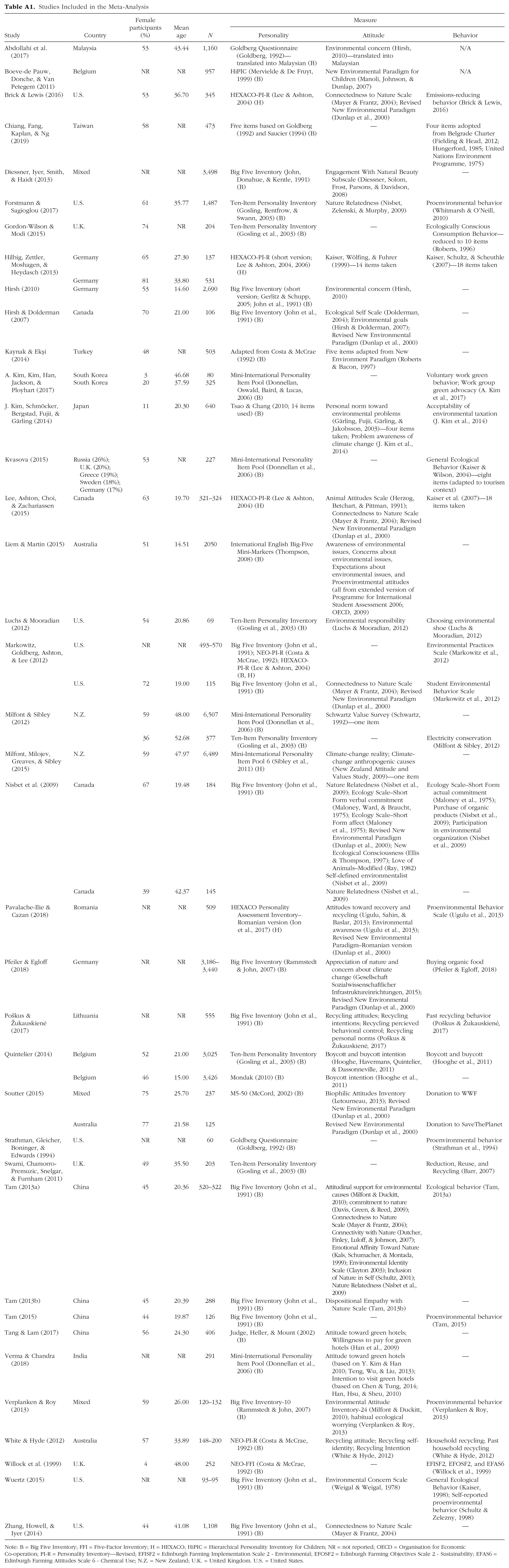
In 30 of the 38 sources, authors had collected their own data, amounting to 34 author-collected data sets (some sources ran multiple studies). The remaining eight sources used existing data sets for a total of 9 separate existing data sets (some sources ran multiple studies with different existing data sets whereas others used the same existing data set). In sum, these sources included data from 44,993 individuals, of which 11,813 were from the 34 author-collected data sets and 33,180 were from the 9 existing data sets. Where a study noted multiple sample sizes within a single data set (k = 7), the highest sample size was used for reporting. See Appendix A for a summary of the studies used in the meta-analysis. Most studies were conducted in Europe (32%, k = 12, N = 16,659), followed by North America (26%, k = 10, N = 4,608), Asia (24%, k = 9, N = 4,111), Australia and New Zealand (13%, k = 5, N = 15,748), and in mixed regions (8%, k = 3, N = 3,867). One source included two studies with different country samples (which is why k sums to 39 rather than the 38 sources stated above).
The articles meeting inclusion standards used a wide range of proenvironmental attitudes and behaviors. We recorded 61 measures of proenvironmental attitudes and 35 measures of proenvironmental behaviors. At times these measures were slightly different versions of the same scale, but the number of scales is indicative of the breadth of proenvironmental attitude and behavior measures studied. Measures varied in length from single-item measures (“Is climate change real?” or “Have you donated to an environmental charity?”) to longer measures of broader constructs such as one’s connection to nature, as measured by the Connectedness to Nature Scale (Mayer & Frantz, 2004), or scales that assess a variety of behaviors ranging, for example, from recycling to financial contributions (e.g., see Kaiser, Schultz, & Scheuthle, 2007). Measurements of behavior covered different categories as defined by Lange and Dewitte (2019), although they were predominantly self-reported. This breadth of measurement allows the results of the meta-analysis to be generalized across a variety of attitudes and behaviors rather than being restricted to specific scales (see Mõttus, 2016). Because of their diversity, this may be particularly important with regard to measuring personality traits’ relationships with proenvironmental attitudes and behaviors (Lange & Dewitte, 2019). A full list of the proenvironmental attitudes and behaviors included in this meta-analysis can be found on the Open Science Framework at https://osf.io/jky45.
Publication biases
Funnel plots were used to identify publication bias by plotting effects against their standard errors to examine whether there was a trend for effect sizes as a function of standard errors (e.g., less precise studies reporting stronger associations). Egger’s tests were also performed to indicate potential strengths of these publication biases. We used p-curves (i.e., the distributions of p values) to examine whether significant results indicated a true effect or could have resulted from p hacking or publication bias (Simonsohn, Nelson, & Simmons, 2014). If an effect is true these distributions tend to be skewed to the right, nonexistent effects tend to yield a flat line, and p hacking leads to a skew to the left whereby p values close to common thresholds are most common (Simonsohn, Simmons, & Nelson, 2015). The funnel plots and p-curves can be found in the Supplemental Material. To briefly summarize, p-curve analyses found that there was no indication of potential p hacking, except for the association between neuroticism and behavior.
The funnel plots supported by Egger’s test showed little publication bias. Occasional evidence for biases showed a sporadic pattern, and it is therefore unlikely that there was strong overall evidence for systematic publication bias. Although there was some skew on a few graphs, only agreeableness and conscientiousness’ association with behaviors and honesty-humility and openness’ association with attitudes suggested some publication bias.
Main effects
A summary of the meta-analytic associations between personality domains and proenvironmental attitudes and behaviors is presented in Table 2.
Summary of Main Effects
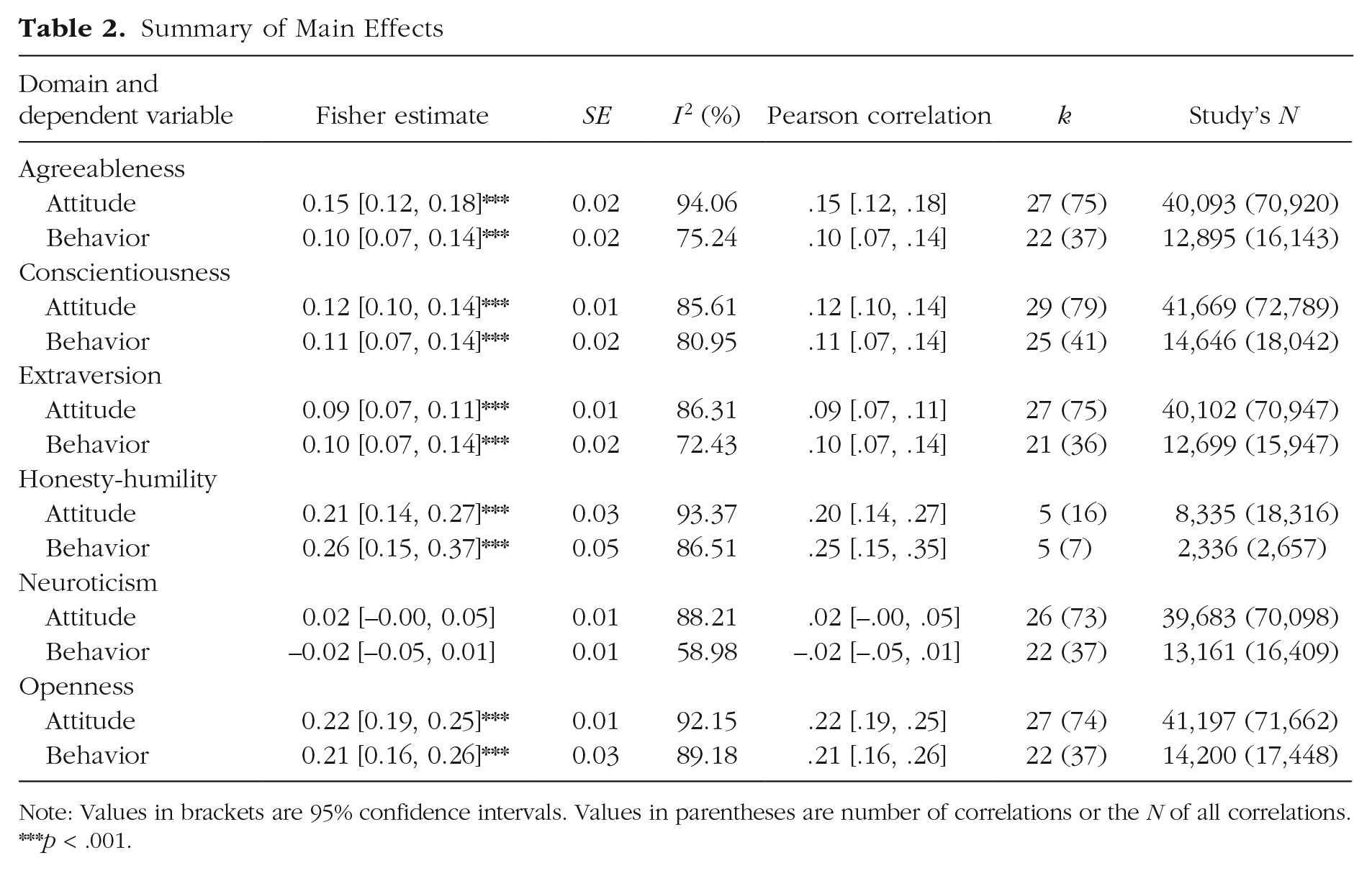
Note: Values in brackets are 95% confidence intervals. Values in parentheses are number of correlations or the N of all correlations.
p < .001.
Our initial analysis mapped similarly named HEXACO domains to their corresponding Big Five domains. The HEXACO honesty-humility domain was not matched with any Big Five domain but analyzed independently. This grouping ensured that the simplest model, treating trait scores exchangeably regardless of their specific model, could be examined first. However, a flag for the personality model was retained as a differentiating column in the data set, making it possible in subsequent moderation analyses to differentiate results on the basis of the personality model.
In line with our prediction, openness had the strongest association with proenvironmental attitudes, r (k = 27) = .22, p < .001. Unpredictably, however, honesty-humility had a similarly strong association, r (k = 5) = .20, p < .001. As predicted, agreeableness, r (k = 27) = .15, p < .001, and conscientiousness, r (k = 29) = .12, p < .001, had weaker associations. Neuroticism was also consistent with the prediction of a nonsignificant association with proenvironmental attitudes, r (k = 26) = .02, p = .082, although extraversion had a small but significant association, r (k = 27) = .09, p < .001.
Similar associations were found for proenvironmental behavior. We had predicted that the effect sizes would generally be smaller for behaviors than attitudes because the latter could be thought of as a more proximal variable (mediator) to the former. A visual inspection demonstrated that this marginally applied to three of the domains linked with attitudes (agreeableness, conscientiousness, and openness), whereas honesty-humility, r (k = 5) = .25, p < .001, and extraversion, r (k = 21) = .10, p < .001, had a somewhat stronger association with proenvironmental behavior than with attitudes, and for neuroticism the effect sizes were identical.
Moderator analysis
Because of the high heterogeneity in the main effects, indicated by high I2 values, we conducted an exploratory analysis of the possible moderating role of the personality model used to operationalize personality (Big Five vs. HEXACO) as well as the demographic variables of age, gender, and country of origin. The analyses for age and gender were performed in a subset of data because 17 studies did not report the age of participants and 13 did not report gender distributions. There were no specific hypotheses regarding moderation. Caution must be taken when interpreting these moderations because other study characteristics may covary with the moderating variables in question. This is compounded by some moderation analyses having a small number of observations.
The first moderation analysis was conducted to address the role of the personality model, as combining similarly named constructs of the Big Five and HEXACO can be problematic (e.g., Ashton & Lee, 2007; Ashton et al., 2014; Lee et al., 2015). For moderation by personality model, the results revealed an inconsistent pattern (see Appendix B). There was no difference between the HEXACO and Big Five models for conscientiousness’ association with proenvironmental attitudes, QB(1) = 0.95, p = .330, or behaviors, QB(1) = 1.57, p = .210. For agreeableness there was no difference for behaviors, QB(1) = 0.43, p = .514, but there was a moderating effect for attitudes, QB(1) = 8.59, p = .003. The HEXACO agreeableness was not significant, r (k = 5) = .07, p = .051, whereas the Big Five agreeableness had a significant association, r (k = 22) = .17, p < .001. For neuroticism, there was no difference for behaviors, QB(1) = 0.37, p = .543, but there was one for attitudes, QB(1) = 24.22, p < .001. HEXACO neuroticism (emotionality) had a significant association with attitudes, r (k = 5) = .11, p < .001, but the Big Five neuroticism did not, r (k = 21) = −.01, p = .548. No difference was found for the association of attitudes with openness, QB(1) = 1.63, p = .202, but the association of behaviors was moderated by personality model for openness, QB(1) = 19.05, p < .001. The HEXACO domain had a stronger association with behaviors for openness, r (k = 5) = .39, p < .001, than the Big Five, r (k = 18) = .17, p < .001. Last, for extraversion there was no difference for behaviors, QB(1) = 2.76, p = .096, but one for attitudes, QB(1) = 3.99, p = .046. HEXACO extraversion had a significant association with attitudes, r (k = 5) = .05, p = .037, as did neuroticism in the Big Five, r (k = 22) = .10, p < .001.
Age (see Appendix C) was a moderating factor only for the relationship between agreeableness and Behavior, QB(1) = 3.94, p = .047. As the mean age of the sample increased, the association between agreeableness and Behavior increased. Gender was a partial moderator of the associations of proenvironmental attitudes with agreeableness, QB(1) = 6.44, p = .011, and conscientiousness, QB(1) = 6.07, p = .014 (see Appendix D). Specifically, for agreeableness the association was smaller in the meta-analysis of samples with an above-median proportion of female participants, r (k = 21) = .02, p = .721, than in samples with a below-median proportion of female participants, r (k = 21) = .34, p = .011; the same applied to conscientiousness, r (k = 22) = .02, p = .589, and r (k = 22) = .23, p < .001, respectively. Gender also moderated the association of proenvironmental behaviors with openness, QB(1) = 9.30, p = .002; a higher proportion of female participants yielded a stronger association, r (k = 16) = .32, p < .001, than a lower proportion of female participants, r (k = 16) = .04, p = .460. Neither of the moderations were statistically significant after Bonferroni corrections for multiple testing except for openness and proenvironmental behavior.
The sample’s country of origin was a moderator of the association of proenvironmental attitudes with agreeableness, QB(4) = 24.67, p < .001, conscientiousness, QB(4) = 25.75, p < .001, extraversion, QB(4) = 35.68, p < .001, honesty-humility, QB(2) = 42.12, p < .001, and openness, QB(4) = 11.77, p = .002 (see Appendix E). Specifically, samples from Asia had stronger associations with agreeableness, r (k = 5) = .29, p < .001, conscientiousness, r (k = 5) = .22, p < .001, and extraversion, r (k = 5) = .19, p < .001. For honesty-humility, Australian and New Zealand samples had a nonsignificant association, r (k = 1) = −.03, p = .399. For openness, the association was the strongest in North American samples, r (k = 9) = .26, p < .001. Country of origin was also a moderator for the association between proenvironmental behaviors and honesty-humility, QB(1) = 7.36, p = .007, as well as openness, QB(4) = 16.26, p = .003. Specifically, in North American samples, the association was weaker for honesty-humility, r (k = 3) = .17, p = .001, and Asian samples had a nonsignificant association for openness, r (k = 4) = .08, p = .125.
Prediction of proenvironmental behavior
Finally, we set out to control for overfitting of the associations in individual samples, possible systematic effects of publication biases (which tend to inflate associations), and overlaps among personality domains, as well as to ensure that the meta-analytic effects indeed have predictive value for proenvironmental attitudes and behaviors (Yarkoni & Westfall, 2017). For this, we used the Big Five’s meta-analytic coefficients to predict proenvironmental attitudes and behaviors in two unpublished holdout data sets that we had previously collected and that were not included in the meta-analysis. In both data sets (N = 499, mean age = 40.40 years, 60.9% female; N = 287, mean age = 27.23 years, 72.1% female), Big Five personality domains were measured using the 120-item International Personality Item Pool scales (Johnson, 2014), whereas proenvironmental attitudes and behaviors were measured with various instruments (Table 3). In addition to scores on individual scales, combined scores for both proenvironmental attitudes and behaviors were created within each data set by standardizing scores of different scales measuring these constructs and calculating their averages. Specifically, the standardized Big Five scores in these two data sets were multiplied by corresponding domains’ meta-analytic associations (for the Big Five–based instruments) with either proenvironmental attitudes or behaviors and subsequently summed, yielding predicted (from the Big Five) proenvironmental attitude and behavior scores for each individual. These predicted scores were then correlated with the measured scores of proenvironmental attitudes and behaviors. Such predictive model “training” (meta-analyses) and “validation” (correlations between predicted and observed scores) in independent participants (and even using disparate measures for the same constructs) is more common in standard machine learning, where it has been shown to mitigate potential effects of sampling biases, instrument biases, and researcher degrees of freedom. This can be thought of conceptually as a very thorough test of the degree to which personality is linked with proenvironmental attitudes and behaviors.
Prediction of Proenvironmental Attitudes and Behaviors
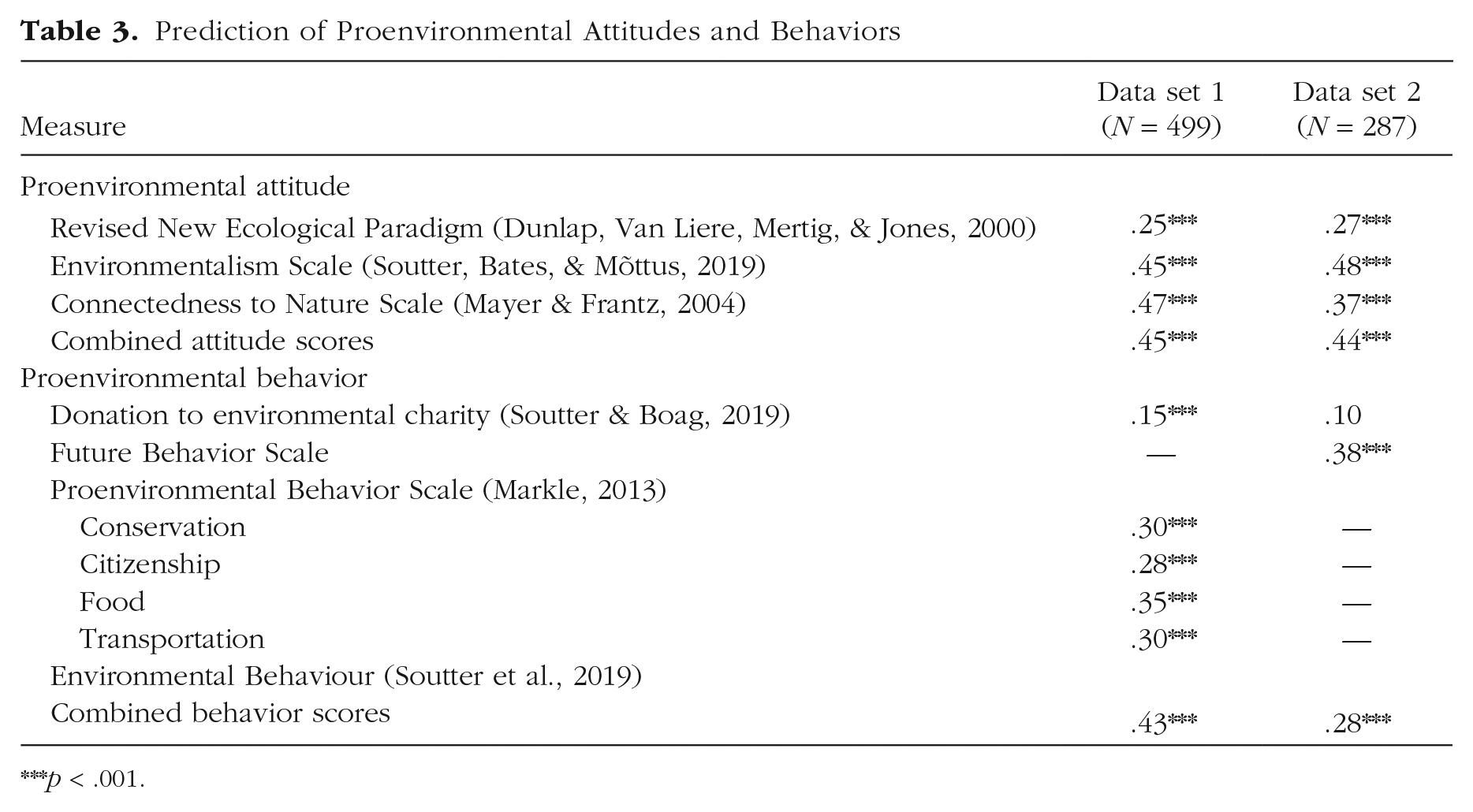
Note: ***p < .001.
The Big Five-predicted proenvironmental attitude and behavior scores correlated substantially with overall proenvironmental attitudes (r = .44–.45) and behaviors (r = .28–.43). There were some differences across the particular attitude or behavior measures, but as a whole the correlations were sizable and significant for all attitude measures and for most behavior measures. A summary of the results can be found in Table 3.
Discussion
This meta-analysis examined quantitative evidence for associations of major personality domains with proenvironmental attitudes and behaviors, collating data from 44,993 participants from 38 sources representing at least 19 countries across 4 continents. Openness and honesty-humility had sizable (r ~ .20) associations with both proenvironmental attitudes and behaviors, whereas somewhat weaker associations emerged for agreeableness, conscientiousness, and extraversion. Neuroticism had no significant associations with either proenvironmental attitudes or behaviors. Collectively, the Big Five domains allowed the prediction of proenvironmental attitudes and behaviors in independent samples.
Effect sizes
The significant meta-analytic effects (r) ranged between .09 and .26. Although these individual meta-analytic effect sizes might be considered small by some, they are in line with other meta-analytic associations between psychological domains and real-life outcomes. For example, the associations of the Big Five personality domains and intelligence with academic performance range up to r = .25 (Poropat, 2009), and intelligence and academic performance are clearly closely linked constructs. Furthermore, within environmental psychology, small changes in environmental attitudes or behaviors could have a substantial impact on environmental issues when aggregated across many people (Milfont & Sibley, 2012). Moreover, when it comes to democratically decided policy decisions, small influences can, at the margins, flip policy responses between starkly differing options. Finally, the combined effect sizes (r) of the Big Five domains in the prediction of proenvironmental attitudes and behaviors in independent samples were between .44 and .45 and between .28 and .43, respectively, which are strong prediction effects.
Interpretation of the associations
Openness is positively correlated with cognitive ability and being generally informed (Ackerman & Heggestad, 1997) and could therefore increase environmentalism through a greater awareness of the consequences of human’s actions on the environment. Specifically, research indicates that openness is more strongly related to crystallized intelligence than to fluid intelligence (Ashton, Lee, Vernon, & Jang, 2000; Bates & Shieles, 2003). Crystallized intelligence is intelligence gained through learning and experience, such as scientific and history-related knowledge (Cattell, 1963). This strengthens the argument that higher openness is associated with environmentalism through greater environmental knowledge, but additional research should control for the effects of intelligence.
Behaving in proenvironmental ways also requires knowing and mastering new behavioral strategies, which is likely helped by cognitive abilities. People with high openness may also be more willing to accept and adopt new ideas (Hirsh, 2014) and may be more tolerant toward the out-group (Lee et al., 2015). Greater connection and care for other species, other kingdoms of life, and the wider environment of nonliving elements may be aided by this fuzzier distinction between in-groups (humans) and out-groups (other species). Last, the Aestheticism facet of openness in particular has been found to be correlated with proenvironmental attitudes and behaviors (Markowitz et al., 2012). It has been argued that this facet is likely related to a greater aesthetic appreciation of nature, motivating a desire to preserve it (e.g., Hirsh & Dolderman, 2007).
A rationale is also available for why proenvironmental attitudes and behaviors are more likely for people with high honesty-humility. Specifically, this domain is defined by a tendency to cooperate and not to exploit others (Ashton & Lee, 2007; Lee et al., 2015). Therefore, as environmentalism suggests that it is human’s exploitation of the environment that has led to the anthropogenic climate change we are currently facing (e.g., Cook et al., 2016), high honesty-humility may lead to an alignment with environmentalism. The same logic can be applied to the positive association of agreeableness with proenvironmental attitudes and behaviors. Agreeableness is associated with greater levels of empathy and compassion (Graziano & Eisenberg, 1997), which have been suggested to be one of the major predictors of proenvironmental behaviors (Schultz, 2000). Finally, as major environmental changes may take a long time to affect humans and may not directly affect the individuals who contributed to the environmental issue, taking actions that are costly to one’s own convenience—as is often the case for proenvironmental actions—may require an element of empathy for future generations, other animals, or even the wider environment.
The prominent associations of honesty-humility and openness with proenvironmental attitudes and behaviors can be further explained in the wider context of personal values and worldviews. These two HEXACO domains have been found to be related to Schwartz values scores (Lee et al., 2009; Schwartz, 1992). Likewise, the Big Five’s openness and agreeableness, which are most similar to the HEXACO’s openness and honesty-humility (Lee et al., 2015), have been similarly related to these values (Dobewall, Aavik, Konstabel, Schwartz, & Realo, 2014; Roccas, Sagiv, Schwartz, & Knafo, 2002). Honesty-humility and openness have also been found to be the strongest correlates of sociopolitical factors such as social-conformity and social-dominance orientation (Lee, Ashton, Ogunfowora, Bourdage, & Shin, 2010). These results combined with the results of this study demonstrate that when it comes to one’s personal values and worldviews, openness and honesty-humility are the key personality domains to examine.
Individuals with high conscientiousness are often characterized by goal-directed behavior, such as thinking through one’s actions, delaying gratification, following norms and rules, and planning and organizing tasks (John & Srivastava, 1999). It is likely that highly conscientiousness people would be expected to carefully follow socially appropriate norms toward environmental behavior (Hirsh, 2010). However, the weaker association than openness and honesty-humility might be explained by social norms and goals being inconsistent with respect to environmental behaviors. For example, an often desirable social goal is being able to travel or own a large house. However, both of these behaviors are often not environmentally friendly. Furthermore, conscientiousness has been associated with greater wealth (e.g., Duckworth, Weir, Tsukayama, & Kwok, 2012), which in turn is linked with higher carbon emissions (e.g., Hubacek et al., 2017).
Last, those with high extraversion are often characterized as being highly social, active, and person-oriented (McCrae & Costa, 1999). This desire to engage with others could be related to proenvironmental action such as joining environmental organizations or groups or actions that increase environmental awareness (e.g., being outdoors, taking part of tours or campaigns). Furthermore, those with high extraversion may also have high self-expression and low fate control, both of which have been linked to more proenvironmental action (Inglehart & Baker, 2000; Leung & Bond, 2004).
Mediating role of attitudes between personality domains and behavior
Our prediction that personality domains would show stronger associations with proenvironmental attitudes than with proenvironmental behaviors was partly supported, at least when considering the ability of the Big Five domains to collectively predict them (see Table 3). The only exceptions to this were for honesty-humility and extraversion, possibly due to a larger number of factors connecting honesty-humility and extraversion with acting proenvironmentally. There seems to be a gap between attitudes and behaviors in the environmental context (e.g., Kollmuss & Agyeman, 2002), and these results seem to support that notion.
Moderators of the associations
We performed moderation analyses because of the high heterogeneity of the effects across individual studies to examine whether any characteristics of the study (e.g., country conducted in) could explain this variance. The proportion of female participants, age, and country of origin of samples, as well as whether the associations were based on HEXACO or the Big Five domains, moderated several associations, although no consistent patterns emerged. For example, the HEXACO construct of agreeableness had a weaker association with attitudes than the Big Five agreeableness, but there was no difference for its association with behaviors. Inversely, there was no difference between the HEXACO and Big Five on openness’ association with attitudes, but the HEXACO construct of openness had a stronger association with behaviors. Some of these differences may reflect greater similarity in the HEXACO and Big Five constructs of extraversion, conscientiousness, and openness compared with those for agreeableness and neuroticism (Lee et al., 2015). This could not explain, however, why the personality model also moderates the more similar constructs. The patterns for country, age, and proportion of female participants in the study were also not consistent. These analyses were exploratory in nature, and because of moderation creating small group sizes in some cases and because of possible covariances among the focal moderators and other study characteristics, caution must be taken when interpreting these moderation effects. Even if variations due to gender, age, country of sample, and personality model were factored into the models, the levels of heterogeneity remained high for most associations, suggesting unmeasured factors play a significant role in generating observed heterogeneity.
Limitations
Meta-analyses in general suffer from the limitations of publication bias (studies reporting only significant results being published) and selection bias, and the reliability and validity of meta-analytic estimates depend on the quality of the studies used (Rosenthal & DiMatteo, 2001). We attempted to avoid these limitations by including as comprehensive a set of findings as possible and by contacting researchers to include their unreported estimates. This was reflected in the little (and inconsistent) evidence for publication bias observed in our findings. Our study does, however, have some further potential limitations. First, we chose to examine only zero-order correlations. This is limiting because it does not take into account the reality of proenvironmental attitudes and behaviors, which are most likely influenced by several factors, for example, age, political ideology, and educational level. This idea was reflected in our high levels of heterogeneity. Personality variables also tend to overlap. We relied on zero-order correlations because studies do not consistently control for the same factors, which prevents a meta-analysis with any significant number of studies being performed. It is noteworthy, however, that the prediction models we applied in independent samples partly mitigated these issues, showing that associations between personality domains and proenvironmental attitudes and behaviors are not sample-specific and cannot be strongly inflated by the intercorrelations among personality domains. Second, we limited this meta-analysis to the broad personality domains of the HEXACO and Big Five models, restricting us from understanding which facets within these domains were driving the observed associations (Mõttus, 2016). This was done because too few individual studies had reported facet-specific associations (and the facets are inconsistent across the two personality models).
Implications
Despite these limitations, this meta-analysis provides a solid foundation for understanding the associations of major personality domains with proenvironmental attitudes and behaviors. Past research has largely ignored the role of individual differences in shaping environmentalism (Markowitz et al., 2012), whereas our meta-analysis demonstrates a sizable link between personality domains and proenvironmental attitudes and behaviors. It is therefore wise to consider the roles of personality traits when attempting to understand why people do or do not care or act in environmentally responsible ways, as well as when attempting to create effective policies and regulations to improve such behaviors and combat climate change.
Research into persuasion has long highlighted the effectiveness of tailoring messages to fit their intended audience (Cacioppo, Petty, & Sidera, 1982; Petty & Wegener, 1998). Experimental studies have also demonstrated the effectiveness of reframing messages to fit existing attitudes of the audience (e.g., Edwards, 1990; Fabrigar & Petty, 1990). Individual differences in psychological traits have featured less frequently in this field of research, but a recent example (Feinberg & Willer, 2015) reported that policies traditionally associated with a particular political orientation could gain support from those of an opposing political orientation when presented using moral values consistent with those of the opposing perspective. Furthermore, it was shown that differences in framing did not negatively affect persuasion among those who originally supported the argument. This suggests that environmental policy intervention should likely not be framed in terms that resonate with those who already support the policy; instead, framing in terms that resonate with those who least support it can be more effective. In the context of the current article, personality factors may play a significant and systematic role in such reframing.
Effective policies and strategies can be informed by the associations of openness and honesty-humility with both attitudes and behaviors. For example, because low openness is one of the barriers to proenvironmental behavior, interventions and policies may be more effective if they provide and frame the adoption of new environmentally friendly cognitive and behavioral strategies rather than framing the desired behaviors as a moral imperative. Furthermore, creating simple cognitive and behavioral strategies might further aid those with low openness in adopting desired strategies, despite their newness, because the domain is often linked with low cognitive abilities and less knowledge, and those with low openness may be less likely to make an effort to try out something new. Furthermore, it may not be helpful to frame environmentally friendly practices as novel but rather demonstrate the extent to which they are already established; those on the lookout for novel practices are already more likely to behave proenvironmentally.
Framing interventions for proenvironmental behaviors as a moral imperative could also be ineffective because of low honesty-humility and agreeableness being among the barriers to such behaviors; the main intervention targets might simply care less about this or be less trustful of the aims of the interventions. Those more receptive to the moral aspects of proenvironmental messages are already more likely to behave in desired ways. Instead, messages could be framed in a manner that promotes or emphasizes the personal profitability of proenvironmental behaviors. For example, instead of highlighting that the use of electric vehicles is important in reducing carbon emissions that damage the environment, campaigns could highlight the financial savings of using electricity as a fuel source over petrol.
Future research on this topic should examine the effectiveness of targeting these personality domains through policies and strategies, especially through experimental designs. For example, to study effective marketing of the use of electric vehicles, one could randomly assign people into one of two groups; one group would receive marketing messages in which purchasing an electric vehicle is framed as a moral imperative (e.g., reduced carbon emissions), and the other group would receive marketing messages in which such a purchase was framed in terms of personal profit (e.g., reduced fuel cost), after which participants’ honesty-humility would be measured. If participants with low honesty-humility indicate a greater willingness to purchase/use an electric vehicle in the personal-profit group than in the moral-imperative group, and those with high honesty-humility demonstrate the opposite, this would indicate the effectiveness of catering to different levels of honesty-humility in adopting environmental behaviors.
Future research should also examine factors that are potentially related to proenvironmental attitudes and behaviors. Although displaying sizable effect sizes, the broad personality domains of the HEXACO and Big Five are not the only contributors to proenvironmental attitudes and behaviors. There is research on a variety of factors that includes demographic variables such as age (e.g., Wiernik, Ones, & Dilchert, 2013), social factors such as social norms (e.g., St. John, Edwards-Jones, & Jones, 2010) and goal setting (e.g., Osbaldiston & Schott, 2012), developmental factors such as early-childhood experience with nature (e.g., Wells & Lekies, 2006), and indeed many other personality factors (e.g., time perspective: Milfont, Wilson, & Diniz, 2012; political ideology: Brick & Lewis, 2016). However, only a few studies have attempted to combine elements from separate disciplines. The use of multiple frameworks of psychology in a study, such as including all of the above factors, could provide a more holistic understanding of why people act or do not act in proenvironmental ways. This is vitally important considering the pressing risk of climate change to numerous aspects of not only humans’ lives but also to the ecosystem that is Earth.
Supplemental Material
Soutter_Supplemental_Material – Supplemental material for Big Five and HEXACO Personality Traits, Proenvironmental Attitudes, and Behaviors: A Meta-Analysis
Supplemental material, Soutter_Supplemental_Material for Big Five and HEXACO Personality Traits, Proenvironmental Attitudes, and Behaviors: A Meta-Analysis by Alistair Raymond Bryce Soutter, Timothy C. Bates and René Mõttus in Perspectives on Psychological Science
Footnotes
Appendix A
Studies Included in the Meta-Analysis
| Study | Country | Female participants (%) | Mean age | N | Measure | ||
|---|---|---|---|---|---|---|---|
| Personality | Attitude | Behavior | |||||
| Abdollahi et al. (2017) | Malaysia | 53 | 43.44 | 1,160 | Goldberg Questionnaire (Goldberg, 1992)—translated into Malaysian (B) | Environmental concern (Hirsh, 2010)—translated into Malaysian | N/A |
| Boeve-de Pauw, Donche, & Van Petegem (2011) | Belgium | NR | NR | 957 | HiPIC (Mervielde & De Fruyt, 1999) (B) | New Environmental Paradigm for Children (Manoli, Johnson, & Dunlap, 2007) | N/A |
| Brick & Lewis (2016) | U.S. | 53 | 36.70 | 345 | HEXACO-PI-R (Lee & Ashton, 2004) (H) | Connectedness to Nature Scale (Mayer & Frantz, 2004); Revised New Environmental Paradigm (Dunlap et al., 2000) | Emissions-reducing behavior (Brick & Lewis, 2016) |
| Chiang, Fang, Kaplan, & Ng (2019) | Taiwan | 58 | NR | 473 | Five items based on Goldberg (1992) and Saucier (1994) (B) | — | Four items adopted from Belgrade Charter (Fielding & Head, 2012; Hungerford, 1985; United Nations Environment Programme, 1975) |
| Diessner, Iyer, Smith, & Haidt (2013) | Mixed | NR | NR | 3,498 | Big Five Inventory (John, Donahue, & Kentle, 1991) (B) | Engagement With Natural Beauty Subscale (Diessner, Solom, Frost, Parsons, & Davidson, 2008) | — |
| Forstmann & Sagioglou (2017) | U.S. | 61 | 35.77 | 1,487 | Ten-Item Personality Inventory (Gosling, Rentfrow, & Swann, 2003) (B) | Nature Relatedness (Nisbet, Zelenski, & Murphy, 2009) | Proenvironmental behavior (Whitmarsh & O’Neill, 2010) |
| Gordon-Wilson & Modi (2015) | U.K. | 74 | NR | 204 | Ten-Item Personality Inventory (Gosling et al., 2003) (B) | — | Ecologically Conscious Consumption Behavior—reduced to 10 items (Roberts, 1996) |
| Hilbig, Zettler, Moshagen, & Heydasch (2013) | Germany | 65 | 27.30 | 137 | HEXACO-PI-R (short version; Lee & Ashton, 2004, 2006) (H) | Kaiser, Wölfing, & Fuhrer (1999)—14 items taken | Kaiser, Schultz, & Scheuthle (2007)—18 items taken |
| Germany | 81 | 33.80 | 531 | ||||
| Hirsh (2010) | Germany | 53 | 14.60 | 2,690 | Big Five Inventory (short version; Gerlitz & Schupp, 2005; John et al., 1991) (B) | Environmental concern (Hirsh, 2010) | — |
| Hirsh & Dolderman (2007) | Canada | 70 | 21.00 | 106 | Big Five Inventory (John et al., 1991) (B) | Ecological Self Scale (Dolderman, 2004); Environmental goals (Hirsh & Dolderman, 2007); Revised New Environmental Paradigm (Dunlap et al., 2000) | — |
| Kaynak & Ekşi (2014) | Turkey | 48 | NR | 503 | Adapted from Costa & McCrae (1992) (B) | Five items adapted from New Environment Paradigm (Roberts & Bacon, 1997) | — |
| A. Kim, Kim, Han, Jackson, & Ployhart (2017) | South KoreaSouth Korea | 320 | 46.6837.59 | 80325 | Mini-International Personality Item Pool (Donnellan, Oswald, Baird, & Lucas, 2006) (B) | — | Voluntary work green behavior; Work group green advocacy (A. Kim et al., 2017) |
| J. Kim, Schmöcker, Bergstad, Fujii, & Gärling (2014) | Japan | 11 | 20.30 | 640 | Tsao & Chang (2010; 14 items used) (B) | Personal norm toward environmental problems (Gärling, Fujii, Gärling, & Jakobsson, 2003)—four items taken; Problem awareness of climate change (J. Kim et al., 2014) | Acceptability of environmental taxation (J. Kim et al., 2014) |
| Kvasova (2015) | Russia (26%); U.K. (20%); Greece (19%); Sweden (18%); Germany (17%) | 53 | NR | 227 | Mini-International Personality Item Pool (Donnellan et al., 2006) (B) | — | General Ecological Behavior (Kaiser & Wilson, 2004)—eight items (adapted to tourism context) |
| Lee, Ashton, Choi, & Zachariassen (2015) | Canada | 63 | 19.70 | 321–324 | HEXACO-PI-R (Lee & Ashton, 2004) (H) | Animal Attitudes Scale (Herzog, Betchart, & Pittman, 1991); Connectedness to Nature Scale (Mayer & Frantz, 2004); Revised New Environmental Paradigm (Dunlap et al., 2000) | Kaiser et al. (2007)—18 items taken |
| Liem & Martin (2015) | Australia | 51 | 14.51 | 2050 | International English Big-Five Mini-Markers (Thompson, 2008) (B) | Awareness of environmental issues, Concerns about environmental issues, Expectations about environmental issues, and Proenvirontmental attitudes (all from extended version of Programme for International Student Assessment 2006; OECD, 2009) | — |
| Luchs & Mooradian (2012) | U.S. | 54 | 20.86 | 69 | Ten-Item Personality Inventory (Gosling et al., 2003) (B) | Environmental responsibility (Luchs & Mooradian, 2012) | Choosing environmental shoe (Luchs & Mooradian, 2012) |
| Markowitz, Goldberg, Ashton, & Lee (2012) | U.S. | NR | NR | 493–570 | Big Five Inventory (John et al., 1991); NEO-PI-R (Costa & McCrae, 1992); HEXACO-PI-R (Lee & Ashton, 2004) (B, H) | — | Environmental Practices Scale (Markowitz et al., 2012) |
| U.S. | 72 | 19.00 | 115 | Big Five Inventory (John et al., 1991) (B) | Connectedness to Nature Scale (Mayer & Frantz, 2004); Revised New Environmental Paradigm (Dunlap et al., 2000) | Student Environmental Behavior Scale (Markowitz et al., 2012) | |
| Milfont & Sibley (2012) | N.Z. | 59 | 48.00 | 6,507 | Mini-International Personality Item Pool (Donnellan et al., 2006) (B) | Schwartz Value Survey (Schwartz, 1992)—one item | — |
| 36 | 52.68 | 377 | Ten-Item Personality Inventory (Gosling et al., 2003) (B) | — | Electricity conservation (Milfont & Sibley, 2012) | ||
| Milfont, Milojev, Greaves, & Sibley (2015) | N.Z. | 59 | 47.97 | 6,489 | Mini-International Personality Item Pool 6 (Sibley et al., 2011) (H) | Climate-change reality; Climate-change anthropogenic causes (New Zealand Attitude and Values Study, 2009)—one item | — |
| Nisbet et al. (2009) | Canada | 67 | 19.48 | 184 | Big Five Inventory (John et al., 1991) (B) | Nature Relatedness (Nisbet et al., 2009); Ecology Scale–Short Form verbal commitment (Maloney, Ward, & Braucht, 1975); Ecology Scale–Short Form affect (Maloney et al., 1975); Revised New Environmental Paradigm (Dunlap et al., 2000); New Ecological Consciousness (Ellis & Thompson, 1997); Love of Animals–Modified (Ray, 1982)Self-defined environmentalist (Nisbet et al., 2009) | Ecology Scale–Short Form actual commitment (Maloney et al., 1975); Purchase of organic products (Nisbet et al., 2009); Participation in environmental organization (Nisbet et al., 2009) |
| Canada | 39 | 42.37 | 145 | Nature Relatedness (Nisbet et al., 2009) | — | ||
| Pavalache-Ilie & Cazan (2018) | Romania | NR | NR | 509 | HEXACO Personality Assessment Inventory–Romanian version (Ion et al., 2017) (H) | Attitudes toward recovery and recycling (Ugulu, Sahin, & Baslar, 2013); Environmental awareness (Ugulu et al., 2013); Revised New Environmental Paradigm–Romanian version (Dunlap et al., 2000) | Proenvironmental Behavior Scale (Ugulu et al., 2013) |
| Pfeiler & Egloff (2018) | Germany | NR | NR | 3,186–3,440 | Big Five Inventory (Rammstedt & John, 2007) (B) | Appreciation of nature and concern about climate change (Gesellschaft Sozialwissenschaftlicher Infrastruktureinrichtungen, 2015); Revised New Environmental Paradigm (Dunlap et al., 2000) | Buying organic food (Pfeiler & Egloff, 2018) |
| Poškus & Žukauskiene· (2017) | Lithuania | NR | NR | 555 | Big Five Inventory (John et al., 1991) (B) | Recycling attitudes; Recycling intentions; Recycling percieved behavioral control; Recycling personal norms (Poškus & Žukauskiene·, 2017) | Past recycling behavior (Poškus & Žukauskiene·, 2017) |
| Quintelier (2014) | Belgium | 52 | 21.00 | 3,025 | Ten-Item Personality Inventory (Gosling et al., 2003) (B) | Boycott and buycott intention (Hooghe, Havermans, Quintelier, & Dassonneville, 2011) | Boycott and buycott (Hooghe et al., 2011) |
| Belgium | 46 | 15.00 | 3,426 | Mondak (2010) (B) | Boycott intention (Hooghe et al., 2011) | — | |
| Soutter (2015) | Mixed | 75 | 25.70 | 237 | M5-50 (McCord, 2002) (B) | Biophilic Attitudes Inventory (Letourneau, 2013); Revised New Environmental Paradigm (Dunlap et al., 2000) | Donation to WWF |
| Australia | 77 | 21.58 | 125 | Revised New Environmental Paradigm (Dunlap et al., 2000) | Donation to SaveThePlanet | ||
| Strathman, Gleicher, Boninger, & Edwards (1994) | U.S. | NR | NR | 60 | Goldberg Questionnaire (Goldberg, 1992) (B) | — | Proenvironmental behavior (Strathman et al., 1994) |
| Swami, Chamorro-Premuzic, Snelgar, & Furnham (2011) | U.K. | 49 | 35.50 | 203 | Ten-Item Personality Inventory (Gosling et al., 2003) (B) | — | Reduction, Reuse, and Recycling (Barr, 2007) |
| Tam (2013a) | China | 45 | 20.36 | 320–322 | Big Five Inventory (John et al., 1991) (B) | Attitudinal support for environmental causes (Milfont & Duckitt, 2010); commitment to nature (Davis, Green, & Reed, 2009); Connectedness to Nature Scale (Mayer & Frantz, 2004); Connectivity with Nature (Dutcher, Finley, Luloff, & Johnson, 2007); Emotional Affinity Toward Nature (Kals, Schumacher, & Montada, 1999); Environmental Identity Scale (Clayton 2003); Inclusion of Nature in Self (Schultz, 2001); Nature Relatedness (Nisbet et al., 2009) | Ecological behavior (Tam, 2013a) |
| Tam (2013b) | China | 45 | 20.39 | 288 | Big Five Inventory (John et al., 1991) (B) | Dispositional Empathy with Nature Scale (Tam, 2013b) | — |
| Tam (2015) | China | 44 | 19.87 | 126 | Big Five Inventory (John et al., 1991) (B) | — | Proenvironmental behavior (Tam, 2015) |
| Tang & Lam (2017) | China | 56 | 24.30 | 406 | Judge, Heller, & Mount (2002) (B) | Attitude toward green hotels; Willingness to pay for green hotels (Han et al., 2009) | — |
| Verma & Chandra (2018) | India | NR | NR | 291 | Mini-International Personality Item Pool (Donnellan et al., 2006) (B) | Attitude toward green hotels (based on Y. Kim & Han 2010; Teng, Wu, & Liu, 2013); Intention to visit green hotels (based on Chen & Tung, 2014; Han, Hsu, & Sheu, 2010) | — |
| Verplanken & Roy (2013) | Mixed | 59 | 26.00 | 120–132 | Big Five Inventory-10 (Rammstedt & John, 2007) (B) | Environmental Attitude Inventory-24 (Milfont & Duckitt, 2010); habitual ecological worrying (Verplanken & Roy, 2013) | Proenvironmental behavior (Verplanken & Roy, 2013) |
| White & Hyde (2012) | Australia | 57 | 33.89 | 148–200 | NEO-PI-R (Costa & McCrae, 1992) (B) | Recycling attitude; Recycling self-identity; Recycling Intention (White & Hyde, 2012) | Household recycling; Past household recycling (White & Hyde, 2012) |
| Willock et al. (1999) | U.K. | 4 | 48.00 | 252 | NEO-FFI (Costa & McCrae, 1992) (B) | — | EFISF2, EFOSF2, and EFAS6 (Willock et al., 1999) |
| Wuertz (2015) | U.S. | NR | NR | 93–95 | Big Five Inventory (John et al., 1991) (B) | Environmental Concern Scale (Weigal & Weigal, 1978) | General Ecological Behavior (Kaiser, 1998); Self-reported proenvironmental behavior (Schultz & Zelezny, 1998) |
| Zhang, Howell, & Iyer (2014) | U.S. | 44 | 41.08 | 1,108 | Big Five Inventory (John et al., 1991) (B) | Connectedness to Nature Scale (Mayer & Frantz, 2004) | — |
Note: B = Big Five Inventory; FFI = Five-Factor Inventory; H = HEXACO; HiPIC = Hierarchical Personality Inventory for Children; NR = not reported; OECD = Organisation for Economic Co-operation; PI-R = Personality Inventory—Revised; EFISF2 = Edinburgh Farming Implementation Scale 2 - Environmental; EFOSF2 = Edinburgh Farming Objectives Scale 2 - Sustainability; EFAS6 = Edinburgh Farming Attitudes Scale 6 - Chemical Use; N.Z. = New Zealand; U.K. = United Kingdom. U.S. = United States.
Appendix B
Summary of Personality-Model Moderation Effects
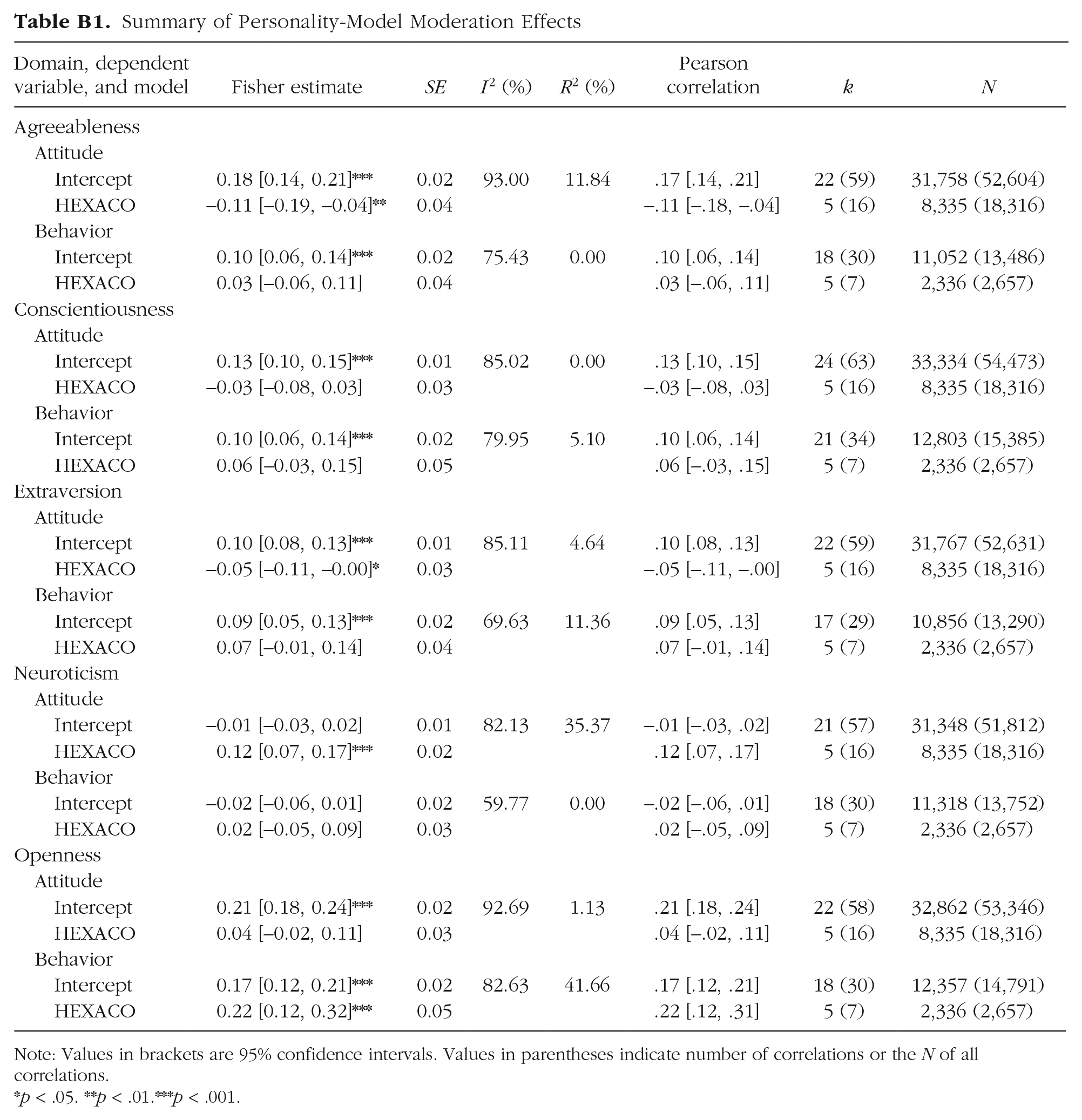
| Domain, dependent variable, and model | Fisher estimate | SE | I2 (%) | R2 (%) | Pearson correlation | k | N |
|---|---|---|---|---|---|---|---|
| Agreeableness | |||||||
| Attitude | |||||||
| Intercept | 0.18 [0.14, 0.21]*** | 0.02 | 93.00 | 11.84 | .17 [.14, .21] | 22 (59) | 31,758 (52,604) |
| HEXACO | −0.11 [–0.19, –0.04]** | 0.04 | −.11 [–.18, –.04] | 5 (16) | 8,335 (18,316) | ||
| Behavior | |||||||
| Intercept | 0.10 [0.06, 0.14]*** | 0.02 | 75.43 | 0.00 | .10 [.06, .14] | 18 (30) | 11,052 (13,486) |
| HEXACO | 0.03 [–0.06, 0.11] | 0.04 | .03 [–.06, .11] | 5 (7) | 2,336 (2,657) | ||
| Conscientiousness | |||||||
| Attitude | |||||||
| Intercept | 0.13 [0.10, 0.15]*** | 0.01 | 85.02 | 0.00 | .13 [.10, .15] | 24 (63) | 33,334 (54,473) |
| HEXACO | −0.03 [–0.08, 0.03] | 0.03 | −.03 [–.08, .03] | 5 (16) | 8,335 (18,316) | ||
| Behavior | |||||||
| Intercept | 0.10 [0.06, 0.14]*** | 0.02 | 79.95 | 5.10 | .10 [.06, .14] | 21 (34) | 12,803 (15,385) |
| HEXACO | 0.06 [–0.03, 0.15] | 0.05 | .06 [–.03, .15] | 5 (7) | 2,336 (2,657) | ||
| Extraversion | |||||||
| Attitude | |||||||
| Intercept | 0.10 [0.08, 0.13]*** | 0.01 | 85.11 | 4.64 | .10 [.08, .13] | 22 (59) | 31,767 (52,631) |
| HEXACO | −0.05 [–0.11, –0.00]* | 0.03 | −.05 [–.11, –.00] | 5 (16) | 8,335 (18,316) | ||
| Behavior | |||||||
| Intercept | 0.09 [0.05, 0.13]*** | 0.02 | 69.63 | 11.36 | .09 [.05, .13] | 17 (29) | 10,856 (13,290) |
| HEXACO | 0.07 [–0.01, 0.14] | 0.04 | .07 [–.01, .14] | 5 (7) | 2,336 (2,657) | ||
| Neuroticism | |||||||
| Attitude | |||||||
| Intercept | −0.01 [–0.03, 0.02] | 0.01 | 82.13 | 35.37 | −.01 [–.03, .02] | 21 (57) | 31,348 (51,812) |
| HEXACO | 0.12 [0.07, 0.17]*** | 0.02 | .12 [.07, .17] | 5 (16) | 8,335 (18,316) | ||
| Behavior | |||||||
| Intercept | −0.02 [–0.06, 0.01] | 0.02 | 59.77 | 0.00 | −.02 [–.06, .01] | 18 (30) | 11,318 (13,752) |
| HEXACO | 0.02 [–0.05, 0.09] | 0.03 | .02 [–.05, .09] | 5 (7) | 2,336 (2,657) | ||
| Openness | |||||||
| Attitude | |||||||
| Intercept | 0.21 [0.18, 0.24]*** | 0.02 | 92.69 | 1.13 | .21 [.18, .24] | 22 (58) | 32,862 (53,346) |
| HEXACO | 0.04 [–0.02, 0.11] | 0.03 | .04 [–.02, .11] | 5 (16) | 8,335 (18,316) | ||
| Behavior | |||||||
| Intercept | 0.17 [0.12, 0.21]*** | 0.02 | 82.63 | 41.66 | .17 [.12, .21] | 18 (30) | 12,357 (14,791) |
| HEXACO | 0.22 [0.12, 0.32]*** | 0.05 | .22 [.12, .31] | 5 (7) | 2,336 (2,657) |
Note: Values in brackets are 95% confidence intervals. Values in parentheses indicate number of correlations or the N of all correlations.
p < .05. **p < .01.***p < .001.
Appendix C
Summary of Age-Moderation Effects
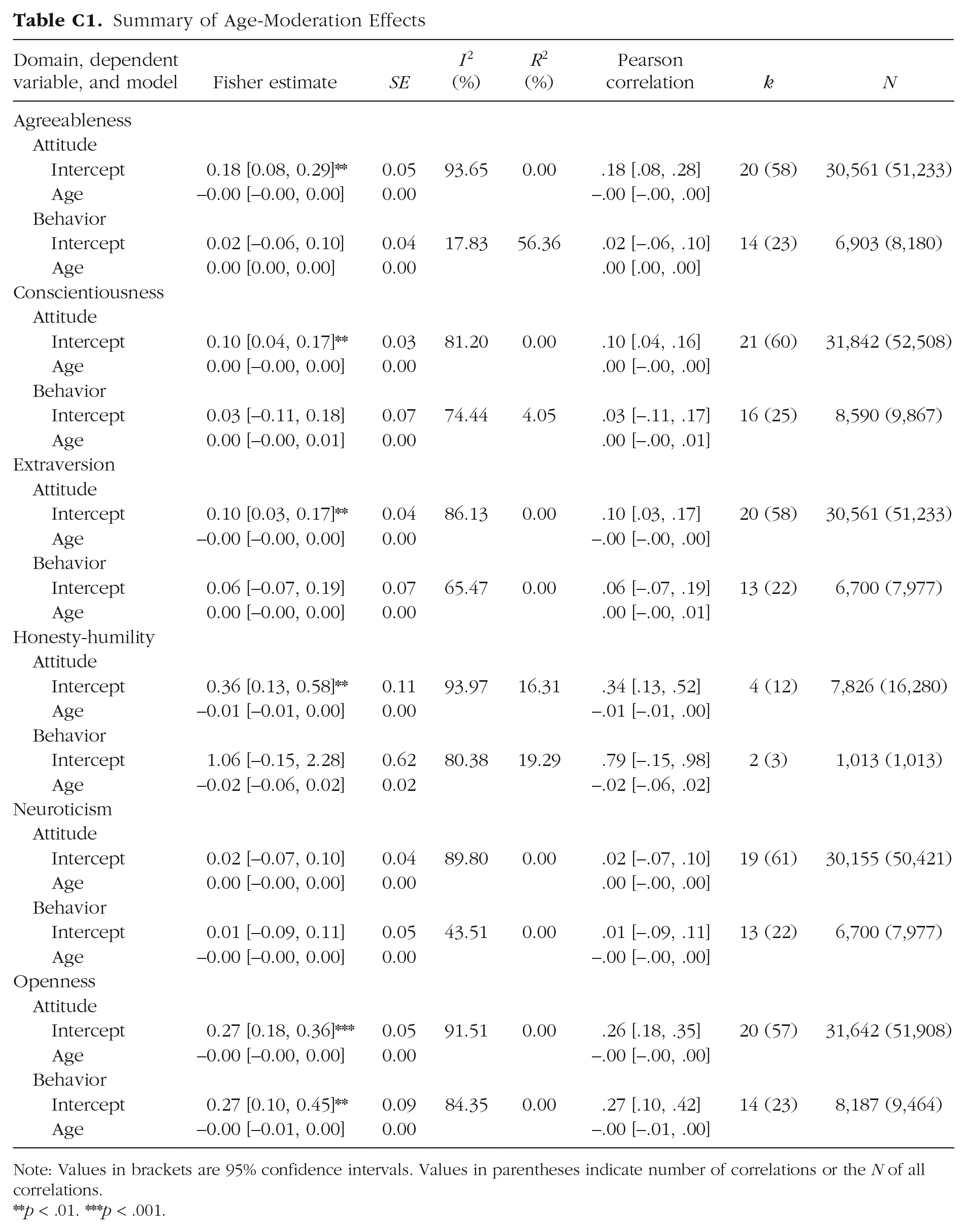
| Domain, dependent variable, and model | Fisher estimate | SE | I2 (%) | R2 (%) | Pearson correlation | k | N |
|---|---|---|---|---|---|---|---|
| Agreeableness | |||||||
| Attitude | |||||||
| Intercept | 0.18 [0.08, 0.29]** | 0.05 | 93.65 | 0.00 | .18 [.08, .28] | 20 (58) | 30,561 (51,233) |
| Age | −0.00 [–0.00, 0.00] | 0.00 | −.00 [–.00, .00] | ||||
| Behavior | |||||||
| Intercept | 0.02 [–0.06, 0.10] | 0.04 | 17.83 | 56.36 | .02 [–.06, .10] | 14 (23) | 6,903 (8,180) |
| Age | 0.00 [0.00, 0.00] | 0.00 | .00 [.00, .00] | ||||
| Conscientiousness | |||||||
| Attitude | |||||||
| Intercept | 0.10 [0.04, 0.17]** | 0.03 | 81.20 | 0.00 | .10 [.04, .16] | 21 (60) | 31,842 (52,508) |
| Age | 0.00 [–0.00, 0.00] | 0.00 | .00 [–.00, .00] | ||||
| Behavior | |||||||
| Intercept | 0.03 [–0.11, 0.18] | 0.07 | 74.44 | 4.05 | .03 [–.11, .17] | 16 (25) | 8,590 (9,867) |
| Age | 0.00 [–0.00, 0.01] | 0.00 | .00 [–.00, .01] | ||||
| Extraversion | |||||||
| Attitude | |||||||
| Intercept | 0.10 [0.03, 0.17]** | 0.04 | 86.13 | 0.00 | .10 [.03, .17] | 20 (58) | 30,561 (51,233) |
| Age | −0.00 [–0.00, 0.00] | 0.00 | −.00 [–.00, .00] | ||||
| Behavior | |||||||
| Intercept | 0.06 [–0.07, 0.19] | 0.07 | 65.47 | 0.00 | .06 [–.07, .19] | 13 (22) | 6,700 (7,977) |
| Age | 0.00 [–0.00, 0.00] | 0.00 | .00 [–.00, .01] | ||||
| Honesty-humility | |||||||
| Attitude | |||||||
| Intercept | 0.36 [0.13, 0.58]** | 0.11 | 93.97 | 16.31 | .34 [.13, .52] | 4 (12) | 7,826 (16,280) |
| Age | −0.01 [–0.01, 0.00] | 0.00 | −.01 [–.01, .00] | ||||
| Behavior | |||||||
| Intercept | 1.06 [–0.15, 2.28] | 0.62 | 80.38 | 19.29 | .79 [–.15, .98] | 2 (3) | 1,013 (1,013) |
| Age | −0.02 [–0.06, 0.02] | 0.02 | −.02 [–.06, .02] | ||||
| Neuroticism | |||||||
| Attitude | |||||||
| Intercept | 0.02 [–0.07, 0.10] | 0.04 | 89.80 | 0.00 | .02 [–.07, .10] | 19 (61) | 30,155 (50,421) |
| Age | 0.00 [–0.00, 0.00] | 0.00 | .00 [–.00, .00] | ||||
| Behavior | |||||||
| Intercept | 0.01 [–0.09, 0.11] | 0.05 | 43.51 | 0.00 | .01 [–.09, .11] | 13 (22) | 6,700 (7,977) |
| Age | −0.00 [–0.00, 0.00] | 0.00 | −.00 [–.00, .00] | ||||
| Openness | |||||||
| Attitude | |||||||
| Intercept | 0.27 [0.18, 0.36]*** | 0.05 | 91.51 | 0.00 | .26 [.18, .35] | 20 (57) | 31,642 (51,908) |
| Age | −0.00 [–0.00, 0.00] | 0.00 | −.00 [–.00, .00] | ||||
| Behavior | |||||||
| Intercept | 0.27 [0.10, 0.45]** | 0.09 | 84.35 | 0.00 | .27 [.10, .42] | 14 (23) | 8,187 (9,464) |
| Age | −0.00 [–0.01, 0.00] | 0.00 | −.00 [–.01, .00] |
Note: Values in brackets are 95% confidence intervals. Values in parentheses indicate number of correlations or the N of all correlations.
p < .01. ***p < .001.
Appendix D
Summary of Moderation Effects in Female Participants
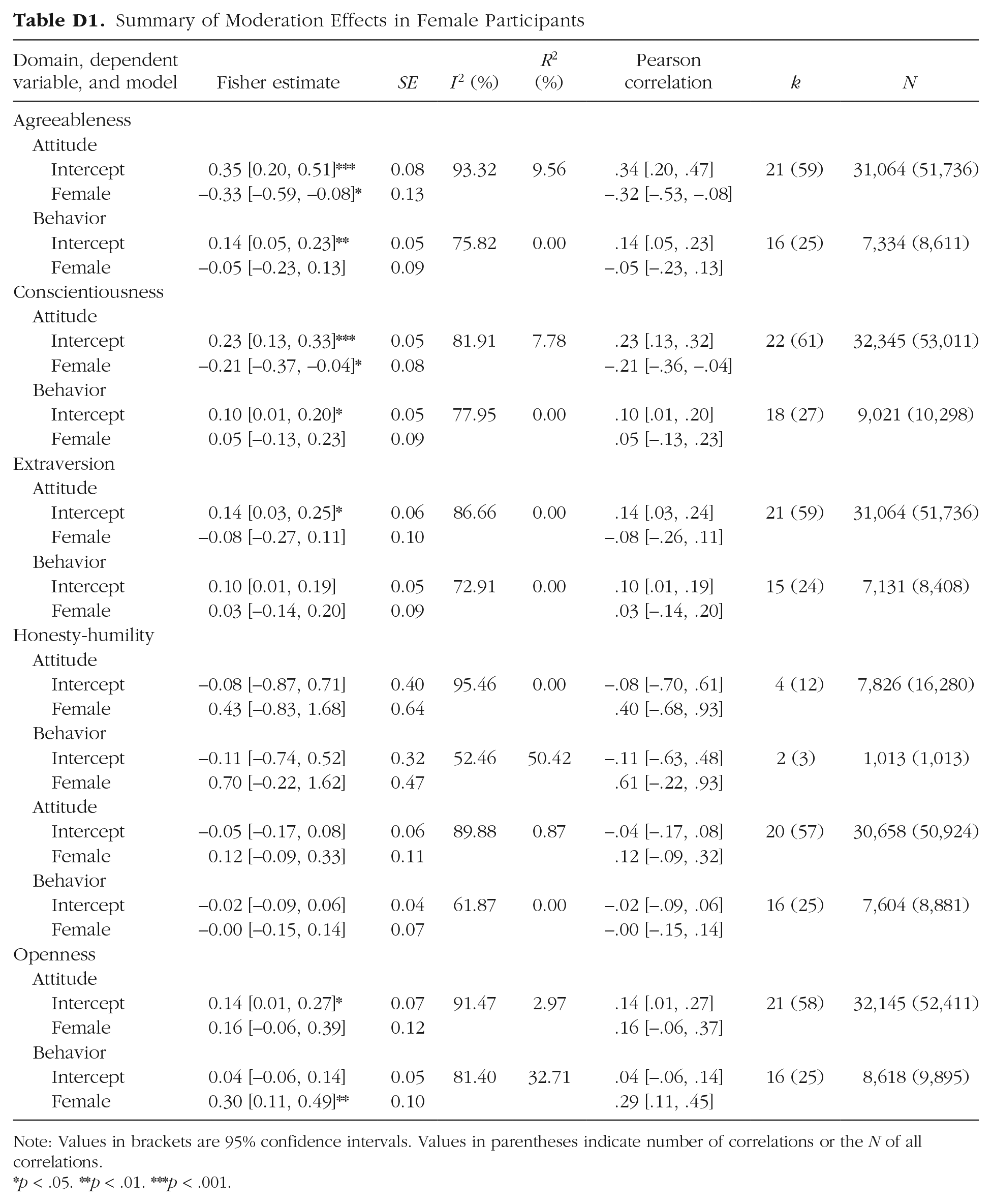
| Domain, dependent variable, and model | Fisher estimate | SE | I2 (%) | R2 (%) | Pearson correlation | k | N |
|---|---|---|---|---|---|---|---|
| Agreeableness | |||||||
| Attitude | |||||||
| Intercept | 0.35 [0.20, 0.51]*** | 0.08 | 93.32 | 9.56 | .34 [.20, .47] | 21 (59) | 31,064 (51,736) |
| Female | −0.33 [–0.59, –0.08]* | 0.13 | −.32 [–.53, –.08] | ||||
| Behavior | |||||||
| Intercept | 0.14 [0.05, 0.23]** | 0.05 | 75.82 | 0.00 | .14 [.05, .23] | 16 (25) | 7,334 (8,611) |
| Female | −0.05 [–0.23, 0.13] | 0.09 | −.05 [–.23, .13] | ||||
| Conscientiousness | |||||||
| Attitude | |||||||
| Intercept | 0.23 [0.13, 0.33]*** | 0.05 | 81.91 | 7.78 | .23 [.13, .32] | 22 (61) | 32,345 (53,011) |
| Female | −0.21 [–0.37, –0.04]* | 0.08 | −.21 [–.36, –.04] | ||||
| Behavior | |||||||
| Intercept | 0.10 [0.01, 0.20]* | 0.05 | 77.95 | 0.00 | .10 [.01, .20] | 18 (27) | 9,021 (10,298) |
| Female | 0.05 [–0.13, 0.23] | 0.09 | .05 [–.13, .23] | ||||
| Extraversion | |||||||
| Attitude | |||||||
| Intercept | 0.14 [0.03, 0.25]* | 0.06 | 86.66 | 0.00 | .14 [.03, .24] | 21 (59) | 31,064 (51,736) |
| Female | −0.08 [–0.27, 0.11] | 0.10 | −.08 [–.26, .11] | ||||
| Behavior | |||||||
| Intercept | 0.10 [0.01, 0.19] | 0.05 | 72.91 | 0.00 | .10 [.01, .19] | 15 (24) | 7,131 (8,408) |
| Female | 0.03 [–0.14, 0.20] | 0.09 | .03 [–.14, .20] | ||||
| Honesty-humility | |||||||
| Attitude | |||||||
| Intercept | −0.08 [–0.87, 0.71] | 0.40 | 95.46 | 0.00 | −.08 [–.70, .61] | 4 (12) | 7,826 (16,280) |
| Female | 0.43 [–0.83, 1.68] | 0.64 | .40 [–.68, .93] | ||||
| Behavior | |||||||
| Intercept | −0.11 [–0.74, 0.52] | 0.32 | 52.46 | 50.42 | −.11 [–.63, .48] | 2 (3) | 1,013 (1,013) |
| Female | 0.70 [–0.22, 1.62] | 0.47 | .61 [–.22, .93] | ||||
| Attitude | |||||||
| Intercept | −0.05 [–0.17, 0.08] | 0.06 | 89.88 | 0.87 | −.04 [–.17, .08] | 20 (57) | 30,658 (50,924) |
| Female | 0.12 [–0.09, 0.33] | 0.11 | .12 [–.09, .32] | ||||
| Behavior | |||||||
| Intercept | −0.02 [–0.09, 0.06] | 0.04 | 61.87 | 0.00 | −.02 [–.09, .06] | 16 (25) | 7,604 (8,881) |
| Female | −0.00 [–0.15, 0.14] | 0.07 | −.00 [–.15, .14] | ||||
| Openness | |||||||
| Attitude | |||||||
| Intercept | 0.14 [0.01, 0.27]* | 0.07 | 91.47 | 2.97 | .14 [.01, .27] | 21 (58) | 32,145 (52,411) |
| Female | 0.16 [–0.06, 0.39] | 0.12 | .16 [–.06, .37] | ||||
| Behavior | |||||||
| Intercept | 0.04 [–0.06, 0.14] | 0.05 | 81.40 | 32.71 | .04 [–.06, .14] | 16 (25) | 8,618 (9,895) |
| Female | 0.30 [0.11, 0.49]** | 0.10 | .29 [.11, .45] |
Note: Values in brackets are 95% confidence intervals. Values in parentheses indicate number of correlations or the N of all correlations.
p < .05. **p < .01. ***p < .001.
Appendix E
Summary of Country-Moderation Effects
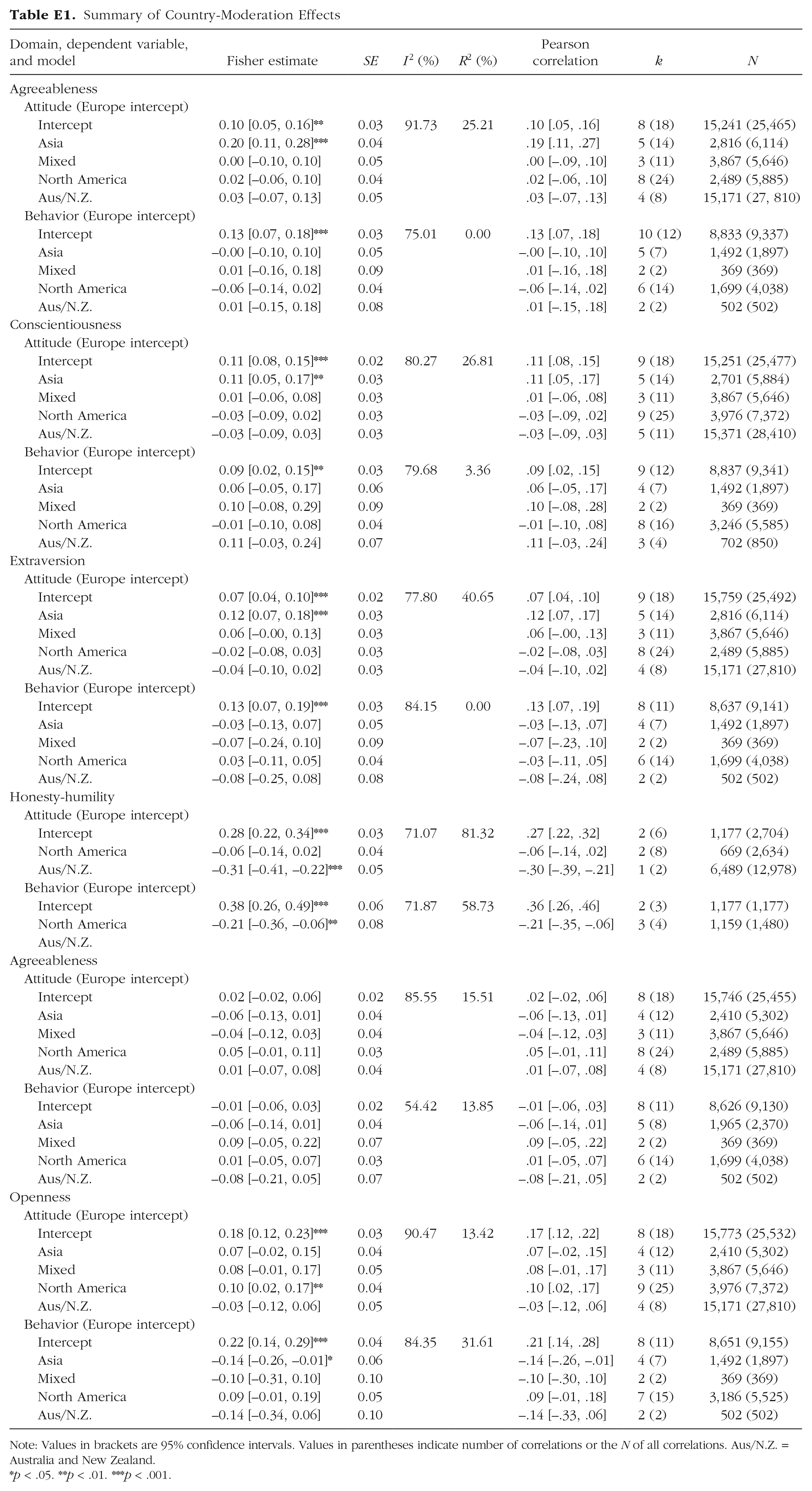
| Domain, dependent variable, and model | Fisher estimate | SE | I2 (%) | R2 (%) | Pearson correlation | k | N |
|---|---|---|---|---|---|---|---|
| Agreeableness | |||||||
| Attitude (Europe intercept) | |||||||
| Intercept | 0.10 [0.05, 0.16]** | 0.03 | 91.73 | 25.21 | .10 [.05, .16] | 8 (18) | 15,241 (25,465) |
| Asia | 0.20 [0.11, 0.28]*** | 0.04 | .19 [.11, .27] | 5 (14) | 2,816 (6,114) | ||
| Mixed | 0.00 [–0.10, 0.10] | 0.05 | .00 [–.09, .10] | 3 (11) | 3,867 (5,646) | ||
| North America | 0.02 [–0.06, 0.10] | 0.04 | .02 [–.06, .10] | 8 (24) | 2,489 (5,885) | ||
| Aus/N.Z. | 0.03 [–0.07, 0.13] | 0.05 | .03 [–.07, .13] | 4 (8) | 15,171 (27, 810) | ||
| Behavior (Europe intercept) | |||||||
| Intercept | 0.13 [0.07, 0.18]*** | 0.03 | 75.01 | 0.00 | .13 [.07, .18] | 10 (12) | 8,833 (9,337) |
| Asia | −0.00 [–0.10, 0.10] | 0.05 | −.00 [–.10, .10] | 5 (7) | 1,492 (1,897) | ||
| Mixed | 0.01 [–0.16, 0.18] | 0.09 | .01 [–.16, .18] | 2 (2) | 369 (369) | ||
| North America | −0.06 [–0.14, 0.02] | 0.04 | −.06 [–.14, .02] | 6 (14) | 1,699 (4,038) | ||
| Aus/N.Z. | 0.01 [–0.15, 0.18] | 0.08 | .01 [–.15, .18] | 2 (2) | 502 (502) | ||
| Conscientiousness | |||||||
| Attitude (Europe intercept) | |||||||
| Intercept | 0.11 [0.08, 0.15]*** | 0.02 | 80.27 | 26.81 | .11 [.08, .15] | 9 (18) | 15,251 (25,477) |
| Asia | 0.11 [0.05, 0.17]** | 0.03 | .11 [.05, .17] | 5 (14) | 2,701 (5,884) | ||
| Mixed | 0.01 [–0.06, 0.08] | 0.03 | .01 [–.06, .08] | 3 (11) | 3,867 (5,646) | ||
| North America | −0.03 [–0.09, 0.02] | 0.03 | −.03 [–.09, .02] | 9 (25) | 3,976 (7,372) | ||
| Aus/N.Z. | −0.03 [–0.09, 0.03] | 0.03 | −.03 [–.09, .03] | 5 (11) | 15,371 (28,410) | ||
| Behavior (Europe intercept) | |||||||
| Intercept | 0.09 [0.02, 0.15]** | 0.03 | 79.68 | 3.36 | .09 [.02, .15] | 9 (12) | 8,837 (9,341) |
| Asia | 0.06 [–0.05, 0.17] | 0.06 | .06 [–.05, .17] | 4 (7) | 1,492 (1,897) | ||
| Mixed | 0.10 [–0.08, 0.29] | 0.09 | .10 [–.08, .28] | 2 (2) | 369 (369) | ||
| North America | −0.01 [–0.10, 0.08] | 0.04 | −.01 [–.10, .08] | 8 (16) | 3,246 (5,585) | ||
| Aus/N.Z. | 0.11 [–0.03, 0.24] | 0.07 | .11 [–.03, .24] | 3 (4) | 702 (850) | ||
| Extraversion | |||||||
| Attitude (Europe intercept) | |||||||
| Intercept | 0.07 [0.04, 0.10]*** | 0.02 | 77.80 | 40.65 | .07 [.04, .10] | 9 (18) | 15,759 (25,492) |
| Asia | 0.12 [0.07, 0.18]*** | 0.03 | .12 [.07, .17] | 5 (14) | 2,816 (6,114) | ||
| Mixed | 0.06 [–0.00, 0.13] | 0.03 | .06 [–.00, .13] | 3 (11) | 3,867 (5,646) | ||
| North America | −0.02 [–0.08, 0.03] | 0.03 | −.02 [–.08, .03] | 8 (24) | 2,489 (5,885) | ||
| Aus/N.Z. | −0.04 [–0.10, 0.02] | 0.03 | −.04 [–.10, .02] | 4 (8) | 15,171 (27,810) | ||
| Behavior (Europe intercept) | |||||||
| Intercept | 0.13 [0.07, 0.19]*** | 0.03 | 84.15 | 0.00 | .13 [.07, .19] | 8 (11) | 8,637 (9,141) |
| Asia | −0.03 [–0.13, 0.07] | 0.05 | −.03 [–.13, .07] | 4 (7) | 1,492 (1,897) | ||
| Mixed | −0.07 [–0.24, 0.10] | 0.09 | −.07 [–.23, .10] | 2 (2) | 369 (369) | ||
| North America | 0.03 [–0.11, 0.05] | 0.04 | −.03 [–.11, .05] | 6 (14) | 1,699 (4,038) | ||
| Aus/N.Z. | −0.08 [–0.25, 0.08] | 0.08 | −.08 [–.24, .08] | 2 (2) | 502 (502) | ||
| Honesty-humility | |||||||
| Attitude (Europe intercept) | |||||||
| Intercept | 0.28 [0.22, 0.34]*** | 0.03 | 71.07 | 81.32 | .27 [.22, .32] | 2 (6) | 1,177 (2,704) |
| North America | −0.06 [–0.14, 0.02] | 0.04 | −.06 [–.14, .02] | 2 (8) | 669 (2,634) | ||
| Aus/N.Z. | −0.31 [–0.41, –0.22]*** | 0.05 | −.30 [–.39, –.21] | 1 (2) | 6,489 (12,978) | ||
| Behavior (Europe intercept) | |||||||
| Intercept | 0.38 [0.26, 0.49]*** | 0.06 | 71.87 | 58.73 | .36 [.26, .46] | 2 (3) | 1,177 (1,177) |
| North America | −0.21 [–0.36, –0.06]** | 0.08 | −.21 [–.35, –.06] | 3 (4) | 1,159 (1,480) | ||
| Aus/N.Z. | |||||||
| Agreeableness | |||||||
| Attitude (Europe intercept) | |||||||
| Intercept | 0.02 [–0.02, 0.06] | 0.02 | 85.55 | 15.51 | .02 [–.02, .06] | 8 (18) | 15,746 (25,455) |
| Asia | −0.06 [–0.13, 0.01] | 0.04 | −.06 [–.13, .01] | 4 (12) | 2,410 (5,302) | ||
| Mixed | −0.04 [–0.12, 0.03] | 0.04 | −.04 [–.12, .03] | 3 (11) | 3,867 (5,646) | ||
| North America | 0.05 [–0.01, 0.11] | 0.03 | .05 [–.01, .11] | 8 (24) | 2,489 (5,885) | ||
| Aus/N.Z. | 0.01 [–0.07, 0.08] | 0.04 | .01 [–.07, .08] | 4 (8) | 15,171 (27,810) | ||
| Behavior (Europe intercept) | |||||||
| Intercept | −0.01 [–0.06, 0.03] | 0.02 | 54.42 | 13.85 | −.01 [–.06, .03] | 8 (11) | 8,626 (9,130) |
| Asia | −0.06 [–0.14, 0.01] | 0.04 | −.06 [–.14, .01] | 5 (8) | 1,965 (2,370) | ||
| Mixed | 0.09 [–0.05, 0.22] | 0.07 | .09 [–.05, .22] | 2 (2) | 369 (369) | ||
| North America | 0.01 [–0.05, 0.07] | 0.03 | .01 [–.05, .07] | 6 (14) | 1,699 (4,038) | ||
| Aus/N.Z. | −0.08 [–0.21, 0.05] | 0.07 | −.08 [–.21, .05] | 2 (2) | 502 (502) | ||
| Openness | |||||||
| Attitude (Europe intercept) | |||||||
| Intercept | 0.18 [0.12, 0.23]*** | 0.03 | 90.47 | 13.42 | .17 [.12, .22] | 8 (18) | 15,773 (25,532) |
| Asia | 0.07 [–0.02, 0.15] | 0.04 | .07 [–.02, .15] | 4 (12) | 2,410 (5,302) | ||
| Mixed | 0.08 [–0.01, 0.17] | 0.05 | .08 [–.01, .17] | 3 (11) | 3,867 (5,646) | ||
| North America | 0.10 [0.02, 0.17]** | 0.04 | .10 [.02, .17] | 9 (25) | 3,976 (7,372) | ||
| Aus/N.Z. | −0.03 [–0.12, 0.06] | 0.05 | −.03 [–.12, .06] | 4 (8) | 15,171 (27,810) | ||
| Behavior (Europe intercept) | |||||||
| Intercept | 0.22 [0.14, 0.29]*** | 0.04 | 84.35 | 31.61 | .21 [.14, .28] | 8 (11) | 8,651 (9,155) |
| Asia | −0.14 [–0.26, –0.01]* | 0.06 | −.14 [–.26, –.01] | 4 (7) | 1,492 (1,897) | ||
| Mixed | −0.10 [–0.31, 0.10] | 0.10 | −.10 [–.30, .10] | 2 (2) | 369 (369) | ||
| North America | 0.09 [–0.01, 0.19] | 0.05 | .09 [–.01, .18] | 7 (15) | 3,186 (5,525) | ||
| Aus/N.Z. | −0.14 [–0.34, 0.06] | 0.10 | −.14 [–.33, .06] | 2 (2) | 502 (502) |
Note: Values in brackets are 95% confidence intervals. Values in parentheses indicate number of correlations or the N of all correlations. Aus/N.Z. = Australia and New Zealand.
p < .05. **p < .01. ***p < .001.
Transparency
Action Editor: Richard Lucas
Editor: Laura A. King

References
Supplementary Material
Please find the following supplemental material available below.
For Open Access articles published under a Creative Commons License, all supplemental material carries the same license as the article it is associated with.
For non-Open Access articles published, all supplemental material carries a non-exclusive license, and permission requests for re-use of supplemental material or any part of supplemental material shall be sent directly to the copyright owner as specified in the copyright notice associated with the article.
