




Abstract
Background:
Globally, 570,000 cases of cervical cancer and 311,000 deaths from the disease occurred in 2018. Cervical cancer is the fourth most common cancer in women. About 96,922 new cervical cancer cases are diagnosed annually in India.
Objective:
To summarize the knowledge, attitude, and practice toward screening of cervical cancer among health professionals in India.
Materials and methods:
Health sciences electronic databases PubMed and Google Scholar were searched for studies published between 2012 and March 2020. Keywords used for the search were (“CERVICAL CANCER”), (“SCREENING”), (“KNOWLEDGE”), (“ATTITUDE”), (“PRACTICE”), (“HEALTH PROFESSIONALS”), AND (“INDIA”). A total of 22 articles were included in the review based on the eligibility criteria. Statistical software SPSS-V.23 was used for the statistical application.
Results:
A total of 22 studies met the inclusion criteria with total of 6811 health professionals. The age of the study participants ranged from 18 to 60 years. The overall knowledge of cervical cancer among health professionals was 75.15%. The knowledge toward signs and symptoms and risk factors was adequate among health professionals. The knowledge, attitude, and practice toward screening was 86.20%, 85.47%, and 12.70%, respectively.
Conclusion:
The health professionals have optimum level of knowledge of cervical cancer and knowledge of screening of cervical cancer with appropriate attitude toward screening with low uptake of practice toward screening.
Introduction
Globally, 570,000 cases of cervical cancer and 311,000 deaths from the disease occurred in 2018. Cervical cancer is the fourth most common cancer in women, ranking after breast cancer (2.1 million cases), colorectal cancer (0.8 million), and lung cancer (0.7 million). 1 One in every five women in the world suffering from cervical cancer belongs to India, which has the largest burden of cervical cancer patients in the world. 2 Unlike many other cancers, cervical cancer occurs early and strikes at the productive period of a woman’s life. The incidence rises at 30–34 years of age and peaks at 55–65 years, with a median age of 38 years (age 21–67 years). 3 Estimates suggest that more than 80% of the sexually active women acquire genital HPV by 50 years of age. 4
In developed countries, incidence and mortality from cervical cancer have been reduced through measures, which include cytological screening and prompt treatment of early cervical lesions.5,6 Among all malignant tumors, cervical cancer is the one that can be most effectively controlled by organized screening programs. 7 According to NHFS report, in India, 22% of women have undergone cervical examination, the pattern of cervical examination indicated that the southern region mainly Kerala has the major contribution toward screening followed by the various districts of Maharashtra. 8 This is one of the main reasons that in India patients are being diagnosed at advanced stages. The main risk factor for development of cervical cancer is infection with human papilloma virus (HPV) types (HPV 16 and HPV 18). 9 HPV-DNA viral load quantification and integration and E6/E7 expression are promising biomarkers that can predict the progression of lesions to cervical cancer. 10
Population-based screening program utilizing exfoliative cervical cytology, the Pap test, has reduced cervical cancer morbidity and mortality in developed countries. 11 In India, both early detection and screening remains a major area of concern to the health workers in the absence of screening facilities coupled with poor literacy and low level of awareness among Indian women. 12
Healthcare providers play an essential role in imparting knowledge of risk factors and prevention of the disease; therefore, emphasis was laid on them in this review. Awareness about cervical cancer is the basic requirement in the implementation of successful screening program, which in future help in reducing the incidence of cervical cancer.
The aim of this review is to explore knowledge toward cervical cancer and knowledge, attitude and practice toward screening of cervical cancer among health professionals including medical students, physicians, dentists and nurses in India.
Methodology
Search strategy
A thorough writing search directed between 2012 and March 2020 in electronic dataset PubMed and Google Scholar was led. We retrieved all studies in English language containing information on knowledge, awareness, attitude and practice on cervical Cancer and its screening in India. Articles were included if they reported quantitative data of knowledge, awareness, attitude, or practice of cervical cancer and its screening among health professionals in India. Primary concepts of “cervical cancer,” “cervical cancer screening,” “cervical cancer knowledge,” “cervical cancer attitude,” “cervical cancer awareness,” and “cervical cancer practice” were elaborated to generate additional medical terms (cervix, cervical, cancer, neoplasm, cervical neoplasms, screening and primary diagnosis of cancer) for the search. The text word search and subject search were done in PubMed and Google Scholar individually and then combined with “OR” and “AND” operators. Combined terms were used, for example, (“CERVICAL CANCER SCREENING” or “CERVICAL SCREENING”) AND (“CERVICAL CANCER KNOWLEDGE” or “CERVICAL CANCER ATTITUDE”) or (HEALTH PROFESSIONALS). Gray literature and additional articles were identified using the bibliography of included articles and some excluded review articles.
Study selection
Articles reported quantitative data on knowledge, awareness, attitude, and practice toward screening among health professionals including medical students, community health workers (accredited social health activist (ASHA), auxilliary nurse midwife (ANM)), nurses, and practicing doctors aged between 18 and 60 years in India.
Figure 1 shows the selection process of articles retrieved. Our review was done according to PRISMA Guidelines. 13
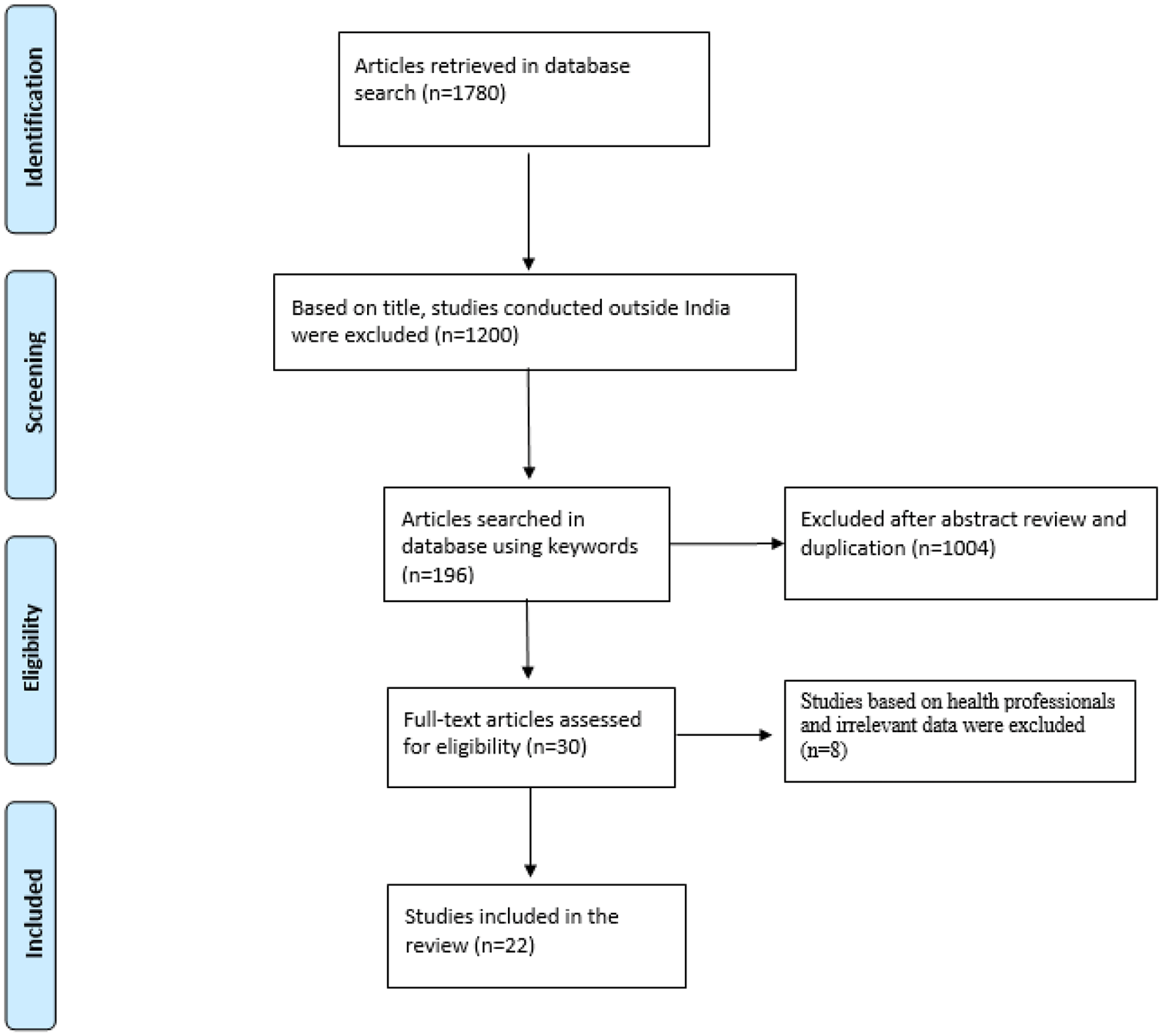
PRISMA diagram.
Inclusion criteria
Cross-sectional studies and English language studies conducted in diverse settings like hospitals, health centers, and Medical Colleges of India published from 2012 till March 2020 on knowledge, awareness, attitude, and practice regarding cervical cancer and its screening among health professionals in India.
Exclusion criteria
Case reports, case series, earlier reviews, and qualitative studies of cervical cancer and its screening uptake were excluded. Studies conducted in low- or high-income countries other than India, articles published in languages other than English and articles conducted among women other than health professionals were excluded.
Data extraction and analysis
We extracted the following key characteristics of the studies: lead author and country, year published, study design, sample size, age group and knowledge of cervical cancer, cervical cancer signs and symptoms and risk factors, screening, attitude, and practice toward screening among health professionals. After the removal of duplicates, primary outcome data of all articles were indexed in Microsoft Excel. Later, interpretation of textual data was extracted to a Microsoft Word document. Two authors independently carried out the literature search and identified citations for knowledge, attitude, and practice on cervical cancer and screening independently. Full-text articles were identified and assessed for eligibility after applying the inclusion and exclusion criteria. Statistical software like SPSS-V.23 was used for statistical application.
Results
A total of 22 studies met the inclusion criteria that are included in the review. These studies included 6811 health professionals including medical students, community health workers (ASHA, ANM), nurses, and practicing doctors aged between 18 and 60 years. The studies included in the review are conducted across India in various tertiary care hospitals. Majority of health professionals included were married ranging from 50% to 95% (Table 1).
Characteristics of the studies included in the review.

HPV: human papilloma virus; ASHA: accredited social health activist; ANM: auxiliary nurse midwife.
Among 22 studies reviewed, 19 studies15–25,27–30,32–35 reported knowledge of cervical cancer. The overall knowledge of cervical cancer among health professionals was 75.14%. The awareness level of risk factors was adequate. Among 22 studies, 14 studies14,15,17–21,24,25,28,29,33–35 reported knowledge of risk factors of cervical cancer. The most common risk factor known was multiple sexual partners 44.07%, HPV infection 40.85%, and early age of marriage 38.52% (Figure 2).
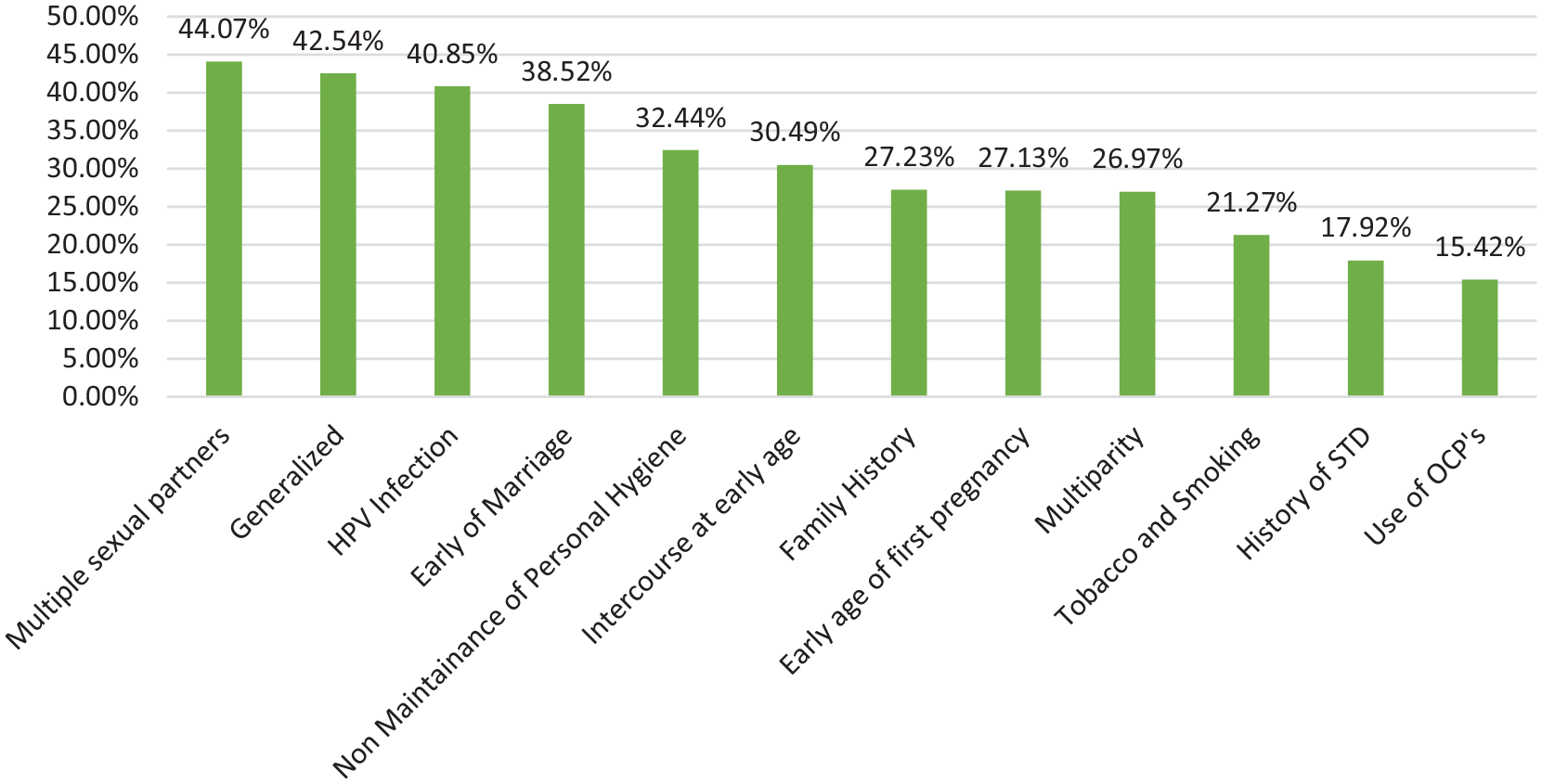
Knowledge of risk factors of cervical cancer among health prfessionals.
Among 22 articles reviewed, 11 articles14,15,17,18,20,21,24,25,28,34,35 reported knowledge of signs and symptoms of cervical cancer. The awareness level of signs and symptoms was also adequate. The most common sign and symptom reported was intermenstrual bleeding 65.48%, abnormal vaginal discharge 63.19%, foul-smelling discharge 62.90% (Figure 3).
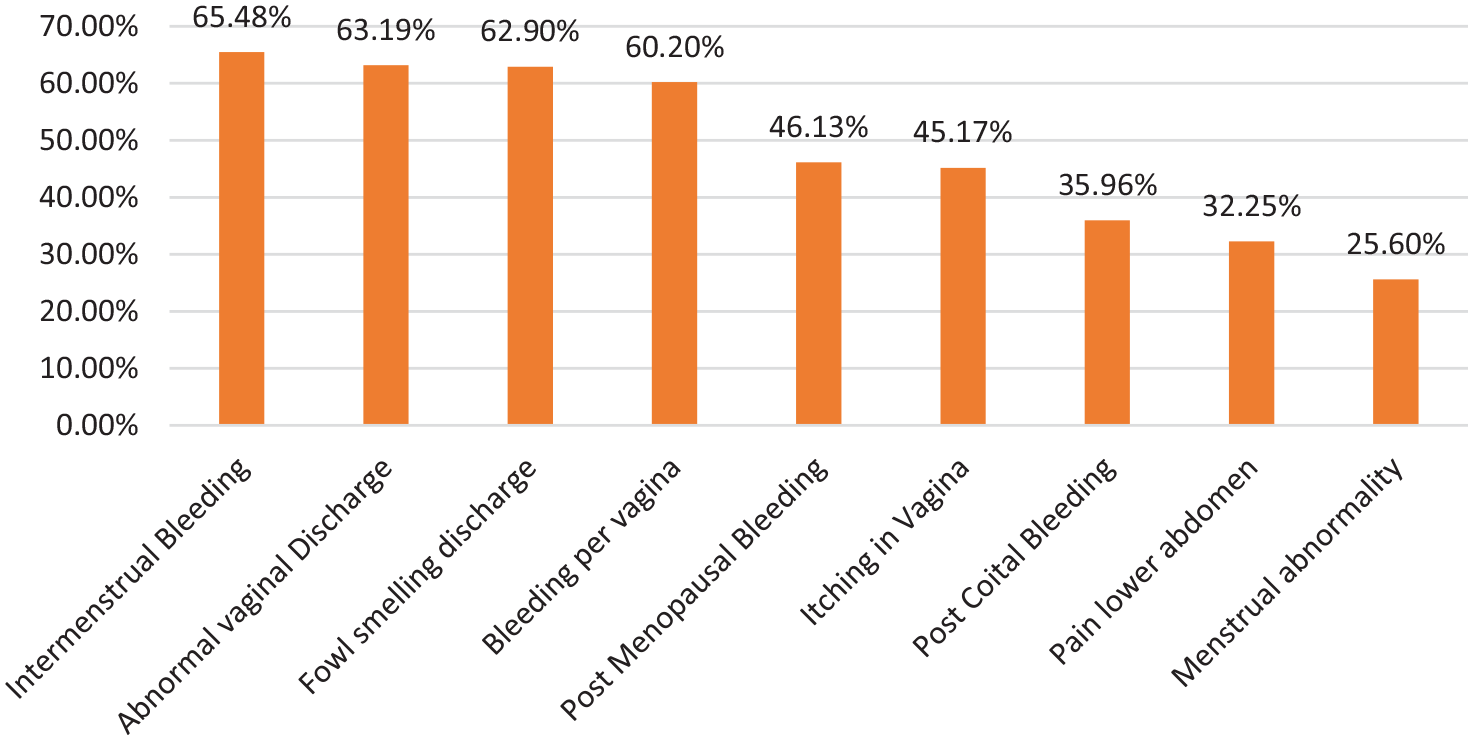
Knowledge of signs and symptoms of cervical cancer.
Based on review, the overall knowledge of screening toward cervical cancer was 86.20%. Knowledge of screening through Pap smear was 66.66%, attitude toward screening of cervical cancer was 85.47%, and practice toward screening came out to be 12.70% (Figure 4).

Knowledge, attitude, and practice toward cervical cancer screening.
In the present review, the knowledge of HPV is 76.68%, knowledge of HPV vaccine, and practice toward HPV vaccine is 68.68% and 20.56%, respectively (Figure 5).

Knowledge toward HPV, HPV vaccine, and practice toward HPV vaccine.
Discussion
This review focused on knowledge, attitude, and practice toward screening of cervical cancer among health professionals including medical students, community health workers (ANM, ASHA), nurses, and practicing physicians in India. The knowledge regarding cervical cancer came out to be 75.14%. Similar study conducted in Qatar showed the findings that over 80% of women had knowledge of cervical cancer. 36 Various studies conducted in China, 37 the United Kingdom, 38 and Hong Kong 39 showed that the knowledge level about cervical cancer was low among the participants, although women who were willing to participate in the screenings had a higher knowledge level.
With regard to signs and symptoms of cervical cancer, 65.48% knew about intermenstrual bleeding, 63.19% knew about abnormal vaginal discharge, 62.09% knew about foul-smelling vaginal discharge, 60.02% knew about bleeding per vagina as common symptoms of cervical cancer. A similar finding (menstrual abnormality—80.6%) was found in a study by Anya et al. 40 among female health personnel. Also, in a study conducted by Narayana et al., 41 among the 403 women who completed the survey, 64.2% had some knowledge about signs and symptoms. Despite having adequate knowledge of screening, signs and symptoms, and risk factors of cervical cancer, the practice toward screening is low, that is, only 12.70% health professionals have undergone screening test. This low uptake rate is very similar to other studies conducted among healthcare workers.42–46 Studies among female students in Nigeria, 47 Malaysia, 48 and Turkey 48 showed low utilization of Pap test. The reason enlisted include having not thought about it and absence of symptoms, which illustrates how cervical screening is conceptualized and understood. 49
We observed positive attitude toward screening in majority of health workers, that is, 85.47% had positive attitude toward screening. Our finding was comparable to many Indian-based studies on general female population and to other community health worker–based studies in other countries.50–54 In the present review, 44.07% health professionals told that multiple sexual partners is the risk factor; also 40.85% told HPV infection is the risk factor; 38.52% and 30.49% think that early age of marriage and early age of intercourse, respectively, are the risk factors for cervical cancer; similarly in a study by Nilaweera et al., 54 45% mentioned multiple partners and other promiscuous behaviors as the most common risk factors. Ali et al. 55 in their study mentioned that 81.8% and 85.6% of respondents knew that first sexual intercourse at a young age and having multiple sexual partners were risk factors for cervical cancer.
In the present review, it was seen that 76.68% health professionals had knowledge of HPV, 68.68% had knowledge of HPV vaccine but again uptake of HPV vaccine was low, that is, only 20.56% had HPV vaccine. In many European countries, almost 80% of the target population has been vaccinated; however, in developing countries, vaccination rates are disappointing. 56
Our review concluded that health professionals have optimum level of knowledge of cervical cancer and knowledge of screening toward cervical cancer, attitude toward screening is also appropriate but the uptake of screening is very low despite being a health professional. This shows that there is need for sensitization of healthcare professionals for cervical cancer screening because they play an essential role in the implementation of any future screening programs and in their educative role with patients. 22
Strength
To our knowledge, it is the first review done on the knowledge, attitude, and practice toward cervical cancer and screening among the health professionals in India. Health professionals are primary source of knowledge for people toward any disease; therefore, the review will serve as a guide for policy makers to enhance the system and create suitable awareness toward cervical cancer and screening.
Limitations
Studies included in the review vary in geographical areas in India and heterogeneity of diversified population data collected and pooled. Variations such as age range, sampling techniques, medical profession including BDS, MBBS, nurses, ANM workers were also not uniform. Merging such data may lead to high heterogeneity, which is a potential source of bias.
Conclusion
The review concludes that health professionals have optimum level of knowledge of cervical cancer and knowledge of screening of cervical cancer with appropriate attitude toward screening with low uptake of practice toward screening. There is need for implementation of practice toward screening. Despite being a health professional, there is lack of practice toward screening. There is a need for screening among health professionals because they play an essential role to educate their patients and motivate them toward screening. Health professionals play an educative role with their patients.
Footnotes
Declaration of conflicting interests
The author(s) declared no potential conflicts of interest with respect to the research, authorship, and/or publication of this article.
Funding
The author(s) disclosed receipt of the following financial support for the research, authorship, and/or publication of this article: Funding for the following paper is provided by ICMR (Indian Council of Medical Research) under the project entitled “Artificial Intelligence enabled early detection of Cervical Cancer in tertiary care setting and extended community.”
