




Abstract
Background:
Breast cancer occurs when abnormal breast cells grow rapidly and uncontrollably. Early detection and intervention have been established to significantly decrease mortality rates.
Objective:
There is a lack of focused research investigating the degree of breast cancer awareness among Saudi women. Thus, this study aimed to fill this gap by conducting a nationwide survey on a large pool of women.
Design:
A cross-sectional web-based nationwide study.
Methods:
This study targeted Saudi women from all regions of the country and was conducted from 20 August to 3 September 2021. The study used the Breast Cancer Awareness Measure questionnaire to measure breast cancer awareness. This study was approved by the King Abdullah International Medical Research Center institutional review board.
Results:
Overall, poor breast cancer awareness scores were demonstrated by 71% of the participants. Unemployed women were more likely to have poor breast cancer awareness.
Conclusion:
Our study reports an alarmingly high level of poor overall breast cancer awareness in Saudi women. Interventions should be implemented to combat this lack of awareness.
Introduction
Breast cancer occurs when abnormal breast cells divide and grow uncontrollably. 1 Breast cancer is the most common cancer among women, and one of the three most common malignancies globally, the others being lung and colon cancer. 2 Globally, in 2012, almost 1.7 million individuals were diagnosed with breast cancer, and about half a million died from it. 2 Moreover, according to projections, 1:8 women will get breast cancer during their lifetime. 2
Early detection and screening programs have significantly contributed to decreasing breast cancer mortality rates. 2 Furthermore, breast cancer screening programs include a variety of examinations and tests. One of the most used tests is breast mammograms. A breast mammogram is an X-ray examination of the breast, and it is regarded as the best way to detect the presence of cancerous cells early. 3 The goal of a screening mammogram is to detect breast cancer when it is still too small to be felt by either the woman or the doctor by a simple hand examination. 3
In Saudi Arabia, breast cancer is the most prevalent cancer with an incidence rate of 14.8% and a mortality rate of 8.5% among both sexes. The incidence of breast cancer among women was 29.7% in 2018. 4 As per the International Agency for Research on Cancer, in 2020, the age-standardized (world) incidence and mortality rates of breast cancer were 28.8% and 8.9% among women, respectively. 5 In its continuous effort to decrease the prevalence of breast cancer and promote early detection, the Ministry of Health established mammogram clinics across the country to provide free screening services to both citizens and foreigners. 6
Previous studies on Saudis have established the low levels of awareness regarding breast cancer knowledge and breast screening programs.7–11 However, these studies were either regional, limited to a specific city in the country, or included a relatively small sample size. The local literature, therefore, is still in need of a comprehensive national study that investigates breast cancer awareness and screening, and its predictors. Hence, this study aimed to fill this gap in the literature by conducting a nationwide survey on a large pool of women using the Breast Cancer Awareness Measure (BCAM) questionnaire. 12
Methodology and materials
This study used a cross-sectional design and a self-administered questionnaire, BCAM version 2. 13 In addition to questions targeting sociodemographic details, the transculturally adapted and Arabic-translated BCAM 12 contains 12 questions assessing the knowledge of breast cancer warning signs, 1 question with 14 statements about knowledge of breast cancer risk factors, 2 questions about knowledge of breast cancer screening programs, and 3 questions about knowledge on Breast Self-Examination (BSE). These questions were designed to explore Saudi women’s knowledge of breast cancer warning signs, risk factors, screening programs, and BSE (see Supplementary Material Appendix 2).
The study was approved by King Abdullah International Medical Research Center (KAIMRC). According to the General Authority for Statistics in Saudi Arabia, the total population of Saudi women is 10,192,732. 14 This number was used to calculate the estimated sample size at a 95% confidence level with an estimated 50% response distribution and a ±5% margin of error. The calculation was done using Raosoft, Inc. http://www.raosoft.com/samplesize.html. The minimum required sample size was determined to be 385. However, as this was a nationwide study, we targeted larger sample size. A non-probability convenience sampling technique was used to fulfill the single inclusion criterion of being a Saudi woman. Non-Saudi respondents were excluded. The study had 2544 participants.
Over a 15-day period starting on 20 August to 3 September 2021, data were collected by distributing an online questionnaire via social media applications, mainly WhatsApp. As this was a nationwide study, women from all regions of Saudi Arabia were invited to fill in the online survey. It was indicated that participation was voluntary, and that the data collected would be kept confidential. All participants were provided with the informed consent form approved by the Institutional Review Board (IRB) committee, and their agreement to participate was obtained.
In accordance with the scoring manual of the BCAM, correct answers were coded as 1, and incorrect answers were coded as 0. The total awareness score was the sum of answers participants answered correctly in the questionnaire’s four sections. A score ranging from 1 to 31 was obtained, where higher scores indicated greater breast cancer awareness. Scoring 60% or below was classified as poor breast cancer awareness while scoring above 60% was considered good breast cancer awareness.
Statistical analysis
The data were analyzed using Statistical Packages for Social Sciences (SPSS) version 26 Armonk, NY: IBM Corp. Categorical variables were presented using numbers and percentages (%), while continuous variables were presented as means and standard deviations. Univariate analysis using a chi-square test was done to show the relationship between sociodemographic characteristics and level of awareness toward breast cancer (poor or good). To conduct multiple logistic regression analysis, a total of 10 observations per independent variable is required. In this study, nine independent variables were identified, and each had more than 10 observations. Therefore, significant results were subjected to multivariate regression analysis to determine independent significant predictors of breast cancer awareness and screening. A p-value of 0.05 was considered statistically significant.
Results
Of the 2544 Saudi women who participated in this study, the most common age group was 20–39 years (52.2%), 48.3% were single, and 46.5% were married. With regard to the region of residence, Saudi Arabia is divided into five main regions: Northern, Southern, Western, Eastern, and Central regions. In this study, 26.4% of the participants lived in the Western region, while 21.1% lived in the Central region. A total of 79.2% of the participants lived in major cities, the rest lived in rural areas (20.8%). Regarding educational level, nearly two-thirds of the participants held bachelor’s degrees (62.7%). With regard to participants’ husband’s education, 21.5% of the participants reported that their husbands were university graduates. The percentage of participants who were working was 29.8%, and 40% of those married reported that their husbands had jobs. With respect to their monthly income, 53.2% reported earning between 5000 and 15,000 SAR per month. Moreover, 23% of the participants reported that they have 3–5 children. In addition, 39.1% of the participants used oral contraceptives, while 4.8% were smokers. Further sociodemographic characteristics of the participants are presented in Table 1.
Sociodemographic characteristics of the women.

Furthermore, 16.9% of participants had a previous family history of breast cancer, while 16.7% had friends with a history of breast cancer as shown in Figure 1.

Knowledge about the family and friends’ previous history or diagnosis of breast cancer.
Statistical analysis revealed that the percentage of participants who were aware of breast cancer (as a disease) was 68.6%, while the percentage of participants who underwent any sort of breast cancer screening was only 30.7%. Of those who underwent breast cancer screening, 36.6% indicated that it was carried out by a specialized physician in a public hospital. Furthermore, 28% indicated that it was done in a private hospital by a specialized physician. The percentage of participants who had had a mammogram test was only 15.6%. Of them, 46.9% and 39.5% reported that it was done in a public and private hospital, respectively. The percentage of participants who were planning to perform a breast cancer self-examination was 25.5%, while the percentage of participants who were planning to have a mammogram test in the future was only 15.2%. Those planning to have a breast screening by a specialized doctor was 21.7%. For further details of participants’ confidence, skills, and behavior toward breast cancer, see Supplementary Material Appendix 1, Table A1.
As correctly reported by Saudi women, the most common warning sign of breast cancer was a breast lump (81%), followed by a lump under the armpit (72.2%), and bloody nipple discharge (70.8%). Redness on the breast was reported by only 45.2% of participants. With regard to risk factors, it was observed that the recurrence of breast cancer was the most common risk factor (57.9%), followed by stress and anxiety (54.9%), and having a close relative with breast cancer (52%). Early menarche was reported by only 16% of participants (see Supplementary Material Appendix 1, Table A2).
Regarding the awareness assessments, 84% of participants were aware of breast cancer screening programs in Saudi Arabia, and 62.3% were aware of the Saudi Cancer Society and Zahra Association for raising awareness about breast cancer. Furthermore, 60.3% know how to perform BSE. Approximately 23.7% were confident that they can notice any changes in their breast, and 67.3% were aware of what to do whenever there is a change (see Supplementary Material Appendix 1, Table A3).
The mean scores of knowledge about warning signs, risk factors, breast cancer screening programs, and BSE were 7.29, 4.99, 1.46, and 1.51, respectively. The total awareness mean score was 15.2 (SD: 5.65). The mean scores of knowledge about warning signs, risk factors, breast cancer screening program, BSE, and overall awareness are presented in Supplementary Material Appendix 1, Table A4.
Based on the analyses, 71% of the participants had poor overall breast cancer awareness as shown in Figure 2.
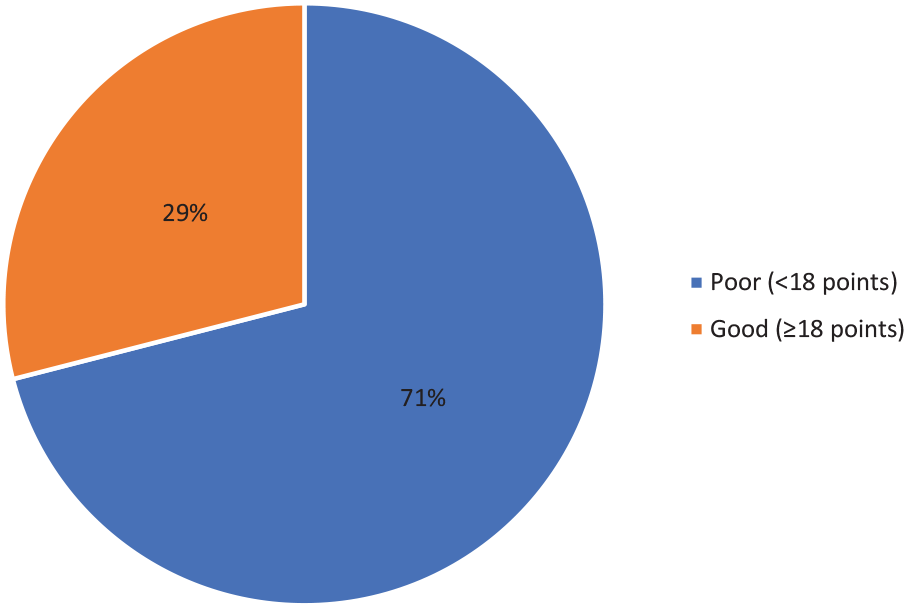
Level of total breast cancer awareness.
The univariate analysis for the predictors of breast cancer awareness showed that good breast cancer awareness scores were more common among the 20–39 years age group (p < 0.001), women with a bachelor’s degree (p < 0.001), and women who earn 5000–15,000 SAR monthly (p = 0.006). Importantly, good breast cancer awareness scores were more common among women living in the Eastern and Western regions (p < 0.001). Further details about the predictors of awareness scores are presented in Table 2.
The relationship between sociodemographic characteristics and level of awareness toward breast cancer.

p-value has been calculated using chi-square test.
Significant at p < 0.05 level.
Scoring 60% or below was classified as poor breast cancer awareness. Using a multivariate regression model revealed that participants who live in the Southern region were 1.8 times more likely to be associated with poor breast cancer awareness (AOR = 1.819; 95% CI = 1.319–2.508; p < 0.001). Moreover, statistical analysis revealed that women living in the Northern region might have 1.6 times higher likelihood of having poor breast cancer awareness (AOR = 1.575; 95% CI = 1.134–2.188; p = 0.007). Furthermore, statistical analysis revealed that unemployed women were 1.4 times more likely to be associated with poor breast cancer awareness (AOR = 1.369; 95% CI = 1.108–1.691; p = 0.004). Subsequently, participants who earned 5000–15,000 SAR per month were more likely to be associated with good breast cancer awareness (AOR = 0.699; 95% CI = 0.534–0.914; p = 0.009). Further details regarding the multiple linear regression analysis to determine the predictors of poor breast cancer awareness are presented in Table 3.
Multiple linear regression predicting poor awareness toward breast cancer.

AOR: adjusted odds ratio; CI: confidence interval; Ref: reference.
Significant at p < 0.05 level.
This study’s results demonstrated that age, region of residence, location of residence (urban or rural area), educational level, employment status, monthly family income, and the use of oral contraceptives were factors associated with participants’ awareness of breast cancer screening.
Regarding age, participants who were in the age group 20–39 years were 4.3 times more likely to be aware of breast cancer screening (AOR = 4.307; 95% CI = 2.818–6.582; p < 0.001) compared to those less than 20 years of age. Moreover, the 40–49 years age group exhibited 2.2 times more awareness of breast cancer screening (AOR = 2.219; 95% CI = 1.606–3.066; p < 0.001) compared to the 50 years age group or above (AOR = 2.031; 95% CI = 1.460–2.825; p < 0.001).
Regarding region of residence, participants living in the Southern region (AOR = 0.560; 95% CI = 0.409–0.766; p < 0.001) and those residing in rural areas had significantly lower awareness of breast cancer screening compared to other regions. Regarding educational level, participants who had a bachelor’s degree were 1.7 times more likely to be aware of breast cancer screening (AOR = 1.795; 95% CI = 1.133–2.843; p = 0.013), whereas for participants who had a master’s degree or PhD, the likelihood ratio rose 1.9 (AOR = 1.998; 95% CI = 1.296–3.082; p = 0.002).
Regarding employment status, the awareness of breast cancer screening in unemployed women was significantly low (AOR = 0.784; 95% CI = 0.635–0.969; p = 0.024). Furthermore, compared to participants who earned less than 5000 SAR per month, participants who earned 5000–15,000 SAR per month were 1.4 times more likely to be aware of breast cancer screening (AOR = 1.411; 95% CI = 1.073–1.855; p = 0.014). For those who earned more than 15,000 SAR per month, the awareness rate was only 1.3 times higher (AOR = 1.333; 95% CI = 1.084–1.610; p = 0.029). Participants who were not using oral contraceptives were 1.2 times more likely to be aware of breast cancer screening (AOR = 1.285; 95% CI = 1.025–1.610; p = 0.029). Further details regarding multiple logistic regression analysis for the predictors of breast cancer screening awareness are presented in Table 4.
Multiple logistic regression predicting awareness toward breast cancer screening.

AOR: adjusted odds ratio; CI: confidence interval; Ref: reference.
Significant at p < 0.05 level.
Discussion
Poor knowledge of breast cancer warning signs and screening techniques contributes to increased breast cancer mortality. 15 Previous research predicted that developing countries, such as Saudi Arabia, might have a high prevalence of breast cancer. 15 Therefore, these countries must adapt their breast cancer prevention and early detection programs to combat this global health concern. 15 There are prior publications covering breast cancer awareness in Saudi Arabia7–11; however, to the best of our knowledge, there is no nationwide research investigating the degree of breast cancer awareness and its predictors among Saudi women from different regions of the country.
This study aimed to assess the degree and determinants of breast cancer awareness among Saudi women on a nationwide scale. It also aimed to assess the relationship between awareness levels and demographic variables. Inadequate knowledge and awareness of breast cancer have been identified as proven risk factors for the rising incidence of the disease. 15 Importantly, participants in this study had a high level of awareness regarding breast cancer as a disease (68.6%). Moreover, around 60.3% of the women knew how to perform BSE, and 84% were aware of breast cancer screening programs in Saudi Arabia. However, when we calculated the total breast cancer awareness score (which includes knowledge of breast cancer warning signs, risk factors, screening programs, and BSE), we found that 71% of the participants had poor knowledge and awareness, while only 29% were sufficiently aware and knowledgeable. This result is alarming and the relevant governing bodies of breast cancer awareness in Saudi Arabia should take practical actions toward increasing breast cancer awareness to avoid a possibly high incidence of advanced breast cancer diagnoses in the future.
The findings of this study were found to be consistent with previous global and local studies assessing the level of awareness of breast cancer knowledge and screening. Internationally, Modeste et al. found that only 31% of their participants reported that they had performed a screening examination within the preceding month. Moreover, only 37% reported that they examined their breasts more than twice per year. 16 A recent study surveying 614 patients presenting to Mayo Clinic, Arizona pointed out that the majority appreciated the role of clinical examination and mammogram in detecting cancer. However, they were unaware of the recent updates to the breast screening guidelines, which can influence their knowledge in this regard. 17 Locally, a study conducted by El Bcheraoui et al. 8 in Saudi Arabia demonstrated that out of 10,753 participants, about 89% of them reported not having a clinical screening for breast cancer in the past year, and 92% reported never having a mammogram in their lifetime. Another local study investigated the attitudes and behavior patterns of women with regard to screening mammography and showed that only 12.4% of participants performed mammography. Furthermore, only 48.1% reported their intention of performing it in the future. 7
Among our participants, almost half of the women in this report were between 20 and 39 years of age (52.2%), indicating that the study sample has a sufficient number of participants within the median age group of the Saudi Arabia population. 18 Majority of previous research on this topic aimed to assess women’s awareness and knowledge of breast cancer with age as a variable. A study conducted by Mandelblatt et al. 19 found that age is inversely proportional to knowledge about breast cancer, meaning that the older a woman, the lower their knowledge of breast cancer. Our study’s result is similar, as the prevalence of adequate knowledge and awareness of breast cancer was higher among participants aged between 20 and 39 years (p < 0.001). Moreover, our results confirm that higher levels of education are associated with adequate breast cancer knowledge and awareness (p < 0.001), which is consistent with the findings from previous research related to breast cancer awareness and knowledge in Saudi Arabia.10,11
Al-Mulheim et al. 7 found a significant relationship between educational level and the level of awareness of the importance of breast cancer screening. Another study conducted by Alshahrani et al. revealed that more than 80% of the participants displayed a low level of knowledge regarding the importance of mammograms in detecting breast cancer. They also found that the highest predictors for general breast cancer knowledge were occupation, medical history, and age of menarche. 9 A study done on women in Jordan reported that their level of education is the main factor influencing their knowledge of breast cancer. 20 A previous study conducted in Turkey evaluated the relationship between educational level and breast cancer awareness and concluded that a higher level of education is positively associated with adequate awareness of breast cancer and BSE. However, knowledge of BSE and breast cancer should be explained to all women, regardless of their educational background. 21 According to our findings, unemployed women have insufficient knowledge and awareness of breast cancer as compared to employed women (95% CI = 1.108–1.691; p = 0.004). This finding is similar to research conducted on the Saudi Arabia population by Alsolami et al. 22 Being unemployed might be identified as having a poor income, one of the most significant barriers to early breast cancer screening. Furthermore, the expenses of diagnostic procedures make breast cancer prevention difficult. 23 The majority of women who participated in the current study were unemployed, which might explain why the majority had family monthly incomes ranging between 5000 and 15,000 (51.4%), which are classified as moderate income.
This research shows that 71% of Saudi women have poor knowledge regarding breast cancer warning signs, risk factors, screening programs, and BSE. We propose a few solutions that could decrease the low levels of awareness. First, using media, such as television, the Internet, radio, and social media, to increase breast cancer awareness would likely yield significant results. We propose focusing on publicizing the following: knowledge of breast cancer, the screening programs available in the country, the risk factors of developing breast cancer, and the warning signs of breast cancer. Second, having full-year campaigns targeting the public in places, such as malls and shops, would also likely yield increased breast cancer awareness. Currently, such campaigns only occur on a specific day (Breast Cancer Awareness Day in October). Based on our results, this is not sufficient. Finally, we highly recommend that local organizations and initiatives that advocate for breast cancer encourage its survivors to share their experiences and stories online, at conferences, or health-related meetings. Sharing such inspiring experiences can make a difference and raise awareness of breast cancer among women.
Limitations and future recommendations
There are some limitations to our study that must be addressed. First, using the Internet to distribute the survey might have skewed the results as those without Internet access might have been deprived of the opportunity to participate in the study. Second, the results of this study were obtained from a self-administered questionnaire. Thus, we cannot rule out the possibility of reporting bias. Furthermore, there might be a systematic disparity between those who answered and those who did not, which can affect the results of our study. Third, the method used to recruit participants was non-probability convenience sampling, which makes it difficult to generalize the results of the survey to the population as a whole. Future studies should avoid most of the mentioned confounding factors, such as using Internet-accessed surveys.
Conclusion
Of this study’s participants, 71% were classified as being poorly knowledgeable about breast cancer. This alarmingly poor overall level of knowledge of breast cancer among Saudi women may reflect insufficient efforts being made to raise public awareness toward breast cancer. Campaigns and educational programs targeting the public are necessary to spread knowledge about breast cancer, the screening programs available in the country, the risk factors for developing breast cancer, and breast cancer warning signs.
Supplemental Material
sj-pdf-1-whe-10.1177_17455057221133835 – Supplemental material for Level and predictors of breast cancer awareness among Saudi women: A nationwide study
Supplemental material, sj-pdf-1-whe-10.1177_17455057221133835 for Level and predictors of breast cancer awareness among Saudi women: A nationwide study by Jumanah T Qedair, Abdullah A Al Qurashi, Turki Alfayea, Hatan Mortada, Ali Alsudais, Saleh Almuntashiri and Alqassem Y Hakami in Women’s Health
Supplemental Material
sj-pdf-2-whe-10.1177_17455057221133835 – Supplemental material for Level and predictors of breast cancer awareness among Saudi women: A nationwide study
Supplemental material, sj-pdf-2-whe-10.1177_17455057221133835 for Level and predictors of breast cancer awareness among Saudi women: A nationwide study by Jumanah T Qedair, Abdullah A Al Qurashi, Turki Alfayea, Hatan Mortada, Ali Alsudais, Saleh Almuntashiri and Alqassem Y Hakami in Women’s Health
Footnotes
Acknowledgements
The authors thank Editage ( ) for English language editing. They also thank the following individuals for their extraordinary contributions in the data collection process: Sultan Alnashmi Alqasim, Amal Abdulmalik Alrizqi, Ahmed Ibrahim M Algabishi, Sanad Khalaf Alshammari, Turki Ayad Alenezi, Raghad Mubarak Almutairi, and Fatimah Jawad Aledili.
Declarations
Supplemental material
Supplemental material for this article is available online.
References
Supplementary Material
Please find the following supplemental material available below.
For Open Access articles published under a Creative Commons License, all supplemental material carries the same license as the article it is associated with.
For non-Open Access articles published, all supplemental material carries a non-exclusive license, and permission requests for re-use of supplemental material or any part of supplemental material shall be sent directly to the copyright owner as specified in the copyright notice associated with the article.
