




Abstract
Background:
Implanon discontinuation before the recommended time is problematic, as it puts women at risk of unwanted pregnancies and unsafe abortions, along with negative maternal health outcomes. Although the magnitude and determinants of Implanon discontinuation have been studied in Ethiopia, the results were inconsistent, with significant variability. Hence, this systematic review and meta-analysis aimed at estimating the pooled prevalence of Implanon discontinuation and its determinants in Ethiopia.
Methods:
A comprehensive search of studies published before 18 February 2022 was done using electronic databases such as PubMed, Embase, Google Scholar, Scopus, Web of Science, Science Direct, and Cochrane Library. The relevant data were extracted using a Microsoft Excel 2013 and analyzed using STATA Version 16. A random-effect meta-analysis model was used to compute pooled prevalence and odds ratio. The Cochrane Q test statistics and I2 tests were used to assess the heterogeneity of the included studies. A funnel plot, Begg’s, and Egger’s tests were used to check for the presence of publication bias.
Results:
A total of 11 studies with 4320 study participants were included in this meta-analysis. The overall pooled prevalence of Implanon discontinuation in Ethiopia was found to be 32.62% (95% confidence interval = 24.10, 41.13). There was significant heterogeneity among the included studies (I2 = 97.4%, p < 0.001). However, there was no statistical evidence of publication bias (p = 0.533). Dissatisfied with service provision at the time of insertion (odds ratio = 3.92, 95% confidence interval = 1.54, 6.29), not having pre-insertion counseling (odds ratio = 2.98, 95% confidence interval = 1.91, 5.04), the absence of post-insertion follow-up (odds ratio = 4.03, 95% confidence interval = 2.17, 5.90), and the presence of side effects (odds ratio = 2.93, 95% confidence interval = 1.87, 3.98) were found to be determinants of Implanon discontinuation.
Conclusion:
According to this systematic review and meta-analysis, one-third of Ethiopian women discontinued Implanon before the recommended time (3 years). Program managers and service providers should consider using more evidence-based and participatory counseling approaches to enhance client satisfaction. Furthermore, family planning service delivery points should be equipped to manage and reassure women who are experiencing side effects.
Introduction
Contraception is an important public health strategy that promotes women in preventing unintended and/or unwanted pregnancies, and the negative consequences of unsafe abortions, through proper spacing and timing of birth. 1 Although family planning (FP) has long been recognized as a right of a woman, discontinuing a method while she is still in need may imply that the right is not being maintained by the FP community of practice. 2 Proper timing and spacing (getting the desired number of children) have multidimensional benefits for both women and children. 3 Unintended pregnancy due to a lack of or discontinuation of contraception accounted for an estimated 13% of maternal mortality from unsafe abortion. 4
Implanon (Etonogestrel) is a second-generation single-rod progestogen-only, long-acting reversible contraceptive (LARC) method with a clinical failure rate of less than 1%.5,6 Its primary mode of action is ovulation suppression, which is aided by increased cervical mucus viscosity, which prevents spermatozoa from passing through the endometrial lining. 7 Its effectiveness in preventing pregnancy is high as compared to other short-acting contraceptives. Because Implanon does not contain estrogen, it has minimal contraindications and has been used by over 4.5 million women worldwide. 8
Although effectiveness, safety, accessibility, affordability, and utilization of Implanon have greatly improved, its discontinuation has become a problem, with more than half of users discontinuing the method before the recommended timeframe (3 years).7,9 Implanon discontinuation is defined as switching or terminating the method within 2.5 years of insertion. The term “early Implanon discontinuation” refers to discontinuing the method within 12 months of insertion. 10 Its discontinuation varies across countries, ranging from 3% in Burkina Faso to 27% in Yemen in the first year, and from 23% in Liberia to 69% in Yemen within 3 years of insertion. 11 According to studies conducted in Egypt, Nigeria, and Kenya, 13.5%, 19.0%, and 30.0% of Implanon users discontinued within the first year of insertion, respectively.12–14
Implanon discontinuation while still in need (IDWSIN) is troublesome because it puts women at risk of unwanted pregnancies and unsafe abortions, along with negative health consequences.11,15 It also puts a strain on the healthcare system and the community, with huge financial and social ramifications as fertility rates rise. 16 However, a birth interval of fewer than 24 months is known to endanger both maternal and child health. 17
Menstrual abnormalities such as menorrhagia or irregular vaginal bleeding, weight gain, local swelling, pain at the insertion site, and generalized fatigue are the commonest method-related reasons for Implanon discontinuation.18–20 In addition, the lack of pre-insertion counseling, the absence of post-insertion follow-up, low service quality, and client dissatisfaction, all contributed to premature discontinuation. 21
Over the last four decades, global and national efforts have made significant progress in increasing the availability and use of FP services, especially LARCs, to reduce unmet needs. 22 According to the 2016 Ouagadougou Partnership Agreement, 23 FP programs need to ensure access to contraceptive methods and allow new acceptors to delay or prevent conception for as long as they want.
The Ethiopian Federal Ministry of Health (FMOH) in collaboration with non-governmental organizations, and public–private partnerships, initiated an Implanon scale-up program in 2009 to increase women’s access to Implanon methods through trained Health Extension Workers for insertion. 24 Implanon use among married or in-union women increased from less than 3.4% in 2011 to 9% in 2019, implying that the scale-up program was somewhat successful in accessing communities. 25
In countries like Ethiopia, where Implanon users represent the vast majority of LARC users, studying Implanon discontinuation and its determinants has significant programmatic implications to enhance the quality of the service. 16 Although many epidemiological studies on the magnitude and determinants of Implanon discontinuation in Ethiopia have been conducted, the results were inconsistent, with significant variability. However, there was no nationwide study assessing the pooled prevalence of Implanon discontinuation among women in the reproductive age group. Such disparities in magnitude and determinants may not be satisfactory for policymakers and planners to intervene in the problem of discontinuation, demanding an assessment of the pooled estimates. Hence, this systematic review and meta-analysis aimed at estimating the pooled prevalence of Implanon discontinuation and its determinants at the country level. The findings of this study will aid policymakers and program planners in designing appropriate interventions to improve the rate of Implanon continuation across the country.
Methods
Study design
This systematic review and meta-analysis was reported under the guideline of Preferred Reporting Items for Systematic Reviews and Meta-Analysis (PRISMA) 2020 26 (Supplemental S1File). Also, a PRISMA flow chart was used for the inclusion of potentially related studies to the outcome of interest (i.e. Implanon discontinuation and associated factors).
Searching strategies
A comprehensive search of studies published before 17 February 2022 was done using databases such as PubMed, Embase, Google Scholar, Scopus, Web of Science, Science Direct, and Cochrane Library supplemented with the gray literature search. The following keywords: Implanon, Etonogestrel, Etonogestrel implant, discontinuation, discontinuance, removal, cessation, termination, early discontinuation, determinants, associated factors, and predictors were combined with Boolean operators and truncation. The search syntax was created for PubMed initially, and subsequently modified to meet the additional database-specific search requirements (Supplemental S2File). For PubMed search: (((((“implan*”) OR (Implanon)) OR (etonogestrel)) OR (“etonogestrel implant”)) AND (((((((“discontinuation”[All Fields]) OR (“discontinu*”[All Fields])) OR (“termination”)) OR (removal)) OR (“early removal”)) OR (“early discontinuation”)) OR (“cessation”))) AND ((((((Ethiopian) OR (Ethiopia)) OR (“southern Ethiopia”)) OR (“northern Ethiopia”)) OR (“eastern Ethiopia”)) OR (“western Ethiopia”)). The electronic database search was supplemented by looking for unpublished literature using Google Scholar, Google searching, and institutional repositories (such as the Addis Ababa University Digital Library). By searching the reference lists of already identified articles, additional articles were found.
Eligibility criteria
Inclusion criteria
Cross-sectional studies conducted in Ethiopia to assess Implanon discontinuation.
Both published and unpublished studies were considered, and if a study was found in many reports, the most thorough and up-to-date version was taken.
Only articles published in the English language were taken into consideration for the sake of clarity, understandability, and simplicity of interpretations.
Those studies published before 18 February 2022.
Exclusion criteria
Systematic reviews, case series, case–control studies, commentaries, letters to editors, conference presentations, qualitative studies, and other opinion papers.
Studies that were not fully available after two email communication with the primary/corresponding author were also excluded as assessing methodological quality in the absence of the full text was challenging.
Articles that were not specifically related to Implanon discontinuance, such as studies on LARCs discontinuation.
Pilot/feasibility studies, and follow-up studies with no standardized outcome measurement.
Studies conducted in the same area during the same study period were excluded as potential duplicates.
Study selection and data extraction
All identified articles through electronic databases were imported to EndNote XI library (Thomson Reuters, CA, USA), and duplication of articles was checked. After removing duplicate articles, four authors (A.H., A.T., D.W., and B.B.) independently extracted all articles using a Microsoft Excel 2013 spreadsheet. The title, abstract, and full text were checked during the extraction process to ensure that they met the predetermined inclusion and exclusion criteria. Disagreements were resolved by an independent assessment of another author (D.E.). During extraction, the following characteristics were considered: the first author name, study area, study settings, region, year of publication, year of the study, study design, age of study participants, sample size, response rate, way of outcome measurement, and the proportion of Implanon discontinuation with a length of use and determinants (risk estimate (odds ratio (OR)) and their 95% confidence interval (CI)). The aforementioned authors collated the screened studies and shared them with the remaining authors and any discrepancies were resolved through discussion.
Quality assessment of the studies
The Joanna Briggs Institute (JBI) 27 Critical appraisal checklist for prevalence studies was used to assess the methodological quality of included studies as well as the risk of bias. This was performed independently by two authors (A.H. and F.E.). There are nine parameters in the JBI tool as follows: (1) Was the sampling frame appropriate to address the target population? (2) Were study participants sampled appropriately? (3) Was the sample size adequate? (4) Were the study subjects and the setting described in detail? (5) Was the data analysis conducted with sufficient coverage of the identified sample? (6) Were valid methods used for the identification of the condition? (7) Was the condition measured in a standard, reliable way for all participants? (8) Was there appropriate statistical analysis? (9) Was the response rate adequate, and if not, was the low response rate managed appropriately? Any disagreement between the two authors was resolved through discussion. An agreement has been made between the authors to give a score of 0 if the study satisfied each specific parameter and 1 if it did not. A composite quality index was computed and the risk of bias was graded as low (0–2), moderate (3 or 4), or high (⩾5) (Supplemental S3File). Finally, articles with low and moderate risk of bias were considered in the systematic review and meta-analysis.
Outcome measurement
The primary outcome variable of this systematic review and meta-analysis was the level of Implanon discontinuation in Ethiopia, and it was estimated using the pooled prevalence. Implanon discontinuation is considered when a woman removes Implanon earlier than the recommended time (3 years) for various reasons. When the removal takes place within the first 12 months of insertion, we call it early Implanon discontinuation (Supplemental S4File). The secondary outcome variable was determinants of Implanon discontinuation and computed using an adjusted OR with their 95% CIs.
Statistical methods and analysis
The data were extracted using a Microsoft Excel spreadsheet, and the statistical analysis has been done with STATA™ 16 statistical software. Meta-analysis was run to compute the pooled prevalence of Implanon discontinuation and its determinants. To examine heterogeneity between studies, the I 2 test was computed and there was significant heterogeneity between the studies (I 2 = 97.8%, p < 0.001). The pooled prevalence of Implanon discontinuation was computed using a random-effects model with the DerSimonian–Laird method. Subgroup analyses were conducted by the residence, year of study, and year of publication. Accordingly, the pooled proportion of Implanon discontinuation across the above parameters and their corresponding 95% CI were presented using forest plots. The adjusted ORs from eligible studies were extracted, along with their 95% CIs. The overall pooled ORs were computed. Again, a forest plot was used to display the pooled estimates of the OR, along with their 95% CIs. Meta-regression was performed to identify the cause of heterogeneity, using sample size and publication years as covariates. A funnel plot, Begg’s, and Egger’s tests were used to check the presence of publication bias. A p-value of 0.533 and 0.575 for Begg’s and Egger’s tests, respectively, implied that a small-study effect was less likely. To assess the impact of a single study on the total pooled estimate, a sensitivity analysis using a random-effects model was done.
Results
Study selection
Through database searches, a total of 305 published and unpublished studies were identified. One hundred forty-eight studies were found to be duplicates and were removed, while 157 were moved to the screening stage. Then, 134 studies were removed based on title and abstract screening, and 23 full articles were obtained. Finally, 11 studies met the eligibility criteria and were included in the final analysis to estimate the overall prevalence of Implanon discontinuation and its determinants (Figure 1).
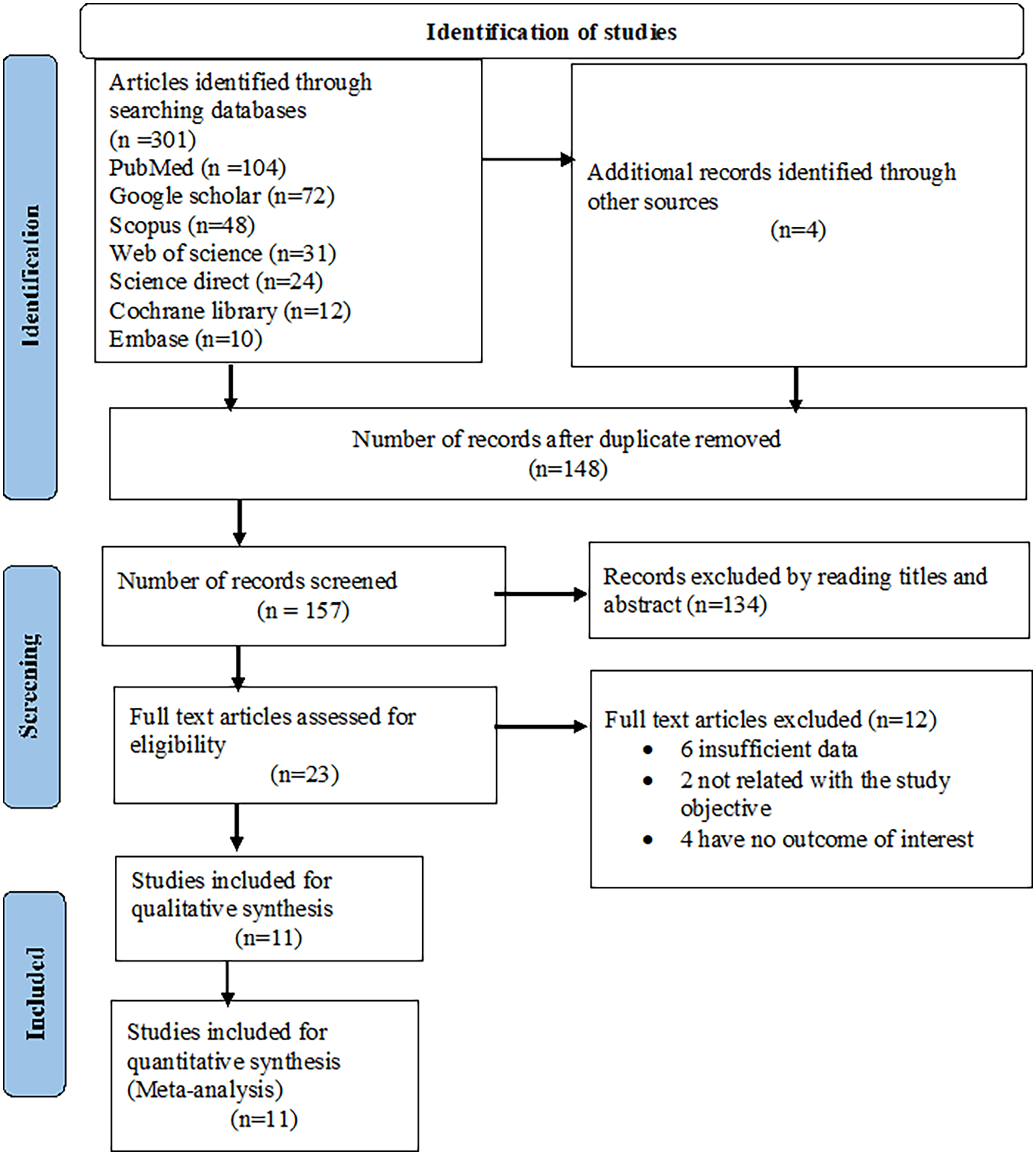
PRISMA flow diagram of study selection for systematic review and meta-analysis on Implanon discontinuation and associated factors among women in Ethiopia, 2022.
Characteristics of identified studies
A total of 11 cross-sectional studies were included in this systematic review and meta-analysis.28–38 A total of 4320 Implanon users were considered in the meta-analysis. In all of the studies, data were collected by a face-to-face interview using a pre-tested, interviewer-administered questionnaire. The publication year ranged from 2015 to 2021. The minimum and the maximum sample sizes were 132 and 711, which were obtained from studies conducted in Amhara 34 and South Nations, Nationalities, and Peoples’ Region (SNNPR), 36 respectively. Regarding the distribution of studies across the geographic region of the country, four were from the Amhara region,28,34,35,37 three were from the Oromia region,28,29,33 two were from Tigray,32,38 and two were from SNNPR31,36 (Table 1).
Descriptive summary of 11 studies included in the meta-analysis of Implanon discontinuation and its determinants among women in Ethiopia, 2022.

CS: cross-sectional study, SRS: systematic random sampling, srs: simple random sampling; SNNPR: South Nations, Nationalities, and Peoples’ Region.
Implanon discontinuation
The overall pooled prevalence of Implanon discontinuation in Ethiopia was found to be 32.62% (95% CI = 24.10, 41.13) (Figure 2). Since the prevalence estimates of the included studies had significant heterogeneity (I 2 = 97.4%, p < 0.001), the pooled prevalence was estimated using a random-effects meta-analysis model. In terms of individual prevalence, a study from Tigray 38 and the Amhara 35 region reported the lowest (16.0%) and highest (65.0%) levels of discontinuation, respectively.

Forest plot displaying the pooled prevalence of Implanon discontinuation among women in Ethiopia, 2022.
Subgroup analysis
Since there was statistically significant heterogeneity, a subgroup meta-analysis analysis was done by geographical region, residence, study year, and publication year. Accordingly, the three parameters, namely, residence, study year, and publication year were found to explain the heterogeneity between groups (p < 0.05). The pooled prevalence of Implanon discontinuation was significantly higher among studies conducted in urban settings (47.01%, 95% CI = 33.40, 60.62) than the rural ones (24.61%, 95% CI = 19.11, 30.10) (Figure 3). By looking at the year, when the study was conducted, the pooled prevalence of discontinuation was higher for those studies conducted before 2018 (41.93%, 95% CI = 26.25, 57.21) as compared to for those studies conducted since 2018 (24.91%, 95% CI = 18.11, 37.71) (Figure 4). Similarly, the level of discontinuation was found to be higher for those studies published before 2020 (2014–2019), 34.87% (95% CI = 21.17, 48.57), than those studies have published since 2020, 28.66 (95% CI = 20.81, 36.50) (Figure 5).

Subgroup analysis of Implanon discontinuation among users by residence, 2022.

Subgroup analysis of Implanon discontinuation among users by study year, 2022.

Subgroup analysis of Implanon discontinuation among users by years of publication, 2022.
In contrast, the analysis showed no significant difference in discontinuation across the regions (I 2 = 97.8%, p = 0.598). The Amhara and SNNPR region had the highest and the lowest proportion of Implanon discontinuation at 41.36% (95% CI = 22.73, 59.98) and 28.57% (95% CI = 18.18, 38.95), respectively. The remaining two regions, Oromia and Tigray, had roughly the comparable level of Implanon discontinuation, with 27.21% (95% CI = 17.66, 36.76) and 26.83% (95% CI = 5.27, 48.55), respectively.
Heterogeneity and publication bias
Meta-regression was performed to identify the cause of heterogeneity, using sample size, and publication years as covariates. According to the analysis, neither sample size nor publication year was found to be statistically significant sources of heterogeneity (Table 2).
A univariate meta-regression analysis to determine factors affecting between-study heterogeneity of Implanon discontinuation among users in Ethiopia.

Visual inspection of the funnel plot was used to assess potential publication bias, which was statistically supported by Begg’s and Egger’s tests. The absence of publication biases was indicated by the symmetrical distribution of the included publications in a large inverted funnel (Figure 6). This was statistically supported by both Begg’s test (p = 0.533) and Egger’s test (bias coefficient = 4.997 (95% CI = −14.43, 24.42; p = 0.575)), both indicate that there was no small-study effect.
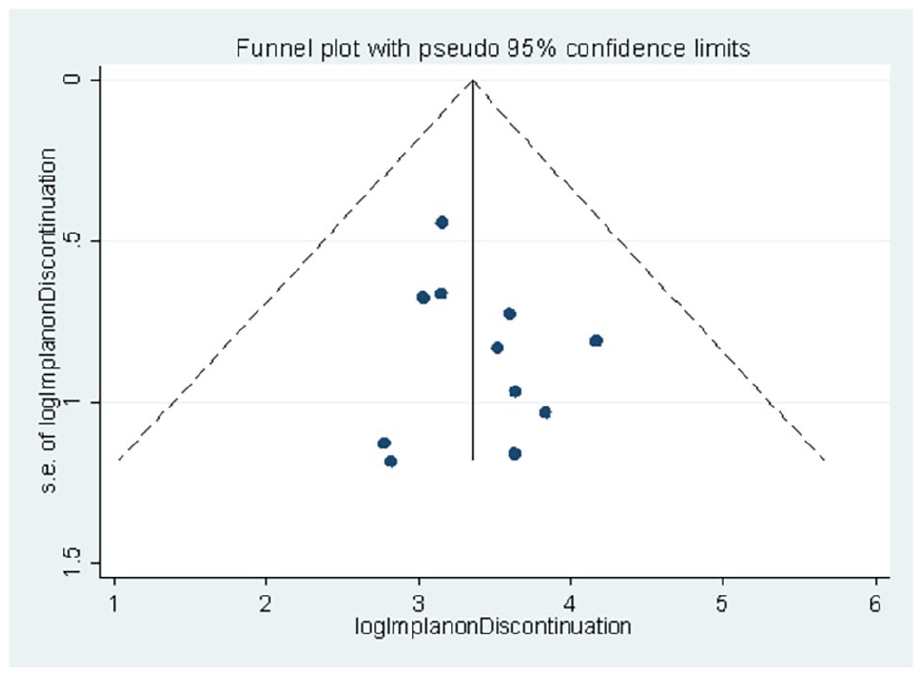
Funnel plot displaying publication bias of studies reporting the Implanon discontinuation in Ethiopia, 2022.
Sensitivity analysis
To detect the impact of a single study on the overall meta-analysis estimate, a sensitivity analysis using a random-effects model was conducted. As a result, there was no evidence that a single study had an impact on the overall pooled estimate of Implanon discontinuation in Ethiopia (Table 3).
Sensitivity analysis for pooled estimates of Implanon discontinuation among Implanon users in Ethiopia, 2022.

CI: confidence interval.
Determinants of Implanon discontinuation in Ethiopia
Variables such as maternal age, level of education, lack of pre-insertion counseling, dissatisfaction with the service provided, lack of pre-insertion counseling, lack of post-insertion follow-up, parity, being a new acceptor, and the presence of side effects were extracted from the included studies to identify significant determinants of Implanon discontinuation (Supplemental S5File). Finally, four variables, namely, being dissatisfied with the service provided during insertion, not having pre-insertion counseling, the absence of post-insertion follow-up, and the presence of side effects, were found to be determinants of Implanon discontinuation.
In this review, women who were unsatisfied with the service provided at the time of insertion had 3.92 times higher chances of discontinuation than satisfied women (OR = 3.92, 95% CI = 1.54, 6.29) (Figure 7). The lack of pre-insertion counseling and post-insertion follow-up, however, were found as determinants of Implanon discontinuation. Women who did not get enough pre-insertion counseling were 2.98 times more likely to discontinue than their counterparts (OR = 2.98, 95% CI = 1.91, 5.04) (Figure 8). Furthermore, women who did not receive any post-insertion follow-up had a 4.03 times greater chance of Implanon discontinuation than those who had (OR = 4.03, 95% CI = 2.17, 5.90) (Figure 9).

Forest plot showing an association between dissatisfaction with service delivery and Implanon discontinuation among women users in Ethiopia, 2022.

Forest plot showing an association between lack of pre-insertion counseling and Implanon discontinuation among women users in Ethiopia, 2022.

Forest plot showing an association between lack of post-insertion follow-up and Implanon discontinuation among users in Ethiopia, 2022.
The presence of side effects was found to be positively associated with Implanon discontinuation. Implanon discontinuation was found to be 2.93 times higher among women who experienced any side effects following insertion as compared to those women who did not face any side effects (OR = 2.93, 95% CI = 1.87, 3.98) (Figure 10).
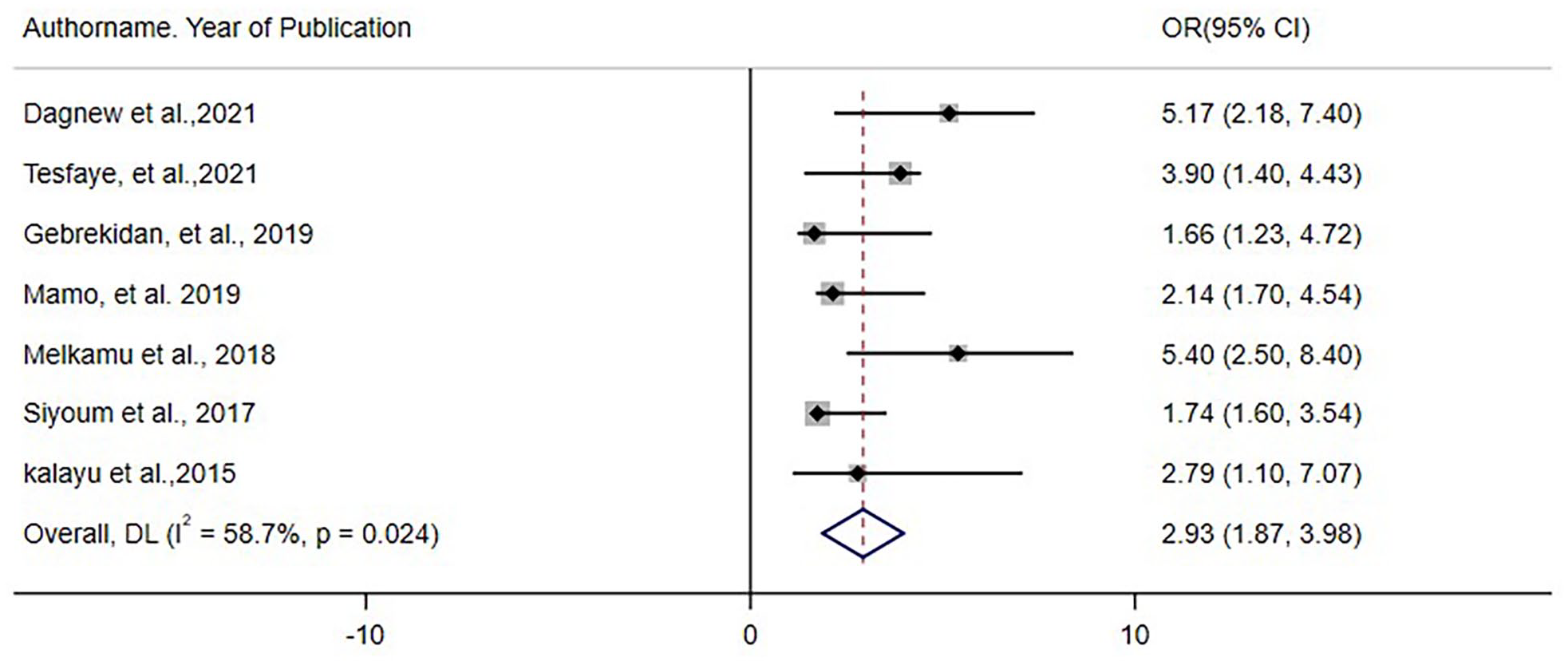
Forest plot showing an association between having side effects and Implanon discontinuation among Implanon users in Ethiopia, 2022.
Discussion
Implanon has led the available long-acting contraceptive method mix in Ethiopia, where it is used by a large proportion of married or in-union women because of its affordability and minimal side effects.39,40 Using it for the recommended time without discontinuation has significant importance in minimizing unwanted pregnancies, unsafe abortions, and related adverse health outcomes on maternal and child health. 41 For myriad reasons, users discontinue using Implanon while they still desire to prevent pregnancy. 17 Its premature discontinuation implies poor quality of FP services provision. 42 It is essential to have a pooled estimate of Implanon discontinuation and its determinants at the national level to develop targeted and cost-effective interventions to improve Implanon service delivery and quality. 17 Hence, this systematic review and meta-analysis aimed at determining the prevalence of Implanon discontinuation and the factors that influence it in Ethiopia.
The estimated pooled prevalence of Implanon discontinuation in Ethiopia was 32.62% (95% CI = 24.10, 42.13). Although no systematic reviews and meta-analyses have been conducted in Ethiopia or elsewhere, we have compared the current pooled prevalence with some primary studies conducted abroad. Accordingly, the level of discontinuation was higher than primary studies conducted in Zaria (19.0%) and Ilorin districts of Nigeria (23.6%),43,44 Egypt (13.5%), 12 Malaysia (22.86%), 45 and Senegal (6.1%). 46 This high rate of discontinuation might be due to inadequate pre-insertion counseling and post-insertion follow-up, as well as minimal male partner involvement before insertion, as seen in the majority of the included studies in this systematic review and meta-analysis.31,35,37 Also, this could be due to a decreased need for contraception, dissatisfaction with the current methods, or poor management of side effects. 42 This high rate of discontinuance could also be due to the good/cheap access to implant removal services in Ethiopia, as compared to other countries where women may not have this option.
This finding implies the importance of providing comprehensive FP information that helps women in selecting a good method that they can use for a longer time. 47 To minimize the discontinuation, policymakers, program planners, and other stakeholders in the health sector need to focus on creating an enabling environment for Implanon users by providing client-centered care. 48
However, the finding was lower than studies conducted in Cambodia (45%), 16 Ghana (43%), 49 Uganda (56%), 11 and South Africa (67.3%). 50 In the context of Ethiopia, some health care providers strongly recommend Implanon users to complete the entire recommended time (3 years), which may reduce the number of women who discontinue the method. Furthermore, the disparity could be due to socio-demographic characteristics, beliefs, norms, and other cultural differences.
Based on the subgroup analysis result, the highest level of Implanon discontinuation 47.01% (95% CI = 33.40, 60.62, I 2 = 96.3%) was found among studies conducted in urban setup as compared to those studies conducted in rural one 24.61% (95% CI = 19.11, 30.10). This could be because urban women have better access to removal services by going to nearby health facilities, and they would be more likely to discontinue the method as soon as they experience mild to severe side effects. However, the disparity might be due to differences in socioeconomic status, residence, and the number of studies included in this meta-analysis. For those urban women who have a greater rate of discontinuance, a concerted effort is needed through the provision of health education. When looking at the trend of discontinuation by year of publication, it was found that the pooled prevalence of discontinuation was higher before 2020 and has been decreasing since then. Similarly, the pooled prevalence of discontinuation was higher for those studies conducted before 2018 as compared to those studies conducted since 2018. This might be because, as years roll on, the possibility of getting a well-trained FP service provider who can provide effective pre-insertion counseling and follow-up has grown, resulting in reduced discontinuation. However, low discontinuance could be due to the COVID-19 pandemic and its related anxiety that prevents women from going to a health facility for removal.51,52
Another objective of this systematic review and meta-analysis was to identify the most important factors that affect Implanon discontinuation. Accordingly, being dissatisfied during service provision, not having pre-insertion counseling, the lack of post-insertion follow-up, and experiencing side effects were identified as determinants of Implanon discontinuation.
This meta-analysis identified that women who were dissatisfied with the service provision at the time of insertion had a higher chance of discontinuation. This finding was supported by a scoping review of global studies 17 and other primary studies conducted in Australia 53 and the United States. 54 Service dissatisfaction at first contact has been proven to increase the likelihood of service discontinuation by interrupting a smooth relationship between clients and service providers. 17 In contrast, high service satisfaction leads to women acting on health advice provided by health care providers before discontinuing the method and being able to endure minor side effects, and this lessens the probability of discontinuation. 55 As a result, health care providers at service delivery points need to focus on providing compassionate, confidential, and respectful care at the time of insertion to raise client satisfaction and lower the rate of Implanon discontinuation. 56
Not having pre-insertion counseling on the potential side effects also had a positive association with Implanon discontinuation. This was supported by studies conducted in the United States, 57 Philipines, 58 and Jordan. 59 The possible reason might be that women who are not counseled and informed about side effects before insertion may have difficulty in coping with minor side effects and are easily prone to discontinuation. According to the quality framework of Bruce, 60 if clients clearly understand their choice through better counseling (i.e. interpersonal relations and information exchange), they will feel comfortable in choosing a method and making them more likely to continue using the method. So, health care providers need to organize an interactive counseling session in which women can express their concerns, to extend the duration of Implanon use to the recommended time. 17 Also, clients should be encouraged to engage in a two-way dialogue in which they can exchange information, ask questions, seek clarifications, and express their concerns.
Similarly, this meta-analysis revealed that the likelihood of Implanon discontinuation was higher among those women who did not have post-insertion follow-up as compared to those who had. This was supported by a scoping review of global studies. 17 This might be because as clients did not get adequate post-insertion follow-ups with service providers, they may have difficulty in managing mild side effects, leading to Implanon discontinuation. Women who got a timely follow-up, however, may gain additional counseling about the handling of side effects from service providers, and therefore, they were more encouraged to lengthen the utilization of Implanon.
In this meta-analysis, the odds of Implanon discontinuation were higher among women who experienced side effects following insertion. This was supported by a scoping review 17 and other primary studies conducted in Turkey, 61 Nigeria, 14 Jordan, 62 Australia, 63 and the Democratic Republic of Congo. 64 Evidence showed that method-related side effects were identified as determinants of Implanon discontinuation. 17 A study conducted by World Health Organization (WHO) on 60 Demographic and Health Survey (DHS) surveys from 25 countries found that method-related concerns, especially side effects, were the most common reason for discontinuation across all methods, especially for Implanon. 10 Other studies have revealed that side effects, as well as fears and misconceptions about the method (Implanon), are big reasons for contraceptive discontinuation when they are not adequately addressed with counseling and follow-up.65,66
Limitation of the study
Although this systematic review and meta-analysis was the first of its kind in Ethiopia to look at Implanon discontinuation and its determinants, the findings should be interpreted with caution due to the limitations listed below. All the included studies were cross-sectional, and this makes it difficult to establish a cause–effect relationship due to the nature of the study design. In addition, the studies were limited to four regions, which may limit the representativeness of the findings. Finally, due to a dearth of regional and global systematic reviews and meta-analyses, we were obliged to discuss some of our findings with primary studies conducted out of Ethiopia.
Conclusion
This meta-analysis revealed that one-third of the women in Ethiopia had discontinued Implanon before the recommended time (3 years). Being dissatisfied with the service provided at the time of insertion, not having pre-insertion counseling, the lack of post-insertion follow-up, and the presence of side effects were found to be determinants of Implanon discontinuation. Healthcare providers at service delivery points need to focus on the provision of client-centered care at the time of insertion to raise client satisfaction. Program managers and service providers should consider using more evidence-based and participatory counseling approaches to reduce method-related Implanon discontinuation. In addition, FP service delivery points should be prepared to manage and reassure women experiencing side effects to mitigate Implanon discontinuation.
Supplemental Material
sj-docx-1-whe-10.1177_17455057221109222 – Supplemental material for The prevalence of Implanon discontinuation and associated factors among Ethiopian women: A systematic review and meta-analysis
Supplemental material, sj-docx-1-whe-10.1177_17455057221109222 for The prevalence of Implanon discontinuation and associated factors among Ethiopian women: A systematic review and meta-analysis by Aklilu Habte, Aiggan Tamene, Demelash Woldeyohannes, Biruk Bogale, Dejene Ermias, Fitsum Endale, Addisalem Gizachew, Merertu Wondimu and Dawit Sulamo in Women’s Health
Supplemental Material
sj-docx-2-whe-10.1177_17455057221109222 – Supplemental material for The prevalence of Implanon discontinuation and associated factors among Ethiopian women: A systematic review and meta-analysis
Supplemental material, sj-docx-2-whe-10.1177_17455057221109222 for The prevalence of Implanon discontinuation and associated factors among Ethiopian women: A systematic review and meta-analysis by Aklilu Habte, Aiggan Tamene, Demelash Woldeyohannes, Biruk Bogale, Dejene Ermias, Fitsum Endale, Addisalem Gizachew, Merertu Wondimu and Dawit Sulamo in Women’s Health
Supplemental Material
sj-docx-3-whe-10.1177_17455057221109222 – Supplemental material for The prevalence of Implanon discontinuation and associated factors among Ethiopian women: A systematic review and meta-analysis
Supplemental material, sj-docx-3-whe-10.1177_17455057221109222 for The prevalence of Implanon discontinuation and associated factors among Ethiopian women: A systematic review and meta-analysis by Aklilu Habte, Aiggan Tamene, Demelash Woldeyohannes, Biruk Bogale, Dejene Ermias, Fitsum Endale, Addisalem Gizachew, Merertu Wondimu and Dawit Sulamo in Women’s Health
Supplemental Material
sj-docx-4-whe-10.1177_17455057221109222 – Supplemental material for The prevalence of Implanon discontinuation and associated factors among Ethiopian women: A systematic review and meta-analysis
Supplemental material, sj-docx-4-whe-10.1177_17455057221109222 for The prevalence of Implanon discontinuation and associated factors among Ethiopian women: A systematic review and meta-analysis by Aklilu Habte, Aiggan Tamene, Demelash Woldeyohannes, Biruk Bogale, Dejene Ermias, Fitsum Endale, Addisalem Gizachew, Merertu Wondimu and Dawit Sulamo in Women’s Health
Supplemental Material
sj-xlsx-5-whe-10.1177_17455057221109222 – Supplemental material for The prevalence of Implanon discontinuation and associated factors among Ethiopian women: A systematic review and meta-analysis
Supplemental material, sj-xlsx-5-whe-10.1177_17455057221109222 for The prevalence of Implanon discontinuation and associated factors among Ethiopian women: A systematic review and meta-analysis by Aklilu Habte, Aiggan Tamene, Demelash Woldeyohannes, Biruk Bogale, Dejene Ermias, Fitsum Endale, Addisalem Gizachew, Merertu Wondimu and Dawit Sulamo in Women’s Health
Footnotes
Acknowledgements
The authors are grateful to the Wachemo University, College of Medicine and Health Sciences, staff for providing their unreserved support. The authors thank all authors of studies included in this systematic review and meta-analysis.
Author contribution(s)
Declaration of conflicting interests
The authors assure that, with full responsibility and communication, the document has been submitted. The authors indicated that there is no conflict of interest with other individuals or organizations that could influence or bias the content of the manuscript inappropriately.
Funding
The author(s) received no financial support for the research, authorship, and/or publication of this article.

Availability of data and materials
All the data used to strengthen the results of this study are fully available without restriction.
Supplemental material
Supplemental material for this article is available online.
References
Supplementary Material
Please find the following supplemental material available below.
For Open Access articles published under a Creative Commons License, all supplemental material carries the same license as the article it is associated with.
For non-Open Access articles published, all supplemental material carries a non-exclusive license, and permission requests for re-use of supplemental material or any part of supplemental material shall be sent directly to the copyright owner as specified in the copyright notice associated with the article.
