



Abstract
Assessment and evaluation are crucial to improving educational quality. Examining the opinions of teachers from various countries on in-class assessments can significantly enhance education systems. Similarities and differences in Uganda’s and Turkey’s educational systems justify comparing them. This study aimed to examine and compare the assessment methods used by teachers working in high schools in Uganda and Turkey to determine student achievement. The researcher administered the questionnaire to 119 Ugandan and 85 Turkish high school teachers working in public and private schools in both countries. The researcher used Casual comparative research. The Mann–Whitney U test was used for data analysis. The findings show that Turkish teachers use many in-class assessment methods more often than Ugandan teachers. Compared to Turkish teachers, Ugandan teachers view themselves as more capable of giving student feedback but less competent in taking measures to increase objective scoring. The article outlines further findings and provides recommendations.
Keywords
Introduction
Education is essential in determining a country’s status among the world’s countries. That is why comparing education systems in two countries helps us identify our faults and learn from the other countries in many aspects. Assessment and evaluation are crucial components of the education system, playing a significant role in enhancing the quality of education. Teachers play a pivotal role in the implementation of in-class assessment practices. Within this context, comparing the perspectives of teachers from different countries on in-class assessment practices can significantly contribute to enhancing the education systems in those countries.
This section initially provides brief information about the countries compared (Uganda and Turkey) and presents some conceptual aspects related to in-class assessments. Finally, the comparison of in-class assessment practices by teachers in Uganda and Turkey is discussed in terms of its contribution to the field, practitioners, and policymakers, leading to the presentation of the research problem.
Uganda, which has also recently conducted major curriculum reforms, serves as a basis for Turkey to conduct further studies on educational development. Turkey has a unique geographical location in Asia and partly Europe (OECD, 2016). It is a member of the Organization for Economic Cooperation and Development (OECD) but has one of the most controlled education systems among OECD countries (Fretwell and Wheeler, 2001). Since Turkey was declared a republic in 1923, the education system has undergone various changes. Beginning with the Law on the Unification of Education of 1924, the ministry made significant changes of education in all elements of education, and remarkable reforms made in its organizations, programs, and evaluation methods have had a considerable impact (Akşit, 2006; Ayas et al., 2006; Ministry of Education and Sports and MoES, 2016; Yüksel 2013).
In contrast, Uganda is a small country in Eastern Africa. For over 20 years after gaining independence from British colonial authority in 1962, Uganda has struggled with government failure, political turmoil, and civil conflicts. As a result, damage to the education system was severe; only 50% of children could attend school, and more than 90% of education expenditures were paid directly by parents (ADEA, 2005; Penny et al., 2006). Uganda has one of the highest youth unemployment rates in Sub-Saharan Africa. However, more young people have accessed education since the free Uganda Universal Secondary School (USE) launch for ages 12–18 in 2008 (Penina, 2013).
To improve and strengthen mutual understanding and collaboration with other countries, the Republic of Türkiye introduced Türkiye Scholarships in 1992, which gives scholarships to successful international students. More than 100 Ugandan students receive undergraduate, master’s, and doctoral degrees in Turkish public universities. Thereby building a network of future leaders committed to strengthening cooperation among countries and societies.
In general, educational reforms draw attention to state and district assessments (large-scale assessments) (Thurlow, 1998) as assessments designed to measure the state of the education system for all students in various countries. Various assessment approaches have been explored in education reform to understand individual learners better, encourage higher standards, and support student teaching (Linn and Herman, 1997). In this time and age, the literature has focused on assessing and grading students as critical aspects of effective teaching (McMillan, 1993). Over the years, the emphasis on classroom assessment has increased. It has become a topic of discussion among many educational scientists and researchers in the academic literature. In-class assessment involves observing students’ written work, responses to class questions, and performance on teacher-administered and standardized tests. Assessment should include a variety of acceptable methodologies for making inferences about individual students, classes, schools, regions, and states (Elmore and Rothman, 1999). Assessment is seen as an organic part of teaching and learning and becomes a fact of life for teachers and a part of what teachers do (Lambert and Lines, 2000).
The day-to-day work of teachers is not limited to the small details of the job, such as monitoring students and keeping a record of absenteeism, but also encompasses a more profound role, such as planning instructional activities, grading students, developing the curriculum, and predicting how students can best develop new skills from what is taught (Mertler, 2017). Most academics conclude that classroom assessment activities take up 40–50% of a teacher’s time (Mertler, 2004; Stiggins, 1988). As a result, to use this time effectively, they must acquire assessment literacy skills and regularly use the necessary knowledge and skills in their classrooms. However, students do not fully understand what teachers teach, which creates the need for evaluation. Failure to comprehend is not related to how well teachers plan and carry out the teaching process but to teachers’ inability to predict reliably what students are learning (Nasab, 2015) and how different countries conduct assessments. As agreed, assessment helps bridge the gap between learning and teaching.
Classroom assessment is classified as “evaluation of learning,” “assessment for learning,” and “assessment as learning,” depending on its purpose, method, and time (Suskie, 2018). Teachers should develop assessment methods that address the different types of information gathered about students using various types of assessment and encourage learning for students with different learning styles and backgrounds. If in-class assessment techniques are not carried out per the planned goal, they will not provide helpful feedback on the teaching and learning process (Tuba and Yildizli, 2018). Generally, it is essential for teachers to regularly use some form of formal and informal assessment to measure student progress and grades, attract attention, provide feedback, and tailor instruction to student needs. Students also frequently engage in self-assessment while studying, solving problems, and tracking their progress.
The use of assessment is to monitor learning processes and detect success in all curriculum areas. Through assessment, the teacher creates a comprehensive picture of the child’s short- and long-term needs and plans future work accordingly. Traditionally, teachers use assessment results as a basis for grading students. However, teachers use assessment today to determine grades and improve classroom instruction and student learning. As a result, several unique assessment methods have been developed and are used in classrooms. The traditional assessment generally focuses on intellectual skills by considering only cognitive behaviors. They often consist of processes such as paper-and-pencil exams and quizzes, with only one correct answer for each test item. This assessment form is used effectively in classrooms, as teachers can easily and quickly study large numbers of students simultaneously.
Additionally, the alternative approach observes the developments in affective and psychomotor behaviors (Çalışkan and Kaşıkçı, 2010). Portfolios, projects, performance assignments, concept maps, structured guides, descriptive branched trees, word association, self-assessment, and peer assessment are accepted as alternative assessment tools (Bol et al., 1998). Therefore, teachers should design a reliable, valid, and effective method to enable student learning. The methods for assessing a student’s progress can be daunting. However, the best assessment initiatives use many diversified techniques based on the teacher’s interests and needs, the responsibilities each teacher places on their students, teacher expectations, and the intended style of teacher–student relationships (McMillan et al., 2002). In addition, there is an increasing focus on evaluating the process by which students solve problems and analyzing the final result. Today’s emphasis seems to be on what students already know and can do rather than on what they don’t know. In developed countries such as America, England, and France and in countries such as Sub-Saharan Africa, Kenya, Mozambique, and South Africa, the assessment process seems to have become more individual and student-centered due to educational changes.
Research has shown that many countries have various ways of assessing learners, depending on grade level and attitude toward the subject. In a state in the southern United States, research conducted on teachers’ beliefs about assessment and their assessment practices indicated that teachers’ emphasis on different forms of assessments (such as open-ended responses, homework, and teacher-made tests) varies according to the grade level teachers teach (Adams and Hsu, 1998).
In a study conducted by Bello & Tijan (2018) to evaluate the training needs of teachers in school-based assessment in Anglophone West African Countries of Ghana, Nigeria, and Gambia, the feedback from the research revealed that teachers frequently use assessment tools such as trial tests, Objective tests, and homework and are easy to score. However, Bello & Tijan’s findings indicated that teachers were incompetent in using other assessment tools, especially in evaluating project work, assessment by interview, and behavioral assessment.
In the UK and Northern Ireland, much emphasis is put on formative and diagnostic assessment. It is agreed that formative assessment with methods like self-assessments, student homework, and observations aids teachers to identify various learning needs of different students individually and also student progress (OECD, 2004).
Assessment practices in Uganda and Turkey
In Uganda, public and private secondary schools select, administer, and practice tests for accountability and provide published tables of student test scores. They assess students using various methods, including exams, practice tests, commercial tests, locally developed tests, classroom observations, standardized tests, home-based questionnaires, assignments, projects, and summative exercises (Mwebaza, 2010; Reg et al., 2016). However, these assessments have not been meeting the needs of individual learners, hence the need to revise the curriculum in 2020, replacing the previous subject-based education program with a new theme or competency-based education program for lower secondary schools (Mubangizi, 2020). With this change, teachers will adopt contemporary assessment methods, define high learning standards, and allow tests to measure what they should measure.
On the other hand, the latest Turkish curriculum has tried to develop a performance-based assessment that focuses on measuring students’ success in learning activities and projects without giving up on traditional classroom exams (Ayas et al., 2006; Öztürk, 2011). Recently, Kılıçkaya (2016) investigated the effects of a high-stakes exam on the classroom practices of 32 secondary school English teachers. Kılıçkaya (2016) found that most teachers approved using assessment techniques like quizzes and assignments consisting of multiple-choice questions, end-of-term exams, short-answer questions, fill-in-the-blank, and matching questions to test the English language. In light of this, the research showed that Turkish teachers still rely on traditional assessment methods, although there is a need to apply alternative assessment methods in evaluating both the learning process and learning outcomes (Ayas et al., 2006; Birgin and Baki, 2009; Küçük, 2004).
Additionally, Tuba and Yıldızlı (2018) investigated the classroom assessment practices of 288 primary, secondary, and high school teachers in Turkey. Tuba and Yıldızlı's findings showed that teachers in Middle and High schools mostly used multiple-choice questions, open-ended questions, true/false questions, short-answer questions, matching questions, and performance assignments.
The need to compare Uganda and Turkey assessment methods used
Comparing the in-class assessment practices employed by teachers in Turkey and Uganda holds significant academic and practical importance. Such a comparative study can illuminate the diverse pedagogical approaches and assessment strategies prevalent in distinct educational contexts, influenced by cultural, socioeconomic, and educational policy differences.
This examination can yield valuable insights into the effectiveness of various assessment methodologies, contributing to enhancing educational quality and teaching practices in both countries. Moreover, the findings can inform policymakers and academic stakeholders, facilitating the development of more informed, contextually appropriate educational reforms and teacher training programs. Ultimately, this comparative analysis could foster a more nuanced understanding of global educational practices, encouraging cross-cultural learning and adopting best practices in-class assessments.
Moreover, the results of such a comparative study between in-class assessment practices in Turkey and Uganda can benefit other countries, especially those with similar educational, cultural, or socioeconomic contexts. Countries within the same geographical regions, such as Middle Eastern countries for Turkey and East African countries for Uganda, may find the findings particularly relevant due to shared cultural values and educational challenges. Additionally, developing countries or countries undergoing educational reforms could leverage the insights to inform their own assessment practices and teacher training programs.
The challenges teachers encounter in the context of in-class assessment practices in countries like Uganda and Turkey can offer insights to certain developed nations that are currently not facing these issues but might encounter them in the future due to population growth and an increase in migrant populations.
The presence of certain similarities and differences in Uganda and Turkey’s educational systems and practices also constitutes some of the rationales for comparing these two countries. Uganda and Turkey have recognized the importance of quality education for national prosperity, implementing learning standards and assessments to monitor student growth (OECD, 2005). Both engaged in curriculum reforms, adopting student-centered pedagogies to enhance inquiry-based learning and diversify teaching methods (Altinyelken, 2010, 2015; Verger et al., 2013). However, high-stakes exams in both countries have led to increased student stress and educational inequities (Kanjee and Acana, 2013; Kitchen et al., 2019; OECD, 2020). Despite similarities in educational reforms, Uganda and Turkey differ in structure, historical contexts, and challenges, such as Uganda’s colonial legacy impacting its assessment system and Turkey’s advantage in international assessment participation (Braun et al., 2018; Karakaya, 2004; OECD, 2020).
This comparative research between Uganda and Turkey allows both countries to learn from each other’s experiences, aiming for continuous improvement in their educational and assessment practices amidst their unique challenges and contexts.
Aims and significance of the study
Various researchers have carried out theoretical studies in the field of Student assessment and evaluation (Adams and Hsu, 1998; Bol et al., 1998; Darling-Hammond and Mccloskey, 2008; Earl, 2006; Herzog-Punzenberger et al., 2020; Mertler, 2017; Nenty, 2005; Rotberg, 2006; Thurlow, 1998; Zhang and Burry-Stock, 1997). However, few studies have been conducted in Uganda and Turkey regarding curriculum reform (Altinyelken, 2010, 2015). In light of this, no study has been found that compared the assessment methods used by secondary school teachers in the two countries. In addition, teacher perceptions are also an important aspect to consider, particularly concerning classroom assessment, as they influence the choice of assessment methods used in the classroom. Unfortunately, there is little research on teachers’ perceptions of classroom assessment and their skills and competencies in classroom assessment.
This study examines the assessment methods used by secondary school teachers in Uganda and Turkey to determine how teachers use assessment, their perceptions of the various techniques, the areas where teachers’ competencies are lacking in administering assessment, and what can be done to improve them.
The current research is expected to guide decision-makers in determining the content of education policies and in-service training to be given at schools to improve assessment practices. The research findings are thought to help school heads and teachers in Turkey, and Uganda choose the appropriate assessment methods to enhance teaching and student learning.
Research methodology
The research was carried out by applying quantitative research methods. Quantitative research is a tool used to test objective theories by examining the relationship (Creswell, 2009: 22). Quantitative methods have also been suggested to help make assumptions about deductively testing theories, guarding against biases, checking for alternative explanations, and generalizing and repeating the need to explain findings or the relationship between variables (Creswell, 2017). According to Fraenkel et al. (2012), in a quantitative study, the researcher tries to determine the general trend of responses from individuals and points out how this trend varies among people. Therefore, this method is suitable for explaining and comparing assessment methods used by secondary school teachers in Uganda and Turkey.
Research design
A survey design was used to collect demographic data from the participants. A survey design examines a sample of a population and tests a quantitative description of the trends, principles, and views of that population or the relationships among variables of a population (Creswell, 2009; Creswell and Creswell, 2017). In this context, casual comparative research was one of the descriptive research types. This design enables the description of the existing relationship between variables. The opinions of Turkish and Ugandan teachers on the assessment methods used to determine student achievement were determined and compared, and the relationship between their views and various variables was examined. According to Fraenkel et al. (2012), casual comparative research is for one of two primary purposes: to help explain critical human behaviors or predict possible outcomes. In this study, the assessment methods teachers in Uganda and Turkey used to determine student achievement were applied to help predict potential outcomes.
Sampling and data collection
The researcher could not use the random sampling method due to application problems in collecting the data required. In this context, purposive sampling, a non-random sampling method, was used to select schools in Uganda and Turkey according to school category (private and public school) and respondents’ working category. Purposive sampling allows for in-depth research by selecting information-rich situations depending on the purpose of the study. Purposive sampling, while predominantly utilized in qualitative research due to its focus on choosing information-rich cases that offer deep insights into the research question, can also be applied in quantitative research under specific circumstances (Creswell, 2017).
In this study, the maximum variation sampling method, which is one of the purposive sampling types, was used to select information-rich cases, further taking into account the field of diversity: the branches of the teachers, the type of school, the work category, and years of service. Grades 9–12 in public and private schools in Uganda and 119 teachers working part-time and full-time were selected. Similarly, grades 9–12 in public and private schools and 85 teachers working part-time and full-time in Turkey were selected. A total of 204 teachers were reached.
In data collection, the researcher developed an online survey tool, “Teacher Evaluation Practices Inventory (TUPI),” which was used and applied. This inventory consists of two parts with 27 items. According to the structure of the questions in the questionnaire, a Likert-type rating scale was used in some cases. In some cases, optional questions were used for ranking or classification. The items in the questionnaire were collected under the following criteria: • Teacher Evaluation Practices (14 items), • Teachers’ perceptions of efficacy regarding assessment methods (13 items).
For each item in the questionnaire, the inventory has a Likert-type rating scale of 1 = never, 4 = often, 1 = less proficient, 4 = very proficient, and 1 = strongly disagree to 4 = strongly agree. The questionnaire developed within the scope of the research was measured at categorical and ordinal levels. Therefore, since each item in the questionnaire was evaluated independently, statistical validity and reliability studies were not conducted for the measurement tool.
Data analysis
In the data analysis, the Mann–Whitney U test was used to calculate and determine the frequency of using specific methods in teachers’ classroom assessment and evaluation process in Turkey and Uganda, their perception of efficacy towards these methods, and whether a significant difference was shown. Non-parametric analysis was used because the analysis was based on items, and each item was at the scale level. According to Fraenkel et al. (2012), non-parametric analysis is used to analyze ranked data. Hence, rank totals and averages were calculated for each item, and the significance of the difference between rank averages was tested. For the statistically significant results, the effect size was calculated and interpreted.
Findings and discussions
The study findings are divided into “Teacher evaluation practices” and “Teachers’ perceptions of efficacy regarding assessment methods.”
Teacher evaluation practices
In practice, teacher evaluation involves understanding and agreeing on the practices that define quality teaching, how student achievement is measured, and methods of evaluation in terms of student assessment data, teacher observation rubrics, and methods used for assessment in Figure 1, a column chart containing the comparison of the frequency of using various assessment methods by teachers in Turkey and Uganda in the process of in-class assessment and assessment practices is presented. The graph was created by considering the percentages of respondents in both countries, marking the “often” option for each assessment method. Percentages of assessment methods that Turkish and Ugandan teachers say they use “often.”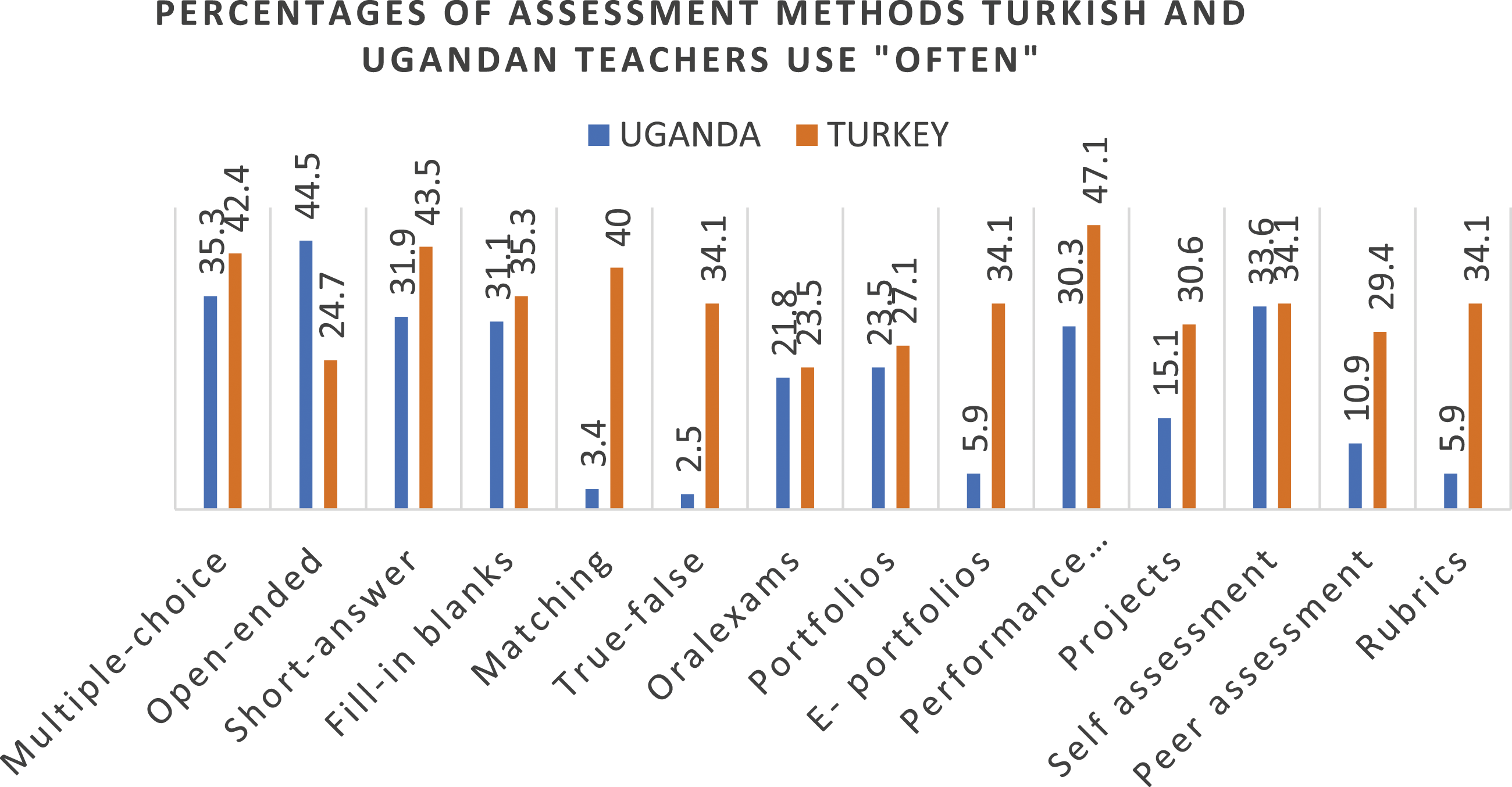
When Figure 1 is examined, it is seen that Turkish and Ugandan teachers use certain methods with different frequencies within the framework of classroom assessment and evaluation practices. Although the order of the methods most frequently used by teachers in both countries varies, it is seen that the frequency of using all methods except open-ended questions by Turkish teachers is higher than that of Ugandan teachers in general. Looking at the findings in general, it is noteworthy that Ugandan teachers use certain methods very often while they use specific methods very little. The size of the difference between the percentage of multiple-choice tests in which Ugandan teachers marked “often” the most and the percentage of true-false tests that they marked “often” the least can be considered as an indicator of this (Range = 44.5 – 2.5 = 42.0). Although Turkish teachers use specific methods more frequently, it can be stated that they generally use all methods at a certain level. The fact that difference between the percentage of performance tasks in which Turkish teachers mark “often” the most and the percentage of oral exams where they mark “often” the least is smaller than that of Ugandan teachers (Ranj = 47.1 – 23.5 = 23.6).
Mann–Whitney U test results of teachers' use of assessment methods by country (Turkey, Uganda).
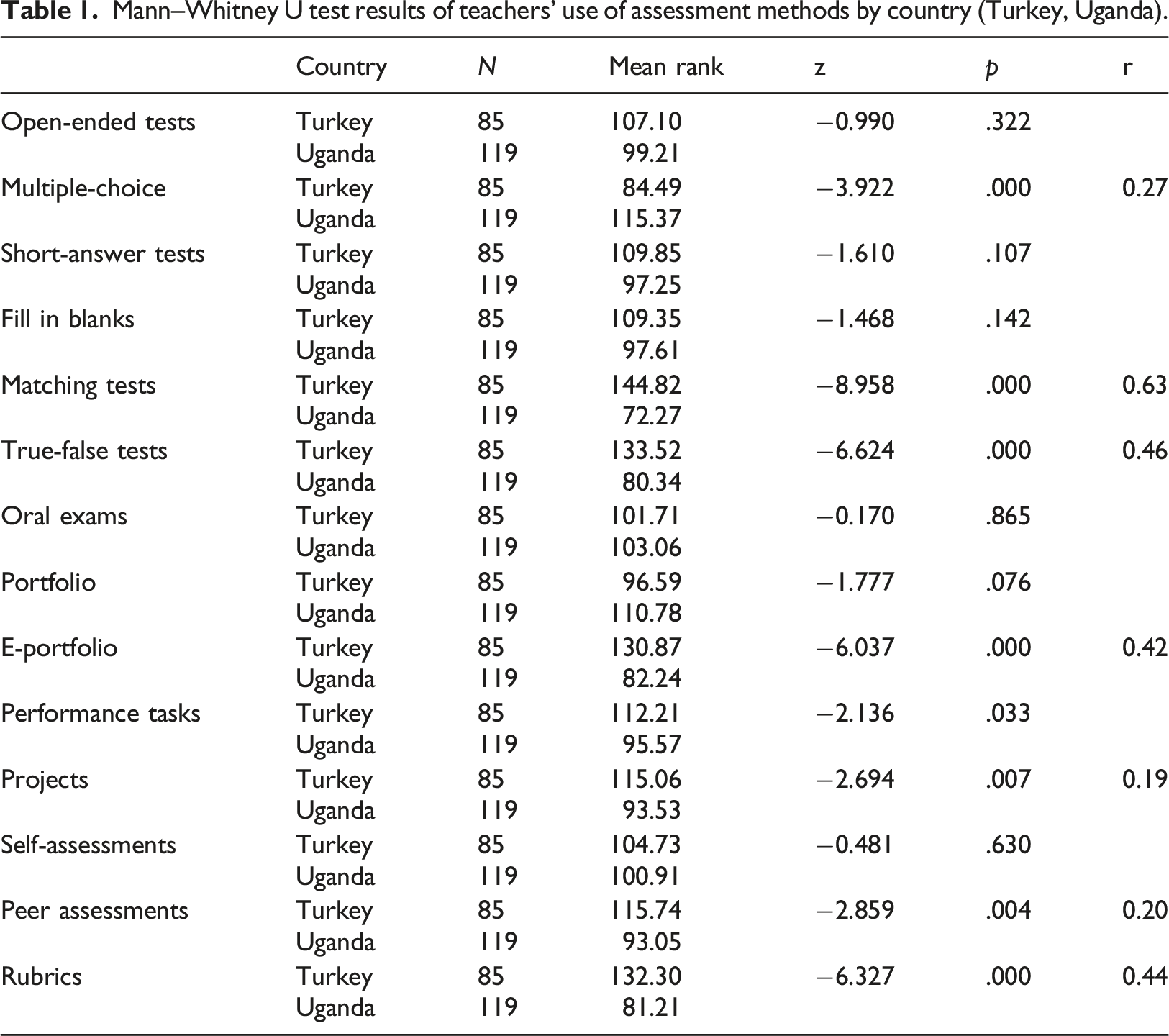
As shown in Table 1, a Mann–Whitney U test was used to analyze teachers’ methods in both countries. Both Ugandan and Turkish teachers preferred traditional methods to contemporary approaches. The rank scores of Turkish teachers for the level of using assessment methods are “matching tests” (z = −8.958, p < .05, r = 0.63), “true-false tests” (z = −6.624, p < .05, r = 0.46), “electronic portfolio” (z = −6.037, p < .05, r = 0.42), “project” (z = −2.694, p < .05, r = 0.19), “peer evaluation” (z = −2.859, p < .05, r = 0.20), and for “rubrics” (z = −6.327, p < .05, r = 0.44) statistically significantly higher than that of Ugandan teachers. These findings mean that Turkish teachers use the abovementioned methods more than Ugandan teachers. When the calculated effect size indices are examined, it can be mentioned that high effect (r = 0.63) for matching tests, moderate effect for true-false tests (r = 0.46), electronic portfolio (r = 0.42), and rubric (r = 0.44). There is a low impact for peer review (r=0.20) and projects (r = 0.19).
While Ugandan teachers’ rank scores for “multiple-choice tests” were significantly higher than Turkish teachers’ rank scores (z = −3.992, p < .05). This finding can be interpreted as Ugandan teachers’ use of multiple-choice tests is higher than that of Turkish teachers. The calculated effect size shows that the country has a negligible effect (r = 0.27) on the level of using multiple-choice tests. No statistically significant difference was observed between the rank scores of Turkey and Uganda regarding the level of use of other assessment methods.
In Uganda, teachers mostly used open-ended questions, multiple-choice tests, and self-assessments for testing. These teachers consider it critical to see how students make sense of information and to examine and evaluate it from their perspective. For example, Mwebaza (2010) found that Uganda Secondary School teachers mostly used open-ended essay questions in history, religious studies (such as Theology and Islam), geography, and economics. Although used by Ugandan teachers, multiple-choice questions do not reflect students’ knowledge of the subject. However, it is an effective way to measure students’ mastery of necessary techniques or expertise.
On the other hand, teachers in Turkey frequently use performance tasks, short-answer tests, and multiple-choice tests. These findings are consistent with the conclusions of the study. Çelikkaya et al. (2010) stated that teachers in Turkey frequently use short-answer test-type assessments. Short-answer tests are primarily used because they effectively examine many topics and determine whether students have learned the vital information highlighted in the lesson. These assessments help increase students’ ability to express information taught in writing and encourage students to think about and apply the content. However, it has been strongly criticized by various academics. For example, according to Yildirim (2004), these assessment forms may be insufficient to measure desired competencies in areas such as social studies that require an in-depth understanding of the subject. In addition, the use of technology-assisted assessments is moderate in both countries. Teachers in Uganda have hardly used e-portfolios, but for teachers in Turkey their use is high to assess students’ skills when determining their achievement. Technology is most commonly used by science teachers in projects, although teachers in all other subject areas rarely use technology as an assessment tool. Henke et al. (1999) found that teachers’ portfolio use strongly correlates with their students’ grade levels.
The lower utilization of e-portfolios by Ugandan teachers compared to their Turkish counterparts may be attributed to challenges in accessing technology. E-portfolios play a significant role in monitoring student progress within contemporary educational systems. In this context, it is crucial for Ugandan policymakers to undertake initiatives aimed at addressing this issue.
The findings indicate that Turkish teachers employ a wider variety of in-class assessment methods more frequently than Ugandan teachers. This observation aligns with the principle of diversity in measurement and evaluation. The predominant focus of Ugandan teachers on multiple-choice and open-ended tests may adversely affect students’ study behaviors. It is imperative for educators to be mindful of this aspect.
Turkish teachers’ limited use of peer assessment and oral exams is thought-provoking. A possible reason for this might be the extensive time required to implement these methods within the classroom. However, oral exams, in particular, can significantly influence the development of students’ communication skills. At this juncture, educational curricula could be structured to afford teachers sufficient time to employ these methods.
Teachers’ perceptions of efficacy regarding assessment methods
Teacher perceptions are an essential issue to consider as they affect teacher behavior in the classroom. This opinion is especially true regarding classroom assessment. Figure 2 presents a column chart comparing the frequency of teachers’ perceptions of efficacy for the use of various assessment methods in Turkey and Uganda. The graph was created by considering the sum of the percentages of the participants in both countries, marking the “Proficient” and “Very Proficient” options for each evaluation method. Percentages of assessment methods in which Turkish and Ugandan teachers marked “proficient” and “Very proficient” options.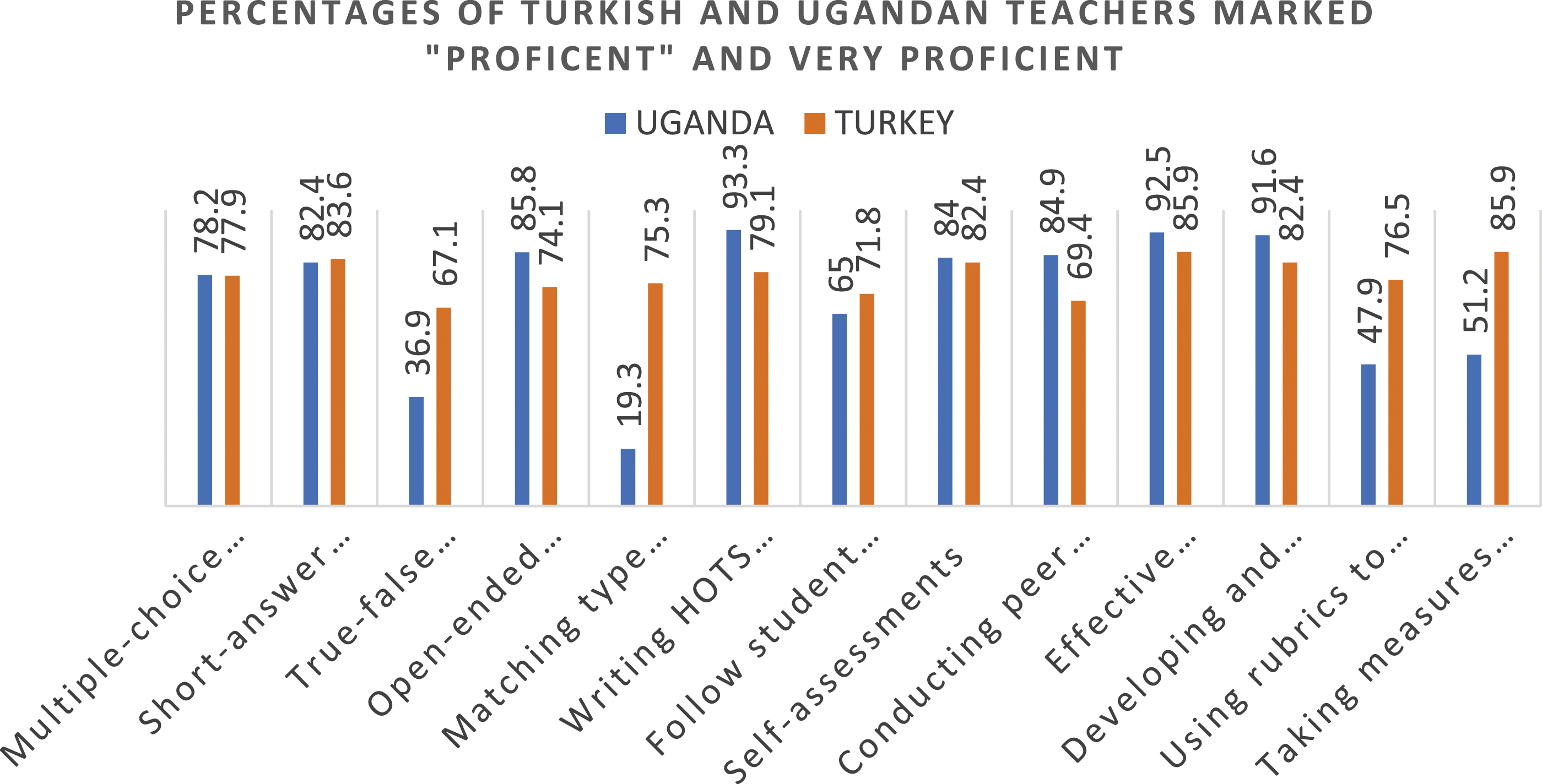
When Figure 2 is examined, it is seen that Turkish and Ugandan teachers’ perceptions of efficacy towards certain assessment methods differ. Ugandan teachers’ “proficient” and “very proficient” options were marked with the highest item “Writing questions measuring high-order thinking skills (HOTS-93.3%), while the lowest item was “Writing matching type questions” (19.3%). The item with the highest sum of marking percentages for the “proficient” and very proficient options of Turkish teachers is “Giving effective feedback based on exam results” (85.9%), while the lowest item is “Writing true-false questions” (67.1%).
Ugandan teachers have “Writing questions measuring high-order thinking skills (HOTS),” “Giving effective feedback based on exam results,” “Writing open-ended questions,” “developing and implementing performance tasks,” “Doing peer assessment activities,” “Doing self-assessment activities” and it is seen that the sum of the percentages of marking the options “proficient” and “very proficient” in the items of “writing multiple choice questions” is higher than that of the Turkish teachers.
On the other hand, Turkish teachers stated that in the items “Writing a short answer question,” “Writing true-false questions,” “Writing a question in matching type,” “Following student development with portfolios,” and “Using rubrics to score student work” and “Taking measures to increase objective scoring.” It is seen that the sum of the percentages of marking “proficient” and “very proficient” options is higher than that of Ugandan teachers.
In this study, the perceptions of teacher effectiveness regarding the assessment and evaluation practices included in the main headings of the survey were gathered under three main headings using the “proficiency” option. It was determined that teachers have higher activity levels in the first two of the three dimensions: “Writing questions in different formats,” “Teachers'' perceptions of efficacy regarding assessment activities that improve learning,” and “Objective scoring.”
Presents Mann–Whitney U test results of teachers' perceptions of efficacy towards assessment methods by country (Turkey, Uganda).
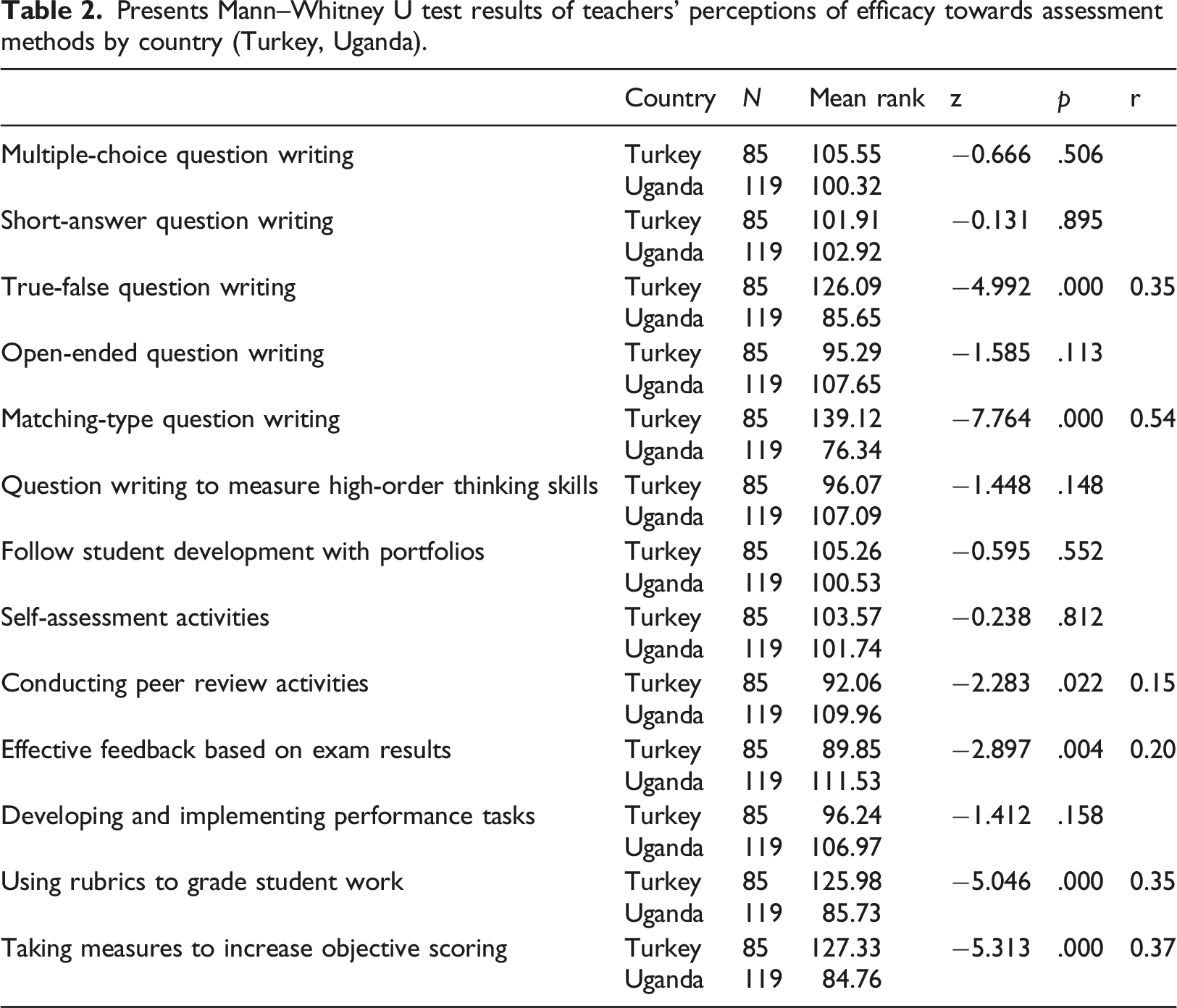
As shown in Table 2, A Mann-Whitney U Test was used to analyze the teachers’ perceptions of efficacy regarding country. The rank scores of Turkish teachers’ efficacy perceptions regarding assessment methods “Writing a true-false question” (z = −4.992, p < .05, r = 0.35), “Writing a match-type question” (z = −7.764, p < .05, r = 0.54), and “using rubrics to score student work” (z = −5.046, p < .05, r = 0.35) are statically significantly higher than Ugandan teachers. It is seen that Ugandan teachers’ rank scores are statistically significantly higher in the subjects of “taking measures to increase objective scoring” (z = −5.313, p < .05, r = 0.37).
These findings mean that Turkish teachers perceive themselves as more proficient in the abovementioned methods than Ugandan teachers. When the calculated effect size indices were examined, it was seen that “writing a question in matching type” (r = 0.54), “writing a true-false question” (r = 0.35), using rubrics to score student work (r = 0.35), and “objective scoring enhancing” It can be said that there is a moderate effect on the issues of “taking precautions” (r = 0.37). On the other hand, when the rank scores of Ugandan teachers’ efficacy perceptions regarding assessment methods “doing peer assessment activities” (z = −2.283, p < .05, r = 0.15) and “giving effective feedback based on exam results” (z = −2.897, p < .05, r = 0.20) were examined. It is seen that the rank scores of Turkish teachers in their subjects are statistically significantly higher. These findings can be interpreted as Ugandan teachers perceiving themselves as more proficient than Turkish teachers in the abovementioned methods. When the calculated effect size indices are examined, it can be said that there is a low effect on “performing peer assessment activities” (r = 0.15) and “giving effective feedback based on exam results” (r = 0.20). However, no statistically significant difference was observed between the rank scores of Turkish and Ugandan teachers in their perceptions of efficacy towards other assessment methods.
Teachers’ perceptions of efficacy in writing questions in different formats
In the first dimension, Ugandan teachers perceive themselves as “very proficient” in open-ended question writing and “writing questions that measure high-order thinking skills,” although less proficient in “matching-type question writing.” While Turkish teachers perceived themselves as very proficient in “Multiple-choice question writing,” “True/false question writing” and “writing matching-type questions” although less proficient in “writing open-ended questions.”
This finding is striking. Ugandan teachers perceive themselves as more competent in using assessment tools that measure higher order cognitive skills. In contrast, Turkish teachers are more proficient with tools that measure lower-order cognitive processes.
Like Uganda, teachers in Turkey also assess the mental skills of students with more focus on measuring understanding, reasoning, and application (higher order thinking). Nevertheless, assessment should focus on all three learning areas: cognitive, affective, and psychomotor (development of competencies) because learning is not just a mental function. Teachers can also learn the students’ attitudes, behaviors, and physical skills (Hoque, 2019). Therefore, formal tests and exams are not essential for most of the information needed by learners of this age. With this, grade level seems essential in determining teachers’ use of different interaction patterns.
In conclusion, some branch teachers are likelier to use assessment strategies involving teacher–student rather than student–student interaction (Henke et al., 1999). Bridgeford and Stiggins (1985) pointed out that the higher the grade level, the higher the tendency for teachers to use their assessments rather than published tests. They also emphasized that teachers’ anxiety increased with the grade level.
Teachers’ perceptions of efficacy on learning development assessment activities
The knowledge of measurement and testing significantly impacts teachers’ self-perceived assessment skills, regardless of their teaching experience. Therefore, teachers need to develop classroom assessments that are consistent with the practices recommended by experts in educational assessment. Identifying student progress in assessment activities, using objective scoring techniques, reviewing teacher-made tests, and changing teaching based on assessment feedback. Therefore, more emphasis should be placed on using performance appraisal and communicating appraisal results. Teachers face increasing pressure due to their role in developing and using classroom assessment practices (Earl, 2013). In this context, when the study’s findings were examined, it was seen that teachers in Uganda and Turkey were highly proficient in giving effective feedback, developing the application of performance tasks, and performing self-evaluation activities. However, they perceive themselves as less proficient in learning the student development of portfolio assessment. Findings from Opolot-okurut (2010) show that Ugandan teachers rarely give feedback to students individually during the beginning, mid-term, and end-of-semester exams. Teaching is clogged, and their focus is on duplicates of the Uganda National Examinations Board final exams. However, these findings contradict the research findings. Additionally, findings from Gursoy and Önalan (2020) showed that secondary school teachers in Turkey use assessment results at a moderate level to plan their lessons with their colleagues. These findings were found to be compatible with the current research findings.
Nevertheless, Gielen et al. (2010) state that highly supportive of peer assessment increases the social pressure on students to perform well on an assignment. In addition, grading group work does not provide teachers, students, or parents with information about students’ achievements (Henke et al., 1999). For this reason, teachers organize classroom assessment environments by choosing the assessment methods to be applied, the frequency of these assessments, and the methods of giving student feedback. Earl (2013) states that student studies are not designed to give students points and make comparative judgments but to emphasize each student’s understanding and thinking and provide students with feedback to further their learning.
Teachers’ perceptions of efficacy towards objective scoring
When the research findings were examined, it was shown that teachers in Uganda and Turkey responded positively to taking precautions against factors that impair objectivity in the scoring process. For example, Reg et al. (2016) reported that exam corruption, loss of security of exam papers, and teachers’ training according to the predictions of exam content remain challenges in the Ugandan assessment system. Opolot-okurut (2010) discovered that secondary school teachers in Uganda frequently use assessments for grading and grade passing. Because the assessment system is exam-based, teachers devote time to the education program and, occasionally, teach students to take tests only to prepare them for the final exam or public exam, hence contradicting the study findings.
Educators see grading as part of a broader teaching and learning philosophy that must accommodate individual differences. Thus, the effort can be seen as a way of judging motivation and engagement. That’s why teachers also want students to be successful and use grading apps that help them get good grades. However, a grade can hide other evaluative information that may be more useful to students and parents, thereby training them to accept a numeric symbol rather than useful information about their literacy process (Jongsma, 1991). Guskey (2004) points out that grades and other reporting methods are important factors in determining student effort for many teachers, which means that students are graded based on non-academic factors such as absenteeism, homework completion, poor academic integrity (i.e., cheating), and timely submission of assignments. According to this study, teachers use grades as feedback for improvement.
On the other hand, teachers in Turkey reacted strongly to using rubrics to rate students’ work. Similar to Uganda, the evaluation system in Turkey is exam-oriented, with placement exams such as High School Entrance Examination (LGS), Secondary Education Institutions Entrance Examination (OKS), and Placement Examination (SBS) (Kitchen et al., 2019). Educators mostly use student data evaluation to inform parents about their child’s progress in monitoring and development. Gursoy and Önalan (2020) reported similar results in a study using assessment and evaluation results by teachers of English as a foreign language at primary and secondary education levels in Turkey. It was seen that the obtained findings were compatible with the research findings. Therefore, most teachers believe they have sufficient test knowledge (Zhang and Burry-Stock, 1997). The findings obtained in the study also show that a significant difference in Turkish teachers’ perceptions of the effectiveness of assessment and evaluation activities is the use of rubrics to score student work. Turkish teachers think they are more proficient in writing true-false questions, matching questions, using rubrics to score student work, and taking measures to increase objective scoring. A significant difference was also observed in Ugandan teachers’ perceptions of the effectiveness of assessment and evaluation activities. Ugandan teachers also feel more proficient in implementing peer assessment activities and giving feedback based on exam results.
Conclusion and suggestions for further research
It is seen that the three methods most frequently used by Ugandan teachers in determining student success in the classroom are open-ended questions, Multiple-choice tests, and Self-assessment applications, respectively. The three methods that Ugandan teachers use the least in in-class assessment and evaluation are true-false tests, matching tests, and rubrics. On the other hand, it is seen that the three methods most frequently used by Turkish teachers in determining student achievement in the classroom are Performance tasks, Short-answer tests, and Multiple-choice items, respectively, and the three methods that Turkish teachers use the least in the process of in-class assessment and evaluation are Oral exams, Open-ended tests, and Portfolios, respectively.
In addition to that, Turkish teachers use matching and true-false tests, electronic portfolios, projects, peer assessment activities, and rubrics statistically significantly more frequently than Ugandan teachers. The frequency of using multiple-choice tests by Ugandan teachers is statistically significantly higher than that of Turkish teachers. In the context of question writing in different formats, Ugandan teachers are mostly proficient in writing questions that measure upper mental processes, open-ended question writing, and short-answer question writing. In addition, in the context of learning-enhancing assessment activities, they are mostly proficient in the issues of giving effective feedback based on exam results and developing and implementing performance tasks. Furthermore, in the dimension of objective scoring, they consider themselves proficient in using rubrics to score student work and take measures to increase objective scoring.
Turkish teachers, in the context of question writing in different formats, consider themselves mostly proficient in writing short-answer questions, writing questions measuring upper mental processes, and writing multiple-choice questions. Furthermore, they are mostly skilled in the context of assessment activities to improve learning, giving effective feedback based on exam results, conducting self-assessment activities, and developing and implementing performance tasks. Lastly, in the context of objective scoring, they consider themselves proficient in taking measures to increase objective scoring.
As a result of the research, it can be concluded that both Ugandan and Turkish teachers use traditional assessment methods more frequently. However, in light of the global changes in assessment, a balanced approach of both traditional and contemporary instruments should be adopted. Therefore, it is recommended that Turkish and Ugandan teachers use complementary and traditional assessment methods in determining student achievement.
Relying solely on specific methods to determine student success can adversely affect students’ study behaviors. For instance, in an education system where only multiple-choice questions are used, students might develop study habits that are only effective for this type of exam. This situation is detrimental to student development. Therefore, it is suggested that policymakers in education, especially in Uganda, initiate efforts to diversify the methods used by teachers.
Furthermore, policymakers for both countries should undertake initiatives to increase the usage of underutilized methods. If factors such as the density of the curriculum prevent teachers from employing specific techniques, it is recommended that policymakers update the curriculum to facilitate this.
The underutilization of certain methods could stem from numerous other reasons. Conducting new research to uncover these reasons is recommended. Within this context, qualitative studies that provide in-depth information can be performed, or quantitative research based on larger samples using regression analysis can be undertaken. Furthermore, if a sufficiently large dataset can be accessed, machine learning-based methods could be employed to predict which methods teachers with specific characteristics are likely to use.
It is also recommended to eliminate the deficiencies in the less proficient dimensions in both countries with in-service training. However, it’s important to note that in-service training may not always yield effective results. Notably, older, more experienced teachers may exhibit resistance to in-service training programs. This consideration should be taken into account when organizing in-service training sessions.
Additionally, the content of courses related to measurement and evaluation (such as testing) in teacher education institutions should be designed to cover all mentioned methods. The credit hours of these courses are also significant. For instance, in Turkey, the “measurement and evaluation in education” course in teacher training institutions is only 2 h per week. Within this framework, teacher candidates cannot receive training on all methods used to assess student success. The methods discussed in the course are approached theoretically, and teacher candidates do not have the opportunity to practice them. For Turkey, if the content of the measurement and evaluation courses in teacher training institutions is not expanded, in-service training alone cannot significantly advance teacher competencies.
Like all research, this study was conducted within certain limitations, primarily concerning the sample size and the method used for sample selection. Practical reasons prevented access to a sufficiently large sample, and random sampling could not be employed. This situation complicates the generalization of the research findings. Researchers must consider this limitation. However, the value of this study’s findings is enhanced because such research has not been conducted before.
It’s noteworthy that carrying out a similar study on a larger sample randomly selected to represent the universe will contribute to obtaining more generalizable findings, and it is thought that a study examining the effects of school culture on the assessment methods used by teachers in both countries will present important findings to the literature. Lastly, it is recommended that research be conducted to determine whether the methods used by teachers in different branches in determining student achievement differ and to determine the problems they experience in this process.
Footnotes
Declaration of conflicting interests
The author(s) declared no potential conflicts of interest with respect to the research, authorship, and/or publication of this article.
Funding
The author(s) received no financial support for the research, authorship, and/or publication of this article.
