



Abstract
The number of expatriate faculty members in Korea has been falling since 2013, intimating that Korean universities face a problem with international faculty satisfaction. This research develops a model for expatriate faculty overall workplace satisfaction at Korean universities by integrating acculturation and enculturation theory, social interaction and social connectedness, and workplace inclusivity considerations while delineating between them. Results are based on quantitative analyses of survey data from 318 PhD holding expatriate faculty working at over 50 universities nationwide. Regression results indicate that social interaction, an “identity blind” inclusive work environment, enculturation, and an “identity conscious” inclusive work environment are positively related to overall workplace satisfaction. By comparison, Korean ethnicity is negatively associated with workplace satisfaction, something explained in terms of Korean organizational culture and associated work expectations. Suggestions to facilitate the development of places to integrate and participate within established Korean university organizational cultures are ventured.
Introduction
The study of expatriate faculty is now a well-established topic of inquiry in comparative and international education and is integral to our understanding of higher education (HE) systems (see Bedenlier and Zawacki-Richter, 2015). While English speaking, and primarily developed, economies continue to both send out and take in the largest number of expatriate academics worldwide (Kim, 2016), globalization processes have led to the creation of new centers (Altbach et al., 2009), including increasingly competitive centers in Asia, that attract this subset of highly skilled mobile knowledge workers (David and Motala, 2017; Jöns and Hoyler, 2013; Kim et al., 2021). East Asian universities, for example, have begun to hire more expatriate academics in conjunction with their internationalization drives. More specifically, they seek to bring English Medium Instruction (EMI) home to their native student bodies, to provide EMI for incoming international students, to increase the exposure and reach of their domestic faculty’s research networks, and, as a result, to move up in the international ratings (David and Motala, 2017; Huang, 2018). These drives have been successful in many ways, to the point that compared to the past, when competition was largely couched in terms of East-West, East Asian universities these days are often competing with each other for recognition not only regionally, but also globally (Chan, 2011).
There are myriad reasons to study this group of expatriates, in this case in the context of Korea. The successful globalization of world-class universities places an onus on these organizations to continually recruit and retain minority faculty (Chun and Evans, 2009). In Korea’s case, however, the percentage of expatriate faculty members peaked in 2013 at 7.1% of the total faculty population, falling to roughly 5.6% by 2020 (University Information Statistics, 2021), intimating that Korean universities face a problem with international faculty satisfaction. Also, as inclined above, expatriate academics are now part and parcel of globalization strategies for universities in major Asian economies, and these efforts represent investments of some magnitude (see Gress and Shin, 2020a). Research pertaining to these scholars as they acclimate to new work environments may help to inform university management and government policy makers of pertinent challenges, or of successful program specifics (Selmer et al., 2017), either of which may prove useful to future-oriented endeavors. Indeed, in a quantitative, single Korean university study, professional satisfaction negatively correlated with an intention to leave on the part of expatriate faculty (Gress and Shin, 2020a). Prior research also indicated that lower levels of faculty morale increased intention to leave, and that lower levels of work satisfaction increased intention to leave academe altogether, thus increasing both financial costs to institutions as well as imparting detrimental impacts on students (Calkins et al., 2019). None of these scenarios would bode well for Korean institutions as the country faces declining domestic student enrollments in the wake of an ongoing demographic crisis. On the other hand, organizational cultures may undergo positive changes as a result of processes associated with successful invited expatriate academic integration (see Altbach and Yudkevich, 2017).
Given the increasing importance of this topic for all stakeholders involved, there is a growing amount of research into expatriate faculty outside of North American and Western European contexts, including a growing number of Korea-based studies (see most recently Gress and Shin, 2020a, 2020b; Kim et al., 2021; Luef, 2020), though scholars have nonetheless suggested that more research into the careers of these scholars as they adjust to workplaces in divergent places is still needed (Bedenlier and Zawacki-Richter, 2015; Rumbley and De Wit, 2017). Still, Mihut et al. (2017) concluded that the majority of the available research on expatriate academics is qualitative and tends to focus on short-term and/or visiting faculty.
Motivated by the above, the present research adds to the literature on expatriate faculty satisfaction by deploying acculturation and enculturation theory (Berry, 1997; Weinreich, 2009), and social interaction (SI) and social connectedness (SC) (Du and Wei, 2015; Yoon and Lee, 2010; Zhang and Goodson, 2011), in addition to workplace inclusivity considerations (Davies et al., 2019; Jonasson et al., 2018), in an attempt to more holistically understand factors impacting expatriate faculty overall workplace satisfaction at Korean universities (see Sam and Berry, 2010). As shall be discussed, the study also addresses calls in the literature to better integrate each of these factors while delineating between them when assessing expatriate faculty satisfaction (see Davies et al., 2019; Rudmin, 2003; Schwartz et al., 2010; Zhang and Goodson, 2011).
Results are based on quantitative analyses of survey data from 318 PhD holding expatriate academics working at over 50 Korean universities nationwide. Building upon a trend from recent studies of expatriate faculty at universities in Asia, the present study also compares the workplace perceptions and adjustment of non-ethnically Korean expatriate faculty and ethnically Korean expatriate faculty (see Gress and Shin, 2020a; Huang, 2018; Paul and Long, 2016; Wu and Huang, 2018). This is a potentially important comparison given that increasing numbers of expatriate faculty with ethnic ties to East Asian countries may be returning to their “home countries” in the future (Froese, 2010).
Two research questions (RQs) guide the research: (1) What cultural adjustment, workplace, and/or socio-economic factors impact overall expatriate academic satisfaction at Korean universities? (2) Are there differences in perceptions between expatriate academics with and without Korean ancestry, and, if so, why?
Theoretical framework
Acculturation
Acculturation, defined by Same and Berry (2010: 472), “refers to the process of cultural and psychological change that results following meeting between cultures.” As originally conceived (e.g., Berry, 1997), acculturation implied a bi-directional exchange, impetus for the addition of workplace inclusivity considerations in the present study. For the purposes of the present research, academic acculturation is of greater interest, and can be defined as, “The processes by which one becomes a part of a group (for example, institution, department, etc.) and integrates with its members” (Jiang et al., 2010: 157).
Acculturation has affective, behavioral, and cognitive aspects (ABC) (Berry, 1997; Sam and Berry, 2010). Work on international students by Zhou et al. (2008) developed a framework with affective considerations, which included personal, personal adjustment, and support factors; behavioral considerations, which included cultural knowledge and language ability; and cognitive considerations, which dealt with perceptions of expatriate-host relationships. In higher academic settings, each of the ABCs can also be integral to expatriate faculty adjustment. In terms of affective considerations, Hsieh and Nguyen (2020), for example, found professional support to be important. In terms of behavioral considerations, research pointed to the importance of language and cultural competence (Luef, 2020; Meng et al., 2017). Regarding cognitive considerations, Gress and Shin (2020a; 2020b) found that perceptions related to the roles and responsibilities of expatriate faculty differed between expatriate faculty and host university management. In the end, as Rowe et al. (2016: 60) intoned with respect to expatriate faculty, “new academic citizens assimilate when they seek to fit in to the dominant practices, discourses, behaviors and social organization of Academia,” whereas, “integration involves the adaptation of the practices, discourses, behaviors and relationships of both the dominant academic culture and the new academic citizen, so that both may effectively cohabit the same space.” Assessing any delineation between these two paths may be difficult, thus providing motivation for the ensuing discussion on enculturation.
Enculturation
Acculturation has not been deployed without criticism, something that has increased interest in enculturation. Weinreich (2009), for example, took issue with assumptions built into Berry’s model, namely that the environment is discrimination free, that the host culture and the expatriate’s culture are compatible, and that people are free to choose whether they want to integrate or assimilate. He argued, “processes of enculturation are often the more significant. The term enculturation is used to emphasize the agentic individual incorporating cultural elements during socialization, whereas acculturation typically references migrants’ movements towards and adoption of the mainstream ‘receiving’ culture” (Weinreich, 2009: 125). Other authors in agreement with this thesis also highlighted an absence of cross-cultural or language skill considerations, or how open the receiving culture is to expatriates (Rudmin, 2003; Schwartz et al., 2010), again impetus for injecting workplace inclusivity into the present research. These may be important considerations for the study of expatriate faculty in Korea. For example, there is a proclivity for an “insider-outsider” schism at Korean organizations characteristic of high-context cultures like Korea’s (see Hall et al., 1981; Yang and Kelly, 2009).
In a qualitative study, Sadao (2003) proposed that “bicultural” scholars who could strategically blend multiple elements of more than one culture together were more successful in cross-cultural academic settings. 1 She stated, “Biculturalism differs from acculturation in that the individual preserves and uses both cultures. Acculturation, in contrast, involves learning a new culture while diminishing one’s identification with the previous culture” (Sadao, 2003: 411). In this sense, the author seemed to be making the case for the consideration of enculturation as put forth by Weinreich (2009), though the contribution of the research could be perceived as mapping out a mode for enculturation processes and the positive impact it can have on academic careers. In the work of other scholars, for example, Du and Wei (2015), bi-directional acculturation has both acculturation and enculturation elements, though they are not specifically detailed as such. The present research examines this potential duality in two ways: first, both acculturation and enculturation variables are introduced, and second, analyses search for differences between those with and without Korean ethnicity. Additionally, Sadao’s (2003) work concentrated on factors contributing to bicultural faculty success. The value added from the present study partially hinges on the fact that it is the first quantitative attempt to examine impacts on faculty satisfaction in the Korean university context.
Social interaction and social connectedness
Other scholars have integrated social interaction (SI) and social connectedness (SC) into their examinations of expatriate adjustment. Zhang and Goodson (2011: 616) related that, “Social interaction with host nationals may include having conversations or doing activities with host nationals,” whereas social connectedness is, “the subjective awareness of being in close relationship with the social world and reflects an internal sense of belonging to that world” (Ibid). In their study of Chinese student adjustment in the US, the authors concluded that SC, adherence to the host culture (i.e., acculturation) and SI were all significant predictors. In another study of Chinese students, Du and Wei (2015) concluded overall that both host and ethnic SC were important to adjustment. Their research examined life satisfaction, but the authors concluded by indicating that these constructs should be applied to other possibilities. The present research therefore considers acculturation, enculturation, SI and SC vis-à-vis overall expatriate faculty workplace satisfaction.
The case can be made to separate SI and SC from acculturation and enculturation, and SI from SC. Yoon and Lee (2010) argue, for example, that SC is different from acculturation and enculturation, which contain affective, behavioral, and cognitive considerations (see Sam and Berry, 2010), whereas SC only deals with affective considerations (e.g., personal and personal adjustment). Then there is the impetus to separate SI from SC. Some authors working on the careers of expatriate academics (Austin et al., 2014; Richardson and Zikic, 2007) found that intra-university relationships were anchored more in politeness and protocol than in a desire to form significant personal connections, a sentiment mirrored in Korea-based studies of both expatriate academics (Froese, 2010, 2012) and students (Moon, 2016). Chu and Morrison (2011), in their study of expatriate English teachers in Hong Kong, recommended that emphasis on social networking, something akin to SI, and on cross-cultural training, more akin to SC, would help to stem defections from the program. Similarly, Tsang (2001), in a study of Chinese expatriate academics and students in Singapore, found social support and interaction key to adjustment and performance. Varma et al. (2012), in a China-based expatriate worker study, found that locals were more apt to offer assistance to expatriate workers who were more culturally similar, something that could impact the present study given the consideration of ethnically Korean expatriate faculty. Manev and Stevenson (2001) studied international MNE manager networks of expressive ties (friendship and social support) and instrumental ties (physical, informational, or financial resources). The results may have implications for expatriate scholar adjustment as well. The authors found, for example, that instrumental ties were successfully formed internationally between managers of different cultures and nationalities. However, managers were more prone to form expressive ties with managers with a similar status from a similar nationality and culture.
Workplace inclusivity
Finally, the present study integrates inclusive management (affective and cognitive) considerations into the framework given their potential impacts on expatriate job satisfaction (see Morley et al., 2018). As previously mentioned, a lack of consideration of the propensity of the mainstream culture to accept immigrants is a perceived limitation to acculturation studies (Rudmin, 2003; Schwartz et al., 2010). Jonasson et al. (2018), in a comparative survey of local and expatriate scholars in four Nordic countries, differentiated between “identity blind” and “identity conscious” inclusive management. Identity blind referred to management inclusive of all personnel to include expatriates, while identity conscious management specifically focused on expatriate needs. English usage was used as a proxy for identity conscious inclusivity as it facilitated communication and participation for potentially marginalized groups. To guage the presence of identity blind inclusive management, respondents were asked the degree to which, “My team leader makes decisions together with the team.” (461). While the authors found evidence that identity blind inclusive management benefited both sets of respondents, identity conscious inclusive management had no impact on expatriate academics, but did yield increased stress for local academics. This type of “host receptivity” was also suggested for future inclusion in studies on expatriate acculturation, enculturation, SI, SC, and adjustment by Zhang and Goodson (2011), partial impetus for the current research design (see also Davies et al., 2019).
Language and inclusivity issues were highlighted in recent work on expatriate academics at individual Korean universities. In Gress and Shin’s (2020a) study, non-ethnically Korean expatriate faculty tended to disagree that meetings were held in a language that they could understand, and that their opinion carried weight. In another Korea-based, single-university study done by Gress and Shin (2020b), there was an acknowledged amount of difficulty associated with helping expatriate faculty by the native administration, but an equally large amount of consternation on the part of the expatriate faculty, because while they were attending meetings and functions, they felt cut-off from opportunities and left out of the decision-making process because of language issues.
In a 175-expatriate worker study done in Korea, Davies et al. (2019) found that lack of an inclusive organizational climate impacted intention to leave. Work done on universities in Azerbaijan and Turkey likewise found that university climate and peer collegiality impacted job satisfaction (Ismayilova and Kalssen, 2019). Inclusiveness in the former study was apparently more a mix of workplace-related inclusion and SI factors, a quantitative measure which included, “instances of social exclusion and discrimination at work,” and SC, more of a qualitative measure captured by, “misunderstandings, frustration, and exclusion of expatriates’ opinion in decision-making processes” (1400). These studies provide the motivation to separate SI, SC, acculturation and enculturation from work environment inclusivity in the present study.
Other individual-oriented workplace and socio-economic considerations
As mentioned in the introduction, this research examines differences between expatriate faculty both with and without Korean ancestry. Again, this may be an important comparison to make given the prospect of increasing numbers of returning expatiate faculty with ethnic ties to East Asian countries in the future (Froese, 2010). Wu and Huang (2018) compared non-native expatriate academics and home-country returnees in China, and Huang (2018) in Japan. Froese (2010) gave an individual account in the Korean context, and Gress and Shin (2020a) provided some initial work on the topic based on a single Korean-university study. However, the present study represents the first effort to examine this cohort of expatriate scholars nationally.
Tenure-track status and gender may impact workplace satisfaction. In Rosser’s (2004) study, satisfaction was not impacted by tenure status or gender. In the aforementioned work of Manev and Stevenson (2001), however, status was found to impact host-expatriate relationships. In terms of gender impacts, Morley et al. (2018) conceded that gender biases make it more difficult for women to have international careers in academe.
Respondents’ discipline (STEM/non-STEM), too, may have implications given that imbalances between genders were found in previous research on expatriate faculty at Korean universities (Gress and Shin, 2020b). As such, in addition to a call in the literature to examine STEM effects on expatriate faculty careers (see Morley et al., 2018), this is included in the present study.
Time is another consideration. Berry (1997) originally hypothesized that length of time in a target culture would mediate acculturation processes for immigrant populations. This was mirrored in results from a later study of Chinese international students in the US (Zhang and Goodson, 2011). In terms of expatiate academics, however, some studies concluded that length of employment had no impact on adjustment or satisfaction levels (Amir et al., 2013; Lauring and Selmer, 2015).
As briefly described previously, language ability is another complex and interrelated issue when it comes to workplace satisfaction. Studies point to adjustment being positively impacted by an expatriate academic’s language ability (Tsang, 2001). On the other hand, Luef (2020), in a Korea and Japan-based study, found that language level increased when there was a desire to integrate, but that willingness to integrate and time spent in the host country did not influence study effort.
This also raises the issue of socio-economic and language status. Recall the previously mentioned Manev and Stevenson (2001) results, wherein managers of similar background and status were more apt to share expressive ties, and the Kim et al. (2021) results asserting an expectation to use English at the work place, but to not necessarily integrate. Korea is a developed country and a global top-15 economy. The present research therefore deploys variables capturing the economic development status of respondent home country and home-country native language (e.g., English/non-English).
Data and methodology
Data, survey, and sample
In order to build the database of expatriate faculty members in Korea, a list of all 4-year university faculty members and their affiliated institutions was extracted from the “Korea Researcher Information” database maintained by the Korea Research Foundation (KRF). From data on approximately 70,000 faculty members nationally, an initial list of 3250 expatriate faculty members was extracted based on name identification. After deleting expatriate faculty members who had left Korea, this list was narrowed to 2284 (960 PhD holders and 1324 Master’s degree holders) working at a total of 134 universities. The number of doctoral degree holders in the database was later expanded in January–February of 2019 via an extensive individual university website search. This served to increase the number of doctoral degree holders in the database to 1026 for a total of 3.4% of the total faculty population.
According to recent data, the number of expatriate faculty members in Korea has consistently declined since reaching a peak of just over 6100 in 2013 (7.1% of the total faculty population) to roughly 5126 (5.6%) in 2020, partial impetus for the present study (University Information Statistics, 2021). It is difficult to know the exact representativeness of the sample because these data do not provide specific distributions regarding expatriate faculty members (e.g., rank and contract status), and the KRF database only includes personally registered individuals.
The survey instrument consisted of individual sections of multiple questions dedicated to (a) motivations to expatriate to Korea; (b) academic life in Korea; (c) teaching activities; (d) research activities; (e) future plans; and (f) personal background. For the purposes of the present study, questions from sections b, e, and f were of primary interest. 2 Questions used for variable creation and analyses will be quoted verbatim and/or in tables to aid in clarity.
Participation in the study was solicited online from April 5 to May 22, 2019. Institutional Review Board (IRB) approval for the study was received prior to the survey distribution. Potential participants were sent a link to the electronic survey and provided an incentive for participation. 335 doctoral degree holders and 169 Master’s degree holders responded. The present study focuses only on doctoral degree holders, primarily because Chi-squared tests indicated that roughly 88% of the Master’s degree holders worked in non-STEM positions, the bulk of which were English as a Second Language (ESL) positions, and only about 2% were on the tenure track. For doctoral degree holders, there was a more representative 55.5%/41.5% split between the two in terms of STEM/non-STEM, and a more fairly even split in terms of tenure track/non-tenure track status. Other reasons for not including non-Ph.D. holding personnel include the fact that as instructors, these professionals are not generally required to conduct and publish research, and they are not included in decision-making at the departmental and college levels, all factors captured by variables in the present study. The response rate was 32.62% for doctoral degree holders, but the final database was narrowed to 318 (31%) after incomplete and erroneous entries were deleted.
Descriptive statistics: Expatriate academics at Korean universities.
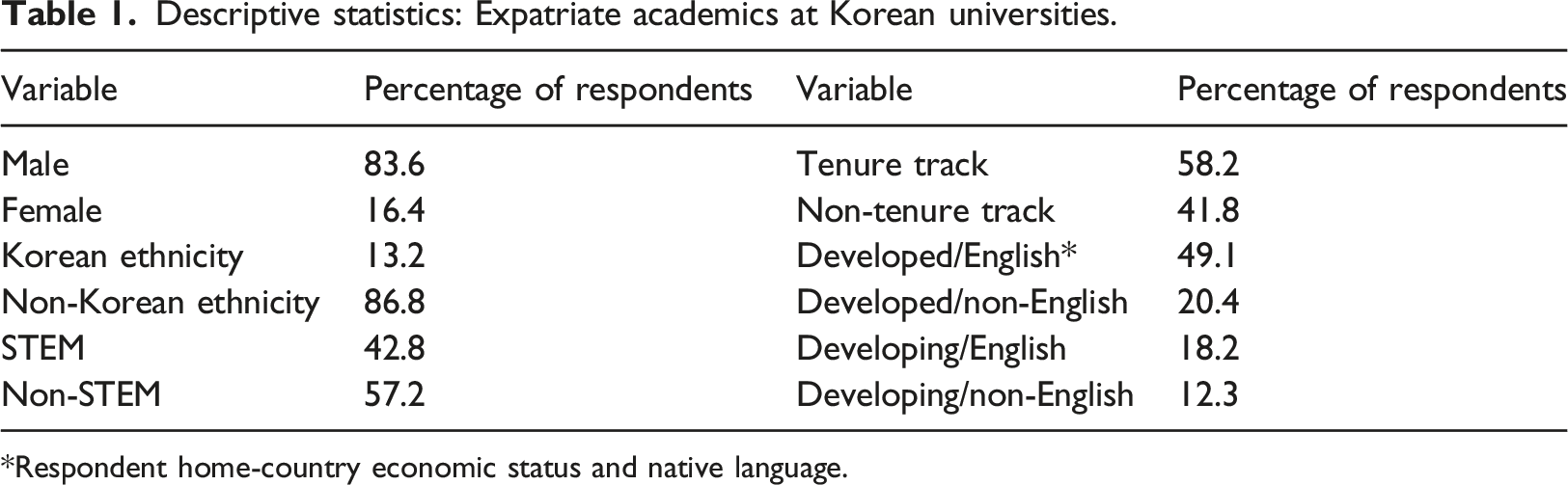
*Respondent home-country economic status and native language.
Measures and methodology
Dependent variable and main cultural adjustment and workplace inclusivity variables
Dependent Variable (Overall Workplace Satisfaction): How satisfied are you with your overall work environment? 5-point Likert scale (1 = Not satisfied at all to 5 = Extremely satisfied). 3
Acculturation: I try my best to understand and to adapt to how things are done in Korea. 5-point Likert scale (1 = Not true at all to 5 = Extremely true).
Enculturation: I mix Korean and my home country’s culture in my life. 5-point Likert scale (1 = Not true at all to 5 = Extremely true).
SI: How well are you integrated socially with Korean colleagues in your department? 5-point Likert scale (1 = Not at all to 5 = Very well).
SC: Please indicate your level of difficulty experienced with reference to understanding overall Korean norms, values and practices. 5-point Likert scale (1 = Very easy to 5 = Very difficult).
Workplace inclusivity—Identity Conscious (Inclusive (IC)) How would you rate the work environment at your university concerning effective use of English language in the workplace? 5-point Likert scale (1 = Very weak to 5 = Very strong).
Workplace inclusivity—Identity Blind (Inclusive (IB)) My department welcomes the opinions of international faculty members. 5-point Likert scale (1 = Very weak to 5 = Very strong).
Individual-oriented workplace and socio-economic variables
Korean ethnicity: a dichotomous variable
Tenure-track status: a dichotomous dummy variable.
Gender identity: a dichotomous dummy variable.
STEM/non-STEM: a dichotomous dummy variable.
Time (in country): a continuous variable.
Language effort: I am actively trying to improve my Korean language skills. 5-point Likert scale (1 = Not true at all, to 5 = Extremely true).
Socio-economic and language status: dummy variables for four sets of respondents based on economic development status of home country and home-country language (developed/English, developed/non-English, developing/English, and developing/non-English).
Stepwise regression is merited because this is a first-of-its kind, quantitative-based inquiry into expatriate faculty satisfaction deploying the constructs described previously, and is therefore exploratory in nature. Concerns over the use of a stepwise regression are mediated in part by subsequent analysis of squared structure coefficients and the additional running of both standard linear and backward regressions (see Courville and Thompson, 2001; Montgomery et al., 2012). This will be discussed shortly. Additional analyses deploy correlation and Mann-Whitney U tests.
Findings
Adjustment, inclusivity, and workplace satisfaction
RQ 1 asks what cultural adjustment, workplace, and/or socio-economic factors impact overall expatriate faculty satisfaction at Korean universities? Based on the previous review of the literature, cultural adjustment and workplace inclusivity variables, along with individually oriented workplace and socio (economic) variables were loaded into a stepwise regression to assess predictors of satisfaction with expatriate faculty members’ “overall work environment.”
Zero-order correlations of variables in final analysis.
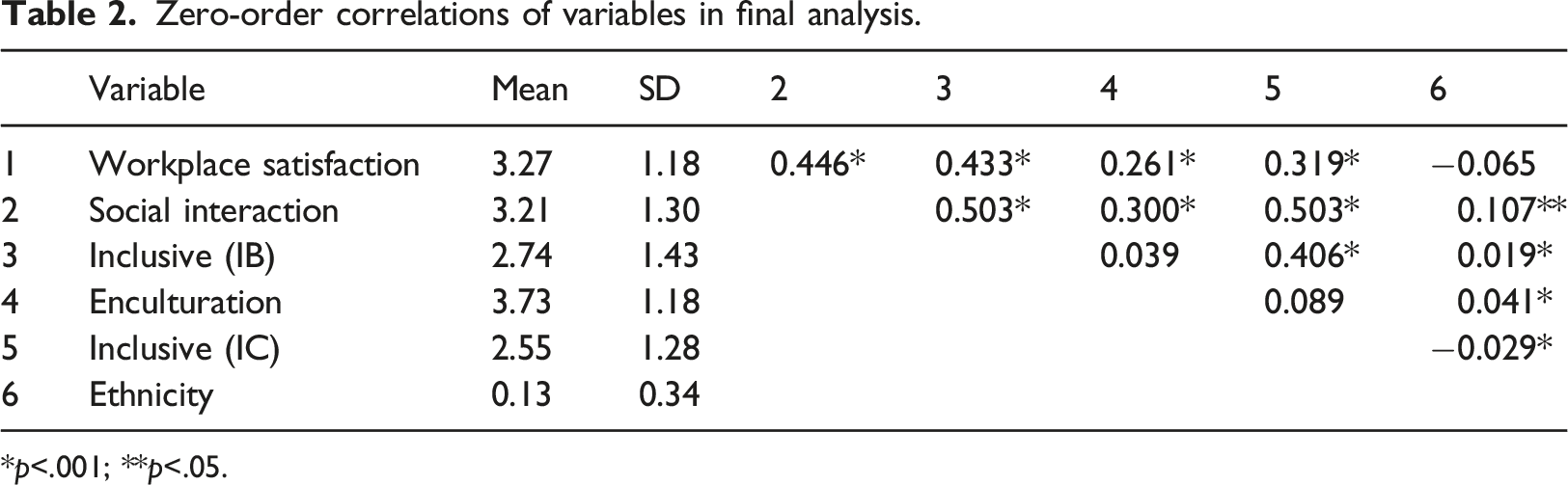
*p<.001; **p<.05.
Factors influencing workplace satisfaction: Stepwise regression results.
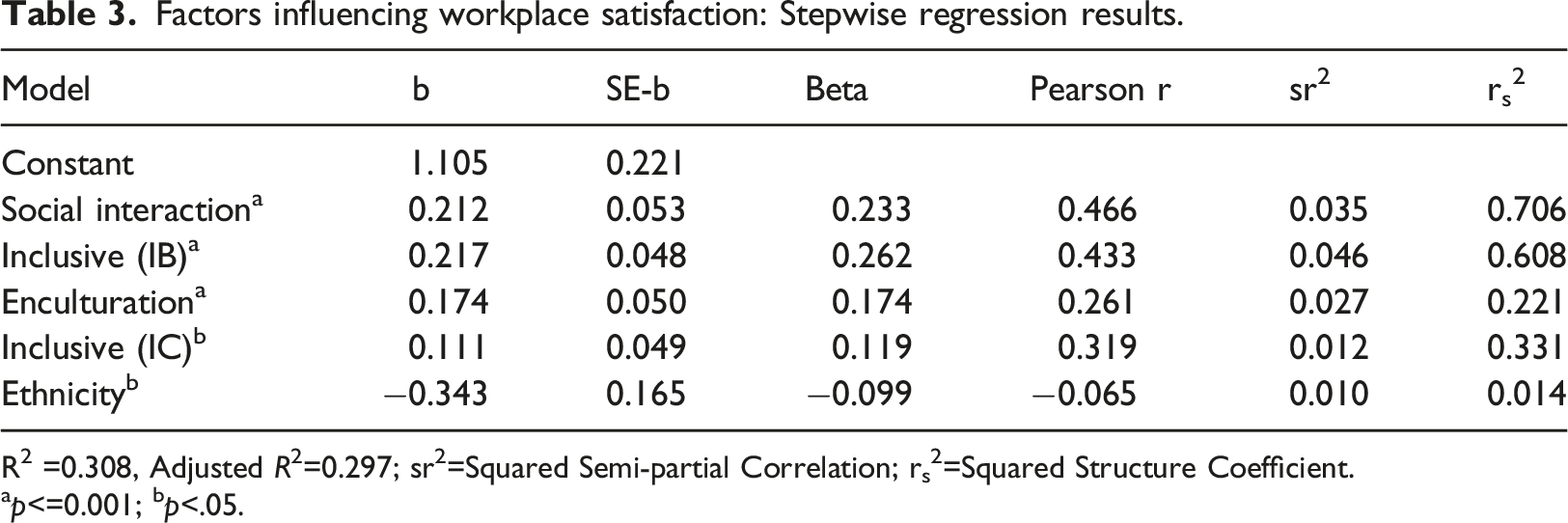
R 2 =0.308, Adjusted R2=0.297; sr2=Squared Semi-partial Correlation; rs2=Squared Structure Coefficient.
ap<=0.001; bp<.05.
An examination of the squared structure coefficients (rs2) reflects some differentiation from the examination of the weights indicated by Beta. In terms of overall explained variance, SI (70.6%) and Inclusive (IB) (60.8%) have the highest percentages, followed by Inclusive (IC) (33.1%), Enculturation (22.1%), and Korean ethnicity (1.4%). Recall that the interpretation of the Beta alone weighted these variables differently; Inclusive (IB) and SI switched places in terms of being the top two most important predictors, while enculturation and Inclusive (IC) switched third and fourth places. This suggests that intra-organizational considerations contribute the most to faculty satisfaction, though extra-organizational enculturation does have a noticeable impact. This will be addressed further in the discussion section.
Expatriate academics with Korean ethnicity
RQ2 inquires as to whether or not there are differences in perceptions between expatriate faculty with and without Korean ancestry, and, if so, why? Korean ethnicity was the only socio-economic variable to emerge as significant in the final model, and this subset of expatriate faculty indicated being less satisfied with their overall work environment than their expatriate counterparts without Korean ancestry. Direct moderating effects for this variable on the other predictors (or vice versa) could not be ascertained as there was no direct relationship between this variable and the dependent variable, a violation of necessary criteria (see Baron and Kenny, 1986). However, other (organizational) cultural insights help to mobilize additional analyses.
In a 2018 study on Korean organizational expectations done at a major Korean university done by Shin and Gress, management indicated that non-ethnically Korean expatriate scholar absences over summer and winter breaks, weak Korean language skills, and associated detrimental impacts on their ability to participate in service and administrative duties all detracted from a sense of “we-ness” (우리성) and frustration on the part of the management. It may be possible that ethnically Korean expatriate faculty feel the need to fill these perceived voids and have the ability to do so. “We-ness” and its impact on Korean organizational culture will be addressed in more depth shortly.
To examine this possibility, time spent on professional activities by expatriate academics with and without Korean ancestry were therefore compared. Respondents were asked to provide the number of hours they worked in a typical week, both during semesters and during semester breaks, on teaching, research, externally oriented activities (services to clients and/or patients, consulting, public or voluntary services, etc.); administration and services within academia (committee work, paper work, activities in associations, reviews, etc.); and “other” academic activities (professional activities not clearly attributable to any of the categories above).
Academic life and Korean ancestry: Mann-Whitney U-test results.
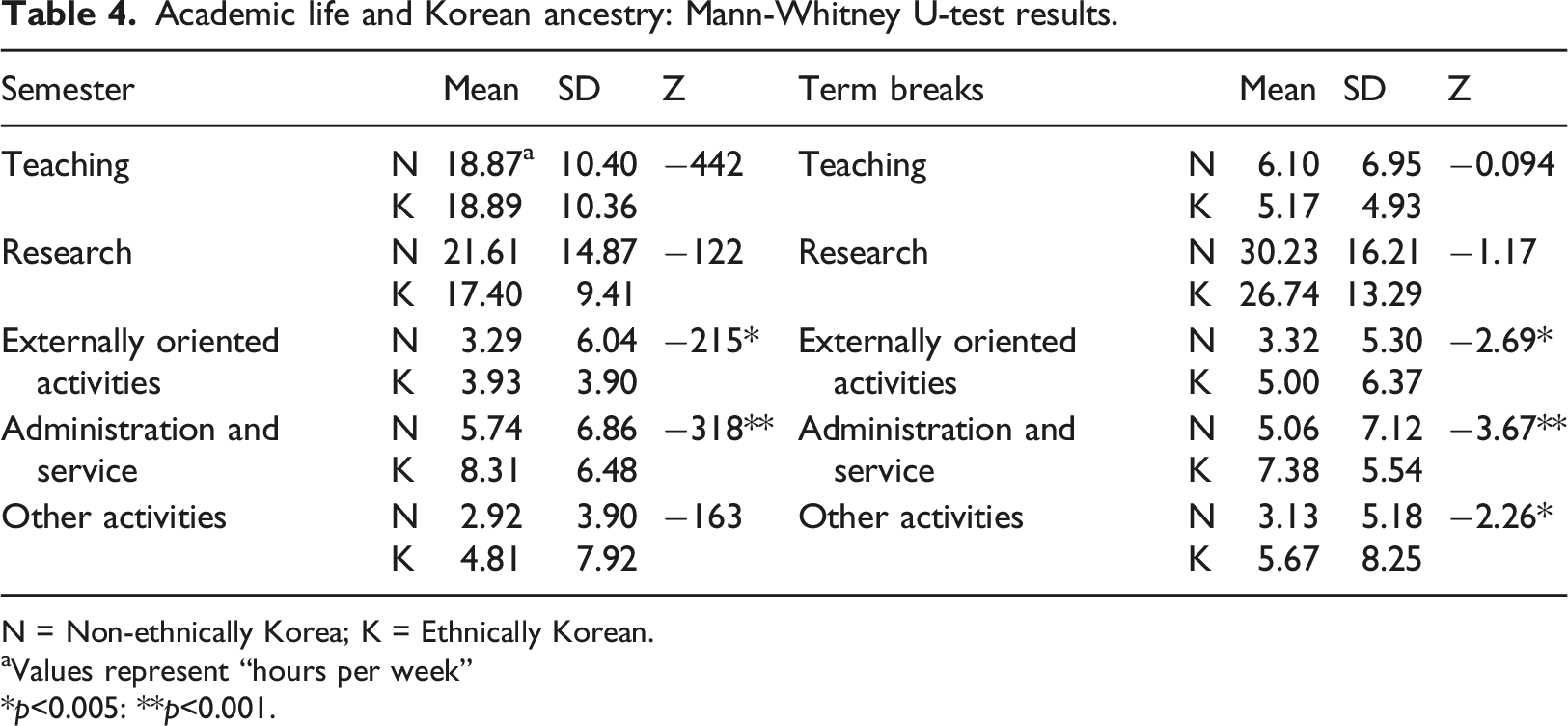
N = Non-ethnically Korea; K = Ethnically Korean.
aValues represent “hours per week”
*p<0.005: **p<0.001.
Discussion
Workplace satisfaction and interstices
The Cambridge English Dictionary defines an interstice as, “a space between things or events,” and offers as an example of usage, “They might have to operate in the interstices of institutional guidelines and testing mandates.” It appears that expatriate academics in Korea are seeking just such spaces. As reflected by the squared structure coefficient, SI, and IB inclusivity, particularly at the departmental level, may be key, but as the overall model suggests, they need to be interpreted in concert with other workplace realities impacting satisfaction. Taken together with the importance IC workplace inclusivity, it would appear that the overall quality of interaction, rather than mere quantity, may be paramount. These results back up previous research that showed that departmental relations are integral to faculty satisfaction (Callister, 2006; Ismayilova and Kalssen, 2019). As a word of caution, however, departments, and by extension the institutions within which they are located, could enter into a vicious cycle; lower levels of expatriate faculty integration are associated with lower employment satisfaction levels, which may in turn increase tensions with the native faculty (Altbach and Yudkevich, 2017). In a quantitative, single Korean university study, both department cordiality and professional satisfaction negatively correlated with an intention to leave on the part of expatriate faculty (Gress and Shin, 2020a).
In the present research, expatriate faculty were apparently seeking professional integration (not assimilation) via the development of interstices, or spaces to fit in, without necessarily doing things in Korean or “the Korean way” at work, but accruing some benefit from mixing home and host cultures in everyday life. Acculturation, for example, was not a significant predictor, but SI coupled with an inclusionary work atmosphere, both in terms of being receptive to expatriate input and making workplace participation viable via the use of English, fueled overall workplace satisfaction. By way of comparison, Jonasson et al. (2018) found that an inclusive IB work environment was not significant for expatriate faculty in their Nordic university sample. Recall, however, that in the present study, these variables had means of under the midway cut-off point on the five-point Likert scales, meaning that there is room for improvement. Higher levels of enculturation, or mixing home and Korean cultures in everyday life, a behavioral consideration (e.g., cultural knowledge), also contributed to overall workplace satisfaction, but to a lesser degree. These findings highlight the importance of including perceptions of extra-organizational host-culture acclimation to studies of workplace satisfaction and adjustment, as well as the “agentic behavior” of expatriate academics and host receptivity within a given organization (see Davies et al., 2019; Weinreich, 2009). Importantly, this result points to the fact that workplace satisfaction for expatriates may be positively impacted by extra-organizational enculturation to the host culture, something to which Korean universities should apparently be paying increased attention. Interestingly, results presented thus far largely mirror recent findings presented in Chen’s (2022) qualitative study of expatriate faculty in Japan. The author concluded that expatriate faculty were seeking quality and engagement intra-organizationally, while their adjustment benefited from the development of a closer cultural affinity with Japan in their everyday lives.
Comparatively speaking, results presented thus far somewhat back up conclusions drawn recently by Kim et al. (2021) in their qualitative study of expatriate faculty at one Korean university. The authors, building out their concept of “segmented mobility,” found that the study’s participants were, “separating the professional realm from personal, cultural, or linguistic spheres” (2). This was attributed to “entitlement” on the part of the expatriate faculty, or, “that their English language ability, race, and gender would entitle them to Western cultural norms in their professional and personal lives in South Korea” (7). This deserves consideration given the results presented thus far, though enculturation, significant in the model, would indicate that respondents had no illusion of entitlement in their personal lives. Recall, also, that in the present study, economic level of the home country, English as a first language, and gender had no impact on satisfaction, nor did Korean language acquisition effort. Further, respondents in the present study were also asked to rate the work environment at their university, “concerning an expectation that international academics should follow Korean norms,” with 50% indicating that this strongly or very strongly described where they worked, and 18% indicating the opposite. This variable also negatively correlated to workplace satisfaction (−0.165, 0.003). So apparently respondents knew about expectations to acculturate (not enculturate) at work, but they still wanted an inclusive and flexible work environment in which they could participate on their own ground, or interstices.
It is questionable whether this desire was generated solely from a sense of entitlement. Organizational change and change on the part of invited academics are two sides of the same coin. Numerous other studies (Froese, 2012; Gress and Shin, 2020a, 2020b; T. Kim, 2005; S. Kim, 2016; Palmer and Cho, 2012; Shin and Gress, 2018) found Korean universities, departments and/or faculty to be unreceptive to change and status quo-oriented. These interstices may be crucial if Korean universities plan on evolving and benefiting from an influx of expatriate faculty over the longer term, not unlike Palmer and Cho’s (2012: 398) recommendation to collaborate via “developed spaces and encouragement.” Lauring and Selmer (2015: 639) found, for example, that workplace engagement was positively related to workplace satisfaction, but that, “it is likely that a cognitively demanding job environment will drain mental resources necessary for engaging in intercultural activities.” Expatriate faculty at Korean universities are operating in just such an environment as evidenced by the recent work of Luef (2020).
Further, Korean universities, unlike some universities elsewhere (i.e., in Japan, Israel, and Norway) do not stipulate that a (Korean) fluency be obtained as a requisite for job retention or promotion and tenure, a fact not brought up in the Kim et al. (2021) research mentioned earlier. In short, more akin to expatriate faculty opinions expressed in Gress and Shin (2020b), rather than a sense of entitlement, results overall point to expatriate faculty perceiving themselves as seeking some flexibility in standing Korean university organizational norms, with reasonable expectations of being included, and of this inclusion being facilitated by English usage. And this should be considered important. Stoermer et al. (2020) found, for example, that the more different respondents perceived their culture and the host culture, the more they needed job clarity to feel satisfied with their jobs. Gress and Shin (2020a) in a Korea-based, quantitative, one-university study, found that non-ethnically Korean expatriate faculty were more pessimistic about the clarity of rules and regulations, to include those governing promotion and tenure, compared to their ethnically Korean expatriate faculty colleagues. An identity conscious, inclusive workplace atmosphere would help to alleviate many of these obstacles. This may not come without consequences for domestic faculty, however. As Jonasson et al. (2018) found, an identity conscious, inclusive workplace placed additional stresses on native faculty, a sentiment echoed in findings presented in Shin and Gress (2018) in their study of management and organizational culture at a major Korean university. Cumulatively, therefore, the results of the Kim et al. (2021) study could perhaps be understood in concert with results presented thus far; international faculty may not be perceiving their expectations as portraying any sense of entitlement, but that does not necessarily mean that that is the perception of their Korean peers or of the university management. As such, Korean universities would benefit from a multi-scalar (university, college, and departmental level) pre-hiring assessment of openness, or possible obstacles to, cross-cultural and organizational change possibilities, or, in the event that expatriate faculty are on staff, an assessment of what is working, what is not working, and why.
On why ethnically Korean expatriate faculty may be less satisfied
In Korean academe, service activities, many of which often take place during semester breaks, are highly integral to successful career progression, and these activities are often completely unrelated to one’s areas of expertise and interests (Shin et al., 2015). Regardless, active participation is a barometer of dedication to one’s place of employment (see Shin and Gress, 2018). Recalling from the results section, ethnically Korean expatriate faculty were spending more time on externally oriented activities, and on administration and service activities, both during semesters and during term breaks, compared to their non-ethnically Korean expatriate academic colleagues.
This imbalance may have to do with Korean conceptualizations of woori (우리), nunchi (눈치), and jeong (정) (Yang, 2014), and an ethnically Korean expatriate faculty perceived need to assimilate (not integrate) more fully than their non-ethnically Korean peers. Indeed, this may be the message communicated, whether codified or not, from their Korean peers and the Korean upper management. Woori, “is a psychological state where individuals merge themselves into the collective body (i.e., I disappeared into we-ness; S. C. Choi and Choi 1990) through the process of sharing jeong or empathy” (Yang, 2014: 580). “Nunchi is a communicative mechanism for building and maintaining woori relationships between interactant parties (S.C. Choi and Choi 1990) and is concerned with consideration of the emotions of the other and paying attention in relationships (S.H. Lee 1997)” (Ibid). As evidenced by the Shin and Gress (2018) results previously mentioned, paying attention to relationships in Korean places of work can often mean paying attention to who is present and who is doing what. “Jeong is an unconsciously formed psychological bond with somebody or something through contacts over time” (Ibid). If one is not perceived as present to a necessary extent, they may be perceived as having no or little jeong. Language binds all of this together in Korea, a culture known to be hierarchal and paternalistic (Yang and Kelly, 2009). In this sense, recommendations to consider context in comparative and international education studies should be heeded (see Bedenlier and Zawacki-Richter, 2015).
Expatriate academics with Korean ethnicity may be engaging in more administrative and service activities because they can, on the one hand, and because they feel culturally assimilated to the point where, given the cultural specificities mentioned above, they feel they must. It is not easy to find a happy medium. For the non-ethnically Korean expatriate faculty, the additional time may be used for general overall enculturation into Korean society, for example, learning the local language and acclimating to doing things locally; some results suggest these may improve workplace satisfaction. Useful activities may include learning about banking, housing, educational issues for children, and assisting significant others to acclimate. Concerning the ethnically Korean expatriate faculty, Lauring and Selmer (2015) found a negative relationship between “cognitive engagement” and work satisfaction among expatriate academics in their study as this constricted the amount of time spent on the “thinking-oriented work” engaged in by academics. Further to this, Johnsrud and Rosser (2002) determined that a decrease in work-life quality negatively impacted morale.
While Korean ethnicity was not as significant a predictor in the model as the other key variables, it was nonetheless statistically significant. This subset of expatriate academics at Korean universities deserves more attention. At some major universities, ethnically Korean expatriate academics make up nearly 50% of the expatriate faculty body. Korean universities may be making the mistake of thinking that these academics can effortlessly bridge cultural divides vis-à-vis work expectations without any detrimental impact on their professional satisfaction. In short, if these scholars are bringing value added to the table that augments the capabilities of domestic faculty and furthers the university’s globalization efforts much like their non-ethnically Korean peers, they should be informed that they are not expected to take on the same amount of administrative and service work as their domestic colleagues, or they should be rewarded proportionately if they do. Universities, in short, should have to prioritize what they expect from these different cohorts of scholars, or risk higher levels of burn out among them. This particular finding may lend itself well to comparative studies of expatriate faculty in other international contexts, particularly in Asia, as more and more scholars return to their countries of origin there (see Froese, 2010).
Conclusion
This research deployed two RQs and data on 318 PhD holding expatriate academics working at over 50 Korean universities nationwide in order to examine possible cultural adjustment, workplace inclusivity, and socio-economic factors influencing overall workplace satisfaction. The study was motivated by several factors. First, the number of expatriate faculty in Korea has been steadily declining in recent years. This may have negative impacts financially as well as on student bodies if not rectified (Calkins et al., 2019). Second, and related to the previous, a better understanding of expatriate faculty satisfaction may help Korean universities and universities elsewhere to undergo positive organizational changes as a result of employing these scholars (see Altbach and Yudkevich, 2017). Third, compared to qualitative studies focusing on short-term and/or visiting faculty, there is a dearth of large-scale, quantitative studies on long-term, more permanent faculty (Mihut et al., 2017). Finally, in terms of theory development, this study met calls in the literature to better integrate acculturation, enculturation, SI, SC, and workplace inclusivity while delineating between them when assessing expatriate faculty satisfaction.
Regression results suggested that social interaction (SI), and an identity blind (IB) inclusive workplace contributed most to expatriate faculty workplace satisfaction, followed by enculturation and an identity conscious (IC) inclusive workplace. By way of comparison, ethnically Korean expatriate faculty exhibited more dissatisfaction with their overall work environments, something explained in terms of Korean organizational culture and associated work expectations. Based on these results, recommendations were forwarded. It was suggested that interstices will be crucial if Korean universities plan on evolving and benefiting from an influx of expatriate faculty over the longer term. Support for extra-organizational enculturation in the host culture was also suggested as warranting attention.
Several limitations to the study should be mentioned. First, given the emphases on the primary explanatory variables, results were necessarily based on individual experiences and attributes revolving around the workplace, and on personal expatriate faculty extra-organizational adjustment to life in Korea (enculturation). The literature, however, also examines the potential impact of family and motivations to mobilize abroad. Motivations to move and factors such as schooling and spousal opportunities and adjustment may not solely revolve around the individual. A wider net could be cast in future studies to capture the universe of these possible impacts on work and life satisfaction, not only in Korea, but elsewhere. Second, additional data from ethnically Korean expatriate faculty would be beneficial, particularly given the amount of attention increasingly being paid to the concept of biculturalism. Such scholars may come to play increasingly larger rolls in evolving HE systems in Asia and elsewhere. In relation to the previous, qualitative input would be most welcomed in order to flush out perceptions related to the model and to the Korean (organizational) cultural considerations highlighted in the discussion. Finally, adding the voices of Korean university administration to the conversation would help to provide a better picture of institutional positioning vis-à-vis ethnically Korean and non-ethnically Korean expatriate faculty employment and organization change potentialities.
Footnotes
Acknowledgments
The author would like to express gratitude to Dr HeeJin Lim for her tireless effort and assistance over the course of the data collection and database creation phases connected to the project, and to Dr JungCheol Shin for his constructive input on an earlier draft of this article.
Declaration of conflicting interests
The author(s) declared no potential conflicts of interest with respect to the research, authorship, and/or publication of this article.
Funding
The author(s) disclosed receipt of the following financial support for the research, authorship, and/or publication of this article: This study was supported by the Ministry of Education of the Republic of Korea and the National Research Foundation of Korea [NRF-2018S1A5A2A03029277].
