



Abstract
Inclusive education is now advocated as best practice in schools. However, the extent to which adolescents with severe disabilities access the abundant social and academic experiences available in general education classes remains uncertain. We conducted multiple observations of 146 U.S. high school students with severe disabilities (including intellectual disability, autism, or multiple disabilities), who were enrolled in at least one general education class. Peer interactions with classmates tended to be very infrequent for most students with severe disabilities. Moreover, rates of peer interaction were the lowest during large-group instruction and when students were sitting next to paraprofessionals or special educators rather than with their peers. Academic engagement also varied across students and was highest during small-group instruction, during 1-on-1 work with adults, and when students sat near their peers. Observations of a comparison sample of peers attending these same classes revealed striking overall differences in social and academic participation. We offer recommendations for research and practice aimed at bolstering inclusive education in high schools.
Calls to increase the inclusion of students with severe disabilities have remained an enduring aspect of our field’s past and present (Agran et al., 2020). The early movement from separate schools to neighborhood schools soon progressed into a shift from self-contained classrooms toward general education classrooms. Strong advocacy—supported by a growing research base—has led to modest changes in the extent to which students with severe disabilities attend the same classes as their peers without disabilities over the last 25 years (United States Department of Education, 1997, 2020). Specifically, the proportion of students with intellectual disability who spent 80% or more of their school day in general education classes increased from 9.7% to 17.4% between 1994 and 2019. Students with autism (from 10.7% to 39.7%) or multiple disabilities (from 9.0% to 14.3%) also experienced increases during this same period. Although national data are not available for the subset of students with severe disabilities (i.e., students eligible for alternate assessments based on having significant cognitive impairments), these percentages appear to be much lower. For example, Kleinert et al. (2015) found that fewer than 3% of students in 15 states had a general education classroom as their primary placement.
Attention is now focused on ensuring students with severe disabilities have high-quality experiences within these classrooms. Numerous scholars have emphasized the critical difference between class enrollment and class membership; between presence in a general education classroom and both accessing and progressing within the curriculum that is taught there (e.g., Davern et al., 1997; Jorgensen, 2018; Schnorr, 1997). In other words, changes in educational placement must also be accompanied by active participation in all of the social and academic experiences that comprise any class. For example, Giangreco et al. (2020) detail key markers of inclusive education: all students are welcomed in general education, disability is seen as a form of human diversity, appropriate supports are available, classrooms reflect natural proportions, students are educated with peers in same-age groupings, and shared educational experiences attend to both academic-functional and social-personal goals. This is especially important—and challenging—for adolescents with severe disabilities. High school differs substantially from earlier grades in the areas of academic instruction and curricula, peer relationships and social norms, and classroom context (Carter, 2018; Hume, 2014). Over the last 20 years, several observational studies have provided insights into the social and academic experiences of students with intellectual disability, autism, or multiple disabilities. Carter and colleagues (2005) observed 16 high school students with severe disabilities across a range of integrated and segregated settings. Interactions were rated as occurring at modest rates within general education classrooms, though somewhat less often than in special education classrooms (2.5 vs 3.0 on a 5-point scale; 1 = low frequency to 5 = high frequency). Carter and colleagues (2008) then observed 23 students with intellectual disability or autism enrolled in core academic and related arts classes; nine were in high school. Although there was considerable variability in their peer interactions (i.e., initiations and responses exchanged among students) and academic engagement (i.e., active involvement in or attending to instructional activities aligned with the rest of the class), indicators of social (i.e., no interactions during one quarter of all observations) and learning outcomes (i.e., academic engagement averaged 62%) tended to be quite low. Chung and colleagues (2019) observed 10 high school students with intellectual disability or autism taking elective classes. Peer interactions were somewhat higher (averaged 24% of intervals) and academic engagement was not addressed. Most recently, Kuntz and colleagues (2022) observed 15 students with intellectual disability or autism who were enrolled in STEM classes; four were in high school. Academic engagement was fairly limited (averaged 58% of intervals) and peer interactions occurred during an average of just 15% of intervals.
Findings from each of these studies affirms the concerns and calls repeatedly raised by advocates, researchers, parents, and policymakers—inclusive education must be marked by meaningful participation in both social and academic experiences. However, additional research is needed that focuses more centrally on the experiences of students with severe disabilities. With the exception of Carter et al. (2005), all of these studies focused on a mix of students who did and did not have severe disabilities. Just as the overall educational placement patterns of students with severe disabilities are more restricted, so might be their social and academic participation. In addition, each of these studies focused on a relatively small number of high school students (range, 4–16). A larger sample that spans multiple districts is needed to provide a more representative depiction of the experiences of adolescents with severe disabilities. The availability of data from a comparison group of peers attending the same classes is also needed to place any observation findings in context. Only two of these prior studies incorporated such normative comparisons (Chung et al., 2019; Kuntz et al., 2022).
In addition to capturing an overall portrait of students’ experiences within general education classrooms, it is also important to identify factors that might be associated with variations in students’ social and academic experiences. The class arrangements within which students receive academic instruction is one factor that may affect their opportunities to interact with others and expectations for learning (e.g., Carter et al., 2008). For example, lectures differ from small-group and independent work with regard to how and with whom students learn and opportunities for collaboration. Likewise, the proximity of peers and special education staff could have contrasting impacts on students’ outcomes. For example, working closely with peers may increase social interactions, while working closely with a paraprofessional could produce a stifling effect on these interactions (Carter et al., 2008; Giangreco, 2010). Finally, the social and communication skills of students might affect the degree to which high school students are able to initiate and maintain conversations with fellow classmates (Lyons et al., 2016). For example, Carter et al., (2022) posited that students with stronger social skills might be more likely to interact socially with peers within and beyond the classroom. However, this relationship is yet to be explored empirically for students with severe disabilities.
The purpose of this study was to present a portrait of the social and academic participation of high school students with disabilities enrolled in general education classes. We were also interested in how outcomes in these two areas might be associated with several classroom and student factors. We addressed the following research questions:
For each of these questions, we also examined how the patterns of students with severe disabilities converged or diverged from those of their classmates without severe disabilities.
Method
This exploratory study was part of a larger, multi-year project examining the efficacy of two peer-mediated interventions: peer support arrangements (Carter et al., 2016) and peer networks (Asmus et al., 2017). We combined pre-intervention data from these two conditions, as well as a comparison group. The study took place prior to the global COVID-19 pandemic.
Participating Students
Our observations focused on the classroom experiences of 146 high school students with severe disabilities. To be included in our analyses, students must have (a) received special education services under the categories of intellectual disability and/or autism; (b) had a significant cognitive impairment and/or qualified for the state’s alternate assessment; (c) been enrolled in at least one general education class (other than physical education); and (d) received direct support from a paraprofessional or special educator in that class. After receiving institutional review board (IRB) and district approvals, we worked with school staff to identify all students meeting these criteria and obtain required consent and assent. Among the 206 students originally invited to participate, our final sample included 146 students. Demographics for these students are displayed in Table 1.
Demographics of Students With Severe Disabilities.
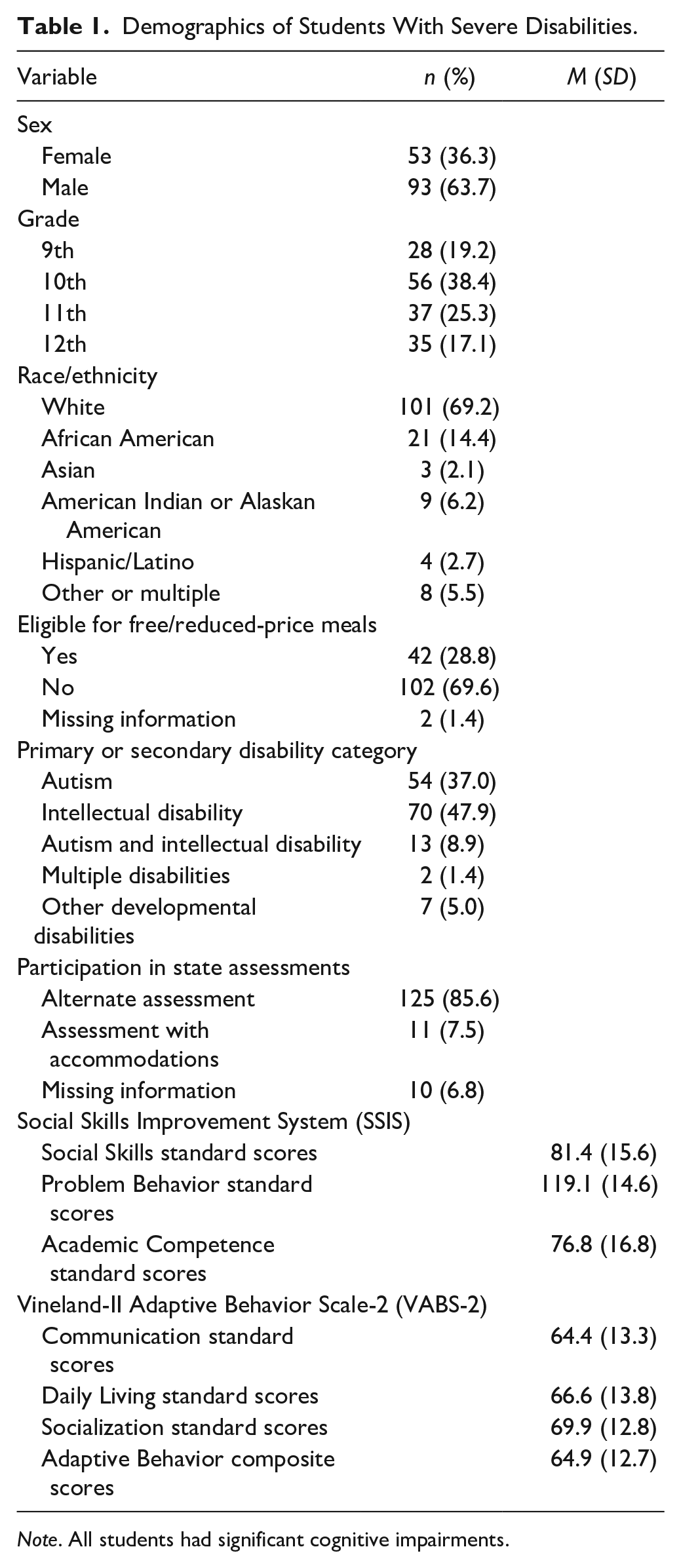
Note. All students had significant cognitive impairments.
To estimate typical academic and social patterns, we also observed a normative sample of peers without disabilities enrolled in the same classes (i.e., comparison peers). Peer comparison observations were completed in just over half (52.0%) of the classrooms. We selected peers who (a) did not have severe disabilities according to special educators and (b) were in close enough proximity to the observers to allow for accurate observation. One peer was chosen for the first half of the class, and a different peer was observed for the second half of class. We combined these data to create a peer composite.
Schools and Classrooms
Students attended 23 high schools in 12 districts across two states (i.e., Tennessee, Wisconsin). Student enrollment averaged 1,331 (SD = 438). Average race/ethnicity of students across schools ranged from 1.3% to 58.8% African American (M = 15.1%), 0% to 0.7% American Indian or Alaska Native (M = 0.3%), 0.3% to 11.2% Asian (M = 3.8%), 22.8% to 94.2% White (M = 71.9%), 1.6% to 17.0% Hispanic/Latino (M = 7.2%), and 0.7% to 8.3% other or multiple options indicated (M = 3.4%). The percentage of students eligible for free/reduced-price meals ranged from 6.6% to 83.4% (M = 30.3%).
Our observations focused on one general education classroom for each student. According to teachers, students were enrolled in an average of 3.1 (SD = 1.6) general education classes at the time of the study (average of 45.3% of their school day). Specifically, 17.2% took one general education class, 24.9% took two classes, 21.4% took three classes, 15.2% took four classes, 11.7% took five classes, and 9.6% took six or more classes. When students took multiple general education classes, we selected one classroom based on scheduling considerations (e.g., avoiding classes during the same period of the day to accommodate observations) and input from school staff (e.g., classes in which adult support was available). We observed 56 students (38.4%) in core academic classes (i.e., math, science, language arts, social studies) and 90 students (61.6%) in elective and related arts classes (e.g., music, chorus, band, art, theater, dance, digital arts, computer technology, wellness, culinary arts). The average enrollment was 24.2 students (SD = 7.5). Most schools used 50-min class periods; however, six schools used an alternating block schedule of 100-min periods. With only a few exceptions, all of the students with severe disabilities were accompanied by paraprofessionals to these classes; several were accompanied by special educators.
Observational Measures and Procedures
We observed three full-length class periods for each student (i.e., 438 total observations), each lasting an average of 59.7 min (SD = 20.6). The three observations were collected over a 2- to 3-week period and began after the first 2 weeks of the semester (i.e., weeks 3–5 of the semester). To include observational data in our project, students had to be in the classroom for at least 20 min of the class period. If a student did not show up (due to absence at school or other reasons) or stayed less than 20 min, we rescheduled the observation. We used tablet computers equipped with MOOSES (Multi-Option Observation System for Experimental Studies; Tapp, 2012) to collect frequency (i.e., peer interactions) and duration (i.e., academic engagement, instructional format, proximity) data second-by-second in real time. We converted frequency counts to rates (per hour) and duration measures to percentages of total observations. Definitions of all measures were adapted from prior observational studies focused on this population (Carter et al., 2008; Hughes et al., 1999) and are available from the first author.
Peer Interactions
We coded all peer interactions between the focus student and other classmates without severe disabilities. This included any verbal or nonverbal behavior produced by the student and directed to a peer without severe disabilities (or vice versa). We coded each interactive behavior according to its function (i.e., initiation or response), topic (i.e., task- or social-related), and source and recipient (i.e., focus student, classmates without severe disabilities). Task-related interactions addressed activities, materials, or expectations related to the current class; all other interactions were considered social-related. Initiations were interactions preceded by at least 5 s without an interaction, they reflected a change from task- to social-related topic (or vice versa), or they occurred with a new peer; all other interactions were responses. We summarized each of these interactive behaviors separately (see Figure 1). Total peer interactions is the sum of all initiations and responses between the students and their peers, student contributions is the sum of initiations and responses produced by the students with severe disabilities, and classmate contributions is the sum of initiations and responses produced by classmates.
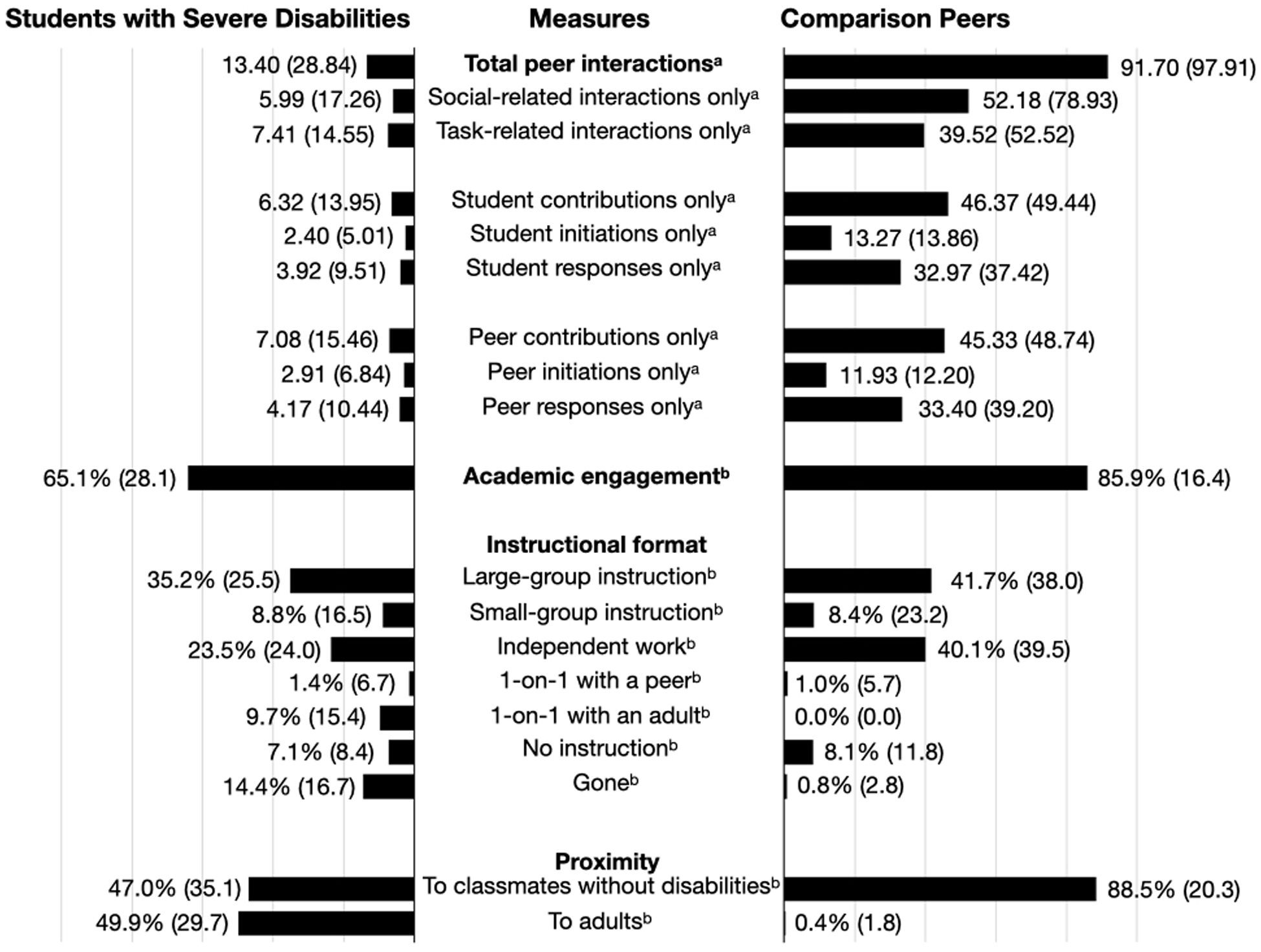
Descriptive Statistics of Classroom Observational Data.
Academic Engagement
Students were considered academically engaged when they were actively involved in instructional activities or attending to lectures or class discussions that were aligned with those provided by the general education teacher to the majority of students in the class. For example, students might be looking at materials (e.g., textbook, worksheet, overheads) related to ongoing instructional activities, looking at the teacher, writing related to the assigned activity, following teacher directions, raising their hand, or asking questions of the teacher about class activities. In all other situations, students were considered unengaged. This included working on tasks unrelated to the rest of the class or not participating in any instructional activities. We noted any changes in this variable only after 5 s had elapsed after going from one state to another.
Proximity to Others
We separately coded whether the students were in proximity to (a) peers without severe disabilities and (b) adults who provided direct support. We defined proximity as being oriented in a position and distance that allowed for easy interactions (i.e., about 3 feet).
Instructional Format
We coded instructional format as (a) large-group instruction (i.e., student and their classmates were all receiving instruction from one educator), (b) small-group instruction (i.e., students were working with a group of five or fewer classmates), (c) independent work (i.e., students were primarily working on their own without ongoing assistance from adults or classmates), (d) 1-on-1 with a peer (i.e., students were working primarily with the help of a classmate), (e) 1-on-1 with adults (i.e., students were working primarily with the help of a paraprofessional or teacher), (f) no instruction (i.e., students were not assigned any work), or (g) gone (i.e., students had left the classroom). Codes were mutually exclusive and exhaustive.
Interobserver Agreement
Twenty-three graduate students, staff, and faculty served as classroom observers. Observers discussed coding definitions and scored 100% on quizzes prior to observing. We required observers to meet (a) 90% agreement on practice videos and (b) 80% agreement with a trained observer in classrooms. For one third (33.8%) of all observations across students, a second observer independently collected data. We calculated point-by-point agreement for event-based codes using a 5-s window around each observer’s coded events. We calculated percentage of agreement by dividing the number of agreements by the number of agreements plus disagreements (times 100%). Agreement averaged 85.2% for task-related interactions and 80.5% for social-related interactions. We compared duration-based codes on a second-by-second basis and calculated agreement by dividing the total seconds in agreement by the total observation seconds in the observation, and multiplying by 100%. Agreement averaged 97.8% for academic engagement, 98.2% for classmate proximity, 95.4% for adult proximity, 96.8% for large-group instruction, 89.6% for small-group instruction, 94.8% for independent work, 95.2% for 1-on-1 with a peer, 94.1% 1-on-1 with an adult, 91.6% for no instruction, and 98.4% for gone.
Other Measures and Procedures
We distributed the following assessments to each student’s special education teachers, asking them to complete it at around the same time we conducted our classroom observations.
Social Skills Improvement System
The Social Skills Improvement System (SSIS) is a widely used social skills assessment tool with strong psychometric properties (Gresham & Elliott, 2008; Lyons et al., 2016). We examined standard scores for its three scales: Academic Competence, Social Skills, and Problem Behavior.
Vineland Adaptive Behavior Scales-2
The Vineland Adaptive Behavior Scales-2 (VABS-2; Sparrow et al., 2005) is a widely used, psychometrically sound measure of adaptive behavior and functioning level for youth with intellectual and developmental disabilities. We examined standard scores for Communication, Daily Living, and Socialization domains, as well as for the overall Composite.
Data Analysis
To address RQ1 and RQ2, we used descriptive statistics to summarize peer interactions, academic engagement, contextual factors, and classroom supports across all observations. We converted interaction counts to rate (per hour) and duration measures to percentage of observational session to control for any differences in observational lengths. To address RQ3, we used the nested analysis feature in MOOSES to examine how peer interactions and academic engagement varied based on each level of instructional format (i.e., large-group, small-group, independent work, 1-on-1 with a peer, 1-on-1 with an adult, no instruction) and proximity (i.e., in and out of proximity to classmates, in and out of proximity to adults). Because not every participant was observed under every level of these contextual factors, sample sizes for nested variables are provided in Table 2. For example, some students with severe disabilities never received small-group instruction. Thus, nested data were only analyzed for the 52 students who participated in small-group instruction. For RQ4, which was a post hoc analysis, we computed Pearson correlation coefficients to examine the strength of the associations between two observational measures (i.e., total peer interactions, academic engagement) and the standard scores for each scale of the SISS and VABS-2.
Academic Engagement and Social Interactions by Contextual Factors.
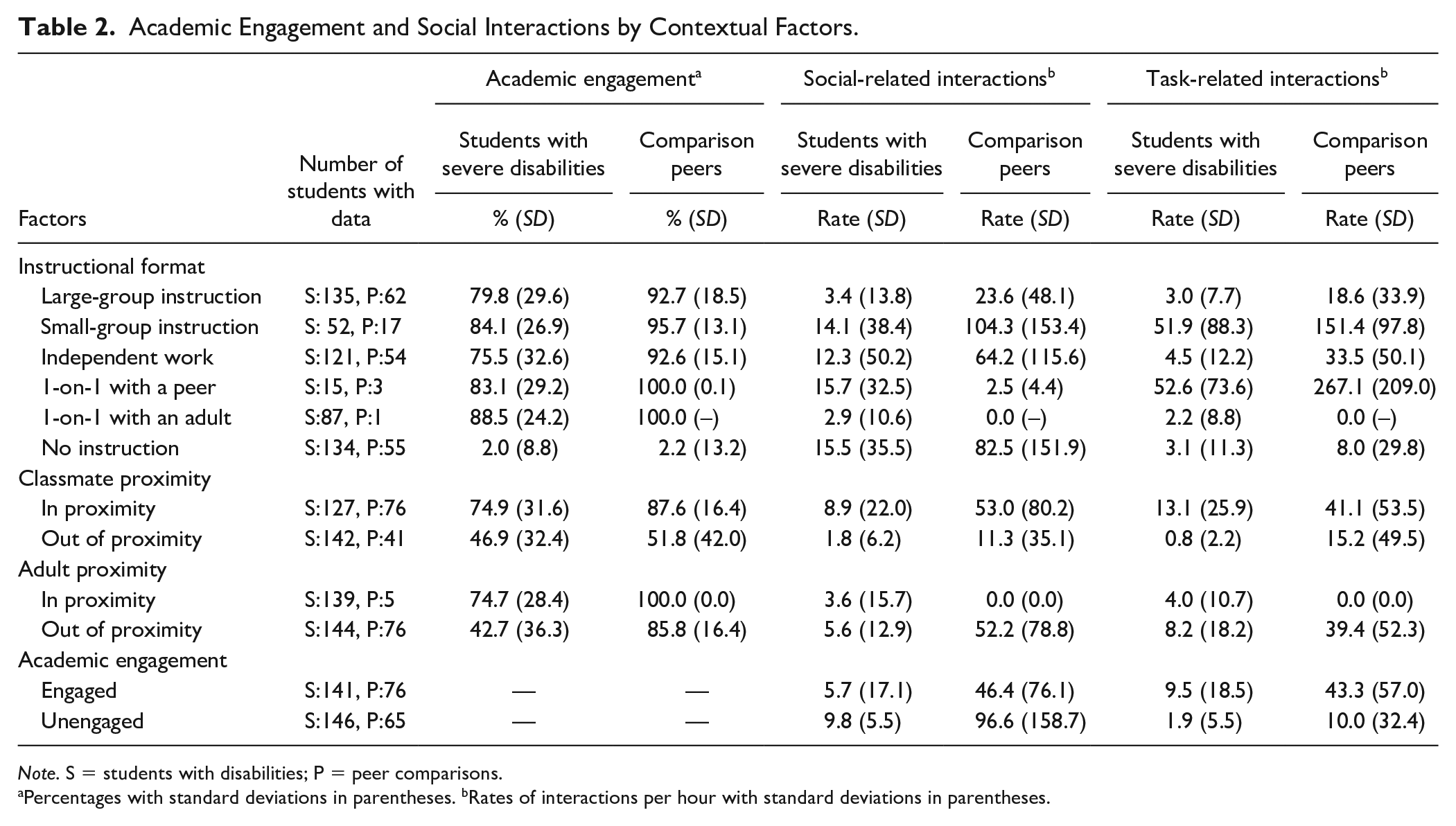
Note. S = students with disabilities; P = peer comparisons.
Percentages with standard deviations in parentheses. bRates of interactions per hour with standard deviations in parentheses.
Results
RQ1. What Is the Nature of Students’ Peer Interactions in General Education Classrooms?
Students with severe disabilities interacted with peers an average of 13.40 times per hour (SD = 28.84). This rate was considerably lower than we observed among comparison peers (M = 91.70; SD = 97.91). Moreover, students with severe disabilities varied widely in their total number of peer interactions across all three observations. Almost one third (30.1%) of these students did not have a single peer interaction during all three observations, despite being in a room among numerous classmates. In contrast, this absence of any interaction was only observed for 3.9% of comparisons peers. Among the remaining students with severe disabilities, 17.8% had fewer than two interactions across the three observations, 13.0% had between two and five interactions, 7.5% had between five and 10 interactions, 6.8% had between 10 and 15 interactions, and 24.7% had more than 15 interactions. In contrast, among the remaining comparison peers, 1.3% had fewer than two interactions across the three observations, 2.6% had between two and five interactions, 5.2% had between five and 10 interactions, 5.2% had between 10 and 15 interactions, and 81.8% had more than 15 interactions.
Overall, the peer interactions students with severe disabilities did have tended to be more task-related, while the interactions of comparison peers were more social-related (see Figure 1). However, peer interactions tended to be fairly reciprocal (i.e., similar rates of contributions by students and classmates) for students with severe disabilities and comparison peers.
RQ2a. How Do Peer Interactions Vary Based on Instructional Format and Proximity?
Instructional Format
Rates of peer interaction for students with severe disabilities varied widely across instructional formats (see Table 2). For social-related interactions, the highest rates were evident during 1-on-1 work with peers (M = 15.7; SD = 32.5), no instruction (M = 15.5; SD = 35.5), and small-group instruction (M = 14.1; SD = 38.4). Such interaction was especially rare during large-group instruction and 1-on-1 work with adults. For comparison peers, social-related interactions were also highest during small-group instruction (M = 104.3; SD = 153.4) and no instruction (M = 82.5; SD = 151.9). The pattern for task-related peer interactions among both groups was similar, with the unsurprising exception of having very low rates when there was no instruction.
Proximity to Classmates
Social-related peer interactions were higher for students with severe disabilities (M = 8.9; SD = 22.0) and comparison peers (M = 53.0; SD = 80.2) when classmates were in proximity. The same pattern was evident for task-related peer interactions among students with severe disabilities (M = 13.1; SD = 25.9) and comparison peers (M = 41.1; SD = 53.5). Interestingly, comparison peers still had social- and task-related peer interactions even when they were not in close proximity to classmates. This was rarely the case for students with severe disabilities.
Proximity to Adults
We observed striking differences in the degree to which students with severe disabilities were in proximity to adults (49.9%) relative to the comparison peers (0.4%). Social-related peer interactions were higher for students with severe disabilities (M = 5.6; SD = 12.9) when adults were not in close proximity compared with when they were (M = 3.6; SD = 15.7). The same pattern held for task-related peer interactions among students with severe disabilities: out of proximity (M = 8.2; SD = 18.2) versus in proximity (M = 4.0; SD = 10.7). Students with severe disabilities rarely interacted with peers when sitting near a paraprofessional or special educator.
Academic Engagement
The topics of peer interaction involving students with severe disabilities varied based on their academic engagement (see Table 2). Social-related interactions were higher when students were unengaged (M = 9.8; SD = 5.5) compared with when they were engaged in instruction (M = 5.7; SD = 17.1). The opposite was true for task-related interactions, which were higher when students were engaged in instruction (M = 9.5; SD = 18.5) compared with when they were unengaged (M = 1.9; SD = 5.5). Similar patterns were observed among comparison peers.
RQ2b. How Does Academic Engagement Vary Based on Instructional Format and Proximity?
Instructional Format
Academic engagement did not vary substantially across instructional formats for students with severe disabilities or comparison peers (see Table 2). The highest levels of engagement were evident during 1-on-1 work with adults (M = 88.5; SD = 24.2), small-group instruction (M = 84.1; SD = 26.9), and 1-on-1 work with peers (M = 83.1; SD = 29.2).
Proximity to Classmates
Academic engagement was substantially higher for students with severe disabilities (M = 74.9; SD = 31.6) and comparison peers (M = 87.6; SD = 16.4) when they were in close proximity to classmates. When they were not near their peers, students with severe disabilities (M = 46.9; SD = 32.4) and comparison peers (M = 51.8; SD = 42.0) were less often engaged.
Proximity to Adults
Academic engagement was also higher for students with severe disabilities (M = 74.7; SD = 28.4) and comparison peers (M = 100.0; SD = 0.0) when they were sitting nearby adults.
RQ3. How Academically Engaged Are Students in General Education Classrooms?
Students with severe disabilities were academically engaged during an average of 64.1% (SD = 28.1) of observations (see Figure 1). This overall duration was considerably lower than comparison peers (M = 85.9%; SD = 16.4)—a difference of 21.8%. When time gone from the classroom was removed, average academic engagement for students with severe disabilities increased to 72.8% (SD = 27.7) and engagement for comparison peers increased to 86.5% (SD = 16.1)—a difference of 13.7%.
RQ4. How Are Social Skills and Adaptive Behavior Associated With Peer Interactions and Academic Engagement?
Rate of total peer interactions was significantly and positively correlated with ratings of Social Skills (r = .26, p = .002), but not with ratings of Academic Competence (r = .04, p = .619) or Problem Behaviors (r = −.08, p = .323). Academic engagement was significantly and positively correlated with ratings of Social Skills (r = .37, p < .001) and with Academic Competence (r = .17, p = .038), but not with Problem Behaviors (r = −.08, p = .359).
Rate of total peer interactions was significantly and positively correlated with VABS ratings for Communication (r = .24, p = .004), Daily Living (r = .25, p = .003), Socialization (r = .29, p < .001), and the Composite score (r =.27, p = .001). Percentage of academic engagement was significantly and positively correlated with VABS ratings for Communication (r = .24, p = .004), Daily Living (r = .46, p < .001), Socialization (r = .46, p < .001), and the Composite score (r = .47, p < .001).
Discussion
As more students with severe disabilities participate in the array of classes that comprise the typical high school curriculum, it is important to understand how they participate in the social and academic experiences that can promote their learning and enjoyment of school. We took an in-depth look inside nearly 150 general education classrooms to present a portrait of participation for students with severe disabilities. Our findings add to a growing body of literature focused on the extent to which students with disabilities are truly experiencing inclusive education within the classes that they take (e.g., Chung et al., 2019; Toews et al., 2020). However, our study focused most directly on whether students are educated with peers in same-age groupings and have shared social and academic experiences in their general education classrooms.
The social experiences of high school students with severe disabilities were often limited within these classrooms. Although a subset of students interacted fairly frequently (i.e., one quarter averaged more than 15 interactions), the majority had very few social connections throughout their classes. Indeed, nearly one third of students (30.4%) did not interact with any other classmate during any of our observations. This contrasted sharply with peers in the same classroom. Such isolation is certainly not new—it has been evident in prior observational studies and depicted in the baseline phases of dozens of intervention studies carried out in high school classrooms (see Kuntz & Carter, 2019). Yet it stands in contrast with prevailing conceptualizations of inclusive education that emphasize collaborative work and abundant interactions among students and their classmates (Jorgensen, 2018; Ryndak et al., 2000). The paucity of peer interactions for many students reflects missed opportunities for relationship formation (e.g., social-related interactions) and shared learning (e.g., task-related interactions). Indeed, comparison peers tended to have fairly high rates of both types of interactions.
Several factors appeared to relate to variations in the peer interactions among students. For example, students with severe disabilities tended to converse more with their classmates when participating in small-group instruction or working directly with another peer. Such instructional arrangements promote interdependence and teacher-sanctioned times for conversation. However, almost two thirds (64%) of students with severe disabilities were not presented with small-group instruction opportunities, missing out on a critical time to engage and interact with their peers. Similar patterns were evident in the observational study by Carter and colleagues (2008). However, these two instructional formats—which ensure the close proximity of one or more classmates—were rarely observed in these general education classrooms (i.e., an average of 10.2% of intervals). In contrast, the close and ongoing proximity of a paraprofessional or special educator was associated with much lower rates of peer interaction—both social- and task-related. Interactions occurred at nearly half the rate when adults were in proximity compared with when they were not. It may be that adolescents are reluctant to converse with their classmates with severe disabilities when paraprofessionals are present or that students with severe disabilities have less need to initiate to peers if an adult is addressing most of their academic needs. Finally, students who had higher rates of peer interaction tended to receive higher ratings in the areas of social skills and adaptive behavior. Students who exhibit stronger social and communication skills may be more competent in capitalizing on the social opportunities that exist within their classrooms.
Academic engagement also tended to be substantially lower for students with severe disabilities relative to comparison peers from the same classrooms. Although continuous engagement was not a reality for anyone we observed (i.e., average engagement for peers without disabilities was 86%), we were struck that students with severe disabilities were actively engaged an average of two thirds (64%) of their classes. Some of their unengagement (about 8% of the class) was due to periods of no instruction (e.g., toward the start or end of the class period, transitions between instructional activities). In addition, students were unengaged because they were gone from the classroom (about 14% of the class) due to arriving late, leaving early, or being pulled out for alternative activities. When students with severe disabilities are not actively engaged in ongoing instruction, they miss out on the opportunity to learn key knowledge or skills related to general education curriculum. These moderate to low levels of engagement are comparable to those also documented by Kuntz and colleagues (2022; 58% of intervals) and Carter and colleagues (2008; 60% of time).
As with peer interactions, we identified some factors that were associated with variations in academic engagement for students. Higher levels of engagement were observed when students and comparison peers were in close proximity to other classmates, regardless of the instructional format. Rather than distracting students from their work, the presence of peers may serve in some way to elevate engagement. As in the observational study by Carter and colleagues (2008), the close proximity of a special educator or paraprofessional was also associated with much higher levels of academic engagement. The use of individually assigned adults is often predicated on a student’s need for ongoing assistance or support to access challenging coursework. Yet, as noted previously, this arrangement also serves to stifle social interactions. The solution to this challenge may reside in greater use of peer support arrangements (Brock & Huber, 2017; Carter et al., 2016) or other peer-mediated approaches that equip fellow classmates to provide much of the help a student with severe disabilities needs to participate in learning activities (e.g., cooperative learning groups, classwide peer tutoring). This shifts paraprofessionals to facilitative roles where they provide only-as-needed support.
Limitations and Future Research
Several limitations to this study suggest areas for future research. First, other contextual factors also likely converge to shape the social and academic participation of students. Our study was limited to just three relevant features of the classroom. Future studies should explore the role that instructional quality, teacher experience, peer attitudes, and availability of supports also play within these classrooms. Second, establishing a truly representative sample of comparison peers is quite difficult and there is little guidance available in the literature (e.g., Hughes et al., 1996). Moreover, our comparison sample sizes were small when examining contextual influences on social and academic outcomes. Although the addition of this reference point is a strength of our study, additional research is needed to establish stronger criteria for which (and how many) classmates must be observed (and how often). In resource-intensive observational studies, researchers must strike the right balance between completing their primary data collection and securing an adequate comparison sample. Third, we completed these observations relatively early on in the semester, as the overall project involved incorporating peer-mediated interventions into a subset of these same classrooms. It is unclear whether the natural patterns we observed would look similar or different toward the middle or end of the semester. Future scholars should address the timing of observational studies to provide guidance on the optimal windows for data collection. Fourth, we did not collect information regarding general educators’ engagement with students with severe disabilities in their classrooms. For example, data addressing the proximity of general educators and their interactions with participating students would provide additional insights into the nature of their direct involvement. However, we had to make tough decisions about what measures (and how many) we could collect reliably through live coding. Future studies should capture the ways classroom teachers plan for, interact with, and support students with severe disabilities (cf., Chung et al., 2019; Kuntz et al., 2022). Fifth, we did not explore whether special educator and paraprofessional proximity might have led to greater prompt dependence among students with severe disabilities. The balance of providing “just enough” support can be difficult for some educators and often requires explicit training (Brock & Huber, 2017).
Implications for Practice
These findings highlight several areas in which new approaches to educational service delivery may be needed. First, teachers must collect their own data to inform the educational experiences each of their students with severe disabilities is having within each of their general education classes. Any presumption that placement in a particular classroom will automatically bring about certain benefits is certainly challenged by the overall portrait presented in this observational study. Rather than assuming students with severe disabilities will be woven into the social and academic fabric of the classroom, educators should regularly gather data on any social, learning, and other outcomes that are important for each student. Doing so will enable teachers to make any adjustments needed to promote full participation.
Second, in addition to joining their classmates in making progress on the general education curriculum, individualized goals should also be established for students with severe disabilities. Teachers should adopt a data-based approach to goal setting and decision making so that it is clear what students should accomplish and whether they are making movement in this desired direction. For example, if teachers collected data on the types of measures used in this observational study, they could identify areas needing improvement and set targets for the mid-point and end-of-the semester (e.g., doubling the number of peer interactions, increasing academic engagement by 20% during large-group instruction). In addition, consideration is needed for the types of opportunities that students with disabilities have to engage with their classmates. Our findings suggest that incorporating various types of learning groups (e.g., small group) and reducing the sustained proximity of a paraprofessional may lead to enhanced opportunities for social interactions with peers.
Third, our results suggest many of the students in this study would benefit from additional interventions or supports that are known to improve social, academic, and other classroom outcomes. In their systematic review of 40 intervention studies focused on supporting middle and high school students with intellectual disability in general education classes, Kuntz and Carter (2021) identified four promising intervention approaches: systematic instruction, peer support arrangements, self-management strategies, and peer-mediated communication interventions. Each of these research-based practices holds promise for enhancing the quality of the education students with severe disabilities receive in general education settings. However, implementation of these interventions requires ongoing collaboration between general and special educators, as well as careful consideration of the roles of paraprofessionals. Likewise, much more attention should be given to pre-curricular planning for and the engagement of general educators in teaching students with severe disabilities. documented the power of collaborative planning as an avenue for improving the instructional behaviors of general educators and increasing the academic engagement of students with severe disabilities enrolled in their classes. Deepening their involvement may set the stage for more substantive academic and social participation of students.
Summary
General education enrollment is not always synonymous with inclusive education. Mere presence is not the same as meaningful participation and progress. A commitment to providing high-quality education requires that educators also actively monitor and work to enhance the social and academic experiences of students with severe disabilities in general education classrooms. Social interaction and academic engagement, important markers of inclusion, were evident for some of the students we observed in this study, but they were absent or limited for most. Although general education placement is a necessary condition for inclusive education, it is not a sufficient condition. We hope these findings will spur educators to reflect on the educational experiences of their students with severe disabilities and take active steps to improve its quality and impact.
Footnotes
Declaration of Conflicting Interests
The author(s) declared no potential conflicts of interest with respect to the research, authorship, and/or publication of this article.
Funding
Support for this research came from the Institute of Education Sciences, U.S. Department of Education, through Grant R324A100391 to Vanderbilt University and the University of Wisconsin–Madison.
