




Abstract
The U.S. federal government strives to be a model employer of people with disabilities. Although it has been successful in recent years in increasing disability hiring, retention of this workforce remains a concern. The researchers of this mixed-methods study sought to understand the perceptions of workplace attributes by employees with disabilities in federal agencies through analysis of the Federal Employee Viewpoint Survey (FEVS) and focus groups. The study results indicate that people with disabilities, in general, have lower perceptions of workplace attributes than their peers without disabilities; however, looking at groups differentiated by disability, military experience, and sex tells a richer story. This article incorporates the voices of agency representatives and employees with disabilities to provide additional context to the survey findings. Based on the results, the authors offer practice and policy recommendations to support improved workplace experiences and retention of employees with disabilities.
The U.S. federal government is one of the world’s largest employers, with 2.1 million executive branch civilian employees (U.S. Office of Personnel Management [OPM], 2018), with federal workers accounting for nearly 2.4% of all U.S. civilian workers (author calculation based on U.S. Census Bureau, 2017). The federal government has been subject to disability nondiscrimination legislation since 1973 and it remains committed to improving employment opportunities for people with disabilities (U.S. Equal Employment Opportunity Commission [EEOC], 2017). On July 26, 2010, President Barack Obama signed an executive order (Executive Order No. 13548, 2010) “to establish the Federal government as a model employer of individuals with disabilities.” From 2011 to 2015, about 143,600 employees with disabilities were hired, with about 60% of those hired into fulltime permanent positions (U.S. Government Accountability Office [GAO], 2020). These hiring efforts have increased the representation of non-seasonal and full-time career employees who self-identified on SF-256 (federal form for self-identification) as having any disability from 7.1% in 2010 to 9.5% in 2015. Likewise, the percentage of employees with a targeted/severe disability rose from 0.95% to 1.10% (OPM, 2015c). These rates approach the recently updated federal goals of 12% disability and 2% targeted disability representation (EEOC, 2017) and they are much higher than typically seen in the private sector (The Conference Board, 2015).
Although the federal sector has a relatively high representation of employees with a disability, there are concerns about retaining these employees. A recent GAO report highlighted that among employees with disabilities hired from 2011 to 2017, 39% stayed less than 1 year and 60% left within 2 years—rates similar for employees without disabilities (GAO, 2020). An EEOC (2022) report found that from 2014 to 2018, people with disabilities were 27% more likely to voluntarily separate as compared with individuals without disabilities. The GAO report recommended better tracking of retention of employees with disabilities to understand the root cause of why so many were not retained.
The current study uses the Federal Employee Viewpoint Survey (FEVS) and focus groups to identify and understand differences in perceptions regarding workplace attributes, job satisfaction, and intentions to quit of federal employees with and without disabilities. We acknowledge that individuals with disabilities have intersecting identities that may influence their perceptions of the workplace. Therefore, we examined eight groups distinguished by disability status, military experience, and sex to shed light on group differences that may be obscured when focusing only on disability. The study used a conceptual model of the relationships among workplace attributes, job satisfaction, and turnover intent that allowed us to simultaneously assess the impact of disability (and other intersecting identities) on these variables while taking into consideration the conceptual relationships among these constructs. By better understanding employee perceptions of the federal workplace, we can understand where gaps exist and better target interventions to reduce those gaps. In the next sections, we outline the research upon which our conceptual model is based and describe our hypotheses related to group differences.
Conceptual Framework
Our study is grounded in the conceptual framework presented in Figure 1. This model is based on the considerable research examining the relationships among workplace attributes, job satisfaction, and intentions to quit (e.g., Kinicki et al., 2002; Madigan & Kim, 2021). Job satisfaction is often treated as a dependent variable in a conceptual framework examining the impact of other phenomena or as an antecedent of withdrawal attitudes and behaviors (e.g., intent to quit, absenteeism, actual turnover). For example, Leader–Member Exchange (LMX) theory argues that supervisors form relationships of varying quality with different subordinates and it is the quality of those relationships that predicts subordinate job satisfaction (among other things; Graen, 1976; Graen & Scandura, 1987).
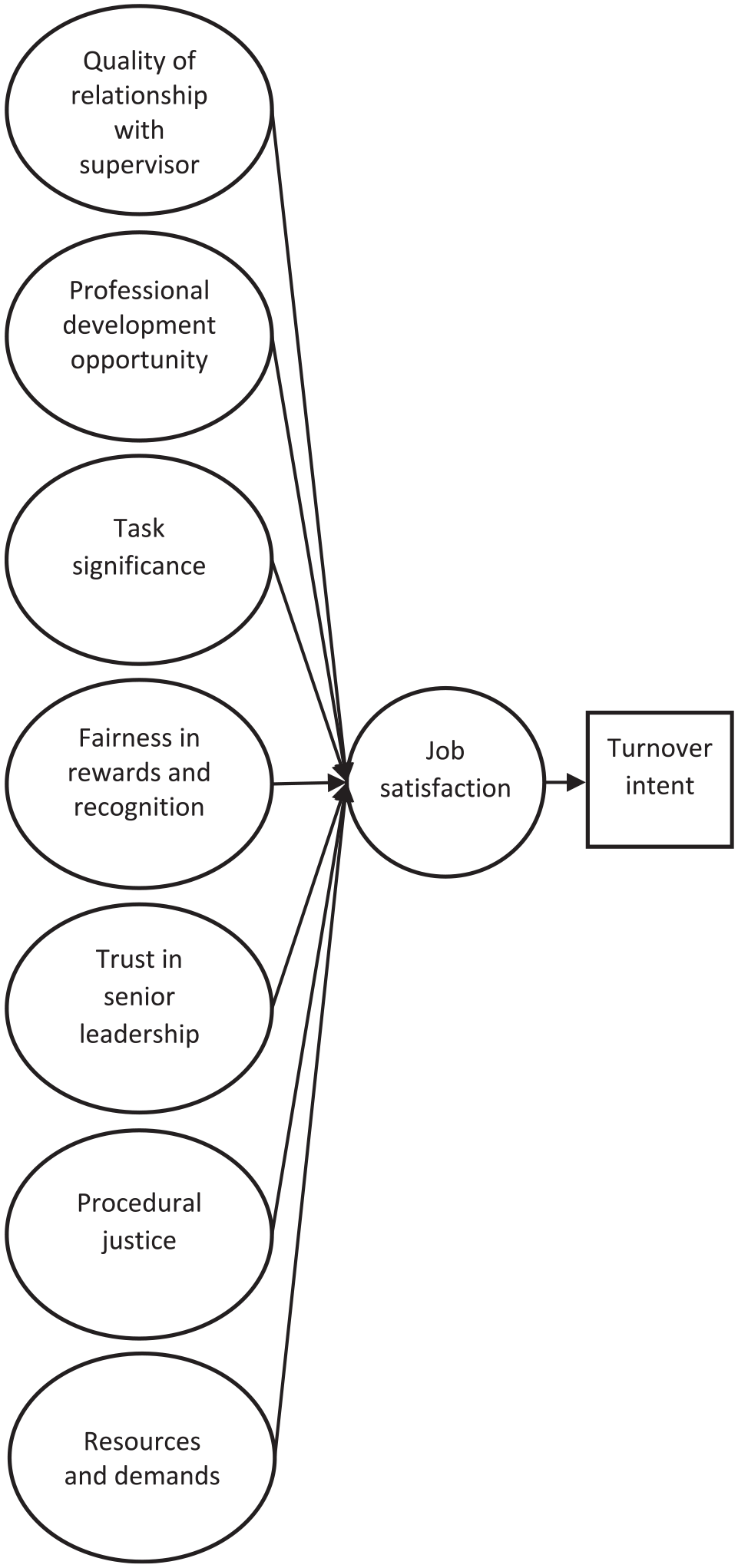
The model of workplace attributes predicting job satisfaction that then predicts turnover intent.
Based on various theoretical models (which are too numerous to detail here), all seven of the workplace attributes derived from the FEVS and depicted in Figure 1 have been linked in meta-analyses to job satisfaction. A meta-analysis by Huseyin (2018) found perceptions of organizational trust, ethical leadership, and organizational support to be related to job satisfaction. A more expansive meta-analysis by Kinicki et al. (2002) identified task significance, professional development opportunities, perceptions of equity (fairness), work demands and resources (stressors), and relationship with one’s supervisor to be related to job satisfaction. According to Rudolph et al. (2017), job demands are related to satisfaction. Both Wolfe and Lawson (2020) and Colquitt et al. (2001) found fairness of rewards and recognition (distributive justice) and procedural justice to be related to job satisfaction. Dulebohn et al. (2012) found quality of the supervisory relationship to be strongly related to job satisfaction. Several meta-analyses reported a strong relationship between job satisfaction and intentions to quit, including Kinicki et al. (2002) and Madigan and Kim (2021). Based on this, our first hypothesis can be broken into two parts:
Disability Differences in Workplace Attributes by Military Experience and Sex
A great deal of research has shown that persons with disabilities can have lower job satisfaction than individuals without disabilities (see Beatty et al., 2019). Previous research has shown that people with disabilities often have poorer quality relationships with their supervisors than do nondisabled persons (Colella & Varma, 2001; Dwertmann & Boehm, 2016; Nishii & Bruyère, 2014). Similarly, federal supervisors have reported that supervisor knowledge of accommodations and attitudes toward people with disabilities were continuing barriers to promotion and advancement of federal employees with disabilities (Bruyère et al., 2002). Research has also shown that persons with disabilities may receive unfair treatment in the evaluation process (see meta-analysis by Ren et al., 2008). Schur et al. (2009) found that people with disabilities had more difficulty in obtaining development opportunities, whereas Colella and Varma (2001) reported that raters were less likely to recommend people with disabilities for future opportunities. We were confident that perceptions of workplace attributes and job satisfaction of people with disabilities would be lower than for their colleagues without disabilities. However, a common criticism of research examining disparate treatment is the tendency to only consider one demographic dimension at a time, without considering how other aspects of a person may influence treatment in interaction with the characteristic under concern (Colella et al., 2017). In this study, we examined two such factors: military experience and sex.
An early finding in the disability literature has been that the attribution that people make about why a person has a disability influences their treatment of that person (Bordieri & Drehmer, 1987). The treatment of an individual at work may be influenced by the employee’s disability and stigma related to that disability (Ren et al., 2008); however, when a disability is assumed to be a result of “service to the country,” treatment of that employee may be better. Furthermore, the federal workforce provides a great deal of support to employees with military experience; thus, persons with a disability and military experience may find themselves in a more supportive environment than individuals without military experience (U.S. Department of Veterans, 2018; Weissman, 2014). Vanderschuere and Birdsall (2019) noted that federal employees who are veterans have lower job satisfaction than their nonveteran peers but did not look at differences by disability status. Because people with disabilities and military experiences may experience less stigmatization from supervisors and coworkers and have more workplace supports available, our second hypothesis was as follows:
In their model of disability effects on workplace experiences, Stone and Colella (1996) proposed that a type of “double jeopardy” may exist when women also have a disability. Research evidence on this has been mixed (see Beatty et al., 2019; Colella & Bruyère, 2011). However, most individual studies do not examine these effects across the variety of jobs and with the sample size we had in our study. Thus, we provide a robust scenario for testing the following third hypothesis:
Method
Survey
The Federal Employee Viewpoint Survey (FEVS) is an annual survey that the U.S. federal government uses to measure employee perceptions of working conditions across agencies. The OPM designed the FEVS to (a) provide indicators of how well the government is running its human resources, (b) assess individual agencies and their progress, and (c) provide senior management with information to help them improve their agencies. It was first administered in 2002 and is conducted annually (OPM, 2015b). Employees are invited to participate in the FEVS by e-mail and the survey itself is completed online. In 2015, 848,237 employees received the FEVS, of whom 421,748 completed the survey, resulting in an overall response rate of 49.7% (OPM, 2015a). The FEVS added a disability question in 2012 and we limited our analysis to 2015, the most recent year with a disability variable on the public use data file. Employees self-identify as a person with a disability on the FEVS by an affirmative response to the following question: “Are you an individual with a disability?” About 14% of respondents indicated that they had a disability (OPM, 2015a). Full text of all survey items is available in the 2015 Public Release File Codebook, which is available for download at https://www.opm.gov/fevs/public-data-file/.
Sample
The full 2015 FEVS contains 421,748 responses. We excluded military agencies (U.S. Department of Defense—Army, Air Force, Navy) because of very different composition of the military experience among their workforces, dropping the sample to 364,078. Finally, we excluded responses that did not include key demographics of disability status, sex, and military experience, further dropping the sample to 327,067. We determined military experience by the response the following question: “What is your U.S. military service experience?” Response choices were “Currently in National Guard or Reserves,” “Retired,” “Separated of Discharged,” all coded at 1 (yes), and “No prior military experience,” coded at 0 (no). Examination of the weighted estimates for respondents with disabilities showed that 66.6% had U.S. military service experience and 35.5% were female. For respondents without disabilities, only 21.5% had U.S. military service experience and 49.9% were female.
To answer the research questions based on our hypotheses, we used the binary variables of disability status, military service experience, and sex to create eight equally sized groups of respondents:
females with no disability and no military experience;
females with disability and no military experience;
females with no disability and military experience;
females with disability and military experience;
males with no disability and no military experience;
males with disability and no military experience;
males with no disability and military experience; and
males with disability and military experience.
Females with a disability and military experience were the smallest group in the data set, with about 4,600 responses. Therefore, using SAS 9.3, we selected a random sample of 4,600 responses from each of the remaining seven groups, creating eight equally sized groups because unequal group sizes negatively impact ability to detect differences (Chen, 2007). About 35% of respondents without disabilities identified as minorities, 21.3% as supervisors, and 21.6% as below 40 years of age. Percentages for respondents with disabilities were similar but with more minorities (40.8%), fewer supervisors (14.6%), and fewer below age 40 (16.8%). Table 1 contains descriptive statistics for both the whole sample and subsample.
Characteristics by Disability Status for 2015 FEVS and Study Subsample.
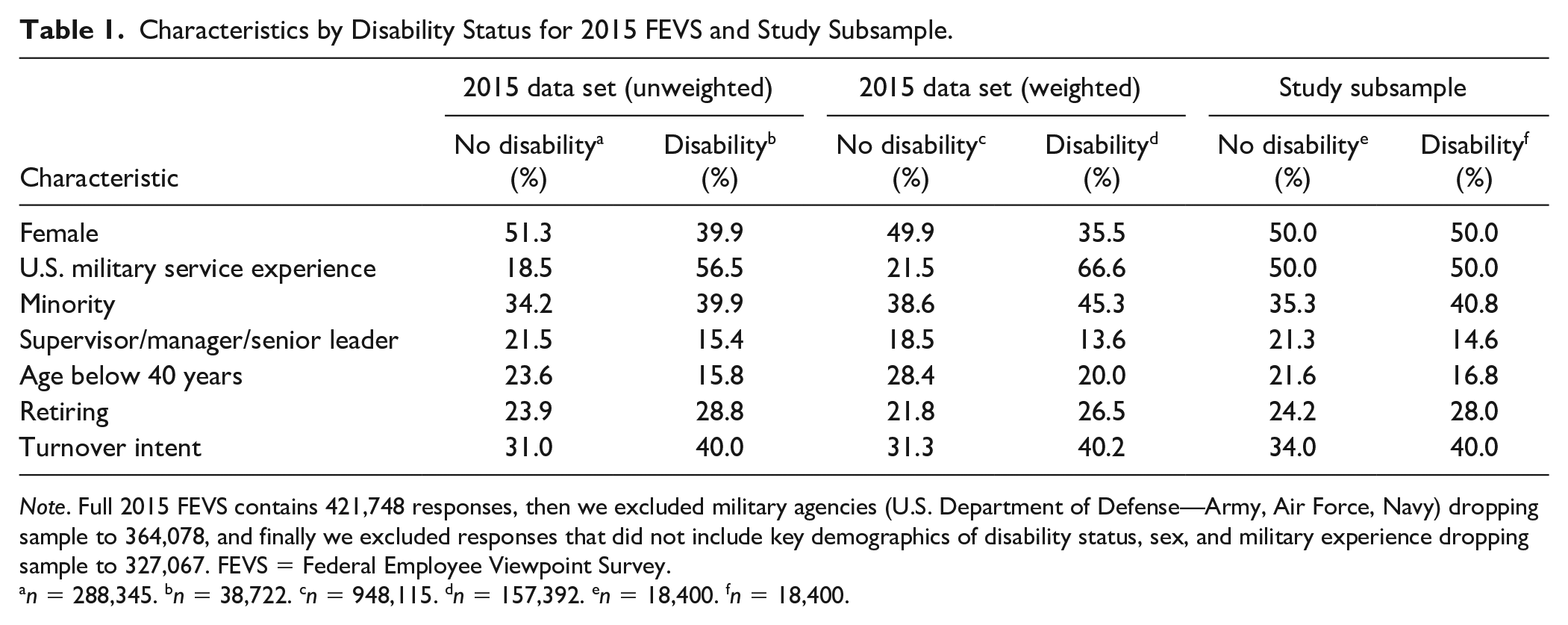
Note. Full 2015 FEVS contains 421,748 responses, then we excluded military agencies (U.S. Department of Defense—Army, Air Force, Navy) dropping sample to 364,078, and finally we excluded responses that did not include key demographics of disability status, sex, and military experience dropping sample to 327,067. FEVS = Federal Employee Viewpoint Survey.
n = 288,345. bn = 38,722. cn = 948,115. dn = 157,392. en = 18,400. fn = 18,400.
Procedure
Workplace attribute subscales, job satisfaction, turnover intent, and covariates
We organized 32 questions with Likert-type responses ranging from 1 to 5 (higher values being more positive) into eight subscales: one subscale for job satisfaction and seven subscales for workplace attributes: quality of supervisor relationship, professional development opportunities, task significance, fairness in rewards and recognition, trust in senior leadership, procedural justice, and resources and demands. To inform initial item selection for each subscale, a content area expert conducted an independent item review and grouping, and we reviewed how previous studies using the FEVS had measured similar constructs. We then examined item polychoric correlation matrices, conducted a confirmatory factor analysis (CFA) with all eight subscales, and then examined measurement invariance by disability status. Our analysis supported the development of the eight subscales and indicated strong factorial invariance by disability supporting the appropriateness of group comparisons (Putnick & Bornstein, 2016). Cronbach’s alpha (α), a measure of internal consistency, ranged from .68 for resources/demands to .95 for quality of supervisor relationship (see Supplemental Table S1 for items and α values for each subscale).
We used seven other questions in the analysis as covariates: sex, disability status, military service experience, minority status, supervisor status, intent to retire within 5 years, and age below 40 years. Finally, we determined turnover intent by an affirmative response to the item, “Are you considering leaving your organization within the next year?”
Analysis
The analysis plan consisted of three phases. Broadly, the first phase was CFA; the second phase was structural equation modeling, with turnover intent and covariates included in the model; and the third phase was a pruned model. The amount of missingness for any workplace attribute question ranged from 1.0% to 9.0%. After considering modern missing data methods and the needed model estimator of robust maximum likelihood (MLR), we selected full information maximum likelihood (FIML) because it enabled nested model testing via the Satorra and Bentler’s (2010) scaled chi-square difference test and the retention of all responses in the data set. All models were estimated with MLR and clustering variable of agency in Mplus 8.4 (Muthén & Muthén, 2018). Due to the very large sample size and the number of model comparisons that we expected to make, we set Cronbach’s alpha to .001.
Using the identified survey questions and the eight subscales, we created an eight-factor confirmatory factor model with job satisfaction and the seven workplace attributes. The scale of the factors was set with effects coding. We evaluated model estimates and fit statistics for goodness of fit for the model to the data. Acceptable fit was indicated if root mean square error of approximation (RMSEA) was less than .08, the comparative fit index (CFI) was greater than .90, and the non-normed fit index (NNFI) was greater than 0.90, per Little (2013).
After evaluating the model as a single group, we evaluated measurement invariance for an eight-group model based on disability status, sex, and military service experience to determine whether the FEVS measurement properties were equivalent across groups. We used measurement invariance to test equality of structure, factor loadings, and intercepts in a three-step process of evaluating configural, scalar, and metric models. For the configural test of structural equality, we needed to be able to judge that model fit as acceptable with factor loadings similar across groups. To determine whether the model fit was negatively impacted when moving from one step to the next in invariance testing (configural to scalar or scalar to metric), we examined RMSEA, CFI, and NNFI to see whether those statistics were acceptable and changing minimally (Brown, 2006). If change in CFI (ΔCFI) between two models was calculated to be less than .01, invariance was achieved at that stage (Cheung & Rensvold, 2002).
We evaluated the hypotheses with the eight-group model that contained covariates controlling for minority status, supervisor status, intent to retire within 5 years, and age below 40 with results based on adjusted means. Due to the complexity and computation time of a model with eight factors, eight groups, and the addition of a binary outcome for the second stage of analysis, factor scores were exported from the final metric model to create a path analysis model based on the factor scores, turnover intent outcome, and covariates. We used effect sizes to evaluate Hypotheses 2 and 3. Effect sizes of |d| ≥ 0.20 are small, |d| ≥ 0.50 medium, and |d| ≥ 0.80 large (Cohen, 1992); absolute values smaller than 0.20 are not considered meaningful.
Focus Groups
We engaged federal agency representatives and employees with disabilities in focus groups according to our key findings. The focus groups’ discussions began with a review of both preliminary findings and results presented in this article. We began the discussions related to these findings by talking about the poorer perceptions of workplace attributes among employees with disabilities as compared with those without disabilities and then considering why these perceptions might further vary by military experience or sex. The focus groups were fairly unstructured, with broad questions like, “Did these results surprise you?” and “Do you have any experiences that may help to explain or that conflict with the findings?” We conducted focus groups via Zoom and included a total of 25 participants representing 20 different agencies or subagencies. Further information on recruitment and methods are available in von Schrader and MacDowell (2021). Finally, we conducted a content analysis to identify themes in the focus groups’ discussions relevant to the findings of this article (Braun & Clarke, 2006); these themes are presented with example quotations after the survey results.
Results
Survey
Hypothesis 1: Workplace attributes, job satisfaction, and turnover intent
We conducted invariance testing to determine whether each group in the eight-group model responded to the FEVS in the same way. The model responses were found to be invariant at the configural (RMSEA = 0.055, 90% confidence interval [CI] = [0.055, 0.056], CFI = .949, NNFI = 0.942), metric (RMSEA = 0.054, 90% CI = [0.054, 0.055], CFI = .948, NNFI = 0.943), and scalar (RMSEA = 0.054, 90% CI = [0.054, 0.055], CFI = .946, NNFI = 0.944) levels for equal form, factor loadings, and intercepts, respectively, with a total ΔCFI < .003 across the models (see Supplemental Table S3). We converted the CFA model to a structural equation model with workplace attributes predicting job satisfaction and job satisfaction predicting turnover intent, as shown in Figure 1.
All workplace attributes except procedural justice had a positive effect on job satisfaction (see Supplemental Table S4). Across groups, the effects of task significance and trust in senior leadership were largest for job satisfaction. After model pruning, procedural justice was only statistically significant, with small effects in three groups: females with a disability and no military experience (β = −0.06, SE = 0.007), males with a disability and no military experience (β = 0.03, SE = 0.010), and males without disability and no military experience (β = −0.09, SE = 0.008). These coefficients are minimal in their effects on average job satisfaction.
The effects of job satisfaction were negative on turnover intent, meaning as job satisfaction increased, the odds of responding “yes” to turnover intent decreased. Across the groups, estimates ranged from −1.04 (SE = 0.036) to −1.31 (SE = 0.043) with no discernible pattern of effects on turnover intent based on group membership.
Hypothesis 2: Disability and military experience differences
We examined disability status and military service experience together to determine whether differences by disability status on workplace attributes were buffered by military service experience. Table 2 (see columns indicating H2, Female and Male) contains Cohen’s d effect sizes calculated to compare no disability with disability by sex and military experience. For both males and females, the disability effect sizes were smaller among groups with military experience. For example, the disability effect sizes for professional development for males and females with no military experience were, respectively, 0.36 and 0.25, compared with 0.12 and 0.08, respectively, for males and females with military experience. So, using Cohen’s criteria (Cohen, 1992), the effect sizes for respondents with military experience are not meaningful but the effect sizes for respondents without military experience are small.
Adjusted Workplace Attribute Means, Standard Deviations, and ES Differences by Sex, Military Status, and Disability Status.
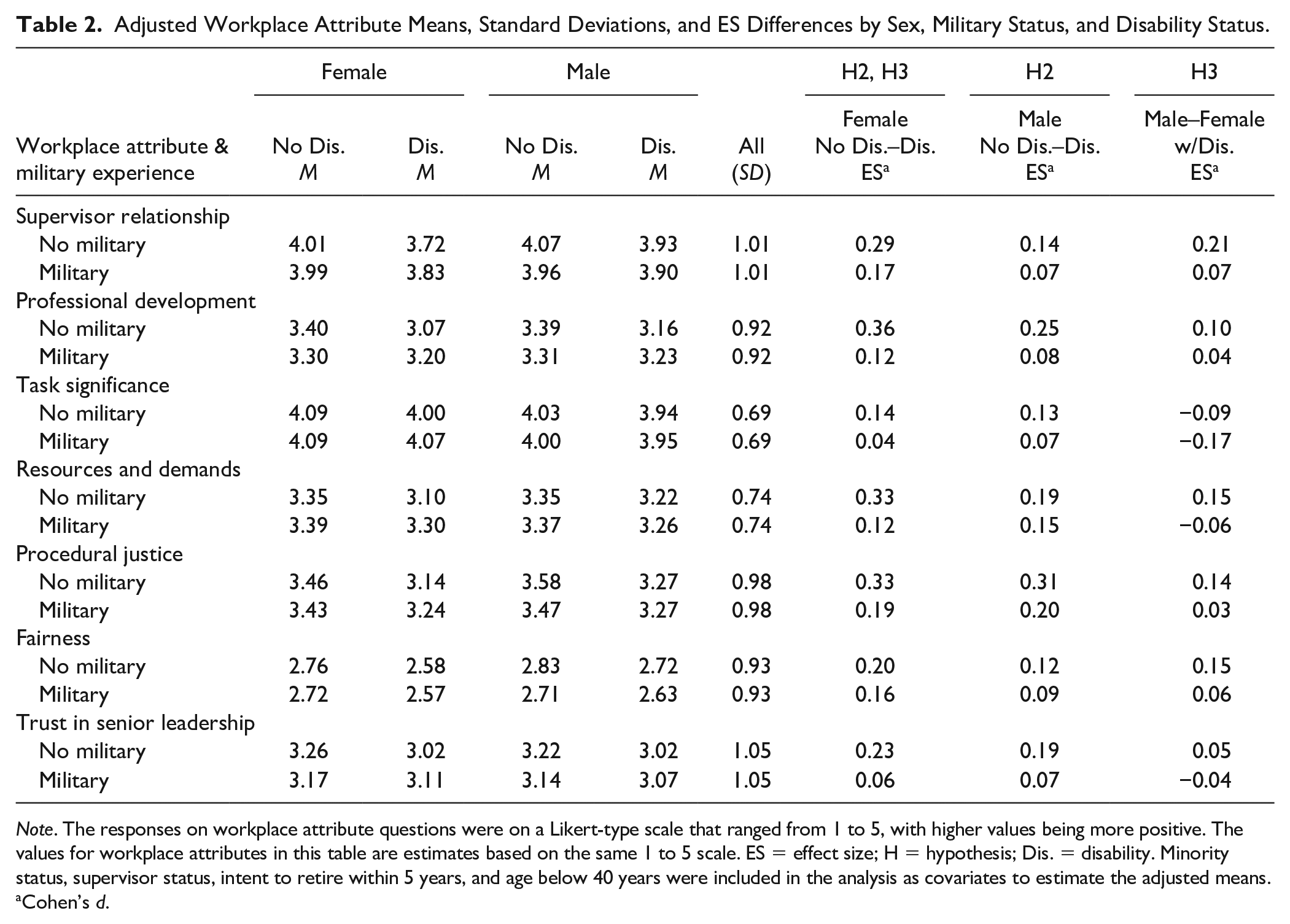
Note. The responses on workplace attribute questions were on a Likert-type scale that ranged from 1 to 5, with higher values being more positive. The values for workplace attributes in this table are estimates based on the same 1 to 5 scale. ES = effect size; H = hypothesis; Dis. = disability. Minority status, supervisor status, intent to retire within 5 years, and age below 40 years were included in the analysis as covariates to estimate the adjusted means.
Cohen’s d.
Hypothesis 3: Females with disabilities
As shown in Table 2 (see column H3, Female), the disability effect sizes for females are all positive, indicating lower perceptions of workplace attributes for females with disabilities as compared with females without disabilities. For example, the disability effect size for supervisory relationship is .29 for females with no military experience. When females with disabilities are compared with males with disabilities (column H3, Dis.), the former’s workplace attribute ratings are lower than their male peers on supervisor relationship, professional development opportunities, procedural justice, and fairness. For task significance, the negative effect sizes indicate higher means for females with disabilities than for males with disabilities. For resources and demands and trust in senior leadership, workplace attribute ratings were lower for females with disabilities without military experience compared with male peers but higher for those with military experience compared with male peers.
Focus Groups
In our analysis of focus group data, we identified three main challenges to explain why certain workplace attribute ratings may be lower for employees with disabilities: access to accommodations, opportunity for advancement, and the Equal Employment Opportunity (EEO) complaint process.
Participants in nearly every focus group discussed the accommodation process within agencies as something that may be related to lower perceptions of workplace attributes for employees with disabilities. One employee who has worked across multiple agencies noted, “Some places, it’s streamlined and some places, it’s a lot of work and a lot of heartache and frustration.” One agency representative noted, “The issue is that the agency doesn’t necessarily deny them a reasonable accommodation, but it may not be the accommodation that they’re asking for.” Other representatives noted that at times there is not adequate training and/or follow-up to ensure that the accommodation is working for the individual: “The EEOC has a list of requirements, data points you’re supposed to track. Follow up is not one of them. The effectiveness of an accommodation is not one of those data elements.”
Participants explained differences observed in opportunity for professional development by disability status by stressing that the way you move up within their agencies is by participating in training or being willing to travel (or being onsite for teleworkers) for new assignments. Participants noted potential barriers to both kinds of opportunities. One employee with a disability noted,
I’m told constantly that I’m an outstanding performer. But they . . . said that if you applied for a new job, you had to come in for a couple of days. Nowhere did anybody say anything about how a [reasonable accommodation] would help override that. I just assumed I could not apply because I couldn’t come in. There was no communication there.
Another individual with a hearing impairment stated, “I can’t tell you the amount of trouble I’ve had getting some really basic reasonable accommodations for trainings. Without appropriate access to these opportunities, it can feel challenging to move up the career ladder.” Agency representatives again noted lack of data collection in this area: “The programs that are designed to help people advance within our departments are not really being tracked in terms of the participation of people with disabilities.”
Participants noted that individuals who have engaged (or are aware of other’s experiences) with the EEO complaint process may have particularly poor impression of procedural justice in their agencies. One participant with a disability noted, “The EEO process is regressive and adversarial, is not a collaborative, progressive process.” Another said that “in my experience, as soon as you file on the EEO complaint, the system kind of locks up and it becomes you versus the government . . . even if you have a stellar performance record.” An employer representative recognized the challenges with the complaint process and stated that “if we can avoid going through a formal process, that is always going to be preferable.” They highlighted approaches in some agencies to work on addressing issues before they were formally filed as EEO complaints. However, an employee with a disability pointed out a lack of options: “There’s a very, very large gap existing right now in options that employees have to resolve workplace issues. Everyone opts for EEO because it’s kind of the only game in town.” In general, there seems to be a feeling that the EEO process is slow and unlikely to result in the desired change.
Effect size differences for disability demonstrated that persons with disabilities had lower perceptions regarding workplace attributes; however, the disability effect sizes were consistently smaller for respondents with military experience compared with their peers without. Among focus group participants, there was discussion about why military experience may buffer differences by disability status. As a veteran with a disability noted,
We’re more likely to identify that we have disability if we’re a veteran—it seems like it’s almost kind of acceptable versus other individuals that may not have military experience. There’s such a stigma with disability that people may be kind of standoffish to identify.
Furthermore, participants noted that accommodations might be more available to veterans: “If you have a disability in the workplace and you’re a veteran, you can push that envelope and make somebody look really bad for not accommodating you.” There may also be opportunities for networking available to veterans with a disability that may build connections in the workplace. As one agency representative noted,
There are some disabled veteran groups that meet monthly to kind of share their experiences about how their disabilities . . . make a situation better or worse when they’re interacting with people that do not have disabilities. And together, they come up with coping strategies.
Focus group participants offered some suggestions for why women with disabilities may rate their experiences lower. Much of the discussion related to women not being represented equitably in higher level General Schedule (i.e., pay scale) positions or in agency leadership. For example, an agency representative remarked, “In my agency, the female individuals with disabilities are at the lowest ranks.” A participant who was a female employee with disability was frustrated that she did not see role models in her agency leadership:
If I don’t see someone who is above me who I can relate to as a person with a disability, who I feel may have gone through similar struggles or understands what I might be going through either as a single mom, as a mom with disabilities, as someone who wants to move up in federal service.
Discussion
The U.S. federal government’s 2021 Executive Order on Diversity, Equity, Inclusion, and Accessibility (DEIA) in the Federal Workforce, given by President Joseph Biden, strongly signals the administration’s commitment to reducing barriers to federal employment for “underserved communities” (Exec. Order No. 14035, 2021). People with disabilities, veterans, and women are all groups considered in this executive order. As agencies self-assess their DEIA programs as part of the executive order, this study demonstrates the value of considering intersecting identities in data analysis in addition to gathering information from employees with disabilities and those who work on DEIA issues in an agency. In the following discussion, we offer key findings and highlight practice and policy implications.
Our analysis confirms that across groups (differentiated by sex, military experience, and disability) in the federal workforce, (a) job satisfaction predicts turnover intent and (b) the workplace attributes included in our model predict job satisfaction (with the exception of procedural justice). The findings of this study also indicate that there are differences in the perceptions of workplace attributes between employees with and without disabilities in federal agencies. The four groups of employees with disabilities consistently had lower workplace attribute ratings than like groups of employees without disabilities. Despite great efforts in the federal sector toward being a model workplace for people with disabilities, there is still room for growth.
Participants of the focus groups highlighted possible areas of growth for federal agency employers related to the workplace attributes measured in this study; two that were mentioned frequently were the accommodation process and need for better communication. Access to workplace accommodations may allow an individual with a disability to fully engage in the workplace, for example, allowing participation in professional development opportunities. When there are challenges of accessing accommodations or inequitable access to accommodations, this is likely to impact perceptions of the workplace and ability for the individual to succeed (Schur et al., 2014). A well-defined policy and clearly communicated process for accommodations should be in place in every agency. Furthermore, data collection on accommodation, including gathering feedback from employees on the process and outcomes, may allow agencies to understand and address possible barriers to effectively accommodating their employees (GAO, 2020). Finally, in some agencies there may be the perception that certain employees have differential access to accommodations. If there are programs that offer accommodations with preferences for veterans, agency leadership should consider how they could provide equitable access to accommodations for all employees with (and without) disabilities (Schur et al., 2014).
Although procedural justice did not predict job satisfaction among most groups in our model, there were still group mean differences that suggest individual with disabilities have lower perceptions in this area (one item on this subscale is, “I can disclose a suspected violation of any law, rule, or regulation without fear of reprisal”). Agencies may want to consider whether there are processes in place that allow an employee to communicate concerns and grievances to their employer prior to the employee filing an EEO complaint. The EEO complaint process was described as highly divisive and as often resulting in even poorer communication. For processes like reasonable accommodations, ensuring that there is a safe place to report a concern (e.g., to an ombudsman) may help. In addition, improving lines of communication more broadly to include the voice of people with disabilities when choosing and implementing initiatives and processes may help to avoid later perceptions of inequitable treatment. A more responsive and collaborative approach to addressing issues may improve employees’ perceptions of procedural justice in their agency.
Most of the recent increase in employment of people with disabilities in the federal sector is a result of an increase in hiring of veterans with disabilities (Enayati et al., 2019). We hypothesized and confirmed that military service experience buffers gaps in perceptions of workplace attributes between persons with and without disabilities. Two primary explanations discussed in the focus groups were supports available to veterans (including those with disabilities) and that stigma of disability may be lessened when an individual is also a veteran. Focus groups’ participants noted that veterans with disabilities have cross-agency groups that build community and offer a safe place to discuss issues faced at work. Further research may help understand whether replicating aspects of these cross-agency groups may be a worthwhile initiative for nonveterans with disabilities. Focus groups’ findings suggest that stigma related to disability is a continuing challenge in agencies, particularly for employees with disabilities who are not veterans. Schur et al. (2005) discussed how organizational culture, values, and practices can reduce negative attitudes and treatment of employees with disabilities. Agencies should clearly communicate top management commitment to diversity and disability inclusion, reward managers who promote values of disability inclusion, and strive to create a supportive, accommodating, flexible workplace for all employees (Schur et al., 2014).
The results indicate that females with disabilities may be doubly disadvantaged in supervisor relationships, professional development opportunities, resources and demands, procedural justice, and fairness. Focus groups analysis suggested that seeing females with disabilites in leadership is critical. Employees with disabilities are more highly represented in lower General Schedule levels (OPM, 2015c), and agencies are required to track this type of information as part of the existing MD-715 data collection. However, a closer look at representation and perceptions of workplace attributes of those with intersecting identities (intersectional data is not collected by the MD-715), like females with disabilities, can help identify important issues. Disaggregating on key data points like disability, gender, race, and sexual orientation across job categories may point out places where agencies may need to focus efforts. Furthermore, this type of analysis is consistent with Executive Order No. 14035, which calls for agencies to use a “data-driven approach” to understand practices, outcomes, and barriers to equitable employment opportunities.
Limitations
It is important to recognize several limitations of our study. This study relies on secondary analysis of the FEVS, so our measurement of key constructs and demographics was limited to the items on the existing survey. For example, there are likely many unmeasured variables, such as occupation type or salary level, that may be related to our constructs of interest. The measurement of disability relied on respondent self-identification using a single item (with no definition of disability); furthermore, no information was collected about the type or cause of disability. Federal employees are asked regularly to complete the SF-256 self-identification form, which lists specific disabilities and defines disability under the Rehabilitation Act. Although we cannot assume that respondents will recall this definition, it is a definition to which all federal employees are exposed.
Our analyses were limited to data from 2015 as this was the most recent year with the disability item on the public use file. We did confirm that our findings were consistent across years from 2012 to 2015 with supplemental analyses; however, under new presidential administrations in 2017 and in 2021, these findings may look different. Finally, we added the voices of federal agency employees through focus groups, for which the data were collected in 2019 and 2020. Participants in the focus groups were not a representative sample because they were volunteers who were interested in learning about and contributing to our research findings. We limited our presentation of results to the key themes identified from across the focus groups. Research to examine factors that may lead to or reduce observed differences in perceptions of workplace attributes in federal agencies is needed, specifically identifying and evaluating initiatives, policies, and practices that are effective and could be replicated in other agencies.
Conclusion
While U.S. federal agencies are likely different in many ways from employers in other sectors, the federal sector offers a unique opportunity to study workplace disability inclusion because of its many initiatives to improve employment outcomes for people with disabilities, its progressive disability-related policies and practices, and the availability of data on disability. The federal government has been a leader in disability employment, particularly in hiring individuals with disabilities. However, there is still work to do in the retention of and equitable representation of people with disabilities on all levels of the career ladder. The insights from group differences on specific workplace attributes (related to turnover intent) on the FEVS and discussion about what might be driving those differences can support agencies that are committed to improving the workplace experiences of employees with disabilities. Future research needs to focus on how the adoption of specific diversity, equity, inclusion, and accessibility initiatives may mitigate the negative perceptions and improve retention and full inclusion of employees with disabilities.
Supplemental Material
sj-docx-1-dps-10.1177_10442073221128917 – Supplemental material for Perceptions of Federal Workplace Attributes: Interactions Among Disability, Sex, and Military Experience
Supplemental material, sj-docx-1-dps-10.1177_10442073221128917 for Perceptions of Federal Workplace Attributes: Interactions Among Disability, Sex, and Military Experience by Sarah von Schrader, Leslie Shaw and Adrienne Colella in Journal of Disability Policy Studies
Supplemental Material
sj-docx-2-dps-10.1177_10442073221128917 – Supplemental material for Perceptions of Federal Workplace Attributes: Interactions Among Disability, Sex, and Military Experience
Supplemental material, sj-docx-2-dps-10.1177_10442073221128917 for Perceptions of Federal Workplace Attributes: Interactions Among Disability, Sex, and Military Experience by Sarah von Schrader, Leslie Shaw and Adrienne Colella in Journal of Disability Policy Studies
Supplemental Material
sj-docx-3-dps-10.1177_10442073221128917 – Supplemental material for Perceptions of Federal Workplace Attributes: Interactions Among Disability, Sex, and Military Experience
Supplemental material, sj-docx-3-dps-10.1177_10442073221128917 for Perceptions of Federal Workplace Attributes: Interactions Among Disability, Sex, and Military Experience by Sarah von Schrader, Leslie Shaw and Adrienne Colella in Journal of Disability Policy Studies
Supplemental Material
sj-docx-4-dps-10.1177_10442073221128917 – Supplemental material for Perceptions of Federal Workplace Attributes: Interactions Among Disability, Sex, and Military Experience
Supplemental material, sj-docx-4-dps-10.1177_10442073221128917 for Perceptions of Federal Workplace Attributes: Interactions Among Disability, Sex, and Military Experience by Sarah von Schrader, Leslie Shaw and Adrienne Colella in Journal of Disability Policy Studies
Supplemental Material
sj-docx-5-dps-10.1177_10442073221128917 – Supplemental material for Perceptions of Federal Workplace Attributes: Interactions Among Disability, Sex, and Military Experience
Supplemental material, sj-docx-5-dps-10.1177_10442073221128917 for Perceptions of Federal Workplace Attributes: Interactions Among Disability, Sex, and Military Experience by Sarah von Schrader, Leslie Shaw and Adrienne Colella in Journal of Disability Policy Studies
Footnotes
Acknowledgements
The authors would like to thank Hassan Enayati, Kate MacDowell, and Susanne Bruyère for their input and support on this project.
Declaration of Conflicting Interests
The author(s) declared no potential conflicts of interest with respect to the research, authorship, and/or publication of this article.
Funding
The contents of this article were developed under a grant to Cornell University for Connecting Practices to Outcomes: Lessons from the Federal Sector Workplace from the National Institute on Disability, Independent Living, and Rehabilitation Research, Administration for Community Living (ACL), U.S. Department of Health and Human Services (HHS; NIDILRR Grant No. 90IFRE0014). The NIDILRR is a Center within the ACL, HHS. The contents of this article do not necessarily represent the policy of NIDILRR, ACL, HHS, EEOC Office of Federal Operations (OFO), and Office of Personal Management (OPM) and you should not assume endorsement by the Federal Government.

References
Supplementary Material
Please find the following supplemental material available below.
For Open Access articles published under a Creative Commons License, all supplemental material carries the same license as the article it is associated with.
For non-Open Access articles published, all supplemental material carries a non-exclusive license, and permission requests for re-use of supplemental material or any part of supplemental material shall be sent directly to the copyright owner as specified in the copyright notice associated with the article.
