



Abstract
The ‘Programme for the International Assessment of Adult Competencies’ (PIAAC), developed and managed by the OECD, is an important source of knowledge about adult skills as well as an intervention in the field of education policy. One level of the intervention is the presence of PIAAC results in public media and debate. This article presents a comparative analysis of the way major newspapers in Italy and Denmark presented and used PIAAC over the period 2013–2019. The press contributes to constructing knowledge and setting agendas for education by presenting information structured from criteria of news value and from ideological stances. The analysis, done as part of the ENLIVEN research project (Milana et al., 2020), traces how PIAAC results were covered in Italian and Danish newspapers and used in the construction of themes, angles and ‘truths’ on skills and adult learning.
Keywords
Production and distribution of new knowledge related to education is one of the tools of transnational organisations’ education policy. It is a tool with a long history. In the second half of the 19th century, national governments often sent missions to other countries in order to investigate and report on educational institutions and policies that were perceived as successful and as relevant sources of inspiration for national policy (Noah and Eckstein, 1969). With the increasing coordination of education through international organisations and the professionalization and digitalisation of knowledge production, information and data on education systems and practises, standardized in order to allow for comparison, are constantly circulated internationally. This knowledge is put to use in education policy, though not in a simple way. International organizations such as the European Union, OECD and UNESCO often link new standardized knowledge on education to policy recommendations that generally point towards harmonisation of educational structures and priorities across nations. Across the world, education policies are shaped mainly by national governments, but new transnational knowledge influences governments and their decisions, especially if combined with the authority of central international organisations. The actual influence at the same time depends on the national context. While governments generally have most resources for absorbing and using this knowledge, other actors may also draw on it and use it for their own purposes.
The media, including newspapers, electronic media and the growing maze of social media, play an important role in receiving and circulating new transnational knowledge on education. In this paper, we present a comparative analysis of the way the ‘Programme for the International Assessment of Adult Competencies’ (PIAAC) entered the press discourse in two European countries, Italy and Denmark, over the period 2013–2019. The paper is based on a broader comparative study of PIAAC in the media carried out as part of the research project ‘Encouraging Lifelong Learning for an Inclusive and Vibrant Europe’ (ENLIVEN); the study is reported in Milana and Vatrella (2019). Our analysis sheds lights on the dominant themes, angles, and ‘truths’ on adult learning that, substantiated by the PIAAC data, were popularized and shared by the press, and thereby potentially informed public debates on adult learning in the two countries studied. After presenting the PIAAC survey and its context, we outline a theoretical approach to the role of the press in setting policy agendas and present the methodology of our study. The main part of the article consists of analysis of the press coverage of PIAAC in each of the two national settings, followed by a comparative discussion and a conclusion.
The PIAAC study, its contest and its public presence
Since both Denmark and Italy are members of the European Union, not only the national contexts but also the EU needs to be included when looking closer into how PIAAC data were popularised and shared by the press.
In the coordinated education policy developed by the EU, central community institutions such as the Commission, the Council and (to some degree) the Parliament negotiate and decide common policy objectives and benchmarks, often linked to core EU policy fields such as macro-economic coordination and employment (Lawn and Grek, 2012). Member states maintain and reform their systems of education, and they allocate institutional energies and resources to reaching the common objectives, while EU institutions monitor and document the progress. EU institutions also support the member states’ efforts in other ways, not least through dedicated funding for specific initiatives but also by sharing information and advice, for instance, through policy learning circles with officials and experts from different member states (Rasmussen, 2014). The implementation of common policy goals is thus embedded in a network of continuous semi-formal collaboration between EU institutions and member states, involving policy actors present at both levels, including among others business organizations and professional associations (Milana et al., 2019).
As part of the effort to secure relevant data for coordinated education policy, the EU has been strongly involved in the development of the PIAAC surveys on adult competencies. Early in the Lisbon process, when the European Commission recommended an explicit benchmark on adult learning under the Education and Training 2010 program, there were several European surveys producing data on adults’ participation in formal, non-formal and informal education, but none on adults’ performances. Therefore, the European Commission considered whether data for monitoring adults’ performances ‘could be covered by a survey focused on adults’ skills measurement which was under preparation by the OECD, or whether a new EU survey should be developed’ (European Commission, 2007: p.11). In the end, EU and the OECD agreed to ‘join forces in three important aspects of education and skills development: Skills Strategies, Country Analyses and International Surveys’ (European Commission, 2013). This led to the PIAAC survey.
The survey was designed and managed by the OECD, based on agreements with and funding from national governments. It is a population survey that measures adults’ proficiency in key information-processing skills – literacy, numeracy and problem-solving – and gathers information and data on how adults use their skills at home, at work and in the wider community. At the time of writing, three rounds of the first cycle of the PIAAC study have been carried out (2011–2012; 2014–2015; and 2017–2018) in a total of 38 countries around the world, and a new cycle is under way, planned to take place 2022–2023. The participating countries in the first cycle include most EU countries, as well as countries from the Americas (Canada, Chile, Ecuador, Mexico, Peru and the USA), Asia (Indonesia, Israel, Japan, Kazakhstan, Korea, Singapore and Turkey), Australasia (Australia and New Zealand) and the Russian Federation (an OECD partner).
When national governments hand over the task of undertaking evaluations such as PIAAC to international organizations, these organizations may increase their power position (Martens and Jacobi, 2010) and governments may gain increased authority for policies following the evaluations. The circulation of evaluation results may also enable new ways for different actors to influence governmental action. In such processes of influencing, the media often play an important part.
Media receive and collect information from many sources, synthesize and structure it and communicate it to their audiences. In this process, the media, while drawing on ideological stances as well as commercial motives, give priority to certain topics and approaches. Thus, the media produce and circulate knowledge in different policy fields and can be assumed to influence both the public and the decision-makers. This is also the case when it comes to education and education policy. In examining what contributed to a growing political concern about adult literacy in Canada over three decades (from the 1980s to the 2010s), Walker and Rubenson (2014) pointed at national newspapers as central in shaping both governmental and public perceptions about adult literacy, leading to the creation of the International Adult Literacy Survey (IALS) and reinforcing the links between development of governmental policies and measurements of adult skills.
The reception and popularizing of the PIAAC Survey and its results through different media has also attracted scholarly attention. For instance, Cort and Larson (2015) have examined how national media in Denmark covered the release of the first survey results, analysing approximately 30 texts from print and online media. The analysis concluded that although PIAAC offered a window of opportunity for opening up new policy solutions for the development of adult skills, this was not really taken up by influential policy entrepreneurs. One reason was that the media directed attention to the role of primary and secondary education rather than to adult education. The study, thus, indicates that the influence of the media might be more complex, and that media coverage does not automatically lead to policy changes.
Other studies of PIAAC and the media have taken a comparative approach. Yasukawa et al. (2017) examined and compared the ways main national newspapers covered the first PIAAC survey results in Japan, England and France, in the period from their release by the OECD in early October 2013 up to December that year. The authors questioned to what extent the media echoed the OECD’s key messages to those countries, made public through the OECD Country Notes. When results from the second round of the survey were released by the OECD by the end of June 2016, Hamilton (2018) examined how these were reported in public news media in Greece, New Zealand, Singapore and Slovenia during the week following the release. One result of these studies is that the survey findings are often framed and interpreted through existing public debates in the different national contexts.
While some research has been done on the coverage of PIAAC in newspapers and other media, it has only in preliminary ways explored the relationship between the media, public authorities and policy-making in education. In this paper, we contribute with a theoretical perspective informed by concept of agenda setting through the media and based on empirical studies of two national cases, Denmark and Italy. These two countries have been selected for two main reasons: First, according to PIAAC results, the countries represent different positions in terms of adults’ proficiency scores in literacy, numeracy and problem-solving skills in technology-rich environments. While Denmark is significantly above the OECD mean scores in all these three domains of competencies, Italy is significantly below the OECD mean scores (OECD skills studies, 2016). Second, the two countries represent different types of welfare state regime in relation to education and labour market policies (Roosmaa and Saar, 2017), Denmark representing a Nordic, social democratic model, Italy a Southern European model. The Nordic model with its emphasis on universal access to public welfare benefits and services and its tradition of collaboration between government and social partners may promote a more consensus-oriented media coverage and debate than the Southern European model with its weaker and more fragmented states.
Agenda setting through the media
One resource for exploring the contribution of the media to adult education policy is research on agenda setting by and through the media. Research within this field asks how policy agendas are constructed and what roles the media as well as other actors play in these processes (e.g. Wolfe et al., 2013). According to Denham (2010), research on agenda setting covers several types of studies. One type is studies on media content as an independent agenda-shaping force, for instance when investigative reporting uncovers important facts or stories that strongly influence public and political debate. Another type is studies that analyse reciprocity and interchange among policymakers, mass media and mass publics. A third type of studies examines influences on media content, for instance, in tracing the impact of information subsidies such as press releases and press conferences from governments and other actors. Our study on PIAAC in the press falls mainly in the third category, as it concerns media treatment of policy-relevant information commissioned by governments and since we have no information on the attention and the reaction to articles on PIAAC by the newspapers’ audiences.
Berkowitz (1992) has argued that political actors and authorities are the primary ‘architects’ of the agendas being communicated in the media. Working on market conditions – which even state-owned media often do – journalists and editors have limited resources to collect primary information on their own. Investigative journalism does exist, but it is too expensive to constitute the main part of the media content. For most of the content, the media, therefore, depend on information subsidies and other types of reliable information from key informants. The most powerful among such informants are generally governments; but there are many other informants, including political parties, organized interest groups and think tanks as well as international organisations. In recent years, the relation between informants and media has become more asymmetrical due to the massive growth of publicly available information and data, which means that journalists generally have little chance of really assessing the available information. They, thus, become dependent on the structured information provided by their sources, and their main contributions becomes ‘popularizing’ the information by combining it with ‘human interest’ material such as individual stories. This kind of media content is also found in the press coverage of PIAAC.
Given this relationship between powerful sources and the media, it is logical for governments and other policymakers to use the media for agenda setting by providing information that is general and reliable while at the same time being prioritized and structured to promote certain agendas. This kind of information is, according to Turk and Franklin (1988), the basis for much media content. Governments as well as other actors organize their contact to the media professionally in order to provide information that at the same time reflect the priorities and interpretations of the ‘senders’ and may be found relevant by editors of and journalists at the media (Zoch and Molleda, 2010). However, the success of government attempts to build and confirm policy agendas through the media depends on several different factors. We will here briefly discuss some factors relevant to the case of PIAAC.
The clarity and strength of the ‘sender’ position is important. There is a hierarchy in governmental authority, usually with government ministers and leading state department officials at the top and ministry sub-agencies at the bottom. In the case of PIAAC, there is a potential ambiguity in the sender position, because the information is produced by a transnational agency (the OECD) on behalf of national governments. The extent to which national governments present PIAAC as their own project will be an important factor.
Another complicating factor is the presence of other stakeholders in the national public sphere. Different non-governmental organisations with contrasting agendas or interpretations, and with resources for documentation and communication, may disturb the messages from the government. In the case of PIAAC, such stakeholders may include for instance associations of unskilled workers, arguing for more basic and vocational adult education, or associations of higher education graduates, arguing for more in-service training for their members. To strengthen their arguments, different stakeholders may use consultancies and think tanks to produce analyses and documentation.
Further, some policy fields appear as more ‘newsworthy’ than others (Zoch and Supa, 2014). Media resonance, thus, can be limited by the specific character of an issue. Health issues, such as the availability of health service in all parts of a country and the cost of medicine, generally receive much public interest and are seen as newsworthy by the media, while economic policy gets comparatively less public attention in mainstream media. In relation to education, the schooling of children and young people, likewise, is a much more newsworthy issue that adult education, whereas adult skills (as those measured in PIAAC) may receive more public attention as a proxy for the preparedness of adults to fulfil their social roles, for example in the labour market.
It should be noted that media are of course different and cater for different audiences. The explosive growth in electronic media, including international and national ‘channels’ in different media formats as well as the social media, has changed the position of traditional newspapers. Since the latest news are always available through the electronic media, the newspapers have to focus more on background and in-depth content, such as documentation and comments from important stakeholders as well as ordinary citizens. For the traditional tabloid press this means even more content on celebrities, sports, sensations and everyday hardships, while for the traditional omnibus press it means more in-depth coverage in the different types of content, including education and education policy.
Historically, newspapers have had strong ties to specific interest groups, especially to political parties. Parties established and sponsored newspapers in order to have a presence in public spheres and to be able to communicate with their potential voters. Over time, the logics of capitalist media markets (Habermas, 1989) has generally weakened the links to political parties and other interest groups, but the editorial profiles in most omnibus newspapers still position them somewhere on a value spectrum such as left versus right or materialist versus post-materialist. For the newspapers in this study, we therefore indicate their rough political and ideological position.
In sum, the concepts presented above, along with previous research on PIAAC and the media, lead us to ask how the PIAAC study and its results are reported and discussed in key national newspapers in Denmark and Italy. This is specified in the following questions for the empirical study: • What aspects of the PIAAC study and its results are reported and discussed in the newspapers? • Are there differences between Italy and Denmark in the newspaper coverage of PIAAC, and if yes, how do such differences relate to the national political and cultural contexts? • Are there differences in PIAAC coverage between newspapers with different political and ideological positions? • How are the OECD and national governments influencing the knowledge on PIAAC and PIAAC results communicated by the newspapers? Is there influence from other stakeholders?
We present our empirical study and country analyses before discussing the results.
Study design, methodology and data
In continuation of other work on PIAAC and the media, we pursue a comparative approach. Comparison is a fundamental property of empirical social research, allowing researchers to move beyond the specific setting – be it a school, a neighbourhood, a country or the like – and observe similarities and differences in relation to other settings. However, comparative research is demanding and must strive to avoid the risk of superficial impressions or indicators. As indicated above, we have chosen Denmark and Italy as cases because they represent two different levels of adult’s proficiency scores in the PIAAC survey and two different types of welfare state.
Our study draws on the literature on qualitative approaches to media content analysis (among others: Macnamara 2005; Krippendorff, 2018), and particularly those employed to analyse newspaper content in multiple-year studies (Lacy et al., 2001). In each country, the data consists of articles, editorials and opinion pieces, identified and collected by means of a shared protocol. In our analysis of the texts, we have been aware of the fact that there are different types of content in newspapers, the three primary types being: (1) editorials, (2) news and feature articles written by journalists and (3) debate and commentary (often called opinion pieces) written by readers, stakeholders and experts. Editorials directly express the opinion of a newspaper, articles written by journalist also represent the newspaper, while debate and commentary by other authors, especially stakeholders and experts, mainly draw authority from their own positions or the organisations they represent. Still, all content is filtered by the editors, so the content as a whole typically conforms with the general platform of the newspaper. In our analysis, we mainly see texts as representing the different newspaper platforms but in some instances we also take account of the different types of content.
In order to collect the texts for analysis in each country, we first considered the highest circulating newspapers as well as newspapers with different political, ideological and/or cultural orientations. Circulation figures were obtained from relevant national and European agencies (see Milana and Vatrella, 2019: p 53 for Denmark and p 83–85 for Italy). In Denmark, the most circulated newspapers belong to the group of centre-right or centre-left in political orientation, with a prevalence of centre-right oriented newspapers. We collected data from the three most circulated newpapers: Berlingske (liberal-conservative, established as early as 1749); Politiken (centre-left, established 1884) and Jyllands-Posten (liberal-conservative, established 1871). Berlingske earlier had a combination of Danish companies as primary shareholders, but today it is owned by a Belgian media corporation, the De Persgroep; Politiken and Jyllands-Posten are owned by the same Danish media corporation. We also collected data from three less circulated and more specialized newspapers, but they are not included in the analysis presented here. In Italy too, we restricted our attention to three newspapers: La Republica (centre-left, launched in 1976 as a press organ of the secular and reformist left), Il Sole 24 Ore (economic-financial daily), and Il Giornale (liberal-conservative, established 1974). La Republica belonged to the GEDI Publishing Group until December 2019, when the relative majority of the Group was acquired by Exor, the largest Italian company by turnover, owned by the Agnelli-Elkann family. Il Sole 24 Ore is a result of a merger between Ore, a mercurial of the business community founded in 1865 and its competitor 24 Ore. It is today the most widespread economic-financial daily, published by the 24 Ore Group owned by Confindustria, the Federation of Italian Employers. Il Giornale has since 1979 been owned by the Berlusconi family (led by Silvio Berlusconi, Italian entrepreneur and politician).
Data set, by country, newspaper, political orientation and no. of texts.
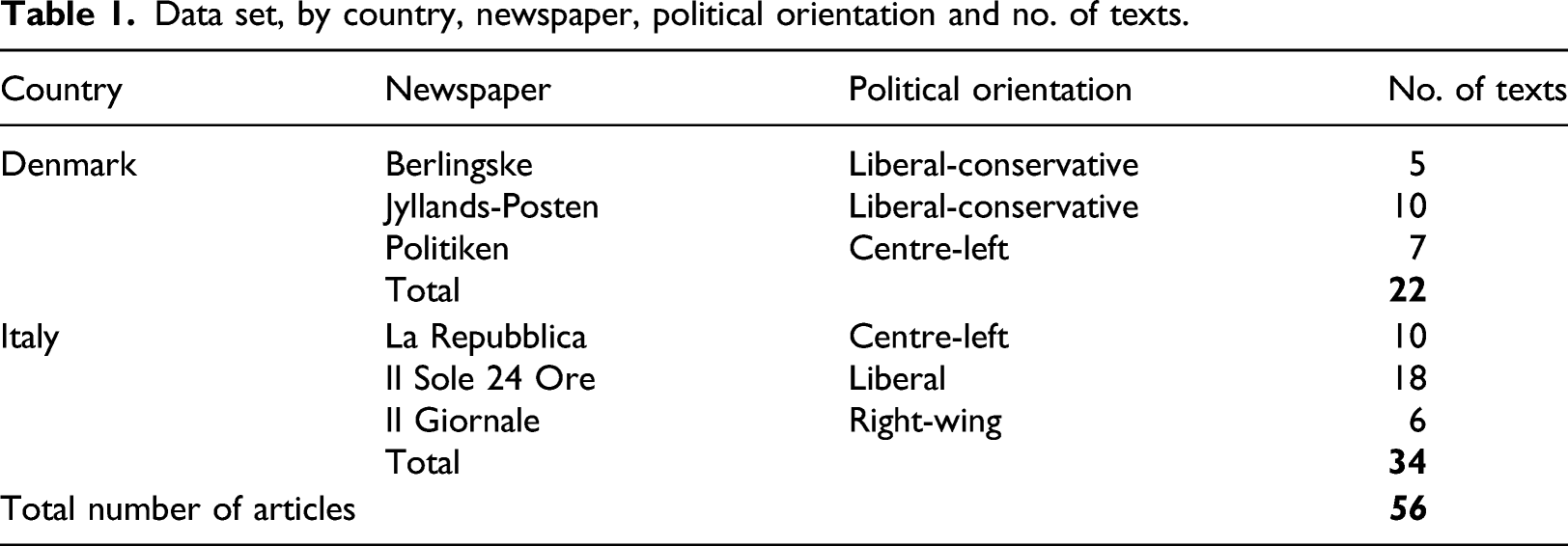
The newspapers represented in this study of PIAAC are all national omnibus newspapers that can be expected to cover some main topics in education policy and devote some resources to investigative journalism within the field. The newspapers chosen for the analysis hold key positions in the media picture and are generally regarded as ‘serious’ media that are also often used as sources by media with less investigative resources, especially the electronic media.
Each article was registered and summarized in a grid composed of two sections. The first section holds descriptive information (e.g. the newspaper’s title and orientation, type of article and date of publication), and whether PIAAC was the main topic/scope of the article. The second section contains analytical notes on graphical displays, reliability, and credibility, as well as explicit or implicit references to politicians, policy priorities, reforms and the language used and meaning conveyed. In order to ensure accuracy, parsimony and flexibility (Miles and Huberman, 1985), we further, for each country, synthesised both the descriptive and the analytical information through a matrix.
Country analysis: Denmark
Denmark: Articles, editorials and opinion pieces by newspaper and year.

When the first Danish PIAAC results were released in October 2013, all three newspapers published articles on this. Most of the news coverage drew on the press release on the PIAAC results brought out by the government, in some cases recycled through a news agency. The press release summarized that Danish adults had fairly good competencies in math and medium level competencies in IT, but below the OECD-average competencies in reading. This, along with the statement in the brief report summarizing the Danish results that ‘one out of six Danes aged 16–65 years has bad reading skills’ (Socialforskningsinstituttet, 2013, p 4), inspired most of the news coverage in 2013. Examples of headlines are: • ‘One in six Danes is a bad reader’ (Berlingske, 9 October 2013) • ‘Danish youngsters have become worse at reading’ (Jyllands-Posten, 10 October 2013) • ‘Tuesday Analysis: Adults’ reading skills getting worse’ (Politiken, 5 November 2013)
Of the three newspapers, Berlingske and Jyllands-Posten frame the problem in a similar way. Berlingske emphasizes the reading difficulties of many Danes, including older adults, unemployed and immigrants, and quotes the Director of the Danish Association of Employers, who accuses the then Social Democratic government for not having fostered an education system at top international level. On the other hand, the article also quotes the (then) Minister of Education, who says that the recent reform of the ‘folkeskole’ (primary and lower secondary school), along with a major government grant for boosting activities in adult education, will improve the situation. Jyllands-Posten restricts attention to the literacy competences among young Danes and, in line with the minister, links the question to the (then) ongoing reform of primary and lower secondary schooling.
In the early phase of the news coverage and discussion, both Berlingske and Jyllands-Posten focus on the reading difficulties of adult Danes and link the implications of this to previous and current public education policy. Both papers confirm that the limited reading skills of many adults represent a problem; they emphasize the business and competitiveness aspects of the problem and in discussing the PIAAC results, they draw on different stakeholders, experts and data.
Politiken takes a somewhat different position. The headline from this paper quoted above is from a signature article by an expert from the Danish Evaluation Institute (EVA) an independent state institution under the Danish Ministry of Education. In this article, the focus is on the adult population rather than on the young. Drawing on PIAAC as well as on other data, the article concludes that even though more people now take part in adult education, the political goals of increasing basic competences among Danish adults have not yet been met.
Still, the main picture given in the 2013 coverage (as also pointed out by Cort and Larson, 2015) is that too many Danes are bad readers, and that the political response is a reform of primary and lower secondary education. This is in line with messages that the state sent along with the PIAAC report. It should be noted, however, that the PIAAC results are reported in a relatively sophisticated way, using a variety of experts to analyse and comment and providing alternative explanations to the apparent decline in adult competences, as suggested in the quote below: It was much easier to be a good reader then, 15 years ago. Today you need not only read a newspaper, but also keep up to date in other kinds of texts, as for instance the electronic, and that means a much higher degree of complexity (Jyllands-Posten, 10 Oct 2013, own translation).
In the following 3 years, there were only occasional references to PIAAC in the newspapers, and Berlingske made no references to PIAAC at all after 2014. The second period of substantial PIAAC coverage is in 2017 and it is different from the first. By this time, PIAAC was no longer news, but a feature article in Jyllands-Posten led to debate with comments from different sides, and Politiken also published a few related articles.
The first article in Jyllands-Posten in 2017 is a feature article by a journalist (22 April 2017). The article appears in the business section of the paper and discusses the need of companies for a competent workforce. The article argues that many employees lack basic skills, especially in information technology, and that this is a problem for the flexibility and innovative ability of companies. Adult education in basic skills, therefore, is a necessary remedy. The article refers to a Danish study showing that companies with human resource units are much better at providing flexibility and innovation. A specific Danish company is presented as an example of this, and interviews with management staff and production workers are quoted. PIAAC is cited for the information that over one million Danes between 16 and 65 have weak IT skills, finding it hard for instance to write emails.
The feature article was followed up by several comments written by experts or stakeholders. The first is by the director of the Danish Evaluation Institute, who argues that ‘We need an alliance for better IT, numeracy and literacy skills’ (27 May 2017). Referring to the recent establishment by the government of a ‘Disruption Council’, tasked with investigating how Denmark can become a leading country in using new technologies, the director argues that Denmark still has a problem with 600.000 adults lacking basic competences. The next article (‘The basic IT-skills of the Danes are overrated’, 20 June 2017), written by a coordinator from a national organization of IT companies, criticises the political initiatives within this field for mainly focussing on digital literacy and not sufficiently on basic IT-competences.
Two month later the director of EVA writes again, this time together with the chairman of the national association of school heads. The article repeats that ‘600.000 weak adult readers is a burning question’ (22 August 2017) and argues for the importance of improving literacy and numeracy teaching for adults. The authors point out that the skills of parents are important for the learning of children and refer to specific national and international research documenting this. Responding to this article, the Chairman of the national association of librarians calls for ‘Support [for] the weak readers’ (25 august, 2017). She points out that this is not just a question of formal training but also of independent reading activity, and that public libraries can support the motivation for reading through ‘reading clubs’ and guidance for users.
Politiken also published a PIAAC-related article in 2017. This article (‘The public school must find the bulwark in the struggle against the robots’, 20 May 2017) is written by a journalist, but it is based on an interview with a representative from 3F, the Danish trade union for unskilled workers, and can be seen as a comment from him. He argues that in order to ‘make sure that employees at the Danish labour market will not drown in the wave of artificial intelligence and high technology robots‘, both the public school system and the system of adult and continuing education need to cope with the situation. The following spring, Politiken published an article written by the director of EVA, entitled: ‘Create objectives for digital competences’ (11 May 2018).
The picture given in this 2017 coverage of PIAAC is different from the picture in the initial coverage. The problem of reading difficulties is still mentioned, but there is more emphasis on IT skills. The issue of adult skills is contextualised mainly by referring to changes in the labour market and employment, and to implications for adult education as well as for school education. Most articles are written not by journalists but by experts or stakeholders. Government politicians or officials do not directly participate, but government-sponsored agencies are active in the debate. The difference from the original coverage may at least partly be explained by the fact that by 2017, the public school reform was well established, and more recent government initiatives such as the Disruption Council and a tripartite (employers’ organisations, employees’ organisations and the government) working group on adult education and training drew attention.
The ideological difference between the two liberal-conservative newspapers, Berlingske and Jyllands-Posten, and the centre-left Politiken is reflected in the coverage. In Berlingske and Jyllands-Posten, the question of adult competencies, especially reading and IT skills, is framed mainly by the needs of the economy, represented by individual employers as well as by national economic competitiveness. Politiken, on the other hand, emphasizes the situation of employees in a changing labour market and the need for better competences in order to avoid unemployment. It should be noted, however, that despite adopting the needs of the economy as framing for PIAAC results, Jyllands-Posten hosts an open and well-informed debate on the topic.
The Danish government has different roles in the two periods where PIAAC coverage is concentrated. In 2013, the Ministry of Education and the research institute responsible for the PIAAC study in Denmark are the sources for the news concerning PIAAC, and their choice of frame for interpreting the PIAAC results strongly influences the newspaper coverage. The OECD contributes to the framing by highlighting the issue of adult competences and providing information, but this contribution is indirect. With the OECD as background authority, the Danish government tries to set the agenda and more or less succeeds. In 2017, the situation is different. PIAAC is no longer news, and government no longer tries to frame the results. However, PIAAC results are seen as research-based knowledge and this knowledge is used by stakeholders and experts when they argue for specific views and priorities. Government priorities influence this indirectly because article authors have links to government institutes and commissions.
Country analysis: Italy
Italy: Articles, editorials and opinion pieces by newspaper and year of publication.

As noted, in 2013 all three newspapers covered the topic, particularly La Repubblica (with five out of eight articles published that year). While all newspapers recall the key results that can be found in the OECD’s press release and country fiche, stressing the scarce results obtained by the Italian population, the newspapers frame the problem slightly differently.
La Repubblica, in line with its ideal readership (a general, but cultured and pluralist audience), proposes a detailed interpretation of the data with an alarmist tone. All five articles collected depict Italy as the backmarker of the OECD-PIAAC league table and Italians as ‘new illiterates’ (La Repubblica, 29 March 2013). In general, the articles recall that 70% of the Italian population has ‘skills deemed below the “minimum required for living and working in the 21st Century”’ (La Repubblica, 13 October 2013, quotation marks in original), and point at a clear gap between Centre-North and Southern Italy. Depending on the section of the newspaper in which the articles appear (culture; education; economy), different explanations and/or preoccupations about the seriousness of the Italian situation emerge. A general lack of education, limiting the exercise of citizenship and constituting risks for democracy, was addressed even before the official release of the PIAAC data, when the preliminary results for Italy confirmed the low literacy skills indicated a few years back by the Adult Literacy and Life skills Survey (La Repubblica, 29 March 2013). Following the official release of the PIAAC data, however, higher emphasis is posed on two alternative explanations: a low quality of education in literacy and numeracy skills leading to a waste of talents, or a waste of human capital that calls for reforms of the labour market.
PIAAC and its results were commented in the media at a time when the Italian government was discussing the Stability Law 2014. Three articles by La Repubblica dealt with this issue either directly or indirectly. One (just before the official publication of the PIAAC results) is an interview with the then Minister of Labour and Social Policy, Enrico Giovannini, an economist and ex-Director of the OECD’s Statistics Directorate (2001–2009), who comments: In the coming weeks, the OECD will publish the PIAAC data, essentially the PISA for adults. This is the first time this has happened and frankly I don't expect any positive data. I’m sure that training will have to be the heart of the investment in human capital that Italy will have to do in the next few years (La Repubblica, 5 October 2013, own translation).
Another article cites both Enrico Giovannini and Maria Chiara Carozza, then then Minister of Education, referring to the alarming PIAAC results that ‘impose a U-turn’ (La Repubblica, 8 October 2013) and reports on the analysis of the PIAAC data by Tito Boeri, an Italian economist. Within a few days, a signature article by Tito Boeri, emblematically titled ‘Italians cannot read and count. Let’s fail the politicians who do not think about the future’ (La Repubblica, 13 October 2013), claims there is ‘one hope’ to address the problem, and that is reforming the labour market. He notes that PIAAC data for Italy shows that the youngest reach higher scores than the remaining population, yet youth unemployment is at 40 pct. in 2013; women have equal scores to those of men yet are less represented in the labour market; and finally, unemployed and inactive people are equally competent to those in employment. Hence, Boeri claims a ‘waste of human capital’ that calls for a reform of the labour market so to absorb competent people, who are currently excluded from this market.
Similarly, Il Giornale and Il Sole 24 Ore also emphasise how bad performers Italians are, as exemplified by the following headlines: • ‘New OECD surveys: Italians below EU average’ (Il Giornale, 8 October 2013) • ‘Employment, Isfol: Italy black shirt in literacy and numeracy’ (Il Sole 24 Ore, 8 October 2013)
Unlike La Repubblica, both newspapers underline how worrying the decrease in adult’s participation in formal and informal learning activities (which is close to the lowest levels among the countries partaking in the first round of PIAAC) is.
At the same time, Il Giornale is the only newspaper to pay attention to the ‘female capital’, as brought to light by the Institute for the Development of Vocational Training of Workers (ISFOL), a research institute reporting to the Ministry of Labour and Social Policy and in charge of the PIAAC survey and country report for Italy.
‘Women can boast a fair development in the area of grammar and literary skills: “This confirms the existence of a significant female capital that deserves to be more valued professionally”, Isfol emphasizes’ (Il Giornale, 8 October 2013).
By contrast, Il Sole 24 Ore stresses the negative structural evolution of the Italian economy following the 2007-08 global financial crisis, and argues that the PIAAC data, metaphorically captured in the title ‘Italy black shirt 1 in literacy and numeracy’ (Il Sole 24 Ore, 10 October 2013), push strongly towards further investment in knowledge. This entails structural reforms of the economy, production and education to make Italy competitive with respect to other EU countries.
As noted, Il Sole 24 Ore is the only newspaper with a persistent coverage of PIAAC (with 2015 as the only exception). It pushes a rather coherent agenda across time that links educational attainment to labour market demands, as it claims that the deterioration of education and training achievements leads to a lack of skills in the labour market and highlights an increasing mismatch between skills/education and jobs. This in turn has a negative impact on Italian productivity and economy. In 2014, it resorts to ‘early school leaving’ and ‘poor basic skills’ as key words and links them to systemic deficiencies in the Italian educational system resulting from a lack of both private investment in education, according to the report Education at a Glance: OECD Indicators for 2014, and effective school-to-work transitions as noted in a report by the European Commission on Italy’s macro-economic imbalances.
The right-wing Il Giornale uses PIAAC data in articles promoting a specific conservative ideological discourse on patriotic nationalism and to denigrate schoolteachers. In 2015, PIAAC data is mentioned in an article discussing the relationship between the use of English language by Italians and their sense of national identity, under the provoking title: ‘We use English words since we do not love nor do we know Italian’ (Il Giornale, 23 February 2015). In 2016, PIAAC data is mentioned briefly to disqualify the work of schoolteachers in an article against demonstrations by schoolteachers with precarious contracts who were offered a fix-term contract in a region different from the one they lived in as a consequence of the so-called ‘Good School’ reform of 2015 (Il Giornale, 8 August 2016).
In 2016, and again in 2017, Il Sole 24 Ore covers the publication by the OECD of new ‘policy-oriented notes’ in the Adult Skills in Focus series (OECD, 2016a; 2016b, 2017), but also a research on Skill mismatch and labour shortages in the Italian labour market, all drawing on PIAAC data. Across the articles, ample space is given to claims by Francesca Borgonovi, an economist and Senior Analyst at the OECD, responsible for analytical work in the PIAAC team. Altogether, the articles argue for the need for technological changes in the labour market and more continuing professional education for workers, as it is after school completion that ‘a gap opens up in skills development opportunities between social classes’ (Il Sole 24 Ore, 30 March 2017).
By contrast, over the same period (2016–2017) La Repubblica cites the PIAAC data in a few articles addressing the role of the school in preparing youth for adulthood as well as for the labour market and praising the school-work experience model introduced in upper secondary schools by the 2015 school reform. In 2017, two articles by La Repubblica also dedicate attention to an OECD note in the ‘Adult Skills in Focus’ series, addressing how the socio-economic disparities in skills grow between the teenage years and young adulthood (OECD, 2017). These articles highlight the positive effect of the Italian school system that flattens socio-economic differences; but they point out that such differences re-emerge in the world of work, professional training and universities, as noted by Francesca Borgonovi (La Repubblica, 29 March 2017). Interestingly, an article by Il Giornale (29 March 2017) recalls this information, explicitly citing La Repubblica.
Over 2018–2019, Il Sole 24 Ore keeps its attention on PIAAC data but also on the self-assessment tool, PIAAC Online, a joint initiative of the OECD and the European Union to which Italy was among the first countries to adhere. The piloting of PIAAC online in Italy is financed by the European Structural Funds, under the National Operational Programme on Research and Innovation for the period 2014–2020.
In 2018, an article in Il Sole 24 Ore appears twice at a few months distance under a slightly revised title: ‘Are you too a functional illiterate?’ (March 21) and ‘Find out if you too are a functional illiterate’ (August 13). It draws attention on the relapse into illiteracy among the Italian population, and recalls how an article by ISFOL’s researchers that back in 2016, based on PIAAC data, had offered an ‘identikit’ of the Italian functional illiterate (Di Francesco et al., 2016). In the following year, the newspaper reports on the decision by the then Ministry of Education, in collaboration with the National Agency for Active Labour Market Policy (ANPAL) and the network of Adult Education Centres, to pilot PIAAC online among 500 adult students (20 March 2019).
In short, although the alarmist tone about Italy being the backbencher of the OECD-PIAAC league table and Italians being ‘new illiterates’ is found across newspapers and remains a concern over time, some ideological differences are reflected in the coverage by the centre-left (La Repubblica) and economic (Il Sole 24 Ore) newspapers. In La Repubblica, higher attention is given to the role of the school system in guaranteeing basic literacy and numeracy skills, hence to the quality of education and its links to the world of work. Original concerns with the reform of the labour market back in 2013 have thus slowly moved into higher concerns with the school reform and the links between schooling and the world of work, for instance through the school-work experience model. In Il Sole 24 Ore stronger concerns with the links between education, production and the economy have been present from the early stage but are continuously addressed, attention shifting over time towards skills mismatches, the need for technological reforms of the labour market, continuing professional training for workers, and the extended use of adult skills assessments.
More than the Italian government, it is ministerial agencies (e.g., ANPAL) and research institutes (e.g., ISFOL), either belonging to or reporting to the Ministry of Labour and Social Policy, which have proved to be sources for information and discussion based on PIAAC data, hence their way of framing data interpretation has influenced the newspaper coverage. However, the OECD has contributed extensively to such framing, especially by the business newspaper (Il Sole 24 Ore), as a background authority in different ways. This contribution has come through its analytical reports based on PIAAC data (e.g. the Adult Skills in Focus Series) as well as through the strong links that exists between Italian experts, researchers and officials holding responsibilities at the OECD or in PIAAC. Besides those that surfaced in the examined articles, it may be worth noting that one manager of ISFOL is a high-level international expert who has been appointed by the Italian government as member of the OECD Skills Strategy Advisory Group since 2010, and since 2016 as co-director of the PIAAC Board of participating countries by the OECD. Hence, there is a strong circulation of knowledge about PIAAC and an exploitation of its data and results by researchers that attract the attention of journalists.
Comparative discussion
There is considerable overlap between the Danish and the Italian press in the aspects of the PIAAC study and its results that are reported and discussed. This is especially true in the initial coverage following (and in Italy leading up to) the publication of the first results in 2013. In both countries, newspapers focus on the insufficient literacy skills of adults, the insufficiency of the public education system and the need for reforms, as well as the impact of this on labour markets and the situation of citizens more generally. Newspapers present the PIAAC results as cause for alarm, especially in Italy, exemplified by the Il Sole 24 Ore headline referring to Italy as the black shirt (namely the loser) of Europe. In Denmark the tone is less alarmist, but the news that one out of six Danes has bad reading skills is emphasized as worrying by all newspapers. The difference in the degree of alarm corresponds to the fact that PIAAC results in Denmark are clearly better than in Italy.
However, there are also significant differences in the media coverage. In Denmark, most of the initial coverage relates PIAAC to the situation in the school system, with critics deploring the lack of international quality and government officials arguing that challenges are being met by the ongoing school reform. In Italy, the press also criticizes the quality of education, but raises other issues as well, including a need for labour market reform and a gap in literacy skills between the centre-north and the south of the country.
In the years following initial publication of PIAAC results, the press coverage becomes more diverse in both countries. PIAAC results are no longer important news, instead they become facts referred to in coverage of, or debates on, related issues. In the Italian context, however, the news value of PIAAC is renewed when one newspaper draws on new OECD policy notes on adult skills. This newspaper, Il Sole 24 Ore, comes to represent the main PIAAC coverage in Italy, pursuing an agenda emphasizing deficiencies in the education system as cause of mismatch between skills and jobs with negative consequences for the economy. In Denmark Jyllands-Posten, aiming at much the same audience as Il Sole 24 Ore, becomes the main newspaper covering PIAAC, especially in the year 2017. This coverage mainly consists of comments written by experts and stakeholders and does not express a definite agenda; but the common focus is on the need for better IT skills instead of the original focus on reading and writing.
In both national contexts much of the PIAAC press coverage links the need for adult skills mainly to the labour market and national economic competitiveness, although broader aspects of citizenship are sometimes mentioned. Importantly, however, labour market issues tend to be presented differently in the two national contexts. In the Italian newspapers, PIAAC results are often linked to demands and arguments for labour market reform, including better links between secondary schools and the world of work, while in the Danish newspapers, the demands and arguments concern improvement of education in order to produce the right skills for business and for individual workers. A possible explanation for this is the institutionalised collaboration between the social partners, which is a general element in the Nordic welfare state model and a strong tradition in the Danish labour market. This tends to keep questions of labour market reform in tripartite fora of employer and employee organisations together with the state, sheltered from broader political debate (Milana and Rasmussen, 2018).
In both countries, there are differences in the PIAAC coverage reflecting political-ideological positions of newspapers and their main audiences. In Italy, the most consistent coverage of, or reference to, PIAAC data is by Il Sole 24 Ore, which has a liberal platform and many readers among business communities. As noted above, this newspaper pursues a relatively coherent agenda with a main focus on the national economic performance, and on structural problems in the education system and the labour market undermining this performance. Characteristically, the newspaper also calls for more private investment in education. In the initial PIAAC coverage, the centre-left newspaper La Republica also voices concerns about the literacy skills of adult Italians and calls for reforms of the education and labour market systems. However, in later coverage La Republica seems to frame the problem broader than Il Sole 24 Ore; it cites PIAAC data in articles on socio-economic disparities in skills during the transition from youth to adulthood and it praises the school system for somewhat reducing these differences.
In Denmark, most PIAAC coverage is provided by two liberal-conservative newspapers, Berlingske and Jyllands-Posten. In the coverage following the initial publication of PIAAC results, both focus on the reading difficulties of many adult Danes, framing them as the outcome of a school policy with too little focus on skills and quality and as a potential threat to national economic competitiveness. Later PIAAC coverage, mainly in Jyllands-Posten, consists mostly of debate with comments from experts and stakeholders, but the needs of business and the national competitiveness continue to be the interpretive framework for the debate. The centre-left newspaper Politiken pursues an agenda with a different emphasis. Its initial PIAAC coverage does not differ substantially from that of the two liberal-conservative papers; but in the later phase a different orientation becomes evident. Where Jyllands-Posten tends to focus on the needs of employers for skilled employees in order to be competitive, Politiken rather focuses on the situation of employees and their need for better skills in order to secure employment.
There are clear differences between Denmark and Italy in the influence of national governments and the OECD on newspaper coverage of PIAAC. In Denmark, the initial coverage in all newspapers is strongly influenced by the way that the state – represented by the Ministry of Education – has structured the information released on the PIAAC results. The statement from the press material that ‘one out of six adult Danes has bad reading skills’ is echoed in the newspaper headlines and is the result that politicians and stakeholders are asked by journalists to respond to. In the later coverage, the government does not set a clear agenda for the debate between experts and stakeholders; but comments from experts in public commissions or agencies – especially the EVA institute – feature strongly in the debate. In the Danish newspapers, the OECD does not stand out strongly in relation to PIAAC coverage. The role of the OECD in managing the PIAAC surveys is acknowledged, and this is taken as a sign of the validity and relevance of the knowledge presented; but policy implications are seen as the business of the nation-state.
In Italy, the national government has a much weaker role in both the initial and later press coverage of PIAAC. Like in Denmark, ministerial agencies as well as research institutes such as ISFOL are frequently used as sources by the newspapers and thus contribute to framing the coverage. But in contrast to Denmark, the Italian newspapers draw directly on OECD press material and on statements from experts or stakeholders with links to the OECD, starting already before the official publication of the PIAAC results. Through the later period considered, the Italian newspapers continue to draw on OECD sources, such as the ‘Education at a glance’ report and policy notes on adult skills, and such sources are brought to the attention of the general public as soon as they are made available by the OECD.
There may be several reasons for the fact that the OECD is much more visible in Italian than in Danish PIAAC coverage. Italy is a much larger country than Denmark, but because it is in a more precarious economic situation, it is more dependent on support from international organisations and probably more aware of its perception by these organisations. This may also be connected to the fact that network links between national officials and experts and different sections of the OECD seem stronger and more visible in Italy than in Denmark.
Conclusion
How do national newspapers contribute to shaping the policy agenda when a major international organisation conducts comparative research on an issue in its member states and feeds the results back to the member states and their public spheres? That is what we have investigated in this study. The conclusion is not simple, but our comparative study of PIAAC and the media in Denmark and Italy adds new insights to existing research. Several earlier studies have also taken a comparative approach to this topic (e.g. Hamilton, 2018; Yasukawa et al., 2017). These studies have brought to light the extent to which the media echoed the OECD’s key messages in different countries and how survey findings are often framed and interpreted through existing public debates in the different national contexts. Deeper analysis in single countries (e.g. Cort and Larson, 2015) has questioned whether such media framing is capable of bringing about actual policy changes.
Earlier research on a growing political concern on adult literacy (for instance in Canada from the 1980s to the 2010s) had pointed at the active role of national newspapers in focusing public attention on the question of adult literacy and ‘gluing’ public concerns and governmental policies to certain understanding of this issue (e.g. Walker and Rubenson, 2014). By contrast, our study does not seem to point at a similar influential role in neither of the two countries we consider.
Our study confirms to some extent that the national media – more specifically major national newspapers – communicate and comment on the OECD’s findings and recommendations regarding adult literacy, based on analyses of national data and cross-national comparisons. However, we found no evidence that the newspapers necessarily echoed OECD’s key policy messages to Denmark or Italy. Rather we found that in both countries the newspapers refer to studies carried out under the aegis of the OECD, like PIAAC, as an authoritative, valid source of knowledge. This is the case in both countries, but especially in Italy, where reports and policy notes by the OECD are taken an unquestionable valid source. Coverage of PIAAC in the newspapers recognise and confirm the kind of authority OECD has gained as an analytical hub, an international organization with a stronger analytical capacity than other international organizations.
This said, our study also confirms that cross-national survey data such as the PIAAC results, together with their analytical interpretations by the OECD and/or national research institutes, constitute part of the frame for education policy debates at national level. In some cases, national governments clearly co-construct this frame, in other cases they remain in the background. The policy debates reflect the different ideological platforms and audiences of different media, showing in both countries differences between liberal or liberal-conservative newspapers emphasizing business perspectives and centre-left newspapers adopting broader perspectives. The press thus contributes to constructing knowledge and setting agendas for education by presenting information structured from criteria of news value as well as from ideological stances.
Our study also sheds new light on the complex crafting of PIAAC data into the plotting of public debates by different interest groups (e.g., social science researchers, economists and politicians) that materialise through the pages of a single newspaper across time. These groups adjust their interventions to shifts in political and public debates around public reforms, being it reform of the school system, the labour market or both and to the broader macro-economic or social concerns framing these reform debates.
In setting agendas for policies on adult skills, the media play an important, but not necessarily dominant role. The authority and influence of international organisations, the objectives and strategies of national governments and their agencies as well as the interests of different stakeholders all interact with and through the media, leading to different agendas in different contexts.
For education policy studies as well as for media studies, it is important to recognize the complexity of this field of investigation. Complexity does not mean that relations of power and influence between policymakers, media and publics cannot be traced, but it demands balanced approaches and careful work. The thematization or non-thematization of education policy issues by governments, the presence and interests of other actors, the character, biases and audiences of media must be considered together with the wider economic and political background, both in the individual country and in a broader transnational context. Untangling untidy mixes of knowledge production, transnational and national policy agendas and ideological as well as commercial media interests may be a contribution to clarity and reason in democratic formation of education policy.
Footnotes
Declaration of conflicting interests
The author(s) declared no potential conflicts of interest with respect to the research, authorship, and/or publication of this article.
Funding
The author(s) received no financial support for the research, authorship, and/or publication of this article.