



Abstract
This study explores how local-level infrastructures can better support lifelong development for vulnerable adults by analysing 29 Dutch organisations across three regions. Using a card-sorting method grounded in capability and social skills ecosystem frameworks, the research identifies key systemic weaknesses, particularly in governance, funding, political will, partnerships and monitoring. At the organisational level, outreach and guidance are also perceived as insufficient. Yet differences between work integration, education and welfare organisations reveal opportunities for mutual learning: work-oriented actors excel in flexibility and funding stability; education providers in tailored learning; and welfare groups in trust-building and outreach. Interviewees propose seven key actions to strengthen infrastructures: (1) formalising inclusive governance, (2) aligning lifelong learning with wider political priorities, (3) transitioning to sustainable, regionally pooled funding, (4) embedding learner-centred monitoring systems, (5) building trust-based partnerships, (6) enhancing guidance through dedicated coaches and (7) co-designing proactive outreach. The research also tests an evaluative framework for assessing learning systems, thereby yielding actionable insights. Ultimately, the study underscores that empowering vulnerable adults through learning requires more than educational provision alone; it demands cohesive, place-based ecosystems that integrate social, economic and pedagogical support. Coordinated local action is key to getting it right, together.
Keywords
Introduction
Policy documents at both European and national levels increasingly emphasise the need for adults to engage in lifelong learning, or more accurately, lifelong development (Council of the European Union, 2021; European Commission, 2017; Ministerie van Sociale Zaken en Werkgelegenheid & Ministerie van Onderwijs, Cultuur en Wetenschap, 2018). Lifelong development refers to learning and developmental activities through which adults proactively build knowledge, skills and attitudes that enable them to contribute sustainably to society, work and their own health and wellbeing (Kuijpers et al., 2025). In a context of rapid labour-market change, demographic ageing and growing social inequalities, lifelong development is considered crucial not only for individuals, but also for economic resilience and social cohesion (European Commission, 2018; Schuller & Desjardins, 2010). In line with this importance, lifelong development is increasingly framed as a social right rather than solely an individual responsibility (European Commission, 2021).
Although these ambitions are largely articulated at national and European levels, their realisation depends on how they are translated into practice at local and regional levels. The local level is particularly critical because it is where macro-level policies, funding frameworks and institutional arrangements are translated into concrete interventions that respond to the lived realities of adult learners within specific socio-spatial contexts (Broek et al., 2024). The promotion of adult learning requires strong local learning environments and infrastructures that lower barriers to participation and actively encourage adults to continue developing throughout their lives (Lifelong Learning Partnership (Flanders), 2021; Ministerie van Sociale Zaken en Werkgelegenheid & Ministerie van Onderwijs, Cultuur en Wetenschap, 2018).
This local embedding is particularly decisive for adults in vulnerable positions. Their willingness and ability to engage in lifelong development is shaped less by abstract policy objectives and more by the accessibility, coherence and responsiveness of local learning infrastructures. At the local and regional level, multiple conditions converge that can either enable or constrain participation in learning, such as outreach and guidance, trust-based networks, alignment between social, employment and education services and the availability of learning opportunities that connect to everyday life and work. As a result, local learning infrastructures play a central role in motivating, or discouraging, adults in vulnerable positions to take part in learning throughout their lives (Broek et al., 2024).
Vulnerability can be understood as arising from personal, social and structural conditions that reduce individuals’ real freedoms to engage in learning (Egdell & Graham, 2017; Robeyns, 2017). In the context of learning, vulnerability is shaped by a combination of unfavourable past experiences, constrained present circumstances and limited future imaginaries. For individuals in such positions, engaging in learning often involves risks, financial, emotional or social, that are significantly larger compared to those faced by individuals in more favourable situations. Learning, in this study, refers to all forms of adult learning, irrespective of form (formal, non-formal or informal) or purpose (work-related, civic or personal). Conceptually, learning is conceptualised as development, implying that learning results in some form of application or change, however incremental (Kuijpers & Draaisma, 2020; Kuijpers et al., 2019).
Defining Local-Level Learning Infrastructures
Whether adults engage in learning depends on a multitude of interrelated factors (Broek et al., 2023). These include individual agency towards learning as well as contextual factors (social, organisational, financial and institutional), that shape whether learning intentions can be translated into action. Consequently, learning infrastructures must address not only learning provision itself, but also the broader contexts in which adults live, work and learn, in order to make learning meaningful and accessible, particularly for those in vulnerable positions (Chang & Cha, 2008).
Learning infrastructures therefore extend beyond education providers alone. They encompass a wider set of material, social, discursive and technological mechanisms that enable flows of knowledge, information and opportunities, as well as the agency of social actors to engage with learning (Facer & Buchczyk, 2019b). Within this broad infrastructure, different organisations support adult learning with varying primary intentions (Desjardins, 2017; Field, 2006). These intentions can be broadly clustered into three perspectives: (1) a labour market perspective, viewing learning as a means of (re-)integration into employment; (2) an educational perspective, focusing on obtaining formal qualifications; and (3) a societal perspective, emphasising social inclusion, self-efficacy and wellbeing. Together, organisations operating from these perspectives form the local learning infrastructure that enables lifelong development across work, education and society.
The Dutch infrastructure for adult learning is multi-level, decentralised and hybrid. It combines a strong role for employers and individuals, supported by sectoral training funds and a private training market, with a public responsibility for stimulating learning through targeted subsidies and basic skills provision. At the national level, the central government sets strategic priorities and legal frameworks, while implementation is largely delegated to municipalities, labour market regions and sectoral actors. Municipalities coordinate adult education and skills development within 35 labour market regions, aligning education, labour market policy, social support and reintegration measures (Ockham-IPS et al., 2025). This involves collaboration between vocational education and training providers, private training providers, libraries, welfare organisations, volunteer initiatives, public employment services and employers.
For adults in vulnerable positions, lifelong development often spans basic skills training, vocational education, employability programmes and guided transitions into work, frequently combining formal and non-formal learning. Historically rooted in shared responsibility between state, market and civil society, the Dutch system reflects ongoing shifts between decentralisation, marketisation and public coordination. These dynamics result in substantial regional variation in the coherence, accessibility and continuity of learning opportunities (Hake, 2025), making the local level particularly relevant for understanding how learning infrastructures function in practice.
Conditions for Successful Local-Level Learning Infrastructures
Research on conditions that motivate adults to engage in learning at the local level is dispersed across several strands of literature. While each strand offers valuable insights, they tend to focus on specific domains and do not fully capture how local learning infrastructures function as integrated systems, particularly for adults in vulnerable positions. This study therefore draws on three complementary strands of literature to develop a conditions-based framework for analysing local-level learning infrastructures.
First, the literature on learning cities highlights system-level conditions such as political will, long-term vision, inclusive governance, stakeholder engagement and coordinated infrastructures that support lifelong learning for all, including vulnerable groups (Facer & Buchczyk, 2019b; Yang, 2012). Education providers are often conceptualised as anchoring institutions that collaborate with a broad range of local actors to activate and support learners (Facer & Buchczyk, 2019a; Hambleton, 2015).
Second, research on adult learning environments within educational institutions identifies conditions that directly affect adults’ motivation and engagement, including learner-centred approaches, relevance to lived experience, flexibility, supportive pedagogies, recognition of prior learning and institutional commitment to inclusion (see for instance: Merriam & Bierema, 2014; Schuetze & Slowey, 2002). While this strand provides detailed insights into learning settings, it tends to prioritise educational institutions over the broader local infrastructure.
Both strands pay limited attention to the role of welfare and labour market organisations, despite their central importance in reaching adults in vulnerable positions. These organisations not only refer adults to education, but also function as learning environments in their own right, supporting confidence-building, life skills and occupational competences (European Commission, 2024).
A third strand, the literature on social skills ecosystems, explicitly conceptualises skills development as a place-based, multi-actor system (Spours, 2019, 2024). Building on earlier work on skills ecosystems (Finegold, 1999), this approach emphasises horizontal collaboration between organisations with different primary intentions, vertical alignment between national frameworks and local autonomy, leadership across levels and time for systems to evolve and stabilise (Ramsarup & Russon, 2023; Spours, 2024).
Drawing these strands together, this study builds on Broek et al. (2024), which synthesised the literature into a comprehensive framework of favourable conditions for local and regional learning infrastructures without privileging educational organisations over other actors. The framework distinguishes between two analytical levels: a system (regional) level, concerning conditions that require cooperation across networks of organisations, and an organisational (intervention) level, concerning conditions within individual organisations and learning settings. These levels correspond to the vertical and horizontal dynamics highlighted in the social skills ecosystem literature.
Analytical framework: conditions for regional-level infrastructures to support adult learning (based on Broek et al. (2024))
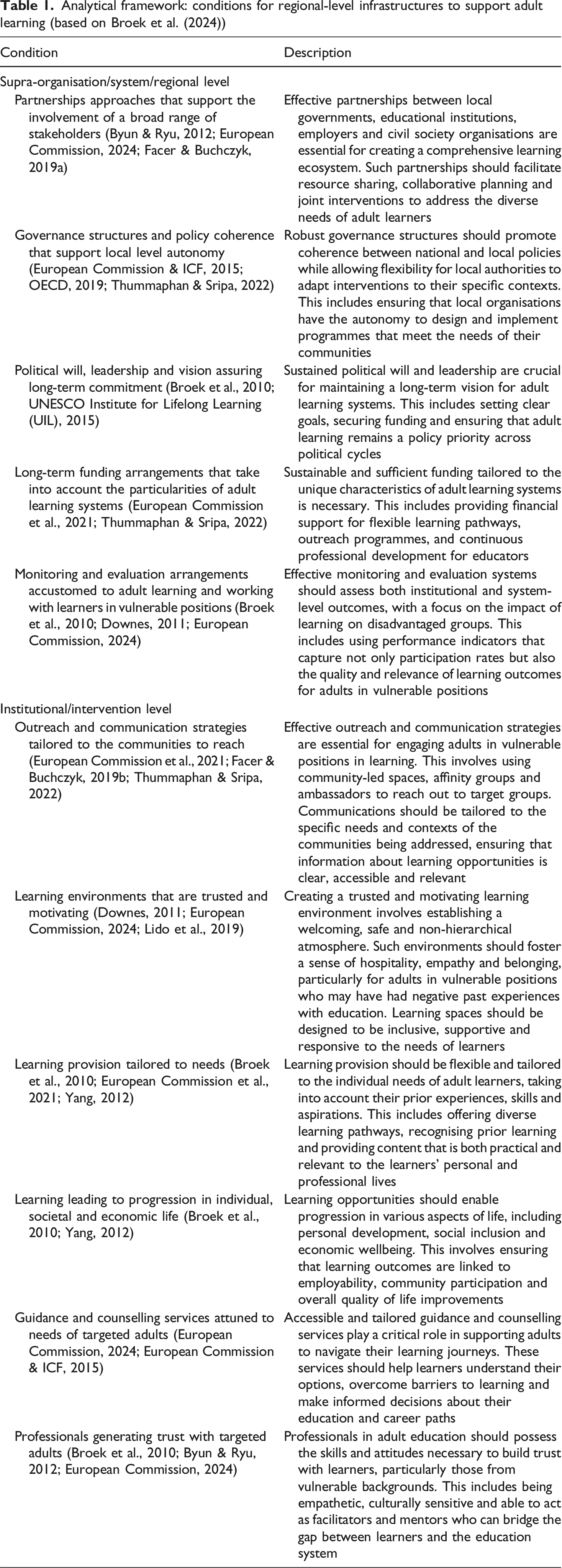
Building on this framework, the study addresses the following research questions: 1. Which conditions in local-level learning infrastructures are perceived as insufficient or lacking by organisations with varying intentions? 2. What can organisations learn from one another in securing more conducive conditions? 3. What actions could strengthen local learning infrastructures to better support adults in vulnerable positions? By addressing these questions, the paper also explores the extent to which the theoretical framework (Broek et al., 2024), combined with the empirical approach (Broek et al., 2025), can function as an evaluative framework for analysing and improving local-level learning infrastructures.
Method
This study draws on 29 semi-structured interviews with representatives of organisations supporting adults in vulnerable positions in learning across the Netherlands. Interviewees were selected for their involvement in adult learning for vulnerable groups and their broad overview of both internal organisational practices and the wider regional learning infrastructure. Organisations were identified through a snowballing approach in three regions: Rotterdam-Zuid (12 interviews), Achterhoek (8) and Groningen (7), supplemented by two stand-alone organisations outside these regions.
The regions were selected to reflect diverse local contexts. Rotterdam-Zuid represents a densely populated metropolitan area characterised by socio-economic challenges alongside substantial public investment. Groningen reflects a mixed urban–rural context, combining city-based infrastructure with dispersed rural challenges. Achterhoek, a predominantly rural region with many SMEs in technical and logistics sectors, offers a contrasting socio-economic and labour-market profile. Together, these regions capture variation in population density, economic structure and governance arrangements relevant to local learning infrastructures.
Within each region, organisations were selected to reflect variation in institutional form, size and primary intention in supporting adult learning. Three broad organisational types were included. First, 14 organisations focused on labour market (re-)integration, supporting adults with limited qualifications, literacy or digital skills to access or progress in work. These organisations typically provide personalised pathways that combine skills training, guidance, work-based learning, mentorship and collaboration with employers. Second, eight organisations were primarily education-oriented, largely formal education providers offering vocational education and training (VET), Dutch language provision and non-formal training for migrants. Their programmes follow structured curricula aligned with recognised standards and aim to support progression in work or further education. Third, seven welfare-oriented organisations, including libraries, focused on societal integration, wellbeing and personal development through accessible learning opportunities. These organisations serve adults facing unemployment, social isolation or language barriers and typically offer low-threshold provision in literacy, digital skills and wellbeing, often in collaboration with community partners.
In-person interviews were conducted between October 2022 and January 2024 at the organisations’ premises. Interviews lasted between 30 and 90 minutes. Each session started with an information leaflet and the signing of an informed consent form. Ethical approval for the study was granted by the Open University of the Netherlands.
Data collection employed a card-sorting interview method (Broek et al., 2025), chosen for its capacity to elicit reflective, comparative and context-sensitive judgements. Card-sorting invites participants to organise physical or virtual cards to represent their thinking about a predefined set of concepts (Gravlee et al., 2018; Jindal, 2020). In this study, the cards represented conditions for a conducive local learning environment as developed in the analytical framework presented in the introduction (Broek et al., 2024).
The card-sorting board (Figure 1) consisted of two horizontal fields indicating whether a condition was perceived as sufficiently in place or insufficiently in place in the local context, combined with a vertical axis indicating perceived importance (low to high). To allow participants to express ambivalence or mixed assessments, each condition was represented by two identical cards. Participants could therefore place the same condition in both fields if they considered it partially present but insufficiently developed. Set up card-sorting method: cards and playing board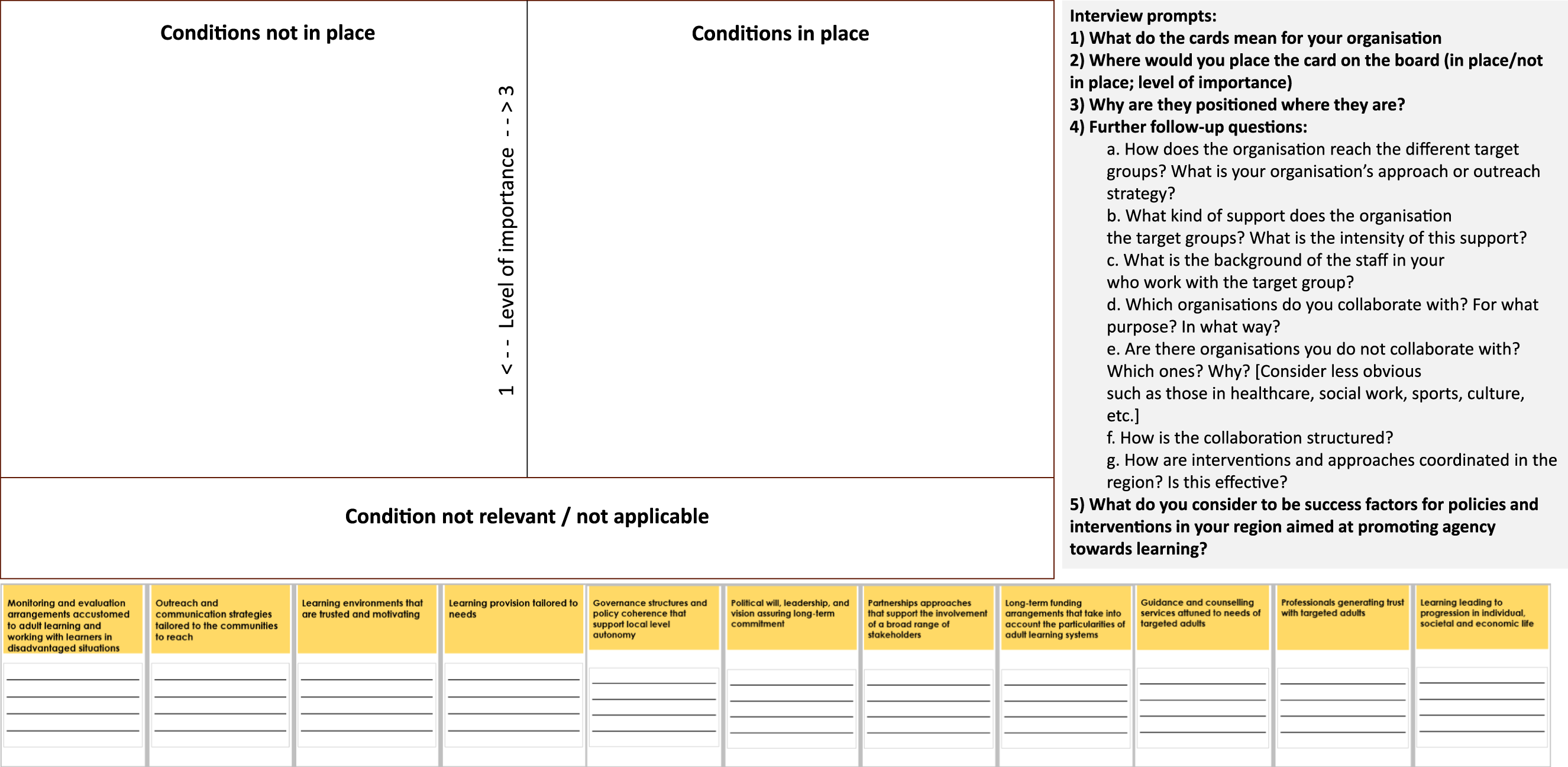
The interview followed a structured yet iterative sequence. Participants were first invited to place cards freely on the board while thinking aloud about their local context. They were explicitly encouraged to rearrange cards during the interview and to revisit earlier placements as their reflections evolved. This supported consideration of interdependencies between conditions and avoided premature closure of judgements. After completing the layout, participants were asked to explain their final configuration, including the relative importance of conditions and any clustering of cards (Barton, 2015). Interviews concluded with a reflective discussion on which conditions required strengthening and what types of organisational or policy action would be needed.
Given the interactive nature of card-sorting, several measures were taken to minimise interviewer influence while maintaining consistency. Interviewers followed a standardised protocol that limited their role to explaining the task and axes, clarifying card descriptions when requested, and prompting reflection through neutral, open-ended questions (e.g. ‘Can you explain why you placed this card here?’). Interviewers did not suggest placements or interpretations. To enhance consistency, interviewers jointly conducted and reflected on initial interviews and held regular peer consultations throughout data collection. Importantly, all card placements were made by participants themselves, reinforcing participant ownership of the data (Broek et al., 2025).
When participants placed the same condition in both horizontal fields, this was interpreted as indicating partial presence: the condition existed in the local infrastructure but not at a level considered sufficient or effective. Rather than treating this as ambiguity, dual placement was analytically meaningful, often signalling tensions between policy intent and practical implementation or between formal availability and actual accessibility. These cases were examined closely through participants’ verbal explanations.
For quantitative analysis, the vertical position of each card was translated into a four-point ordinal scale: 0 (not placed/not important), 1 (low importance), 2 (moderate importance) and 3 (high importance). When a condition was placed twice, both scores were included in the analysis, while qualitative data captured the reasoning behind the dual placement. Ordinal scores were analysed at the level of individual organisations. Differences between organisational types were tested using non-parametric statistics suitable for ordinal data and small, unequal group sizes. Kruskal–Wallis tests were used to assess overall differences, followed by pairwise Mann–Whitney U tests with Bonferroni correction where appropriate. Analyses were conducted using PSPP (a statistical analysis tool developed as a free, open-source alternative to SPSS). Given the exploratory nature of the study and limited sample size, quantitative results are interpreted cautiously and in conjunction with qualitative findings.
All interviews were audio-recorded, and photographs were taken of final card configurations. Transcripts and visual data were analysed using Atlas.ti. The analytic strategy combined thematic analysis (Braun & Clarke, 2006) and grounded theory approaches (Glaser & Strauss, 2017) to develop thick, context-sensitive descriptions of how conditions for conducive learning infrastructures are experienced locally (Geertz, 1973; Luhrmann, 2015). Quantitative patterns were systematically triangulated with interview narratives to strengthen interpretive validity.
Results
This section first reports perceived weaknesses in local learning infrastructures, based on the card-sorting outcomes (quantitative ordinal scores) and qualitative elaboration from interview transcripts, including comparisons across the three organisational types. Second, it summarises suggested actions and improvements identified by interviewees. Importantly, the findings reflect organisations’ perceptions and experiences of local learning infrastructures. These perceptions are analytically valuable because they shape coordination, decision-making and service delivery, but they should not be interpreted as direct evidence of objective infrastructural performance or failure. Where possible, perceived weaknesses are therefore presented together with the reasoning interviewees provided, and implications are treated as an interpretive synthesis further developed in the discussion.
Overview of Perceived Weaknesses in the Local-Level Learning Infrastructure
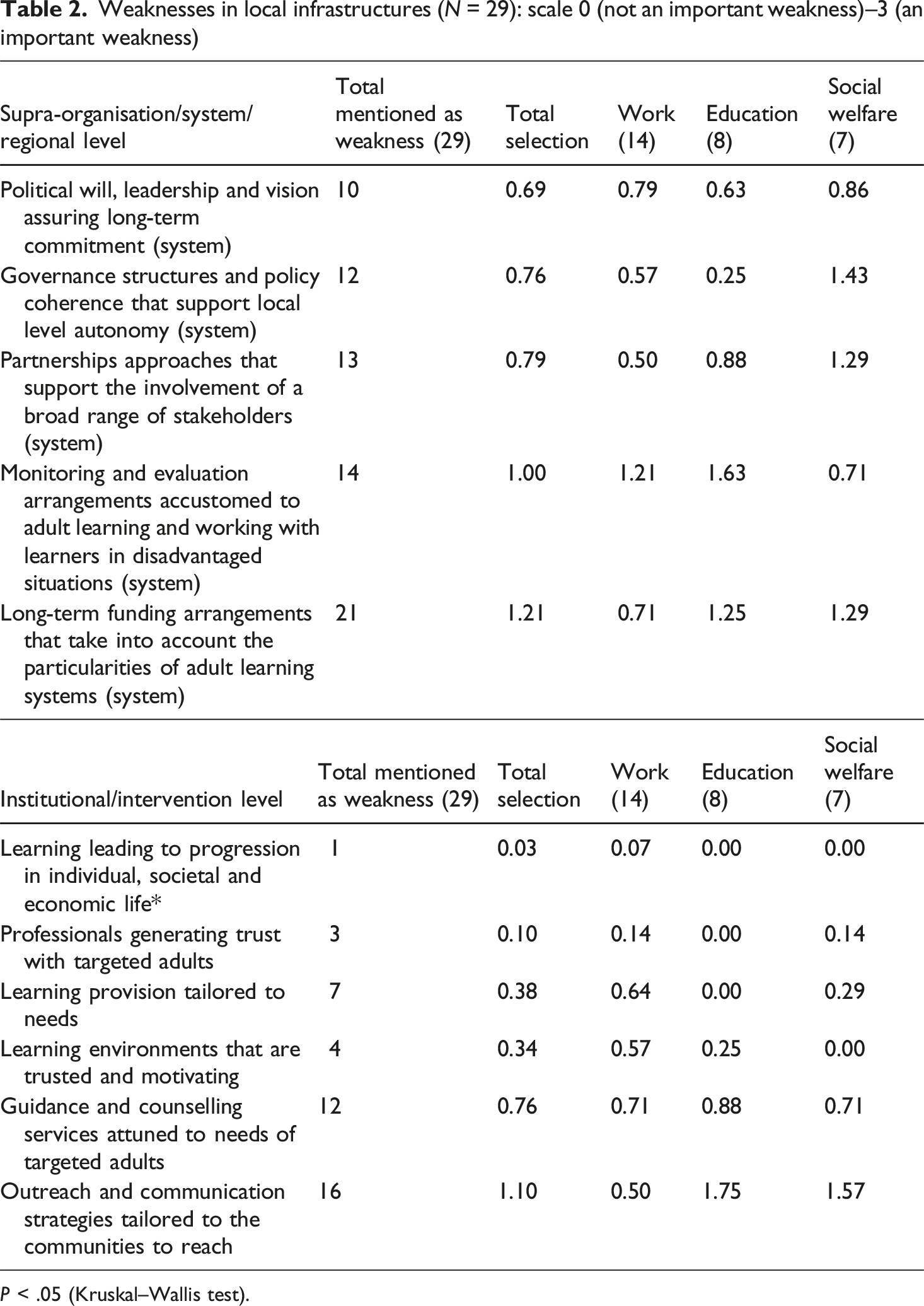
Weaknesses in local infrastructures (N = 29): scale 0 (not an important weakness)–3 (an important weakness)
P < .05 (Kruskal–Wallis test).
At the supra-organisational level, all conditions were perceived as challenging: at least one-third of interviewees mentioned each as insufficiently in place. Political will was often described as volatile; policy coherence and governance were questioned; partnership approaches were not consistently developed across segments of the infrastructure. The most prominent perceived weaknesses concerned funding, monitoring/evaluation and partnership approaches.
At the institutional level, interviewees were generally more positive about conditions within their own organisational sphere. Weaknesses related to professionals generating trust, progression, tailored provision and trusted learning environments were rarely prioritised, gaps in guidance/counselling and outreach/communication on the other hand were more frequently identified as weakness within their organisations.
Differences Between Organisations by Dominant Intention
Organisations differed in how they conceptualised their role in supporting adults in vulnerable positions. Work-integration organisations emphasised flexible, practical interventions aimed at employability and broader life chances, often through workplace-based pathways. Further-learning organisations emphasised structured progression routes leading to recognised credentials and frequently highlighted sustained guidance to retain adult learners. Welfare organisations foregrounded low-threshold access, community embeddedness and safe learning spaces that help adults take initial steps toward development and participation.
These distinct roles were mirrored in the perceived importance of insufficiently-in-place conditions (Table 2), although many differences were descriptive rather than statistically significant.
Supra-Organisational Conditions
Across organisational types, monitoring and evaluation were generally considered weak, especially by work and education organisations (work 1.21, education 1.63) compared to welfare organisations (0.71). Education providers in particular pointed to the difficulty of assessing programme impact and tracking learners across organisational boundaries, whereas welfare organisations more often described longer-term engagement that extends beyond single programmes. Despite these differences, no statistically significant differences were found for supra-organisational conditions, suggesting broadly shared concerns.
Work-oriented organisations were comparatively less negative about long-term funding (0.71) than education (1.25) and welfare (1.29) organisations, reflecting relatively more stable funding streams for employment activation in parts of the work-integration domain. Welfare organisations attributed higher importance to weaknesses in governance (1.43 vs. work: 0.57, education: 0.25), partnerships (1.29 vs. 0.50 and 0.88) and political will (0.86 vs. 0.79 and 0.63), often linking this to their smaller scale and more peripheral position in formal governance arrangements, which heightens their reliance on coordination and partnership quality.
Institutional/Intervention Conditions
At the institutional level, organisations were generally more positive, but differences remained. One condition, learning leading to progression in individual, societal and economic life, showed a statistically significant difference between organisational types (χ2(2) = 7.88, p = .019). Education-oriented organisations considered this condition a significantly more important weakness than work-oriented organisations, while no significant difference emerged between education- and welfare-oriented organisations. Qualitative accounts suggest that education and welfare organisations often evaluated outcomes in terms of longer-term learner trajectories beyond immediate programme outputs, whereas work organisations more frequently prioritised initial labour market entry.
Other institutional differences were descriptive. Work-oriented organisations were relatively more positive about outreach and communication (0.50) than education (1.75) and welfare (1.57), often because they relied on municipal referrals rather than proactive outreach. Welfare organisations rated learning environments as trusted and motivating (0.00) compared with work (0.57) and education (0.25), reflecting a perceived core strength. Work organisations rated tailoring provision to needs as more challenging (0.64) than welfare (0.29) and education (0.00), sometimes citing limited pedagogical expertise or narrow programme constraints.
Most Prominent Weaknesses
The following sections elaborate seven conditions most frequently identified as insufficiently in place and/or discussed as particularly consequential. First, five supra-organisational conditions are presented (political will, governance, partnerships, monitoring, funding), followed by two organisational conditions (guidance, outreach). Quotes are included with organisational intention (work, education, welfare) and region (ACH: Achterhoek; GR: Groningen; RZ: Rotterdam-Zuid; OTH: other).
Political Will, Leadership and Vision Assuring Long-Term Commitment (System)
Ten of the 29 interviewees cited political will as a major weakness in regional learning ecosystems. While ambitions around participation, inclusion and lifelong development are voiced, implementation often falls short. One interviewee remarked, ‘The political will is there… it’s in the programmes. But apparently, it must cost nothing’ (work, GR_O06). Another added, ‘There is political will and vision, but leadership and commitment are not always fully present’ (education, RZ_O01). This gap is most evident in funding and follow-through. Despite enthusiastic municipal responses, support often stalls after initial endorsement: ‘They loved the project… but nothing happened afterwards’ (work, GR_O06). Local autonomy proves hollow without financial backing: ‘We had the freedom to act locally, but they didn’t want to fund exploitation costs’ (work, GR_O06). Instability in political leadership exacerbates the issue. Shifting administrations reset priorities, undermining long-term efforts on structural issues like poverty. ‘Every 4 years… everything starts again’ (work, RZ_O07). According to interviewees, political colour heavily influences direction: ‘Radically different choices are made depending on who is in charge’ (welfare, RZ_O10). Governance is also siloed and fragmented, with policy officers pursuing separate agendas. ‘Everyone knows it doesn’t really work, but no one can break through the system’ (welfare, RZ_O08). Even with commitment, lack of shared vision hinders collaboration: ‘We start with cooperation, but once institutionalised, it’s dropped again’ (work, ACH_O01). Finally, national leadership is seen as insufficient: ‘Locally we have some leadership, but I miss political will and vision at national level’ (work, ACH_O07). In short, interviewees indicate that political will is often symbolic rather than strategic, and its fragmented, underfunded, inconsistent nature limits the development of sustainable, inclusive regional learning ecosystems.
Governance Structures and Policy Coherence That Support Local Level Autonomy (System)
Twelve of 29 interviewees identified governance as a major weakness. Local learning infrastructures often suffer from fragmentation. Promising initiatives emerge but frequently operate in isolation, without coordination or alignment. As one interviewee in Rotterdam-Zuid explained, ‘Every sail has its own policy. Through the RWC (Regional Work Centres; a newly established cooperation structure), we try to bring all the parties together and look at how we can better align our policies… but it takes a lot of effort’ (education, RZ_O01). This disjointedness creates barriers for professionals and, especially, learners in vulnerable positions, who struggle to access consistent support. Governance structures are often informal and underdeveloped. ‘Is it there? Informally, yes. Formally, no’ (work, RZ_O03). The absence of formal frameworks limits strategic planning, collective decision-making and long-term implementation. Fragmentation and duplication persist despite good intentions. Local autonomy, typically a strength, is undermined by top-down policies and unstable political direction. ‘The politicians make a plan… but in practice, it’s not workable’ (welfare, GR_O05). Even when autonomy is granted, substantive support is lacking: ‘Yes, autonomy… but we didn’t really feel the support’ (work, GR_O06). In regions like the Achterhoek, a proliferation of uncoordinated initiatives further fragments the landscape. ‘So many parties… it’s all very fragmented’ (work, ACH_O02). While potential governance structures exist, strategic direction is missing: ‘A course or strategy? No, I don’t think we’re there yet’ (work, ACH_O08). Ultimately, informal networks and ad hoc partnerships cannot replace integrated, accountable governance. Without shared vision, stable coordination and political commitment, regional learning systems remain weak. As one interviewee put it, ‘Everyone wants it… but the system works against people’ (welfare, GR_O05).
Partnership Approaches That Support the Involvement of a Broad Range of Stakeholders (System)
Thirteen of 29 interviewees identified partnership approaches as a weakness. Despite growing cross-regional and cross-sector partnerships, many fail to foster inclusive, effective collaboration. Fragmentation and institutional self-interest often outweigh collective needs. ‘They should focus less on getting money for their own organisation, and more on what this region actually needs’ (welfare, GR_O04). Competition over funding further erodes cooperation: ‘As long as I win my tender application, I’ll see whom I want to work with later’ (education, RZ_O04). Partnerships often lack coherence and long-term focus. Many are project-based, temporary, and siloed. ‘The system is persistent… even if some try to innovate, others fall back on the rules, and then you hit a wall again’ (welfare, GR_O05). Overlapping initiatives, driven by self-interest, hinder joint efforts: ‘They sometimes overlap. That can be obstructive’ (work, ACH_O01). Rigid formal requirements stifle innovation, while municipal engagement is unreliable. ‘We’re regularly let down by the municipality’, noted one interviewee (work, GR_O06). Poor mutual awareness and weak information flows limit synergy: ‘Everything is made into small, manageable chunks… it’s hard to see the forest for the trees’ (welfare, RZ_O08). Competition and misunderstandings between formal and non-formal providers add to the problem: ‘Everyone wants to keep what they get… this shouldn’t compete, it should complement’ (work, OTH_O01). Finally, partnerships often depend too much on individual champions. Without mandate or continuity, progress falters: ‘It really depends on the people… some municipalities do great, others not at all’ (work, ACH_O07). This person-dependency underscores structural fragility in partnership governance.
Monitoring and Evaluation Arrangements Accustomed to Adult Learning and Working With Learners in Vulnerable Positions (System)
Monitoring and evaluation are widely viewed as underdeveloped elements of regional learning infrastructures, cited by 14 of 29 interviewees. While stakeholders collaborate on initiatives, systematic mechanisms to track outcomes and societal impact are lacking. As one interviewee noted, ‘We continuously invest in pilots and projects, but after completion, there is hardly any follow-up. We just don’t know whether the interventions create long-lasting effects’ (welfare, GR_O04). Others echoed this, seeing evaluation as ‘mostly a formality’ (work, RZ_O02). Practices are often fragmented. ‘Monitoring is very ad hoc. Each partner has their own key performance indicators, but there’s no integrated approach to assess collective impact’ (welfare, GR_O05). Another added, ‘We evaluate regularly, but it is fragmented and not region-wide’ (work, RZ_O03), while a third said, ‘Not really, it’s fragmented’ (work, ACH_O05). This lack of coordination hinders shared learning and accountability. Depth is also missing: ‘It remains a checkbox exercise instead of deep learning’ (work RZ_O05) and ‘That’s still too weakly embedded in our region’ (work, ACH_O01). Accountability often prioritises financial compliance over learning: ‘Requirements focus on financials rather than learning effects’ (education, RZ_O04). Even when valued, monitoring lacks urgency: ‘Monitoring and evaluation is very important but hardly a priority’ (education, ACH_O04). Collaborative reflection is rare: ‘No, and we rarely reflect together’ (work, ACH_O02). Without embedded frameworks, adaptive policy development stalls and societal returns remain unclear, weakening the strategic position of regional learning systems.
Long-Term Funding Arrangements That Take Into Account the Particularities of Adult Learning Systems (System)
Long-term funding is a major weakness in regional learning infrastructures, cited by 21 of 29 interviewees. Most initiatives rely on temporary, project-based funding, creating instability and fragmentation. ‘We live from subsidy to subsidy… just to keep existing partnerships alive’, said one interviewee (welfare, GR_O05). Others echoed: ‘Projects are often temporarily funded and then everything stops again’ (education, RZ_O01), and ‘Funding… remains ad hoc’ (work, ACH_O07). This short-term approach discourages strategic investment in sustainable infrastructure. ‘There is no structural funding stream to build the ecosystem as a permanent feature. It always depends on political priorities’, noted one interviewee (work, GR_O06). Another added, ‘Funding… it’s a political choice each time, so not structural’ (welfare, OTH_O02). Interviewees stressed the cycle of starting over: ‘We often sit at the table for years, but then a project ends, the funding stops, and we’re back to square one’ (work, ACH_O05). Funding is ‘always temporary and uncertain’ (welfare, RZ_O08), ‘not structurally secured’ (education, RZ_O06), undermining continuity, trust and long-term planning. Even successful programmes remain precarious: ‘The resources from prestatie010 [mandatory municipal activation programme in Rotterdam that requires long-term welfare recipients to remain socially active through volunteering, care work, training, or personal development activities] are good but temporary, so uncertainty remains’ (work, RZ_O05). This uncertainty weakens collaboration, staff retention and innovation. One interviewee summarised: ‘To what extent is there budget to secure this in the long term?’ (work, ACH_O01). Without stable funding, regional learning infrastructures risk remaining fragmented projects rather than resilient lifelong development systems.
Guidance and Counselling Services Attuned to Needs of Targeted Adults (Organisation)
Guidance and counselling are often cited as underdeveloped elements of regional learning infrastructures (mentioned by 12 of the 29 interviewees). Despite ambitious visions for learning regions, practical implementation of guidance remains fragmented and insufficiently embedded. Current systems are short-term and not sufficiently person-centred. As one interviewee warned: ‘Attention and guidance are essential… you can enrol someone in a programme, but without guidance you leave them alone with a high chance they will start drowning’ (work, ACH_O01). Another added: ‘And if you look purely at finances, there is actually a kind of compartmentalisation between the different funding streams, and then the question is who pays for the part of guidance, coaching and aftercare. In practice, you really notice that this always remains a bit vague’ (education, GR_O07). This fragmentation means learners, especially vulnerable groups, often lack tailored support connecting education, work, and personal development pathways. ‘We find that guidance and counselling offers are still too fragmented and not always tailored to the learning pathways of individuals. There is a need for more integrated services that connect education and work transitions seamlessly’ (work, RZ_O03). Such gaps undermine the potential of learning infrastructures to foster inclusive, sustainable participation. Stakeholders call for integrated cross-sectoral financing models and dedicated roles for guidance professionals to address this weakness.
Outreach and Communication Strategies Tailored to the Communities to Reach (Organisation)
Outreach and communication strategies are widely viewed as weak within regional learning infrastructures (mentioned by 16 of 29 interviewees). Despite multiple initiatives, the reach to target groups remains limited and fragmented. One interviewee noted: ‘These outreach and communication strategies are often not aligned. Everyone does their own thing a bit, but there is no joint campaign or recognisable message towards citizens’ (work, GR_O06). This lack of coordination reduces visibility and accessibility, particularly for groups least aware of available opportunities. Current approaches rely too heavily on passive information provision: ‘People don’t come because they saw a flyer. You need to reach out, talk, and show you care’ (work, ACH_O01). Another interviewee stressed: ‘We have to do much more on outreach and communication, because currently the efforts are scattered and lack clear branding. People don’t know where to go, and each municipality or provider uses different language and channels’ (education, RZ_O01). The issue is intensified for those with limited digital or literacy skills: ‘Many people are not digitally literate. If something is only online, they won’t find it. They need a guide to search with them’ (education, RZ_O06). Reaching low-literate groups requires tailored, relational approaches: ‘Native Dutch low-literate people are very hard to reach. If reading and writing is hard, why would you go to the library?’ (welfare, RZ_O09). Personal networks and informal communication work better: ‘We reach people through via-via. Children take flyers home for their parents. Mouth-to-mouth communication works better than formal channels’ (welfare, RZ_O06). Even in regions with strong initiatives, visibility remains a barrier: ‘We’re very bad at it. That’s a real improvement point. In the Achterhoek a lot of great things happen, but it doesn’t get beyond Arnhem. It depends too much on individual people and networks instead of broader exposure’ (work, ACH_O01). Such insights reveal a structural weakness: outreach efforts are fragmented across municipalities, providers and employers, lacking unified branding, language or entry points. Effective communication requires shared strategies, simplified language and co-designed campaigns. Without this, learning infrastructures risk perpetuating exclusion rather than fostering inclusive lifelong development.
Suggestions From Interviewees for Actions and Improvements
Building on the perceived weaknesses above, interviewees proposed seven clusters of actions to strengthen local learning infrastructures. These suggestions often leveraged perceived strengths (e.g., trusted environments, capable professionals and tailored provision) while focusing on systemic conditions that constrain scale and continuity. 1. Securing and stimulating political will: Interviewees argued that political support becomes more durable when lifelong development is explicitly tied to broader priorities such as labour market resilience, poverty reduction, inclusion, digitalisation and regional development. One respondent summarised the multi-domain payoff: ‘If this works, people go to work, they feel better, they become role models for their children… it pays off for everyone’ (education, ACH_O06). Suggested actions included multi-year regional strategies that outlast election cycles, coalitions spanning municipalities, providers and employers and using evidence, combining data and lived-experience stories, to sustain commitment and empower local political champions. 2. Improving governance: Respondents frequently proposed more integrated place-based governance structures at regional or subregional levels (e.g., learning coalitions) involving municipalities, VET, employers, libraries and social partners. They emphasised role clarity, shared referral pathways and joint agenda-setting: ‘You need to know from each other who does what, and make the services complement each other’ (work, ACH_O02). Interviewees suggested dedicated coordinators/brokers to maintain continuity and reduce duplication, and (in several cases) involving learners and community representatives to strengthen legitimacy and responsiveness. 3. Addressing financial challenges: Interviewees consistently called for shifting from short-term project funding toward structural, multi-year arrangements that support infrastructure rather than isolated interventions: ‘We need a future-oriented vision with financial resources… bundling strengths and services to complement each other’ (work, ACH_O02). Some participants argued that nationally designed instruments such as STAP (an individual voucher system that has since been discontinued) did not sufficiently reach adults in a vulnerable position due to complexity: ‘It requires HBO+ (i.e., a bachelor degree) digital skills to apply… it didn’t reach the people who needed it most” (education, ACH_O03). In contrast, regional and recognisable instruments (e.g., Opijver (i.e., a regional voucher system]) were seen as lower-threshold and more workable: ‘regional, recognisable, low-threshold, fast, flexible, and collaborative’ (education, ACH_O03). Suggested improvements included simplified regional funding, guidance-supported access and blended financing models across public, employer and social-partner contributions. 4. Improving monitoring: Interviewees proposed strengthening evaluation by tracking not only participation but also qualitative and longer-term outcomes, and by supporting cross-organisational learning rather than compliance. One respondent stressed that change can be gradual and relational: ‘It’s about seeing people, giving them confidence, and small successes. That cannot be captured in simple numbers’ (education, GR_O07). Suggestions included mixed-methods monitoring, shared regional dashboards, mechanisms to follow learners across providers, and co-defining success with learners: ‘Not thinking for people, but with them. Customisation starts there’ (education, GR_O07). A recurrent theme was that monitoring should support joint continuous improvement: ‘Monitoring should be about learning together, not just ticking boxes’ (work, GR_O06). 5. Strengthening partnerships: Interviewees emphasised that partnerships require both formal arrangements (for mandate, continuity, resource alignment) and relational work (trust, mutual understanding). ‘You really need to work together… know each other’ (work, GR_O06). Suggested actions included pooled funding to reduce competition, clearer division of labour between formal and non-formal providers, co-location where feasible and involving learners (e.g., peer ambassadors) to keep partnerships grounded in lived realities. Others stressed informal, trust-based relationships built through co-location and joint activities: ‘It is about removing worries, being open to questions, showing commitment to help. We must do it together’ (work, GR_O03). 6. Improving guidance systems: Respondents strongly advocated long-term, relational guidance and proposed dedicated learning coaches who build trust and remain involved across learning pathways. ‘It starts with listening… someone needs to reach out because it doesn’t come automatically’ (welfare, GR_O04). Interviewees suggested integrating guidance across sectors through one-stop hubs in accessible places (libraries, community centres) and emphasised proactive accompaniment: ‘You shouldn’t say “five streets away there is a course on Wednesday.” You should say: let’s go together’ (welfare, RZ_O08). Several interviewees also highlighted strengths-based and trauma-informed approaches: ‘Learning is a basic need. People need to feel heard and seen, not judged or labelled’ (work, GR_O02). They also noted the need for training, manageable caseloads and supervision to maintain quality and prevent burnout. 7. Improving outreach and communication: Interviewees argued that outreach should be proactive and relational, with trusted intermediaries accompanying adults into learning spaces. They suggested that communication should emphasise opportunity and aspiration rather than deficits, and make use of relatable role models: ‘Role models… that works very well with this target group. They are looking for a role model: if it worked for her, then I can do it too’ (education, RZ_O06). Participants proposed culturally and linguistically tailored approaches using community networks, faith groups, local radio and social media. Peer ambassadors were described as particularly credible messengers, and practical information, on costs, transport and childcare, was seen as essential to reduce barriers. Interviewees stressed the importance of sustained visibility through repeated contact, shifting from passive information provision towards active engagement over time.
Discussion
The findings of this study illustrate how the multi-level, decentralised and hybrid nature of the Dutch adult learning infrastructure is experienced by organisations operating within it. Interviewees’ accounts suggest that the combination of decentralised responsibilities, project-based public funding and reliance on market and sectoral arrangements generates persistent challenges in coordination, continuity and collective learning. While regional governance structures are intended to align education, labour market policy and social support, organisations frequently experienced fragmentation between policy domains and instability linked to political cycles and short-term funding instruments. In this sense, the decentralised architecture appears to amplify variation between regions, with coherence and accessibility depending heavily on local leadership, informal networks and individual actors rather than on institutionalised arrangements.
At the same time, the hybrid character of the system, combining public responsibility for inclusion and basic skills with market-based provision and employer-led training, was reflected in differing organisational perspectives. Work-oriented organisations operating closer to employer-funded pathways tended to report relatively stable funding and clearer mandates, whereas education and welfare organisations more often emphasised gaps in monitoring, learner progression and long-term support across organisational boundaries. The results thus suggest that while decentralisation and market involvement enable flexibility and local tailoring, they also create weak points at the interfaces between actors, particularly for adults in vulnerable positions whose learning trajectories depend on sustained guidance, coordination and transitions across programmes.
Overall, the organisational perceptions documented in this study indicate that the Dutch adult learning infrastructure functions less as a coherent system and more as a fragmented patchwork of initiatives whose effectiveness is contingent on local governance capacity, partnership quality and funding continuity. These findings do not constitute an assessment of system performance as such, but they provide insight into how existing institutional arrangements are experienced in practice, and where organisations see tensions between policy intent and lived implementation within the Dutch lifelong learning landscape.
Against this backdrop, this discussion addresses the three central research questions, and in doing so, the discussion also reflects on the potential of the applied theoretical and empirical framework (Broek et al., 2024, 2025) as a tool to evaluate local learning infrastructures. While most differences between organisational types reflect descriptive patterns rather than statistically significant contrasts, one institutional condition, learning leading to progression in individual, societal and economic life, showed a significant difference between organisational types. Education-oriented organisations perceived this condition as a more important weakness than work-oriented organisations. This finding helps to nuance the discussion of organisational roles, suggesting that concerns about longer-term learner trajectories are more salient for organisations positioned closer to formal education pathways.
Question 1: Which conditions in local-level learning infrastructures are perceived as insufficient or lacking by organisations with varying intentions?
The study found key weaknesses in the local learning infrastructure: lack of political will, governance, partnership approaches, monitoring and financial models to support collaboration among organisations helping adults in vulnerable positions. Organisations also struggle with outreach, communication and guidance strategies that enable all adults to see learning as valuable, achievable and motivating.
Question 2. What can these organisations learn from one another to secure more conducive conditions?
The study found that organisations with different dominant intentions – work integration, further learning and societal integration – can benefit from mutual learning. Work-oriented organisations excel in flexible delivery and stable funding, offering lessons for education and welfare providers facing resource volatility. Education providers stand out in tailored learning provision, providing insights on structuring and assessing programme impact. Welfare organisations, despite systemic challenges in governance and partnerships, have strong expertise in outreach and trusted learning environments, which is especially relevant for organisations relying on referrals rather than active engagement. Cross-sector collaboration can enhance pedagogical support in work-based programmes, improve data systems in welfare settings and integrate community-based practices into formal education. Together, these synergies create more inclusive, responsive learning infrastructures.
Question 3: What actions can be taken to address weaknesses and strengthen infrastructures supporting adults in vulnerable positions?
Interviewees identified seven areas in which action would, in their view, strengthen local learning infrastructures. Building on these articulated priorities, and integrating patterns across organisational types, the study distils the following implications for policy and system design: 1. Institutionalising inclusive governance through cross-sector platforms with clear roles and sustained facilitation. 2. Building political will by aligning lifelong development with broader goals and forming stakeholder coalitions. 3. Moving funding from short-term projects to regionally pooled, multi-year models prioritising accessibility and continuity. 4. Creating integrated monitoring systems, co-designed with learners, to track outcomes and experiences. 5. Establishing trusted partnerships across education, welfare, municipalities and employers. 6. Strengthening relational guidance via dedicated learning coaches, integrated services and professional development. 7. Making outreach proactive, culturally sensitive and trust-based, using peer ambassadors and local networks.
These implications should be read as analytically derived from organisations’ experiences and perceptions rather than as prescriptive blueprints. They indicate directions for policy development that align with actors’ lived realities, but further research, including learner perspectives and outcome data, is needed to assess their effectiveness. These measures could be used to transform fragmented initiatives into inclusive, resilient infrastructures that support lifelong development and adapt to changing needs.
This study has several limitations. First, extending the research to additional regions proved challenging due to limited interest and research fatigue; a more targeted follow-up design building on the present findings may facilitate broader engagement in the Netherlands and beyond. Second, the analysis reflects the perspectives of organisational representatives rather than adult learners themselves. While learners’ experiences are reported elsewhere (Broek et al., forthcoming), future research could integrate both perspectives to deepen understanding of how learning infrastructures function for adults in vulnerable positions. Third, the quantitative findings should be interpreted cautiously. The sample is small and purposive, limiting statistical power, and multiple conditions were examined, increasing the risk of Type I error. Ordinal scoring necessarily simplifies nuanced judgements expressed during interviews, although this was mitigated through systematic triangulation with qualitative explanations. Moreover, organisational types are analytically distinct but internally heterogeneous, suggesting that within-group variation may be as important as between-group differences. Despite these limitations, the convergence of quantitative patterns and qualitative accounts strengthens confidence in the substantive interpretation of the findings.
When comparing the results with earlier research, this study shows that not all conditions identified by Broek et al. (2024) and the learning cities literature (e.g., Facer & Buchczyk, 2019b; Yang, 2012) are equally felt in place or seen as important, and patterns emerge in how conditions interrelate. Interviews reveal broad consensus on systemic weaknesses hindering inclusive and sustainable regional learning ecosystems. Across the 29 participants, political will, governance coherence, funding stability, and partnership quality were not just recurring issues but interconnected constraints shaping local initiatives. Political will was often seen as performative – visible in programmes and speeches but lacking sustained leadership or investment. Many interviewees described political support as symbolic or vulnerable to electoral cycles, which reset priorities every 4 years. Governance was portrayed as fragmented, with limited coordination and local autonomy often undermined by top-down policy shifts or poor strategic alignment across sectors.
A related pattern concerns partnerships and funding. While collaboration is valued, partnerships are often short-term, project-based and driven by institutional self-interest rather than collective goals. Competition for funding erodes trust and coordination, while the absence of structural financing fosters a ‘project logic’ that limits continuity, innovation and system learning. Monitoring and evaluation were seen as weak and compliance-oriented, with few shared indicators or collective learning platforms. Guidance and outreach were described as insufficiently tailored to vulnerable groups, fragmented across funding streams and poorly coordinated at regional level.
Overall, interviewees described local learning infrastructures as marked by fragmented implementation, weak institutional memory and a strong reliance on individual actors. While local commitment exists, interviewees describe systemic inertia that hinders scaling, sustainability and inclusivity in adult learning. From the perspective of the organisations involved, addressing these challenges would require changes that go beyond individual projects and ad hoc initiatives. Interviewees see adult learning as lacking the priority it deserves, both nationally and locally, despite decades of EU and national attention (e.g., Council of the European Union, 2021; European Commission, 2006; Ministerie van Sociale Zaken en Werkgelegenheid & Ministerie van Onderwijs, Cultuur en Wetenschap, 2020).
In relation to the social skills ecosystem approach (Spours, 2024), participants’ accounts suggest that Dutch local learning infrastructures perform unevenly across key dimensions. Collaborative horizontalities (network-building toward institution-building) are acknowledged but seen as weak. Facilitating verticalities (enabling states and local governments) are undermined by inconsistent political will and continuity. Leadership approaches to support horizontal and vertical interaction are recognised (e.g., Regional Workcentre approaches, the dissolved STAP budget (an individual voucher system to pay for training)) but remain insufficient. Time for systems to evolve is lacking due to political cycles, preventing long-term system building. This study adds a detailed description of how local organisations perceive these conditions and identifies concrete actions needed to advance effective learning infrastructures (or social skills ecosystems). Rather than demonstrating infrastructural failure, the findings illuminate how organisations experience and navigate constraints within existing systems, and where they see opportunities for improvement.
To conclude, the study also tested an evaluative approach for local learning infrastructures, grounded in theoretical frameworks and methodologies (Broek et al., 2024, 2025). The approach successfully provided deep insights into what works locally and yielded actionable policy recommendations. It could be further applied to assess other contexts, such as learning cities or regions to build systems that instead of working against people, work for people!
Footnotes

Funding
The authors disclosed receipt of the following financial support for the research, authorship and/or publication of this article: the research was funded by the Netherlands Initiative for Education Research (NRO) through grant 40.5.21955.006, project title ‘Fostering Learning! A development-oriented monitor for more lifelong development (LLD) through improved self-direction’.
Declaration of conflicting interests
The authors declared no potential conflicts of interest with respect to the research, authorship and/ or publication of this article.