



Abstract
This paper focuses on patterns of instructional practices in mathematics classrooms in two Nordic contexts, Finland and Norway. While sharing some key features in terms of ways of organizing schooling and education, these two contexts also exhibit interesting differences in instruction at the classroom level. In using a standardized coding manual to systematically analyze features of instruction in 16 classrooms, eight in Helsinki, and eight in Oslo, we found that whole-class instruction dominated in Oslo, and individual seatwork was the main instructional activity in Helsinki. Instruction in Helsinki showed more evidence of clear instructional explanations, connection of new knowledge to existing knowledge, and explicit learning goals; Oslo students had greater opportunities to participate in classroom discourse and peer discussions. This study contributes to the understanding of how similar contexts enact distinct instructional patterns in the classroom, and how these can be related to the aspects of instructional quality.
Keywords
Teachers’ instructional quality is a key concern for educational stakeholders, and there is growing interest in comparing instruction across countries. Cross-national comparative studies on instruction typically gather data from student achievement scores (e.g., OECD’s PISA tests), teacher self-reports (e.g., Nilsen and Gustafsson, 2016), or classroom video data (e.g., Guo and Pilz, 2020). A famous example of a comparative video study is the first TIMSS video study, that examined patterns of instruction in the United States, Germany, and Japan and described “cultural scripts” for each context (e.g., the “script” in Japan was described as lessons exhibiting high-level thinking, problem solving, direct teaching, and extended seatwork and group work) (Stigler and Hiebert, 1999). These “cultural scripts” were suggested as explanations for the high mathematics achievement in Japan and the lack of similar results in the United States. Several high-achieving countries participated in a follow-up study, TIMSS-R 1999, and their exhibition of different instructional methods, undermined the idea that there is only one way of teaching to achieve good results on international achievement tests (Hiebert et al., 2003). The learner’s perspective study (LPS study) comparing mathematics classrooms in 16 countries challenged the idea of “cultural scripts” as an explanation for achievement variation between countries, finding that lessons within the same countries show considerable variation (Clarke and Xu, 2008) yet some patterns seem to be more context specific (e.g., discourse patterns, see Clarke et al. (2013). Comparative classroom video studies using standardized measures are however few (Praetorius et al., 2019), while considered promising and direct lenses to explore instructional quality across contexts (OECD, 2020).
Despite the debate and criticism around the idea of “cultural scripts,” comparative video studies continue to identify distinct cultural patterns across contexts (Paine et al., 2016), and thus have the potential to raise awareness of one’s own practices, which may otherwise not be visible (Alexander et al., 2000; Blömeke and Paine, 2008). In addition, they can offer important insights into different cultures from which both researchers and educators can learn (Xu and Clarke, 2018). Yet, cross-national comparative studies often focus on very different educational systems, such as East–West-comparisons (Paine et al., 2016), while the present study explores and compares the quality of mathematics instruction in two rather similar contexts, Finland and Norway, which facilitates comparability and identification of distinct features (Adamson, 2012; Hemmi et al., 2020).
Comparing instructional patterns in Finnish and Norwegian mathematics classrooms is especially intriguing due to Finland’s previous success in PISA tests for 15-year-old students, while Norway had a so-called “PISA shock” in 2000—surprisingly poor PISA results considering the generous funding of education (Sivesind and Elstad, 2010). This has led Norway and other countries to view Finland as a reference for educational reform (Darling-Hammond et al., 2017). The Finnish “PISA miracle” (Simola, 2005) is often explained by high-quality teacher education and teachers’ status in society (Sahlberg et al., 2015), as well as societal, historical, and cultural factors (Simola, 2005; Simola et al., 2017). Classroom instruction, however, has not been, at least not directly, included in this explanation. In contrast, the quality of instruction was problematized as a key reason for the Norwegian PISA results (Klette et al., 2008). Yet, few if any studies systematically compare contemporary mathematics instruction in these contexts. On a small scale, that is the exact ambition of the present study, focusing on content presentation and classroom discourse in mathematics classrooms, two key dimensions of instructional quality across observation instruments (e.g., Praetorius and Charalambous, 2018), as well as lessons structure, which often varies across contexts (Stigler and Hiebert, 1999).
Mathematics instruction in Norway and Finland
Finnish mathematics instruction is often portrayed as “traditional,” for example, teacher-led plenary teaching and individual seatwork, with little attention to collaboration and communication (Krzywacki et al., 2016). Studies on teachers’ self-reported practices and perceptions support this image. For example, in Kupari’s (2003) study on Finnish mathematics teachers’ instructional practice, the most common activities were teacher-led, whole-class instruction, and individual seatwork. Hemmi and Ryve (2015) studied Finnish and Swedish teacher educators’ perceptions of effective mathematics teaching, characterizing Finnish educators’ views as clear routines with lesson goals and homework, as well as building on students’ prior knowledge. In addition, Pehkonen (2007) found that Finnish mathematics teachers prefer teacher-centered methods (teacher-led plenary instruction and students completing tasks individually) and the use of textbooks, because textbooks are considered “safe” for ensuring learning. However, few empirical classroom studies exist (Simola et al., 2017), and those that do are small scale, such as Andrews (2013) and Andrews et al. (2014), which also indicate little collaboration and communication.
Norway participated in the Learners’ Perspective Study (LPS-study, see Klette, 2009) and the PISA + study (Klette et al., 2015), video studies that concentrated on ninth-grade mathematics classrooms. In these studies, Norwegian mathematics instruction is characterized by individual seatwork and whole-class instruction (Bergem, 2009; Klette, 2015), while peer and group learning were rare, and students seldom solved complex mathematical problems (Bergem and Klette, 2010). Bergem (2009) thus describes Norwegian mathematics classrooms as “monotonous,” with little variation in learning activities. In addition, while students spent significant time task-solving, the task purpose was not clearly communicated to them, and instruction focused mainly on the task at hand rather than connecting new and prior knowledge (Klette et al., 2008). A follow-up study (Klette, 2020), however, pointed to an increase in group work, and thus presumably more student participation in mathematical discussions. In Fauskanger’s (2016) study on Norwegian mathematics teachers’ beliefs (N = 28) about effective instruction, teachers highlighted student responses as the most decisive indicator of good mathematics instruction. Unlike Pehkonen (2007) and Hemmi and Ryve (2015), Fauskanger (2016) concluded that teacher characteristics, such as enthusiasm and positive attitude, were considered essential, while teachers’ mathematical knowledge or lesson routines carried less emphasis.
The classroom video study VIDEOMAT (Kilhamn and Säljö, 2019) focused on how algebra is introduced across contexts, exploring three videotaped classrooms from Finland (Swedish-speaking) and two from Norway. While not systematically comparing instruction, the authors concluded that the Finnish teachers relied on textbook introductory examples, while the Norwegian teachers designed their own examples (Kilhamn and Säljö, 2019). Also, OECD’s Teaching and Learning International Survey (TALIS) revealed that Norwegian teachers assign a wider variety of tasks and have a higher preference for group work than the TALIS average (Taajamo et al., 2014: 40), while Finnish teachers provide less variation in tasks and have a lower preference for group work, compared to the TALIS average. However, TALIS is not a subject-specific study, making it difficult to draw inferences about mathematics.
TALIS (2014), Fauskanger (2016), Pehkonen (2007), and Kupari (2003) all base their data on self-reporting teachers. Although these studies give insight into what might be expected in mathematics classrooms, self-reports alone are insufficient since teachers often report their practices inaccurately (Ronfeldt et al., 2018), underscoring the need for investigating instruction as it unfolds in the classroom. In addition, several policy-level changes have been implemented since many of these studies took place, especially in the Norwegian context, including an action plan focused on varying activities and encouraging peer learning in mathematics classrooms (Ministry of Education and Research, 2014), and a curriculum emphasizing collaborative learning and participation in discourse in all subjects (Ministry of Education and Research, 2013). Meanwhile, the Finnish curriculum (Finnish National Board of Education, 2004: 163–167) 1 makes no specific reference to student participation in classroom discourse, and traditionally, discussion has not been prioritized in mathematics education in Finland (Kaasila et al., 2010). The structure of teacher education also recently underwent considerable change in Norway, requiring as a master’s degree and a certain number of mathematics courses for all teachers, beginning in 2017 (Government of Norway, 2017). In Finland, a master’s degree has been the standard since 1979 (Sahlberg, 2010).
Based on this summary of previous research, we see a need for updated insight into mathematics instruction with respect to activity formats, classroom discourse, and presentation of content. Of special interest are three research questions: What activity formats do teachers use to engage students? What is the quality of instructional explanations of content, connections to prior knowledge, and setting a purpose for learning? What characterizes discourse features in mathematics classrooms? Such a detailed comparative approach can provide insight into teaching and distinguish key patterns and possible differences in instructional quality in contexts often assumed to be similar, as well as nuance the debate of instructional quality otherwise driven by Anglo-Saxon and Central European contexts (e.g., Paine et al., 2016).
Conceptualizing instructional quality
Instructional quality refers to features of teachers’ instructional practice that mediates students’ opportunities to learn (e.g., Nilsen and Gustafsson, 2016). It is a contested concept especially in cross-national studies due to its normative character (Park, 2019), and there is no international agreement on what it comprises (Praetorius et al., 2019), as all frameworks represent a specific community’s view of quality teaching (Bell et al., 2019). Yet, there are some commonalities across classroom observation frameworks and four domains especially stand out: instructional clarity (clear goals, explicit instruction, content-focused instruction), cognitive activation (cognitive challenge, quality of task, content coverage), discourse features (quality of teacher-student interaction, student participation, opportunity for content-related talk), and supportive climate (managing classroom procedures, creating an environment of respect) (e.g., Klette, 2015; Nilsen and Gustafsson, 2016; Praetorius and Charalambous, 2018). In our study, we analyze presentation of content (i.e., clarity of instructional explanations, mathematical connections, and learning goals), discourse features, (i.e., student opportunities for verbal participation and engagement), together with the structural category activity formats (i.e., the use of whole-class instruction, individual seatwork, and group work/peer learning).
Activity format
Activity format here refers to the way in which teachers organize instruction. We chose the generic constructs of whole class, group work, and individual work to understand how instruction is organized, while others, such as Leinhardt and Greeno (1986), used more fine-grained categorizations, decomposing “activity structure” into 10 sub-activities. Instruction, along with activity format, may vary depending on content (Hill and Grossman, 2013), context (Clarke et al., 2006), and the teacher’s skills and beliefs (e.g., Boaler, 2002). This study embraces the theoretical notion that no one activity format is superior to others; rather, a variety of activities treating the same topic may enable learning and make content more productive and memorable (Nuthall, 2007).
Presentation of content
The way teachers present and frame content should ideally address both conceptual understanding and procedural fluency, for example, making sure students understand why a mathematical idea is important and the contexts in which it is useful, as well as acquire knowledge of mathematical procedures and how and when to use them effectively (Kilpatrick et al., 2001). Teachers can target conceptual understanding by explaining the connections between mathematical facts and ideas and mathematical representations (Hiebert and Grouws, 2007), for example, by demonstrating how fractions and percentages are related, with the help of graphics (Hill et al., 2008), and by making clear connections between new and previously learned content (Stigler and Miller, 2018). Clear explanations of content also involve distinguishing similarities and differences between concepts, addressing student misunderstandings, and using slightly different examples and counterexamples (Ball and Hill, 2009; Zaslavsky and Sullivan, 2011). If explanations only focus on procedures and definitions, students may view mathematics as sets of unrelated rules and procedures (Kaasila and Pehkonen, 2009). However, some argue that the process of learning may start with gaining competence in procedures, and that much understanding of school mathematics can be gained through repeated practice (Leung, 2006). Finally, researchers argue that mathematics should be presented in a context relevant to students, making it easier to expand content into generalized strategies (Anthony and Walshaw, 2009), and that content ought to be framed with a clear purpose tied to broader learning goals (Borko and Livingston, 1989; Cai et al., 2017).
Classroom discourse
The notion of classroom discourse concerns the degree of opportunity for students to participate in content-related discourse. This article focuses on two aspects of classroom discourse: teachers’ uptake of student responses and students’ opportunity to talk. Analyses of classroom discourse have identified a basic classroom interaction sequence of initiation–response–evaluation/follow-up (IRE/IRF; see Cazden, 1988), characterized by the teacher asking a question, a student providing an answer, and the teacher evaluating or giving feedback on that answer. Features of instructional conversations also include teachers’ uptake (Juzwik et al., 2008; Nystrand et al., 1997), elaboration of students’ ideas (Stein et al., 2008), and revoicing (Cazden, 1988; Grouws and Cebulla, 2002), as well as students’ opportunity to participate in the discourse (Hiebert and Grouws, 2007). Uptake of student ideas and elaboration of student work can be used as launching points for discussion, through which teachers can actively shape student ideas and lead them to more powerful, efficient, and accurate thinking (Stein et al., 2008). Revoicing student utterances supports students’ idea development and encourages their mathematical voices (Franke et al., 2007), while asking for justification and elaboration of students’ ideas give students opportunities to participate in mathematical discourse (Grouws and Cebulla, 2002). However, evidence of whether student participation in discourse is efficient for student learning is inconclusive (Howe and Abedin, 2013), and may be inefficient if students are not primarily interacting with the mathematical content at hand (e.g., Bergem and Klette, 2010). Classroom discourse has been of special focus in comparative studies, as it may facilitate understanding of how learning theories and practices are differently valued (Clarke, 2013a). Also, studies have shown that the grain size of analyses might make a great difference in findings of discourse patterns. For example, Clarke and colleagues (2013) found that while opportunities for student talk was greater in some Western classroom contexts compared to some Asian contexts, the pattern was almost the opposite when focusing on more fine-grained analyses of use of key mathematical terms in discourse.
Methods: Research design and data
Video-recorded lessons provide the opportunity to systematically investigate complex educational settings (e.g., Snell, 2011). In this study, the empirical data consist of video-recorded mathematics lessons from three or four
2
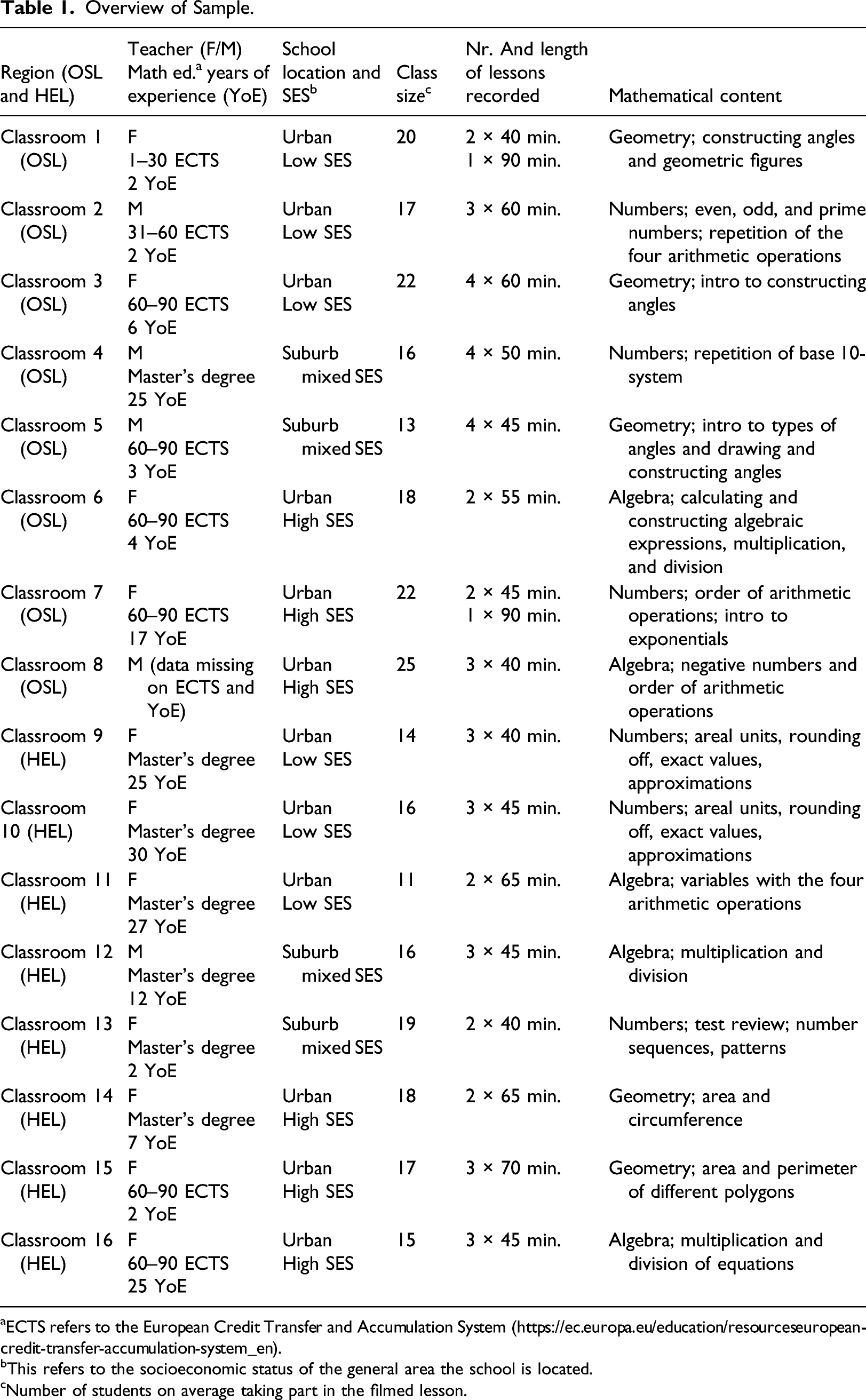
consecutive mathematics lessons taught in eight classrooms in the Oslo region (26 lessons), filmed in 2014–2015, and eight Swedish-speaking classrooms in the Helsinki region
3
(21 lessons), filmed in 2016 (see research design in (Klette et al., 2017)). The lessons were recorded with a two-camera solution via small, fixed cameras, one capturing the teacher and one the classroom (Figure 1). Two microphones were used, one worn by the teacher and another placed among the students. Camera angles in the classroom.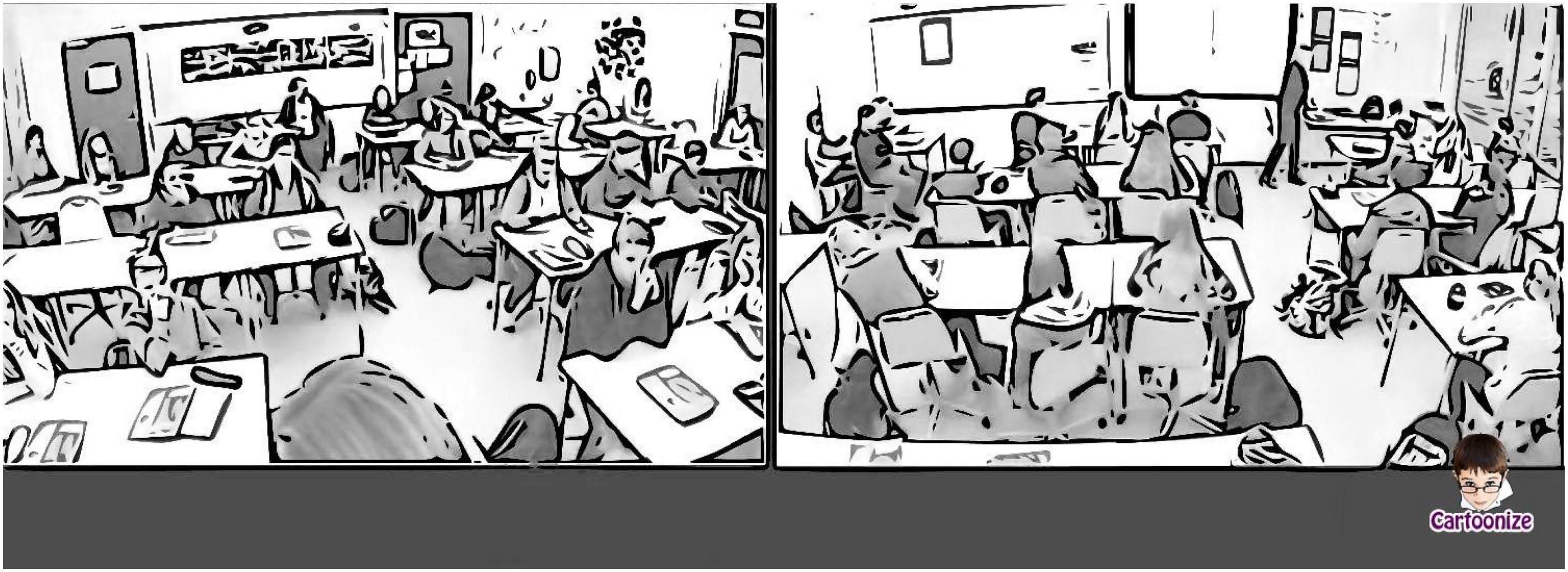
The Finnish and Norwegian educational contexts
Finland and Norway, similar in population size and geographic location, are part of the Nordic context and share key educational characteristics, including generous welfare policies in education and schooling as a basic right and a key vehicle for forging a fair and equal society (Lundahl, 2016). Key elements of the Nordic education model further include: (a) a non-tracked and unstreamed model for K–9 education, providing all students, irrespective of social, economic, and geographical background, the same educational opportunities; (b) a focus on inclusion and integrated solutions (e.g., consideration of students’ social and ethnic diversity, and adaptive education); and (c) a long tradition of national curricula (Blossing and Imsen, 2014). For mathematics instruction, there have been some difference in approaches from government initiatives as mentioned in the introduction, with varying activities and encouraging peer learning in mathematics classrooms (e.g., Ministry of Education and Research, 2014) while the Finnish educational context to a less degree has been characterized by reform initiatives on teaching practice (Sahlberg et al., 2015).
Both countries have a well-educated teaching force, with considerable autonomy in instructional methods, including the freedom to select instructional materials. However, Mølstad (2015) analyzed state-based curriculum making in Finland and Norway, and found that in Norway, the national curriculum is applied to local curriculum work while in Finland the local curriculum is developed based on the national curriculum, suggesting a stronger emphasis on teacher autonomy in this context.
Sample
Overview of Sample.
aECTS refers to the European Credit Transfer and Accumulation System (https://ec.europa.eu/education/resourceseuropean-credit-transfer-accumulation-system_en).
bThis refers to the socioeconomic status of the general area the school is located.
cNumber of students on average taking part in the filmed lesson.
Written and informed participation consent was provided by parents, students, and teachers in compliance with the ethical requirements in both countries.
Analyzing video recordings using a standardized observation system
To systematically compare the larger instructional-quality elements of content presentation and discourse features into smaller, observable entities, we used the standardized observation system Protocol for Language Arts Teacher Observations (PLATO; Grossman, 2015). PLATO was originally designed for English language arts classrooms, but has since been used in mathematics (Cohen, 2013) including Norwegian mathematics classrooms (e.g., Mahan et al., 2018; Stovner, 2018). While many mathematics-subject manuals exist (see Praetorius and Charalambous, 2018), PLATO captures key elements critical for instructional quality across subjects and fits well with the identified challenges in Nordic classrooms (Klette and Blikstad-Balas, 2017). PLATO; considers four domains, divided into 12 elements 6 (for a full overview, see Grossman, 2015). Six elements are of particular importance to the focus of the present study: uptake of student responses and opportunity for student talk, together making up classroom discourse; quality of instructional explanations and richness of instructional explanations, connection to prior knowledge, and purpose, together making up presentation of content.
In line with PLATO coding procedures, each recorded lesson was divided into 15-min segments, for a total of 162 segments (Helsinki, N = 71; Oslo, N = 91). The number of segments per classroom varies, as the lessons varied in length and number (see Table 1). If a lesson ended in the middle of a 15-min segment, the last segment was either included with the previous segment (<7.5 min) or coded as a separate, shorter segment (>7.5 min). Each segment was PLATO-coded for all six elements and main activity format, providing information on how activity formats interact with classroom discourse and presentation of content elements. The activity format occupying the most time (whole-class instruction, individual seatwork, or group work) was used as the main format for the segment.
The 162 segments (71 + 91) were coded by raters according to which PLATO elements occurred, when, and at what level on a four-point scale (see next paragraph). All raters were PLATO certified (raters reached a minimum of 80% agreement with master coders in a formal certification process). Fifteen percent of the Helsinki lessons were scored by two raters, and after the members of the research team discussed the segments, supported by detailed, qualitative notes, agreement was reached on all scores in these double-scored segments. At least two certified raters rated the Oslo classrooms as part of the overall LISA-study (Klette et al., 2017), and the first author then thoroughly double-checked all ratings and notes for the rest of the segments, including all of the Oslo data. Where necessary, the first author recoded the Oslo segments after discussing with other members of the research group to ensure internal consistency across raters and contexts.
The PLATO elements as analytical lenses
Protocol for Language Arts Teacher Observation uses a four-point scale to differentiate between high (3 and 4), and low (1 and 2) scores. For example, QIEs covers the extent to which explanations of content are clear and accurate. Low scores indicate no mathematical explanations (1) or that the explanations were incomplete (2), while high scores indicate accurate and clear examples of mathematical content or addressed student misunderstandings (3), or additionally highlighted the nuances of mathematical concepts with different examples or counterexamples (4). See the Appendix for the full scoring rubric.
Methodological limitations
A limitation of this study is that the sample is not representative of Norwegian and Finnish schools nationwide, as only a small sample of schools from particular areas participated, and, only Swedish-speaking schools from Helsinki. However, although not generalizable to a national context, we are confident that the sample provides rich enough data to compare and contrast these two contexts (Patton, 2015). Moreover, the sampled lessons covered mathematics instruction in algebra, numbers, and geometry. Thus, a caution when interpreting the results is that differences in content may affect instructional patterns (Hill and Grossman, 2013). As mentioned, we focus only on two domains of PLATO, while recognizing that there are important subject-specific aspects of instructional quality, such as use of mathematical language or opportunities to grapple with mathematical sense making (see Schlesinger et al., 2018).
Findings
Our findings indicate differences between the two contexts across activity format as well as the analyzed features of instructional quality of how content is presented and classroom discourse. In the following sub-sections, we describe the patterns in relation to these features.
Activity format
The most common activity format in the Helsinki sample (N = 71) was individual seatwork, dominating 62% of the segments (see Figure 2). Whole-class instruction was also common (34%), while there was almost no group work (4%). In the Oslo sample (N = 91), the most common format was whole-class instruction (62%), followed by individual seatwork (25%), and group work was the main format in 13% of the Oslo segments. Activity Format. Bars Show Percentage in Each Context.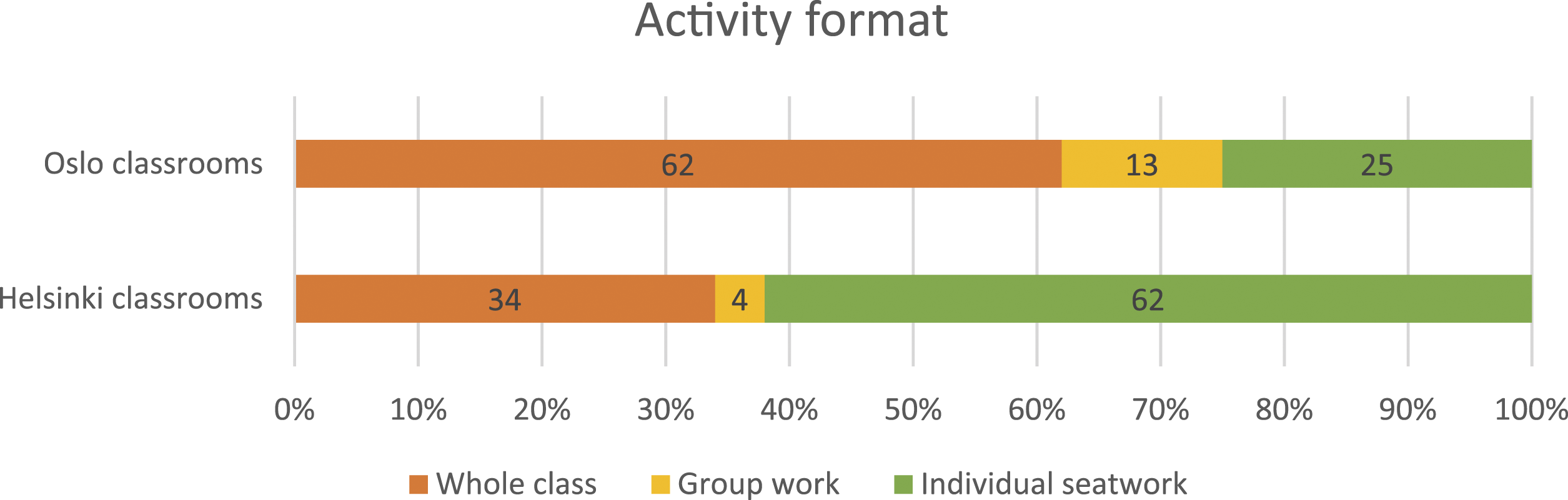
Individual seatwork in both contexts was characterized by students working on tasks, usually from a textbook—paper or online—while the teacher circulated and checked student progress. In all Helsinki classrooms, the students at some point worked individually, and only 3 of the 21 lessons did not include any 15-min segments dominated by individual seatwork. In the Oslo classrooms, 13 of the 26 lessons did not include any segments with individual seatwork as the main activity. Whole-class instruction in the Oslo classrooms often consisted of long sessions broken up by short individual or group tasks, either to practice a new procedure (e.g., construct a 60-degree angle) or to have short peer discussions (e.g., discuss how you understand “an angle”), followed by a return to the teacher-led, whole-class discussion of the tasks, a practice observed at some point in seven of the eight Oslo classrooms. This was only observed in two Helsinki classrooms, in which whole-class sessions were generally shorter in duration and dominated by teacher-led instruction, with little student participation (see section Classroom Discourse). As the coding was based on the main activity in a segment, brief group tasks that did not take up the majority of a 15-min segment are not included in the graph. Four of the eight Oslo classrooms engaged in group work as the main activity at least once during the recorded lessons, and three of the Oslo classrooms contained multiple instances of group work as the main activity. In contrast, group work in the Helsinki sample was the main activity in only one classroom.
Presentation of content
In the elements QIE, CPK, and Purpose, segments from the Helsinki classrooms were consistently coded at the high end more often than those from the Oslo classrooms, while exhibiting similar levels of Richness of explanations (RIE) (see Figure 3). Across contexts, many of the segments scoring 2 on QIE consisted of teacher explanations during individual seatwork concentrated on tasks with which students were struggling. These explanations were often procedural, superficial, and related solely to the specific task at hand. For example, in an Oslo classroom (Classroom 4), students completed an individual drill task on multiplying and dividing with 10, 100, and 1000. The teacher asked the students to answer one by one, but the explanations, for example, why 5.5 × 10 is 55, remained at a surface-level, such as: “Because you move the decimal one place to the right.” There is a more complete explanation of place value in another segment in the same lesson; however, scoring high in one segment does not transfer to the other segments. Presenting mathematical content through comprehensive examples and explanations regularly occurred in a whole-class format, while explanations tend to be more procedural and directed at the task at hand during individual seatwork. Still, the Helsinki classrooms score higher on this element and have more individual seatwork. One reason for this is that explanations during seatwork are often tied to addressing student misunderstandings. Presentation of Content in Helsinki and Oslo Classrooms.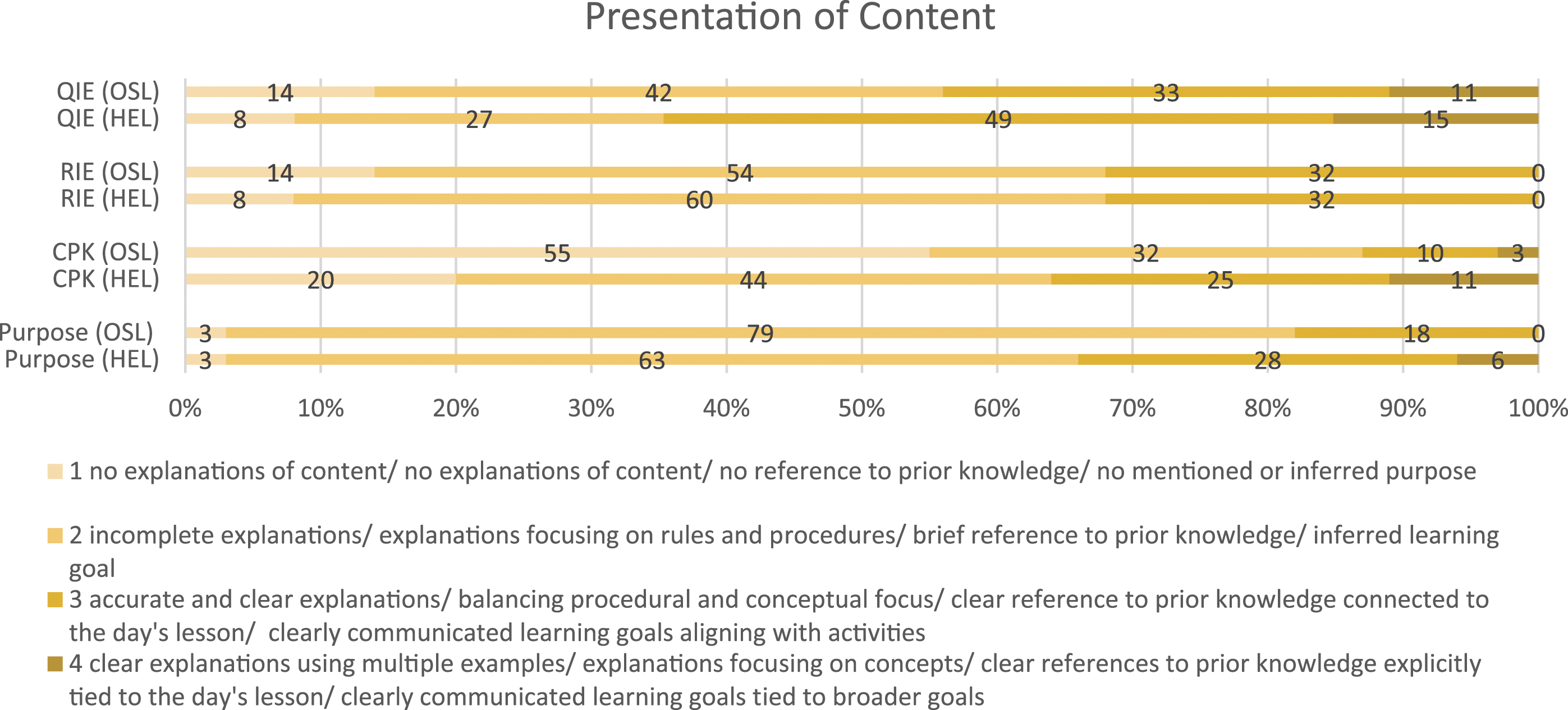
The overall findings from both contexts regarding the conceptual nature of explanations (RIE) indicate that around 30% of the lesson segments emphasized conceptual understanding in conjunction with procedural fluency (score 3), while the rest of the segments clearly focused on procedures and labels. Various types of explanations fall into the score of 3; one trend emerging from our data shows that teachers in the Oslo classrooms often provided conceptual richness through everyday examples familiar to students (as in the earlier example of an arithmetic task involving apples and candy). In the Helsinki classrooms, in contrast, conceptual richness often occurred through connections between different mathematical concepts and ideas.
Instruction in the Helsinki classrooms scored at the high end more often on the element CPK than instruction in the Oslo classrooms (36% compared to 13%, for a combined score of 3 and 4). This indicates a tighter and more explicit connection between new and old content in the Helsinki classrooms. One reason for this is that many Helsinki lessons started with reviewing homework or previous tests, or with eliciting students’ knowledge from previous lessons, linking this to the day’s lesson. In the following example of this feature, the teacher (Helsinki Classroom 12) introduces the multiplication of variables.
Teacher: Some of you have already started with multiplication and division of variables, but we are going to talk about it a little today, and in order to know how to do that, we need to know what we did before we started with variables. Anyone remember what that was?
Student 1: Exponents.
Teacher: Yes, exponents, or “power of.” So you must know exponents in order to know what we will start with now. We take three examples. What can we do with the first one?
[Examples on the board are:
Teacher: What can we do with the last example, x2?
Student 2: We can take x×x
Teacher: Very good; x×x, and then we can’t do anything else, as it means the same thing. That was the exponent, and now we are working with variables. [Teacher writes new example:
Teacher: You may remember that the numbers represented by x are called variables, and the numbers in front of x are called coefficients. Any suggestions for what we could do with this? Now you need to remember the exponent rules!
This type of practice of connecting prior and new content in the context of homework or test review, either by the teacher explaining the tasks or the students showing their calculations, was observed in 10 out of 21 lessons (8 homework and 2 tests) in the Helsinki classrooms; in three additional lessons, homework was reviewed individually or in groups, by checking answers. In the Oslo classrooms, only on three occasions were previous assignments discussed with the whole class, two of these occasions involving the same teacher.
Overall, we found that teachers in the Oslo and Helsinki classrooms consistently expressed the purpose of the lessons implicitly as “the program for today,” as indicated by the clear majority of all segments scoring a 2 on Purpose. Specifically, addressing purpose as a learning goal was, however, slightly more common in the Helsinki classrooms than in the Oslo classrooms (34% compared to 18%, for a combined score of 3 and 4). However, in both contexts, the instances in which teachers referred specifically to learning goals were always motivated by performance or understanding in an in-school context rather than knowing mathematics for other purposes. For example, in Classroom 15 (Helsinki), the teacher asks students what they worked on in math class before a holiday and a student answers, “Significant figures.” The teacher replies: “Yes, significant figures, we will continue with areas and perimeters of polygons, that is to say, some geometry. But I think a little repetition is necessary, so I will introduce this by thinking about the old stuff.” After a teacher-led session connecting rounding off and significant figures with the calculation of area and perimeter, the teacher refers back to the purpose as a learning goal: “Okay, this repetition was needed. You have had time to forget it, and this will be used very much later in physics and in tests, so you need to know how you can round off.”
Classroom discourse
In both contexts, the typical mathematical discourse in whole-class discussions follows traditional IRE/F patterns (Cazden, 1988), with little use of high-level uptake of student responses (Nystrand et al., 1997), as indicated by the prevalence of score 2 in Figure 4. However, there was more evidence of student participation in content-related discussions in the Oslo classrooms, as approximately 20% of the segments indicate instruction with uptake and an opportunity for students to share ideas (combined score of 3 and 4), compared to 8/9% in the Helsinki classrooms. Classroom Discourse in Helsinki and Oslo Classrooms.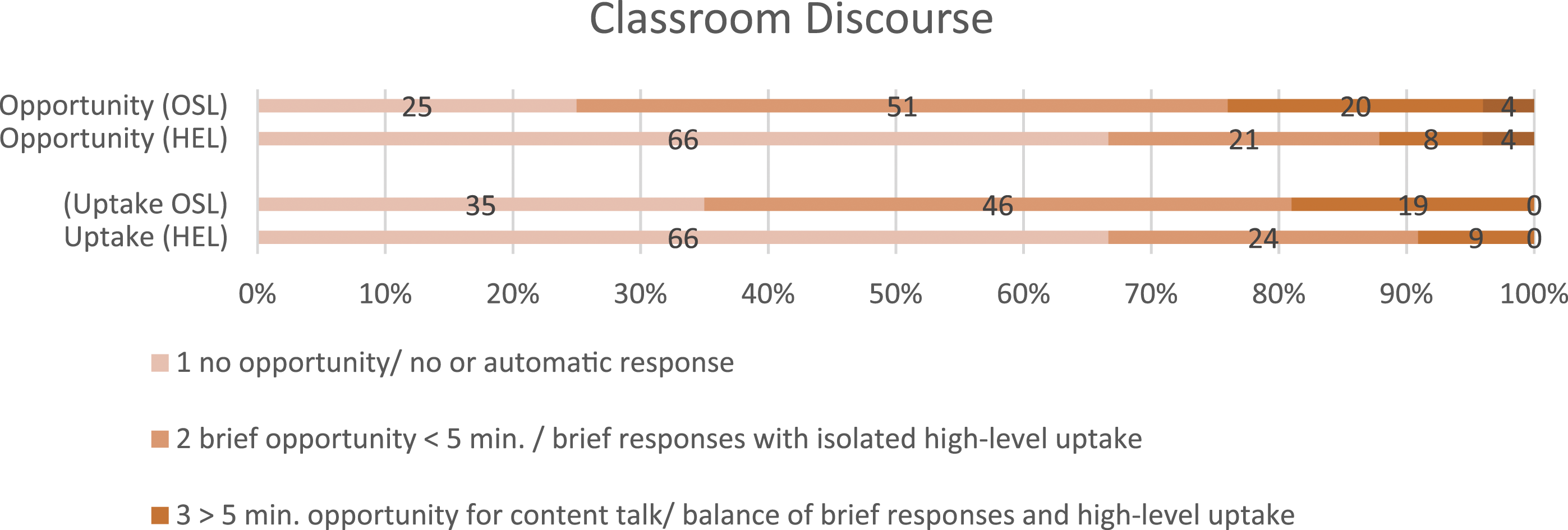
The low classroom discourse scores are linked to the fact that the lessons in Helsinki were mainly organized as individual seatwork, but we also see different trends in uptake and elaborations in whole-class discussions. Half of the Helsinki classrooms (n = 4) showed evidence of teachers’ use of uptake (score 3); however, these sequences were mostly short, and the opportunity to share ideas was available to only a few students. In contrast, uptake was observed at some point in all but one (n = 7) of the Oslo classrooms, and the teachers more often prompted several students to participate in discussions. In none of the contexts do teachers or students consistently pick up on ideas or request clarification of student ideas, required to score a 4 for uptake. Also, there are very few whole-class and group sessions in which the majority of students have a substantial opportunity for content-related talk (score of 4 for opportunity) in either context.
The following example is therefore worth noting, in which the teacher in an Oslo classroom (Classroom 8) unites high-level uptake/opportunity for student talk and quality/richness of instructional explanations in a whole-class session on the use of parenthesis. An arithmetic task is written on the blackboard, in which candy costs 11 NOK and apples cost 5 NOK.
Teacher: Like you said, Adam, when we add these together, we get 16, even if we do not have a parenthesis. Now I want us to compare this with having a minus in front of the parenthesis. We have 20 NOK, and we buy candy for 11 NOK and apples for 5 NOK. How much do we have left?
Student 1: 4 NOK.
Teacher: How did you think that?
Student 1: I added together 11 and 5 and took it off 20 NOK.
Teacher: Oh! How many of you thought like this? [A few students raise their hands].
Teacher: You added these two [points to “11” and “5”], and then you took 20 minus the sum?
Student 1: Yes.
Teacher: Right, how can we make a mathematical expression to show this? To show how you thought?
Student 1: We can start with 11 plus 5, minus 20.
Teacher: But that would be negative 4.
Student 1: I meant 20 minus 11 plus 5.
Teacher: So you mean like this? [Teacher writes 20−11+5 on blackboard].
Student 1: Yes.
Teacher: I agree with you, but we need to do something more because 20 minus 11 is…?
Student 2: 9.
Teacher: Plus 5…
Student 2: 14
Student 1: But what if we put parentheses around 11 plus 5?
Teacher: Like this! [Teacher writes 20 − (11+5) on the blackboard].
This segment shows a balance of brief student responses (“20 minus 11 is?”) and higher-level uptake (teacher asks for elaboration: “How did you think that?”) and clarification of student ideas (“So you mean like this?”). The teacher also explicitly picks up on student ideas and makes them available for the peers: “Like you said, Adam, when we add these together…” The teacher’s explanations attend to both procedural and conceptual knowledge, as he demonstrates with counterexamples in a real-world context what the parentheses signify. Assumedly, this practice helps students distinguish between the implications of expressions with and without parentheses.
Discussion
The aim of this study was to explore and compare patterns of instruction, focusing on the presentation of content, discourse features, and activity formats, in mathematics classrooms in Helsinki and Oslo. Through this systematic, cross-national comparison, we aim to inform educational debates of what is occurring in classrooms with empirical and conceptual grounding and contrast the instruction in one context with those in another similar context (e.g., Hemmi et al., 2020). In line with previous video studies (Paine et al., 2016), we found that some instructional patterns are clearly more contextually distinct suggesting “cultural scripts” (Stigler and Hiebert, 1999). In the following sub-sections, we discuss the findings drawing on the research questions: What activity formats do teachers use to engage students? What is the quality of the instructional explanations of content, connections to prior knowledge, and setting a purpose for learning? What characterizes discourse features in mathematics classrooms?
Activity formats: Prevailing or changing?
The Helsinki mathematics lessons included a large portion of individual seatwork, as well as teacher-centered whole-class instruction with few opportunities for student talk and collaboration. Other studies have painted a similar picture (e.g., Krzywacki et al., 2016), indicating that this pattern of individualized mathematics instruction is common across Finnish classrooms. The absence of group work might, however, change in the coming years as the new curriculum promotes collaborative practices (Finnish National Agency for Education, 2014). In contrast, activity formats in the Oslo context varied more than previously observed (e.g., Bergem, 2009), and compared to the Helsinki context. One possible explanation for this may be an explicit focus on instructional variations in mathematics classrooms combined with a national initiative to improve instruction in mathematics supported by the curriculum (Ministry of Education and Research, 2013, 2014, 2015).
Differences in presenting and framing mathematical content
Taking three of the content-related elements together (QIE, CPK, and purpose), the way content is framed and presented in the Helsinki classrooms is generally more explicit and coherent than in the Oslo classrooms. Specifically, our analyses suggest that routines with textbooks and checking homework work as a “glue,” connecting content, lessons, and, most importantly, mathematical ideas. We find support for this idea in other studies that have emphasized Finnish educators’ preferences for clear lesson goals, homework, and textbooks (Hemmi and Ryve, 2015; Pehkonen, 2007). The Helsinki mathematics lessons may thus be characterized as coherent and predictable for students—which may enable them to more easily extract the key points of a lesson (Fernandez et al., 1992). However, such lessons may also discourage students from experiencing math as a creative problem-solving subject (Echazarra et al., 2016). In addition, while students benefit from having clearly articulated purposes (Borko and Livingston, 1989), only referring to school-related purposes and “goals,” as teachers did in both contexts, may instead strengthen views that mathematics is unrelated to students’ “real” lives (see Cobb and Yackel, 1998).
In contrast to the Helsinki sample, Oslo teachers generally spent more time instructing the whole class, while their explanations were more often surface-level (e.g., proportionately fewer instances of teachers providing multiple examples and counterexamples or addressing student misunderstandings). Also, there was almost no homework review in Oslo classrooms, resembling the findings in other Norwegian classroom studies (e.g., Klette et al., 2015). Conceptual instructional explanations were provided at the same level, however somewhat differently; Oslo teachers emphasized real-world examples and Helsinki teachers connected mathematical ideas. This is similar to the distinction made by Kilhamn and Säljö (2019), in which Norwegian teachers used designed examples, while Finnish teachers used textbook examples to present algebra. The similarity in how lessons are delivered in the Helsinki context and more variation in the Oslo context is interesting, considering the supposed greater autonomy of Finnish teachers (Mølstad, 2015). Perhaps teacher status and autonomy also is one factor that enables the “traditional” way of whole class teaching and individual seatwork in Finland to continue (cf. Simola et al., 2017).
Classroom discourse: Limited focus on student participation
Classroom discourse in the form of uptake of students’ ideas and opportunities for student talk appear common more common in Oslo classrooms compared to Helsinki classrooms. With caution, we call attention to curricular differences here. As mentioned previously, the Norwegian curriculum, in contrast to the Finnish curriculum, presses for student participation in discourse in all subjects (Ministry of Education and Research, 2013). There is also some limited evidence that student participation as a sign of quality mathematics instruction is supported by teachers in Norway (Fauskanger, 2016), in contrast to Finnish teachers’ previously reported content and textbook focus (e.g., Pehkonen, 2007). These findings highlight the difficulty of balancing student participation and content in a classroom dialog without watering down the content (Emanuelsson and Sahlström, 2008). Yet some teachers elegantly manage this balance (see example on p. 20), and focusing on such practices in particular could inform new instructional practices in mathematics in both contexts, as well as internationally.
Oslo teachers often activated all students during whole-class instruction via short individual or peer/group activities. However, this was not always captured as high-quality discourse in PLATO because duration (>5 min) is set as a criterion for high scores (3 or 4) on students’ opportunity to talk, highlighting the issue of sequencing lessons when measuring instruction with standardized measures (see also Bell et al., 2015). While important to keep in mind, overall, little time is allocated for students to engage in content-related talk suggesting that the students’ role in the discourse is, still, mainly to provide the right answer (Cazden, 1998). Similar to other “Western classrooms,” teachers were generally more concerned with establishing correct mathematical procedures than giving students opportunities to provide explanations (Clarke et al., 2013). Further research on the quality and nature of talk is needed to confirm such indications and to elaborate on how the nature of short- and long-interaction talk is related to, for example, tasks.
Patterns of instructional quality: A matter of perspective?
The reviewed contextual differences together with previous research lend support to a conclusion that the findings of this study are unlikely coincidental but reveal more profound differences in mathematics education within Nordic contexts that otherwise share educational similarities (Lundahl, 2016) but also structural differences in curricula making (Mølstad, 2015). We found that our contexts showed strength in the two different dimensions of instructional quality that we focused on—instructional clarity in Helsinki and student engagement in discourse in Oslo. While we do not know whether the identified patterns resonate with international achievement scores, it is likely that these two dimensions support different types of learning (e.g., Hiebert and Grouws, 2007; Schoenfeld, 2016). Commentaries on the Finnish way of teaching have suggested that this “traditional way” of teaching only works as long as students accept their roles in the classroom (Simola, 2017). However, the previous success of Finnish students is steadily declining in international achievement studies in mathematics. This might indicate that the while this practice characterized by teacher-led plenary work and a high degree of individual seatwork (Krzywacki et al., 2016) might have been a successful practice in earlier years, it may no longer suffice, as interest and skills in mathematics in older grades are plummeting (Portaankorva-Koivisto et al., 2018). Recognizing local distinctiveness is particularly important for national contexts, as it calls attention to the specific features of instruction relevant for professional development. Our findings, together with other studies, point to different strengths in the two contexts; clear and coherent lessons and individual seatwork in the Helsinki context, and more student engagement in Oslo classrooms. This can inform educators in both contexts on possible areas for improvement, as both coherency of explanations and student engagement in discussions are important aspects of mathematics classrooms (Grouws and Cebulla, 2002; Hiebert & Grows, 2007). This is also of importance for an international audience, as it offers insight into teaching in different contexts and how teaching is shaped by contextual factors, which might nuance the debate of instructional quality otherwise driven by Anglo-Saxon and Central European contexts (e.g., Paine et al., 2016). The comparative findings of this study should be interpreted while keeping in mind that “instructional quality” is always a matter of perspective and that we only focused on a two dimensions of this construct with a specific set of lenses, and that contextual aspects such as teacher intentions for their lessons vary and are likely to affect the patterns of instruction (see Luoto and Selling, 2021).
Instructional features are valued differently across observation instruments (Bell et al., 2019), and as the studies by Pehkonen (2007), Hemmi and Ryve (2015), and Fauskanger (2016) indicate, teachers’ perceptions of quality instruction may differ across Finnish and Norwegian contexts (see also Clarke, 2013b). Thus, while PLATO successfully revealed differences in patterns of instructional quality, we recognize that high-quality instruction is more than presence or absence of particular instructional practices. However, at the same time, standardized measures makes it easier to compare across studies (Klette and Blikstad-Balas, 2017), as it is challenging based on single studies using different frameworks to assess how for example the instructional patterns in this study compares in detail to patterns in the TIMSS video studies (Hiebert et al., 2003; Stigler and Hiebert, 1999), or the LPS studies (Clarke et al., 2006). Future research could thus combine standardized measures of instructional quality with contextual perspectives, by, for example, exploring how differently sequenced instruction may facilitate learning, and how cultural views of teaching and learning relate to standardized observation manuals’ definitions of quality instruction (Clarke, 2013b).
Footnotes
Declaration of conflicting interests
The author(s) declared no potential conflicts of interest with respect to the research, authorship, and/or publication of this article.
Funding
The author(s) disclosed receipt of the following financial support for the research, authorship, and/or publication of this article: This work was supported by the Norges Forskningsråd and the grant number 222620/F10.

Notes
Author Biographies
PLATO elements and Rubrics.
Classroom discourse
1 Provides almost no evidence
2 Provides limited evidence
3 Provides evidence with some weaknesses
4 Provides consistent, strong evidence
Uptake of student responses
Teacher or students rarely if ever respond to students’ ideas about mathematical content.
Automatic teacher responses that simply acknowledge or echo student contributions “(e.g., repetition, “Okay,” “Good job,” “Thanks”) would fall into this category. Teacher accepts answers without asking for clarification or elaboration.Teacher or students respond briefly to student ideas, and responses do not elaborate or help develop the ideas (e.g., restating without academic language, simple “I agree/disagree”). Alternatively, the teacher may mostly respond to student ideas with automatic responses interspersed with an isolated instance of high-level uptake (e.g., revoicing in academic language, asking for clarification, elaboration, or evidence).
Teacher or student contributions show a balance between brief responses and higher-level uptake (e.g., revoicing in academic language: Asking for clarification, elaboration, or evidence). There are multiple instances in which the teacher or students specifically address student ideas.
Teacher and students consistently engage in high-level uptake of students’ ideas, responding in ways that expand on student ideas or enable students to further explain, clarify, and specify their thinking.
Opportunity for student talk
There are few or no opportunities for mathematics-related student talk. Teacher lecture, extended introduction (including giving directions) to an assignment or activity, or recitation format lasting fewer than 5 min would fall in this category.
Talk is tightly teacher-directed, but there are occasional opportunities for brief mathematics-related student talk. Examples include recitation formats lasting 5 min or longer, or mathematics-related talk (whole group, small group, partner talk) lasting fewer than 5 min.
Teacher provides opportunities for at least 5 min of mathematics-related conversation between teacher and students, and/or among students. Some students participate actively by speaking and/or listening, but only 2–3 students are the primary participants. There may still be a substantial amount of teacher direction, and some of the questions that guide the conversation are open-ended. Student-directed discussions that fail to stay on track would also be at this level.
Teacher provides opportunities for at least 5 min of mathematics-related conversation between teacher and students and/or among students. The majority of the students participate by speaking/actively listening, and students respond to each other, even if the teacher is still mediating the conversation. The questions that guide the conversation are mostly open-ended, and the focus of the conversation is clear and stays on-track.
Presentation of content
Quality of instructional explanations
Teacher provides no, weak, or incorrect explanations of mathematical concepts that may include incorrect analogies, examples, or explanations.
For example, if a teachers’ explanations does not contain or illuminate any mathematical ideas or the explanations are inaccurate (e.g., introducing fractions and mixing up what is a nominator and a denominator)Teacher provides incomplete or perfunctory examples, analogies, or explanations that only touch surface-level features of mathematical content. The explanations are only partially successful in illuminating a concept.
For example explaining fractions using only similar examples, e.g., 1/2 = 0.5, 3/4 = 0.75Teacher provides accurate and clear examples, analogies, or explanations to sufficiently explain mathematical concepts. While the teacher may address misunderstandings, the teacher does not highlight the nuances of concepts, or provide counterexamples to help students distinguish among different features of related ideas.
For example, presenting fractions with several different examples, the teacher does not make specific connections to other mathematical concepts (e.g., percentage, decimal numbers or divided circles)
Common misunderstandings might be addressed, like why ½ is bigger than 12/25.Teacher provides examples, analogies, or explanations that are accurate and clear. In addition, the teacher addresses student misunderstandings, highlights the nuances of concepts (perhaps through the use of multiple slightly different examples or models), or provides counterexamples to help students distinguish among different features of related ideas.
For example, if a teacher presents fractions using multiple examples and different representations, making their connections explicit (demonstrating relationships between fractions, decimal numbers, percentage, circles). Common misunderstandings are addressed, like why ½ is bigger than 12/25.
Richness of instructional explanations
Teacher provides no, weak, or incorrect explanations of mathematical concepts.
The teacher provides superficial representation of mathematical content, focusing on rules, procedures, and labels, with little attention to conceptual or deeper understanding.
The teacher’s representation of content includes a balance of a focus on rules, procedures, and labels, as well as attention to conceptual or deeper understanding.
The majority of the teacher’s instruction focuses on conceptual understanding of mathematical content. The teacher provides instruction that goes beyond the superficial to a focus on interpretation or deeper understanding of the concepts.
Connections to prior academic knowledge
Teachers or students do not refer to prior lessons nor elicit students’ prior/background academic knowledge on a topic.
Teacher (or students) may refer briefly or superficially to prior lessons and/or attempt to elicit students’ prior/background academic knowledge.
Teacher elicits or refers to students’ prior/background academic knowledge multiple times on a topic.
Connections made between prior knowledge and the day’s lesson are clear enough to enable understanding of the material.Teacher elicits or refers to students’ prior/background academic knowledge multiple times on a topic (one or several really clear examples).
Connections made between prior knowledge and new mathematical concepts or tasks are clear, explicit, and specifically tied to new material.
Purpose
There is no clear learning goal in the class or the learning goal is not related to the development of mathematical skills or understanding.
There is a learning goal communicated or inferred that is connected to the development of mathematical skills, the goal takes the form of a general topic or activity.
There is a clearly communicated, specific learning goal that is connected to the development of mathematics skills. The lesson activities align to and target the specific learning goal.
There is a clearly communicated, specific learning goal that is connected to the development of mathematics skills.
The lesson activities align to and target the specific learning goal. There is evidence that students are aware of the purpose. The teacher or students refer back to the purpose during the segment.
The teacher makes clear how the lesson will support students’ development as learners of mathematics.