




Abstract
Educational institutions, especially those facilitating vocational education and training (VET), face the challenge of combining social goals, such as the provision of quality education for a large section of the population, with rising economic utility demands. However, we know little about how VET systems institutionalize these different demands and, further, how social and economic goals are actually institutionalized in VET. Our article aims to unpack this puzzle by analysing short-track dual vocational training programmes (short-tracks) in Denmark, Germany and Switzerland. These short-tracks combine on-the-job and school-based training, targeting candidates who face difficulties entering full-length dual programmes. Thus, short-tracks are prime examples of training programmes located at the nexus of economic and social demands. In our comparative institutional analysis, we bridge the political economy of collective skill formation and sociological institutionalism literatures. We find that the institutionalization of goals in VET not only differs between countries but that there is also considerable variation within national VET systems. Our analysis reveals that VET regulations, regional and sectoral standards, and the legitimization of key actors can differ greatly in their institutionalization of social and economic goals.
Keywords
Introduction
The governance of educational institutions increasingly faces the challenge of combining social goals with rising economic utility demands (Felouzis et al., 2013; Thelen, 2014). Educational reforms strengthening the marketization and privatization of education (Whitty and Power, 2000), including the European Union’s promotion efforts to strengthen the link between education and companies (European Commission, 2014), fuel the debate on the question that asks to what extent market mechanisms and private actors should be part of educational governance. Traditionally, the governance of dual vocational education and training (VET) is closely aligned with the world of work and economic goals. The satisfaction of employers’ skill demands is often linked to a strong involvement of business interests in the development of curricula, the selection of candidates and the provision of training (López-Fogués, 2012). At the same time, VET systems are aligned with social goals such as equal access to quality education, the provision of transferable vocational skills and certificates, and also a smooth school-to-work transition for those young people seen as disadvantaged (Granato and Ulrich, 2013; Hupka-Brunner et al., 2010; Jackson, 2009). Thus, dual VET is a prime example to use for studying the interplay and tension between economic and social goals.
Duality in education and especially in dual vocational training, however, is present at different levels. On the one hand, dual apprenticeships refer to the combination of the two learning locations of the school and the firm. In order to align school-based training with work-based training, public (e.g. ministries, schools) and private actors (e.g. employer associations, firms) need to cooperate. This is why the governance of dual vocational training is referred to as ‘collective’ governance. The involvement of public as well as private actors links dual VET to another level of duality, namely the interplay and tension between economic (serving the labour market) and social goals (providing quality education to a large number of young people) in education. In our study, we focus on this latter aspect in the governance of VET, which is, however, rooted in the dual character of the learning sites.
Even though dual vocational training systems are described as being part of the family of ‘collective skill formation systems’ by the political economy literature (e.g. Busemeyer and Trampusch, 2012), national VET systems differ. For example, the engagement of firms in the selection process or content definition can vary across countries and, thereby, influence the role and effect of VET. The more the selection process is left to the firms, the harder it might be for students who do not perform so well at school to enter the training system. Furthermore, business influence on curricula might shift the training content towards marketable vocational-specific skills at the expense of general knowledge, which might, in turn, influence the stratification effect of vocational education (see Nylund and Virolainen, 2019). This variation can potentially have an influence on the inclusive character of dual vocational training.
The tension between economic and social goals is especially tangible in short-track dual training programmes (short-tracks). Short-tracks usually last only two years instead of three to four years, but still lead to standardized certificates. They are located within dual VET while targeting candidates who lack a good general education or academic credentials. Short-tracks focus on theory-reduced applied dual training. They address young people who face problems entering ‘regular’ three- or four-year training programmes. Short-tracks are typically allocated to the European Qualification Framework (EQF) levels 2–3. 1 Similar to the regular-length programmes, the employers voluntarily select the apprentices although they do not usually receive specific subsidies. Short-tracks fully qualify their students for entry into the labour market, which distinguishes them from (most) transition measures, and often count towards longer VET programmes. To provide the first systematic comparative institutional mapping of short-tracks, we ask: How are economic and social goal dimensions institutionalized in short-track dual training programmes?
We have identified three VET systems that offer short-tracks: Denmark (Basic Vocational Training (Erhvervsgrunduddannelse (EGU)); Germany (two-year training programme (Zweijährige Ausbildungsberufe)); and Switzerland (Federal Vocational Certificate (Eidgenössische Berufsatteste (EBA))). Due to pressure on the apprenticeship market, all three VET systems strengthened short-tracks in reform processes in the 1990s and early 2000s. From a global perspective, the VET systems in Denmark, Germany and Switzerland can be considered to be very similar (Ebner, 2013; Hall and Soskice, 2001). They are all located in a coordinated market economy cluster with a long and strong tradition of dual apprenticeship training (Graf, 2013). Against this backdrop, we zoom in on the lower level within these VET systems, the level that aims at opening the door for those students who are seen as less qualified for regular apprenticeships. So far, we know little about how different VET systems institutionalize dual VET for these disadvantaged students and what role social and economic considerations play in this context.
In order to operationalize the social and economic goal dimensions, we discuss key concepts in the relevant political economy literature. Historical institutionalism distinguishes between the ‘Williamsonian’ approach in which economic efficiency stands in focus and the ‘Durkheimian’ perspective that underlines the social equality aspect of institutions (Carstensen and Ibsen, 2019; Höpner, 2007; Streeck, 2009; Thelen, 2014). We argue that the economic goal dimension relates to policies based on market mechanisms and the involvement of employers. We evaluate, for example, to what extent employers are involved in the selection of candidates and the development of curricula. On the other hand, we view the social goal dimension as the perspective that takes into account the needs of young people (especially those seen as disadvantaged). This goal dimension is aimed at enabling a broad spectrum of students to enter dual VET. Most studies on the institutional underpinning of VET focus on the regulative framework of training and how it is continuously
(re-)shaped by various stakeholders. Our research applies a complementary perspective by also incorporating the normative and cultural–cognitive dimensions of the institutionalization of VET. We apply sociological institutionalism (DiMaggio and Powell, 1991; Powell et al., 2012; Scott, 2014), allowing us to offer a fine-grained account of the institutionalization of goals in VET according to the regulative (rules), normative (standards) and cultural–cognitive (ideas) dimensions of short-track dual training. In this context, we concentrate on the legal framework, the degree of standardization and the legitimizing arguments of the key stakeholders. We apply this extended framework because we argue that economic and social goals in training are not only rooted in the regulations but that standards and ideas as applied to training are equally important.
This theoretical framework allows us to gain new insights as it focuses on how the three institutional dimensions (regulative, normative and cultural–cognitive) may systematically vary within one case with regard to their respective orientations, that is, economic goal versus social goal. This differentiated approach is particularly relevant in the case of short-tracks, because partly opposing goal dimensions are at play (López-Fogués, 2012). Our research suggests that the important question, that is, to what extent VET and other educational systems meet their social goals, can be answered in greater detail if all three institutional dimensions are considered individually as well as in combination.
Our comparative analysis employs document analysis and 20 expert interviews with representatives of employers, employees, the federal state, the regions and national VET institutes in all three countries.
We find significant cross-national variation, but also within-case variation across the three institutional dimensions with regard to the goal orientation of short-track dual training. In Denmark, all three institutional dimensions are mainly oriented towards the social goal dimension. However, in both Germany and Switzerland, we find a discrepancy between the regulative dimension and the two other dimensions. In Germany, the VET law does not explicitly mention social goals for short-tracks, but social goals enter the scene when it comes to the relevant standards and ideas that relate to short-tracks. In Switzerland, conversely, the VET law clearly also foresees a social role for short-tracks, and, similar to the Danish case, provides individual support measures for the participating young people. However, when it comes to concrete implementation and the application of standards and ideas, economic goals dominate in Switzerland.
Given that all three countries believe in collective skill formation (Busemeyer and Trampusch, 2012), at first sight, this significant cross-case variation may seem rather puzzling. In our concluding discussion, we present reasons why in the German and Swiss cases, economic goals play more of a part in the institutionalized systems of these countries than in Denmark. In this context, our analysis suggests that when studying economic and social goals in educational institutions, making a distinction between the three institutional dimensions is a fruitful endeavour.
The following section elaborates on our theoretical approach, and includes a discussion of the two key goal dimensions in educational governance. We then present our methods and data. The subsequent section focuses on the case studies, namely short-track dual training in Denmark, Germany and Switzerland. The two final sections discuss our key findings from a comparative perspective and conclude.
Analytical framework: Goal dimensions and institutionalization
In this section, we summarize the institutional framing of economic efficiency and social equality in comparative political economy. On this basis, we next outline the key characteristics of social and economic goals in education. In the final part, we present our conceptualization of the social equality and economic efficiency dimensions in the institutionalization of the short-tracks, combining the political economy perspective with sociological institutionalism.
The institutional framing of economic efficiency and social equality in comparative political economy
Comparative institutionalists from different disciplines are interested in institutional differences and their societal and economic implications (Gonon and Maurer, 2012; Iversen and Stephens, 2008; Martin and Swank, 2012; Powell et al., 2012; Thelen, 2014). In this article, we concentrate on two key institutional dimensions of education – economic efficiency and social equality – to investigate central institutional underpinnings of educational systems. Here, we draw on insights from recent institutionalist literature in political economy that discusses the distinction between Williamsonian and Durkheimian institutions (Streeck, 2009; Thelen, 2012). Williamsonian institutions are tailored towards economic efficiency because they focus on providing employers with an adequately skilled labour force (Culpepper, 2007; Hall and Soskice, 2001). On the other hand, Durkheimian institutions aim to provide equality through the inclusion of a broad spectrum of the population in the labour market, including societal groups seen as disadvantaged (Carstensen and Ibsen, 2019; Martin and Thelen, 2007; Nelson, 2012; Thelen, 2004).
This two-dimensional space is broadly reflected in the more general political economy debate about different cooperation patterns and their outcomes, for instance, in collectively governed training systems. Thus, Thelen (2014) distinguishes between an equality dimension on the one hand and a dimension measuring the ‘strategic’ employer coordination on the other. Trampusch (2007) highlights the importance of industrial relations that include collective agreements, which can be seen to represent the degree of social solidarity in a policy field. Höpner (2007: 5) concentrates on the ‘status of firms in society’ and distinguishes between coordination and organization within non-liberal capitalism. Here, coordination is seen as a means of maximizing the rational firm’s individual profit. In contrast, organization ‘obliges firms to act in accordance with collective interests’ (Höpner, 2007: 9).
This short review shows that the political economy literature offers different but related concepts that can help to capture differences in the economic and social institutional underpinnings of socio-economic systems. In the following section, we specify the concepts of economic and social goals in the context of education.
Two goal dimensions of education: Economic efficiency and social equality
The importance of education as a highly political arena is often emphasized. Investments in skills are essential for competitiveness and economic growth (Busemeyer and Trampusch, 2012; Cedefop, 2017) and one of the most important means of achieving both economic and social welfare. In our article, we are specifically interested in the underlying ‘goals’ of VET. Inspired by the Williamsonian and Durkheimian perspectives outlined above, we distinguish between the economic goal dimension and the social goal dimension.
In our analysis, the economic goal dimension of education (Williamsonian perspective), refers to education as a means of providing the labour market with the skills that are currently required by employers. We stipulate that employers represent the demand side whereas graduates are seen as the supply side. Employers demand ‘marketable’ skills to sustain their economic success (Ferrier and Anderson, 1998). In our economic goal dimension, education is oriented towards the market and needs of employers (Nylund and Virolainen, 2019) and is aimed at the ‘employability’ of young people (see Brunila et al., 2017) and the production of human capital (see Becker, 1993). From our economic goal perspective, skills serve to boost economic growth and efficiency (of the national economy). In other words, when we identify an educational institution as oriented towards the economic goal dimension, we mean that its key objective is to enhance economic efficiency.
In contrast, when we address the social goal dimension (inspired by a Durkheimian perspective), we put the needs of young people and society in focus and expect that education serves to meet encompassing societal goals. This includes the usage of VET as a means of preparing (a broad spectrum of) citizens for political and social participation in society, even those lacking strong academic credentials (Protsch, 2014; Solga, 2005). This implies that this type of education system should not depend on market mechanisms but is every citizen’s right (Bernhard, 2017). Furthermore, in our social goal dimension, education functions as an entrance ticket (for the individual) to the labour market and, importantly, decent living wages (e.g. Busemeyer, 2015), ideally promoting individual social and economic welfare. Another important aspect is that being allowed into VET increases social justice because the students’ sense of belonging not only within education but also in society more generally plays a key role (Li and Dervin, 2019). In sum, in our analysis, an institution is seen to be oriented towards the social goal dimension if it meets the needs of the individuals and society as a whole by promoting greater social equality.
It is important to note that the Durkheimian literature on education also discusses the hierarchical relationship between vocational/practical (‘lower’) skills and general/academic (‘higher’) skills (Canning, 2012; Walford, 1998). In our case of short-tracks, vocational skills (attained through on-the-job training) are combined with general skills (attained through theory-focused school-based training). Even though we argue that short-tracks enable those young people who are perceived as disadvantaged to enter the training system and later the labour market, we want to emphasise that short-tracks do not provide the same level of general skills as academic and mainly school-based training would do. Thus, short-tracks are limited in their capacity to provide full and equal access to social and political participation (see Canning, 2012; Nylund and Virolainen, 2019; Walford, 1998; Young, 2009). However, we focus on a group of young people who are at risk of not accessing any adequate training were it not for the short-track programmes. Therefore, our use of the Durkheimian perspective relies on the assumption that access to the short-tracks enhances their chance to achieve equal social and political participation compared to the alternative of collective skill formation without such an offer.
It should be emphasized that social and economic goals can go hand in hand; thus, a system can score high on both aspects. For example, apprentices with skills that are in demand by the labour market will find it easier to enter a well-paid job after training. However, in other cases, the social and economic perspectives contradict each other. For example, the more selective the access to education is, the lower it scores on social equality. At a very basic level, our argument is that educational governance has to find a way of combining economic and social goals at the same time.
Conceptualizing the institutionalization of economic efficiency and social equality in short-track dual training
In this section, we conceptualize more concretely the institutionalization of the short-track programmes. Short-tracks in Denmark, Germany and Switzerland have not yet been systematically compared from an institutionalist perspective. This also implies that we lack a systematic account of the social versus economic orientation of these programmes. Literature on the institutionalization of dual VET has mainly focused on ‘regular’ three- and four-year apprenticeships. Thus, this study contributes to two main puzzles. On the one hand, it adds to a better understanding of the variety within dual vocational training programmes and, specifically, of the differences in dual VET programmes targeted at disadvantaged candidates. On the other hand, we develop a framework that helps to capture the institutionalization of two central goal dimensions in education: economic efficiency and social equality. In this context, we aim to contribute to the abovementioned political economy literature.
To uncover and map in detail how short-tracks straddle the boundary between economic efficiency and social equality, we consider the important regulative institutional dimension, but complement this view with the normative and cultural–cognitive dimensions. We propose this extended view as we expect that in the complex case of short-tracks there is a high likelihood of observing multiple and partly divergent institutionalizations in terms of how short-tracks are framed by laws, standards and legitimizing arguments. Thus, in the following conceptualization, we link the regulative, normative and cultural–cognitive institutional dimensions typically associated with organizational sociology and sociological institutionalism (DiMaggio and Powell, 1991; Scott, 2014) with key concepts in the political economy of collective skill formation, for instance, with decentralized cooperation (e.g. Busemeyer and Trampusch, 2012; Culpepper, 2003) and Williamsonian and Durkheimian institutions (Streeck, 2009; Thelen, 2012).
That is, our point of departure is the regulative (rules), normative (standards) and cultural–cognitive (legitimation arguments and ideas) institutional dimensions (Scott, 2014) that we combine with the economic and social goal dimensions discussed in the previous section. This framework, summarized in Table 1, then guides our qualitative cases studies of Denmark, Germany and Switzerland, enabling us to explore relevant within- and cross-case variation in relation to short-tracks.
Institutional dimensions and their conceptualization.
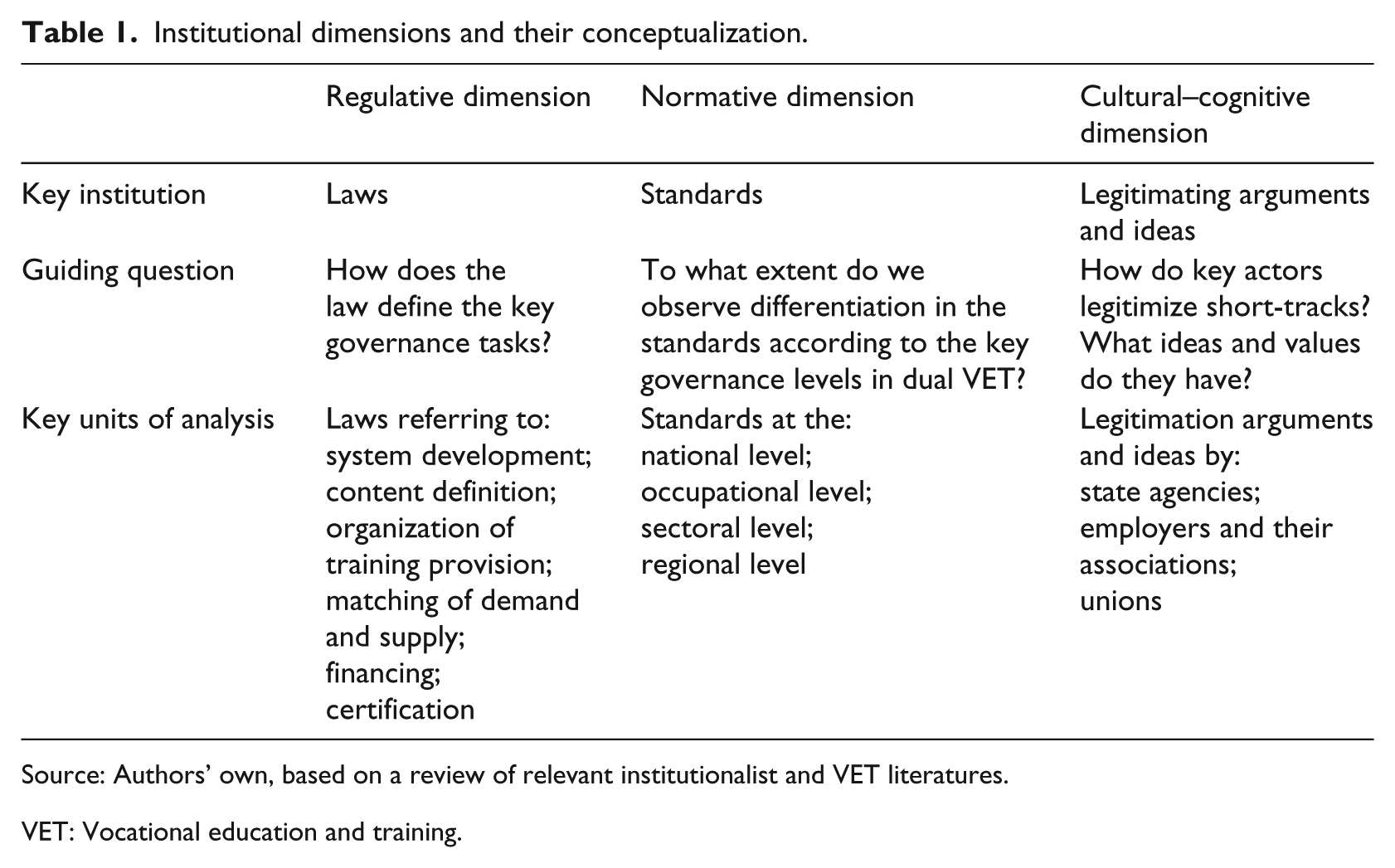
Source: Authors’ own, based on a review of relevant institutionalist and VET literatures.
VET: Vocational education and training.
First, we view the regulative dimension as referring to the legal definition of short-tracks. In other words, we focus on the relevant law(s) and regulations with regard to short-tracks training programmes and whether they are oriented more towards economic efficiency or social equality (or balance both perspectives equally). We follow Emmenegger et al. (2019) in arguing that six areas reflect the core governance functions that a collective VET system needs to perform to enable successful cooperation with regard to vocational training both in economic and societal terms (see also Busemeyer and Trampusch, 2012; Streeck et al., 1987; Wegge and Weber, 1999). The six task areas (Emmenegger et al., 2019, adapted for short-tracks) are given below.
System development: strategic development of the short-track system, including its steering at the macro level.
Content definition: concrete formulation of the contents of learning in short-tracks (e.g. syllabi, vocational profiles and curricula).
Organization of training provision: implementation and administration of short-tracks and of the concrete means and processes needed to put training to work (e.g. instructor training, teaching materials and learning site cooperation) and, crucially, any supporting measures for students who risk leaving school with poor academic credentials.
Matching of supply and demand: organization of processes that link individual educational aspirations and employers’ needs for skilled labour in the domain of short-tracks. This refers especially to the options through which students (including those seen as disadvantaged) may gain access to short-tracks.
Financing: distribution of resources and costs and regulation of apprentices’ wages. Given the potential ‘social policy’ nature of short-tracks, we also look at possible state subsidies for short-tracks.
Monitoring, examination and certification: quality control as well as maintenance of transparency of short-track qualifications. Given the role of short-tracks as a potential stepping stone for advancing educational opportunities for disadvantaged students, here we focus especially on how short-track certificates allow a transition to further educational programmes (such as the ‘regular’ apprenticeship programmes).
Whereas core task areas 1 and 2 reflect the stages of cooperation that define the structure for short-tracks, areas 3 and 4 are mainly concerned with the actual operation of the short-track system. Area 5 is about the financing of the different elements of the system, whereas area 6 represents the ‘final’ stage of system and quality control.
Second, with regard to the normative dimension, we investigate the key organizational standards. In collective VET systems, national legal frameworks provide significant scope for multi-layered cooperation and related standards at the decentralized levels of the occupation, sector or region (see Culpepper, 2003; Emmenegger et al., 2019). In other words, countries with dual training systems differ with regard to the implementation of national-level regulations at the subnational level (see Rauner, 2009). This opens up the possibility of significant differentiation with regard to the goal orientation of standards at the key subnational level. Therefore, we suggest analysing each of these levels individually. More specifically, ‘below’ the national level, we expect that relevant standards for short-tracks can be systematically structured by three key decentralized governance levels, namely, occupations, sectors (e.g. related to industries dominated by large firms vs crafts sectors dominated by small firms) and regions (e.g. related to states, municipalities, industrial regions, etc.). This conceptualization allows us to evaluate whether a specific short-track system displays variation between these governance levels.
Finally, we conceptualize the cultural–cognitive dimension as the ideas and cultural concepts behind the short-tracks. We ask, how are the short-tracks culturally framed? To which ideals are they connected? Here, we focus on the key actors’ ideas, values and legitimation arguments. Given the corporatist nature of apprenticeship training, the three key actors we focus on are state agencies (federal and subnational level), employer associations and unions.
Thus, in each of the country cases, we explore short-track laws, short-track standards and short-track legitimation arguments in relation to economic efficiency and social equality in a systematic way (Table 1). Ultimately, we visualize aggregate values for each institutional dimension for each country in a two-dimensional table (see Figures 1, 2 and 3) and compare and interpret our findings in the discussion section.
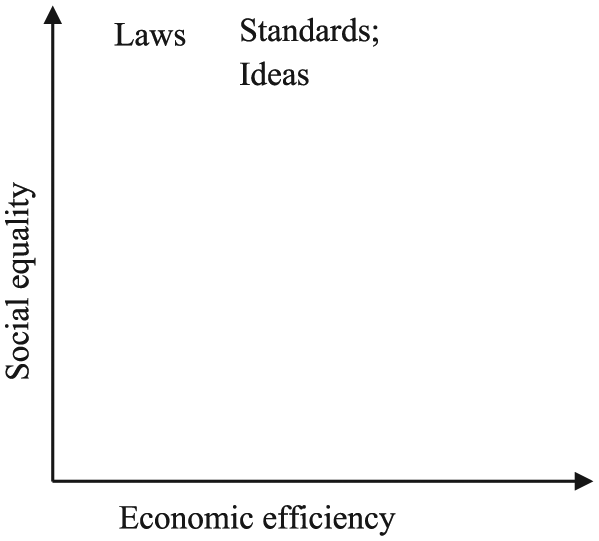
The institutionalization of short-tracks in Denmark between economic efficiency and social equality.
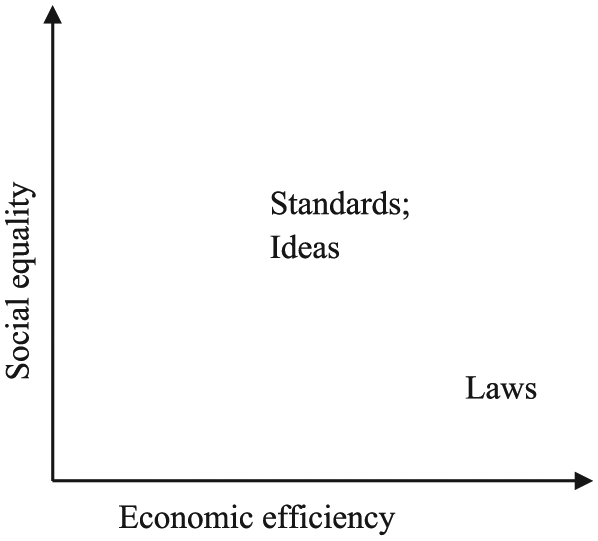
The institutionalization of short-tracks in Germany between economic efficiency and social equality.
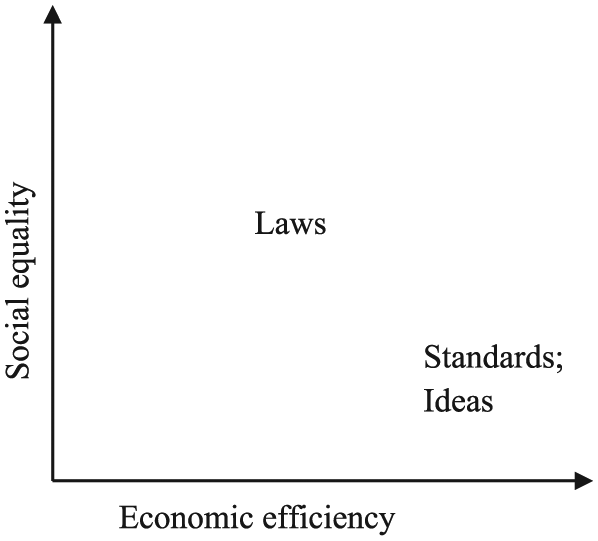
The institutionalization of short-tracks in Switzerland between economic efficiency and social equality.
Methodology
Our comparative institutional study applies a case study design. This allows us to delve into the case of short-tracks and, thereby, reveal the complex interplay of social and economic aspects therein (George and Bennett, 2005: 20). Our empirical analysis is based on desk research, utilizing official documents, transcripts from parliamentary sessions and the available secondary literature. Additionally, we complement our research with the help of 20 semi-structured expert interviews (Leech, 2002) (see list of interviews in Table 2 in the appendix). This strategy allows us to compare and cross-check information gained from the different sources (Martin, 2013). For each country, we selected interview partners representing key actor groups in the governance of the short-track programmes. We talked to representatives from the umbrella organizations of unions and employer associations, from the relevant national ministries and from the national/federal VET institutes. Furthermore, we interviewed national representatives from the countries’ regional organizations for VET governance, as well as academic experts in the field. In Denmark, we also interviewed representatives from youth centres and production schools, which are key local actors for the implementation of the short-track programmes. (Production schools in Denmark target people under 25 years who have not completed a youth education and offer preparatory [non-certifying] vocational training [Produktionsskoler, 2019]).
We structured and formulated our interview questions according to the different key dimensions in our theoretical framework. The first group of questions addressed the regulation of the short-tracks and the second group targeted the actual standards (variation) in place to control them. Finally, we asked questions aimed at capturing the actors’ perception of the ideas, ideals and goals of the short-tracks, thus, capturing the cultural–cognitive institutional pillar. The interviews lasted on average about one hour and were conducted between October and December 2017.
After the data collection, we analysed the data according to the different theoretical aspects we described in the previous section. In order to systematically compare short-tracks in the three countries, we applied the three main theoretical dimensions (regulative, normative and cultural–cognitive) and their specific subaspects to each country. We used the data generated through the interviews and the document analysis to develop a thick description of each dimension and for each case. We present the results of our analysis in the following sections. The case studies are organized by country in order to get a better understanding of the country-specific institutionalization of the short-tracks. Subsequently, we offer a cross-national comparative perspective.
Case studies
Denmark
The Danish short-tracks are the EGU. Although other two-year precursors date back to 1956 (Sigurjonsson, 2002: 17, 40–42; Sørensen and Jensen, 1988: 54), the EGU was initiated by the government in 1993 (Jørgensen, 2014; Retsinformation, 2018a). It was the Social–Liberal minister of education, a member of a broad coalition led by the Social Democratic Party, who was the main architect of this law and its adjacent school reform entitled Education for All (Uddannelse til Alle). Presently, the participation rate in the short-tracks relative to the total number of students in VET is around 2% (Undervisningsministeriet, 2017).
Laws (regulative dimension)
The EGU law and, thus, the system development, is overseen and reformed by the Ministry of Education together with the National Council for Vocational Training (DK2, 5 (see Table 2 in Appendix for list of interviews); Retsinformation, 2018a). The law gives quite a lot of freedom to the actors involved, because it delegates the responsibility of implementation of the short-tracks to the municipalities (DK1, 2, 4). In addition, the programme was conceived at the national state level as a response both to the high level of dropouts from the regular programmes and the increase in young people not in education or training (Blaksteen, 1994).
The short-track training is highly individualized, given that the curriculum is adapted to the apprentice’s social, personal and vocational capacity (Retsinformation, 2018a). As opposed to the regular-length programmes, the social partners are not part of the curriculum development (Martin and Knudsen, 2010; Undervisningsministeriet, 2017). Every short-track contract is uniquely adapted to the young people and their agreement with the training firm, regardless of occupation or sector. Thus, content definition is not primarily oriented to labour market needs but, rather, to social equality.
The responsibility for organizing the short-track training provision and instigating contact with other actors lies at the municipal level as clearly defined in the law. The youth education centres and the production schools are the ones with knowledge both about the young person in question, his/her profile and capacity, and the local labour market (DK1, 2, 4, 6). It is also the schools who engage with the local firms through outreach and, therefore, match the supply of the labour market with the demand from the target group (Rambøll, 2016).
The financing structure of the short-tracks is similar to the regular system, with the Employers’ Reimbursement Fund, which all employers contribute to, financing the apprentices’ wages (Cedefop, 2014). The state has, however, initiated subsidies for firms participating in these short-track programmes (Retsinformation, 2018b) in order to incentivize their participation in such a measure (DK5, 6, 7).
The Danish short-track certificates are largely used as stepping stones to further training (Wiborg and Cort, 2009), but they do not automatically qualify the graduates for this (DK2). However, the short-track training agreement can be individually adapted to help prepare the young people as much as possible for the transition (DK5, 6). The transferability of the short-track certificates is, therefore, a multifaceted issue, and regardless of the region, occupation or sector, they are crafted to suit the individual.
From a regulative point of view, the short-track programmes clearly have a social organizational logic. Their very intention is to cater for those who are not ready for a regular training programme, but who will be prepared for the transition into regular programmes or jobs through participation in the short-tracks. In this sense, the economic aspects on a sectoral level, for instance, are not in focus.
Standards (normative dimension)
The emphasis on the local level with regard to national short-track regulation in Denmark implies great regional (municipal) variation (Wiborg and Cort, 2009). One drawback with this, mentioned in the interviews, is that there are very few individuals enrolled in short-tracks in some municipalities, despite the overall approval of the short-tracks and the programme’s mission to reintegrate disadvantaged young people. Another interviewee states that when the local economy struggles, then it is more difficult to make employers agree to take on short-track apprentices (DK5). The local variations in effort and orientation of the short-tracks are, therefore, large.
The target group for the two-year programmes do not have the necessary grades to be considered for a regular-track programme (DK1, 2, 3, 4, 5) and this is how the law defines the target group. Most firm-provided short-track training entails more narrow and specific tasks and takes place, for example, in the retail and maintenance sectors and the social welfare and healthcare fields, or can involve simpler automechanic work (DK4, 5; Nielsen and Cort, 1997: 68).
The issue with the short-track certificates and their low standardization is that the employers’ recognition of their value seems limited. The training is seen as work experience or probation time in the firm rather than an indicator of portable skills (DK6, 7). On the other hand, the short-track contracts initiated between the young people and the firm reflect both a demand for specific types of skill from the employers’ side and their adaptation to the capacity of the young people. The outcome on an aggregate level is a small number of firms providing short-tracks and relatively few contracts, but a high level of ‘matching’ between the young people and the training (DK2, 3). We conclude that the standards for the short-tracks reflect a mix of economic efficiency and social equality orientation among the firms but that, overall, the sectoral and occupational perspectives have little relevance in the Danish case.
In sum, however, the standardization of the short-tracks at the subnational level follows the social equality orientation stipulated in the regulative dimension quite closely, although with the caveat that the possibility of training at a firm is limited due to the high specialization of the training required to meet the apprentices’ needs.
Legitimizing arguments and ideas (cultural–cognitive dimension)
For state actors at the national level, the idea seems to be that although municipal rule is good in order to secure the social aim of the short-tracks, the quality varies across the country (DK1, 2). Other than that, the satisfaction with the short-tracks is currently high, and so is the consensus surrounding the legitimacy of their social orientation (DK2; Wiborg and Cort, 2009: 93).
However, the employers’ camp is critical of the pressure to produce more short-track apprenticeship positions (DK1, 3; Nergaard-Holm, 2008), because they cost as much as training regular apprentices but involve more effort. From the employers’ perspective, participation in short-track programmes is largely based on individual firms’ willingness to take on social responsibility (DK1, 2, 3, 6). That the work tasks suit the capacity of the young people is a necessary condition for participation, but then a sense of social responsibility is a key condition for the firms to take on a short-track apprentice (Rambøll, 2016: 23). The social responsibility argument is often used by the youth centre counsellor in his/her approach to cajole the firm to provide short-tracks (DK6). Short-track training is still a quite limited programme and not all employers are aware of it (DK3).
Taken together with the firms’ demand for apprentices who can carry out the more mundane tasks compared to the regular-track apprentices, we see that although the social equality norms are strong, there is a degree of economic logic in play for Danish training firms (DK1, 4, 5). This indicates a certain limitation to the social equality perspective to the benefit of more economic thinking among the employers’ camp.
The unions’ interest in the two-year programmes, compared to the employers’, is high and has increased over time, as they are seen more and more as a measure that provides skills and good working and salary conditions for those in society who lack academic credentials. In particular, the Danish Confederation of Trade Unions (LO) is of this opinion (DK1). Furthermore, the LO was the architect behind the collective wage agreements for the short-tracks (covering all EGU apprentices) and access to unemployment insurance for short-track graduates (Rambøll, 2016: 23).
With regard to the cultural–cognitive dimension, the idea of the short-tracks as a social equality tool prevails among the different actor groups involved. What differs is the ways in which the actors are trying to reconcile this idea with their own interests: employer associations by leaving it up to the sense of social responsibility of the individual firms, and the unions by trying to ameliorate the labour agreements for those that enter the short-tracks.
Summary
Social equality is decidedly the key dimension for the Danish short-tracks, illustrated in Figure 1, and this orientation is firmly established through the law (regulative dimension), which is free from substantial elements of economic efficiency. In the normative dimension, the short-tracks’ standards are based on a slightly mixed logic of strong regional variation with regard to implementation strategies, social responsibility aspects and appropriate provision of low-skilled tasks, because the training content is highly individualized. This is, however, mostly in line with what the short-track regulations stipulate. As a result, we place ‘standards’ at the highest point on the social equality axis, but one step closer to economic efficiency compared to the regulative dimension. From a cultural–cognitive perspective, the support for the short-tracks and their social orientation is broad, but the rather limited social partner interest and engagement bears witness to difficulties reconciling a high level of social equality focus with an economic goal orientation. The placement of ‘ideas’ is, therefore, in the same box as the standards.
Germany
Two-year programmes have a long tradition in Germany. Although the number of short-track programmes has been dropping since the 1950s, at the beginning of the 21st century the number has risen again (Uhly et al., 2011: 11). In 2011, there were 40 two-year programmes (Uhly et al., 2011: 10), and in 2015, 8.6% of all new training contracts consisted of two-year programmes (BIBB, 2016: 39). 2
Laws (regulative dimension)
The two-year programmes are governed, as are the regular dual training programmes, by the Vocational Training Act and the crafts code, and the corresponding social partnership mechanisms (system development). The German VET law does not distinguish between the two-year and the three- or three-and-a-half-year apprenticeships. Even on the final certificate and during the graduation ceremony, the shorter duration is not made explicit. The situation today, in which short-tracks, in terms of their content definition, are often framed as theory reduced, has evolved in the normative and cultural–cognitive dimensions, not in the regulative dimension (DE4, 6 (see Table 2 in appendix for list of interviews)).
With regard to the organization of the training provision (e.g. supporting measures), the law makes no special provision for short-tracks. As with a ‘regular’ apprenticeship, when it comes to the matching of supply and demand, employers’ skills demands are clearly emphasized (DE2, 3, 5) and two-year programmes are only implemented if there is a demand from the employers. In terms of access, there are no formal entry requirements except that candidates must have completed compulsory school education. 3 The law offers no special provision for short-tracks in terms of financing (or state subsidies). At the formal level, two-year apprenticeship certificates are recognized at the national level just like the traditional apprenticeships. However, whether this certification allows holders to make the transition to a ‘regular’ length apprenticeship is not stipulated by the law and represents one of the major sources of variation.
In sum, considering the content of the law, two-year apprenticeships are located at the nexus of economic cooperation and social policy in the same way as traditional apprenticeships. In both cases, the economic efficiency perspective, rather than the social equality perspective, is the key organizing logic.
Standards (normative dimension)
Although the VET law institutionalizes short-tracks at the national level, we observe significant variation in the occupational, sectoral and regional dimensions. With regard to the occupational level, there are just a few occupational training programmes that account for the vast majority of all apprentices in two-year programmes. 4 Although the two-year programmes are recognized by the state, the understanding of what these are is sometimes vague, for example, whether they are intended for candidates perceived as disadvantaged or offer similarly complex curricula as three-year programmes, just in a shorter time (Esser, 2009). Furthermore, the situation is rather fuzzy when it comes to the distinction between two-year programmes that ‘stand on their own’ and those that are supposed to be part of a step-by-step ‘modular’ dual training approach (both leading to an official certificate) (Protsch, 2014: 34–37). In these ‘staged apprenticeships’ (Stufenausbildung), there is first a less demanding stage and then a decision, by the employer rather than the apprentice, as to whether the apprentice can continue with the second stage (see Thelen and Busemeyer, 2012). Out of the 40 two-year programmes, 23 foresee a transition into a regular dual training programme with prior learning being recognized (Uhly et al., 2011: 10).
Similarly, there are specific sectors in which two-year programmes are most relevant given the demand by the employers. Today, around 78% of the short-track programmes are located in industry and commerce and 12% in the crafts sector. 5 Interestingly, the employers’ camp is to some extent split on the issue of two-year apprenticeships. The chambers of commerce and industry are in favour, whereas the chambers of crafts and trades are usually opposed. Given the respective skill requirements, in certain industries such as retail the two-year programmes are attractive to employers, whereas employers in the crafts sector often favour traditional apprenticeships (DE5, 6; see also Thelen and Busemeyer, 2008). In this context, it should be noted that the chambers of commerce and industry are purely employer based, whereas the chambers of crafts and trades also represent employees to some extent.
Regional variation, then, also occurs depending on where such a sector is located in Germany. Generally, the proportion of short-tracks compared to the regular length programmes is higher in labour market regions in which the offering of regular dual study programmes is rather low (Uhly et al., 2011: 34). There are stark differences between western and eastern Germany (DE5). For instance, in the economically more powerful western part, there are (a) fewer two-year programmes and (b) these are less often or less heavily subsidized by the state. Interestingly, although the number of training contracts in the two-year format expanded in the 1990s until around 2010 (see Ebner, 2013), it has stagnated or slightly decreased since 2010 (BIBB, 2016: 145). One reason for this decline is that in eastern Germany, two-year programmes expanded in the 1990s when most of them were publicly financed in this region (Uhly et al., 2011), but then declined again when state subsidies were reduced (BIBB, 2016: 145).
In sum, the degree of standardization of two-year programmes is limited, with varying quality of programmes and significant differentiation along occupational, sectoral and regional lines (several interviews). The occupational level is essential in structuring variety with regard to the standardization of two-year programmes, with most short-tracks being offered in occupations in which they serve employers to reduce their investment in training (economic efficiency). Similarly, we find significant sectoral differences if we consider which sectors are more involved in expanding two-year programmes. Furthermore, in the implementation of these programmes, there are important regional differences, for example, considering the differences between western Germany (focus: economic efficiency) and eastern Germany (focus: social equality). Overall, in the normative dimension, the economic efficiency perspective is more prevalent than the social equality one.
Legitimizing arguments and ideas (cultural–cognitive dimension)
Broadly speaking, (large) employers are pro two-year apprenticeships, unions against. At the request of the employers, the federal state, in the person of the minister of economics, can decide in favour of the introduction of short-tracks against the will of the unions, and has occasionally done so in the past (e.g. Busemeyer, 2009: 195). However, traditionally, the state has left it mainly to the social partners to decide about the introduction and implementation of short-tracks.
Although unions acknowledge that two-year apprenticeships can also serve as a stepping stone to traditional programmes, they are aware of the risk that employers will use them as a way of exploiting apprentices (especially disadvantaged students) as cheap labour and tailor the programmes more to their specific skills demands (DE1, 4). In this sense, unions tend to favour alternatives such as assisted apprenticeships or even full-time vocational schooling (DE3, 4). More generally, even if short-tracks are more accessible for disadvantaged young people, from a trade union’s perspective, the shorter and less encompassing the training, the less empowered the workers are in relation to capital (see Solga, 2009).
The employers’ side argues that two-year apprenticeships should not be about integrating young people who lack academic credentials (social policy) per se. In other words, it is not so much the target group that is in the minds of the employers who push for two-year programmes but, rather, their own (i.e. the firms’) skills demands (DE1, 5). In addition, some employers see two-year programmes as an extended probation time (DE4). However, on both the employer and employee sides, there seems to be a general preference not to frame two-year apprenticeships as special programmes that carry less value. These programmes are supposed to either prepare people for an occupation or serve as a stepping stone to a traditional apprenticeship. For both purposes, it would not be helpful to culturally frame them as a social inclusiveness measure that might weaken their attractiveness both for employers and potential apprentices (DE6).
In short, we observe that social equality arguments, which are largely absent in the regulative dimension in the German case, come to the fore in the cultural–cognitive dimension. Yet, in the cultural–cognitive dimension too, the economic efficiency dimension is more prevalent overall. As it might be expected for differently positioned actor groups within a given socio-economic system, the relevant groups often draw on the social equality dimension in different ways. In the case of Germany, the (large) employers and the state refer to it to legitimize short-tracks, and unions and small firms rather to discredit them.
Summary
As Figure 2 illustrates, in the German case we find a discrepancy between the regulative dimension and the two other dimensions (normative and cultural–cognitive). The VET law does not explicitly mention social goals for the short-tracks (hence the location in the bottom right corner), but social goals partly enter the scene when it comes to the relevant standards and ideas that are applied to the short-tracks (hence, these are located in the centre between economic efficiency and social inequality).
Switzerland
Since the 1970s, informal and individual training plans (Anlehre) have enabled students who are struggling to access regular training programmes to receive short-track vocational training in Switzerland. The VET reform in 2004 introduced a standardized two-year VET level that replaces the informal training plans (Wettstein and Gonon, 2009: 98). Graduates from the two-year programmes receive nationally recognized federal VET Certificates (EBAs). About 6% of apprentices in Switzerland are enrolled in a short-track programme (SBFI, 2016).
Laws (regulative dimension)
The short-tracks are part of the national Swiss VET system because they are anchored in the national VET law and lead to nationally standardized certificates. The State Secretariat for Education, Research and Innovation (SBFI) issued a non-binding guideline (2005, updated 2014) on the implementation of the short-tracks. The governance and system development of the Swiss VET system is characterized by the strong involvement of the so-called organizations of the working world (Organisationen der Arbeitswelt (OdAs)). Most of the OdAs represent employers’ interests, which are are organized along sectoral lines, and they are the key drivers of the development of the short-tracks. They initiate new occupations and are responsible for content definition. Thus, the development of the short-tracks is driven mainly by the market perspective.
However, the VET law emphasizes that the short-tracks should take account of an apprentice’s individual competences (Berufsbildungsgesetz 2002, Art. 17). In addition, the VET law establishes the means of individual support (fachkundige individuelle Betreuung) to help apprentices in short-tracks to complete the training successfully. These measures are the main distinguishing feature of the organization of the training provision of Swiss short-tracks in contrast to three- and four-year training programmes. Even though the federation ‘may support’ these measures (Berufsbildungsgesetz 2002, Art. 18), the responsibility for implementing them is delegated to the cantons (SBFI, 2014). This emphasis strengthens the social goal dimension of the short-tracks.
Short-tracks are, as stated by the VET law, targeted at ‘practically talented’ young people (praktisch Begabte). Even though the VET law leaves the definition of ‘practically talented’ open, one of the state-orchestrated evaluations argues that short-tracks are important in offering certified vocational training to those students who do not perform well at school (Bundesrat, 2019: 4). In the public debate, short-tracks are also often referred to as a tool to enable ‘as many youths and adults as possible’ to enter vocational training (Bundesrat, 2019).
Although the term ‘practically talented’ is not clearly defined, in reality, we find a very heterogeneous population in the short-tracks with a high proportion (about 30%) of migrants (SBFI, 2016: 31; CH3 [see Table 2 in appendix for list of interviews]). All interview partners agreed that it is not those students perceived as the weakest who make it into short-tracks and this might be related to the selective access to short-tracks that still remains. Employers are the key gatekeepers, just as in the three-and four-year programmes. Thus, the matching of supply and demand is largely driven by economic efficiency.
In addition, when it comes to financing, the legislative documents do not distinguish between short-tracks and three- and four-year training programmes. We do not find specific structural short-track subsidies. The interview partners emphasized that short-tracks ‘stand on their own’. The certification represents an independent occupation that is demanded by the labour market. However, the SBFI guideline in particular emphasizes the fact that short-tracks should also enable the transition to further educational programmes. Yet, the responsibility for guaranteeing permeability lies with the employer-dominated OdAs who develop the short-tracks.
In a nutshell, the regulative dimension is strongly influenced by the interests of the labour market. However, the regulations emphasize the fact that short-tracks are a means of allowing ‘practically talented’ young people to enter the VET system and, therefore, also introduce individual support measures to enhance inclusiveness. These features strengthen the social goal of short-tracks in Switzerland.
Standards (normative dimension)
Short-track graduates receive certificates that are standardized at the national level. However, the implementation is characterized by great variation at the sectoral level. Traditionally, sectoral organizations, such as the OdAs, have a strong influence on the Swiss collective training system (Gonon and Maurer, 2012). Although some OdAs welcome the possibility of implementing short-tracks, others see no use in it (CH3), pointing to a dominance of the economic efficiency logic. This leads to great variation at the occupational level with 53 short-track programmes as opposed to 181 three- and four-year tracks as of April 2018 (SBFI, 2018). The interview partners agreed that the main motivation an OdA has for developing a short-track is the demand by the employers for specific (lower-level) skills (CH3, 4). The state actors do not want to interfere too much in the development process because, traditionally, the governance of VET in Switzerland is mainly shared between business and the state. Therefore, all actors seem to accept this sectoral variation.
When it comes to the participation of employers in short-tracks (offering training places), we find not only sectoral variation, but also great variation at the regional level. After the reform in 2004 that introduced short-tracks, some cantonal actors directly approached local employers to offer these. One interview partner described this as ‘selling from door to door’ (Klinkenputzen) (CH4). However, especially along the language borders, the share of short-tracks (in all apprenticeships) differs greatly. In the French and Italian speaking parts, short-tracks play only a minor role with a participation rate of 1% (SBFI, 2016). In contrast, the canton of Basel-Stadt has one of the highest participation rates (5.3%) due to very active cantonal actors who cooperate with the local employers (CH4).
In addition, when it comes to the implementation of the individual support measures, we find great regional and even local variation (Stern and Von Dach, 2018). The initial idea of the SBFI’s national guideline was to streamline cantonal support measures and guarantee a minimum of support (CH5). However, the cantons ‘interpret very freely’ how to implement the measures (CH5). One interview partner argued that this variation undermines the inclusiveness function of the short-tracks because the support depends on the canton the apprentice lives in (CH3). To what extent cantons invest in individual support measures depends on their social policy agenda (CH3). In addition, although the national VET law states that the cantons are responsible for support measures, it is often the local schools that get involved in providing these (CH5).
In sum, we find significant sectoral, occupational and regional variation when it comes to the standards applying to short-tracks in Switzerland.
Legitimizing arguments and ideas (cultural–cognitive dimension)
For state actors, the delegation of the central tasks of short-track governance to business actors is important (CH1, 4). The state wants short-tracks to be tailored towards the needs of the labour market. At the same time, the initial motivation to introduce a standardized option for disadvantaged students in the VET system came from state actors (CH1, 2, 6). The state actors wanted to strengthen the social equality aspect, which is why the national VET office developed the abovementioned guideline for the support measures (CH3). The guideline was aimed at strengthening the social and inclusiveness character of the short-tracks and, in fact, the state actors initially hoped to establish a binding guideline (CH3). However, the state was not aiming to create a safety net for a large number of young people (CH5). Several interview partners emphasized that there are ‘other ways’ for those seen as being the most disadvantaged young people (CH4, CH5). For the cantons, short-tracks also have a social function, which is why they try to prevent businesses from dropping them (CH4). In addition, the state actors pay close attention to the short-tracks’ function as a stepping stone to further training options (CH4). One interview partner admitted that the short-tracks carry a ‘contradiction in terms’ (CH5) – a ‘split between standardization and individualization’ (CH3).
Employers view short-tracks as means of providing (lower-level) skills that are needed in the labour market. The aim of the development (of the content) of the short-tracks is to create an independent occupation that the labour market needs (CH7). Similarly, the decision to offer short-track training places, and the selection process for apprentices are driven by the idea of creating a (bespoke) trained labour force rather than the idea of providing training for vulnerable groups (CH5). For the unions, the possibility of progression to further training options is an essential feature because they view the short-tracks as a social tool for integrating young people who may lack academic credentials into the system (CH2). However, the support from the unions also focuses on the employability of the apprentices.
All interview partners agreed that the implementation of the short-tracks is very successful. They referred to the evaluations that show a high proportion of the graduates continue in further training (40%) (SBFI, 2016). 6 Overall, all actors (state, employers and unions) support the key role of employers and the orientation towards the labour market. However, focusing on the motives, we find that the state and the unions also try to support short-tracks as a means of bringing students with lower grades into training but without interrupting the close private–public cooperation.
Summary
In a nutshell, the Swiss national VET law provides the frame for a social interpretation and implementation of short-tracks through individual support measures. However, the cantons vary greatly in their efforts to enhance the inclusiveness character of short-tracks. This is why we situate the regulative dimension of Swiss short-tracks in the middle of the social equality axis (see Figure 3). The further institutionalization of the Swiss short-tracks is mainly guided by the economic goal of producing skilled labour that is demanded by the labour market. In particular, the standards according to which short-tracks are implemented and the ideas behind institutionalization are dominated by market forces and a strong dependency on employers. This leads us to characterize institutionalization according to standards and ideas as very much driven by economic efficiency and it scores low with regard to social equality (Figure 3).
Comparison and discussion
Our analysis allows us to compare the institutionalization of short-tracks according to three aspects: (a) the overall goal orientation between the three countries (cross-case); (b) the three institutional dimensions (across the three countries); and (c) within one country (within-case). The following section concentrates on the comparison according to the three institutional dimensions across the three countries. After this, we will turn to the cross-case and within-case variation.
Short-tracks and the law (regulative dimension)
The comparison of the regulative frameworks mirrors the different social and economic ambitions in the three countries. The Danish regulative framework places social orientation at the centre. The curricula orientation towards the apprentices’ abilities, and state subsidies for firms largely decouples the short-tracks from market forces. The targeting of young people who are seen as disadvantaged moves the Danish regulative dimension clearly towards the social goal dimension. In contrast, the German and Swiss regulative dimensions grant a great deal of power to the business actors. Employers have a large say in the content definition of short-tracks and function as gatekeepers for them. Technically, the German VET law does not even refer to short-tracks as a specific programme for students who do not meet certain thresholds. This is different in the Swiss case. The Swiss national VET law emphasizes the social ambitions of short-tracks and establishes a frame for individual support measures. A non-binding guideline is supposed to strengthen this social dimension. Overall, we see that the Danish regulative dimension clearly targets the social goal dimension, whereas the Swiss regulative dimension touches upon both social equality and economic efficiency. Seen from the regulative dimension, the German case is least oriented towards social equality.
Short-tracks and standardization (normative dimension)
With regard to the normative dimension, we find that the Danish case is the one most oriented towards social equality and that this is the scenario most consistently across the three decentralized governance levels (sector, occupation and region). In Germany and Switzerland, the economic efficiency dimension is more dominant than in Denmark. In the German and the Swiss cases, standardization across the various governance levels is more limited. Thus, for instance, in eastern Germany, short-tracks lean more towards the social dimension (as opposed to western Germany). In Switzerland, cantonal and school actors in certain regions are key players in pushing the social dimension of short-tracks. Interestingly, in both these examples, state actors play a crucial role in driving institutional variation when intervening in the regional economy within decentralized systems. However, crucially, the limited standardization across governance levels of short-tracks in Germany and Switzerland, which to some extent limits their overall social equality orientation, seems to raise employers’ participation in the short-track programmes.
Short-tracks and legitimizing argument (cultural–cognitive dimension)
One interesting finding is the difference in how the social partners legitimize the short-tracks in the cultural–cognitive dimension. As the German and Swiss employers have a big stake in the short-tracks due to their demand-driven configuration, they are quite active in the process of keeping them oriented towards economic efficiency. In the German case, initially, this even led to a break with the consensus principle adopted between the social partners. In Denmark, on the other hand, the employers have more or less given up trying to shape the programmes to their advantage and, thereby, ‘allow them’ to be socially oriented. Conversely, however, the employers are participating less in the programmes and this contributes to the modest coverage of the short-tracks. The social equality idea of the Danish short-tracks also permeates the employers’ side but the decision as to whether to participate is left up to each firm to decide according to its sense of social responsibility. As far as the case of Switzerland is concerned, in which the unions are playing a more marginal role, the employers’ side has more leeway to set the terms for the training without ‘risking’ conflict with the unions or the state. With regard to the state actors, we observe that in all three countries the state emphasizes the role of short-tracks as a means of enacting social policy. In Denmark in particular, this is the case. In Switzerland, however, the policy orientation according to market forces is far more present among the state actors, who view economic efficiency as a precondition for a social policy tool to be successful.
Conclusion
The aim of this article was to understand how economic and social goal dimensions are institutionalized in short-track dual training programmes in Denmark, Germany and Switzerland. Therefore, we drew on the institutionalist literature and combined sociological institutionalism and political economy perspectives. So, are short-tracks torn between economic efficiency and social equality? We find that both goals are relevant for the institutionalization of short-tracks and that each institutional dimension and each country has developed its own way of speaking to both goals. The systematic comparative institutional analysis of our three cases revealed interesting variations between the countries and between the three institutional dimensions, but also within the countries.
In Denmark, the employers have relatively little influence over the content definition of the training programmes, which is highly individualized to adjust for the specific needs of apprentices. The support structure around the apprentices is strong and there are youth counsellors who help with matching the young people with firms. The state and the unions, but also the employers, understand short-tracks as a means whereby academically and socially disadvantaged young people are offered the opportunity to receive vocational training. In Switzerland and in Germany, on the contrary, the definition of the training curricula is, rather, oriented towards market needs. The economic goal dimension of the Swiss short-tracks overall is relatively strong, especially in the normative and cultural–cognitive dimensions. In Germany, the normative and cultural–cognitive dimensions have a slightly stronger social equality orientation than the regulative framework prescribes. However, the view of the short-tracks as an economically oriented and quite similar programme to the regular-length programmes is more pertinent in Germany than in both Switzerland and Denmark.
It follows that the goal orientation of the short-tracks shows clear traits of Williamsonian (more in Germany and Switzerland) and Durkheimian (more in Denmark) institutions. Whereas in Switzerland the state was the main driver of the short-track reform, in Germany it was the employers’ camp, which adopted an employer-oriented focus albeit mixed with a social equality orientation. In the three-country comparison, Switzerland provides the example in which the balance between the two dimensions is most pronounced. Despite the three countries’ belief in collective skill formation, our findings suggest that there are elements of welfare system types, industrial relations and social policy tradition in general (Esping-Andersen, 1990; Iversen and Stephens, 2008) that might – at least partly – explain the observed variation and offer a promising starting point for further research.
Our analysis also reveals that the countries not only differ in their overall goal orientation, but that different institutional dimensions vary in their orientation towards a more social or more economic understanding of training programmes. In Denmark, the three institutional dimensions seem to be the most homogenous, with a clear focus on the social function of short-tracks in all three institutional dimensions. In Germany, we see that the regulative dimension clearly differs from the other two dimensions. Whereas the regulative framework focuses on the economic efficiency of training, the standards and ideas related to short-tracks reveal that German short-tracks have a social goal orientation. Compared to Germany, the institutionalization of short-tracks in Switzerland is inverted. Here, the regulative dimension highlights the social aspect of short-tracks, although this impression fades away when looking at the strong economic orientation in the normative and cultural–cognitive dimensions.
Overall, our analytical strategy of combining sociological institutionalism with comparative political economy concepts and, more specifically, the economic efficiency and social equality perspectives, has allowed us to move beyond written rules and accentuate variation between the three key institutional dimensions: regulative, normative and cultural–cognitive. This provides an important basis for a better understanding of how complex institutional configurations are put into practice in strongly decentralized governance systems and for uncovering the specific normative and cultural underpinnings of collectively organized work-based educational programmes. Indeed, our findings suggest that normative and cultural elements seem to be tightly connected (in all three countries), although decoupling can occur between the goal orientation of these two dimensions, and that of the regulative dimension (as found in Germany and Switzerland).
Even though collective skill formation systems and especially short-tracks are limited in the extent to which they provide general skills (often seen as key to social and political participation), we find that these systems differ in their approach with regard to how to combine social and economic demands. Whereas some countries mainly rely on the voluntary engagement of business – the backbone of dual vocational training – other countries stretch these boundaries further and focus more on the apprenticeship perspective. The extent to which one or the other way is more successful in enhancing social inclusion is a question for further empirical research. Also, further analyses are needed to explore the extent to which these findings go beyond the case of short-track training in collective skill formation. The remaining puzzle is how the institutionalization of the short-tracks has come about and developed over time into what they are today. Our study could only touch upon the question as to why we observe the current emphasis on economic versus social goals in short-track vocational training. Further research could focus on the historical development of short-tracks, exploring in greater detail the intricate and dynamic interplay between actors and institutions at the intersection of social and economic policies associated with short-track apprenticeships.
Footnotes
Appendix: List of interviews
Overview interviews (chronologically sorted for each country case).
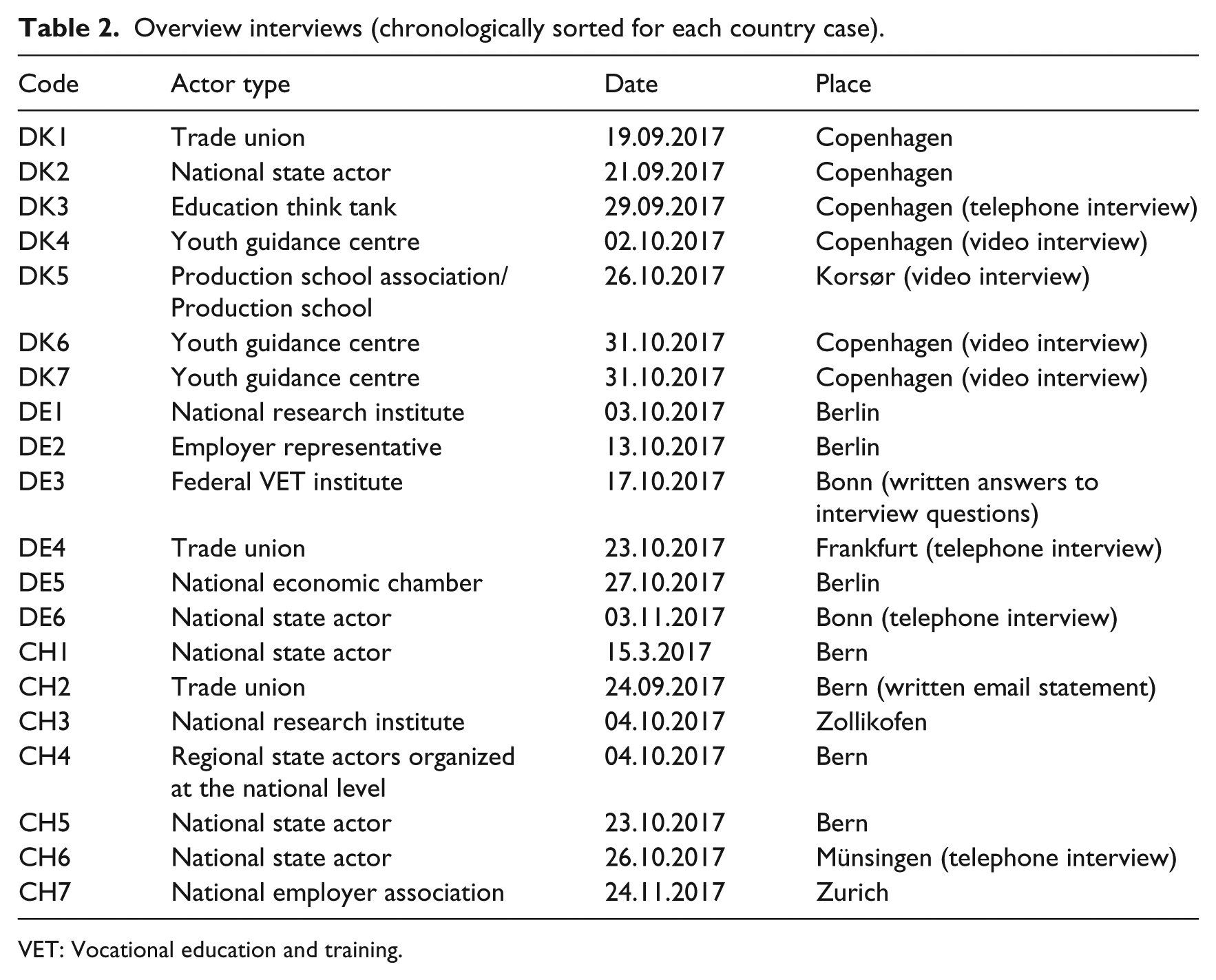
| Code | Actor type | Date | Place |
|---|---|---|---|
| DK1 | Trade union | 19.09.2017 | Copenhagen |
| DK2 | National state actor | 21.09.2017 | Copenhagen |
| DK3 | Education think tank | 29.09.2017 | Copenhagen (telephone interview) |
| DK4 | Youth guidance centre | 02.10.2017 | Copenhagen (video interview) |
| DK5 | Production school association/Production school | 26.10.2017 | Korsør (video interview) |
| DK6 | Youth guidance centre | 31.10.2017 | Copenhagen (video interview) |
| DK7 | Youth guidance centre | 31.10.2017 | Copenhagen (video interview) |
| DE1 | National research institute | 03.10.2017 | Berlin |
| DE2 | Employer representative | 13.10.2017 | Berlin |
| DE3 | Federal VET institute | 17.10.2017 | Bonn (written answers to interview questions) |
| DE4 | Trade union | 23.10.2017 | Frankfurt (telephone interview) |
| DE5 | National economic chamber | 27.10.2017 | Berlin |
| DE6 | National state actor | 03.11.2017 | Bonn (telephone interview) |
| CH1 | National state actor | 15.3.2017 | Bern |
| CH2 | Trade union | 24.09.2017 | Bern (written email statement) |
| CH3 | National research institute | 04.10.2017 | Zollikofen |
| CH4 | Regional state actors organized at the national level | 04.10.2017 | Bern |
| CH5 | National state actor | 23.10.2017 | Bern |
| CH6 | National state actor | 26.10.2017 | Münsingen (telephone interview) |
| CH7 | National employer association | 24.11.2017 | Zurich |
VET: Vocational education and training.
Acknowledgements
We thank the members of and scientific advisers to the Swiss research cluster entitled Governance in Vocational and Professional Education and Training (GOVPET) for their generous and insightful comments. Earlier versions of this article were presented at the 25th International Conference of Europeanists in Chicago on 28 March 2018, at the Annual Conference of the Swiss Political Science Association in Geneva on 5 February 2018 and at the international Congress on Governance of Education in Basel on 11 November 2017. We thank all the commentators for their helpful and relevant feedback.
Authors’ note
Authors are listed in alphabetical order. All authors contributed equally to the design and implementation of the research, to the analysis of the results and to the writing of the manuscript.
Declaration of conflicting interest
The author(s) declared no potential conflicts of interest with respect to the research, authorship, and/or publication of this article.
Funding
The author(s) disclosed receipt of the following financial support for the research, authorship, and/or publication of this article: This work was supported by the Swiss research cluster entitled Governance in Vocational and Professional Education and Training (GOVPET).
