



Abstract
The aim of this study is to reveal perceptions of pre-service teachers about ‘LEGO robotic instructional practices,’ ‘augmented reality’ and ‘flipped classroom’ concepts through metaphors. The study is descriptive research that was conducted as a survey model. The study group consists of 37 pre-service teachers studying the undergraduate programme of Science Teaching, Faculty of Education of a university in the Western Black Sea Region in the spring semester of the academic year 2016–2017. A form consisting of three open-ended questions was used as a data collection tool during the study. The data acquired were analyzed through content analysis method. Following the study, 15 different metaphors created in relation to the LEGO robotic instructional practices concept were categorized as ‘edutainment tool,’ ‘a technological tool’ and a ‘development tool,’ while 24 different metaphors created in relation to the augmented reality concept were categorized as ‘Perception Of Reality’, ‘A Technological Tool’, ‘Change/Transformation Tool’ and ‘Entertainment Tool’. Moreover, 25 different metaphors created in relation to the flipped classroom concept were classified in two categories as a ‘form of education’ and ‘an education shaping tool’. Moreover, almost all of the metaphors created were observed to have positive features.
Introduction
The rapid developments achieved in technology in the recent years have significantly influenced all systems of contemporary societies; the tools presented by technology have begun to take their place among the indispensable elements of our lives. The education system, without doubt, is among the systems influenced by those developments. The considerable influence of the use of technology on our daily lives has brought along the requirement that the technologies that can be used in learning-teaching environments must adapt themselves accordingly. Especially after constructivist learning and student-centred learning have become the focus of interest, the use of instructional technologies in today’s educational environments has also become intense (Ugur Erdogmus & Cagiltay, 2013). The current time period is the age of more realistic technologies, providing students with opportunities to gain much more experience and increasing cooperation (Turan et al., 2016). In this sense, ‘robotic instructional practices’, ‘augmented reality’ and ‘flipped classroom model’ embodying the said characteristic features are among the technology-based popular instructional practices. The mentioned practices are also addressed as the technological developments of the recent years in Horizon Report which is published regularly by The New Media Consortium (Adams Becker et al., 2017) and included among the major developments in the field of educational technologies (Johnson et al., 2015; Johnson et al., 2016). Furthermore, the importance of these practices is underlined in the sense that they enable individuals to associate knowledge with their real lives and allow for an active learning environment
The integration of these technologies into learning environments will continue in line with the ongoing technological development and renewal, and it is emphasized that what is important is to train the trainers who will effectively implement the technologies in a frame of precise objectives (Cakiroglu, 2016). Thus, views of pre-service teachers on developing technologies should be analyzed since they are teachers of the future (Kahyaoglu et al., 2017). As a powerful cognitive tool in determining perceptions of these and similar technologies, the use of metaphors is considered an important method (Karakoc Ozturk & Dagistanlioglu, 2018). Moreover, metaphors created by students are regarded as an effective tool to examine significant aspects of their views (Akyol, 2017).
Metaphors are cognitive models enabling individuals to interpret a phenomenon through another phenomenon (Lakoff & Johnson, 2005; Saban, 2008). Strenski (1989) and Fidan (2014) suggest that metaphors in our minds have an effect that shapes our attitudes and behaviours, and Lakoff (1993) underlines that metaphors are a ‘way of thinking’, making it possible to attribute deep meanings to a concept beyond describing such a concept by using a superficially similar concept. Besides, metaphors enable us to clarify particular situations that previously went unnoticed and to see different aspects of them as well as to reapprehend an object or an event by way of association to another conceptual network of the semantic domain (Taylor, 1984). Metaphors and metaphorical thinking are highly important not only as mechanisms by which individuals attribute a meaning to their own worlds and daily lives but also in the aspect of their role in revealing ideas in instructional terms (Botha, 2009). Metaphors in education are pedagogical tools that help in describing abstract concepts in a concrete way (Singh, 2010). In this sense, students’ interpretation of abstract concepts, which they find difficult to understand and express, may be considered an aspect of learning by associating them to metaphors (Beldag & Gecit, 2017).
Metaphors are of particular importance as they set the perceptions, beliefs and tendencies of pre-service teachers and contribute to their professional/vocational development (Noyes, 2004). There are a large number of studies evidencing that metaphors have been often used in recent years to identify the perceptions of pre-service teachers (Ersen, 2016; Gecit & Gencer, 2011; Karabay, 2016; Koc, 2014; Ma & Gao, 2017; Onen Ozturk & Aglarci, 2017; Saglam Kaya, 2017; Sahin & Sabanci, 2018; Tok, 2018). Nevertheless, implementation of technology-based instructional practices such as robotic instructional practices, flipped classroom models and augmented reality and adaptation of such practices as required by user views are deemed to be essential. Accordingly, as pre-service teachers are the primary future implementers and instructors of the said practices, it is suggested that their perceptions on these practices should be examined (Cukurbasi et al., 2018). There are a limited number of studies in the literature that address metaphors relating to new and rather specific technologies, such as flipped classroom, augmented reality and robotics (Cetintas & Avcu, 2017); it has been observed that the studies mainly address general concepts such as science (Biyikli et al., 2014; Kiral, 2017; Senel & Aslan, 2014; Uslu et al., 2016), technology (Arslan & Zengin, 2017; Karacam & Aydin, 2014; Karakoyun, 2017; Koc, 2013; Korkmaz & Unsal, 2016), the Internet (Suer et al., 2017) and social media (Fidan, 2014; Koseoglu, 2018; Sarac, 2018). Therefore, it is important to identify metaphors relating to current and developing technologies in terms of instructional inference-making on positive and negative tendencies of pre-service teachers towards such technologies, meanings they ascribe, and their status in using such technologies and integrating them to learning environments. In this context, views of pre-service teachers were referred to and the following three innovative technologies are addressed in the study, through the brief definitions, assumptions and instructional aspects below.
LEGO robotic instructional practices (LRIP)
LEGO is a kind of toy consisting of pieces in different colours that can be joined together to create almost any object. The use of robotic systems, which are created in instructional environments by joining such pieces with a programmable LEGO piece and various sensors and motors for a particular purpose, is referred to as LRIP (Cukurbasi & Kiyici, 2018). Robotic instructional media such as LRIP improve innovation skills and the creativity of students (Eguchi, 2014; Erdogan et al., 2013), enrich critical thinking and problem-solving skills of students during robotic activities (Hinton, 2017) and, it is noted that robotic activities provide a great contribution to learning abstract science concepts (Erdogan et al., 2013). Moreover, robotic activities contribute to the development of communication and cooperation skills (Eguchi, 2016). The study carried out by Cam et al. (2017) on LRIP, which stands out as one of the most innovative and popular robotic platforms (Hinton, 2017), points to the considerable increase in the number of studies on LRIP in related fields. Yolcu and Demirer (2017) reviewed 45 studies on the use of robotic technologies between the years 2007–2017, which were seen to have most commonly employed LEGO Mindstorms products as the material. Thus, it is noted that as the prospective LRIP instructors, the eager and willing attitude of pre-service teachersfor LRIP is a crucial factor for future instructional activities (Cukurbasi et al., 2018).
Augmented reality (AR)
AR is a technology by which the real world and virtual images are joined, and a simultaneous interaction is ensured between real and virtual objects (Carmigniani et al., 2011). Kounavis et al. (2012) addresses AR as a visualization technique combining computer-based information with physical media. Fidan (2018) describes AR as a technology, which combines the real world with digital media to augment the user’s perception of reality. The AR concept in the literature is usually confused with the virtual reality (VR) concept. As a matter of fact, AR is a variation of VR and what distinguishes AR from VR is that AR is based on the real-world environment (Azuma, 1997). AR technology is becoming widespread in the field of education as in many other fields, thanks to its fascinating structure and the opportunities it offers. Also, the study by Kiyici (2018), which reviews the studies carried out on AR, indicates that there has been an increasing trend, year by year, in studies premised on this technology in the field of educational sciences.
AR is used in the visualisation of complicated course subjects for better understanding (Wu et al., 2013; Yoon et al., 2017), thus ensuring a more entertaining and interesting class (Akcayir & Akcayir, 2017; Tomi & Rambli, 2013), representing abstract concepts in concrete form (Cai et al., 2014; Fidan, 2018; Wojciechowski & Cellary, 2013), teaching abstract concepts (Abdusselam, 2014; Lee, 2012), and safely introducing dangerous experiments (Cai et al., 2014). Moreover, AR technology contributes to the realization of permanent learning by offering a real learning experience in which more senses are incorporated (Saltan & Aslan, 2017).
Flipped classroom (FC)
FC is a system in which students complete certain online pre-learning activities (usually watching videos that address brief and important points) so that they prepare in advance for instructional activities structured within the classroom (Reidsema et al., 2017). FC enhances the interaction of students with their teachers and peers, provides the opportunity to pause and re-play the video records prepared by teachers, encourages students to study and helps in recording all student activities (Bergman & Sams, 2012). In addition, it is emphasized that FC practice is perceived by students as a useful instructional experience, and FC involves access to information, which assists students in learning, assessment and feedback, and structuring of information (Awidi & Paynter, 2019). Studies
Purpose and questions of the study
In light of the foregoing explanations and on the basis of the relevant literature, the aim of this study is to reveal the perceptions of pre-service teachers studying in the undergraduate programme in science teaching about ‘AR’, ‘LRIP’ and ‘FC’ concepts through metaphors. In this context, answers are sought for the following questions:
What are the metaphors which pre-service science teachers have in respect of the ‘LRIP’, ‘AR’ and ‘FC’ concepts?
Under which categories the metaphors which pre-service science teachers produce in respect of the ‘LRIP’, ‘AR’ and ‘FC’ concepts can be classified?
Methodology
This is a descriptive study, which was conducted in survey model.
Study group
The study group consisted of 37 pre-service teachers studying the undergraduate programme of Science Teaching, Faculty of Education of a university in the Western Black Sea Region in the spring semester of the academic year 2016–2017. In this sense, undergraduate students who enrolled in an elective course on the use of technology in science teaching and voluntarily participated in the study were included in the study. Data on the demographic characteristics of pre-service teachers are given in Table 1.
Demographic Characteristics.

The pre-service teachers
Collection of data
In order to reveal metaphorical perceptions of the pre-service teachers who took part in the study, a form consisting of three open-ended questions such as ‘LEGO robotic instructional practices are like . . . because . . .’, ‘Augmented Reality is like . . . because . . .’ and ‘Flipped Classroom is like . . . because . . .’ was used. In studies on metaphors, the term ‘like’ is usually employed to denote more clearly the similarity between the subject of metaphor and the source of the metaphor (Saban, 2008). The term ‘because’ was also incorporated into the study in order to ensure that the participants produced a logical reason for their analogies. In this frame, forms prepared by the researcher were handed out to the pre-service teachers, asking them to focus on only one metaphor for each concept. After they chose the metaphors, the students were asked to submit a detailed rationale for them in the second part of the sentence. Before filling out the form, the participants were informed about the metaphors by the researchers through examples. The pre-service teachers spent 15–20 minutes to complete filling out the form.
Analysis and interpretation of data
Content analysis was used to analyze the metaphors developed by the pre-service teachers. Cohen, et al. (2007) define content analysis as summarizing and reporting the basic content of written information available and the messages it includes. In other words, content analysis is aimed at identifying data and revealing the facts inherent in such data (Gulbahar & Alper, 2009). In this frame, the data obtained are converted into systematic data, or in other words, categorized. Then, precise, definite, and detailed rules are identified to allow all participating students to interpret in the same manner; that is, categories are fully formulated (Tavsancil & Aslan, 2001). The metaphors developed by the pre-service teachers are analyzed and interpreted in four stages.
Choosing and coding metaphors
A comprehensive list was prepared for the metaphors developed. According to this list, the data collected from the pre-service teachers were examined in terms of whether they involved a metaphor clearly defined for them, and whether they were associated with the related concepts. The data sheets, which did not contain any clearly defined metaphor, were marked and sorted. Two sheets related to the LRIP concept, one sheet related to the AR concept and two sheets related to the FC concept were screened out as they lacked a specific rationale.
Classification of metaphors and development of categories
At this stage, metaphors produced by the pre-service teachers were grouped and categorized by their common characteristics. Each metaphor was associated in terms of the pre-service teachers’ perceptions about the LRIP, AR and FC concepts. Following the mentioned procedures, 64 metaphors in total were included within the scope of study. In addition, it was observed that some of the metaphors were produced by several pre-service teachers.
Determining exemplary metaphors and rationale
The documents that were deemed to be the best representative of the metaphors developed were selected with the aim of creating a list. Metaphors were determined by means of exemplary statements thus selected. The abbreviation ‘PST’ was used for the quotes of the pre-service teachers in respect of the rationale of related metaphors, and each of the pre-service teachers was assigned a number. For instance, PST-1 refers to the first pre-service teacher who participated in the study while PST-2 refers to the second.
Validity and reliability works
The data collected were extensively reported, original statements of the participants were exactly quoted without any addition and the method used by the researcher to achieve the results was described; these are the most significant indicators of validity in terms of qualitative research (Yildirim & Simsek, 2011). In this sense, the data analyzed were reported in detail along with their frequencies and categories; original statements that were deemed to be convenient as representatives of the metaphors obtained, and their rationales were compiled and listed in the findings section. Whereas, with regard to the reliability of the study, two experts were referred to for their views about whether the metaphors obtained were representative of the conceptual categories created, the numbers of agreement and disagreement were identified based on reviews of experts. The reliability formula suggested by Miles and Huberman (1994) was used to perform a reliability estimation of the study. Following the estimation, it was found that the research has a reliability ratio of 92%. Reliability of the coefficient ratio above 70% is considered reliable for the study (Miles & Huberman, 1994).
Determining exemplary metaphors and rationale
All the data were computerized, tabulated and interpreted along with their frequencies.
Findings
This section contains findings on metaphors related to the ‘LRIP’, ‘AR’ and ‘FC’ concepts in line with the research questions, and categories in which the metaphors are addressed.
Metaphors relating to the ‘LRIP’
In the scope of the study, 15 different metaphors created by the pre-service teachers in relation to the ‘LRIP’ concept were divided into three sub-categories, which included ‘edutainment tool’, a ‘technological tool’ and a ‘development tool’. Table 2 shows the metaphors relating to the ‘LRIP’ concept and their distribution by category.
Metaphors Produced In Relation To The ‘LRIP’.
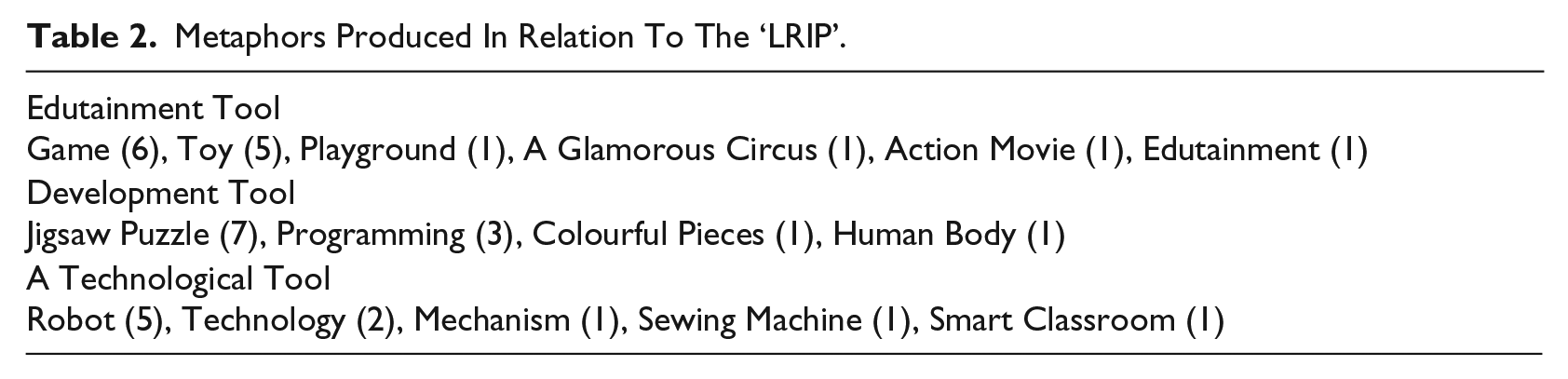
When Table 2 is examined, it is seen that the pre-service teachers produced the metaphors related to the ‘LRIP’ concept most commonly under the sub-theme ‘edutainment tool’. Accordingly, it was found out that the participants most commonly indicated the metaphors ‘game’ (f = 6) and ‘toy’ (f = 5). For this category, the rationale for the metaphors produced by certain pre-service teachers were addressed:
PST-5: Creating and programming robots and completing certain missions brings the concept of a game to mind. (Game)
PST-4: This application both entertains us and helps us learn. We can create our toys by ourselves. We can include new information to create more different designs and applications. (Toy)
PST-23: You can feel like a child while making a robot, time flies when you’re having fun. This primarily involves psychomotor skills. Students learn by doing. (Action movie)
Under the category of ‘development tool’, the pre-service teachers most commonly made an analogy between the LRIP and the ‘jigsaw puzzle’ concept. In terms of frequency, this metaphor is followed by programming (f = 3), colourful pieces (f = 1) and human body (f = 1), respectively. Below are some of the statements made by the participants regarding the rationale of the metaphors produced in this category:
PST-8: We’re trying to build an entire structure by using LEGO pieces, and finally we sort of create a product. (Jigsaw puzzle)
PST-11: Dozens of colourful pieces are put together to form a whole, they would not be so attractive and entertaining if they were colourless. (Colourful pieces)
PST-14: Going from part to whole, we create a system. We can make an analogy between the smallest units and cells. (Human body)
Under the category of ‘A technological tool’, the most commonly addressed metaphor is ‘robot’ (f = 5), which is followed by technology (f = 2). Additionally, the metaphors ‘mechanism’, ‘sewing machine’, and ‘smart classroom’ were each produced by one participant in relation to the concept mentioned. Below are some of the rationales presented by the pre-service teachers regarding the metaphors developed in this category:
PST-7: Robot design is, in a way, a mechanical work force which we can use for different tasks. We can program a robot to make it move however we want. (Robot)
PST-19: The aim of science is to try to understand and explain the natural world. Technology, on the other hand, is aimed at changing the natural world in order to meet demands and needs of people. It is observed that technology supports improvement of certain scientific skills, saves time and enhances critical and creative thinking skills of students. (Technology)
PST-19: LEGO robotic instructional practices are just like a sewing machine, which enables us join pieces to create a product. (Sewing machine)
Metaphors relating to the ‘AR’
In the scope of the study, 24 different metaphors created by the pre-service teachers in relation to the ‘AR’ concept were divided into four sub-categories, which are ‘Perception of Reality’, ‘A Technological Tool’, ‘Change/Transformation Tool’ and ‘Entertainment Tool’. Table 3 shows the metaphors relating to the ‘AR’ concept and their distribution by category.
Metaphors Relating To The AR Concept.
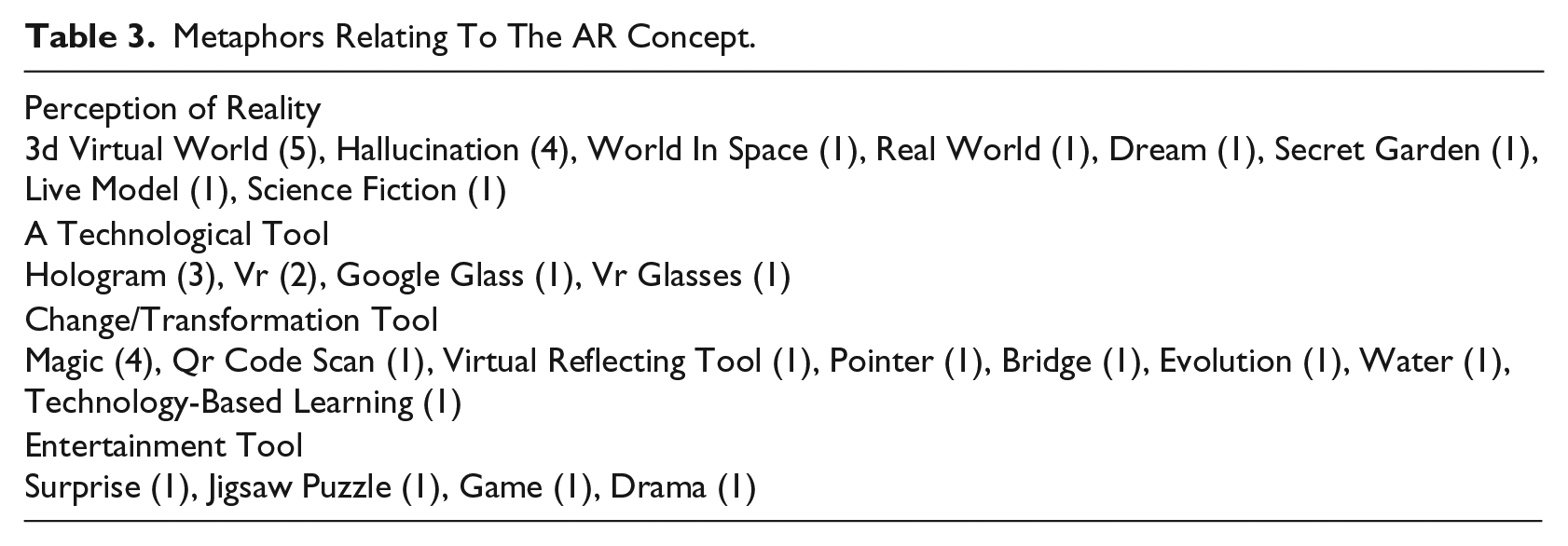
When Table 3 is examined, the metaphors produced by the pre-service teachers in relation to the ‘AR’ concept were most commonly listed in the category ‘Perception of Reality’. Under this category, ‘3D virtual world’ (f = 5) and ‘hallucination’ (f = 4) were the most commonly addressed metaphors. Furthermore, the participants made an analogy between AR and the concepts ‘world in space’, ‘dream’, ‘secret garden’, ‘live model’ and ‘science fiction’. Below are the rationales presented by some of the pre-service teachers in relation to the metaphors produced in this category.
PST-30: Hallucination seems real to the experiencer even though it is unreal. Augmented reality, on the other hand, is where virtuality meets reality. (Hallucination)
PST-6: I think that the augmented reality behind images is more beautiful, vibrant and attractive. (Secret garden)
Under the category of ‘A technological tool’, it was observed that the pre-service teachers most commonly developed the metaphors ‘hologram’ (f = 3) and ‘virtual reality’ (f = 2). ‘Google glass’ and ‘Virtual reality glasses’ were each used in analogies to the AR concept by a participant. In reference to these findings, some of the pre-service teachers presented the following rationale:
PST-15: We encounter the silhouette - virtual image of an object or human like a hologram, as if it were with us. . . (Hologram)
PST-22: In fact, it simulates an object or environment that physically does not exist, it reminds me of the term virtual reality, which is commonly used. (VR)
PST-35: This is a similar technology to Google virtual reality headset, which I have seen before. It was more of a wearable computer, but this one can be viewed on different devices. (Google glass)
The metaphor most commonly addressed by the pre-service teachers under the category of ‘Change/Transformation Tool’ is ‘magic’ (f = 4). Additionally, an analogy was made to the concepts of QR code scan, virtual reflecting tool, pointer, bridge, evolution, water, and technology-based learning. Below are some examples of the rationale presented by the pre-service teachers regarding the metaphors developed in this category:
PST-16: The sheet you hold in your hand is no different than ordinary sheets, but it’s animated as soon as you hold an application on it. Actually, it isn’t there, but it looks like it is real. (Magic)
PST-21: Just like water being the source of life for human beings, augmented reality and other applications also have the same function in terms of education. They liven up the class and increase interest. (Water)
The metaphors created in category ‘Entertainment Tool’ are ‘surprise’, ‘jigsaw puzzle’, ‘game’ and ‘drama’. In reference to these findings, the pre-service teachers who made an analogy between the AR and the concepts ‘drama’ and ‘surprise’ presented the following rationale:
PST-3: Drama involves animation. But it is not fully real. Augmented reality, on the other hand, presents an image which will enable us to better picture the image in our minds. (Drama)
PST-26: This makes us wonder about what will meet us, whether it will be a virtual show, whether it will be entertaining or how it is designed. (Surprise)
Metaphors relating to the ‘FC’
In scope of the study, 25 different metaphors created in relation to the ‘FC’ concept were classified in two sub-categories as ‘form of education’ and ‘an education shaping tool’. Table 4 shows the metaphors relating to the ‘FC’ concept and their distribution by category.
Metaphors Relating to the FC Concept.
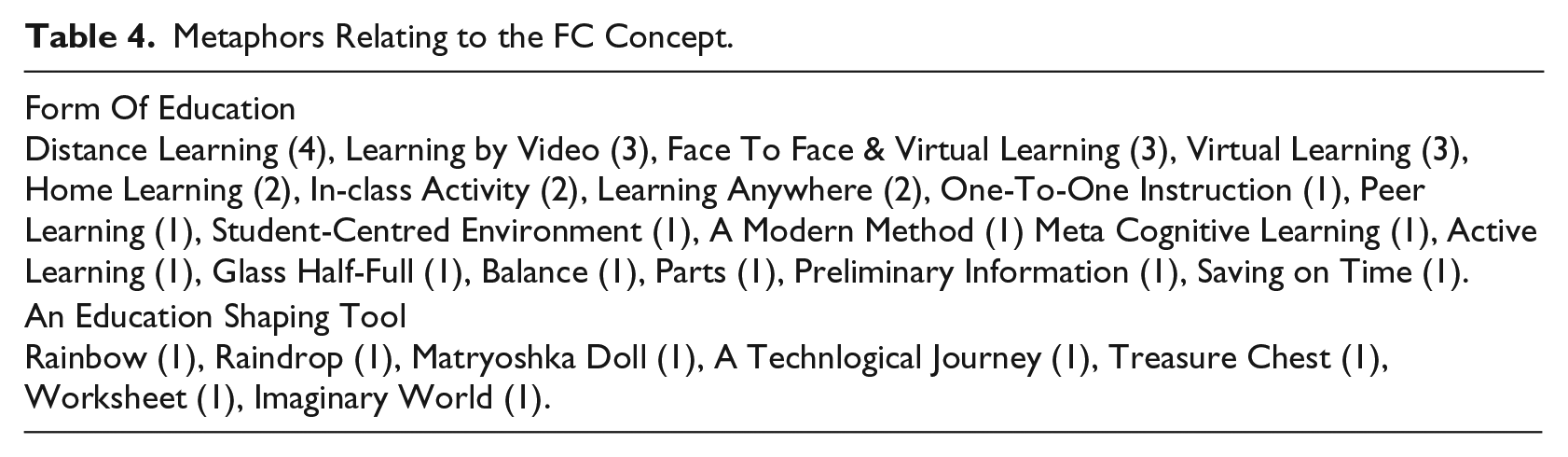
When Table 4 is examined, the metaphors produced by the pre-service teachers in relation to the ‘FC’ concept are most commonly listed in the category ‘Form of Education’. Under this category, the pre-service teachers commonly made an analogy between FC and the concepts of ‘distance learning’ (f = 4), ‘learning by video’ (f = 3), ‘face to face and virtual learning’ (f = 3) and ‘virtual learning’ (f = 3). Below are some of the rationales for the metaphors produced in the category ‘Form of Education’:
PST-8: We see our teacher in videos, as well. The distance learning method used prevents loss of time. So we can have more time to spend for in-class activities. (Distance learning)
PST-23: We have the opportunity to repeat the course lectured in the class by viewing the video of that course at any time we want, and being able to rewind-forward videos is an advantage for learning because we do not have the chance to have the teacher’s lecture repeated. (Learning by video)
PST-12: Let’s assume that a student without knowledge about the topic is an empty glass. Later, what they have learned through flipped classroom method will fill that glass half, and help the glass be filled in following practices. (Glass half full)
PST-1: The teacher can attract attention while lecturing on the subject. Allowing students to view the favourite parts will arouse their interest. This will make the lesson more entertaining. And there is the opportunity to repeat the video several times for distracted or uninterested students. (Parts)
Under the category of ‘an education shaping tool’, the pre-service teachers made an analogy between FC and the concepts of ‘rainbow’, ‘raindrop’, ‘matryoshka dolls’, ‘a technological journey’, ‘treasure chest’, ‘worksheet’ and ‘imaginary world’. Below are the rationales presented by some of the participants in relation to the metaphors produced in this category.
PST-35: It contains a variety of colours which offer a magnificent view when they come together. (Rainbow)
PST-6: When they open the chest, they will find the gold, or in other words, the information; so they will be prepared for the next lesson and the activities. They will be able to play the video as many times as they want, take notes, answer the questions in the video and make use of the interactive flipped classroom environment. (Treasure chest)
PST-18: They can always offer something more beautiful and more entertaining. Like matryoshka dolls, once you think you have none left, you will get one more. Therefore, I made an analogy to this example. (Matryoshka doll)
Discussion and conclusion
In the scope of this, which aimed to reveal metaphorical perceptions of the pre-service science teachers on the concepts of ‘LRIP’, ‘AR’ and ‘FC’, the 64 metaphors obtained were classified under nine conceptual categories and the results were discussed in the light of the findings obtained. The findings obtained from the study reveal that the most commonly produced metaphors in relation to the ‘LRIP’ concept are in categories of ‘Edutainment tool’, ‘Development tool’ and ‘A technological tool’. In the category of ‘Edutainment tool’, which is represented by the highest number of metaphors, the participants most commonly produced the metaphors ‘game’ and ‘toy’. The category of ‘Development tool’ was most commonly represented by the metaphor ‘jigsaw puzzle’, while the category of ‘A technological tool’ is most commonly represented by the metaphor ‘robot’. This manifests that the participants have positive views on the related concept and usually they associate it with the concept of ‘entertainment’. Hence, it was observed that the results obtained from this study have similarities to the study
The metaphors most commonly produced by the participants in relation to the ‘AR’ concept are in the categories ‘Perception of Reality’, ‘Change / Transformation Tool’, ‘A Technological Tool’ and ‘Entertainment Tool’. In the category ‘Perception of Reality’, which is represented by the highest number of metaphors, the participants most commonly produced the metaphors ‘3D virtual world’ and ‘hallucination’. Indeed, the AR technology allows students to have fascinating experiences by integrating virtual objects into their real
The metaphors most commonly produced by the participants in relation to the ‘FC’ concept are in the categories ‘Form of Education’ and ‘An Education Shaping Tool’. In the category ‘Form of Education’, which is represented by the highest number of metaphors, the participants mainly produced the metaphors ‘distance learning’, ‘learning by video’, ‘face to face and virtual learning’ and ‘virtual learning’. In the category of ‘an education shaping tool’, the metaphors ‘rainbow’, ‘raindrop’, ‘matryoshka dolls’, ‘a technological journey’, ‘treasure chest’, ‘worksheet’ and ‘imaginary world’ were produced in equal number. No study has been found in the literature which examines the metaphorical perceptions in relation to the FC. However, the studies which reveal views of participants on the FC are observed to have results that are supportive of the findings obtained in the scope of the study. (Goru Dogan, 2015; ThiThanhQuyen, 2017; Yildiz et al., 2017; Yilmaz, 2017; Xiu et al., 2018). In the study by Cukurbasi and Kiyici (2017), where the participants were prepared for the classes by using the FC method, they took active roles in the class, they had the opportunity to view the videos repeatedly and to eliminate time and space restrictions. Moreover, Akgun and Atici (2017) evidenced that the participants had the opportunity to work at their own learning pace, they were able to use the time in the class more efficiently, they were prepared in advance for the class and their active participation in the class was increased.
Briefly, it was observed that the pre-service teachers have positive views on the new technologies and they attribute instructional meanings to these technologies. The reason for these views of the participants might include applied trainings on new technologies in the scope of the related course and their experience in it. Considering that the pre-service teachers have a positive tendency towards related technologies in the study, integration of these technologies into classes in training of teachers may facilitate learning and contribute to improvement of the entertaining aspects of classes.
The study was carried out within the context of a class and therefore the number of participants was low, which may be regarded as a restriction. Nevertheless, it is considered that necessary materials and applied courses for instructional technologies such as LRIP, AR and FC are not adequate in instructional environments. In this frame, more materials can be made available in the future and richer data can be obtained in a larger sample group; further studies can be carried out by integrating new technologies and practices (e.g. virtual reality, hologram). Additionally, a comparative study can be conducted on metaphors regarding the content of the lecture to pre-service teachers on new technologies, and analyzed in two stages before and after the instructional practice.
Footnotes
Acknowledgements
This study is the extended and enhanced version of the paper titled ‘Öğretmen Adaylarının LEGO Robotik Öğretim, Artırılmış Gerçeklik ve Ters Yüz Edilmiş Sınıf Kavramlarına İlişkin Metaforik Algıları’ which was presented as an abstract between 7-8 December 2017 at the International Conference on Quality in Higher Education (ICQH 2017), which is not included in the proceeding as a full text.
Funding
The author(s) received no financial support for the research, authorship and/or publication of this article.
Declaration of conflicting interests
The author(s) declared no potential conflicts of interest with respect to the research, authorship, and/or publication of this article.
