



Abstract
Within the Middle East and North Africa region, more than 5,600,000 Syrian refugees are currently registered with the UN Refugee Agency (UNHCR) as seen here https://www.unhcr.org/. Amongst university-aged refugees, only a small fraction (Jordan – 8%, Lebanon – 6%, Turkey – 1%) are currently enrolled in higher education. This paper, based on empirical qualitative research with Syrian refugee youth, is a critical investigation into their access to, and experiences with, higher education opportunities provided for them by local and international partners. Using interview and focus group data, the paper examines the availability, accessibility, acceptability and adaptability of higher education opportunities currently on offer for Syrian refugees in Jordan, Lebanon and Turkey. The paper argues that while access to higher education is increasing for refugees within the Syrian context, accessibility, acceptability and adaptability of these opportunities to the needs of refugees remains problematic. In this way, higher education often falls short of enabling refugees to live lives that they have reason to value.
Introduction
Despite the importance of higher education for refugees, access is severely limited, and globally only 1% of refugees attend university (The UN Refugee Agency (UNHCR), 2016). Where higher education is available for refugees, it is not always accessible, nor is it always acceptable to individuals and communities. Moreover, available higher education opportunities for refugees are not always adaptable to their particular needs. From a capabilities perspective, higher education on offer for refugees does not always increase their ‘functionings’ – the ability to be or do what is valuable to the individual. It also does not always enable an expansion of refugees’ ‘capabilities’ – their freedoms and opportunities to achieve the effectively possible (Robeyns, 2003; Sen, 1992; Vaughan, 2007). As a result of the inadequate attention paid to higher education within contexts of displacement, there are research gaps in relation to the availability of higher education for refugees, refugees’ access to these opportunities, refugees’ expectations from higher education and their experiences within it. Where research has been conducted in this area, many studies have not met the standards of academic rigour.
Using empirical qualitative research (with focus groups as the primary research method), this paper is a critical investigation into Syrian refugees’ interest in, access to and experiences within higher education opportunities provided for them by local and international partners within the Middle East and North Africa (MENA) region. The war in Syria has been widely regarded as one of the biggest humanitarian crises of modern times and has resulted in an influx of millions of refugees into neighbouring countries (particularly Jordan, Lebanon and Turkey). Within this context, key questions raised in relation to higher education include: what higher education opportunities are currently available for Syrian refugees in Jordan, Lebanon and Turkey? How do refugees engage with these opportunities (i.e. accessibility, acceptability)? To what extent are these opportunities adaptable to the needs, desired functionings and capabilities of refugees?
This paper aims to address these questions by examining the availability, accessibility, acceptability and adaptability of higher education opportunities currently on offer for Syrian refugees in Jordan, Lebanon and Turkey. Availability looks at the existence of higher education opportunities (of all types and at all levels) currently on offer for refugees within these country contexts. Accessibility is an analysis of the direct and indirect barriers faced by particular groups of refugees in relation to accessing the higher education opportunities that are available to them (‘conversion factors’). Acceptability is an analysis of how higher education can actually be of use to refugees, not only in seeking employment, but also in supporting their overall well-being and enabling them to achieve desired functionings. Finally, adaptability is an analysis of the efforts of higher education systems, institutions and providers to promote inclusiveness and to be flexible towards the particular needs of refugees (rather than the other way around) to enable them to turn education resources into capability sets (Tomasevski, 2006).
The paper argues that while higher education opportunities for refugees are becoming increasing available within these contexts (although demand is far from being met), the accessibility, acceptability and adaptability of these opportunities to the needs of refugees remain problematic as they are being conceptualized with reference to a decontextualized and homogenized universal (western) male subject. Moreover, as higher education for refugees is being conceptualized through neoliberal discourse, the overarching aim is to improve employment outcomes, produce a skilled workforce and drive post-conflict reconstruction. However, this one-size-fits-all approach to higher education, with predetermined notions of refugees’ desired functionings, fails to address the non-financial aspects of welfare and refugees’ other capabilities (e.g. being part of a community, being respected, etc.) In this way, higher education, as it is currently conceptualized and operationalized within refugee contexts, is falling short of enabling young people to live lives that they have reason to value (Sen, 1992).
Background
It is estimated that two-thirds of the world’s refugees live in contexts of protracted displacement (Sheehy, 2014). In such contexts, refugees often face challenges of protection and human rights, including confinement to camps, restricted movement and/or difficulties in service access in urban areas. Refugees are often unable to access the full cycle of education, earn livelihoods or develop sufficient resilience for self-reliance and meaningful participation in civil society.
Education, which has traditionally been considered to be a foundational component of long-term development assistance, is increasingly being included in humanitarian relief efforts (UNHCR, 2016). Although it is gaining traction, in terms of humanitarian assistance, higher education for refugees still remains low on the agenda and has been perceived as a luxury in contexts without universal primary or secondary education. In most humanitarian crises, this age group is overlooked because they fall outside the more vulnerable category of school-aged children, and limited resources tend to restrict aid to compulsory education (primary school) (Chatty, 2016). Indeed, costs for higher education remain elevated in comparison with primary or secondary education, and tertiary education programmes require multi-year donor commitment to enable students to graduate (Sheehy, 2014). Moreover, critics argue that investment in higher education is likely to benefit only a small and elite group of refugees (Dryden-Peterson, 2010).
Yet humanitarian professionals argue that higher education is particularly important for refugees as it can provide many social and economic benefits for individuals and communities (Sheehy, 2014). For individuals, higher education can help to combat feelings of stagnation and hopelessness, support the process of self-actualization, promote the development of active social networks and facilitate refugees’ social integration into the host society. It can also provide individuals with the knowledge and skills they need to achieve better livelihood prospects, enhance their opportunities for economic self-reliance, facilitate their economic integration into local economies and enable their greater participation and leadership possibilities in civic and public life (e.g. serve as role models for children and youth) (Sheehy, 2014). For governments, higher education has the potential to foster social stability and cohesion and grow and sustain the economy. Moreover, higher education has the potential to create a well-educated and skilled labour force that the business sector can then access (UNHCR, 2016). During post-conflict reconstruction, educated refugees are the human capital that can play an important role in rebuilding local, national and regional institutions and provide teachers for schools (Sheehy, 2014).
Refugees themselves may have various motivations for wanting to undertake higher education, including the instrumental – to achieve a given end, such as employment (Brown and Scase, 1994; Saiti and Prokopiadou, 2008; Street et al., 2006; Townsend 2003), the intrinsic – to achieve personal satisfaction (Collier et al., 2003; Pasternak 2005) and the social – to secure an advantageous position in society (Antonio, 2004; Mullen, 2009). In one of the only studies specifically focused on exploring the needs and motives of Syrian university students, Al-Fattal and Ayoubi’s (2013) data reveals that there are essentially three dimensions related to how and why Syrian young people make decisions about their higher education. These are needs and motives related to ‘the self’, ‘the social’ and ‘the souk’ (market). Self needs and motives include a general love of knowledge, intrinsic interest in the subject matter, and a desire for personal development, empowerment, a sense of achievement and enhanced self-esteem. On the other hand, social needs and motives include family expectations and traditions, belonging to a local community, developing friendships, social networking, achieving an advanced social position and gaining respect from the community. Finally, souk needs and motives include improvement of job prospects and employability, increased future earnings, financial security, a comfortable standard of living, economic self-sufficiency and financial and social independence. The Al-Fattal and Ayoubi (2013) study reveals that Syrian young people often have multiple motivations for undertaking tertiary education, and these motivations may overlap in complex ways. For example, economic needs and motives may have social or familial dimensions, such as when young people intend (or are expected) to take over parents’ or family businesses.
Additionally, Buckner (2013) notes that there are gendered dimensions as to why Syrian males and females might decide to undertake higher education. Within the Syrian community, gender has traditionally been an important mediating factor in determining the link between higher education and employment. In line with other MENA countries, Syria has had a very low rate of female labour-force participation with only 15.1% of the entire labour force being female (Kabbani and Kamel, 2009). However, despite overall low labour-force participation rates for women, attending higher education has significantly facilitated Syrian females’ entry into the labour market. While males with primary schooling have been those with the lowest rates of unemployment, females with the lowest rates of unemployment have had higher education. This can be explained through the socially and culturally constructed gender roles and obligations in Syrian society (Buckner, 2013). Because of the pressure on Syrian males to earn a salary to provide for their families (the ‘breadwinner’s burden’), many men must accept any available job. On the other hand, as Syrian women are not considered to be primary breadwinners for their families, cultural norms discourage all but professional employment for women. This has traditionally meant that Syrian females have not entered the labour force unless they could obtain a professional job. As a result, higher education has been a much more powerful mechanism for female entry into the labour market, and there has been a dramatic increase in the number of working females with university credentials in Syria and in neighbouring countries. On the other hand, as Syrian females are not considered to be primary breadwinners, they have had the relative luxury of being able to study for reasons of intrinsic satisfaction rather than expected employment outcomes (Buckner 2013; Kabbani 2009). Although these studies on Syrian youth predate the refugee crisis, these same themes need to be explored and taken up within refugee contexts.
Despite the importance of higher education for refugees, access is severely limited and many of the brightest and most ambitious young Syrians have not had the opportunity to start university or have had their education abruptly disrupted (Ward, 2014). Syrian refugees in the MENA region face a unique situation: not only are their participation rates in higher education lower than those of their peers in host countries, participation of refugees in higher education is lower than the Syrian access rate before 2011 (European Union (EU), 2016). Before the war in Syria, approximately 20% of the age group 18–24 was in higher education. Today, this has dropped dramatically to almost half, and less than 5% of the more than 400,000 of this age group who have fled the country have access to higher education (EU, 2016). This indicates a considerable unmet demand for higher education amongst refugees living in exile.
When access to higher education for refugees is severely limited or non-existent, children and young people may become less motivated to enrol in and complete primary and secondary school (Sherab and Kirk, 2016). Lack of higher education opportunities, unequal access to these opportunities, and/or the wrong type of education can also contribute to regional insecurity and instability and increase refugees’ vulnerability to a range of undesirable outcomes, including criminal activity, radicalization or fighting for young men, and early or forced marriage for young women (United Nations Educational, Scientific and Cultural Organization (UNESCO), 2011; Watenpaugh et al., 2014a). When refugees are in need of a better future, they may consider desperate measures and become vulnerable to human traffickers.
It is against this backdrop that western donors, bilateral and multilateral organizations and international non-governmental organizations (INGOs) have been working with local partners to provide higher education opportunities for Syrian refugees in the neighbouring countries of Jordan, Lebanon and Turkey. The complex national and regional contexts in which this research takes place are discussed below.
Research context
Since the civil war broke out in March 2011, an estimated 11 million Syrians have fled their homes, and one-quarter of the Syrian population are now refugees or asylum seekers (UNHCR, 2020). Within Syria, approximately 6.6 million people are internally displaced, and within the wider MENA region (Turkey, Lebanon, Jordan, Egypt and Iraq), more than 5,600,000 Syrian refugees are currently registered with UNHCR (Migration Policy Centre, 2016; UNHCR, 2020). This research focuses on the country contexts of Jordan, Lebanon and Turkey – the countries hosting the largest number of Syrian refugees.
Jordan
Higher education in Jordan is relatively new. It began in 1958 with the establishment of Teachers’ House (Dar Al-Mu’lemeen), a two-year teacher training college. This was followed by the establishment of the first university in the country (the University of Jordan) in 1962 and the first private university (Al-Ahliyya Amman University) in 1989. Jordan currently has 10 public universities (generally offering a full range of bachelor’s, master’s and doctoral degrees), 18 private universities (offering primarily bachelor’s degrees), 2 regional universities and 51 community colleges (European Commission (EC) 2017a). Jordan is also a regional pioneer in online education through providers, such as Edraak. 1 These different types of opportunities have been made available to expand higher education access to different demographics of young people within the country. In Jordan, almost 236,000 students are enrolled in higher education (67% of them in public institutions), representing 30% of the total Jordanian population of that age group (Jordan Ministry of Higher Education and Research (Jordan MoHE), 2015).
Jordan is currently hosting more than 656,000 Syrian refugees (approximately 9% of the country’s population) and nearly 10,000 Palestinian refugees from Syria, making it the country hosting the sixth-highest number of refugees in the world (Human Rights Watch, 2014; UNHCR, 2020; United Nations Relief and Works Agency for Palestine Refugees in the Near East (UNRWA), 2020). The majority of refugees in Jordan (predominantly from regime-controlled areas centred around the southern Syrian city of Dera’a) are registered with UNHCR in the Amman, Mafraq, Irbid and Zarqa governorates in the northwest of the country. Most refugees (approximately 80%) in these areas live outside camps in urban and peri-urban areas where competition for resources and services with the host Jordanian community is most intense (UNHCR, 2016; Watenpaugh et al., 2013). The remainder of refugees (approximately 20%) live in camps run by UNHCR, the main camps being: Za’atari – housing 80,000 refugees; Azraq – housing 54,000 refugees; and Emirati-Jordanian – housing 7400 refugees (UNHCR, 2016, World Bank, 2016). Located near the city of Mafraq close to the border with Syria, Za’atari Camp is one of the world’s largest refugee camps and is in effect Jordan’s fourth-largest city (Watenpaugh et al., 2013). Only 8% of Syrian refugees in Jordan are participating in higher education (EU, 2016). This is due to a complex array of factors, including financial hardship and the higher cost of living in Jordan, refugees’ lack of identity documentation and proof of former study, institutional rigidity and the incapacity of Jordanian higher education institutions to absorb vast numbers of refugees. To address this need, international and local providers have focused on ways to increase access to higher education opportunities for refugees through scholarship programmes and increased provision of vocational training/technical studies and online education programmes.
While the government of Jordan has generally adhered to the humanitarian principles of refugee assistance and has provided Syrian refugees with a high degree of safety and security, the country is facing mounting economic, environmental and social pressures (Watenpaugh et al., 2013). Consequently, some policymakers have expressed concern that helping Syrians to access higher education will disadvantage young Jordanians in a state system that is already under pressure (Watenpaugh et al., 2013). As a result, Jordan is becoming increasingly inhospitable for refugees, which has resulted in their inability to move around the country freely, as well as their sometimes difficult interactions with Jordanian authorities and the general population (UNHCR, 2016). These tensions have influenced Syrian refugees’ interest in, access to and satisfaction with higher education opportunities in the country (Watenpaugh et al., 2013). Higher education is often strongly linked to the perception of employment outcomes. However, until recently, Syrians have not been entitled to work in Jordan, as the government was worried that they would push down wages, take jobs from Jordanians and be encouraged to stay permanently, stirring up resentment amongst the local population (Knell, 2016).
Lebanon
Compared to Jordan, higher education in Lebanon is well established. However, a distinctive feature of higher education in Lebanon is that it has historically been provided by private institutions (primarily missionaries), beginning formally in 1866 when the American Evangelical Mission established the Syrian Evangelical College, which was renamed the American University of Beirut in 1920. The Lebanese University, which was initially founded in the late 19th century to educate women, officially became a co-ed university in 1992. It remains the only public university in Lebanon. Today, there are 35 private universities, 1 public university (the Lebanese University) and 11 institutes of higher education in the country, offering a wide variety of educational opportunities (EC, 2017b). The vast majority of Lebanon’s universities were established after the end of the Lebanese Civil War (circa 1990) and are associated with a single religious group, political party or politician and draw students from a limited geographical range and social demographic. In 2007, around 160,000 Lebanese students were enrolled in universities (45% of them in the public university) and some 100,000 students were enrolled in technical and vocational studies (only 38% of them in public institutions) (Watenpaugh et al., 2014b).
Lebanon is currently hosting more than 910,000 registered Syrian refugees and nearly 29,000 Palestinian refugees from Syria (as well as over 475,000 Palestinian refugees) (Government of Lebanon, 2017; UNHCR, 2020; UNRWA, 2020). This means that one-fifth of the current population of Lebanon are Syrian refugees, and Lebanon has the highest per capita concentration of refugees in the world. Syrian refugees in Lebanon face particular challenges because of the complex history of Lebanon–Syria relations: Syria was an occupying force in the country from 1976 to 2005 and dominated Lebanon’s political and economic life for 29 years, which affects how Syrian refugees are currently perceived by their Lebanese ‘hosts’. Moreover, the presence of large numbers of Palestinians in the country, and their perceived role in past Lebanese conflicts, has contributed to a heightened anxiety amongst Lebanese about the presence of large numbers of refugees in Lebanon (Watenpaugh et al., 2014a). This concern has manifested itself in the Lebanese government’s refusal to give UNHCR permission to establish official refugee camps in the country (Jazar, 2015; UNRWA, 2016; Watenpaugh et al., 2014a). Thus, Syrian refugees are scattered in more than 1700 localities across the country (often in the poorest and most vulnerable neighbourhoods), often without adequate access to essential services (EU, 2016). Only 6% of Syrian refugees in Lebanon currently have access to higher education (EU, 2016). This is due to factors including financial hardship and the higher cost of living in Lebanon; refugees’ lack of identity documentation, residence permits and proof of former study; institutional rigidity; and the lack of capacity of Lebanese higher education institutions to absorb vast numbers of refugees. In response, international and local providers have been focusing on ways to increase access to higher education opportunities for refugees in Lebanon through scholarship programmes and increased provision of non-formal and online education programmes.
Lebanon’s public services and infrastructure (fragile even before the crisis) are now under severe strain as a result of the refugee influx (Watenpaugh et al., 2014a). The tensions described above have only been intensified within the context of Lebanon’s ‘weak state’, in which its governmental institutions are less powerful than many non-state actors. In particular, political movements and non-state paramilitary organizations organized along religious lines maintain considerable clout within the country (the most powerful being Shi’a-dominated Hezbollah). Hezbollah is actively supporting the Syrian government headed by Bashar Al Assad in the Syrian conflict. The Syrian government is dominated by the Alawi sect (offshoot of Shi’a Islam), while the majority of the Syrian population is Sunni. As a large segment of the Lebanese population is Shi’a (estimated at 30–40%), and there are fears about the fragility of the delicate communal balance established in Lebanon at the end of the Lebanese Civil War, this has implications for Syrian refugees’ experiences within educational institutions in the country, as well as in society more broadly. This history of political instability and sectarianism has created unique challenges for Syrian refugees within the Lebanese context (Watenpaugh et al., 2014a).
Turkey
Higher education in Turkey has a long history in the form of madrasas (Islamic learning institutes). The first secular university, the Darulfünun, was founded in 1863 as the first and only university of the Ottoman State. With the proclamation of the Turkish Republic in 1923, all madrassas and religious schools were closed, and the Darulfünun was converted into Istanbul University in 1933. After the foundation of the Republic, there were four types of higher education institutions in Turkey: universities, academies, vocational schools and teacher training institutes. In 1981, tertiary education in Turkey was comprehensively reorganized and all institutions of higher education were designated as universities. Expansion of higher education throughout the country was consolidated, access to higher education was centralized and a central university entrance exam was introduced. Student fees at public universities were also introduced, and non-profit organizations were allowed to establish private higher education institutions. Since then, both public and private universities have been controlled and regulated by the Council of Higher Education (Mizikaci, 2006). The higher education sector has expanded, and the number of universities in the country has more than doubled since 2002. At present,Turkey has a total of 207 higher education institutions, including 130 state universities, 72 foundation universities and 5 foundation vocational schools (EC, 2019). These institutions host more than 5 million students, educating close to 40% of Turkish students (Watenpaugh et al., 2014a).
At present, Turkey is hosting almost 3,580,000 Syrian refugees (approximately 3.5% of the country’s population), which means it is the country hosting the world’s largest number of refugees (UNHCR, 2020). Some 260,000 of Syrian refugees in Turkey live in 26 state-run camps, where they have access to shelter, health, education, food and social activities (UNHCR, 2016). The largest camps are located in Sanliurfa province with a total population of 115,134 refugees. However, the vast majority (about 90%) of Syrian refugees in Turkey live in urban settings (Istanbul and urban areas in the southeast provinces of Mersin, Adana, Hatay, Gaziantep and Sanliurfa) (UNHCR, 2016). Hundreds of thousands of refugees are employed illegally in factories and on farms, working long hours for less than the minimum wage. In principle, registered refugees in Turkey have access to public services, including education and healthcare (European Commission (EC), 2017). However, for many refugees, access to basic services is limited for various reasons, including problems in registering with local authorities, and their inability to speak Turkish (EC, 2017). Only 1% of Syrian refugees in Turkey currently have access to higher education (EU, 2016). To address this need, international and local providers have focused on ways to increase access to higher education opportunities for refugees in Turkey through scholarship programmes and increased provision of non-formal and online education programmes.
In contrast to Lebanon and Jordan, Turkey’s large territory, population of nearly 80 million, strong economy and (until recently) relatively stable political situation have meant that Syrian refugees have imposed less of a burden on Turkey’s infrastructure, including employment, housing, and natural resources – except in border provinces where the large numbers of refugees have strained public resources (Watenpaugh et al., 2014b). Turkey is also considered to be a ‘strong state’, and, at least in the early stages of the crisis, it largely handled the Syrian refugee crisis, including higher education, within its borders through its own programmes, thus limiting the role of the United Nations (UN), foreign governments, and INGOs. Unlike in Jordan or Lebanon, the government of Turkey took proactive measures to facilitate the enrolment of Syrian youth in universities and enabled them to continue their studies in Turkey. However, as the scale of the crisis has grown, and the patience of local Turkish populations has been tested, international stakeholders have become more involved in supporting Syrians in the country, including their higher education. This has been challenging, as the Turkish government has had a longstanding reluctance to authorize foreign humanitarian involvement in the country, and external actors have faced difficulties in running their own programmes, even if these programmes were developed in collaboration with local partners (Watenpaugh et al., 2014b).
Country demographics in relation to Syrian refugees are summarized in Table 1.
Country demographics.
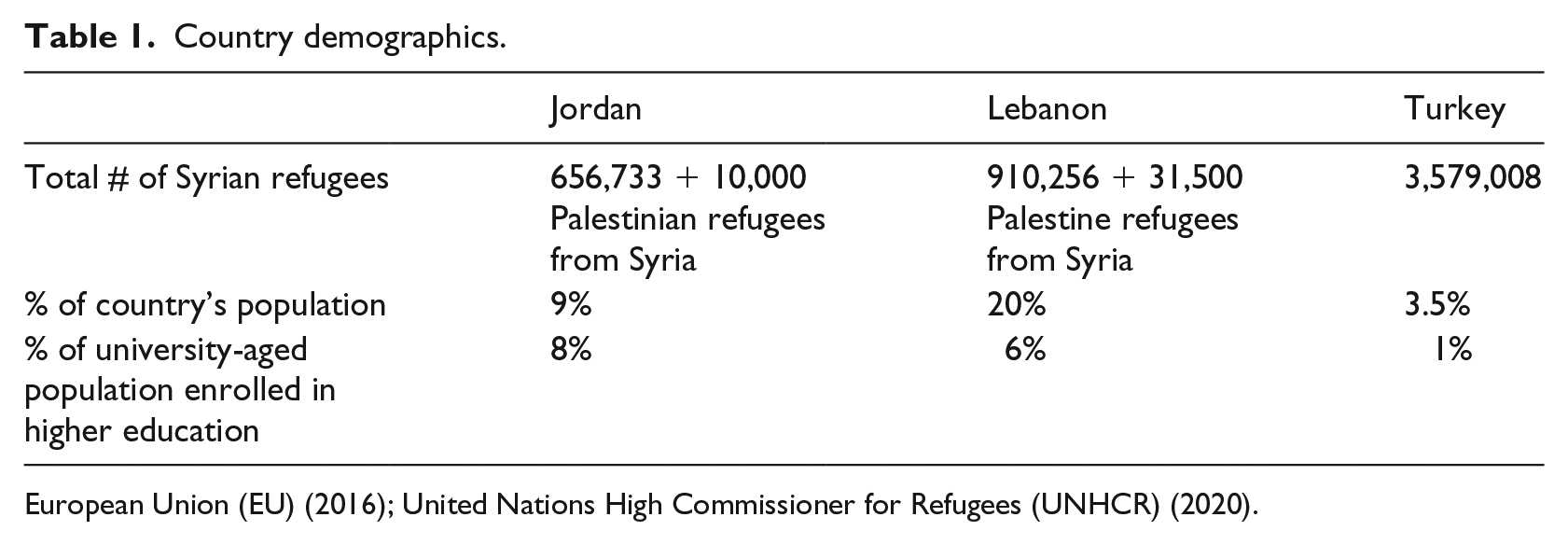
European Union (EU) (2016); United Nations High Commissioner for Refugees (UNHCR) (2020).
It is within these complex contexts of displacement, marginalization, chronic poverty and uncertainty that young Syrians engage with higher education opportunities provided for them by host-country governments in partnership with western donors, bilateral and multilateral agencies, and INGOs.
Theoretical framework
As mentioned above, higher education opportunities are severely limited for refugees globally and for Syrian refugees in particular. Although the limited participation of Syrian refugees in higher education in Jordan, Lebanon and Turkey is a highly complex phenomenon, emphasis placed by governments and international agencies on initial access often simplifies the issue and obscures the real roots of the problem. While there is an emerging literature (mostly non-academic research commissioned by humanitarian organizations) which attempts to address issues of access for refugees in relation to higher education, few studies focus on the complex processes and the push/pull factors within households, communities and institutions which factor into refugees’ interest in, access to, engagement with and retention in higher education (Hunt, 2008).
Moreover, much existing ‘grey’ literature (e.g. bilateral/multilateral agency and INGO technical reports) tends to focus on higher education for refugees simply in relation to employment outcomes. However, the discussion above indicates that refugees often have multiple motivations for undertaking tertiary education, and these motivations may overlap in complex ways. Moving beyond simplistic resource-based welfare approaches to education, the capability approach recognizes that different people have different motivations for undertaking higher education, as well as different educational needs within it. Therefore, this framework is particularly helpful for thinking about higher education in relation to refugees.
The capability approach is a theoretical framework that is founded on the following precepts:
Freedom to achieve well-being is of primary importance.
Freedom to achieve well-being should be understood in terms of people’s capabilities – their actual opportunities to do and be what they have reason to value.
The main proposition of the capability approach is that education should provide people with the freedoms they need to achieve their desired functionings (i.e. to be or do what is valuable to the individual) (Sen, 1992). While functionings (e.g. being literate, being educated) are realized achievements, capabilities are the effectively possible – a person’s real freedoms and opportunities to achieve their desired functionings (e.g. the opportunity for a refugee to attend higher education) (Sen, 1992). Education itself can be a functioning that an individual may, or may not, have the freedom to achieve. Alternatively, education can act as a conversion factor enabling other possible functionings (e.g. providing the opportunity for refugees to claim their legal rights enabled by literacy).
The capability approach acknowledges the role of social norms and discriminatory practices that may hamper an individual from converting a resource into a capability. Due to structural differences related to gender, class, ethnicity, etc., individuals differ in their ability to convert resources into ‘beings’ and ‘doings’ that are important to them. For example, a female refugee may have a legal right to freedom from domestic violence. However, her actual freedom from violence will depend on a number of other factors, such as legal literacy to understand her right, a public environment in which it is acceptable for her to seek help in the case of violence, and the existence of supporting institutions, organizations and networks (Vaughan, 2007). In this way, having an equal command over resources is not the same thing as having equal opportunities.
There are a number of ways in which the capability approach represents an improvement to standard approaches to education for refugees. Central to the capability approach is a recognition of individual difference and a concern with individual capabilities. As people differ over things that are important to them, it cannot be assumed that, given the same opportunities, everyone will achieve the same functionings owing to their different perspectives on the kind of lives they wish to lead (Robeyns, 2003). Similarly, the capability approach is inclusive of different framings of gender equality and empowerment, as it is concerned with what these concepts mean for particular groups of people in specific contexts (DeJaeghere and Wiger, 2013). For example, in some refugee contexts, women may prioritize the elevated social status they achieve by reaffirming the nation in exile through the performance of gendered scripts (e.g. voluntary adherence to traditional cultural and/or religious codes) (Dunne et al., 2017). In this way, the capability approach is particularly helpful in drawing attention to the non-financial aspects of welfare and refugees’ other desired capabilities in and through education (e.g. being part of a community, being respected by others, etc.) This stands in contrast to theoretical and practical approaches that only focus on people’s levels of resources, income or fulfilment of basic needs (Vaughan, 2007).
Moreover, sensitivity to social context and individual difference within the capability approach enables a comparison of how free refugees genuinely are to participate in education and to gain from it (rather than merely looking at the distribution of educational resources within refugee contexts). As the capability approach focuses on what is valuable to the individual rather than collective outcomes at the societal level (as is frequently the case with human capital and structuralist approaches to education), refugees’ agency and empowerment to make choices between different functionings becomes foregrounded as centrally important (Vaughan, 2007).
However, there are also a number of challenges with this approach. First, there is the challenge of measurement: how is it possible to tell which capabilities a refugee really values and whether they have adapted their preferences to suit a situation of disadvantage (e.g. prolonged displacement within a camp setting)? Also, in terms of education for children, or women within conservative communities, to what extent should their stated preferences be taken into account (e.g. if they say it is not valuable for them to pursue education) or attributed to a type of ‘false consciousness’? (Sen, 1999). Moreover, in Sen’s approach, education is assumed to be an unquestioned force for good. However, a number of educational theorists have concluded that engagement with education can actually diminish an individual’s capabilities; for example, through violence within educational spaces, or through reinforcement of particularly harmful cultural and social structures, such as gender inequality within education (Vaughan, 2007). There have also been debates about whether it is possible to identify core educational capabilities which should be guaranteed to all (Nussbaum, 2000). Despite its shortcomings, the capability approach moves beyond the human capital focus on economic productive capacities to focus on the relationship between education and the expansion of an individual’s overall capability set (Vaughan, 2007).
It is within the conceptual framework discussed above that this research attempts to move beyond resource-based welfare approaches to education for refugees (e.g. number of school/university places) and reconceptualize the rights of refugees to, in and through education. Tomasevski’s ‘4A’ framework (availability, accessibility, acceptability and adaptability of education opportunities), discussed earlier, is a helpful analytical tool to map concepts of capabilities/functionings/conversion factors onto higher education structures and policies on offer for refugees in the three country contexts (Tomasevski, 2006).
Methodology
This paper reports on qualitative empirical research conducted with Syrian refugee youth in and out of higher education in Jordan, Lebanon and Turkey as part of a wider research project funded by a large INGO and multilateral aid agency focused on investigating Syrian youth’s perspectives and experiences of higher education opportunities for refugees in the MENA region. Research in the three country contexts took place in the months of January and February 2017, with fieldwork in each country lasting approximately two weeks.
An interpretivist theoretical perspective was adopted for the study in order to privilege youth perceptions of the availability, accessibility, acceptability and adaptability of higher education opportunities for Syrian refugees in these countries (Tomasevski, 2006). Qualitative research methods were used to enable local, individual and marginalized viewpoints to emerge. The main research method used were focus groups, which enabled a large amount of data to be collected within a short timeframe and provided a comfortable research environment for participants (discussed in more detail below).
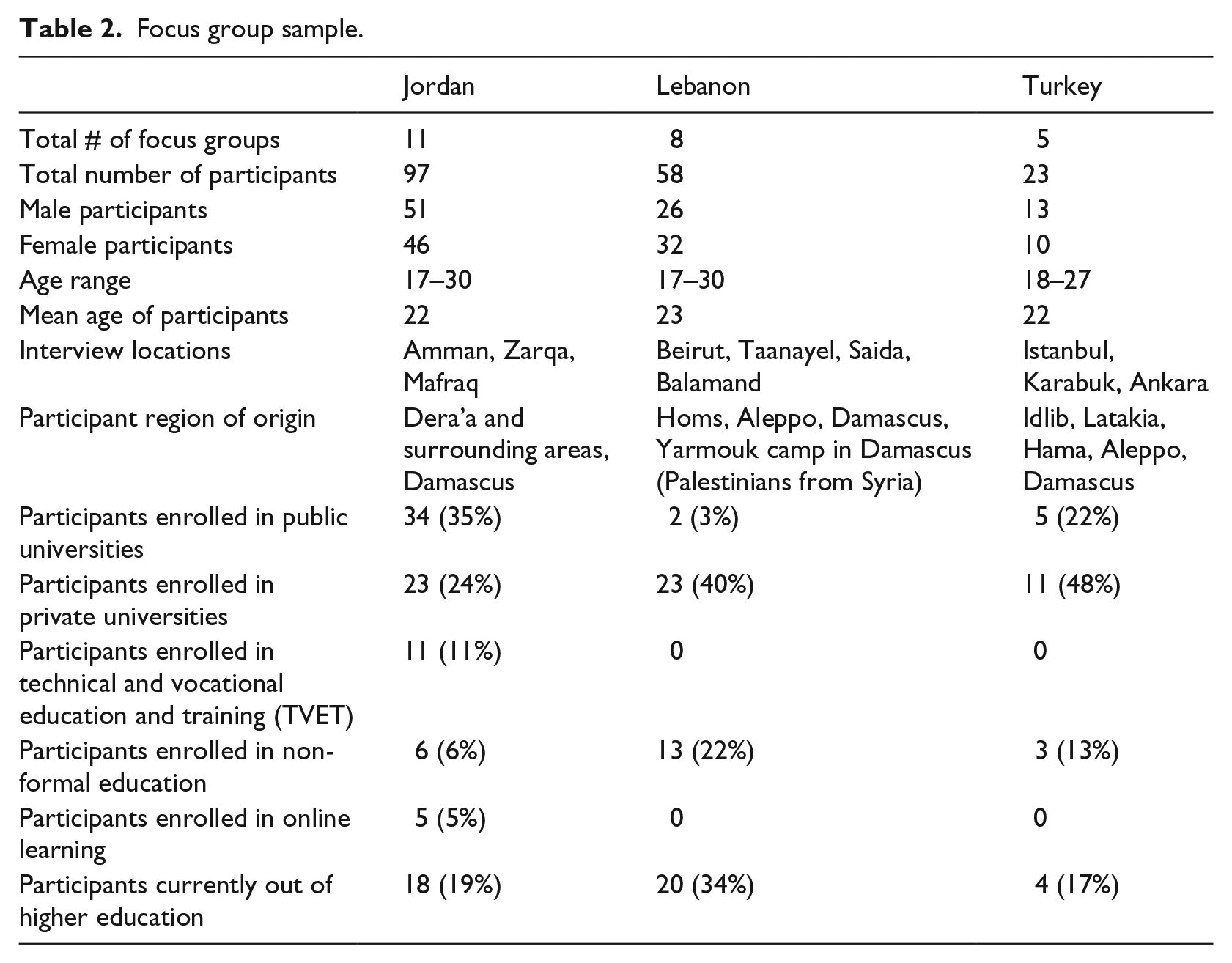
The lead researcher for this study (and the author of this paper) is an academic based at a UK university with extensive experience of living, working and researching in the region. As a native Canadian married to a native of the region in which the research took place (and therefore attached to a local tribe), the lead researcher was simultaneously an insider and an outsider with respect to the research context. In each country, the lead researcher was accompanied by a local research assistant, who was a trained researcher selected by the partner organizations. Fieldwork for the study was conducted with the help of the INGO and multilateral aid agency and their local partners in Jordan, Lebanon and Turkey who made choices regarding focus countries, cities and participants and who facilitated access to the refugees. Interview contexts were specifically chosen to reflect the broad range of educational experience amongst Syrian refugee youth in the region. Moreover, strategic sampling was used to recognize the existence of multiple perspectives within the Syrian refugee youth populations in the three country contexts, including youth in urban, camp and rural settings; youth in public and private universities leading to degree qualifications; youth in technical and vocational education and training (TVET) leading to diploma qualifications; youth in non-formal and online education (often unaccredited); and youth out of higher education (including individuals who were unable to access or remain in higher education despite expressing interest in doing so) (see Table 2). Within these contexts, an equal number of male and female participants were sought (where possible). Participants were also selected based on their availability and their interest in participating in the study. The fact that the vast majority of Syrian refugees in Jordan, Lebanon and Turkey are Sunni Muslim is reflected in the research sample (100% Sunni Muslim). Moreover, the age of research participants (17–30) reflects the age range most likely to be enrolled in higher education. The vast majority of participants in the research samples in all country contexts hailed from the middle and working classes back in Syria. Although a few participants came from privileged economic circumstances, they indicated that after many years living in exile, their family’s financial reserves had been depleted and they were relying on remittances received from family members abroad.
Focus group sample.
All participants were informed both orally and in writing about the purposes of and expected outputs from the study, and their participation was voluntary. As virtually all refugees had crossed the border illegally from Syria into their country of asylum, they preferred to give verbal rather than written consent for their participation.
The regional focus group sample is summarized in Table 2.
Focus group discussions were conducted in educational institutions or local offices of partner organizations as a matter of convenience. Focus groups were conducted using prepared (but flexible) interview schedules addressing topics such as young people’s attitudes towards, their access to, their experiences in and their expectations from higher education. In order to comply with cultural norms, single-sex focus groups were conducted lasting approximately two hours each with Syrian youth in the contexts described above. To enable participants to speak more freely, focus groups were limited in number and each comprised approximately five young people (although one focus group in Jordan was considerably largely).
Focus group interviews were conducted by the lead researcher (a native English-speaker with some knowledge of Arabic) using a mixture of Arabic and English, and a native Arabic-speaking research assistant was always present to ensure fluency of expression and clarity of understanding. A reflective diary was kept by the researchers to record informal observations and responses to interview encounters. Where possible, interviews were recorded and, if needed, later translated into English. All focus group data were transcribed and saved on a password-protected computer. Analysis was conducted through thematic coding aligned to the 4A framework and the capabilities approach. Preliminary analyses (using pseudonyms) were subsequently discussed both formally (i.e. through debriefing sessions) and informally with individuals familiar with the particular research contexts (e.g. local and international researchers and education practitioners working with refugees in Jordan, Lebanon and Turkey). Analytical categories and theoretical framing for the study emerged from the empirical data through a process of reflective analysis.
Limitations of the study included complex and sometimes inefficient coordination between partner organizations, dependence on local organizations and gatekeepers to access refugee participants, and limited access to refugees with personal experience of online learning. As permission was not granted by the Turkish government to conduct focus groups in the state-run camps, all focus groups with refugees in Turkey were conducted in the urban areas of Istanbul, Karabuk and Ankara. The larger number of participants in Jordan, compared with the other two country contexts, is reflective of the superior partner coordination within this environment.
This study was an initial investigation into the engagement of Syrian refugees in higher education in the MENA region. A future research angle would be to explore how particular groups of refugees (e.g. Palestinians from Syria, overage learners, young people with disabilities, etc.) engage with higher education opportunities provided for refugees in the three country contexts.
Discussion
The sections below discuss how Syrian refugee youth perceive their experiences in and through higher education in Jordan, Lebanon and Turkey in relation to availability, accessibility, acceptability and adaptability. I begin with a discussion of Syrian youth’s interest in, and expectations from, higher education within these contexts.
Interest in, and expectations from, higher education
Youth narratives indicate that interest in higher education amongst Syrian refugees in the three country contexts (both presently in and out of higher education) is extremely high.
Although males and females expressed an equally strong desire to pursue higher education, their reasons for wanting to continue their studies were often gendered. As discussed earlier, these differences reflect the different roles that higher education plays in men’s and women’s lives in Syrian society, as well as the differential impact it has on men’s and women’s access to the labour market. As males have been socially constructed as the primary breadwinners for their families in Syrian society, they view higher education primarily in economic terms (Buckner, 2013). Young males in all three countries generally sought higher education as a means to secure better employment opportunities, increased earnings, economic mobility and an elevated social position within the community. Although male refugees acknowledged the legal restrictions on their employment within their current circumstances in host countries, they believed that higher education would ultimately stand them in good stead when they eventually returned to Syria or were resettled in Europe.
Although male refugees primarily sought higher education for its perceived (future) economic returns, female refugees’ motivations for wanting to undertake higher education were more complex. As discussed earlier, Syria is located in the global region (MENA) with the world’s lowest rates of female labour-force participation, and cultural norms discourage all but professional employment for women (Ahmed et al., 2012; Kabbani, 2009). As a result, Syrian females have to achieve a high level of education in order for them to enter the labour market (Ahmed et al., 2012; Kabbani, 2009). However, because they are not culturally responsible for providing for their families, females are freer to pursue higher education for a wider range of purposes than only employment outcomes, such as intrinsic satisfaction. As one young Syrian female out of higher education in Jordan explained: ‘I want to go to university to expand my mind. I want to fulfil my dreams and move forward in my life’ (‘Aisha’, Amman, Jordan, 8 January 2017) Beyond (perceived) economic outcomes, young people noted that higher education also played a significant role in the construction of social relations in Syrian society, such as their ability to marry. This finding affirms previous studies in relation to this theme (e.g. Rao, 2012). One young Syrian male out of higher education in Lebanon explained it this way: ‘Education is the only way to have a good life. We need education to get a job, buy a house, buy a car and find a wife’ (‘Ashraf’, Taanayel, Lebanon, 2 August 2017). Young males explained how they needed steady and lucrative employment to be able to enter into marriage and take on the financial responsibilities of being the provider for the family. For their part, young females stated that they were more inclined to accept the marriage proposal of a man in high-status professional employment (and, by implication, with higher education qualifications). In this way, higher education worked to socially benefit Syrian males by providing them with a wider choice of marriage partners. On the other hand, while young males wanted their (future) wives to achieve a certain level of education because they believed that educated women could raise their children better, they did not want to marry women who achieved higher levels of education than they did, as these women might then challenge their (male) authority within the home. Thus, while some education enabled females in Syrian society to be more marriageable, too much education was deemed likely to limit their marriage prospects. This was significant, as within the context of Syrian culture, (heterosexual) marriage is compulsory, especially for females (Fincham, 2013). Moreover, being married and being a mother are social positions from which women derive a great deal of respect within Syrian society (Fincham, 2013). As one young Syrian female in higher education in Turkey stated: ‘We need to marry by our 30s. People will insult a woman if she is not married, and she will be thought of as a prostitute’ (‘Samia’, Karabuk, Turkey, 3 June 2017). On the other hand, some female refugees indicated that they strategically used higher education as a means to delay marriage, as in many cases their parents did not pressure them to marry until after they had finished their studies. On the other hand, some female refugees indicated that they strategically used higher education as a means to delay marriage, as in many cases their parents did not pressure them to marry until after they had finished their studies.
Moreover, some young females noted how the war in Syria had resulted in social transformation and changed the way that women (and their families) viewed higher education for females. Because of increased economic hardship, men becoming incapacitated and the increased prevalence of female-headed households within the Syrian community, the war had actually encouraged some parents to be more willing to allow their daughters to undertake further studies. As one young Syrian female out of higher education in Lebanon noted, The war has pushed people to rethink their views. There are more widows. This is pushing women to achieve more to take care of their families. Education is a weapon for women to secure a living and to help us become independent and self-sufficient. Wives of detainees can secure a job and be a role model for their kids. (‘Samira’, Taanayel, Lebanon, 2 August 2017)
These examples illustrate how there are complex and often contradictory social and economic factors which are shaping the educational aspirations of Syrian females in the MENA region.
When asked what they would be doing if they were not in higher education, young females noted that, as it was harder for females to find an acceptable job, their parents would encourage them to marry early. This would transfer the responsibility of their upkeep (both financial and in terms of sharaf
2
) to their husbands, discussed in detail by scholars, such as Nira Yuval-Davis (1997). As one young female in higher education in Lebanon explained: If we are not in education our parents will encourage us to marry. They think we will marry anyway, so marrying early is more likely to result in us finding a better husband and having children. Parents care more about our marriage than our accomplishments. There is an Arabic proverb that says, ‘If you have a girl, you have a burden for a lifetime.’ (‘Arwa’, Beirut, Lebanon, 2 July 2017)
If they worked, females (particularly those from lower socioeconomic backgrounds or resident in camps) explained that they would largely be restricted to employment within home-based or female-only environments that fell within acceptable gender norms, such as cooking, sewing or hairdressing. Those who did not work would engage in volunteering to help their community or simply stay at home and help their mothers with housework and childcare.
For their part, when asked what they would be doing if they were not in higher education, in order to perform their culturally constructed role as ‘breadwinners’, young males explained that they would work illegally in unregulated employment contexts in the informal sector or be tempted to return to Syria. As one young male out of higher education in Jordan explained: ‘I feel like I am spinning my wheels. I want to return to education but I don’t see it happening. I might go back to Syria and open a shop’ (‘Hosni’, Amman, Jordan, 1 September 2017). In order to perform their socially constructed role as ‘economic provider for the family’, some young males indicated that they had considered making the dangerous and illegal journey to Europe across the Mediterranean by boat in search of employment opportunities. Young males explained that while virtually all of them had thought about pursuing this option, most had decided against it for two reasons: (a) family members they would leave behind; and (b) the availability of higher education opportunities in their country of asylum that gave them hope for the future. As males have also been culturally constructed as ‘protectors’ of family and country in Syrian society, one male university student in Turkey said that if he was not able to continue his studies, he would return to Syria to fight with the Free Syrian Army. As young people may be unlikely to disclose this kind of information within a research context, it is difficult to ascertain exactly how prevalent this viewpoint is amongst male Syrian refugees living in exile. Nevertheless, the examples above indicate the strong correlation between higher education and protection issues for refugees.
Once young people dropped out of education, it was hard for them to re-enter. Although almost all of the young people out of higher education interviewed for this research wanted to return to education (as they saw no future for themselves if they remained on their current paths), they were unaware of any re-entry mechanisms that would enable them to do so. Moreover, young people who had left education many years ago said that because so much time had elapsed, they had lost the confidence to try and re-enter education.
The discussion above indicates that Syrian refugee youth strongly perceive higher education to be both a functioning in itself (e.g. the capability of a refugee to attend higher education) and a conversion factor enabling them to achieve other possible functionings. Functionings and capabilities achieved in and through higher education for refugees may be economic (e.g. employability prospects), intrinsic (e.g. personal fulfilment) or social (e.g. the ability to gain status within the eyes of the community; the ability to secure a good matrimonial match). Moreover, within Syrian society, desired functionings and capabilities are inflected by gender in complex and nuanced ways. This challenges the presumptions of many donors and education providers that refugees are a unified collective who only require, and seek, higher education for the purpose of gaining employment outcomes.
Availability of higher education opportunities
In Jordan, Lebanon and Turkey, there are numerous public and private universities and institutes of higher education located in areas where many refugees live (as discussed earlier). Moreover, there is a plethora of non-formal education programmes for Syrian refugees provided by local non-governmental organizations (NGOs) and INGOs. Consequently, almost all the Syrian youth interviewed for this study felt that higher education provision for refugees in the three countries was adequate in terms of the extent and breadth of the programmes available to them. However, as all of the young people experienced varying degrees of financial hardship, they were unable to study without the assistance of a scholarship (Dhingra, 2016). In part, this is because in public universities in Jordan and Lebanon, refugees are charged as ‘foreign students’ at international rates (public universities in Turkey are free for Syrians in terms of the direct costs of education – i.e. tuition). On the other hand, private institutions in all three countries charge the same fees for locals and Syrians; however, the higher fees are out of reach for all but the elite. Therefore, it is not a lack of higher education opportunities available to refugees that is of concern to young people. Rather, it is the availability of scholarships that enables them to take up these opportunities. In this way, scholarships act as a critical conversion factor enabling refugees to achieve a particular functioning (i.e. access to higher education) and develop capability sets.
Scholarships
Scholarships can relieve, or at least alleviate, the financial burden of higher education for refugees by providing full or partial financial support to students (UNHCR, 2016). Full scholarships generally cover both direct and indirect study costs, such as tuition and registration fees, learning supplies, accommodation, transportation, research and internship costs, medical fees, language and integration programmes, and any other essential expenses. Partial scholarships may cover only a portion of an academic programme (e.g. first year) or specific costs (e.g. tuition) and/or include a work stipulation/option (e.g. teaching assistantship). Scholarships may also include in-kind contributions of a non-financial nature (e.g. accommodation).
Syrian youth generally felt that scholarship provision for refugees was inadequate in terms of quantity (not enough scholarships available) as well as quality (the terms and conditions of the scholarships provided). In terms of quantity, young people noted that the overall number of scholarships provided for refugees did not meet demand. As one young Syrian male in higher education in Jordan stated: ‘You need to be the crème of the crop to get a scholarship. The competition is very tough, and only one scholarship is given per family. I had to wait for 3 years to get a scholarship’ (‘Mohamed’, Amman, Jordan, 1 September 2017).
In particular, young people cited the inadequacy of scholarship provision for academic study (at universities) and for postgraduate study (master’s and PhD level) in particular. This was significant, as the young people almost unanimously valued academic education over other types of education (discussed in more detail later in the paper).
In addition to the limited number of scholarship opportunities on offer for refugees, young people also noted that the scholarships that were available to them were limited to certain subject areas (which varied by scholarship) and were generally not available for high-demand subjects, such as medicine. This resulted in many young people studying subjects in their country of asylum that were not related to their academic studies back in Syria and/or subjects for which they had little aptitude or interest. As one young Syrian male in higher education in Lebanon explained: I studied Geology in Syria, but I couldn’t find it on the list of majors (for scholarship availability) in Lebanon, so now I study Islamic Finance. The scholarship definitely influenced my choice of academic subject. I still dream of returning to Geology. (‘Said’, Taanayel, Lebanon, 2 August 2017)
However, the students questioned how useful higher education would be under these circumstances if it did not enable them to live lives and envision futures that they had reason to value. In other words, structural issues were hampering young people from converting higher education as a resource into a set of ‘capabilities’. Moreover, many young people felt that scholarship providers in the three country contexts were simply repeating mistakes made by the Syrian government, which had tracked students into particular fields, giving them little choice over their own futures and preventing them from pursuing their personal interests without guarantees of employment (discussed in more detail in Buckner, 2013). As one young Syrian male no longer in higher education in Lebanon explained: Most Syrians are not happy with their major. In Syria, we were channelled into a category (Scientific or Literary stream) from grade 9, and in Grade 12 the government chose our major for us. The (Syrian) government sends you to do the least appealing option and disregards your choice. If you want to change your major, you have to repeat the Baccalaureate again and try to get higher grades. I lost 3 years of my life. (‘Anwar’, Taanayel, Lebanon, 2 August 2017)
Young people also noted that scholarships could only be applied at certain universities, which meant that they often had to commute long distances to campus (1.5–2 hours one way). Not only did this leave them feeling tired and with little time to study, in certain contexts (particularly Lebanon) and for females in particular, the long commute to campus exposed them to safety and security risks (discussed in more detail later in the paper). The young people generally believed that the scholarships offered to Syrian refugees were ‘leftover’ spaces at institutions after paying national students had had their first pick of majors.
Refugees also noted the problematic nature of the financial terms and conditions of their scholarships. As discussed earlier, education always has direct, indirect and opportunity costs. However, scholarships offered to refugees often covered only the direct costs of their education. Not only did this exclude many young people from higher education, it also increased class inequalities within Syrian society, as only those from the elite could afford to cover the extra indirect and opportunity costs of education. Thus, students felt that scholarships needed to include an adequate living allowance to enable them to focus on studying without working (particularly the case for males). Other general complaints about the financial terms and conditions of scholarships included: not covering the full programme of study (i.e. covering only one year); not covering all semesters (i.e. excluding the summer semester); and delayed payment or payment provided at infrequent intervals. These factors resulted in significant economic hardship for both individual students and their families, who were often dependent on remittances.
Young people noted that the provision of scholarships was often inadequate for the most vulnerable segments of Syrian society. For example, so-called ‘overage learners’ lamented that they were unable to return to their studies because, by the age of 30, they were ineligible for almost all scholarships available to refugees. As one young male out of higher education in Jordan petitioned: ‘It is necessary to expand the age of scholarship eligibility to 35. Younger students can find many fully-funded scholarships in Jordanian universities through different agencies, but there is nothing for us’ (‘Omar’, Amman, Jordan, 1 September 2017).
Other particularly vulnerable groups of refugees who noted that there were no special scholarships on offer for them (or at least they were unaware of these opportunities) included: young people with disabilities; lesbian, gay, bisexual and transgender (LGBT) young people; and Palestinians from Syria.
As a result of these issues, Syrian youth generally regarded scholarships to be a major source of stress in their lives. On the other hand, virtually all students indicated that scholarships were the main conversion factor that enabled them to take up available higher education opportunities.
The discussion above highlights that higher education opportunities are becoming increasingly available for Syrian refugees within the context of the MENA region. However, scholarships (the main conversion factor enabling refugees to take up available opportunities) are, from the point of view of refugees, often being conceptualized by donors in ways that do not take into consideration the needs and interests (desired functionings and capabilities) of refugees living within the context of exile. Moreover, education/scholarship policies are often being formulated in relation to a homogenized ‘refugee subject’, without reference to particular refugee identities. This puts the education of the most vulnerable segments of Syrian society at risk (e.g. the poorest, females, overage learners, Palestinians from Syria).
Accessibility of higher education opportunities
Higher education opportunities that are available for refugees are not necessarily accessible to all individuals. Cultural and structural issues mean that individuals differ in their ability to participate in education and to gain from it. In this way, equal availability of education resources is not the same thing as equal opportunity to benefit from them. Syrian youth explained how they were often unable to access existing opportunities due to the complex ways in which cultural traditions, gender roles and relations (home and community-based factors) intersected with higher education policies and practices (educational institution-based factors).
Home and community-based factors
In a community-oriented society, such as Syria, personal decisions to enter higher education often have to be vetted through the family, and particularly household heads (usually fathers) (Fincham, 2013). While young males said that they generally did not have to seek permission from their parents to undertake higher education, as they had increased levels of autonomy and decision-making power within the household, they often chose (or felt pressure) to follow in their father’s footsteps or defer to their father’s wishes in terms of the subject of study that they pursued.
By contrast, all young females said that they needed to get the permission of their parents before they could enrol in college or university. This was because females needed to have a male ‘guardian’ in Syrian society, discussed in detail by writers such as Harris (2004). Moreover, being financially dependent on males within the family meant that Syrian females had less control over their own decisions and actions. Sometimes stereotypical beliefs about females discouraged parents from encouraging their daughters to continue their education, such as ‘they only want to go to university to play and fall in love’ (‘Abbas’, Zarqa, Jordan, 1 October 2017). On the other hand, stereotypical beliefs sometimes facilitated females’ access to higher education, such as when parents believed females to be more studious, more able to multi-task, more committed to study than males and to require professional employment to enter the labour market. However, young people noted that when household resources were stretched, males (sons) were often prioritized for higher educational opportunities to enable them to fulfil their culturally assigned role as financial providers. As one young female Syrian currently in higher education in Jordan explained: We need laptops to do our coursework. We have a laptop at home, but my brother takes it, and I can only use it when he isn’t using it. It is the priority for him to finish his studies first so he can support the family. (‘Zainab’, Zarqa, Jordan, 1 October 2017)
For married women, the approval of their husbands to continue their education was paramount. While some females noted that their husbands were supportive of their studies, all of them stated that they would not go against their husband’s wishes in this regard. Failure to respect their husbands could result in restrictions on their movements, marital discord (and possible divorce) and potential for domestic violence. Reasons why husbands might not want their wives to continue their education included: perceived competition with men and challenge to male authority; inappropriate mixing with males in educational spaces; and lack of time to take care of children and do the housework (culturally assigned roles for females in Syrian society). Even if husbands did allow their wives to study, they often restricted the subjects that they could pursue if these programmes required students to stay late at night (e.g. nursing). In a few cases, married women out of higher education felt that they did not need to further their studies, as they gained an identity and status in the community from being married and having children. As one young female in Lebanon put it: ‘I prefer my house and children to studying. I take pride in this’ (‘Amal’, Taanayel, Lebanon, 2 August 2017). This is an example of how gender empowerment is framed differently in different contexts and how women (and men) may prioritize intrinsic and social functionings over economic ones.
For males, the biggest challenge to entering and remaining in higher education was the pressure to work and support their families financially. Young males noted that it was very difficult for them to find time to study while working, and several males reported that their academic performance had been negatively impacted as a result. As almost all students were on scholarship, and a condition of most scholarships is the maintenance of high academic performance, this was of significance. Males who were particularly vulnerable to dropout from these pressures included: men who were married with children; those who had parents back in Syria who depended on their remittances; the eldest son; the only son; those who supported more than one household (due to family breakdown and/or divorce); those who lived in households with absent fathers; and those who lived alone.
On the other hand, females reported that their biggest challenge to entering and remaining in higher education was their cultural responsibility for all childcare and housework (especially for eldest daughters). Despite generally perceiving domestic work to be their duty (and an expression of love) towards their families, many young females admitted that the burden of housework and childcare was sometimes overwhelming, particularly in large families and particularly during exam times. The work itself made them feel tired, but it also affected the number of hours they could sleep and took valuable time away from studying. Married women in particular found it very difficult to continue in/return to higher education after they had children. As one young Syrian female out of higher education in Lebanon explained: ‘I married and I had a baby. I never considered returning to education. My priority is to help my husband and take care of my daughter’ (‘Miriam’, Taanayel, Lebanon, 2 August 2017). Young people noted that even if males wanted to share the domestic load, cultural scripts of appropriate gendered behaviour prevented them from doing so. As one young Syrian female in Jordan explained: ‘Men are not respected if they cook. People will gossip’ (‘Fatima’, Zarqa, Jordan, 1 October 2017). Young people noted that males generally only undertook housework in cases where there were no females in the home to do it.
All females in the research samples in Jordan and Lebanon lived with their families, which offered them support as well as specific challenges (i.e. domestic burden) in relation to their continuation in higher education. By contrast, many young women in the research sample in Turkey lived in state dormitories alongside Turkish students. Although these young people lived far away from their families, they generally enjoyed the experience of dormitory life, as their food was provided, they did not need to worry about transportation to and from the campus, and their semi-independent living gave them a welcome taste of autonomy. However, in all three fieldsites (Jordan, Lebanon and Turkey), completely independent living was not available to Syrian females due to concerns over their safety and security and cultural constructions of appropriate female propriety.
Although many of the cultural constructions and gender relations discussed here are generic to the wider region, the young people explained that Syrian culture was particularly traditional and conservative in relation to that of neighbouring countries (especially ‘secular’ Turkey and ‘socially liberal’ Lebanon). Moreover, they noted how living in exile amidst security concerns had resulted in a recall of traditional masculinities and increased social regulation of female movements and behaviour within Syrian society. On the other hand, they acknowledged that some Syrian parents were permitting increased freedom of movement for females due to restrictions on male mobility within the country of asylum (Jordan and Lebanon), or because of confidence in the local security situation (Turkey). All of these factors have important implications for Syrian young people’s ability to enter and remain in higher education.
Educational institution-based factors
The home and community-based factors discussed above intersected with educational institution-based factors (discussed below) to enable or impede Syrian youth’s access to higher education opportunities on offer for them.
In all three country contexts, Syrian youth noted that the documentation they were required to provide in order to apply for a scholarship or gain admission to university (passport, high school certificate, transcripts, residence document – Lebanon) was a significant and particular barrier for refugees. As many families had to leave Syria in a hurry due to the war, they were unable to bring all of their documentation with them to the country of asylum. In many cases, these documents were only attainable if the young people themselves returned to Syria (often risking their lives) or paid an exorbitant amount of money (which they often did not have) for a representative to return to Syria and collect these documents on their behalf. Moreover, available documentation held by refugees was not always accepted by higher education institutions. For example, while most refugees held a baccalaureate certificate issued to them by the Syrian government, a few young people held the Interim Syrian Government-issued ‘opposition certificate’ (i’tilaf). However, they noted that in Jordan and Lebanon this certificate was often not recognized or accepted for enrolment in accredited higher education programmes lasting longer than six months (i.e. a university degree programme). Thus, although Syrian youth were technically eligible to enrol in universities and colleges in their countries of asylum, documentation policies conceptualized with reference to a ‘citizen’ subject often precluded refugees from furthering their studies (UNHCR, 2016).
Syrian youth noted that institutional inflexibility also made it difficult for them to remain in higher education. For example, rigidity in terms of course scheduling and timetabling caused the students significant difficulty, and the challenges faced by young people in this regard were often gendered. As ‘breadwinners’, the large gaps between classes made it very difficult for male students to find (and maintain) employment to support themselves and their families. On the other hand, as courses available to refugees were often scheduled in the evening, students had to commute long distances (frequently to/from different cities or the camps) after dark. For male refugees (discursively constructed as existential threats to national borders and security), this posed safety concerns, as they could be detained or abducted at government and/or paramilitary checkpoints (particularly in Lebanon). For female refugees, commuting after dark caused personal discomfort and put them into conflict with their families. This was a particular problem for female refugees in cities, as the anonymity of public transportation in urban areas exposed them to greater risk of sexual harassment. As one young Syrian female no longer in higher education in Jordan reminisced: ‘I had to take 3 buses to get to and from university. My father was afraid for my safety because I came home late, so he told me to drop out’ (‘Amina’, Mafraq, Jordan, 1 December 2017). As maintaining employment (for males) and a sense of propriety (for females) were key functionings valued by young people, institutional policies and practices insensitive to the particular needs of male and female refugees often resulted in their exclusion from higher education.
An institution-based factor which specifically impeded access to tertiary education opportunities for refugees with young children was the absence of nursery and childcare facilities in universities and colleges. As females have been culturally constructed as nurturers responsible for childcare in Syrian society, this disproportionately affected them. Although female students often resorted to leaving their children with other female family members while they were attending university or college, this meant that these childcare providers (other women) would then be unable to continue their own studies. Although this situation also affected female students from host countries, refugees were less likely than many locals to be able to afford alternatives, such as paid childcare.
As the discussion above highlights, higher education opportunities made available for refugees are not necessarily accessible to all individuals. People’s freedoms (e.g. choices they are able to make regarding their education) are constrained by their socio-cultural, economic, political and historical positionings. Moreover, these positionings intersect with institutional structures, policies and practices to enable or impede refugees’ participation in higher education.
Acceptability of higher education opportunities
Even if higher education opportunities are available and accessible to refugees, they may not be acceptable to them in terms of supporting their overall well-being and enabling them to achieve functionings and capabilities that they have reason to value.
Universities
In terms of type of education (i.e. academic, TVET, non-formal), Syrian youth almost unanimously preferred face-to-face academic education offered through universities because they perceived it to enable them to build broad-based capability sets and achieve multiple functionings (economic, intrinsic, social). However, refugees’ motivations for wanting to undertake academic education were often gendered. As ‘breadwinners’, males generally preferred university education because they believed that it would prepare them for career options other than manual labour and technical work. Moreover, they believed that it would offer them higher lifetime earnings, higher status within the community, internationally recognized qualifications, and higher educational and economic mobility should they later decide to emigrate abroad or return to Syria. As one young male currently out of higher education in Lebanon explained: I spent a long time studying at university in Syria and I want to continue studying at university in Lebanon. I don’t want to be a daily labourer like my parents. I want a better standard of living and to be respected in my community. (‘Mouin’, Taanayel, Lebanon, 2 August 2017)
On the other hand, female refugees generally wanted to pursue academic education because they felt that it would support their goal of self-actualization, offer them a wider variety of subjects to choose from and enable them to pursue their intellectual passions.
Despite the popularity of academic education amongst (male and female) refugees, Syrian youth noted that there was less scholarship provision for academic study at universities. This meant that refugees interested in pursuing higher education had to align their desired functionings and capability sets with donor agendas (e.g. efficiency and effectiveness). As a female Syrian university student in Jordan lamented: ‘My studies didn’t help me to achieve my passion. Dreams come from education, but in Jordan, they don’t care about the value of the person’ (‘Lina’, Amman, Jordan, 1 August 2017).
TVET
A popular donor strategy for increasing access to higher education for Syrian refugees within the MENA region has been TVET. TVET, in particular, has arisen out of neoliberal agendas focusing on employment for refugees (e.g. skills development) and economic development within the context of post-conflict reconstruction. TVET programmes on offer for refugees may be long-established and include students from local communities or they may be bespoke for refugees. Syrian students enrolled in TVET programmes in Jordan (no data is available for Lebanon and Turkey) generally expressed a high degree of satisfaction with the quality of the education they received, which they defined as access to modern facilities, applied curriculum, hands-on learning and dynamic teaching involving problem-solving and team work.
However, young people noted that TVET was attributed a lower status than traditional academic education and was viewed as ‘less desirable’ within the Syrian community. Young males in particular noted that, in comparison with academic qualifications, TVET qualifications were less likely to provide them with high lifetime earnings and economic mobility should they return to Syria or be resettled in Europe. They also questioned how advantageous their technical education would be in the current political economy of Jordan and Lebanon where refugees are not legally entitled to work. For their part, young females noted that TVET education focused on building limited ‘capability sets’ and only enabled the achievement of functionings related to economic outcomes. Thus, as TVET education was not seen to effectively address their (often gendered) motivations for wanting to engage in higher education, a number of Syrian students saw it merely as a stepping stone towards their real goal of obtaining a university degree. Young people who were out of higher education generally viewed TVET programmes as a second choice. As one young Syrian male in Lebanon explained: ‘I don’t want to downgrade and go to college (TVET). I only want to go to university’ (‘Musa’, Amman, Jordan, 1 August 2017).
Non-formal education
Particular to refugees is the proliferation of non-formal education programmes provided for them by local NGOs and INGOs in camps and urban areas in the three country contexts. Non-formal education programmes are generally easier for refugees to enter than formal ones, as they are less stringent with regard to documentation requirements. On the one hand, Syrian youth noted that they valued these programmes, as they provided refugees with an opportunity to develop new skills, to take on leadership roles (particularly for males) and to be part of a community whilst in exile. On the other hand, many refugees had concerns about the poor quality of non-formal education programmes on offer for them with regard to instructor qualifications and professionalism, the one-size-fits-all approach (treating all refugees the same regardless of skills, interest or social positioning) and the lack of accreditation. As one young male who had recently completed non-formal education in Turkey explained: ‘I liked my course but all refugees took the same course and they only provided certification at level one. This is not enough for me to get a job. The course was too short to be useful’ (‘Waleed’, Ankara, Turkey, 4 June 2017). As with TVET, many non-formal education programmes provided for refugees within the Syrian context are embedded within neoliberal agendas of education for employability, to the exclusion of other functionings and ‘capability sets’ desired by young people (as discussed earlier). Moreover, young people noted how non-formal education programmes on offer for refugees often promoted employment paths based on gendered stereotypes (e.g. ‘childcare’ courses for women). On the one hand, these programmes were developed in step with local cultural sensibilities. On the other hand, female refugees eager to develop new knowledge and skills were offered few options other than to comply with traditional gender norms.
Adaptability of higher education opportunities
The war in Syria has posed unique challenges for donors and higher education providers in Jordan, Lebanon and Turkey, who have had to think creatively about how to provide enough quality higher education spaces for the thousands of young refugees waiting for such opportunities. In addition, they have had to strategize about how to best adapt these opportunities to the special needs of refugees. Two strategies achieving a lot of attention have been online learning and international scholarships.
Online learning
Amongst donors, policymakers and practitioners, online learning has been seen as a kind of panacea to address the problem of the thousands of young refugees seeking higher education opportunities (Easton-Calabria and Omata, 2018). Within the Syrian context, online learning programmes for refugees are generally provided by western educational providers through asynchronous, synchronous or blended learning approaches (although there are also some local providers, such as Edraak in Jordan 3 ).
However, when asked to rank educational opportunities in terms of desirability, the vast majority of Syrian youth (both male and female) in all three country contexts said that their first choice would be to study at university, their second choice would be to study in a TVET college and their last choice would be to study online. Some young people said that they would accept online learning if it were the only option available to them, whereas others said that they would not accept online learning programmes at all.
Some refugees acknowledged that online education permitted flexible learning and had the potential to expand educational access to marginalized groups (e.g. those who were housebound, women with small children, people with disabilities and those in full-time work). Moreover, some refugees indicated that they could see the potential of online learning in limited contexts, such as for the study of humanities and social science subjects and for certificate- or diploma-level studies. Some young people also acknowledged that attitudes towards online learning were improving in Syrian society (particularly amongst the younger generation).
However, many refugees perceived online learning to be inferior to face-to-face learning. Some refugees assumed that online professors would be less competent than professors who taught at a ‘real university’. Moreover, refugees generally bemoaned the fact that online credits and qualifications were often not recognized by local universities and employers. As one young Syrian male out of higher education in Lebanon put it: ‘Online learning is not known in our community. We don’t have examples of people who have studied online. It is not a serious diploma. We would need English skills. It is not an option for everyone’ (‘Hassan’, Beirut, Lebanon, 2 July 2017). Amongst Syrian youth, reluctance towards online learning often had a gender dimension. Syrian males, in particular, were concerned about the potential of programmes delivered online to enable them to achieve desired economic ‘capability sets’, including employability and economic mobility. As Syrian males primarily had economic motivations for wanting to pursue higher education, they felt that online learning did not meet their needs as it was inappropriate for the study of high status and financially lucrative degree programmes, such as science, engineering and medicine, which required the mastery of technical equipment and lab work.
On the other hand, as most female refugees wanted to continue their education, at least in part, for social reasons (such as belonging to a local community, developing friendships, and social networking), they said that they would have no motivation to study online (which has often been framed as sitting in front of a computer screen), as they would not be able to interact with classmates and make friends, and they would not be able to have personal contact with their professors. Female camp residents in Jordan had particular concerns about online learning, explaining how physically attending a university or college gave them reprieve from the psychological imprisonment of camp life. As one Syrian female student in Jordan said: ‘I prefer traditional education. Interactivity online is not like real ‘face-to-face’ interaction. It is not good, we need physical interaction. The professor can’t get to know all students’ needs and levels of achievement. We want to make friends’ (‘Nahed’, Amman, Jordan, 1 August 2017). For the reasons stated above, both male and female refugees resident in camps in Jordan reported that they were willing to commute long distances to campus despite the fact that many had to wait in long lines to renew their camp exit/re-entry permits every two months.
The examples above illustrate how, in the interest of rapid expansion of higher education opportunities for Syrian refugees, donor strategies (focused on efficiency) have often been at odds with local perspectives and values. Moreover, individual refugees’ desired functionings and ‘capability sets’ have often been subordinated in the interest of collective outcomes for refugees.
International scholarships
As local higher education institutions have become overwhelmed with the number of Syrian refugees seeking tertiary education opportunities in Jordan, Lebanon and Turkey, international scholarships for refugees to study abroad have become a key donor strategy employed to relieve the pressure. For their part, many young Syrian males expressed a strong interest in receiving an international scholarship. For some of these young people, the attraction of an international scholarship was related to ‘pull factors’, such as the perceived superior quality of education in Europe, as well as increased opportunities to find work. There were also ‘push’ factors which encouraged young Syrian males to want to leave Jordan and Lebanon in particular, such as restrictions on their movements, discrimination against Syrians, and the difficult economic situation they had experienced in these countries.
Although most male refugees were eager to take up an international scholarship opportunity, a few young Syrian males expressed hesitation at the thought of travelling abroad to study. Some young people were concerned about losing their refugee status or not being able to return to their country of asylum if they left. Others worried about having to ‘start again’ in yet another new country. As one young male explained: ‘If I go abroad, I will lose years of my life trying to learn a new language’ (‘Osama’, Ankara, Turkey, 4 June 2017). A few young males also said that they wanted to stay close to Syria to keep an eye on developments back in their homeland.
However, in contrast to male refugees, virtually all young females said that they would not be able to accept an international scholarship. In some cases, female refugees themselves did not want to travel abroad and leave their family and friends behind. Moreover, some young females preferred to stay in the region due to reasons of cultural, religious and linguistic familiarity. As one young female out of higher education in Jordan said: ‘I have established a life here, and I want to stay. The culture, religion and language are the same as in Syria. I would prefer to study here’ (‘Miriam’, Mafraq, Jordan, 1 December 2017).
However, the majority of female refugees stated that, even if they wanted to, they would not be able to travel abroad because they were responsible for taking care of their parents. Moreover, they could not travel alone without being accompanied by an acceptable male guardian, such as a husband or older brother. All young females said that they would not travel abroad without their parents’ or husband’s approval. Reasons that they might not receive this approve included: safety concerns (‘women can’t protect themselves’), fears of discrimination against Muslims in Europe, fears that females may reject their culture and religion and remove the hijab, fears that foreign males might fall in love with them and compromise their honour, and community pressure to keep traditions (out of the 88 Syrian females interviewed for this research, 85 (97%) wore the hijab, 4 indicating adherence to local cultural/religious traditions).
On the one hand, some young people acknowledged that attitudes towards gender roles and relations were slowly changing in Syrian society as a result of the war. As one young female in higher education in Jordan noted: When Syria was secure, my parents wouldn’t allow me to travel to another city to study, but now my parents will allow me to take a scholarship in Germany. The war has made our lives uncertain, and they want me to have the best opportunities for my future. (‘Muna’, Amman, Jordan, 1 September 2017)
On the other hand, focus group discussions in all three countries revealed that most young Syrian females supported the status quo (or were unwilling to resist familial/cultural pressure) and did not question the ability of males to travel abroad alone when they could not. As one young female explained: ‘Males will know how to manage it. Men are stronger intellectually, more capable and more resourceful. Girls might feel lonely and get dragged into something bad. She might fall in love with the wrong person’ (‘Noura’, Amman, Jordan, 1 September 2017). Despite the concerns expressed by Syrian youth above, the vast majority of international scholarships on offer for refugees do not provide for accompanying family members. As international scholarships have been conceptualized by donors with reference to a male subject (with the assumption that female refugees would be willing and able to travel and live abroad alone), female refugees have been implicitly excluded from taking up international scholarships. This exemplifies how having equal access to resources (e.g. international scholarships) is not the same thing as having equal opportunity to benefit from them.
Conclusions
Since the outbreak of the Syrian civil war in March 2011, donors and higher education providers have had to think creatively about how best to provide enough quality higher education spaces for the thousands of young refugees waiting for such opportunities in Jordan, Lebanon and Turkey. To meet the overwhelming demand, education providers have focused on ‘efficiency’ and employed strategies such as scholarships (both domestic and international), TVET, non-formal learning programmes and online learning. These strategies have increased the number of higher education places available for refugees in these countries, with scholarships being the main conversion factor that enables refugees to take up available higher education opportunities.
However, focus group interviews with Syrian youth in these contexts reveal that while these strategies have increased the availability of higher opportunities for refugees, concerns remain related to accessibility (direct and indirect barriers faced by particular groups of refugees in relation to accessing the higher education opportunities that are available to them – conversion factors), acceptability (how higher education can actually be of use to refugees, not only in seeking employment, but also in supporting their overall well-being and enabling them to achieve desired functionings) and adaptability (efforts of higher education systems, institutions and providers to promote inclusiveness and to be flexible towards the particular needs of refugees to enable them to turn education resources into capability sets). Due to structural and cultural issues, individual refugees differ in their ability to participate in education that is made available to them and to gain from it. In this way, equal availability of education resources is not the same thing as equal opportunity to benefit from them.
Moreover, refugee narratives indicate that individuals have different motivations for wanting to undertake higher education and that higher education serves both as a functioning (e.g. the capability of a refugee to attend higher education) and as a conversion factor enabling them to achieve other possible functionings. Functionings achieved in and through higher education for refugees may be economic (e.g. employability prospects), intrinsic (e.g. personal fulfilment) or social (e.g. the ability to gain status within the eyes of the community; the ability to secure a good matrimonial match). Additionally, desired functionings are inflected by gender in complex and nuanced ways. This challenges the presumptions of many donors and education providers that, given the same opportunities and availability of higher education, all refugees will pursue and achieve the same functionings (e.g. higher education for the purpose of gaining employment outcomes). This has important implications for how higher education is approached for refugees (e.g. the one-size-fits-all approach).
Finally, donor agendas supportive of particular education strategies (e.g. TVET, online learning) and collective outcomes for refugees and communities (e.g. employment outcomes, post-conflict reconstruction) may actually be undermining refugees’ agency and empowerment to make individual choices between different capability sets and functionings (e.g. intrinsic, social). Without an expansion of freedoms, the notion of higher education for refugees as an unquestioned force for good is put into question. This has important implications for how higher education for refugees is conceptualized and operationalized both within the Syrian context and more broadly.
Footnotes
Acknowledgements
This paper was inspired by research conducted as part of a broader funded research project (the opinions expressed here are not representative of the organisations who commissioned the research).
Funding
The author received no financial support for the research, authorship and/or publication of this article.