



Abstract
Textbooks are major organizers of Arabic language instruction in most Arab countries (Faour, 2012). Textbooks approved by ministries of education have traditionally guided teaching of content knowledge, skills, and values to be taught at each grade level (Faour, 2012; Sabella, 2014; Taha-Thomure, 2008). This research is a foundation study into the use of Arabic Language Arts (ALA) standards in six schools in three countries in the Arabian Gulf region (Bahrain, Saudi Arabia, and United Arab Emirates). Fifty-eight teachers used the ALA standards adapted from the Ohio English Language Arts standards (Taha, 2017a) for at least one year. Results of the online survey indicated that 83.5% of teachers found the standards had a positive effect on their teaching, while 94.9% of teachers found that the standards helped them collaborate with each other in planning and finding suitable resources to use. This suggests that well-supported innovations can lead to teachers being aware of and using ALA to improve student learning and instruction. Results also highlight some of the challenges teachers faced to find the necessary Arab language resources that will help them implement a standards-based approach, in addition to the amount of time they needed to put into preparing for the lessons.
Keywords
Context
This paper contributes to the debates around standards-based instruction in Arabic language and fills a research gap in that domain. Although research in other countries (e.g. United States of America, British Columbia, New Zealand, Singapore) has focused on implementation of standards-based research and its results (Polikoff, 2017; Polikoff et al., 2016; Sahlberg, 2014), studies in Arabic-speaking countries are very limited (Faour, 2012; Taha, 2008). Recently, there have been unprecedented initiatives focused on improving and modernizing the teaching of Arabic language teaching in the Arab world. Both Jordan and Saudi Arabia introduced in 2018 their first Arabic language teachers’ standards (EEC, 2018; Language Magazine, 2018).
The United Arab Emirates has launched several Arabic language initiatives and policies, including an Arabic Language Charter (Emirates News, 2012) and an Arabic Reading Challenge that to date has donated over 50m children’s books written in Modern Standard Arabic (MSA) to 5m children around the Arab world. Most recently, a Reading Law of 2016 issued in the United Arab Emirates produced changes including requiring all school and university libraries, in addition to public libraries, to enrich and increase their collections of books on an annual basis. The law also asks all employers to provide their employees with professional reading time during work hours, as this will enhance productivity and skills needed for the job. All reading “goods” and materials according to this law are tax exempt. The law dedicates one month a year as the reading month across the UAE (Salama, 2016).
Those initiatives have sparked formal and informal debates in the entire Arab world around how best to approach the teaching of Arabic language, including the move into standards-based instruction, and whether Arabic language teachers are ready to make that major shift from textbook-based instruction to standards-based instruction.
The standards movement
Standards-based instruction started in the United States in the 1980s when the National Council for the Teachers of Mathematics put together the general frameworks and skills that students in grades K-12 needed to know and do (Taha, 2017a; Zigrang, 2008). Other fields, including English language arts, followed in the footsteps of teachers of mathematics and the standards-based instruction movement started to find many followers and proponents (Taha, 2017a; Zigrang, 2008). The move into standards-based instruction was based on a philosophical notion that all students can learn, succeed, and achieve, but they might do so at different paces, and from a humanistic notion that all students, poor and rich, can have the same quality education that they truly deserve (Ogawa et al., 2004).
A standards-based approach does not compare students to one another, but rather student progress and achievement are measured against a standard set of clear and published learning outcomes or performance indicators (Carr and Harris, 2001; Hartwell and Furr, 2003; Reeves, 2004; Zigrang, 2008). Those standards do not change with new textbooks, teachers, schools, or districts (Chambers and Dean, 2000). Such consistency leads to transparency in the educational process and allows for the fair treatment of all students (Reeves, 2004). Standards help students, parents, and caregivers as well as teachers to know when a student has met a performance indicator (Matlock et al., 2001; Reeves, 2004; Zigrang, 2008). Standards-based instruction, additionally, focuses on what students learned rather than on when they learned it (Chambers and Dean, 2000).
The clear articulation of K-12 benchmarks and performance indicators allowed teachers the freedom to use many resources and to move away from sticking to one textbook (Marzano and Schmoker, 1999). This freedom to choose resources that would address the performance indicators needed for the grade level meant that teachers were able to use a vast array of resources that would achieve the goals set and that would be of greater interest to teachers and students (Taha, 2017b). Freedom to create teaching modules if combined with enough school support and quality professional development can lead to gains in students’ performance (Darling-Hammond, 2004). A study done on 65 seventh-grade students showed students taught using a standards-based approach gained as many as five points more than students taught in the traditional textbook-based method (Kemp, 2007). In some schools in Lake Havasu City, Arizona, Marzano and Schmoker (1999) cited a 15% increase in student achievement in reading after one year of standards-based instruction.
Current debates in standards-based instruction
The launching of the Common Core State Standards (CCSS) in 2009 came as a natural evolutionary result of the standards-based instruction movement of the 1990s. The public and governors and state commissioners of education felt the need to have schools across the United States adhere to a consistent, unified common core of standards in mathematics and reading that focused on rigor, academic vocabulary, ability to read complex texts, and higher academic standards in general, in the hope of achieving better student results (Halladay and Moses, 2013).
The advent of the CCSS ignited many old and new debates within the educational arena, from teacher beliefs and self-efficacy to where teachers move via a recursive progression rather than a linear one from mere listeners and observers to believers and implementers (Barlow, 2012; Lavern, 2017). Other related debates in the CCSS have included: teacher autonomy in light of what is seen as a prescriptive set of common standards (Gewertz, 2012); how best to develop students’ reading, analytical thinking, and reasoning skills to cope with the CCSS assessments and the demands of college and a job market that are becoming increasingly challenging and sophisticated (Polikoff et al., 2016); and whether the purpose of the common core standards is merely to define what students will be able to know and do, or whether they also define how teachers should teach (Gewertz, 2012).
Another debate is the pressing need to provide continuous professional development opportunities for teachers and educational leaders in order to support a successful implementation of standards-based instruction in the classroom (Barlow, 2012). The transition into the CCSS, as with any other transition, demands training, support, modeling, and scaffolding that could realistically extend throughout the life span of the initiative itself.
This interaction between the introduction of a new concept or initiative—CCSS—and how teachers perceive it, interpret it, observe it, and implement it, given that teachers get enough help and support, is still one of the most complex behaviors pivotal to the success of any new initiative in education.
The case of Arabic language standards-based instruction
Although standards-based instruction has gained influence in the West throughout the past three decades, the case is different in the Arab world, however. While the debates in the West have been focused on how to best implement a standards-based approach and how to make the standards more rigorous and responsive in an unpredictable world, the debates surrounding the teaching of Arabic language in public schools and many private schools in the Arab world have been focused on which textbook is best. Teaching of Arabic language in general is bound to one textbook that defines all content knowledge, skills, and values that students ought to learn at each grade level (Taha-Thomure, 2008). Students and teachers in Arabic language classrooms use textbooks that are usually mandated, written, and designed by ministries of education (Faour, 2012; Taha, 2008; Taha, 2015; Taha, 2017b). It is essential to note here that all textbooks written in Arabic in all of the Arab world are written in Modern Standard Arabic (MSA) and not in the regional dialects, which makes the language of textbooks and schooling more or less standardized for all Arab countries (AlDanan, 2010).
Arabic language textbooks become the actual curriculum and the core of the annual instructional and assessment plan in the absence of performance indicators, a literacy framework, and other resources to lean on (Faour, 2012; Taha, 2017a). Many ministry inspectors visit classrooms on a regularly scheduled basis to ensure that teachers are following the textbook and are working on the assigned lesson for that month. Some ministries say that they have no problem with teachers using other resources provided they cover the same type of content and skills that the textbook asks for (private conversations with two ministries of education undersecretaries). However, no written evidence to that effect has been found, and most teachers and schools remain hesitant to introduce new resources that have not been vetted and mandated by the Ministry of Education (Taha, 2017b).
The researcher has taken part in several Arabic language textbook reviews commissioned by ministries of education in Bahrain, Jordan, Morocco, Sultanate of Oman, and United Arab Emirates. The reviews were mainly focused on analyzing the content, methodologies used, differentiation strategies used, developmental appropriateness, alignment of content to the nationally stated learning outcomes, and appropriateness of artwork used. The unpublished reports of those reviews reveal that most Arabic language textbooks designed for grades 1–6 usually center around some recurring themes. Those themes include topics on families, communities, environment, national identity, virtue, values, space, technology, and health.
Most passages used in the textbooks are contrived and written by ministry curriculum directorate employees usually for the purpose of teaching specific skills, values, or themes (Taha-Thomure, 2008). When textbooks change, teachers who go through the textbook page by page see changes in learning expectations, leading to a disruption in the flow, direction, and pace of literacy learning and instruction from year to year, and decreased motivation for teachers and students (Sabella, 2014; Sabella and Taha, 2015).
Many ministries of education in the Arab world are realizing the value of standards-based instruction and have, accordingly, worked on articulating a set of standards and performance indicators that are in line with international practice (ADEC, 2014). Qatar was the first Arab country to venture into designing national standards for Arabic language, followed by the United Arab Emirates in 2011. Saudi Arabia and Jordan are currently in the process of developing Arabic language standards (EEC, 2018; Language Magazine, 2018). This means that the standards debate in Arabic language is still fairly new, and this novelty could be one reason why there is hardly any research in this area. This study is, therefore, a foundational study and a first attempt to understand the effect of standards-based instruction on Arabic language teaching and learning.
Having national Arabic language standards is a move forward and is an acknowledgment that a new and different approach to teaching Arabic language is needed, but it is only the first step and does not guarantee that instruction in the class has moved or will move in that direction. Although some Arab countries might have an articulated standards document, they, however, remain dependent on one textbook that is not necessarily aligned with those standards (Sabella and Taha, 2015). Alignment of standards, learning outcomes, textbooks, assessment, and instruction is a natural development of the institutionalization of standards.
Teaching in the classroom is still governed by a ministry-mandated textbook that is not designed to address the standards-based approach adopted. Moreover, most Arabic language teachers are not aware of standards-based instruction, have not been trained well to be able to implement it, have not been given a copy of those standards and performance indicators (classroom observations done by Taha throughout 2016–2017), neither do they have a strong theoretical foundation of literacy processes such as that provided by Speaker (1998) and Ruddell and Speaker (1985).
Method
The purpose of this study is to examine the effect of using the Arabic Language Arts (ALA) standards on teachers’ perceptions of their classroom practice and their growth as professionals. The following questions were examined using an online survey and descriptive statistics:
How did the ALA standards affect the practice of the teachers who used them?
How did the implementation of the ALA standards affect students’ learning?
How did the training, support, and time influence teachers’ implementation of the ALA standards?
Participants
There are currently close to 100,000 students using the ALA standards—some in public schools, namely in Abu Dhabi (UAE), and some in private schools in Bahrain, Oman, Saudi Arabia, and UAE. It is unknown to us how many schools are using the standards, because the standards are available online and free of charge from the researcher’s website. However, the schools that contacted the researcher and took permission to use the ALA standards are estimated to be 249 public schools in Abu Dhabi, and close to 15 private schools that we know of. The directorate of K-12 public schooling was contacted, but no response was received, and hence those schools were removed from our list. Then, all 15 private schools were contacted and invited to participate. From the pool of 15 schools, six schools responded and all teachers in those schools were invited to take the survey. The other nine schools did not respond. There are close to 75 Arabic language teachers in those six schools which agreed to participate. Of the 75 teachers, 58 from Bahrain, Saudi Arabia, and United Arab Emirates completed the study, with the bulk of responses coming from two schools in UAE and one school in Saudi Arabia, making this sample a convenience sample.
The ALA standards (Appendix B) used in their schools were adapted, with permission, from the Ohio English Language Arts standards in 2010 and made available for any school interested in trying them (Taha, 2017a). The ALA standards document includes 10 standards per grade level, with benchmarks and performance indicators that detail what students should know and be able to do under each standard. The 10 standards are:
Phonemic awareness, word recognition and fluency.
Vocabulary acquisition.
Reading process: concepts of print, comprehension strategies, and self-monitoring strategies.
Reading applications: informational, technical, and persuasive text.
Reading applications: literary text.
Writing processes.
Writing applications.
Writing conventions.
Research.
Communication: oral and visual.
Survey instrument
The single-round, online survey instrument (see Appendix A for the Arabic form of the survey) included 26 items on a 5-point Likert scale that asked Arabic language teachers about the effects of using the ALA standards on their classroom practice and their students’ learning, collaboration with other teachers in the field, training needed, and preparation time. The survey also asked about the support schools gave teachers in order to implement a standards-based instruction approach. Average completion time for the survey was about 20 minutes. Face validity of the instrument was obtained via feedback solicited from four Arabic language faculty members and K-12 practitioners regarding the clarity and completeness of the items from the survey.
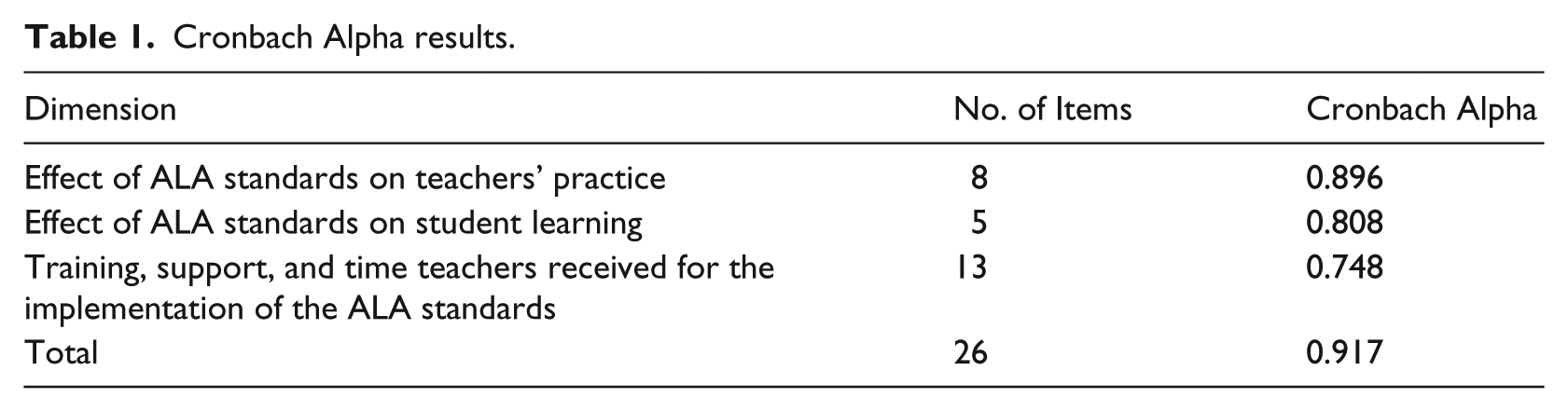
Data were analyzed using descriptive statistical analysis including frequencies, means, and percentages (see Tables 3, 4, and 5). Test items were piloted on a sample of 30 participants. Cronbach Alpha was conducted to determine the internal consistency reliability of all 26 items and was found to be 0.917 (see Table 1). For this study, subscale variables were created by summing across all the Likert-type items that loaded on a factor: 1) effect of ALA standards on teachers’ practice, including eight items; 2) effect of ALA standards on student learning, including five items; 3) training, support, and time teachers received for the implementation of the ALA standards, including 13 items. Cronbach Alpha was calculated for all three subscales. Subscale on teachers’ practice consisted of eight items and yielded high reliability (α = .896), the student learning subscale consisted of five items (α = .808), and the support and training subscale consisted of 13 items (α = .748).
Cronbach Alpha results.
Procedure
Teachers who used the ALA standards (Taha, 2017a) for at least one year between 2012 and 2015 were asked to respond to a 26-item survey 5-point Likert scale (strongly agree, agree, neutral, disagree, strongly disagree) in which they rated their experience using those standards. The survey was uploaded online, and a link was sent to the teachers. Once they opened the link, a page appeared explaining the objective of the survey in Arabic, informing them about the time required to complete it, and asking for their approval to participate. Once they clicked “approve,” the survey commenced with five demographic information questions (see Table 2) followed by 26 items on a 5-point Likert scale.
Demographic information of participating teachers.
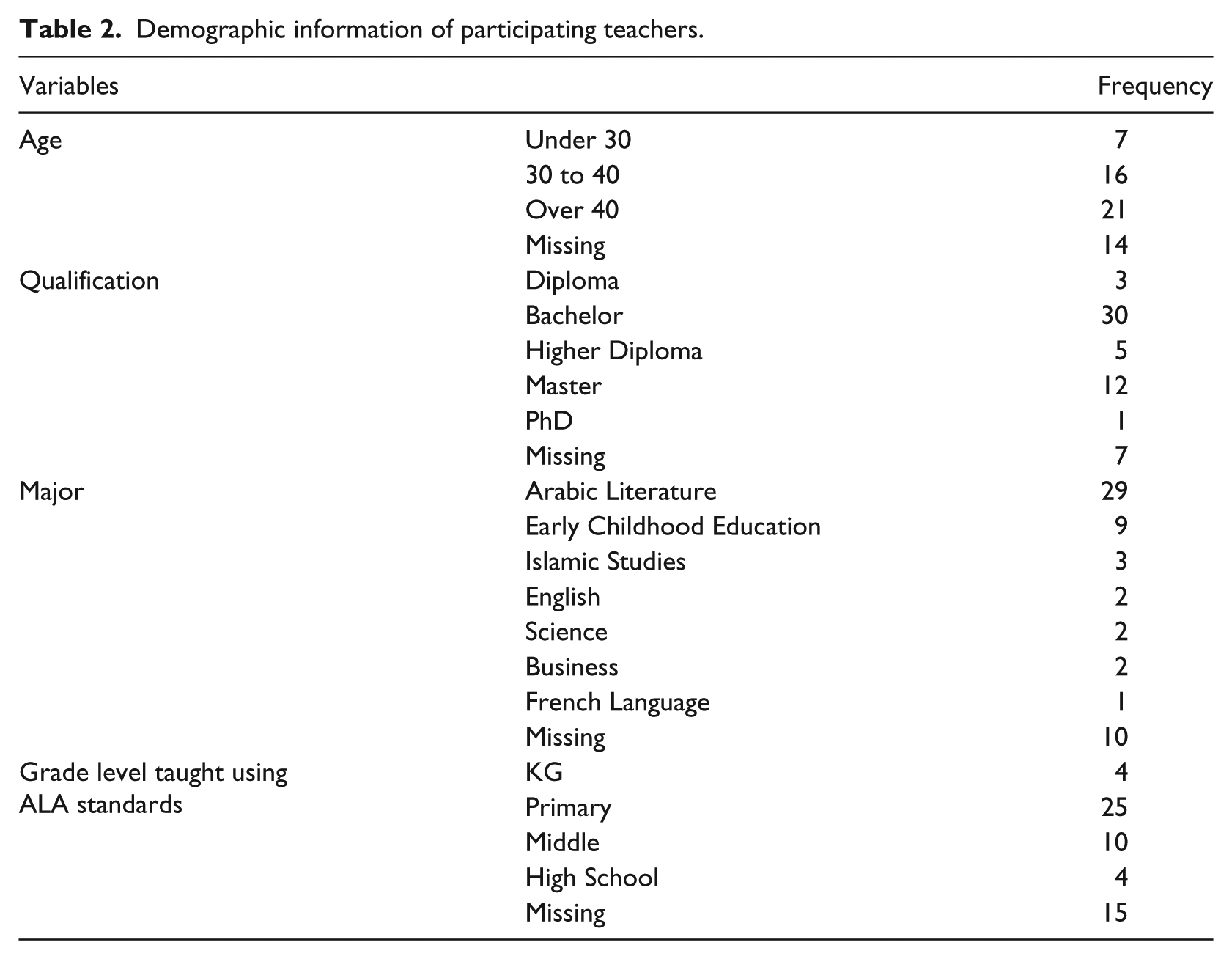
Table 2 summarizes demographic information collected, including age, qualifications, specialization studied at university, and years of experience in grade level. Fifty-seven percent of teachers were under 40 years old; 31% of teachers reported having graduate and postgraduate degrees; 50% of teachers reported having a degree in Arabic language, while 32% of teachers did not have a degree in Arabic language. Some of the reported specializations ranged from Islamic studies and early childhood education (cycle 1) to French, English, science, and business. The majority (67%) of teachers using the ALA standards taught in middle or primary schools.
Figure 1 illustrates years of participants’ teaching experience, with 43% reporting having more than 10 years’ experience.
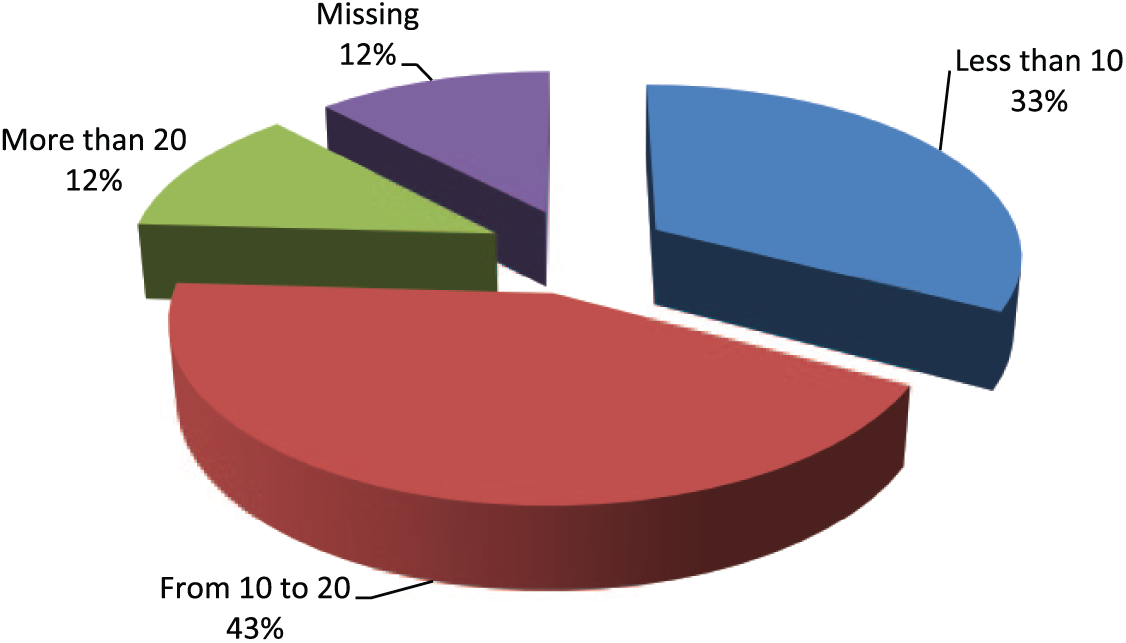
Years of teaching experience.
Results
Fifty-eight Arabic language teachers who used the ALA standards (Taha, 2017a) responded to a 26-item online survey. Multi-item aggregation refers to collections of individual items combined to enhance the measurement of a characteristic (Converse and Presser, 1986). Items included under one dimension are logically linked to each other, which gives a more reliable view of participants’ responses (Edwards et al., 1997). Items in this study were aggregated into three main dimensions or subscales based on the logical connections between the items. Those dimensions are:
Effect the use of the ALA standards had on their classroom practice.
Effect the use of the ALA standards had on their students’ learning.
Time, support, and training needed to implement the standards-based approach.
Reported results are mainly percentages that were calculated by summing up the “strongly agree” and “agree” responses on the 5-point Likert scale and deriving the percentage based on that.
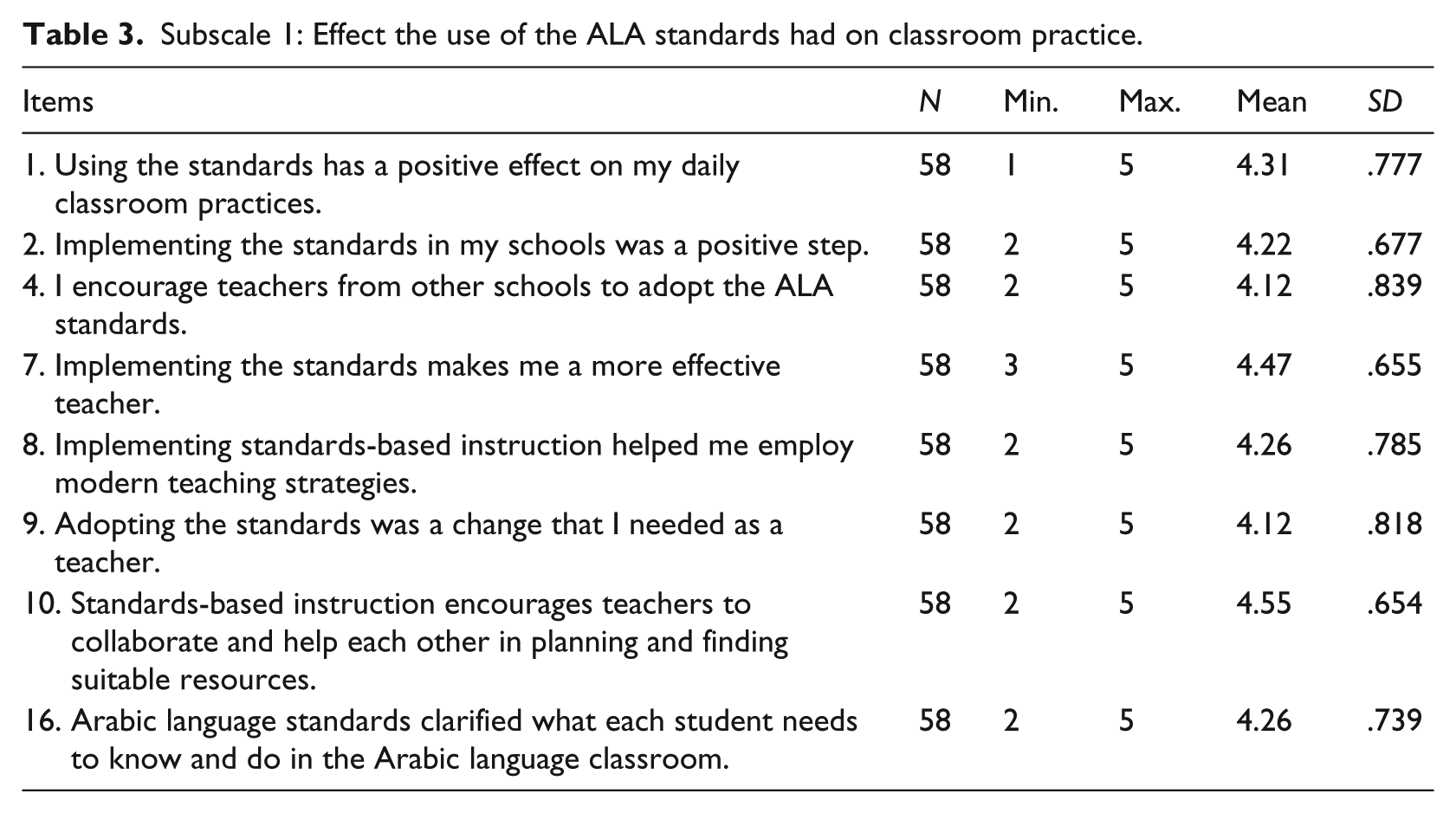
For subscale 1 (see Table 3), teachers to a large extent found that adopting the ALA standards made them more effective in the classroom; 89.6% (n = 52) of teachers said that using the ALA standards had a positive effect on their daily classroom practices. Teachers also indicated that using the ALA standards was a positive step for the school (89.7%; n = 52). Teachers agreed that employing the ALA standards helped them use modern teaching strategies (86.2%; n = 50) and that adopting the ALA standards was a change that they needed as teachers (79.3%; n = 46). Most teachers indicated that the ALA standards clarified what each student needs to know and do in Arabic (89%; n = 52), and 94.9% (n = 54) of teachers said that standards-based instruction encouraged them to collaborate with teachers and help each other in planning and finding suitable resources, while some (75.8%; n = 44) said that they have encouraging teachers from other schools to adopt those standards.
Subscale 1: Effect the use of the ALA standards had on classroom practice.
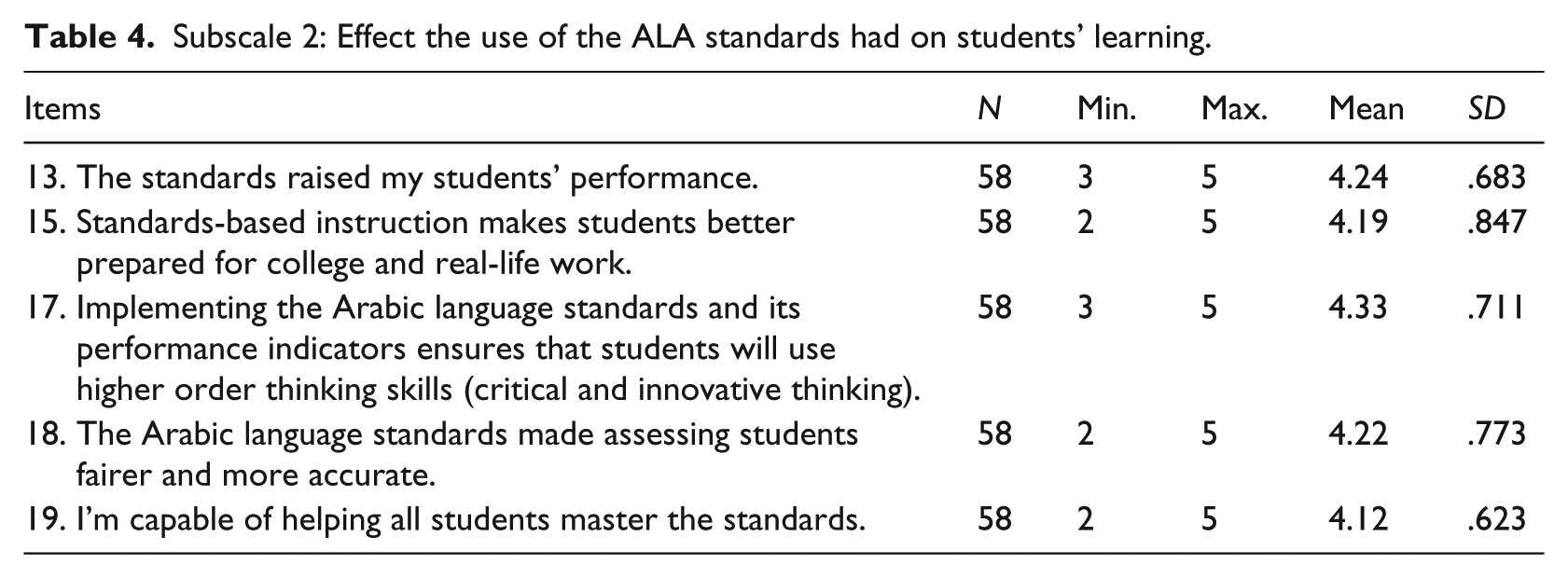
For subscale 2 items (see Table 4) regarding the effect the use of the ALA standards had on their students’ learning, 86.2% (n = 50) of teachers indicated that the standards helped raise their students’ performance, while 86.6% (n = 50) thought that the standards made assessing students easier, and 89.6% (n = 50) responded that they are able to help all students master the standards. Seventy-nine percent (n = 46) of teachers pointed out that standards-based instruction made students better prepared for college and real-life work, and 86.3% (n = 50) thought that implementing the ALA standards ensured that students will use higher order thinking skills.
Subscale 2: Effect the use of the ALA standards had on students’ learning.
For subscale 3 (see Table 5), teachers were asked about the time, support, and training they received from their schools to be able to implement the standards-based approach. Most teachers (94.9%; n = 55) indicated that they do not regret the time and effort they put into understanding and implementing the ALA standards, and 89.6% (n = 52) thought that the ALA standards are easy to comprehend; however, that number slipped to 79.3% (n = 46) regarding ease of implementation of the ALA standards. In addition, most teachers (93.1%; n =54) thought that they have sufficient knowledge of the ALA standards, while 77.5% (n = 45) indicated that they received sufficient training to enable them to implement the standards. Some teachers reported that they spend a lot of time preparing lessons (75.8%; n = 44), and only 62.1% (n = 36) indicated that there is enough time in the school year to cover all the performance indicators in each grade level.
Subscale 3: Time, support, and training needed to implement the standards-based approach.
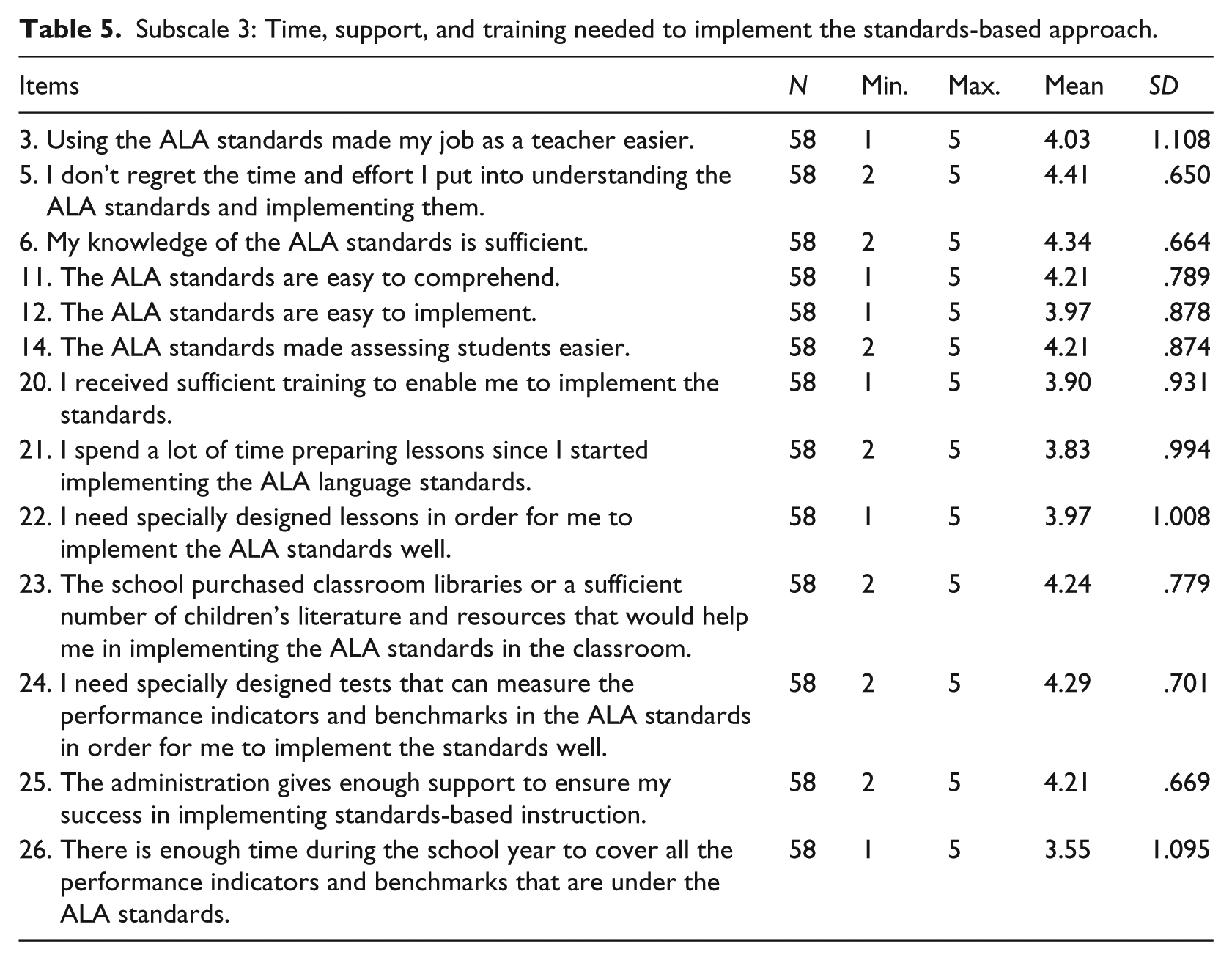
The lowest scoring item in terms of respondents’ agreement was “teachers have enough time during the year to cover all the ALA standards.” For this item further analysis was conducted, but no statistically significant connections between rates of agreement to the item and background characteristics including age, educational qualifications, or specialization were found.
Regarding the support that schools give Arabic language teachers in their implementation of the standards, 89.7% (n = 52) indicated that they get enough support, and 86.2% (n =50) pointed out that their schools purchased classroom libraries and resources to help them implement the standards well.
Discussion
The objective of this study was to find out what teachers’ perceptions towards ALA standards are, and whether they thought that they had a positive effect on their classroom practice. To address these questions, 58 Arabic language teachers from six private schools in Bahrain, Saudi Arabia, and United Arab Emirates that adopted the ALA standards (Taha, 2017a) between 2012 and 2013 were asked to respond to a 26-item survey on a 5-point Likert scale.
Most teachers thought that the implementation of the ALA standards in their classrooms had a positive effect on their teaching. They indicated that adopting the standards-based instruction approach was a change they needed and that it made them more effective and enabled them to employ modern teaching strategies in the classroom. The shift towards a standards-based approach seemed to encourage teachers to collaborate with other colleagues in the field, especially in planning and sharing resources. The common articulation of learning outcomes or performance indicators among teachers who used the standards could be a factor that contributed to the level of collaboration teachers experienced and reported (Chambers and Dean, 2000). Having common “terminology” and goals leads to transparency, which could be very comforting to all stakeholders in the educational process. This is in line with a study on the Qatari standards conducted by the Rand Corporation (Brewer et al., 2006) in which the researchers acknowledged the importance and success of standards-based instruction as a vehicle that provides accountability in teaching and learning without being overly prescriptive.
Those results have major implications on the teaching of Arabic language that has remained over the decades textbook-centered and teacher-centered. Teachers of Arabic need this paradigm shift that the standards-based approach brings and the effect that can have on their own classroom practices and the level of collaboration it can foster with other teachers. Just by bringing forth into the field of Arabic language education a different way of thinking about teaching and learning and different strategies that have proven to be successful in other regions of the world (Chambers and Dean, 2000) might usher in a new era in the field of Arabic language education, whereby new ideas will be tried and new ways of thinking about the teaching of Arabic language will be adopted.
Most teachers indicated in their responses that they believed that the ALA standards moderately raised their students’ performance, and many indicated that adopting a standards-based instruction approach will make students better prepared for college and real-life work. The use of the ALA standards, according to teachers’ responses, ensured that students used higher order thinking skills, including critical and innovative thinking. Teachers who successfully adopted a standards-based approach in their classrooms used a variety of instructional strategies and reported that their students usually were engaged in higher order thinking skills (Marzano and Schmoker, 1999).
When it comes to assessing students, most teachers believed that they have been able to ensure mastery of the standards in their students and that the use of the standards made assessing students easier. The standards-based approach has been credited with bringing specific and clear learning objectives to the learning process, in addition to bringing standards that apply to all students and assessment that measures students’ performance against those standards rather than against other students (Chamber and Dean, 2000). These three main characteristics that define the standards-based approach could be the drive behind the positive effect on students’ learning that the teachers of Arabic describe in their responses. This clarity makes it easier for teachers to know where each student is and what help each one of them might need to get them where they need to be.
Most teachers surveyed thought that the ALA standards were easy to understand and that their level of understanding of the standards-based approach is solid. A large percentage of teachers said that they do not regret the time and effort they had to put into understanding the standards and implementing them. This should carry some positive implications for ministries of education and other stakeholders looking to adopt a standards-based approach. When teachers are trained and supported while implementing a new strategy or approach, it has a greater chance of being successful (Coe et al., 2014; Fullan, 2007). This is in line with findings from Barlow’s study in 2012, whereby math teachers using standards-based instruction for one academic year reported higher levels of success when supported by peers and school leadership via discourse, providing the necessary resources and time management.
Most teachers surveyed thought that the standards made assessing their students easier, which could be because of the clarity of what they are supposed to assess and against what standards. The idea of comparing students to one another can be quite daunting and a bell curve philosophy can, at times, leave teachers feeling as if they have betrayed their students—especially those who, despite their best efforts, still end up in the 68% bracket (Marzano and Schmoker, 1999).
Many teachers surveyed felt well supported by their schools in terms of getting the training and resources needed to be able to effectively implement the standards approach. However, 10% of the participants disagreed and said that the training they received from the school was not sufficient. Most teachers agreed that the schools purchased the necessary resources and classroom libraries to be able to implement the standards well. School support in terms of training and resources acquisition can make or break the successful adoption of any approach (Fullan, 2007). Without the school leadership buy-in and support, the difficulty level of implementing the standards-based approach in class will be exponential. As it is, close to a quarter of the respondents thought that there was not enough time during the school year to cover all the performance indicators pertaining to each grade level, which is why support and training become of paramount importance when adopting the standards-based approach. No differences were found on this item between younger or older teachers, highly qualified teachers and those less so, and similarly no differences were found when teachers had varying specializations. This is in line with what Chambers and Dean (2000) reported about teachers expressing frustration that there is not enough time to teach all the performance indictors under each standard.
Limitations
Limitations to this study stem mainly from using a convenience sample. Approximately 1000 Arabic language teachers are using the ALA standards, but it has been difficult to reach out to them, since most work in public schools. Several attempts at communicating with the public school system were made via email, phone calls and personal communication with a senior official, but no responses were received, and as such the survey was only answered by teachers using the ALA standards in private schools.
The study depended on the responses of the 58 teachers whose schools responded to an email sent by the researcher inviting their participation. It will be important to elicit responses from more users to make the results more generalizable and wider-ranging. Also, the use of a survey as the only investigation tool limits the amount of data that can be generated and does not allow for a multi-level analysis. Further research including classroom observations and interviews will be needed to examine the actual effect of using the ALA standards on students’ performance in Arabic.
Conclusion
Arabic language teaching has for decades been dominated by a textbook and teacher-centered approach (Faour, 2012). Content, skills, and values to be learned in each grade level are dictated by textbooks vetted by the ministries of education. Thus, if the textbook is changed or if a teacher retires or resigns, then the content, skills, and values to be acquired at each grade level would change (Taha, 2017b). This study is an initial work to fill a research gap in the domain of Arabic language teaching and learning; it was designed to survey teachers’ perceptions of their use of standards-based instruction—a practice common in many parts of the world, but new to Arabic language arts instruction. The study surveyed Arabic language teachers who adopted the ALA standards and used them with their students for at least a year.
Results of this study show that teachers, to a large extent, found that adopting the ALA standards made them more effective in the classroom. Most teachers indicated that they believed the ALA standards moderately raised their students’ performance, making them better prepared for college and real-life work. Teachers reported that their students became more engaged in higher order thinking skills as a result of the implementation of a standards-based approach. Results also showed that most teachers received adequate training and support from their schools on standards-based instruction and teachers overwhelmingly did not regret the time and effort they put into implementing this approach.
The results of this study shed a positive light on adopting a standards-based approach in the Arabic classroom and deserve, accordingly, to be examined on a larger scale to see whether that same level of enthusiasm and success is replicable. For now, we can say with some degree of confidence that the Arabic Language Arts standards adopted were a positive innovation to the decades-old tradition of textbook-based instruction and have contributed to the way some Arabic language teachers in the Gulf Region think about their practice.
Footnotes
Appendix A: Arabic survey given to teachers
Appendix B: Sample of the Arabic Language Arts standards for Grade 1
Acknowledgements
We thank Dr Moosa Fateel for all his help and support.
Declaration of Conflicting Interests
The author(s) declared no potential conflicts of interest with respect to the research, authorship, and/or publication of this article.
Funding
The author(s) disclosed receipt of the following financial support for the research, authorship, and/or publication of this article: The authors thank Zayed University for the funding of this research (Cluster Grant R18024).