




Abstract
In international comparisons, the Swedish heritage-language education (HLE) system is often described as being at the forefront of HLE in Europe. Following recent right-wing shifts in national politics, HLE has now come under threat. This article investigates the current state of HLE in Sweden, focussing on Arabic, through a survey of the literature, statistics on HLE provision and attendance and two empirical studies. Arabic is by far the most taught heritage-language in Swedish schools; research on Arabic HLE is surprisingly scarce though. Study 1, based on questionnaires and interviews, investigates the attitudes and experiences of parents of 100 Arabic-speaking preschool and primary-school children, cross-sectionally and longitudinally (age 4−10 years). Interview-based Study 2 sheds light on the practices and experiences of 17 HLE teachers. Both parents and teachers express appreciation of state-funded HLE, but critique similar aspects of its implementation (e.g. scheduling, class duration). Arabic HLE attendance is high. Teachers report that children make progress despite time constraints and heterogeneous groups. They emphasise how they align their lessons with other school subjects and act as cultural mediators. Unlike some parents, teachers view exposure to different varieties of Arabic in the HLE classroom as beneficial for developing children’s linguistic repertoires and promoting pluralism.
Keywords
Introduction
In international comparisons, Sweden is often described as being at the forefront of heritage-language education (HLE) in Europe. What sets Sweden apart from many other countries is that HLE is offered as a state-financed elective subject within the regular school system, and that preschool and school-age children who grow up with a home language other than the majority societal language are entitled to HLE by law. Swedish legislation and state-level language policy have promoted HLE and the use of minority languages in schools and preschools since the 1970s; its actual implementation may be a different matter. After decades of uncontested governmental backing, HLE in Sweden has now come under threat, due to recent right-wing shifts in national politics.
The aim of this article is to investigate the current state of HLE in Sweden, with a focus on Arabic. Arabic is the largest minority language in Sweden and by far the most taught heritage-language in Swedish schools (28.7%, Skolverket, 2024a). Surprisingly though, research on Arabic HLE is next to nonexistent. This is where the present study comes in. Having reviewed the literature on the foundations and practical implementation of HLE in Sweden, we identify a number of knowledge gaps and provide the latest statistics on HLE provision and attendance. This is followed by two empirical studies on the lived experiences and practices of Arabic HLE in Sweden today. The first study focusses on the perspective of the families of 100 preschool and primary-school children entitled to HLE in Arabic, and presents both cross-sectional and longitudinal results based on parental questionnaire and interview data. The second study, an interview study, focusses on the experiences of Arabic HLE teachers. By combining these two perspectives, we hope to give a more comprehensive picture of HLE in Sweden today.
Background
Heritage language education in Sweden today
Around 200 languages are spoken in Sweden today, making it a multilingual country. The official language of the country is Swedish (Språklagen, Language Act, 2009). Sweden is generally considered to stand out among Western countries for its strong public support of minority languages in education, state integration policies and multicultural politics, consistently ranking highly in various surveys and indices such as Indicators of Citizenship Rights for Immigrants (Koopmans et al., 2012), Migrant Integration Policy Index (Solano and Huddleston, 2020), Multiculturalism Policies in Contemporary Democracies (2021) and Special Eurobarometer 469 (European Commission Directorate-General for Communication, 2018).
One of the factors contributing to these high rankings is the long-standing Swedish tradition of having a system in place that offers state-funded HLE to children. For a long time, HLE in Sweden was referred to as hemspråksundervisning (home language instruction), but it is now officially known as modersmålsundervisning (mother tongue instruction). The motivation behind this terminological change was to signal that a child’s mother tongue is important and that its use is not only confined to the sphere of the home. A drawback of this change in official terminology (at the behest of policy makers in 1997) is that it has led to terminological confusion, as the Swedish language now no longer can be referred to as a mother tongue (modersmål), contrary to the linguistic intuitions and experiences of many people in Sweden. 1 In the following, we will avoid the term mother tongue instruction and refer to heritage language education as HLE.
The current regulations for HLE are that all pupils in primary school and lower secondary school (age 6−15 years) who have a caregiver with a native language other than Swedish should be offered HLE in the language spoken at home if the child has basic knowledge of the language (Skollagen, Education Act, 2010). In upper secondary school (age 16−19 years), HLE lessons should be offered to pupils who have previously earned a pass grade in the language. HLE must be offered if more than four eligible pupils want to study the language and if there is a suitable teacher (Skolförordningen, School Ordinance, 2011: Ch.5 §10). If the heritage language is one of the five national minority languages, that is, a language with official status in Sweden (Finnish, Meänkieli, Romani, Sami and Yiddish), then the minimum of five pupils does not apply. For national minority languages (spoken by 0.4% of the population), pupils do not need basic knowledge of the language to be offered HLE, as long as there is a history of the language in the family (Education Act, 2010: Ch.10 7§). In addition to HLE lessons, minority-language pupils are also entitled to ‘mother-tongue study guidance’ (studiehandledning på modersmål) if they need it. Here, a HLE teacher accompanies the pupil to regular lessons in school subjects taught in Swedish to help them understand the subject matter by translating and explaining in the pupil’s native language. This service is mainly provided to recent newcomers (nyanlända) but is also available to other minority-language pupils with insufficient Swedish skills.
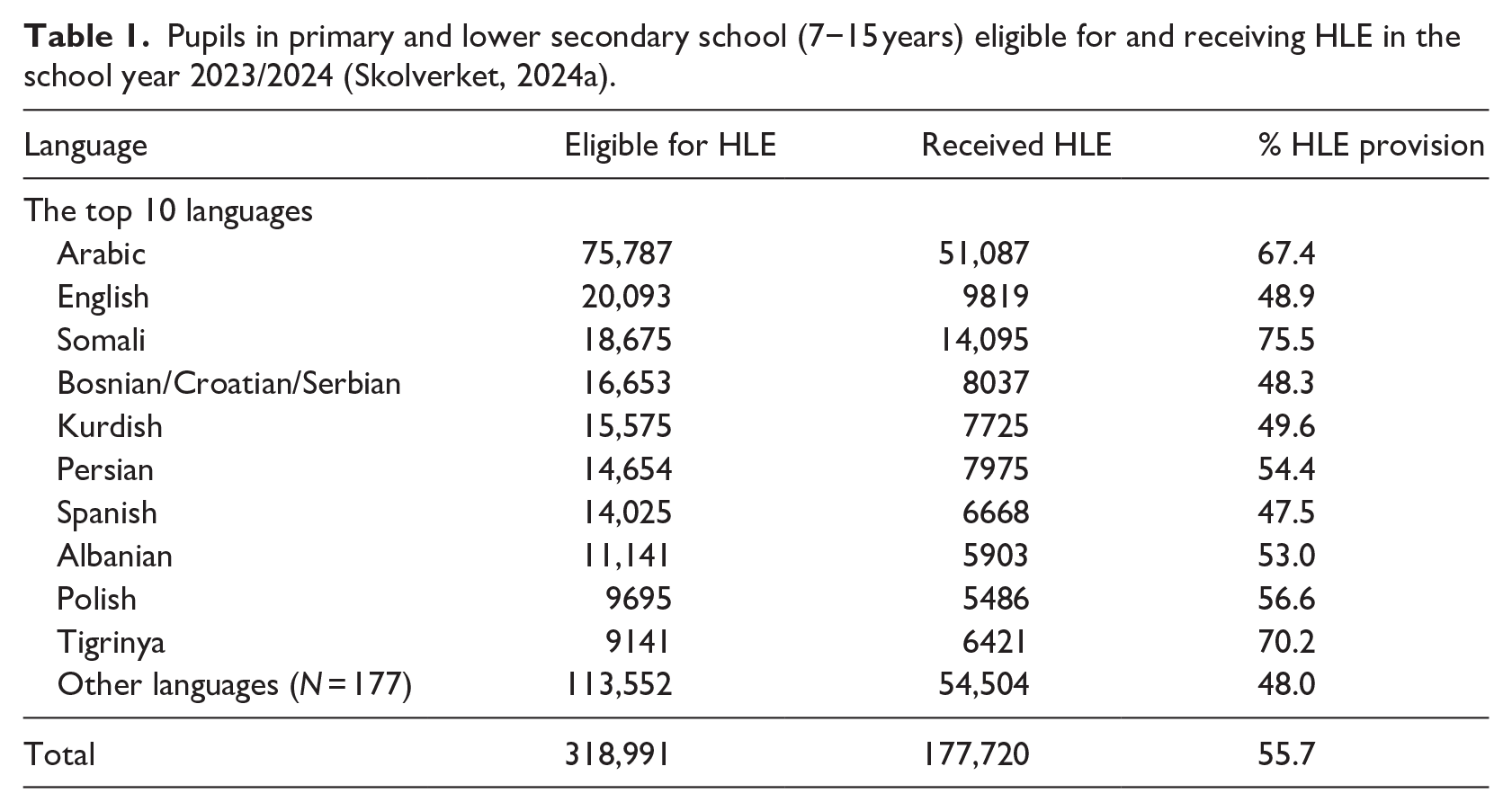
Of all pupils aged 7−15 years attending school in Sweden in 2023/2024, 318,991, or 28.9%, were entitled to HLE, and 55.7% of them attended HLE (Skolverket, 2024a). They were entitled to HLE in 187 different languages, the top 10 being Arabic, English, Somali, Bosnian/Croatian/Serbian, Kurdish, Persian, Spanish, Albanian, Polish and Tigrinya (Skolverket, 2024a). Most pupils are entitled to HLE in languages that do not have any official status in Sweden. This is because the heritage languages spoken by most children do not classify as indigenous national minority languages. Rather, they have been introduced to the country as a result of large-scale immigration in the late 20th and early 21st century. It is the state-funded HLE support for these ‘immigrant’ languages that has recently come under political flak, as described in Section ‘Shifting political attitudes’.
Political views on HLE and languages other than Swedish
Initial consensus to introduce HLE
In the mid-1970s, Sweden moved towards a more pluralistic language policy. A pluralistic language policy encourages multilingualism and recognises and supports diversity in society. It aims to protect the right of individuals to express themselves in their native language and for all languages to be treated equally. Following this policy, immigrants were given the right to choose if they want to keep their cultural identities and their languages. In 1974, a constitutional reform enabled protection of minority language rights (Justitiedepartementet, 1974: Ch.1 §2). This was at a time when bilingualism began to be viewed in a more positive light, in contrast to the predominantly monolingual, monocultural and assimilationist discourse of earlier periods. The Home Language Reform of 1977 introduced the right to ‘home language education’ for minority-language pupils. These children attended Swedish-language mainstream schooling, but in addition, municipalities were obliged to offer them lessons devoted to developing oral proficiency and literacy skills in the minority language. This system is still in place today, even though practical implementations have changed over the years.
Since 2009, Swedish legislation stipulates that all people who live in Sweden should get the chance to learn Swedish and use and develop their mother tongue (Education Act, 2010; Language Act, 2009). 2 The Swedish state does not have many tools at its disposal for putting into practice the right to use and develop one’s mother tongue. HLE is its most important tool, since the state, under the Education Act, can demand from municipalities that they ensure that children are provided with HLE.
Since HLE was introduced at a general level in 1977, the intended aim has been for pupils to achieve aktiv tvåspråkighet, that is, active bilingualism (Regeringskansliet, 1976 (Prop. 1975/1976:118)). This means that pupils should develop their speaking, listening, reading and writing skills in the heritage language alongside Swedish, so that they become active users of both languages. Behind this aim lay the assumption that the development of language and literacy skills in the heritage language would aid children in learning the majority language Swedish (Ganuza and Hedman, 2019; Salö et al., 2018). This is a notion that can be traced back to bilingualism research, for instance to work by Tove Skutnabb-Kangas and Jim Cummins. According to the threshold and interdependence hypotheses (e.g. Cummins, 1979), high levels of language and literacy proficiency in the L1 (first language) facilitate the acquisition of L2 language and literacy. The development of both languages is interlinked, with beneficial transfer of skills both ways. Another assumption was that active bilingualism would have positive socioemotional and cultural-identity effects for the individual (Skutnabb-Kangas and Toukomaa, 1976), and positive effects for Swedish society at large.
Whilst the empirical research evidence bolstering these assumptions was not necessarily extensive at the time, numerous studies since have documented transfer of knowledge and skills between L1 and L2, and several studies have shown that participation in HLE has beneficial effects for the development of Swedish as an L2, literacy and school performance in general (Ganuza and Hedman, 2018, 2019; Mehlbye et al., 2011; Skolverket, 2008; SOU 2019:18, 2019: 273−289). This, in turn, may have positive socioemotional repercussions for the individual and facilitate integration. International studies (e.g. Portes and Hao, 2002) have shown active bilingualism to be associated with positive adaptation outcomes, more harmonious family relationships and socioemotional wellbeing in heritage-language children and adolescents.
Even though decisions on HLE provision in Sweden were made on the political level, many of the political discussions around HLE can be viewed as academically founded (Bajqinca, 2019; Salö et al., 2018). Sweden has a tradition of scholarly expert commissions, where state and political representatives investigate matters of interest in cooperation with academics in order to suggest political solutions based on facts. Following the recommendations of such a government-appointed scholarly expert commission, parliamentarians from across the political spectrum agreed to introduce HLE (Bajqinca, 2019; Jacobsson, 1984). The introduction of HLE was a symbol that the predominantly assimilationist policies of earlier times were replaced by a vision of a pluralistic society, at least on a rhetorical level (Hyltenstam and Milani, 2012; Salö et al., 2018).
Shifting political attitudes
The Home Language Reform of 1977 was both progressive and radical for its time, as granting general HLE rights to minority-language children meant that the educational system from one year to the next was expected to find and/or train teachers for more than 100 languages. At first, relatively generous state funds were allocated for HLE, and municipalities as executive agents of schooling received an earmarked per capita sum from the state, a salary equivalent for 1.1 weekly teaching hours for each child attending HLE (Hyltenstam and Milani, 2012: 57). Also, 2-year teacher training programmes for 20 languages were established, yielding 1300 graduates who then served as HLE teachers (Hyltenstam and Tuomela, 1996: 51). Already in 1988, these teacher training programmes were terminated though (Hyltenstam and Milani, 2012: 59). Moreover, in 1991, following a political decision to decentralise the national educational system, schooling responsibilities were moved from the state to the municipal level. Previously earmarked funding for every child attending HLE was abolished. In practice, this meant cuts in funding and less incitement to offer HLE. Local authorities could now set their priorities differently, and municipalities and schools could decide how (or how not) to provide HLE. This system is still in place today.
For some time now, Swedish right-wing politicians have been calling for further cuts in HLE. Whilst these were fringe views at first, they have entered the political mainstream. Populist parties want to abolish state-funded HLE altogether, allegedly because it is harmful to children’s acquisition of Swedish, contrary to fact, and because they consider it an unnecessary expense. For instance, in 2023, the far-right Sverigedemokraterna campaigned at national level with the slogan Vi ska inte lägga en krona på att lära barn arabiska (‘we won’t pay one crown for teaching children Arabic’) on their official accounts on social media.
In a recent survey study by Bijvoet and Spetz (2022), the political parties in Sweden got to answer several questions about language politics. The survey asked the parliamentary parties whether the Swedish state should actively support multilingualism among residents with foreign backgrounds. This question was based on the aforementioned 2010 Language Act (14§) which enshrines people’s rights to their mother tongue. All the parliamentary parties answered ‘yes’ to this question except the right-wing parties, which have been in power since the 2022 elections. Another question asked in Bijvoet and Spetz’s (2022) survey was ‘How important do you find HLE in primary and secondary school?’ The political parties had to rate the importance of the subject on a four-level scale. All parliamentary parties rated HLE as very important except for the right-wing parties, who rated HLE as only ‘somewhat important’ or as ‘not at all important’. They even commented that they would like to abolish HLE and instead put more focus on school subjects taught in Swedish. Parties who agreed on the importance of HLE pointed to studies that showed that heritage-language development can also aid L2 development. One party also mentioned that HLE is good for children’s cultural identity development (Bijvoet and Spetz, 2022).
After repeated vociferous demands by the currently leading right-wing parties, it was decided on 18 December 2023 that a new investigation into the status and future of HLE and the study of Swedish as a second language would be launched. An independent commissioner was appointed to lead this investigation, due to submit a report to parliament by 6 December 2024 (Regeringskansliet, 2023). The motivation is an alleged need for more knowledge in this area, including how HLE affects integration, pupils’ development of Swedish and their overall school performance (Regeringskansliet, 2023). Only a few years earlier, an independent investigation had been commissioned by the then government and issued a detailed report on the status and future of HLE, including fact-based recommendations on how to improve HLE (SOU 2019:18, 2019). Interestingly though, the 2019 scholarly expert commission report has been shelved, presumably because it does not reflect the views of the right-wing parties.
Implementation of HLE
Overview articles and reports (e.g. Hyltenstam and Milani, 2012; Spetz, 2014) generally characterise HLE as a school subject that has suffered from practical implementation issues since its inception in 1977. HLE in Sweden is offered as an elective subject as part of the school curriculum of primary and secondary schools; it is not just an extra-curricular activity organised by volunteers, minority organisations or foreign agents as in many other places (Salö et al., 2018; Yağmur, 2020). Still, HLE remains a peripheral subject in the Swedish curriculum. Evidence for its marginalised status comes from the following.
Teaching hours and curriculum
There are no guaranteed minimum teaching hours for HLE, unlike for other school subjects, such as foreign languages (English, Spanish, German and French). The municipality or school decides how much time is allotted to HLE. According to the National Agency for Education, HLE lessons range from 30 to 100 minutes/week, where 40−60 minutes are typical (Skolverket, 2008 Appendix 1 : 13). This means that HLE hours only add up to a fraction of the hours allotted to other languages (3−5 hours/week).
The national curriculum also sets HLE apart. Compared to the relatively detailed curricula for other school subjects, including foreign languages, the HLE curriculum has always been formulated in very general terms, stating only some overarching learning objectives: ‘Mother tongue education should give pupils the opportunity to develop knowledge in and about their mother tongues’, ‘develop oral and written language skills’ and ‘develop their cultural identity and become multilingual’ (Lgr22, Skolverket, 2022: 84). 3 One and the same curriculum is meant to cover all heritage languages. For instance, for a pass in HLE Grade 6, a pupil is expected ‘to be able to write different types of text that are comprehensible, structurally functioning and linguistically varied’ (Skolverket, 2022: 88−89). The same learning objectives obtain irrespective of whether the heritage language is closely related to Swedish (such as Norwegian or English) or not (such as Arabic), and irrespective of whether literacy is acquired for the same orthography as in Swedish (i.e. the Latin alphabet), or for a different orthography (e.g. Arabic). The curriculum affords HLE teachers a lot of leeway in interpreting learning objectives, and choosing content and pedagogical approaches, but this also means that the content and quality of HLE teaching may vary across the country. We know of no systematic studies in this regard.
Another aspect that sets HLE apart from other school subjects is that it is mostly scheduled outside the regular school day. Whilst this practice ensures that HLE will not clash with other school subjects, children attending HLE need to stay behind when all other pupils and staff have gone home. This sends signals that HLE is not included in the daily work of the school. The School Ordinance (2011) allows different ways of organising HLE, but recent statistics show that municipalities and schools predominantly offer HLE after hours (69.8%, Skolverket, 2024a).
Teachers’ working conditions
HLE is taught by language teachers employed by the municipality, or sometimes by teachers directly employed by schools (the latter option is usually restricted to languages with large enrolment, e.g. Arabic, Somali). Typically, a designated central unit supplies HLE teachers to schools and also organises in-house training. 4
From the perspective of the municipality, sending out HLE teachers to several different schools may seem efficient, but from a pedagogical perspective it is problematic, since it hinders HLE teachers from being properly integrated in the workings of the school, participating in regular staff meetings and collaborating with teachers of other school subjects (Skolinspektionen, 2010; Spetz, 2014: 31). HLE teachers may need to shuttle between schools as their pupils are distributed across the municipality. In an ethnographic study involving nine Somali and six Bosnian/Croatian/Serbian HLE teachers (Ganuza and Hedman, 2015), most of the teachers were ambulerande (peripatetic), serving up to 12 different schools every week. Similar conditions were found for one of the Turkish HLE teachers in Bohnacker (2022). None of the HLE teachers in Ganuza and Hedman (2015) participated in planning meetings or in-house training at the schools where they taught; they only received training at the municipal units or via national network meetings for HLE teachers.
Ganuza and Hedman (2015), who carried out 67 HLE classroom observations, found that class sizes for Somali and Bosnian/Croatian/Serbian were heterogeneous with 1−26 pupils. In the Somali lessons, children of similar ages tended to be grouped together, whereas in Bosnian/Croatian/Serbian, which has lower HLE enrolment, children of very different ages (grades 1−7) were in one and the same class. Bohnacker (2022) describes a similar setup for four Turkish HLE teachers who teach pupils of different ages and proficiency levels together to make up the numbers; alternatively shorter, individual HLE lessons are offered. All teachers interviewed by Ganuza and Hedman (2015) considered it a challenge to cater to the needs of all pupils in a HLE class; they also lamented a lack of suitable teaching materials, time constraints and a heavy workload, including having to serve many different schools (p. 129). We are not aware of comparable studies for other HLE languages in Sweden, but the working conditions of many HLE teachers appear to be far from optimal.
There are also anecdotal reports of schools not always providing HLE teachers with a properly equipped classroom, but only a corner in the school hallway to sit and teach. Again, such scheduling and location issues signal that HLE is a low-priority subject.
Teachers’ qualifications
Claims abound about HLE teachers’ insufficient pedagogical qualifications. Concerning their formal qualifications, this may often be true. As the demand for HLE teachers is high, Swedish school authorities regularly grant exemptions from formal qualifications. Thus, in 2017/2018, only 24% of the practising HLE teachers nationwide were certified teachers for HLE as a school subject (SOU 2019:18, 2019: 151), and only 31% had a higher-education teaching degree, with varying percentages for different languages (e.g. 62% for Finnish, 26% for Arabic and 5% for Somali; SOU 2019:18, 2019: 147−152). The low figures for formal qualifications are not surprising in view of the fact that there has been no large-scale HLE teacher education programme since the abolition of the 1980s’ programmes that trained 1300 teachers. Prospective HLE teachers have had to develop their pedagogical skills without any regulated pathways since then. Some universities have offered small-scale further education courses for practising HLE teachers, and a few had plans to launch a full HLE teacher education programme but put it on hold again due to low enrolment (Bohnacker, 2022; SOU 2019:18, 2019: 155–160). Now, in 2024, several Swedish universities provide (at least some) HLE education courses for prospective as well as practising HLE teachers, and some also offer a full-fledged HLE teacher training programme, but with few applicants and only for one or two languages (e.g. Finnish or Arabic).
The few (small-scale) studies that asked HLE teachers about their pedagogical practices and qualifications (Bohnacker, 2022; Ganuza and Hedman, 2015) did not find a lack of formal education. Most teachers reported that they had teacher training degrees or other relevant academic degrees from their home countries, from Sweden or a third country, supplemented by further education in Sweden. Many took pride in their education and professionalism, but also felt that their qualifications were continually being questioned and that they had ‘to disprove commonly held beliefs about [HLE] teachers’ supposed lack of formal education in order to be viewed as ‘real’ teachers’ (Ganuza and Hedman, 2015: 128).
Provision of HLE
Municipalities do not always offer HLE to all pupils who are eligible for it, for budgetary and/or other reasons. Recent statistics show that HLE is provided nationwide for only slightly more than half (55.7%) of the pupils entitled to it (Skolverket, 2024a). While the total number of pupils attending HLE has increased more than fivefold over the past 30 years (from ca 60,000 in 1991/1992 to nearly 320,000 today), HLE provision and enrolment have hovered around 52%−59% (SOU 2019:18, 2019: 178). Provision varies greatly between municipalities, ranging from 0% to 100%, with higher proportions in cities and districts with commuting distance to cities, and lower proportions in rural areas (Skolverket, 2024a). Provision also varies considerably for individual heritage languages and has for many years been highest for Somali (75.5%) and Arabic (67.4%), see Table 1.
Pupils in primary and lower secondary school (7−15 years) eligible for and receiving HLE in the school year 2023/2024 (Skolverket, 2024a).
Statistics are also available for (6-year-old) children in förskoleklass (‘preschool class’), a preparatory year between preschool and first grade of primary school, which starts at age 7 years. In 2024, 28,655, or 24.2%, preschool-class children had a first language other than Swedish, and 25.5% of those attended HLE (Skolverket, 2024b). No language statistics are available for preschoolers. Since municipalities are no longer obliged to offer HLE to minority-language preschoolers (so-called modersmålsstöd ‘mother-tongue support’), many have discontinued it altogether and provision is likely to be very low (for more details, see Bohnacker, 2022; Nordenstam, 2003). As a result, alternative private initiatives have sprung up, at least for some languages such as Arabic, English and Russian. Parents have critiqued the recent cuts of municipal HLE for preschoolers (Bohnacker, 2022, 2023, for Turkish).
In 2014, the Swedish Language Council published a detailed report on how HLE was implemented around the country (Spetz, 2014). The report included statistics on HLE provision for a 20-year period (from 1991/1992 to 2011/2012), survey results on what officials in charge of HLE units thought about HLE (across all 290 municipalities in Sweden, 53% response rate, N = 154), as well as survey results on the views of Finnish, Persian- and Somali-speaking parents in five municipalities (28% response rate, N = 197). In 2011/2012, only 25% of the municipalities provided HLE to all pupils who were entitled to it (Spetz, 2014: 28−29). Often, pupils whose families had applied were not offered HLE because of low numbers or because no suitable teacher could be found. In the survey, officials in charge of the municipal HLE units typically blamed low provision rates on (i) not being able to find suitable teachers, and (ii) there being fewer than five pupils per language so HLE classes could not be organised. They also claimed that (iii) families were not interested in sending their child to HLE, and that (iv) families believed that HLE would be detrimental to their child’s acquisition of Swedish (Spetz, 2014: 30). However, only 15% of the municipalities had investigated these issues, so the opinions voiced by officials were not necessarily based on fact. On the contrary, the survey responses from the Finnish-, Somali- and Persian-speaking families showed that parents did not believe that HLE was harmful to the acquisition of Swedish. Rather, the main reasons given by parents for their child not attending HLE were that (i) the municipality did not offer it, (ii) the HLE teacher was unsuitable or (iii) practical issues (inconvenient scheduling, location; Spetz, 2014: 40–41). There also seemed to be a misconception or misconstrual by many municipalities that HLE cannot be offered for a language when there are fewer than five pupils. Swedish legislation does not stipulate any such rule; rather, the School Ordinance (2011: Ch.5 §10) allows municipalities to opt out in such cases, that is, they are not obliged to offer HLE when there are fewer than five pupils. Spetz’s survey results suggest that some municipalities may be prejudiced against HLE and may find excuses for not offering it.
Summary
The literature has pinpointed several implementation issues regarding municipal HLE provision, the organisation of teaching, teachers’ working conditions and the marginalised status of HLE compared to other school subjects. Still, from an international perspective, the preconditions for HLE in Sweden are relatively good (Salö et al., 2018), and there has long been support for it in official Swedish opinion. The ever-increasing numbers of children attending municipal HLE, with very high enrolment rates at least for certain languages, indicate that there is a strong demand for it from minority-language parents and their children. Yet the voices of heritage-language families, their experiences with HLE in Sweden, have been largely absent from research (save for Spetz’s (2014) survey of Finnish-, Somali- and Persian-speaking parents and Bohnacker’s (2022, 2023) study of Turkish-heritage families). The voices of HLE teachers have not been given very much room either (one of the exceptions being Ganuza and Hedman’s (2015) study of Bosnian/Croatian/Serbian and Somali teachers). Concerning Arabic, which is by far the largest minority language in Sweden, we are not aware of any such published HLE research.
Arabic
Arabic in a majority and a minority setting
Arabic belongs to the Afro-Asiatic language family and is spoken as a first language by an estimated 300 million people, and it is an L2 for an additional 60 million people (Owens, 2013). In Arab countries, a regional variety (in Arabic ʿāmiyya) is used for daily, informal communication, while a standard variety (Modern Standard Arabic (MSA), in Arabic fuṣḥa) is used for formal communication and for official and liturgical purposes, e.g. in written discourse, education, religion and media (Suleiman, 2005). The regional varieties are often referred to as dialects, vernaculars or colloquials, and speakers of different varieties do not always fully understand each other. Arabic is spoken in a vast geographical area spanning 22 countries, often with large differences between the regional varieties. The farther the geographical distance is between two varieties, the harder mutual communication becomes (Aoun et al., 2009). Thus, a speaker of Levantine Arabic (an umbrella term for all varieties spoken in the Middle East) and a speaker of a Maghrebi (North African) variety may only partly understand each other, unless they modify their speech to resemble the standard variety as a common code. 5
Regional varieties differ from MSA in several aspects of vocabulary, phonology, syntax and grammar (Abu-Rabia, 2000). The use of different varieties of the same language for different purposes creates a diglossic linguistic environment (Ferguson, 2007), where nobody speaks the standard variety as their first language, and the regional variety is society’s language of natural communication. Since MSA is not acquired as a native language, many Arabs have only limited knowledge of it (Versteegh, 2014). Children growing up in the Arab world acquire the regional societal variety as a first language and learn the standard variety at school. At preschool age, children in the Arab world are usually exposed to MSA to some degree through television and the internet.
However, the situation can differ for children growing up with Arabic as their first language in the diaspora, such as Sweden. The parents might speak two different regional varieties, and the child may be exposed to these but not to additional Arabic input elsewhere; instead, the child will hear Arabic predominantly at home, and upon starting preschool, the child will mostly hear the majority language. Any potential Arabic-speaking peers may speak different regional varieties, which can be mutually unintelligible if the varieties originate from distant enough geographical areas. Lastly, when the time comes for enrolment in Arabic HLE, the child will have to learn to read and write in MSA and will be taught by a teacher who might speak a variety that the child only remotely understands. We are not aware of any research on this matter in a Swedish context. 6
Arabic in Sweden
Arabic is the largest heritage language taught in Swedish schools (28.7%, Skolverket, 2024a), having steadily been increasing over the years, both in proportion and total numbers. Arabic is also considered to be the second most frequent language (after Swedish) in terms of native speakers, and likely to exceed 400,000 speakers, 7 whereof 86% were born in Syria, Iraq or Lebanon (Bohnacker, 2017). Sweden has welcomed mass migration from these three countries since the 1980s. The first migration wave was from Lebanon as a consequence of the country’s civil war (1975–1990), the second from Iraq (1990s−2000s) and the third from Syria (since 2011). The main two reasons for emigrating from Arabic-speaking countries have been seeking asylum (i.e. fleeing war, conflict, persecution and hardship), and family reunification. In consequence, the Arabic varieties mostly spoken in Sweden are Levantine (approximately 48%) and Iraqi (approximately 37%; Bohnacker, 2017). Due to the different migration waves, Arabic/Swedish-speaking bilingual children include both first-generation (not born in Sweden) and second-generation heritage-language children (born in Sweden). They live predominately in Sweden’s three largest cities, Stockholm, Göteborg and Malmö. The Swedish National Agency for Education (Skolverket) registers how many pupils in compulsory school are eligible for HLE. 8 In the academic year 2023/2024, 75,787 children in primary and lower secondary school were eligible for HLE in Arabic, and 51,087, or 67%, received HLE (Skolverket, 2024a, recall Table 1). Moreover, 6471 children in preschool class were eligible, provision being 29% (Skolverket, 2024b). Arabic HLE provision rates vary greatly between municipalities, from 0% to 85% (Bohnacker, 2017; Skolverket, 2017).
The present study
The previous sections have pointed out a number of knowledge gaps concerning the current state of HLE in Sweden. In general, there is a lack of empirical studies on how minority-language families experience HLE, so we know very little about the views and attitudes of parents of children attending (or not attending) HLE. Also, not much research attention has been given to the experiences of HLE teachers, to the actual content of HLE classes (in view of recent curriculum revisions) and to the education and in-service training of HLE teachers today. Most striking is the absence of research publications on the implementation of HLE in Arabic, even though Arabic is the most taught heritage language in Swedish schools.
The present paper addresses these knowledge needs by presenting and discussing results from two empirical studies of Arabic HLE. Study 1 focusses on the perspective of the families of 100 Arabic-speaking preschool and primary-school children entitled to HLE, and presents results based on parental questionnaire and interview data. Study 2 focusses on the practices and experiences of 17 Arabic HLE teachers, based on interview data. What do parents vis-á-vis teachers consider to be the strengths and weaknesses, challenges and opportunities of HLE? Are they in agreement, or is there a mismatch, and if so, why? By combining these two perspectives, we aim to provide a more comprehensive picture of HLE in Sweden today.
Study 1: The children and the parents
The research reported in Study 1 is part of a larger child multilingualism project, BiLI-TAS, 9 directed by the first author, that investigates the language development of Swedish preschool and primary-school children, 100 of whom are Arabic/Swedish-speaking, cross-sectionally (4–7 years) and longitudinally (from age 4 years to around 10 years). For the cross-sectional study, 100 Arabic/Swedish children were recruited who were active bilinguals, that is, they could speak both languages (at least to some degree). A subgroup of these children participated in a longitudinal follow-up 2 years later (Follow-up 1), and in another follow-up 5 years later (Follow-up 2), see Table 2. Each time, the children were administered a range of language tasks (not reported here). 10
The Arabic/Swedish BiLI-TAS studies.

Information about language use and exposure, (pre)school and HLE attendance etc. was gathered via extensive parental questionnaires (available in Arabic and Swedish). Additionally, the authors interviewed the parents (in Arabic) concerning family language practices and attitudes towards heritage language. 11 For the present study, we focus on the HLE-related information provided by the parents. Their questionnaire responses were coded, entered into spreadsheets and analysed quantitatively. Interview responses were transcribed, entered into spreadsheets and thematically grouped.
Cross-sectional study (age 4 –7 years)
Participants
The families of 100 Arabic/Swedish-speaking children aged 4–7 years from urban regions in eastern central Sweden took part in the cross-sectional study (September 2017−March 2019). Almost all children (98/100) had been exposed to Arabic from birth. For about half of them (48/100), continuous exposure to Swedish had started before age 3 years. A total of 55 children were born in Sweden and 44 in an Arabic-speaking country (one child was born in an English-speaking country). Most of the parents were born and brought up in an Arabic-speaking country (parent1 = 91, parent2 = 83) and spoke Arabic as their L1 (parent1 = 98, parent2 = 94). The families spoke different Arabic varieties, roughly reflecting the proportions of Arabic varieties found in Sweden, with a preponderance of Levantine varieties. The children spoke Syrian (43/100), Palestinian (26/100), Iraqi (17/100), Lebanese (9/100) and Egyptian Arabic (4/100). The families’ socio-economic status varied greatly regarding occupation and parental education, ranging from less than 6 years of primary education to doctoral degrees. Most parents had completed secondary education.
Results
Two thirds of the children (65/100) attended Arabic HLE class (either organised via the municipality, private initiative or both). 31/100 children did not attend HLE (see Table 3). Attendance did not distribute evenly across age. The vast majority of the 6-and-7-year-olds attended municipal HLE, whereas more of the 4- and-5-year-olds attended privately organised HLE. This is likely due to the fact that municipalities recently have cut back on HLE for preschoolers and nowadays only offer HLE from age 6 years (school age).
Arabic HLE attendance in the cross-sectional study (N = 100).

Most of the children attended Arabic HLE once a week, except those who attended both municipal and private HLE classes. Classes lasted between 45 minutes and 4 hours, with a mean of 1.9 hours/week, due to the extra private classes.
The proportion of children attending Arabic HLE classes was high, especially in the two older age groups. This may reflect positive parental attitudes towards their child learning Arabic. In the questionnaire, the parents were asked which language they considered to be the most important for their child to learn. For a large majority of children in our sample (81/100), the parents believed Arabic and Swedish to be equally important for their child. This type of answer is expected and aligns with the official language policy in Sweden, which supports both the home language and Swedish. However, a sizeable minority of parents answered differently: 12/100 considered learning Arabic to be more important than Swedish, 2/100 learning Swedish more important than Arabic and 4/100 stressed the importance of learning English in addition to both Arabic and Swedish. 12 For one child, no such information was available.
The children were assessed in both languages on several language tasks, one of which targeted vocabulary knowledge (Cross-linguistic Lexical Task, CLT, Haman et al., 2015). 13 At group level, the results showed a general development with age in both of the children’s languages; however, vocabulary growth was stronger for Swedish than for Arabic (Bohnacker et al., 2021a, 2021b). Multivariate analyses revealed no significant effect of HLE attendance on Arabic vocabulary comprehension or production when HLE was included as a variable in a regression model in addition to age (Haddad, 2022). We know from other studies of older children in Sweden (e.g. Somali/Swedish-speaking children (age 6–12 years) in Ganuza and Hedman, 2019) that HLE attendance can measurably boost vocabulary development. For our age group (4–7 years) and language combination Arabic/Swedish, we did not (yet) see such an effect, plausibly because the cumulative attendance of HLE at this young age does not add up to many hours.
Follow-up 1 at age 6 years
Participants and method
Approximately 2 years after participation in the cross-sectional study (at age 4 years), a subgroup of 10 children and their families were seen again (November 2019−February 2021). 14 Below we report on HLE-related information from the questionnaire and telephone interviews with the parents.
Results
By age 6 years, 9 out of 10 children attended municipal Arabic HLE classes, lasting 45 minutes to 2 hours/week. Three children were reported to attend both municipal and privately-run HLE. Two of them had already started private HLE classes at age 4 years. The third child was not explicitly reported to take private HLE at age 4 years, but instead frequently attended extra-curricular activities with Arabic-speaking peers. This suggests that the parents of the three children who attended both private and municipal HLE at age 6 years were keen on teaching their children the mother tongue from a very young age.
In the parental interviews, the parents expressed a strong wish for their child to learn Arabic, the main motivation being to keep contact with extended family members outside of Sweden. Another important motivational factor mentioned was religious affiliation. Parents were keen on their child being able to read religious texts and participate in liturgical services in Arabic in the future.
Similarly, to the cross-sectional study, the language measures in the longitudinal study showed that from age 4 to age 6 years there was vocabulary growth in both of the children’s languages, and that this development was stronger for Swedish than for Arabic. Due to the small sample size in Follow-up 1, no statistical analyses could be carried out on the potential effect of HLE attendance on vocabulary scores (Haddad, 2022).
Follow-up 2 at age 9−10 years
Participants and method
For the second longitudinal follow-up, 5 years after participation in the cross-sectional study (at age 4−5 years), a subgroup of 23 children (now age 9−10 years) and their families were seen again, in 2023. (There were 20 families, as the sample contains three pairs of siblings.) Six of them had also participated in Follow-up 1. In addition to a questionnaire on language use, all parents were interviewed in Arabic by phone or in person at the families’ homes, except one who preferred to be interviewed in Swedish. The 22 open-ended questions predominantly targeted language use at home, school, close social environment, HLE attendance and parents’ opinions and experiences with the HLE their children were receiving.
Results
HLE attendance, class duration and scheduling
A change in HLE attendance is observed over time: attendance rates are proportionally higher at ages 6 and 9–10 years, increasing from 41% at age 4–5 years to 100% at age 6 years and 83% at age 9–10 years. 4- to 5-year-old preschoolers are not generally offered municipal HLE, and if children attend HLE at this young age, it is organised out of school, primarily via private initiatives (some of which are organised by religious congregations). As children enter the Swedish school system, most take HLE municipal classes. Table 4 shows the participants in Follow-up 2 who attended HLE during all three studies. 15
HLE attendance over time.

Data is missing for one child at age 4 years.
When the children were age 4–5 years and 9–10 years, the families were also asked about the duration of the HLE classes (see Table 5 for those who provided this information). A duration of 30 minutes to 1 hour/week was most common, which roughly corresponds to the time municipalities allocate to HLE.
HLE hours per week.

Regarding the scheduling of municipal HLE, the majority of the children at age 9–10 years (14/19) were reported to have HLE after hours. Two children had HLE in the morning, while no information was given for the remaining three children. Two families specified that the class is on Friday after all other classes are finished. To quote a parent: ‘The child is already tired since it’s the end of the week’ (parent of BiAra5-09).
Parents’ experiences with HLE content
Turning to HLE content and practices, the families were asked an open-ended question concerning what their children were learning in class. 14 out of 20 families answered, and the language skills and activities most frequently mentioned were reading (12 families), writing (9 families) and ‘Arabic script’ (mentioned by 3 families with no specification of a particular skill practiced). Text comprehension, vocabulary, pronunciation and listening were mentioned once each. Five families were teaching their children Arabic at home themselves. 16 In general though, the parents seemed to expect the school to play the role of the main educator, as not all families have the time, expertise and energy to teach language skills to their children themselves.
We were particularly interested in the parents’ opinions on Arabic HLE, and 19 out of 20 families talked about their experiences, which we afterwards grouped into positive/satisfied and negative/unsatisfied. Five families expressed opinions reflecting satisfaction or a positive experience with how HLE is implemented. The main reasons for the reported satisfaction were that the parents saw that the child benefits (two families), that the classes were good (another two families) and that the teacher was doing a good job (one family). One parent said, ‘I see the child benefits from the class; she focusses in the class and learns’ (parent of BiAra4-11). Two families seemed neutral and expressed neither satisfaction nor dissatisfaction. One such opinion is quoted here:
I cannot demand or expect anything because we now live in Sweden and not in an Arabic country. The most important thing is that they learn Swedish, and if I want them to learn Arabic, I need to help them with that myself. (parent of BiAra5-03)
12 families expressed negative experiences, with varying reasons for their dissatisfaction. By far the most prevalent reason, voiced by seven families, was that the teaching hours allocated to HLE are not enough for the child to develop their Arabic. Another two families were of the opinion that not much is taught in class. A parent thus voiced their concern:
I gave up on the HLE because I don’t feel that they are doing enough. I was surprised and worried when I noticed after several years in HLE that my children couldn't write their own names in Arabic. Now I’ve taken matters into my own hands, and we read for 15 minutes every morning to practice Arabic reading. (parent of BiAra5-04)
Two other families thought that the skills taught in HLE are not the most relevant and that other skills should be prioritised. For example, one parent said they would prefer the teacher to teach the children to communicate better in Arabic rather than focussing on reading, a skill that is less often practiced in a minority context. Another parent said:
The quality of the lessons depends on the teacher’s teaching techniques. The teacher that they have now teaches way too complex subjects for the children, which makes it hard for them to understand, for example, global warming (parent of BiAra5-18).
Yet another challenge was that children in one and the same class often have varying proficiency levels:
One thing that is not so good is that the children in the HLE classes are on different levels, which makes some children feel they are not as good as their peers and start comparing themselves. (parent of BiAra5-18)
Lastly, two parents expressed the belief that HLE is not taken seriously, neither by children nor by teachers. One of them said:
It is an optional class, and the children don’t take it seriously. If it were obligatory, my child would strive more to excel in it and would be more committed. (parent of BiAra5-09)
Concerning the importance of HLE, two families commented that HLE is an important class for them, while one family voiced the belief that HLE is not important to the school. The parent informed us characteristically:
At school, they don’t care about HLE. I feel that the other teachers try to discourage the children and just advise them to drop HLE if they feel tired. They don’t schedule HLE at the beginning of the day; they leave it last after all the most important classes have finished. (parent of BiAra5-07)
Thus, while 12/20 families critiqued the way Arabic HLE is implemented, their criticism does not indicate that they do not value HLE; rather, they wished it were valued more by the educational system and that more time and resources were allocated to it. This is reflected by the frequently expressed opinion that current HLE teaching hours do not suffice for the pupils to develop their heritage language significantly and that the pupils should be taught a wider variety of language skills.
Parental language attitudes
During the interviews, the parents were asked whether it is important to them that their child speaks good Arabic. All of them answered yes to this question. When asked why, the prevailing reason they gave was that communication in their immediate and extended family circle is in Arabic. Another frequent motivation was that Arabic would be beneficial for professional opportunities in the future since it ‘is spoken in so many countries, it’s a huge language’ (parent of BiAra4-18). Another parent stressed the status of Arabic as a lingua franca because of its many speakers worldwide, including in non-Arabic countries: ‘wherever you go in the world, you can find someone to speak Arabic’ (parent of BiAra-5-05). Some parents also pointed out the usefulness of Arabic in case of repatriation. It is worth mentioning here that the majority of the families (15/20) had reported that it was equally important for them that their child learned Arabic and Swedish when their child was age 4–5 years. To quote the parent of BiAra5-22, ‘If you know languages you know the world’.
Exposure to Arabic varieties
We now turn to the varieties of Arabic used in class and the matter of intelligibility. For almost half of the children (N = 10), the HLE teacher was reported to speak the same variety of Arabic as the child; the rest (N = 9) spoke a different regional variety. Of the latter, four spoke a variety that is not considered to be mutually intelligible with the child’s variety. One parent reported that they had to ask the teacher to speak Standard Arabic so that their son would understand her in class. The parent said:
[. . .] the teacher was Iraqi, and the child didn’t understand her at all. I was concerned and asked the teacher to speak in Standard Arabic since it will be easier for my son to understand her. He was demotivated during that year, but I kept encouraging him. This year it’s better with the (new teacher’s) Syrian variety. (parent of BiAra5-09)
We will revisit the issue of different varieties in class in our study with the teachers (Study 2).
The parents were also asked whether the children were exposed to an Arabic variety other than the one spoken by their family. A total of 10 children were reported to hear varieties other than their own, mainly through school and friends, while 13 did not have such exposure.
Summary of study 1
In our dataset (N = 100, age 4–7 years), the mean attendance rate for Arabic HLE is high (65%), and for children age 6 years or older, rates are even higher. HLE classes are commonly reported to be 30−60 minutes/week, longer in case of privately organised HLE. We see a tendency for 4-to-5-year-olds to be exposed to HLE mainly through private initiatives, as municipalities rarely offer HLE for this age group. By contrast, school-age children attend municipal HLE. We can conclude that when municipal HLE is offered at school, almost all children attend it (83%−100%). Finally, the families maintain their stance that Arabic is an important language to be learnt by the children throughout the years, an attitude reflected in continued HLE attendance.
Study 2: An interview study of Arabic HLE teachers
Participants and method
In early 2024, Arabic HLE teachers were recruited by contacting municipalities across the country, via social media and word of mouth. Having received written and oral information about the study, 17 teachers agreed to participate who worked in six municipalities from eastern central to southernmost Sweden, some with earlier work experience from northern Sweden. They had worked as HLE teachers for 4–25 years. Many also provided mother-tongue study guidance, working alternately in Arabic and Swedish to help Arabic-speaking pupils develop their knowledge in Swedish and various subjects. Two teachers were interviewed by video call and 15 by phone by the second author, a native speaker of Arabic and Swedish. All chose to have the interview in Arabic except one who was interviewed in Swedish. 15 open-ended interview questions targeted teachers’ experiences, education, lesson planning, teaching materials, language use in class, working conditions, collaboration with colleagues and parents. Answers were transcribed, anonymised, entered into spreadsheets and thematically grouped for analysis.
Results
School and class arrangements
Most HLE teachers (11/17) worked at several schools, between two and nine schools each. Six teachers worked at only one school. The more pupils enrolled in Arabic HLE per school, the more teaching hours the teachers receive, which is also the main factor in how many schools a HLE teacher has to serve. HLE teachers who only teach at one school report that they have more time to establish contact with the other subject teachers and have better cooperation with school staff than teachers who need to serve and divide their time between several schools. Unlike earlier studies (Ganuza and Hedman, 2015), most of the HLE teachers we interviewed reported to have contact with other subject teachers and special education teachers. Special education teachers often contact HLE teachers when investigating suspected language and/or learning difficulties in a pupil. The HLE teachers contribute and share their evaluation of the child in the heritage language, which is often vital information when multilingual children are being assessed for developmental language disorder, dyslexia, learning disorder and the like.
The HLE teachers divide their pupils into groups, and each group gets one weekly lesson. Lessons are nearly always held after school hours. Class size and constellation depend on several factors. Teachers reported having 2−20 pupils per group, depending on the number of teaching hours allocated by the school. Group sizes of up to 20 pupils are described as too big, since pupils are often of different ages and proficiency levels, making it hard to manage and teach all levels within one class (echoing previous studies). Some teachers report that they try to divide the groups according to pupils’ age, others according to grade. Constructing the groups is a real challenge, since teachers must also take into consideration at what time pupils finish their other classes for the day, and whether the HLE lesson clashes with extracurricular activities. This often leads to very heterogeneous groups.
Teacher qualifications
Nearly all teachers we interviewed (16/17) had a teaching degree; seven obtained their teaching degree from Sweden and nine from their home countries. All teachers of the latter category also had completed further education in Sweden, such as Arabic with a didactic focus, a special further education programme for teachers trained abroad and HLE courses. Teachers with degrees from Sweden also availed themselves of further education options in Arabic, and HLE courses. Only one informant did not have a teaching degree but a higher degree in another domain. (When changing careers to HLE, this teacher attended courses in Arabic with a didactic focus and a further education programme for teachers, though without graduation.)
It was common for the HLE teachers to have continuous in-service training, targeting subjects such as special education, language acquisition, and digital tools. In our study, the majority of the teachers appeared to be highly qualified to teach HLE (in contrast to previous studies). This is likely to reflect an ongoing shift, and it is possible that both the teachers’ competence and the quality of HLE will witness a development in the coming years.
HLE learning objectives, teaching materials and content
A peculiarity of the Swedish school system is that the curriculum and learning objectives are the same for all HLE languages; they are, therefore, quite general and not customised for Arabic. There was a general agreement among the teachers interviewed that the learning objectives are too difficult to achieve for Arabic, and may be more fitting for HLE languages with a Latin alphabet, which the pupils are already accustomed to from Swedish and English. Teachers reported trying to adapt the learning objectives without changing the criteria. For example, if a criterion in grade 6 states that a pupil must be able to write several texts in the heritage language (recall Teaching Hours and Curriculum Section), HLE teachers may adjust this to being able to write a couple of sentences in Arabic. As proficiency levels in class vary widely, the teachers set up and work towards individual goals for pupils.
Nearly all informants report that they use multimodal tools in their HLE teaching, and just as in the rest of the Swedish education system today, many digital materials are being used. We found a consensus among HLE teachers within a certain municipality on which materials to use, but different opinions and choices of materials across different municipalities. Some municipalities seem to prefer using Arabic textbooks created in Sweden as these books match the Swedish education system and values. Others prefer using Arabic textbooks imported from Arab countries and describe them as more refined and written by professionals. Some municipalities prefer using materials from web-based programmes. Several teachers stressed the importance of carefully checking teaching materials before use so they would not contain any political or religious content, and would match the values of the Swedish school system. Teachers must often pick and choose between several sources and combine different texts and exercises to create suitable materials for the pupils.
Teachers report that they often structure their HLE lessons according to topics. Sometimes, HLE teachers within the same municipality work on the same topic during a school term, for example Arab countries or renewable energy, and pupils get to immerse themselves in the topic and prepare presentations. HLE teachers may also work on the topic that the pupils are learning about in their Swedish lessons. This is considered beneficial, as it helps both languages develop. 17 Teachers report that they often try to structure HLE lessons in a comparable manner to ordinary Swedish lessons so the pupils do not experience a big difference. Lessons need to be structured engagingly to motivate the pupils since they are held after school hours and pupils are often tired by that time. Lessons consist of reading and writing tasks, conversations and discussions, giving presentations and learning grammar. Some teachers recollect that earlier, Arabic HLE focussed mainly on reading and writing, but since new learning objectives were introduced (Skolverket, 2022), lessons now include more activities targeting speech, grammar and other language domains. Since pupils’ proficiency is very heterogeneous, teachers need to tailor the lessons to suit all levels. Some teachers describe that they usually introduce a new topic for the whole class on a medium level for everybody to understand, and later give the pupils different exercises on the same topic, but on different levels. Other teachers divide the group into smaller groups.
Among the teachers interviewed, only 1 of 17 reported using Modern Standard Arabic (MSA) during class. All others were in agreement that HLE teachers mix different regional varieties with MSA during lessons. Most teachers report that pupils do not understand MSA, so they use varieties. They try to modify their variety for the pupils to understand, and some describe this as using ‘White Arabic’, also called ‘White dialect’ (al-lugha al-bayda), which is a neutralised type of variety that adopts linguistic features from different Arabic varieties (Iriarte Diez et al., 2023). According to the teachers, different varieties in class are usually neither a problem for them nor for the pupils, except when a pupil speaks Maghrebi. This is because, in the Swedish context, mainly Levantine varieties are spoken and heard, whilst Maghrebi varieties are uncommon. Teachers may sometimes need to use Swedish to ensure their Maghrebi pupils understand. The motivation given by a teacher as to why using varieties and not MSA in class is the right choice was:
. . .because the child will encounter the varieties in their everyday life and not MSA, and because HLE is heritage language education and not Arabic classes. (teacher HLE16)
Another teacher thought that regional varieties are not a problem, especially lately with the development of social media and TV channels in Arab countries.
Benefits of HLE and current challenges
During the interviews, several HLE teachers expressed gratitude to Sweden for understanding the value of HLE and for offering it to pupils. Advantages mentioned were that HLE helps pupils develop their identity and learn about their language and culture. HLE is repeatedly described as helping pupils with their other school subjects and transferring the knowledge they acquire to other languages. Some teachers state that they have noticed an association between pupils doing well in HLE and doing well in other subjects. Other teachers also describe how they often mediate between pupils and Swedish society. They try to introduce and explain Swedish culture to pupils and find that pupils seem more accepting of new (i.e. Swedish) cultural practices and ideas when these are introduced by a teacher with a similar ethnic background. One informant describes how they are not just teachers, but also a bridge of knowledge between parents, pupils and Swedish society. Also, when pupils come from countries at war, they may need a therapeutic approach, as some pupils have suffered trauma and loss (separation or loss of family members), and leaving one’s home country is in itself a traumatic experience. This means that HLE teachers often need to take on several roles in their profession.
Disadvantages of how HLE is implemented in Sweden today are that lessons are after school hours and that the time allocated (1 hour) is insufficient. These aspects are explicitly mentioned by nearly all teachers interviewed (15/17). Just like the parents interviewed, teachers also mention that pupils are often tired and hungry after school hours, making it hard for them to focus and be motivated. HLE lessons may also clash with pupils’ extracurricular activities after school. Some teachers even feel that HLE is not taken as seriously as other subjects and has a lower status, since it is not mandatory and offered after hours. For these reasons, the teachers would prefer to have HLE during school hours. Very few schools comply with this and schedule HLE lessons on Friday mornings at 8 a.m., while pupils who do not attend HLE start their school day on Fridays at 9 a.m. Some HLE teachers also wish other subject teachers to be more informed about HLE.
Changes in HLE over time
The HLE teachers also pointed out changes they noticed in HLE over time. An aspect often mentioned is that pupils’ proficiency in Arabic has changed. Earlier, most pupils used to be first-generation immigrants, but lately, many are also second- or third-generation, which means that their parents are not as proficient in Arabic and have a harder time helping their children with homework. Some parents do not even speak Arabic with their children. In such cases, HLE teachers sometimes have to refuse enrolment, since, according to current Swedish regulations, pupils need to have some proficiency in the heritage language in order to be eligible for HLE.
Another repeatedly mentioned and lamented change is that HLE in preschools has been discontinued. Teachers feel that pupils used to be more proficient in Arabic and ready for the HLE lessons in grade 1 when they already had HLE in preschool. HLE lessons also used to be scheduled more often during school hours. Considering the current right-wing government’s plans to cut back on HLE, several teachers worry that HLE will be discontinued or offered with even fewer hours. One such concern is quoted here:
We hear a lot about that HLE may be discontinued which makes us really sad, not only because we will lose our jobs but also because our children need people from the same countries and cultures to communicate with. (teacher HLE03)
But there have also been positive changes according to the informants, for instance the fact that far more teaching materials are available for use during lessons now, many of which are digital. Moreover, school web platforms make it easier for HLE teachers to share lesson plans and evaluations with the other subject teachers, parents and pupils, easing communication. Collaboration with colleagues and collegial learning have also become more common compared to before. Some teachers state that new HLE teachers teach in a way that is more adapted to the Swedish education system. Workplace conditions have also improved for some HLE teachers, though not all. HLE teachers recollect how they previously did not always have proper classrooms and sometimes had to give lessons in hallways or basements, and/or classrooms did not always have the equipment needed. Communication between HLE teachers and school staff was not always good. It could happen that an HLE teacher travelled to a school to give the weekly lesson, only to discover that all pupils were away on a field trip. According to most HLE teachers interviewed, these things are better now, and communication with the schools has improved regarding classrooms and schedules.
Pupils’ language development
When asked about the pupils’ Arabic language development over the course of HLE, all teachers were of the opinion that pupils do show development. Nearly all teachers stressed that the help pupils get from home is a very important factor in their development. One hour of HLE a week is often not enough, so parents’ support, cooperation and homework are important. This is also why all HLE teachers describe having regular contact with the parents to keep them updated about their children’s homework and development. Pupils with more exposure to Arabic outside of class also show better development, according to the teachers.
Summary
In the interviews, the 17 Arabic HLE teachers expressed remarkably similar opinions. Detected differences had more to do with which municipality the teacher worked for than individual differences. The biggest challenges mentioned were class constellations and limited lesson hours. It appears that HLE in Sweden has evolved considerably in recent years, and positive changes include more and better teaching materials, as well as better cooperation between HLE teachers. HLE classes are also reported to be taught in a way that is more adapted to the Swedish education system. The HLE teachers expressed a wish to develop the subject further and wish that HLE would be taken more seriously and valued since they see how important the subject is for their pupils’ development.
Discussion
The HLE system of Sweden enjoys a good reputation internationally (e.g. Koopmans et al., 2012; Salö et al., 2018; Yağmur, 2020). This reputation may be rosier than reality though, as Swedish-language publications have pointed out persistent problems with the implementation of HLE.
Focussing on Arabic, the present study has investigated parents’ and teachers’ experiences with municipal HLE in Sweden today. The experiences reported match up in many respects. Arabic HLE is provided 30−60 minutes/week and mostly scheduled after school hours in the late afternoon, typically for very heterogeneous groups. Both parents and teachers critiqued this municipal setup, while also expressing appreciation for the provision of HLE by the Swedish state. We saw very high attendance rates among the children in the present study, suggesting that parents enrol their children in Arabic HLE class as soon as a municipality offers it. Even parents who voiced dissatisfaction with HLE still sent their children there, indicating that they value HLE and want their children to learn the language. Thus, the parents’ critiqued the current structure of HLE rather than HLE itself. The HLE teachers pointed out the same kind of problems as the parents but were not able to solve these problems due to limited resources.
Although Sweden may be well-known for offering state-funded HLE within the regular school system, the subject still has a low status in Swedish education, as pointed out by parents and HLE teachers alike. Some parents and teachers suggested that giving HLE more resources, such as more time, scheduling lessons during school hours or even making it an obligatory subject, could improve its status.
The matching experiences of Arabic-speaking parents and HLE teachers align closely with how Swedish researchers have described the implementation of HLE in general (e.g. Ganuza and Hedman, 2015; Hyltenstam and Milani, 2012; SOU 2019:18, 2019; Spetz, 2014). Other insights from the present study have not received much attention in the literature so far. The teacher interviews suggest that HLE in Sweden has evolved quite remarkably in recent years concerning teaching materials, including multimodal and digital materials, in-service training and collaboration between HLE teachers. Cooperation with schools and other subject teachers may also have improved through the introduction of web-based learning platforms. This would deserve a more systematic investigation, going beyond interviews with Arabic HLE teachers.
There were two points where the teachers’ experiences in our study diverged from those of the parents. Firstly, while some parents expressed the view that their children are learning too little in HLE, the teachers unanimously viewed the learning objectives of the HLE curriculum as too difficult for the pupils, given the short time allocated to lessons and the fact that Arabic has a writing system different from Latin-based Swedish-style orthography. Moreover, while teachers noticed how pupils make progress in Arabic, only some parents reported such development. Others thought that their children were not learning or improving very much. These diverse experiences may be accounted for if one considers how teachers evaluate children’s development over the course of HLE, taking into consideration the limited amount of time and resources, vis-á-vis parents, who may base their expectations on their country of origin, where the teaching of Arabic is more extensive.
Secondly, we found diverging views on the use of Arabic varieties in HLE. Some parents viewed the co-existence of multiple Arabic varieties in the classroom as a drawback, whereas teachers thought that this variation is beneficial for pupils, since it raises awareness of linguistic pluralism and trains children to communicate with speakers of different varieties. 18 Both parents and teachers reported that some children stop attending HLE because of a new teacher who speaks a different variety than the one before him/her. While there can be issues with mutual intelligibility between some varieties, this need not be the reason why a child drops HLE. It is possible and natural for parents to be emotionally and culturally attached to the variety of their country of origin, but when children are exposed to other Arabic varieties and incorporate elements from them into their speech, this adds richness to their linguistic repertoire and continued HL input. Here, teachers help by explaining words in different varieties and/or using a neutralised ‘White’ variety.
A common misconception, frequently expressed by right-wing politicians but also by municipal officials in Sweden (Spetz, 2014: 30), is that offering municipal HLE will slow down the integration of pupils into Swedish society. In the current study, several teachers volunteered information on how they strive not to include religious or political content in HLE lessons and teaching materials. They stressed how they work actively towards implementing Swedish school values and how they function as cultural brokers and mediators between pupils, parents and schools. Teachers also pointed out that pupils get the chance to meet other Arabic-speaking peers from different cultures and religions through municipal HLE, which makes it clear that HLE and the Arabic language are not solely connected to one culture, country or religion. Children get the opportunity to practice their heritage language at school, in a neutral environment that encourages literacy and values all knowledge. By contrast, private HLE is often offered by religious associations and thus has certain cultural and religious connotations. Municipal HLE offers heritage-language lessons that do not emphasise these aspects. In the cross-sectional study, several parents of children in preschool who were not offered municipal HLE chose to enrol their children in private HLE instead. Having the option of municipal HLE is therefore of great importance.
Last but not least, we found that municipal HLE teachers make another important contribution, as they are the only source of pedagogical knowledge concerning the pupil’s heritage-language proficiency. HLE teachers reported that they often have contact with special education teachers when a pupil is being investigated for learning and/or language difficulties, such as developmental language disorder. The HLE teacher’s evaluation of the pupil’s language development for such assessment is crucial. In order to ensure equity and child wellbeing, and to use resources wisely, it is vital to avoid misdiagnosis due to a lack of information on the child’s heritage language development. This information can be provided by HLE teachers. HLE teachers thus function as mediators, as their offer valuable competence and insights into the pupils’ development.
Footnotes
Acknowledgements
We would like to thank the children, their parents and the teachers for participating in the study. We thank Linnéa Öberg for her contribution to the cross-sectional study.
Declaration of conflicting interests
The author(s) declared no potential conflicts of interest with respect to the research, authorship, and/or publication of this article.
Funding
The author(s) disclosed receipt of the following financial support for the research, authorship, and/or publication of this article: We gratefully acknowledge research grants to the first author from the Swedish Research Council (VR 421-2013-1309) and the Bank of Sweden Tercentenary Foundation (P19-0644:1).
