



Abstract
In this paper, I consider not only issues associated with the positionality of the researcher in international and comparative education fieldwork, but also how the researcher’s gender intercedes and intersects with position. Using heuristic research methods, specifically (self-)dialogue and the collection of research manuscripts, I explored how women researchers describe their experiences conducting international fieldwork and how they position their work as insiders/outsiders. Findings suggest that women struggled less with their insider/outsider stance than they did with a researcher/practitioner stance. Additionally, women spoke of gender as being associated with their bodies, perceptions of their bodies by participants and others, and how this positioned them in the field. Important, challenging questions emerged related to how we train women researchers, the homogeneity of the field of international and comparative education, and using gender norms to gain access to participants.
Researchers are often faced with serious challenges when conducting international fieldwork. These challenges may take the form of the appropriateness of certain research practices, the nature of the topic and its impact on participants, attrition, safety, language, and cross-cultural communication (Buzzard, 1990; Chilisa, 2005; Coe, 2001; Crossley, 2008; Fife, 1997; Lewin, 1990). Increasingly those who participate in research are faced with questions about their position in the field, their power and privilege, and their representations of participants’ experiences. The researcher is not an “objective politically neutral observer who stands outside … Rather the researcher is historically and locally situated within the very processes being studied” (Denzin, 2017: 12). How does a researcher who does not share the social, ethnic, linguistic, or racial characteristics of their participants render that experience with verisimilitude?
In education research methodologists call this the emic/etic problem or the insider/outsider position in fieldwork (Merton, 1972). Researchers attempt to address this via a variety of methods, such as using culturally appropriate methods and tools, including participants in the creation of the research design and overall research process, and eschewing paradigmatic and theoretical lenses situated in the researcher’s own experience (Brown and Durrheim, 2009; Chilisa, 2005; Saville Young, 2011).
Those things that had been understandable in theoretical terms back home lost their clarity when I began to listen to rural women’s standpoint; their myriad experiences could not be squeezed into a procrustean bed of Western concepts without distorting the complexity of their lives. (Hinson Shope, 2006: 171)
The above issues notwithstanding, others suggest that the insider/outsider position in research is a false dichotomy, instead that the boundary is permeable (Merton, 1972) or that the researcher’s experience parallels that of the participant (Gair, 2012). “The challenge is to combine participation and observation so as to become capable of understanding the setting as an insider while describing to and for outsiders” (Patton, 2002: 268). Prolonged engagement in the field, common personal experience, or a common purpose between the researcher and the researched may enable a researcher to transcend the dichotomy and shift stances (Milligan, 2016). However, perceptions of the researcher external to the field and the research process may trouble the validity or trustworthiness of the work (see critiques of Alice Goffman’s ethnography on young Black men in West Philadelphia). The experience of and struggle with stance is not only one internal to the researcher, but external to those that consume the research through various forms of dissemination.
In this paper, I consider not only issues associated with the positionality of the researcher in international and comparative education fieldwork, but also how the researcher’s gender intercedes and intersects with position. As a White woman who studies higher education in Africa, I have struggled extensively with my positionality, causing me to question the appropriateness of my research agenda. Of this, Van Manen (1990) wrote: to do research is always to question the way we experience the world … and since to know the world is profoundly to be in the world in a certain way, the act of researching – questioning – theorizing is the intentional act of attaching ourselves to the world … to become the world. (5)
The work reported here is the result of this questioning; I spoke with other women to gauge how they understand their stance and how it becomes manifest in their research practice. I also consider that positionality is not just a concern in the field, but also emerges in the dissemination of that research. Using heuristic research methods, specifically (self-)dialogue and the collection of research manuscripts, I explored how women researchers described their experiences conducting international fieldwork and how they positioned their work as insiders/outsiders. Findings suggest that women struggled less with their insider/outsider stance than they did with a researcher/practitioner stance. Additionally, women spoke of gender as being associated with their bodies, perceptions of their bodies by participants and others, and how this positioned them in the field.
Conceptual framework
Grounding this work is the research and normative literature related to conducting international and comparative education research, notions of researcher identity, and gender as it relates to reflexivity and dialectical ways of knowing.
International and comparative education research
Research on education in other countries (from that of the researcher) emerged as an interdisciplinary field of study in the early 19th century (Phillips and Schweisfurth, 2014). At that time, educational research tended to be conducted by men in Europe. Genres in international and comparative education ranged from “traveler’s tales,” to learning from foreign examples to improve education at home, to educational exchange, to exploring various conditions that inform educational provision in another country, to explaining education phenomena internationally via analysis of large-scale data sets (Noah and Eckstein, 1969, as cited in Phillips, 2011). Comparative education research, according to Crossley and Watson (2003), is best characterized by positivist analysis of education systems and policy absent questions of context, whereas international education research takes place in situ, activating constructivist concerns for context. However, it is important to note that methodologists do not consider these to be separate fields, but symbiotic (Phillips and Schweisfurth, 2014).
In 2008, Dolby and Rahman stated that international education had existed only in the margins of education research emerging only after pressure to internationalize in Western education, suggesting that this has led to the propagation of the term “international education.” This term has come to mean everything. However, researchers have become increasingly concerned that international and comparative education may promote a Eurocentric view giving “little attention to the geopolitics of knowledge in the disciplines from which their theories and concepts are derived” (Takayama, Sriprakash and Connell, 2016: S3). This is a valid concern, as much of the research on international education is found in journals produced in the Global North and in English, which perpetuates periphery dependency on center knowledge production.
Moreover, as international and comparative education overlaps with other fields such as international development, questions about “a rising tide of positivistic certainty about evidence reflected in notions of what works, evidence-based practice, randomi[z]ed control trials, and international best practice” (McGrath, 2012: 621), ostensibly objective, have emerged. This has led to what Carbonnier, Carton, and King (2014) considered now “mundane and routinized” work in international education and development research (para. 34). Conversely, comparativists suggested though that the cultural turn in research has led to small N studies or a focus on single-country (that “date quickly,” according to Phillips and Schweisfurth, 2014: 184) at the expense of quantitative and mixed methods approaches (Steiner-Khamsi, 2009). Legitimately, these problems ask us to engage with questions about who the researcher is, how they come to their work, what their purpose is, and what methods they use to explore that purpose in international and comparative education.
Researcher identity
Identity is a social process involving perception and differentiation. It can be defined as the ways in which individuals and groups regard themselves as similar to or different from each other. These perceptions can change over time, so identity is a fluid construct rather than a static one. Identity has both individual and collective dimensions; people identify as unique in certain respects and as members of social groups in other contexts. (Sherry, 2008: 415).
This construction of identity seems self-evident in that it encompasses all identities as fluid. McNess, Arthur, and Crossley advised researchers to see neither themselves nor their participants as “fixed, stable or coherent” (2015: 21). However, the ways in which we discursively construct the researcher often seem static. This can be found in conceptions of the insider/outsider problem in international research. The researcher is either an insider or an outsider, but notions of simultaneity or continuum are rarely present in researcher accounts. The conceptualization of this dichotomy of extreme positions can be traced to the field of anthropology in the early 20th century (Mercer, 2007). At that point, indigenous populations were being studied by White researchers placing cultural space and research distance between the “stranger” and the “native,” ostensibly enabling objectivity on the part of the researcher (Labaree, 2002; Mercer, 2007). Here racial, cultural, and ethnic differences from the study participants distinguished the researcher firmly as outsider, lending the researcher credibility within their academic discipline.
Over time, however, the position of outsider has become less desirable, less credible, and as a result, a critique has emerged to address the potential for shared knowledge experiences or beliefs between researcher and participant. Gair (2012) suggested that “any lines drawn to determine who legitimately might conduct insider research, interpret data and confidently present authentic insightful accounts of participants’ stories are not instructive” (134). Instead of using professional competencies related to the academic discipline, and qualitative inquiry in general, researchers might transcend these borders to empathize with participants. Gair acknowledged that using empathy can be tricky and many methodologists are critical of such approach (she named Lather as strenuously opposing this idea). Shariff (2014) also noted how empathy via shared ideology and political beliefs enabled her to envision a “shared positioning” that shifted across fieldwork sites in her research. While far from exhaustive, the literature here contests a static researcher identity.
This contestation centers on other identities that the researcher may share with participants. Wagle and Cantaffa (2008) wrote of “working our hyphens,” drawn from Fine’s (1994) conceptualization, meaning that there are other salient identities beyond that of researcher (in their case, sexual orientation and identity) that impact the research process and enable access and rapport with participants. Ng (2011) wrote that as a researcher in Hong Kong studying indigenous people in a walled village, her Hong Kong urbanite identity marked her as both an insider and an outsider: As a Hong Kong native born and raised in Hong Kong, but who had only been to the walled village once, I knew that part of me could blend in with the villagers. But there was still the possible danger of being unwelcome or even ostracized during my fieldwork. (446)
Sharing the same country of origin and cultural background does not an insider make. However, Ng concluded that certain identity markers conferred status or situated her as harmless during fieldwork: being well-educated, being a university employee, being a woman, and being a divorcée. She highlighted that sharing her life and her stories with participants enabled rapport: “Not until I offered my own little stories and daily habits did they reveal their true beliefs” (2011: 449).
Maxwell, Abrams, Zungu, and Mosavel (2016) added that intersectional identities also shape the research experience—as it relates to race, gender, and country of origin—creating spaces for shared experience, for complications, and for misconceptions: although our female African American student researcher assumed her racial identification as an African woman and phenotypic approximation to other Black South Africans would afford her “insider” status, the additional intersection of her national identity led the participants to perceive her as an “outsider.” (105)
Consequently, the multiple identities of researchers, and the intersections of those identities, moderates fixed representations of the insider/outsider researcher.
Finally, construction of the researcher is unsettled by notions of ethics in research practice. Tatebe (2015) suggested that “researcher” is a political identity, particularly as an “external researcher,” and as such, ethical issues must be considered, such as approval to conduct said research, power dynamics with the context of the research, and the need for transparency. “The internal–external researcher binary also falls short in terms of acknowledging the complexities of positionality, reflexivity, and power relations implicit in the research process” (2015: 235). Johnson (2013) identified many ethical considerations that a complex researcher identity brings with it to the field, such as the possible stigmatization of research participants, power relations that may alienate certain participants in the research process, the use of English during data collection, and researcher paradigmatic and cultural assumptions that infringe upon participant narratives and devalue their experiences. Instructively, Savvides, Al-Youssef, Colin, and Garrido (2014) asked researchers to reflexively engage with identity during study design, by asking how one should ethically negotiate power with participants; what identities does one accentuate with different participants; and what biases and prejudices does one have and how do those impact building rapport (417). As researchers increasingly engage with diverse contexts, ethical consideration must be given to their varied and complex identities within the research context and its impact on the process and the participant.
Gender identity
Researchers experience the social pressures, restrictions, and expectations constructed by social and cultural norms associated with gender identity. For women, Walker (1998) noted that they are limited in the identities that they may express in education and that they must engage in a “complex and chaotic” struggle in an environment that often views women as inadequate. Much of the international and comparative research on women shows similar obstacles: low and/or variable academic labor market participation in order to address work–life patterns that are often socially imposed; the devaluation of women’s intelligence, abilities, and worth; social and organizational power structures that inhibit women’s access; and attempts at creating more gender equity in education (Acker, 1990; Blackmore and Sachs, 2000; Lester, 2008; Lynch, 2010; Valian, 2005). However, as Ward and her colleagues (2015) warn, these assertions about similarities “[run] the risk of naturalizing inequalities considering women as a unitary category characterized by uniformity of purpose and behaviour” (16). As the literature on gender identity in fieldwork seems to suggest, various enactments and intersections related to gender (age, marital status, education, race, language, ethnicity, etc.) during the research process might open productive spaces for knowing, understanding, and exploration in unfamiliar contexts.
Interestingly, there is work that suggests gender identity as perceived by participants may to some extent attenuate negative perceptions of women in gender-divided societies. Grünenfelder (2014) wrote that being a “foreign woman” enabled access to men’s worlds in metropolitan Pakistan (a foreign man would not have access to women’s worlds); however, gender-segregated spaces were difficult to transcend and non-observance of traditional behavior (such as being accompanied by a man or dressing in a certain way) were censured. Mazzei and O’Brien (2009) stated that deploying culturally based gender scripts in the field enabled them to gain access to participants and to develop rapport. Chiswell and Wheeler (2016) centered in on the issue of behavior and safety associated with gender (and age and status) during their experiences doing research in remote farms within their own country. Their gender identity invited unwelcome responses about their appearance (while still conferring access to participants); youth and gender “seemed to assume greater importance to many farmers and we subsequently felt … our role in the interview was largely defined by the subordinate position constructed for us” (2016: 232). Zalcberg (2015) found, when researching sexual abuse of men in the ultra-Orthodox community, that her approach to the recruitment process presented the most trouble (as it often does in sensitive research topics), but that her gender and outsider status facilitated the research once under way. She had no connection to the community and her “gender and outsider status may also have been advantageous in increasing the interviewees’ sense of adventure. Forbidden things are always more interesting and exciting” (2015: 125). However, the notion of gender identity as having a positive outcome on the field is contrary to most discourse on women in education, a field pervaded by negative accounts.
What this discussion has illuminated is that women’s subordinate position, their struggle, presents an opportunity for them to assert various identities in the field. Indeed, discussions of gender identity suggest that identity may be fundamentally dialectical, housing tensions and contradictions. Arendell (1997) suggested that the very nature of the research process sets up this dialectical relationship with the participant; accordingly, does one emerge within the researcher herself as a result of her multiple identities in the field? Currently the research on this issue tends toward autobiographical and autoethnographic narratives focused on one or two researchers examining their personal fieldwork experiences. The work described here is empirical in nature, engaging a research design that enabled the aggregating of many fieldwork experiences over a diverse set of women (demographically, experientially, and geographically) who conducted research in contexts to which they did not belong.
Methods
This project took a heuristic design, an approach that is focused on discovery through qualitative means “in the search to understand one’s self and the world in which one lives” (Moustakas, 1990: 15). It is an “inverted perspective” (Salk, 1983: 7), meaning that the researcher’s experience figures prominently in the design and interpretation. This design was driven by the following questions:
What do women say when they describe their experiences with international fieldwork?
How do women position their identity in both their narratives and in their written work?
Heuristic inquiry takes places in a series of stages: initial engagement with the topic; incubation, in which the researcher steps back from the subject; illumination, in which the researcher corrects distorted perceptions and reflects on the research; explication, in which the researcher examines the various layers of meaning associated with the phenomenon; creative synthesis, in which the findings are conveyed; and validation, in which the researcher represents the synthesis vividly, comprehensively, and accurately (Moustakas, 1990). Van Manen’s (1990) hermeneutic phenomenological approach to thematic analysis supplemented the analysis and final display of findings.
Participants
I collected data from 14 women participants (see Table 1). According to Moustakas (1990), depth and varied meaning are generated from 10–15 participants in a heuristic inquiry. Only women were asked to participate due to the gender focus of the study. The women were predominantly White early and mid-career researchers who conducted research on education in a variety of international contexts (in which they did not share the ethnic, linguistic, and/or racial characteristics of their participants). While race and ethnicity were not central concepts to this exploration, attempts were made to identify diverse participants, but were largely not successful. This may be due to the racial characteristics that dominate researcher identity in international and comparative education, to failure on the part of the field to build a pipeline for diverse researchers, and the possibility that I may have left out critical voices. The women were predominantly educated in the United States (n = 11) while others were trained in the United Kingdom (n = 3). All the women were in the process of or had completed their doctoral degrees (EdD or PhD). Two participants were a part of the international development community and had graduated from programs in international and comparative education. Their responses were located in both their development work and their research as PhD students. All participants studied higher education, community colleges, or primary/secondary education. Participants hailed from the US and the UK. Research paradigms and traditions were not a part of the sampling strategy, although most participants reported using qualitative strategies of inquiry.
Participant characteristics.
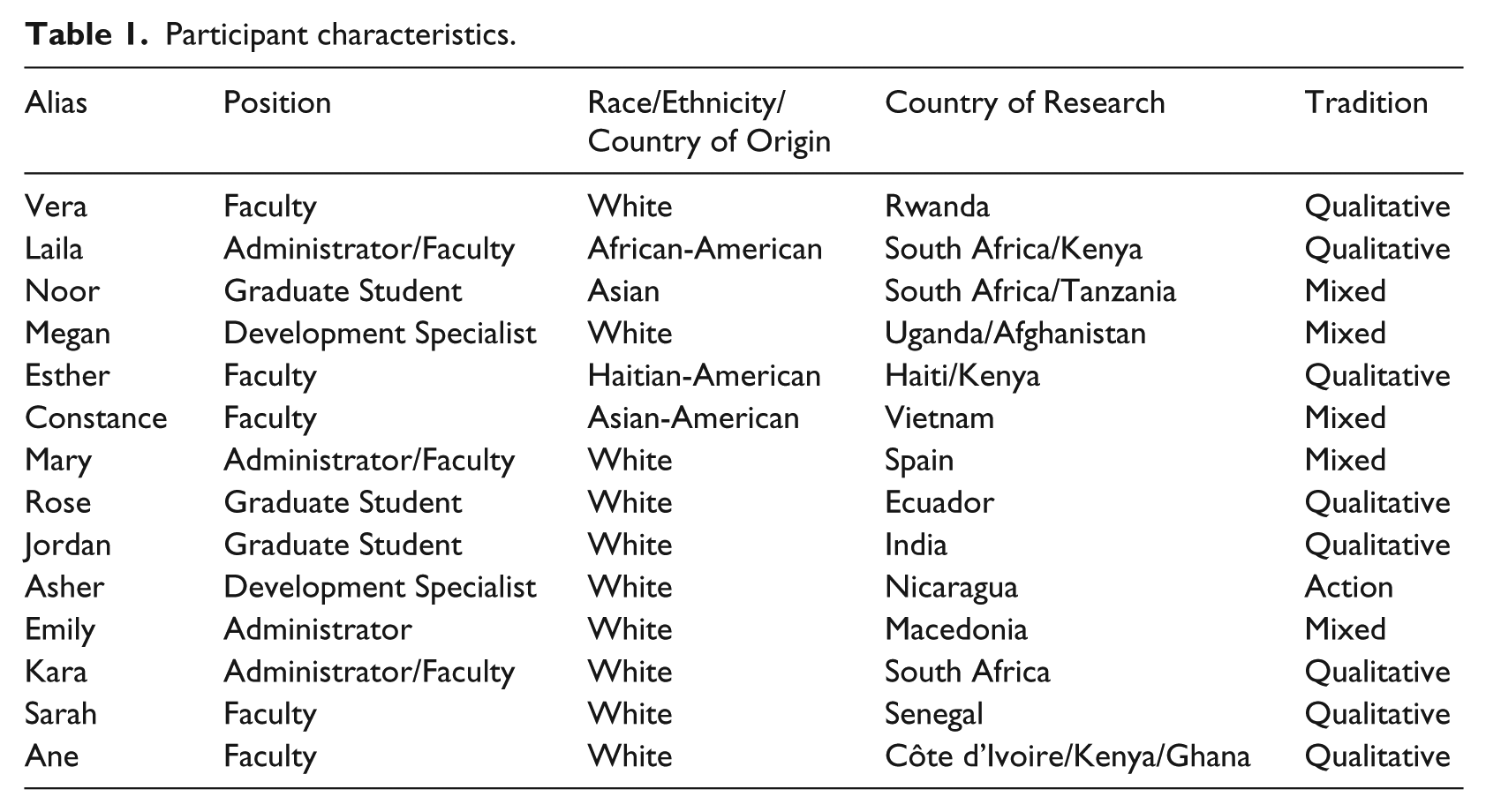
Snowball sampling was used to identify participants. I was aware of potential participants due to my affiliation with the field, thus I used contacts to identify initial participants (Patton, 2002). While I do think that there are many more women to talk to and learn from—time and resources always confine fieldwork—I stopped sampling when I noted commonalities among participant experiences. That is not to say, however, that this work is a full accounting of all women’s experiences as researcher in international and comparative education.
Data collection
The study used a semi-structured interview guide to elicit dialogue with participants. These dialogues, while guided by questions, took the form of naturalistic conversations in which both the participant and myself reciprocated. “Dialogue is the preferred approach in that it aims toward encouraging expression, elucidation, and disclosure of the experience being investigated” (Moustakas, 1990: 47). I shared my experiences doing international fieldwork and my struggles with my identity as a researcher in order to engender reciprocity. Interviews were conducted either face to face or via Skype.
During the interviews, I asked participants to share their stories and provide examples to invite further illumination of our shared phenomenon. Interviews were recorded with the permission of participants and later transcribed. Each participant read their transcripts, provided revisions and clarifying statements, and approved the use of their data.
To supplement the interviews, I collected documents from the participants. I asked them to provide me with empirical peer-reviewed publications or draft manuscripts they had produced. The purpose was to understand how the participants wrote about their research and how they positioned themselves and their identities in their writing. Van Manen (1990) suggests that there are other ways of knowing about human experience such as art, stories, biographies, and journals, which I interpreted loosely to capture other phenomenological accounts. I read these articles ahead of the interview and interspersed the interview with comments and questions about the participant’s written research. These techniques were used together to understand the essence of the women’s experiences as researchers in international contexts with complex and fluid identities.
Data analysis
The initial analysis approach taken here was similar to that suggested by Moustakas’ immersion and incubation phases. I lived in the transcripts, reading and re-reading. During the interviews, I also took copious field notes that suggested possible relationships in the data, which I began to connect to the transcripts. I began to draw examples away from the transcripts, identifying them by abstractions that seemed to transcend the individual transcripts, instead of individual depictions as Moustakas recommends in heuristic inquiry. Here I switched to Van Manen’s phenomenological thematic analysis or “the process of recovering the theme or themes that are embodied and dramatized in the evolving meanings and imagery of the work” (1990: 78). This entailed a selective reading approach that focused on impactful and salient responses—often those contrary to my own experience (however mine may also be found in the analysis and in the findings)—and transforming those responses into thematic “inventions discoveries and disclosures” (1990: 88). In my findings, I use gerunds to capture the action, or work, that is being a woman researcher abroad. The participants cooperated in the final account of this research project, providing feedback, clarifying ideas, and correcting misunderstandings. The findings are focused on establishing commonalities between the participants, although dissonances are also explored.
Note on theory
A particular theoretical understanding of gender or feminism does not drive the research reported here. This is intentional. I did not want to burden my participants’ narratives with my own theoretical suppositions and standpoint. While I claim a feminist lens, I did not believe it would be methodologically sound for this research to be framed as such. Phenomenological research is not necessarily atheoretical, but the approach taken here was to reveal practical “discoveries” in our collective fieldwork experiences that would enable recommendations for the conduct of international and comparative education research.
Findings
In the following section, I present these thematic discoveries to uncover the essence of the experience of being a woman researcher in international contexts related specifically to different identities encompassed within her role as researcher. This essence I divide into three themes: positioning, troubling, and bodying the “I” in our research. I provide excerpts from our interviews to elucidate the themes presented so as to put the analysis “on stage,” opening interpretations up to the scrutiny of the reader (Anfara, Brown and Mangione, 2002).
Positioning the “I”
Researchers often found themselves questioning the appropriateness of their research as outsiders as they tell the story of a group to which they do not belong. Beyond practices in the field that position researchers within a context to identify participants, establish rapport, and uncover phenomenon in an ethical manner, many researchers explicated this “positioning” in their written work in different ways.
Two participants in this study, Esther and Constance—researchers who investigated higher education in Haiti and Vietnam respectively—wrote an article together, published in 2016, based on a joint qualitative research project. In a section entitled “Trustworthiness and Validity,” they elucidated their perspectives on positionality and its role in their work. Specifically, they acknowledge their identities and the impact this has on their roles as research instruments. They also identify their critical perspectives in order to challenge dominant paradigms in social and educational structures. Fundamentally, they asserted that their assumptions and biases, as related to their identities, had meaning for both their interpretations and for the reliability of the study. Here Esther and Constance acknowledged the bias that emanates from the “researcher as instrument” paradigm in research and associated their identities, perspectives, and experiences as the foundation of that bias. However, acknowledgment does not equal abandonment; consequently, the authors listed the many ways in which they addressed their bias (triangulation, expert review, and rich, thick description), while fundamentally finding value and credibility in their identities.
In my own work, as I operate from an interpretivist paradigm, I find myself being very direct about my position in the research. In a section titled “Positionality” in a paper published in 2013 on work conducted in Ghana, I openly identified myself in the research, enumerated the ways in which I attempted to attenuate my perspective, and suggested what that might mean for the research’s findings. I did this (and continue to do this) because I struggled with my identity and what it meant for the research that I did. Fundamentally I leave it to the reader to decide. Here Constance, Esther, and myself express very similar sentiments as it relates to our identities and research practice.
Yet another participant, Asher—an action researcher who focuses on Nicaragua, community water, and education—stated in her work on positionality (in the limitations section, at the end of her article published in 2014, in contrast to others who wrote about researcher identity in the methods section), that her role as both practitioner and researcher may have influenced her analysis (although she also asserts that the involvement of the community may attenuate this bias due to long-term relationships). She also underscored the importance of continuing to widen the participant pool to ensure all voices are heard that may challenge the assumptions influencing the study. Asher, in our interview, often referred to herself as an insider because she spent 14 years working in the community where she conducted the research. I probed this in our interview.
I guess my question … is that this issue of positionality really … you know that being a White American woman does give you access in a way that it doesn’t give other people access. Have you thought about that and the privilege that comes with that and what that means for your work?
Oh my gosh, for like 14 years. [My project partner] reflected on what the first meeting was like [with me] “I have to go pick this gringa up from the airport. I want nothing to do with this. Why are you coming here to learn about what reality is?” When he talks about how he told me the water was clean and he gave me contaminated drinking water for me to [drink] to like really experience what it was like to not have drinking water.
This was an extreme example of the impact of a researcher’s identity in fieldwork, but, as she stated, it was an educative one. In it she showed the messiness that is researcher identity; that one can be treated as an outsider, become an insider over time, and end up somewhere in between. What her account also underscored is the importance of participants’ perspectives and the impact they can have on researcher identities.
Many participants asserted a less troubled stance when writing about identity, instead appealing to traditional conventions of third person academic writing. Of this, Vera, a researcher who focuses on higher education in Rwanda, stated: I mean I definitely grew up through an academic tradition of you don’t put yourself in the writing and so I just don’t. It’s something that comes up a lot when I’m tutoring students. A lot of my students put themselves in their writing and I completely can see why … I still have the “oh this feels a little—like it’s about you and it shouldn’t be about you” kind of thing.
While Vera readily admitted that positionality concerns played a role in her research practice in the field and how she thought about herself as a researcher, she did not think those issues had a place in her written work. Conversely, Sarah, a historian who studied education policy in Senegal, stated: “Positionality is tricky … I use ‘I’ to draw closer to the reader and emphasize that this is my interpretation” in the written work. She added of her positionality: “There is a third gender space in research: Western woman—it’s easier for us.” As a result, concerns for the position of the researcher are attenuated internally, to some degree, by the academic conventions one brings to the research endeavor internationally, and externally by acknowledging and claiming various identities in the field.
Troubling the “I”
Perhaps the most interesting finding was the unwillingness of many participants to claim the title or the identity of “researcher.” Many struggled with what that meant and how it contrasted with what they considered to be real work in the field—the work of the practitioner.
Mary, a full professor at a comprehensive institution who conducted research on teacher educators in Spain, provided a story that relayed her disquiet with the researcher identity: I remember I was having a conversation once with a colleague of mine who I’ve worked with a good amount. We were talking about the fact that when someone asks you what you do and, particularly she and I are both from more blue-collar families, but when someone asks you what you do what do you say? I told her I always say, “I teach people how to teach, I’m a teacher educator.” She was like “Oh, I always say I’m a researcher.” I was struck by that. That wouldn’t be my primary means of identification. I think about that a lot too because people always ask me what I do. Do I say professor? Which sounds really pretentious to me. That also connects to other pieces of my identity and not coming from a place where people do research or know about research. I don’t know if I had grown up in a different family or in a different place …
Here Mary contrasted the researcher identity with her blue-collar background. Instead she chooses to rely on her practitioner identity—the teacher educator—as the primary identity in the academic setting, despite being prolifically published and respected in her field.
Other participants also alluded to their problems with the researcher identity. Jordan, a recent graduate and former community college administrator who studied community colleges in India, connected her perceptions of researchers to her experiences doing research at a small local college in India and her time working at a community college in the United States: Obviously, I’m not going to be an insider in India, but [I] have a much more intense immersive relationship. I have amazing data, but what I really wanted to do was be in that community college … in Bangalore with that one community college with the women and the male professor, I could have that … could have been the way I worked every day. That could have been the work I did and so I think it’s the same reason I’m struggling with “I don’t want to do this professorship! I want to get my hands dirty!” I want to be in it.
Jordan believed that researchers do not practice and as a result she did not want to become a faculty member, but to continue her work in community colleges both here and abroad because she valued the work. This was echoed in Asher’s own ideas about the relevance of research: “I still continue to struggle with this, [I] don’t often see the direct value of research in practice. Without a real, direct kind of connection to relevance, I just felt like I was asking for it for me and not for any direct [reason].” Practice and research were tenuously connected in these narratives.
Other women, however, saw the importance of research to practice. Vera, a researcher of higher education in Rwanda, began as a practitioner (in international development), but experience enabled her to see that her researcher identity was vital to advancing practice: As I mentioned, I didn’t go into research then. In fact, I actively kicked against it. I didn’t do an undergraduate thesis, I didn’t pursue a research-based masters, it was like “oh no, no, I’m a doer.” I don’t want to sit in some ivory tower and think about it, I want to do. I came to research in my 30s when I found it was something that I needed for my practice that no one had looked into. I felt [like the topic] needed actual thoughtful research, which is why I did my PhD, and in the so doing I crossed the great divide [between practitioner and researcher] and haven’t gone back.
Rose, a PhD student (now administrator) who studied faculty reform in Ecuador, began similarly, as a practitioner working internationally. “I obviously worked abroad and I think that somehow that led me to where I am today.” But she noted that her experiences led her to claim expert status: I found something I’m really interested in. I can’t say that many people get a chance to do that, but also as a researcher what that means when I’ve never really thought that that was something I would define myself as, but I do see myself moving in that direction … certainly redefining myself as a researcher, [but] also an expert in my very specific field.
Rose implied that it would be disingenuous to deny her researcher identity; she cogently added: “Education, sometimes, people want to more look at themselves as practitioners than they do necessarily scholars or researchers.”
Megan, a development specialist who did her dissertation research in Uganda, stated that she knew she was a researcher when she had to do paperwork: “I am now a researcher. I have to fill out paperwork!” The institutional review board process, according to Megan, was a salient characteristic of the researcher identity.
Laila, an administrator who has conducted research in Kenya and South Africa on women administrators in higher education, found that capitalizing on her practitioner identity during the research facilitated access to and rapport with participants. Below is an excerpt from our conversation:
No truly because I mean there just seems to be this divide between my participants who are like “I’m not a researcher, I’m a practitioner who does research.” You’re like “No I can, I’m both.”
I had to find that balance, right?
Yeah, but that practitioner identity became useful for you?
Yes, it did and I used it to my advantage, I really did. I yukked it up whenever they said, “Oh this is therapeutic, I will tell so and so to call you.” I’m like “Okay, tell her to call me. Send her to me. I’ll be in the same building tomorrow.” I did use it to my advantage but … I was like “but I didn’t come here to be a counselor.”
Laila admitted that she wanted to claim the researcher identity in a more meaningful way. She elaborated: I want it to be “hey look this is my first real research project” so I’m like “I want to be a researcher, I want to be intentional about not being a counselor.” I want to be intentional about not asking questions and this turning into something therapeutic, but if it does that’s fine. I want to be able to glean as much data as I can from them in order to see what emerges in my research.
Here she was troubled by her therapeutic role in the research, but pragmatically used the practitioner identity to advance the work. In these women’s narratives, we see some paradoxes: researchers unwilling to claim the researcher identity and practitioners becoming researchers who see value in this role. Fundamentally, the narratives point to a question of relevance associated with the researcher identity to the needs of the community and the field.
Bodying the “I”
When I spoke with the participants about gender, their answers revolved around people’s (participants, others in the field) conceptions of women, their bodies, and what their bodies do. Participants also noted that they did certain things to their bodies to meet those expectations. Emily, an administrator and a newly minted PhD who studied a higher education partnership in Macedonia, spoke of attempting to meet cultural expectations by clothing her body in a certain way, yet she would still encounter “unnerving” reactions: I couldn’t walk down the street by myself in the capital city of Skopje or in the town of [X] where this university [was] … I still don’t quite understand this and people there weren’t able to explain it to me. I’d be walking by myself conservatively dressed and probably every 30 feet or so some man would break away from his group and come up to me going “Tsk. Tsk. Tsk. Tsk.’ Tsking at me and waving his finger. I was like “What the hell?” I don’t know if it’s because I was walking alone. I have friends here at [workplace] who are both Macedonian and Albanian. I asked them about it and they said “I don’t know. I don’t know what that is. It might of because you were walking alone.” Yeah. I don’t know. I don’t know if they’re too embarrassed to tell me that people thought I was a prostitute.
She was not alone in this experience. Constance, an Asian-American woman who conducted research in Vietnam, also spoke of perceptions of her body in the field: Women don’t really walk around on their own too much … especially foreign women. They could look at me and tell that I wasn’t from there. To be honest the people there are super tiny. I’m not super tiny. I’m short, but I’m a little chubbier than what they’re used to. Yep. It was also interesting to be in the area that I was in, and this is probably going to be so terrible to say, but it was something that I was like I never thought I’d experience something like this, but late at night local ladies [sex workers] would come by. So I also was like “I’m just not going to leave my room at night.” I don’t want to be in a situation like that [being perceived as a sex worker].
Constance and Emily were concerned about being perceived as sex workers because they shared similar racial and ethnic characteristics with their participants. I, however, did not. But the interaction with sex workers made me very aware of how different my body was from that of my participants. In fact, in Côte d’Ivoire and in Ghana participants thought it perfectly acceptable to comment on my body. In Ghana, one participant stated: “We thought, as an American, you’d be a skinny blonde.” In all cases the researcher identity was accompanied with gender identity expectations, most of them cultural in nature.
Noor, a former administrator and current graduate student who researched higher education in South Africa and Tanzania, used symbols and her biological capacity to ward off unwanted attention: I made sure I wore my wedding band, often dropped like “Yeah my husband so-and-so, my kids so-and-so” and I think there for sure I had to have that guard around me. I was aware that I couldn’t be chatty with a man. And that even with the women I just had to really watch what I was saying. So that I would say yes, that’s when my gender did definitely play the role. When you mix gender and culture … I knew they were conscious of I was coming in from New York, and they were watching me for what I was wearing and I borrowed my mom’s clothes just to fit in.
The women’s stories, in aggregate, underscore that being women may have enabled access to research sites and participants, but this did not come without expectations of what women’s bodies must be covered with, must do or not do, or even when those bodies may be seen in public, and the discomfort of attending to these expectations. Indeed, the researcher status across narratives never allowed for transcending those expectations.
Discussion and implications
The essence of being a woman researcher in international and comparative education is that of tension: conforming to expectations, confronting positionality, and struggling with identity. Are women who do research in international and comparative education always outsiders? Participants suggested otherwise. Can women be both researchers and practitioners? Few participants claimed both. Do women researchers have to manage perceptions of their identity in the field? Unequivocally yes. Below I consider what this means for doing international fieldwork, writing about research, and experiencing dialectical identities as researchers.
Identity and the international and comparative education researcher
Researcher privilege has a complicated meaning for the research process, troubling the way we view how one acquires access to the field, to participants, and to knowledge. This even has meaning for where and how knowledge is distributed and by whom. Srivastava (2006) asserted that researchers should accentuate shared statuses with participants and attempt to achieve a more balanced dynamic in the research process. Some participants considered this and how it impacted their work and their legitimacy, but there was no clear pattern of in their written work or in their talking and thinking about positionality and privilege, although each engaged with it in some manner. Variances seemed to occur around the academic training of the participant, the nature of their work, and the subfield in which they conducted their research, seeming to point to differences in academic cultures and norms.
Writing positionality
Yet talking (and writing) about researcher identity is important; it situates the research “story” within the researcher’s own personal biography, enables us to draw closer to participants, and empowers the reader to reach their own conclusions regarding the findings’ transferability to different contexts. Hertz (1997) referred to voice to capture how researchers represent themselves and their participants in written work, reflecting the what and the how of knowledge claims. Therefore, our personal biographies are inextricably tied to the way we position our work, the stories we choose to tell, and how we tell them. “The values that critical reflexivity promotes allow for the co-creation of knowledge among researchers and the researched and they are therefore more likely to generate strong authentic and credible research outcomes” (Savvides et al., 2014: 423). In this way, too, the biography of the researcher connects intimately with ethical practice in the field. As a result, we must insist that these biographies, as they are reflected in researcher positionality statements, be an essential part of our scholarly reporting structures (understood by both author and reviewer alike) and the preparation of new researchers. Regardless of discipline, field, and context, and as Ramanathan (2005) suggests, we must be open about our tensions. This should not only be required of interpretivists and qualitative researchers, but all researchers in international and comparative education, as our topics, our methodologies, and our reporting reflect, to a significant degree, our training, our identities, and our assumptions about education.
Gender norms
The descriptions of the women’s experiences conducting research in other contexts were replete with gendered expectations reflecting the culture of the context. Arendell (1997) in her work with divorced men, observed that participants assigned shifting identities and roles to her: mother, wife, divorcée, honorary male, and potential date. Our bodies and associated performances may take precedence over other, more preferred roles in the field. “Our bodies can be read in many ways ‘right/wrong’ ‘good/bad’ ‘insider/outsider,’ but we also go beyond these dichotomies” (Kannen, 2013: 189). These roles and identities may be further burdened by the high degree of gender inequality around the world, found in many if not all of the countries the participants worked in. As a result, it is not unexpected that the researchers were beholden to these complicated expectations, ones that often conflicted with their own cultural norms or personal epistemologies (Henderson, 2009).
What do we do when these norms are sexist (or racist, etc.)? Do we conform in order to do our work successfully? Mazzei and O’Brien (2008), among others, encourage women to take strategic advantage of these norms. I would argue, however, that taking advantage of these norms on some level justifies women’s continued oppression and subjugation in these contexts. Do we have a responsibility to challenge these norms? Or does contesting these norms then put the researcher in the position of, problematically, claiming a superior culture? There are no easy answers here, which further highlights the complexity of being a woman and being a researcher in international contexts.
Diversifying the field
Another critical issue emerged from this research: the sub-field of international and comparative education is not very diverse. Despite efforts at diversifying the voices in this work, I found it difficult to identify women researchers of color who conduct international and comparative education research. According to the Integrated Postsecondary Education Data System (IPEDS), 58% of graduate students are women and 55% are White in the United States, where many international and comparative education programs are located. These figures do not bode well for creating a pipeline into this field for women researchers of color. As we know, intersectional identities matter in research, potentially assisting researchers in establishing reciprocal relationships with participants. It behooves new faculty and established researchers alike to support and encourage students of color to join our field, expand our dominant epistemological frameworks, and contribute to a global understanding of education systems.
Negotiating dialectical identities
The ever-increasing body of research and editorial pieces on insider/outsider identities in the research process is often contradictory and still begs the question: can outsiders tell other’s stories? Should they? Yet much research, as well as the experiences of the participants in this study on the whole, attests to women’s ability to transcend these questions. For some, tensions produced by the insider/outsider dialectic may have been negotiated by participants, particularly when discussing being a “practitioner” versus a “researcher.” In their narratives, the position of the practitioner is as an insider, due to their familiarity with the educational practice and the participant practitioners at the heart of their research endeavors. Those on the other end of this practitioner–researcher spectrum, such as Esther and Constance, were also the participants who took the most care to outline their positionality in their written work. Those who consider themselves somewhere in between included Asher, who articulated a complex relationship with her research context and her identity as a researcher—a struggle, she stated in our interview, that has gone on for over 14 years. These accounts demonstrate tensions with identity in the research process; I argue that this is related to gender and to how our field is constructed.
Constructing women researchers
As noted above, several participants expressed uneasiness with being called a researcher and/or calling themselves a researcher. One participant related this to her socio-economic status and others to perceptions about the overall relevance of research, while some see the value in being both. Academic culture and values are often considered middle-class and may conflict with the experiences of faculty and students from the working class (Langston, 1993). Moreover, the practitioner identity may also be related to education as a field of study or degree type, where students are socialized toward certain values and norms.
Interestingly, academic programs associated with education, in general, are heavily feminized. In 2015, women made up 70% of doctoral degree earners in education and 76% of master’s degree earners in education (Okahana, Feaster and Allum, 2016), which may speak to the gendering of the practitioner identity versus that of the researcher. Are women in these programs socialized to think of themselves as practitioners? Is the researcher identity conveyed as an agentic, masculinized one? Giampapa (2011) suggested that “researcher identities are assigned and constructed through discourses within one’s discipline and the processes and procedures … are imposed on researchers through institutional discourses” (133). While not the focus of this study, what discourses are present in education programs that may, in conjunction with class and other identities, lead to women eschewing the researcher identity? And, finally, does this socialization then prevent women from participating in education research endeavors, internationally?
Conclusions
The research reported here sought to understand how women position themselves as researchers, both in the field and in their writing, in international and comparative education research. Participants did not find gender as a factor that prevented them from gaining access to the field and to informants, but they did find it governed how, when, and where their bodies were seen in the research context. Additionally, participants experienced tension in their roles as researchers and practitioners, which has implications for how we educate international and comparative education researchers. This research suggests that the insider/outsider discussion is no longer of much significance to methodological discussions, instead that other identities in the field may be more relevant to both our participants and to ourselves. Consideration must also be given to the construction of the field of international and comparative education, particularly a demonstrable increase in the encouragement of and opportunities given to women of color in order to diversify the nature of our discourse and identities in the field. Moreover, the written and spoken struggle with positionality attests to the need to encourage students to engage with their identities in the research process, across methodological traditions. Finally, this struggle should transcend gender in the academic socialization process.
Footnotes
Declaration of Conflicting Interests
The author(s) declared no potential conflicts of interest with respect to the research, authorship, and/or publication of this article.
Funding
The author(s) received no financial support for the research, authorship, and/or publication of this article.