



Abstract
This article investigates aspects of policy transfer and educational borrowing in German higher education in the wake of the Bologna reforms of higher education in Europe. It examines the origins and results of the Bologna reform process in Germany. Focussing on teacher education, it highlights inconsistencies between political legitimation, reform discourse and objectives, the actual framework and its implementation. Based on an empirical case study, it explores the implementation processes and different institutional stakeholders’ perspectives and understanding of reform ideas, concepts and tools. It discusses how these influenced the way stakeholders acted during the implementation process and the particular effects of their actions on approaches to teaching, learning and studying within the re-designed study programmes.
Keywords
Introduction and background
Over the past 20 years, national education systems have been influenced by different international education policies and initiatives that have impacted different areas and phases of education in Europe and further afield. In the German context, the three most prominent examples are: (1) the impact of the PISA results on public awareness of education outcomes and national education policy; (2) the subtle influence of European Union (EU) policy tools such as the European Qualifications Framework (EQF) on Vocational Education and Training (VET) perspectives and debates; and (3) transformations within the German higher education (HE) sector based on the Bologna reform process.
All of these show signs of political interest in educational policy borrowing. Following the so-called PISA Schock (e.g. Ertl, 2006; Gruber, 2006), for example, German politicians and policy makers exhibited a growing interest in the Finnish education system and its features and were considering its implementation in Germany. In the case of the VET policies of the EU, the debate on the EQF led to negotiations and, subsequently, to the implementation of the German Qualification Framework (GNF) in 2013 (Klenk, 2013). It might be mentioned that National Qualification Frameworks (NQF), well established in the Anglo-Saxon context, are traditionally not a common feature in German education. And, finally, the Bologna reform process led to an intense reorganization of HE study programmes in Germany, based on the traditional Anglo-Saxon concept of a two-cycle HE system. All these developments show how German educational policy is increasingly reliant on policy borrowing.
However, the term ‘educational policy borrowing’ is somewhat slippery. There is no overall agreement on its definition, even among the education research community. As Phillips and Ochs (2004: 774) or Phillips (2015: 138) show, the term ‘borrowing’ is often used synonymously with ‘copying’, ‘importation’ or ‘transfer’. Educational policy borrowing could be described as processes involving the ‘conscious adoption in one context of policy observed in another’ (Phillips, 2015: 138; also Phillips and Ochs, 2004: 774). It has a purpose and requires a certain degree of awareness of the processes of borrowing a concept, instrument, model or the like that already exists and is used in another context (Phillips and Ochs, 2004: 774).
When looking into the why and how of policy borrowing, it becomes obvious that the particularities and details of an education policy in the original country appear less relevant than their possible impact on the political discourse within the borrowing country. Politicians may be more interested in the political symbol of borrowing than in the detail of borrowed concepts themselves (Halpin and Troyna, 1995: 307ff.). As Steiner-Khamsi (2006: 671) puts it: ‘borrowing does not occur because reforms from elsewhere are better, but because the very act of borrowing has a salutary effect on domestic conflict’.
This suggests the need for certain conditions and opportunities to exist in the borrowing country. The ‘policy window’ (Kingdon, 1995) for borrowing includes three central aspects: the acknowledgement of a problem; the existence of possible solutions; and alterations of the political context which open the situation for change, such as an alteration in political allies, power relations or government structures (Steiner-Khamsi, 2016: 383). The specific local situation has to be understood to recognize the logic of borrowing and the reasons for the ‘externalized’ solution to the problem. Local stakeholders imbue external policies with local relevance; they utilize selected education systems, where these policies already apply ‘as external sources of authorities’ (Steiner-Khamsi, 2016: 382ff.). This idea of externalization within processes of educational policy borrowing also applies when local stakeholders provoke educational developments at an international or global level with the intention of initiating policy reform at a local level. Educational policy borrowing uses the beneficial effect of external, seemingly neutral, alternative solutions or reference points to support decision-making in political conflict situations. As a result, processes of educational policy borrowing are often more oriented towards the legitimization of a certain policy agenda than towards the transfer of the particularities of a genuine educational concept (Halpin and Troyna, 1995: 307ff.; Waldow, 2012: 417).
This article investigates the processes of educational borrowing during the introduction of the Bologna reform process in the German HE sector. First, it outlines central characteristics of the Bologna reform process and discusses its inherent tension in converging and, at the same time, maintaining the diversity of national HE systems. Following this, it examines the early initiation and reception of the Bologna reform process in Germany with special reference to teacher education. It highlights discrepancies between political reform legitimation, discourse and aims, and the actual reform framework and specification. It then discusses the eventual central role of HE institutions and their stakeholders in interpreting, specifying and, to some extent, inventing reform features. Using empirical data, it examines the implementation processes in university-based teacher education using the example of a university in the state of Berlin. The analysis of these processes is based on interviews with stakeholders from political macro-level to university micro-level, and on an online journal study examining students’ approaches to studying and learning within the re-designed study programmes. The article refers to different stakeholders’ perspectives and understanding of reform ideas, concepts and tools. It shows how these different perspectives influenced the actions of the stakeholders within the processes of reform implementation and internalization and discusses their particular effects on approaches to teaching, learning and studying within the re-designed study programmes. In doing so, the article follows an analytical rather than a normative approach (see Steiner-Khamsi, 2016: 382). It focuses on actual implementation and internalization processes of policy borrowing and reviews the adaptation of the reform content and context and its impact at the local level.
Bologna reform process – reform characteristics and initiation in the German context
Viewed from an international macro-perspective, the introduction of the Bologna Declaration, a voluntary intergovernmental agreement without legal jurisdiction, can be interpreted as a way of circumventing the subsidiarity principle of the EU, and enforcing a higher degree of convergence and harmonization on the various national HE sectors in Europe (Brøgger, 2016; De Rudder, 2010). Since the responsibility for education lies with each EU member state, it limits the EU’s ability to directly intervene in national education policies.
The Bologna Declaration has now been signed by 48 states. It aims to create a European Higher Education Area (EHEA) that allows for a high degree of comparability, compatibility and transparency and, hence, a greater convergence of national HE systems. In this way, it meets, as Brøgger (2016: 76) argues, central ambitions of the European Commission (EC) as far as HE is concerned. The EC sees HE as a crucial factor for economic prosperity in the knowledge society. The EC’s ambitions outlined in an EU memorandum in 1991, for example, included: enhanced student mobility, the recognition of qualifications, and similar periods of study (Commission of the European Communities, 1991). All these ambitions matched the main objectives of the Bologna Declaration in 1999, which stipulates comprehensible and comparable degrees, a two-cycle system of study programmes, the introduction of a credit transfer system (ECTS), quality assurance mechanisms and enhanced mobility, and the development of an European dimension in HE (Brøgger, 2016: 76ff.).
This intergovernmental agreement with its underlying aim of convergence and the subsequent reform processes, however, has been re-interpreted at the individual, national level by most of the participating countries (e.g. Kehm, 2012; Michelsen, 2006; Moscati, 2008; Schriewer, 2007), starting with the intended outcomes of the process. These were re-interpreted, enhanced, altered and shaped to match the needs of and address the problems within national HE sectors, an approach Musselin called the ‘re-nationalization’ of the Bologna process (Musselin, 2008: 311). The Bologna reform process was used at national level to legitimize individual reform intentions, while its features and design were adapted to national or local requirements. This remains the case despite the similarities of national requirements and problems in HE sectors in a number of countries (Tauch, 2016: 19) and the expanding application of mechanisms similar to EU education governance procedures of the ‘open method of coordination’ (OMC) (Brøgger 2016). As a result, the Bologna reform process has promoted diversity within and between national HE systems despite its aim to bring about more harmonization in HE in Europe (Kehm, 2012; Witte, 2008).
This attempt to create convergence within HE in Europe and, at the same time, to maintain national characteristics, local features and diversity, resulted in significant tensions during the Bologna reform process. These tensions are inherent, as the Bologna Declaration’s aim to converge is indirectly defined by reform objectives, such as the aim to generate a EHEA while fully respecting the diversity of the different national education systems and the autonomy of HE institutions (Bologna Declaration 1999, in more detail Witte, 2008). The tensions are further magnified by the manifold reform objectives themselves, which have been changed, specified and expanded during the negotiations at follow-up conferences – with quite contradictory effects (Teichler, 2016; see also De Rudder, 2010). The aim to converge, for example, might not necessarily be congruent with the aim to enhance competition between HE systems. And while the 2010 target of establishing the EHEA has not been reached, its discussion has moved into the background as other objectives, such as mobility, have been brought to the fore and become a stronger focus of attention instead (Teichler, 2016; Witte, 2008).
It may be argued that whether national HE systems have converged or not is a matter of perspective; the more abstract the perspective the more alike the features. At the macro-level, convergence exists with the introduction of the two-cycle system of study programmes and the usage of ECTS in the participating countries, while at the institutional and micro-levels, systems show more heterogeneity (Kehm, 2012). But, to a certain extent, this view does not take into account the fact that national policies in the Bologna reform context seem to be driven by an ‘imitation of each other’s policy’ (Rakic, 2001: 238), and a ‘mimetic desire’ (Brøgger, 2016: 81ff.). The political symbol of policy borrowing may be more important than the actual design and outcomes of reform policies; convergence on the macro-level might be a fallacy, as the similar terminologies, formal features and structures may hide an often very different content (e.g. Brøgger, 2016; see furthermore Meyer and Rowen, 1977; Powell and Di Maggio, 1983, on institutional isomorphism). A differentiated description of the effects and effectiveness of the Bologna reform process calls for a deeper understanding of the implementation, adaptation and translation of the policies at institutional and micro-levels in specific national HE sectors.
These issues need to be taken into account when looking at the early initiation and reception of the Bologna reform process in Germany. Two central lines of development – national and international – are relevant when discussing this phase:
(1) National development: In the 1990s, an intense debate arose about problems and defects in the German HE system and on the pressing need to reform it following a reform ‘bottle neck’ (Reformstau) from the 1970s onwards. Criticism included the traditionally long duration of study before gaining a first academic degree (6–7 years), the high drop-out rates (about 25%) and the high rate of students changing study programmes (about 20%) (e.g. Teichler, 2005: 40ff.). Overall, the competitiveness of the German HE sector was criticized as insufficient in a global context and, therefore, unattractive to international students. One solution put forward was the introduction of a two-cycle system of study programmes similar to those in Anglo-Saxon countries. At the beginning of 1998, the federal Higher Education Act (Hochschulrahmengesetz (HRG)) was amended to include two-cycle study programmes as an alternative to traditional forms (Teichler, 2016: 399). As Germany is a federal state, the responsibility and decision-making power for education and education reform lies with each separate state. Consequently, the decision to introduce such systems is also a matter for the state. In addition, the self-governance rights of HE institutions allow them to manage their own affairs, including study programmes (for an account of HE institutions self-governance see Kremkow, 2015). And while the Standing Conference of the Ministers of Education and Cultural Affairs of the German states (Kultusministerkonferenz (KMK)) promoted the reform (KMK, 1997, 1999), the success of its implementation might, nevertheless, have been questionable since the enforcement of education reforms in Germany is traditionally rather difficult and slow. The reason for this is often seen in this strict federalist approach in the education sector and its inner governance structure (Kuhlee, 2017: 102).
(2) International development: In May 1998 the Sorbonne Declaration was signed; an important predecessor of the Bologna Declaration in 1999. This declaration aimed to harmonize the HE systems in Europe based on a two-cycle system of study programmes to enhance students’ mobility (see Teichler, 2016: 399). The signatories of this declaration were the relevant ministers for HE in France, the United Kingdom, Italy and Germany. In fact, seen from an international level, Germany has been one of the initiators of the Bologna reform process.
The combination of these chronologically overlapping developments characterized the German reform discourse. The international development of the growing Bologna reform process was used for the legitimization of national reform intentions and their implementation (Maeße, 2008a, 2010: 244). This, in turn, was based on complex interactions at local, national and international or European level as Maeße (2010: 245ff.) shows. These processes can be seen as an example of a certain mode of educational policy borrowing, where the initiation of educational developments at the higher, international level by certain stakeholders is used to enforce reform processes at the lower, national one.
In this manner, the German political discourse associated the Bologna reform process with its national discussion of HE reforms and reform aims, going back to the 1990s in order to solve its long-standing problems. For some HE subject areas, other strands of debate and connected aims may have even been added to address specific problems in these areas, as in the case of university-based teacher education.
Despite the intense discussion about the reform process and its aims in Germany, the outline of the actual reform content was insufficient, as Maeße (2008, 2010: 247ff.) showed. Detailed descriptions and guidelines as to how to transfer a very broad general discourse into tangible reform components and associated designs did not exist. Stakeholders at HE institutions had not only to implement but also to interpret and, to some extent, invent reform features and content for their own practice (Maeße, 2008, 2010: 247). It is not surprising to find that these interpretations differed from institution to institution, or even within institutions. And, as a result of the strong federalist principle, further differences included timescales, scope and content of the reform and its implementation across the German states. Both aspects furthered heterogeneity and diversity in the German HE sector rather than harmonizing it. In his analysis, Maeße (2010: 247) argues that the real content and relevance of the reform only became visible in its actual and re-interpreted implementation at the institutional level. Empirically sound research into these processes of interpretation, translation and implementation in different institutional settings and their effects, however, is, by and large, missing. The following provides a valuable insight into these processes on the example of university-based teacher education.
The reform of university-based teacher education in the context of the German Bologna reform process
During the past 15 years, teacher education in Germany has been subject to intense political scrutiny. As with the general debate about changes in the HE sector in general, German reform intentions on teacher education preceded the introduction of the Bologna reform process (Bauer et al., 2012; Terhart, 2000). At the time of the introduction of the Bologna reform process, two complementary reform initiatives for German university-based initial teacher education (ITE) were, therefore, central. The first, directly connected to the Bologna reform process, reflects the structural aspects of ITE, while the second initiative focused on its content and the introduction of teacher education standards. The following includes a brief description of both.
The Bologna reform process in ITE
As part of the Bologna reform process, the KMK agreed in 2002 on the general legal terms and conditions for the introduction of a two-cycle system of university-based ITE. This provided the legal basis for the adoption of the central reform features of the German Bologna reform initiative for university-based ITE (Bauer et al., 2012: 104). These were:
(a) the implementation of a two-cycle system of study programmes leading to bachelor and masters degrees;
(a) modularized programmes based on self-contained, individually examined and outcome-oriented modules, where each module requires a description of the expected professional competencies to be acquired;
(c) the implementation of a credit transfer system (ECTS) with its shift to learner-orientation, where the necessary time investment of an average student (workload) serves as an indication of the requirements of the study programme and its individual modules.
In relation to (c) above, students’ workload is, therefore, seen as the central measure for both the modularization of programmes and the award of credits (for a critical account see Kuhlee, 2012). Under the regulations of the credit transfer system, students are expected to invest 40 hours work per week in their studies. With every 30 hours work, they gain one credit point. Therefore, a student should invest 900 hours per semester in her/his studies, resulting in 30 credit points. Within a three-year bachelor programme this adds up to 5400 hours of work, which correspond to 180 credit points (KMK, 2000, 2010). 1
The general adoption of the two-cycle system for university-based ITE was undertaken without the existence of a precise framework and guidelines to assist the actual reform implementation. It was only in 2005 that the KMK agreed on further structural features for the implementation of new ITE study programmes by the individual states (KMK, 2005). Overall, reform specifications remained rather sketchy, leaving wide scope for interpretation. There were no central guidelines and detailed descriptions for the actual implementation of reform features, including, for example, how ‘relevant workload’ was to be identified and estimated in relation to the different programme contents and parts. It was up to the stakeholders at the institutional level to implement their interpretation of reform requirements and instruments in line with existing practice and overcome the vagueness of specification in university-based ITE (Bauer et al., 2012). As a result, and due to the different timescales and extent to which these reforms were implemented, and given the fact that not all states introduced the new structures, different models and conceptual designs of ITE study programmes can be found. Consequently, university-based ITE programmes differ widely throughout Germany. This is particularly evident in the amount of content allocated to subject-specific topics, for example, or pedagogical content in the ITE study programmes. As Bauer et al. (2012: 115) indicate in their research on ITE programmes for upper secondary teachers in different states, the amount of subject-specific pedagogical content (Fachdidaktik), for example, differs by a factor of 4.2. This means that students on ITE programmes with a strong content focus in that area have to invest up to 4.2 times more than students in programmes with a less intensive focus.
Overall, the Bologna process enhanced and furthered visibility of the already existing heterogeneity of university-based ITE programmes in Germany (Keuffer, 2010).
The introduction of teacher education standards
The implementation of teacher education standards came in the wake of more extensive school reforms in the early 2000s in Germany. The poor performance of German students in the PISA achievement tests sparked an intensive debate about the attainment of German pupils and the effectiveness of German schools. This debate paved the way for reform initiatives. Central to these was a new concept of school governance, which was gradually implemented by the KMK following the Konstanzer Beschluss from 24 October 1997. It aimed to enhance the transparency of outcomes, leading, for example, to the introduction of standards, achievement tests, quality management and educational monitoring systems (Baumert and Füssel, 2012).
The intensive debate about student performance with its increasing criticism of the quality of education eventually came to focus on the teaching profession and teacher education. Changes to teacher education were seen as a means to improve the quality of education. One of the essential outcomes was the development of teacher education standards. In 2003, a working group developed teacher education standards for general pedagogy and education (Bildungswissenschaften), which form one main part of university-based ITE programmes (Terhart, 2014: 303). These were adopted by the KMK in 2004 (KMK, 2014[2004]). Subject-specific standards followed in 2008 (KMK, 2017[2008]; Oelkers, 2009). In this manner, the KMK school reform initiative with its underlying ideas and features entered teacher education.
Teacher education standards for general pedagogy and education (Bildungswissenschaften) as agreed by the KMK (KMK, 2014[2004]) are described in terms of competencies required to fulfil the demands of professional practice in German schools. Students have to achieve these in their university-based ITE courses and develop them further in the school-based part of ITE (Vorbereitungsdienst), which follows the successful completion of the university-based ITE study programmes. The KMK (KMK, 2014[2004]: 4, translated) emphasizes ‘that overall a systematic, cumulative development of professional expertise [has to be] realised’.
Nevertheless, the ratification and implementation of these standards resides with the individual state. The KMK stated that teacher education standards were implemented in the different states by 2005/06 (KMK, 2016), but there is little information about or research into their actual implementation throughout the HE institutions in the different states (Terhart, 2014: 302).
It is interesting to note that despite their different origins, reform activities in relation to teacher education standards are linked to the structural changes of the Bologna reform process as both connect through the modularized structure of the study programmes. Ideally, the competence-based design of the modules in ITE study programmes should be based on teacher education standards, allowing for an integrative implementation of the two reform strands, and aiming to ensure the quality of the ITE programmes according to the needs of the school system.
These reform developments reflect the growing political interest in further aligning university-based ITE with the demands of the profession (Bauer et al., 2012: 104) and, thereby, solving long-standing problems of German ITE, such as overlong duration of studies or fragmented study programmes. This is sometimes referred to as the ‘miseries of the old teacher education programmes’ (Elend der alten Lehrerbildung).
Reform implementation in university-based teacher education in the state of Berlin – an empirical case study
In Berlin, reforms in ITE began in time for the winter semester 2004/05, when traditional study programmes were replaced by bachelor and masters degrees. Their introduction was based on contractual agreements between the HE institutions and the state government. Since university-based ITE study programmes are traditionally subject to stronger state regulations than other HE courses (teacher accreditation is a remit of the state), the introduction of re-designed ITE programmes required changes to teacher education law and regulations. This included the 12th amendment of the Berlin Teacher Education Act from 5 December 2003, and the Lehramtserprobungsverordnung (LEPVO) of 2006. Negotiation processes between the four Berlin universities that offered teacher education programmes and the state government also resulted in the development of joint procedures for the reform of their respective ITE programmes (see Arbeitsgruppe Struktur, 2006; van Buer et al., 2007: 31ff.). This allowed the state government to retain a measure of influence over the structural features of the re-designed study programmes and the scope and content of certain parts of the study programmes, especially general pedagogy and education (Berufswissenschaften). 2 However, the new frameworks and the agreed overall guidelines offered ample spaces for re-interpretation, to be filled in at the institutional level (for more detail see van Buer and Kuhlee, 2010).
While ITE study programmes in Berlin followed the general Bologna reform features and its two-cycle system, they also included a measure of adaptation to reflect the different levels student teachers intended to work at (primary school, lower or upper secondary school). All new study programmes, nevertheless, followed a consecutive and modularized structure based on a credit point system following KMK principles (KMK, 2000, 2010). They stipulated that for each module a set of achievements were to be defined. These were expected to outline the professional competencies students were to develop while studying for a particular module and which were examined at the end of it. These competencies were based on the teacher education standards as outlined in the Berliner Qualifikationsrahmen, which recognized the KMK guidelines on teacher education standards (see Arbeitsgruppe Struktur, 2006). Lecturers and students at these institutions were expected to follow them in their teaching and learning processes. In addition to the description of competencies, each module taught had to define the workload an average student had to invest in its successful completion.
Under these new guidelines, teacher education students for the upper secondary level, for example, follow a three-year bachelor programme, during which they attend lectures, seminars and tutorials in their two chosen academic subjects (Fachwissenschaften), in subject-specific pedagogy (Fachdidaktik) and in general pedagogy and education (Berufswissenschaften). This gains them 180 credit points. After the successful completion of their bachelor programme, they will undertake a two-year masters programme in the same areas, but with a stronger focus on pedagogical issues, gaining 120 credit points. Following this, students enter the school-based ITE preparation phase (Vorbereitungsdienst), the last step on the way to fully qualified teacher status organized outside the university context.
The traditional German ITE triad of academic subjects (Fachwissenschaften), subject specific pedagogy (Fachdidaktik) and general pedagogy and education (Berufswissenschaften) was retained, even in the new ITE structures. And although the shares of the three areas have been adapted for the different degree levels, ITE programmes preserved their traditional cross-sectional, interdisciplinary setup within the university (universitäre Querschnittsaufgabe). As part of their course, student teachers attend lectures, seminars and tutorials in at least three different faculties within the university. This traditional feature of German ITE came repeatedly under criticism as insufficient co-ordination between the different institutions could impact on the study conditions of students and result in fragmentation of the content taught.
Given these reform features, the question arises of how the different stakeholders in Berlin, and especially those at institutional level, put the reform features and new frameworks into practice. How did they understand and (re-)interpret the different reform elements and frameworks and their underlying conceptual ideas? What role did these play in the implementation processes and thereafter? Furthermore, how were these re-designed study programmes eventually used and valued by the students as a central stakeholder group in the university context?
To investigate these issues, the perspectives of different stakeholders and their role in the actual reform implementation at one university in Berlin are examined and the possible effects on approaches to teaching, learning and studying within the re-designed study programmes discussed. The empirical data presented here were collected as part of LehrOptim, a research project set up to examine the reform implementation and its effectiveness for and effects on teacher education at this university in Berlin. The research project focused on the Master of Education (MEd) programme. It was financed by the Federal Ministry of Education and Research (Bundesministerium für Bildung und Forschung (BMBF)). The survey period was from 2009 to 2012 and covered three central sub-studies. Given the questions outlined above, data from two of those studies are used to give an insight into the implementation processes and effects.
(1) The first sub-study investigated reform implementation and governance, including stakeholders’ perception of the reform, its conceptual ideas, instruments and tools, and their role in and approaches towards the reform process. It included a structured interview study (N = 29) with stakeholders from political macro-level to university micro-level, who were directly involved in the ITE reform within the state of Berlin and at that specific university. These were high-level decision-makers and negotiators of the Berlin state government (N = 4), and university representatives including vice presidents (N = 3), full professors (N = 5), lecturers (N = 10) and students (N = 7). The last three stakeholder groups were associated with five different ITE subject areas. Subject-specific pedagogy (Fachdidaktik) in those subject areas was the field of expertise of the professors and lecturers interviewed. The students interviewed were also participants of the second sub-study (online journal study, see (2) below). Interviews lasted on average for an hour. They were transcribed, coded (using consensual approaches) and analysed according to individual cases and main categories (Kruse, 2013), based on methodological approaches by Kuckartz (2014).
(2) The second sub-study focused on the students’ approaches to learning and studying during the third semester of their MEd in three different subject areas. Central to this sub-study was the students’ real time investment in their studies (actual workload) and its distribution throughout the semester and modules attended. As part of the study, details of learning strategies used, the formal and perceived learning outcomes and, importantly, students’ stress perception, were also collected. In addition, the study gathered further socio-demographic data and personal characteristics such as self-regulation and self-efficacy. The survey was based on an online journal lasting the entire semester. Daily notes were entered into individually programmed journals following the semester timetable of each participant; their journals were further supplemented by questionnaires. The study was undertaken during winter semesters 2009/10 and 2010/11 with 40 participants each time (for more detail on the method and data design see Kuhlee, 2013). The data presented here were collected during the winter semester 2010/11.
Case study findings (I) – reform perspectives and implementation
The following paragraphs review stakeholder perspectives of two central reform features of the re-designed study programmes – credit points (ECTS) and competence-orientation. Based on data collected during the two studies, the following considers the relevance of these reform features for the way stakeholders act within reform processes and in their daily work, especially where this is related to teaching and learning.
Political and university macro-level (N = 7)
At the political and university macro-level, respondents saw the credit point system merely as a formal instrument (N = 5). It was perceived as a system used to document the fact that students meet the formal requirements of their studies; its inner form and conceptual structure, such as leaner-oriented workload, were not seen as central aspects. It is interesting to note that the political actors in particular seemed to have a less detailed knowledge of the underlying concept: ‘whether with credit points or other figures, right now I don’t know exactly how the system works, […] you always need some kind of measurement system. It doesn’t matter which form it has, really’ (Ma1, 1182–1188, translated).
Respondents did not object to the use of formal quantitative procedures, such as a fixed coefficient, to convert previously used contact hours of seminars, lectures and tutorials (Semesterwochenstunden (SWS)) into credit points; and one of the respondents at university macro-level stated: ‘we solved the discussion of how to translate Semesterwochenstunden into credit points in a rather pragmatic way’ (Ma6, 60–61, translated).
Only one respondent clearly criticized the translation procedures, which by now have developed into a bureaucratic mechanism of their own. It was felt that they did not reflect the learner perspective and, hence, the workload of students needed to fulfil the credit point requirements of each module.
By contrast, the idea of competence-oriented module descriptions was seen as a change of paradigm and highly relevant for the re-designed study programmes (the notion of competence differs to the English one; for the German discourse see Weinert, 2001; for professional competencies of teachers see Baumert and Kunter 2006). All university actors at the macro-level (N = 3) rated it highly. The political actors within the sample, however, seemed rather divergent in their judgment. One actor referred to this as a ‘pompous discussion’ (Ma4, 524–525, translated), whereas another highlighted the relevance of the development of professional competence within the study programmes, regardless of their actual structure.
University meso-level (ITE professors; N = 5)
The professors interviewed were involved in the design of the study programme and examination regulations (Studien- und Prüfungsordnungen) for their subject area within the re-designed ITE study programmes. Overall, this group discussed the credit point system critically and saw it as a formal requirement, especially when looking at the changes in study programme and examination regulations (N = 5). The relation between credit points and workload was seen as rather fictional, following the professors’ experiences in re-designing the study programmes. As one respondent said: ‘these are all fictional calculations after all’ (Me4, 527, translated). In thier own work, respondents used a range of approaches to allocate credit points to the different parts of the study programme, but only one respondent explicitly stated that the workload of students was estimated and used for the allocation of credits. In some cases, as stated by one respondent credit points were adapted when the relation between credit points and workload seemed inadequate. Most respondents did not acknowledge the use of credit points as a central issue for their everyday work (N = 4).
But respondents did criticize the general idea behind credit points, namely the construct of the ‘average’ student, which, in their view, denied the uniqueness of learning processes. Moreover, three of the respondents reflected critically on the effects the credit point system had on students and their learning. Using credit points seemed to develop into a ‘tick off system’ (Me5, 654, translated), generating only medium aspiration levels in students, especially at bachelor level.
Looking at the issue of competence-oriented module descriptions, it has to be noted that over the past 15 years, the discourse on competencies – their development, modelling and testing – had been a central theme in education research, including subject-specific pedagogy (Fachdidaktik), general pedagogy and education (Berufswissenschaften). This discourse connected with the PISA Schock debates and their corresponding reform initiatives and found its way into the content of teacher education programmes, especially in relation to school teaching and practice.
Against this background, the professors interviewed held divergent opinions about the use of competence-oriented module descriptions in ITE teacher programmes, and on the German competence discourse as such. But they nevertheless displayed a generally positive attitude towards adding a stronger focus on professional competencies rather than solely focussing on content-related issues. Respondents mostly, though, referred to the competence discourse in relation to schools and teaching here. They discussed critical aspects of its implementation, such as operationalizing and measuring the construct of competence, and commented on the still-vague terminology, arguing that the same problems would apply in the context of university teaching. Only one respondent stated explicitly that as a pedagogical concept competencies could not be taken seriously (Me3, 2203–2204, translated).
Competencies seemed to be a central issue for the respondents in terms of the theoretical discourse, of education research and as teaching content, but less so when applied to their actual teaching. Only one respondent stated clearly: ‘we do teach in this way ourselves’ (Me1, 517, translated). In addition, although respondents stated that their work had changed in recent years, they did not see the reason in the structural reform, but related it more to other contextual developments within the university.
University micro-level (ITE lecturers; N = 10)
The lecturers’ responses to questions about the credit point system ranged from critical to fully negative; one respondent stated: ‘this is complete nonsense’ (MiD9, 193, translated). They described the credit system as random, with no suitable fit between student workload and credit points (N = 5). Four of the respondents argued that it was only a formal instrument without any relevance for their teaching, while six respondents stated that they would try to adapt their seminar programme according to the actual workload of students. For them, this meant lowering the requirements where necessary: ‘so we do look now and then, whether we can lighten the workload of students a bit’ (MiD3, 887, translated).
However, the idea of competence-orientation in ITE study programmes was generally seen as positive, although critical aspects of its underlying concept were highlighted and discussed by the respondents. It has to be emphasized that the lecturers too considered the competence discussion mainly in its relation to school teaching and practice. Explicit reflections on their thoughts and the subsequent transfer of these to their own university context and its teaching were less evident. Only one lecturer referred directly to teacher education standards and the Berliner Qualifikationsrahmen, and their relevance to the re-defined study programmes. Furthermore, two respondents stated that they had adapted teaching approaches to include a more competence-oriented focus. Other respondents (N = 7) highlighted the fact that their teaching already encompassed some of its elements: ‘one orients one’s teaching into that direction, but I think, this is not much different from what we did before’ (MiD3, 804–805, translated). The lecturers described their teaching as research-oriented (N = 6), activating (N = 4) and application-oriented (N = 4) and it is important to note that the descriptions include especially the critical reflection on course content. These features were seen as important for competence-oriented teaching approaches.
Overall, respondents argued that the two reform features did not exert a strong influence over their teaching approaches, but that their work had, nevertheless, changed in some aspects. They saw, for example, less flexibility in the content they were teaching (N = 4), more need for co-ordination with colleagues (N = 4) and a tendency towards more school-like approaches by students and lecturers (N = 6).
University micro-level (ITE students; N = 7)
The credit point system and the competence-oriented design of modules were rarely reflected on by the students interviewed, and if they did so it was in a rather critical fashion. They seemed to be aware of the formal aims and features of the credit point system: ‘credit points stand for, I think, the amount of work you have to invest into a seminar’ (MiS1, 478–479, translated). While students reported that credit points did play a role in their decision-making about their studies (N = 4), only one of them used credit points to make decisions about the time to invest in learning. The other students only referred to their more formal aspects, using credits as an instrument of accumulation, for example. Despite this, the majority criticized the inadequate relationship between requirements of the different parts of the study programme and credit points awarded.
The students interviewed reflected on the competence concept mainly in relation to their later work as teachers since it was part of their study content. Only two students referred to the issue when looking at their own study programme, but in a rather vague manner. Overall, students did not seem to be aware that their study programmes were or should be competence-oriented: ‘Competencies? Are they written down in the study regulations?’ (MiS2, 1431–1432, translated).
It seems that the different stakeholder groups held rather critical opinions about the credit point system. It did not seem to find acceptance within the stakeholder groups at the different institutional levels, and its implementation remained at a formal level. The system was only technically adapted to stakeholders’ former practice when designing the inner structure of study programmes. Consequently, students also interpreted credit points in relation to their possible formal function. In contrast, stakeholders voiced rather positive views about the general idea of a more competence-oriented approach for the re-designed study programmes with a stronger focus on the development of the professional competence of teachers. While the discussion may have been strongly influenced by the current German discourse on competencies in education research, a distinct alignment of this idea to the design of courses and their teaching is rather difficult to identify. The group of lecturers in particular argued that their usual teaching approaches by and large already matched the relevant course requirements. Teacher education standards and with them the content-oriented reform strand did not seem to attract the central focus of attention. Institutional stakeholders seemed to have focused on its structural and formal aspects in their interpretation and enactment of the reform requirements rather then on curricular re-organisation and teacher education standards. This matches findings from the few empirical studies on the application of teacher education standards to study programmes and examination regulation in ITE (Hohenstein et al., 2014; Terhart et al., 2010) which show that 10 years after their introduction standards were still insufficiently reflected in the official regulations.
Case study findings (II) – approaches to learning and studying
Despite this strong orientation towards formal and structural aspects, the re-structured study programmes appear to have had a strong impact on students’ approaches to learning and studying as the professors and lecturers interviewed (N = 15) (university meso- and micro-level) pointed out. They described students in the re-designed study programmes as significantly more target-driven, and finishing their courses faster than students under the old programme format (N = 11). In this manner, the re-designed programmes seem to fulfil an essential reform aim.
However, at the same time, the professors and lecturers also reported that students seemed to be under a lot of pressure and showed high stress levels (N = 10). They saw the reasons for this in the workload required, the number of examinations necessary to pass and the aim to finish their studies within the expected period of time. This seemed to match the public debate on students’ stress in re-organized study programmes, which has remained a hot topic up to the present day. In addition, the professors and lecturers interviewed indicated that students’ attitudes to learning and studying did not seem to be interest-driven, and that the necessary academic- and content-wise profoundness appeared to be missing (N = 11). They also noted that students showed less interest in additional content that was not examined and marked, such as guest lectures or excursions (N = 5). Overall, the respondents identified a highly tactical and exam-oriented approach on the part of the students (N = 14): Students would ask themselves: ‘Do I need this knowledge for the examination of this module? If not, this is a luxury which I cannot afford’ (Me2, 588–590, translated).
Indeed, the empirical data generated in the online journal study on students’ approaches to learning and studying indicated that students did have a very strong stress perception. Students were questioned based on the Perceived Stress Questionnaire (PSQ) (Fliege et al., 2001). They showed a high mean value of M = 0.55 (R = 0–1, SD = 0.2), above reference values such as those of psychosomatic patients (M = 0.52, SD = 0.18). In fact, the students evaluated their workload in the survey period as very high: 62.5% said their workload was very high and they could not have invested more time without risking, among other things, their health; 17.5% of the students surveyed thought their workload was almost impossible to bear: ‘I have given all I could. I was really on my last legs. I have even resigned my student job […] and reduced social contacts’ (R14, 03/09, translated). Only 20% said they could have invested more.
However, a statistically significant correlation between the actual workload of students throughout the semester and their perceived stress values (PSQ) could not be found. Therefore, the actual workload did not seem to have been a main stressor. Indeed, the students’ actual workload was not as high as might be expected from the statements given. The following figure displays the average weekly workload of students throughout the semester (Figure 1). It shows that their average workload of 26.7 hours during course time and 20.1 hours outside of this was, for every week of the surveyed semester, lower than the theoretically required 40 hours per week - despite a significant peak during the examination period.
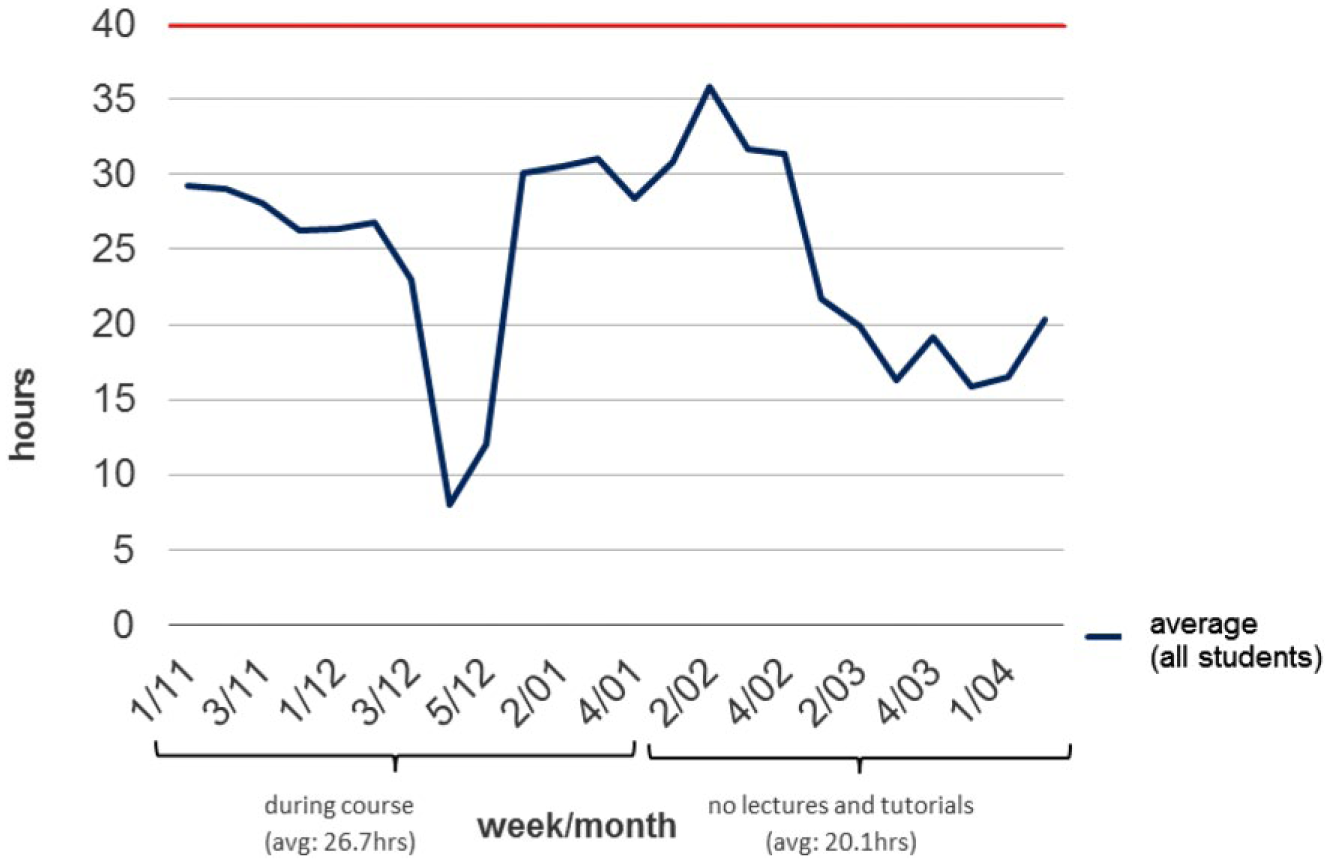
Average weekly workload for students throughout the semester.
If the actual workload was not - against the general assumption - the reason for the students’ strong perception of stress what were the stressors? Asked for the perceived pressures of the programmes, two issues stood out: 3
(1) Twenty-five of the 40 students surveyed saw a big problem in the organization and inner structure of their study programme. They criticized high levels of bureaucracy, inadequate linkages between different university faculties and, hence, programme parts, clashes in their timetables and insufficient communication and information. They also commented on inflexible programme structures, which gave them little choice of courses and content.
(2) Nineteen of the 40 students surveyed felt stressed by the study content; often they could not see the relevance of the course content for their future teaching work. This included all three components of their programme: the subject areas (Fachwissenschaften), the subject-specific pedagogy (Fachdidaktiken) and the general pedagogy and education (Berufswissenschaften). Students also mentioned unsatisfactory methodological approaches used in courses as being a burden, and they did not see the need for the rather strong research orientation found in some of their courses.
It is not surprising that students who were convinced that the masters programme would provide more pedagogical course content were statistically significantly less stressed than those who were not (t-test, p < 0.05).
Taking this into consideration, it seemed worthwhile to ask students what they thought they had learned during the programme. Using an instrument developed in former studies on teacher education (for more details see Kuhlee et al., 2009), students were asked about their perceived learning outcomes from their MEd programme. The instrument differentiates between four dimensions of professional knowledge and competencies: supporting students and teaching methods (KOMP1); self-competence and working skills (KOMP2); subject knowledge and subject-specific pedagogical knowledge (KOMP3); and school management and school development (KOMP4). As Table 1 indicates, students documented only a moderate perceived learning outcome in all four dimensions. The mean values for each dimension are below the theoretical mean. Despite this, formal course requirements were met by the students. They gained on average 32.7 credit points in the semester surveyed; and attained on average good grades at level 2.0 (M = 2.0, SD = 0.34, scale of 1–5).
Perceived learning outcomes.
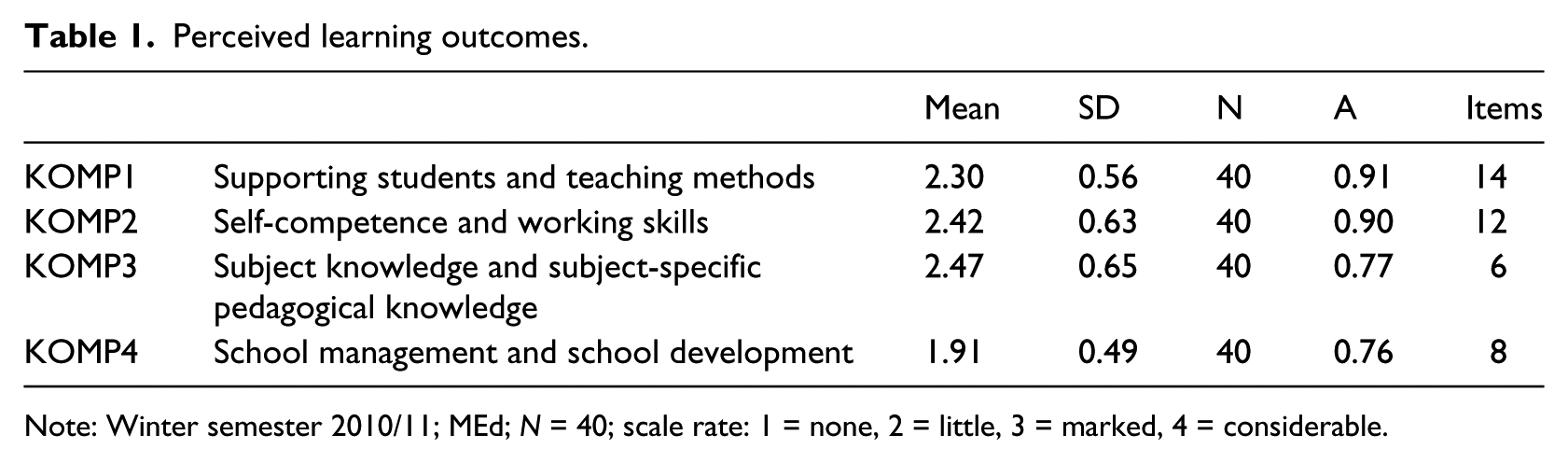
Note: Winter semester 2010/11; MEd; N = 40; scale rate: 1 = none, 2 = little, 3 = marked, 4 = considerable.
Different aspects, such as the attitude towards the course, priorities set by the students or the actual workload, seemed to influence students perceived learning outcomes in these four dimensions. But only those students who critically and regularly verified and questioned the acquired content to gain a better understanding had statistically significant higher learning outcomes in all four dimensions (KOMP1–KOMP4) (LIST scale KRIT: r1 = 0.49, p < 0.01; r2 = 0.35, r3 = 0.35, r4 = 0.33, p < 0.05).
When asked about strategies employed in their learning processes, students indicated that the critical reflection of leaning content and argumentation structures was one rarely used (LIST KRIT). This is reflected in Table 2, which documents the applied learning strategies of students based on the LIST scales by Wild and Schiefele (1994). Furthermore, when asked for suitable strategies for successful study, 25% of the students surveyed argued that one should avoid the critical reflection on study content and requirements.
LIST scales learning strategy (Wild and Schiefele, 1994).
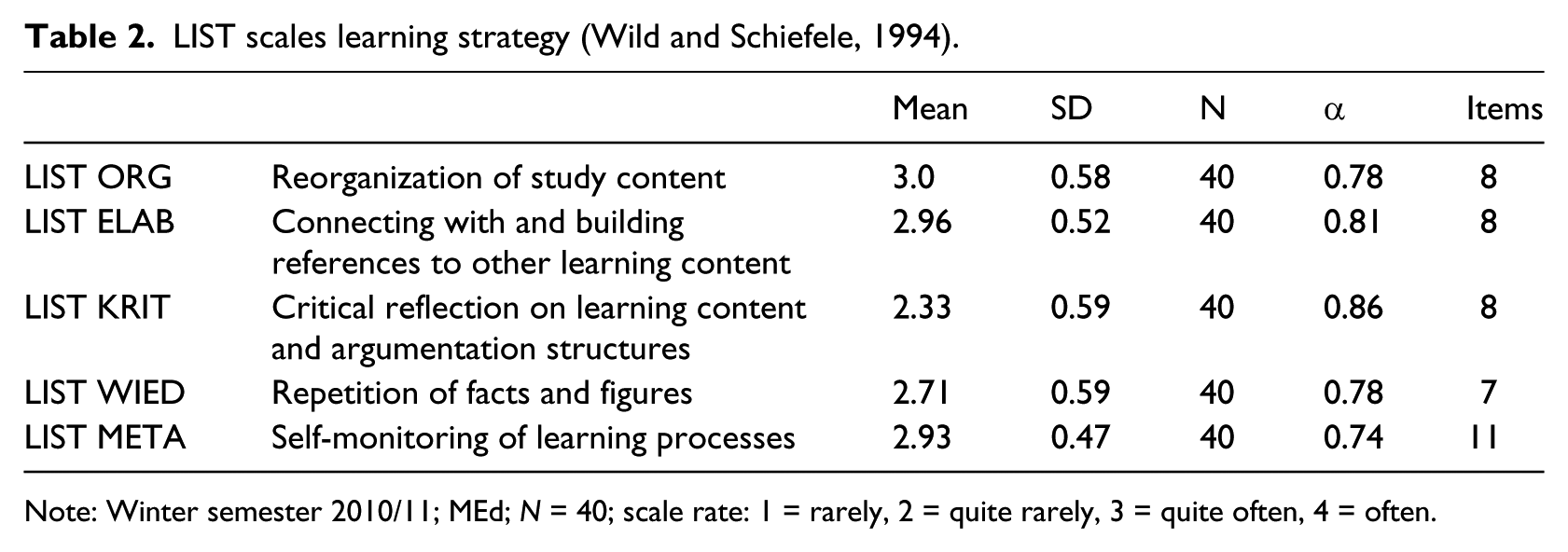
Note: Winter semester 2010/11; MEd; N = 40; scale rate: 1 = rarely, 2 = quite rarely, 3 = quite often, 4 = often.
The findings above indicate that students’ approaches to learning and studying in the re-designed study programmes contrasted their lecturers’ teaching intentions (for more details on these data see e.g. Kuhlee, 2012, 2015). Lecturers aimed to encourage critical reflection in line with current theoretical concepts on the nature of the teaching profession (e.g. Krauss and Bruckmaier, 2014). Students, however, showed a tendency to avoid these. This might be a strategy of adaption since students identified the study content as a stressor due to its perceived insufficient relevance. And, as a result of the more inflexible structures of the re-designed study programmes, students were not able to avoid certain content by choosing alternatives. This is likely to have enhanced their stress perception, so they sidestepped it by increasing the use of surface approaches to learning (see Briggs, 1987; Marton and Saljö 1974). The students’ learning strategies reflected in the data can be seen as an indicator for potential contra-intentional effects of the reform process, with its stronger focus on the implementation of formal structures than on the reflection and analysis of content and curricular design. While traditional, often problematic features of the study organisation such as the insufficient linkages between the different faculties were re-incorporated in the new programmes, little effort was made to integrate reform requirements identified as part of the teaching standards discussion.
Summary and conclusion
During the past 15 years, the Bologna Reform process has developed into a central feature of the German HE sector and promoted transformation in a traditionally reform-resistant sector, where this development was seen as an opportunity to legitimize and enforce reform initiatives at national level. And although the reform process generated intense political debates on (re-nationalised) aims, objectives and general reform features, the development of detailed reform frameworks and their internal design were left to the individual HE institutions. Here, institutional actors, with their understanding, reinterpretation and adaptation of the reform features, became the designers of the re-organised courses and their content and, therefore, shaped the outcome of the reform and its impact. And while case study findings are not generalizable, the studies introduced in this article provide detailed insight into the multifaceted relationships within those processes. They highlight the central role of the different institutional stakeholders in the interpretation and implementation of new structures and content, and their inclination to adapt and redefine them in the light of established practice. Stakeholders seemed to have followed a rather formal reform implementation approach, without detailed revision and adaptation of their established practice - with significant effects on reform outcomes. This approach and the reform reception of the Bologna reform process in Germany not only reflects typical features of educational policy borrowing, but at the same time sheds light on typical mechanisms of governance in the field of education.
And while the Bologna process with its general structural features has significantly changed the higher education landscape in Europe, the example discussed here highlights the need to focus more intensely on meso- and micro-level developments, which may facilitate a deeper understanding of reform processes, their interaction with common educational practice and other contextual developments and their intended and unintended effects. For educational comparatists, these analytical perspectives are essential for a mutual understanding, especially at a time of globalised education developments.
Footnotes
Declaration of Conflicting Interests
The author(s) declared no potential conflicts of interest with respect to the research, authorship, and/or publication of this article.
Funding
The author(s) disclosed receipt of the following financial support for the research, authorship, and/or publication of this article: The underlying data are part of the research project LehrOptim (2009-2012), funded by the Federal Ministry of Education and Research (Bundesministerium für Bildung und Forschung (BMBF)).