




Abstract
Constructive alignment is often promoted as a principle to enhance the quality of learning but the student perspective has often been neglected when exploring its influence on student learning. There is therefore a need to further explore how students’ experiences of the different elements of constructive alignment influence the approach to learning they adopt. Student perceptions and their approaches to learning were analysed. The results show that different elements of constructive alignment had a clear role in guiding student learning. The teaching and assessment related factors appeared to play a crucial role in guiding student learning and studying. Teaching and assessment that required students’ active involvement clearly encouraged students to adopt a deep approach to learning whereas the opposite was true for more traditionally organised courses. The intended learning outcomes did not seem to influence student learning much. The results also imply that the key is to find an optimal level of challenge to support student learning and studying. The study deepens our understanding of the importance and influence of constructively aligned teaching to students’ learning processes.
Constructive alignment as a way to enhance the quality of teaching
There is on-going debate about how to develop university teaching in a way that it would support high quality learning (Larkin and Richardson, 2013). High-quality learning may be defined as cognitive and emotional engagement to create a deep and broad understanding of the topic under study. This requires important cognitive skills, such as critical thinking, problem solving, relating ideas, as well as using evidence to create arguments (Entwistle, 2018; Entwistle and McCune, 2013). Teaching that requires active engagement from students is likely to increase quality learning (Biggs and Tang, 2011). Thus, the principle of constructive alignment has long been promoted as a powerful way to enhance the quality of teaching and learning. The basic premise of constructive alignment is a student-centred approach to teaching in which the emphasis is on what the student does and the ways to improve students’ active engagement and deep approach to learning (e.g. Biggs and Tang, 2011; Prosser and Trigwell, 2014). The principles of constructive alignment emerge from a constructivist approach to teaching and learning which means that the knowledge is created through the activities of the learner (Biggs, 1996). Thus, the ultimate aim of constructive aligned teaching is to design teaching so that it promotes students’ deep approach to learning which is more likely to enhance deep understanding and lead to higher quality learning outcomes (e.g. Entwistle, 2018; Trigwell, 2012; Watters and Watters, 2007).
Constructive alignment is an integrative design for teaching in which the alignment between intended learning outcomes, teaching-learning activities and assessment tasks is emphasised. The central step in designing learning is to define the intended learning outcomes, that is, what the students are supposed to learn and how they will demonstrate that learning has taken place (Biggs and Tang, 2011). Further, the intended learning outcomes should be stated as actions that the students are supposed to bring into play and define what the students should master after the course, for example, ‘identify’, ‘compare’, ‘analyse’. The role of the instructor is to engage the student in relevant activities that support the attainment of the intended learning outcomes (Biggs, 1996). Constructive alignment therefore reflects the more general paradigm shift from teacher-centred teaching to student-centred teaching in which the student is seen as an active constructor of knowledge (Tran et al., 2010). By choosing appropriate assessment methods and tasks and aligning assessment with the intended learning outcomes and the teaching-learning activities, instructors can effectively guide students’ study practices and enhance deep, meaning-oriented learning (Biggs and Tang, 2011; Boud and Falchikov, 2006). To sum up, constructively aligned teaching is essentially a criterion-referenced system where the central elements, that is, intended learning outcomes, teaching-learning activities and assessment, are aligned and there is consistency throughout these elements.
Whilst the importance of constructive alignment is generally recognised, research investigating the effectiveness of the principle is rare and mostly theoretical in nature (Chadwick, 2004). A study comparing the influence of the elements of constructive alignment from the students’ perspective is largely missing. However, many studies have had a focus on separate elements of constructive alignment and their influence on student learning, for example, assessment. Research indicates that students are sensitive about what will be assessed and how, since they want to proceed and succeed in their studies (Struyven et al., 2005). On the other hand, instructors are usually more concerned about the content of the course and teaching methods than about assessment, which is often taken as granted (Boud and Falchikov, 2006). Further, the teaching methods have indeed changed but changes in assessment methods are not common (Boud et al., 2018), and instructors may not emphasise the link between assessment and good teaching (Parpala and Lindblom-Ylänne, 2007).
However, there are a few exceptions in which the influence of constructive alignment on student learning have been investigated. Wang et al. (2013) showed that constructively aligned teaching enhanced the employment of a deep approach to learning despite the initial individual differences. Treleaven and Voola (2008) showed a significant increase in students’ reporting of the development of intended graduate attributes as well as student satisfaction when employing a constructive alignment matrix in which the intended graduate attributes were integrated into intended learning outcomes, teaching-learning activities and assessment (see also Harvey and Kamvounias, 2008; Sumsion and Goodfellow, 2004). These studies largely neglected the student perspective to evaluate the effectiveness of constructive alignment. Larkin and Richardson (2013) tried to address the gaps and included a baseline measure for comparison before and after the initiation of constructive alignment. They used student evaluations and student grades to explore the outcomes of a student perspective and expanded their study over a 4-year academic programme. They found that constructive alignment improved students’ satisfaction as well as grades. These studies support the idea that students are more satisfied and perform better in more constructively aligned courses. In their review, Biggs (2014) listed numerous articles that provide support for the benefits of employing the principles of constructive alignment. However, in most of the studies the focus was more on student satisfaction, grades or engagement instead of the student perspective on the elements of constructive alignment which enhance their deep level learning. As Larkin and Richardson (2013) stated, if one is to evaluate the effectiveness of constructive alignment with the focus on what it is that the students do and need to learn, the research has to include the student perspective.
Students’ approaches to learning
Student learning has been widely explored using the concept of approaches to learning (Entwistle et al., 2006; Marton and Säljö, 1976). These describe the variation in the nature of students’ learning processes and they refer, firstly, to students’ intentions and aims concerning their studying and learning, and secondly, to the learning processes they apply to achieve their aims (e.g. Entwistle et al., 2006; Entwistle and Ramsden, 1983). The deep approach to learning is characterised by an intention to understand information deeply. To achieve this, students adopt a range of learning processes. Typical examples of such processes are relating ideas, using evidence as well as reflective and critical thinking to create one’s own understanding of the contents under study (Entwistle, 2018). Typical of the surface approach to learning is the intention to learn facts to pass a course. Students adopting a surface approach to learning concentrate more on remembering facts than on creating their own understanding (Spada and Moneta, 2012). Furthermore, unreflective studying is typical, meaning that students lack clear study plans, skills to assess their own learning or think critically, and thus, unreflective studying and experience of a fragmented knowledge base especially seem to be at the core of the surface approach (Lindblom et al., 2018).
Students apply different combinations of approaches to learning (Entwistle and Entwistle, 2003; Meyer, 2000). While there is a strong negative correlation between the deep and surface approaches to learning, students are able to use both surface and deep approaches to learning either together or in a stepwise process (Fryer and Vermunt, 2018). This suggests that the pairing of seemingly contradictory approaches is common (see also Marton et al., 2005). Thus, it may be suggested that both the deep and surface approaches to learning could be described rather as intermediate positions on the spectrum measuring student approaches to learning (Kember, 1996) rather than seeing them as dichotomous, exclusive variables (Fryer and Vermunt, 2018).
The deep approach to learning is more likely to enhance deep understanding and lead to learning outcomes that are higher than those from the unreflective approach (see e.g. Trigwell, 2012; Uiboleht et al., 2018). However, findings are contradictory, as several studies did not reveal relationships between the deep approach and academic achievement (Diseth, 2003, 2007a, 2007b; Gijbels et al., 2005; Rytkönen et al., 2012). Being able to use both strategies flexibly might be potentially adaptive in the learning context (Fryer and Vermunt, 2018). Both individual and contextual factors might impede the adoption of the deep approach. Considering the individual factors, some students lack the skills to adopt deep processing strategies or they might lack motivation to go deep into the study content (Postareff et al., 2015). The contextual factors might encourage students to adopt more unreflective approaches instead of the deep approach, if, for example, the learning environment is too challenging (Postareff et al., 2015), or if the students do not receive support from the instructors or from their peers (Parpala et al., 2010), or if the assessment guides students towards memorisation instead of knowledge construction (e.g. Asikainen et al., 2013). On the other hand, assessment can be used as an effective tool to guide students towards adopting the deep approach to learning (e.g. Baeten et al., 2010). More generally, the learning-focused approach to teaching has been shown to enhance the adoption of the deep approach (Trigwell et al., 1999). It is also suggested that some students are more influenced by the teaching-learning environment than others (Parpala et al., 2010; see also Ellis and Bliuc 2017). Some students adopt the deep approach across a range of learning environments (e.g. Wilson and Fowler, 2005), and show a ‘disposition to understand for oneself’ (McCune and Entwistle, 2011). These students are not typically affected by the demands of the teaching-learning environment. On the contrary, students who display more variation in their approaches are more vulnerable to the characteristics of the teaching-learning environment, and are keen to adopt the unreflective approach in a teacher-focused environment (Gijbels et al., 2009; Uiboleht et al., 2018).
By applying the principle of constructive alignment in designing teaching, students may be encouraged to adopt the deep approach to learning (Biggs and Tang, 2011). However, there is little evidence how different elements of the principle actually influence the students’ actions and approaches to learning especially from the students’ point of view. All in all, the studies focusing on the effect of constructive alignment have somewhat neglected the student perspective which is somewhat surprising as the basic idea of the principle is to put the students and students’ actions in the centre of the process. There is a need to understand which elements of constructive alignment (intended learning outcomes, teaching-learning activities and assessment) are especially important in enhancing students’ deep approach to learning. The research described in this article focuses on exploring which elements of constructive alignment are related to the approaches to learning the students adopt, from the student perspective.
Methods
Context and participants
Thirty-seven students at a major research-intensive university in Finland were interviewed: 19 from the Faculty of Biological and Environmental Sciences and 18 from the Faculty of Theology. The students participated voluntarily. The gender distribution was 16 male and 21 female, and ages ranged from 19 to 43, with the median age being 32 years.
The 19 participants from the Biological and Environmental Sciences took a compulsory 5-credit (ECTS; one credit is equivalent to 27 hours of work by the student) bachelor-level Biochemistry course (Course 1) lasting for 7 weeks. In the curriculum, the course is a part of the first-year studies but depending on the major, some students may take it later in their studies. The course included lecturing (24 hours), practical sessions offered by teaching assistants (two hours per week), individual reading and a written examination (assessed on scale 0–5, failed-excellent). The interviews revealed that the lectures were mainly based on the instructors’ presentation of the topics and included occasional short discussions with the students. Around 100 students took the course.
The 18 theology undergraduates took two courses which are targeted for second year students. The students needed to choose one course from a set of courses, of which these two courses were part. Eight took a 5-credit course which lasted for 6 weeks (Course 2). In the curriculum description, the intended learning outcomes were described using the verbs ‘is able to evaluate’, ‘is able to collect and analyse information and present it clearly’, while the teaching methods or assessment were not described. The interviews revealed that the course included elements of flipped learning: the students had preparatory reading assignments and often the lectures began with discussions of the reading materials. The assessment was conducted in the form of a drama examination for which the students prepared a play about a central theme of the course in small groups. Around 25 students took the course.
Ten other theology students took part in another 6-week 5-credit course (Course 3). The learning objectives were described using the verbs ‘is able to interpret, compare and specify’, and ‘is able to select a meaningful research area’ and write a scientific essay based on this. The course consisted of lectures and essay groups with a written examination. The interviews revealed that the course consisted mainly of lecturing, but some discussions with the students also took place. Around 60 students took part in the course.
Materials
The interviews were conducted in Finnish by the last author or by educational sciences doctoral students. The semi-structured interview sought to investigate students’ perceptions of the course they participated in, their descriptions of their own actions in the course, their own learning objectives, and their perceptions of the teaching and how it guided their learning. The students also answered questions about their conceptions of learning. The interviews lasting 35–75 minutes were digitally audio-recorded, and transcribed verbatim. The selected extracts were translated into English.
Analysis
We used qualitative content analysis to analyse the data (e.g. Denzin and Lincoln, 2011). The data observations and prior understanding based on theories were repeatedly assessed in relation to each other by combining data grounded (Harry et al., 2005) and theory guided analysis strategies (Denzin and Lincoln, 2011). All authors participated in coding the data. At the end of each phase of analysis, the entire research group validated the categories that emerged from the content analysis. The validation process involved comparisons of the individual researchers’ categorisations, and in cases of disagreement, the categorisation was discussed until consensus was reached. Hence, every coded segment was agreed upon by the entire group.
Firstly, we coded all text segments in which students referred to their own learning objectives, studying or learning outcomes during the course in a one hermeneutic category called elements of approaches to learning. Then, the materials were coded into two exclusive categories, deep or unreflective, according to student approaches to learning. To recognise the elements of unreflective approach to learning we used the frame and criteria given by Lindblom et al. (2018) according to which the elements pivotal for unreflective approach are: (1) Aim to learn facts to pass the course, (2) Memorisation, (3) Unreflective studying, and (4) Fragmented knowledge. The criteria for the deep approach to learning were created during the first analysis phase. The criteria are based on the theory of approaches to learning, indicating which processes are pivotal in students’ active knowledge construction. Hence, the elements pivotal to the deep approach to learning were set as: (1) Purpose and aim to understand, (2) Construction of knowledge, (3) Reflective studying with enthusiasm, own interest, putting effort and time in studying, and (4) Coherent knowledge. The unreflective and deep approaches to learning were viewed as opposite ends of a continuum.
Secondly, we used the elements of unreflective and deep approaches to learning to recognise each student’s approach to learning. In this person-orientated analysis phase, a third category, mixed approach to learning was created to represent cases in which we recognised a clear inconsistency between the elements according to the criteria of either unreflective or deep approach to learning. Three of the authors read and coded independently 10% of the data, discussed and developed consistency of coding. Thus, each student was identified as belonging to one of these three profiles. During the third phase, we re-read all the material to explore each student’s experiences and descriptions concerning the different elements of alignment, namely, intended learning outcomes, teaching-learning activities, and the assessment.
These initial phases of the analysis provided the material for the subsequent analysis when we explored the links between each student’s approach to learning, the student’s learning activities during the course, the student’s experience of their own learning outcomes, and the elements of alignment. Also, the course descriptions were included into the analysis in this phase. The original data were regularly re-read to help secure reliability.
Results
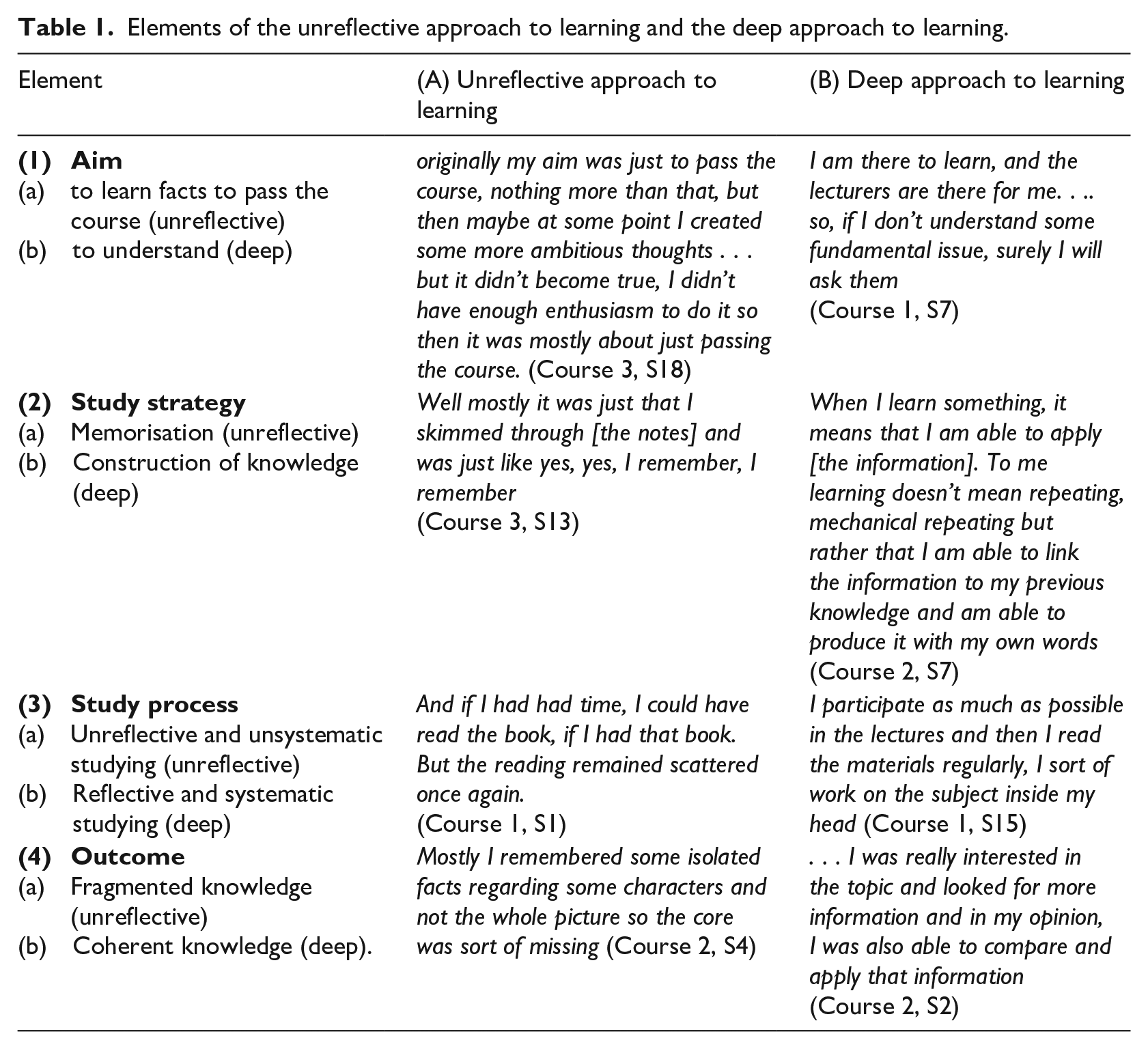
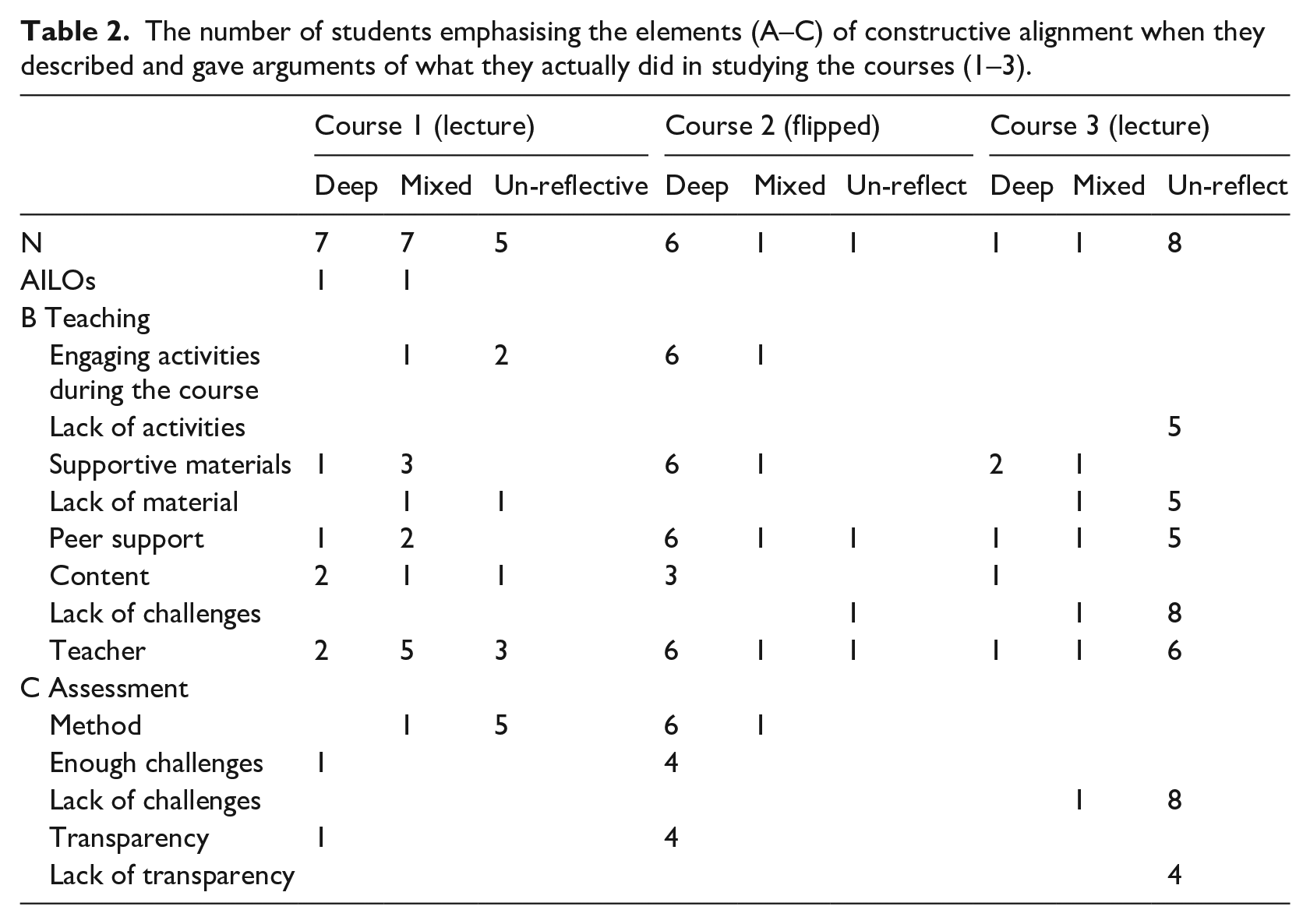
Two distinct approaches to learning were identified (Table 1). In addition, a third approach to learning was identified. The three approaches to learning were evenly distributed in proportion to the number of students (Table 2).
Elements of the unreflective approach to learning and the deep approach to learning.
The number of students emphasising the elements (A–C) of constructive alignment when they described and gave arguments of what they actually did in studying the courses (1–3).
Approaches to learning
Three approaches to learning, namely, unreflective, deep, and mixed, emerged. Table 1 shows the characteristics of the unreflective approach and the deep approach with quotations from the interviews.
The mixed approach to learning included elements from both unreflective and deep approaches that resulted in various combinations. For example, the student’s personal aim to understand indicates a reflective approach, while the way the student describes own study practices indicates an unreflective approach, as the following shows:
I always have the goal that I would at least learn something for myself from the course. . . . I had no specific goals other than to really learn something, kind of deep learning and not superficial so that I won’t forget everything after the exam, it would be wise to do that but no [. . .] but I didn’t so much link the things to the whole. . . I just read the notes and because it was interesting, I sometimes told my friends about them. . . . (Course 3, S17)
Elements of constructive alignment and their relation to approaches to learning
Table 2 shows how the three elements of constructive alignment, namely, (1) intended learning outcomes, (2) the teaching and learning activities, and (3) the assessment (Table 2) are related to the different approaches to learning students adopted. The results emerged from the descriptions of the factors that the students emphasised when they evaluated their own study practices and processes. Hence, numerous factors were identified and their link to the three distinct student profiles based on approaches to learning is reported below.
Intended learning outcomes (A)
The intended learning outcomes had surprisingly little influence on students’ study processes. Only a few of the students we interviewed mentioned these when describing their personal study aims and practices or described their experiences of teaching. One student with a deep approach to learning described how the teaching activities with assignments helped one to become aware of the objectives, and further, to adopt study strategies to reach the objectives. One other student with an unreflective approach to learning wondered why the particular course content needed to be learned, and in that sense, showed interest in intended learning outcomes. Only one student accurately described the orientation to these as influencing own study process, as the following excerpt shows:
I usually go through the goals of the course that are in the curriculum, like what the course is aiming at. . . Then I know what the aim is. . . It does guide the process. Whether you do the exam or write an essay you have to know what the goal is and what the course is aiming at. (Course 2, S7 Deep)
Teaching and learning activities (B)
The teaching-learning activities seemed to have a strong influence on study strategies and processes. Most of the students in course 2, in which the teaching activities required active involvement throughout, adopted the deep approach (Table 2). The course included flipped learning with materials to be read before taking the class, and students described how the teaching supported the learning process:
Personally, this suits me really well and I learn really well with this technique. First I acquainted myself with the subject a little bit and then it was handled together. And also it was handled in a group, so you heard so many different points of view and how different people had interpreted the same text so differently and so you went really deeply into the topic —
(Course 2, 2 Deep)
In contrast, the courses with lectures and final examinations and with no engaging activities had significantly more students adopting the unreflective or mixed approach. Based on the students’ descriptions, some exerted little effort in studying if it was not required of them and if it was possible due to the way the teaching and learning activities were organised. It seems that in the more traditional lecture-based courses (Table 2) many students adopted an unreflective approach because their studying was driven by the activities that were obligatory to pass the course. Thus, they did not study systematically during the course and focused only on obligatory parts of it:
Now in this course it happened so that I didn’t really do any of them [activities) because they were not obligatory. . . . (Course 1, S5 Unrefl.)
Peer support was mentioned by quite a few as enhancing learning. All the students in Course 2 emphasised the importance of peer group discussions as supporting their learning and making the understanding of the contents deeper. These students emphasised that the teaching method gave them the opportunity to learn by sharing and constructing knowledge together:
. . . the course had really good pre-materials in Moodle . . .we could read the texts beforehand and then we discussed them. And the information was gathered together collaboratively, so it was like collaborative work (Course 2, S7 Deep)
Other teaching-related factors such as interesting and meaningful content and good quality teaching materials were valued by many but rarely emphasiszed as having a role in how they studied. In each course, there was a variety of ways to support learning, such as practical sessions, group work, discussions, an excursion outside class, textbooks etc. The students in course 2 especially valued the quality materials that supported their learning, while many in course 3 claimed that the lack of materials was negative.
Some who described an unreflective approach to learning in course 3 mentioned the lack of challenges as a factor influencing their studying (Table 2). More precisely, in their opinion, there were too few challenges that would have inspired them to learn more intensively. Lack of challenges seemed to be related either to the cognitive requirements of the lectures (content), or to the activating tasks during the lectures (e.g. lack of discussions). Some of these students who did not put effort in studying viewed that additional reading may have supported their studying, as shown:
There could have been some additional reading materials anyway, I sometimes felt that there is like not enough substance in the teaching. (Course 3, S11 Unref.)
Concerning the instructor-related factors, many students appreciated the quality of teaching, praised their enthusiasm, awarded their capability to teach by giving examples and being clear and kind. The students with a deep approach to learning in course 2 emphasised the teacher’s academic expertise and enthusiasm in enhancing their learning:
You could tell from the instructor that he was maybe enthusiastic about the teaching that he was not like there because he was forced, so it does have a big influence. (Course 2, S8 Deep)
Assessment related factors (C)
Concerning assessment practices and the link to the approaches to learning, there were several aspects. The students mainly described the specific assessment method implemented, and quite a few talked about if and how they understood the expectations of the assessment. Hence, in these descriptions they clarified how they perceived the transparency of assessment. In each course, assessment was highlighted by a group of students with a certain approach to learning (Table 2). Concerning students with an unreflective approach to learning, the link between the final examination and study practices emerged in lecture course 1. Hence, the following describes a study strategy in which the student puts effort into studying only before the final examination:
Well, when you study that kind of trivia in order to remember it still in the exam, the last few days before the exam are the most important (Course 1, S11 Unref.)
The transparency of assessment, or the lack of it, was pointed out by some. One student adopting the deep approach to learning from course 1 described that if they had known what the final examination would be like, they would have not studied as much. In lecture course 3, the lack of challenges regarding the assessment, and the way the instructor talked about the assessment seemed to have a negative effect on learning as the students put little effort into studying:
They had told us that there is no reason to worry about it that it’s like if you have been in the classes you will pass it for sure. . . So I took it really casually and just read through (the materials). (Course 3, S14 Unref.)
The students adopting a deep approach to learning in the flipped class course emphasised the assessment practices when they evaluated their study processes during the course (Table 2). They seemed to value both the drama examination as a method, being a group presentation, and the transparency of assessment. In that course, the assessment method was mutually agreed upon and the students were able to decide what materials they would examine as a peer group. When preparing themselves for the drama examination, they worked together which according to their reports, resulted in deeper understanding. The assessment criteria were available, so they knew that it was not important to concentrate on small details and facts. Some also pointed out that the assessment was a learning situation:
This was really interesting, especially because of the different kind of exam. That the instructor and the group had the courage to do it differently which I thought was really good and I think it also freed you from the pressure to learn, that now you have to study for the exam, but you were free to learn and the exam was a part of that learning. (Course 2, S1 Deep)
Other factors explaining students’ approaches to learning
Students did not always emphasise factors related to course aims, teaching or assessment when they evaluated their own studying in the courses. That was especially true for students adopting the deep approach to learning in the lecture course 1 with a final examination (Table 2). Students’ own targets and willingness to put effort into studying (Table 1) seemed to be especially valuable if the teaching method itself did not guide learning activities a lot – a traditional lecture course situation. Opposite to the students with an unreflective approach to learning in the same learning environment, the students with a deep approach appeared to be active in learning, such as searching for information and familiarising themselves with learning materials in accordance with their own targets. They also seemed to value the opportunity to take part in discussions or ask questions if they found any of the content difficult to understand. Some valued the flexibility in studying and instead of participating in classes, they read a textbook. In general, those with a deep approach seemed to regulate their learning in a particular course by taking into account their own aims in learning and the available materials:
I did just that, I went to the lectures, I participated in practical sessions, I did the exercises beforehand and then I corrected them if there was something, so you learned a lot and then I read throughout the course and then even for the exam. (Course 1, S16 Deep)
In many cases, also the students with a mixed approach to learning emphasised their own targets to learn and understand the content. Unlike those with a deep approach, these students were not satisfied with their learning outcomes because in practice they did not study as effectively as they had planned:
Maybe I didn’t reach my aim to understand everything, which I really wanted initially, because I just didn’t have enough time (Course 1 St13 ).
Discussion
The aim was to explore how different elements of constructive alignment influence the approach to learning the students adopt. Differences in students’ approaches to learning as well as factors that contributed to the adoption of different approaches to learning were identified. It was evident that different elements of constructive alignment had a clear role in guiding student learning and studying. The teaching and assessment related factors appeared to play a big role. In the course that applied active teaching and learning activities, almost all the students described adopting a deep approach. It appears that teaching that provides enough challenges for students, requires active involvement from the students throughout the course, provides chances for peer support and uses high quality teaching materials supports students to adopt a deep approach. On the other hand, traditionally organised courses with lectures and final examinations, and with no engaging activities had significantly more students adopting the unreflective or mixed approach. Thus it appears that teaching that does not require active involvement on the part of the students also provides more options for students not to engage. Hence, the way the teaching is organised seems to play a crucial role in guiding what the students actually do. As suggested by Prosser and Trigwell (2014) and Uiboleht et al. (2018), a student-centred approach to teaching appears to support students’ learning towards the adoption of a deep approach.
Similarly, assessment that required active involvement on the part of the students and applied transparent assessment criteria clearly motivated student learning towards the deep approach. Assessment has a strong influence on students’ studying and can either encourage or discourage the adoption of the deep approach (e.g. Asikainen et al., 2013). Interestingly, the results show that the deep approach can also be adopted in a learning environment that does not push students towards active participation. In these cases, studying was influenced by factors apart from the elements of constructive alignment. Students’ own aims, interests and motivation played a crucial role. Some students put a lot of their own effort into studying, although the instructor did not especially require active involvement. These are most likely to be students who tend to adopt the deep approach to learning in any context, and thus are not affected much by the teaching-learning environment (e.g. McCune and Entwistle, 2011; Postareff et al., 2015; Wilson and Fowler, 2005). These students are not typically affected by the demands of the teaching-learning environment.
The intended learning outcomes did not seem to influence student learning much. It might be that these were not clearly visible to the students, and thus they ignored them in the interviews. The objectives evidently play a significant role in designing the teaching-learning process. However, according to the results, they might not have a visible and significant role from the students’ perspective if the teaching and assessment practices clearly manifest what the important competencies to learn are. Learning objectives serve as the starting point for instructors to consider students’ learning. Thus, objectives can drive their learning if objectives are manifested in well-designed teaching and learning activities and assessment methods. However, students should be aware of the objectives, because knowing what the instructor expects of them and being aware of their learning priorities can make their learning more efficient and reduce their anxiety (Blumberg, 2009).
The results were interesting in that they showed that the experience of a lack of challenges was clearly related with the adoption of the unreflective approach. In constructively aligned teaching, the idea is that teaching should encourage not only the adoption of the deep approach but also to reach higher levels of understanding. It seems, that one course failed in challenging students to reach higher levels of understanding, which resulted in adoption of the unreflective approach by many. This supports findings suggesting the negative influence of lack of challenges on students’ studying (Coertjens et al., 2016). The combining of the descriptions of the elements of constructive alignment that students provided with their approaches to learning revealed how elements of constructive alignment relate to their learning processes. Evidence of the impact of constructive alignment on students’ learning has been scarce, and therefore, this study deepens our understanding of the importance of constructively aligned teaching.
However, there are limitations in the study and it should be noted that the students were not asked to describe their perceptions regarding the alignment of the courses but more generally their experiences of them. Furthermore, there was an absence of a measure of learning outcomes regarding the influence of the experienced alignment. Future research should include this in order to investigate the influence of alignment on the outcomes of learning, for example, course grades. The results were based solely on students’ experiences of the alignment. The study lacked the instructors’ evaluations of the alignment and in future research it would be important to add the instructor perspective. The study also has limited generalizability, namely, the participants of the study were undergraduate students from three courses within two disciplines within one university in Finland. Furthermore, the sample size was rather small and the pedagogy used in the course was limited to lectures, small group discussions and two different assessment methods. The research also relied solely on self-report data which provides limited accounts of the phenomenon. The findings may be relevant across disciplines, but this research should be replicated in other contexts. Future work is needed with students at different levels of study, in courses of different types and with different assessments, and within different contexts both in terms of the type of university and also in terms of different cultural contexts.
The results of this study imply that constructively aligned teaching, including activating teaching and assessment methods, can especially support students who would adopt an unreflective approach to learning if they are not actively supported and encouraged to take an active role. In other words, students who tend to adopt the unreflective approach to learning can be supported in transforming their learning into deeper and reflective processing through constructively aligned teaching. The demands of the learning environment, including teaching-learning activities, can guide students’ learning in the desired direction. Instructors should always pay attention to how to actively engage the students and shift the focus to what the student does and should do in order to learn. Active engagement is the key to student success and thus it is important to pay attention to how to engage students (Bolden et al., 2019). Our results highlight that this is especially important for those who would otherwise adopt unreflective approach (see also Vercellotti, 2018). Assessment is a powerful way to guide student learning and so we should continue to focus our attention on designing this in order to best support student learning.
Footnotes
Declaration of conflicting interests
The author(s) declared no potential conflicts of interest with respect to the research, authorship, and/or publication of this article.
Funding
The author(s) received no financial support for the research, authorship, and/or publication of this article.
