



Abstract
As in many other social sciences, in international and comparative education there is an epistemological schism between two main approaches, one of which is traditional whose methodology and methods are historical-hermeneutical, while the other is empirical and oriented towards the natural sciences. In international and comparative education, these two orientations are represented by one scientific community which is devoted to historical approaches – the idiographic orientation, and another community which represents the nomothetic orientation. The epistemological differences between both run too deep to be overcome by normative appeals for mutual understanding and for using all methods available and not only those which are prefered by the respective scientific community. A further problem is that studies on methodology and methods usually look for differences. Instead of causing new dichotomies by looking at differences, in this paper possible common characteristics between both positions will be sought. This will be reached by using a tertium comparationis. It is based on the ‘systematicity’ of the leading epistemological positions. Systematicity is a philosophical concept developed by Paul Hoyningen-Huene which describes ‘what makes scientific knowledge special’. It will be demonstrated that the main epistemological positions are all systematic. On this basis, a new approach for a joint systematicity is developed, grounded in the generalizability of the research question. This approach may help both of the scientific communities and their respective research to contribute collectively to social problems with their findings, without giving up their specific epistemology.
Keywords
Introduction: The schism between comparativists’ styles of thinking
There are two basic positions of comparing, the idiographic and the nomothetic. These two approaches characterize two different communities in comparative work: the traditional, idiographic position of international and comparative education (ICE) and the more recent, nomothetic position of empirical educational (social) sciences. The idiographic position is rooted in historical sciences. It is interested in the uniqueness of a phenomenon, which is observed within its special social, political and cultural context. The nomothetic position is that of the social sciences, which are interested in finding rules or regularities; causal presuppositions and hypotheses are verified or falsified mainly with quantitative methodology (Parreira do Amaral, 2015: 109–111). From the epistemological point of view the idiographic approach is characterized by relativism for contextuality, and the nomothetic for positivsm. Qualitative methods are mainly applied in idiographical comparisons. Quantitative methods, which are more generalizable (Allemann-Ghionda, 2004: 152-158) are used in nomothetic comparisons. Both approaches represent separate lines of discourse, with different journals, conferences and ‘styles of thinking’ (Fleck 1980). This created the existence of two scientific communities, more or less separated by a gap of communication and mutual understanding.
A further position, historical functionalism, is seen by some authors as the third main approach to ICE (Amos, 2015: 63–64), which strives to overwhelm the aforementioned schism. It is not yet clear whether this third position, founded on the idiographic tradition, will have such integrative power. At any rate, the talk of only two main positions of ICE in lots of papers on methodology and methods does not take into account this third position, whereas one of its famous representatives, Jürgen Schriewer (2000: 4), identifies three disciplinary and methodical phases of ICE (Table 1): Despite of this integrative intention the functionalist approach is more linked in the research discourse of idiographic than nomothetic tradition. This is why the talk of only two main approaches is proceded here.
Shortened version from table 4, Schriewer 2000: 4.
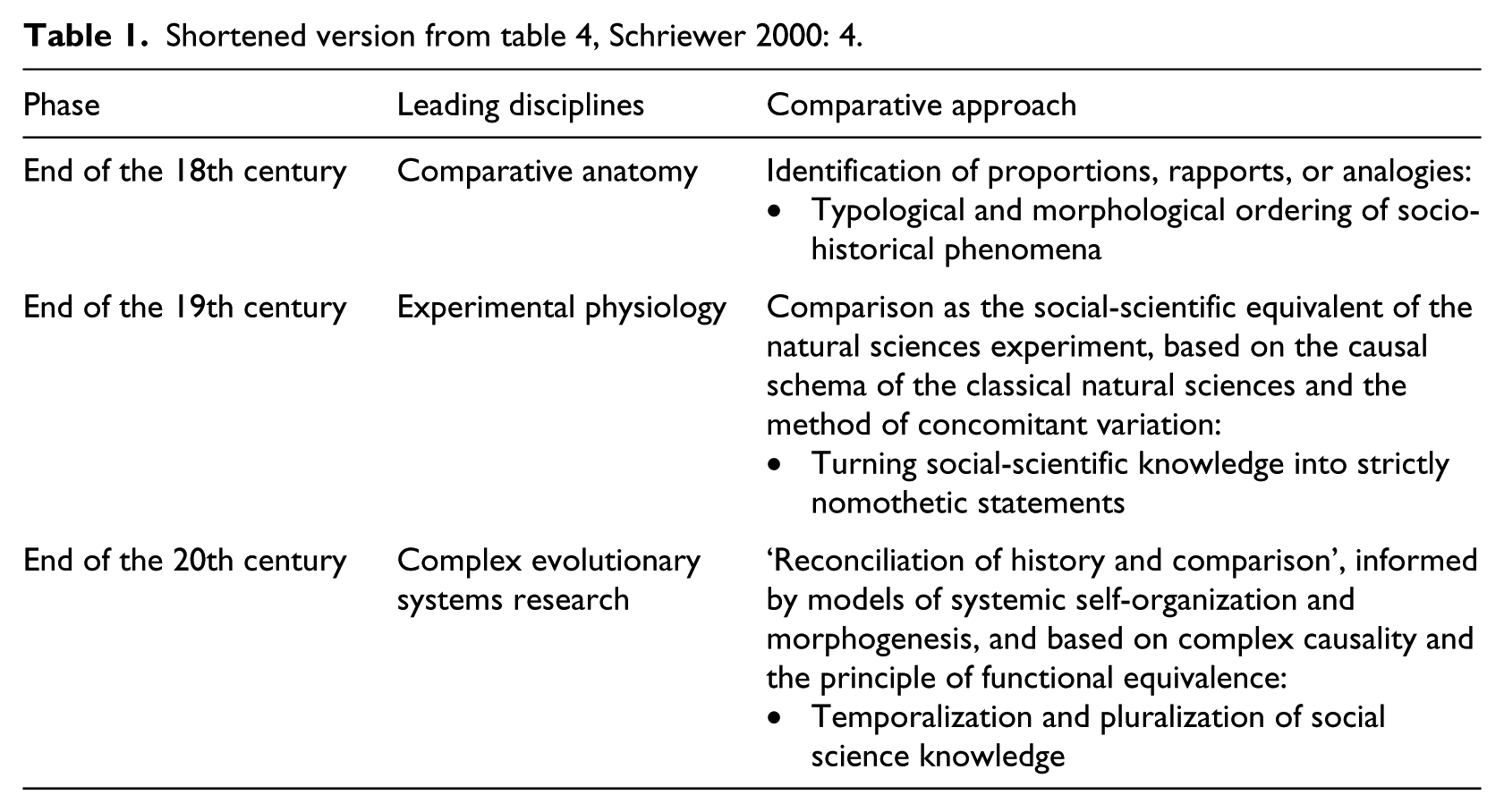
While during the first phase, when comparative education emerged, the historical comparative approach dominated, ruled by the search for ‘typological patterns and morphological features’ (Schriewer, 2000: 11), in the second phase the nomothetical comparison evolved. Influenced by Emile Durkheim, the idea of cause and sociological proof took the lead: In the tradition of Durkheim’s ‘relational thinking’, it ‘is necessary to distinguish, then, between operations that set the objects of comparison as such in relationship to one another (with regard merely to their actual aspects), and those operations which are concerned with relationships between varying object areas or system levels and with setting these in relation to one another’. This way of ‘establishing relations between relations’ instead of ‘establishing relations between observable “facts”’ promoted comparing as a social scientific method (Schriewer, 2000: 9). The third position is seen as an alternative to nomothetic explanations. It is founded on functionalism, a metatheory standing in the tradition of Emile Durkheim, with Talcott Parsons as its most important representative, followed by Luhmann with his functional-differentiating perspective. The structural-functionalist theory is one of the dominant and influencing metatheories in ICE (Amos, 2015: 67). Since its methodology is rooted in the discourse of the idiographic tradition, it is very often not seen as a position in its own right.
The modes of comparing represent different ‘styles of thinking’ [Denkstile] (Fleck, 1980). In his famous study on how a scientific fact emerges, Ludwig Fleck shows that scientific facticity is related to the development of a certain style of thinking. Research requires to adopt such a special style of thinking, because only within this style scientific facts become visible. This is due to the dominant methodology and methods within a research community. At the same time, the style of thinking opens the possibility of errors, since it forces to limit one’s own thinking (Fleck, 1980: 111). The leading patterns of understanding and of proceding within the styles of thinking, can be attributed to certain phases of a scientific discipline, since they change over time. The problem is that styles of thinking of other research groups are hard to understand. Their characteristics touch the epistemological self-evidence of researchers deeply, since these characteristics often seem to be unscientific from another style of thinking. These different characteristics in thinking hinder researchers to cooperate. A gap, which could not be closed as yet by appealing to their good will (Clifton and Serlin, 2011: 142): it might be imagined that qualitative and quantitative methods have been promoted to educational researchers in the spirit of ‘Use the methodology or methodologies that (are) most helpful for your purposes’, but that is not quite the case. Rather, educational research in the last two decades has been home to considerable conflict fueled by advocates of each methodology who have emphasized weaknesses of the other in terms of epistemology, importance for the field, permissible inferences (Harwell, 2011: 150–151).
This situation is bad for research and for society too, since it constrains the development of broad knowledge about a subject matter, which should be based on the whole state of research for handling the complex demands of future problems ICE is confronted with. Their challenges create a twofold task:
Search for the pedagogical projection of society’s development to metacivilization.
Keeping national cultures as distinctive heritage (Oksana Chigisheva, 2015: 135).
To handle these challenges decision makers, operating on the micro- and macrolevel of social institutions, need research findings ranging from subjective perspectives to objective relations (Ercikan and Roth, 2006: 23). This demands from ICE to provide them with all knowledge available, either belonging to the idiographic or the nomothetic position. Out of this reason it is important to find out what both research communities have in common, instead of looking at the differences, to be able to create a mutual acceptance for their epistemological differences. Such an acceptance may be gained by looking at the various types of research from a perspective, which makes visible the commonalities between both. Such a mutual understanding of epistemological differences might be gained by looking at the various types of research from a metaperspective.
Usually methodologies and methods, associated with the idiographic or the nomothetic position, are compared with respect to their similarities and differences. This resembles spontaneous everyday comparisons [spontane Alltagsvergleiche] (Waterkamp, 2006: 196), when one object is made to be the criterion of another. Such comparisons may even deepen the gap, like a ‘quantitative–qualitative dichotomy’ (106), a term that illustrates how significant the differences are. A way out of this dilemma is to build categories of another quality than the compared elements share by installing a tertium comparationis. In regard to epistemology, systematicity (Hoyningen-Huene, 2013) can be installed as a tertium comparationis. The metaperspective of systemacity allows to see what all approaches – the idiographic, the historical functionalist and the nomothetic – have in common in regard to their epistemological state, which is characterized by being systematic.
Systematicity in international and comparative education
With his concept of systematicity, the German philosopher Paul Hoyningen-Huene shows that science is a special kind of knowledge. He wants to give an answer to the old question ‘What is science?’ It could neither be answered by the certainty of scientific knowledge nor by its methodology, nor by the distinction between science and pseudo-science or metaphysics (2017: 29). Because of this, Hoyningen-Huene follows a new path: He shows that scientific knowledge is more systematic than other forms of knowledge, particularly everyday knowledge (2013: 15). The umbrella concept of systematicity contains nine dimensions: descriptions, explanations, predictions, the defense of knowledge claims, critical discourse, epistemic connectedness, the ideal of completeness, the generation of new knowledge and the representation of knowledge. The abstract principle of systematicity becomes concrete on these dimensions by examples of the single dimensions derived from the whole landscape of sciences. A process like systematizing is to be understood within the context in which it takes place (2013: 27), because only within this context does the abstract principle unfold. The various sciences provide the context of systematicity, for example, the historical sciences finding regularities for a type of event. The strands of systematicity are not shared by all sciences. This is due to the fact that, concomitantly with methodological changes, systematicity changes too. If science develops new modes of abstraction that lead to more systematicity or eliminate those modes that are not usable anymore, scientific knowledge extends its nature of being more systematic than other types of knowledge. However, this process should not be equated with scientific progress, a question which is not yet answered (Hoyningen-Huene, 2017).
The abstract principle of systematicity can be explained on another abstract principle, Albert Einstein’s ‘refinement’. It describes a process which is always based on the same dynamic, but refinement in various things does not necessarily lead to the same ‘set of refined things’, e.g. a refined sauce and a high-resolution spectrograph are quite different: On a more concrete level, the notions of refinement operative in the two cases appear to have nothing to do with each other. It remains true, however, that all more concrete notions of refinement are connected by family resemblance, generating a tenuous sort of unity.’ (Hoyningen-Huene, 2013: 30).
Of the nine dimensions of systematicity listed by Hoyningen-Huene, only two will be looked at more closely here. This is due to the space available and to the problem in question. The different styles of thinking are related to the methods used. Those dimensions which relate mostly to methods are ‘descriptions’ and ‘explanations’. This is because comparisons require to describe the compared units and they seek for explanations why and how national specificities lead to better or worse educational effects.
Following Hoyningen-Huene, descriptions can be historical or generalizing. Historical descriptions demonstrate the uniqueness of a unique phenomenon. In generalized descriptions, the systematic abstraction ‘intentionally destroys all to a uniquely identifiable event or phenomenon, generalizing the description and making it applicable to a whole class of events or phenomena’ (Hoyningen-Huene, 2013: 40). Descriptions answer ‘what’ questions, while explanations seek to answer ‘why?’ questions (Hoyningen-Huene, 2013: 53).
Systematicity of idiographic comparisons
It is not that there is a real border between science and non-science, and if there is, it is an ‘ill-defined, porous one’ (Phillips, Denis C., 2011: 18). This statement can be grounded on systematicity. The border lies between more or less systematicity of everyday and scientific knowledge. Comparativists are aware of that. Even if they do not use the term ‘systematicity’, they talk of a difference between ‘thinking’ and comparing as scientific method or of ‘simple’ and ‘complex’ comparisons (Parreira do Amaral, 2015: 107). Jürgen Schriewer calls comparing a systematic means of knowledge production (1983, 631ff., quoted from Parreira do Amaral, 2015).
Since comparative education is closely related to studies of history (Phillips, D., 2011: 185), it is the historical comparison which is the main approach of achieving systematicity. Its first methodical step is to describe the compared units. Such historical descriptions of individual processes and events ‘take on the form of narratives in which a particular sequence of events or processes is told’ (Hoyningen-Huene, 2013: 49) in a methodical way. In David Phillips’ six step model the systematicity of idiographic methodology and method becomes visible.
The historical grounding of this procedure lies in ‘contextualization’: The ‘description of issues against local background’ is the first step toward understanding uniqueness by abstracting certain features in Country 1 that can be found in or at least are comparable with those of Country 2. Otherwise the abstraction of issues with the aim of comparing them would not work. The more abstract the compared units are described, the better the single issues of the compared units become visible. Further, idiographic comparisons search for ‘explanation, causality and prediction’ (Phillips, D., 2011: 185), which, following Hoyningen-Huene, are modes of systematicity:
1. Causality may be found by using historical data with the literature of historiography as one of the most important sources. Historical causality leads to another mode of systematicity, ‘periodization’ (Hoyningen-Huene, 2013: 43). As ‘the temporal counterpart to classification’, it structures ‘the historical development of the subject matter by different “phases”, or “periods”, or “epochs”’ (44). A well known, systematic example for periodization by David Phillips shows the stages of policy borrowing (Phillips and Schweisfurth, 2006: 97).
2. Explanation is sought for from the point of view of an outsider – a first step in abstracting from everyday narratives (Hoyningen-Huene, 2011: 53). Hoyningen-Huene sees historical systematicity as linear and causal, with arguments caused by facts and evidences. In accordance to that, causality is drawn from the historical example ‘by drawing on equivalent experience in other situations’ (Phillips D., 2011: 185). This experience from the past is used as a predictor for similar situations in the future. However, these predictions are more of the hypothesis ‘that certain types of outcome will in most cases be observed if certain types of conditions are in place’ (186). Explanations sought for from the idiographic position use hermeneutics as an abstractional mode. This is due to the role written documents play in historical descriptions. In hermeneutics comparing and contextualizing is an important starting point for developing new insights. While in natural or social sciences, where the term ‘new’ means data ‘that are absolutely new because they were, for instance, produced by newly designed instruments’ (Hoyningen-Huene, 2013: 74), in humanities it is reflection that produces
new insights or, at least, new possibilities of interpretation. Indeed, reflecting on known data may trigger new questions that, in turn, may call for a reevaluation of the importance of those data and the inclusion of data as yet not considered. This may then lead to a new interpretation of the issue at interest, or even generate new issues.(Hoyningen-Huene, 2013: 74)
3. Predictions, in the notion of David Phillips, are hypotheses: ‘It seems therefore acceptable to assume that certain types of outcome will in most cases be observed if certain types of conditions are in place.’ (2011: 186) Correct premises, deep understanding of the past and of cultural diversity as tools of historical research help to teach what history shows. Here predictions are generalizations from unique events.
Idiographic comparisons share a number of trends for more systematicity, which are typical for historical sciences. Descriptions become systematic by the historical narrative, using historical causality and periodization. Explanations are sought on the grounds of hermeneutical text studies and predictions as generalizations from unique cases are made. This kind of prediction can meet the standards of systematicity Hoyningen-Huene demands, a point I will refer to below.
Systematicity of nomothetic comparisons
In the early stages of ICE, the main interest was how other countries organize their education with the aim of learning from them. In the 1970s interest in teaching and learning processes in schools and into school systems grew, due to a need for knowledge about the relationship between society and learning. The relationship between national educational administration and the performance levels of pupils requires comparison of data from more than one country to be verifiable.
Since then, Eckstein and Noah (1974) observe a trend towards quantitative studies. This type of research roots in a tradition, emerging in the end of the nineteenth and the beginning of the twentieth century, when an epistemological change happened towards generalizable statements. The nomothetic methodology grew with the development of social sciences and their orientation to natural sciences. In social sciences this development is rooted in the approach of the great sociologist Emile Durkheim and his notion of sociology. His idea of carrying out a social experiment was borrowed from natural sciences. With the method of developing a hypothesis, collecting and analyzing data and drawing a conclusion on the truthfulness of the hypothesis, educational researchers imitate social sciences and ‘pretend a level of control so as to carry out an experiment’ (Bean, 2011: 170). Since an experiment in society cannot be artificially constructed, the hypotheses are proved on real, historical situations to see in their example, in how far events and processes under certain historical conditions are to be expected or not (cf. Waterkamp, 2006: 197). Empirical explanations are used on the basis of international large-scale studies. If some nations like Finland are more successful than others explanations are sought for, for example that there are smaller classes or more constructivist didactics. Empirical generalizations are sought for especially in the context of globalization.
Quantitative studies are more general than qualitative ones. The design of the latter is less abstract, using a more personal ‘narrative’ (Bean) which is addressed to an audience, stressing the significance of the study and the reader’s interest and giving recommendations to others. Quantitative studies, on the other hand, stress conceptual arguments and the methods used, the way data are gathered, measured and analyzed, as well as the appropriateness of the method. The findings are discussed with regard to their generalizability: the sample in regard to data and missing cases, bias, the assumptions in relation to the chosen statistics, how far the hypotheses can be supported, the discussion of the findings and a conclusion. The summary asks for practical implications of the study and further research (Bean, 2011: 171). Thus, the narrative of quantitative research is embedded in an impersonal research context reflecting scientific knowledge. Tests are administered across various classrooms and schools. Here, variations are ‘almost guaranteed’. The test has to treat such variations ‘as random’ (Ercikan and Wolff, 2011: 240).
Thus, the nomothetic position exemplifies different modes of systematicity than the idiographic. Looking again at the dimension ‘descriptions’, the nomothetic position uses the abstracting modes of ‘quantification’ and ‘empirical generalizations’:
1. Quantification means ‘the transition from the qualitative understanding and use of a concept to its quantitative understanding and use’ (Hoyningen-Huene, 2013: 45). When knowledge, opinions, feelings are measured, they are not directly observable constructs. The responses of the participants ‘do not have any meaning in relation to the construct’ (Ercikan and Roth, 2006: 17). Instead, scoring rules are used to ensure the relation between the measurement and the artefact, for example problem solving as part of mathematical competence. The responses are highly standardized, they are not individual, but typified by pre-given possibilities of behaviour. The relation between the response and the artefact can be expressed by quantitative data, since it is not the quality of the response which is measured, but the occurrence of a standardized response. However, it is not, as Hoyningen-Huene points out, that quantities are measured, it is qualities (2013: 45), though not described by a quality, but by a quantity.
Quantification is another form of abstraction that leads to systematicity, since quantitative descriptions are precise in a specific way: quantitative data have epistemic advantages, like reproduction of data, or intersubjective tests; quantitative data ‘are by themselves uniquely ordered’ (46).
2. Empirical generalizations: Quantitative data allow empirical generalizations, like they are sought for in social sciences: they enable to compare on a level, on which singularity, uniqueness and historical contextualization are replaced by generality, universality and abstract contexts like ‘nation’ or ‘school system’. From such empirical descriptions empirical explanations may be derived. They consist ‘of the value(s) of the changed variable from the empirical generalization together with some information about the concrete situation, demonstrating that the change is due to the regularity holding for the respective system’ (56). Empirical generalizations are generalized descriptions, ‘that reach beyond singular cases’ (47). They do not express something observable, but a ‘connection between events that holds (presumably) with necessity in contrast to mere “regularities” that may be accidental in character’ (47). To make such generalizations it is necessary that:
• an appropriate classification of the phenomena is constructed;
• ‘a set of appropriate state variables must be identified’;
• and the latter must be in quantitative form (49).
Nomothetic methodology is characterized by trends for more systematicity, which are typical for general descriptions and general explanations. They are based on quantification, even if qualitative differences are described. In contrast to idiographic comparisons, the data have to be decontextualized to be generalizable, the explanations reach beyond single cases. These abstractional modes distinguish general descriptions and explanations, which are far removed from everyday knowledge, by using statistics as a method for describing samples and deriving causal relations.
Systematicity of historic-funtional comparisons
The third position, historical functionalism, emerges at the end of the twentieth century. The historic-functional methodology is seen either as a synthesis of the idiographic and nomothetic methodologies (Amos, 2015: 63–64) or as possibility ‘to in method relativize the contrasts between historical and social scientific – or between idiographic and nomothetic types-of comparative analysis’ (Schriewer, 2000: 32). It strives to explain matters of growing complexity due to globalization and pushs ICE to become more systematic by searching for new types of systematicity for new problems.
Since the millennium, people find themselves confronted with changes in their work and their private lives. International mobility is expected, and migration demands sharing of resources with others; education and learning are now seen as economic investments, rather than as biographical merits. These trends are attributed to globalization, even if most people are unable to explain what this ‘unobservable entity’ (Hoyningen-Huene, 2013: 61) is. Everyday theories emerge to pseudo-religious beliefs, while social science explains systematically how globalization demands from people standardization ‘to achieve diversity, to increase specialization and the promotion of dedicated research centers, to enhance global employability’ (Jackson, 2016: 12.).
In politics, these changes are mastered with the scientific tool of educational monitoring, like operated by OECD with the PISA studies. It resulted in education’s arrival at the level of a world system, as a functionally differentiated system besides others, like the global economic system (Lenhart, 2007: 811). Concomitantly, in ICE the question arose about which theories might best explain the phenomenon of globalization (Scheunpflug, 2003: 168). In functional theory, Luhmann’s theory of social systems provides an approach which is able to describe ‘globalization with its opposed and contradictory tendencies’ (162).
It is based on the approach of ‘functional equivalence’. The function provides a point of reference, whereas ‘equivalence’ maintains that ‘input and output performances, strategies or problem solutions’ are varied in the sense of ‘establishing relation between relationships’. The latter is not to be confused with causal relationship, as a range, which is unfolded by the respective functional system: Thus, comparative analysis is ‘transformed from a quasi-experimental procedure of testing hypothetical statements assuming, in universalist terms, some definite consequences following from particular effects into the empirical uncovering of a range, structured with reference to a functional vantage point, of alternative possibilities of producing particular effects’ (Schriewer, 2000: 45)
This pattern allows for a kind of explanation Schriewer calls ‘functional-cum-configurational’. To operate in this way a theoretical framework is needed that makes it possible to understand problems as interwoven in interrelated sets of systems. Such functional social theories, like Luhmann’s systems theory, enable comparative analyses as ‘a combination of opposite intellectual operations, of generalization and re-specification’ (Schriewer, 2000: 45). Thus, comparative analysis operates ‘between theoretically expanding and historically limiting the range of that which is possible’ (45). The empirical structure of the historic situation does not permit to randomize functional variations unlimitedly. Here, the morphogenetic of the historical phenomenon is combined with a new type of explanation, which contains within its relational thinking causal explanations, as one alternative of possible relations. Schriewer explains how the macro-level has to be related to the analyzed phenomenon, how causal relations become one type of relation among others. Such methodical procedures can be related to epistemology, like Luhmann’s systems theory. Comparative analysis using Schriewer’s approach is transformed into ‘the empirical uncovering of a range, structured with reference to a functional vantage point, of alternative possibilities of producing particular effects’ (Schriewer, 2000: 41).
From the perspective of systematicity this approach is a further mode of abstracting. Schriewer sees the advantages of his suggestion in its potential to meet the challenges implied by a world system, in combining historical and generalizing descriptions, and in striving for more systematicity. It turns comparative analysis into an explanation. This is managed ‘by way of conceptually informed re-constructions, historically realized problem solutions as particular realizations of what is structurally possible in differing socio-cultural settings or configurations’ (2000: 48).
Explanations by theory, such as structural-functionalist theory in sociology, bear a hypothecating character, since theories of the empirical sciences are not ‘the last word on the matter’ (Schriewer, 2000: 59). Their explanations are more systematic than those based on empirical generalizations, since the theory is able to unify corresponding phenomena under one theoretical roof. By using functional social theory Schriewer achieves a systematicity of explanations which is related to a special paradigm of thinking, rooted in cybernetics and systems theory. Though at the beginning of his paper Schriewer states that he would neither want to argue ‘from the point of view of epistemological criticism nor of methodological prescription’, his approach of a ‘theoretical-cum-methodological’ model implies exactly this as in order to be able to use his method, one has to apply functional social theory. Because of this, the historical-functional approach can be seen as a new methodology.
Following Hoyningen-Huene (2013), another mode of systematicity is given here, explanations using theories (59–61). Among theories typically applied for theoretical explanations is functional theory. To understand this kind of systematicity it is important to note that theories generally are hypothetical (Hoyningen-Huene, 2013: 59), because they are general – there might be other theories, and they refer to ‘so-called theoretical entities’. They differ from empirical explanations, ‘the recourse to unobservable entities’ (Hoyningen-Huene, 2013: 60). Theoretical explanations that contain laws reach a larger explanatory range than those based on quantitative data, since ‘they bring order to a wide range of phenomena that may appear to be totally unrelated’ (Hoyningen-Huene, 2013: 61). In exactly that sense functional theory strives to explain how social systems work and how they are interwoven. Explanations that are ‘based on theories are more systematic than corresponding explanations based on empirical generalizations’ (Hoyningen-Huene, 2013: 61) and lead ICE to a new level of systematicity.
Integrating the findings of ICE by systematizing the research questions
All three positions achieve systematicity. In spite of the epistemological differences between the idiographic and the historical approach, their systematicity is something they have in common. However, to be able to understand each other better, only a joint systematicity could function as a bridge over the epistemological gap. To identify such a bridge is the intention of Ercikan and Roth (2006, 2011). They seek a means of mutual understanding by decoupling the research questions from methods. With this separation they want to change the notion that research that applies quantitative methodology is more generalizable than qualitative research. Their dictum is that: (a) all phenomena are quantitative and qualitative at the same time; and (b) data construction processes follow similar interpretation processes for all education research; and (c) for most constructs that education researchers are interested in, these data construction processes are based on subjective, defensible judgments [sic]. (Ercikan and Roth 2006: 18)
Since it is not possible to go deeper into the argumentation, here, only their main points will be referred to. Ercikan und Roth state that:
Quantitative research can be singular and contextualized.
Qualitative research may find general rules.
Regarding 1) The generalizability of findings based on the typical experimental design is critically discussed in psychology. The question is ‘whether generalizability actually is attained in most quantitative psychological research based on interindividual variation’ (Ercikan and Roth, 2006: 15)
Regarding 2) Even if research is more generalizing, this does not mean that it has to use quantitative data like numbers and counts: ‘some high-inference research, such as phenomenological studies that target understanding the structure of experience, might not use numbers at all; however, they might use terms that distinguish degrees of something’ (Ercikan and Roth, 2011: 221).
Instead of looking at the type of methods, the authors distinguish between the type of research questions and separate questions from the methods applied. They distinguish between ‘high- and low-inference research’, which is measured by the degree of generalizability in respect of the questions and not the methods. Thus, low generalizability in ‘low-inference research’ is possible with quantitative and qualitative data and ‘high-inference research’ with quantitative data as well as qualitative data. High-inference research begins with research questions, which lead to identify data sources and to construct data, whereas low-inference research adapts a question to the field-experience and the understanding of the interview partners (Ercikan and Roth, 2011: 239). High-inference research is interested in identifying patterns that are valid across an investigated population, low-inference research is interested in variations, deviations, deep and dense insight into the participants and events within a certain context. Both research types might use quantitative or qualitative data, depending on the research question. Thus, it is not the type of data, but the way in which they are constructed and interpreted that differentiates high- and low-inference research (Ercikan and Roth, 2006: 241–242). While in low-inference research details are important because they ‘may contribute to or interact with the research process’, this is not the case in high-inference research: ‘In high inference research, on the other hand, the study is expected to be conducted in a predetermined uniformed manner that guarantees the comparability of results across situations or, in other words, guarantees the generalizability of results’ (240). A similar suggestion is made by Sten Ludvigsen (2016). He talks about different ‘forms of evidence’ given by asking ‘what’ and ‘why’ questions. ‘What’ questions are asked in survey studies, while ‘why’ questions are typical for more ‘detailed observations’ (Ludvigsen 2016: 23–24). Ludvigsen pleads for the need for both types. This difference corresponds to the difference between descriptions (‘what?’) and explanations (‘why?’) (Hoyningen-Huene 2013: 53). It contradicts the usually stated dichotomy between ‘causal explanations’ (‘why’) in social sciences and ‘understanding’ (‘what’) in historical sciences. The latter also ask ‘why’ questions, and the former also describe. Here, it can be seen that looking at the research questions actually helps to overcome prejudices about different styles of thinking.
Following Ercikan and Roth, it is possible to distinguish four research fields, between the two dimensions quantitative–qualitative methods and high- and low-inference research. Figure 1 demonstrates how this decoupling leads to various systematic types of research field and their respective findings, while by coupling methods and research questions, there are only two fields, with the problem that they are seen as being opposed to each other.
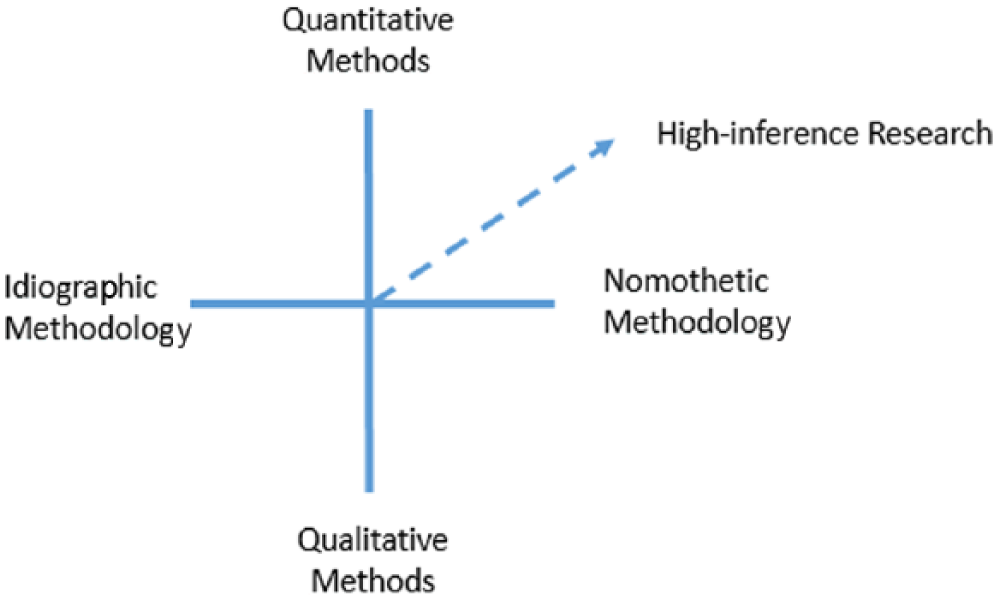
Relations of research question and method in low and high inference research in ICE.
The approach of Ercikan and Roth is very promising in regard to finding a type of systematicity, which can be shared by the idiographic and the nomothetic orientation. However, their approach only works if methodology and method are mixed together. This is often done, because of the ‘styles of thinking’ discussed in the introduction to this article. Correspondingly, the choice of method is very often seen as an epistemological choice too. But the choice of method is less an epistemological decision than the choice of methodology that reflects epistemological preconditions, the theory and questioning as well as how questioning is relevant for society. Methodology reflects the choice of methods, whereas a research method describes a controlled procedure, which is documented, justified and made intersubjectively transparent (Adick, 2014: 27). In spite of these differences, methods are very often confused with methodology. This confusion hinders understanding of generalizability – the distinction between high- and low-inference research – as a way out of epistemological dichotomy through joint systematicity. For Ercikan and Roth’s approach to be successful, it is not only necessary to decouple methods and question, it is also necessary to decouple methods from methodology.
By separating methods from methodology, methods and methodology may be understood as crossover dimensions of systematicity and not as a one-dimensional frontier line. Thus, the idiographic and nomothetic positions and quantitative and qualitative methodologies describe four fields, corresponding to Figure 1, and not only two fields on a bidirectional dimension like the opposites of idiographic and nomothetic. Then, high- and low-inference research can be introduced as a third dimension characterizing all four research fields. Thus, generalizability, which is the systematic trait of research questions, becomes visible as a new systematic trait of the research findings of all four methodical-methodological fields. Generalizability allows for understanding high- and low-inference research as a trend for enhancing systematicity of all findings of ICE in all four fields of possible research questions and their respective methodology and chosen methods (see Figure 1). The historical functionalism can be positioned in these four fields, too. Historical functionalism combines with idiographic and/or nomothetic epistemology and seeks for theoretical explanations (high-inference research) of single cases or of quantitative data.
This systematic opens the possibility for more integration in regard to mutual interest in findings, since it makes it possible to order research findings in terms of their generalizability, structured by method and methodology. In this way, new relations between research findings respectively data become visible, beyond the dichotomous schism between the idiographic and the nomothetic approaches. If researchers of both parties are able and willing to connect their respective findings to the nomenclature of low- and high-inference research within the four fields of methodology and method, this can help uncover a new systematicity. It helps to ‘complete’ the knowledge of ICE, following the scientific ‘ideal of completeness’ (Hoyningen-Huene, 2013: 124), since a lack of knowledge becomes better visible by systematizing all findings available on a problem beyond different methodologies and methods.
Conclusion
By unfolding the systematicity of the idiographic, the nomothetic and the historical-functional positions, it was possible to make visible the fact that all three of them share a joint characteristic: all positions systematize their descriptions and explanations. However, although they are all systematic, their ‘systematicity’ differs. In a further step, a joint systematicity was sought. This was demonstrated by separating methods from methodology and including the research questions as a measurement of generalizability. By systematizing the research field in regard to the generalizability of its findings, a dense description of a problem and of possible explanations can be made in relation to the knowledge available about a problem. This may be a step toward systematizing the findings of ICE research ‘completely and thoroughly’ (Hoyningen-Huene, 2013: 132) – and integrating them – beyond the epistemological schism between styles of thinking.
Footnotes
Acknowledgements
I thank Prof. Dr. Frank Fischer, University of Munich, Germany, for his hint.
Declaration of Conflicting Interests
The author(s) declared no potential conflicts of interest with respect to the research, authorship, and/or publication of this article.
Funding
The author(s) received no financial support for the research, authorship, and/or publication of this article.
Author biography
 ). Special areas of research: Media education.